
1
Foundations of streaming SQL
or: stream & table theory
Anton Kedin
Apache Beam Contributor
Software Engineer at Google
Original Presentation by Tyler Akidau, @takidau
Covering ideas from across the Apache Beam, Apache Calcite, Apache Kafka, and Apache Flink communities, with
thoughts and contributions from Tyler Akidau, Julian Hyde, Fabian Hueske, Shaoxuan Wang, Kenn Knowles, Ben
Chambers, Reuven Lax, Mingmin Xu, James Xu, Martin Kleppmann, Jay Kreps and many more, not to mention that whole
database community thing...
Dataworks San Jose 2018
2
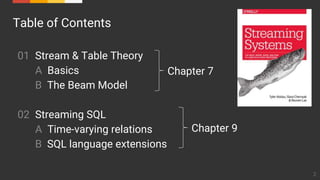
Table of Contents
01
02
Stream & Table Theory
A Basics
B The Beam Model
Streaming SQL
A Time-varying relations
B SQL language extensions
Chapter 7
Chapter 9
3
01 Stream & Table Theory
TFW you realize everything you do was invented by the database community decades ago...
A Basics
B The Beam Model
4
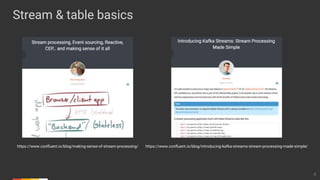
Stream & table basics
https://www.confluent.io/blog/making-sense-of-stream-processing/ https://www.confluent.io/blog/introducing-kafka-streams-stream-processing-made-simple/
5
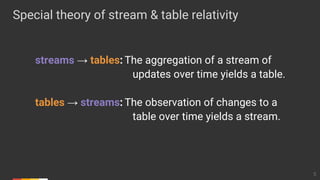
Special theory of stream & table relativity
streams → tables:
tables → streams:
The aggregation of a stream of
updates over time yields a table.
The observation of changes to a
table over time yields a stream.
6
Non-relativistic stream & table definitions
Tables are data at rest.
Streams are data in motion.
7
01 Stream & Table Theory
TFW you realize everything you do was invented by the database community decades ago...
A Basics
B The Beam Model
8
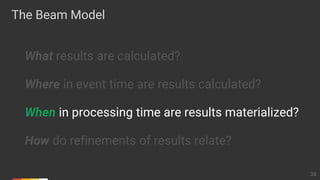
The Beam Model
What results are calculated?
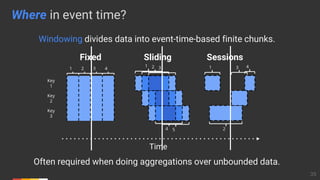
Where in event time are results calculated?
When in processing time are results materialized?
How do refinements of results relate?
9
Reconciling streams & tables w/ the Beam Model
● How does batch processing fit into all of this?
● What is the relationship of streams to bounded and
unbounded datasets?
● How do the four what, where, when, how questions map
onto a streams/tables world?
10
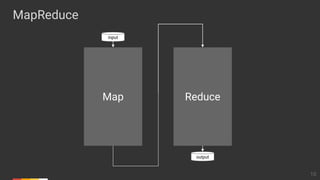
ReduceMap
MapReduce
input
output
11
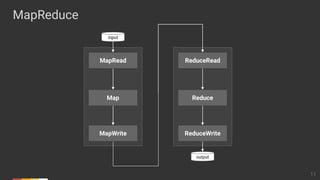
MapReduce
input
output
MapRead
Map
MapWrite
ReduceRead
Reduce
ReduceWrite
12
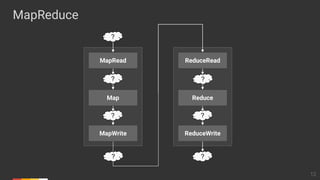
MapReduce
MapRead
Map
MapWrite
ReduceRead
Reduce
ReduceWrite
?
?
?
?
?
??
13
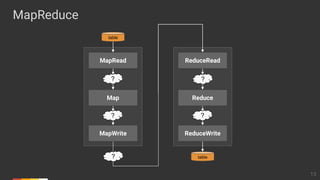
MapReduce
MapRead
Map
MapWrite
ReduceRead
Reduce
ReduceWrite
?
?
?
?
?
table
table
14
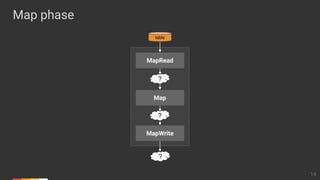
Map phase
MapRead
Map
MapWrite
table
?
?
?
15
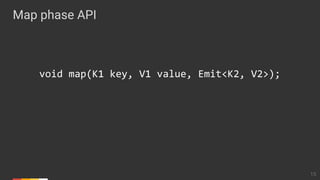
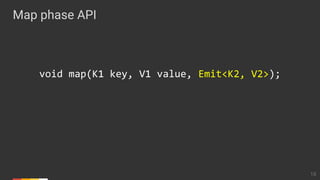
Map phase API
void map(K1 key, V1 value, Emit<K2, V2>);
16
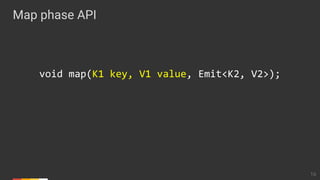
Map phase API
void map(K1 key, V1 value, Emit<K2, V2>);
17
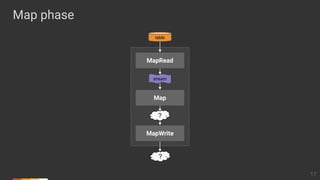
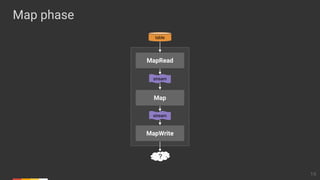
Map phase
MapRead
Map
MapWrite
table
stream
?
?
18
Map phase API
void map(K1 key, V1 value, Emit<K2, V2>);
19
Map phase
MapRead
Map
MapWrite
table
stream
stream
?
20
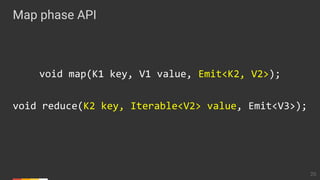
Map phase API
void map(K1 key, V1 value, Emit<K2, V2>);
void reduce(K2 key, Iterable<V2> value, Emit<V3>);
21
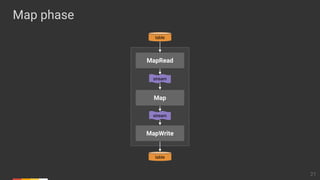
Map phase
MapRead
Map
MapWrite
table
stream
stream
table
22
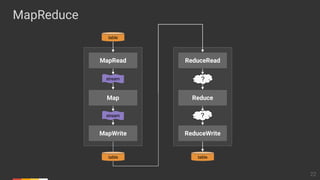
MapReduce
MapRead
Map
MapWrite
ReduceRead
Reduce
ReduceWrite
table
stream
stream
table
?
?
table
23
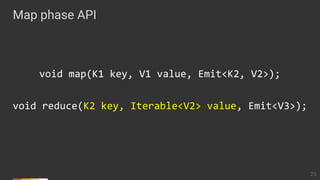
Map phase API
void map(K1 key, V1 value, Emit<K2, V2>);
void reduce(K2 key, Iterable<V2> value, Emit<V3>);
24
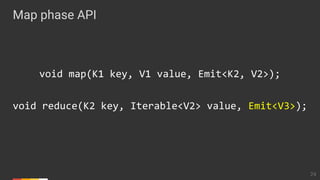
Map phase API
void map(K1 key, V1 value, Emit<K2, V2>);
void reduce(K2 key, Iterable<V2> value, Emit<V3>);
25
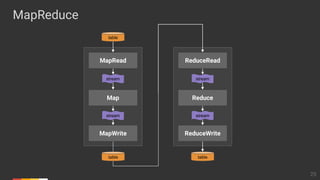
table
MapReduce
MapRead
Map
MapWrite
ReduceRead
Reduce
ReduceWrite
table
stream
stream
table
stream
stream
26
Reconciling streams & tables w/ the Beam Model
● How does batch processing fit into all of this?
● What is the relationship of streams to bounded and
unbounded datasets?
● How do the four what, where, when, how questions map
onto a streams/tables world?
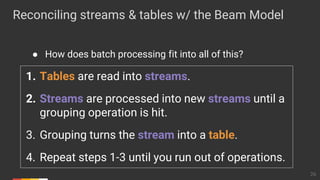
1. Tables are read into streams.
2. Streams are processed into new streams until a
grouping operation is hit.
3. Grouping turns the stream into a table.
4. Repeat steps 1-3 until you run out of operations.
27
Reconciling streams & tables w/ the Beam Model
● How does batch processing fit into all of this?
● What is the relationship of streams to bounded and
unbounded datasets?
● How do the four what, where, when, how questions map
onto a streams/tables world?
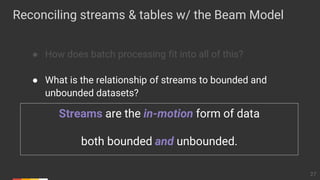
Streams are the in-motion form of data
both bounded and unbounded.
28
Reconciling streams & tables w/ the Beam Model
● How does batch processing fit into all of this?
● What is the relationship of streams to bounded and
unbounded datasets?
● How do the four what, where, when, how questions map
onto a streams/tables world?
29
The Beam Model
What results are calculated?
Where in event time are results calculated?
When in processing time are results materialized?
How do refinements of results relate?
30
The Beam Model
What results are calculated?
Where in event time are results calculated?
When in processing time are results materialized?
How do refinements of results relate?
31
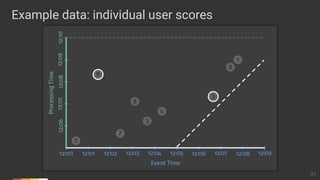
Example data: individual user scores
32
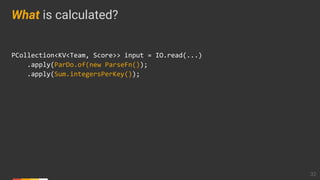
What is calculated?
PCollection<KV<Team, Score>> input = IO.read(...)
.apply(ParDo.of(new ParseFn());
.apply(Sum.integersPerKey());
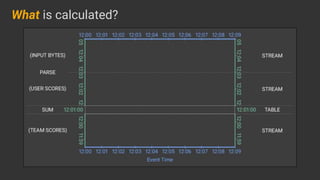
What is calculated?
34
The Beam Model
What results are calculated?
Where in event time are results calculated?
When in processing time are results materialized?
How do refinements of results relate?
35
Windowing divides data into event-time-based finite chunks.
Often required when doing aggregations over unbounded data.
Fixed Sliding
1 2 3
54
Sessions
2
431
Key
2
Key
1
Key
3
Time
2 3 4
Where in event time?
36
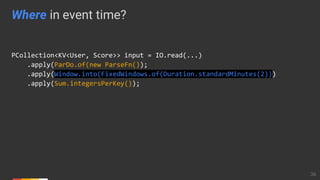
Where in event time?
PCollection<KV<User, Score>> input = IO.read(...)
.apply(ParDo.of(new ParseFn());
.apply(Window.into(FixedWindows.of(Duration.standardMinutes(2)))
.apply(Sum.integersPerKey());
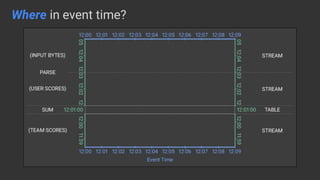
Where in event time?
38
The Beam Model
What results are calculated?
Where in event time are results calculated?
When in processing time are results materialized?
How do refinements of results relate?
39
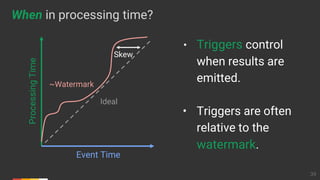
• Triggers control
when results are
emitted.
• Triggers are often
relative to the
watermark.
ProcessingTime
Event Time
~Watermark
Ideal
Skew
When in processing time?
40
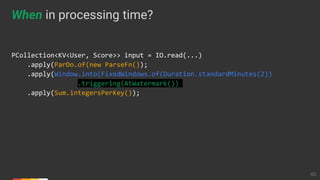
When in processing time?
PCollection<KV<User, Score>> input = IO.read(...)
.apply(ParDo.of(new ParseFn());
.apply(Window.into(FixedWindows.of(Duration.standardMinutes(2))
.triggering(AtWatermark())
.apply(Sum.integersPerKey());
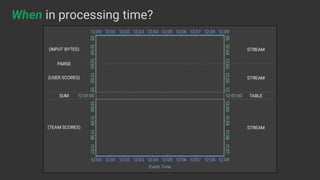
When in processing time?
42
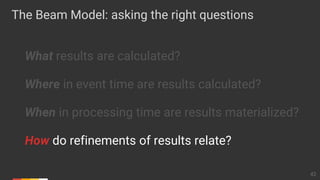
The Beam Model: asking the right questions
What results are calculated?
Where in event time are results calculated?
When in processing time are results materialized?
How do refinements of results relate?
43
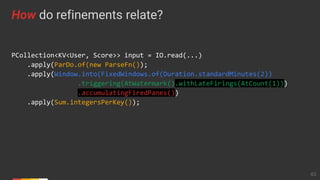
How do refinements relate?
PCollection<KV<User, Score>> input = IO.read(...)
.apply(ParDo.of(new ParseFn());
.apply(Window.into(FixedWindows.of(Duration.standardMinutes(2))
.triggering(AtWatermark().withLateFirings(AtCount(1)))
.accumulatingFiredPanes())
.apply(Sum.integersPerKey());
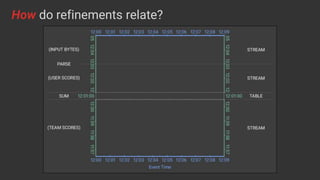
How do refinements relate?
45
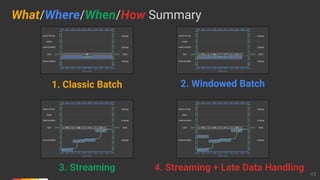
What/Where/When/How Summary
3. Streaming 4. Streaming + Late Data Handling
1. Classic Batch 2. Windowed Batch
46
Reconciling streams & tables w/ the Beam Model
● How does batch processing fit into all of this?
● What is the relationship of streams to bounded and
unbounded datasets?
● How do the four what, where, when, how questions map
onto a streams/tables world?
47
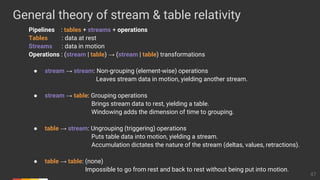
General theory of stream & table relativity
Pipelines : tables + streams + operations
Tables : data at rest
Streams : data in motion
Operations : (stream | table) → (stream | table) transformations
● stream → stream: Non-grouping (element-wise) operations
Leaves stream data in motion, yielding another stream.
● stream → table: Grouping operations
Brings stream data to rest, yielding a table.
Windowing adds the dimension of time to grouping.
● table → stream: Ungrouping (triggering) operations
Puts table data into motion, yielding a stream.
Accumulation dictates the nature of the stream (deltas, values, retractions).
● table → table: (none)
Impossible to go from rest and back to rest without being put into motion.
48
02 Streaming SQL
Contorting relational algebra for fun and profit
A Time-varying relations
B SQL language extensions
49
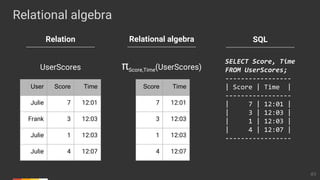
Relational algebra
User Score Time
Julie 7 12:01
Frank 3 12:03
Julie 1 12:03
Julie 4 12:07
Score Time
7 12:01
3 12:03
1 12:03
4 12:07
πScore,Time(UserScores)πUserScoresπ
SELECT Score, Time
FROM UserScores;
-----------------
| Score | Time |
-----------------
| 7 | 12:01 |
| 3 | 12:03 |
| 1 | 12:03 |
| 4 | 12:07 |
-----------------
Relational algebra SQLRelation
50
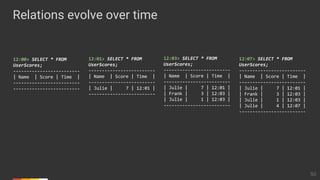
Relations evolve over time
12:07> SELECT * FROM
UserScores;
-------------------------
| Name | Score | Time |
-------------------------
| Julie | 7 | 12:01 |
| Frank | 3 | 12:03 |
| Julie | 1 | 12:03 |
| Julie | 4 | 12:07 |
-------------------------
12:03> SELECT * FROM
UserScores;
-------------------------
| Name | Score | Time |
-------------------------
| Julie | 7 | 12:01 |
| Frank | 3 | 12:03 |
| Julie | 1 | 12:03 |
-------------------------
12:00> SELECT * FROM
UserScores;
-------------------------
| Name | Score | Time |
-------------------------
-------------------------
12:01> SELECT * FROM
UserScores;
-------------------------
| Name | Score | Time |
-------------------------
| Julie | 7 | 12:01 |
-------------------------
51
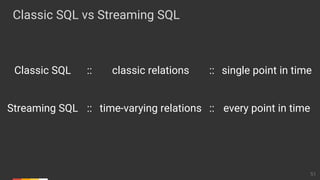
Classic SQL vs Streaming SQL
Classic SQL classic relations single point in time:: ::
Streaming SQL time-varying relations every point in time:: ::
52
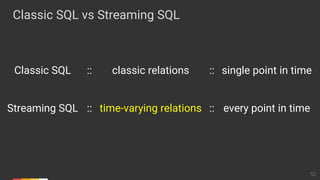
Classic SQL vs Streaming SQL
Classic SQL classic relations single point in time:: ::
Streaming SQL time-varying relations every point in time:: ::
53
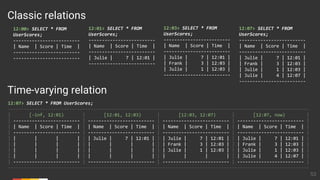
Classic relations
12:07> SELECT * FROM UserScores;
-----------------------------------------------------------------------------------------------------------------
| [-inf, 12:01) | [12:01, 12:03) | [12:03, 12:07) | [12:07, now) |
| ------------------------- | ------------------------- | ------------------------- | ------------------------- |
| | Name | Score | Time | | | Name | Score | Time | | | Name | Score | Time | | | Name | Score | Time | |
| ------------------------- | ------------------------- | ------------------------- | ------------------------- |
| | | | | | | Julie | 7 | 12:01 | | | Julie | 7 | 12:01 | | | Julie | 7 | 12:01 | |
| | | | | | | | | | | | Frank | 3 | 12:03 | | | Frank | 3 | 12:03 | |
| | | | | | | | | | | | Julie | 1 | 12:03 | | | Julie | 1 | 12:03 | |
| | | | | | | | | | | | | | | | | Julie | 4 | 12:07 | |
| ------------------------- | ------------------------- | ------------------------- | ------------------------- |
-----------------------------------------------------------------------------------------------------------------
12:07> SELECT * FROM
UserScores;
-------------------------
| Name | Score | Time |
-------------------------
| Julie | 7 | 12:01 |
| Frank | 3 | 12:03 |
| Julie | 1 | 12:03 |
| Julie | 4 | 12:07 |
-------------------------
12:03> SELECT * FROM
UserScores;
-------------------------
| Name | Score | Time |
-------------------------
| Julie | 7 | 12:01 |
| Frank | 3 | 12:03 |
| Julie | 1 | 12:03 |
-------------------------
12:00> SELECT * FROM
UserScores;
-------------------------
| Name | Score | Time |
-------------------------
-------------------------
12:01> SELECT * FROM
UserScores;
-------------------------
| Name | Score | Time |
-------------------------
| Julie | 7 | 12:01 |
-------------------------
Time-varying relation
54
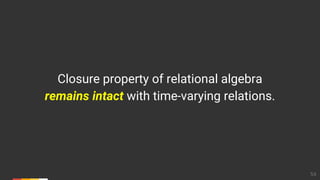
Closure property of relational algebra
remains intact with time-varying relations.
55
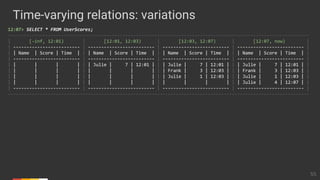
Time-varying relations: variations
12:07> SELECT * FROM UserScores;
-----------------------------------------------------------------------------------------------------------------
| [-inf, 12:01) | [12:01, 12:03) | [12:03, 12:07) | [12:07, now) |
| ------------------------- | ------------------------- | ------------------------- | ------------------------- |
| | Name | Score | Time | | | Name | Score | Time | | | Name | Score | Time | | | Name | Score | Time | |
| ------------------------- | ------------------------- | ------------------------- | ------------------------- |
| | | | | | | Julie | 7 | 12:01 | | | Julie | 7 | 12:01 | | | Julie | 7 | 12:01 | |
| | | | | | | | | | | | Frank | 3 | 12:03 | | | Frank | 3 | 12:03 | |
| | | | | | | | | | | | Julie | 1 | 12:03 | | | Julie | 1 | 12:03 | |
| | | | | | | | | | | | | | | | | Julie | 4 | 12:07 | |
| ------------------------- | ------------------------- | ------------------------- | ------------------------- |
-----------------------------------------------------------------------------------------------------------------
56
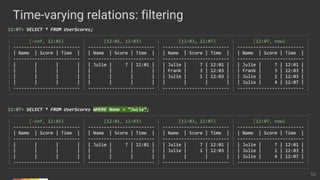
Time-varying relations: filtering
12:07> SELECT * FROM UserScores;
-----------------------------------------------------------------------------------------------------------------
| [-inf, 12:01) | [12:01, 12:03) | [12:03, 12:07) | [12:07, now) |
| ------------------------- | ------------------------- | ------------------------- | ------------------------- |
| | Name | Score | Time | | | Name | Score | Time | | | Name | Score | Time | | | Name | Score | Time | |
| ------------------------- | ------------------------- | ------------------------- | ------------------------- |
| | | | | | | Julie | 7 | 12:01 | | | Julie | 7 | 12:01 | | | Julie | 7 | 12:01 | |
| | | | | | | | | | | | Frank | 3 | 12:03 | | | Frank | 3 | 12:03 | |
| | | | | | | | | | | | Julie | 1 | 12:03 | | | Julie | 1 | 12:03 | |
| | | | | | | | | | | | | | | | | Julie | 4 | 12:07 | |
| ------------------------- | ------------------------- | ------------------------- | ------------------------- |
-----------------------------------------------------------------------------------------------------------------
12:07> SELECT * FROM UserScores WHERE Name = “Julie”;
-----------------------------------------------------------------------------------------------------------------
| [-inf, 12:01) | [12:01, 12:03) | [12:03, 12:07) | [12:07, now) |
| ------------------------- | ------------------------- | ------------------------- | ------------------------- |
| | Name | Score | Time | | | Name | Score | Time | | | Name | Score | Time | | | Name | Score | Time | |
| ------------------------- | ------------------------- | ------------------------- | ------------------------- |
| | | | | | | Julie | 7 | 12:01 | | | Julie | 7 | 12:01 | | | Julie | 7 | 12:01 | |
| | | | | | | | | | | | Julie | 1 | 12:03 | | | Julie | 1 | 12:03 | |
| | | | | | | | | | | | | | | | | Julie | 4 | 12:07 | |
| ------------------------- | ------------------------- | ------------------------- | ------------------------- |
-----------------------------------------------------------------------------------------------------------------
57
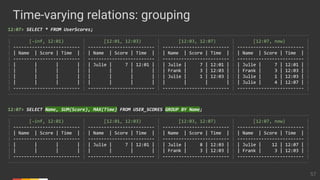
Time-varying relations: grouping
12:07> SELECT * FROM UserScores;
-----------------------------------------------------------------------------------------------------------------
| [-inf, 12:01) | [12:01, 12:03) | [12:03, 12:07) | [12:07, now) |
| ------------------------- | ------------------------- | ------------------------- | ------------------------- |
| | Name | Score | Time | | | Name | Score | Time | | | Name | Score | Time | | | Name | Score | Time | |
| ------------------------- | ------------------------- | ------------------------- | ------------------------- |
| | | | | | | Julie | 7 | 12:01 | | | Julie | 7 | 12:01 | | | Julie | 7 | 12:01 | |
| | | | | | | | | | | | Frank | 3 | 12:03 | | | Frank | 3 | 12:03 | |
| | | | | | | | | | | | Julie | 1 | 12:03 | | | Julie | 1 | 12:03 | |
| | | | | | | | | | | | | | | | | Julie | 4 | 12:07 | |
| ------------------------- | ------------------------- | ------------------------- | ------------------------- |
-----------------------------------------------------------------------------------------------------------------
12:07> SELECT Name, SUM(Score), MAX(Time) FROM USER_SCORES GROUP BY Name;
-----------------------------------------------------------------------------------------------------------------
| [-inf, 12:01) | [12:01, 12:03) | [12:03, 12:07) | [12:07, now) |
| ------------------------- | ------------------------- | ------------------------- | ------------------------- |
| | Name | Score | Time | | | Name | Score | Time | | | Name | Score | Time | | | Name | Score | Time | |
| ------------------------- | ------------------------- | ------------------------- | ------------------------- |
| | | | | | | Julie | 7 | 12:01 | | | Julie | 8 | 12:03 | | | Julie | 12 | 12:07 | |
| | | | | | | | | | | | Frank | 3 | 12:03 | | | Frank | 3 | 12:03 | |
| ------------------------- | ------------------------- | ------------------------- | ------------------------- |
-----------------------------------------------------------------------------------------------------------------
58
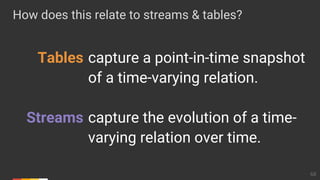
How does this relate to streams & tables?
59
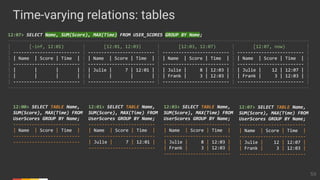
Time-varying relations: tables
12:07> SELECT TABLE Name,
SUM(Score), MAX(Time) FROM
UserScores GROUP BY Name;
-------------------------
| Name | Score | Time |
-------------------------
| Julie | 12 | 12:07 |
| Frank | 3 | 12:03 |
-------------------------
12:03> SELECT TABLE Name,
SUM(Score), MAX(Time) FROM
UserScores GROUP BY Name;
-------------------------
| Name | Score | Time |
-------------------------
| Julie | 8 | 12:03 |
| Frank | 3 | 12:03 |
-------------------------
12:01> SELECT TABLE Name,
SUM(Score), MAX(Time) FROM
UserScores GROUP BY Name;
-------------------------
| Name | Score | Time |
-------------------------
| Julie | 7 | 12:01 |
-------------------------
12:07> SELECT Name, SUM(Score), MAX(Time) FROM USER_SCORES GROUP BY Name;
-----------------------------------------------------------------------------------------------------------------
| [-inf, 12:01) | [12:01, 12:03) | [12:03, 12:07) | [12:07, now) |
| ------------------------- | ------------------------- | ------------------------- | ------------------------- |
| | Name | Score | Time | | | Name | Score | Time | | | Name | Score | Time | | | Name | Score | Time | |
| ------------------------- | ------------------------- | ------------------------- | ------------------------- |
| | | | | | | Julie | 7 | 12:01 | | | Julie | 8 | 12:03 | | | Julie | 12 | 12:07 | |
| | | | | | | | | | | | Frank | 3 | 12:03 | | | Frank | 3 | 12:03 | |
| ------------------------- | ------------------------- | ------------------------- | ------------------------- |
-----------------------------------------------------------------------------------------------------------------
12:00> SELECT TABLE Name,
SUM(Score), MAX(Time) FROM
UserScores GROUP BY Name;
-------------------------
| Name | Score | Time |
-------------------------
-------------------------
60
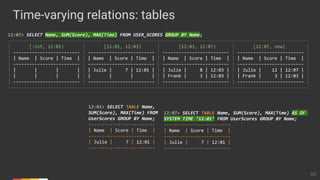
Time-varying relations: tables
12:01> SELECT TABLE Name,
SUM(Score), MAX(Time) FROM
UserScores GROUP BY Name;
-------------------------
| Name | Score | Time |
-------------------------
| Julie | 7 | 12:01 |
-------------------------
12:07> SELECT Name, SUM(Score), MAX(Time) FROM USER_SCORES GROUP BY Name;
-----------------------------------------------------------------------------------------------------------------
| [-inf, 12:01) | [12:01, 12:03) | [12:03, 12:07) | [12:07, now) |
| ------------------------- | ------------------------- | ------------------------- | ------------------------- |
| | Name | Score | Time | | | Name | Score | Time | | | Name | Score | Time | | | Name | Score | Time | |
| ------------------------- | ------------------------- | ------------------------- | ------------------------- |
| | | | | | | Julie | 7 | 12:01 | | | Julie | 8 | 12:03 | | | Julie | 12 | 12:07 | |
| | | | | | | | | | | | Frank | 3 | 12:03 | | | Frank | 3 | 12:03 | |
| ------------------------- | ------------------------- | ------------------------- | ------------------------- |
-----------------------------------------------------------------------------------------------------------------
12:07> SELECT TABLE Name, SUM(Score), MAX(Time) AS OF
SYSTEM TIME ‘12:01’ FROM UserScores GROUP BY Name;
-------------------------
| Name | Score | Time |
-------------------------
| Julie | 7 | 12:01 |
-------------------------
61
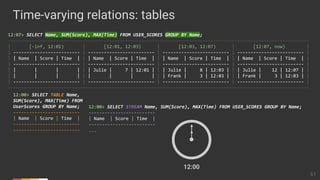
Time-varying relations: tables
12:07> SELECT Name, SUM(Score), MAX(Time) FROM USER_SCORES GROUP BY Name;
-----------------------------------------------------------------------------------------------------------------
| [-inf, 12:01) | [12:01, 12:03) | [12:03, 12:07) | [12:07, now) |
| ------------------------- | ------------------------- | ------------------------- | ------------------------- |
| | Name | Score | Time | | | Name | Score | Time | | | Name | Score | Time | | | Name | Score | Time | |
| ------------------------- | ------------------------- | ------------------------- | ------------------------- |
| | | | | | | Julie | 7 | 12:01 | | | Julie | 8 | 12:03 | | | Julie | 12 | 12:07 | |
| | | | | | | | | | | | Frank | 3 | 12:03 | | | Frank | 3 | 12:03 | |
| ------------------------- | ------------------------- | ------------------------- | ------------------------- |
-----------------------------------------------------------------------------------------------------------------
12:00> SELECT STREAM Name, SUM(Score), MAX(Time) FROM USER_SCORES GROUP BY Name;
-------------------------
| Name | Score | Time |
-------------------------
...
12:00
12:00> SELECT TABLE Name,
SUM(Score), MAX(Time) FROM
UserScores GROUP BY Name;
-------------------------
| Name | Score | Time |
-------------------------
-------------------------
62
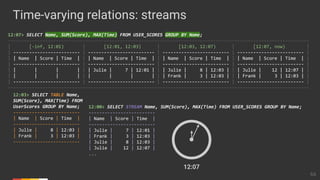
Time-varying relations: streams
12:07> SELECT Name, SUM(Score), MAX(Time) FROM USER_SCORES GROUP BY Name;
-----------------------------------------------------------------------------------------------------------------
| [-inf, 12:01) | [12:01, 12:03) | [12:03, 12:07) | [12:07, now) |
| ------------------------- | ------------------------- | ------------------------- | ------------------------- |
| | Name | Score | Time | | | Name | Score | Time | | | Name | Score | Time | | | Name | Score | Time | |
| ------------------------- | ------------------------- | ------------------------- | ------------------------- |
| | | | | | | Julie | 7 | 12:01 | | | Julie | 8 | 12:03 | | | Julie | 12 | 12:07 | |
| | | | | | | | | | | | Frank | 3 | 12:03 | | | Frank | 3 | 12:03 | |
| ------------------------- | ------------------------- | ------------------------- | ------------------------- |
-----------------------------------------------------------------------------------------------------------------
12:00> SELECT STREAM Name, SUM(Score), MAX(Time) FROM USER_SCORES GROUP BY Name;
-------------------------
| Name | Score | Time |
-------------------------
| Julie | 7 | 12:01 |
...
12:01
12:00> SELECT TABLE Name,
SUM(Score), MAX(Time) FROM
UserScores GROUP BY Name;
-------------------------
| Name | Score | Time |
-------------------------
-------------------------
63
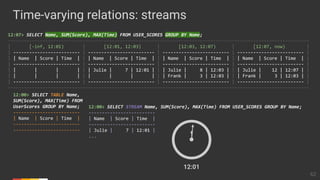
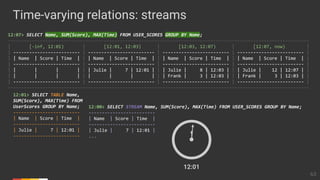
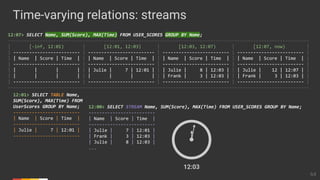
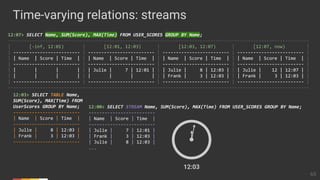
Time-varying relations: streams
12:07> SELECT Name, SUM(Score), MAX(Time) FROM USER_SCORES GROUP BY Name;
-----------------------------------------------------------------------------------------------------------------
| [-inf, 12:01) | [12:01, 12:03) | [12:03, 12:07) | [12:07, now) |
| ------------------------- | ------------------------- | ------------------------- | ------------------------- |
| | Name | Score | Time | | | Name | Score | Time | | | Name | Score | Time | | | Name | Score | Time | |
| ------------------------- | ------------------------- | ------------------------- | ------------------------- |
| | | | | | | Julie | 7 | 12:01 | | | Julie | 8 | 12:03 | | | Julie | 12 | 12:07 | |
| | | | | | | | | | | | Frank | 3 | 12:03 | | | Frank | 3 | 12:03 | |
| ------------------------- | ------------------------- | ------------------------- | ------------------------- |
-----------------------------------------------------------------------------------------------------------------
12:00> SELECT STREAM Name, SUM(Score), MAX(Time) FROM USER_SCORES GROUP BY Name;
-------------------------
| Name | Score | Time |
-------------------------
| Julie | 7 | 12:01 |
...
12:01
12:01> SELECT TABLE Name,
SUM(Score), MAX(Time) FROM
UserScores GROUP BY Name;
-------------------------
| Name | Score | Time |
-------------------------
| Julie | 7 | 12:01 |
-------------------------
64
Time-varying relations: streams
12:07> SELECT Name, SUM(Score), MAX(Time) FROM USER_SCORES GROUP BY Name;
-----------------------------------------------------------------------------------------------------------------
| [-inf, 12:01) | [12:01, 12:03) | [12:03, 12:07) | [12:07, now) |
| ------------------------- | ------------------------- | ------------------------- | ------------------------- |
| | Name | Score | Time | | | Name | Score | Time | | | Name | Score | Time | | | Name | Score | Time | |
| ------------------------- | ------------------------- | ------------------------- | ------------------------- |
| | | | | | | Julie | 7 | 12:01 | | | Julie | 8 | 12:03 | | | Julie | 12 | 12:07 | |
| | | | | | | | | | | | Frank | 3 | 12:03 | | | Frank | 3 | 12:03 | |
| ------------------------- | ------------------------- | ------------------------- | ------------------------- |
-----------------------------------------------------------------------------------------------------------------
12:00> SELECT STREAM Name, SUM(Score), MAX(Time) FROM USER_SCORES GROUP BY Name;
-------------------------
| Name | Score | Time |
-------------------------
| Julie | 7 | 12:01 |
| Frank | 3 | 12:03 |
| Julie | 8 | 12:03 |
...
12:03
12:01> SELECT TABLE Name,
SUM(Score), MAX(Time) FROM
UserScores GROUP BY Name;
-------------------------
| Name | Score | Time |
-------------------------
| Julie | 7 | 12:01 |
-------------------------
65
Time-varying relations: streams
12:07> SELECT Name, SUM(Score), MAX(Time) FROM USER_SCORES GROUP BY Name;
-----------------------------------------------------------------------------------------------------------------
| [-inf, 12:01) | [12:01, 12:03) | [12:03, 12:07) | [12:07, now) |
| ------------------------- | ------------------------- | ------------------------- | ------------------------- |
| | Name | Score | Time | | | Name | Score | Time | | | Name | Score | Time | | | Name | Score | Time | |
| ------------------------- | ------------------------- | ------------------------- | ------------------------- |
| | | | | | | Julie | 7 | 12:01 | | | Julie | 8 | 12:03 | | | Julie | 12 | 12:07 | |
| | | | | | | | | | | | Frank | 3 | 12:03 | | | Frank | 3 | 12:03 | |
| ------------------------- | ------------------------- | ------------------------- | ------------------------- |
-----------------------------------------------------------------------------------------------------------------
12:00> SELECT STREAM Name, SUM(Score), MAX(Time) FROM USER_SCORES GROUP BY Name;
-------------------------
| Name | Score | Time |
-------------------------
| Julie | 7 | 12:01 |
| Frank | 3 | 12:03 |
| Julie | 8 | 12:03 |
...
12:03
12:03> SELECT TABLE Name,
SUM(Score), MAX(Time) FROM
UserScores GROUP BY Name;
-------------------------
| Name | Score | Time |
-------------------------
| Julie | 8 | 12:03 |
| Frank | 3 | 12:03 |
-------------------------
66
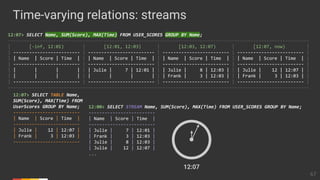
Time-varying relations: streams
12:07> SELECT Name, SUM(Score), MAX(Time) FROM USER_SCORES GROUP BY Name;
-----------------------------------------------------------------------------------------------------------------
| [-inf, 12:01) | [12:01, 12:03) | [12:03, 12:07) | [12:07, now) |
| ------------------------- | ------------------------- | ------------------------- | ------------------------- |
| | Name | Score | Time | | | Name | Score | Time | | | Name | Score | Time | | | Name | Score | Time | |
| ------------------------- | ------------------------- | ------------------------- | ------------------------- |
| | | | | | | Julie | 7 | 12:01 | | | Julie | 8 | 12:03 | | | Julie | 12 | 12:07 | |
| | | | | | | | | | | | Frank | 3 | 12:03 | | | Frank | 3 | 12:03 | |
| ------------------------- | ------------------------- | ------------------------- | ------------------------- |
-----------------------------------------------------------------------------------------------------------------
12:00> SELECT STREAM Name, SUM(Score), MAX(Time) FROM USER_SCORES GROUP BY Name;
-------------------------
| Name | Score | Time |
-------------------------
| Julie | 7 | 12:01 |
| Frank | 3 | 12:03 |
| Julie | 8 | 12:03 |
| Julie | 12 | 12:07 |
...
12:07
12:03> SELECT TABLE Name,
SUM(Score), MAX(Time) FROM
UserScores GROUP BY Name;
-------------------------
| Name | Score | Time |
-------------------------
| Julie | 8 | 12:03 |
| Frank | 3 | 12:03 |
-------------------------
67
Time-varying relations: streams
12:07> SELECT Name, SUM(Score), MAX(Time) FROM USER_SCORES GROUP BY Name;
-----------------------------------------------------------------------------------------------------------------
| [-inf, 12:01) | [12:01, 12:03) | [12:03, 12:07) | [12:07, now) |
| ------------------------- | ------------------------- | ------------------------- | ------------------------- |
| | Name | Score | Time | | | Name | Score | Time | | | Name | Score | Time | | | Name | Score | Time | |
| ------------------------- | ------------------------- | ------------------------- | ------------------------- |
| | | | | | | Julie | 7 | 12:01 | | | Julie | 8 | 12:03 | | | Julie | 12 | 12:07 | |
| | | | | | | | | | | | Frank | 3 | 12:03 | | | Frank | 3 | 12:03 | |
| ------------------------- | ------------------------- | ------------------------- | ------------------------- |
-----------------------------------------------------------------------------------------------------------------
12:00> SELECT STREAM Name, SUM(Score), MAX(Time) FROM USER_SCORES GROUP BY Name;
-------------------------
| Name | Score | Time |
-------------------------
| Julie | 7 | 12:01 |
| Frank | 3 | 12:03 |
| Julie | 8 | 12:03 |
| Julie | 12 | 12:07 |
...
12:07
12:07> SELECT TABLE Name,
SUM(Score), MAX(Time) FROM
UserScores GROUP BY Name;
-------------------------
| Name | Score | Time |
-------------------------
| Julie | 12 | 12:07 |
| Frank | 3 | 12:03 |
-------------------------
68
How does this relate to streams & tables?
capture a point-in-time snapshot
of a time-varying relation.
capture the evolution of a time-
varying relation over time.
Tables
Streams
69
02 Streaming SQL
Contorting relational algebra for fun and profit
A Time-varying relations
B SQL language extensions
70
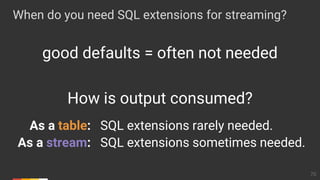
When do you need SQL extensions for streaming?
As a table:
As a stream:
SQL extensions rarely needed.
SQL extensions sometimes needed.
How is output consumed?
good defaults = often not needed
71
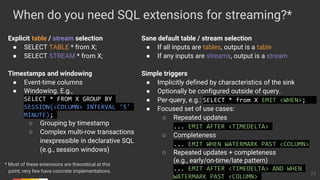
When do you need SQL extensions for streaming?*
Explicit table / stream selection
● SELECT TABLE * from X;
● SELECT STREAM * from X;
Timestamps and windowing
● Event-time columns
● Windowing. E.g.,
SELECT * FROM X GROUP BY
SESSION(<COLUMN> INTERVAL '5'
MINUTE);
○ Grouping by timestamp
○ Complex multi-row transactions
inexpressible in declarative SQL
(e.g., session windows)
Sane default table / stream selection
● If all inputs are tables, output is a table
● If any inputs are streams, output is a stream
Simple triggers
● Implicitly defined by characteristics of the sink
● Optionally be configured outside of query.
● Per-query, e.g.: SELECT * from X EMIT <WHEN>;
● Focused set of use cases:
○ Repeated updates
... EMIT AFTER <TIMEDELTA>
○ Completeness
... EMIT WHEN WATERMARK PAST <COLUMN>
○ Repeated updates + completeness
(e.g., early/on-time/late pattern)
... EMIT AFTER <TIMEDELTA> AND WHEN
WATERMARK PAST <COLUMN>
* Most of these extensions are theoretical at this
point; very few have concrete implementations.
72
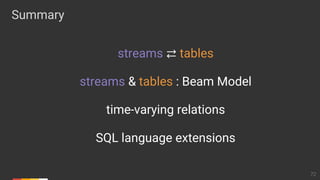
Summary
streams ⇄ tables
streams & tables : Beam Model
time-varying relations
SQL language extensions
73
Thank you!
In early release now
streamingsystems.net
Streaming SQL spec (WIP: Apex, Beam, Calcite, Flink): http://s.apache.org/streaming-sql-spec
Streaming in Calcite (Julian Hyde): https://calcite.apache.org/docs/stream.html
Streams, joins & temporal tables (Julian Hyde): http://s.apache.org/streams-joins-and-temporal-tables
Streaming 101: http://oreilly.com/ideas/the-world-beyond-batch-streaming-101
Streaming 102: http://oreilly.com/ideas/the-world-beyond-batch-streaming-102
Animations: http://github.com/takidau/animations
Apache Beam: http://beam.apache.org
Apache Calcite: http://calcite.apache.org
Apache Flink: http://flink.apache.org

Foundations of streaming SQL: stream & table theory

  • 1.
    1 Foundations of streamingSQL or: stream & table theory Anton Kedin Apache Beam Contributor Software Engineer at Google Original Presentation by Tyler Akidau, @takidau Covering ideas from across the Apache Beam, Apache Calcite, Apache Kafka, and Apache Flink communities, with thoughts and contributions from Tyler Akidau, Julian Hyde, Fabian Hueske, Shaoxuan Wang, Kenn Knowles, Ben Chambers, Reuven Lax, Mingmin Xu, James Xu, Martin Kleppmann, Jay Kreps and many more, not to mention that whole database community thing... Dataworks San Jose 2018
  • 2.
    2 Table of Contents 01 02 Stream& Table Theory A Basics B The Beam Model Streaming SQL A Time-varying relations B SQL language extensions Chapter 7 Chapter 9
  • 3.
    3 01 Stream &Table Theory TFW you realize everything you do was invented by the database community decades ago... A Basics B The Beam Model
  • 4.
    4 Stream & tablebasics https://www.confluent.io/blog/making-sense-of-stream-processing/ https://www.confluent.io/blog/introducing-kafka-streams-stream-processing-made-simple/
  • 5.
    5 Special theory ofstream & table relativity streams → tables: tables → streams: The aggregation of a stream of updates over time yields a table. The observation of changes to a table over time yields a stream.
  • 6.
    6 Non-relativistic stream &table definitions Tables are data at rest. Streams are data in motion.
  • 7.
    7 01 Stream &Table Theory TFW you realize everything you do was invented by the database community decades ago... A Basics B The Beam Model
  • 8.
    8 The Beam Model Whatresults are calculated? Where in event time are results calculated? When in processing time are results materialized? How do refinements of results relate?
  • 9.
    9 Reconciling streams &tables w/ the Beam Model ● How does batch processing fit into all of this? ● What is the relationship of streams to bounded and unbounded datasets? ● How do the four what, where, when, how questions map onto a streams/tables world?
  • 10.
  • 11.
  • 12.
  • 13.
  • 14.
  • 15.
    15 Map phase API voidmap(K1 key, V1 value, Emit<K2, V2>);
  • 16.
    16 Map phase API voidmap(K1 key, V1 value, Emit<K2, V2>);
  • 17.
  • 18.
    18 Map phase API voidmap(K1 key, V1 value, Emit<K2, V2>);
  • 19.
  • 20.
    20 Map phase API voidmap(K1 key, V1 value, Emit<K2, V2>); void reduce(K2 key, Iterable<V2> value, Emit<V3>);
  • 21.
  • 22.
  • 23.
    23 Map phase API voidmap(K1 key, V1 value, Emit<K2, V2>); void reduce(K2 key, Iterable<V2> value, Emit<V3>);
  • 24.
    24 Map phase API voidmap(K1 key, V1 value, Emit<K2, V2>); void reduce(K2 key, Iterable<V2> value, Emit<V3>);
  • 25.
  • 26.
    26 Reconciling streams &tables w/ the Beam Model ● How does batch processing fit into all of this? ● What is the relationship of streams to bounded and unbounded datasets? ● How do the four what, where, when, how questions map onto a streams/tables world? 1. Tables are read into streams. 2. Streams are processed into new streams until a grouping operation is hit. 3. Grouping turns the stream into a table. 4. Repeat steps 1-3 until you run out of operations.
  • 27.
    27 Reconciling streams &tables w/ the Beam Model ● How does batch processing fit into all of this? ● What is the relationship of streams to bounded and unbounded datasets? ● How do the four what, where, when, how questions map onto a streams/tables world? Streams are the in-motion form of data both bounded and unbounded.
  • 28.
    28 Reconciling streams &tables w/ the Beam Model ● How does batch processing fit into all of this? ● What is the relationship of streams to bounded and unbounded datasets? ● How do the four what, where, when, how questions map onto a streams/tables world?
  • 29.
    29 The Beam Model Whatresults are calculated? Where in event time are results calculated? When in processing time are results materialized? How do refinements of results relate?
  • 30.
    30 The Beam Model Whatresults are calculated? Where in event time are results calculated? When in processing time are results materialized? How do refinements of results relate?
  • 31.
  • 32.
    32 What is calculated? PCollection<KV<Team,Score>> input = IO.read(...) .apply(ParDo.of(new ParseFn()); .apply(Sum.integersPerKey());
  • 33.
  • 34.
    34 The Beam Model Whatresults are calculated? Where in event time are results calculated? When in processing time are results materialized? How do refinements of results relate?
  • 35.
    35 Windowing divides datainto event-time-based finite chunks. Often required when doing aggregations over unbounded data. Fixed Sliding 1 2 3 54 Sessions 2 431 Key 2 Key 1 Key 3 Time 2 3 4 Where in event time?
  • 36.
    36 Where in eventtime? PCollection<KV<User, Score>> input = IO.read(...) .apply(ParDo.of(new ParseFn()); .apply(Window.into(FixedWindows.of(Duration.standardMinutes(2))) .apply(Sum.integersPerKey());
  • 37.
  • 38.
    38 The Beam Model Whatresults are calculated? Where in event time are results calculated? When in processing time are results materialized? How do refinements of results relate?
  • 39.
    39 • Triggers control whenresults are emitted. • Triggers are often relative to the watermark. ProcessingTime Event Time ~Watermark Ideal Skew When in processing time?
  • 40.
    40 When in processingtime? PCollection<KV<User, Score>> input = IO.read(...) .apply(ParDo.of(new ParseFn()); .apply(Window.into(FixedWindows.of(Duration.standardMinutes(2)) .triggering(AtWatermark()) .apply(Sum.integersPerKey());
  • 41.
  • 42.
    42 The Beam Model:asking the right questions What results are calculated? Where in event time are results calculated? When in processing time are results materialized? How do refinements of results relate?
  • 43.
    43 How do refinementsrelate? PCollection<KV<User, Score>> input = IO.read(...) .apply(ParDo.of(new ParseFn()); .apply(Window.into(FixedWindows.of(Duration.standardMinutes(2)) .triggering(AtWatermark().withLateFirings(AtCount(1))) .accumulatingFiredPanes()) .apply(Sum.integersPerKey());
  • 44.
  • 45.
    45 What/Where/When/How Summary 3. Streaming4. Streaming + Late Data Handling 1. Classic Batch 2. Windowed Batch
  • 46.
    46 Reconciling streams &tables w/ the Beam Model ● How does batch processing fit into all of this? ● What is the relationship of streams to bounded and unbounded datasets? ● How do the four what, where, when, how questions map onto a streams/tables world?
  • 47.
    47 General theory ofstream & table relativity Pipelines : tables + streams + operations Tables : data at rest Streams : data in motion Operations : (stream | table) → (stream | table) transformations ● stream → stream: Non-grouping (element-wise) operations Leaves stream data in motion, yielding another stream. ● stream → table: Grouping operations Brings stream data to rest, yielding a table. Windowing adds the dimension of time to grouping. ● table → stream: Ungrouping (triggering) operations Puts table data into motion, yielding a stream. Accumulation dictates the nature of the stream (deltas, values, retractions). ● table → table: (none) Impossible to go from rest and back to rest without being put into motion.
  • 48.
    48 02 Streaming SQL Contortingrelational algebra for fun and profit A Time-varying relations B SQL language extensions
  • 49.
    49 Relational algebra User ScoreTime Julie 7 12:01 Frank 3 12:03 Julie 1 12:03 Julie 4 12:07 Score Time 7 12:01 3 12:03 1 12:03 4 12:07 πScore,Time(UserScores)πUserScoresπ SELECT Score, Time FROM UserScores; ----------------- | Score | Time | ----------------- | 7 | 12:01 | | 3 | 12:03 | | 1 | 12:03 | | 4 | 12:07 | ----------------- Relational algebra SQLRelation
  • 50.
    50 Relations evolve overtime 12:07> SELECT * FROM UserScores; ------------------------- | Name | Score | Time | ------------------------- | Julie | 7 | 12:01 | | Frank | 3 | 12:03 | | Julie | 1 | 12:03 | | Julie | 4 | 12:07 | ------------------------- 12:03> SELECT * FROM UserScores; ------------------------- | Name | Score | Time | ------------------------- | Julie | 7 | 12:01 | | Frank | 3 | 12:03 | | Julie | 1 | 12:03 | ------------------------- 12:00> SELECT * FROM UserScores; ------------------------- | Name | Score | Time | ------------------------- ------------------------- 12:01> SELECT * FROM UserScores; ------------------------- | Name | Score | Time | ------------------------- | Julie | 7 | 12:01 | -------------------------
  • 51.
    51 Classic SQL vsStreaming SQL Classic SQL classic relations single point in time:: :: Streaming SQL time-varying relations every point in time:: ::
  • 52.
    52 Classic SQL vsStreaming SQL Classic SQL classic relations single point in time:: :: Streaming SQL time-varying relations every point in time:: ::
  • 53.
    53 Classic relations 12:07> SELECT* FROM UserScores; ----------------------------------------------------------------------------------------------------------------- | [-inf, 12:01) | [12:01, 12:03) | [12:03, 12:07) | [12:07, now) | | ------------------------- | ------------------------- | ------------------------- | ------------------------- | | | Name | Score | Time | | | Name | Score | Time | | | Name | Score | Time | | | Name | Score | Time | | | ------------------------- | ------------------------- | ------------------------- | ------------------------- | | | | | | | | Julie | 7 | 12:01 | | | Julie | 7 | 12:01 | | | Julie | 7 | 12:01 | | | | | | | | | | | | | | Frank | 3 | 12:03 | | | Frank | 3 | 12:03 | | | | | | | | | | | | | | Julie | 1 | 12:03 | | | Julie | 1 | 12:03 | | | | | | | | | | | | | | | | | | | Julie | 4 | 12:07 | | | ------------------------- | ------------------------- | ------------------------- | ------------------------- | ----------------------------------------------------------------------------------------------------------------- 12:07> SELECT * FROM UserScores; ------------------------- | Name | Score | Time | ------------------------- | Julie | 7 | 12:01 | | Frank | 3 | 12:03 | | Julie | 1 | 12:03 | | Julie | 4 | 12:07 | ------------------------- 12:03> SELECT * FROM UserScores; ------------------------- | Name | Score | Time | ------------------------- | Julie | 7 | 12:01 | | Frank | 3 | 12:03 | | Julie | 1 | 12:03 | ------------------------- 12:00> SELECT * FROM UserScores; ------------------------- | Name | Score | Time | ------------------------- ------------------------- 12:01> SELECT * FROM UserScores; ------------------------- | Name | Score | Time | ------------------------- | Julie | 7 | 12:01 | ------------------------- Time-varying relation
  • 54.
    54 Closure property ofrelational algebra remains intact with time-varying relations.
  • 55.
    55 Time-varying relations: variations 12:07>SELECT * FROM UserScores; ----------------------------------------------------------------------------------------------------------------- | [-inf, 12:01) | [12:01, 12:03) | [12:03, 12:07) | [12:07, now) | | ------------------------- | ------------------------- | ------------------------- | ------------------------- | | | Name | Score | Time | | | Name | Score | Time | | | Name | Score | Time | | | Name | Score | Time | | | ------------------------- | ------------------------- | ------------------------- | ------------------------- | | | | | | | | Julie | 7 | 12:01 | | | Julie | 7 | 12:01 | | | Julie | 7 | 12:01 | | | | | | | | | | | | | | Frank | 3 | 12:03 | | | Frank | 3 | 12:03 | | | | | | | | | | | | | | Julie | 1 | 12:03 | | | Julie | 1 | 12:03 | | | | | | | | | | | | | | | | | | | Julie | 4 | 12:07 | | | ------------------------- | ------------------------- | ------------------------- | ------------------------- | -----------------------------------------------------------------------------------------------------------------
  • 56.
    56 Time-varying relations: filtering 12:07>SELECT * FROM UserScores; ----------------------------------------------------------------------------------------------------------------- | [-inf, 12:01) | [12:01, 12:03) | [12:03, 12:07) | [12:07, now) | | ------------------------- | ------------------------- | ------------------------- | ------------------------- | | | Name | Score | Time | | | Name | Score | Time | | | Name | Score | Time | | | Name | Score | Time | | | ------------------------- | ------------------------- | ------------------------- | ------------------------- | | | | | | | | Julie | 7 | 12:01 | | | Julie | 7 | 12:01 | | | Julie | 7 | 12:01 | | | | | | | | | | | | | | Frank | 3 | 12:03 | | | Frank | 3 | 12:03 | | | | | | | | | | | | | | Julie | 1 | 12:03 | | | Julie | 1 | 12:03 | | | | | | | | | | | | | | | | | | | Julie | 4 | 12:07 | | | ------------------------- | ------------------------- | ------------------------- | ------------------------- | ----------------------------------------------------------------------------------------------------------------- 12:07> SELECT * FROM UserScores WHERE Name = “Julie”; ----------------------------------------------------------------------------------------------------------------- | [-inf, 12:01) | [12:01, 12:03) | [12:03, 12:07) | [12:07, now) | | ------------------------- | ------------------------- | ------------------------- | ------------------------- | | | Name | Score | Time | | | Name | Score | Time | | | Name | Score | Time | | | Name | Score | Time | | | ------------------------- | ------------------------- | ------------------------- | ------------------------- | | | | | | | | Julie | 7 | 12:01 | | | Julie | 7 | 12:01 | | | Julie | 7 | 12:01 | | | | | | | | | | | | | | Julie | 1 | 12:03 | | | Julie | 1 | 12:03 | | | | | | | | | | | | | | | | | | | Julie | 4 | 12:07 | | | ------------------------- | ------------------------- | ------------------------- | ------------------------- | -----------------------------------------------------------------------------------------------------------------
  • 57.
    57 Time-varying relations: grouping 12:07>SELECT * FROM UserScores; ----------------------------------------------------------------------------------------------------------------- | [-inf, 12:01) | [12:01, 12:03) | [12:03, 12:07) | [12:07, now) | | ------------------------- | ------------------------- | ------------------------- | ------------------------- | | | Name | Score | Time | | | Name | Score | Time | | | Name | Score | Time | | | Name | Score | Time | | | ------------------------- | ------------------------- | ------------------------- | ------------------------- | | | | | | | | Julie | 7 | 12:01 | | | Julie | 7 | 12:01 | | | Julie | 7 | 12:01 | | | | | | | | | | | | | | Frank | 3 | 12:03 | | | Frank | 3 | 12:03 | | | | | | | | | | | | | | Julie | 1 | 12:03 | | | Julie | 1 | 12:03 | | | | | | | | | | | | | | | | | | | Julie | 4 | 12:07 | | | ------------------------- | ------------------------- | ------------------------- | ------------------------- | ----------------------------------------------------------------------------------------------------------------- 12:07> SELECT Name, SUM(Score), MAX(Time) FROM USER_SCORES GROUP BY Name; ----------------------------------------------------------------------------------------------------------------- | [-inf, 12:01) | [12:01, 12:03) | [12:03, 12:07) | [12:07, now) | | ------------------------- | ------------------------- | ------------------------- | ------------------------- | | | Name | Score | Time | | | Name | Score | Time | | | Name | Score | Time | | | Name | Score | Time | | | ------------------------- | ------------------------- | ------------------------- | ------------------------- | | | | | | | | Julie | 7 | 12:01 | | | Julie | 8 | 12:03 | | | Julie | 12 | 12:07 | | | | | | | | | | | | | | Frank | 3 | 12:03 | | | Frank | 3 | 12:03 | | | ------------------------- | ------------------------- | ------------------------- | ------------------------- | -----------------------------------------------------------------------------------------------------------------
  • 58.
    58 How does thisrelate to streams & tables?
  • 59.
    59 Time-varying relations: tables 12:07>SELECT TABLE Name, SUM(Score), MAX(Time) FROM UserScores GROUP BY Name; ------------------------- | Name | Score | Time | ------------------------- | Julie | 12 | 12:07 | | Frank | 3 | 12:03 | ------------------------- 12:03> SELECT TABLE Name, SUM(Score), MAX(Time) FROM UserScores GROUP BY Name; ------------------------- | Name | Score | Time | ------------------------- | Julie | 8 | 12:03 | | Frank | 3 | 12:03 | ------------------------- 12:01> SELECT TABLE Name, SUM(Score), MAX(Time) FROM UserScores GROUP BY Name; ------------------------- | Name | Score | Time | ------------------------- | Julie | 7 | 12:01 | ------------------------- 12:07> SELECT Name, SUM(Score), MAX(Time) FROM USER_SCORES GROUP BY Name; ----------------------------------------------------------------------------------------------------------------- | [-inf, 12:01) | [12:01, 12:03) | [12:03, 12:07) | [12:07, now) | | ------------------------- | ------------------------- | ------------------------- | ------------------------- | | | Name | Score | Time | | | Name | Score | Time | | | Name | Score | Time | | | Name | Score | Time | | | ------------------------- | ------------------------- | ------------------------- | ------------------------- | | | | | | | | Julie | 7 | 12:01 | | | Julie | 8 | 12:03 | | | Julie | 12 | 12:07 | | | | | | | | | | | | | | Frank | 3 | 12:03 | | | Frank | 3 | 12:03 | | | ------------------------- | ------------------------- | ------------------------- | ------------------------- | ----------------------------------------------------------------------------------------------------------------- 12:00> SELECT TABLE Name, SUM(Score), MAX(Time) FROM UserScores GROUP BY Name; ------------------------- | Name | Score | Time | ------------------------- -------------------------
  • 60.
    60 Time-varying relations: tables 12:01>SELECT TABLE Name, SUM(Score), MAX(Time) FROM UserScores GROUP BY Name; ------------------------- | Name | Score | Time | ------------------------- | Julie | 7 | 12:01 | ------------------------- 12:07> SELECT Name, SUM(Score), MAX(Time) FROM USER_SCORES GROUP BY Name; ----------------------------------------------------------------------------------------------------------------- | [-inf, 12:01) | [12:01, 12:03) | [12:03, 12:07) | [12:07, now) | | ------------------------- | ------------------------- | ------------------------- | ------------------------- | | | Name | Score | Time | | | Name | Score | Time | | | Name | Score | Time | | | Name | Score | Time | | | ------------------------- | ------------------------- | ------------------------- | ------------------------- | | | | | | | | Julie | 7 | 12:01 | | | Julie | 8 | 12:03 | | | Julie | 12 | 12:07 | | | | | | | | | | | | | | Frank | 3 | 12:03 | | | Frank | 3 | 12:03 | | | ------------------------- | ------------------------- | ------------------------- | ------------------------- | ----------------------------------------------------------------------------------------------------------------- 12:07> SELECT TABLE Name, SUM(Score), MAX(Time) AS OF SYSTEM TIME ‘12:01’ FROM UserScores GROUP BY Name; ------------------------- | Name | Score | Time | ------------------------- | Julie | 7 | 12:01 | -------------------------
  • 61.
    61 Time-varying relations: tables 12:07>SELECT Name, SUM(Score), MAX(Time) FROM USER_SCORES GROUP BY Name; ----------------------------------------------------------------------------------------------------------------- | [-inf, 12:01) | [12:01, 12:03) | [12:03, 12:07) | [12:07, now) | | ------------------------- | ------------------------- | ------------------------- | ------------------------- | | | Name | Score | Time | | | Name | Score | Time | | | Name | Score | Time | | | Name | Score | Time | | | ------------------------- | ------------------------- | ------------------------- | ------------------------- | | | | | | | | Julie | 7 | 12:01 | | | Julie | 8 | 12:03 | | | Julie | 12 | 12:07 | | | | | | | | | | | | | | Frank | 3 | 12:03 | | | Frank | 3 | 12:03 | | | ------------------------- | ------------------------- | ------------------------- | ------------------------- | ----------------------------------------------------------------------------------------------------------------- 12:00> SELECT STREAM Name, SUM(Score), MAX(Time) FROM USER_SCORES GROUP BY Name; ------------------------- | Name | Score | Time | ------------------------- ... 12:00 12:00> SELECT TABLE Name, SUM(Score), MAX(Time) FROM UserScores GROUP BY Name; ------------------------- | Name | Score | Time | ------------------------- -------------------------
  • 62.
    62 Time-varying relations: streams 12:07>SELECT Name, SUM(Score), MAX(Time) FROM USER_SCORES GROUP BY Name; ----------------------------------------------------------------------------------------------------------------- | [-inf, 12:01) | [12:01, 12:03) | [12:03, 12:07) | [12:07, now) | | ------------------------- | ------------------------- | ------------------------- | ------------------------- | | | Name | Score | Time | | | Name | Score | Time | | | Name | Score | Time | | | Name | Score | Time | | | ------------------------- | ------------------------- | ------------------------- | ------------------------- | | | | | | | | Julie | 7 | 12:01 | | | Julie | 8 | 12:03 | | | Julie | 12 | 12:07 | | | | | | | | | | | | | | Frank | 3 | 12:03 | | | Frank | 3 | 12:03 | | | ------------------------- | ------------------------- | ------------------------- | ------------------------- | ----------------------------------------------------------------------------------------------------------------- 12:00> SELECT STREAM Name, SUM(Score), MAX(Time) FROM USER_SCORES GROUP BY Name; ------------------------- | Name | Score | Time | ------------------------- | Julie | 7 | 12:01 | ... 12:01 12:00> SELECT TABLE Name, SUM(Score), MAX(Time) FROM UserScores GROUP BY Name; ------------------------- | Name | Score | Time | ------------------------- -------------------------
  • 63.
    63 Time-varying relations: streams 12:07>SELECT Name, SUM(Score), MAX(Time) FROM USER_SCORES GROUP BY Name; ----------------------------------------------------------------------------------------------------------------- | [-inf, 12:01) | [12:01, 12:03) | [12:03, 12:07) | [12:07, now) | | ------------------------- | ------------------------- | ------------------------- | ------------------------- | | | Name | Score | Time | | | Name | Score | Time | | | Name | Score | Time | | | Name | Score | Time | | | ------------------------- | ------------------------- | ------------------------- | ------------------------- | | | | | | | | Julie | 7 | 12:01 | | | Julie | 8 | 12:03 | | | Julie | 12 | 12:07 | | | | | | | | | | | | | | Frank | 3 | 12:03 | | | Frank | 3 | 12:03 | | | ------------------------- | ------------------------- | ------------------------- | ------------------------- | ----------------------------------------------------------------------------------------------------------------- 12:00> SELECT STREAM Name, SUM(Score), MAX(Time) FROM USER_SCORES GROUP BY Name; ------------------------- | Name | Score | Time | ------------------------- | Julie | 7 | 12:01 | ... 12:01 12:01> SELECT TABLE Name, SUM(Score), MAX(Time) FROM UserScores GROUP BY Name; ------------------------- | Name | Score | Time | ------------------------- | Julie | 7 | 12:01 | -------------------------
  • 64.
    64 Time-varying relations: streams 12:07>SELECT Name, SUM(Score), MAX(Time) FROM USER_SCORES GROUP BY Name; ----------------------------------------------------------------------------------------------------------------- | [-inf, 12:01) | [12:01, 12:03) | [12:03, 12:07) | [12:07, now) | | ------------------------- | ------------------------- | ------------------------- | ------------------------- | | | Name | Score | Time | | | Name | Score | Time | | | Name | Score | Time | | | Name | Score | Time | | | ------------------------- | ------------------------- | ------------------------- | ------------------------- | | | | | | | | Julie | 7 | 12:01 | | | Julie | 8 | 12:03 | | | Julie | 12 | 12:07 | | | | | | | | | | | | | | Frank | 3 | 12:03 | | | Frank | 3 | 12:03 | | | ------------------------- | ------------------------- | ------------------------- | ------------------------- | ----------------------------------------------------------------------------------------------------------------- 12:00> SELECT STREAM Name, SUM(Score), MAX(Time) FROM USER_SCORES GROUP BY Name; ------------------------- | Name | Score | Time | ------------------------- | Julie | 7 | 12:01 | | Frank | 3 | 12:03 | | Julie | 8 | 12:03 | ... 12:03 12:01> SELECT TABLE Name, SUM(Score), MAX(Time) FROM UserScores GROUP BY Name; ------------------------- | Name | Score | Time | ------------------------- | Julie | 7 | 12:01 | -------------------------
  • 65.
    65 Time-varying relations: streams 12:07>SELECT Name, SUM(Score), MAX(Time) FROM USER_SCORES GROUP BY Name; ----------------------------------------------------------------------------------------------------------------- | [-inf, 12:01) | [12:01, 12:03) | [12:03, 12:07) | [12:07, now) | | ------------------------- | ------------------------- | ------------------------- | ------------------------- | | | Name | Score | Time | | | Name | Score | Time | | | Name | Score | Time | | | Name | Score | Time | | | ------------------------- | ------------------------- | ------------------------- | ------------------------- | | | | | | | | Julie | 7 | 12:01 | | | Julie | 8 | 12:03 | | | Julie | 12 | 12:07 | | | | | | | | | | | | | | Frank | 3 | 12:03 | | | Frank | 3 | 12:03 | | | ------------------------- | ------------------------- | ------------------------- | ------------------------- | ----------------------------------------------------------------------------------------------------------------- 12:00> SELECT STREAM Name, SUM(Score), MAX(Time) FROM USER_SCORES GROUP BY Name; ------------------------- | Name | Score | Time | ------------------------- | Julie | 7 | 12:01 | | Frank | 3 | 12:03 | | Julie | 8 | 12:03 | ... 12:03 12:03> SELECT TABLE Name, SUM(Score), MAX(Time) FROM UserScores GROUP BY Name; ------------------------- | Name | Score | Time | ------------------------- | Julie | 8 | 12:03 | | Frank | 3 | 12:03 | -------------------------
  • 66.
    66 Time-varying relations: streams 12:07>SELECT Name, SUM(Score), MAX(Time) FROM USER_SCORES GROUP BY Name; ----------------------------------------------------------------------------------------------------------------- | [-inf, 12:01) | [12:01, 12:03) | [12:03, 12:07) | [12:07, now) | | ------------------------- | ------------------------- | ------------------------- | ------------------------- | | | Name | Score | Time | | | Name | Score | Time | | | Name | Score | Time | | | Name | Score | Time | | | ------------------------- | ------------------------- | ------------------------- | ------------------------- | | | | | | | | Julie | 7 | 12:01 | | | Julie | 8 | 12:03 | | | Julie | 12 | 12:07 | | | | | | | | | | | | | | Frank | 3 | 12:03 | | | Frank | 3 | 12:03 | | | ------------------------- | ------------------------- | ------------------------- | ------------------------- | ----------------------------------------------------------------------------------------------------------------- 12:00> SELECT STREAM Name, SUM(Score), MAX(Time) FROM USER_SCORES GROUP BY Name; ------------------------- | Name | Score | Time | ------------------------- | Julie | 7 | 12:01 | | Frank | 3 | 12:03 | | Julie | 8 | 12:03 | | Julie | 12 | 12:07 | ... 12:07 12:03> SELECT TABLE Name, SUM(Score), MAX(Time) FROM UserScores GROUP BY Name; ------------------------- | Name | Score | Time | ------------------------- | Julie | 8 | 12:03 | | Frank | 3 | 12:03 | -------------------------
  • 67.
    67 Time-varying relations: streams 12:07>SELECT Name, SUM(Score), MAX(Time) FROM USER_SCORES GROUP BY Name; ----------------------------------------------------------------------------------------------------------------- | [-inf, 12:01) | [12:01, 12:03) | [12:03, 12:07) | [12:07, now) | | ------------------------- | ------------------------- | ------------------------- | ------------------------- | | | Name | Score | Time | | | Name | Score | Time | | | Name | Score | Time | | | Name | Score | Time | | | ------------------------- | ------------------------- | ------------------------- | ------------------------- | | | | | | | | Julie | 7 | 12:01 | | | Julie | 8 | 12:03 | | | Julie | 12 | 12:07 | | | | | | | | | | | | | | Frank | 3 | 12:03 | | | Frank | 3 | 12:03 | | | ------------------------- | ------------------------- | ------------------------- | ------------------------- | ----------------------------------------------------------------------------------------------------------------- 12:00> SELECT STREAM Name, SUM(Score), MAX(Time) FROM USER_SCORES GROUP BY Name; ------------------------- | Name | Score | Time | ------------------------- | Julie | 7 | 12:01 | | Frank | 3 | 12:03 | | Julie | 8 | 12:03 | | Julie | 12 | 12:07 | ... 12:07 12:07> SELECT TABLE Name, SUM(Score), MAX(Time) FROM UserScores GROUP BY Name; ------------------------- | Name | Score | Time | ------------------------- | Julie | 12 | 12:07 | | Frank | 3 | 12:03 | -------------------------
  • 68.
    68 How does thisrelate to streams & tables? capture a point-in-time snapshot of a time-varying relation. capture the evolution of a time- varying relation over time. Tables Streams
  • 69.
    69 02 Streaming SQL Contortingrelational algebra for fun and profit A Time-varying relations B SQL language extensions
  • 70.
    70 When do youneed SQL extensions for streaming? As a table: As a stream: SQL extensions rarely needed. SQL extensions sometimes needed. How is output consumed? good defaults = often not needed
  • 71.
    71 When do youneed SQL extensions for streaming?* Explicit table / stream selection ● SELECT TABLE * from X; ● SELECT STREAM * from X; Timestamps and windowing ● Event-time columns ● Windowing. E.g., SELECT * FROM X GROUP BY SESSION(<COLUMN> INTERVAL '5' MINUTE); ○ Grouping by timestamp ○ Complex multi-row transactions inexpressible in declarative SQL (e.g., session windows) Sane default table / stream selection ● If all inputs are tables, output is a table ● If any inputs are streams, output is a stream Simple triggers ● Implicitly defined by characteristics of the sink ● Optionally be configured outside of query. ● Per-query, e.g.: SELECT * from X EMIT <WHEN>; ● Focused set of use cases: ○ Repeated updates ... EMIT AFTER <TIMEDELTA> ○ Completeness ... EMIT WHEN WATERMARK PAST <COLUMN> ○ Repeated updates + completeness (e.g., early/on-time/late pattern) ... EMIT AFTER <TIMEDELTA> AND WHEN WATERMARK PAST <COLUMN> * Most of these extensions are theoretical at this point; very few have concrete implementations.
  • 72.
    72 Summary streams ⇄ tables streams& tables : Beam Model time-varying relations SQL language extensions
  • 73.
    73 Thank you! In earlyrelease now streamingsystems.net Streaming SQL spec (WIP: Apex, Beam, Calcite, Flink): http://s.apache.org/streaming-sql-spec Streaming in Calcite (Julian Hyde): https://calcite.apache.org/docs/stream.html Streams, joins & temporal tables (Julian Hyde): http://s.apache.org/streams-joins-and-temporal-tables Streaming 101: http://oreilly.com/ideas/the-world-beyond-batch-streaming-101 Streaming 102: http://oreilly.com/ideas/the-world-beyond-batch-streaming-102 Animations: http://github.com/takidau/animations Apache Beam: http://beam.apache.org Apache Calcite: http://calcite.apache.org Apache Flink: http://flink.apache.org