gohbase
Pure Go HBase Client
Andrey Elenskiy • Bug Breeder at Arista Networks
What’s so special?
● A (sorta)-fully-functional driver for HBase written in Go
● Kinda based on AsyncHBase Java client
● Fast enough
● Small and simple codebase (for now)
● No Java (not a single AbstractFactoryObserverService)
Top contributors (2,000 ++)
● Timoha (Andrey Elenskiy)
● tsuna (Benoit Sigoure)
● dgonyeo (Derek Gonyeo)
● CurleySamuel (Sam Curley)
So much failure
● HBase's feature-set is huge → bunch of small projects → bugs
● Asynch, wannabe lock-free architecture + handling failures = :coding_horror:
● Benchmarking is tricky
● Found some HBase issues in the process
Go is pretty cool I guess
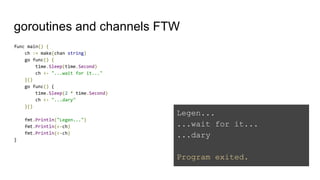
goroutines and channels FTW
func main() {
ch := make(chan string)
go func() {
time.Sleep(time.Second)
ch <- "...wait for it..."
}()
go func() {
time.Sleep(2 * time.Second)
ch <- "...dary"
}()
fmt.Println("Legen...")
fmt.Println(<-ch)
fmt.Println(<-ch)
}
Legen...
...wait for it...
...dary
Program exited.
context.Context
func main() {
ch := make(chan string)
ctx, cancel := context.WithTimeout(context.Background(), 100*time.Millisecond)
defer cancel()
go func() {
time.Sleep(100 * time.Millisecond)
ch <- "SWAG"
}()
// 50/50 chance to fall into either
select {
case s := <-ch: // could be HERE
fmt.Println(s)
case <-ctx.Done():
fmt.Println("YOLO") // could or HERE
}
}
SWAG
Program exited.
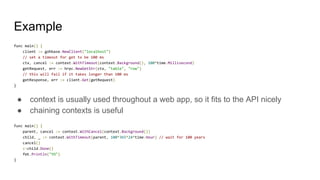
Example
func main() {
client := gohbase.NewClient("localhost")
// set a timeout for get to be 100 ms
ctx, cancel := context.WithTimeout(context.Background(), 100*time.Millisecond)
getRequest, err := hrpc.NewGetStr(ctx, "table", "row")
// this will fail if it takes longer than 100 ms
getResponse, err := client.Get(getRequest)
}
● context is usually used throughout a web app, so it fits to the API nicely
● chaining contexts is useful
func main() {
parent, cancel := context.WithCancel(context.Background())
child, _ := context.WithTimeout(parent, 100*365*24*time.Hour) // wait for 100 years
cancel()
<-child.Done()
fmt.Println("YO")
}
Internal architecture in a nutshell
Case A: Normal (95%)
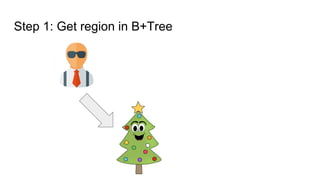
Step 1: Get region in B+Tree
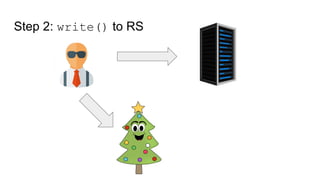
Step 2: write() to RS
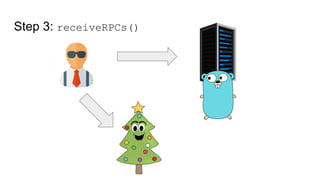
Step 3: receiveRPCs()
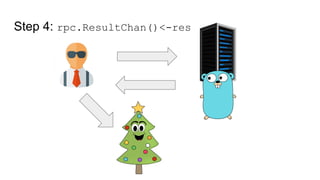
Step 4: rpc.ResultChan()<-res
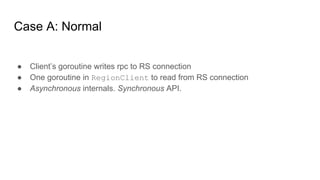
Case A: Normal
● Client’s goroutine writes rpc to RS connection
● One goroutine in RegionClient to read from RS connection
● Asynchronous internals. Synchronous API.
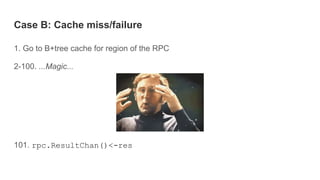
Case B: Cache miss/failure
1. Go to B+tree cache for region of the RPC
2-100. ...Magic...
101. rpc.ResultChan()<-res
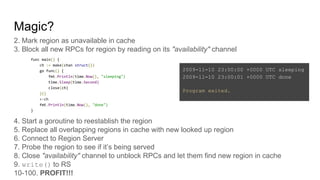
Magic?
2. Mark region as unavailable in cache
3. Block all new RPCs for region by reading on its "availability" channel
4. Start a goroutine to reestablish the region
5. Replace all overlapping regions in cache with new looked up region
6. Connect to Region Server
7. Probe the region to see if it’s being served
8. Close "availability" channel to unblock RPCs and let them find new region in cache
9. write() to RS
10-100. PROFIT!!!
func main() {
ch := make(chan struct{})
go func() {
fmt.Println(time.Now(), "sleeping")
time.Sleep(time.Second)
close(ch)
}()
<-ch
fmt.Println(time.Now(), "done")
}
2009-11-10 23:00:00 +0000 UTC sleeping
2009-11-10 23:00:01 +0000 UTC done
Program exited.
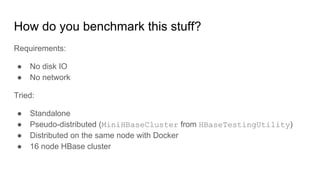
How do you benchmark this stuff?
Requirements:
● No disk IO
● No network
Tried:
● Standalone
● Pseudo-distributed (MiniHBaseCluster from HBaseTestingUtility)
● Distributed on the same node with Docker
● 16 node HBase cluster
I want my cores
● Using 70% CPU per Region Server on client side
● Region Server is chilling and not using all CPUs per connection
● Where’s the bottleneck?
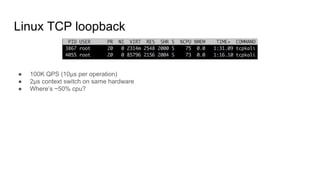
Linux TCP loopback
● 100K QPS (10μs per operation)
● 2μs context switch on same hardware
● Where’s ~50% cpu?
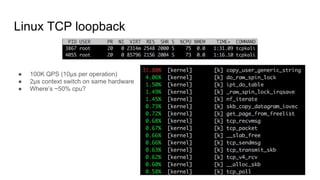
Linux TCP loopback
● 100K QPS (10μs per operation)
● 2μs context switch on same hardware
● Where’s ~50% cpu?
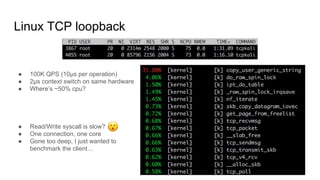
Linux TCP loopback
● 100K QPS (10μs per operation)
● 2μs context switch on same hardware
● Where’s ~50% cpu?
● Read/Write syscall is slow?
● One connection, one core
● Gone too deep, I just wanted to
benchmark the client…
fast.patch [HBASE-15594]
24 clients doing 1M random reads each to one HBase 1.3.1 regionserver
fast.patch [HBASE-15594]
● With it, same %75 / %75 CPU utilization per connection
● Without it, RegionServer is 100% CPU per connection: probably wasting time
context switching
● More threads, more throughput
● More connections, even more throughput
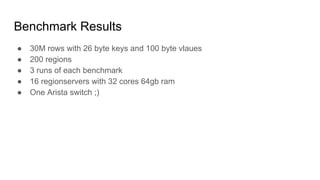
Benchmark Results
● 30M rows with 26 byte keys and 100 byte vlaues
● 200 regions
● 3 runs of each benchmark
● 16 regionservers with 32 cores 64gb ram
● One Arista switch ;)
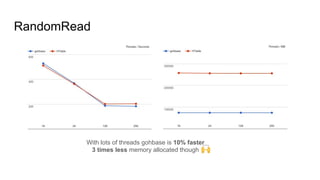
RandomRead
With lots of threads gohbase is 10% faster
3 times less memory allocated though
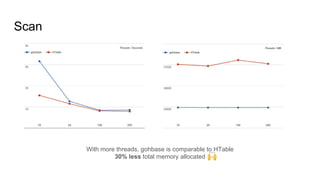
Scan
With more threads, gohbase is comparable to HTable
30% less total memory allocated
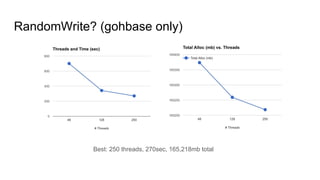
RandomWrite? (gohbase only)
Best: 250 threads, 270sec, 165,218mb total
Benchmarking was “entertaining”
Region split/merge bug [HBASE-18066]
WTF
Get with closest_row_before can return empty cells during a region
split/merge
It's not you, it's me
Stayed as skeptical about the bug in HBase as possible, but then gave up and
started blaming it
Bug breeding
A bug in gohbase exposed a bug in HBase
What's missing?
● Your usage
● Your contribution
● More unit tests...
Thank you
Andrey Elenskiy
Bug Breeder at Arista Networks
andrey.elenskiy@gmail.com

HBaseCon2017 gohbase: Pure Go HBase Client

  • 1.
    gohbase Pure Go HBaseClient Andrey Elenskiy • Bug Breeder at Arista Networks
  • 2.
    What’s so special? ●A (sorta)-fully-functional driver for HBase written in Go ● Kinda based on AsyncHBase Java client ● Fast enough ● Small and simple codebase (for now) ● No Java (not a single AbstractFactoryObserverService)
  • 3.
    Top contributors (2,000++) ● Timoha (Andrey Elenskiy) ● tsuna (Benoit Sigoure) ● dgonyeo (Derek Gonyeo) ● CurleySamuel (Sam Curley)
  • 4.
    So much failure ●HBase's feature-set is huge → bunch of small projects → bugs ● Asynch, wannabe lock-free architecture + handling failures = :coding_horror: ● Benchmarking is tricky ● Found some HBase issues in the process
  • 5.
    Go is prettycool I guess
  • 6.
    goroutines and channelsFTW func main() { ch := make(chan string) go func() { time.Sleep(time.Second) ch <- "...wait for it..." }() go func() { time.Sleep(2 * time.Second) ch <- "...dary" }() fmt.Println("Legen...") fmt.Println(<-ch) fmt.Println(<-ch) } Legen... ...wait for it... ...dary Program exited.
  • 7.
    context.Context func main() { ch:= make(chan string) ctx, cancel := context.WithTimeout(context.Background(), 100*time.Millisecond) defer cancel() go func() { time.Sleep(100 * time.Millisecond) ch <- "SWAG" }() // 50/50 chance to fall into either select { case s := <-ch: // could be HERE fmt.Println(s) case <-ctx.Done(): fmt.Println("YOLO") // could or HERE } } SWAG Program exited.
  • 8.
    Example func main() { client:= gohbase.NewClient("localhost") // set a timeout for get to be 100 ms ctx, cancel := context.WithTimeout(context.Background(), 100*time.Millisecond) getRequest, err := hrpc.NewGetStr(ctx, "table", "row") // this will fail if it takes longer than 100 ms getResponse, err := client.Get(getRequest) } ● context is usually used throughout a web app, so it fits to the API nicely ● chaining contexts is useful func main() { parent, cancel := context.WithCancel(context.Background()) child, _ := context.WithTimeout(parent, 100*365*24*time.Hour) // wait for 100 years cancel() <-child.Done() fmt.Println("YO") }
  • 9.
  • 10.
  • 11.
    Step 1: Getregion in B+Tree
  • 12.
  • 13.
  • 14.
  • 15.
    Case A: Normal ●Client’s goroutine writes rpc to RS connection ● One goroutine in RegionClient to read from RS connection ● Asynchronous internals. Synchronous API.
  • 16.
    Case B: Cachemiss/failure 1. Go to B+tree cache for region of the RPC 2-100. ...Magic... 101. rpc.ResultChan()<-res
  • 17.
    Magic? 2. Mark regionas unavailable in cache 3. Block all new RPCs for region by reading on its "availability" channel 4. Start a goroutine to reestablish the region 5. Replace all overlapping regions in cache with new looked up region 6. Connect to Region Server 7. Probe the region to see if it’s being served 8. Close "availability" channel to unblock RPCs and let them find new region in cache 9. write() to RS 10-100. PROFIT!!! func main() { ch := make(chan struct{}) go func() { fmt.Println(time.Now(), "sleeping") time.Sleep(time.Second) close(ch) }() <-ch fmt.Println(time.Now(), "done") } 2009-11-10 23:00:00 +0000 UTC sleeping 2009-11-10 23:00:01 +0000 UTC done Program exited.
  • 18.
    How do youbenchmark this stuff? Requirements: ● No disk IO ● No network Tried: ● Standalone ● Pseudo-distributed (MiniHBaseCluster from HBaseTestingUtility) ● Distributed on the same node with Docker ● 16 node HBase cluster
  • 19.
    I want mycores ● Using 70% CPU per Region Server on client side ● Region Server is chilling and not using all CPUs per connection ● Where’s the bottleneck?
  • 20.
    Linux TCP loopback ●100K QPS (10μs per operation) ● 2μs context switch on same hardware ● Where’s ~50% cpu?
  • 21.
    Linux TCP loopback ●100K QPS (10μs per operation) ● 2μs context switch on same hardware ● Where’s ~50% cpu?
  • 22.
    Linux TCP loopback ●100K QPS (10μs per operation) ● 2μs context switch on same hardware ● Where’s ~50% cpu? ● Read/Write syscall is slow? ● One connection, one core ● Gone too deep, I just wanted to benchmark the client…
  • 23.
    fast.patch [HBASE-15594] 24 clientsdoing 1M random reads each to one HBase 1.3.1 regionserver
  • 24.
    fast.patch [HBASE-15594] ● Withit, same %75 / %75 CPU utilization per connection ● Without it, RegionServer is 100% CPU per connection: probably wasting time context switching ● More threads, more throughput ● More connections, even more throughput
  • 25.
    Benchmark Results ● 30Mrows with 26 byte keys and 100 byte vlaues ● 200 regions ● 3 runs of each benchmark ● 16 regionservers with 32 cores 64gb ram ● One Arista switch ;)
  • 26.
    RandomRead With lots ofthreads gohbase is 10% faster 3 times less memory allocated though
  • 27.
    Scan With more threads,gohbase is comparable to HTable 30% less total memory allocated
  • 28.
    RandomWrite? (gohbase only) Best:250 threads, 270sec, 165,218mb total
  • 29.
  • 30.
    Region split/merge bug[HBASE-18066] WTF Get with closest_row_before can return empty cells during a region split/merge It's not you, it's me Stayed as skeptical about the bug in HBase as possible, but then gave up and started blaming it Bug breeding A bug in gohbase exposed a bug in HBase
  • 31.
    What's missing? ● Yourusage ● Your contribution ● More unit tests...
  • 32.
    Thank you Andrey Elenskiy BugBreeder at Arista Networks andrey.elenskiy@gmail.com