C100K And Go
Kai Ding
tracymacding@gmail.com
Outline
• C100K problem
• Go
• Example
• Go vs Nginx
• Go stack
• Go schedule
• Go network
C100K
• The C100K problem is the problem of optimising
network sockets to handle a large number of clients
at the same time.The name C100K is a numeronym
for concurrently handling one hundred thousand
connections.
C100K: Key point
Memory
• the less, the better
Scheduler
• the faster, the better
Complexity
• the simple, the better
Solutions
• serve one client with each server thread, use blocking I/O
• Serve many clients with each thread, use nonblocking I/O and
level-triggered readiness notification
• Serve many clients with each thread, use nonblocking I/O and
readiness change notification
• Serve many clients with each thread, use asynchronous I/O
• Build the server code into the kernel
• Others …
• serve one client with each server thread, use blocking I/O
• Simple
• Memory
• ~1MB*100K = 100GB
• Scheduler
• maintain 100K kernel threads in RB tree(using NPTL)
• thread switch (~30 us) (http://blog.tsunanet.net/2010/11/how-long-does-it-
take-to-make-context.html)
Solution
• Serve many clients with each thread, use nonblocking I/O
• Complexity
• using epoll: can’t deal with file IO
• using thread pool or async API to deal with file IO
• Memory
• Low: numCPU * 1MB
• Scheduler
• Low
• Serve many clients with each thread, use asynchronous I/O
• Complexity
• Highest
• Limitation: only support direct io
• Memory
• Low: numCPU * 1MB
• Scheduler
• Low
Another Way?
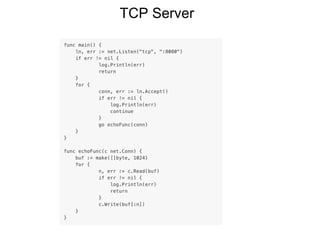
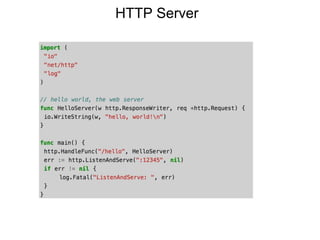
Example of web server using Go
TCP Server
HTTP Server
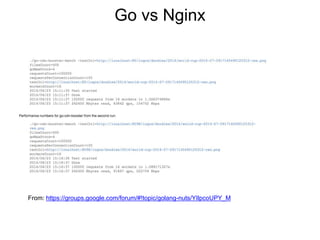
Go vs Nginx
From: https://groups.google.com/forum/#!topic/golang-nuts/YIlpcoUPY_M
Go
• Go is an open source programming language that
makes it easy to build simple, reliable, and efficient
software.
Go routine
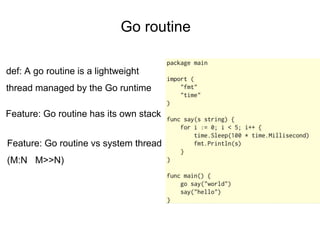
def: A go routine is a lightweight
thread managed by the Go runtime
Feature: Go routine has its own stack
Feature: Go routine vs system thread
(M:N M>>N)
Go stack
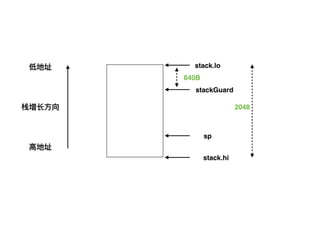
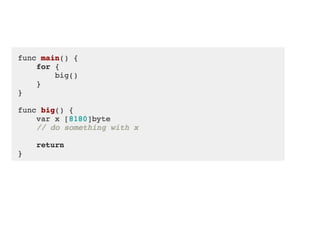
• Tiny stack:~2KB
• Stack grows as needed (2X each time)
• when?
• how?
Go stack
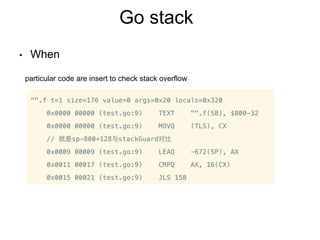
• When
particular code are insert to check stack overflow
Go stack
• How
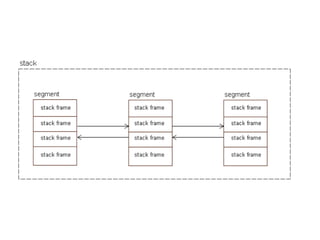
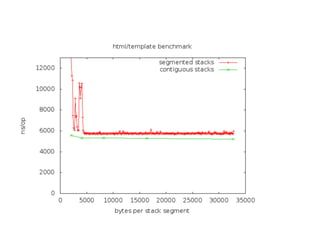
• split stack (v1.0 ~ v1.2)
or segment stack. In this approach, stacks are discontiguous and grow
incrementally. Each stack starts with a single segment. When the stack needs to
grow, another segment is allocated and linked to the previous one, and so forth.
Each stack is effectively a doubly linked list of one or more segments.
Go stack
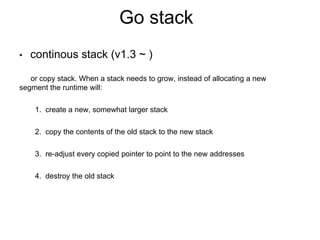
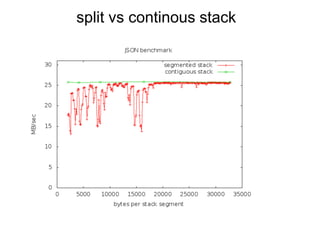
• continous stack (v1.3 ~ )
or copy stack. When a stack needs to grow, instead of allocating a new
segment the runtime will:
1. create a new, somewhat larger stack
2. copy the contents of the old stack to the new stack
3. re-adjust every copied pointer to point to the new addresses
4. destroy the old stack
split vs continous stack
Go scheduler
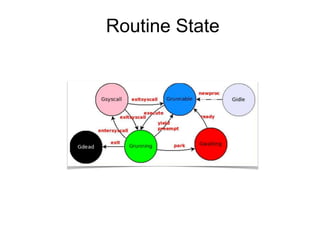
• G & M & P
• Routine state
• Schedule
• Routine switch
G & M & P
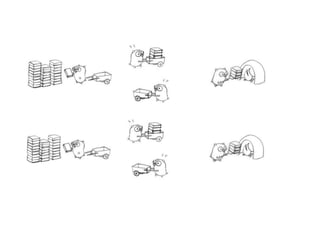
• G: represent go routine
• M: represent system thread
• P: represent processor (since go 1.1)
• G >> M >> P
Routine State
Schedule
• System call
• Channel r/w
• Preempt
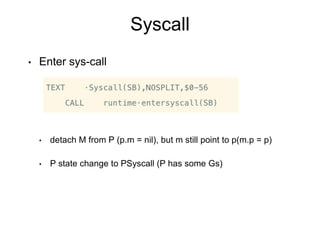
Syscall
• Enter sys-call
• detach M from P (p.m = nil), but m still point to p(m.p = p)
• P state change to PSyscall (P has some Gs)
Syscall
• Exit sys-call
• if m.p is still waiting, put g into p and run
• else find a idle p and run g in it
• else put g in global queue and sleep
Syscall
• P state during syscall
• if PSyscall state last over 10ms, sysmon will take over
• P state become PIdle
• sysmon will get a new idle M to run Gs on P
Channel r/w
• if G
• read from a empty channel (a := <-c)
• write to a full channel (false->c)
• G will be scheduled out
• A brand new G will be picked and run
Preemption
• sysmon will check all P’s last schedule time
• if now - lastsched > 10ms, force running G on P to schedule
• set G.preempt = true and
• set G.stackguard0 = StackPreempt(-1314)
• next time G does function call, stack overflow check, bingo!
• during new stack, schedule
Get runnable G
• from global run queue for fairness
• from P’s local runnable G queue
• wait any G blocked on IO event(network)
• steal from other P
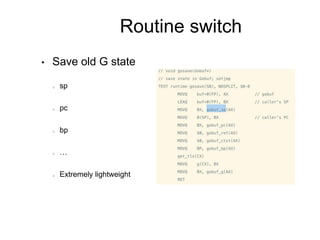
Routine switch
• Save old G state
sp
pc
bp
…
Extremely lightweight
Routine switch
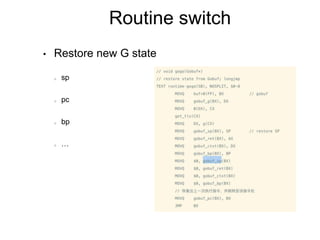
• Restore new G state
sp
pc
bp
…
Go network
• TCP/HTTP Server Example
• Implementation(Linux)
• Some Issue
• timeout
Implementation(Linux)
• Using epoll under linux
• routines blocked on r/w will be scheduled out
• routines woken up if socket has i/o event
• sysmon will check I/O event in socket
• ……
Epoll Init
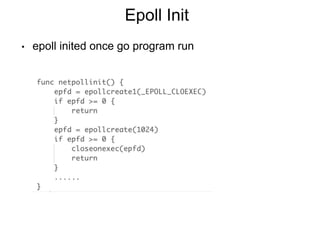
• epoll inited once go program run
New Socket
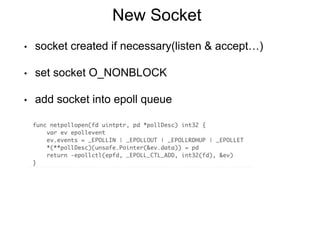
• socket created if necessary(listen & accept…)
• set socket O_NONBLOCK
• add socket into epoll queue
Read/Write
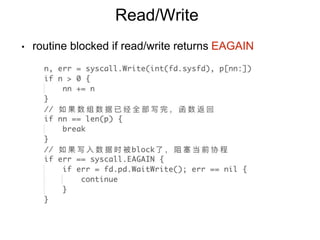
• routine blocked if read/write returns EAGAIN
Read/Write
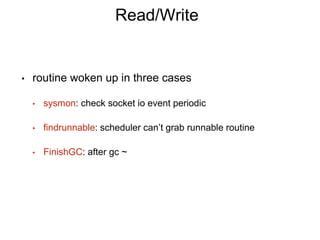
• routine woken up in three cases
• sysmon: check socket io event periodic
• findrunnable: scheduler can’t grab runnable routine
• FinishGC: after gc ~
wake up
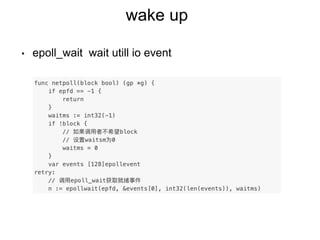
• epoll_wait wait utill io event
wake up
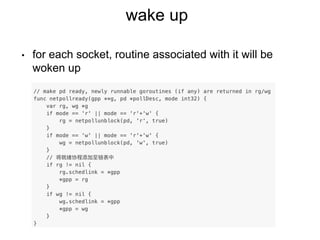
• for each socket, routine associated with it will be
woken up
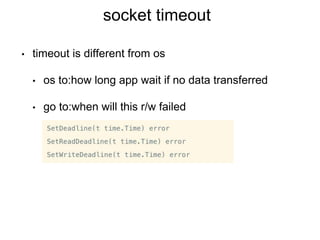
socket timeout
• timeout is different from os
• os to:how long app wait if no data transferred
• go to:when will this r/w failed
socket timeout
• timeout is different from os
• os to:set once, take effective every time
• go to:set each time before r/w
• go to:more exactly than os to!
• suppose 100KB data to be read, 10KB each time

C100 k and go

  • 1.
    C100K And Go KaiDing tracymacding@gmail.com
  • 2.
    Outline • C100K problem •Go • Example • Go vs Nginx • Go stack • Go schedule • Go network
  • 3.
    C100K • The C100Kproblem is the problem of optimising network sockets to handle a large number of clients at the same time.The name C100K is a numeronym for concurrently handling one hundred thousand connections.
  • 4.
    C100K: Key point Memory •the less, the better Scheduler • the faster, the better Complexity • the simple, the better
  • 5.
    Solutions • serve oneclient with each server thread, use blocking I/O • Serve many clients with each thread, use nonblocking I/O and level-triggered readiness notification • Serve many clients with each thread, use nonblocking I/O and readiness change notification • Serve many clients with each thread, use asynchronous I/O • Build the server code into the kernel • Others …
  • 6.
    • serve oneclient with each server thread, use blocking I/O • Simple • Memory • ~1MB*100K = 100GB • Scheduler • maintain 100K kernel threads in RB tree(using NPTL) • thread switch (~30 us) (http://blog.tsunanet.net/2010/11/how-long-does-it- take-to-make-context.html) Solution
  • 7.
    • Serve manyclients with each thread, use nonblocking I/O • Complexity • using epoll: can’t deal with file IO • using thread pool or async API to deal with file IO • Memory • Low: numCPU * 1MB • Scheduler • Low
  • 8.
    • Serve manyclients with each thread, use asynchronous I/O • Complexity • Highest • Limitation: only support direct io • Memory • Low: numCPU * 1MB • Scheduler • Low
  • 9.
  • 11.
    Example of webserver using Go
  • 12.
  • 13.
  • 14.
    Go vs Nginx From:https://groups.google.com/forum/#!topic/golang-nuts/YIlpcoUPY_M
  • 15.
    Go • Go isan open source programming language that makes it easy to build simple, reliable, and efficient software.
  • 19.
    Go routine def: Ago routine is a lightweight thread managed by the Go runtime Feature: Go routine has its own stack Feature: Go routine vs system thread (M:N M>>N)
  • 20.
    Go stack • Tinystack:~2KB • Stack grows as needed (2X each time) • when? • how?
  • 22.
    Go stack • When particularcode are insert to check stack overflow
  • 23.
    Go stack • How •split stack (v1.0 ~ v1.2) or segment stack. In this approach, stacks are discontiguous and grow incrementally. Each stack starts with a single segment. When the stack needs to grow, another segment is allocated and linked to the previous one, and so forth. Each stack is effectively a doubly linked list of one or more segments.
  • 26.
    Go stack • continousstack (v1.3 ~ ) or copy stack. When a stack needs to grow, instead of allocating a new segment the runtime will: 1. create a new, somewhat larger stack 2. copy the contents of the old stack to the new stack 3. re-adjust every copied pointer to point to the new addresses 4. destroy the old stack
  • 27.
  • 29.
    Go scheduler • G& M & P • Routine state • Schedule • Routine switch
  • 30.
    G & M& P • G: represent go routine • M: represent system thread • P: represent processor (since go 1.1) • G >> M >> P
  • 32.
  • 33.
    Schedule • System call •Channel r/w • Preempt
  • 34.
    Syscall • Enter sys-call •detach M from P (p.m = nil), but m still point to p(m.p = p) • P state change to PSyscall (P has some Gs)
  • 35.
    Syscall • Exit sys-call •if m.p is still waiting, put g into p and run • else find a idle p and run g in it • else put g in global queue and sleep
  • 36.
    Syscall • P stateduring syscall • if PSyscall state last over 10ms, sysmon will take over • P state become PIdle • sysmon will get a new idle M to run Gs on P
  • 37.
    Channel r/w • ifG • read from a empty channel (a := <-c) • write to a full channel (false->c) • G will be scheduled out • A brand new G will be picked and run
  • 38.
    Preemption • sysmon willcheck all P’s last schedule time • if now - lastsched > 10ms, force running G on P to schedule • set G.preempt = true and • set G.stackguard0 = StackPreempt(-1314) • next time G does function call, stack overflow check, bingo! • during new stack, schedule
  • 39.
    Get runnable G •from global run queue for fairness • from P’s local runnable G queue • wait any G blocked on IO event(network) • steal from other P
  • 40.
    Routine switch • Saveold G state sp pc bp … Extremely lightweight
  • 41.
    Routine switch • Restorenew G state sp pc bp …
  • 42.
    Go network • TCP/HTTPServer Example • Implementation(Linux) • Some Issue • timeout
  • 43.
    Implementation(Linux) • Using epollunder linux • routines blocked on r/w will be scheduled out • routines woken up if socket has i/o event • sysmon will check I/O event in socket • ……
  • 44.
    Epoll Init • epollinited once go program run
  • 45.
    New Socket • socketcreated if necessary(listen & accept…) • set socket O_NONBLOCK • add socket into epoll queue
  • 46.
    Read/Write • routine blockedif read/write returns EAGAIN
  • 47.
    Read/Write • routine wokenup in three cases • sysmon: check socket io event periodic • findrunnable: scheduler can’t grab runnable routine • FinishGC: after gc ~
  • 48.
    wake up • epoll_waitwait utill io event
  • 49.
    wake up • foreach socket, routine associated with it will be woken up
  • 50.
    socket timeout • timeoutis different from os • os to:how long app wait if no data transferred • go to:when will this r/w failed
  • 51.
    socket timeout • timeoutis different from os • os to:set once, take effective every time • go to:set each time before r/w • go to:more exactly than os to! • suppose 100KB data to be read, 10KB each time