1
The Snowflake Elastic Data Warehouse
SIGMOD 2016 and beyond
Ashish Motivala, Jiaqi Yan
2
Our Product
•The Snowflake Elastic Data Warehouse, or “Snowflake”
•Built for the cloud
•Multi-tenant, transactional, secure, highly scalable, elastic
•Implemented from scratch (no Hadoop, Postgres etc.)
•Currently runs on AWS and Azure
•Serves tens of millions of queries per day over hundreds
petabytes of data
•1000+ active customers, growing fast
3
Talk Outline
•Motivation and Vision
•Storage vs. Compute or the Perils of Shared-Nothing
•Architecture
•Feature Highlights
•Lessons Learned
4
Why Cloud?
•Amazing platform for building distributed systems
•Virtually unlimited, elastic compute and storage
•Pay-per-use model (with strong economies of scale)
•Efficient access from anywhere
•Software as a Service (SaaS)
•No need for complex IT organization and infrastructure
•Pay-per-use model
•Radically simplified software delivery, update, and user support
•See “Lessons Learned”
5
Data Warehousing in the Cloud
•Traditional DW systems pre-date the cloud
•Designed for small, fixed clusters of machines
•But to reap benefits of the cloud, software needs to be elastic!
•Traditional DW systems rely on complex ETL
(extract-transform-load) pipelines and physical tuning
•Fundamentally assume predictable, slow-moving, easily categorized
data from internal sources (OLTP, ERP, CRM…)
•Cloud data increasingly stems from changing, external sources
•Logs, click streams, mobile devices, social media, sensor data
•Often arrives in schema-less, semi-structured form (JSON, XML, Avro)
6
What about Big Data?
•Hive, Spark, BigQuery, Impala, Blink…
•Batch and/or stream processing at datacenter scale
•Various SQL’esque front-ends
•Increasingly popular alternative for high-end use cases
•Drawbacks
•Lack efficiency and feature set of traditional DW technology
•Security? Backups? Transactions? …
•Require significant engineering effort to roll out and use
7
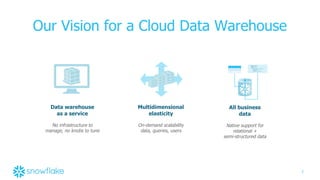
Our Vision for a Cloud Data Warehouse
Data warehouse
as a service
No infrastructure to
manage, no knobs to tune
Multidimensional
elasticity
On-demand scalability
data, queries, users
All business
data
Native support for
relational +
semi-structured data
8
Shared-nothing Architecture
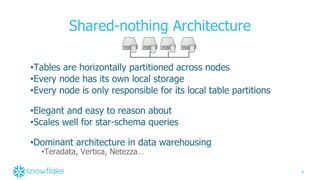
•Tables are horizontally partitioned across nodes
•Every node has its own local storage
•Every node is only responsible for its local table partitions
•Elegant and easy to reason about
•Scales well for star-schema queries
•Dominant architecture in data warehousing
•Teradata, Vertica, Netezza…
9
The Perils of Coupling
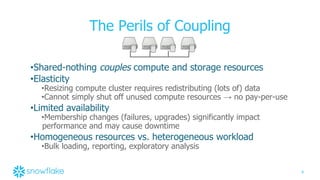
•Shared-nothing couples compute and storage resources
•Elasticity
•Resizing compute cluster requires redistributing (lots of) data
•Cannot simply shut off unused compute resources → no pay-per-use
•Limited availability
•Membership changes (failures, upgrades) significantly impact
performance and may cause downtime
•Homogeneous resources vs. heterogeneous workload
•Bulk loading, reporting, exploratory analysis
10
Multi-cluster, shared data architecture
Databases
Virtual
Warehouse
Virtual
Warehouse
ETL & Data
Loading
Virtual
Warehouse
Finance
Virtual
Warehouse
Dev, Test,
QA
Dashboards
Virtual
Warehouse
Marketing
Data Science
Clone
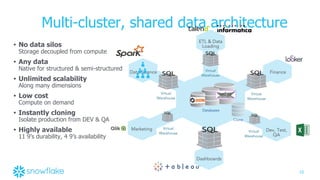
• No data silos
Storage decoupled from compute
• Any data
Native for structured & semi-structured
• Unlimited scalability
Along many dimensions
• Low cost
Compute on demand
• Instantly cloning
Isolate production from DEV & QA
• Highly available
11 9’s durability, 4 9’s availability
11
Data Storage
Multi-cluster Shared-data Architecture
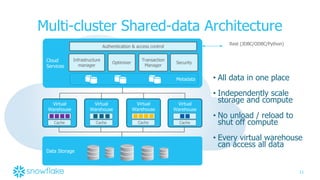
• All data in one place
• Independently scale
storage and compute
• No unload / reload to
shut off compute
• Every virtual warehouse
can access all data
Cloud
Services
Transaction
Manager
Security
Optimizer
Infrastructure
manager
Authentication & access control
Virtual
Warehouse
Cache
Virtual
Warehouse
Cache
Virtual
Warehouse
Cache
Virtual
Warehouse
Cache
Rest (JDBC/ODBC/Python)
Metadata
12
Data Storage Layer
•Stores table data and query results
•Table is a set of immutable micro-partitions
•Uses tiered storage with Amazon S3 at the bottom
•Object store (key-value) with HTTP(S) PUT/GET/DELETE interface
•High availability, extreme durability (11-9)
•Some important differences w.r.t. local disks
•Performance (sure…)
•No update-in-place, objects must be written in full
•But: can read parts (byte ranges) of objects
•Strong influence on table micro-partition format and
concurrency control
13
Table Files
•Snowflake uses PAX [Ailamaki01] aka
hybrid columnar storage
•Tables horizontally partitioned into
immutable mirco-partitions (~16 MB)
•Updates add or remove entire files
•Values of each column grouped together
and compressed
•Queries read header + columns they need
14
Other Data
•Tiered storage also used for temp data and query results
•Arbitrarily large queries, never run out of disk
•New forms of client interaction
•No server-side cursors
•Retrieve and reuse previous query results
•Metadata stored in a transactional key-value store (not S3)
•Which table consists of which S3 objects
•Optimizer statistics, lock tables, transaction logs etc.
•Part of Cloud Services layer (see later)
15
Virtual Warehouse
•warehouse = Cluster of EC2 instances called worker nodes
•Pure compute resources
•Created, destroyed, resized on demand
•Users may run multiple warehouses at same time
•Each warehouse has access to all data but isolated performance
•Users may shut down all warehouses when they have nothing to run
•T-Shirt sizes: XS to 4XL
•Users do not know which type or how many EC2 instances
•Service and pricing can evolve independent of cloud platform
16
Worker Nodes
•Worker processes are ephemeral and idempotent
•Worker node forks new worker process when query arrives
•Do not modify micro-partitions directly but queue removal or addition
of micro-partitions
•Each worker node maintains local table cache
•Collection of table files i.e. S3 objects accessed in past
•Shared across concurrent and subsequent worker processes
•Assignment of micro-partitions to nodes using consistent hashing, with
deterministic stealing.
17
Execution Engine
•Columnar [MonetDB, C-Store, many more]
•Effective use of CPU caches, SIMD instructions, and compression
•Vectorized [Zukowski05]
•Operators handle batches of a few thousand rows in columnar format
•Avoids materialization of intermediate results
•Push-based [Neumann11 and many before that]
•Operators push results to downstream operators (no Volcano iterators)
•Removes control logic from tight loops
•Works well with DAG-shaped plans
•No transaction management, no buffer pool
•But: most operators (join, group by, sort) can spill to disk and recurse
18
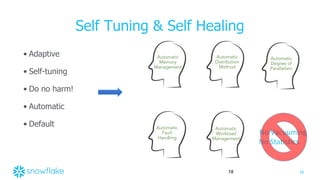
• Adaptive
• Self-tuning
• Do no harm!
• Automatic
• Default
18
Self Tuning & Self Healing
Automatic
Memory
Management
Automatic
Workload
Management
Automatic
Distribution
Method
Automatic
Degree of
Parallelism
Automatic
Fault
Handling
19
•
•
•
•
•
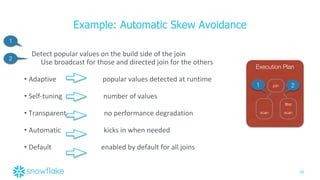
Example: Automatic Skew Avoidance
Execution Plan
2
scan
join
scan
filter
1
1
2
20
Cloud Services
•Collection of services
•Access control, query optimizer, transaction manager etc.
•Heavily multi-tenant (shared among users) and always on
•Improves utilization and reduces administration
•Each service replicated for availability and scalability
•Hard state stored in transactional key-value store
21
Concurrency Control
•Designed for analytic workloads
•Large reads, bulk or trickle inserts, bulk updates
•Snapshot Isolation (SI) [Berenson95]
•SI based on multi-version concurrency control (MVCC)
•DML statements (insert, update, delete, merge) produce new table
versions of tables by adding or removing whole files
•Natural choice because table files on S3 are immutable
•Additions and removals tracked in metadata (key-value store)
•Versioned snapshots used also for time travel and cloning
22
Pruning
•Database adage: The fastest way to process data? Don’t.
•Limiting access only to relevant data is key aspect of query processing
•Traditional solution: B+
-trees and other indices
•Poor fit for us: random accesses, high load time, manual tuning
•Snowflake approach: pruning
•AKA small materialized aggregates [Moerkotte98], zone maps
[Netezza], data skipping [IBM]
•Per file min/max values, #distinct values, #nulls, bloom filters etc.
•Use metadata to decide which files are relevant for a given query
•Smaller than indices, more load-friendly, no user input required
23
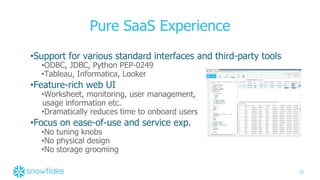
Pure SaaS Experience
•Support for various standard interfaces and third-party tools
•ODBC, JDBC, Python PEP-0249
•Tableau, Informatica, Looker
•Feature-rich web UI
•Worksheet, monitoring, user management,
usage information etc.
•Dramatically reduces time to onboard users
•Focus on ease-of-use and service exp.
•No tuning knobs
•No physical design
•No storage grooming
24
Continuous Availability
•Storage and cloud services replicated across datacenters
•Snowflake remains available even if a whole datacenter fails
•Weekly Online Upgrade
•No downtime, no performance degradation!
•Tremendous effect on pace of development and bug resolution time
•Magic sauce: stateless services
•All state is versioned and stored in common key-value store
•Multiple versions of a service can run concurrently
•Load balancing layer routes new queries to new service version, until
old version finished all its queries
25
Semi-Structured and Schema-Less Data
•Three new data types: VARIANT, ARRAY, OBJECT
•VARIANT: holds values of any standard SQL type + ARRAY + OBJECT
•ARRAY: offset-addressable collection of VARIANT values
•OBJECT: dictionary that maps strings to VARIANT values
•Like JavaScript objects or MongoDB documents
•Self-describing, compact binary serialization
•Designed for fast key-value lookup, comparison, and hashing
•Supported by all SQL operators (joins, group by, sort…)
26
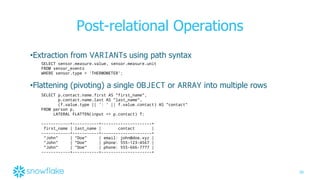
Post-relational Operations
•Extraction from VARIANTs using path syntax
•Flattening (pivoting) a single OBJECT or ARRAY into multiple rows
SELECT p.contact.name.first AS "first_name",
p.contact.name.last AS "last_name",
(f.value.type || ': ' || f.value.contact) AS "contact"
FROM person p,
LATERAL FLATTEN(input => p.contact) f;
------------+-----------+---------------------+
first_name | last_name | contact |
------------+-----------+---------------------+
“John" | “Doe" | email: john@doe.xyz |
“John" | “Doe" | phone: 555-123-4567 |
“John" | “Doe" | phone: 555-666-7777 |
------------+-----------+---------------------+
SELECT sensor.measure.value, sensor.measure.unit
FROM sensor_events
WHERE sensor.type = ‘THERMOMETER’;
27
Schema-Less Data
•Cloudera Impala, Google BigQuery/Dremel
•Columnar storage and processing of semi-structured data
•But: full schema required up front!
•Snowflake introduces automatic type inference and columnar storage for
schema-less data (VARIANT)
•Frequently common paths are detected, projected out, and stored in separate (typed
and compressed) columns in table file
•Collect metadata on these columns for use by optimizer → pruning
•Independent for each micro-partition → schema evolution
28
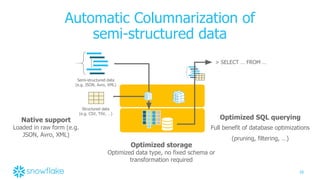
Automatic Columnarization of
semi-structured data
> SELECT … FROM …
Semi-structured data
(e.g. JSON, Avro, XML)
Structured data
(e.g. CSV, TSV, …)
Native support
Loaded in raw form (e.g.
JSON, Avro, XML)
Optimized storage
Optimized data type, no fixed schema or
transformation required
Optimized SQL querying
Full benefit of database optimizations
(pruning, filtering, …)
29
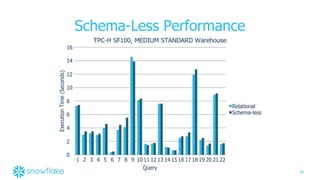
Schema-Less Performance
30
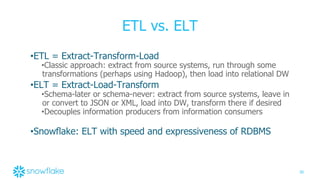
ETL vs. ELT
•ETL = Extract-Transform-Load
•Classic approach: extract from source systems, run through some
transformations (perhaps using Hadoop), then load into relational DW
•ELT = Extract-Load-Transform
•Schema-later or schema-never: extract from source systems, leave in
or convert to JSON or XML, load into DW, transform there if desired
•Decouples information producers from information consumers
•Snowflake: ELT with speed and expressiveness of RDBMS
31
Time Travel and Cloning
•Previous versions of data
automatically retained
•Same metadata as Snapshot Isolation
•Accessed via SQL extensions
•UNDROP recovers from accidental
deletion
•SELECT AT for point-in-time selection
•CLONE [AT] to recreate past versions
> SELECT * FROM mytable
AT T0
New
data
Modified
data
T0 T1 T2
32
Security
•Encrypted data import and export
•Encryption of table data using NIST 800-57 compliant
hierarchical key management and key lifecycle
•Root keys stored in hardware security module (HSM)
•Integration of S3 access policies
•Role-based access control (RBAC) within SQL
•Two-factor authentication and federated authentication
33
Post-SIGMOD ‘16 Features
•Data sharing
•Serverless ingestion of data
•Reclustering of data
•Spark connector with pushdown
•Support for Azure Cloud
•Lots more connectors
34
Lessons Learned
•Building a relational DW was a controversial decision in 2012
•But turned out correct; Hadoop did not replace RDBMSs
•Multi-cluster, shared-data architecture game changer for org
•Business units can provision warehouses on-demand
•Fewer data silos
•Dramatically lower load times and higher load frequency
•Semi-structured extensions were a bigger hit than expected
•People use Snowflake to replace Hadoop clusters
35
Lessons Learned (2)
•SaaS model dramatically helped speed of development
•Only one platform to develop for
•Every user running the same version
•Bugs can be analyzed, reproduced, and fixed very quickly
•Users love “no tuning” aspect
•But creates continuous stream of hard engineering challenges…
•Core performance less important than anticipated
•Elasticity matters more in practice
36
Ongoing Challenges
•SaaS and multi-tenancy are big challenges
•Support tens of thousands of concurrent users, some of which do
weird things, and need protection for themselves.
•Metadata layer has become huge
•Categorizing and handling failures automatically is hard, but
•Automation is key to keeping operations lean
•Lots of work left to do
•SQL performance improvements, better skew handling etc.
•Cloud platform enables a slew of new classes of features.
37
Future work
•Advisors
•Materialized Views
•Stored procedures
•Data Lake support
•Streaming
•Time series
•Multi-cloud
•Global Snowflake
•Replication
38
Who We Are
•Founded: August 2012
•Mission in 2012: Build an enterprise data warehouse as a cloud
service
•HQ in downtown San Mateo (south of San Francisco), Engr
Office #2 in Seattle
•400+ employees, 80 engrs and hiring…
•Founders: Benoit Dageville, Thierry Cruanes, Marcin Zukowski
•CEO: Bob Muglia
•Raised $283M in 2018
39
Summary
•Snowflake is an enterprise-ready data warehouse as a service
•Novel multi-cluster, shared-data architecture
•Highly elastic and available
•Semi-structured and schema-less data at the speed of relational data
•Pure SaaS experience
•Rapidly growing user base and data volume
•Lots of challenging work left to do
40

25 snowflake

  • 1.
    1 The Snowflake ElasticData Warehouse SIGMOD 2016 and beyond Ashish Motivala, Jiaqi Yan
  • 2.
    2 Our Product •The SnowflakeElastic Data Warehouse, or “Snowflake” •Built for the cloud •Multi-tenant, transactional, secure, highly scalable, elastic •Implemented from scratch (no Hadoop, Postgres etc.) •Currently runs on AWS and Azure •Serves tens of millions of queries per day over hundreds petabytes of data •1000+ active customers, growing fast
  • 3.
    3 Talk Outline •Motivation andVision •Storage vs. Compute or the Perils of Shared-Nothing •Architecture •Feature Highlights •Lessons Learned
  • 4.
    4 Why Cloud? •Amazing platformfor building distributed systems •Virtually unlimited, elastic compute and storage •Pay-per-use model (with strong economies of scale) •Efficient access from anywhere •Software as a Service (SaaS) •No need for complex IT organization and infrastructure •Pay-per-use model •Radically simplified software delivery, update, and user support •See “Lessons Learned”
  • 5.
    5 Data Warehousing inthe Cloud •Traditional DW systems pre-date the cloud •Designed for small, fixed clusters of machines •But to reap benefits of the cloud, software needs to be elastic! •Traditional DW systems rely on complex ETL (extract-transform-load) pipelines and physical tuning •Fundamentally assume predictable, slow-moving, easily categorized data from internal sources (OLTP, ERP, CRM…) •Cloud data increasingly stems from changing, external sources •Logs, click streams, mobile devices, social media, sensor data •Often arrives in schema-less, semi-structured form (JSON, XML, Avro)
  • 6.
    6 What about BigData? •Hive, Spark, BigQuery, Impala, Blink… •Batch and/or stream processing at datacenter scale •Various SQL’esque front-ends •Increasingly popular alternative for high-end use cases •Drawbacks •Lack efficiency and feature set of traditional DW technology •Security? Backups? Transactions? … •Require significant engineering effort to roll out and use
  • 7.
    7 Our Vision fora Cloud Data Warehouse Data warehouse as a service No infrastructure to manage, no knobs to tune Multidimensional elasticity On-demand scalability data, queries, users All business data Native support for relational + semi-structured data
  • 8.
    8 Shared-nothing Architecture •Tables arehorizontally partitioned across nodes •Every node has its own local storage •Every node is only responsible for its local table partitions •Elegant and easy to reason about •Scales well for star-schema queries •Dominant architecture in data warehousing •Teradata, Vertica, Netezza…
  • 9.
    9 The Perils ofCoupling •Shared-nothing couples compute and storage resources •Elasticity •Resizing compute cluster requires redistributing (lots of) data •Cannot simply shut off unused compute resources → no pay-per-use •Limited availability •Membership changes (failures, upgrades) significantly impact performance and may cause downtime •Homogeneous resources vs. heterogeneous workload •Bulk loading, reporting, exploratory analysis
  • 10.
    10 Multi-cluster, shared dataarchitecture Databases Virtual Warehouse Virtual Warehouse ETL & Data Loading Virtual Warehouse Finance Virtual Warehouse Dev, Test, QA Dashboards Virtual Warehouse Marketing Data Science Clone • No data silos Storage decoupled from compute • Any data Native for structured & semi-structured • Unlimited scalability Along many dimensions • Low cost Compute on demand • Instantly cloning Isolate production from DEV & QA • Highly available 11 9’s durability, 4 9’s availability
  • 11.
    11 Data Storage Multi-cluster Shared-dataArchitecture • All data in one place • Independently scale storage and compute • No unload / reload to shut off compute • Every virtual warehouse can access all data Cloud Services Transaction Manager Security Optimizer Infrastructure manager Authentication & access control Virtual Warehouse Cache Virtual Warehouse Cache Virtual Warehouse Cache Virtual Warehouse Cache Rest (JDBC/ODBC/Python) Metadata
  • 12.
    12 Data Storage Layer •Storestable data and query results •Table is a set of immutable micro-partitions •Uses tiered storage with Amazon S3 at the bottom •Object store (key-value) with HTTP(S) PUT/GET/DELETE interface •High availability, extreme durability (11-9) •Some important differences w.r.t. local disks •Performance (sure…) •No update-in-place, objects must be written in full •But: can read parts (byte ranges) of objects •Strong influence on table micro-partition format and concurrency control
  • 13.
    13 Table Files •Snowflake usesPAX [Ailamaki01] aka hybrid columnar storage •Tables horizontally partitioned into immutable mirco-partitions (~16 MB) •Updates add or remove entire files •Values of each column grouped together and compressed •Queries read header + columns they need
  • 14.
    14 Other Data •Tiered storagealso used for temp data and query results •Arbitrarily large queries, never run out of disk •New forms of client interaction •No server-side cursors •Retrieve and reuse previous query results •Metadata stored in a transactional key-value store (not S3) •Which table consists of which S3 objects •Optimizer statistics, lock tables, transaction logs etc. •Part of Cloud Services layer (see later)
  • 15.
    15 Virtual Warehouse •warehouse =Cluster of EC2 instances called worker nodes •Pure compute resources •Created, destroyed, resized on demand •Users may run multiple warehouses at same time •Each warehouse has access to all data but isolated performance •Users may shut down all warehouses when they have nothing to run •T-Shirt sizes: XS to 4XL •Users do not know which type or how many EC2 instances •Service and pricing can evolve independent of cloud platform
  • 16.
    16 Worker Nodes •Worker processesare ephemeral and idempotent •Worker node forks new worker process when query arrives •Do not modify micro-partitions directly but queue removal or addition of micro-partitions •Each worker node maintains local table cache •Collection of table files i.e. S3 objects accessed in past •Shared across concurrent and subsequent worker processes •Assignment of micro-partitions to nodes using consistent hashing, with deterministic stealing.
  • 17.
    17 Execution Engine •Columnar [MonetDB,C-Store, many more] •Effective use of CPU caches, SIMD instructions, and compression •Vectorized [Zukowski05] •Operators handle batches of a few thousand rows in columnar format •Avoids materialization of intermediate results •Push-based [Neumann11 and many before that] •Operators push results to downstream operators (no Volcano iterators) •Removes control logic from tight loops •Works well with DAG-shaped plans •No transaction management, no buffer pool •But: most operators (join, group by, sort) can spill to disk and recurse
  • 18.
    18 • Adaptive • Self-tuning •Do no harm! • Automatic • Default 18 Self Tuning & Self Healing Automatic Memory Management Automatic Workload Management Automatic Distribution Method Automatic Degree of Parallelism Automatic Fault Handling
  • 19.
    19 • • • • • Example: Automatic SkewAvoidance Execution Plan 2 scan join scan filter 1 1 2
  • 20.
    20 Cloud Services •Collection ofservices •Access control, query optimizer, transaction manager etc. •Heavily multi-tenant (shared among users) and always on •Improves utilization and reduces administration •Each service replicated for availability and scalability •Hard state stored in transactional key-value store
  • 21.
    21 Concurrency Control •Designed foranalytic workloads •Large reads, bulk or trickle inserts, bulk updates •Snapshot Isolation (SI) [Berenson95] •SI based on multi-version concurrency control (MVCC) •DML statements (insert, update, delete, merge) produce new table versions of tables by adding or removing whole files •Natural choice because table files on S3 are immutable •Additions and removals tracked in metadata (key-value store) •Versioned snapshots used also for time travel and cloning
  • 22.
    22 Pruning •Database adage: Thefastest way to process data? Don’t. •Limiting access only to relevant data is key aspect of query processing •Traditional solution: B+ -trees and other indices •Poor fit for us: random accesses, high load time, manual tuning •Snowflake approach: pruning •AKA small materialized aggregates [Moerkotte98], zone maps [Netezza], data skipping [IBM] •Per file min/max values, #distinct values, #nulls, bloom filters etc. •Use metadata to decide which files are relevant for a given query •Smaller than indices, more load-friendly, no user input required
  • 23.
    23 Pure SaaS Experience •Supportfor various standard interfaces and third-party tools •ODBC, JDBC, Python PEP-0249 •Tableau, Informatica, Looker •Feature-rich web UI •Worksheet, monitoring, user management, usage information etc. •Dramatically reduces time to onboard users •Focus on ease-of-use and service exp. •No tuning knobs •No physical design •No storage grooming
  • 24.
    24 Continuous Availability •Storage andcloud services replicated across datacenters •Snowflake remains available even if a whole datacenter fails •Weekly Online Upgrade •No downtime, no performance degradation! •Tremendous effect on pace of development and bug resolution time •Magic sauce: stateless services •All state is versioned and stored in common key-value store •Multiple versions of a service can run concurrently •Load balancing layer routes new queries to new service version, until old version finished all its queries
  • 25.
    25 Semi-Structured and Schema-LessData •Three new data types: VARIANT, ARRAY, OBJECT •VARIANT: holds values of any standard SQL type + ARRAY + OBJECT •ARRAY: offset-addressable collection of VARIANT values •OBJECT: dictionary that maps strings to VARIANT values •Like JavaScript objects or MongoDB documents •Self-describing, compact binary serialization •Designed for fast key-value lookup, comparison, and hashing •Supported by all SQL operators (joins, group by, sort…)
  • 26.
    26 Post-relational Operations •Extraction fromVARIANTs using path syntax •Flattening (pivoting) a single OBJECT or ARRAY into multiple rows SELECT p.contact.name.first AS "first_name", p.contact.name.last AS "last_name", (f.value.type || ': ' || f.value.contact) AS "contact" FROM person p, LATERAL FLATTEN(input => p.contact) f; ------------+-----------+---------------------+ first_name | last_name | contact | ------------+-----------+---------------------+ “John" | “Doe" | email: john@doe.xyz | “John" | “Doe" | phone: 555-123-4567 | “John" | “Doe" | phone: 555-666-7777 | ------------+-----------+---------------------+ SELECT sensor.measure.value, sensor.measure.unit FROM sensor_events WHERE sensor.type = ‘THERMOMETER’;
  • 27.
    27 Schema-Less Data •Cloudera Impala,Google BigQuery/Dremel •Columnar storage and processing of semi-structured data •But: full schema required up front! •Snowflake introduces automatic type inference and columnar storage for schema-less data (VARIANT) •Frequently common paths are detected, projected out, and stored in separate (typed and compressed) columns in table file •Collect metadata on these columns for use by optimizer → pruning •Independent for each micro-partition → schema evolution
  • 28.
    28 Automatic Columnarization of semi-structureddata > SELECT … FROM … Semi-structured data (e.g. JSON, Avro, XML) Structured data (e.g. CSV, TSV, …) Native support Loaded in raw form (e.g. JSON, Avro, XML) Optimized storage Optimized data type, no fixed schema or transformation required Optimized SQL querying Full benefit of database optimizations (pruning, filtering, …)
  • 29.
  • 30.
    30 ETL vs. ELT •ETL= Extract-Transform-Load •Classic approach: extract from source systems, run through some transformations (perhaps using Hadoop), then load into relational DW •ELT = Extract-Load-Transform •Schema-later or schema-never: extract from source systems, leave in or convert to JSON or XML, load into DW, transform there if desired •Decouples information producers from information consumers •Snowflake: ELT with speed and expressiveness of RDBMS
  • 31.
    31 Time Travel andCloning •Previous versions of data automatically retained •Same metadata as Snapshot Isolation •Accessed via SQL extensions •UNDROP recovers from accidental deletion •SELECT AT for point-in-time selection •CLONE [AT] to recreate past versions > SELECT * FROM mytable AT T0 New data Modified data T0 T1 T2
  • 32.
    32 Security •Encrypted data importand export •Encryption of table data using NIST 800-57 compliant hierarchical key management and key lifecycle •Root keys stored in hardware security module (HSM) •Integration of S3 access policies •Role-based access control (RBAC) within SQL •Two-factor authentication and federated authentication
  • 33.
    33 Post-SIGMOD ‘16 Features •Datasharing •Serverless ingestion of data •Reclustering of data •Spark connector with pushdown •Support for Azure Cloud •Lots more connectors
  • 34.
    34 Lessons Learned •Building arelational DW was a controversial decision in 2012 •But turned out correct; Hadoop did not replace RDBMSs •Multi-cluster, shared-data architecture game changer for org •Business units can provision warehouses on-demand •Fewer data silos •Dramatically lower load times and higher load frequency •Semi-structured extensions were a bigger hit than expected •People use Snowflake to replace Hadoop clusters
  • 35.
    35 Lessons Learned (2) •SaaSmodel dramatically helped speed of development •Only one platform to develop for •Every user running the same version •Bugs can be analyzed, reproduced, and fixed very quickly •Users love “no tuning” aspect •But creates continuous stream of hard engineering challenges… •Core performance less important than anticipated •Elasticity matters more in practice
  • 36.
    36 Ongoing Challenges •SaaS andmulti-tenancy are big challenges •Support tens of thousands of concurrent users, some of which do weird things, and need protection for themselves. •Metadata layer has become huge •Categorizing and handling failures automatically is hard, but •Automation is key to keeping operations lean •Lots of work left to do •SQL performance improvements, better skew handling etc. •Cloud platform enables a slew of new classes of features.
  • 37.
    37 Future work •Advisors •Materialized Views •Storedprocedures •Data Lake support •Streaming •Time series •Multi-cloud •Global Snowflake •Replication
  • 38.
    38 Who We Are •Founded:August 2012 •Mission in 2012: Build an enterprise data warehouse as a cloud service •HQ in downtown San Mateo (south of San Francisco), Engr Office #2 in Seattle •400+ employees, 80 engrs and hiring… •Founders: Benoit Dageville, Thierry Cruanes, Marcin Zukowski •CEO: Bob Muglia •Raised $283M in 2018
  • 39.
    39 Summary •Snowflake is anenterprise-ready data warehouse as a service •Novel multi-cluster, shared-data architecture •Highly elastic and available •Semi-structured and schema-less data at the speed of relational data •Pure SaaS experience •Rapidly growing user base and data volume •Lots of challenging work left to do
  • 40.