Curriculum and Instruction
Day 1
Prepared by
Ms. Naina Hassan ALi
Introduction
 Name and its meaning
2
Expectation
 Your expectation from course
 Your expectation from Facilitator
3
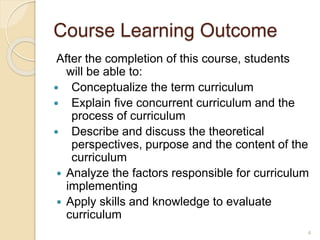
Course Learning Outcome
After the completion of this course, students
will be able to:
 Conceptualize the term curriculum
 Explain five concurrent curriculum and the
process of curriculum
 Describe and discuss the theoretical
perspectives, purpose and the content of the
curriculum
 Analyze the factors responsible for curriculum
implementing
 Apply skills and knowledge to evaluate
curriculum
4
Course Contents
 Introduction to curriculum
◦ Meaning of Curriculum
◦ Types of Curriculum
◦ Curriculum Models
 Taba’s Model
 Tyler’s Model
5
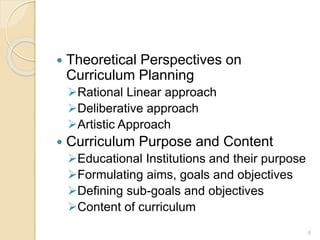
 Theoretical Perspectives on
Curriculum Planning
Rational Linear approach
Deliberative approach
Artistic Approach
 Curriculum Purpose and Content
Educational Institutions and their purpose
Formulating aims, goals and objectives
Defining sub-goals and objectives
Content of curriculum
6
 Curriculum Organization
The future and curriculum choices
The future and organization of curriculum
Proposal for a better future curriculum
 Curriculum Implementation and
instructions
Teaching and instructions
Basis for selecting teaching Models
Individualized Instructions and curriculum
planning
7
 Curriculum Evaluation
Evaluations- goals, sub-goals and
objectives
Methods of assessments
Evaluation models
8
Curriculum
 Think, Pair & Share
 Write your own definition and then
discussion…
9
Curriculum
 Curriculum is a continuous reconstruction,
moving from the child’s present experience out
into that represented by the organized bodies of
truth that we call studies . . . the various studies .
. . are themselves experience— they are that of
the race. (pp. 11–12)
John Dewey
 The curriculum is composed of all the
experiences children have under the guidance of
teachers. . . . Thus, curriculum considered as a
field of study represents no strictly limited body of
content, but rather a process or procedure. (pp.
66, 70)
 Hollis Caswell in Caswell & Campbell
10
Activity 1
 Peer (Types of Curriculum)
 Hidden
 Null
 Written
11
12
Recommended Curriculum
 The recommended curriculum is the one
recommended by the individual scholars,
professional associations, and reform
commissions; it also encompasses the
curriculum requirements of policymaking
groups, such as federal and state
governments. Similar to Goodlad’s
“ideological curriculum,” it is a curriculum
that stresses “oughtness,” identifying the
skills and concepts that ought to be
emphasized, according to the
perceptions and value systems of the
sources.
13
Written Curriculum
 The written curriculum is intended
primarily to ensure that the educational
goals of the system are being
accomplished; it is a curriculum of
control. Typically, the written curriculum
is much more specific and
comprehensive than the recommended
curriculum, indicating a rationale that
supports the curriculum, the general
goals to be accomplished, the specific
objectives to be mastered, the sequence
in which those objectives should be
studied, and the kinds of learning
activities that should be used 14
Supported Curriculum
 The supported curriculum is the curriculum as
reflected in and shaped by the resources allocated
to support and deliver it. Four kinds of resources
seem to be most critical here: the time allocated to
a given subject at a particular level of schooling
(How much time should we allocate to social
studies in Grade 5?); the time allocated by the
classroom teacher within that overall subject
allocation to particular aspects of the curriculum
(How much time shall I allocate to the first unit on
the explorers?); personnel allocations as reflected
in and resulting from class-size decisions (How
many physical education teachers do we need in
the middle school if we let PE classes increase to
an average of 35?); and the textbooks and other
learning materials provided for use in the
classroom (Can we get by with those old basals for
one more year?).
15
Taught Curriculum
 The taught curriculum is the delivered
curriculum, a curriculum that an
observer sees in action as the teacher
teaches
16
Tested Curriculum
 The tested curriculum is that set of
learning's that is assessed in teacher-
made classroom tests; in district-
developed, curriculum-referenced
tests; and in standardized tests.
17
Learned Curriculum
 The term learned curriculum is used
here to denote all the changes in
values, perceptions, and behavior that
occur as a result of school
experiences. As such, it includes
what the student understands, learns,
and retains from both the intentional
curriculum and the hidden
curriculum. The discussion here
focuses on what is learned from the
intentional curriculum; the last part of
the chapter analyzes what is learned
from the hidden curriculum.
18
HIDDEN CURRICULUM
 Hidden curriculum, which is
sometimes called the “unstudied
curriculum” or the “implicit curriculum,”
might best be defined in the following
manner:
“Those aspects of schooling, other than
the intentional curriculum, that seem
to produce changes in student values,
perceptions, and behaviors”.
19

Curriculum and Instruction Class # 1

  • 1.
    Curriculum and Instruction Day1 Prepared by Ms. Naina Hassan ALi
  • 2.
  • 3.
    Expectation  Your expectationfrom course  Your expectation from Facilitator 3
  • 4.
    Course Learning Outcome Afterthe completion of this course, students will be able to:  Conceptualize the term curriculum  Explain five concurrent curriculum and the process of curriculum  Describe and discuss the theoretical perspectives, purpose and the content of the curriculum  Analyze the factors responsible for curriculum implementing  Apply skills and knowledge to evaluate curriculum 4
  • 5.
    Course Contents  Introductionto curriculum ◦ Meaning of Curriculum ◦ Types of Curriculum ◦ Curriculum Models  Taba’s Model  Tyler’s Model 5
  • 6.
     Theoretical Perspectiveson Curriculum Planning Rational Linear approach Deliberative approach Artistic Approach  Curriculum Purpose and Content Educational Institutions and their purpose Formulating aims, goals and objectives Defining sub-goals and objectives Content of curriculum 6
  • 7.
     Curriculum Organization Thefuture and curriculum choices The future and organization of curriculum Proposal for a better future curriculum  Curriculum Implementation and instructions Teaching and instructions Basis for selecting teaching Models Individualized Instructions and curriculum planning 7
  • 8.
     Curriculum Evaluation Evaluations-goals, sub-goals and objectives Methods of assessments Evaluation models 8
  • 9.
    Curriculum  Think, Pair& Share  Write your own definition and then discussion… 9
  • 10.
    Curriculum  Curriculum isa continuous reconstruction, moving from the child’s present experience out into that represented by the organized bodies of truth that we call studies . . . the various studies . . . are themselves experience— they are that of the race. (pp. 11–12) John Dewey  The curriculum is composed of all the experiences children have under the guidance of teachers. . . . Thus, curriculum considered as a field of study represents no strictly limited body of content, but rather a process or procedure. (pp. 66, 70)  Hollis Caswell in Caswell & Campbell 10
  • 11.
    Activity 1  Peer(Types of Curriculum)  Hidden  Null  Written 11
  • 12.
  • 13.
    Recommended Curriculum  Therecommended curriculum is the one recommended by the individual scholars, professional associations, and reform commissions; it also encompasses the curriculum requirements of policymaking groups, such as federal and state governments. Similar to Goodlad’s “ideological curriculum,” it is a curriculum that stresses “oughtness,” identifying the skills and concepts that ought to be emphasized, according to the perceptions and value systems of the sources. 13
  • 14.
    Written Curriculum  Thewritten curriculum is intended primarily to ensure that the educational goals of the system are being accomplished; it is a curriculum of control. Typically, the written curriculum is much more specific and comprehensive than the recommended curriculum, indicating a rationale that supports the curriculum, the general goals to be accomplished, the specific objectives to be mastered, the sequence in which those objectives should be studied, and the kinds of learning activities that should be used 14
  • 15.
    Supported Curriculum  Thesupported curriculum is the curriculum as reflected in and shaped by the resources allocated to support and deliver it. Four kinds of resources seem to be most critical here: the time allocated to a given subject at a particular level of schooling (How much time should we allocate to social studies in Grade 5?); the time allocated by the classroom teacher within that overall subject allocation to particular aspects of the curriculum (How much time shall I allocate to the first unit on the explorers?); personnel allocations as reflected in and resulting from class-size decisions (How many physical education teachers do we need in the middle school if we let PE classes increase to an average of 35?); and the textbooks and other learning materials provided for use in the classroom (Can we get by with those old basals for one more year?). 15
  • 16.
    Taught Curriculum  Thetaught curriculum is the delivered curriculum, a curriculum that an observer sees in action as the teacher teaches 16
  • 17.
    Tested Curriculum  Thetested curriculum is that set of learning's that is assessed in teacher- made classroom tests; in district- developed, curriculum-referenced tests; and in standardized tests. 17
  • 18.
    Learned Curriculum  Theterm learned curriculum is used here to denote all the changes in values, perceptions, and behavior that occur as a result of school experiences. As such, it includes what the student understands, learns, and retains from both the intentional curriculum and the hidden curriculum. The discussion here focuses on what is learned from the intentional curriculum; the last part of the chapter analyzes what is learned from the hidden curriculum. 18
  • 19.
    HIDDEN CURRICULUM  Hiddencurriculum, which is sometimes called the “unstudied curriculum” or the “implicit curriculum,” might best be defined in the following manner: “Those aspects of schooling, other than the intentional curriculum, that seem to produce changes in student values, perceptions, and behaviors”. 19