Community engagement
as a principled approach
Graeme Stuart
Evidence-informed practice and
evidence-based programs
Graeme Stuart, Jamin Day, Alan Hayes
Introductions: Name and Role
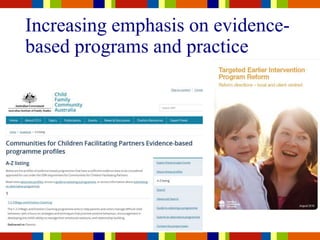
Increasing emphasis on evidence-
based programs and practice
Evidence-informed practice:
Which are you?
How do you feel about an increasing
emphasis on evidence-informed
practice?
Very
positive
Very
concerned
How prepared are you for an
increasing emphasis on evidence-
informed practice?
Very
prepared
Not at all
prepared
Evidence-based practice
(Williams et al., 2015)
A decision-making process that incorporates
Complex problems
Simple problem
(e.g., following a recipe)
Complicated problems
(e.g., sending a rocket to the moon)
The recipe is essential Formulae are critical and necessary
Recipes are tested to assure easy
replication
Sending one rocket increases
likelihood that the next will be OK
Expertise is not required, but cooking
experience increases success rate
High levels of expertise in a variety of
fields are necessary for success
Recipes produce standardized
products
Rockets are similar in critical ways
The best recipes give good results
every time
There is a high degree of certainty of
outcome
Complex problems
Complex problem
(e.g., raising a child)
Formulae have a limited application
Raising a child gives experience but
doesn’t assure success with the next
Expertise helps but does not assure
success
Every child is unique and must be
understood as an individual
Uncertainty of outcome remains
(Moore, 2011)
Evidence-informed practice
A cyclical process
Define &
redefine
practice
questions
Gather
evidence
Critically
appraise
evidence
Practice
decisions
Evaluate
EBP process
& client
outcomes
Organisational
processes to
engage staff and
move programs
through phases
(Plath, 2017)
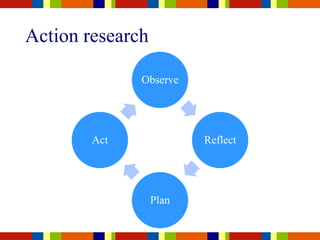
Action research
Observe
Reflect
Plan
Act
What is evidence?
Wheel of research evidence
Correlation
studies
Qualitative
studies
Case
studies
RCTs
Quasi-
experiential
(Epstein, 2009)
Knowledge diamond
(Humphreys et al., 2011)
How do you know you are
making a difference?
Results-Based Accountability
http://raguide.org/
Results Accountability
is made up of two parts:
Performance Accountability
about the well-being of
CLIENT POPULATIONS
For Programs – Agencies – and Service Systems
Population Accountability
about the well-being of
WHOLE POPULATIONS
For Communities – Cities – Counties – States - Nations
Measures
Important to differentiate between:
1. Populations level measures – whole populations
(For communities, towns, city, region etc.)
2. Performance level measures – the people we work
with (For programs, services, organisations etc.)
(Friedman, 2005)
Quantity Quality
How
Much
did we do?
How
Well
did we do it?
Results based accountability (http://raguide.org/)
Effort How hard
did we try?
Effect
Is anyone
better off?
Quantity Quality
Effort How much
did we
do?
How well
did we
do it?
Effect
How much
change
did we produce?
What quality of
change
did we produce
Quantity Quality
Effort How much
did we
do?
How well
did we
do it?
Effect
Is anyone better off?
(How many?) (To what extent?}
Strengths-based measurement
ASEBA
From a survey for
high school students
Franklin County/North Quabbin Youth Health Survey
During your life, how many times
have you used:
• Heroin (also called smack, junk, or China White)?
• Methamphetamines (also called speed, crystal,
crank, or ice)?
• Ecstasy (also called MDMA)?
• Synthetic marijuana (also called K2, Spice, fake
weed, King Kong, Yucatan Fire, Skunk, or Moon
Rocks)?
During the past 30 days, how many
times did you
• Use prescription stimulants or amphetamines without
a doctor telling you to take them?
• Use prescription sedatives without a doctor telling you
to take them?
• Use prescription tranquilizers without a doctor telling
you to take them?
• Use narcotic prescription drugs without a doctor
telling you to take them?
What messages
do these questions
give to youth
filling in the survey?
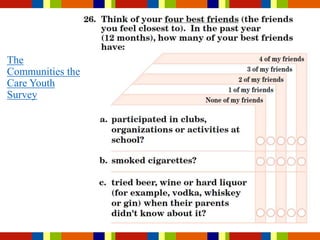
The
Communities the
Care Youth
Survey
continued
• Made a commitment to stay drug-free?
• Used marijuana?
• Tried to do well in school?
• Used LSD, cocaine, amphetamines, or other illegal
drugs?
• Been suspended from school?
• Liked school?
continued
• Have one or two drinks of an alcoholic beverage
nearly everyday?
• Drink beer, wine or hard liquor (for example, vodka,
whiskey or gin) regularly, that is, at least once or twice
a month?
• Smoke cigarettes?
• Smoke marijuana?
• Use LSD, cocaine, amphetamines or another illegal
drug?
Do these questions
give a different message
to youth
filling in the survey?
What is our priority?
Parent Empowerment and
Efficacy Measure (PEEM)
https://www.realwell.org.au/tools/peem/
Case studies
Possible questions for case studies
1. What measures are used or could be used?
2. Which of the RBA questions do they answer?
• How much did we do?
• How well did we do it?
• What difference did we make?
3. What would the experience of families be like in
having this data collected? (e.g., Is it strengths-based?
How personal is it?)
4. How is it fed back to families?
5. How is incorporated into practice?
Evidence-based programs
Practice vs Programs
• Evidence-based practices are built on theory and
research but are not a complete, systematised
program of intervention
• Evidence-based programs are standardised,
systematised and rigorously evaluated
Program fidelity
Important to balance
• Fidelity - Staying true to the original program design
• Adaptation – Ensuring the program is appropriate for
the context
Risky or unacceptable adaptations
• Reducing the number or length of sessions or how
long participants are involved
• Lowering the level of participant engagement
• Eliminating key messages or skills learned
• Removing topics
• Changing the theoretical approach
• Using staff or volunteers who are not adequately
trained or qualified
• Using fewer staff members than recommended.
(O'Connor, Small, & Cooney, 2007)
Acceptable adaptations
• Changing language – translating and/or modifying
vocabulary
• Replacing images to show children and families that
look like the target audience
• Replacing cultural references
• Modifying some aspects of activities such as physical
contact
• Adding relevant, evidence-based content to make the
program more appealing to participants
Be selective
Efficacy versus effectiveness
• Efficacy involves demonstrating that the program
can work under controlled (often ideal) conditions
• Effectiveness involves demonstrating that it works
under the conditions typically encountered “in the
field”
Selecting programs
• Evidence-based programs may not be effective in
some contexts
• Not all effective initiatives have an evidence-base or
are on lists of evidence-based programs
• Wise to measure the impact of the programs we run
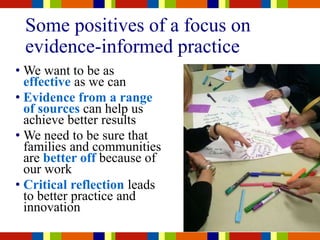
Some positives of a focus on
evidence-informed practice
• We want to be as
effective as we can
• Evidence from a range
of sources can help us
achieve better results
• We need to be sure that
families and communities
are better off because of
our work
• Critical reflection leads
to better practice and
innovation
References
• Epstein, I. (2009). Promoting harmony where there is commonly conflict: Evidence-informed practice as
an integrative strategy. Social Work in Health Care, 48(3), 216-231. doi: 10.1080/00981380802589845
• Friedman, M. (2005). Trying hard is not good enough: How to produce measurable improvements for
customers and communities. Victoria, Canada: Trafford Publishing.
• Humphreys, C., Marcus, G., Sandon, A., Rae, K., Wise, S., Webster, M., & Waters, S. (2011). Informing
policy with evidence: Successes, failures and surprises. In K. Dill & W. Shera (Eds.), Implementing
evidence-informed practice: International perspectives. Toronto: Canadian Scholars' Press.
• Moore, T. (2011). Wicked problems, rotten outcomes and clumsy solutions: Children and families in a
changing world. Paper presented at the NIFTey/CCCH Conference, Sydney. Available from
http://www.rch.org.au/emplibrary/ccch/NIFTeY_CCCH_Conference_11_-_paper.pdf
• O'Connor, C., Small, S. A., & Cooney, S. M. (2007). Program fidelity and adaptation: Meeting local needs
without compromising program effectiveness. What Works, Wisconsin – Research to Practice Series(4).
Available from http://fyi.uwex.edu/whatworkswisconsin/files/2014/04/whatworks_04.pdf
• Plath, D. (2017). Engaging human services with evidence-informed practice. Washington, DC: NASW
Press.
• Williams, K. E., Berthelsen, D., Nicholson, J. M., & Viviani, M. (2015). Systematic literature review:
Research on supported playgroups. Brisbane: Queensland University of Technology. Available from
http://eprints.qut.edu.au/91439/
Graeme Stuart
graeme.stuart@newcastle.edu.au
Blog:
sustainingcommunity.wordpress.com

Evidence informed practice

  • 1.
    Community engagement as aprincipled approach Graeme Stuart Evidence-informed practice and evidence-based programs Graeme Stuart, Jamin Day, Alan Hayes
  • 2.
  • 3.
    Increasing emphasis onevidence- based programs and practice
  • 4.
  • 5.
    How do youfeel about an increasing emphasis on evidence-informed practice? Very positive Very concerned
  • 6.
    How prepared areyou for an increasing emphasis on evidence- informed practice? Very prepared Not at all prepared
  • 7.
    Evidence-based practice (Williams etal., 2015) A decision-making process that incorporates
  • 8.
    Complex problems Simple problem (e.g.,following a recipe) Complicated problems (e.g., sending a rocket to the moon) The recipe is essential Formulae are critical and necessary Recipes are tested to assure easy replication Sending one rocket increases likelihood that the next will be OK Expertise is not required, but cooking experience increases success rate High levels of expertise in a variety of fields are necessary for success Recipes produce standardized products Rockets are similar in critical ways The best recipes give good results every time There is a high degree of certainty of outcome
  • 9.
    Complex problems Complex problem (e.g.,raising a child) Formulae have a limited application Raising a child gives experience but doesn’t assure success with the next Expertise helps but does not assure success Every child is unique and must be understood as an individual Uncertainty of outcome remains (Moore, 2011)
  • 10.
  • 11.
    A cyclical process Define& redefine practice questions Gather evidence Critically appraise evidence Practice decisions Evaluate EBP process & client outcomes Organisational processes to engage staff and move programs through phases (Plath, 2017)
  • 12.
  • 13.
  • 14.
    Wheel of researchevidence Correlation studies Qualitative studies Case studies RCTs Quasi- experiential (Epstein, 2009)
  • 15.
  • 16.
    How do youknow you are making a difference?
  • 17.
  • 18.
    Results Accountability is madeup of two parts: Performance Accountability about the well-being of CLIENT POPULATIONS For Programs – Agencies – and Service Systems Population Accountability about the well-being of WHOLE POPULATIONS For Communities – Cities – Counties – States - Nations
  • 19.
    Measures Important to differentiatebetween: 1. Populations level measures – whole populations (For communities, towns, city, region etc.) 2. Performance level measures – the people we work with (For programs, services, organisations etc.) (Friedman, 2005)
  • 20.
    Quantity Quality How Much did wedo? How Well did we do it? Results based accountability (http://raguide.org/)
  • 21.
    Effort How hard didwe try? Effect Is anyone better off?
  • 22.
    Quantity Quality Effort Howmuch did we do? How well did we do it? Effect How much change did we produce? What quality of change did we produce
  • 23.
    Quantity Quality Effort Howmuch did we do? How well did we do it? Effect Is anyone better off? (How many?) (To what extent?}
  • 24.
  • 25.
  • 26.
    From a surveyfor high school students Franklin County/North Quabbin Youth Health Survey
  • 27.
    During your life,how many times have you used: • Heroin (also called smack, junk, or China White)? • Methamphetamines (also called speed, crystal, crank, or ice)? • Ecstasy (also called MDMA)? • Synthetic marijuana (also called K2, Spice, fake weed, King Kong, Yucatan Fire, Skunk, or Moon Rocks)?
  • 29.
    During the past30 days, how many times did you • Use prescription stimulants or amphetamines without a doctor telling you to take them? • Use prescription sedatives without a doctor telling you to take them? • Use prescription tranquilizers without a doctor telling you to take them? • Use narcotic prescription drugs without a doctor telling you to take them?
  • 31.
    What messages do thesequestions give to youth filling in the survey?
  • 32.
  • 33.
    continued • Made acommitment to stay drug-free? • Used marijuana? • Tried to do well in school? • Used LSD, cocaine, amphetamines, or other illegal drugs? • Been suspended from school? • Liked school?
  • 35.
    continued • Have oneor two drinks of an alcoholic beverage nearly everyday? • Drink beer, wine or hard liquor (for example, vodka, whiskey or gin) regularly, that is, at least once or twice a month? • Smoke cigarettes? • Smoke marijuana? • Use LSD, cocaine, amphetamines or another illegal drug?
  • 36.
    Do these questions givea different message to youth filling in the survey?
  • 37.
    What is ourpriority?
  • 38.
    Parent Empowerment and EfficacyMeasure (PEEM) https://www.realwell.org.au/tools/peem/
  • 39.
  • 40.
    Possible questions forcase studies 1. What measures are used or could be used? 2. Which of the RBA questions do they answer? • How much did we do? • How well did we do it? • What difference did we make? 3. What would the experience of families be like in having this data collected? (e.g., Is it strengths-based? How personal is it?) 4. How is it fed back to families? 5. How is incorporated into practice?
  • 41.
  • 42.
    Practice vs Programs •Evidence-based practices are built on theory and research but are not a complete, systematised program of intervention • Evidence-based programs are standardised, systematised and rigorously evaluated
  • 43.
    Program fidelity Important tobalance • Fidelity - Staying true to the original program design • Adaptation – Ensuring the program is appropriate for the context
  • 44.
    Risky or unacceptableadaptations • Reducing the number or length of sessions or how long participants are involved • Lowering the level of participant engagement • Eliminating key messages or skills learned • Removing topics • Changing the theoretical approach • Using staff or volunteers who are not adequately trained or qualified • Using fewer staff members than recommended. (O'Connor, Small, & Cooney, 2007)
  • 45.
    Acceptable adaptations • Changinglanguage – translating and/or modifying vocabulary • Replacing images to show children and families that look like the target audience • Replacing cultural references • Modifying some aspects of activities such as physical contact • Adding relevant, evidence-based content to make the program more appealing to participants
  • 46.
  • 47.
    Efficacy versus effectiveness •Efficacy involves demonstrating that the program can work under controlled (often ideal) conditions • Effectiveness involves demonstrating that it works under the conditions typically encountered “in the field”
  • 48.
    Selecting programs • Evidence-basedprograms may not be effective in some contexts • Not all effective initiatives have an evidence-base or are on lists of evidence-based programs • Wise to measure the impact of the programs we run
  • 49.
    Some positives ofa focus on evidence-informed practice • We want to be as effective as we can • Evidence from a range of sources can help us achieve better results • We need to be sure that families and communities are better off because of our work • Critical reflection leads to better practice and innovation
  • 50.
    References • Epstein, I.(2009). Promoting harmony where there is commonly conflict: Evidence-informed practice as an integrative strategy. Social Work in Health Care, 48(3), 216-231. doi: 10.1080/00981380802589845 • Friedman, M. (2005). Trying hard is not good enough: How to produce measurable improvements for customers and communities. Victoria, Canada: Trafford Publishing. • Humphreys, C., Marcus, G., Sandon, A., Rae, K., Wise, S., Webster, M., & Waters, S. (2011). Informing policy with evidence: Successes, failures and surprises. In K. Dill & W. Shera (Eds.), Implementing evidence-informed practice: International perspectives. Toronto: Canadian Scholars' Press. • Moore, T. (2011). Wicked problems, rotten outcomes and clumsy solutions: Children and families in a changing world. Paper presented at the NIFTey/CCCH Conference, Sydney. Available from http://www.rch.org.au/emplibrary/ccch/NIFTeY_CCCH_Conference_11_-_paper.pdf • O'Connor, C., Small, S. A., & Cooney, S. M. (2007). Program fidelity and adaptation: Meeting local needs without compromising program effectiveness. What Works, Wisconsin – Research to Practice Series(4). Available from http://fyi.uwex.edu/whatworkswisconsin/files/2014/04/whatworks_04.pdf • Plath, D. (2017). Engaging human services with evidence-informed practice. Washington, DC: NASW Press. • Williams, K. E., Berthelsen, D., Nicholson, J. M., & Viviani, M. (2015). Systematic literature review: Research on supported playgroups. Brisbane: Queensland University of Technology. Available from http://eprints.qut.edu.au/91439/
  • 51.