Seminar presentation 
on 
“GROUND PENETRATING RADAR”
Contents: 
1. Introduction 
2. Components of GPR 
3. GPR working principle 
4. Reflected signal 
5. GPR depth determination 
6. How deep can GPR go into ground? 
7. GPR received signal and graphic profile display 
8. Advantages 
9. Applications 
10. Conclusion 
11. References
Introduction: 
RADAR → Radio Detection and Ranging. 
Detect target in free space 
Determine the range 
Ground-penetrating radar (GPR) is a geophysical method 
that uses radar pulses to image the subsurface. 
GPR finding and detecting buried object. 
GPR can be used in a variety of media, including rock, 
soil, ice, fresh water, pavements and structures. It can 
detect objects, changes in material, and voids and cracks. 
Probing into soil to detect pipelines and tanks and detect 
thickness of soil.
Components of GPR: 
1. Transmitting 
and receiving 
unit 
2. Control unit 
3. Display unit 
4. Power 
supplies
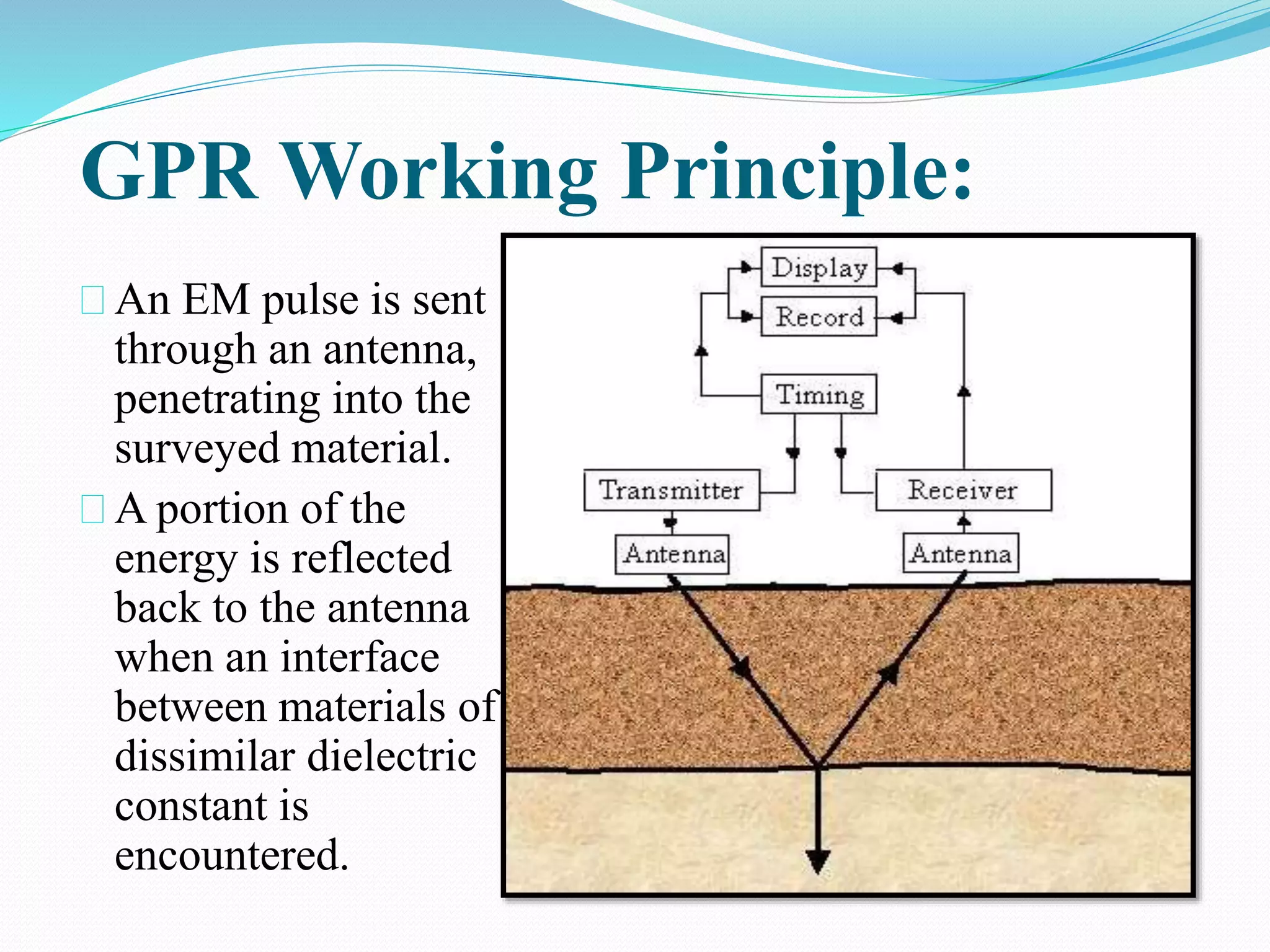
GPR Working Principle: 
An EM pulse is sent 
through an antenna, 
penetrating into the 
surveyed material. 
A portion of the 
energy is reflected 
back to the antenna 
when an interface 
between materials of 
dissimilar dielectric 
constant is 
encountered.
Reflected Signal: 
The amount of reflected 
energy at an interface is 
governed by: 
  
 
r r 
  
1 2 
 
r r 
1 2 
 
1,2 
 
where ρ1,2 is the 
reflection coefficient 
and εr1 and εr2 are the 
dielectric constants. 
Typical Dielectric Constants: 
Material Relative 
permittivity 
Air 1 
Asphalt: dry 2-4 
Clay 2-40 
Dry sand 3-5 
Concrete: dry 4-10 
Fresh water 80 
Metals ∞
GPR Depth Determination: 
The reflected signal 
has information on: 
how quickly 
the signal traveled 
how much was 
attenuated 
These quantities 
depend on spatial 
configuration and 
materials. 
The depth of a layer is given by: 
D = (5.9t)/sqrt. of(Er) 
D = depth of target (inch.) 
t = wave travel time (nanosecond) 
5.9 = a constant incorporating speed of 
light and unit conversions 
Er = dielectric constant of subsurface 
material
How deep can GPR go into 
ground?: 
It depend upon two 
condition: 
 The type of soil or rock in 
the GPR survey area. 
 The frequency of the 
antenna used. 
 Low frequency systems are 
more penetrating but data 
resolution is lower. 
 High frequency systems 
have limited penetration but 
offer a much higher 
resolution. 
Antenna 
Frequency 
Maximum 
Penetration 
Depth 
Appropriate 
Application 
1500 MHz 0.5 m 
Rebar mapping 
and concrete 
evaluation. 
900 MHz 1 m 
Pipe and void 
detection or 
assessing concrete 
thickness. 
400 MHz 4 m 
Utility surveys, 
pavement 
evaluation, storage 
tank detection and 
assessing 
structural integrity 
270 MHz 6m 
Utility surveys, 
geology and 
archaeology
GPR Received signal and graphic 
profile display:
Advantages: 
Extremely accurate 
Fast 
Not needed to drilling and digging selected area 
Real time targeting 
Non-destructive 
Non-intrusive 
Digital media storage 
Easy to operate 
Safe
Applications: 
In the Earth sciences it is used to study bedrock, soils, 
groundwater, and ice. 
Military uses include detection of mines, unexploded 
ordnance, and tunnels. 
locating clandestine graves and buried evidence. 
the other main applications for ground penetration radars 
to locate underground utilities.
Conclusion: 
GPR has been developed into a sophisticated 
technique that can provide detailed images of the near 
surface. As opposed to other locating techniques that are 
capable of detecting only metallic or conductive utilities 
and underground targets, GPR can locate and characterize 
both metallic and non-metallic subsurface features. It is 
completely non-intrusive, non-destructive and safe.
References : 
vashov, S. I.; Razevig, V. V.; Vasiliev, I. A.; Zhuravlev, A. V.; Bechtel, T. D.; 
Capineri, L. (2011). "Holographic Subsurface Radar of RASCAN Type: 
Development and Application". IEEE Journal of Selected Topics in Applied Earth 
Observation and Remote Sensing 4 (4): 763–778. 
doi:10.1109/JSTARS.2011.2161755. Retrieved 26 September 2013. 
ETSI EG 202 730 V1.1.1 (2009–09), "Electromagnetic compatibility and Radio 
spectrum Matters (ERM); Code of Practice in respect of the control, use and 
application of Ground Probing Radar (GPR) and Wall Probing Radar (WPR) 
systems and equipment 
Wilson, M. G. C.; Henry, G.; Marshall, T. R. (2006). "A review of the alluvial 
diamond industry and the gravels of the North West Province, South Africa". South 
African Journal of Geology (Geological Society of South Africa) 109 (3): 301–314 
Daniels DJ (ed.) (2004). Ground Penetrating Radar (2nd ed.). Knoval (Institution of 
Engineering and Technology). pp. 1–4. ISBN 978-0-86341-360-5
ground penetrating radar

ground penetrating radar

  • 1.
    Seminar presentation on “GROUND PENETRATING RADAR”
  • 2.
    Contents: 1. Introduction 2. Components of GPR 3. GPR working principle 4. Reflected signal 5. GPR depth determination 6. How deep can GPR go into ground? 7. GPR received signal and graphic profile display 8. Advantages 9. Applications 10. Conclusion 11. References
  • 3.
    Introduction: RADAR →Radio Detection and Ranging. Detect target in free space Determine the range Ground-penetrating radar (GPR) is a geophysical method that uses radar pulses to image the subsurface. GPR finding and detecting buried object. GPR can be used in a variety of media, including rock, soil, ice, fresh water, pavements and structures. It can detect objects, changes in material, and voids and cracks. Probing into soil to detect pipelines and tanks and detect thickness of soil.
  • 4.
    Components of GPR: 1. Transmitting and receiving unit 2. Control unit 3. Display unit 4. Power supplies
  • 5.
    GPR Working Principle: An EM pulse is sent through an antenna, penetrating into the surveyed material. A portion of the energy is reflected back to the antenna when an interface between materials of dissimilar dielectric constant is encountered.
  • 6.
    Reflected Signal: Theamount of reflected energy at an interface is governed by:    r r   1 2  r r 1 2  1,2  where ρ1,2 is the reflection coefficient and εr1 and εr2 are the dielectric constants. Typical Dielectric Constants: Material Relative permittivity Air 1 Asphalt: dry 2-4 Clay 2-40 Dry sand 3-5 Concrete: dry 4-10 Fresh water 80 Metals ∞
  • 7.
    GPR Depth Determination: The reflected signal has information on: how quickly the signal traveled how much was attenuated These quantities depend on spatial configuration and materials. The depth of a layer is given by: D = (5.9t)/sqrt. of(Er) D = depth of target (inch.) t = wave travel time (nanosecond) 5.9 = a constant incorporating speed of light and unit conversions Er = dielectric constant of subsurface material
  • 8.
    How deep canGPR go into ground?: It depend upon two condition:  The type of soil or rock in the GPR survey area.  The frequency of the antenna used.  Low frequency systems are more penetrating but data resolution is lower.  High frequency systems have limited penetration but offer a much higher resolution. Antenna Frequency Maximum Penetration Depth Appropriate Application 1500 MHz 0.5 m Rebar mapping and concrete evaluation. 900 MHz 1 m Pipe and void detection or assessing concrete thickness. 400 MHz 4 m Utility surveys, pavement evaluation, storage tank detection and assessing structural integrity 270 MHz 6m Utility surveys, geology and archaeology
  • 9.
    GPR Received signaland graphic profile display:
  • 10.
    Advantages: Extremely accurate Fast Not needed to drilling and digging selected area Real time targeting Non-destructive Non-intrusive Digital media storage Easy to operate Safe
  • 11.
    Applications: In theEarth sciences it is used to study bedrock, soils, groundwater, and ice. Military uses include detection of mines, unexploded ordnance, and tunnels. locating clandestine graves and buried evidence. the other main applications for ground penetration radars to locate underground utilities.
  • 12.
    Conclusion: GPR hasbeen developed into a sophisticated technique that can provide detailed images of the near surface. As opposed to other locating techniques that are capable of detecting only metallic or conductive utilities and underground targets, GPR can locate and characterize both metallic and non-metallic subsurface features. It is completely non-intrusive, non-destructive and safe.
  • 13.
    References : vashov,S. I.; Razevig, V. V.; Vasiliev, I. A.; Zhuravlev, A. V.; Bechtel, T. D.; Capineri, L. (2011). "Holographic Subsurface Radar of RASCAN Type: Development and Application". IEEE Journal of Selected Topics in Applied Earth Observation and Remote Sensing 4 (4): 763–778. doi:10.1109/JSTARS.2011.2161755. Retrieved 26 September 2013. ETSI EG 202 730 V1.1.1 (2009–09), "Electromagnetic compatibility and Radio spectrum Matters (ERM); Code of Practice in respect of the control, use and application of Ground Probing Radar (GPR) and Wall Probing Radar (WPR) systems and equipment Wilson, M. G. C.; Henry, G.; Marshall, T. R. (2006). "A review of the alluvial diamond industry and the gravels of the North West Province, South Africa". South African Journal of Geology (Geological Society of South Africa) 109 (3): 301–314 Daniels DJ (ed.) (2004). Ground Penetrating Radar (2nd ed.). Knoval (Institution of Engineering and Technology). pp. 1–4. ISBN 978-0-86341-360-5