KINETIC
MOLECULAR
THEORY OF
LIQUIDS AND
GASES
Specific Learning Outcomes
» compare the properties of liquids and solids with those of gases
» apply the kinetic molecular theory to describe liquids and solids
» describe the various intermolecular forces and factors that affect their
strengths
» identify the types of intermolecular forces that may operate in a given
molecular substance
» rank substances according to strength of intermolecular forces;
» illustrate the intermolecular forces between molecules of a compound.
2
At the end of the lesson, the
learners will be able to:
ACTIVITY!
PAINT ME A PICTURE
Discuss among your group how to act the
assigned state. One member of the group will
explain their act.
3
ACTIVITY!
DONE BY 5 MEMBERS
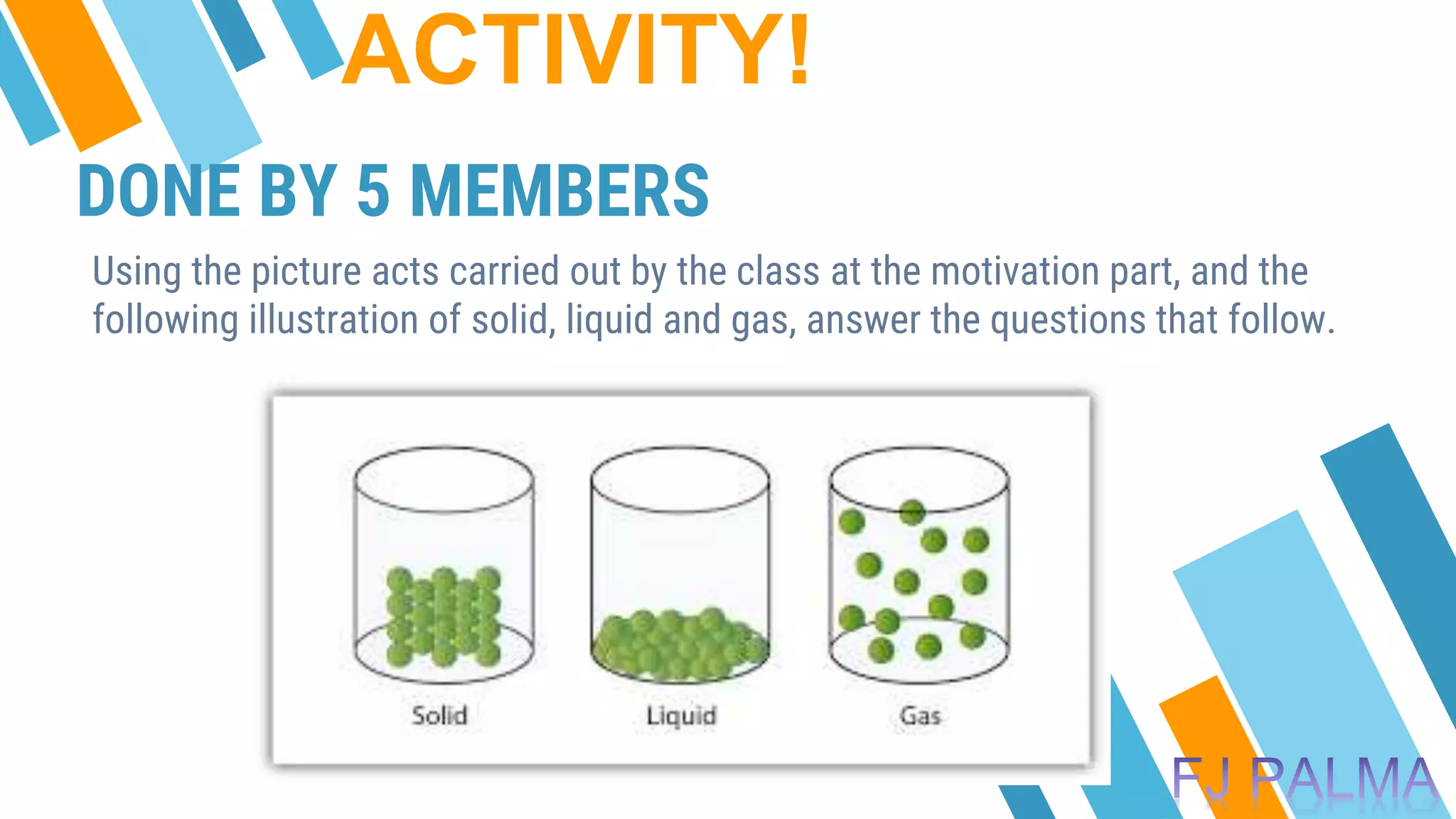
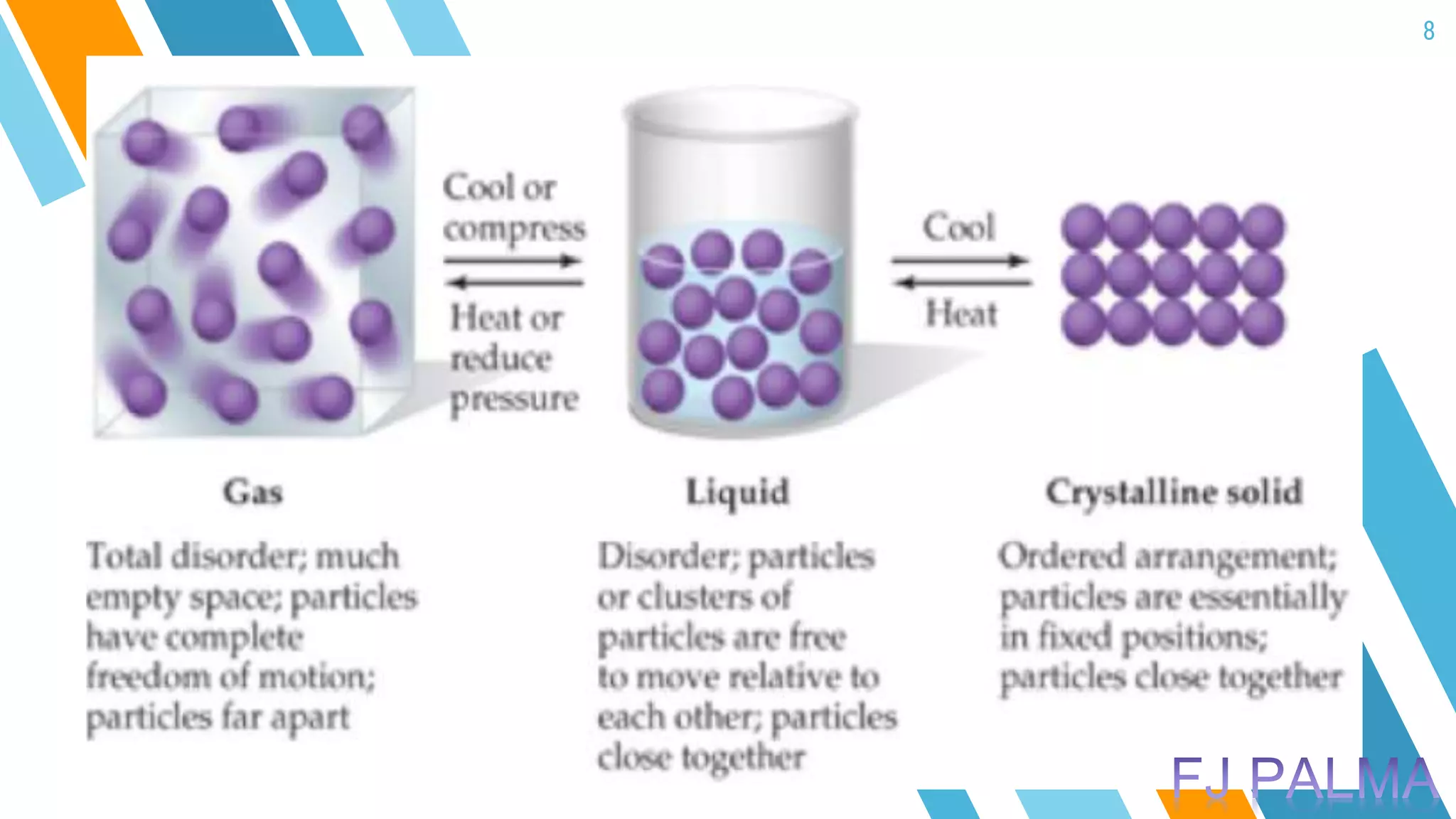
Using the picture acts carried out by the class at the motivation part, and the
following illustration of solid, liquid and gas, answer the questions that follow.
4
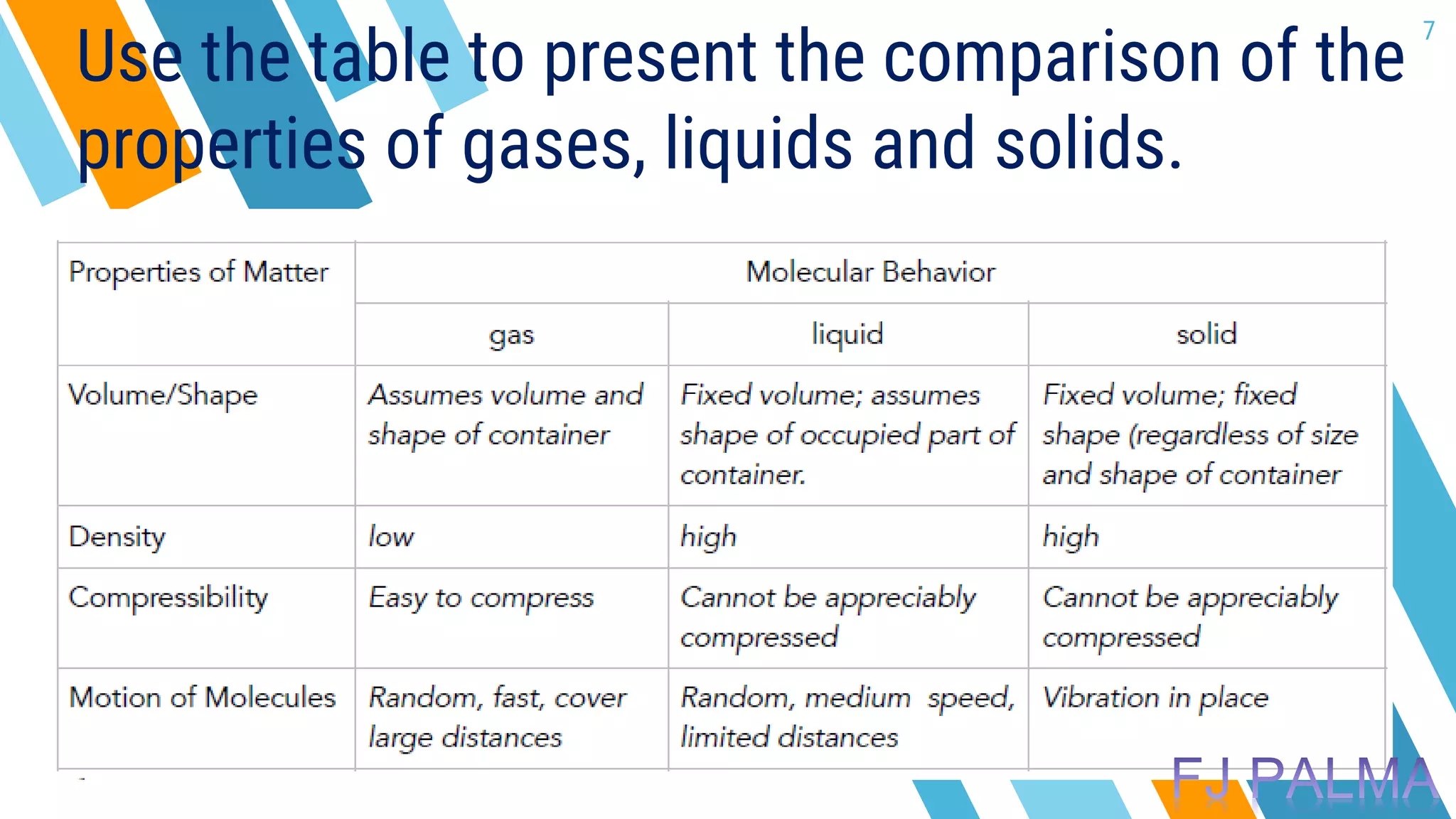
1. Compare the properties of gases, liquids, and solids in terms of
distances and arrangement of their molecules.
a. Compare the distances among molecules in the gas, liquid and
solid and rank the phases in increasing distance between
particles.
b. Describe the characteristic movement of the particles of gas,
liquid and solid.
c. How are the molecules of gas, liquid and solid arranged?
d. Arrange the three phases of matter in order of increasing
volume of empty space between its molecules.
e. Identify the property of matter that corresponds to the
molecular behavior.
5
6
Use the table to present the comparison of the
properties of gases, liquids and solids.
7
Use the table to present the comparison of the
properties of gases, liquids and solids.
8
LET’S REVIEW SOME
CONCEPTS
(BY TABLE)
PLEASE BRING THE FOLLOWING:
 ALCOHOL
 ACETONE
 BUTANE (OR FUEL FOR LIGHTERS)
 4 DROPPERS
9
1.
Intermolecular
forces of
attraction
10
ACTIVITY!
» Water
» Ethanol
» Acetone
» Butane or lighter fluid
» 8 one peso coins
11
Materials needed:
SAFETY
PRECAUTIONS!!!
12
 The activity should be performed in an airy
or well-ventilated room.
Remind the students of the proper handling of
the substances they will be using.
Avoid contact with the skin and direct
inhalation of the vapors of the substances. It
is best if the students use safety gloves,
goggles and mask.
13
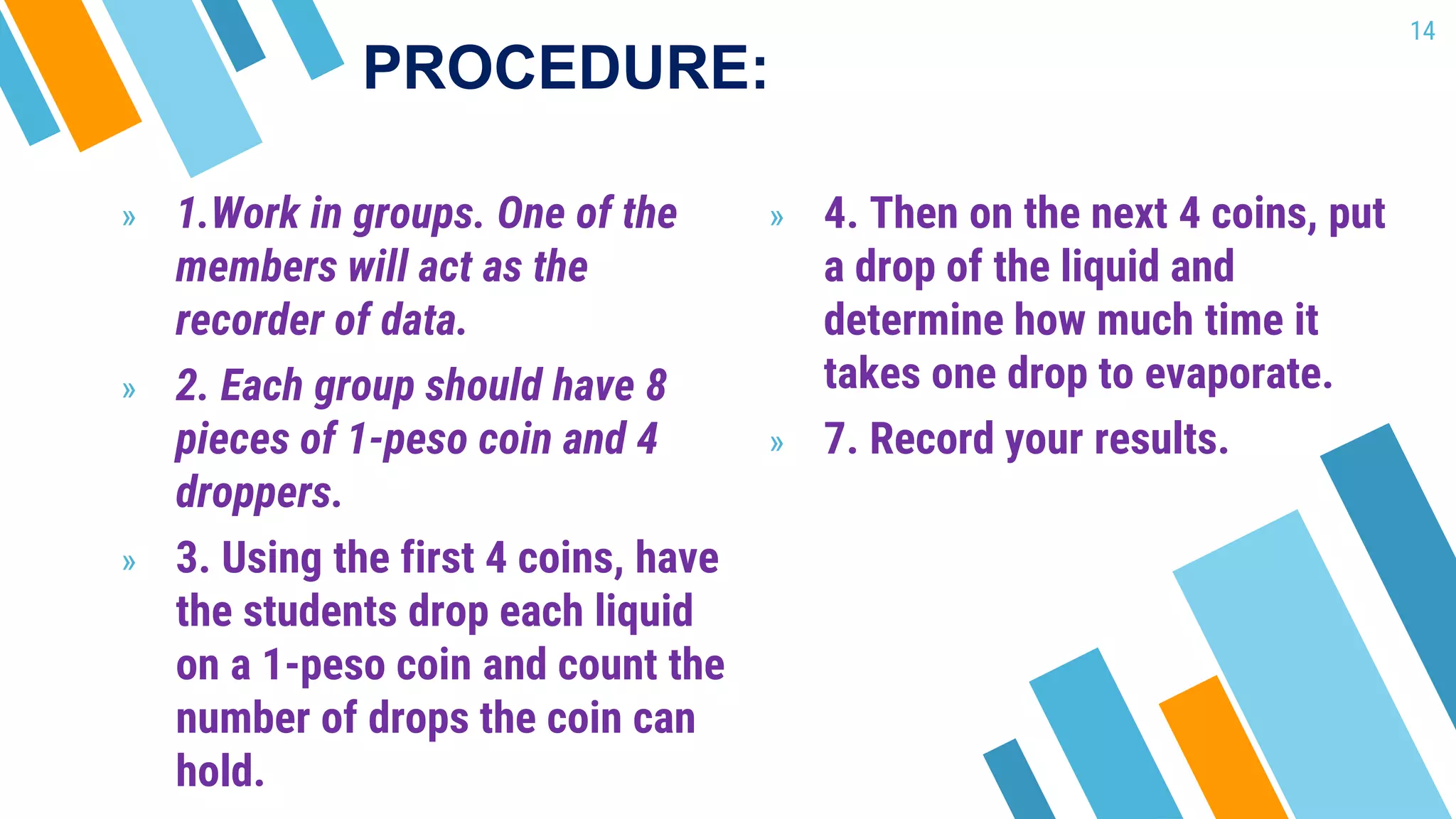
» 1.Work in groups. One of the
members will act as the
recorder of data.
» 2. Each group should have 8
pieces of 1-peso coin and 4
droppers.
» 3. Using the first 4 coins, have
the students drop each liquid
on a 1-peso coin and count the
number of drops the coin can
hold.
PROCEDURE:
» 4. Then on the next 4 coins, put
a drop of the liquid and
determine how much time it
takes one drop to evaporate.
» 7. Record your results.
14
Guide questions:
a. Which molecules can hold more drops on the coin?
b. Which molecules took longer to evaporate?
c. Are the molecules that can hold the lesser number of
drops the same as the molecules that took less
time to evaporate?
d. Based on the formula and geometries of the
substances, are the molecules that can hold more drops
on the coin polar or nonpolar? What about those that took
longer to evaporate?
15
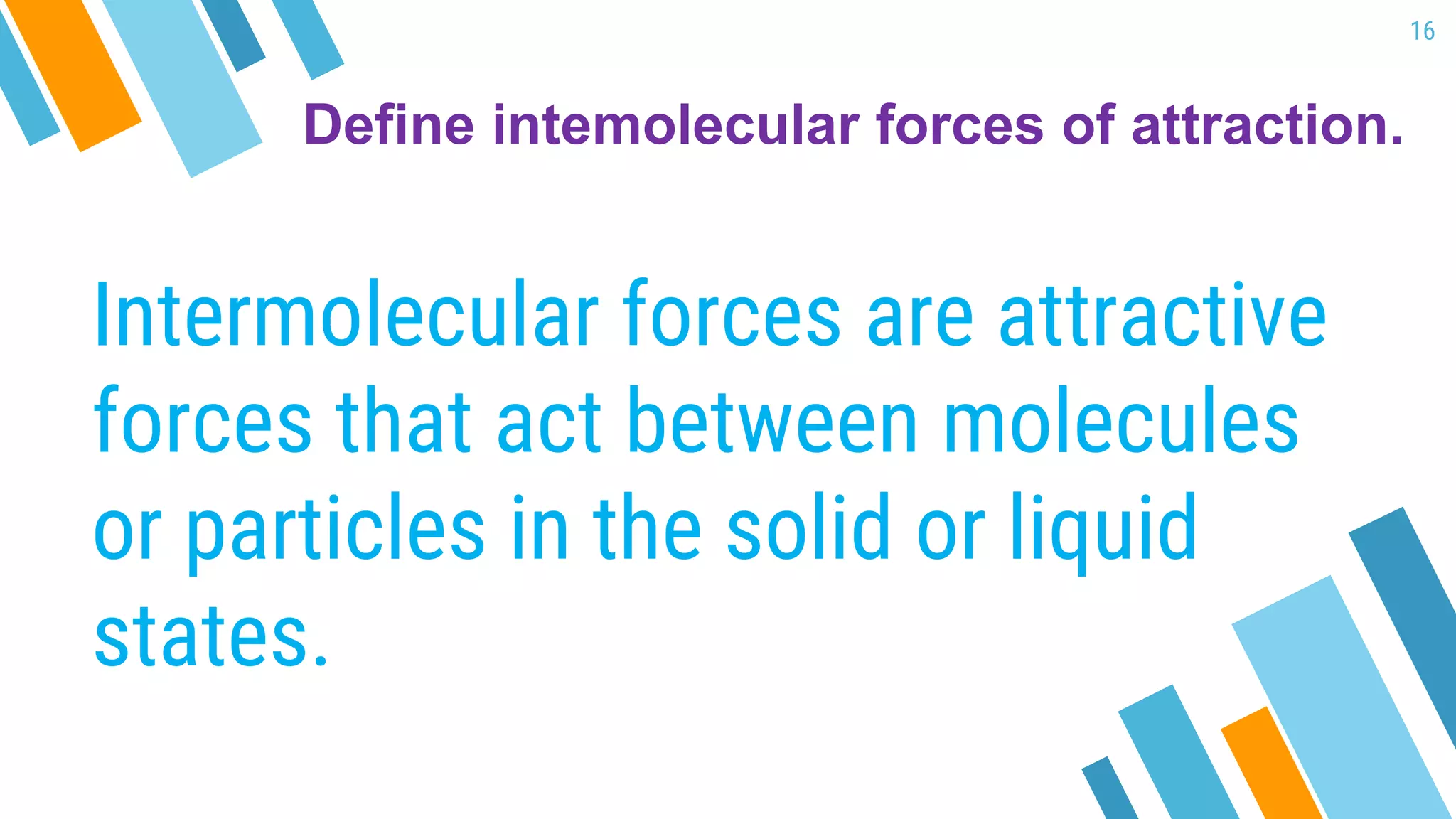
Define intemolecular forces of attraction.
Intermolecular forces are attractive
forces that act between molecules
or particles in the solid or liquid
states.
16
Explain why melting points and boiling points of
substances can be used as indicators of strength of
intermolecular forces operating in given solids and
liquids.
When a solid melts, or a liquid boils, the particles move away
from each other. As they do, intermolecular forces of attraction
are broken. The stronger the intermolecular forces to be
broken, the larger the amount of energy needed to break them,
hence, the higher the melting point for solid to liquid
transformation, and boiling point for liquid to gas
transformation.
17
THE DIFFERENT
TYPES OF
INTERMOLECULAR
FORCES
18
19
London Dispersion Forces
These forces of attraction result
from temporary dipole moments
induced in ordinarily nonpolar
molecules. These forces are
present between all types of
molecules due to the movement
of electrons.
20
Dipole-dipole forces
These are attractive forces between polar molecules
(molecules that possess dipole moments).
This type of force is stronger than the dispersion
forces because polar molecules have a permanent
uneven distribution of electrons. The nature of
attraction is electrostatic and can be understood in
terms of Coulomb’s law: The larger the dipole
moment, the stronger the attraction.
21
Hydrogen bond
is a special type of dipole-dipole
interaction between the hydrogen atom in
a polar bond, such as N‒H, O‒H, or F‒H,
and an electronegative O, N, or F atom.
Hydrogen bonds between water
molecules are particularly strong.
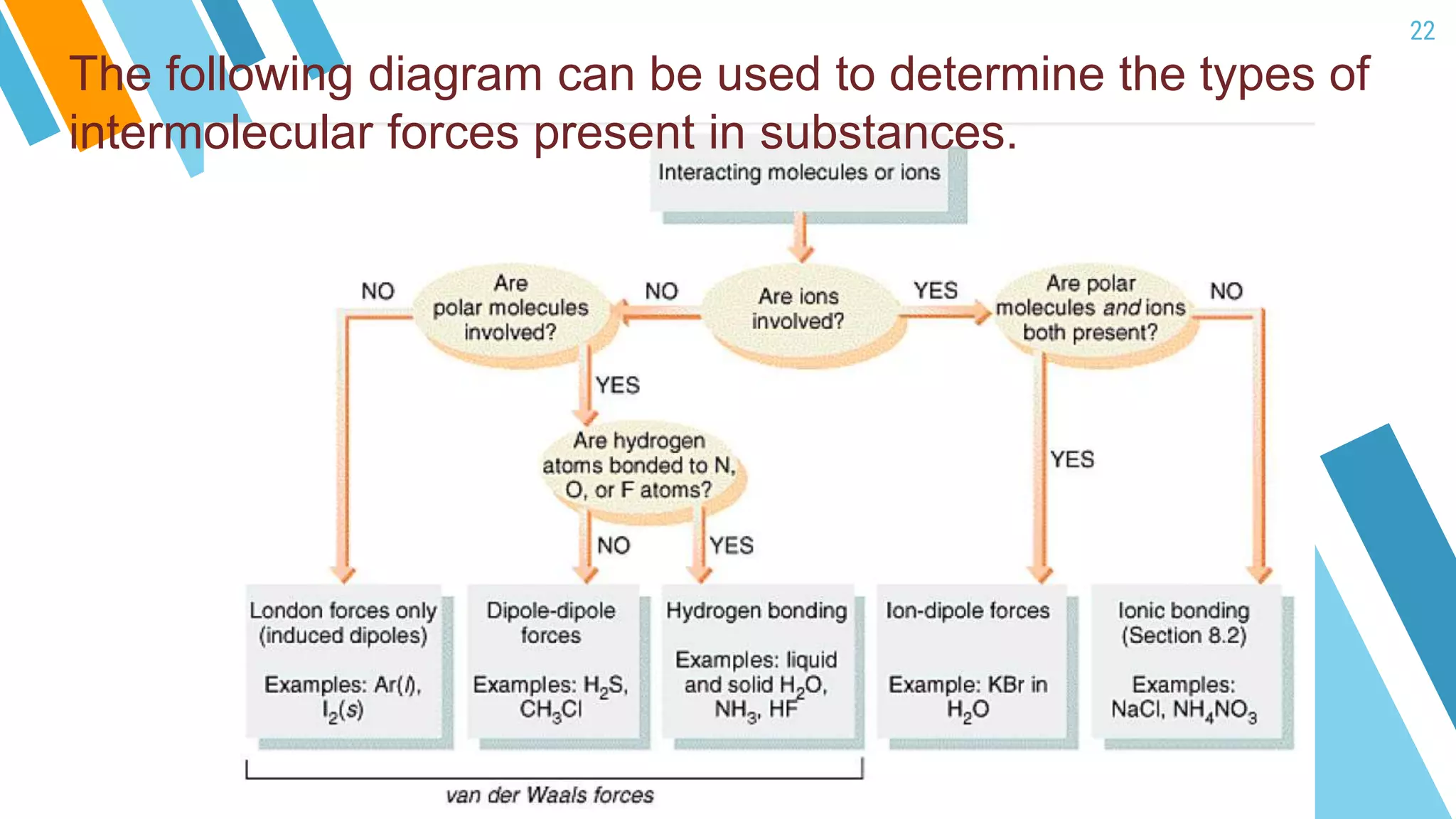
The following diagram can be used to determine the types of
intermolecular forces present in substances.
22
The following diagram can be used to determine the types of
intermolecular forces present in substances.
23
THANKS!
Any questions?
You can find me at
» NANGANGAMOY
MANGABSENT UGMA😂
» FACULTY ROOM
» OWN FB
25
Any questions?
You can find me at
» NANGANGAMOY MANGABSENT
UGMA😂
» FACULTY ROOM
» OWN FB
THANKS!
ANDROID
PROJECT
Show and explain your web, app
or software projects using these
gadget templates.
Place your screenshot here
26
Place your screenshot here
iPHONE
PROJECT
Show and explain your web, app
or software projects using these
gadget templates.
27
Place your screenshot here
TABLET
PROJECT
Show and explain your web, app
or software projects using these
gadget templates.
28
CREDITS
Special thanks to all the people who made and
released these awesome resources for free:
» Presentation template by SlidesCarnival
» Photographs by Unsplash
29
PRESENTATION DESIGN
This presentation uses the following typographies and colors:
» Titles: Oswald
» Body copy: Roboto Condensed
You can download the fonts on these pages:
https://www.fontsquirrel.com/fonts/oswald
https://www.fontsquirrel.com/fonts/roboto
Dark aqua #3796bf / Aqua #4bb5d9 / Light aqua #81d1ec
Yolk yellow #ff9900
You don’t need to keep this slide in your presentation. It’s only here to serve you as a design guide
if you need to create new slides or download the fonts to edit the presentation in PowerPoint®
30
SlidesCarnival icons are editable shapes.
This means that you can:
● Resize them without losing quality.
● Change fill color and opacity.
● Change line color, width and style.
Isn’t that nice? :)
Examples:
31
Now you can use any emoji as an icon!
And of course it resizes without losing quality and you can change the color.
How? Follow Google instructions
https://twitter.com/googledocs/status/730087240156643328
✋👆👉👍👤👦👧👨👩👪💃🏃💑❤😂
😉😋😒😭👶😸🐟🍒🍔💣📌📖🔨🎃🎈
🎨🏈🏰🌏🔌🔑 and many more...
😉
32

Intermolecular forces (liquids and solids)

  • 1.
  • 2.
    Specific Learning Outcomes »compare the properties of liquids and solids with those of gases » apply the kinetic molecular theory to describe liquids and solids » describe the various intermolecular forces and factors that affect their strengths » identify the types of intermolecular forces that may operate in a given molecular substance » rank substances according to strength of intermolecular forces; » illustrate the intermolecular forces between molecules of a compound. 2 At the end of the lesson, the learners will be able to:
  • 3.
    ACTIVITY! PAINT ME APICTURE Discuss among your group how to act the assigned state. One member of the group will explain their act. 3
  • 4.
    ACTIVITY! DONE BY 5MEMBERS Using the picture acts carried out by the class at the motivation part, and the following illustration of solid, liquid and gas, answer the questions that follow. 4
  • 5.
    1. Compare theproperties of gases, liquids, and solids in terms of distances and arrangement of their molecules. a. Compare the distances among molecules in the gas, liquid and solid and rank the phases in increasing distance between particles. b. Describe the characteristic movement of the particles of gas, liquid and solid. c. How are the molecules of gas, liquid and solid arranged? d. Arrange the three phases of matter in order of increasing volume of empty space between its molecules. e. Identify the property of matter that corresponds to the molecular behavior. 5
  • 6.
    6 Use the tableto present the comparison of the properties of gases, liquids and solids.
  • 7.
    7 Use the tableto present the comparison of the properties of gases, liquids and solids.
  • 8.
  • 9.
    LET’S REVIEW SOME CONCEPTS (BYTABLE) PLEASE BRING THE FOLLOWING:  ALCOHOL  ACETONE  BUTANE (OR FUEL FOR LIGHTERS)  4 DROPPERS 9
  • 10.
  • 11.
    ACTIVITY! » Water » Ethanol »Acetone » Butane or lighter fluid » 8 one peso coins 11 Materials needed:
  • 12.
  • 13.
     The activityshould be performed in an airy or well-ventilated room. Remind the students of the proper handling of the substances they will be using. Avoid contact with the skin and direct inhalation of the vapors of the substances. It is best if the students use safety gloves, goggles and mask. 13
  • 14.
    » 1.Work ingroups. One of the members will act as the recorder of data. » 2. Each group should have 8 pieces of 1-peso coin and 4 droppers. » 3. Using the first 4 coins, have the students drop each liquid on a 1-peso coin and count the number of drops the coin can hold. PROCEDURE: » 4. Then on the next 4 coins, put a drop of the liquid and determine how much time it takes one drop to evaporate. » 7. Record your results. 14
  • 15.
    Guide questions: a. Whichmolecules can hold more drops on the coin? b. Which molecules took longer to evaporate? c. Are the molecules that can hold the lesser number of drops the same as the molecules that took less time to evaporate? d. Based on the formula and geometries of the substances, are the molecules that can hold more drops on the coin polar or nonpolar? What about those that took longer to evaporate? 15
  • 16.
    Define intemolecular forcesof attraction. Intermolecular forces are attractive forces that act between molecules or particles in the solid or liquid states. 16
  • 17.
    Explain why meltingpoints and boiling points of substances can be used as indicators of strength of intermolecular forces operating in given solids and liquids. When a solid melts, or a liquid boils, the particles move away from each other. As they do, intermolecular forces of attraction are broken. The stronger the intermolecular forces to be broken, the larger the amount of energy needed to break them, hence, the higher the melting point for solid to liquid transformation, and boiling point for liquid to gas transformation. 17
  • 18.
  • 19.
    19 London Dispersion Forces Theseforces of attraction result from temporary dipole moments induced in ordinarily nonpolar molecules. These forces are present between all types of molecules due to the movement of electrons.
  • 20.
    20 Dipole-dipole forces These areattractive forces between polar molecules (molecules that possess dipole moments). This type of force is stronger than the dispersion forces because polar molecules have a permanent uneven distribution of electrons. The nature of attraction is electrostatic and can be understood in terms of Coulomb’s law: The larger the dipole moment, the stronger the attraction.
  • 21.
    21 Hydrogen bond is aspecial type of dipole-dipole interaction between the hydrogen atom in a polar bond, such as N‒H, O‒H, or F‒H, and an electronegative O, N, or F atom. Hydrogen bonds between water molecules are particularly strong.
  • 22.
    The following diagramcan be used to determine the types of intermolecular forces present in substances. 22
  • 23.
    The following diagramcan be used to determine the types of intermolecular forces present in substances. 23
  • 24.
    THANKS! Any questions? You canfind me at » NANGANGAMOY MANGABSENT UGMA😂 » FACULTY ROOM » OWN FB
  • 25.
    25 Any questions? You canfind me at » NANGANGAMOY MANGABSENT UGMA😂 » FACULTY ROOM » OWN FB THANKS!
  • 26.
    ANDROID PROJECT Show and explainyour web, app or software projects using these gadget templates. Place your screenshot here 26
  • 27.
    Place your screenshothere iPHONE PROJECT Show and explain your web, app or software projects using these gadget templates. 27
  • 28.
    Place your screenshothere TABLET PROJECT Show and explain your web, app or software projects using these gadget templates. 28
  • 29.
    CREDITS Special thanks toall the people who made and released these awesome resources for free: » Presentation template by SlidesCarnival » Photographs by Unsplash 29
  • 30.
    PRESENTATION DESIGN This presentationuses the following typographies and colors: » Titles: Oswald » Body copy: Roboto Condensed You can download the fonts on these pages: https://www.fontsquirrel.com/fonts/oswald https://www.fontsquirrel.com/fonts/roboto Dark aqua #3796bf / Aqua #4bb5d9 / Light aqua #81d1ec Yolk yellow #ff9900 You don’t need to keep this slide in your presentation. It’s only here to serve you as a design guide if you need to create new slides or download the fonts to edit the presentation in PowerPoint® 30
  • 31.
    SlidesCarnival icons areeditable shapes. This means that you can: ● Resize them without losing quality. ● Change fill color and opacity. ● Change line color, width and style. Isn’t that nice? :) Examples: 31
  • 32.
    Now you canuse any emoji as an icon! And of course it resizes without losing quality and you can change the color. How? Follow Google instructions https://twitter.com/googledocs/status/730087240156643328 ✋👆👉👍👤👦👧👨👩👪💃🏃💑❤😂 😉😋😒😭👶😸🐟🍒🍔💣📌📖🔨🎃🎈 🎨🏈🏰🌏🔌🔑 and many more... 😉 32

Editor's Notes

  • #6 In liquids, the molecules are so close together that there is very little empty space between them. Liquids are much more difficult to compress and they are much denser at normal conditions. • Molecules in a liquid are held together by one or more types of attractive forces. However, the molecules can move past one another freely. Liquids can flow, can be poured and assumes the shape of its container. • In a solid, molecules are held tightly in position with virtually no freedom of motion. There is even less empty space in a solid than in a liquid. • Solids are almost incompressible and possess definite shape and volume.
  • #16 Water 100 C polar Butane -1 C non polar Ethyl alcohol 78.37 C polar Isopropyl less polar 82.6 C Acetone 56 C polar