Cypher-based
Graph Pattern
Matching
in Apache Flink
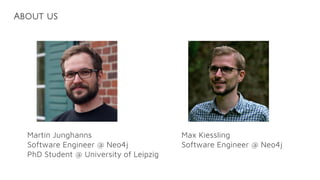
About us
Martin Junghanns
Software Engineer @ Neo4j
PhD Student @ University of Leipzig
Max Kiessling
Software Engineer @ Neo4j
Motivation
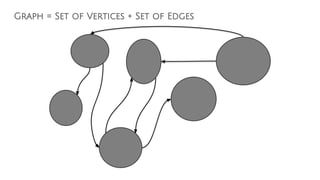
Graph = Set of Vertices + Set of Edges
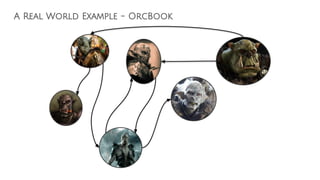
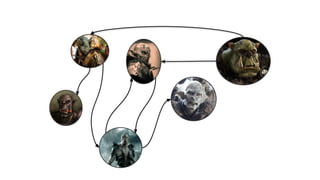
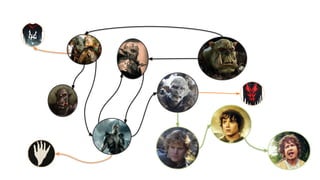
A Real World Example - OrcBook
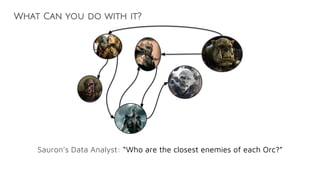
Sauron’s Data Analyst: “Who are the closest enemies of each Orc?”
What Can you do with it?
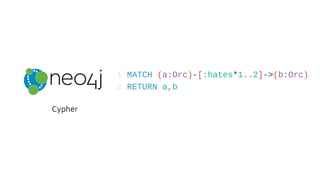
Cypher
Flink Gelly
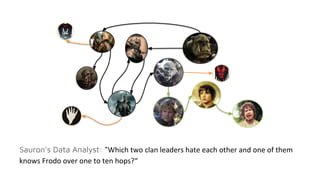
Sauron’s Data Analyst: “
Cypher
MATCH (c1:Clan)<-[:LEADER_OF]-(o1:Orc),
(o1)-[:HATES]->(o2:Orc),
(o2)-[:LEADER_OF]->(c2:Clan),
(o2)-[:KNOWS*1..10]->(h:Hobbit)
WHERE NOT (c1 = c2 AND o1 = o2)
AND h.name = "Frodo"
RETURN o1.name, o2.name
Flink Gelly
or any other non-declarative
graph processing system
Cypher
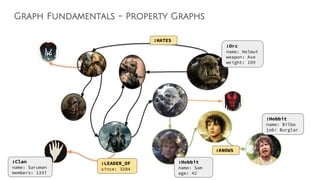
Graph Fundamentals - Property Graphs
:Orc
name: Helmut
weapon: Axe
weight: 199
:Hobbit
name: Bilbo
job: Burglar
:Clan
name: Saruman
members: 1337
:HATES
:LEADER_OF
since: 3204
:Hobbit
name: Sam
age: 42
:KNOWS
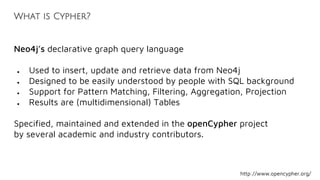
What is Cypher?
Neo4j’s declarative graph query language
● Used to insert, update and retrieve data from Neo4j
● Designed to be easily understood by people with SQL background
● Support for Pattern Matching, Filtering, Aggregation, Projection
● Results are (multidimensional) Tables
Specified, maintained and extended in the openCypher project
by several academic and industry contributors.
http://www.opencypher.org/
Cypher Query Syntax
Find all vertices with
label Clan and assign
them to c1
Traverse incoming edges of
type LEADER_OF
Describes the pattern that should be
matched
Filters the match results
Specifies which fields to return
MATCH (c1:Clan)<-[:LEADER_OF]-(o1:Orc),
(o1)-[:HATES]->(o2:Orc),
(o2)-[:LEADER_OF]->(c2:Clan),
(o2)-[:KNOWS*1..10]->(h:Hobbit)
WHERE NOT (c1 = c2 AND o1 = o2)
AND h.name = "Frodo"
RETURN o1.name, o2.name
Cypher Query Syntax
MATCH (c1:Clan)<-[:LEADER_OF]-(o1:Orc),
(o1)-[:HATES]->(o2:Orc),
(o2)-[:LEADER_OF]->(c2:Clan),
(o2)-[:KNOWS*1..10]->(h:Hobbit)
WHERE NOT (c1 = c2 AND o1 = o2)
AND h.name = "Frodo"
RETURN o1.name, o2.name
Cypher Query Syntax
MATCH (c1:Clan)<-[:LEADER_OF]-(o1:Orc),
(o1)-[:HATES]->(o2:Orc),
(o2)-[:LEADER_OF]->(c2:Clan),
(o2)-[:KNOWS*1..10]->(h:Hobbit)
WHERE NOT (c1 = c2 AND o1 = o2)
AND h.name = "Frodo"
RETURN o1.name, o2.name
Cypher Query Syntax
MATCH (c1:Clan)<-[:LEADER_OF]-(o1:Orc),
(o1)-[:HATES]->(o2:Orc),
(o2)-[:LEADER_OF]->(c2:Clan),
(o2)-[:KNOWS*1..10]->(h:Hobbit)
WHERE NOT (c1 = c2 AND o1 = o2)
AND h.name = "Frodo"
RETURN o1.name, o2.name
Cypher Query Syntax
MATCH (c1:Clan)<-[:LEADER_OF]-(o1:Orc),
(o1)-[:HATES]->(o2:Orc),
(o2)-[:LEADER_OF]->(c2:Clan),
(o2)-[:KNOWS*1..10]->(h:Hobbit)
WHERE NOT (c1 = c2 AND o1 = o2)
AND h.name = "Frodo"
RETURN o1.name, o2.name
Cypher Operator in Gradoop
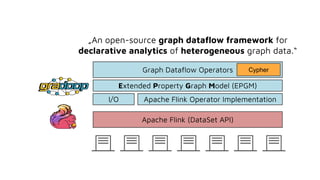
Apache Flink (DataSet API)
Apache Flink Operator Implementation
Extended Property Graph Model (EPGM)
Graph Dataflow Operators
I/O
Cypher
„An open-source graph dataflow framework for
declarative analytics of heterogeneous graph data.“
2
1|Area|title:Mordor
|Area|title:Shire
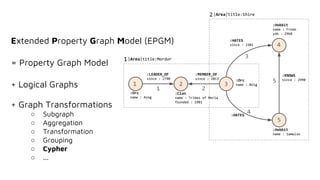
Extended Property Graph Model (EPGM)
1 2
3
4
5
1 2 3
4
5
:Hobbit
name : Samwise
:Orc
name : Azog
:Clan
name : Tribes of Moria
founded : 1981
:Orc
name : Bolg
:Hobbit
name : Frodo
yob : 2968
:LEADER_OF
since : 2790
:MEMBER_OF
since : 2013
:HATES
since : 2301
:HATES
:KNOWS
since : 2990
= Property Graph Model
+ Logical Graphs
+ Graph Transformations
○ Subgraph
○ Aggregation
○ Transformation
○ Grouping
○ Cypher
○ ...
Pattern
Graph Collection
LogicalGraph graph1 = new CSVDataSource(“hdfs:///path/to/graph”, conf).getLogicalGraph();
a b1
1 2 3
4
5
2|map:{a:1, b:2} 3|map:{a:3, b:4}
1 2 3
4
Cypher Operator
GraphCollection collection = graph1.cypher(pattern);
String pattern = “MATCH (a:Green)-[:orange]->(b:Orange)”;
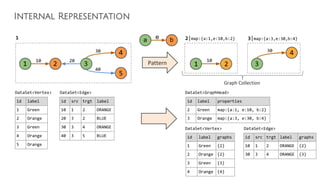
Internal Representation
2|map:{a:1,e:10,b:2} 3|map:{a:3,e:30,b:4}
1 2 3
4
id label
1 Green
2 Orange
3 Green
4 Orange
5 Orange
id src trgt label
10 1 2 ORANGE
20 3 2 BLUE
30 3 4 ORANGE
40 3 5 BLUE
1
1 2 3
4
5
2010
30
40
DataSet<Vertex> DataSet<Edge>
a be
10
30
id label graphs
1 Green {2}
2 Orange {2}
3 Green {3}
4 Orange {4}
id src trgt label graphs
10 1 2 ORANGE {2}
30 3 4 ORANGE {3}
DataSet<Vertex> DataSet<Edge>
id label properties
2 Green map:{a:1, e:10, b:2}
3 Orange map:{a:3, e:30, b:4}
DataSet<GraphHead>
Cypher Engine
Parsing Execution
c1
o2 h
c2
o1
((c1 != c2) AND (o1 != o2)
AND (h.name = Frodo Baggins)
=> 23
=> 42
=> 84
=> 123
=> 456
=> 789
0
3 4
1
2
0
3 5
1
2 4
0
3 6
1
2 4
0
3 6
1
2
4
7
Planning
Query Overview
MATCH (c1:Clan)<-[:LEADER_OF]-(o1:Orc),
(o1)-[:HATES]->(o2:Orc),
(o2)-[:LEADER_OF]->(c2:Clan),
(o2)-[:KNOWS*1..10]->(h:Hobbit)
WHERE NOT (c1 = c2 AND o1 = o2)
AND h.name = "Frodo"
RETURN o1.name, o2.name
Parsing and Query Rewriting
o1 h
__edge01
Query Graph
(o1.weapon = "Axe" AND o1.weight > h.weight)
OR o1.weapon = "Sword"
(o1.weapon = "Axe" OR o1.weapon = "Sword")
AND
(o1.weight > h.weight OR o1.weapon = "Sword")
Conjunctive-Normal-Form
Transformation
ANTLR
MATCH (o1:Orc)-[:KNOWS]->(h:Hobbit)
WHERE (o1.weapon = "Axe" AND o1.weight > h.weight)
OR o1.weapon = "Sword"
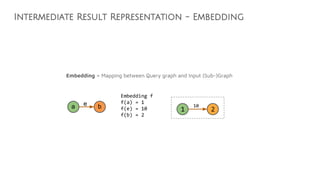
Intermediate Result Representation - Embedding
1 2
10
Embedding = Mapping between Query graph and Input (Sub-)Graph
a be
Embedding f
f(a) = 1
f(e) = 10
f(b) = 2
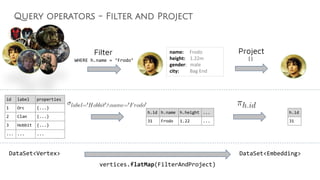
Query operators - Filter and Project
Filter
WHERE h.name = ‘Frodo’
Project
DataSet<Vertex> DataSet<Embedding>
vertices.flatMap(FilterAndProject)
id label properties
1 Orc {...}
2 Clan {...}
3 Hobbit {...}
... ... ...
h.id h.name h.height ...
31 Frodo 1.22 ...
h.id
31
Query operators - Join Embeddings
DataSet<Embedding> lhs DataSet<Embedding>
lhs.flatJoin(rhs).with(Combine)DataSet<Embedding> rhs
Combine
JoinEmbeddings
Left: (c1:Clan)<-[:HAS_LEADER]-(o1:Orc)
Right: (o1:Orc)-[:HATES]->(o2.Orc)
c.id _e1.id o1.id
51 11 2
52 12 3
... ... ...
c.id _e1.id o1.id _e2.id o2.id
51 11 2 13 5
52 12 3 14 3
... ... ... ... ...
o1.id _e2.id o2.id
2 13 5
3 14 3
... ... ...
Query operators - Expand Embeddings
ExpandEmbeddings
Left: (o2:Orc)
Edges: (o2)-[:KNOWS*1..10]->(h:Hobbit)
DataSet<Embedding> lhs
DataSet<Embedding>
DataSet<Embedding> rhs
BulkIteration ws = lhs.join(rhs))
filteredPaths = ws.filter(filterByLength)
newPaths = filteredPaths.flatJoin(rhs, combine)
nextWs = ws.union(newPaths)
Combine
Check for vertex/edge isomorphism
o2.id
5
_e3.sid _e3.id _e3.tid
5 26 31
31 27 32
32 28 33
o2.id _e3.id h.id
3 [26] 31
3 [26,31,27] 32
3 [26,31,27,32,28] 33
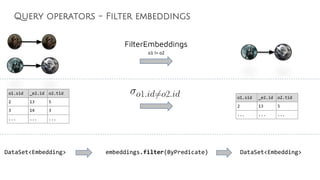
Query operators - Filter embeddings
FilterEmbeddings
o1.sid _e2.id o2.tid
2 13 5
3 14 3
... ... ...
o1.sid _e2.id o2.tid
2 13 5
... ... ...
DataSet<Embedding> DataSet<Embedding>embeddings.filter(ByPredicate)
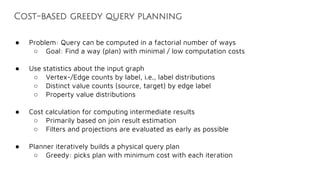
Cost-based greedy query planning
● Problem: Query can be computed in a factorial number of ways
○ Goal: Find a way (plan) with minimal / low computation costs
● Use statistics about the input graph
○ Vertex-/Edge counts by label, i.e., label distributions
○ Distinct value counts (source, target) by edge label
○ Property value distributions
● Cost calculation for computing intermediate results
○ Primarily based on join result estimation
○ Filters and projections are evaluated as early as possible
● Planner iteratively builds a physical query plan
○ Greedy: picks plan with minimum cost with each iteration
MATCH (c1:Clan)<-[:LEADER_OF]-(o1:Orc),
(o1)-[:HATES]->(o2:Orc),
(o2)-[:LEADER_OF]->(c2:Clan),
(o2)-[:KNOWS*1..10]->(h:Hobbit)
WHERE NOT (c1 = c2 AND o1 = o2)
AND h.name = "Frodo"
RETURN o1.name, o2.name
PlanTableEntry | type: GRAPH | all-vars: [...] | proc-vars: [...] | attr-vars: [] | est-card: 23 | prediates: () | Plan :
|-FilterEmbeddingsNode{filterPredicate=((c1 != c2) AND (o1 != o2))}
|.|-JoinEmbeddingsNode{joinVariables=[o2], vertexMorphism=H, edgeMorphism=I}
|.|.|-JoinEmbeddingsNode{joinVariables=[o1], vertexMorphism=H, edgeMorphism=I}
|.|.|.|-JoinEmbeddingsNode{joinVariables=[c1], vertexMorphism=H, edgeMorphism=I}
|.|.|.|.|-FilterAndProjectVerticesNode{vertexVar=c1, filterPredicate=((c1.label = Clan)), projectionKeys=[]}
|.|.|.|.|-FilterAndProjectEdgesNode{sourceVar='o1', edgeVar='_e0', targetVar='c1', filterPredicate=((_e0.label = leaderOf)), projectionKeys=[]}
|.|.|.|-JoinEmbeddingsNode{joinVariables=[o1], vertexMorphism=H, edgeMorphism=I}
|.|.|.|.|-FilterAndProjectVerticesNode{vertexVar=o1, filterPredicate=((o1.label = Orc)), projectionKeys=[]}
|.|.|.|.|-FilterAndProjectEdgesNode{sourceVar='o1', edgeVar='_e1', targetVar='o2', filterPredicate=((_e1.label = hates)), projectionKeys=[]}
|.|.|-JoinEmbeddingsNode{joinVariables=[o2], vertexMorphism=H, edgeMorphism=I}
|.|.|.|-JoinEmbeddingsNode{joinVariables=[h], vertexMorphism=H, edgeMorphism=I}
|.|.|.|.|-FilterAndProjectVerticesNode{vertexVar=h, filterPredicate=((h.label = Hobbit) AND (h.name = Frodo Baggins)), projectionKeys=[]}
|.|.|.|.|-ExpandEmbeddingsNode={startVar='o2', pathVar='_e3', endVar='h', lb=1, ub=10, direction=OUT, vertexMorphism=H, edgeMorphism=I}
|.|.|.|.|.|-FilterAndProjectVerticesNode{vertexVar=o2, filterPredicate=((o2.label = Orc)), projectionKeys=[]}
|.|.|.|.|.|-FilterAndProjectEdgesNode{sourceVar='o2', edgeVar='_e3', targetVar='h', filterPredicate=((_e3.label = knows)), projectionKeys=[]}
|.|.|.|-JoinEmbeddingsNode{joinVariables=[c2], vertexMorphism=H, edgeMorphism=I}
|.|.|.|.|-FilterAndProjectVerticesNode{vertexVar=c2, filterPredicate=((c2.label = Clan)), projectionKeys=[]}
|.|.|.|.|-FilterAndProjectEdgesNode{sourceVar='o2', edgeVar='_e2', targetVar='c2', filterPredicate=((_e2.label = leaderOf)), projectionKeys=[]}
MATCH (c1:Clan)<-[:LEADER_OF]-(o1:Orc),
(o1)-[:HATES]->(o2:Orc),
(o2)-[:LEADER_OF]->(c2:Clan),
(o2)-[:KNOWS*1..10]->(h:Hobbit)
WHERE NOT (c1 = c2 AND o1 = o2)
AND h.name = "Frodo"
RETURN o1.name, o2.name
Demo
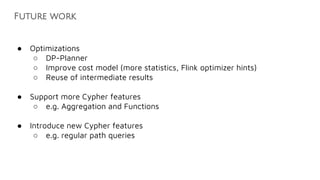
Future work
● Optimizations
○ DP-Planner
○ Improve cost model (more statistics, Flink optimizer hints)
○ Reuse of intermediate results
● Support more Cypher features
○ e.g. Aggregation and Functions
● Introduce new Cypher features
○ e.g. regular path queries
Further reading / Contributing
Gradoop: http://www.gradoop.com
Demo: https://github.com/dbs-leipzig/gradoop_demo
Paper: https://event.cwi.nl/grades/2017/03-Junghanns.pdf
Neo4j: https://neo4j.com/
openCypher: http://www.openCypher.org
Q & A

Flink Forward Berlin 2017: Max Kiessling, Martin Junghanns - Cypher-based Graph Pattern Matching in Apache Flink

  • 1.
  • 2.
    About us Martin Junghanns SoftwareEngineer @ Neo4j PhD Student @ University of Leipzig Max Kiessling Software Engineer @ Neo4j
  • 3.
  • 4.
    Graph = Setof Vertices + Set of Edges
  • 5.
    A Real WorldExample - OrcBook
  • 6.
    Sauron’s Data Analyst:“Who are the closest enemies of each Orc?” What Can you do with it?
  • 7.
  • 8.
  • 12.
  • 13.
  • 14.
    Flink Gelly or anyother non-declarative graph processing system
  • 15.
  • 16.
    Graph Fundamentals -Property Graphs :Orc name: Helmut weapon: Axe weight: 199 :Hobbit name: Bilbo job: Burglar :Clan name: Saruman members: 1337 :HATES :LEADER_OF since: 3204 :Hobbit name: Sam age: 42 :KNOWS
  • 17.
    What is Cypher? Neo4j’sdeclarative graph query language ● Used to insert, update and retrieve data from Neo4j ● Designed to be easily understood by people with SQL background ● Support for Pattern Matching, Filtering, Aggregation, Projection ● Results are (multidimensional) Tables Specified, maintained and extended in the openCypher project by several academic and industry contributors. http://www.opencypher.org/
  • 18.
    Cypher Query Syntax Findall vertices with label Clan and assign them to c1 Traverse incoming edges of type LEADER_OF Describes the pattern that should be matched Filters the match results Specifies which fields to return MATCH (c1:Clan)<-[:LEADER_OF]-(o1:Orc), (o1)-[:HATES]->(o2:Orc), (o2)-[:LEADER_OF]->(c2:Clan), (o2)-[:KNOWS*1..10]->(h:Hobbit) WHERE NOT (c1 = c2 AND o1 = o2) AND h.name = "Frodo" RETURN o1.name, o2.name
  • 19.
    Cypher Query Syntax MATCH(c1:Clan)<-[:LEADER_OF]-(o1:Orc), (o1)-[:HATES]->(o2:Orc), (o2)-[:LEADER_OF]->(c2:Clan), (o2)-[:KNOWS*1..10]->(h:Hobbit) WHERE NOT (c1 = c2 AND o1 = o2) AND h.name = "Frodo" RETURN o1.name, o2.name
  • 20.
    Cypher Query Syntax MATCH(c1:Clan)<-[:LEADER_OF]-(o1:Orc), (o1)-[:HATES]->(o2:Orc), (o2)-[:LEADER_OF]->(c2:Clan), (o2)-[:KNOWS*1..10]->(h:Hobbit) WHERE NOT (c1 = c2 AND o1 = o2) AND h.name = "Frodo" RETURN o1.name, o2.name
  • 21.
    Cypher Query Syntax MATCH(c1:Clan)<-[:LEADER_OF]-(o1:Orc), (o1)-[:HATES]->(o2:Orc), (o2)-[:LEADER_OF]->(c2:Clan), (o2)-[:KNOWS*1..10]->(h:Hobbit) WHERE NOT (c1 = c2 AND o1 = o2) AND h.name = "Frodo" RETURN o1.name, o2.name
  • 22.
    Cypher Query Syntax MATCH(c1:Clan)<-[:LEADER_OF]-(o1:Orc), (o1)-[:HATES]->(o2:Orc), (o2)-[:LEADER_OF]->(c2:Clan), (o2)-[:KNOWS*1..10]->(h:Hobbit) WHERE NOT (c1 = c2 AND o1 = o2) AND h.name = "Frodo" RETURN o1.name, o2.name
  • 23.
  • 24.
    Apache Flink (DataSetAPI) Apache Flink Operator Implementation Extended Property Graph Model (EPGM) Graph Dataflow Operators I/O Cypher „An open-source graph dataflow framework for declarative analytics of heterogeneous graph data.“
  • 25.
    2 1|Area|title:Mordor |Area|title:Shire Extended Property GraphModel (EPGM) 1 2 3 4 5 1 2 3 4 5 :Hobbit name : Samwise :Orc name : Azog :Clan name : Tribes of Moria founded : 1981 :Orc name : Bolg :Hobbit name : Frodo yob : 2968 :LEADER_OF since : 2790 :MEMBER_OF since : 2013 :HATES since : 2301 :HATES :KNOWS since : 2990 = Property Graph Model + Logical Graphs + Graph Transformations ○ Subgraph ○ Aggregation ○ Transformation ○ Grouping ○ Cypher ○ ...
  • 26.
    Pattern Graph Collection LogicalGraph graph1= new CSVDataSource(“hdfs:///path/to/graph”, conf).getLogicalGraph(); a b1 1 2 3 4 5 2|map:{a:1, b:2} 3|map:{a:3, b:4} 1 2 3 4 Cypher Operator GraphCollection collection = graph1.cypher(pattern); String pattern = “MATCH (a:Green)-[:orange]->(b:Orange)”;
  • 27.
    Internal Representation 2|map:{a:1,e:10,b:2} 3|map:{a:3,e:30,b:4} 12 3 4 id label 1 Green 2 Orange 3 Green 4 Orange 5 Orange id src trgt label 10 1 2 ORANGE 20 3 2 BLUE 30 3 4 ORANGE 40 3 5 BLUE 1 1 2 3 4 5 2010 30 40 DataSet<Vertex> DataSet<Edge> a be 10 30 id label graphs 1 Green {2} 2 Orange {2} 3 Green {3} 4 Orange {4} id src trgt label graphs 10 1 2 ORANGE {2} 30 3 4 ORANGE {3} DataSet<Vertex> DataSet<Edge> id label properties 2 Green map:{a:1, e:10, b:2} 3 Orange map:{a:3, e:30, b:4} DataSet<GraphHead>
  • 28.
  • 29.
    Parsing Execution c1 o2 h c2 o1 ((c1!= c2) AND (o1 != o2) AND (h.name = Frodo Baggins) => 23 => 42 => 84 => 123 => 456 => 789 0 3 4 1 2 0 3 5 1 2 4 0 3 6 1 2 4 0 3 6 1 2 4 7 Planning Query Overview MATCH (c1:Clan)<-[:LEADER_OF]-(o1:Orc), (o1)-[:HATES]->(o2:Orc), (o2)-[:LEADER_OF]->(c2:Clan), (o2)-[:KNOWS*1..10]->(h:Hobbit) WHERE NOT (c1 = c2 AND o1 = o2) AND h.name = "Frodo" RETURN o1.name, o2.name
  • 30.
    Parsing and QueryRewriting o1 h __edge01 Query Graph (o1.weapon = "Axe" AND o1.weight > h.weight) OR o1.weapon = "Sword" (o1.weapon = "Axe" OR o1.weapon = "Sword") AND (o1.weight > h.weight OR o1.weapon = "Sword") Conjunctive-Normal-Form Transformation ANTLR MATCH (o1:Orc)-[:KNOWS]->(h:Hobbit) WHERE (o1.weapon = "Axe" AND o1.weight > h.weight) OR o1.weapon = "Sword"
  • 31.
    Intermediate Result Representation- Embedding 1 2 10 Embedding = Mapping between Query graph and Input (Sub-)Graph a be Embedding f f(a) = 1 f(e) = 10 f(b) = 2
  • 32.
    Query operators -Filter and Project Filter WHERE h.name = ‘Frodo’ Project DataSet<Vertex> DataSet<Embedding> vertices.flatMap(FilterAndProject) id label properties 1 Orc {...} 2 Clan {...} 3 Hobbit {...} ... ... ... h.id h.name h.height ... 31 Frodo 1.22 ... h.id 31
  • 33.
    Query operators -Join Embeddings DataSet<Embedding> lhs DataSet<Embedding> lhs.flatJoin(rhs).with(Combine)DataSet<Embedding> rhs Combine JoinEmbeddings Left: (c1:Clan)<-[:HAS_LEADER]-(o1:Orc) Right: (o1:Orc)-[:HATES]->(o2.Orc) c.id _e1.id o1.id 51 11 2 52 12 3 ... ... ... c.id _e1.id o1.id _e2.id o2.id 51 11 2 13 5 52 12 3 14 3 ... ... ... ... ... o1.id _e2.id o2.id 2 13 5 3 14 3 ... ... ...
  • 34.
    Query operators -Expand Embeddings ExpandEmbeddings Left: (o2:Orc) Edges: (o2)-[:KNOWS*1..10]->(h:Hobbit) DataSet<Embedding> lhs DataSet<Embedding> DataSet<Embedding> rhs BulkIteration ws = lhs.join(rhs)) filteredPaths = ws.filter(filterByLength) newPaths = filteredPaths.flatJoin(rhs, combine) nextWs = ws.union(newPaths) Combine Check for vertex/edge isomorphism o2.id 5 _e3.sid _e3.id _e3.tid 5 26 31 31 27 32 32 28 33 o2.id _e3.id h.id 3 [26] 31 3 [26,31,27] 32 3 [26,31,27,32,28] 33
  • 35.
    Query operators -Filter embeddings FilterEmbeddings o1.sid _e2.id o2.tid 2 13 5 3 14 3 ... ... ... o1.sid _e2.id o2.tid 2 13 5 ... ... ... DataSet<Embedding> DataSet<Embedding>embeddings.filter(ByPredicate)
  • 36.
    Cost-based greedy queryplanning ● Problem: Query can be computed in a factorial number of ways ○ Goal: Find a way (plan) with minimal / low computation costs ● Use statistics about the input graph ○ Vertex-/Edge counts by label, i.e., label distributions ○ Distinct value counts (source, target) by edge label ○ Property value distributions ● Cost calculation for computing intermediate results ○ Primarily based on join result estimation ○ Filters and projections are evaluated as early as possible ● Planner iteratively builds a physical query plan ○ Greedy: picks plan with minimum cost with each iteration
  • 37.
    MATCH (c1:Clan)<-[:LEADER_OF]-(o1:Orc), (o1)-[:HATES]->(o2:Orc), (o2)-[:LEADER_OF]->(c2:Clan), (o2)-[:KNOWS*1..10]->(h:Hobbit) WHERE NOT(c1 = c2 AND o1 = o2) AND h.name = "Frodo" RETURN o1.name, o2.name PlanTableEntry | type: GRAPH | all-vars: [...] | proc-vars: [...] | attr-vars: [] | est-card: 23 | prediates: () | Plan : |-FilterEmbeddingsNode{filterPredicate=((c1 != c2) AND (o1 != o2))} |.|-JoinEmbeddingsNode{joinVariables=[o2], vertexMorphism=H, edgeMorphism=I} |.|.|-JoinEmbeddingsNode{joinVariables=[o1], vertexMorphism=H, edgeMorphism=I} |.|.|.|-JoinEmbeddingsNode{joinVariables=[c1], vertexMorphism=H, edgeMorphism=I} |.|.|.|.|-FilterAndProjectVerticesNode{vertexVar=c1, filterPredicate=((c1.label = Clan)), projectionKeys=[]} |.|.|.|.|-FilterAndProjectEdgesNode{sourceVar='o1', edgeVar='_e0', targetVar='c1', filterPredicate=((_e0.label = leaderOf)), projectionKeys=[]} |.|.|.|-JoinEmbeddingsNode{joinVariables=[o1], vertexMorphism=H, edgeMorphism=I} |.|.|.|.|-FilterAndProjectVerticesNode{vertexVar=o1, filterPredicate=((o1.label = Orc)), projectionKeys=[]} |.|.|.|.|-FilterAndProjectEdgesNode{sourceVar='o1', edgeVar='_e1', targetVar='o2', filterPredicate=((_e1.label = hates)), projectionKeys=[]} |.|.|-JoinEmbeddingsNode{joinVariables=[o2], vertexMorphism=H, edgeMorphism=I} |.|.|.|-JoinEmbeddingsNode{joinVariables=[h], vertexMorphism=H, edgeMorphism=I} |.|.|.|.|-FilterAndProjectVerticesNode{vertexVar=h, filterPredicate=((h.label = Hobbit) AND (h.name = Frodo Baggins)), projectionKeys=[]} |.|.|.|.|-ExpandEmbeddingsNode={startVar='o2', pathVar='_e3', endVar='h', lb=1, ub=10, direction=OUT, vertexMorphism=H, edgeMorphism=I} |.|.|.|.|.|-FilterAndProjectVerticesNode{vertexVar=o2, filterPredicate=((o2.label = Orc)), projectionKeys=[]} |.|.|.|.|.|-FilterAndProjectEdgesNode{sourceVar='o2', edgeVar='_e3', targetVar='h', filterPredicate=((_e3.label = knows)), projectionKeys=[]} |.|.|.|-JoinEmbeddingsNode{joinVariables=[c2], vertexMorphism=H, edgeMorphism=I} |.|.|.|.|-FilterAndProjectVerticesNode{vertexVar=c2, filterPredicate=((c2.label = Clan)), projectionKeys=[]} |.|.|.|.|-FilterAndProjectEdgesNode{sourceVar='o2', edgeVar='_e2', targetVar='c2', filterPredicate=((_e2.label = leaderOf)), projectionKeys=[]}
  • 38.
  • 39.
  • 40.
    Future work ● Optimizations ○DP-Planner ○ Improve cost model (more statistics, Flink optimizer hints) ○ Reuse of intermediate results ● Support more Cypher features ○ e.g. Aggregation and Functions ● Introduce new Cypher features ○ e.g. regular path queries
  • 41.
    Further reading /Contributing Gradoop: http://www.gradoop.com Demo: https://github.com/dbs-leipzig/gradoop_demo Paper: https://event.cwi.nl/grades/2017/03-Junghanns.pdf Neo4j: https://neo4j.com/ openCypher: http://www.openCypher.org
  • 42.