Done by : FATIMAH ALLUWAIM
Group NO. : 3
Tutor : DR. DALIA ASHOR
Objectives
•
•
•
•
•
•
•
•
•
•
•
•
•
•
•

class switching.
affinity maturation.
What is immunoglobulin.
IgA Definition.
IgA types.
Definition of Selective IgA deficiency .
Types.
Causes.
Risk factors.
Pathophysiology.
Symptoms.
Diagnosis.
Treatment.
What is the adverse reaction.
The patient can take influenza vaccination and other vaccines.
Immunoglobulin
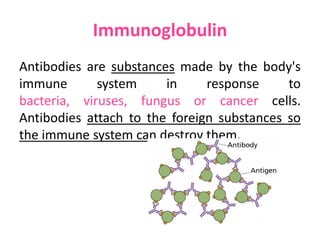
Antibodies are substances made by the body's
immune
system
in
response
to
bacteria, viruses, fungus or cancer cells.
Antibodies attach to the foreign substances so
the immune system can destroy them.
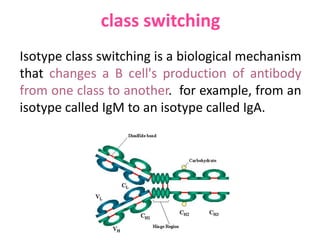
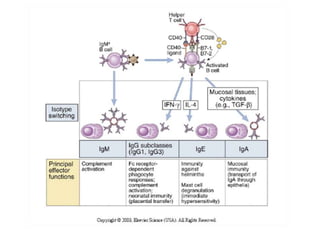
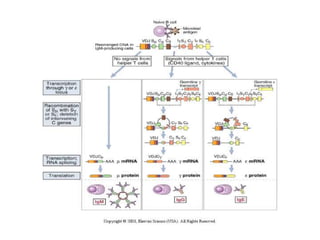
class switching
Isotype class switching is a biological mechanism
that changes a B cell's production of antibody
from one class to another. for example, from an
isotype called IgM to an isotype called IgA.
What is the affinity maturation
It is the process by witch the affinity of
antibodies produced in response to protein
antigen increases with prolonged or repeated
exposure to that antigen.
Where do you think Affinity
maturation occurs ?
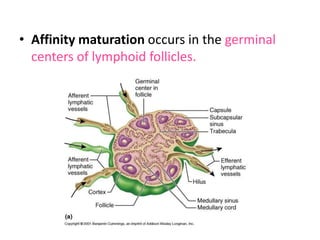
• Affinity maturation occurs in the germinal
centers of lymphoid follicles.
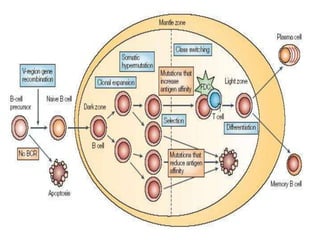
• Two interrelated processes, occurring in the
germinal centers of the secondary lymphoid
organs:
1. somatic hypermutation.
2. clonal selection.
Molecular basis of affinity maturation
1. Activation of B cells and migration into germinal
center.
2. B cell proliferation.
3. Somatic hypermutation of Ig genes.
4. B cell recognition of antigen on follicular
dendritic cells, selection of high-affinity B cells.
5. Death of B cells that do not bind antigen.
6. Generation of memory and balsama cells.
Immunoglobulin A
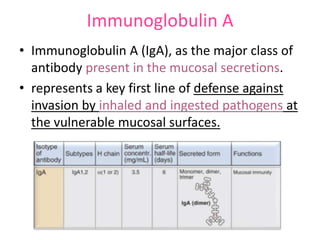
• Immunoglobulin A (IgA), as the major class of
antibody present in the mucosal secretions.
• represents a key first line of defense against
invasion by inhaled and ingested pathogens at
the vulnerable mucosal surfaces.
IgA Subclasses
• IgA1, comprises approximately 85% of total IgA
concentration in serum. IgA1 shows a good immune
response to protein antigens and, to a lesser degree, to
polysaccharide and lipopolysaccharides.

• IgA2, representing only up to 15% of total IgA in
serum, plays an important role in the mucosa of the
airways, eyes, and the gastrointestinal tract to fight
against polysaccharide and lipopolysaccaride antigens.
It also fighting bacterial infections.
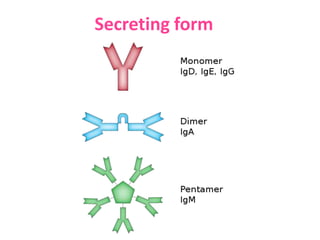
Secreting form
Selective deficiency of IgA is the most
common (PIDD). Persons with this
disorder have low or absent levels of a
blood protein called IgA.
Do you know why the
disorder termed “selective”
Classification
• Severe IgA deficiency refers to serum levels
below 0.7 mg/mL, which is the lower limit of
detection for most assays.
• Partial IgA deficiency refers to serum levels
above 0.7 mg/mL, but below the lower limit of
normal.
causes
• Unknown in many cases
• mutation of heavy chain constant regionin
some.
• IgA deficiency is could be inherited (20% of
cases) , which means it is passed down
through families. It may be inherited as an
autosomal dominant or autosomal recessive
trait.
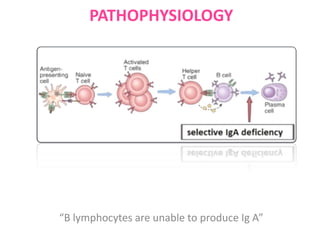
PATHOPHYSIOLOGY

“B lymphocytes are unable to produce Ig A”
Risk factor
• Caucasians People have a higher risk factor, it
is found in approximately 1 in 700 individual.
• Family history especially if the patient has
First-degree relative in this condition.
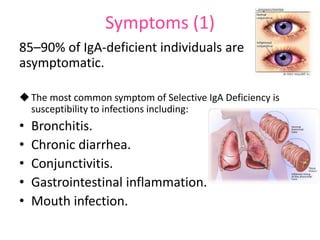
Symptoms (1)
85–90% of IgA-deficient individuals are
asymptomatic.
 The most common symptom of Selective IgA Deficiency is
susceptibility to infections including:

•
•
•
•
•

Bronchitis.
Chronic diarrhea.
Conjunctivitis.
Gastrointestinal inflammation.
Mouth infection.
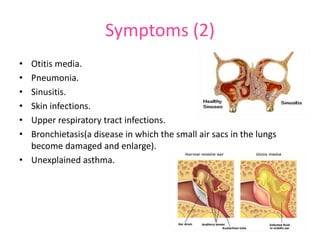
Symptoms (2)
•
•
•
•
•
•

Otitis media.
Pneumonia.
Sinusitis.
Skin infections.
Upper respiratory tract infections.
Bronchietasis(a disease in which the small air sacs in the lungs
become damaged and enlarge).
• Unexplained asthma.
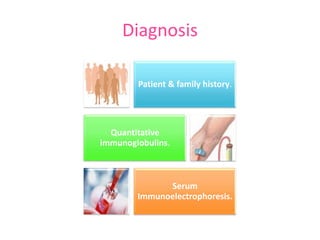
Diagnosis
Patient & family history.

Quantitative
immunoglobulins.

Serum
Immunoelectrophoresis.
Patient & family history
• Family history of selective IgA deficiency.
• Either chronic or recurrent
infections, allergies, auto-immune
diseases, chronic diarrhea, or some
combination of these problems.
Quantitative immunoglobulins
• rapid and accurate measurement of the
amounts of the immunoglobulins M, G, and A.
• tests of blood serum demonstrate absence of
IgA with normal levels of the other major
classes of immunoglobulins (IgG and IgM).
NORMAL results of Ig M, G and A
IgG

560 to 1800 mg/dL

IgM

45 to 250 mg/dL

IgA

100 to 400 mg/dL
Serum Immunoelectrophoresis
• detect the presence of certain antibody.
• It is used to detect if the patient have
anti-IgA antibodies.
Complication
• An autoimmune disorder such as rheumatoid
arthritis.

• severe, even life-threatening, reactions to
transfusions of blood and blood products because
they develop anti-IgA antibody .What if transfusions
are necessary?
• Some patients develop common variable
immunodeficiency.

Management
• patients who do not have any symptoms do
not need any treatment.
• prevent anaphylactic reaction secondary to
blood transfusion.
• treatment of associated diseases.
Treatment
• No specific treatment is available. Some
people gradually develop normal levels of IgA
without treatment.

• Infections should be treated with antibiotics.
• Those with selective IgA deficiency who also
have IgG subclass deficiencies can benefit
from Intravenous immunoglobulin (IVIG).
Intravenous immunoglobulin (IVIG)
• It is a sterile solution of concentrated
antibodies extracted from healthy donors
which is administered into a vein.

• IVIG is used to treat disorders of the immune
system or to boost immune response to
serious illness.
The side effects for IVIG treatment (1)
• People with complete IgA deficiency may develop
anti-IgA antibodies if given blood products and
IVIG. This may lead to allergies or lifethreatening anaphylactic shock.
(These individuals can safely be given IgA-depleted
IVIG if this deficiency is also associated with IgG
subtype deficiency)
The side effects for IVIG treatment (2)
•
•
•
•

Headache.
dermatitis - usually peeling of the skin.
infection (such as HIV or viral hepatitis).
damage such as hepatitis caused directly by
antibodies contained in the pooled IVIG.
• acute kidney injury.
• venous thrombosis.
Prevention
There is no means of prevention of Selective IgA
Deficiency.
• Because IgA Deficiency does not become detectable
until approximately six months of age, prenatal and
neonatal detection of this disorder is currently not
possible.
• But genetic counseling may be of value to prospective
parents with a family history of selective IgA deficiency.

• Vaccines, including the pneumococcal vaccine, may be
administered to prevent infections that are commonly
associated with the disorder.
Vaccination and IgA deficiency
• Local live virus vaccine, such as intranasal
influenza vaccine, yellow fever vaccine and
live rotavirus vaccine, should not be given to
patients with IgA deficiency until their
immune status is fully evaluated.
• Other vaccines, such as those against
pneumococcus, are specifically
recommended.
References
•
•
•
•
•

•
•
•

Basic Immunology, Abbas 3th ed.
http://www.nlm.nih.gov/medlineplus/ency/article/001476.htm
http://www.ncbi.nlm.nih.gov/pmc/articles/PMC2821513/
http://primaryimmune.org/wpcontent/uploads/2011/04/Selective-IgA-Deficiency.pdf
http://www.cdc.gov/vaccines/pubs/pinkbook/downloads/appendic
es/A/immuno-table.pdf
http://bandbacktogether.com/Immunoglobulin-A-IgA-Deficiencyresources/
http://www.healthcentral.com/ency/408/001476.html?ic=506019
http://www.aaaai.org/conditions-and-treatments/primaryimmunodeficiency-disease/selective-iga-deficiency.aspx
Selective igA deficiency

Selective igA deficiency

  • 1.
    Done by :FATIMAH ALLUWAIM Group NO. : 3 Tutor : DR. DALIA ASHOR
  • 2.
    Objectives • • • • • • • • • • • • • • • class switching. affinity maturation. Whatis immunoglobulin. IgA Definition. IgA types. Definition of Selective IgA deficiency . Types. Causes. Risk factors. Pathophysiology. Symptoms. Diagnosis. Treatment. What is the adverse reaction. The patient can take influenza vaccination and other vaccines.
  • 3.
    Immunoglobulin Antibodies are substancesmade by the body's immune system in response to bacteria, viruses, fungus or cancer cells. Antibodies attach to the foreign substances so the immune system can destroy them.
  • 4.
    class switching Isotype classswitching is a biological mechanism that changes a B cell's production of antibody from one class to another. for example, from an isotype called IgM to an isotype called IgA.
  • 7.
    What is theaffinity maturation It is the process by witch the affinity of antibodies produced in response to protein antigen increases with prolonged or repeated exposure to that antigen.
  • 8.
    Where do youthink Affinity maturation occurs ?
  • 9.
    • Affinity maturationoccurs in the germinal centers of lymphoid follicles.
  • 10.
    • Two interrelatedprocesses, occurring in the germinal centers of the secondary lymphoid organs: 1. somatic hypermutation. 2. clonal selection.
  • 12.
    Molecular basis ofaffinity maturation 1. Activation of B cells and migration into germinal center. 2. B cell proliferation. 3. Somatic hypermutation of Ig genes. 4. B cell recognition of antigen on follicular dendritic cells, selection of high-affinity B cells. 5. Death of B cells that do not bind antigen. 6. Generation of memory and balsama cells.
  • 13.
    Immunoglobulin A • ImmunoglobulinA (IgA), as the major class of antibody present in the mucosal secretions. • represents a key first line of defense against invasion by inhaled and ingested pathogens at the vulnerable mucosal surfaces.
  • 14.
    IgA Subclasses • IgA1,comprises approximately 85% of total IgA concentration in serum. IgA1 shows a good immune response to protein antigens and, to a lesser degree, to polysaccharide and lipopolysaccharides. • IgA2, representing only up to 15% of total IgA in serum, plays an important role in the mucosa of the airways, eyes, and the gastrointestinal tract to fight against polysaccharide and lipopolysaccaride antigens. It also fighting bacterial infections.
  • 15.
  • 16.
    Selective deficiency ofIgA is the most common (PIDD). Persons with this disorder have low or absent levels of a blood protein called IgA.
  • 17.
    Do you knowwhy the disorder termed “selective”
  • 18.
    Classification • Severe IgAdeficiency refers to serum levels below 0.7 mg/mL, which is the lower limit of detection for most assays. • Partial IgA deficiency refers to serum levels above 0.7 mg/mL, but below the lower limit of normal.
  • 19.
    causes • Unknown inmany cases • mutation of heavy chain constant regionin some. • IgA deficiency is could be inherited (20% of cases) , which means it is passed down through families. It may be inherited as an autosomal dominant or autosomal recessive trait.
  • 20.
    PATHOPHYSIOLOGY “B lymphocytes areunable to produce Ig A”
  • 21.
    Risk factor • CaucasiansPeople have a higher risk factor, it is found in approximately 1 in 700 individual. • Family history especially if the patient has First-degree relative in this condition.
  • 22.
    Symptoms (1) 85–90% ofIgA-deficient individuals are asymptomatic.  The most common symptom of Selective IgA Deficiency is susceptibility to infections including: • • • • • Bronchitis. Chronic diarrhea. Conjunctivitis. Gastrointestinal inflammation. Mouth infection.
  • 23.
    Symptoms (2) • • • • • • Otitis media. Pneumonia. Sinusitis. Skininfections. Upper respiratory tract infections. Bronchietasis(a disease in which the small air sacs in the lungs become damaged and enlarge). • Unexplained asthma.
  • 24.
    Diagnosis Patient & familyhistory. Quantitative immunoglobulins. Serum Immunoelectrophoresis.
  • 25.
    Patient & familyhistory • Family history of selective IgA deficiency. • Either chronic or recurrent infections, allergies, auto-immune diseases, chronic diarrhea, or some combination of these problems.
  • 26.
    Quantitative immunoglobulins • rapidand accurate measurement of the amounts of the immunoglobulins M, G, and A. • tests of blood serum demonstrate absence of IgA with normal levels of the other major classes of immunoglobulins (IgG and IgM). NORMAL results of Ig M, G and A IgG 560 to 1800 mg/dL IgM 45 to 250 mg/dL IgA 100 to 400 mg/dL
  • 27.
    Serum Immunoelectrophoresis • detectthe presence of certain antibody. • It is used to detect if the patient have anti-IgA antibodies.
  • 28.
    Complication • An autoimmunedisorder such as rheumatoid arthritis. • severe, even life-threatening, reactions to transfusions of blood and blood products because they develop anti-IgA antibody .What if transfusions are necessary? • Some patients develop common variable immunodeficiency.
  • 29.
    Management • patients whodo not have any symptoms do not need any treatment. • prevent anaphylactic reaction secondary to blood transfusion. • treatment of associated diseases.
  • 30.
    Treatment • No specifictreatment is available. Some people gradually develop normal levels of IgA without treatment. • Infections should be treated with antibiotics. • Those with selective IgA deficiency who also have IgG subclass deficiencies can benefit from Intravenous immunoglobulin (IVIG).
  • 31.
    Intravenous immunoglobulin (IVIG) •It is a sterile solution of concentrated antibodies extracted from healthy donors which is administered into a vein. • IVIG is used to treat disorders of the immune system or to boost immune response to serious illness.
  • 32.
    The side effectsfor IVIG treatment (1) • People with complete IgA deficiency may develop anti-IgA antibodies if given blood products and IVIG. This may lead to allergies or lifethreatening anaphylactic shock. (These individuals can safely be given IgA-depleted IVIG if this deficiency is also associated with IgG subtype deficiency)
  • 33.
    The side effectsfor IVIG treatment (2) • • • • Headache. dermatitis - usually peeling of the skin. infection (such as HIV or viral hepatitis). damage such as hepatitis caused directly by antibodies contained in the pooled IVIG. • acute kidney injury. • venous thrombosis.
  • 34.
    Prevention There is nomeans of prevention of Selective IgA Deficiency. • Because IgA Deficiency does not become detectable until approximately six months of age, prenatal and neonatal detection of this disorder is currently not possible. • But genetic counseling may be of value to prospective parents with a family history of selective IgA deficiency. • Vaccines, including the pneumococcal vaccine, may be administered to prevent infections that are commonly associated with the disorder.
  • 35.
    Vaccination and IgAdeficiency • Local live virus vaccine, such as intranasal influenza vaccine, yellow fever vaccine and live rotavirus vaccine, should not be given to patients with IgA deficiency until their immune status is fully evaluated. • Other vaccines, such as those against pneumococcus, are specifically recommended.
  • 36.
    References • • • • • • • • Basic Immunology, Abbas3th ed. http://www.nlm.nih.gov/medlineplus/ency/article/001476.htm http://www.ncbi.nlm.nih.gov/pmc/articles/PMC2821513/ http://primaryimmune.org/wpcontent/uploads/2011/04/Selective-IgA-Deficiency.pdf http://www.cdc.gov/vaccines/pubs/pinkbook/downloads/appendic es/A/immuno-table.pdf http://bandbacktogether.com/Immunoglobulin-A-IgA-Deficiencyresources/ http://www.healthcentral.com/ency/408/001476.html?ic=506019 http://www.aaaai.org/conditions-and-treatments/primaryimmunodeficiency-disease/selective-iga-deficiency.aspx

Editor's Notes

  • #5 Explain the pic ( there are 2 types of light chain, they differ in their C region but have same function.And there are 5 types of heavy chain, such as ……..That also differ in there C region. Antibodies that contain different type of heavy chain belong to different type of Isotype or class.antibody heavy chain is changed the main idea
  • #6 Mature B cells that have not encountered antigen, are membrane bound IgM and IgD. After stimulation by antigen and helper T lymphocyte may expand and differentiate into progeny that secret antibodies. ( class switching couldn't occur with out T cell).Heavy chain isotype switching is induced by a combination of Cd40L mediated signal and cytokines. The defect on cytokines could lead to selective IgA deficiency, because cytokines produced by helper T cell determine heavy chain isotype.
  • #7 The primary transcript of the arranged VDJ heavy chain gene is spliced onto the m mio messenger RNA to produce mio heavy chain and IgM antibody.Signal from helper T cells ( CD40 and cytokine ) may induce recombination of switch S region.The enzyme activation-induced deaminase ( AID ) alters nucleotides in the switch regions so that they can cleaved by other enzymes and joined to down stream switch region.The VDJ primary RNA is spliced onto the RNA from the down stream C gene, producing a heavy chian with a new constant region and a new class Ig.
  • #8 increase in the antigen binding strength as a result of repeated stimulation by an antigen.
  • #12 Some of the B cells that are activated by antigen, with help from T cells, migrate into follicles to form germinal center, where the go under rapid proliferation and accumulate mutation in their immunoglobulin V region. The mutation generate B cells with different affinities for the antigen. Follicular dendritic cells display the antigen, and the B cells that recognize the antigen are selected to survive. FDCs display the antigen, B cells also bind the antigen and present it to helper T cells in the germinal center. As more antibody is produced, the amount of available antigen decreases, so the B cells that are selected have to express receptors with higher affinities to bind the antigen. The B cells who recognize the antigen on FDCs or inter act with helper T cells are selected to survive. Other B cells die.
  • #13 The enzyme AID is play an important role in somatic mutation by changing the nucleotides in the Ig genes and making them go to mutationThis mutation in the V region of the immunoglobulin genes.
  • #16 Pentamer with 10 antigen binding site
  • #17 primary immunodeficiency diseasThe disorder is termed "selective" because other serum immunoglobulins, such as IgM and IgG, are present at normal or increased levels. Additionally, IgA deficient persons have normal or near normal T-cell, phagocytic cell and complement system function.
  • #18 The disorder is termed "selective" because other serum immunoglobulins, such as IgM and IgG, are present at normal or increased levels. Additionally, IgA deficient persons have normal or near normal T-cell, phagocytic cell and complement system function.
  • #21 . The failure of B cells to terminally differentiate into IgA-secreting plasma cells may be due to the lack of effects caused by co-stimulatory molecules or cytokines such as IL-4, IL-6, IL-7, or IL-10.
  • #23 asymptomatic, meaning that they do not experience the symptoms of the disorder until later in their life.
  • #25 Lung function testsUrinalysisThyroid function testsKidney function testsAbsorption of nutrients in the GI tract
  • #29  If transfusions are necessary, washed cells may be cautiously given.
  • #30 Anapgylactic : hypersensitive due toearlier exposure to causative agent.
  • #33 Anapgylactic : hypersensitive due toearlier exposure to causative agent.a special case of IgA deficiency which is complete IgA deficiency. Sometimes this deficiency is also associated with IgG subtype deficiency for which IVIG is given but some patients with this deficiency develop antibodies against IgA, therefore IgA is removed from the IVIG before it is given to these patients.