A Quick History
of VoIP Phones
From the first phone call to modern VoIP Providers
The phone on your desk, and in your
hand, is an underestimated business tool.
Business owners don’t realize how much
they rely on their phones until it stops
functioning.
Let’s explore the history of this important
communication tool…
If you cant imagine a day without your
phone, thank Alexander Graham Bell, the
inventor of the telephone.
Bell executes the first successful phone
call and takes a step towards
communication as we know it today.
1876
In the years after Bell’s invention,
telephone switchboards are used to
connect two parties so that they can
communicate.
At this point, making a phone call requires
a switchboard that necessitates an
operator to manually connect the two
callers using a panel of jacks and wires.
Telephones at this time are made of
wood and need to be hand-cranked to
operate.
Thomas Edison and Tivadar Puskas are
the brains behind a telephone exchange.
The Bell Telephone Company builds one
and inspires future designs.
1877
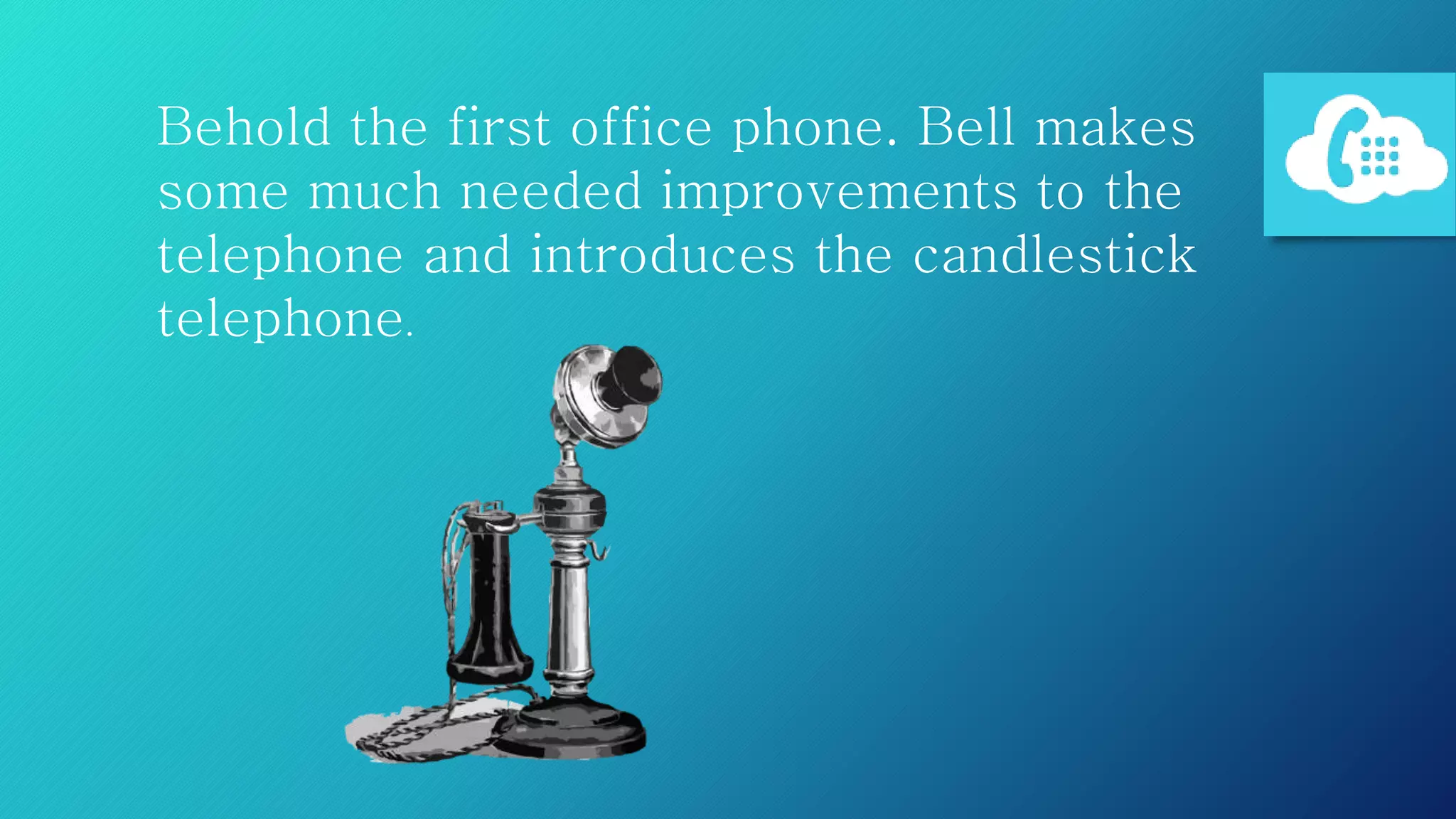
Behold the first office phone. Bell makes
some much needed improvements to the
telephone and introduces the candlestick
telephone.
Two years after the telephone
switchboard exchange is invented,
the first commercial North American
telephone exchange opens in Connecticut.
1878
Due to increasing popularity and
switchboards getting larger, technology
shifts to a Panel Machine Switching
System in the 1920s, which is an early
type of automatic telephone exchange that
eliminates the need for multiple
switchboards.
Almon Strowger modernizes the office
phone with the invention of the rotary dial
telephone.
1892
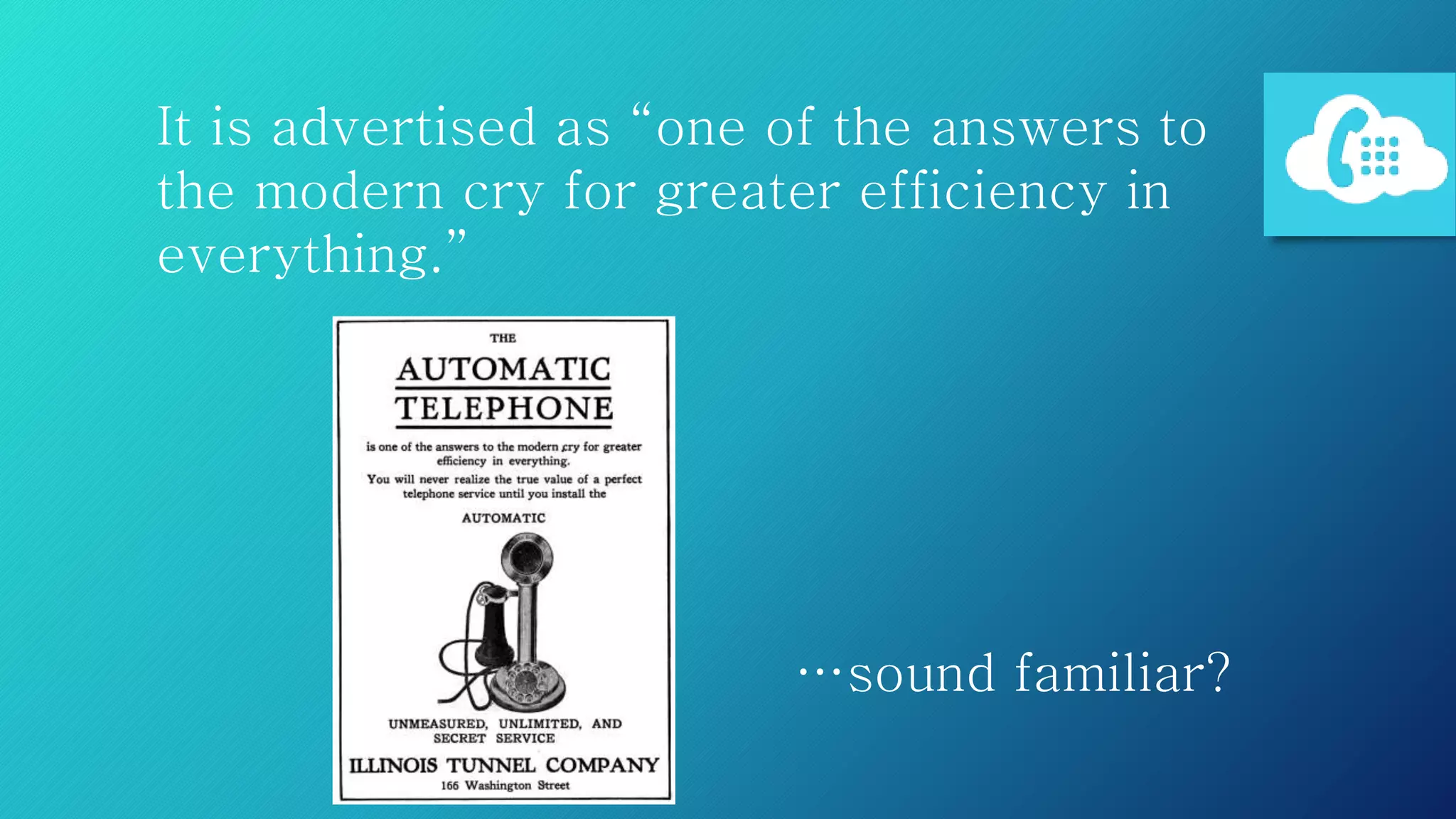
It is advertised as “one of the answers to
the modern cry for greater efficiency in
everything.”
…sound familiar?
The rotary phone, in its various models,
shares the telephone market with the
candlestick until the 1930s. The rotary
dial telephone remains a popular choice as
a home and office phone until the 1960s.
The first direct dialing distance service is
implemented in New Jersey, which allow a
caller to reach another user outside of the
local calling area without operator
assistance.
1951
Modems are now being used for direct
connection by way of phone lines, which
are used to transmit and decode digital
data.
1958
The introduction of modems will
eventually lead to the introduction of echo
cancellation, broadband, radio, and our
beloved Wi-Fi.
As cell phone electronics are developed,
push button phones begin replacing the
rotary dial phones.
1960s
The office phone is now easier to use and
with answering machine technology
gaining popularity, people’s behavior
towards communicating is changing.
The following decades lead to advances
that make the Asterisk Private Branch
Exchange possible, and help power VoIP
providers as we know them today.
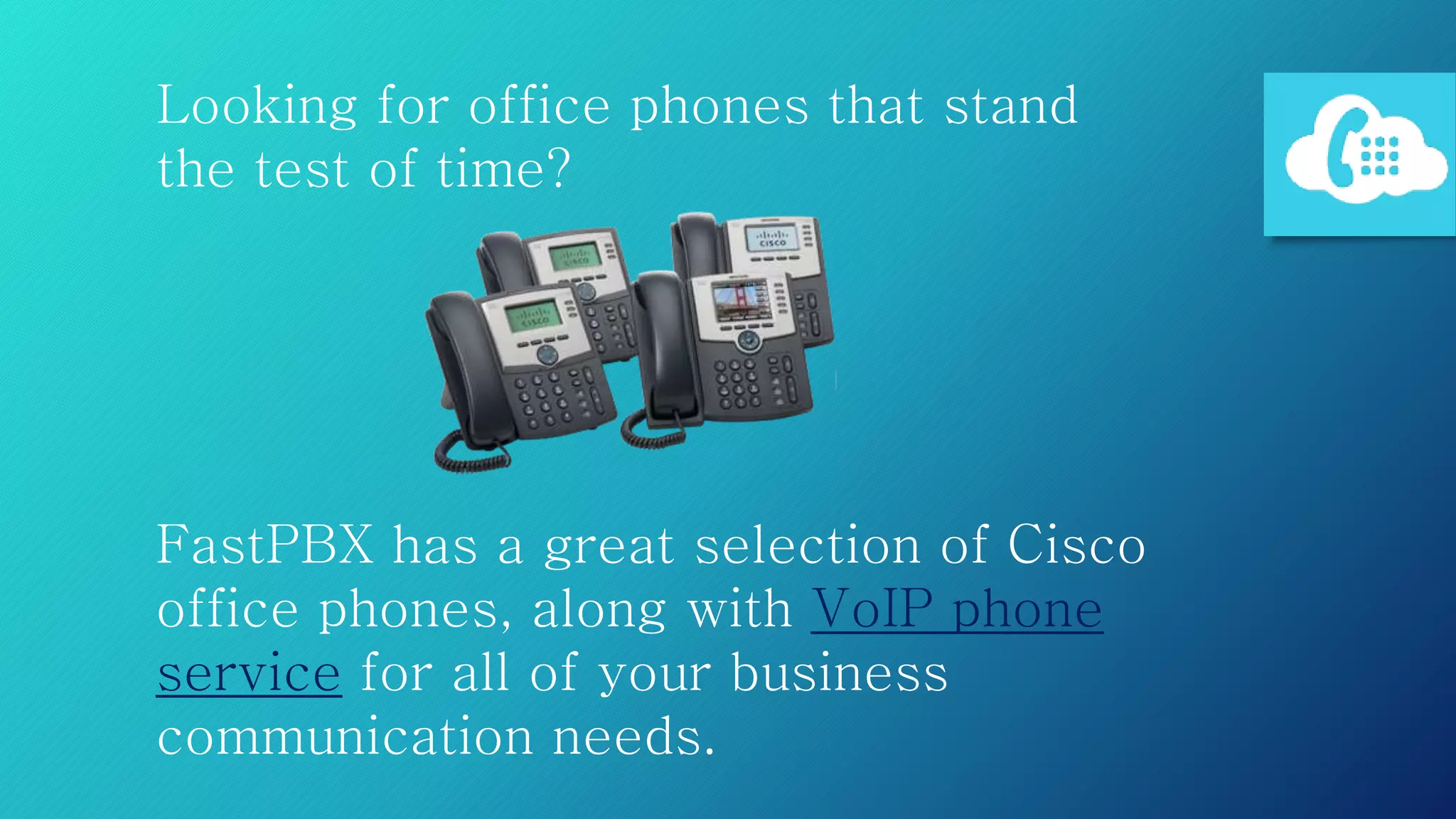
Looking for office phones that stand
the test of time?
FastPBX has a great selection of Cisco
office phones, along with VoIP phone
service for all of your business
communication needs.
FastPBX Business Phone System
www.FastPBX.com | 888-988-5355 | hello@FastPBX.com

A Quick History of VoIP Phones

  • 1.
    A Quick History ofVoIP Phones From the first phone call to modern VoIP Providers
  • 2.
    The phone onyour desk, and in your hand, is an underestimated business tool. Business owners don’t realize how much they rely on their phones until it stops functioning.
  • 3.
    Let’s explore thehistory of this important communication tool…
  • 4.
    If you cantimagine a day without your phone, thank Alexander Graham Bell, the inventor of the telephone.
  • 5.
    Bell executes thefirst successful phone call and takes a step towards communication as we know it today. 1876
  • 6.
    In the yearsafter Bell’s invention, telephone switchboards are used to connect two parties so that they can communicate.
  • 7.
    At this point,making a phone call requires a switchboard that necessitates an operator to manually connect the two callers using a panel of jacks and wires.
  • 8.
    Telephones at thistime are made of wood and need to be hand-cranked to operate.
  • 9.
    Thomas Edison andTivadar Puskas are the brains behind a telephone exchange. The Bell Telephone Company builds one and inspires future designs. 1877
  • 10.
    Behold the firstoffice phone. Bell makes some much needed improvements to the telephone and introduces the candlestick telephone.
  • 11.
    Two years afterthe telephone switchboard exchange is invented, the first commercial North American telephone exchange opens in Connecticut. 1878
  • 12.
    Due to increasingpopularity and switchboards getting larger, technology shifts to a Panel Machine Switching System in the 1920s, which is an early type of automatic telephone exchange that eliminates the need for multiple switchboards.
  • 13.
    Almon Strowger modernizesthe office phone with the invention of the rotary dial telephone. 1892
  • 14.
    It is advertisedas “one of the answers to the modern cry for greater efficiency in everything.” …sound familiar?
  • 15.
    The rotary phone,in its various models, shares the telephone market with the candlestick until the 1930s. The rotary dial telephone remains a popular choice as a home and office phone until the 1960s.
  • 16.
    The first directdialing distance service is implemented in New Jersey, which allow a caller to reach another user outside of the local calling area without operator assistance. 1951
  • 17.
    Modems are nowbeing used for direct connection by way of phone lines, which are used to transmit and decode digital data. 1958
  • 18.
    The introduction ofmodems will eventually lead to the introduction of echo cancellation, broadband, radio, and our beloved Wi-Fi.
  • 19.
    As cell phoneelectronics are developed, push button phones begin replacing the rotary dial phones. 1960s
  • 20.
    The office phoneis now easier to use and with answering machine technology gaining popularity, people’s behavior towards communicating is changing.
  • 21.
    The following decadeslead to advances that make the Asterisk Private Branch Exchange possible, and help power VoIP providers as we know them today.
  • 22.
    Looking for officephones that stand the test of time? FastPBX has a great selection of Cisco office phones, along with VoIP phone service for all of your business communication needs.
  • 23.
    FastPBX Business PhoneSystem www.FastPBX.com | 888-988-5355 | hello@FastPBX.com