Mobile phones, particularly the smartphones that
have become our inseparable companions today,
are relatively new.
However, the origin of the mobile phone goes
back to 1908 when a US Patent was issued in
Kentucky for a wireless telephone.
The story of the modern mobile phone really
begins in the 1940s when engineers working at
AT&T developed cells for mobile phone base
stations
The very first mobile phones were not really mobile
phones at all. They were two-way radios that allowed people
like taxi drivers and the emergency services to
communicate.
Instead of relying on base stations with separate cells (and
the signal being passed from one cell to another), the first
mobile phone networks involved one very powerful base
station covering a much wider area.
These early mobile phones are often referred to as 0G
mobile phones, or Zero Generation mobile phones. Most
phones today rely on 3G or third-generation mobile
technology.
The first so-called claim of a wireless device
came in 1908, when Prof. Albert Jahnke and the
Oakland
Transcontinental Aerial Telephone and Power
Company said they had developed a wireless
telephone. However, they were quickly accused
of fraud and while the charge was later dropped,
production of the device never ensued.
Ten years later, in 1918, the German railroad system
tested its own wireless telephone system on military
trains between Berlin and Zossen. By 1924, public trials
began with telephone connection on trains between
Berlin and Hamburg. A year later, in 1924, Zugtelephonie
A.G. was founded to supply train telephony equipment
with the first telephone systems being approved for use
in postal and other trains by 1926.
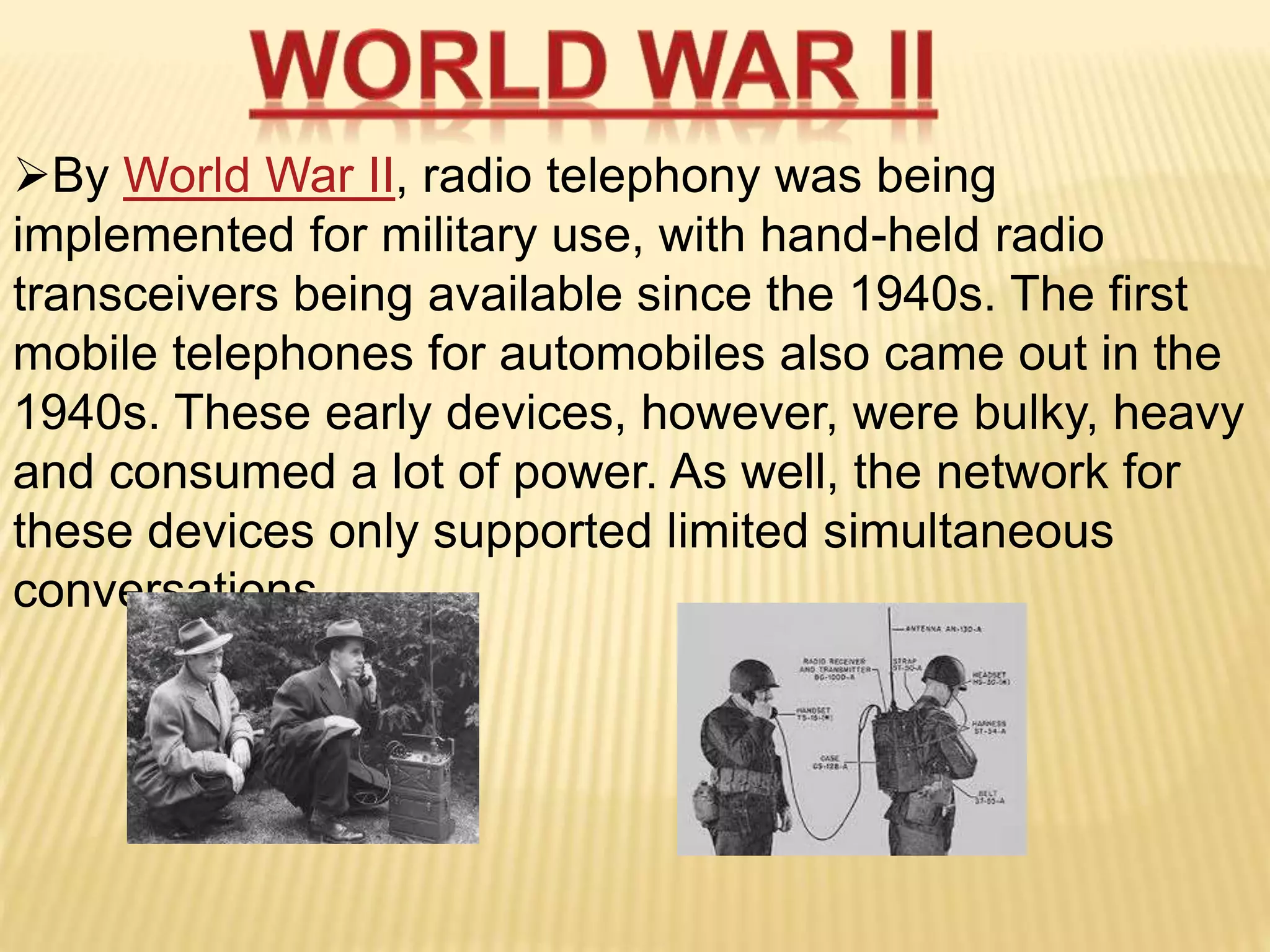
By World War II, radio telephony was being
implemented for military use, with hand-held radio
transceivers being available since the 1940s. The first
mobile telephones for automobiles also came out in the
1940s. These early devices, however, were bulky, heavy
and consumed a lot of power. As well, the network for
these devices only supported limited simultaneous
conversations.
The first truly mobile phone service came to light on
June 17, 1946 under Bell Labs, which developed mobile
phones that allowed users to place and receive phone
calls from their automobiles. Shortly
thereafter, AT&T offered the first Mobile Telephone
Service, but the technology was primitive and only
offered limited coverage area with a few available
channels in urban regions.
The later development of cellular technology would catapult
mobile telephony into a new era, allowing for widespread adoption
of mobile phones. This era was predicted by Arthur C. Clarke in a
1959 essay, where he envisioned a world where every person
could make calls with their very own personal transceiver. In the
essay, Clarke wrote: “The time will come when we will be able to
call a person anywhere on Earth merely by dialing a number.” His
vision also included a means for a global positioning system that
would ensure that “no one need ever again be lost.” He later
predicted the advent of such a device taking place in the 1980s.
In 1965, a mobile automatic phone was unveiled by Bulgarian-
based Radioelektronika, who presented the device at the Inforga-
65 international exhibition in Moscow. The phone was based on
the system developed by Kupriyanovich. The phone system
worked with a base station, and one base station could provide
service for up to 15 customers.
Prior to 1973, mobile telephony was limited to phones installed in
cars, trains and other vehicles. Motorola was the first company to
produce a handheld mobile phone.
The first mobile phone call from a handheld device was made on
April 3, 1973 by Martin Cooper, a research executive at Motorola
to Joel S Engel of Bell Labs. That first handheld phone was 10
inches long and weighed about 2.5 pounds. The prototype offered
30 minutes of talk time on a single charge and took 10 hours to
recharge. John F. Mitchell, Motorola’s chief of portable
communications, successfully pushed Cooper and the Motorola
team to develop wireless communication products that would
become smaller and lighter and could be used anywhere. The
Motorola team was also instrumental in the development and
design of the cellular phone.
The first automatic analog cellular systems were deployed in
Tokyo in 1979, later spreading throughout Japan. The system was
available throughout Nordic countries by 1981. In North America,
the first analog cellular system was widely deployed in the early-
1980s, being rolled out in North America in October 1983. It was
deployed in Israel in 1986 and Australia in 1987. This system was
deployed as the Advanced Mobile Phone System (AMPS). While
the system was much more advanced than the earlier technology,
it was unencrypted and easily vulnerable to eavesdropping. It was
also susceptible to cell phone cloning, and the system required
significant amounts of wireless spectrum to support
With the onset of the 3G and 4G markets, smartphones have begun to quickly outpace
feature phones in sales. While feature phones still command a large percentage of the
market, smartphones with multi-touch displays and high-speed broadband connections
are becoming the mainstay of modern mobility.
In the 1950s, mobile phones allowed a user to make a simple phone call on a bulky and
heavy device that wasn’t truly mobile. Today, mobile technology allows users to connect
nearly every aspect of their life via their smartphone, most notably with the endless
barrage of mobile applications offering everything from gaming to tracking fitness and
listening to music to watching movies and TV.
Today, the smartphone market is overrun with numerous companies and operating
systems. Apple, Samsung, HTC and LG are some of the more notable smartphone
makers vying for dominance in the market, with Apple leading the way with its iPhones.
As for operating systems, Google’s Android OS is way ahead of the curve, outpacing
Apple’s iOS, Microsoft’s Windows Phone OS and others in the field.
Read more at
http://www.redorbit.com/education/referenc
e_library/general-2/history-
of/1113190638/the-history-of-mobile-
phone-
technology/#EZrZsyHO1W9YyqK2.99
Read more at
http://www.redorbit.com/education/referenc
e_library/general-2/history-
of/1113190638/the-history-of-mobile-
phone-technology/#EZrZsyHO
Read more at
http://www.redorbit.com/education/referenc
e_library/general-2/history-
of/1113190638/the-history-of-mobile-
phone-
technology/#kPEqOLCzDhZQRD82.99

History of mobile

  • 2.
    Mobile phones, particularlythe smartphones that have become our inseparable companions today, are relatively new. However, the origin of the mobile phone goes back to 1908 when a US Patent was issued in Kentucky for a wireless telephone. The story of the modern mobile phone really begins in the 1940s when engineers working at AT&T developed cells for mobile phone base stations
  • 3.
    The very firstmobile phones were not really mobile phones at all. They were two-way radios that allowed people like taxi drivers and the emergency services to communicate. Instead of relying on base stations with separate cells (and the signal being passed from one cell to another), the first mobile phone networks involved one very powerful base station covering a much wider area. These early mobile phones are often referred to as 0G mobile phones, or Zero Generation mobile phones. Most phones today rely on 3G or third-generation mobile technology.
  • 4.
    The first so-calledclaim of a wireless device came in 1908, when Prof. Albert Jahnke and the Oakland Transcontinental Aerial Telephone and Power Company said they had developed a wireless telephone. However, they were quickly accused of fraud and while the charge was later dropped, production of the device never ensued.
  • 5.
    Ten years later,in 1918, the German railroad system tested its own wireless telephone system on military trains between Berlin and Zossen. By 1924, public trials began with telephone connection on trains between Berlin and Hamburg. A year later, in 1924, Zugtelephonie A.G. was founded to supply train telephony equipment with the first telephone systems being approved for use in postal and other trains by 1926.
  • 6.
    By World WarII, radio telephony was being implemented for military use, with hand-held radio transceivers being available since the 1940s. The first mobile telephones for automobiles also came out in the 1940s. These early devices, however, were bulky, heavy and consumed a lot of power. As well, the network for these devices only supported limited simultaneous conversations.
  • 7.
    The first trulymobile phone service came to light on June 17, 1946 under Bell Labs, which developed mobile phones that allowed users to place and receive phone calls from their automobiles. Shortly thereafter, AT&T offered the first Mobile Telephone Service, but the technology was primitive and only offered limited coverage area with a few available channels in urban regions.
  • 8.
    The later developmentof cellular technology would catapult mobile telephony into a new era, allowing for widespread adoption of mobile phones. This era was predicted by Arthur C. Clarke in a 1959 essay, where he envisioned a world where every person could make calls with their very own personal transceiver. In the essay, Clarke wrote: “The time will come when we will be able to call a person anywhere on Earth merely by dialing a number.” His vision also included a means for a global positioning system that would ensure that “no one need ever again be lost.” He later predicted the advent of such a device taking place in the 1980s.
  • 9.
    In 1965, amobile automatic phone was unveiled by Bulgarian- based Radioelektronika, who presented the device at the Inforga- 65 international exhibition in Moscow. The phone was based on the system developed by Kupriyanovich. The phone system worked with a base station, and one base station could provide service for up to 15 customers.
  • 10.
    Prior to 1973,mobile telephony was limited to phones installed in cars, trains and other vehicles. Motorola was the first company to produce a handheld mobile phone. The first mobile phone call from a handheld device was made on April 3, 1973 by Martin Cooper, a research executive at Motorola to Joel S Engel of Bell Labs. That first handheld phone was 10 inches long and weighed about 2.5 pounds. The prototype offered 30 minutes of talk time on a single charge and took 10 hours to recharge. John F. Mitchell, Motorola’s chief of portable communications, successfully pushed Cooper and the Motorola team to develop wireless communication products that would become smaller and lighter and could be used anywhere. The Motorola team was also instrumental in the development and design of the cellular phone.
  • 11.
    The first automaticanalog cellular systems were deployed in Tokyo in 1979, later spreading throughout Japan. The system was available throughout Nordic countries by 1981. In North America, the first analog cellular system was widely deployed in the early- 1980s, being rolled out in North America in October 1983. It was deployed in Israel in 1986 and Australia in 1987. This system was deployed as the Advanced Mobile Phone System (AMPS). While the system was much more advanced than the earlier technology, it was unencrypted and easily vulnerable to eavesdropping. It was also susceptible to cell phone cloning, and the system required significant amounts of wireless spectrum to support
  • 12.
    With the onsetof the 3G and 4G markets, smartphones have begun to quickly outpace feature phones in sales. While feature phones still command a large percentage of the market, smartphones with multi-touch displays and high-speed broadband connections are becoming the mainstay of modern mobility. In the 1950s, mobile phones allowed a user to make a simple phone call on a bulky and heavy device that wasn’t truly mobile. Today, mobile technology allows users to connect nearly every aspect of their life via their smartphone, most notably with the endless barrage of mobile applications offering everything from gaming to tracking fitness and listening to music to watching movies and TV. Today, the smartphone market is overrun with numerous companies and operating systems. Apple, Samsung, HTC and LG are some of the more notable smartphone makers vying for dominance in the market, with Apple leading the way with its iPhones. As for operating systems, Google’s Android OS is way ahead of the curve, outpacing Apple’s iOS, Microsoft’s Windows Phone OS and others in the field.
  • 13.
    Read more at http://www.redorbit.com/education/referenc e_library/general-2/history- of/1113190638/the-history-of-mobile- phone- technology/#EZrZsyHO1W9YyqK2.99 Readmore at http://www.redorbit.com/education/referenc e_library/general-2/history- of/1113190638/the-history-of-mobile- phone-technology/#EZrZsyHO Read more at http://www.redorbit.com/education/referenc e_library/general-2/history- of/1113190638/the-history-of-mobile- phone- technology/#kPEqOLCzDhZQRD82.99