Theme 4: Global status of
soil pollution
Natalia Rodríguez Eugenio
Kostiantyn Viatkin
Summary
• Sub-theme 4.1: Developing policies and
setting thresholds for addressing soil
pollution
• 12 oral presentations
• Sub-theme 4.2: Case studies at global,
national and regional scales
• 13 oral presentations
• Theme 4: 10 posters
• Policy questions addressing soil pollution in Europe
• Dynamics of a joint policy making process
• Policies on diffuse soil pollution
• Implementation of bioavailability to derive soil
thresholds
• Thresholds for heavy metals, concepts and
challenges
Main issues addressed in session 4.1
Developing policies and setting thresholds
for addressing soil pollution
• Thresholds in policies
• Students awareness raising
• Lessons learned after 20 years of remediation
policy
• Reference values in fragile ecosystems
• Derivation of soil guideline values
Main issues addressed in session 4.1
Developing policies and setting thresholds
for addressing soil pollution
• Contaminated site management in Malaysia
• Contamination in Pampas soils
• Nitrogen assessment in India
• Tools for creating awareness
• Sustainable remediation approach
• Soil pollution by PCBs in Belarus
• Interaction between nutrients and soil pollution
Main issues addressed in session 4.2 Case
studies at global, national and regional
scales
Remarks and key messages
1. Awareness raising on the
importance of soil and on the effects
of soil pollution on human health
and the environment
2. Technical panel on soil pollution
3. Improve existing international
agreements
Remarks and key messages
4. Development of international
protocols to derive thresholds values at
national level
5. Organic compounds and emerging
contaminants represent the main
challenge
6. The need to increase research to
support informed decision-making
Remarks and key messages
7. Global assessment of soil pollution:
• Modeling chemical production and
emissions
• Prioritize highly contaminated sites
• Assessment at country level
8. Development of accessible
technologies to assess soil pollution
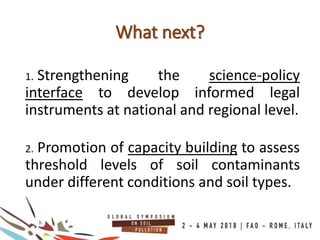
1. Strengthening the science-policy
interface to develop informed legal
instruments at national and regional level.
2. Promotion of capacity building to assess
threshold levels of soil contaminants
under different conditions and soil types.
What next?
Thank you for
your participation!

Theme 4: Global status of soil pollution (final)

  • 1.
    Theme 4: Globalstatus of soil pollution Natalia Rodríguez Eugenio Kostiantyn Viatkin
  • 2.
    Summary • Sub-theme 4.1:Developing policies and setting thresholds for addressing soil pollution • 12 oral presentations • Sub-theme 4.2: Case studies at global, national and regional scales • 13 oral presentations • Theme 4: 10 posters
  • 3.
    • Policy questionsaddressing soil pollution in Europe • Dynamics of a joint policy making process • Policies on diffuse soil pollution • Implementation of bioavailability to derive soil thresholds • Thresholds for heavy metals, concepts and challenges Main issues addressed in session 4.1 Developing policies and setting thresholds for addressing soil pollution
  • 4.
    • Thresholds inpolicies • Students awareness raising • Lessons learned after 20 years of remediation policy • Reference values in fragile ecosystems • Derivation of soil guideline values Main issues addressed in session 4.1 Developing policies and setting thresholds for addressing soil pollution
  • 5.
    • Contaminated sitemanagement in Malaysia • Contamination in Pampas soils • Nitrogen assessment in India • Tools for creating awareness • Sustainable remediation approach • Soil pollution by PCBs in Belarus • Interaction between nutrients and soil pollution Main issues addressed in session 4.2 Case studies at global, national and regional scales
  • 6.
    Remarks and keymessages 1. Awareness raising on the importance of soil and on the effects of soil pollution on human health and the environment 2. Technical panel on soil pollution 3. Improve existing international agreements
  • 7.
    Remarks and keymessages 4. Development of international protocols to derive thresholds values at national level 5. Organic compounds and emerging contaminants represent the main challenge 6. The need to increase research to support informed decision-making
  • 8.
    Remarks and keymessages 7. Global assessment of soil pollution: • Modeling chemical production and emissions • Prioritize highly contaminated sites • Assessment at country level 8. Development of accessible technologies to assess soil pollution
  • 9.
    1. Strengthening thescience-policy interface to develop informed legal instruments at national and regional level. 2. Promotion of capacity building to assess threshold levels of soil contaminants under different conditions and soil types. What next?
  • 10.
    Thank you for yourparticipation!