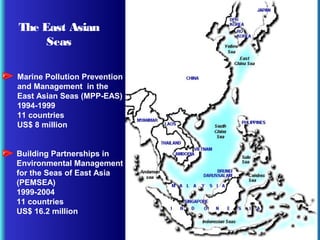
The East Asian
Seas
Marine Pollution Prevention
and Management in the
East Asian Seas (MPP-EAS)
1994-1999
11 countries
US$ 8 million
Building Partnerships in
Environmental Management
for the Seas of East Asia
(PEMSEA)
1999-2004
11 countries
US$ 16.2 million
Local Implementation of
Environment-related
International Conventions
Framework for
Multi-stakeholder
Participation
Poverty
Alleviation
Local Governance
Ecosystem Management
Integrated
Coastal
Management
Framework for
Environmental
Investment
Ecosystem Approach: Integrated Coastal
and Marine Management
Ecosystem and human defined boundaries.
Integrated planning, management and coordinating
framework allow cross-sectoral, interagency concerns
to be addressed.
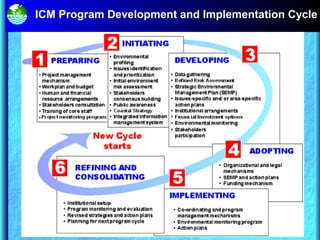
ICM development and implementing cycle provides a
gradual process in managing human use of the goods
and services generated by the ecosystems, thus allowing
continuous efforts for policy, technological and other
management interventions.
Ecosystem Approach: Integrated Coastal and
Marine Management
• Clearly defined stakeholders whose interests intersect
ecosystem at different points.
• Common vision, strategies, action plans provide a
long-term, systematic, and ecosystem approach to
resource management, thereby ensuring production
of goods and services at sustainable level.
ICMConceptual Boundary
The ICM conceptual boundary encompassing the watershed and the extent of Exclusive Economic
Zone (EEZ) is also the seaward boundary of most large marine ecosystems (LMEs). Also shown
are operational boundaries or the general area of existing management boundaries of most
countries which extend from an administrative boundary or high tide line to territorial seas.
ICM Program Development and Implementation Cycle
Measuring the Effectiveness and Viability of ICM
Performance indicators
process
stress reducing
sustainability
environmental status
Levels of attainment
problem identification and program formulation
program implementation
program sustainability
program’s impacts
ICM Working Models
Brunei
Darussalam
Cambodia
China
DPR Korea
Indonesia
Malaysia
Philippines
RO Korea
Singapore
Thailand
Vietnam
Japan *
*Subject to further
confirmation
ICM Demonstration and
Parallel Sites and
Pollution Hot Spots
Bohai Sea
Manila
Bay
Gulf of
Thailand
Malacca
Straits
Ecosystem Management of Subregional Seas
Systematic, programmatic approach.
Simultaneously considers resources, human activities,
ecosystem processes and their interactions.
Risk assessment and risk management approach promote
effective stakeholders participation and the use of policy
and science in management decision making.
Close coordination and mutually supportive ICM approach
such as local implementation of international conventions.
Risk Assessment and Management in Subregional
Sea Areas/Pollution Hot Spots
Bohai Sea
Manila Bay
Gulf of
Thailand
Malacca
Straits
Institutional
Arrangements
Response Compensation/
Restoration
Risk
Assessment
Environmental
Monitoring
Capacity
Building
Environmental Management
Framework
Impediments to Designing and Implementing
Regional Projects
Determination and prioritization of transboundary
environmental issues.
Varying levels of national capability.
Political sensitivity in relation to national boundary disputes.
Varying economic, cultural, technological and political
backgrounds.
Proficiency in common language used.
Solutions to Impediments of Regional Project
Design and Implementation
Consensus building amongst national experts and key
stakeholders.
Creating opportunity for south-south cooperation.
Avoid political, cultural sensitive issues.
Allow national project staff to use own language in report
writing but ensuring their understanding and target of
project activities.
Provide special capacity building program to narrow the gap
of disparity between countries.
Pre-project training on project development and implementation.

chua_session_x.ppt

  • 1.
    The East Asian Seas MarinePollution Prevention and Management in the East Asian Seas (MPP-EAS) 1994-1999 11 countries US$ 8 million Building Partnerships in Environmental Management for the Seas of East Asia (PEMSEA) 1999-2004 11 countries US$ 16.2 million
  • 2.
    Local Implementation of Environment-related InternationalConventions Framework for Multi-stakeholder Participation Poverty Alleviation Local Governance Ecosystem Management Integrated Coastal Management Framework for Environmental Investment
  • 3.
    Ecosystem Approach: IntegratedCoastal and Marine Management Ecosystem and human defined boundaries. Integrated planning, management and coordinating framework allow cross-sectoral, interagency concerns to be addressed. ICM development and implementing cycle provides a gradual process in managing human use of the goods and services generated by the ecosystems, thus allowing continuous efforts for policy, technological and other management interventions.
  • 4.
    Ecosystem Approach: IntegratedCoastal and Marine Management • Clearly defined stakeholders whose interests intersect ecosystem at different points. • Common vision, strategies, action plans provide a long-term, systematic, and ecosystem approach to resource management, thereby ensuring production of goods and services at sustainable level.
  • 5.
    ICMConceptual Boundary The ICMconceptual boundary encompassing the watershed and the extent of Exclusive Economic Zone (EEZ) is also the seaward boundary of most large marine ecosystems (LMEs). Also shown are operational boundaries or the general area of existing management boundaries of most countries which extend from an administrative boundary or high tide line to territorial seas.
  • 6.
    ICM Program Developmentand Implementation Cycle
  • 7.
    Measuring the Effectivenessand Viability of ICM Performance indicators process stress reducing sustainability environmental status Levels of attainment problem identification and program formulation program implementation program sustainability program’s impacts
  • 8.
  • 9.
    Brunei Darussalam Cambodia China DPR Korea Indonesia Malaysia Philippines RO Korea Singapore Thailand Vietnam Japan* *Subject to further confirmation ICM Demonstration and Parallel Sites and Pollution Hot Spots Bohai Sea Manila Bay Gulf of Thailand Malacca Straits
  • 10.
    Ecosystem Management ofSubregional Seas Systematic, programmatic approach. Simultaneously considers resources, human activities, ecosystem processes and their interactions. Risk assessment and risk management approach promote effective stakeholders participation and the use of policy and science in management decision making. Close coordination and mutually supportive ICM approach such as local implementation of international conventions.
  • 11.
    Risk Assessment andManagement in Subregional Sea Areas/Pollution Hot Spots Bohai Sea Manila Bay Gulf of Thailand Malacca Straits Institutional Arrangements Response Compensation/ Restoration Risk Assessment Environmental Monitoring Capacity Building Environmental Management Framework
  • 12.
    Impediments to Designingand Implementing Regional Projects Determination and prioritization of transboundary environmental issues. Varying levels of national capability. Political sensitivity in relation to national boundary disputes. Varying economic, cultural, technological and political backgrounds. Proficiency in common language used.
  • 13.
    Solutions to Impedimentsof Regional Project Design and Implementation Consensus building amongst national experts and key stakeholders. Creating opportunity for south-south cooperation. Avoid political, cultural sensitive issues. Allow national project staff to use own language in report writing but ensuring their understanding and target of project activities. Provide special capacity building program to narrow the gap of disparity between countries. Pre-project training on project development and implementation.

Editor's Notes

  • #10 Based on the Xiamen and Batangas working models, PEMSEA is currently establishing six additional demonstration projects in Nampo (DPR Korea), Bali (Indonesia), Sihanoukville (Cambodia), Klang (Malaysia), Chonburi (Thailand) and Danang (Vietnam) using the same management framework and applying the refined planning and implementation processes. In addition to the six ICM demonstration sites, 10 ICM parallel sites will be established within the participating countries. ICM parallel sites will incorporate the same ICM framework and process that is applied at the national ICM demonstration sites, but will receive no direct financial support from PEMSEA. At the end of PEMSEA, there will be a total of 19 self-sustained ICM sites among the participating countries. The 18 sites will be operated and managed by local government units, and will address a variety of environmental issues that will be representative of the majority of coastal use conflicts in the region. The 18 ICM sites will serve as working models for other sites throughout the region, and as a core of experience and expertise for replicating the ICM framework and process in coastal areas in each participating country. The experience of the Malacca Straits project on the other hand provides the basis for a new subregional initiative on the Gulf of Thailand, Bohai Sea and Manila Bay which are major pollution hot spots in the respective countries. The three new initiatives are intended to build capacity and confidence in managing transboundary marine environmental problems at a much larger geographical scale and complexity of problems. The outputs and experiences shall contribute to future initiatives in the management of other subregional and regional seas of East Asia. The Straits of Malacca will continue to be promoted as a regional working model for environmental management of a subregional sea area. PEMSEA will organize a subregional conference among the three littoral States to transfer the environmental database, modeling software and other tools developed during the Pilot Phase and to develop consensus on the preparation of a strategic environmental management plans for the Straits.
  • #12 The environmental management framework to be adopted for the 3 hot spots includes: - risk assessment (environmental database, profiling, priority areas of concern, resource valuation, identification of ecological, human health and socioeconomic risks) - response (preventive and mitigative responses: strategic environmental management plans and issue-specific action plans, land- and sea-use planning, contingency planning, response equipment, response exercises, shore reception facilities, environmental investments; research, information dissemination - damage compensation and restoration (oil spill accounting and costing, natural resources damage assessment (NRDA), habitat restoration - environmental monitoring (indicators/benchmarks, interagency/intersectoral monitoring, modeling and forecasting) - capacity building (OPRC, resource valuation, NRDA, risk assessment and management, hazardous materials handling) - institutional mechanism (local, national, subregional, international conventions, policy, legislation/regulatory, financing and enforcement