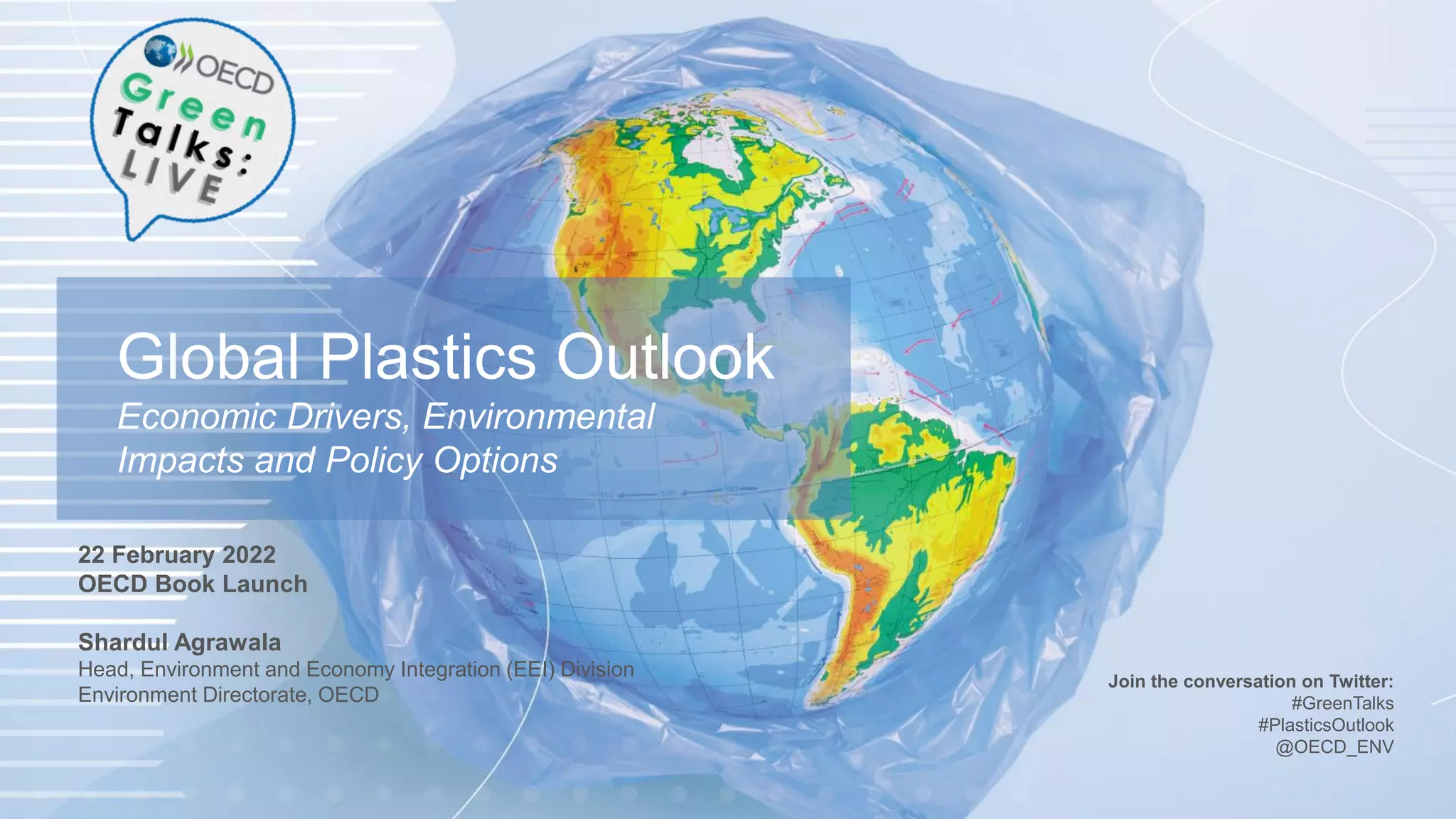
Global Plastics Outlook
Economic Drivers, Environmental
Impacts and Policy Options
22 February 2022
OECD Book Launch
Shardul Agrawala
Head, Environment and Economy Integration (EEI) Division
Environment Directorate, OECD
Join the conversation on Twitter:
#GreenTalks
#PlasticsOutlook
@OECD_ENV
2
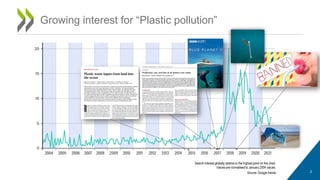
Growing interest for “Plastic pollution”
Search interest globally relative to the highest point on the chart.
Values are normalised to January 2004 values.
Source: Google trends
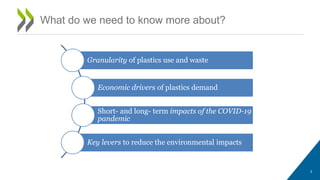
Granularity of plastics use and waste
Economic drivers of plastics demand
Short- and long- term impacts of the COVID-19
pandemic
Key levers to reduce the environmental impacts
3
What do we need to know more about?
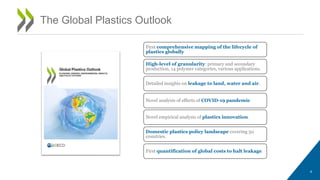
First comprehensive mapping of the lifecycle of
plastics globally
High-level of granularity: primary and secondary
production, 14 polymer categories, various applications.
Detailed insights on leakage to land, water and air.
Novel analysis of effects of COVID-19 pandemic.
4
The Global Plastics Outlook
Novel empirical analysis of plastics innovation.
Domestic plastics policy landscape covering 50
countries.
First quantification of global costs to halt leakage.
Key Findings
5
6
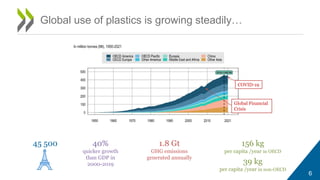
Global use of plastics is growing steadily…
In million tonnes (Mt), 1950-2021
156 kg
per capita /year in OECD
39 kg
per capita /year in non-OECD
1.8 Gt
GHG emissions
generated annually
45 500
Global Financial
Crisis
COVID-19
40%
quicker growth
than GDP in
2000-2019
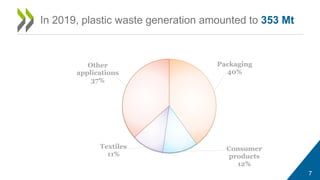
Packaging
40%
Consumer
products
12%
Textiles
11%
Other
applications
37%
7
In 2019, plastic waste generation amounted to 353 Mt
8
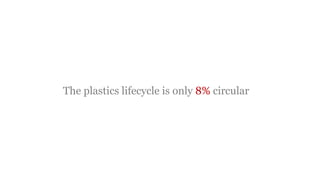
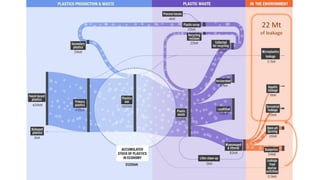
The plastics lifecycle is only 8% circular
9
The plastics lifecycle is only 8% circular
22 Mt
of leakage
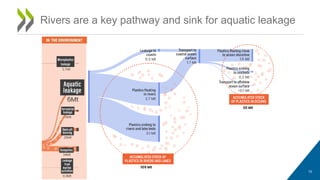
Rivers are a key pathway and sink for aquatic leakage
10
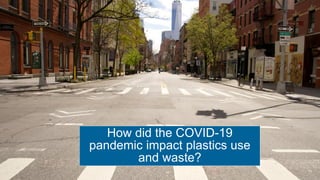
How did the COVID-19
pandemic impact plastics use
and waste?
11
12
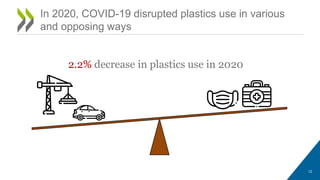
In 2020, COVID-19 disrupted plastics use in various
and opposing ways
2.2% decrease in plastics use in 2020
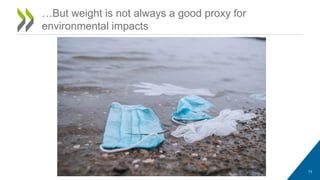
…But weight is not always a good proxy for
environmental impacts
13
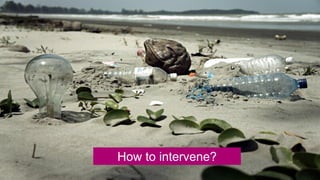
How to intervene?
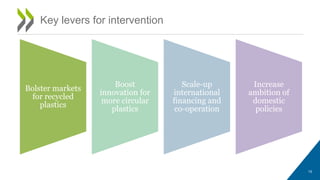
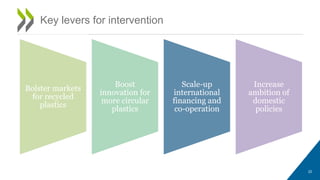
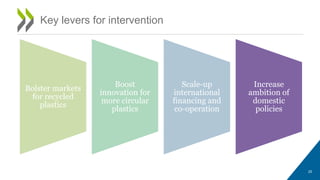
Bolster markets
for recycled
plastics
Boost
innovation for
more circular
plastics
Scale-up
international
financing and
co-operation
Increase
ambition of
domestic
policies
15
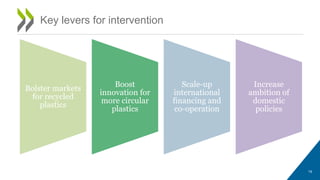
Key levers for intervention
15
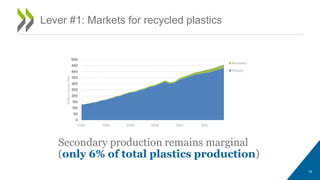
Secondary production remains marginal
(only 6% of total plastics production)
0
50
100
150
200
250
300
350
400
450
500
1990 1995 2000 2005 2010 2015
Million
tonnes
(Mt)
Secondary
Primary
16
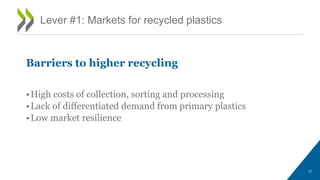
Lever #1: Markets for recycled plastics
17
Lever #1: Markets for recycled plastics
Barriers to higher recycling
•High costs of collection, sorting and processing
•Lack of differentiated demand from primary plastics
•Low market resilience
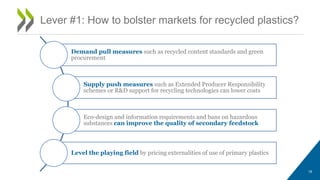
Demand pull measures such as recycled content standards and green
procurement
Supply push measures such as Extended Producer Responsibility
schemes or R&D support for recycling technologies can lower costs
Eco-design and information requirements and bans on hazardous
substances can improve the quality of secondary feedstock
Level the playing field by pricing externalities of use of primary plastics
18
Lever #1: How to bolster markets for recycled plastics?
Key levers for intervention
Bolster markets
for recycled
plastics
Boost
innovation for
more circular
plastics
Scale-up
international
financing and
co-operation
Increase
ambition of
domestic
policies
19
20
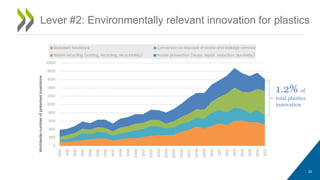
Lever #2: Environmentally relevant innovation for plastics
0
200
400
600
800
1000
1200
1400
1600
1800
2000
1990
1991
1992
1993
1994
1995
1996
1997
1998
1999
2000
2001
2002
2003
2004
2005
2006
2007
2008
2009
2010
2011
2012
2013
2014
2015
2016
2017
Worldwide
number
of
patented
inventions
Biobased feedstock Conversion or disposal of waste and leakage removal
Waste recycling (sorting, recycling, recyclability) Waste prevention (reuse, repair, reduction, durability)
1.2% of
total plastics
innovation
21
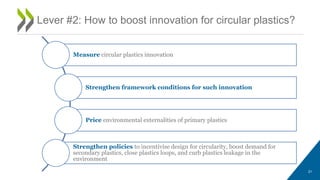
Lever #2: How to boost innovation for circular plastics?
Measure circular plastics innovation
Strengthen framework conditions for such innovation
Price environmental externalities of primary plastics
Strengthen policies to incentivise design for circularity, boost demand for
secondary plastics, close plastics loops, and curb plastics leakage in the
environment
Key levers for intervention
Bolster markets
for recycled
plastics
Boost
innovation for
more circular
plastics
Scale-up
international
financing and
co-operation
Increase
ambition of
domestic
policies
22
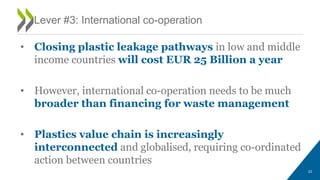
• Closing plastic leakage pathways in low and middle
income countries will cost EUR 25 Billion a year
• However, international co-operation needs to be much
broader than financing for waste management
• Plastics value chain is increasingly
interconnected and globalised, requiring co-ordinated
action between countries
23
Lever #3: International co-operation
24
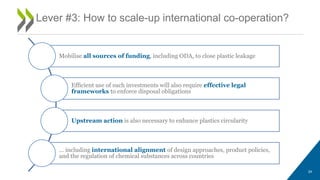
Mobilise all sources of funding, including ODA, to close plastic leakage
Efficient use of such investments will also require effective legal
frameworks to enforce disposal obligations
Upstream action is also necessary to enhance plastics circularity
… including international alignment of design approaches, product policies,
and the regulation of chemical substances across countries
Lever #3: How to scale-up international co-operation?
Key levers for intervention
Bolster markets
for recycled
plastics
Boost
innovation for
more circular
plastics
Scale-up
international
financing and
co-operation
Increase
ambition of
domestic
policies
25
26
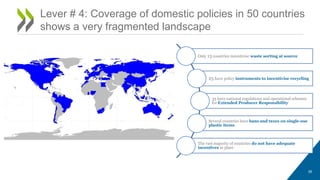
Lever # 4: Coverage of domestic policies in 50 countries
shows a very fragmented landscape
Only 13 countries incentivise waste sorting at source
25 have policy instruments to incentivise recycling
33 have national regulations and operational schemes
for Extended Producer Responsibility
Several countries have bans and taxes on single-use
plastic items
The vast majority of countries do not have adequate
incentives in place
27
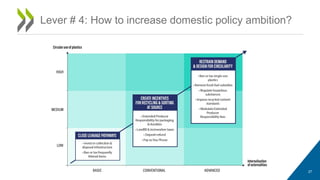
Lever # 4: How to increase domestic policy ambition?
OECD Contributors
• Shardul Agrawala
• Maarten Dubois
• Elisa Lanzi
• Ruben Bibas
• Peter Börkey
• Andrew Brown
• Elena Buzzi
• Rob Dellink
• Damien Dussaux
• Jean Fouré
• Ivan Haščič
• Frithjof Laubinger
• Linda Livingstone
• Eleonora Mavroeidi
• Norbert Monti
• Daniel Ostalé Valriberas
• Daniel Prosi
• Pierra Tortora
• Shunta Yamaguchi
28
Acknowledgements
External Contributors
• Morten Ryberg (Technical University of Denmark)
• Teddy Serrano (Technical University of Denmark)
• Alexis Laurent (Technical University of Denmark)
• Costas A. Velis (University of Leeds)
• Ed Cook (University of Leeds)
• Josh Cottom (University of Leeds)
• Laurent Lebreton (The Ocean Cleanup)
• Nikolaos Evangeliou (Norwegian Institute for Air Research)
• Roland Geyer (University of California, Santa Barbara)
• Trinomics B.V.
• The Institute for Global Environmental Studies
• Prasad Modak (independent expert)
• Louis Tronel (independent expert)
• Flavio Ribeiro (independent expert)
• Darina Petrova (independent expert)
Thank you
Find out more about our work at:
www.oecd.org/environment/plastics
Join the conversation on Twitter:
#GreenTalks
@OECD_ENV
Image sources:
https://fordwarburton.wordpress.com/author/fordwarburton/ [The Graduate quote]
https://books.google.ca/books?id=xlYEAAAAMBAJ [Life Magazine 1 Aug 1955, p.43]
https://icons8.com/ [Eiffel tower icon]
https://www.nationalgeographic.com/photography/article/seahorse-ocean-pollution [seahorse photo]
https://www.imdb.com/title/tt6769208/ [Blue Planet II]
https://commons.wikimedia.org/wiki/File:Bakelite_radio.jpg [Bakelite radio]
https://blog.sciencemuseum.org.uk/alexander-parkes-living-in-a-material-world/ [Objects made from Parkesine]
Shutterstock
Pixabay.com image from CharlieYoon [image airplane & containers waste]
Icons: Freepik from flaticon.com
Pexels.com images from Markus Spiske [toys] and from Tom Fisk [waste]
https://www.thedailybeast.com/plastic-straws-sucked-for-our-taste-buds [Plastic straw ban]

Green Talks LIVE | Global Plastics Outlook

  • 1.
    Global Plastics Outlook EconomicDrivers, Environmental Impacts and Policy Options 22 February 2022 OECD Book Launch Shardul Agrawala Head, Environment and Economy Integration (EEI) Division Environment Directorate, OECD Join the conversation on Twitter: #GreenTalks #PlasticsOutlook @OECD_ENV
  • 2.
    2 Growing interest for“Plastic pollution” Search interest globally relative to the highest point on the chart. Values are normalised to January 2004 values. Source: Google trends
  • 3.
    Granularity of plasticsuse and waste Economic drivers of plastics demand Short- and long- term impacts of the COVID-19 pandemic Key levers to reduce the environmental impacts 3 What do we need to know more about?
  • 4.
    First comprehensive mappingof the lifecycle of plastics globally High-level of granularity: primary and secondary production, 14 polymer categories, various applications. Detailed insights on leakage to land, water and air. Novel analysis of effects of COVID-19 pandemic. 4 The Global Plastics Outlook Novel empirical analysis of plastics innovation. Domestic plastics policy landscape covering 50 countries. First quantification of global costs to halt leakage.
  • 5.
  • 6.
    6 Global use ofplastics is growing steadily… In million tonnes (Mt), 1950-2021 156 kg per capita /year in OECD 39 kg per capita /year in non-OECD 1.8 Gt GHG emissions generated annually 45 500 Global Financial Crisis COVID-19 40% quicker growth than GDP in 2000-2019
  • 7.
  • 8.
    8 The plastics lifecycleis only 8% circular
  • 9.
    9 The plastics lifecycleis only 8% circular 22 Mt of leakage
  • 10.
    Rivers are akey pathway and sink for aquatic leakage 10
  • 11.
    How did theCOVID-19 pandemic impact plastics use and waste? 11
  • 12.
    12 In 2020, COVID-19disrupted plastics use in various and opposing ways 2.2% decrease in plastics use in 2020
  • 13.
    …But weight isnot always a good proxy for environmental impacts 13
  • 14.
  • 15.
    Bolster markets for recycled plastics Boost innovationfor more circular plastics Scale-up international financing and co-operation Increase ambition of domestic policies 15 Key levers for intervention 15
  • 16.
    Secondary production remainsmarginal (only 6% of total plastics production) 0 50 100 150 200 250 300 350 400 450 500 1990 1995 2000 2005 2010 2015 Million tonnes (Mt) Secondary Primary 16 Lever #1: Markets for recycled plastics
  • 17.
    17 Lever #1: Marketsfor recycled plastics Barriers to higher recycling •High costs of collection, sorting and processing •Lack of differentiated demand from primary plastics •Low market resilience
  • 18.
    Demand pull measuressuch as recycled content standards and green procurement Supply push measures such as Extended Producer Responsibility schemes or R&D support for recycling technologies can lower costs Eco-design and information requirements and bans on hazardous substances can improve the quality of secondary feedstock Level the playing field by pricing externalities of use of primary plastics 18 Lever #1: How to bolster markets for recycled plastics?
  • 19.
    Key levers forintervention Bolster markets for recycled plastics Boost innovation for more circular plastics Scale-up international financing and co-operation Increase ambition of domestic policies 19
  • 20.
    20 Lever #2: Environmentallyrelevant innovation for plastics 0 200 400 600 800 1000 1200 1400 1600 1800 2000 1990 1991 1992 1993 1994 1995 1996 1997 1998 1999 2000 2001 2002 2003 2004 2005 2006 2007 2008 2009 2010 2011 2012 2013 2014 2015 2016 2017 Worldwide number of patented inventions Biobased feedstock Conversion or disposal of waste and leakage removal Waste recycling (sorting, recycling, recyclability) Waste prevention (reuse, repair, reduction, durability) 1.2% of total plastics innovation
  • 21.
    21 Lever #2: Howto boost innovation for circular plastics? Measure circular plastics innovation Strengthen framework conditions for such innovation Price environmental externalities of primary plastics Strengthen policies to incentivise design for circularity, boost demand for secondary plastics, close plastics loops, and curb plastics leakage in the environment
  • 22.
    Key levers forintervention Bolster markets for recycled plastics Boost innovation for more circular plastics Scale-up international financing and co-operation Increase ambition of domestic policies 22
  • 23.
    • Closing plasticleakage pathways in low and middle income countries will cost EUR 25 Billion a year • However, international co-operation needs to be much broader than financing for waste management • Plastics value chain is increasingly interconnected and globalised, requiring co-ordinated action between countries 23 Lever #3: International co-operation
  • 24.
    24 Mobilise all sourcesof funding, including ODA, to close plastic leakage Efficient use of such investments will also require effective legal frameworks to enforce disposal obligations Upstream action is also necessary to enhance plastics circularity … including international alignment of design approaches, product policies, and the regulation of chemical substances across countries Lever #3: How to scale-up international co-operation?
  • 25.
    Key levers forintervention Bolster markets for recycled plastics Boost innovation for more circular plastics Scale-up international financing and co-operation Increase ambition of domestic policies 25
  • 26.
    26 Lever # 4:Coverage of domestic policies in 50 countries shows a very fragmented landscape Only 13 countries incentivise waste sorting at source 25 have policy instruments to incentivise recycling 33 have national regulations and operational schemes for Extended Producer Responsibility Several countries have bans and taxes on single-use plastic items The vast majority of countries do not have adequate incentives in place
  • 27.
    27 Lever # 4:How to increase domestic policy ambition?
  • 28.
    OECD Contributors • ShardulAgrawala • Maarten Dubois • Elisa Lanzi • Ruben Bibas • Peter Börkey • Andrew Brown • Elena Buzzi • Rob Dellink • Damien Dussaux • Jean Fouré • Ivan Haščič • Frithjof Laubinger • Linda Livingstone • Eleonora Mavroeidi • Norbert Monti • Daniel Ostalé Valriberas • Daniel Prosi • Pierra Tortora • Shunta Yamaguchi 28 Acknowledgements External Contributors • Morten Ryberg (Technical University of Denmark) • Teddy Serrano (Technical University of Denmark) • Alexis Laurent (Technical University of Denmark) • Costas A. Velis (University of Leeds) • Ed Cook (University of Leeds) • Josh Cottom (University of Leeds) • Laurent Lebreton (The Ocean Cleanup) • Nikolaos Evangeliou (Norwegian Institute for Air Research) • Roland Geyer (University of California, Santa Barbara) • Trinomics B.V. • The Institute for Global Environmental Studies • Prasad Modak (independent expert) • Louis Tronel (independent expert) • Flavio Ribeiro (independent expert) • Darina Petrova (independent expert)
  • 29.
    Thank you Find outmore about our work at: www.oecd.org/environment/plastics Join the conversation on Twitter: #GreenTalks @OECD_ENV Image sources: https://fordwarburton.wordpress.com/author/fordwarburton/ [The Graduate quote] https://books.google.ca/books?id=xlYEAAAAMBAJ [Life Magazine 1 Aug 1955, p.43] https://icons8.com/ [Eiffel tower icon] https://www.nationalgeographic.com/photography/article/seahorse-ocean-pollution [seahorse photo] https://www.imdb.com/title/tt6769208/ [Blue Planet II] https://commons.wikimedia.org/wiki/File:Bakelite_radio.jpg [Bakelite radio] https://blog.sciencemuseum.org.uk/alexander-parkes-living-in-a-material-world/ [Objects made from Parkesine] Shutterstock Pixabay.com image from CharlieYoon [image airplane & containers waste] Icons: Freepik from flaticon.com Pexels.com images from Markus Spiske [toys] and from Tom Fisk [waste] https://www.thedailybeast.com/plastic-straws-sucked-for-our-taste-buds [Plastic straw ban]