Legal approach to measures to prevent soil
contamination and increase food safety for
the consumer
Francisca Ramón, Cristina Lull*
Universitat Politècnica de València (Spain)
* President of the Soil Education and Public Safety Section of the Spanish Society of Soil Science
Soil
Pollution
Food
safety
Health
risks
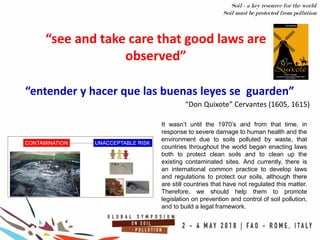
“entender y hacer que las buenas leyes se guarden”
“see and take care that good laws are
observed”
“Don Quixote” Cervantes (1605, 1615)
Soil - a key resource for the world
Soil must be protected from pollution
It wasn’t until the 1970’s and from that time, in
response to severe damage to human health and the
environment due to soils polluted by waste, that
countries throughout the world began enacting laws
both to protect clean soils and to clean up the
existing contaminated sites. And currently, there is
an international common practice to develop laws
and regulations to protect our soils, although there
are still countries that have not regulated this matter.
Therefore, we should help them to promote
legislation on prevention and control of soil pollution,
and to build a legal framework.
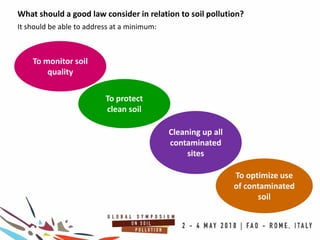
To monitor soil
quality
To protect
clean soil
Cleaning up all
contaminated
sites
To optimize use
of contaminated
soil
What should a good law consider in relation to soil pollution?
It should be able to address at a minimum:
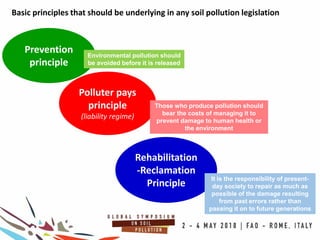
Prevention
principle
Polluter pays
principle
(liability regime)
Rehabilitation
-Reclamation
Principle
Environmental pollution should
be avoided before it is released
Those who produce pollution should
bear the costs of managing it to
prevent damage to human health or
the environment
It is the responsibility of present-
day society to repair as much as
possible of the damage resulting
from past errors rather than
passing it on to future generations
Basic principles that should be underlying in any soil pollution legislation
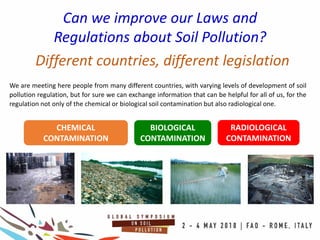
Different countries, different legislation
CHEMICAL
CONTAMINATION
BIOLOGICAL
CONTAMINATION
RADIOLOGICAL
CONTAMINATION
Can we improve our Laws and
Regulations about Soil Pollution?
We are meeting here people from many different countries, with varying levels of development of soil
pollution regulation, but for sure we can exchange information that can be helpful for all of us, for the
regulation not only of the chemical or biological soil contamination but also radiological one.
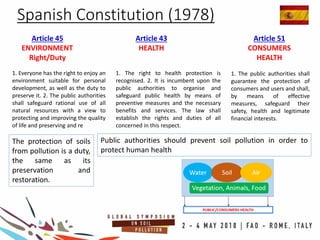
Spanish Constitution (1978)
Article 43
HEALTH
Article 45
ENVIRONMENT
Right/Duty
Article 51
CONSUMERS
HEALTH
The protection of soils
from pollution is a duty,
the same as its
preservation and
restoration.
Public authorities should prevent soil pollution in order to
protect human health
1. Everyone has the right to enjoy an
environment suitable for personal
development, as well as the duty to
preserve it. 2. The public authorities
shall safeguard rational use of all
natural resources with a view to
protecting and improving the quality
of life and preserving and re
1. The right to health protection is
recognised. 2. It is incumbent upon the
public authorities to organise and
safeguard public health by means of
preventive measures and the necessary
benefits and services. The law shall
establish the rights and duties of all
concerned in this respect.
1. The public authorities shall
guarantee the protection of
consumers and users and shall,
by means of effective
measures, safeguard their
safety, health and legitimate
financial interests.
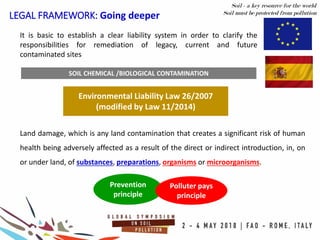
LEGAL FRAMEWORK: Going deeper
Environmental Liability Law 26/2007
(modified by Law 11/2014)
Soil - a key resource for the world
Soil must be protected from pollution
Land damage, which is any land contamination that creates a significant risk of human
health being adversely affected as a result of the direct or indirect introduction, in, on
or under land, of substances, preparations, organisms or microorganisms.
SOIL CHEMICAL /BIOLOGICAL CONTAMINATION
Prevention
principle
Polluter pays
principle
It is basic to establish a clear liability system in order to clarify the
responsibilities for remediation of legacy, current and future
contaminated sites
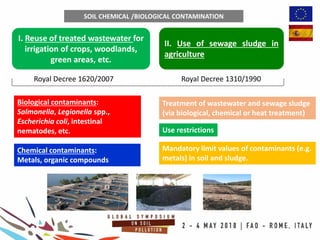
Biological contaminants:
Salmonella, Legionella spp.,
Escherichia coli, intestinal
nematodes, etc.
Chemical contaminants:
Metals, organic compounds
Mandatory limit values of contaminants (e.g.
metals) in soil and sludge.
Treatment of wastewater and sewage sludge
(via biological, chemical or heat treatment)
Use restrictions
I. Reuse of treated wastewater for
irrigation of crops, woodlands,
green areas, etc.
II. Use of sewage sludge in
agriculture
SOIL CHEMICAL /BIOLOGICAL CONTAMINATION
Royal Decree 1620/2007 Royal Decree 1310/1990
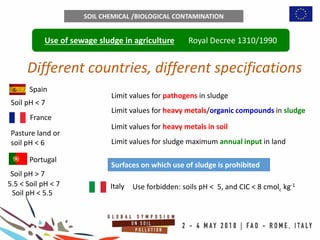
Use of sewage sludge in agriculture Royal Decree 1310/1990
SOIL CHEMICAL /BIOLOGICAL CONTAMINATION
Different countries, different specifications
Limit values for heavy metals/organic compounds in sludge
Pasture land or
soil pH < 6
Soil pH < 7
Limit values for pathogens in sludge
Limit values for sludge maximum annual input in land
Limit values for heavy metals in soil
Surfaces on which use of sludge is prohibited
Spain
France
Italy Use forbidden: soils pH < 5, and CIC < 8 cmolc kg-1
Portugal
Soil pH > 7
Soil pH < 5.5
5.5 < Soil pH < 7
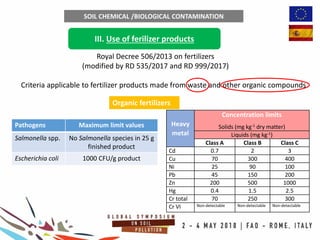
Organic fertilizers
III. Use of ferilizer products
SOIL CHEMICAL /BIOLOGICAL CONTAMINATION
Royal Decree 506/2013 on fertilizers
(modified by RD 535/2017 and RD 999/2017)
Pathogens Maximum limit values
Salmonella spp. No Salmonella species in 25 g
finished product
Escherichia coli 1000 CFU/g product
Criteria applicable to fertilizer products made from waste and other organic compounds
Heavy
metal
Concentration limits
Solids (mg kg-1 dry matter)
Liquids (mg kg-1)
Class A Class B Class C
Cd 0.7 2 3
Cu 70 300 400
Ni 25 90 100
Pb 45 150 200
Zn 200 500 1000
Hg 0.4 1.5 2.5
Cr total 70 250 300
Cr VI Non-detectable Non-detectable Non-detectable
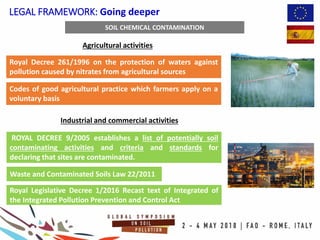
LEGAL FRAMEWORK: Going deeper
Royal Legislative Decree 1/2016 Recast text of Integrated of
the Integrated Pollution Prevention and Control Act
Waste and Contaminated Soils Law 22/2011
ROYAL DECREE 9/2005 establishes a list of potentially soil
contaminating activities and criteria and standards for
declaring that sites are contaminated.
SOIL CHEMICAL CONTAMINATION
Codes of good agricultural practice which farmers apply on a
voluntary basis
Royal Decree 261/1996 on the protection of waters against
pollution caused by nitrates from agricultural sources
Agricultural activities
Industrial and commercial activities
LEGAL FRAMEWORK: Going deeper
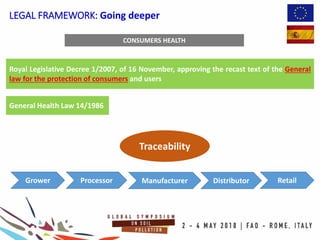
Royal Legislative Decree 1/2007, of 16 November, approving the recast text of the General
law for the protection of consumers and users
General Health Law 14/1986
CONSUMERS HEALTH
Grower Processor Manufacturer Distributor Retail
Traceability
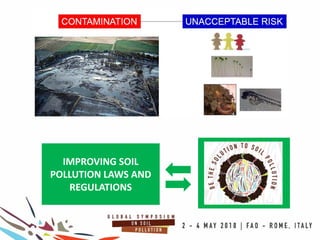
IMPROVING SOIL
POLLUTION LAWS AND
REGULATIONS
Legal approach to measures to prevent soil contamination and increase food safety for the consumer

Legal approach to measures to prevent soil contamination and increase food safety for the consumer

  • 2.
    Legal approach tomeasures to prevent soil contamination and increase food safety for the consumer Francisca Ramón, Cristina Lull* Universitat Politècnica de València (Spain) * President of the Soil Education and Public Safety Section of the Spanish Society of Soil Science Soil Pollution Food safety Health risks
  • 3.
    “entender y hacerque las buenas leyes se guarden” “see and take care that good laws are observed” “Don Quixote” Cervantes (1605, 1615) Soil - a key resource for the world Soil must be protected from pollution It wasn’t until the 1970’s and from that time, in response to severe damage to human health and the environment due to soils polluted by waste, that countries throughout the world began enacting laws both to protect clean soils and to clean up the existing contaminated sites. And currently, there is an international common practice to develop laws and regulations to protect our soils, although there are still countries that have not regulated this matter. Therefore, we should help them to promote legislation on prevention and control of soil pollution, and to build a legal framework.
  • 4.
    To monitor soil quality Toprotect clean soil Cleaning up all contaminated sites To optimize use of contaminated soil What should a good law consider in relation to soil pollution? It should be able to address at a minimum:
  • 5.
    Prevention principle Polluter pays principle (liability regime) Rehabilitation -Reclamation Principle Environmentalpollution should be avoided before it is released Those who produce pollution should bear the costs of managing it to prevent damage to human health or the environment It is the responsibility of present- day society to repair as much as possible of the damage resulting from past errors rather than passing it on to future generations Basic principles that should be underlying in any soil pollution legislation
  • 6.
    Different countries, differentlegislation CHEMICAL CONTAMINATION BIOLOGICAL CONTAMINATION RADIOLOGICAL CONTAMINATION Can we improve our Laws and Regulations about Soil Pollution? We are meeting here people from many different countries, with varying levels of development of soil pollution regulation, but for sure we can exchange information that can be helpful for all of us, for the regulation not only of the chemical or biological soil contamination but also radiological one.
  • 7.
    Spanish Constitution (1978) Article43 HEALTH Article 45 ENVIRONMENT Right/Duty Article 51 CONSUMERS HEALTH The protection of soils from pollution is a duty, the same as its preservation and restoration. Public authorities should prevent soil pollution in order to protect human health 1. Everyone has the right to enjoy an environment suitable for personal development, as well as the duty to preserve it. 2. The public authorities shall safeguard rational use of all natural resources with a view to protecting and improving the quality of life and preserving and re 1. The right to health protection is recognised. 2. It is incumbent upon the public authorities to organise and safeguard public health by means of preventive measures and the necessary benefits and services. The law shall establish the rights and duties of all concerned in this respect. 1. The public authorities shall guarantee the protection of consumers and users and shall, by means of effective measures, safeguard their safety, health and legitimate financial interests.
  • 8.
    LEGAL FRAMEWORK: Goingdeeper Environmental Liability Law 26/2007 (modified by Law 11/2014) Soil - a key resource for the world Soil must be protected from pollution Land damage, which is any land contamination that creates a significant risk of human health being adversely affected as a result of the direct or indirect introduction, in, on or under land, of substances, preparations, organisms or microorganisms. SOIL CHEMICAL /BIOLOGICAL CONTAMINATION Prevention principle Polluter pays principle It is basic to establish a clear liability system in order to clarify the responsibilities for remediation of legacy, current and future contaminated sites
  • 9.
    Biological contaminants: Salmonella, Legionellaspp., Escherichia coli, intestinal nematodes, etc. Chemical contaminants: Metals, organic compounds Mandatory limit values of contaminants (e.g. metals) in soil and sludge. Treatment of wastewater and sewage sludge (via biological, chemical or heat treatment) Use restrictions I. Reuse of treated wastewater for irrigation of crops, woodlands, green areas, etc. II. Use of sewage sludge in agriculture SOIL CHEMICAL /BIOLOGICAL CONTAMINATION Royal Decree 1620/2007 Royal Decree 1310/1990
  • 10.
    Use of sewagesludge in agriculture Royal Decree 1310/1990 SOIL CHEMICAL /BIOLOGICAL CONTAMINATION Different countries, different specifications Limit values for heavy metals/organic compounds in sludge Pasture land or soil pH < 6 Soil pH < 7 Limit values for pathogens in sludge Limit values for sludge maximum annual input in land Limit values for heavy metals in soil Surfaces on which use of sludge is prohibited Spain France Italy Use forbidden: soils pH < 5, and CIC < 8 cmolc kg-1 Portugal Soil pH > 7 Soil pH < 5.5 5.5 < Soil pH < 7
  • 11.
    Organic fertilizers III. Useof ferilizer products SOIL CHEMICAL /BIOLOGICAL CONTAMINATION Royal Decree 506/2013 on fertilizers (modified by RD 535/2017 and RD 999/2017) Pathogens Maximum limit values Salmonella spp. No Salmonella species in 25 g finished product Escherichia coli 1000 CFU/g product Criteria applicable to fertilizer products made from waste and other organic compounds Heavy metal Concentration limits Solids (mg kg-1 dry matter) Liquids (mg kg-1) Class A Class B Class C Cd 0.7 2 3 Cu 70 300 400 Ni 25 90 100 Pb 45 150 200 Zn 200 500 1000 Hg 0.4 1.5 2.5 Cr total 70 250 300 Cr VI Non-detectable Non-detectable Non-detectable
  • 12.
    LEGAL FRAMEWORK: Goingdeeper Royal Legislative Decree 1/2016 Recast text of Integrated of the Integrated Pollution Prevention and Control Act Waste and Contaminated Soils Law 22/2011 ROYAL DECREE 9/2005 establishes a list of potentially soil contaminating activities and criteria and standards for declaring that sites are contaminated. SOIL CHEMICAL CONTAMINATION Codes of good agricultural practice which farmers apply on a voluntary basis Royal Decree 261/1996 on the protection of waters against pollution caused by nitrates from agricultural sources Agricultural activities Industrial and commercial activities
  • 13.
    LEGAL FRAMEWORK: Goingdeeper Royal Legislative Decree 1/2007, of 16 November, approving the recast text of the General law for the protection of consumers and users General Health Law 14/1986 CONSUMERS HEALTH Grower Processor Manufacturer Distributor Retail Traceability
  • 14.