UNIVERSAL METRICS WITH BEAM
APACHECON North America Sept. 24-27, 2018
Etienne CHAUCHOT
Apache Beam Committer
@echauchot, echauchot@apache.org
1
Who am I?
2
@echauchot
Software Engineer
Apache Beam Committer
Integration Software
Big Data
Open Source
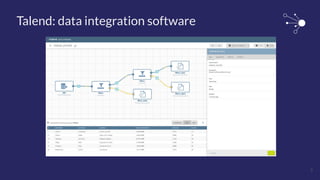
Talend: data integration software
3
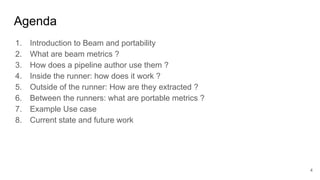
1. Introduction to Beam and portability
2. What are beam metrics ?
3. How does a pipeline author use them ?
4. Inside the runner: how does it work ?
5. Outside of the runner: How are they extracted ?
6. Between the runners: what are portable metrics ?
7. Example Use case
8. Current state and future work
Agenda
4
5
1. Introduction to Beam and portability
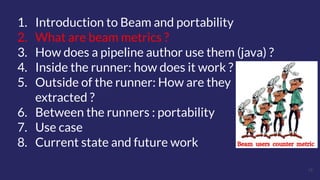
2. What are beam metrics ?
3. How does a pipeline author use them (java) ?
4. Inside the runner: how does it work ?
5. Outside of the runner: How are they
extracted ?
6. Between the runners : portability
7. Use case
8. Current state and future work
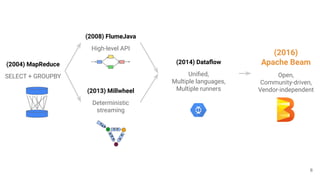
(2008) FlumeJava
High-level API
(2016)
Apache Beam
Open,
Community-driven,
Vendor-independent
(2004) MapReduce
SELECT + GROUPBY
(2014) Dataflow
Unified,
Multiple languages,
Multiple runners(2013) Millwheel
Deterministic
streaming
6
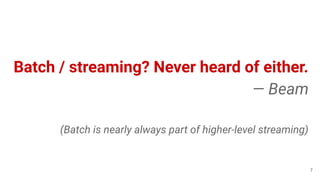
Batch / streaming? Never heard of either.
— Beam
(Batch is nearly always part of higher-level streaming)
7
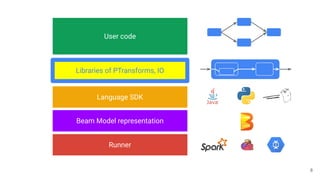
User code
Libraries of PTransforms, IO
Language SDK
Runner
Beam Model representation
8
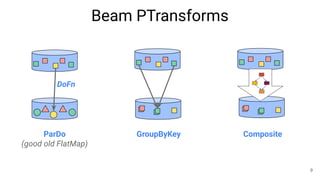
Beam PTransforms
ParDo
(good old FlatMap)
GroupByKey Composite
DoFn
9
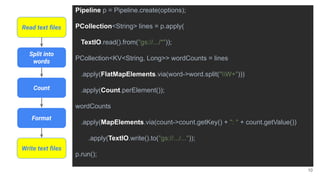
Read text files
Split into
words
Count
Format
Write text files
10
Pipeline p = Pipeline.create(options);
PCollection<String> lines = p.apply(
TextIO.read().from("gs://.../*"));
PCollection<KV<String, Long>> wordCounts = lines
.apply(FlatMapElements.via(word->word.split("W+")))
.apply(Count.perElement());
wordCounts
.apply(MapElements.via(count->count.getKey() + ": " + count.getValue())
.apply(TextIO.write().to("gs://.../..."));
p.run();
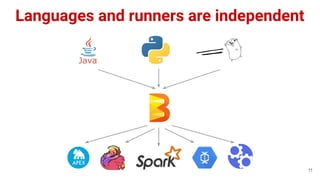
Languages and runners are independent
11
12
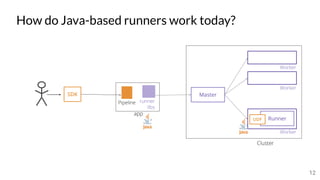
How do Java-based runners work today?
Master
Runner
12
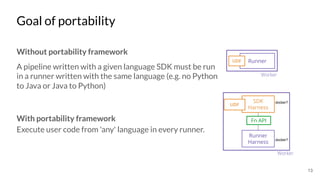
Goal of portability
Without portability framework
A pipeline written with a given language SDK must be run
in a runner written with the same language (e.g. no Python
to Java or Java to Python)
Runner
Harness
SDK
Harness
13
Runner
docker?
docker?
Fn APIWith portability framework
Execute user code from 'any' language in every runner.
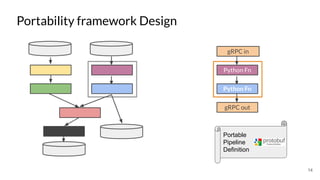
Portability framework Design
14
Python Fn
Python Fn
gRPC in
gRPC out
Portable
Pipeline
Definition
15
1. Introduction to Beam and portability
2. What are beam metrics ?
3. How does a pipeline author use them (java) ?
4. Inside the runner: how does it work ?
5. Outside of the runner: How are they
extracted ?
6. Between the runners : portability
7. Use case
8. Current state and future work
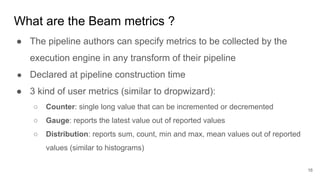
What are the Beam metrics ?
● The pipeline authors can specify metrics to be collected by the
execution engine in any transform of their pipeline
● Declared at pipeline construction time
● 3 kind of user metrics (similar to dropwizard):
○ Counter: single long value that can be incremented or decremented
○ Gauge: reports the latest value out of reported values
○ Distribution: reports sum, count, min and max, mean values out of reported
values (similar to histograms)
16
Beam metrics properties
● Accessible during execution of the pipeline or after it (depends on the
runner)
● Metrics properties:
○ They are named : actual name + namespace (to differentiate and query by namespace)
○ They are scoped to the transform (pipeline step)
○ They are dynamically created: created during runtime (when your transform code
runs), no pre-declaration in the runners/engines
○ They degrade gracefully: if a runner does not support it, it does not report it, no failure
17
Error handling: bundling
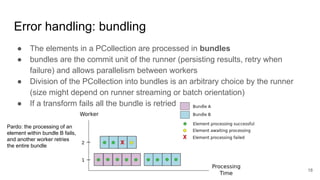
● The elements in a PCollection are processed in bundles
● bundles are the commit unit of the runner (persisting results, retry when
failure) and allows parallelism between workers
● Division of the PCollection into bundles is an arbitrary choice by the runner
(size might depend on runner streaming or batch orientation)
● If a transform fails all the bundle is retried
Pardo: the processing of an
element within bundle B fails,
and another worker retries
the entire bundle
18
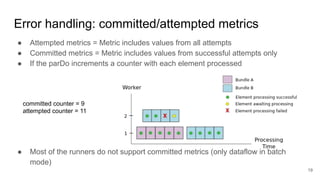
Error handling: committed/attempted metrics
● Attempted metrics = Metric includes values from all attempts
● Committed metrics = Metric includes values from successful attempts only
● If the parDo increments a counter with each element processed
● Most of the runners do not support committed metrics (only dataflow in batch
mode)
committed counter = 9
attempted counter = 11
19
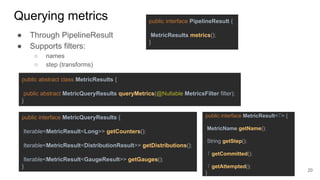
Querying metrics
● Through PipelineResult
● Supports filters:
○ names
○ step (transforms)
public interface PipelineResult {
MetricResults metrics();
}
public abstract class MetricResults {
public abstract MetricQueryResults queryMetrics(@Nullable MetricsFilter filter);
}
public interface MetricQueryResults {
Iterable<MetricResult<Long>> getCounters();
Iterable<MetricResult<DistributionResult>> getDistributions();
Iterable<MetricResult<GaugeResult>> getGauges();
}
public interface MetricResult<T> {
MetricName getName();
String getStep();
T getCommitted();
T getAttempted();
}
20
21
1. Introduction to Beam and portability
2. What are beam metrics ?
3. How does a pipeline author use them (java ) ?
4. Inside the runner: how does it work ?
5. Outside of the runner: How are they
extracted ?
6. Between the runners : portability
7. Use case
8. Current state and future work
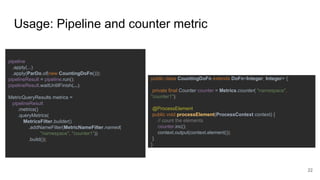
Usage: Pipeline and counter metric
pipeline
.apply(...)
.apply(ParDo.of(new CountingDoFn()));
pipelineResult = pipeline.run();
pipelineResult.waitUntilFinish(...);
MetricQueryResults metrics =
pipelineResult
.metrics()
.queryMetrics(
MetricsFilter.builder()
.addNameFilter(MetricNameFilter.named(
"namespace", "counter1"))
.build());
public class CountingDoFn extends DoFn<Integer, Integer> {
private final Counter counter = Metrics.counter( "namespace",
"counter1");
@ProcessElement
public void processElement(ProcessContext context) {
// count the elements
counter.inc();
context.output(context.element());
}
}
22
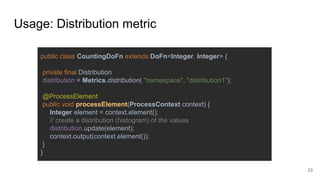
Usage: Distribution metric
public class CountingDoFn extends DoFn<Integer, Integer> {
private final Distribution
distribution = Metrics.distribution( "namespace", "distribution1");
@ProcessElement
public void processElement(ProcessContext context) {
Integer element = context.element();
// create a distribution (histogram) of the values
distribution.update(element);
context.output(context.element());
}
}
23
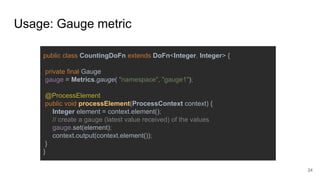
Usage: Gauge metric
public class CountingDoFn extends DoFn<Integer, Integer> {
private final Gauge
gauge = Metrics.gauge( "namespace", "gauge1");
@ProcessElement
public void processElement(ProcessContext context) {
Integer element = context.element();
// create a gauge (latest value received) of the values
gauge.set(element);
context.output(context.element());
}
}
24
25
1. Introduction to Beam and portability
2. What are beam metrics ?
3. How does a pipeline author use them (java)?
4. Inside the runner: how does it work ?
5. Outside of the runner: How are they
extracted ?
6. Between the runners : portability
7. Use case
8. Current state and future work
26
27
1. Introduction to Beam and portability
2. What are beam metrics ?
3. How does a pipeline author use them (java) ?
4. Inside the runner: how does it work ?
5. Outside of the runner: How are they
extracted ?
6. Between the runners : portability
7. Use case
8. Current state and future work
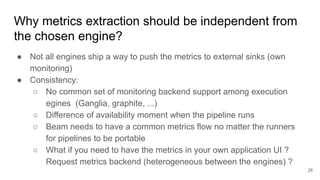
Why metrics extraction should be independent from
the chosen engine?
● Not all engines ship a way to push the metrics to external sinks (own
monitoring)
● Consistency:
○ No common set of monitoring backend support among execution
egines (Ganglia, graphite, ...)
○ Difference of availability moment when the pipeline runs
○ Beam needs to have a common metrics flow no matter the runners
for pipelines to be portable
○ What if you need to have the metrics in your own application UI ?
Request metrics backend (heterogeneous between the engines) ?
28
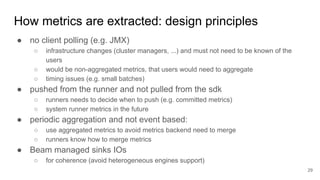
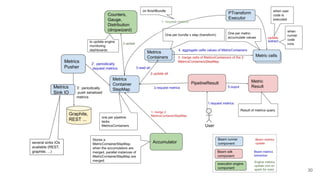
How metrics are extracted: design principles
● no client polling (e.g. JMX)
○ infrastructure changes (cluster managers, ...) and must not need to be known of the
users
○ would be non-aggregated metrics, that users would need to aggregate
○ timing issues (e.g. small batches)
● pushed from the runner and not pulled from the sdk
○ runners needs to decide when to push (e.g. committed metrics)
○ system runner metrics in the future
● periodic aggregation and not event based:
○ use aggregated metrics to avoid metrics backend need to merge
○ runners know how to merge metrics
● Beam managed sinks IOs
○ for coherence (avoid heterogeneous engines support)
29
30
How metrics are extracted: special case of cloud
hosted engines
● runner = empty shell that translates the pipeline and submits the job and
forwards user metric requests through REST calls. But it does not run it
● => the pusher needs to be instantiated in the cloud engine, close to the
pipeline execution
● Solutions
○ When the job starts, the engine receives the serialized PipelineOptions and can trigger the
creation of a MetricsPusher-like service
○ Pipeline pre-processing: DAG modification to include DoFn with native Metrics API calls
● Need to take care of possible network issues to push metrics to the outside
world: open routes or compliant output sinks. (try to avoid pulling metrics from
sdk cf before)
31
32
1. Introduction to Beam and portability
2. What are beam metrics ?
3. How does a pipeline author use them (java) ?
4. Inside the runner: how does it work ?
5. Outside of the runner: How are they
extracted ?
6. Between the runners : portability
7. Use case
8. Current state and future work
Portable metrics (metrics over the Fn API)
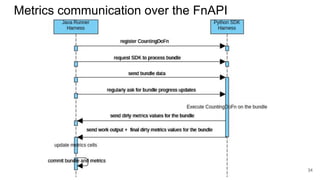
● Metrics definition is part of the protobuf definition of the pipeline
● The SDK harness sends regular updates to the runner harness during the
execution of user defined functions (if they contain metrics) through the FnAPI
(GRPC calls).
● Main communication is on a bundle basis
● Runner still differentiate committed/attempted metrics
● Still very early stage (design of the communications and first step in python
SDK)
33
34
Metrics communication over the FnAPI
Portable metrics: new features
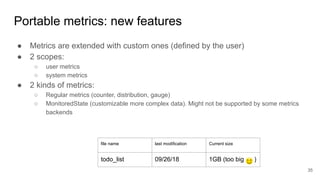
● Metrics are extended with custom ones (defined by the user)
● 2 scopes:
○ user metrics
○ system metrics
● 2 kinds of metrics:
○ Regular metrics (counter, distribution, gauge)
○ MonitoredState (customizable more complex data). Might not be supported by some metrics
backends
file name last modification Current size
todo_list 09/26/18 1GB (too big )
35
36
1. Introduction to Beam and portability
2. What are beam metrics ?
3. How does a pipeline author use them (java) ?
4. Inside the runner: how does it work ?
5. Outside of the runner: How are they
extracted ?
6. Between the runners : portability
7. Example use case
8. Current state and future work
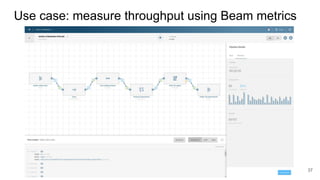
Use case: measure throughput using Beam metrics
37
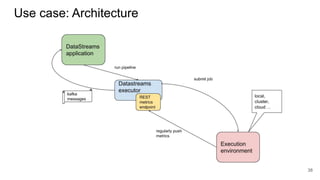
Use case: Architecture
38
39
1. Introduction to Beam and portability
2. What are beam metrics ?
3. How does a pipeline author use them (java) ?
4. Inside the runner: how does it work ?
5. Outside of the runner: How are they
extracted ?
6. Between the runners : portability
7. Example use case
8. Current state and future work
Current state and future work
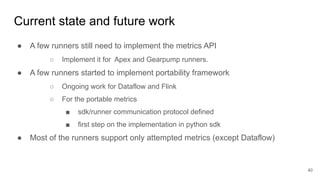
● A few runners still need to implement the metrics API
○ Implement it for Apex and Gearpump runners.
● A few runners started to implement portability framework
○ Ongoing work for Dataflow and Flink
○ For the portable metrics
■ sdk/runner communication protocol defined
■ first step on the implementation in python sdk
● Most of the runners support only attempted metrics (except Dataflow)
40
Current state and future work
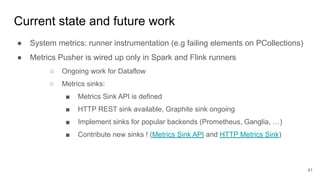
● System metrics: runner instrumentation (e.g failing elements on PCollections)
● Metrics Pusher is wired up only in Spark and Flink runners
○ Ongoing work for Dataflow
○ Metrics sinks:
■ Metrics Sink API is defined
■ HTTP REST sink available, Graphite sink ongoing
■ Implement sinks for popular backends (Prometheus, Ganglia, …)
■ Contribute new sinks ! (Metrics Sink API and HTTP Metrics Sink)
41
Take away
● Metrics can be defined in user code and collected in the native UI
● Metrics can be extracted to external backends independently of the
chosen execution engine
● Metrics will be portable (whatever sdk to whatever runner)
42
43
References
Metrics
Metrics architecture
User metrics
Portable metrics
Metrics extraction
Apache Beam
https://beam.apache.org
Join the mailing lists!
user-subscribe@beam.apache.org
dev-subscribe@beam.apache.org
Follow @ApacheBeam on Twitter
Thanks !
APACHECON North America Sept. 24-27, 2018
45
Backup slides
APACHECON North America Sept. 24-27, 2018
46
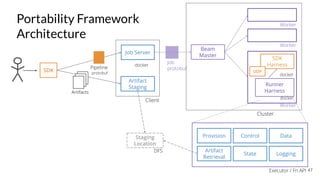
Portability Framework
Architecture
Job Server
Artifact
Staging
Beam
Master
Runner
Harness
SDK
Harness
Provision Control Data
Artifact
Retrieval
State Logging
Artifacts
47
Abstract
Apache Beam provides a unified programming model to execute batch and
streaming pipelines on all the popular big data engines. Lately it has gone beyond
by also providing a unified way to supervise the pipeline execution: universal
metrics. No matter what the chosen execution engine is, Apache Spark, Apache
Flink or others, you specify the metrics to be collected with the same API and you
extract them in a coherent way.
In this talk, you will discover the Beam metrics API, integration with the runners
and finally an end to end example.
48

Universal metrics with Apache Beam

  • 1.
    UNIVERSAL METRICS WITHBEAM APACHECON North America Sept. 24-27, 2018 Etienne CHAUCHOT Apache Beam Committer @echauchot, echauchot@apache.org 1
  • 2.
    Who am I? 2 @echauchot SoftwareEngineer Apache Beam Committer Integration Software Big Data Open Source
  • 3.
  • 4.
    1. Introduction toBeam and portability 2. What are beam metrics ? 3. How does a pipeline author use them ? 4. Inside the runner: how does it work ? 5. Outside of the runner: How are they extracted ? 6. Between the runners: what are portable metrics ? 7. Example Use case 8. Current state and future work Agenda 4
  • 5.
    5 1. Introduction toBeam and portability 2. What are beam metrics ? 3. How does a pipeline author use them (java) ? 4. Inside the runner: how does it work ? 5. Outside of the runner: How are they extracted ? 6. Between the runners : portability 7. Use case 8. Current state and future work
  • 6.
    (2008) FlumeJava High-level API (2016) ApacheBeam Open, Community-driven, Vendor-independent (2004) MapReduce SELECT + GROUPBY (2014) Dataflow Unified, Multiple languages, Multiple runners(2013) Millwheel Deterministic streaming 6
  • 7.
    Batch / streaming?Never heard of either. — Beam (Batch is nearly always part of higher-level streaming) 7
  • 8.
    User code Libraries ofPTransforms, IO Language SDK Runner Beam Model representation 8
  • 9.
    Beam PTransforms ParDo (good oldFlatMap) GroupByKey Composite DoFn 9
  • 10.
    Read text files Splitinto words Count Format Write text files 10 Pipeline p = Pipeline.create(options); PCollection<String> lines = p.apply( TextIO.read().from("gs://.../*")); PCollection<KV<String, Long>> wordCounts = lines .apply(FlatMapElements.via(word->word.split("W+"))) .apply(Count.perElement()); wordCounts .apply(MapElements.via(count->count.getKey() + ": " + count.getValue()) .apply(TextIO.write().to("gs://.../...")); p.run();
  • 11.
    Languages and runnersare independent 11
  • 12.
    12 How do Java-basedrunners work today? Master Runner 12
  • 13.
    Goal of portability Withoutportability framework A pipeline written with a given language SDK must be run in a runner written with the same language (e.g. no Python to Java or Java to Python) Runner Harness SDK Harness 13 Runner docker? docker? Fn APIWith portability framework Execute user code from 'any' language in every runner.
  • 14.
    Portability framework Design 14 PythonFn Python Fn gRPC in gRPC out Portable Pipeline Definition
  • 15.
    15 1. Introduction toBeam and portability 2. What are beam metrics ? 3. How does a pipeline author use them (java) ? 4. Inside the runner: how does it work ? 5. Outside of the runner: How are they extracted ? 6. Between the runners : portability 7. Use case 8. Current state and future work
  • 16.
    What are theBeam metrics ? ● The pipeline authors can specify metrics to be collected by the execution engine in any transform of their pipeline ● Declared at pipeline construction time ● 3 kind of user metrics (similar to dropwizard): ○ Counter: single long value that can be incremented or decremented ○ Gauge: reports the latest value out of reported values ○ Distribution: reports sum, count, min and max, mean values out of reported values (similar to histograms) 16
  • 17.
    Beam metrics properties ●Accessible during execution of the pipeline or after it (depends on the runner) ● Metrics properties: ○ They are named : actual name + namespace (to differentiate and query by namespace) ○ They are scoped to the transform (pipeline step) ○ They are dynamically created: created during runtime (when your transform code runs), no pre-declaration in the runners/engines ○ They degrade gracefully: if a runner does not support it, it does not report it, no failure 17
  • 18.
    Error handling: bundling ●The elements in a PCollection are processed in bundles ● bundles are the commit unit of the runner (persisting results, retry when failure) and allows parallelism between workers ● Division of the PCollection into bundles is an arbitrary choice by the runner (size might depend on runner streaming or batch orientation) ● If a transform fails all the bundle is retried Pardo: the processing of an element within bundle B fails, and another worker retries the entire bundle 18
  • 19.
    Error handling: committed/attemptedmetrics ● Attempted metrics = Metric includes values from all attempts ● Committed metrics = Metric includes values from successful attempts only ● If the parDo increments a counter with each element processed ● Most of the runners do not support committed metrics (only dataflow in batch mode) committed counter = 9 attempted counter = 11 19
  • 20.
    Querying metrics ● ThroughPipelineResult ● Supports filters: ○ names ○ step (transforms) public interface PipelineResult { MetricResults metrics(); } public abstract class MetricResults { public abstract MetricQueryResults queryMetrics(@Nullable MetricsFilter filter); } public interface MetricQueryResults { Iterable<MetricResult<Long>> getCounters(); Iterable<MetricResult<DistributionResult>> getDistributions(); Iterable<MetricResult<GaugeResult>> getGauges(); } public interface MetricResult<T> { MetricName getName(); String getStep(); T getCommitted(); T getAttempted(); } 20
  • 21.
    21 1. Introduction toBeam and portability 2. What are beam metrics ? 3. How does a pipeline author use them (java ) ? 4. Inside the runner: how does it work ? 5. Outside of the runner: How are they extracted ? 6. Between the runners : portability 7. Use case 8. Current state and future work
  • 22.
    Usage: Pipeline andcounter metric pipeline .apply(...) .apply(ParDo.of(new CountingDoFn())); pipelineResult = pipeline.run(); pipelineResult.waitUntilFinish(...); MetricQueryResults metrics = pipelineResult .metrics() .queryMetrics( MetricsFilter.builder() .addNameFilter(MetricNameFilter.named( "namespace", "counter1")) .build()); public class CountingDoFn extends DoFn<Integer, Integer> { private final Counter counter = Metrics.counter( "namespace", "counter1"); @ProcessElement public void processElement(ProcessContext context) { // count the elements counter.inc(); context.output(context.element()); } } 22
  • 23.
    Usage: Distribution metric publicclass CountingDoFn extends DoFn<Integer, Integer> { private final Distribution distribution = Metrics.distribution( "namespace", "distribution1"); @ProcessElement public void processElement(ProcessContext context) { Integer element = context.element(); // create a distribution (histogram) of the values distribution.update(element); context.output(context.element()); } } 23
  • 24.
    Usage: Gauge metric publicclass CountingDoFn extends DoFn<Integer, Integer> { private final Gauge gauge = Metrics.gauge( "namespace", "gauge1"); @ProcessElement public void processElement(ProcessContext context) { Integer element = context.element(); // create a gauge (latest value received) of the values gauge.set(element); context.output(context.element()); } } 24
  • 25.
    25 1. Introduction toBeam and portability 2. What are beam metrics ? 3. How does a pipeline author use them (java)? 4. Inside the runner: how does it work ? 5. Outside of the runner: How are they extracted ? 6. Between the runners : portability 7. Use case 8. Current state and future work
  • 26.
  • 27.
    27 1. Introduction toBeam and portability 2. What are beam metrics ? 3. How does a pipeline author use them (java) ? 4. Inside the runner: how does it work ? 5. Outside of the runner: How are they extracted ? 6. Between the runners : portability 7. Use case 8. Current state and future work
  • 28.
    Why metrics extractionshould be independent from the chosen engine? ● Not all engines ship a way to push the metrics to external sinks (own monitoring) ● Consistency: ○ No common set of monitoring backend support among execution egines (Ganglia, graphite, ...) ○ Difference of availability moment when the pipeline runs ○ Beam needs to have a common metrics flow no matter the runners for pipelines to be portable ○ What if you need to have the metrics in your own application UI ? Request metrics backend (heterogeneous between the engines) ? 28
  • 29.
    How metrics areextracted: design principles ● no client polling (e.g. JMX) ○ infrastructure changes (cluster managers, ...) and must not need to be known of the users ○ would be non-aggregated metrics, that users would need to aggregate ○ timing issues (e.g. small batches) ● pushed from the runner and not pulled from the sdk ○ runners needs to decide when to push (e.g. committed metrics) ○ system runner metrics in the future ● periodic aggregation and not event based: ○ use aggregated metrics to avoid metrics backend need to merge ○ runners know how to merge metrics ● Beam managed sinks IOs ○ for coherence (avoid heterogeneous engines support) 29
  • 30.
  • 31.
    How metrics areextracted: special case of cloud hosted engines ● runner = empty shell that translates the pipeline and submits the job and forwards user metric requests through REST calls. But it does not run it ● => the pusher needs to be instantiated in the cloud engine, close to the pipeline execution ● Solutions ○ When the job starts, the engine receives the serialized PipelineOptions and can trigger the creation of a MetricsPusher-like service ○ Pipeline pre-processing: DAG modification to include DoFn with native Metrics API calls ● Need to take care of possible network issues to push metrics to the outside world: open routes or compliant output sinks. (try to avoid pulling metrics from sdk cf before) 31
  • 32.
    32 1. Introduction toBeam and portability 2. What are beam metrics ? 3. How does a pipeline author use them (java) ? 4. Inside the runner: how does it work ? 5. Outside of the runner: How are they extracted ? 6. Between the runners : portability 7. Use case 8. Current state and future work
  • 33.
    Portable metrics (metricsover the Fn API) ● Metrics definition is part of the protobuf definition of the pipeline ● The SDK harness sends regular updates to the runner harness during the execution of user defined functions (if they contain metrics) through the FnAPI (GRPC calls). ● Main communication is on a bundle basis ● Runner still differentiate committed/attempted metrics ● Still very early stage (design of the communications and first step in python SDK) 33
  • 34.
  • 35.
    Portable metrics: newfeatures ● Metrics are extended with custom ones (defined by the user) ● 2 scopes: ○ user metrics ○ system metrics ● 2 kinds of metrics: ○ Regular metrics (counter, distribution, gauge) ○ MonitoredState (customizable more complex data). Might not be supported by some metrics backends file name last modification Current size todo_list 09/26/18 1GB (too big ) 35
  • 36.
    36 1. Introduction toBeam and portability 2. What are beam metrics ? 3. How does a pipeline author use them (java) ? 4. Inside the runner: how does it work ? 5. Outside of the runner: How are they extracted ? 6. Between the runners : portability 7. Example use case 8. Current state and future work
  • 37.
    Use case: measurethroughput using Beam metrics 37
  • 38.
  • 39.
    39 1. Introduction toBeam and portability 2. What are beam metrics ? 3. How does a pipeline author use them (java) ? 4. Inside the runner: how does it work ? 5. Outside of the runner: How are they extracted ? 6. Between the runners : portability 7. Example use case 8. Current state and future work
  • 40.
    Current state andfuture work ● A few runners still need to implement the metrics API ○ Implement it for Apex and Gearpump runners. ● A few runners started to implement portability framework ○ Ongoing work for Dataflow and Flink ○ For the portable metrics ■ sdk/runner communication protocol defined ■ first step on the implementation in python sdk ● Most of the runners support only attempted metrics (except Dataflow) 40
  • 41.
    Current state andfuture work ● System metrics: runner instrumentation (e.g failing elements on PCollections) ● Metrics Pusher is wired up only in Spark and Flink runners ○ Ongoing work for Dataflow ○ Metrics sinks: ■ Metrics Sink API is defined ■ HTTP REST sink available, Graphite sink ongoing ■ Implement sinks for popular backends (Prometheus, Ganglia, …) ■ Contribute new sinks ! (Metrics Sink API and HTTP Metrics Sink) 41
  • 42.
    Take away ● Metricscan be defined in user code and collected in the native UI ● Metrics can be extracted to external backends independently of the chosen execution engine ● Metrics will be portable (whatever sdk to whatever runner) 42
  • 43.
  • 44.
    References Metrics Metrics architecture User metrics Portablemetrics Metrics extraction Apache Beam https://beam.apache.org Join the mailing lists! user-subscribe@beam.apache.org dev-subscribe@beam.apache.org Follow @ApacheBeam on Twitter
  • 45.
    Thanks ! APACHECON NorthAmerica Sept. 24-27, 2018 45
  • 46.
    Backup slides APACHECON NorthAmerica Sept. 24-27, 2018 46
  • 47.
  • 48.
    Abstract Apache Beam providesa unified programming model to execute batch and streaming pipelines on all the popular big data engines. Lately it has gone beyond by also providing a unified way to supervise the pipeline execution: universal metrics. No matter what the chosen execution engine is, Apache Spark, Apache Flink or others, you specify the metrics to be collected with the same API and you extract them in a coherent way. In this talk, you will discover the Beam metrics API, integration with the runners and finally an end to end example. 48