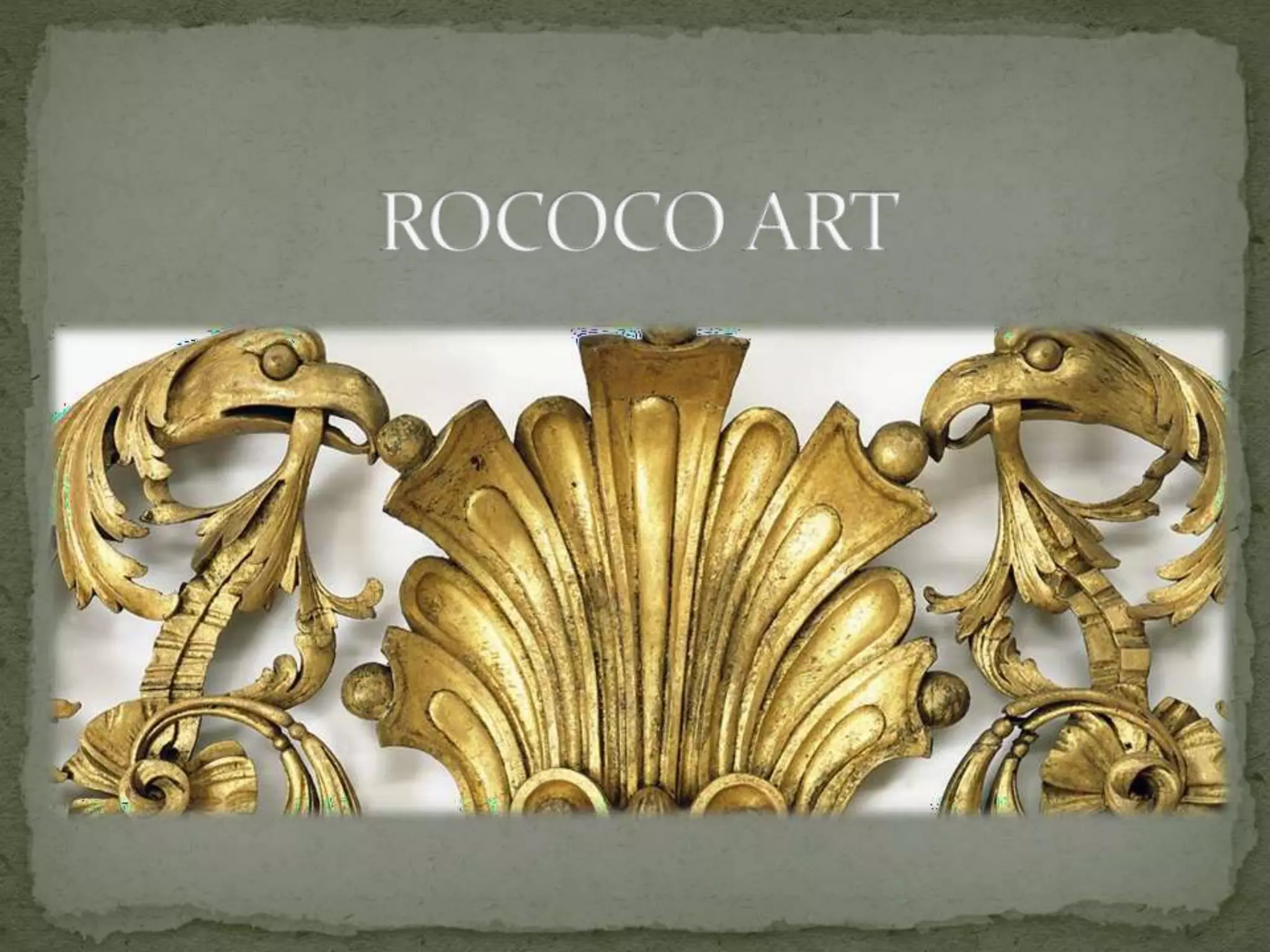
RococoArt
Name: also known as LATE BAROQUE
Origin: Paris, France
Developed in: 18th century
Date: 1700-1750
Derived from: French word“ROCAILLE” meaning
STONE or shell-covered rock.
Rococo is an artistic movement and style which has
affected manyaspects of art:
Sculpture
Painting
Architecture
Interior
Furniture
Fashion
Ceramics
Jewellery
Literature
Music
Theater
• The history of the Rococo style dates back to roughly the 1730s.
• French political life had changed since the death of the Louis XIV in 1715.
• Louis was a powerful monarch who kept the nobles and aristocrats
constantly occupied in courtly life and displayed his regal power through
dark, dramatic, and ornate palaces like Versailles.
• His son, Louis XV, was only five when he inherited the throne, so France
was ruled by a regent and the nobles were able to focus more on their
private affairs.
• This was the world that the Rococo was born into.
• French aristocrats, freed from courtly solemnity, spent more time in their
private estates, hosting lavish parties and generally enjoying life.
• Since they were entertaining guests frequently, interior design was a top
priority, but this wasn't the regal, Baroque design of Versailles.
• What emerged was something just as opulent and lavish, but with none of
the solemnity.
Characteristics:
jocular, florid and graceful approach to Baroque
Vertical lines wereavoided
Angles were softened
style was ornate, used light colors, asymmetrical
designs, curves and gold.
playful and wittythemes.
produced flowing, giddy, visually spectacular carving
elegant and ornate furniture, small sculptures,
ornamental mirrors, and tapestry complementing
architecture, reliefs, andwall paintings.
Features
Natural motifs
Elaborated carved forms
Asymmetry
S and c scrolls
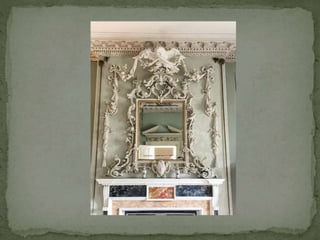
• In the Rococo style, walls, ceilings, and moldings
were decorated with delicate interlacings of
curves and countercurves based on the
fundamental shapes of the “C” and the “S,” as
well as with shell forms and other natural
shapes.
• Asymmetrical design was the rule. Light pastels,
ivory white, and gold were the predominant
colours, and
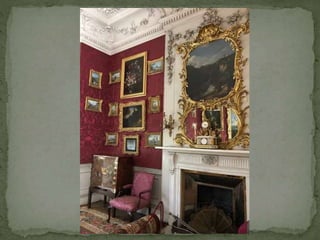
• Rococo decorators frequently used mirrors to
enhance the sense of open space.
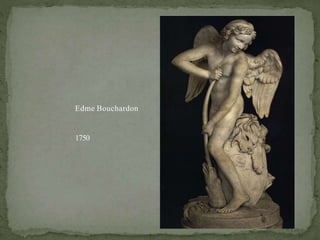
Sculpture
Rococo was widely adapted
Expressed through delicate porcelain sculpture
Themes of love andgaiety
Elements of nature, curving lines and asymmetry.
Edme Bouchardon
1750
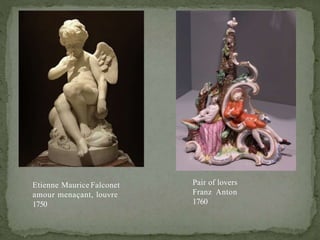
Pair of lovers
Franz Anton
1760
Etienne Maurice Falconet
amour menaçant, louvre
1750
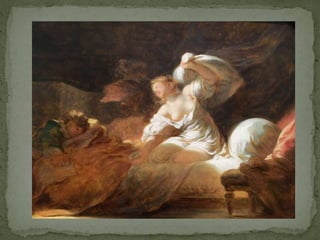
Painting
Decorative art style was clearly shown
Delicate colors and curving forms
Decorating canvas with cherubs and myths of love
Portraits were also popular
Some showed a sort of naughtiness or impurity in the
behavior of their subjects
Pastoral landscapes
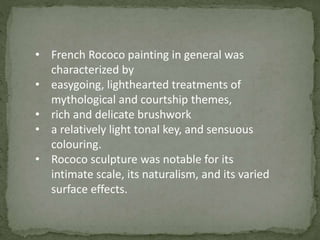
• French Rococo painting in general was
characterized by
• easygoing, lighthearted treatments of
mythological and courtship themes,
• rich and delicate brushwork
• a relatively light tonal key, and sensuous
colouring.
• Rococo sculpture was notable for its
intimate scale, its naturalism, and its varied
surface effects.
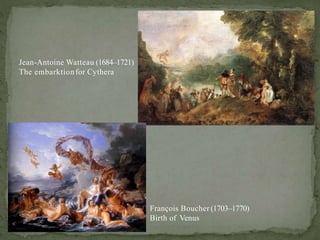
Jean-Antoine Watteau (1684–1721)
The embarktionfor Cythera
François Boucher (1703–1770)
Birth of Venus
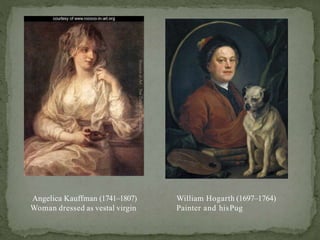
William Hogarth (1697–1764)
Painter and hisPug
Angelica Kauffman (1741–1807)
Woman dressed as vestal virgin
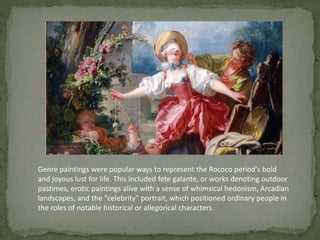
Genre paintings were popular ways to represent the Rococo period's bold
and joyous lust for life. This included fete galante, or works denoting outdoor
pastimes, erotic paintings alive with a sense of whimsical hedonism, Arcadian
landscapes, and the "celebrity" portrait, which positioned ordinary people in
the roles of notable historical or allegorical characters.
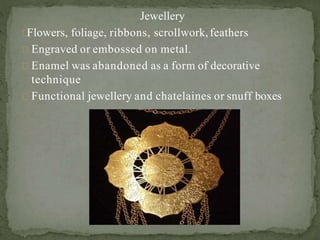
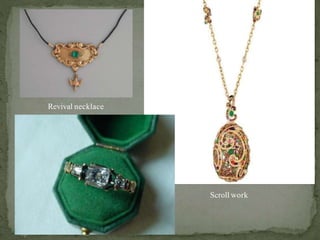
Jewellery
Flowers, foliage, ribbons, scrollwork,feathers
Engraved or embossed on metal.
Enamel was abandoned as a form of decorative
technique
Functional jewellery and chatelaines or snuff boxes
Revival necklace
Scroll work
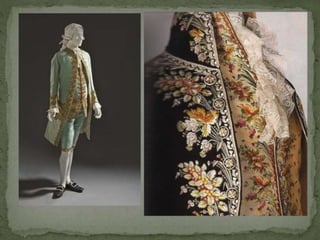
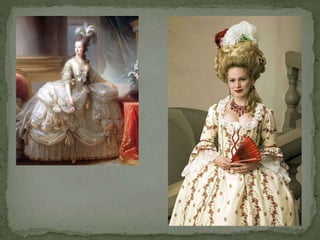
Fashion
Men with highheels
Women with hair mounded on top
Curls and twirls with stings of pearl
Lightweight silk layered TAFETTAand SATIN
Light pastel colors
Large floral motifs
Stripes sprinkled withsprigs
The Rococo Interior Design
The Rococo was an 18th-century style that brought all the focus inside.
While the Rococo style grew to influence architecture, painting, sculpture, and
music, it originated first and foremost as a form of interior design.
So, to understand Rococo design we can't start with grand facades of
buildings; instead we have to look within.
Architecture
Lighter, more graceful
Elaborate version of baroque architecture
Asymmetry of forms
Richly decorated
Numerous curves and decorations
Pale color
Jocular and light hearted themes
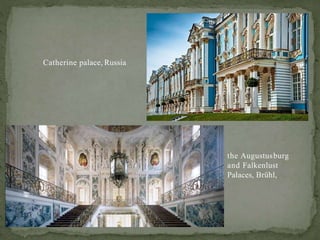
Catherine palace, Russia
the Augustusburg
and Falkenlust
Palaces, Brühl,
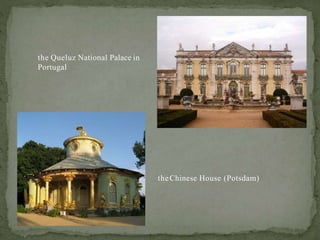
the Queluz National Palace in
Portugal
theChinese House (Potsdam)
Aristocrats hired skilled designers and craftspeople to fill their homes with
lavish, handmade designs that were light, airy, and whimsical.
In most cases, they simply had the interiors of existing buildings redesigned,
without building entirely new homes.
This is one reason why the Rococo is not strongly associated with
architecture, but is associated with interior design.
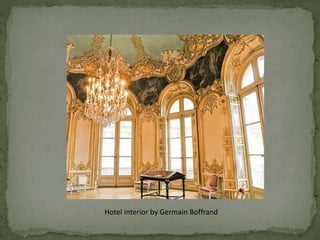
Among the most notable designers and artisans to build up this emerging
Rococo style were engraver Pierre Le Pautre, goldsmith/designer Juste-
Aurèle Meissonnier, carver Nicolas Pineau, architect Jean Aubert, and
designer Germain Boffrand
So, what exactly was this Rococo style of interior design like?
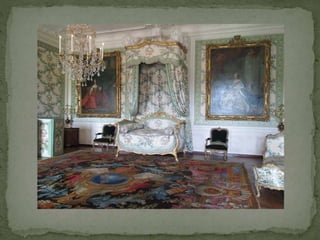
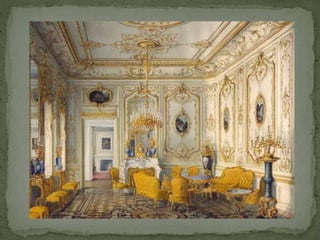
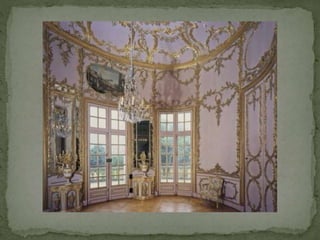
Let's start with the overall aesthetic. Rococo interiors were light and airy.
They felt free, unencumbered, and rejected the confining solemnity of Louis
XIV's Baroque style.
However, at the same time Rococo interiors were unavoidably opulent.
Everything about them was ornate, shiny, elegant, and delicate.
• This aesthetic was achieved through the use of light pastel colors, paired
with ivory whites, polished marble, gold, and silver.
• Every material or color in a Rococo room had to be visually light as well as
opulent, creating an overall sense of floating through a gilded cloud.
• This aesthetic was maintained not only in the walls and ceilings of the
room, but in the furniture, flatware, silverware, paintings, and decorations.
Everything had to match, and everything had to be lavish and handmade
by skilled craftspeople.
After all, French aristocrats of the 18th century were not ones to skimp.
Decorations and Motifs
With such a focus on handcrafted arts and decorations, as well as lavish
ornamentation, it really should be no surprise that Rococo interiors were
incredibly detailed.
In fact, it's the attention to detail that really defines the Rococo. The
style's name comes from the French word rocaille, which is a decorative
seashell or stone motif.
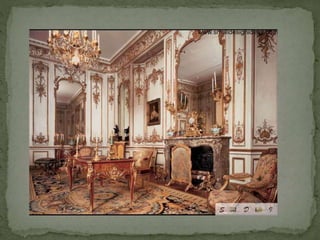
Hotel interior by Germain Boffrand
Interior
Fully in control, sportive, fantastic
Sculptural forms expressed in abstract expressions
Flaming, leafy or shell like textures in asymmetrical
sweeps, flourishes and broken curves.
suppress architectonic divisions of architrave frieze
and cornice for picturesque.
Rococo palette softer and paler then those of baroque
pastel pink, lilac, blue and green
decorative elements were rocaille, S and C shaped
scrolls, acanthus leaves, birds and flower and chubby
babies.
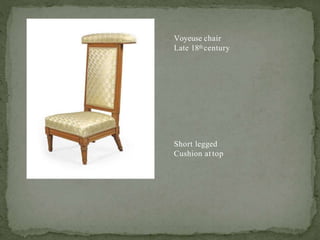
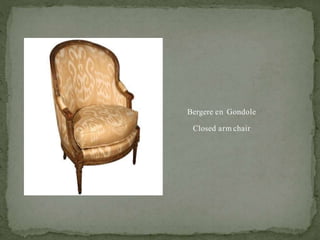
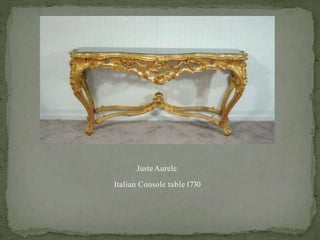
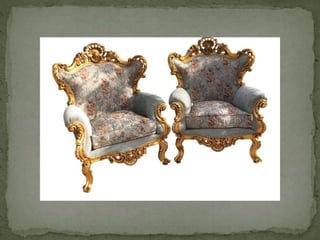
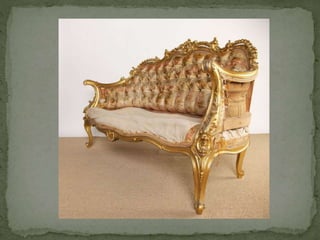
Furniture
Lighthearted, visually andphysically
Ornate, graceful
role in comfort and versatility
Idea has evolved to a symbol of status
Easily moved around
Matching back
Preferred choice due to its strength
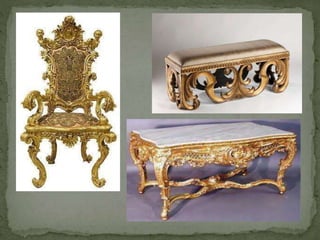
Voyeuse chair
Late 18th century
Short legged
Cushion at top
Bergere en Gondole
Closed arm chair
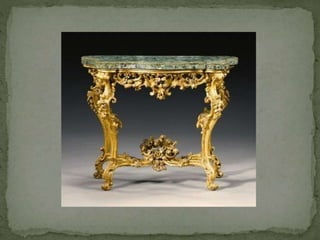
Italian Console table1730
JusteAurele
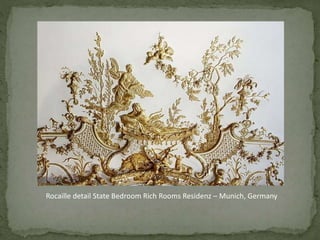
Rocaille detail State Bedroom Rich Rooms Residenz – Munich, Germany
Adding a touch of Rococo to your own home
Here is something to think about if you want to add a touch of Rococo design to
your home:
•Forget about symmetry and think along the lines of sweeping forms, seashells
and scrolls
•Add a piece of furniture with curved legs and sensuous shapes
•Go for patterns full of flowers, birds, animals and leaves
•Introduce one piece in the Rococo style into a modern or minimal interior. The
fine detail and craftsmanship of the Rococo piece will contrast perfectly with the
minimal setting.
•Opt for white and pastel shades
•Adding a Rococo mirror is a very easy way to add some French style
•Think about using fabric or wallpaper with a Rococo pattern to add a touch of
Rococo elegance to your scheme.
Famous for its gilded glamour and pastel shades, the
Rococo style is a well-loved style in interior design.
It's seductive, witty, often playful but always elegant.
If you want to add a touch of glamour and elegance to your
home, you can't really go wrong with Rococo

rococo art-ppt.pptx

  • 2.
    RococoArt Name: also knownas LATE BAROQUE Origin: Paris, France Developed in: 18th century Date: 1700-1750 Derived from: French word“ROCAILLE” meaning STONE or shell-covered rock.
  • 3.
    Rococo is anartistic movement and style which has affected manyaspects of art: Sculpture Painting Architecture Interior Furniture Fashion Ceramics Jewellery Literature Music Theater
  • 4.
    • The historyof the Rococo style dates back to roughly the 1730s. • French political life had changed since the death of the Louis XIV in 1715. • Louis was a powerful monarch who kept the nobles and aristocrats constantly occupied in courtly life and displayed his regal power through dark, dramatic, and ornate palaces like Versailles. • His son, Louis XV, was only five when he inherited the throne, so France was ruled by a regent and the nobles were able to focus more on their private affairs. • This was the world that the Rococo was born into. • French aristocrats, freed from courtly solemnity, spent more time in their private estates, hosting lavish parties and generally enjoying life. • Since they were entertaining guests frequently, interior design was a top priority, but this wasn't the regal, Baroque design of Versailles. • What emerged was something just as opulent and lavish, but with none of the solemnity.
  • 5.
    Characteristics: jocular, florid andgraceful approach to Baroque Vertical lines wereavoided Angles were softened style was ornate, used light colors, asymmetrical designs, curves and gold. playful and wittythemes. produced flowing, giddy, visually spectacular carving elegant and ornate furniture, small sculptures, ornamental mirrors, and tapestry complementing architecture, reliefs, andwall paintings.
  • 6.
    Features Natural motifs Elaborated carvedforms Asymmetry S and c scrolls
  • 7.
    • In theRococo style, walls, ceilings, and moldings were decorated with delicate interlacings of curves and countercurves based on the fundamental shapes of the “C” and the “S,” as well as with shell forms and other natural shapes. • Asymmetrical design was the rule. Light pastels, ivory white, and gold were the predominant colours, and • Rococo decorators frequently used mirrors to enhance the sense of open space.
  • 8.
    Sculpture Rococo was widelyadapted Expressed through delicate porcelain sculpture Themes of love andgaiety Elements of nature, curving lines and asymmetry.
  • 9.
  • 10.
    Pair of lovers FranzAnton 1760 Etienne Maurice Falconet amour menaçant, louvre 1750
  • 12.
    Painting Decorative art stylewas clearly shown Delicate colors and curving forms Decorating canvas with cherubs and myths of love Portraits were also popular Some showed a sort of naughtiness or impurity in the behavior of their subjects Pastoral landscapes
  • 13.
    • French Rococopainting in general was characterized by • easygoing, lighthearted treatments of mythological and courtship themes, • rich and delicate brushwork • a relatively light tonal key, and sensuous colouring. • Rococo sculpture was notable for its intimate scale, its naturalism, and its varied surface effects.
  • 14.
    Jean-Antoine Watteau (1684–1721) Theembarktionfor Cythera François Boucher (1703–1770) Birth of Venus
  • 15.
    William Hogarth (1697–1764) Painterand hisPug Angelica Kauffman (1741–1807) Woman dressed as vestal virgin
  • 16.
    Genre paintings werepopular ways to represent the Rococo period's bold and joyous lust for life. This included fete galante, or works denoting outdoor pastimes, erotic paintings alive with a sense of whimsical hedonism, Arcadian landscapes, and the "celebrity" portrait, which positioned ordinary people in the roles of notable historical or allegorical characters.
  • 20.
    Jewellery Flowers, foliage, ribbons,scrollwork,feathers Engraved or embossed on metal. Enamel was abandoned as a form of decorative technique Functional jewellery and chatelaines or snuff boxes
  • 21.
  • 22.
    Fashion Men with highheels Womenwith hair mounded on top Curls and twirls with stings of pearl Lightweight silk layered TAFETTAand SATIN Light pastel colors Large floral motifs Stripes sprinkled withsprigs
  • 23.
  • 24.
    The Rococo wasan 18th-century style that brought all the focus inside. While the Rococo style grew to influence architecture, painting, sculpture, and music, it originated first and foremost as a form of interior design. So, to understand Rococo design we can't start with grand facades of buildings; instead we have to look within.
  • 25.
    Architecture Lighter, more graceful Elaborateversion of baroque architecture Asymmetry of forms Richly decorated Numerous curves and decorations Pale color Jocular and light hearted themes
  • 26.
    Catherine palace, Russia theAugustusburg and Falkenlust Palaces, Brühl,
  • 27.
    the Queluz NationalPalace in Portugal theChinese House (Potsdam)
  • 28.
    Aristocrats hired skilleddesigners and craftspeople to fill their homes with lavish, handmade designs that were light, airy, and whimsical. In most cases, they simply had the interiors of existing buildings redesigned, without building entirely new homes. This is one reason why the Rococo is not strongly associated with architecture, but is associated with interior design. Among the most notable designers and artisans to build up this emerging Rococo style were engraver Pierre Le Pautre, goldsmith/designer Juste- Aurèle Meissonnier, carver Nicolas Pineau, architect Jean Aubert, and designer Germain Boffrand
  • 29.
    So, what exactlywas this Rococo style of interior design like? Let's start with the overall aesthetic. Rococo interiors were light and airy. They felt free, unencumbered, and rejected the confining solemnity of Louis XIV's Baroque style. However, at the same time Rococo interiors were unavoidably opulent. Everything about them was ornate, shiny, elegant, and delicate.
  • 30.
    • This aestheticwas achieved through the use of light pastel colors, paired with ivory whites, polished marble, gold, and silver. • Every material or color in a Rococo room had to be visually light as well as opulent, creating an overall sense of floating through a gilded cloud. • This aesthetic was maintained not only in the walls and ceilings of the room, but in the furniture, flatware, silverware, paintings, and decorations. Everything had to match, and everything had to be lavish and handmade by skilled craftspeople. After all, French aristocrats of the 18th century were not ones to skimp.
  • 31.
    Decorations and Motifs Withsuch a focus on handcrafted arts and decorations, as well as lavish ornamentation, it really should be no surprise that Rococo interiors were incredibly detailed. In fact, it's the attention to detail that really defines the Rococo. The style's name comes from the French word rocaille, which is a decorative seashell or stone motif.
  • 34.
    Hotel interior byGermain Boffrand
  • 39.
    Interior Fully in control,sportive, fantastic Sculptural forms expressed in abstract expressions Flaming, leafy or shell like textures in asymmetrical sweeps, flourishes and broken curves. suppress architectonic divisions of architrave frieze and cornice for picturesque. Rococo palette softer and paler then those of baroque pastel pink, lilac, blue and green decorative elements were rocaille, S and C shaped scrolls, acanthus leaves, birds and flower and chubby babies.
  • 40.
    Furniture Lighthearted, visually andphysically Ornate,graceful role in comfort and versatility Idea has evolved to a symbol of status Easily moved around Matching back Preferred choice due to its strength
  • 42.
    Voyeuse chair Late 18thcentury Short legged Cushion at top
  • 43.
  • 44.
  • 45.
    Rocaille detail StateBedroom Rich Rooms Residenz – Munich, Germany
  • 49.
    Adding a touchof Rococo to your own home Here is something to think about if you want to add a touch of Rococo design to your home: •Forget about symmetry and think along the lines of sweeping forms, seashells and scrolls •Add a piece of furniture with curved legs and sensuous shapes •Go for patterns full of flowers, birds, animals and leaves •Introduce one piece in the Rococo style into a modern or minimal interior. The fine detail and craftsmanship of the Rococo piece will contrast perfectly with the minimal setting. •Opt for white and pastel shades •Adding a Rococo mirror is a very easy way to add some French style •Think about using fabric or wallpaper with a Rococo pattern to add a touch of Rococo elegance to your scheme.
  • 50.
    Famous for itsgilded glamour and pastel shades, the Rococo style is a well-loved style in interior design. It's seductive, witty, often playful but always elegant. If you want to add a touch of glamour and elegance to your home, you can't really go wrong with Rococo