RENAISSANCE
BY:- Apoorwaa Porwal
RENAISSANCE
12th – 18th century
RENAISSANCE
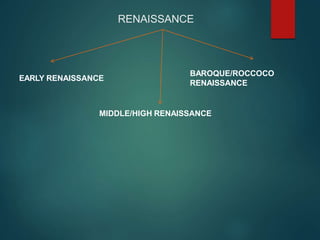
EARLY RENAISSANCE
MIDDLE/HIGH RENAISSANCE
BAROQUE/ROCCOCO
RENAISSANCE
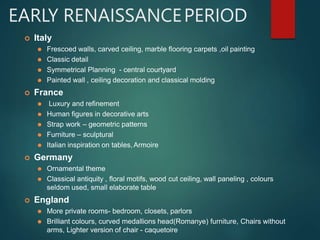
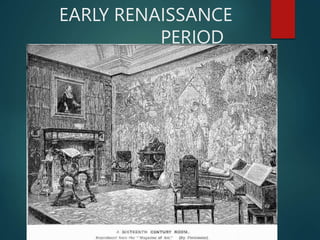
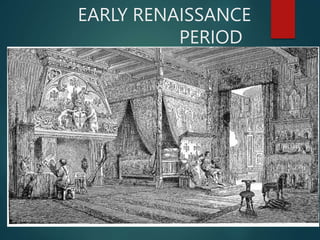
EARLY RENAISSANCEPERIOD
 Italy
⚫ Frescoed walls, carved ceiling, marble flooring carpets ,oil painting
⚫ Classic detail
⚫ Symmetrical Planning - central courtyard
⚫ Painted wall , ceiling decoration and classical molding
 France
⚫ Luxury and refinement
⚫ Human figures in decorative arts
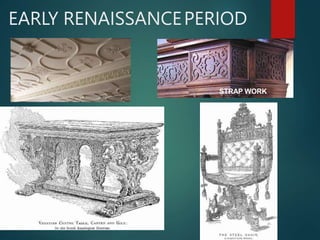
⚫ Strap work – geometric patterns
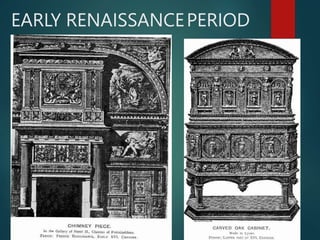
⚫ Furniture – sculptural
⚫ Italian inspiration on tables, Armoire
 Germany
⚫ Ornamental theme
⚫ Classical antiquity , floral motifs, wood cut ceiling, wall paneling , colours
seldom used, small elaborate table
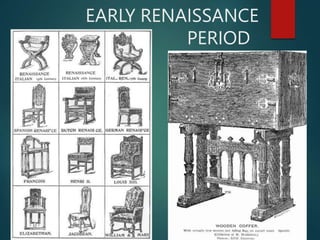
 England
⚫ More private rooms- bedroom, closets, parlors
⚫ Brilliant colours, curved medallions head(Romanye) furniture, Chairs without
arms, Lighter version of chair - caquetoire
EARLY RENAISSANCEPERIOD
STRAP WORK
EARLY RENAISSANCEPERIOD
EARLY RENAISSANCE
PERIOD
EARLY RENAISSANCE
PERIOD
EARLY RENAISSANCE
PERIOD
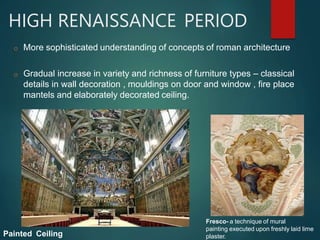
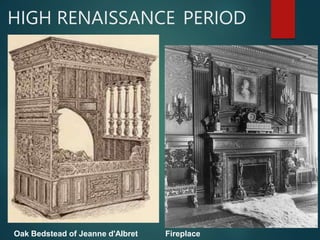
HIGH RENAISSANCE PERIOD
o More sophisticated understanding of concepts of roman architecture
o Gradual increase in variety and richness of furniture types – classical
details in wall decoration , mouldings on door and window , fire place
mantels and elaborately decorated ceiling.
Painted Ceiling
Fresco- a technique of mural
painting executed upon freshly laid lime
plaster.
Oak Bedstead of Jeanne d'Albret
HIGH RENAISSANCE PERIOD
Fireplace
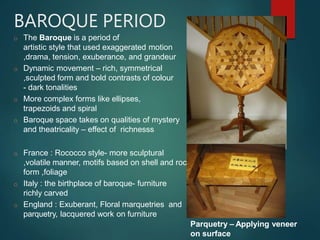
BAROQUE PERIOD
o The Baroque is a period of
artistic style that used exaggerated motion
,drama, tension, exuberance, and grandeur
o Dynamic movement – rich, symmetrical
,sculpted form and bold contrasts of colour
- dark tonalities
o More complex forms like ellipses,
trapezoids and spiral
o Baroque space takes on qualities of mystery
and theatricality – effect of richnesss
o France : Rococco style- more sculptural
,volatile manner, motifs based on shell and rock
form ,foliage
o Italy : the birthplace of baroque- furniture
richly carved
o England : Exuberant, Floral marquetries and
parquetry, lacquered work on furniture
Parquetry – Applying veneer
on surface
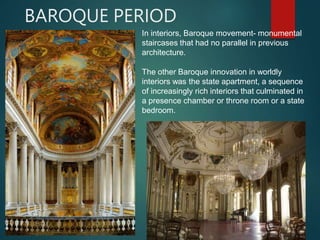
BAROQUE PERIOD
In interiors, Baroque movement- monumental
staircases that had no parallel in previous
architecture.
The other Baroque innovation in worldly
interiors was the state apartment, a sequence
of increasingly rich interiors that culminated in
a presence chamber or throne room or a state
bedroom.
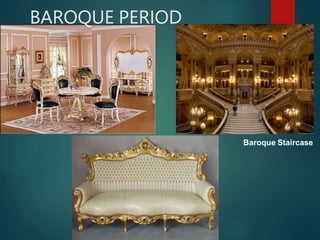
BAROQUE PERIOD
Baroque Staircase
BAROQUE PERIOD
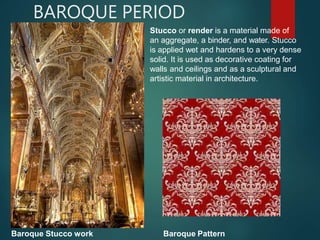
Stucco or render is a material made of
an aggregate, a binder, and water. Stucco
is applied wet and hardens to a very dense
solid. It is used as decorative coating for
walls and ceilings and as a sculptural and
artistic material in architecture.
Baroque Stucco work Baroque Pattern
ROCOCO (LATE BAROQUE)PERIOD
oRococco, also referred to as
"Late Baroque", is an 18th-century
artistic movement and style
in Paris, France, which affected
several aspects of the
arts including painting, sculpture, arc
hitecture, interior design , decoration
, literature , music and theatre.
oThe word 'Rococo' is derived from
the French "rocaille", a word used
to describe the rock and shell work.
oFurniture – lighthearted, symbol of
status , comfort and versatility, easily
moved around for gatherings, many
specialized forms - fauteuil chair, the
voyeuse chair.
FAUTEUIL CHAIR
MIRROR
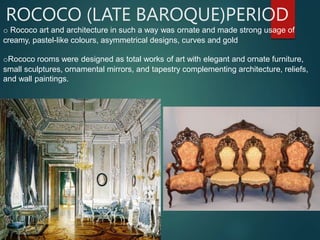
o Rococo art and architecture in such a way was ornate and made strong usage of
creamy, pastel-like colours, asymmetrical designs, curves and gold
oRococo rooms were designed as total works of art with elegant and ornate furniture,
small sculptures, ornamental mirrors, and tapestry complementing architecture, reliefs,
and wall paintings.
ROCOCO (LATE BAROQUE)PERIOD
COLONIAL STYLE – UNITED STATES
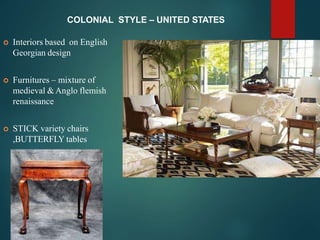
 Interiors based on English
Georgian design
 Furnitures – mixture of
medieval &Anglo flemish
renaissance
 STICK variety chairs
,BUTTERFLY tables
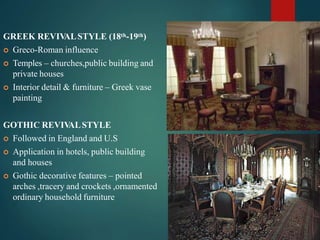
GREEK REVIV
ALSTYLE (18th-19th)
 Greco-Roman influence
 Temples – churches,public building and
private houses
 Interior detail & furniture – Greek vase
painting
GOTHIC REVIV
ALSTYLE
 Followed in England and U.S
 Application in hotels, public building
and houses
 Gothic decorative features – pointed
arches ,tracery and crockets ,ornamented
ordinary household furniture
FEDERAL
STYLE
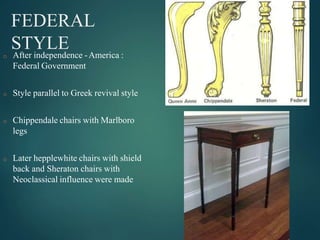
o After independence -America :
Federal Government
o Style parallel to Greek revival style
o Chippendale chairs with Marlboro
legs
o Later hepplewhite chairs with shield
back and Sheraton chairs with
Neoclassical influence were made
RENAISSANCE – UNITED
STATES
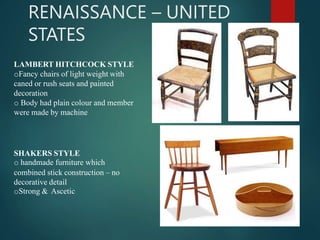
LAMBERT HITCHCOCK STYLE
oFancy chairs of light weight with
caned or rush seats and painted
decoration
o Body had plain colour and member
were made by machine
SHAKERS STYLE
o handmade furniture which
combined stick construction – no
decorative detail
oStrong & Ascetic
INDUSTRIAL ERA
18th – 19th century
ART NOUVEAU
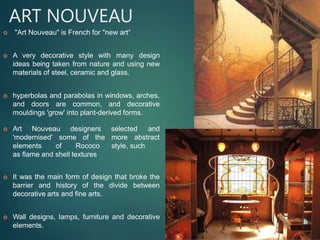
 "Art Nouveau" is French for "new art“
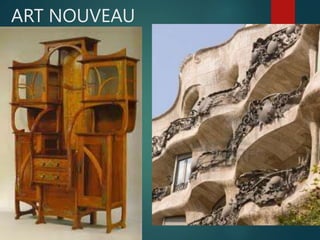
 A very decorative style with many design
ideas being taken from nature and using new
materials of steel, ceramic and glass.
 hyperbolas and parabolas in windows, arches,
and doors are common, and decorative
mouldings 'grow' into plant-derived forms.
 Art Nouveau designers
'modernised' some of the
elements of Rococo
as flame and shell textures
selected and
more abstract
style, such
 It was the main form of design that broke the
barrier and history of the divide between
decorative arts and fine arts.
 Wall designs, lamps, furniture and decorative
elements.
ART NOUVEAU
ART & CRAFT MOVEMENT
 Arts and Crafts was an international
design movement that flourished
between 1860 and 1910, especially in
the second half of that period, continuing
its influence until the 1930s
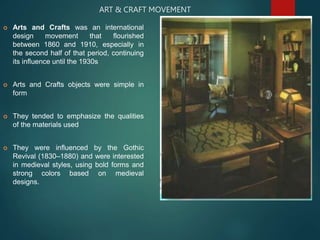
 Arts and Crafts objects were simple in
form
 They tended to emphasize the qualities
of the materials used
 They were influenced by the Gothic
Revival (1830–1880) and were interested
in medieval styles, using bold forms and
strong colors based on medieval
designs.
ART & CRAFT MOVEMENT
 They often had patterns inspired
by British flora and fauna and
used the vernacular, or domestic,
traditions of the British
countryside
 It was largely a reaction against
the impoverished state of
the decorative arts at the time
and the conditions in which they
were produced
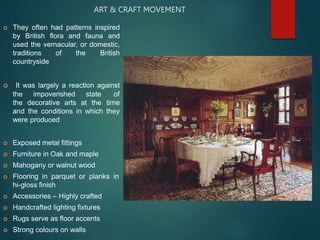
 Exposed metal fittings
 Furniture in Oak and maple
 Mahogany or walnut wood
 Flooring in parquet or planks in
hi-gloss finish
 Accessories – Highly crafted
 Handcrafted lighting fixtures
 Rugs serve as floor accents
 Strong colours on walls

renaissance.pptx

  • 1.
  • 2.
  • 3.
  • 4.
    EARLY RENAISSANCEPERIOD  Italy ⚫Frescoed walls, carved ceiling, marble flooring carpets ,oil painting ⚫ Classic detail ⚫ Symmetrical Planning - central courtyard ⚫ Painted wall , ceiling decoration and classical molding  France ⚫ Luxury and refinement ⚫ Human figures in decorative arts ⚫ Strap work – geometric patterns ⚫ Furniture – sculptural ⚫ Italian inspiration on tables, Armoire  Germany ⚫ Ornamental theme ⚫ Classical antiquity , floral motifs, wood cut ceiling, wall paneling , colours seldom used, small elaborate table  England ⚫ More private rooms- bedroom, closets, parlors ⚫ Brilliant colours, curved medallions head(Romanye) furniture, Chairs without arms, Lighter version of chair - caquetoire
  • 5.
  • 6.
  • 7.
  • 8.
  • 9.
  • 10.
    HIGH RENAISSANCE PERIOD oMore sophisticated understanding of concepts of roman architecture o Gradual increase in variety and richness of furniture types – classical details in wall decoration , mouldings on door and window , fire place mantels and elaborately decorated ceiling. Painted Ceiling Fresco- a technique of mural painting executed upon freshly laid lime plaster.
  • 11.
    Oak Bedstead ofJeanne d'Albret HIGH RENAISSANCE PERIOD Fireplace
  • 12.
    BAROQUE PERIOD o TheBaroque is a period of artistic style that used exaggerated motion ,drama, tension, exuberance, and grandeur o Dynamic movement – rich, symmetrical ,sculpted form and bold contrasts of colour - dark tonalities o More complex forms like ellipses, trapezoids and spiral o Baroque space takes on qualities of mystery and theatricality – effect of richnesss o France : Rococco style- more sculptural ,volatile manner, motifs based on shell and rock form ,foliage o Italy : the birthplace of baroque- furniture richly carved o England : Exuberant, Floral marquetries and parquetry, lacquered work on furniture Parquetry – Applying veneer on surface
  • 13.
    BAROQUE PERIOD In interiors,Baroque movement- monumental staircases that had no parallel in previous architecture. The other Baroque innovation in worldly interiors was the state apartment, a sequence of increasingly rich interiors that culminated in a presence chamber or throne room or a state bedroom.
  • 14.
  • 15.
    BAROQUE PERIOD Stucco orrender is a material made of an aggregate, a binder, and water. Stucco is applied wet and hardens to a very dense solid. It is used as decorative coating for walls and ceilings and as a sculptural and artistic material in architecture. Baroque Stucco work Baroque Pattern
  • 16.
    ROCOCO (LATE BAROQUE)PERIOD oRococco,also referred to as "Late Baroque", is an 18th-century artistic movement and style in Paris, France, which affected several aspects of the arts including painting, sculpture, arc hitecture, interior design , decoration , literature , music and theatre. oThe word 'Rococo' is derived from the French "rocaille", a word used to describe the rock and shell work. oFurniture – lighthearted, symbol of status , comfort and versatility, easily moved around for gatherings, many specialized forms - fauteuil chair, the voyeuse chair. FAUTEUIL CHAIR MIRROR
  • 17.
    o Rococo artand architecture in such a way was ornate and made strong usage of creamy, pastel-like colours, asymmetrical designs, curves and gold oRococo rooms were designed as total works of art with elegant and ornate furniture, small sculptures, ornamental mirrors, and tapestry complementing architecture, reliefs, and wall paintings. ROCOCO (LATE BAROQUE)PERIOD
  • 18.
    COLONIAL STYLE –UNITED STATES  Interiors based on English Georgian design  Furnitures – mixture of medieval &Anglo flemish renaissance  STICK variety chairs ,BUTTERFLY tables
  • 19.
    GREEK REVIV ALSTYLE (18th-19th) Greco-Roman influence  Temples – churches,public building and private houses  Interior detail & furniture – Greek vase painting GOTHIC REVIV ALSTYLE  Followed in England and U.S  Application in hotels, public building and houses  Gothic decorative features – pointed arches ,tracery and crockets ,ornamented ordinary household furniture
  • 20.
    FEDERAL STYLE o After independence-America : Federal Government o Style parallel to Greek revival style o Chippendale chairs with Marlboro legs o Later hepplewhite chairs with shield back and Sheraton chairs with Neoclassical influence were made
  • 21.
    RENAISSANCE – UNITED STATES LAMBERTHITCHCOCK STYLE oFancy chairs of light weight with caned or rush seats and painted decoration o Body had plain colour and member were made by machine SHAKERS STYLE o handmade furniture which combined stick construction – no decorative detail oStrong & Ascetic
  • 22.
  • 23.
    ART NOUVEAU  "ArtNouveau" is French for "new art“  A very decorative style with many design ideas being taken from nature and using new materials of steel, ceramic and glass.  hyperbolas and parabolas in windows, arches, and doors are common, and decorative mouldings 'grow' into plant-derived forms.  Art Nouveau designers 'modernised' some of the elements of Rococo as flame and shell textures selected and more abstract style, such  It was the main form of design that broke the barrier and history of the divide between decorative arts and fine arts.  Wall designs, lamps, furniture and decorative elements.
  • 24.
  • 25.
    ART & CRAFTMOVEMENT  Arts and Crafts was an international design movement that flourished between 1860 and 1910, especially in the second half of that period, continuing its influence until the 1930s  Arts and Crafts objects were simple in form  They tended to emphasize the qualities of the materials used  They were influenced by the Gothic Revival (1830–1880) and were interested in medieval styles, using bold forms and strong colors based on medieval designs.
  • 26.
    ART & CRAFTMOVEMENT  They often had patterns inspired by British flora and fauna and used the vernacular, or domestic, traditions of the British countryside  It was largely a reaction against the impoverished state of the decorative arts at the time and the conditions in which they were produced  Exposed metal fittings  Furniture in Oak and maple  Mahogany or walnut wood  Flooring in parquet or planks in hi-gloss finish  Accessories – Highly crafted  Handcrafted lighting fixtures  Rugs serve as floor accents  Strong colours on walls