Volume of Distribution
Dr Renu Yadav
Resident pharmacology
Question ????
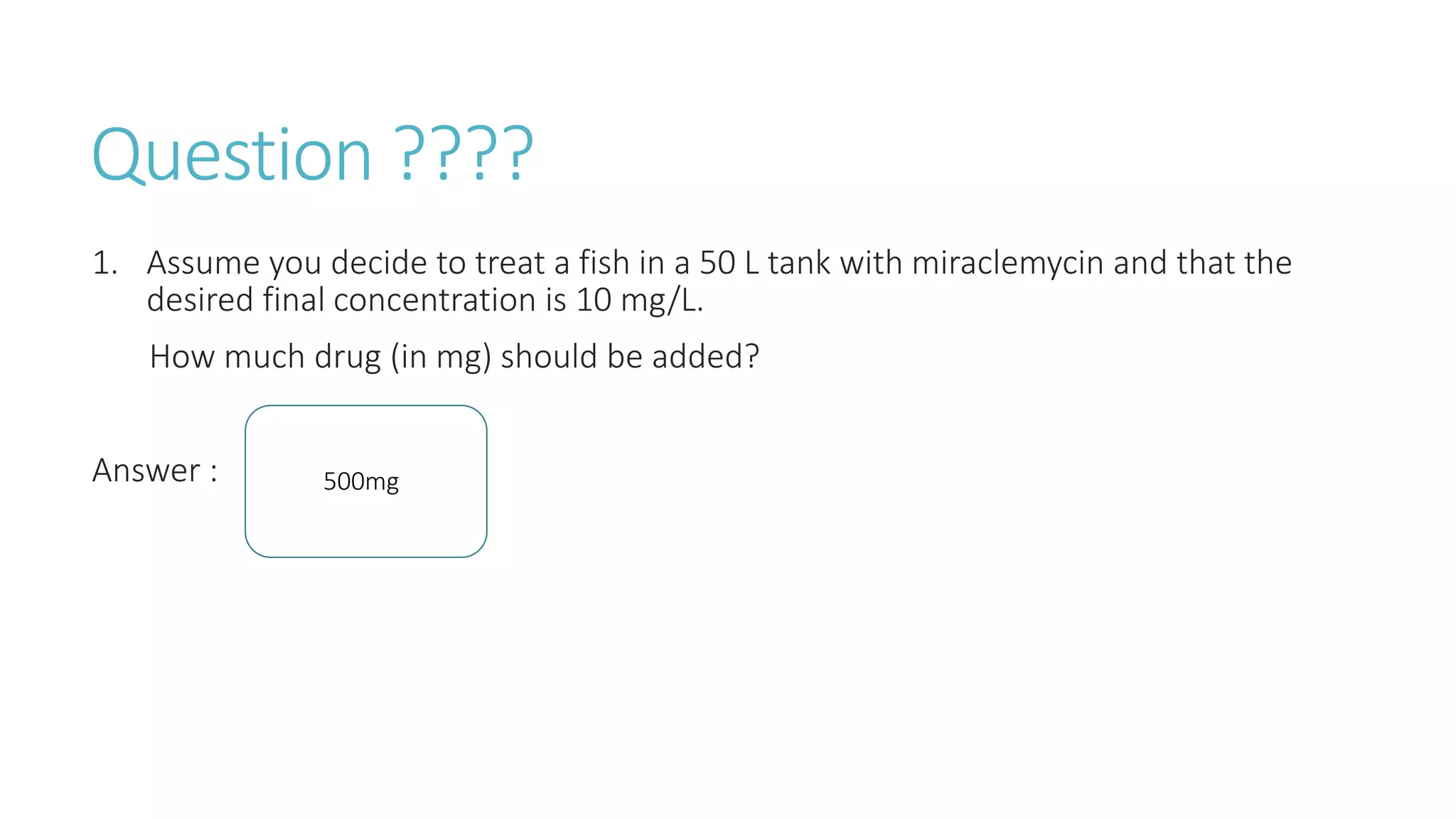
1. Assume you decide to treat a fish in a 50 L tank with miraclemycin and that the
desired final concentration is 10 mg/L.
How much drug (in mg) should be added?
Answer : 500mg
2. How much drug should be given to a patient that weighs 75 kg and has a body
water content of 50 L (assume uniform distribution of drug). Desired concentrations
10 mg/L
Answer :
Scheme
Introduction
Calculation
Factors affecting Vd
Different types of Vd
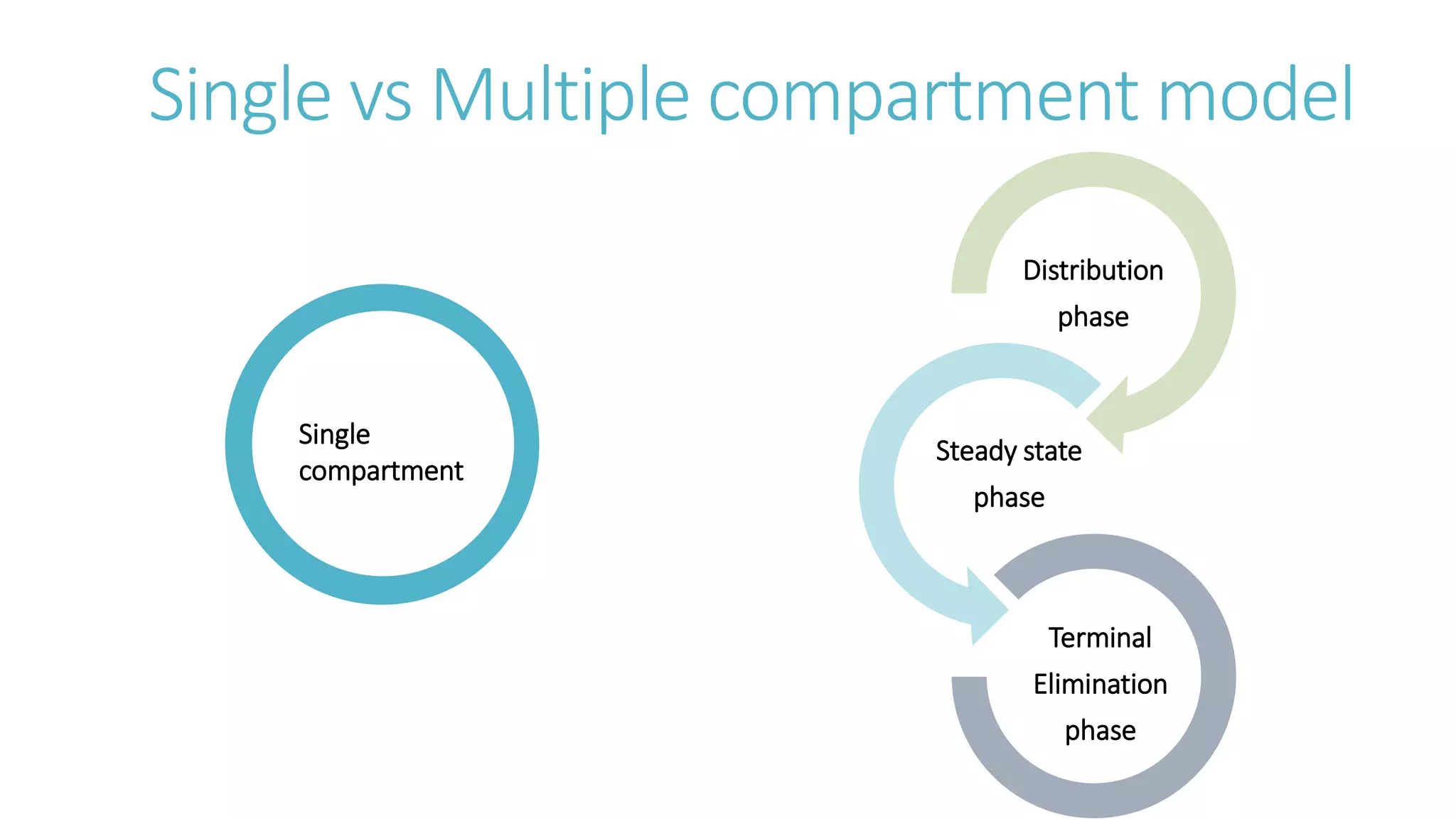
Single vs multiple compartment models of distribution
Clinical significance
Conclusion
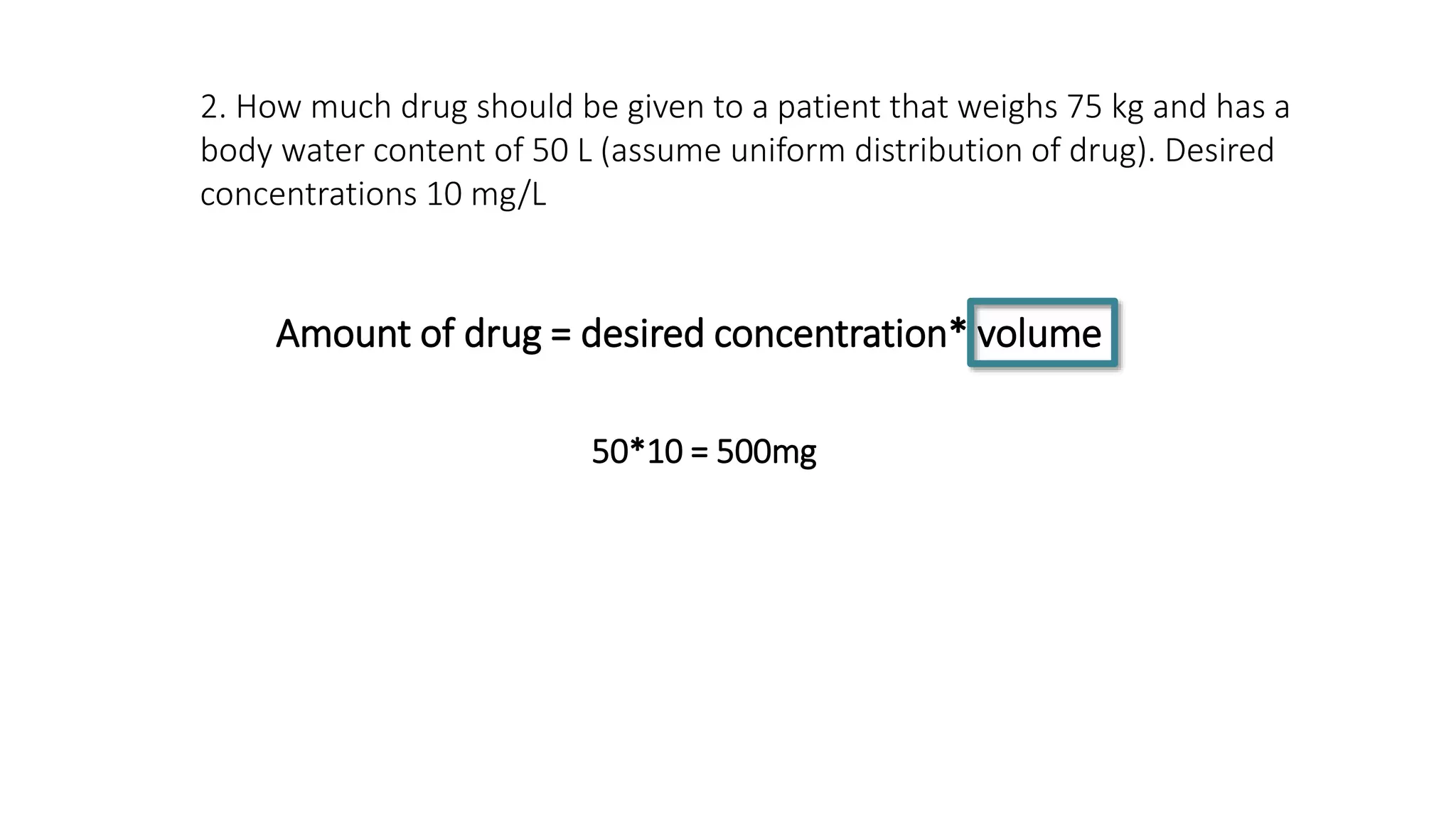
Amount of drug = desired concentration* volume
2. How much drug should be given to a patient that weighs 75 kg and has a
body water content of 50 L (assume uniform distribution of drug). Desired
concentrations 10 mg/L
50*10 = 500mg
•In this case,
These cases assume that no drug has left the tank or body, i.e.,they are values taken
at the instant drug was administered. This time is called zero-time.
A container filled with known quantity of water. ( 100L)
Add 50 fishes to the water
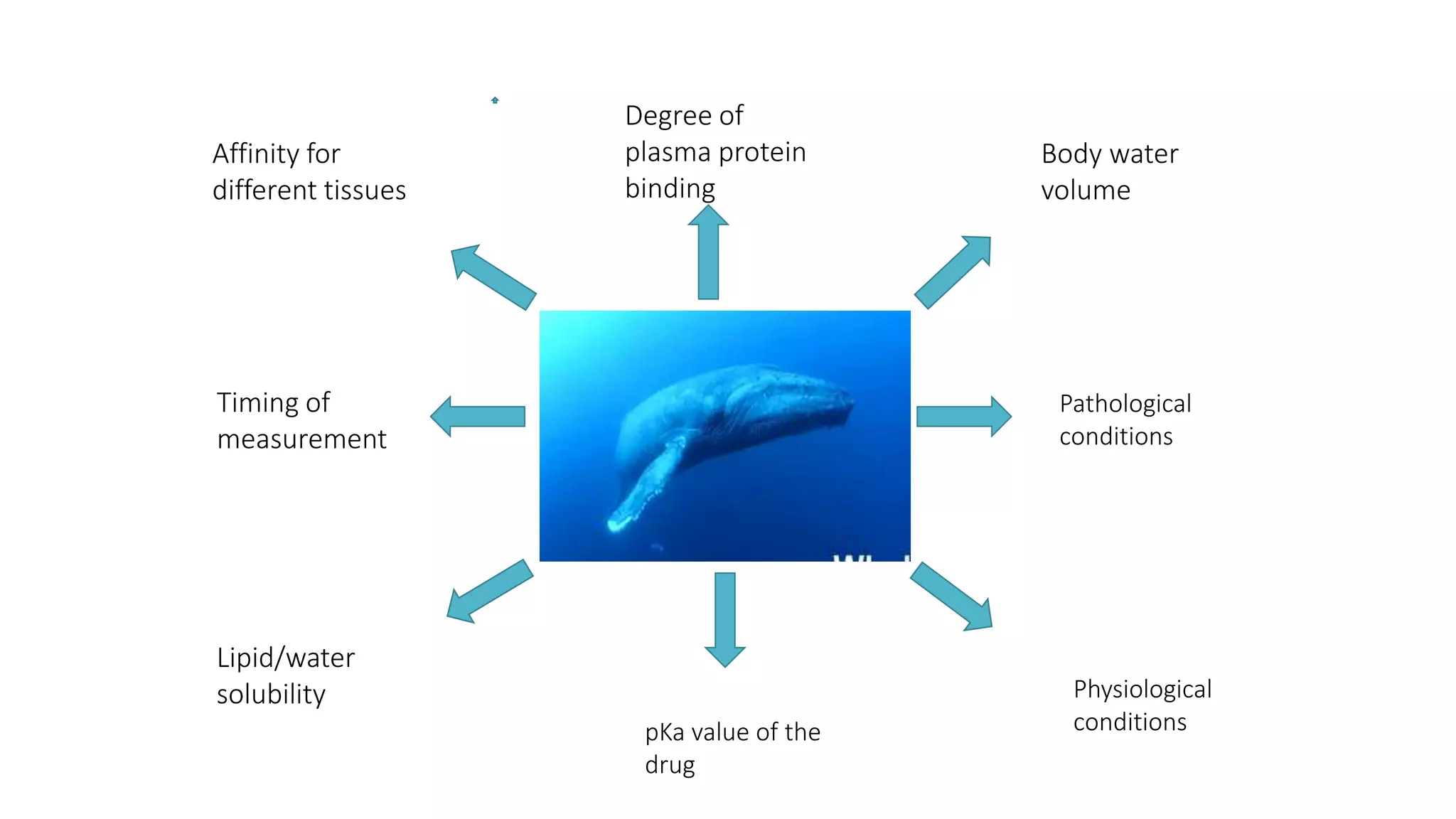
Not just fishes, a blue whale enters the pool of water.
pKa value of the
drug
Affinity for
different tissues
Timing of
measurement
Lipid/water
solubility
Degree of
plasma protein
binding
Pathological
conditions
Physiological
conditions
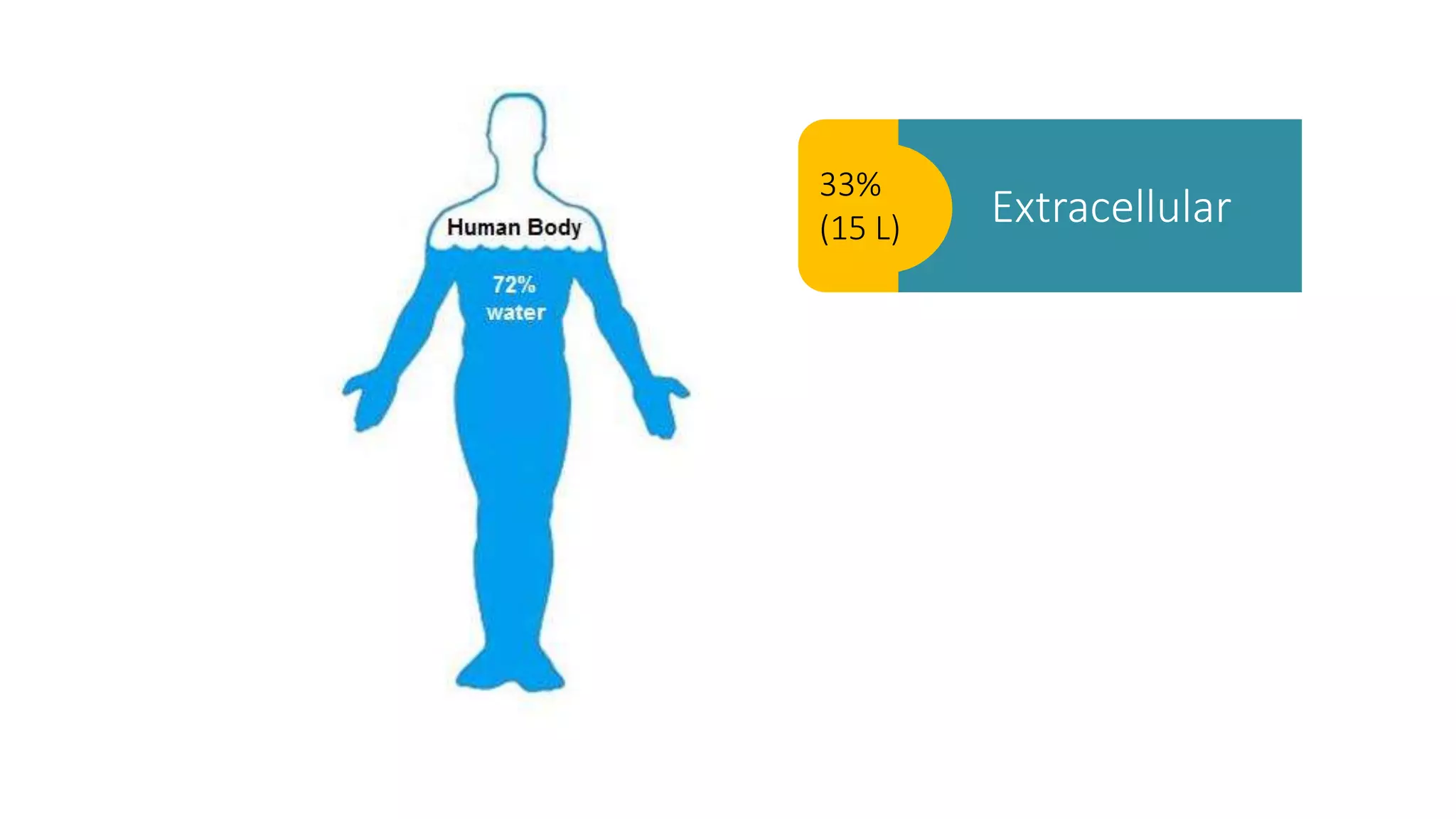
Body water
volume
42L
33%
(15 L) Extracellular
33%
(15 L) Extracellular
66%
(25 L) Intracellular
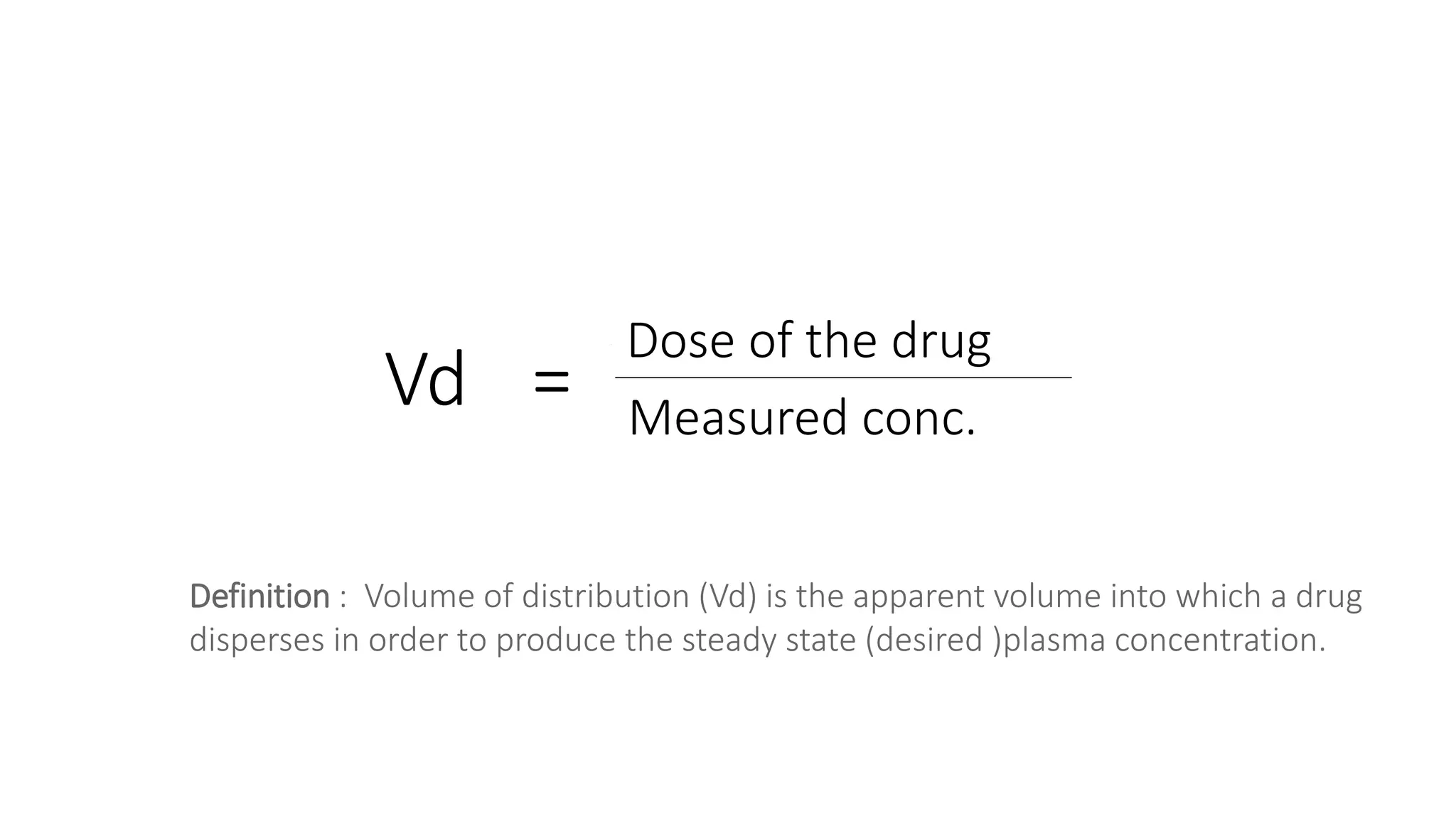
Vd =
Dose of the drug
Measured conc.
Definition : Volume of distribution (Vd) is the apparent volume into which a drug
disperses in order to produce the steady state (desired )plasma concentration.
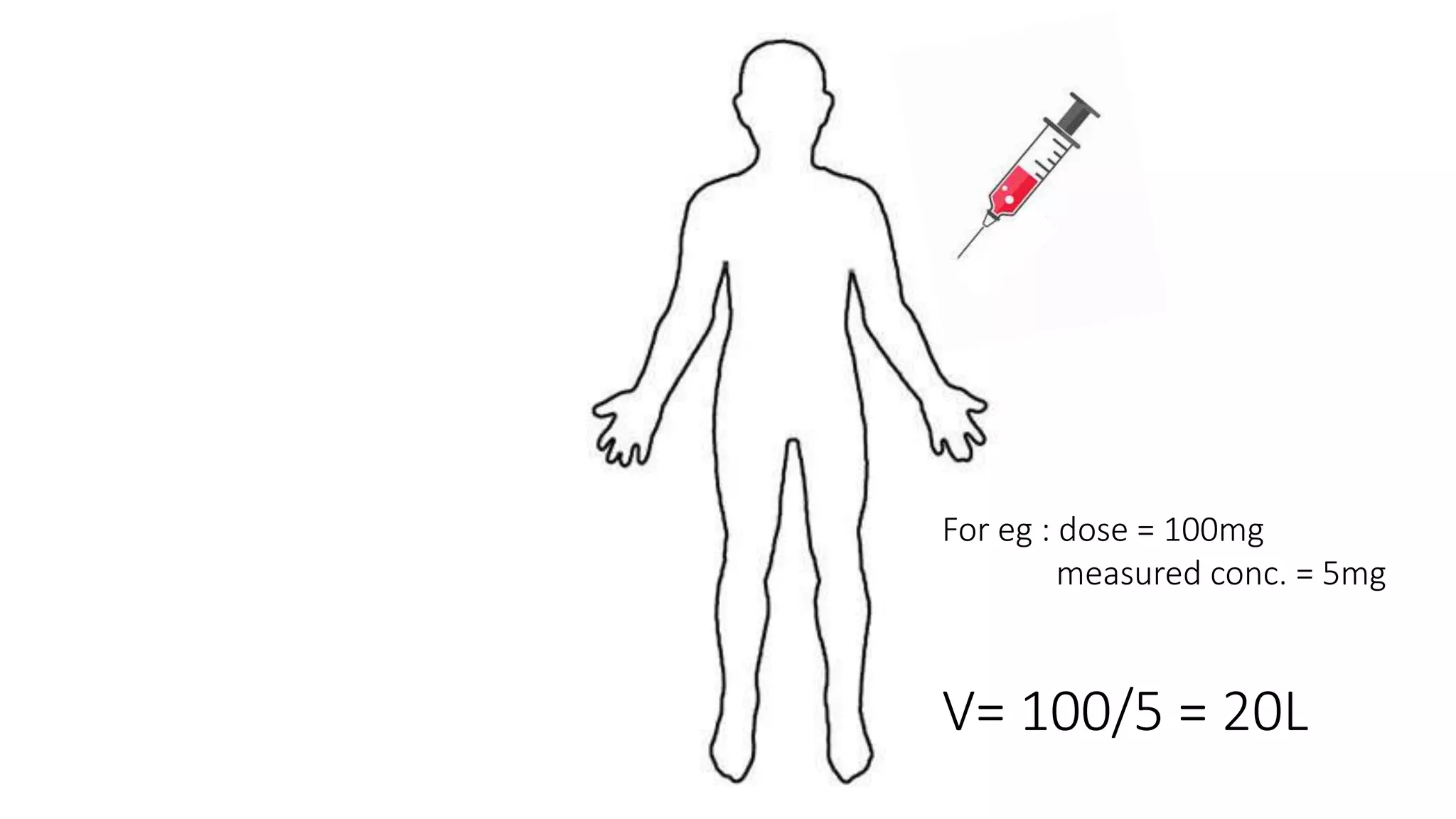
For eg : dose = 100mg
measured conc. = 5mg
V= 100/5 = 20L
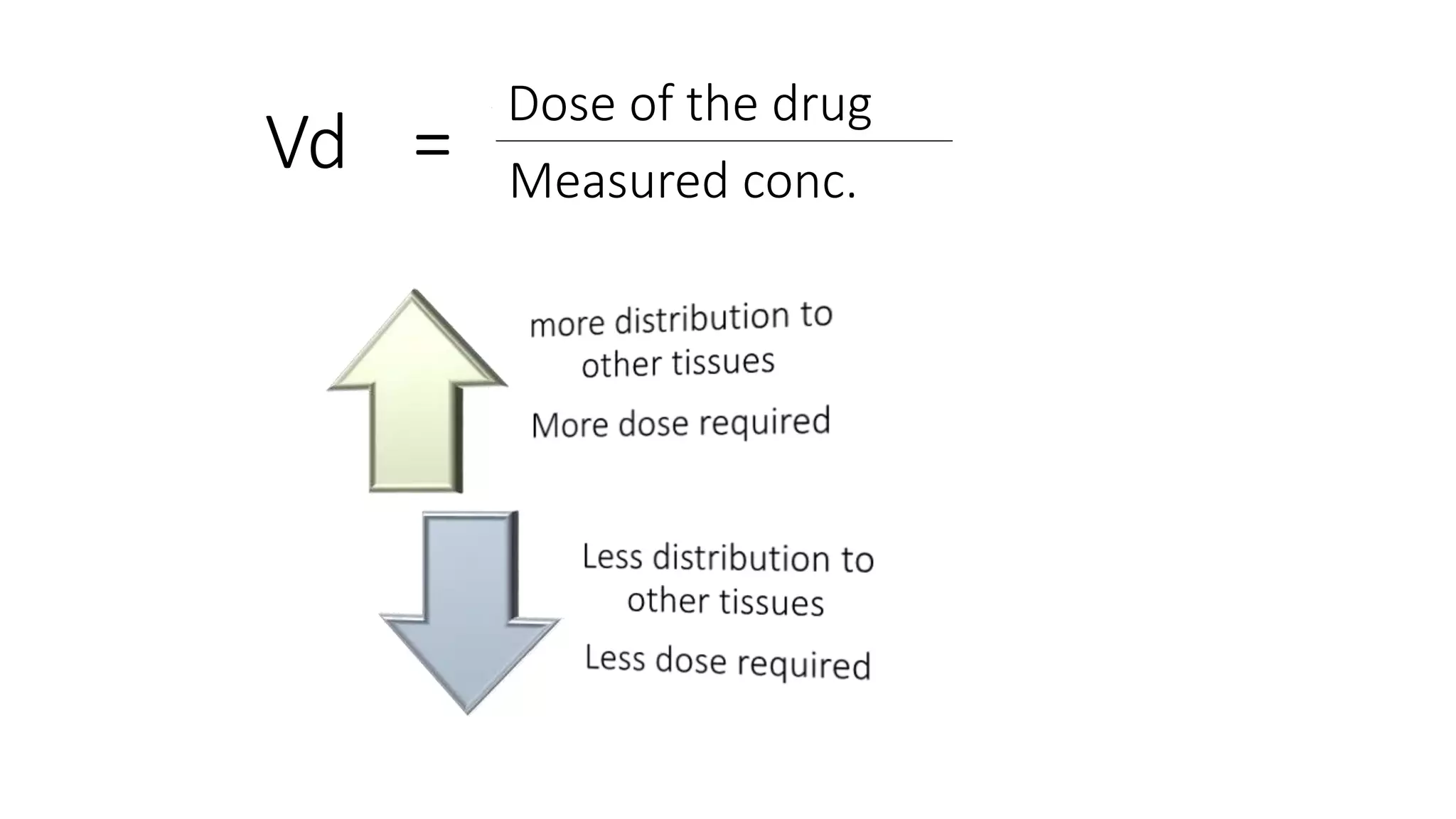
Vd =
Dose of the drug
Measured conc.
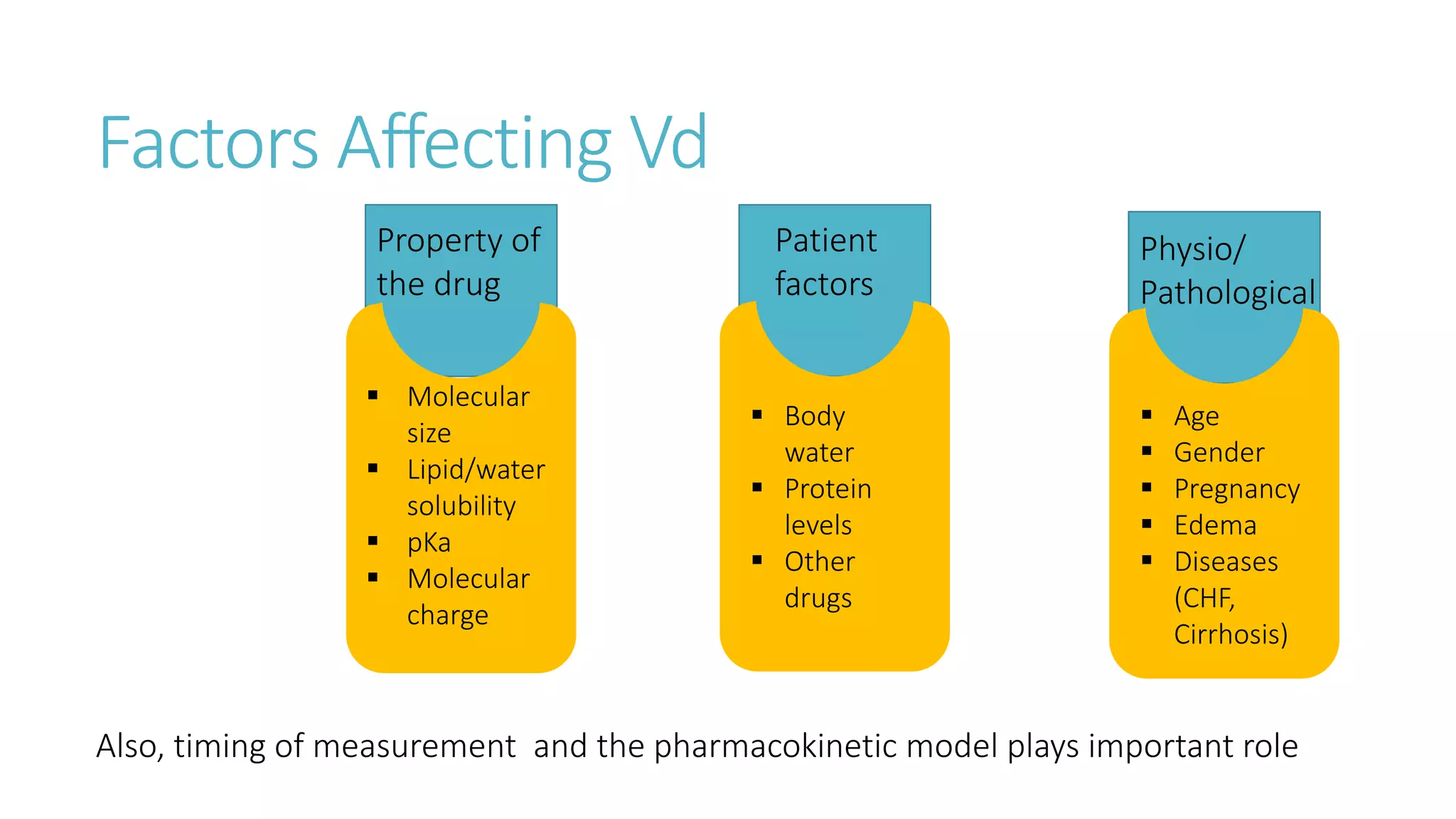
Factors Affecting Vd
Property of
the drug
Patient
factors
Physio/
Pathological
 Molecular
size
 Lipid/water
solubility
 pKa
 Molecular
charge
 Body
water
 Protein
levels
 Other
drugs
 Age
 Gender
 Pregnancy
 Edema
 Diseases
(CHF,
Cirrhosis)
Also, timing of measurement and the pharmacokinetic model plays important role
Special compartment for drug distribution
Drugs that have affinity to tissue proteins
retina
liver
chloroquine
Iodine
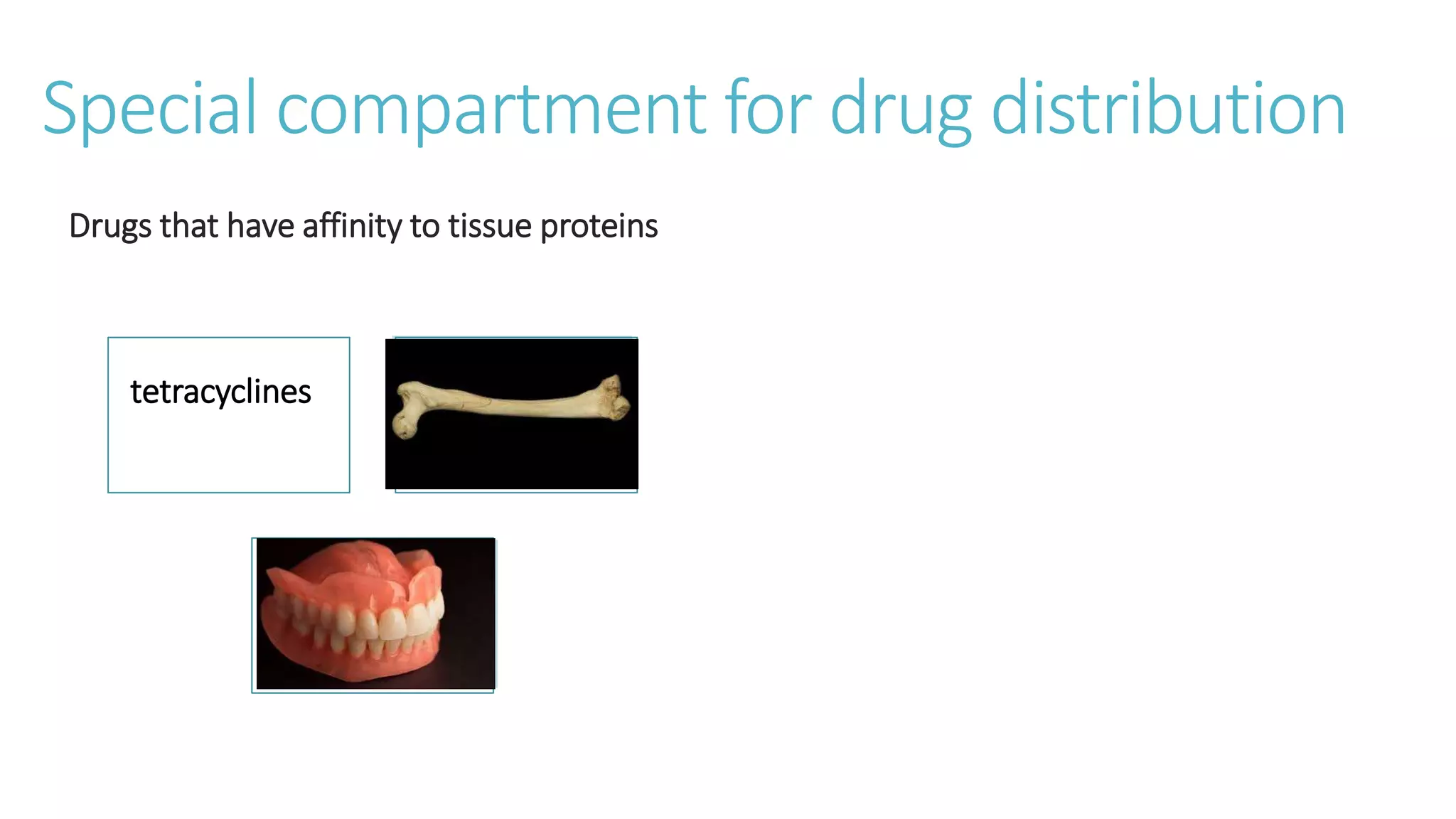
Special compartment for drug distribution
Drugs that have affinity to tissue proteins
retina
liver
tetracyclines
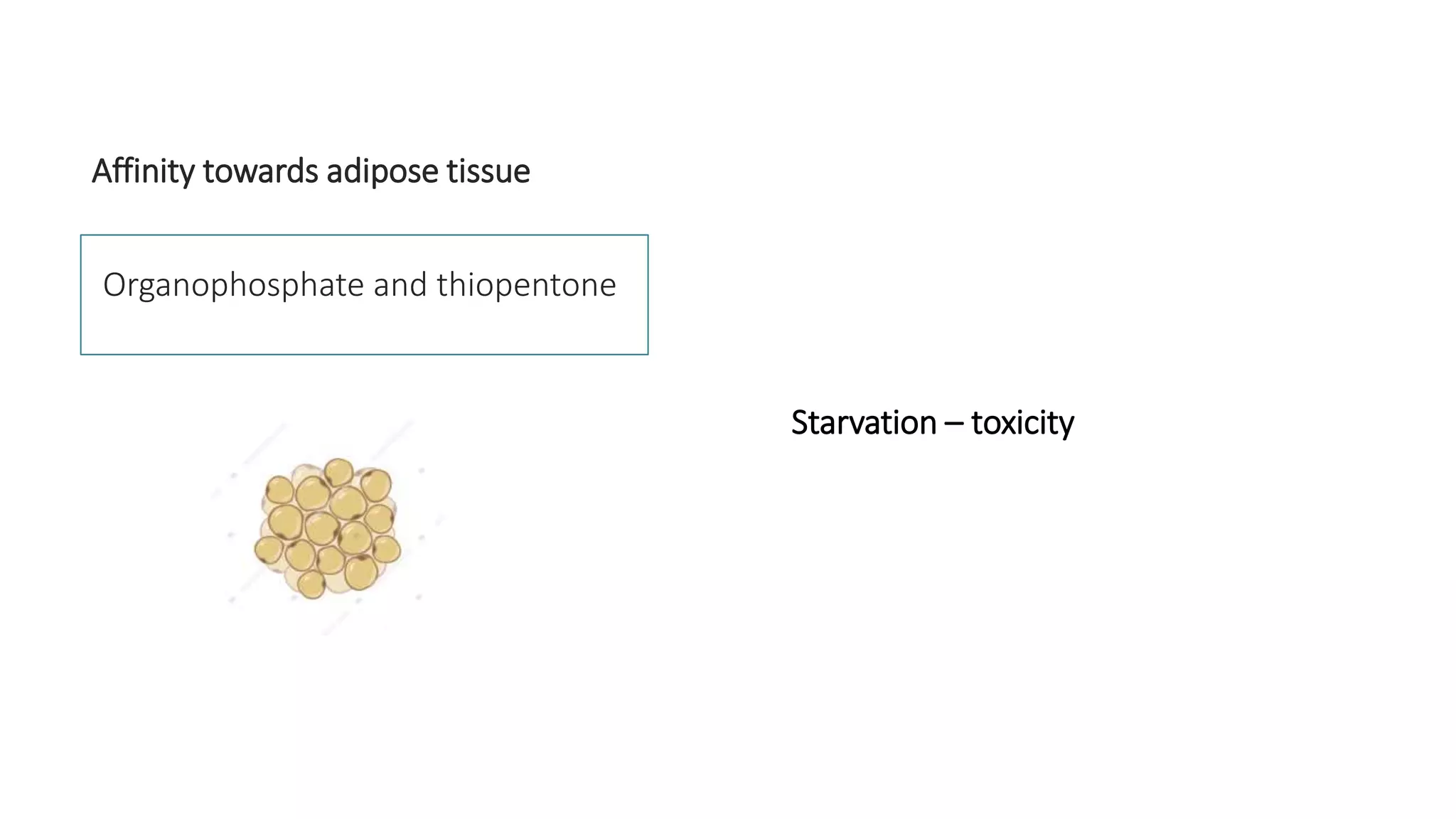
Affinity towards adipose tissue
Organophosphate and thiopentone
Starvation – toxicity
Redistribution
Highly lipid-soluble drugs get initially distributed to organs with high blood
flow, i.e brain, heart kidney etc.
Thiopentone sodium,
diazepam
Different volumes of distribution
1. Initial volume of distribution
( Vi )
2. Extrapolated volume of
distribution ( Vextrap )
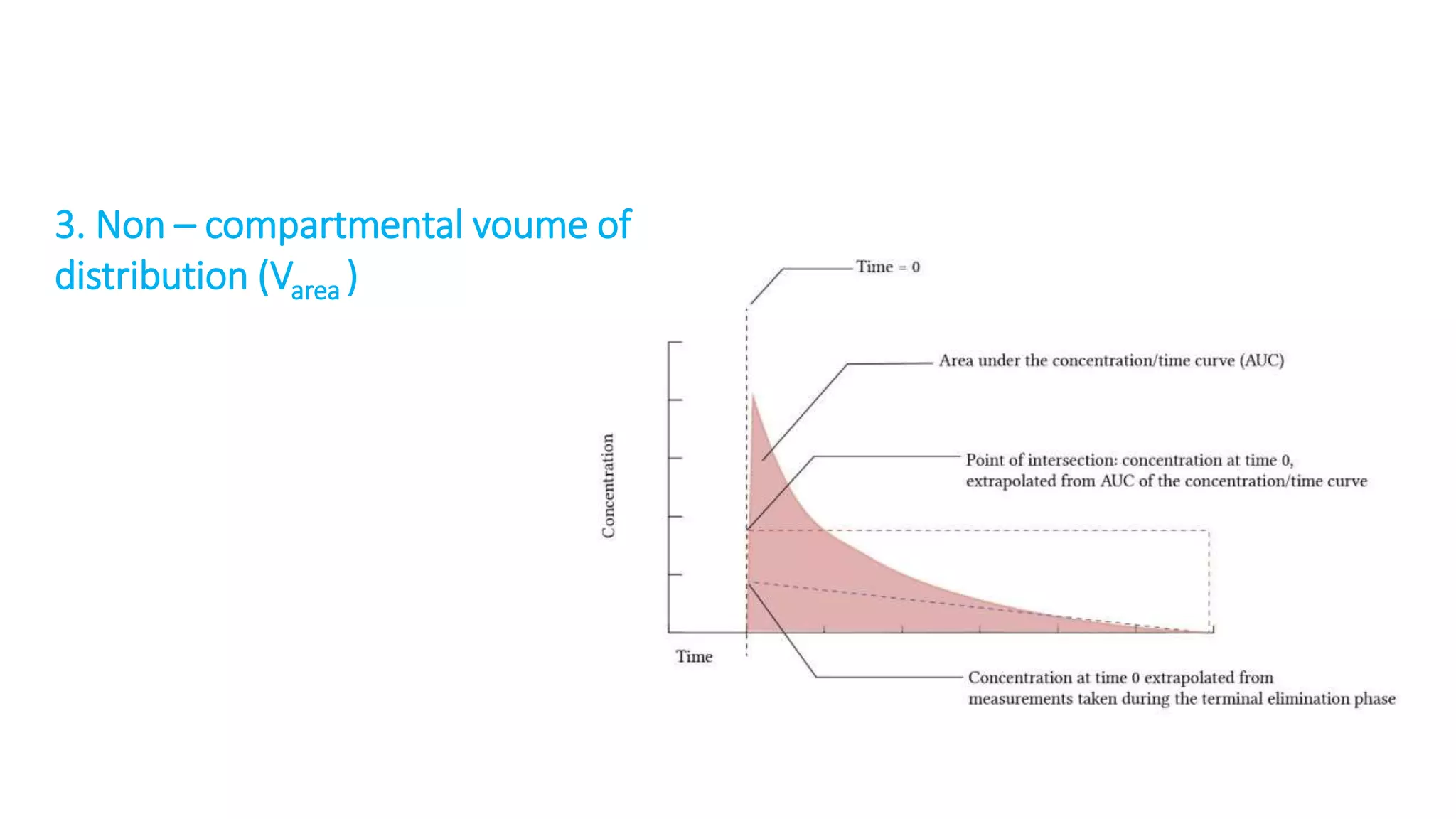
3. Non – compartmental voume of
distribution (Varea )
4. Steady state volume of
distribution ( Vss )
Single vs Multiple compartment model
Distribution
phase
Terminal
Elimination
phase
Steady state
phase
Single
compartment
Clinical significance of aVd
1. Loading dose :
Few eg:
LD = Vd * Cp
chloroquine phenytoin digoxin amiodarone aminoglycosides
polymyxins B-lactams vancomycin
2. Pediatric vs. adult dosing
3. Obesity vs. Normal BMI
4. Conditions affecting plasma protein concentration
Few examples
Drug aVd
Chloroquine 12950
Amiodarone 4620
Azithromycin 2170
Flurazepam 1540
Haloperidol 1400
Doxepin 1400
Conclusion
Study of distribution of drug is an important aspect of pharmacokinetic study
Plasma protein binding, tissue storage and distribution in adipose tissue have
important clinical implication.
Knowledge of aVd helps us to understand why some drugs require loading dose.
Thank You
References
Gibaldi, M., and P. J. McNamara. "Apparent volumes of distribution and drug binding to plasma proteins and tissues."
European journal of clinical pharmacology 13.5 (1978): 373-378.
Toutain, Pierre-Louis, and Alain BOUSQUET‐MÉLOU. "Volumes of distribution." Journal of veterinary pharmacology and
therapeutics 27.6 (2004): 441-453.
Riegelman, S., J. Loo, and M. Rowland. "Concept of a volume of distribution and possible errors in evaluation of this
parameter." Journal of Pharmaceutical Sciences 57.1 (1968): 128-133.
Krishna, Sanjeev, and Nicholas J. White. "Pharmacokinetics of quinine, chloroquine and amodiaquine." Clinical
pharmacokinetics30.4 (1996): 263-299.
Wagner, John G. "Significance of ratios of different volumes of distribution in pharmacokinetics." Biopharmaceutics &
drug disposition 4.3 (1983): 263-270.
Soldin, Offie P., and Donald R. Mattison. "Sex differences in pharmacokinetics and pharmacodynamics." Clinical
pharmacokinetics 48.3 (2009): 143-157.

Volume of distribution...

  • 1.
    Volume of Distribution DrRenu Yadav Resident pharmacology
  • 2.
    Question ???? 1. Assumeyou decide to treat a fish in a 50 L tank with miraclemycin and that the desired final concentration is 10 mg/L. How much drug (in mg) should be added? Answer : 500mg
  • 3.
    2. How muchdrug should be given to a patient that weighs 75 kg and has a body water content of 50 L (assume uniform distribution of drug). Desired concentrations 10 mg/L Answer :
  • 4.
    Scheme Introduction Calculation Factors affecting Vd Differenttypes of Vd Single vs multiple compartment models of distribution Clinical significance Conclusion
  • 5.
    Amount of drug= desired concentration* volume 2. How much drug should be given to a patient that weighs 75 kg and has a body water content of 50 L (assume uniform distribution of drug). Desired concentrations 10 mg/L 50*10 = 500mg
  • 6.
    •In this case, Thesecases assume that no drug has left the tank or body, i.e.,they are values taken at the instant drug was administered. This time is called zero-time.
  • 7.
    A container filledwith known quantity of water. ( 100L)
  • 8.
    Add 50 fishesto the water
  • 9.
    Not just fishes,a blue whale enters the pool of water.
  • 10.
    pKa value ofthe drug Affinity for different tissues Timing of measurement Lipid/water solubility Degree of plasma protein binding Pathological conditions Physiological conditions Body water volume
  • 11.
  • 12.
  • 13.
  • 14.
    Vd = Dose ofthe drug Measured conc. Definition : Volume of distribution (Vd) is the apparent volume into which a drug disperses in order to produce the steady state (desired )plasma concentration.
  • 15.
    For eg :dose = 100mg measured conc. = 5mg V= 100/5 = 20L
  • 16.
    Vd = Dose ofthe drug Measured conc.
  • 17.
    Factors Affecting Vd Propertyof the drug Patient factors Physio/ Pathological  Molecular size  Lipid/water solubility  pKa  Molecular charge  Body water  Protein levels  Other drugs  Age  Gender  Pregnancy  Edema  Diseases (CHF, Cirrhosis) Also, timing of measurement and the pharmacokinetic model plays important role
  • 18.
    Special compartment fordrug distribution Drugs that have affinity to tissue proteins retina liver chloroquine Iodine
  • 19.
    Special compartment fordrug distribution Drugs that have affinity to tissue proteins retina liver tetracyclines
  • 20.
    Affinity towards adiposetissue Organophosphate and thiopentone Starvation – toxicity
  • 21.
    Redistribution Highly lipid-soluble drugsget initially distributed to organs with high blood flow, i.e brain, heart kidney etc. Thiopentone sodium, diazepam
  • 22.
    Different volumes ofdistribution 1. Initial volume of distribution ( Vi )
  • 23.
    2. Extrapolated volumeof distribution ( Vextrap )
  • 24.
    3. Non –compartmental voume of distribution (Varea )
  • 25.
    4. Steady statevolume of distribution ( Vss )
  • 26.
    Single vs Multiplecompartment model Distribution phase Terminal Elimination phase Steady state phase Single compartment
  • 27.
    Clinical significance ofaVd 1. Loading dose : Few eg: LD = Vd * Cp chloroquine phenytoin digoxin amiodarone aminoglycosides polymyxins B-lactams vancomycin
  • 28.
    2. Pediatric vs.adult dosing 3. Obesity vs. Normal BMI 4. Conditions affecting plasma protein concentration
  • 29.
    Few examples Drug aVd Chloroquine12950 Amiodarone 4620 Azithromycin 2170 Flurazepam 1540 Haloperidol 1400 Doxepin 1400
  • 30.
    Conclusion Study of distributionof drug is an important aspect of pharmacokinetic study Plasma protein binding, tissue storage and distribution in adipose tissue have important clinical implication. Knowledge of aVd helps us to understand why some drugs require loading dose.
  • 31.
  • 32.
    References Gibaldi, M., andP. J. McNamara. "Apparent volumes of distribution and drug binding to plasma proteins and tissues." European journal of clinical pharmacology 13.5 (1978): 373-378. Toutain, Pierre-Louis, and Alain BOUSQUET‐MÉLOU. "Volumes of distribution." Journal of veterinary pharmacology and therapeutics 27.6 (2004): 441-453. Riegelman, S., J. Loo, and M. Rowland. "Concept of a volume of distribution and possible errors in evaluation of this parameter." Journal of Pharmaceutical Sciences 57.1 (1968): 128-133. Krishna, Sanjeev, and Nicholas J. White. "Pharmacokinetics of quinine, chloroquine and amodiaquine." Clinical pharmacokinetics30.4 (1996): 263-299. Wagner, John G. "Significance of ratios of different volumes of distribution in pharmacokinetics." Biopharmaceutics & drug disposition 4.3 (1983): 263-270. Soldin, Offie P., and Donald R. Mattison. "Sex differences in pharmacokinetics and pharmacodynamics." Clinical pharmacokinetics 48.3 (2009): 143-157.

Editor's Notes

  • #4 Amount of drug = dose Desired concentration = target concentration (mean or average) in sampled fluid Volume = the volume of sampled fluid in which the drug is distributed These cases assume that no drug has left the tank or body, i.e.,they are values taken at the instant drug was administered. This time is called zero-time. They further assume that no drug was lost during that instant
  • #12 If you administer a dose D of a drug intravenously in one go (IV-bolus), you would naturally expect it to have an immediate blood concentration {\displaystyle C_{0}} which directly corresponds to the amount of blood contained in the body {\displaystyle V_{blood}}. Mathematically this would be: {\displaystyle C_{0}=D/V_{blood}} But this is generally not what happens. Instead you observe that the drug has distributed out into some other volume (read organs/tissue). So probably the first question you want to ask is: how much of the drug is no longer in the blood stream? The volume of distribution {\displaystyle V_{D}} quantifies just that by specifying how big a volume you would need in order to observe the blood concentration actually measured.
  • #13 Pharmacokinetics focuses on drug movement throughout the human body via the processes of absorption, distribution, and elimination. Upon administration, a drug moves from the site of administration and gets absorbed into the systemic circulation where it will then gets distributed throughout the body. The process of distribution refers to the movement of a drug between the intravascular (blood/plasma) and extravascular (intracellular & extracellular) compartments of the body. Within each compartment of the body, a drug exists in equilibrium between a protein-bound or free form. Over time, drugs within the circulation will then be metabolized and excreted from the body by the liver & kidneys.
  • #14 After a drug enters the systemic circulation, it is distributed to the body’s tissues. Distribution is generally uneven because of differences in blood perfusion, tissue binding (eg, because of lipid content), regional pH, and permeability of cell membranes. The entry rate of a drug into a tissue depends on the rate of blood flow to the tissue, tissue mass, and partition characteristics between blood and tissue. Distribution equilibrium (when entry and exit rates are the same) between blood and tissue is reached more rapidly in richly vascularized areas, unless diffusion across cell membranes is the rate-limiting step. After equilibrium, drug concentrations in tissues and in extracellular fluids are reflected by the plasma concentration. Metabolism and excretion occur simultaneously with distribution, making the process dynamic and complex. After a drug has entered tissues, drug distribution to the interstitial fluid is determined primarily by perfusion. For poorly perfused tissues (eg, muscle, fat), distribution is very slow, especially if the tissue has a high affinity for the drug. Volume of distribution provides a reference for the plasma concentration expected for a given dose but provides little information about the specific pattern of distribution. Each drug is uniquely distributed in the body. Some drugs distribute mostly into fat, others remain in extracellular fluid, and others are bound extensively to specific tissues. Many acidic drugs (eg, warfarin, aspirin) are highly protein-bound and thus have a small apparent volume of distribution. Many basic drugs (eg, amphetamine, meperidine) are extensively taken up by tissues and thus have an apparent volume of distribution larger than the volume of the entire body. The extent of drug distribution into tissues depends on the degree of plasma protein and tissue binding. In the bloodstream, drugs are transported partly in solution as free (unbound) drug and partly reversibly bound to blood components (eg, plasma proteins, blood cells). Of the many plasma proteins that can interact with drugs, the most important are albumin, alpha-1 acid glycoprotein, and lipoproteins. Acidic drugs are usually bound more extensively to albumin; basic drugs are usually bound more extensively to alpha-1 acid glycoprotein, lipoproteins, or both. Only unbound drug is available for passive diffusion to extravascular or tissue sites where the pharmacologic effects of the drug occur. Therefore, the unbound drug concentration in systemic circulation typically determines drug concentration at the active site and thus efficacy.
  • #17 A drug with a high Vd has a propensity to leave the plasma and enter the extravascular compartments of the body, meaning that a higher dose of a drug is required to achieve a given plasma concentration. (High Vd -> More distribution to other tissue) Conversely, a drug with a low Vd has a propensity to remain in the plasma meaning a lower dose of a drug is required to achieve a given plasma concentration. (Low Vd -> Less distribution to other tissue)
  • #18 basic molecules will leave the systemic circulation leading to higher Vd as compared to acidic molecules. Acidic molecules have a higher affinity for albumin molecules at lower lipophilicity than neutral or basic molecules. Therefore, acidic drugs are more likely to bind albumin and remain in the plasma leading to lower Vd as compared to more basic molecules. Acidosis----- dec ionization of acidic drugs, increased concentration. And duration. pKa ------ determines the degree of ionisation and therefore influences lipid solubility Lipid solubility is one of the major determinants of Vd; highly lipid-soluble drugs will have the highest Vd values because of the low fat content of the bloodstream. Body water volume----Dehydrated patients will have drug levels concentrated in the plasma just as all dissolved substances are concentrated by loss of water. Protein levelsFor highly protein-bound drugs, lower serum protein levels will result in a higher free (unbound) drug fraction. This may have little effect on the Vd as calculated from total drug concentration, but if you are measuring free drug levels it will make the Vd appear smaller. Age----- babies are grapes and the elderly are raisins. As you age, body water content decreases, shrinking the Vd of water-soluble drugs. GenderFemale Vds tend to be lower than male Vds due to the generally lower  body water content Pregnancy----Both the body water and the body fat content increases, and therefore the Vd increases for most drugs. Not to speak of the possible distribution into amniotic fluid and foetus  
  • #19  Protein binding--- long acting --- bound fraction not available for metab or excretion. Hypoalbuminemihia-----reduced binding, high conc of free drug----(phenytoin) Highly plasma protein bound drug --- low Vd--- difficult to remove by dialysis
  • #22 Redristribution
  • #23 Plasma conc falls ----- drug is withdrawn from highly perfused sites----termination of action eg thiopentone sodium
  • #24 Vd of centraI compartment. Consider if you measure the Vd of the central (intravascular) compartment. It is possible to calculate this soon after a drug is administered intravenously, by extrapolating an imaginary line from plasma concentration measurements, extended to time zero. You need to extrapolate this line because under no realistic circumstances could you ever actually measure the concentration at time zero. So, by this method, you measure the volume of initial dispersion of the drug. This volume is usually called either Vinitial, or Vc, and it represents the behaviour of the drug during the first rapid phase of distribution through the central compartment. 
  • #25 Vd of tissue compartment ( from elimination phase) Obviously if you completely ignore the distribution of the drug into the tissues your volume of distribution estimate is going to be inaccurate for the purpose of determining such things as loading doses. The alternative approach is to ignore everything but the tissue distribution. This method takes the slow late stages along the concentration/time curve (the terminal elimination phase) and extrapolates a line of best fit from them. Obviously this is going to be a massive overestimate for many drugs, particularly if they are drugs which disperse extensively into the tissues. Your (time=0) concentration estimate will potentially be a very low value, producing an unreasonably large Vd estimate.
  • #26 The Vinitial value and the Vextrap value both focus on the drug distributing into some compartment volume (be it central or peripheral). Neither give a good estimate for the "ideal" volume of distribution, one which you could reliably use to calculate your loading doses. Varea is an attempt to get around the errors of focusing on just one compartment at a time. It uses a non-compartmental pragmatic model, easily calculated from serial concentration measurements. where AUC is the area under the concentration-time curve and the "β" terminal elimination time constant is the slow exponential rate of decline at the latter stages of a drug's tenure in the body. You take the whole concentration/time curve, integrate the area under it (AUC) and use this to establish the "true" volume. This gives a better (smaller) Vd estimate than Vextrap but is still frequently incorrect if there is significant distribution around compartments.  The Varea equation assumes that the rate of the concentration decline during the terminal elimination phase is the average rate of clearance for the entire duration of the dose, and that this rate remains constant. Practically, clearance is almost never constant and is usually concentration-dependent ("first order") which means that using the "β" terminal elimination time constant will always yield an underestimate of the "time=0" intercept and therefore an overestimate of the Vd. This problem also limits the utility of Varea in altered clearance states. For instance, for a renally cleared drug Varea measured in a patient with renal failure will always be smaller (because the slope of the β terminal elimination rate will be near-horisontal). But this will not represent any sort of change in the drug's distribution.
  • #27 Vss--- steady state model , most useful As mentioned above, the Varea method assumes some sort of linear rate of drug clearance. So, it's clearly going to be useless in situations where the clearance rate is zero, or appears to be zero- for example, in renal failure, in the context of an intravenous drug infusion or when the drug has long-term regular administration.  Fortunately the real or apparent absence of clearance makes Vd calculations much easier: The point of intersection hardly matters any more. Nobody needs to draw any intercept lines. Vss describes the volume of distribution during steady state conditions, i.e. when there is a stable drug concentration. It is always going to be slightly lower than Varea because of the effect of clearance on the β terminal elimination time constant.  Of all the volumes of distribution, Vss is probably the most useful for calculating the loading dose. The loading dose, after all, is the dose you wish to give in order to achieve a desired (steady state) drug concentration. With the simplicity of the steady state model, the dose is calculated as (Vss × Css) where Css  is the desired steady-state concentration.
  • #29 Some drugs display pharmacokinetics in which they distribute “instantaneously.” These drugs appear to remain in the central compartment and not distribute to peripheral compartments. Therefore, any measured decline in drug plasma concentration is a result of drug elimination from the body only. These drugs are said to display single-compartment models of distribution as they do not move to peripheral compartments. The Vd of these drugs can be represented by a single value, which is the Vd of the central compartment (Vc)  Most drugs will exhibit slower distribution kinetics, which involves an early distribution phase followed by a later elimination phase. Drugs that display multi-compartment models of distribution will move from the central compartment into peripheral compartments before elimination.Phases associated with multi-compartment models of distribution include: Distribution phase: following administration plasma drug concentration will initially decline while the total amount of drug in the body remains the same. This phenomenon will cause a single drug to have multiple Vd values, which are each time-dependent. Terminal elimination phase: Following the distribution phase, the drug will be eliminated from the central compartment (by the kidneys/liver) causing changes in both amounts of the drug in the body and plasma drug concentration. Therefore, additional Vd values are calculable during the terminal elimination phase (Vbeta), which is a Vd value dependent on drug clearance. Steady-state: Between the distribution & elimination phase, there is a transition point known as "steady state." Steady-state represents a period of “dynamic equilibrium” of a drug throughout the body in which the drug has completed distribution between the central & peripheral compartments. At steady state, the net flux of drug between the central & peripheral compartments is 0. Another value for Vd can be calculated during steady-state (Vss)
  • #30 Vd is used to calculate loading doses, much as clearance is used to calculate maintenance dose.
  • #31 2. Body composition changes with aging and therefore, drug distribution will be affected meaning that loading doses will vary between pediatrics and adults. 3. The loading doses of drugs such as anesthetics may be dosed based on different weight scalars such as total body weight vs. ideal bodyweight depending on the pharmacokinetics of specific drugs to prevent over or underdosing. 3- The excess or deficiency of plasma proteins (e.g., albumin) may affect the amount of drug that remains in the plasma and therefore the apparent Vd
  • #32 retaines in vascular compartment. Thru total body water or penetration into various tissues