DRUG DISTRIBUTION
DR AWAIS IRSHAD
Pharamcology FAZAIA RUTH PFAU MEDICAL COLLEGES 1
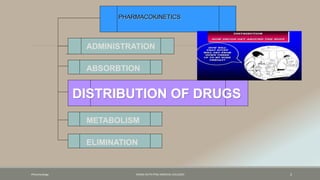
ELIMINATION
METABOLISM
DISTRIBUTION OF DRUGS
ADMINISTRATION
PHARMACOKINETICS
ABSORBTION
Pharamcology FAZAIA RUTH PFAU MEDICAL COLLEGES 2
Presentation Outline
Definition Of Drug Distribution.
Factors affecting drug distribution.
Volume Of Distribution.
Binding of Drug with Plasma proteins.
Pharamcology FAZAIA RUTH PFAU MEDICAL COLLEGES 3
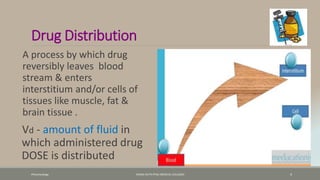
Drug Distribution
A process by which drug
reversibly leaves blood
stream & enters
interstitium and/or cells of
tissues like muscle, fat &
brain tissue .
Pharamcology FAZAIA RUTH PFAU MEDICAL COLLEGES 4
Vd - amount of fluid in
which administered drug
DOSE is distributed
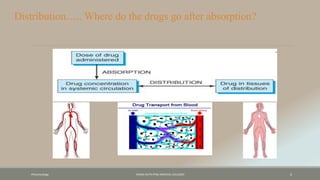
Distribution….. Where do the drugs go after absorption?
Pharamcology FAZAIA RUTH PFAU MEDICAL COLLEGES 5
Pharamcology FAZAIA RUTH PFAU MEDICAL COLLEGES 6
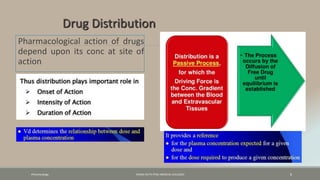
Pharmacological action of drugs
depend upon its conc at site of
action
Drug Distribution
Primary Kinetic parameters
VOLUME OF DISTRIBUTION
Where the drug is distributed over.
In obese persons is high for fat
soluble drugs.
Vital to calculate dose & frequency
CLEARANCE
Clearance of creatinine is 120 ml / min.
It is the volume of plasma that is
completely cleared of drug in unit time.
Pharamcology FAZAIA RUTH PFAU MEDICAL COLLEGES 7
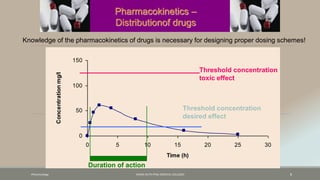
0
50
100
150
0 5 10 15 20 25 30
Time (h)
Concentration
mg/l
Threshold concentration
desired effect
Threshold concentration
toxic effect
Duration of action
Knowledge of the pharmacokinetics of drugs is necessary for designing proper dosing schemes!
Pharmacokinetics –
Distributionof drugs
Pharamcology FAZAIA RUTH PFAU MEDICAL COLLEGES 8
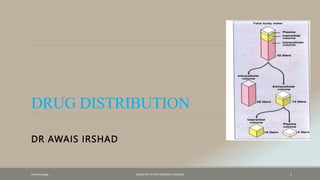
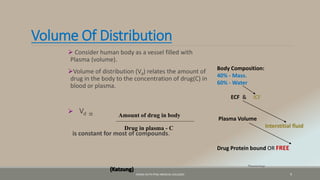
Volume Of Distribution
 Consider human body as a vessel filled with
Plasma (volume).
Volume of distribution (Vd) relates the amount of
drug in the body to the concentration of drug(C) in
blood or plasma.
 Vd =
is constant for most of compounds.
Pharamcology
9
Amount of drug in body
Drug in plasma - C
(Katzung)
Body Composition:
40% - Mass.
60% - Water
ECF & ICF
Plasma Volume
Interstitial fluid
Drug Protein bound OR FREE
FAZAIA RUTH PFAU MEDICAL COLLEGES
Pharamcology FAZAIA RUTH PFAU MEDICAL COLLEGES 10
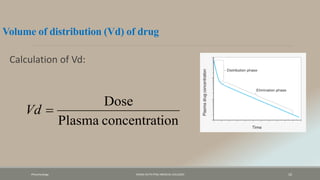
Volume of distribution (Vd) of drug
Calculation of Vd:
ion
concentrat
Plasma
Dose

Vd
Volume of distribution.
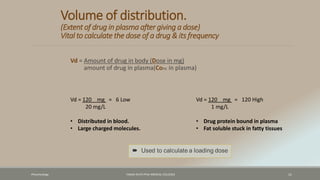
(Extent of drug in plasma after giving a dose)
Vital to calculate the dose of a drug & its frequency
Vd = Amount of drug in body (Dose in mg)
amount of drug in plasma(Conc in plasma)
Pharamcology FAZAIA RUTH PFAU MEDICAL COLLEGES 11
Vd = 120 mg = 6 Low
20 mg/L
• Distributed in blood.
• Large charged molecules.
Vd = 120 mg = 120 High
1 mg/L
• Drug protein bound in plasma
• Fat soluble stuck in fatty tissues
Pharamcology FAZAIA RUTH PFAU MEDICAL COLLEGES 12
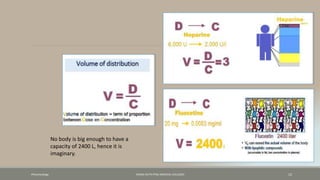
No body is big enough to have a
capacity of 2400 L, hence it is
imaginary.
Pharamcology FAZAIA RUTH PFAU MEDICAL COLLEGES 13
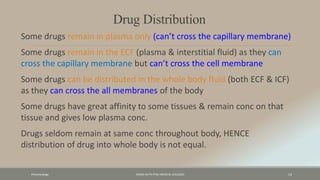
Drug Distribution
Some drugs remain in plasma only (can’t cross the capillary membrane)
Some drugs remain in the ECF (plasma & interstitial fluid) as they can
cross the capillary membrane but can’t cross the cell membrane
Some drugs can be distributed in the whole body fluid (both ECF & ICF)
as they can cross the all membranes of the body
Some drugs have great affinity to some tissues & remain conc on that
tissue and gives low plasma conc.
Drugs seldom remain at same conc throughout body, HENCE
distribution of drug into whole body is not equal.
Pharamcology FAZAIA RUTH PFAU MEDICAL COLLEGES 14
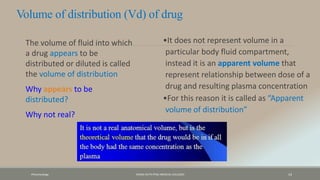
Volume of distribution (Vd) of drug
•It does not represent volume in a
particular body fluid compartment,
instead it is an apparent volume that
represent relationship between dose of a
drug and resulting plasma concentration
•For this reason it is called as “Apparent
volume of distribution”
The volume of fluid into which
a drug appears to be
distributed or diluted is called
the volume of distribution
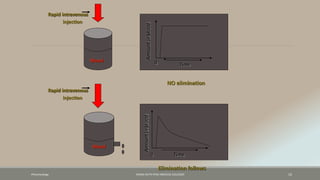
Why appears to be
distributed?
Why not real?
0
0
Time
Time
Amount
in
blood
Amount
in
blood
Blood
Blood
Rapid intravenous
injection
Rapid intravenous
injection
NO elimination
Elimination follows
Pharamcology FAZAIA RUTH PFAU MEDICAL COLLEGES 15
Blood
Blood
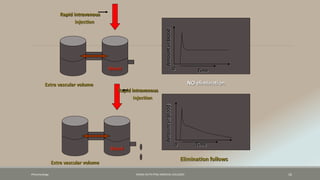
Extra vascular volume
Amount
in
blood
Amount
in
blood
0
0 Time
Time
Rapid intravenous
injection
Rapid intravenous
injection
NO elimination
Elimination follows
Pharamcology FAZAIA RUTH PFAU MEDICAL COLLEGES 16
Pharamcology FAZAIA RUTH PFAU MEDICAL COLLEGES 17
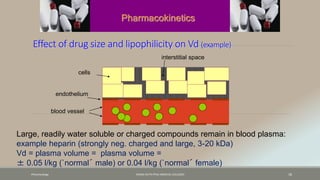
Effect of drug size and lipophilicity on Vd (example)
interstitial space
blood vessel
cells
endothelium
Large, readily water soluble or charged compounds remain in blood plasma:
example heparin (strongly neg. charged and large, 3-20 kDa)
Vd = plasma volume = plasma volume =
± 0.05 l/kg (`normal´ male) or 0.04 l/kg (`normal´ female)
Pharmacokinetics
Pharamcology FAZAIA RUTH PFAU MEDICAL COLLEGES 18
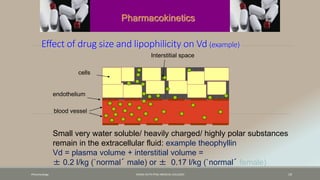
Effect of drug size and lipophilicity on Vd (example)
Interstitial space
blood vessel
cells
endothelium
Small very water soluble/ heavily charged/ highly polar substances
remain in the extracellular fluid: example theophyllin
Vd = plasma volume + interstitial volume =
± 0.2 l/kg (`normal´ male) or ± 0.17 l/kg (`normal´ female)
Pharmacokinetics
Pharamcology FAZAIA RUTH PFAU MEDICAL COLLEGES 19
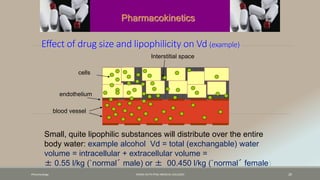
Effect of drug size and lipophilicity on Vd (example)
Interstitial space
blood vessel
cells
endothelium
Small, quite lipophilic substances will distribute over the entire
body water: example alcohol Vd = total (exchangable) water
volume = intracellular + extracellular volume =
± 0.55 l/kg (`normal´ male) or ± 00.450 l/kg (`normal´ female)
Pharmacokinetics
Pharamcology FAZAIA RUTH PFAU MEDICAL COLLEGES 20
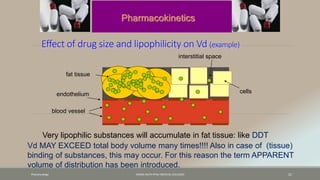
Effect of drug size and lipophilicity on Vd (example)
interstitial space
blood vessel
endothelium
Very lipophilic substances will accumulate in fat tissue: like DDT
fat tissue
cells
Vd MAY EXCEED total body volume many times!!!! Also in case of (tissue)
binding of substances, this may occur. For this reason the term APPARENT
volume of distribution has been introduced.
Pharmacokinetics
Pharamcology FAZAIA RUTH PFAU MEDICAL COLLEGES 21
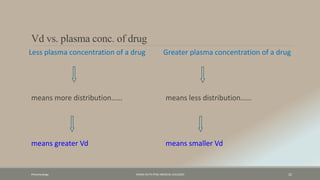
Vd vs. plasma conc. of drug
Less plasma concentration of a drug
means more distribution……
means greater Vd
Greater plasma concentration of a drug
means less distribution……
means smaller Vd
Pharamcology FAZAIA RUTH PFAU MEDICAL COLLEGES 22
Factorswhichaffectsthe drug distributions
 1) Tissue permeability of drug
a. physicochemical property – i) molecular size
ii) pKa
iii) o/w partition coefficient
b. physiological barriers
 2). Organ tissue size and perfusion rate
 3). Binding of drug to tissue components
a. with blood components
b. with extravascular tissue proteins
4). Miscellaneous factors
a. age
b. Pregnancy
d. Obesity
e. Diet
f. Disease states
g. Drug interaction
Pharamcology FAZAIA RUTH PFAU MEDICAL COLLEGES 23
Tissue permeability of drug
 Physicochemical property:
I) Molecular Size;
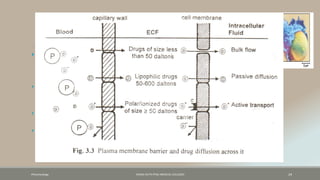
 Mol wt less then 500 to 600 Dalton easily pass capillary membrane to extra
cellular fluid.
 From extra cellular fluid to cross cell membrane through aqueous filled
channels need particle size less then 50 Dalton with hydrophilic property .
 Larger size were restricted unless specialized transport system is exists
Pharamcology FAZAIA RUTH PFAU MEDICAL COLLEGES 24
Physicochemical property
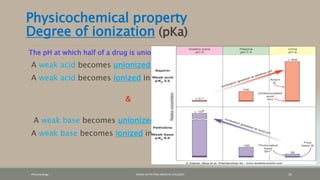
Degree of ionization (pKa)
The pH at which half of a drug is unionized is called pKa
A weak acid becomes unionized in a strong acidic environment.
A weak acid becomes ionized in a neutral or basic environment.
&
A weak base becomes unionized in a strong basic environment.
A weak base becomes ionized in a neutral or acidic environment.
Pharamcology FAZAIA RUTH PFAU MEDICAL COLLEGES 25
Physicochemical property: Permeability
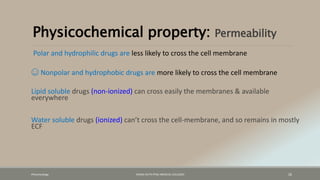
Polar and hydrophilic drugs are less likely to cross the cell membrane
☺ Nonpolar and hydrophobic drugs are more likely to cross the cell membrane
Lipid soluble drugs (non-ionized) can cross easily the membranes & available
everywhere
Water soluble drugs (ionized) can’t cross the cell-membrane, and so remains in mostly
ECF
Pharamcology FAZAIA RUTH PFAU MEDICAL COLLEGES 26
Pharamcology FAZAIA RUTH PFAU MEDICAL COLLEGES 27
Drug Distribution
Importance of PPB of the drugs
Bound drugs are inactive
Bound drugs can’t cross the membranes
Bound drugs are not metabolized
Bound drugs are not excreted
Pharamcology FAZAIA RUTH PFAU MEDICAL COLLEGES 28
Drug Distribution
Plasma-protein binding (PPB)
When the drugs appear in the circulation,
A fraction of drug molecules bind with plasma protein & another
fraction remain free.
In general, binding is reversible and obeys the law of mass action
There is always an equilibrium between bound & free drug
concentration. When free drug concentration is decreased then bound drugs
become free and maintains the equilibrium
Diazepam: 99% bound, 1% free Morphine: 35% bound, 65% free
Plasma Protein Binding [PPB]
ACIDIC DRUGS
High affinity & low capacity
Two particular sites of the albumin molecule
bind acidic drugs with high affinity (strongly)
BASIC DRUG
Low affinity & high capacity
Basic drugs bind with alpha1-acid
glycoprotein & Lipo protein
Pharamcology FAZAIA RUTH PFAU MEDICAL COLLEGES 29
 CLASS I DRUGS
o Low dose/capacity
ratio e.g.
Tolbutamide
 CLASS II DRUGS
o High dose/capacity
ratio e.g.
Sulphonamide
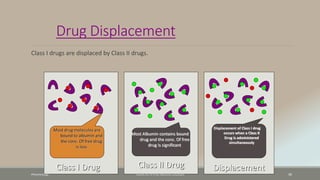
Drug Displacement
Class I drugs are displaced by Class II drugs.
Pharamcology FAZAIA RUTH PFAU MEDICAL COLLEGES 30
Most drug molecules are
bound to albumin and
the conc. Of free drug
is less
Most Albumin contains bound
drug and the conc. Of free
drug is significant
Displacement of Class I drug
occurs when a Class II
Drug is administered
simultaneously
Class I Drug Class II Drug Displacement
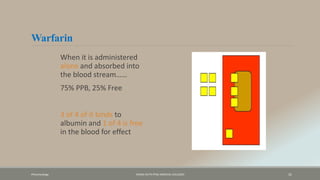
Warfarin
When it is administered
alone and absorbed into
the blood stream……
75% PPB, 25% Free
3 of 4 of it binds to
albumin and 1 of 4 is free
in the blood for effect
Pharamcology FAZAIA RUTH PFAU MEDICAL COLLEGES 31
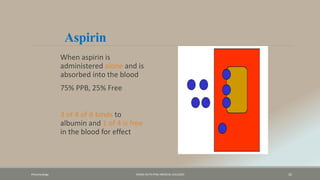
Aspirin
When aspirin is
administered alone and is
absorbed into the blood
75% PPB, 25% Free
3 of 4 of it binds to
albumin and 1 of 4 is free
in the blood for effect
Pharamcology FAZAIA RUTH PFAU MEDICAL COLLEGES 32
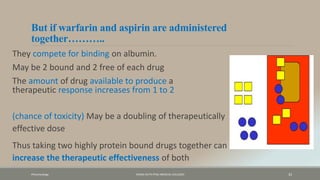
But if warfarin and aspirin are administered
together………..
They compete for binding on albumin.
May be 2 bound and 2 free of each drug
The amount of drug available to produce a
therapeutic response increases from 1 to 2
Pharamcology FAZAIA RUTH PFAU MEDICAL COLLEGES 33
(chance of toxicity) May be a doubling of therapeutically
effective dose
Thus taking two highly protein bound drugs together can
increase the therapeutic effectiveness of both
Relationship Of Drug Displacement to Vd
The impact of drug displacement from albumin depends on Vd.
If the Vd is large, drug displaced from albumin distributes to
periphery and change in free-drug concentration in plasma is not
significant.
If the Vd is small the newly displaced drug does not move into the
tissues as much and the increase in free drug concentration is more
profound.
Pharamcology FAZAIA RUTH PFAU MEDICAL COLLEGES 34
Regional blood flow
More blood flow…more distribution
Drugs distribute….
to tissues with a high blood flow (heart, lungs, brain) most rapidly
then to those with a moderate blood flow (muscle) and
finally to those with a poor blood flow (fat, tendons, cartilage)
Pharamcology FAZAIA RUTH PFAU MEDICAL COLLEGES 35
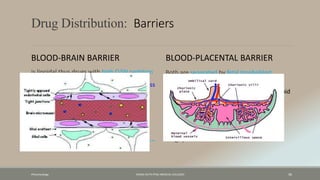
Drug Distribution: Barriers
BLOOD-BRAIN BARRIER
is lipoidal thus drugs with high O/W partition
coefficient diffuse passively others passes
slowly. Only lipid soluble substances can cross
the BBB
Also unique mechanisms
A) permeation enhancers ;- dimethyl
sulfoxide
B) pro- drug approach ;- dopamine----
livodopa
BLOOD-PLACENTAL BARRIER
Both are separated by fetal trophoblast
basement membrane & endothelium .
Mol wt <1000 Dalton & moderate to high lipid
solubility drugs like….. sulfonamides,
barbiturates, steroids, narcotic and some
antibiotics ) cross the barrier by simple
diffusion rapidly
Only low molecular weight - Lipid Soluble
drugs permit to cross
Pharamcology FAZAIA RUTH PFAU MEDICAL COLLEGES 36
Pharamcology FAZAIA RUTH PFAU MEDICAL COLLEGES 37
Drug Distribution
Tissue binding
Some drugs have special affinity to some tissues, e,g,
brain, adipose tissue, kidneys, cornea, bone etc.
Tetracycline to bone
Phenobarbitone to brain
Chlorpromazine to eye
Chloroquine to kidneys
Pharamcology FAZAIA RUTH PFAU MEDICAL COLLEGES 38
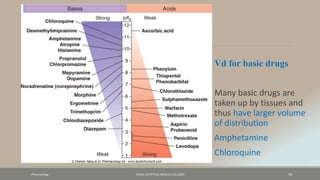
Vd for basic drugs
Many basic drugs are
taken up by tissues and
thus have larger volume
of distribution
Amphetamine
Chloroquine
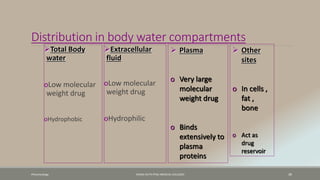
Distribution in body water compartments
Total Body
water
oLow molecular
weight drug
oHydrophobic
Extracellular
fluid
oLow molecular
weight drug
oHydrophilic
Pharamcology FAZAIA RUTH PFAU MEDICAL COLLEGES 39
 Plasma
o Very large
molecular
weight drug
o Binds
extensively to
plasma
proteins
 Other
sites
o In cells ,
fat ,
bone
o Act as
drug
reservoir
Pharamcology FAZAIA RUTH PFAU MEDICAL COLLEGES 40
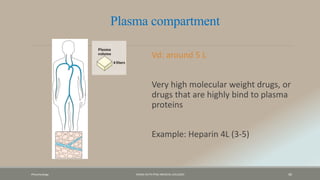
Plasma compartment
Vd: around 5 L
Very high molecular weight drugs, or
drugs that are highly bind to plasma
proteins
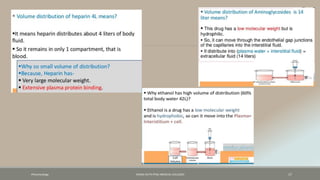
Example: Heparin 4L (3-5)
Pharamcology FAZAIA RUTH PFAU MEDICAL COLLEGES 41
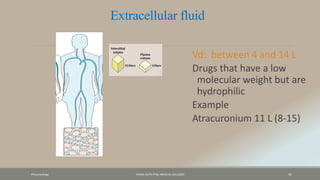
Extracellular fluid
Vd: between 4 and 14 L
Drugs that have a low
molecular weight but are
hydrophilic
Example
Atracuronium 11 L (8-15)
Pharamcology FAZAIA RUTH PFAU MEDICAL COLLEGES 42
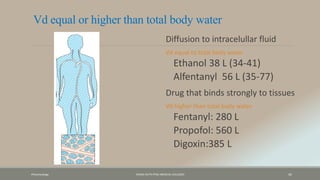
Vd equal or higher than total body water
Diffusion to intracelullar fluid
Vd equal to total body water
◦Ethanol 38 L (34-41)
◦Alfentanyl 56 L (35-77)
Drug that binds strongly to tissues
Vd higher than total body water
◦Fentanyl: 280 L
◦Propofol: 560 L
◦Digoxin:385 L
Pharamcology FAZAIA RUTH PFAU MEDICAL COLLEGES 43
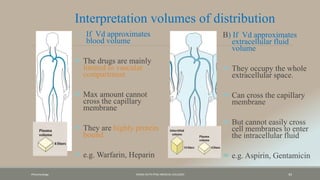
A) If Vd approximates
blood volume
 The drugs are mainly
limited to vascular
compartment
 Max amount cannot
cross the capillary
membrane
 They are highly protein
bound
 e.g. Warfarin, Heparin
B) If Vd approximates
extracellular fluid
volume
 They occupy the whole
extracellular space.
 Can cross the capillary
membrane
 But cannot easily cross
cell membranes to enter
the intracellular fluid
 e.g. Aspirin, Gentamicin
Interpretation volumes of distribution
Pharamcology FAZAIA RUTH PFAU MEDICAL COLLEGES 44
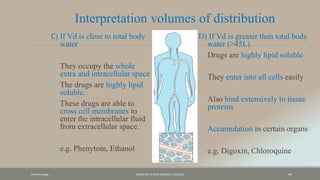
C) If Vd is close to total body
water
 They occupy the whole
extra and intracellular space
 The drugs are highly lipid
soluble.
 These drugs are able to
cross cell membranes to
enter the intracellular fluid
from extracellular space.
 e.g. Phenytoin, Ethanol
D) If Vd is greater than total body
water (>45L)
 Drugs are highly lipid soluble
 They enter into all cells easily
 Also bind extensively to tissue
proteins
 Accumulation in certain organs
 e.g. Digoxin, Chloroquine
Interpretation volumes of distribution
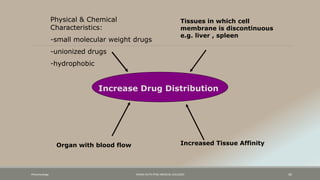
Physical & Chemical
Characteristics:
-small molecular weight drugs
-unionized drugs
-hydrophobic
Tissues in which cell
membrane is discontinuous
e.g. liver , spleen
Organ with blood flow Increased Tissue Affinity
Increase Drug Distribution
Pharamcology FAZAIA RUTH PFAU MEDICAL COLLEGES 45
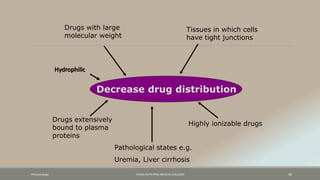
Decrease drug distribution
Drugs with large
molecular weight
Tissues in which cells
have tight junctions
Drugs extensively
bound to plasma
proteins
Highly ionizable drugs
Pathological states e.g.
Uremia, Liver cirrhosis
Hydrophilic
Pharamcology FAZAIA RUTH PFAU MEDICAL COLLEGES 46
References:
Introductory clinical pharmacology by Sally.S.Roach
Pharmaceutical practice by Arthur .J. Winfield
Drug therapy in nursing by DianeS. Aschen brenner
Basic & clinical pharmacology Katzung 14 th edition
Lippincott’s pharmacology 6th edition.
Rang & Dale 9th edition
Clinical pharmacology 11th edition Peter Bennett
Principles of Pharmacology: The Pathophysiologic Basis of Drug Therapy, 2nd edition
Pharamcology FAZAIA RUTH PFAU MEDICAL COLLEGES 47

Drug Distribution.pptx

  • 1.
    DRUG DISTRIBUTION DR AWAISIRSHAD Pharamcology FAZAIA RUTH PFAU MEDICAL COLLEGES 1
  • 2.
  • 3.
    Presentation Outline Definition OfDrug Distribution. Factors affecting drug distribution. Volume Of Distribution. Binding of Drug with Plasma proteins. Pharamcology FAZAIA RUTH PFAU MEDICAL COLLEGES 3
  • 4.
    Drug Distribution A processby which drug reversibly leaves blood stream & enters interstitium and/or cells of tissues like muscle, fat & brain tissue . Pharamcology FAZAIA RUTH PFAU MEDICAL COLLEGES 4 Vd - amount of fluid in which administered drug DOSE is distributed
  • 5.
    Distribution….. Where dothe drugs go after absorption? Pharamcology FAZAIA RUTH PFAU MEDICAL COLLEGES 5
  • 6.
    Pharamcology FAZAIA RUTHPFAU MEDICAL COLLEGES 6 Pharmacological action of drugs depend upon its conc at site of action Drug Distribution
  • 7.
    Primary Kinetic parameters VOLUMEOF DISTRIBUTION Where the drug is distributed over. In obese persons is high for fat soluble drugs. Vital to calculate dose & frequency CLEARANCE Clearance of creatinine is 120 ml / min. It is the volume of plasma that is completely cleared of drug in unit time. Pharamcology FAZAIA RUTH PFAU MEDICAL COLLEGES 7
  • 8.
    0 50 100 150 0 5 1015 20 25 30 Time (h) Concentration mg/l Threshold concentration desired effect Threshold concentration toxic effect Duration of action Knowledge of the pharmacokinetics of drugs is necessary for designing proper dosing schemes! Pharmacokinetics – Distributionof drugs Pharamcology FAZAIA RUTH PFAU MEDICAL COLLEGES 8
  • 9.
    Volume Of Distribution Consider human body as a vessel filled with Plasma (volume). Volume of distribution (Vd) relates the amount of drug in the body to the concentration of drug(C) in blood or plasma.  Vd = is constant for most of compounds. Pharamcology 9 Amount of drug in body Drug in plasma - C (Katzung) Body Composition: 40% - Mass. 60% - Water ECF & ICF Plasma Volume Interstitial fluid Drug Protein bound OR FREE FAZAIA RUTH PFAU MEDICAL COLLEGES
  • 10.
    Pharamcology FAZAIA RUTHPFAU MEDICAL COLLEGES 10 Volume of distribution (Vd) of drug Calculation of Vd: ion concentrat Plasma Dose  Vd
  • 11.
    Volume of distribution. (Extentof drug in plasma after giving a dose) Vital to calculate the dose of a drug & its frequency Vd = Amount of drug in body (Dose in mg) amount of drug in plasma(Conc in plasma) Pharamcology FAZAIA RUTH PFAU MEDICAL COLLEGES 11 Vd = 120 mg = 6 Low 20 mg/L • Distributed in blood. • Large charged molecules. Vd = 120 mg = 120 High 1 mg/L • Drug protein bound in plasma • Fat soluble stuck in fatty tissues
  • 12.
    Pharamcology FAZAIA RUTHPFAU MEDICAL COLLEGES 12 No body is big enough to have a capacity of 2400 L, hence it is imaginary.
  • 13.
    Pharamcology FAZAIA RUTHPFAU MEDICAL COLLEGES 13 Drug Distribution Some drugs remain in plasma only (can’t cross the capillary membrane) Some drugs remain in the ECF (plasma & interstitial fluid) as they can cross the capillary membrane but can’t cross the cell membrane Some drugs can be distributed in the whole body fluid (both ECF & ICF) as they can cross the all membranes of the body Some drugs have great affinity to some tissues & remain conc on that tissue and gives low plasma conc. Drugs seldom remain at same conc throughout body, HENCE distribution of drug into whole body is not equal.
  • 14.
    Pharamcology FAZAIA RUTHPFAU MEDICAL COLLEGES 14 Volume of distribution (Vd) of drug •It does not represent volume in a particular body fluid compartment, instead it is an apparent volume that represent relationship between dose of a drug and resulting plasma concentration •For this reason it is called as “Apparent volume of distribution” The volume of fluid into which a drug appears to be distributed or diluted is called the volume of distribution Why appears to be distributed? Why not real?
  • 15.
    0 0 Time Time Amount in blood Amount in blood Blood Blood Rapid intravenous injection Rapid intravenous injection NOelimination Elimination follows Pharamcology FAZAIA RUTH PFAU MEDICAL COLLEGES 15
  • 16.
    Blood Blood Extra vascular volume Extravascular volume Amount in blood Amount in blood 0 0 Time Time Rapid intravenous injection Rapid intravenous injection NO elimination Elimination follows Pharamcology FAZAIA RUTH PFAU MEDICAL COLLEGES 16
  • 17.
    Pharamcology FAZAIA RUTHPFAU MEDICAL COLLEGES 17
  • 18.
    Effect of drugsize and lipophilicity on Vd (example) interstitial space blood vessel cells endothelium Large, readily water soluble or charged compounds remain in blood plasma: example heparin (strongly neg. charged and large, 3-20 kDa) Vd = plasma volume = plasma volume = ± 0.05 l/kg (`normal´ male) or 0.04 l/kg (`normal´ female) Pharmacokinetics Pharamcology FAZAIA RUTH PFAU MEDICAL COLLEGES 18
  • 19.
    Effect of drugsize and lipophilicity on Vd (example) Interstitial space blood vessel cells endothelium Small very water soluble/ heavily charged/ highly polar substances remain in the extracellular fluid: example theophyllin Vd = plasma volume + interstitial volume = ± 0.2 l/kg (`normal´ male) or ± 0.17 l/kg (`normal´ female) Pharmacokinetics Pharamcology FAZAIA RUTH PFAU MEDICAL COLLEGES 19
  • 20.
    Effect of drugsize and lipophilicity on Vd (example) Interstitial space blood vessel cells endothelium Small, quite lipophilic substances will distribute over the entire body water: example alcohol Vd = total (exchangable) water volume = intracellular + extracellular volume = ± 0.55 l/kg (`normal´ male) or ± 00.450 l/kg (`normal´ female) Pharmacokinetics Pharamcology FAZAIA RUTH PFAU MEDICAL COLLEGES 20
  • 21.
    Effect of drugsize and lipophilicity on Vd (example) interstitial space blood vessel endothelium Very lipophilic substances will accumulate in fat tissue: like DDT fat tissue cells Vd MAY EXCEED total body volume many times!!!! Also in case of (tissue) binding of substances, this may occur. For this reason the term APPARENT volume of distribution has been introduced. Pharmacokinetics Pharamcology FAZAIA RUTH PFAU MEDICAL COLLEGES 21
  • 22.
    Vd vs. plasmaconc. of drug Less plasma concentration of a drug means more distribution…… means greater Vd Greater plasma concentration of a drug means less distribution…… means smaller Vd Pharamcology FAZAIA RUTH PFAU MEDICAL COLLEGES 22
  • 23.
    Factorswhichaffectsthe drug distributions 1) Tissue permeability of drug a. physicochemical property – i) molecular size ii) pKa iii) o/w partition coefficient b. physiological barriers  2). Organ tissue size and perfusion rate  3). Binding of drug to tissue components a. with blood components b. with extravascular tissue proteins 4). Miscellaneous factors a. age b. Pregnancy d. Obesity e. Diet f. Disease states g. Drug interaction Pharamcology FAZAIA RUTH PFAU MEDICAL COLLEGES 23
  • 24.
    Tissue permeability ofdrug  Physicochemical property: I) Molecular Size;  Mol wt less then 500 to 600 Dalton easily pass capillary membrane to extra cellular fluid.  From extra cellular fluid to cross cell membrane through aqueous filled channels need particle size less then 50 Dalton with hydrophilic property .  Larger size were restricted unless specialized transport system is exists Pharamcology FAZAIA RUTH PFAU MEDICAL COLLEGES 24
  • 25.
    Physicochemical property Degree ofionization (pKa) The pH at which half of a drug is unionized is called pKa A weak acid becomes unionized in a strong acidic environment. A weak acid becomes ionized in a neutral or basic environment. & A weak base becomes unionized in a strong basic environment. A weak base becomes ionized in a neutral or acidic environment. Pharamcology FAZAIA RUTH PFAU MEDICAL COLLEGES 25
  • 26.
    Physicochemical property: Permeability Polarand hydrophilic drugs are less likely to cross the cell membrane ☺ Nonpolar and hydrophobic drugs are more likely to cross the cell membrane Lipid soluble drugs (non-ionized) can cross easily the membranes & available everywhere Water soluble drugs (ionized) can’t cross the cell-membrane, and so remains in mostly ECF Pharamcology FAZAIA RUTH PFAU MEDICAL COLLEGES 26
  • 27.
    Pharamcology FAZAIA RUTHPFAU MEDICAL COLLEGES 27 Drug Distribution Importance of PPB of the drugs Bound drugs are inactive Bound drugs can’t cross the membranes Bound drugs are not metabolized Bound drugs are not excreted
  • 28.
    Pharamcology FAZAIA RUTHPFAU MEDICAL COLLEGES 28 Drug Distribution Plasma-protein binding (PPB) When the drugs appear in the circulation, A fraction of drug molecules bind with plasma protein & another fraction remain free. In general, binding is reversible and obeys the law of mass action There is always an equilibrium between bound & free drug concentration. When free drug concentration is decreased then bound drugs become free and maintains the equilibrium Diazepam: 99% bound, 1% free Morphine: 35% bound, 65% free
  • 29.
    Plasma Protein Binding[PPB] ACIDIC DRUGS High affinity & low capacity Two particular sites of the albumin molecule bind acidic drugs with high affinity (strongly) BASIC DRUG Low affinity & high capacity Basic drugs bind with alpha1-acid glycoprotein & Lipo protein Pharamcology FAZAIA RUTH PFAU MEDICAL COLLEGES 29  CLASS I DRUGS o Low dose/capacity ratio e.g. Tolbutamide  CLASS II DRUGS o High dose/capacity ratio e.g. Sulphonamide
  • 30.
    Drug Displacement Class Idrugs are displaced by Class II drugs. Pharamcology FAZAIA RUTH PFAU MEDICAL COLLEGES 30 Most drug molecules are bound to albumin and the conc. Of free drug is less Most Albumin contains bound drug and the conc. Of free drug is significant Displacement of Class I drug occurs when a Class II Drug is administered simultaneously Class I Drug Class II Drug Displacement
  • 31.
    Warfarin When it isadministered alone and absorbed into the blood stream…… 75% PPB, 25% Free 3 of 4 of it binds to albumin and 1 of 4 is free in the blood for effect Pharamcology FAZAIA RUTH PFAU MEDICAL COLLEGES 31
  • 32.
    Aspirin When aspirin is administeredalone and is absorbed into the blood 75% PPB, 25% Free 3 of 4 of it binds to albumin and 1 of 4 is free in the blood for effect Pharamcology FAZAIA RUTH PFAU MEDICAL COLLEGES 32
  • 33.
    But if warfarinand aspirin are administered together……….. They compete for binding on albumin. May be 2 bound and 2 free of each drug The amount of drug available to produce a therapeutic response increases from 1 to 2 Pharamcology FAZAIA RUTH PFAU MEDICAL COLLEGES 33 (chance of toxicity) May be a doubling of therapeutically effective dose Thus taking two highly protein bound drugs together can increase the therapeutic effectiveness of both
  • 34.
    Relationship Of DrugDisplacement to Vd The impact of drug displacement from albumin depends on Vd. If the Vd is large, drug displaced from albumin distributes to periphery and change in free-drug concentration in plasma is not significant. If the Vd is small the newly displaced drug does not move into the tissues as much and the increase in free drug concentration is more profound. Pharamcology FAZAIA RUTH PFAU MEDICAL COLLEGES 34
  • 35.
    Regional blood flow Moreblood flow…more distribution Drugs distribute…. to tissues with a high blood flow (heart, lungs, brain) most rapidly then to those with a moderate blood flow (muscle) and finally to those with a poor blood flow (fat, tendons, cartilage) Pharamcology FAZAIA RUTH PFAU MEDICAL COLLEGES 35
  • 36.
    Drug Distribution: Barriers BLOOD-BRAINBARRIER is lipoidal thus drugs with high O/W partition coefficient diffuse passively others passes slowly. Only lipid soluble substances can cross the BBB Also unique mechanisms A) permeation enhancers ;- dimethyl sulfoxide B) pro- drug approach ;- dopamine---- livodopa BLOOD-PLACENTAL BARRIER Both are separated by fetal trophoblast basement membrane & endothelium . Mol wt <1000 Dalton & moderate to high lipid solubility drugs like….. sulfonamides, barbiturates, steroids, narcotic and some antibiotics ) cross the barrier by simple diffusion rapidly Only low molecular weight - Lipid Soluble drugs permit to cross Pharamcology FAZAIA RUTH PFAU MEDICAL COLLEGES 36
  • 37.
    Pharamcology FAZAIA RUTHPFAU MEDICAL COLLEGES 37 Drug Distribution Tissue binding Some drugs have special affinity to some tissues, e,g, brain, adipose tissue, kidneys, cornea, bone etc. Tetracycline to bone Phenobarbitone to brain Chlorpromazine to eye Chloroquine to kidneys
  • 38.
    Pharamcology FAZAIA RUTHPFAU MEDICAL COLLEGES 38 Vd for basic drugs Many basic drugs are taken up by tissues and thus have larger volume of distribution Amphetamine Chloroquine
  • 39.
    Distribution in bodywater compartments Total Body water oLow molecular weight drug oHydrophobic Extracellular fluid oLow molecular weight drug oHydrophilic Pharamcology FAZAIA RUTH PFAU MEDICAL COLLEGES 39  Plasma o Very large molecular weight drug o Binds extensively to plasma proteins  Other sites o In cells , fat , bone o Act as drug reservoir
  • 40.
    Pharamcology FAZAIA RUTHPFAU MEDICAL COLLEGES 40 Plasma compartment Vd: around 5 L Very high molecular weight drugs, or drugs that are highly bind to plasma proteins Example: Heparin 4L (3-5)
  • 41.
    Pharamcology FAZAIA RUTHPFAU MEDICAL COLLEGES 41 Extracellular fluid Vd: between 4 and 14 L Drugs that have a low molecular weight but are hydrophilic Example Atracuronium 11 L (8-15)
  • 42.
    Pharamcology FAZAIA RUTHPFAU MEDICAL COLLEGES 42 Vd equal or higher than total body water Diffusion to intracelullar fluid Vd equal to total body water ◦Ethanol 38 L (34-41) ◦Alfentanyl 56 L (35-77) Drug that binds strongly to tissues Vd higher than total body water ◦Fentanyl: 280 L ◦Propofol: 560 L ◦Digoxin:385 L
  • 43.
    Pharamcology FAZAIA RUTHPFAU MEDICAL COLLEGES 43 A) If Vd approximates blood volume  The drugs are mainly limited to vascular compartment  Max amount cannot cross the capillary membrane  They are highly protein bound  e.g. Warfarin, Heparin B) If Vd approximates extracellular fluid volume  They occupy the whole extracellular space.  Can cross the capillary membrane  But cannot easily cross cell membranes to enter the intracellular fluid  e.g. Aspirin, Gentamicin Interpretation volumes of distribution
  • 44.
    Pharamcology FAZAIA RUTHPFAU MEDICAL COLLEGES 44 C) If Vd is close to total body water  They occupy the whole extra and intracellular space  The drugs are highly lipid soluble.  These drugs are able to cross cell membranes to enter the intracellular fluid from extracellular space.  e.g. Phenytoin, Ethanol D) If Vd is greater than total body water (>45L)  Drugs are highly lipid soluble  They enter into all cells easily  Also bind extensively to tissue proteins  Accumulation in certain organs  e.g. Digoxin, Chloroquine Interpretation volumes of distribution
  • 45.
    Physical & Chemical Characteristics: -smallmolecular weight drugs -unionized drugs -hydrophobic Tissues in which cell membrane is discontinuous e.g. liver , spleen Organ with blood flow Increased Tissue Affinity Increase Drug Distribution Pharamcology FAZAIA RUTH PFAU MEDICAL COLLEGES 45
  • 46.
    Decrease drug distribution Drugswith large molecular weight Tissues in which cells have tight junctions Drugs extensively bound to plasma proteins Highly ionizable drugs Pathological states e.g. Uremia, Liver cirrhosis Hydrophilic Pharamcology FAZAIA RUTH PFAU MEDICAL COLLEGES 46
  • 47.
    References: Introductory clinical pharmacologyby Sally.S.Roach Pharmaceutical practice by Arthur .J. Winfield Drug therapy in nursing by DianeS. Aschen brenner Basic & clinical pharmacology Katzung 14 th edition Lippincott’s pharmacology 6th edition. Rang & Dale 9th edition Clinical pharmacology 11th edition Peter Bennett Principles of Pharmacology: The Pathophysiologic Basis of Drug Therapy, 2nd edition Pharamcology FAZAIA RUTH PFAU MEDICAL COLLEGES 47