

STEEPEST DESCENT METHOD
LESSON 3
STEEPEST DESCENT METHOD
• An algorithm for finding the nearest local minimum of a
function which presupposes that the gradient of the function
can be computed.
• The method of steepest descent is also called the gradient
descent method starts at point P(0) and, as many times as
needed
• It moves from point P(i) to P(i+1) by minimizing along the line
extending from p(i) in the direction of –<delta> function of P(i).
A DRAWBACK IN THE METHOD
• This method has the severe drawback of requiring a great many
iterations for functions which have long, narrow valley
structures. In such cases, a conjugate gradient method is
preferable.
• To find a local minimum of a function using gradient descent,
one takes steps proportional to the negative of the gradient (or
of the approximate gradient) of the function at the current
point.
• If instead one takes steps proportional to the positive of the
gradient, one approaches a local maximum of that function; the
procedure is then known as gradient ascent
A GOOD AND A BAD EXAMPLE
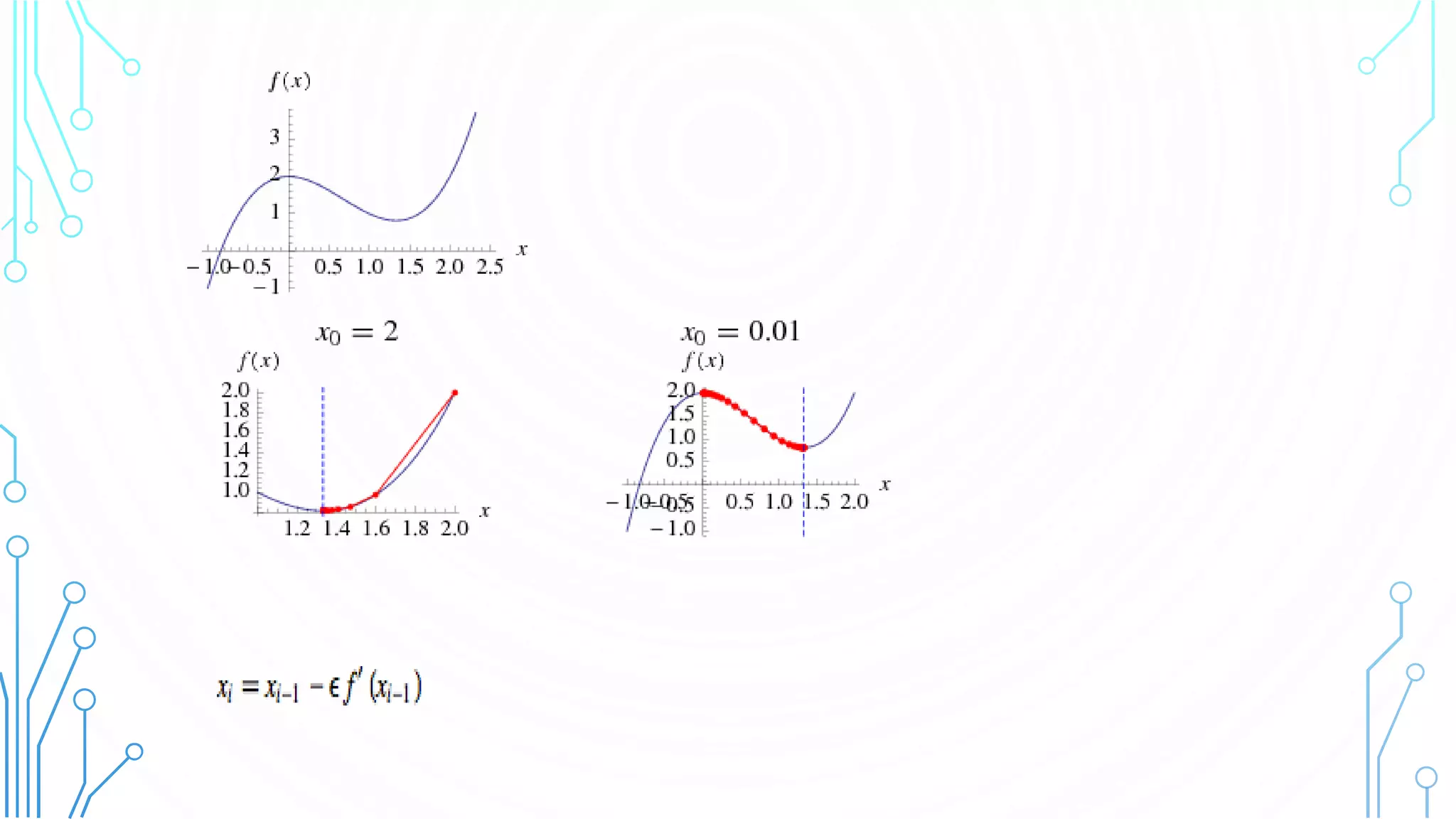
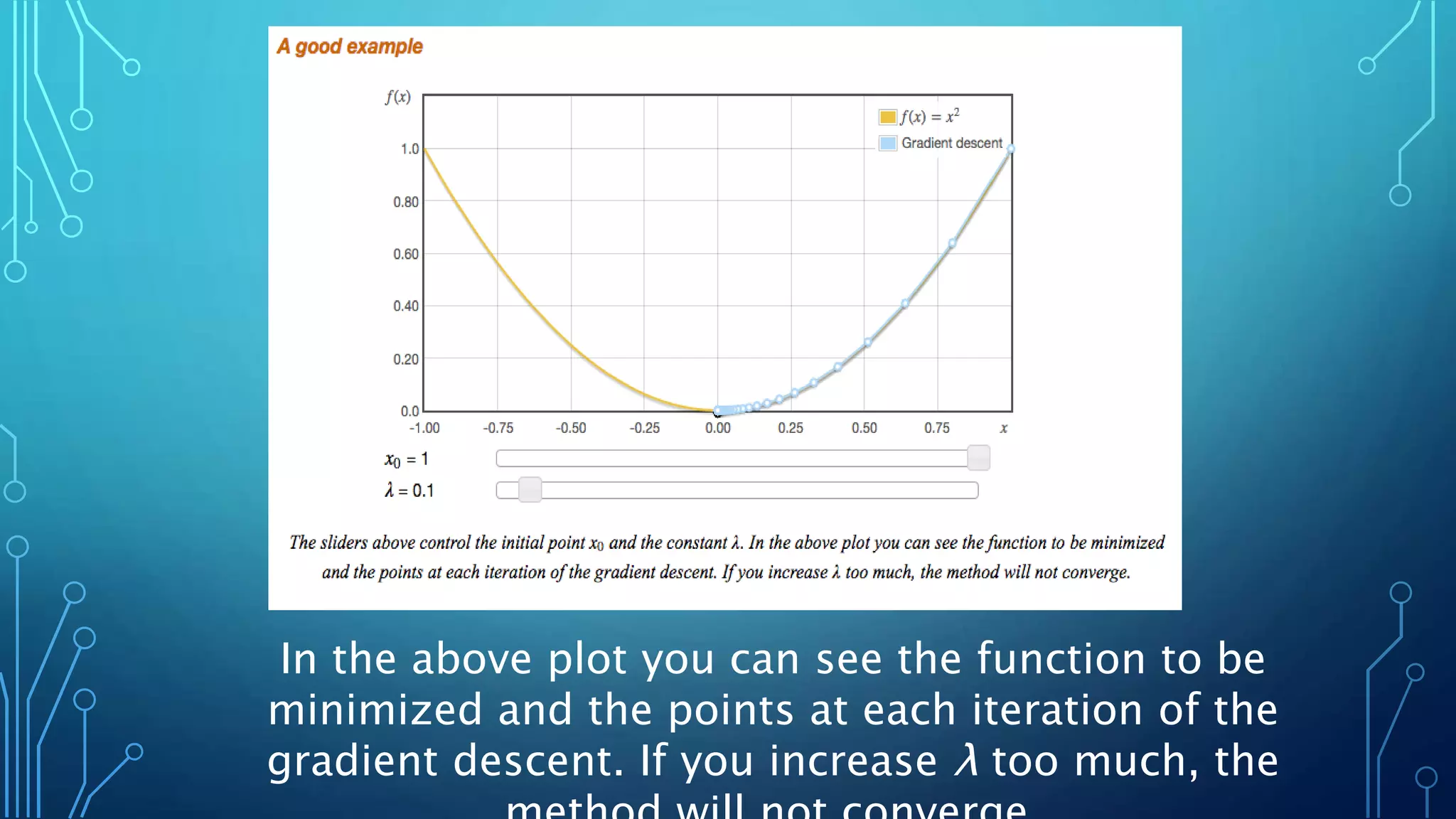
In the above plot you can see the function to be
minimized and the points at each iteration of the
gradient descent. If you increase λ too much, the
THE BAD
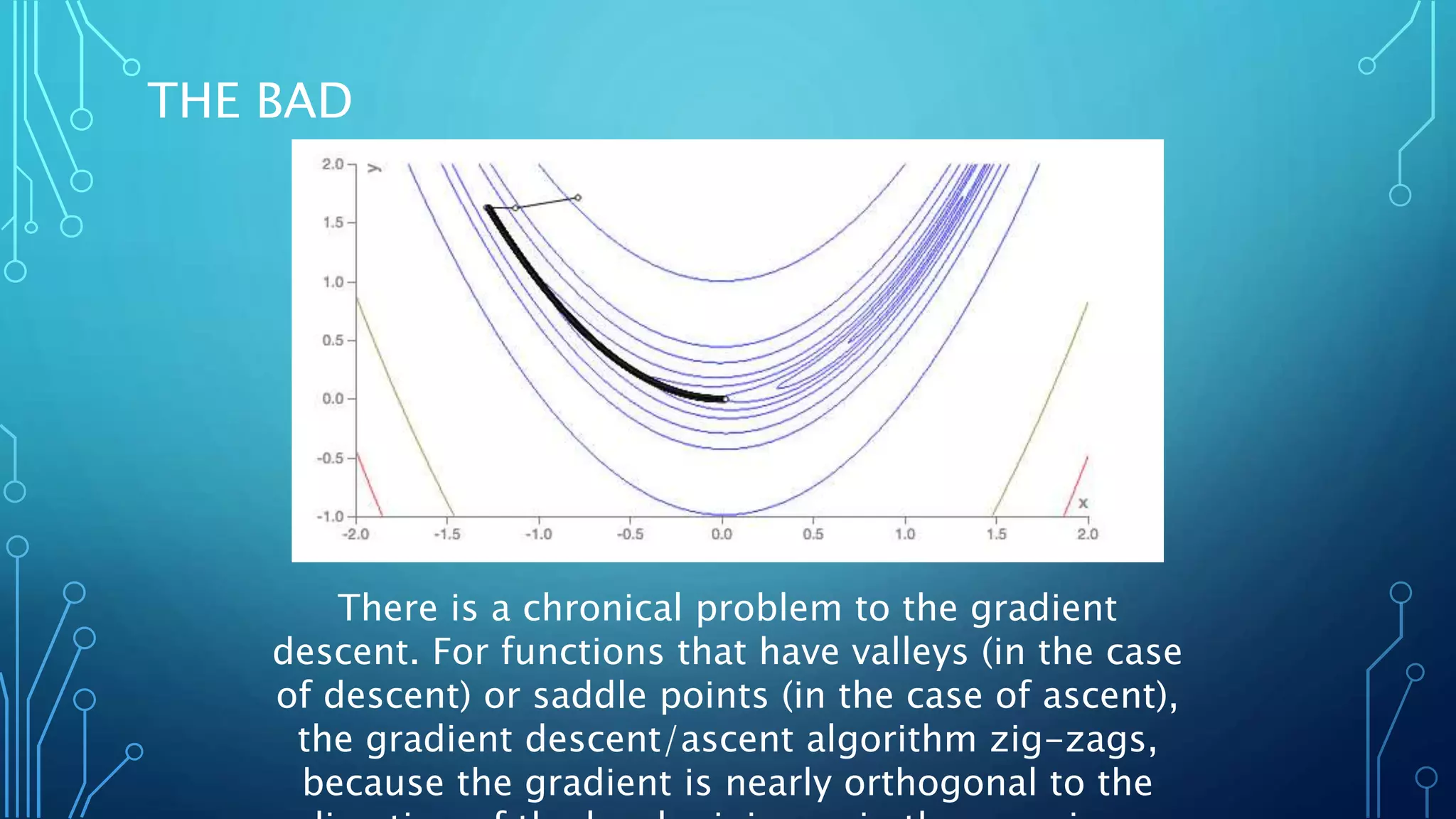
There is a chronical problem to the gradient
descent. For functions that have valleys (in the case
of descent) or saddle points (in the case of ascent),
the gradient descent/ascent algorithm zig-zags,
because the gradient is nearly orthogonal to the
THE UGLY
• Imagine the ugliest example you can think of.
• Draw it on your notebook
• Compare it to the guy next to you
• Ugliest example wins
ESTIMATING STEP SIZE
• A wrong step size λ may not reach convergence, so a careful
selection of the step size is important.
• Too large it will diverge, too small it will take a long time to converge.
• One option is to choose a fixed step size that will assure convergence
wherever you start gradient descent.
• Another option is to choose a different step size at each iteration
(adaptive step size).
MAXIMUM STEP SIZE FOR CONVERGENCE
• Any differentiable function has a maximum derivative value,
i.e., the maximum of the derivatives at all points. If this
maximum is not infinite, this value is known as the Lipschitz
constant and the function is Lipschitz continuous.
‖f(x)−f(y)‖‖x−y‖≤L(f), for any x,y
• This constant is important because it says that, given a certain
function, any derivative will have a smaller value than the
Lipschitz constant.
• The same can be said for the gradient of the function: if the
maximum second derivative is finite, the function is Lipschitz
continuous gradient and that value is the Lipschitz constant of
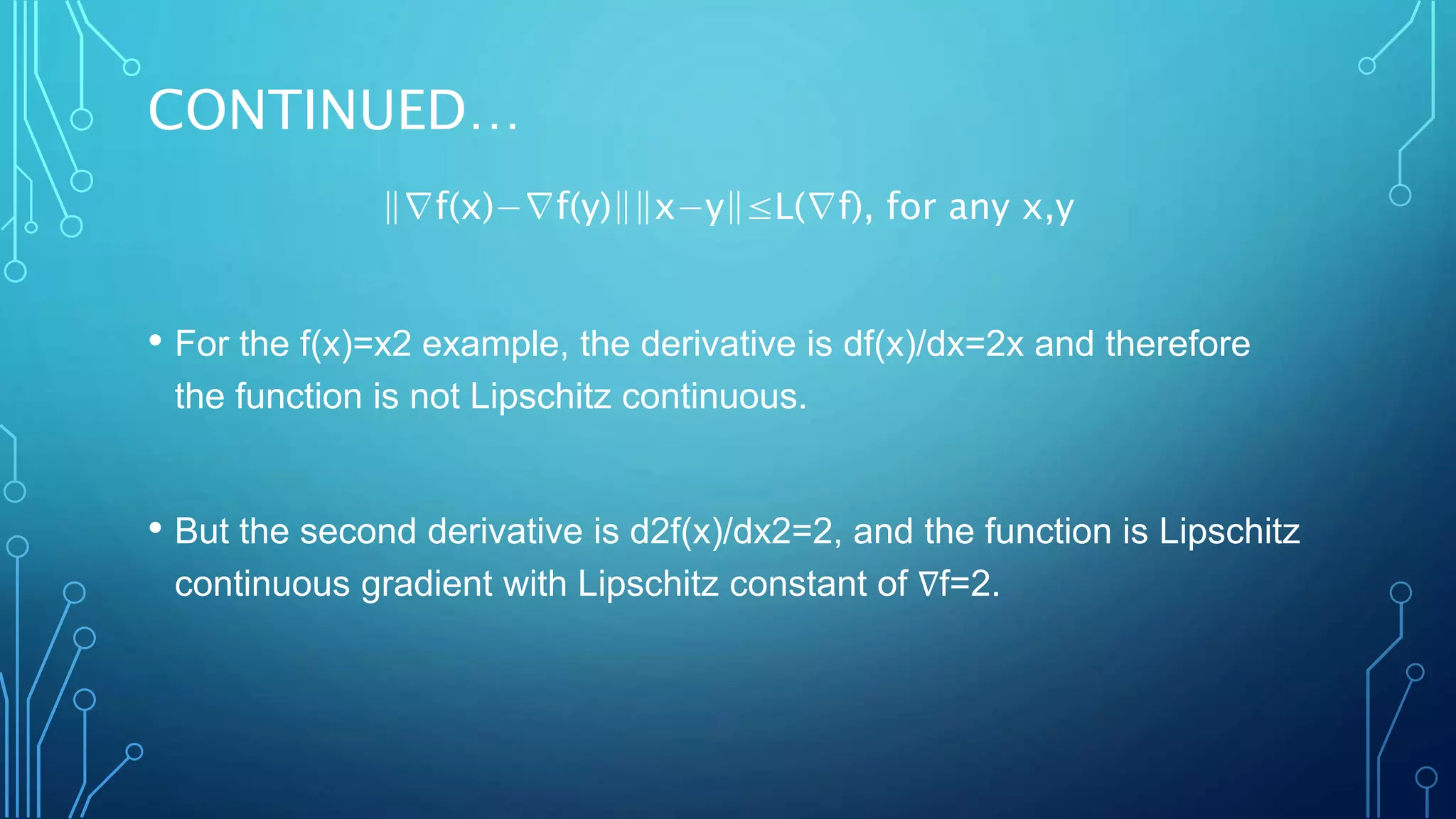
CONTINUED…
‖∇f(x)−∇f(y)‖‖x−y‖≤L(∇f), for any x,y
• For the f(x)=x2 example, the derivative is df(x)/dx=2x and therefore
the function is not Lipschitz continuous.
• But the second derivative is d2f(x)/dx2=2, and the function is Lipschitz
continuous gradient with Lipschitz constant of ∇f=2.
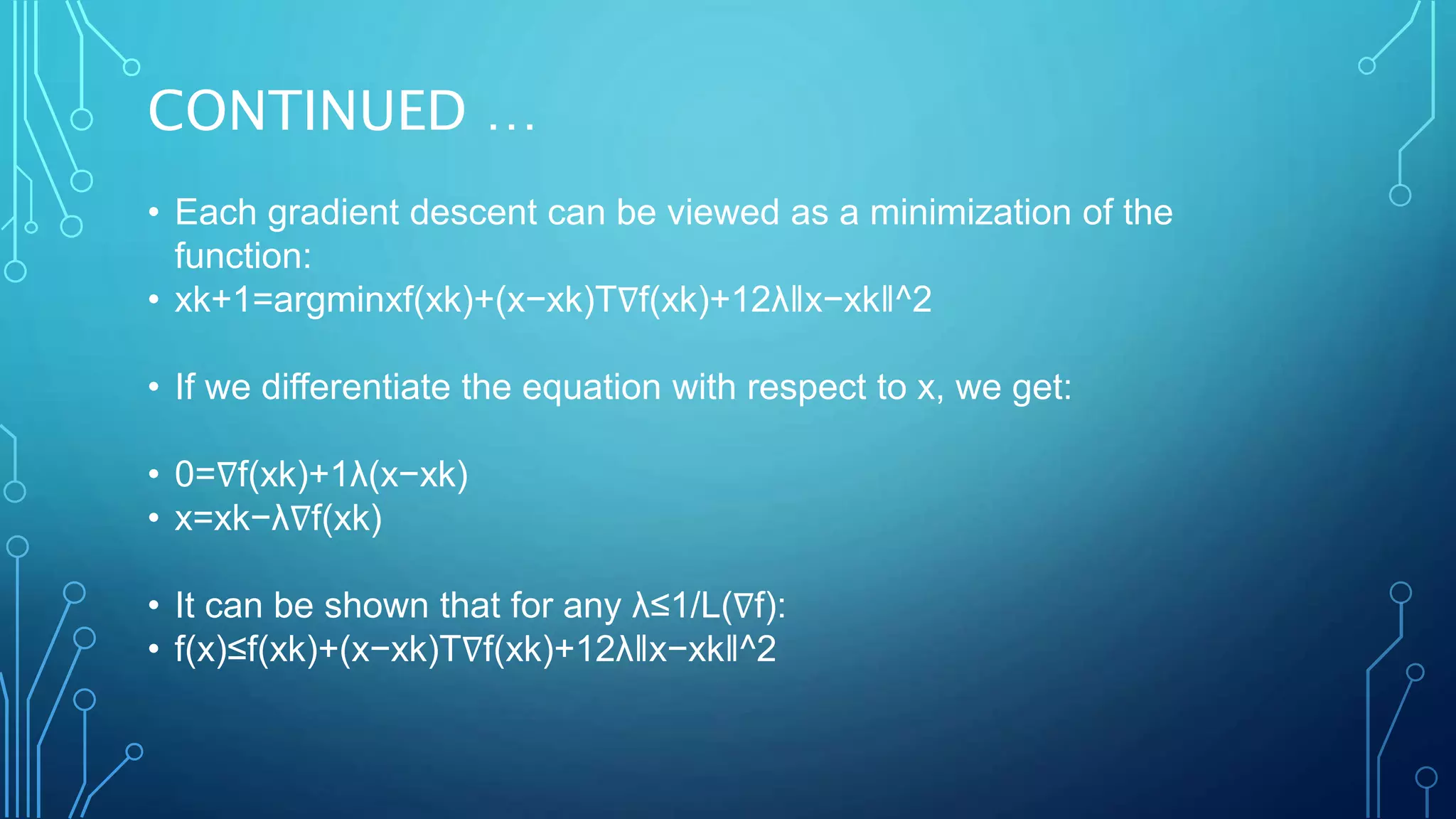
CONTINUED …
• Each gradient descent can be viewed as a minimization of the
function:
• xk+1=argminxf(xk)+(x−xk)T∇f(xk)+12λ‖x−xk‖^2
• If we differentiate the equation with respect to x, we get:
• 0=∇f(xk)+1λ(x−xk)
• x=xk−λ∇f(xk)
• It can be shown that for any λ≤1/L(∇f):
• f(x)≤f(xk)+(x−xk)T∇f(xk)+12λ‖x−xk‖^2

Steepest descent method

  • 1.
  • 2.
    STEEPEST DESCENT METHOD •An algorithm for finding the nearest local minimum of a function which presupposes that the gradient of the function can be computed. • The method of steepest descent is also called the gradient descent method starts at point P(0) and, as many times as needed • It moves from point P(i) to P(i+1) by minimizing along the line extending from p(i) in the direction of –<delta> function of P(i).
  • 4.
    A DRAWBACK INTHE METHOD • This method has the severe drawback of requiring a great many iterations for functions which have long, narrow valley structures. In such cases, a conjugate gradient method is preferable. • To find a local minimum of a function using gradient descent, one takes steps proportional to the negative of the gradient (or of the approximate gradient) of the function at the current point. • If instead one takes steps proportional to the positive of the gradient, one approaches a local maximum of that function; the procedure is then known as gradient ascent
  • 5.
    A GOOD ANDA BAD EXAMPLE
  • 6.
    In the aboveplot you can see the function to be minimized and the points at each iteration of the gradient descent. If you increase λ too much, the
  • 7.
    THE BAD There isa chronical problem to the gradient descent. For functions that have valleys (in the case of descent) or saddle points (in the case of ascent), the gradient descent/ascent algorithm zig-zags, because the gradient is nearly orthogonal to the
  • 8.
    THE UGLY • Imaginethe ugliest example you can think of. • Draw it on your notebook • Compare it to the guy next to you • Ugliest example wins
  • 9.
    ESTIMATING STEP SIZE •A wrong step size λ may not reach convergence, so a careful selection of the step size is important. • Too large it will diverge, too small it will take a long time to converge. • One option is to choose a fixed step size that will assure convergence wherever you start gradient descent. • Another option is to choose a different step size at each iteration (adaptive step size).
  • 10.
    MAXIMUM STEP SIZEFOR CONVERGENCE • Any differentiable function has a maximum derivative value, i.e., the maximum of the derivatives at all points. If this maximum is not infinite, this value is known as the Lipschitz constant and the function is Lipschitz continuous. ‖f(x)−f(y)‖‖x−y‖≤L(f), for any x,y • This constant is important because it says that, given a certain function, any derivative will have a smaller value than the Lipschitz constant. • The same can be said for the gradient of the function: if the maximum second derivative is finite, the function is Lipschitz continuous gradient and that value is the Lipschitz constant of
  • 11.
    CONTINUED… ‖∇f(x)−∇f(y)‖‖x−y‖≤L(∇f), for anyx,y • For the f(x)=x2 example, the derivative is df(x)/dx=2x and therefore the function is not Lipschitz continuous. • But the second derivative is d2f(x)/dx2=2, and the function is Lipschitz continuous gradient with Lipschitz constant of ∇f=2.
  • 12.
    CONTINUED … • Eachgradient descent can be viewed as a minimization of the function: • xk+1=argminxf(xk)+(x−xk)T∇f(xk)+12λ‖x−xk‖^2 • If we differentiate the equation with respect to x, we get: • 0=∇f(xk)+1λ(x−xk) • x=xk−λ∇f(xk) • It can be shown that for any λ≤1/L(∇f): • f(x)≤f(xk)+(x−xk)T∇f(xk)+12λ‖x−xk‖^2