Gradient Descent
Nicholas Ruozzi
University of Texas at Dallas
2
Gradient Descent
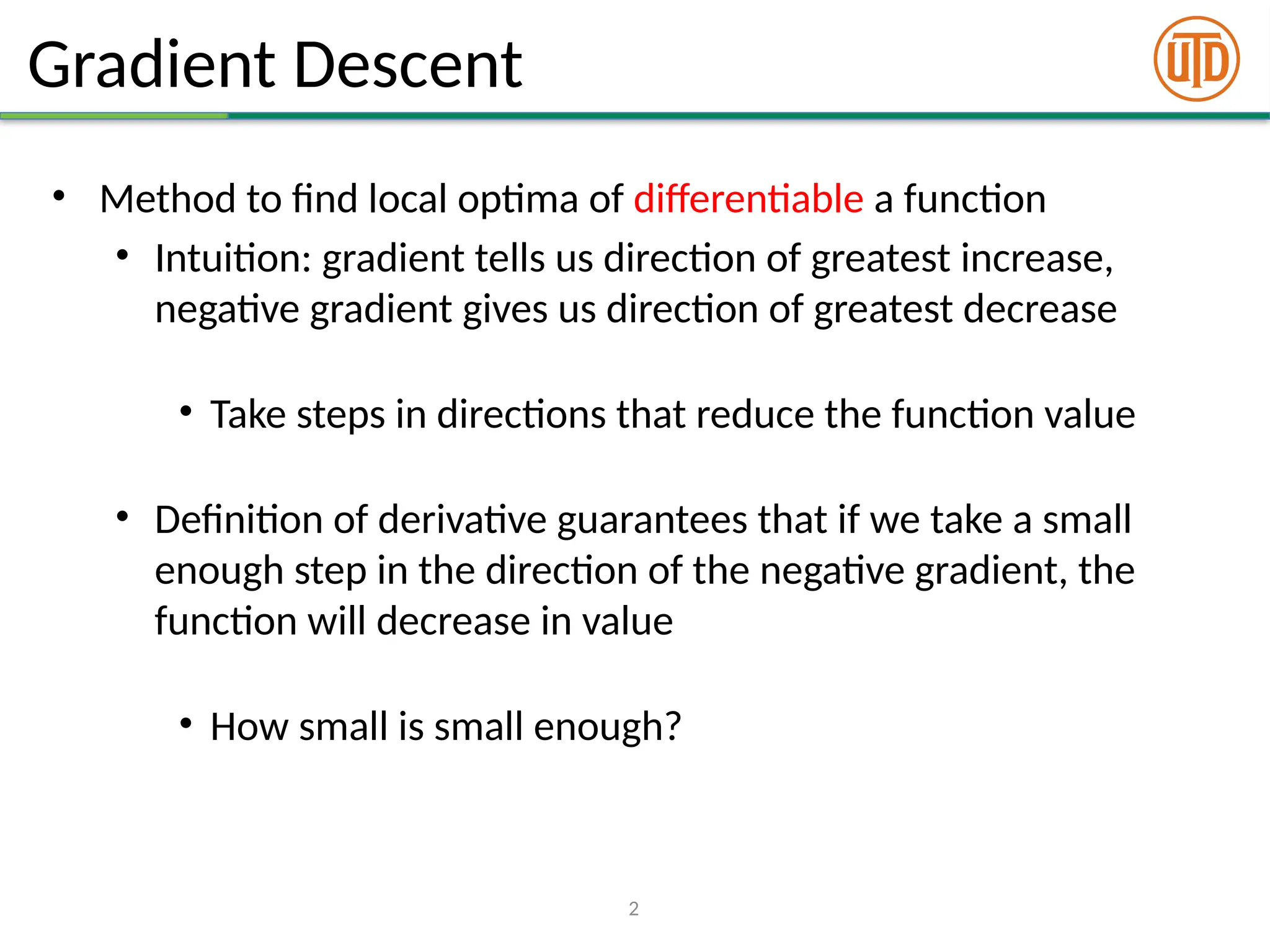
• Method to find local optima of differentiable a function
• Intuition: gradient tells us direction of greatest increase,
negative gradient gives us direction of greatest decrease
• Take steps in directions that reduce the function value
• Definition of derivative guarantees that if we take a small
enough step in the direction of the negative gradient, the
function will decrease in value
• How small is small enough?
3
Gradient Descent
Gradient Descent Algorithm:
• Pick an initial point
• Iterate until convergence
where is the step size (sometimes called learning rate)
4
Gradient Descent
Gradient Descent Algorithm:
• Pick an initial point
• Iterate until convergence
where is the step size (sometimes called learning rate)
When do we stop?
5
Gradient Descent
Gradient Descent Algorithm:
• Pick an initial point
• Iterate until convergence
where is the step size (sometimes called learning rate)
Possible Stopping Criteria: iterate until for some
How small should be?
6
Gradient Descent
𝑓 (𝑥 )=𝑥2
𝑥
(0)
=− 4
Step size:
7
Gradient Descent
𝑓 (𝑥 )=𝑥2
𝑥
(1)
=−4−.8⋅2⋅(−4)
𝑥
(0)
=− 4
Step size:
8
Gradient Descent
𝑓 (𝑥 )=𝑥2
𝑥
(1)
=2.4
𝑥
(0)
=− 4
Step size:
9
Gradient Descent
𝑓 (𝑥 )=𝑥2
𝑥
(1)
=0.4
𝑥(2)
=2.4−.8⋅ 2⋅2.4
𝑥
(1)
=2.4
𝑥
(0)
=− 4
Step size:
10
Gradient Descent
𝑓 (𝑥 )=𝑥2
𝑥(2)
=−1.44
𝑥
(1)
=2.4
𝑥
(0)
=− 4
Step size:
11
Gradient Descent
𝑓 (𝑥 )=𝑥2
1.44
𝑥
(1)
=2.4
𝑥
(0)
=− 4
𝑥(5)
=0.31104
𝑥
(4)
=−0.5184
𝑥(3)
=.864
𝑥
(30)
=−8.84296 𝑒−07
Step size:
12
Gradient Descent
Step size: .9
13
Gradient Descent
Step size: .2
14
Gradient Descent
Step size matters!
15
Gradient Descent
Step size matters!
16
Line Search
• Instead of picking a fixed step size that may or may not actually
result in a decrease in the function value, we can consider
minimizing the function along the direction specified by the
gradient to guarantee that the next iteration decreases the
function value
• In other words choose,
• This is called exact line search
• This optimization problem can be expensive to solve exactly 
• However, if is convex, this is a univariate convex optimization
problem
17
Backtracking Line Search
• Instead of exact line search, could simply use a strategy that
finds some step size that decreases the function value (one must
exist)
• Backtracking line search: start with a large step size, , and keep
shrinking it until
• This always guarantees a decrease, but it may not decrease as
much as exact line search
• Still, this is typically much faster in practice as it only requires
a few function evaluations
18
Backtracking Line Search
• To implement backtracking line search, choose two parameters
• Set
• While
• Set
Iterations continue until
a step size is found that
decreases the function
“enough”
19
Backtracking Line Search
𝛼=.2, 𝛽=.99
20
Backtracking Line Search
𝛼=.1, 𝛽=.3
21
Gradient Descent: Convex Functions
• For convex functions, local optima are always global optima (this
follows from the definition of convexity)
• If gradient descent converges to a critical point, then the
result is a global minimizer
• Not all convex functions are differentiable, can we still apply
gradient descent?
22
Gradients of Convex Functions
• For a differentiable convex function its gradients yield linear
underestimators
𝑥
𝑔 ( 𝑥 )
23
Gradients of Convex Functions
• For a differentiable convex function its gradients yield linear
underestimators
𝑥
𝑔 ( 𝑥 )
24
Gradients of Convex Functions
• For a differentiable convex function its gradients yield linear
underestimators: zero gradient corresponds to a global
optimum
𝑥
𝑔 ( 𝑥 )
25
Subgradients
• For a convex function , a subgradient at a point is given by any
line, such that and for all , i.e., it is a linear underestimator
𝑥
𝑔 ( 𝑥 )
𝑥 0
26
Subgradients
• For a convex function , a subgradient at a point is given by any
line, such that and for all , i.e., it is a linear underestimator
𝑥
𝑔 ( 𝑥 )
𝑥 0
27
Subgradients
• For a convex function , a subgradient at a point is given by any
line, such that and for all , i.e., it is a linear underestimator
𝑥
𝑔 ( 𝑥 )
𝑥 0
28
Subgradients
• For a convex function , a subgradient at a point is given by any
line, such that and for all , i.e., it is a linear underestimator
𝑥
𝑔 ( 𝑥 )
𝑥 0
If is a subgradient
at , then is a global
minimum
29
Subgradients
• If a convex function is differentiable at a point , then it has a
unique subgradient at the point given by the gradient
• If a convex function is not differentiable at a point , it can have
many subgradients
• E.g., the set of subgradients of the convex function at the
point is given by the set of slopes
• The set of all subgradients of at form a convex set, i.e.,
subgradients, then is also a subgradient
• Subgradients only guaranteed to exist for convex functions
30
Subgradient Example
• Subgradient of for convex functions?
31
Subgradient Example
• Subgradient of for convex functions?
• If ,
• If ,
• and are both subgradients (and so are all convex
combinations of these)
32
Subgradient Descent
Subgradient Descent Algorithm:
• Pick an initial point
• Iterate until convergence
where is the step size and is a subgradient of at
33
Subgradient Descent
Subgradient Descent Algorithm:
• Pick an initial point
• Iterate until convergence
where is the step size and is a subgradient of at
Can you use line search here?
34
Subgradient Descent
Step Size: .9
35
Diminishing Step Size Rules
• A fixed step size may not result in convergence for non-
differentiable functions
• Instead, can use a diminishing step size:
• Required property: step size must decrease as number of
iterations increase but not too quickly that the algorithm fails
to make progress
• Common diminishing step size rules:
• for some
• for some
36
Subgradient Descent
Diminishing Step Size
37
Theoretical Guarantees
• The hard work in convex optimization is to identify conditions
that guarantee quick convergence to within a small error of the
optimum
• Let
• For a fixed step size, , we are guaranteed that
where is some positive constant that depends on
• If is differentiable, then we have whenever is small enough
(more on rates of convergence later)
Gradient Descent in Machine Learning and

  • 1.
  • 2.
    2 Gradient Descent • Methodto find local optima of differentiable a function • Intuition: gradient tells us direction of greatest increase, negative gradient gives us direction of greatest decrease • Take steps in directions that reduce the function value • Definition of derivative guarantees that if we take a small enough step in the direction of the negative gradient, the function will decrease in value • How small is small enough?
  • 3.
    3 Gradient Descent Gradient DescentAlgorithm: • Pick an initial point • Iterate until convergence where is the step size (sometimes called learning rate)
  • 4.
    4 Gradient Descent Gradient DescentAlgorithm: • Pick an initial point • Iterate until convergence where is the step size (sometimes called learning rate) When do we stop?
  • 5.
    5 Gradient Descent Gradient DescentAlgorithm: • Pick an initial point • Iterate until convergence where is the step size (sometimes called learning rate) Possible Stopping Criteria: iterate until for some How small should be?
  • 6.
    6 Gradient Descent 𝑓 (𝑥)=𝑥2 𝑥 (0) =− 4 Step size:
  • 7.
    7 Gradient Descent 𝑓 (𝑥)=𝑥2 𝑥 (1) =−4−.8⋅2⋅(−4) 𝑥 (0) =− 4 Step size:
  • 8.
    8 Gradient Descent 𝑓 (𝑥)=𝑥2 𝑥 (1) =2.4 𝑥 (0) =− 4 Step size:
  • 9.
    9 Gradient Descent 𝑓 (𝑥)=𝑥2 𝑥 (1) =0.4 𝑥(2) =2.4−.8⋅ 2⋅2.4 𝑥 (1) =2.4 𝑥 (0) =− 4 Step size:
  • 10.
    10 Gradient Descent 𝑓 (𝑥)=𝑥2 𝑥(2) =−1.44 𝑥 (1) =2.4 𝑥 (0) =− 4 Step size:
  • 11.
    11 Gradient Descent 𝑓 (𝑥)=𝑥2 1.44 𝑥 (1) =2.4 𝑥 (0) =− 4 𝑥(5) =0.31104 𝑥 (4) =−0.5184 𝑥(3) =.864 𝑥 (30) =−8.84296 𝑒−07 Step size:
  • 12.
  • 13.
  • 14.
  • 15.
  • 16.
    16 Line Search • Insteadof picking a fixed step size that may or may not actually result in a decrease in the function value, we can consider minimizing the function along the direction specified by the gradient to guarantee that the next iteration decreases the function value • In other words choose, • This is called exact line search • This optimization problem can be expensive to solve exactly  • However, if is convex, this is a univariate convex optimization problem
  • 17.
    17 Backtracking Line Search •Instead of exact line search, could simply use a strategy that finds some step size that decreases the function value (one must exist) • Backtracking line search: start with a large step size, , and keep shrinking it until • This always guarantees a decrease, but it may not decrease as much as exact line search • Still, this is typically much faster in practice as it only requires a few function evaluations
  • 18.
    18 Backtracking Line Search •To implement backtracking line search, choose two parameters • Set • While • Set Iterations continue until a step size is found that decreases the function “enough”
  • 19.
  • 20.
  • 21.
    21 Gradient Descent: ConvexFunctions • For convex functions, local optima are always global optima (this follows from the definition of convexity) • If gradient descent converges to a critical point, then the result is a global minimizer • Not all convex functions are differentiable, can we still apply gradient descent?
  • 22.
    22 Gradients of ConvexFunctions • For a differentiable convex function its gradients yield linear underestimators 𝑥 𝑔 ( 𝑥 )
  • 23.
    23 Gradients of ConvexFunctions • For a differentiable convex function its gradients yield linear underestimators 𝑥 𝑔 ( 𝑥 )
  • 24.
    24 Gradients of ConvexFunctions • For a differentiable convex function its gradients yield linear underestimators: zero gradient corresponds to a global optimum 𝑥 𝑔 ( 𝑥 )
  • 25.
    25 Subgradients • For aconvex function , a subgradient at a point is given by any line, such that and for all , i.e., it is a linear underestimator 𝑥 𝑔 ( 𝑥 ) 𝑥 0
  • 26.
    26 Subgradients • For aconvex function , a subgradient at a point is given by any line, such that and for all , i.e., it is a linear underestimator 𝑥 𝑔 ( 𝑥 ) 𝑥 0
  • 27.
    27 Subgradients • For aconvex function , a subgradient at a point is given by any line, such that and for all , i.e., it is a linear underestimator 𝑥 𝑔 ( 𝑥 ) 𝑥 0
  • 28.
    28 Subgradients • For aconvex function , a subgradient at a point is given by any line, such that and for all , i.e., it is a linear underestimator 𝑥 𝑔 ( 𝑥 ) 𝑥 0 If is a subgradient at , then is a global minimum
  • 29.
    29 Subgradients • If aconvex function is differentiable at a point , then it has a unique subgradient at the point given by the gradient • If a convex function is not differentiable at a point , it can have many subgradients • E.g., the set of subgradients of the convex function at the point is given by the set of slopes • The set of all subgradients of at form a convex set, i.e., subgradients, then is also a subgradient • Subgradients only guaranteed to exist for convex functions
  • 30.
  • 31.
    31 Subgradient Example • Subgradientof for convex functions? • If , • If , • and are both subgradients (and so are all convex combinations of these)
  • 32.
    32 Subgradient Descent Subgradient DescentAlgorithm: • Pick an initial point • Iterate until convergence where is the step size and is a subgradient of at
  • 33.
    33 Subgradient Descent Subgradient DescentAlgorithm: • Pick an initial point • Iterate until convergence where is the step size and is a subgradient of at Can you use line search here?
  • 34.
  • 35.
    35 Diminishing Step SizeRules • A fixed step size may not result in convergence for non- differentiable functions • Instead, can use a diminishing step size: • Required property: step size must decrease as number of iterations increase but not too quickly that the algorithm fails to make progress • Common diminishing step size rules: • for some • for some
  • 36.
  • 37.
    37 Theoretical Guarantees • Thehard work in convex optimization is to identify conditions that guarantee quick convergence to within a small error of the optimum • Let • For a fixed step size, , we are guaranteed that where is some positive constant that depends on • If is differentiable, then we have whenever is small enough (more on rates of convergence later)