English Pragmatics
Pragmatics:
The Study of the Uses and Effects of language
Implied meaning
Language as used in concrete situations
Language: its impact on the world
1. Key figures (C. Morris, Wittgenstein, Austin, Searle, Grice)
2. Conversational Analysis
3. Text Pragmatics and CDA
4. Language, conflict and peace
5. Non-verbal communication
University cafeteria -
Teacher A to teacher B: “It‘s Friday, unless you‘re tired“
Cindy and Linnea
• Cindy: there is a bookstore over there
• Linnea: no
• Cindy: why not
• Linnea: I‘m tired.
• Cindy: there is a bookstore over there. Let‘s go inside.
• Linnea: no, I don‘t want to go inside.
• Cindy: why do you not want to go inside?
• Linnea: I don‘t want to because I‘m tired.
Charles Morris (1938): Syntactics
Semantics
Pragmatics
• Pragmatics studies (the origins), the uses and the effects
of language.
Ludwig Wittgenstein
(*1889 Vienna, +1951 Cambridge)
Tractatus Logico-Philosophicus (1922)
„Wovon man nicht sprechen kann,
darüber muss man schweigen.“
Philosophical Investigations (1953)
„… musste ich schwere Irrtümer in dem erkennen was ich in
jenem ersten Buch [dem Tractatus] niedergelegt hatte.“
Meaning = use
Language – an activity
Language games (Sprachspiele) – things you do with
language
“Review the multiplicity of language games in the following examples, and
in others:
giving orders, obeying them
reporting an event
play-acting
singing catches
guessing riddles
making a joke, telling it
translating from one language into another
asking, thanking, cursing, greeting, praying.
It is interesting to compare the multiplicity of the tools in a language …
with what logicians have said about the structure of language (including
the author of the Tractatus Logico-philosophicus).“
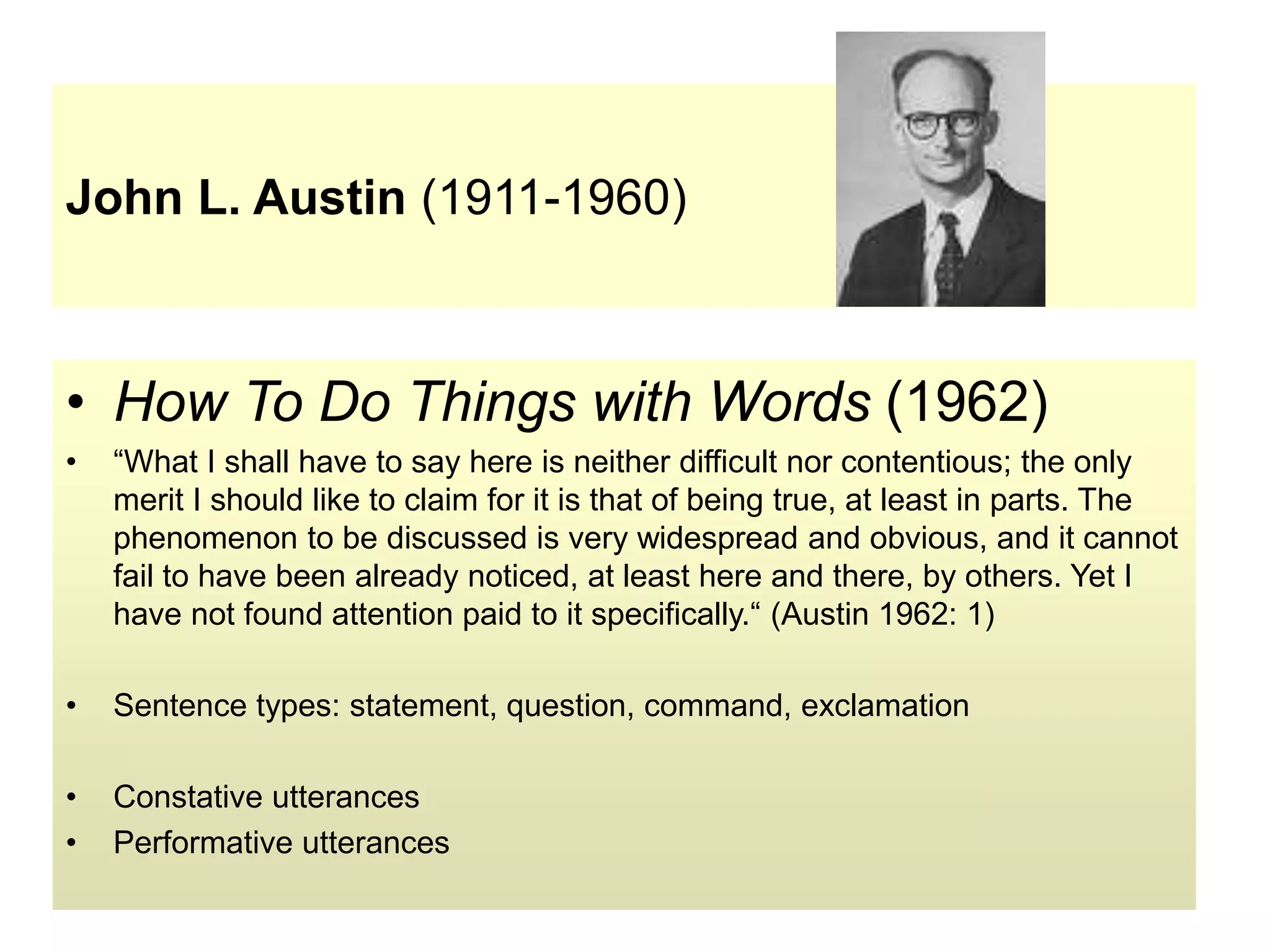
John L. Austin (1911-1960)
• How To Do Things with Words (1962)
• “What I shall have to say here is neither difficult nor contentious; the only
merit I should like to claim for it is that of being true, at least in parts. The
phenomenon to be discussed is very widespread and obvious, and it cannot
fail to have been already noticed, at least here and there, by others. Yet I
have not found attention paid to it specifically.“ (Austin 1962: 1)
• Sentence types: statement, question, command, exclamation
• Constative utterances
• Performative utterances
Performative Utterances:
I name this ship the Queen Elizabeth
I declare the meeting opened
I promise to do this
I apologize
I do (in the marriage ceremony)
I thank you
I congratulate
I hereby question this statement
Explicit performative (apology):
I apologize for my behaviour
Implicit performatives (apology):
I am sorry, It won‘t happen again, It was
stupid of me, I do hope it does not matter, I‘ll
do better next time, I hope you‘re not cross
with me, don‘t be offended …
locutionary act:
there‘s a bull in this field – „just saying it“
illocutionary act:
the „force“ of an utterance
there‘s a bull in this field – warning
perlocutionary act:
the „effect“ of an utterance
there‘s a bull in this field – hearer is frightened,
hearer avoids going into the field
It‘s terribly draughty in here.
I am hungry.
Why are you always late?
Is that your car?
Do you know what time it is?
Are you particularly busy at the moment?
I‘ve been trying to reach you all morning.
Why didn‘t you bring your husband along?
I know you couldn‘t finish your paper because you have so many things on your
hands. (Irony?)
Misunderstandings!
(4)
A: So there‘s no playgroup next week then
B: Oh, isn‘t there [misunderstands A‘s illocution!]
A: No, I was asking
B: Oh, I don‘t know
utterance sentence type illocution
(3)
A: Hey – you‘ve not washed up
yet
B: Yeah – I‘ve been doing my
homework all the time
A: Okay then –
But could you do the washing
up now, please
B: All right
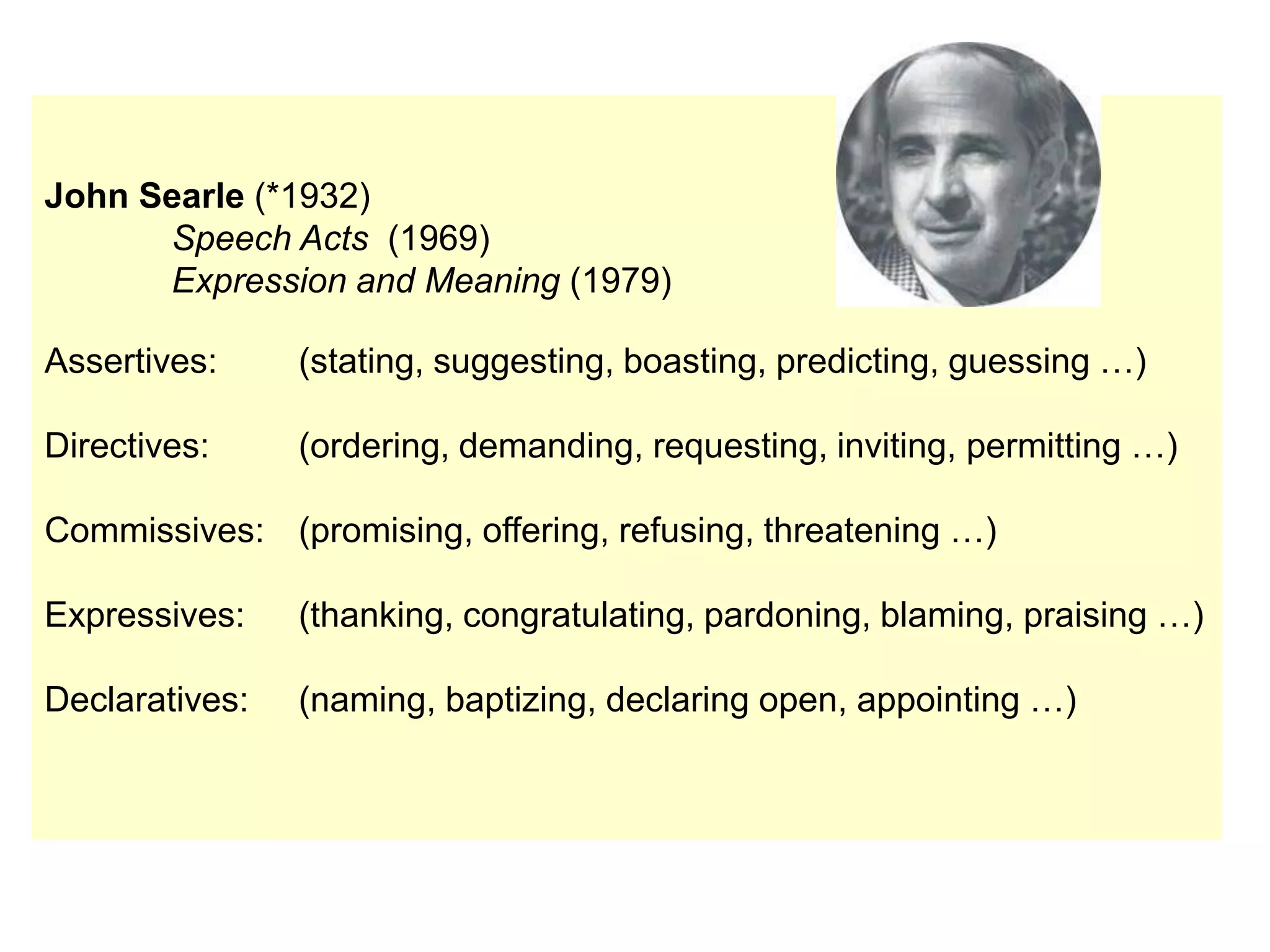
John Searle (*1932)
Speech Acts (1969)
Expression and Meaning (1979)
Assertives: (stating, suggesting, boasting, predicting, guessing …)
Directives: (ordering, demanding, requesting, inviting, permitting …)
Commissives: (promising, offering, refusing, threatening …)
Expressives: (thanking, congratulating, pardoning, blaming, praising …)
Declaratives: (naming, baptizing, declaring open, appointing …)
Searle: Indirect speech acts
An utterance can have two speech acts, one „on top of each other“
A: Do you smoke? (Request for information + offer)
A: let‘s go to the movies tonight (invitation)
B: I have to study for an exam (declining + giving reason)
A: I‘ve been trying to reach you all morning (apology + reproach)
Split illocution (lateral indirectness)
illocution 1 to addressee A
utterance <
illocution 2 to addressee B
Split illocution (lateral indirectness)
A,B,C (professors)
A: Have you read my latest article on pragmatics?
(to B: request for information; to C: boasting)
A(male), B (male), C(female)
A to B: How‘s your wife? (illocution for C?)
A: Can I give you a fag? (offer)
M: We‘ve both given up fags (declines offer, warns
husband)
Paul Grice (1975) „Logic and Conversation“
The Co-operative Principle (CP)
Four maxims: quantity, quality, relation, manner
Pragmatics

Pragmatics

  • 1.
    English Pragmatics Pragmatics: The Studyof the Uses and Effects of language Implied meaning Language as used in concrete situations Language: its impact on the world 1. Key figures (C. Morris, Wittgenstein, Austin, Searle, Grice) 2. Conversational Analysis 3. Text Pragmatics and CDA 4. Language, conflict and peace 5. Non-verbal communication
  • 2.
    University cafeteria - TeacherA to teacher B: “It‘s Friday, unless you‘re tired“ Cindy and Linnea • Cindy: there is a bookstore over there • Linnea: no • Cindy: why not • Linnea: I‘m tired. • Cindy: there is a bookstore over there. Let‘s go inside. • Linnea: no, I don‘t want to go inside. • Cindy: why do you not want to go inside? • Linnea: I don‘t want to because I‘m tired.
  • 3.
    Charles Morris (1938):Syntactics Semantics Pragmatics • Pragmatics studies (the origins), the uses and the effects of language.
  • 4.
    Ludwig Wittgenstein (*1889 Vienna,+1951 Cambridge) Tractatus Logico-Philosophicus (1922) „Wovon man nicht sprechen kann, darüber muss man schweigen.“ Philosophical Investigations (1953) „… musste ich schwere Irrtümer in dem erkennen was ich in jenem ersten Buch [dem Tractatus] niedergelegt hatte.“ Meaning = use Language – an activity Language games (Sprachspiele) – things you do with language
  • 5.
    “Review the multiplicityof language games in the following examples, and in others: giving orders, obeying them reporting an event play-acting singing catches guessing riddles making a joke, telling it translating from one language into another asking, thanking, cursing, greeting, praying. It is interesting to compare the multiplicity of the tools in a language … with what logicians have said about the structure of language (including the author of the Tractatus Logico-philosophicus).“
  • 6.
    John L. Austin(1911-1960) • How To Do Things with Words (1962) • “What I shall have to say here is neither difficult nor contentious; the only merit I should like to claim for it is that of being true, at least in parts. The phenomenon to be discussed is very widespread and obvious, and it cannot fail to have been already noticed, at least here and there, by others. Yet I have not found attention paid to it specifically.“ (Austin 1962: 1) • Sentence types: statement, question, command, exclamation • Constative utterances • Performative utterances
  • 7.
    Performative Utterances: I namethis ship the Queen Elizabeth I declare the meeting opened I promise to do this I apologize I do (in the marriage ceremony) I thank you I congratulate I hereby question this statement
  • 8.
    Explicit performative (apology): Iapologize for my behaviour Implicit performatives (apology): I am sorry, It won‘t happen again, It was stupid of me, I do hope it does not matter, I‘ll do better next time, I hope you‘re not cross with me, don‘t be offended …
  • 9.
    locutionary act: there‘s abull in this field – „just saying it“ illocutionary act: the „force“ of an utterance there‘s a bull in this field – warning perlocutionary act: the „effect“ of an utterance there‘s a bull in this field – hearer is frightened, hearer avoids going into the field
  • 10.
    It‘s terribly draughtyin here. I am hungry. Why are you always late? Is that your car? Do you know what time it is? Are you particularly busy at the moment? I‘ve been trying to reach you all morning. Why didn‘t you bring your husband along? I know you couldn‘t finish your paper because you have so many things on your hands. (Irony?) Misunderstandings!
  • 11.
    (4) A: So there‘sno playgroup next week then B: Oh, isn‘t there [misunderstands A‘s illocution!] A: No, I was asking B: Oh, I don‘t know utterance sentence type illocution (3) A: Hey – you‘ve not washed up yet B: Yeah – I‘ve been doing my homework all the time A: Okay then – But could you do the washing up now, please B: All right
  • 12.
    John Searle (*1932) SpeechActs (1969) Expression and Meaning (1979) Assertives: (stating, suggesting, boasting, predicting, guessing …) Directives: (ordering, demanding, requesting, inviting, permitting …) Commissives: (promising, offering, refusing, threatening …) Expressives: (thanking, congratulating, pardoning, blaming, praising …) Declaratives: (naming, baptizing, declaring open, appointing …)
  • 13.
    Searle: Indirect speechacts An utterance can have two speech acts, one „on top of each other“ A: Do you smoke? (Request for information + offer) A: let‘s go to the movies tonight (invitation) B: I have to study for an exam (declining + giving reason) A: I‘ve been trying to reach you all morning (apology + reproach) Split illocution (lateral indirectness) illocution 1 to addressee A utterance < illocution 2 to addressee B
  • 14.
    Split illocution (lateralindirectness) A,B,C (professors) A: Have you read my latest article on pragmatics? (to B: request for information; to C: boasting) A(male), B (male), C(female) A to B: How‘s your wife? (illocution for C?) A: Can I give you a fag? (offer) M: We‘ve both given up fags (declines offer, warns husband)
  • 15.
    Paul Grice (1975)„Logic and Conversation“ The Co-operative Principle (CP) Four maxims: quantity, quality, relation, manner