A view on procurement best
practice

Dr Gordon Murray
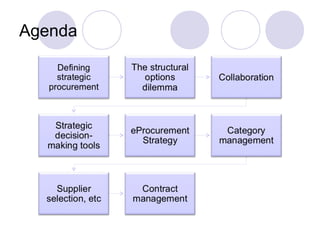
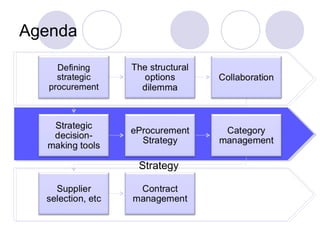
Agenda
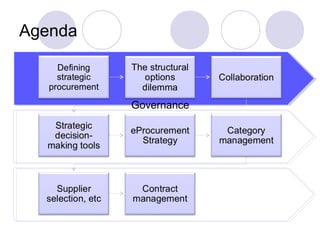
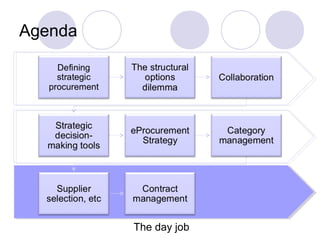
Agenda

Governance
Agenda

Strategy
Agenda

The day job
What do you mean when you
refer to procurement?
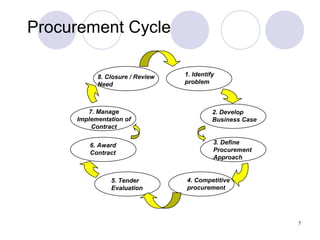
Procurement Cycle
8. Closure / Review
Need

7. Manage
Implementation of
Contract
6. Award
Contract

5. Tender
Evaluation

1. Identify
problem

2. Develop
Business Case

3. Define
Procurement
Approach

4. Competitive
procurement

7
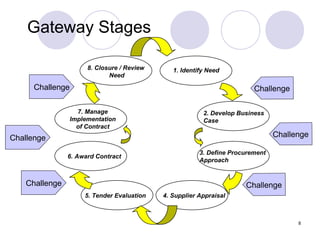
Gateway Stages
8. Closure / Review
Need

1. Identify Need

Challenge

Challenge
7. Manage
Implementation
of Contract

2. Develop Business
Case

6. Award Contract

3. Define Procurement
Approach

Challenge

Challenge

Challenge

Challenge
5. Tender Evaluation

4. Supplier Appraisal

8
Structural options
Which is best – centralised or
decentralised procurement?
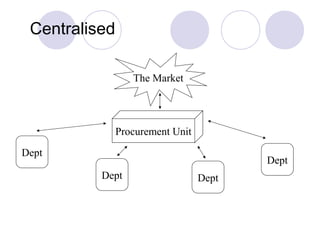
Centralised
The Market

Procurement Unit
Dept

Dept
Dept

Dept
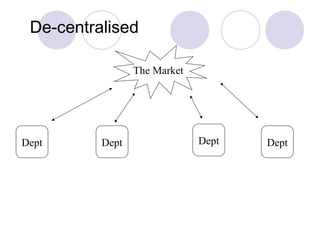
De-centralised
The Market

Dept

Dept

Dept

Dept
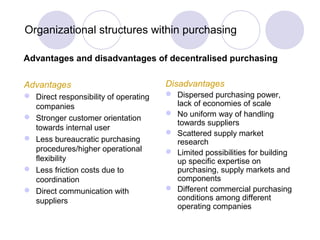
Organizational structures within purchasing
Advantages and disadvantages of decentralised purchasing
Advantages

Disadvantages

 Direct responsibility of operating
companies
 Stronger customer orientation
towards internal user
 Less bureaucratic purchasing
procedures/higher operational
flexibility
 Less friction costs due to
coordination
 Direct communication with
suppliers

 Dispersed purchasing power,
lack of economies of scale
 No uniform way of handling
towards suppliers
 Scattered supply market
research
 Limited possibilities for building
up specific expertise on
purchasing, supply markets and
components
 Different commercial purchasing
conditions among different
operating companies
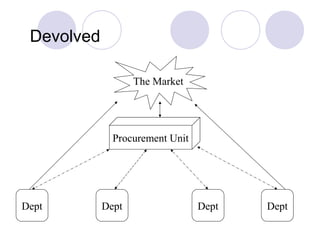
Devolved
The Market

Procurement Unit

Dept

Dept

Dept

Dept
Procurement Collaboration
Why bother?
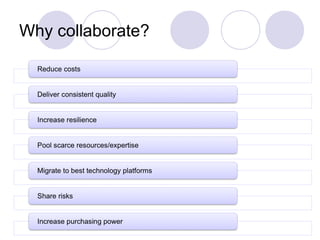
Why collaborate?
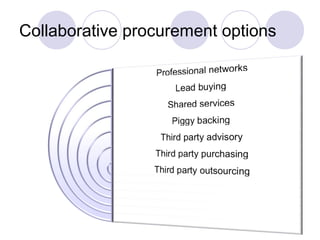
Collaborative procurement options
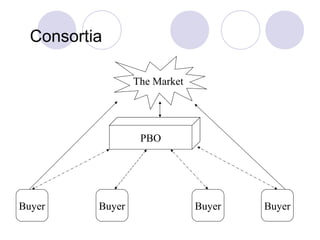
Consortia
The Market

PBO

Buyer

Buyer

Buyer

Buyer
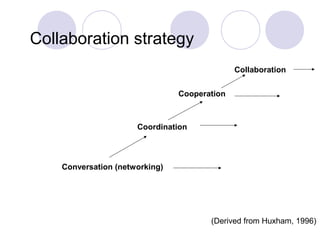
Collaboration strategy
Collaboration
Cooperation

Coordination

Conversation (networking)

(Derived from Huxham, 1996)
Procurement
decision-making tools
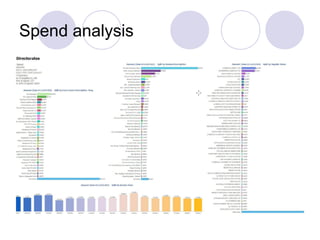
Spend analysis
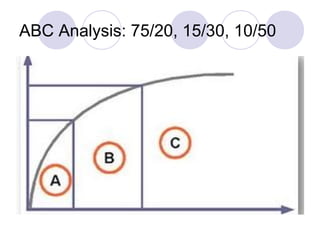
ABC Analysis: 75/20, 15/30, 10/50
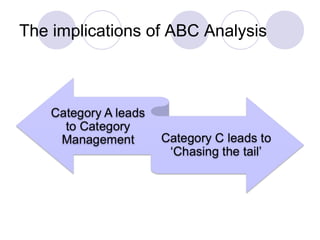
The implications of ABC Analysis
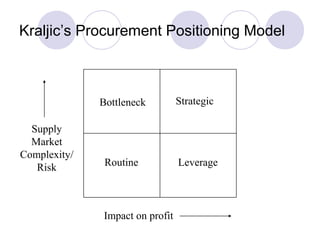
Kraljic’s Procurement Positioning Model

Bottleneck
Supply
Market
Complexity/
Risk

Routine

Impact on profit

Strategic

Leverage
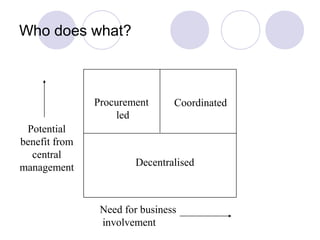
Who does what?

Procurement
led
Potential
benefit from
central
management

Coordinated

Decentralised

Need for business
involvement
Relative Power
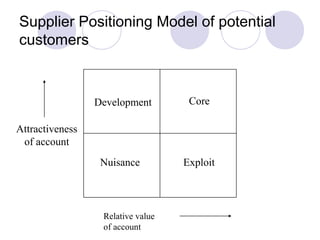
Supplier Positioning Model of potential
customers

Development

Core

Nuisance

Exploit

Attractiveness
of account

Relative value
of account
eProcurement
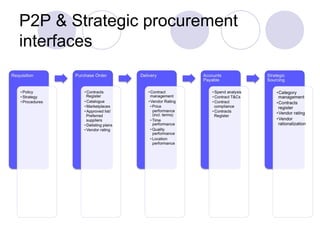
P2P & Strategic procurement
interfaces
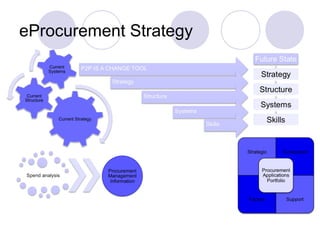
eProcurement Strategy
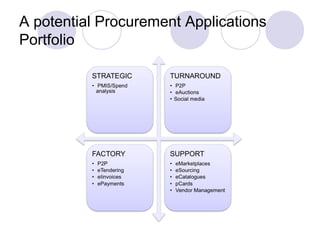
A potential Procurement Applications
Portfolio
Category management
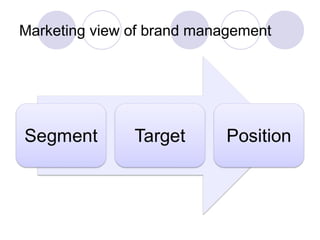
Marketing view of brand management
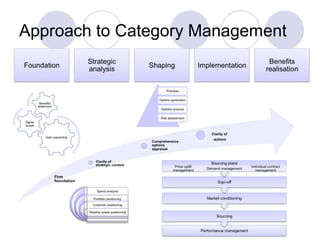
Approach to Category Management
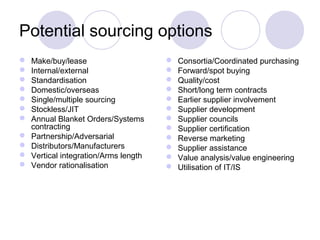
Potential sourcing options












Make/buy/lease
Internal/external
Standardisation
Domestic/overseas
Single/multiple sourcing
Stockless/JIT
Annual Blanket Orders/Systems
contracting
Partnership/Adversarial
Distributors/Manufacturers
Vertical integration/Arms length
Vendor rationalisation














Consortia/Coordinated purchasing
Forward/spot buying
Quality/cost
Short/long term contracts
Earlier supplier involvement
Supplier development
Supplier councils
Supplier certification
Reverse marketing
Supplier assistance
Value analysis/value engineering
Utilisation of IT/IS
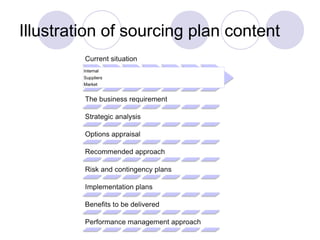
Illustration of sourcing plan content
Supplier selection and
contract award
View supplier selection and
contract award as risk
management
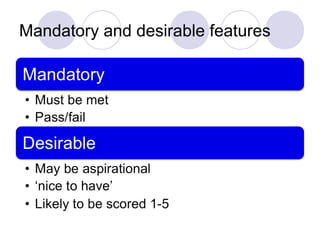
Mandatory and desirable features
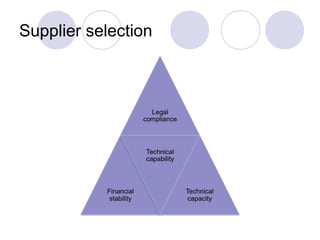
Supplier selection
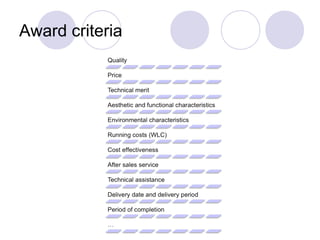
Award criteria
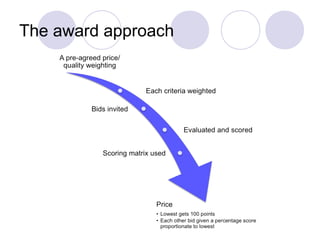
The award approach
Contract Management
Contract Management
When does it start?
When does it end?
Who’s responsible?
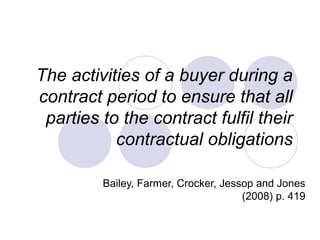
The activities of a buyer during a
contract period to ensure that all
parties to the contract fulfil their
contractual obligations
Bailey, Farmer, Crocker, Jessop and Jones
(2008) p. 419
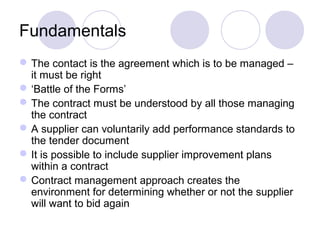
Fundamentals
 The contact is the agreement which is to be managed –
it must be right
 ‘Battle of the Forms’
 The contract must be understood by all those managing
the contract
 A supplier can voluntarily add performance standards to
the tender document
 It is possible to include supplier improvement plans
within a contract
 Contract management approach creates the
environment for determining whether or not the supplier
will want to bid again
What could go wrong with a
contract?

48
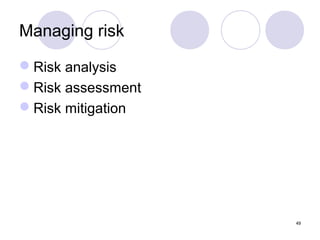
Managing risk
Risk analysis
Risk assessment
Risk mitigation

49
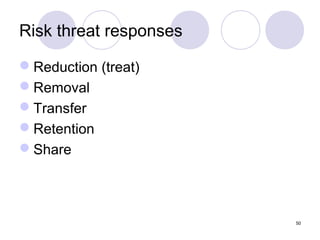
Risk threat responses
Reduction (treat)
Removal
Transfer
Retention
Share

50
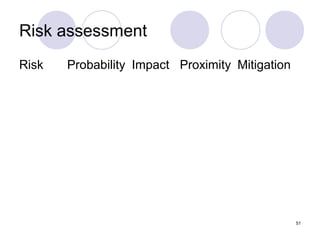
Risk assessment
Risk

Probability Impact Proximity Mitigation

51
Relationship management

52
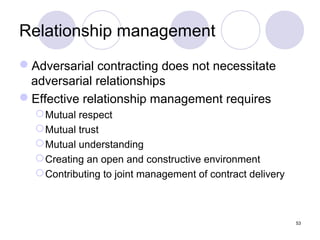
Relationship management
Adversarial contracting does not necessitate
adversarial relationships
Effective relationship management requires
 Mutual respect
 Mutual trust
 Mutual understanding
 Creating an open and constructive environment
 Contributing to joint management of contract delivery

53
Service delivery management

54
Performance management
Shaped by the original customer definition of
need
KPIs identified prior to contracting
Likely to be directly linked to tender evaluation
criteria
KPIs should be
 Proportionate,
 fit for purpose,
 easy to support by evidence,
 accepted by key stakeholders
55
Performance measures
Cost and value obtained
Performance and customer satisfaction
Delivery improvement and added value
Delivery capability
Benefits realised
Relationship strength
Responsiveness
56
Change happens!
Contract variations

57
What circumstances could justify
a change in the contract?

58
What steps are required when
a change takes place?

59
Managing contract change
 Acceptance that change happens
 Risk management predicts what might happen and potential
responses
 Changes require negotiation
 Change management control is essential





Due process
Principles of transparency, fairness, accountability and stewardship
Appropriate record keeping
Due authorisation

 Accepted changes require scheduling to minimise adverse impact
 Changes need to be communicated
 Novation and assignment

60
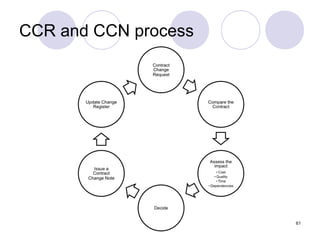
CCR and CCN process

61
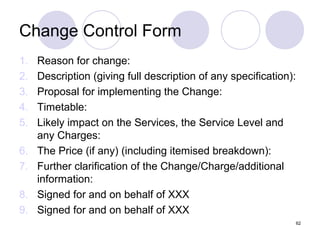
Change Control Form
1.
2.
3.
4.
5.
6.
7.
8.
9.

Reason for change:
Description (giving full description of any specification):
Proposal for implementing the Change:
Timetable:
Likely impact on the Services, the Service Level and
any Charges:
The Price (if any) (including itemised breakdown):
Further clarification of the Change/Charge/additional
information:
Signed for and on behalf of XXX
62
Closing the contract

63
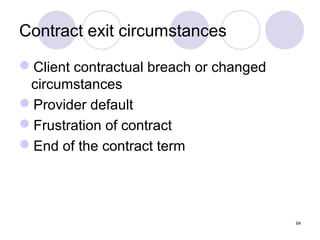
Contract exit circumstances
Client contractual breach or changed
circumstances
Provider default
Frustration of contract
End of the contract term

64
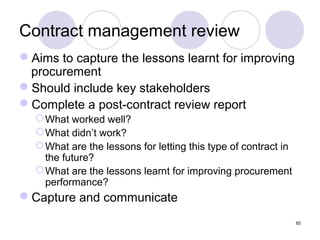
Contract management review
Aims to capture the lessons learnt for improving
procurement
Should include key stakeholders
Complete a post-contract review report
 What worked well?
 What didn’t work?
 What are the lessons for letting this type of contract in
the future?
 What are the lessons learnt for improving procurement
performance?

Capture and communicate
65
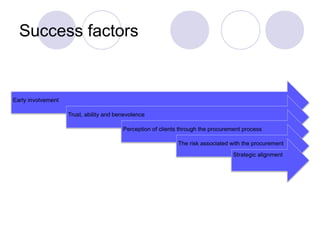
Success factors
Thank you for your attention

A view of procurement best practice

Editor's Notes

  • #63 Change Control Note This Change Control Note (CCN #XXX) is between XXX of XXX Co # and XXX CCN XXX is entered into by the Parties pursuant to a Services Agreement between the Parties dated XXX (the Agreement) and is effective as of the date of the later of the Parties signatures to this CNN# (the Effective Date) WHEREAS This CNN # and all non-contractual obligations arising out f or in connection with it are governed by the laws of XXX and The Parties submit to the exclusive jurisdiction of the courts of XXX CCN #: XXX Title of Change: XXX Originator: XXX Date: XXX Version: v0.1 Priority: H/M/L Cost Impact XXX Schedule Impact: XXX