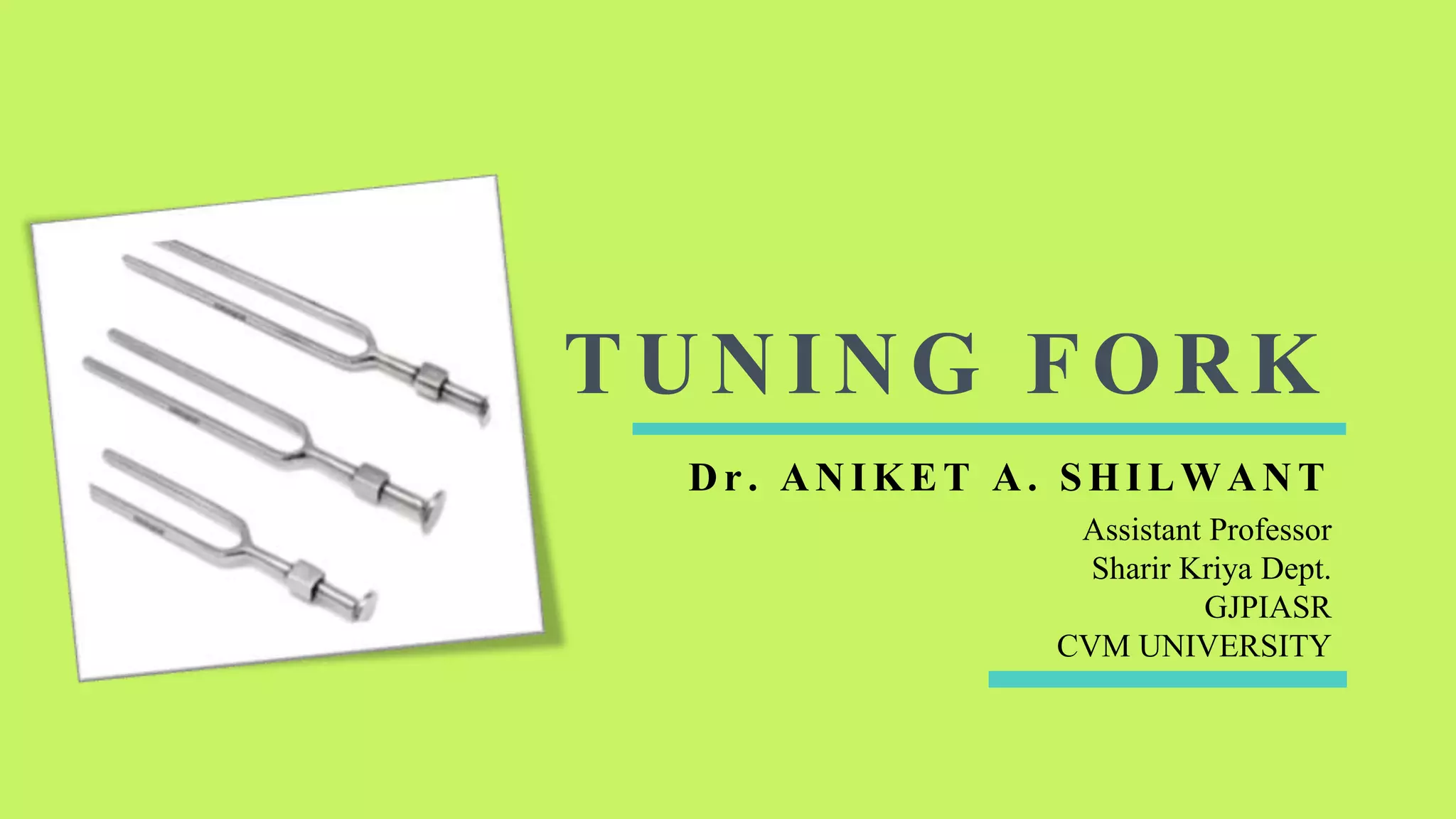

TUNING FORK
D r. A N IKET A . SHILWA N T
Assistant Professor
Sharir Kriya Dept.
GJPIASR
CVM UNIVERSITY
I N T R O D U C T I O N
 Invention – In 1711 by a British Musician – John Shore
 John Shore – A Trumpeter and a Lutenist in a British Musical Band
 A metal instrument with a handle and two prongs or wings to create sound
notes.
 It is also known as an – Acoustic Resonator
 Pitch of sound notes depends on the length and mass of the two prongs.
P R I N C I P L E
 A tuning fork emits a tone or sound notes at a particular pitch.
 The tuning fork is set into vibration by holding the stem or handle in
the hand and stroking the prongs over a firm and resilient surface.
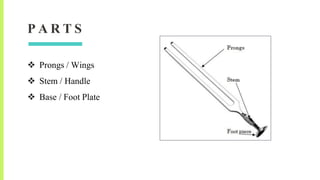
P A R T S
 Prongs / Wings
 Stem / Handle
 Base / Foot Plate
T Y P E S
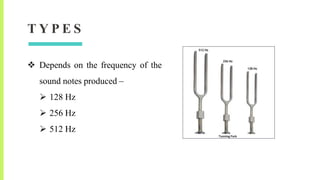
 Depends on the frequency of the
sound notes produced –
 128 Hz
 256 Hz
 512 Hz
U S E S
 Assessment of Hearing sensation
 Primary assessment of Bone fractures
A P P L I C A T I O N S
 Assessment of Hearing sensation can be done by three different tests
–
 Rinne’s Test
 Weber’s Test
 Schwabach’s Test
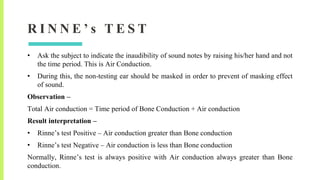
R I N N E ’ s T E S T
Invented by – German otologist Heinrich Adolf Rinne (1819-1868)
Principle – It takes greater level of vibrational stimuli to Bone conduction than Air conduction.
Aim – To determine the conductive hearing deafness of a subject by comparing Air and Bone
conduction.
Procedure –
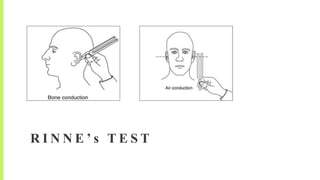
• Set a tuning fork into vibration. Keep a base of vibrational tuning fork on the mastoid
process at post-auricular region on one side of subject. Start the stop watch simultaneously.
• Ask the subject to indicate the inaudibility of sound notes by raising his/her hand and not the
time period. This is Bone Conduction.
• Later, bring the same tuning fork immediately near to the same sided ear without touching
any part. The sound notes are again audible.
R I N N E ’ s T E S T
• Ask the subject to indicate the inaudibility of sound notes by raising his/her hand and not
the time period. This is Air Conduction.
• During this, the non-testing ear should be masked in order to prevent of masking effect
of sound.
Observation –
Total Air conduction = Time period of Bone Conduction + Air conduction
Result interpretation –
• Rinne’s test Positive – Air conduction greater than Bone conduction
• Rinne’s test Negative – Air conduction is less than Bone conduction
Normally, Rinne’s test is always positive with Air conduction always greater than Bone
conduction.
R I N N E ’ s T E S T
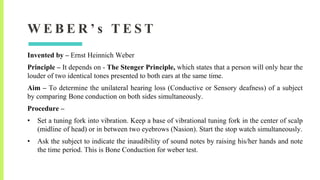
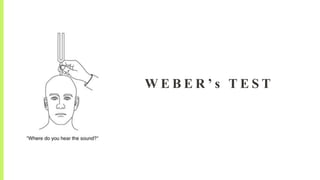
W E B E R ’ s T E S T
Invented by – Ernst Heinnich Weber
Principle – It depends on - The Stenger Principle, which states that a person will only hear the
louder of two identical tones presented to both ears at the same time.
Aim – To determine the unilateral hearing loss (Conductive or Sensory deafness) of a subject
by comparing Bone conduction on both sides simultaneously.
Procedure –
• Set a tuning fork into vibration. Keep a base of vibrational tuning fork in the center of scalp
(midline of head) or in between two eyebrows (Nasion). Start the stop watch simultaneously.
• Ask the subject to indicate the inaudibility of sound notes by raising his/her hands and note
the time period. This is Bone Conduction for weber test.
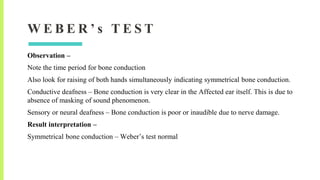
W E B E R ’ s T E S T
Observation –
Note the time period for bone conduction
Also look for raising of both hands simultaneously indicating symmetrical bone conduction.
Conductive deafness – Bone conduction is very clear in the Affected ear itself. This is due to
absence of masking of sound phenomenon.
Sensory or neural deafness – Bone conduction is poor or inaudible due to nerve damage.
Result interpretation –
Symmetrical bone conduction – Weber’s test normal
W E B E R ’ s T E S T
S C H W A B A C H ’ s T E S T
Principle – It is based on the principle that the examiner should have a normal
hearing, or when the tuning fork is vibrated the sound fades after sometime.
Aim – To assess and compare the bone conduction and hearing sensitivity of a
subject with that of examiner.
Procedure –
Base of a vibrating tuning fork is kept over the mastoid process of the patient. Start
the stop watch simultaneously.
Ask the subject to indicate the inaudibility of sound notes by raising his/her hands
and note the time period. This is Bone Conduction for schwabach’s test.
S C H W A B A C H ’ s T E S T
• Later the same vibrating tuning fork is brought and kept on the mastoid process of
examiner immediately.
• Examiner should look for audibility of sound notes, as examiner is standard for that case.
• If both the subject and examiner are normal, then the bone conduction will be same and
examiner will also be unable to hear the sound notes.
Observation –
Note the precise time period of bone conduction for subject and examiner.
Result interpretation –
Symmetrical bone conduction in subject and examiner is indicative that Schwabach’s test is
normal.
Thanks!
D r . A n i k e t A . S h i l w a n t
Assistant Professor
Sharir Kriya Dept.
GJPIASR, CVM University
ayuraniket18@gmail.com
aniket.shilwant@cvmu.edu.in
16

TUNING FORK

  • 1.
    TUNING FORK D r.A N IKET A . SHILWA N T Assistant Professor Sharir Kriya Dept. GJPIASR CVM UNIVERSITY
  • 2.
    I N TR O D U C T I O N  Invention – In 1711 by a British Musician – John Shore  John Shore – A Trumpeter and a Lutenist in a British Musical Band  A metal instrument with a handle and two prongs or wings to create sound notes.  It is also known as an – Acoustic Resonator  Pitch of sound notes depends on the length and mass of the two prongs.
  • 3.
    P R IN C I P L E  A tuning fork emits a tone or sound notes at a particular pitch.  The tuning fork is set into vibration by holding the stem or handle in the hand and stroking the prongs over a firm and resilient surface.
  • 4.
    P A RT S  Prongs / Wings  Stem / Handle  Base / Foot Plate
  • 5.
    T Y PE S  Depends on the frequency of the sound notes produced –  128 Hz  256 Hz  512 Hz
  • 6.
    U S ES  Assessment of Hearing sensation  Primary assessment of Bone fractures
  • 7.
    A P PL I C A T I O N S  Assessment of Hearing sensation can be done by three different tests –  Rinne’s Test  Weber’s Test  Schwabach’s Test
  • 8.
    R I NN E ’ s T E S T Invented by – German otologist Heinrich Adolf Rinne (1819-1868) Principle – It takes greater level of vibrational stimuli to Bone conduction than Air conduction. Aim – To determine the conductive hearing deafness of a subject by comparing Air and Bone conduction. Procedure – • Set a tuning fork into vibration. Keep a base of vibrational tuning fork on the mastoid process at post-auricular region on one side of subject. Start the stop watch simultaneously. • Ask the subject to indicate the inaudibility of sound notes by raising his/her hand and not the time period. This is Bone Conduction. • Later, bring the same tuning fork immediately near to the same sided ear without touching any part. The sound notes are again audible.
  • 9.
    R I NN E ’ s T E S T • Ask the subject to indicate the inaudibility of sound notes by raising his/her hand and not the time period. This is Air Conduction. • During this, the non-testing ear should be masked in order to prevent of masking effect of sound. Observation – Total Air conduction = Time period of Bone Conduction + Air conduction Result interpretation – • Rinne’s test Positive – Air conduction greater than Bone conduction • Rinne’s test Negative – Air conduction is less than Bone conduction Normally, Rinne’s test is always positive with Air conduction always greater than Bone conduction.
  • 10.
    R I NN E ’ s T E S T
  • 11.
    W E BE R ’ s T E S T Invented by – Ernst Heinnich Weber Principle – It depends on - The Stenger Principle, which states that a person will only hear the louder of two identical tones presented to both ears at the same time. Aim – To determine the unilateral hearing loss (Conductive or Sensory deafness) of a subject by comparing Bone conduction on both sides simultaneously. Procedure – • Set a tuning fork into vibration. Keep a base of vibrational tuning fork in the center of scalp (midline of head) or in between two eyebrows (Nasion). Start the stop watch simultaneously. • Ask the subject to indicate the inaudibility of sound notes by raising his/her hands and note the time period. This is Bone Conduction for weber test.
  • 12.
    W E BE R ’ s T E S T Observation – Note the time period for bone conduction Also look for raising of both hands simultaneously indicating symmetrical bone conduction. Conductive deafness – Bone conduction is very clear in the Affected ear itself. This is due to absence of masking of sound phenomenon. Sensory or neural deafness – Bone conduction is poor or inaudible due to nerve damage. Result interpretation – Symmetrical bone conduction – Weber’s test normal
  • 13.
    W E BE R ’ s T E S T
  • 14.
    S C HW A B A C H ’ s T E S T Principle – It is based on the principle that the examiner should have a normal hearing, or when the tuning fork is vibrated the sound fades after sometime. Aim – To assess and compare the bone conduction and hearing sensitivity of a subject with that of examiner. Procedure – Base of a vibrating tuning fork is kept over the mastoid process of the patient. Start the stop watch simultaneously. Ask the subject to indicate the inaudibility of sound notes by raising his/her hands and note the time period. This is Bone Conduction for schwabach’s test.
  • 15.
    S C HW A B A C H ’ s T E S T • Later the same vibrating tuning fork is brought and kept on the mastoid process of examiner immediately. • Examiner should look for audibility of sound notes, as examiner is standard for that case. • If both the subject and examiner are normal, then the bone conduction will be same and examiner will also be unable to hear the sound notes. Observation – Note the precise time period of bone conduction for subject and examiner. Result interpretation – Symmetrical bone conduction in subject and examiner is indicative that Schwabach’s test is normal.
  • 16.
    Thanks! D r .A n i k e t A . S h i l w a n t Assistant Professor Sharir Kriya Dept. GJPIASR, CVM University ayuraniket18@gmail.com aniket.shilwant@cvmu.edu.in 16