Apr 12, 2016
Dr. AMREEN SABA
ATTARIYA
Dr.ASA:ATC/DDD Date: 09/Apr/16
POST GRADUATE STUDENT
DEPT OF PHARMACOLOGY
M.R. MEDICAL COLLEGE, GULBARGA
INDIA
Outline
The ATC/DDD methodology
Definition, Purpose, Structure
And Principles
Real world applications of ATC/DDD.
DU90%
Electronic Prescribing
Summary
References
Apr 12, 2016Dr.ASA:ATC/DDD
ATC/DDD???
ATC (Anatomical Therapeutic Chemical) Classification
Don’t confuse it with Anatomical Therapeutic
(AT)classification developed by European
Pharmaceutical Market Research Association
(EPhMRA)
DDD (Defined Daily Dose) The assumed average
maintenance dose per day for a drug used for its main
indication in adults
Apr 12, 2016
Introduction to Drug Utilization Research, WHO 2003
Dr.ASA:ATC/DDD
Main Purpose
“International language for Drug Utilisation(DU)
research”
Tool for presenting DU researchimprove
quality of drug use
Presentation & comparison of drug consumption
statistics at national & international level.
Apr 12, 2016Dr.ASA:ATC/DDD
Drawback
Not suitable for guiding decisions about
Reimbursment
Pricing
Therapeutic substitution
Apr 12, 2016Dr.ASA:ATC/DDD
The Classification Of A Substance In The
ATC/DDD System Is Not A Recommendation For
Use, Nor Does It Imply Any Judgments About
Efficacy Or Relative Efficacy Of Drugs & Groups Of
Drugs.
Apr 12, 2016Dr.ASA:ATC/DDD
The WHO Collaborating Centre for Drug
Statistics Methodology
Established in 1982 in OSLO.
In 1996WHO recognised the use of ATC/DDD as
international std for DU.
Centre was until 2001 was at Norwegian Medicine
Depot(NMD)From Jan 2002,shifted to Norwegian
Institute Of Public Health(Dept of
Pharmacoepidemiology).
Apr 12, 2016Dr.ASA:ATC/DDD
Main activities of WHO Centre
To classify drugs according to the ATC system and
assign DDDs
Review and revise as necessary.
Stimulate and influence the practical use of the system
Organize training courses in the ATC/DDD
methodology
Provide technical support to countries in setting up
national medicines classification system.
Apr 12, 2016Dr.ASA:ATC/DDD
ATC Main Group(14)
A- Alimentary Tract And Metabolism
B-Blood And Blood Forming Organs
C- Cardiovascular System
D- Dermatologicals
G -Genito Urinary System And Sex Hormones
H -Systemic Hormonal Preparations, Excl. Sex Hormones And Insulins
J- Antiinfectives For Systemic Use
L- Antineoplastic And Immunomodulating Agents
M- Musculo-skeletal System
N- Nervous System
P- AntiParasitic Products, Insecticides And Repellents
R- Respiratory System
S- Sensory Organs
V- Various Apr 12, 2016Dr.ASA:ATC/DDD
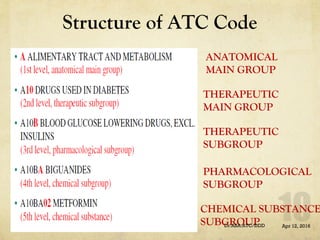
Structure of ATC Code
Apr 12, 2016
ANATOMICAL
MAIN GROUP
THERAPEUTIC
MAIN GROUP
THERAPEUTIC
SUBGROUP
PHARMACOLOGICAL
SUBGROUP
CHEMICAL SUBSTANCE
SUBGROUPDr.ASA:ATC/DDD
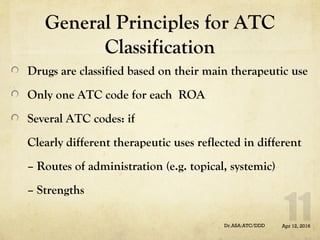
General Principles for ATC
Classification
Drugs are classified based on their main therapeutic use
Only one ATC code for each ROA
Several ATC codes: if
Clearly different therapeutic uses reflected in different
– Routes of administration (e.g. topical, systemic)
– Strengths
Apr 12, 2016Dr.ASA:ATC/DDD
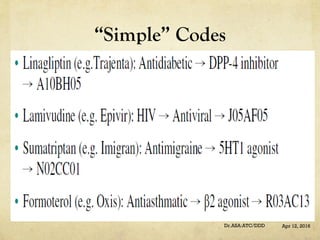
“Simple” Codes
Apr 12, 2016Dr.ASA:ATC/DDD
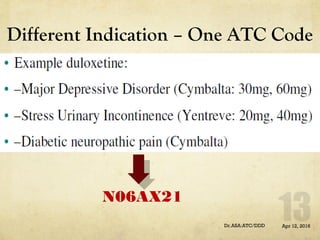
Different Indication – One ATC Code
Apr 12, 2016Dr.ASA:ATC/DDD
N06AX21
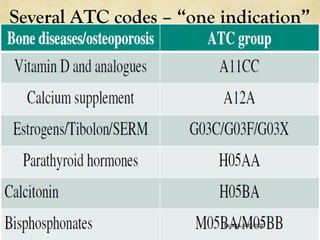
Several ATC codes – “one indication”
Apr 12, 2016Dr.ASA:ATC/DDD
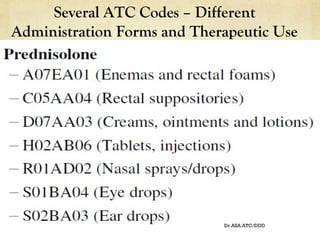
Several ATC Codes – Different
Administration Forms and Therapeutic Use
Apr 12, 2016Dr.ASA:ATC/DDD
OTHER ATC CLASSIFICATION SYSTEMS
ATCvet classification
ATC herbal classification
Apr 12, 2016Dr.ASA:ATC/DDD
Defined Daily Dose (DDD)
Assumed Average Maintenance Dose
Per Day For A Drug Used For Its
Main Indication In Adults.
Apr 12, 2016Dr.ASA:ATC/DDD
DDD is nearly always a compromise
based on a review of the available
information including doses used in
various countries.
Apr 12, 2016Dr.ASA:ATC/DDD
DDD is sometimes a dose that is rarely if
ever prescribed, because
it is an AVERAGE of two or more
commonly used dose sizes.
Apr 12, 2016Dr.ASA:ATC/DDD
Concept of DDD
A technical unit of measurement, represents an
“average” daily dose for the main indication
For measuring & comparing volume of drug
use
Should not be interpreted as the RDA/PDD
Reflects global dosage irrespective of genetic
variations.
Rough estimate of consumption & not an exact
picture of actual use Apr 12, 2016Dr.ASA:ATC/DDD
Principles for DDD assignment
One DDD per ROA within an ATC code.
DDD will NOT be assigned unless a product is approved
& marketed in at least one country.
For substances indicated for rare disorders with individual
dosing DDD may not be assigned.
DDDs for herbal medicinal products are not included in
the ATC index(published in an ATC sorted list on the
website www.whocc.no)
Apr 12, 2016Dr.ASA:ATC/DDD
Sources Used When Assigning DDDs
Approved dose recommendations for the main
indication
Submitted documentation from the applicant,
textbooks, and data from clinical trials
Apr 12, 2016Dr.ASA:ATC/DDD
Commonly Used Measures To
Express Drug Exposure In DDD
DDDs/1000 inhabitants/day
DDDs /100 bed-days
DDDs /inhabitants /year
Apr 12, 2016Dr.ASA:ATC/DDD
DDDs/1000 inhabitants/day
Ex: 10 DDDs/1000 inhabitants/day
1% of the population can receive a
certain treatment daily
Apr 12, 2016Dr.ASA:ATC/DDD
DDDs /100 bed days
When drug use by inpatients.
Ex: 70 DDDs /100 bed days of hypnotics
70% of the inpatients might receive a DDD of a hypnotic
every day.
Useful for benchmarking in hospitals.
Apr 12, 2016Dr.ASA:ATC/DDD
DDDs/1000 inhabitants/year
Estimate of the average number of days
for which each inhabitant is treated
annually
Apr 12, 2016Dr.ASA:ATC/DDD
Selection of units
g
mg
mcg
mmol
U(unit)
TU(thousand U)
MU(million U)
UD(unit dose)for combination products Apr 12, 2016Dr.ASA:ATC/DDD
Codes for Route Of Administration
Inhal = Inhalation
R = Rectal
N = Nasal
SL = Sublingual/buccal/oromucosal
O = Oral
TD = Transdermal
P = Parenteral
V = Vaginal
Apr 12, 2016Dr.ASA:ATC/DDD
Pediatric DDD
DDDs are normally assigned based on use in adults.
For medicinal products approved for use in children,
the dose recommendations will differ based on AGE
& BW.
Pediatric DDDs cant be assigned
Apr 12, 2016Dr.ASA:ATC/DDD
Applications of ATC/DDD
Drug utilization and pharmacoepidemiology
– PVG
– Regulatory intervention and impact of drug
use
Apr 12, 2016Dr.ASA:ATC/DDD
ATC/DDD in DU Research
Study patterns of use and changes over time
Evaluate the impact of information efforts,
regulatory changes etc.
Study drug exposure in relation to ADR
Indicate over-use, under-use and misuse/abuse of
drugs
Defines need for further pharmacoepidemiology
studies
Apr 12, 2016Dr.ASA:ATC/DDD
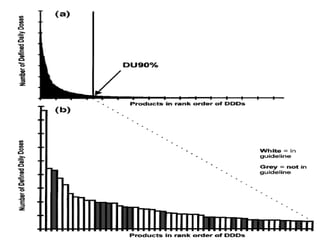
DU90%
Innovative approach to assess drug prescription.
Assumption: Low Number Of Drugs
Prescribed Is Associated With More
Rational Prescribing Practices.
Does not directly reflect the quality of
prescription.
Apr 12, 2016Dr.ASA:ATC/DDD
Used for exploring drug prescription in a rapid,
effective and inexpensive way.
Reflects the number of drugs that account for
90% of drug prescriptions & the adherence to
local or national prescription guidelines in this
segment.
Apr 12, 2016
Dr.ASA:ATC/DDD
*Bergman ULF. Pharmacoepidemiology- from description to quality assessment:
A Swedish perspective. Norwegian Journal of Epidemiology 2001;11(1):31-6
Apr 12, 2016Dr.ASA:ATC/DDD
ELECTRONIC PRESCRIBING*
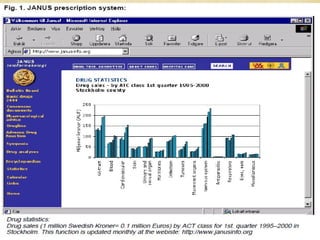
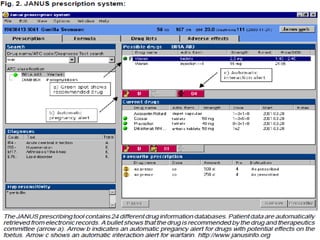
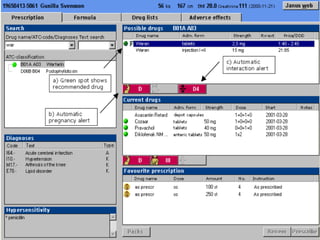
In Stockholm, a computer-based prescription
support system, JANUS telepharmacology, has
been developed.
Aims at providing all prescribers within a country
with
• EASILY ACCESSIBLE
• CLINICALLY RELEVANT
• UPDATED INFORMATION ON DRUGS
Apr 12, 2016Dr.ASA:ATC/DDD*WHO Drug Information Vol. 16, No. 3, 2002
SYSTEM INCLUDES:
Information and recommendations from
Regional and local drug committees in the county
Recent guidelines from the medical products
agency
Links to the physicians desk reference
Recent drug news with comments and evaluations
by specialists.
Apr 12, 2016Dr.ASA:ATC/DDD
Summary
ATC/DDD system is “the gold standard” for international DU research
Tool for exchanging and comparing data on drug use at local, national or
international levels.
This system is itself not suitable for guiding decisions about
reimbursement, pricing etc
DDD-is assumed average maintenance dose in adults & shouldn’t be
confused with PDD/RDA.
Units of DDD.
Pediatric DDD cannot be assigned.
DU90% identifies the number of drugs making upto 90% of the total
volume measured in DDD or number of prescription (NP), during a
certain period of time
Apr 12, 2016Dr.ASA:ATC/DDD
References
www.whocc.no
Annual ATC/DDD courses in Oslo, Norway
Guidelines for ATC classification and DDD
assignment 2016.
Apr 12, 2016Dr.ASA:ATC/DDD

Anatomic Therapeutic Chemical Classification, Defined daily dose, Drug utilisation

  • 1.
    Apr 12, 2016 Dr.AMREEN SABA ATTARIYA Dr.ASA:ATC/DDD Date: 09/Apr/16 POST GRADUATE STUDENT DEPT OF PHARMACOLOGY M.R. MEDICAL COLLEGE, GULBARGA INDIA
  • 2.
    Outline The ATC/DDD methodology Definition,Purpose, Structure And Principles Real world applications of ATC/DDD. DU90% Electronic Prescribing Summary References Apr 12, 2016Dr.ASA:ATC/DDD
  • 3.
    ATC/DDD??? ATC (Anatomical TherapeuticChemical) Classification Don’t confuse it with Anatomical Therapeutic (AT)classification developed by European Pharmaceutical Market Research Association (EPhMRA) DDD (Defined Daily Dose) The assumed average maintenance dose per day for a drug used for its main indication in adults Apr 12, 2016 Introduction to Drug Utilization Research, WHO 2003 Dr.ASA:ATC/DDD
  • 4.
    Main Purpose “International languagefor Drug Utilisation(DU) research” Tool for presenting DU researchimprove quality of drug use Presentation & comparison of drug consumption statistics at national & international level. Apr 12, 2016Dr.ASA:ATC/DDD
  • 5.
    Drawback Not suitable forguiding decisions about Reimbursment Pricing Therapeutic substitution Apr 12, 2016Dr.ASA:ATC/DDD
  • 6.
    The Classification OfA Substance In The ATC/DDD System Is Not A Recommendation For Use, Nor Does It Imply Any Judgments About Efficacy Or Relative Efficacy Of Drugs & Groups Of Drugs. Apr 12, 2016Dr.ASA:ATC/DDD
  • 7.
    The WHO CollaboratingCentre for Drug Statistics Methodology Established in 1982 in OSLO. In 1996WHO recognised the use of ATC/DDD as international std for DU. Centre was until 2001 was at Norwegian Medicine Depot(NMD)From Jan 2002,shifted to Norwegian Institute Of Public Health(Dept of Pharmacoepidemiology). Apr 12, 2016Dr.ASA:ATC/DDD
  • 8.
    Main activities ofWHO Centre To classify drugs according to the ATC system and assign DDDs Review and revise as necessary. Stimulate and influence the practical use of the system Organize training courses in the ATC/DDD methodology Provide technical support to countries in setting up national medicines classification system. Apr 12, 2016Dr.ASA:ATC/DDD
  • 9.
    ATC Main Group(14) A-Alimentary Tract And Metabolism B-Blood And Blood Forming Organs C- Cardiovascular System D- Dermatologicals G -Genito Urinary System And Sex Hormones H -Systemic Hormonal Preparations, Excl. Sex Hormones And Insulins J- Antiinfectives For Systemic Use L- Antineoplastic And Immunomodulating Agents M- Musculo-skeletal System N- Nervous System P- AntiParasitic Products, Insecticides And Repellents R- Respiratory System S- Sensory Organs V- Various Apr 12, 2016Dr.ASA:ATC/DDD
  • 10.
    Structure of ATCCode Apr 12, 2016 ANATOMICAL MAIN GROUP THERAPEUTIC MAIN GROUP THERAPEUTIC SUBGROUP PHARMACOLOGICAL SUBGROUP CHEMICAL SUBSTANCE SUBGROUPDr.ASA:ATC/DDD
  • 11.
    General Principles forATC Classification Drugs are classified based on their main therapeutic use Only one ATC code for each ROA Several ATC codes: if Clearly different therapeutic uses reflected in different – Routes of administration (e.g. topical, systemic) – Strengths Apr 12, 2016Dr.ASA:ATC/DDD
  • 12.
    “Simple” Codes Apr 12,2016Dr.ASA:ATC/DDD
  • 13.
    Different Indication –One ATC Code Apr 12, 2016Dr.ASA:ATC/DDD N06AX21
  • 14.
    Several ATC codes– “one indication” Apr 12, 2016Dr.ASA:ATC/DDD
  • 15.
    Several ATC Codes– Different Administration Forms and Therapeutic Use Apr 12, 2016Dr.ASA:ATC/DDD
  • 16.
    OTHER ATC CLASSIFICATIONSYSTEMS ATCvet classification ATC herbal classification Apr 12, 2016Dr.ASA:ATC/DDD
  • 17.
    Defined Daily Dose(DDD) Assumed Average Maintenance Dose Per Day For A Drug Used For Its Main Indication In Adults. Apr 12, 2016Dr.ASA:ATC/DDD
  • 18.
    DDD is nearlyalways a compromise based on a review of the available information including doses used in various countries. Apr 12, 2016Dr.ASA:ATC/DDD
  • 19.
    DDD is sometimesa dose that is rarely if ever prescribed, because it is an AVERAGE of two or more commonly used dose sizes. Apr 12, 2016Dr.ASA:ATC/DDD
  • 20.
    Concept of DDD Atechnical unit of measurement, represents an “average” daily dose for the main indication For measuring & comparing volume of drug use Should not be interpreted as the RDA/PDD Reflects global dosage irrespective of genetic variations. Rough estimate of consumption & not an exact picture of actual use Apr 12, 2016Dr.ASA:ATC/DDD
  • 21.
    Principles for DDDassignment One DDD per ROA within an ATC code. DDD will NOT be assigned unless a product is approved & marketed in at least one country. For substances indicated for rare disorders with individual dosing DDD may not be assigned. DDDs for herbal medicinal products are not included in the ATC index(published in an ATC sorted list on the website www.whocc.no) Apr 12, 2016Dr.ASA:ATC/DDD
  • 22.
    Sources Used WhenAssigning DDDs Approved dose recommendations for the main indication Submitted documentation from the applicant, textbooks, and data from clinical trials Apr 12, 2016Dr.ASA:ATC/DDD
  • 23.
    Commonly Used MeasuresTo Express Drug Exposure In DDD DDDs/1000 inhabitants/day DDDs /100 bed-days DDDs /inhabitants /year Apr 12, 2016Dr.ASA:ATC/DDD
  • 24.
    DDDs/1000 inhabitants/day Ex: 10DDDs/1000 inhabitants/day 1% of the population can receive a certain treatment daily Apr 12, 2016Dr.ASA:ATC/DDD
  • 25.
    DDDs /100 beddays When drug use by inpatients. Ex: 70 DDDs /100 bed days of hypnotics 70% of the inpatients might receive a DDD of a hypnotic every day. Useful for benchmarking in hospitals. Apr 12, 2016Dr.ASA:ATC/DDD
  • 26.
    DDDs/1000 inhabitants/year Estimate ofthe average number of days for which each inhabitant is treated annually Apr 12, 2016Dr.ASA:ATC/DDD
  • 27.
    Selection of units g mg mcg mmol U(unit) TU(thousandU) MU(million U) UD(unit dose)for combination products Apr 12, 2016Dr.ASA:ATC/DDD
  • 28.
    Codes for RouteOf Administration Inhal = Inhalation R = Rectal N = Nasal SL = Sublingual/buccal/oromucosal O = Oral TD = Transdermal P = Parenteral V = Vaginal Apr 12, 2016Dr.ASA:ATC/DDD
  • 29.
    Pediatric DDD DDDs arenormally assigned based on use in adults. For medicinal products approved for use in children, the dose recommendations will differ based on AGE & BW. Pediatric DDDs cant be assigned Apr 12, 2016Dr.ASA:ATC/DDD
  • 30.
    Applications of ATC/DDD Drugutilization and pharmacoepidemiology – PVG – Regulatory intervention and impact of drug use Apr 12, 2016Dr.ASA:ATC/DDD
  • 31.
  • 32.
    ATC/DDD in DUResearch Study patterns of use and changes over time Evaluate the impact of information efforts, regulatory changes etc. Study drug exposure in relation to ADR Indicate over-use, under-use and misuse/abuse of drugs Defines need for further pharmacoepidemiology studies Apr 12, 2016Dr.ASA:ATC/DDD
  • 33.
    DU90% Innovative approach toassess drug prescription. Assumption: Low Number Of Drugs Prescribed Is Associated With More Rational Prescribing Practices. Does not directly reflect the quality of prescription. Apr 12, 2016Dr.ASA:ATC/DDD
  • 34.
    Used for exploringdrug prescription in a rapid, effective and inexpensive way. Reflects the number of drugs that account for 90% of drug prescriptions & the adherence to local or national prescription guidelines in this segment. Apr 12, 2016 Dr.ASA:ATC/DDD *Bergman ULF. Pharmacoepidemiology- from description to quality assessment: A Swedish perspective. Norwegian Journal of Epidemiology 2001;11(1):31-6
  • 35.
  • 36.
    ELECTRONIC PRESCRIBING* In Stockholm,a computer-based prescription support system, JANUS telepharmacology, has been developed. Aims at providing all prescribers within a country with • EASILY ACCESSIBLE • CLINICALLY RELEVANT • UPDATED INFORMATION ON DRUGS Apr 12, 2016Dr.ASA:ATC/DDD*WHO Drug Information Vol. 16, No. 3, 2002
  • 37.
    SYSTEM INCLUDES: Information andrecommendations from Regional and local drug committees in the county Recent guidelines from the medical products agency Links to the physicians desk reference Recent drug news with comments and evaluations by specialists. Apr 12, 2016Dr.ASA:ATC/DDD
  • 38.
  • 39.
  • 40.
  • 41.
  • 42.
    Summary ATC/DDD system is“the gold standard” for international DU research Tool for exchanging and comparing data on drug use at local, national or international levels. This system is itself not suitable for guiding decisions about reimbursement, pricing etc DDD-is assumed average maintenance dose in adults & shouldn’t be confused with PDD/RDA. Units of DDD. Pediatric DDD cannot be assigned. DU90% identifies the number of drugs making upto 90% of the total volume measured in DDD or number of prescription (NP), during a certain period of time Apr 12, 2016Dr.ASA:ATC/DDD
  • 43.
    References www.whocc.no Annual ATC/DDD coursesin Oslo, Norway Guidelines for ATC classification and DDD assignment 2016. Apr 12, 2016Dr.ASA:ATC/DDD

Editor's Notes

  • #17 The Uppsala Monitoring Centre has published Guidelines for Herbal ATC (HATC) classification and an Herbal ATC Index. The Herbal ATC Index includes a list of accepted scientific names with HATC codes, while the guideline is intended to help in assigning HATC codes to herbal remedies.
  • #32 The WHO Collaborating Centre for International Drug Monitoring (Uppsala Monitoring Centre), Sweden, receives spontaneous reports of suspected adverse reactions from national centres (122 official full member countries are included in the programme, October 2015). Information on all medicinal products appearing in these reports is stored in a drug register, linked to the reports database. All single and multiple ingredient preparations are given an ATC code at the substance level, which allows flexible searches comprising different drug categories or groups of drugs. The ATC system is also used for the grouping of drugs in output documents
  • #38 The remaining 10% may contain specific drugs used for rare conditions in patients with a history of drug intolerance or adverse effects, complex co-morbid conditions and/or therapy prescribed by others
  • #39 Number of drugs ranked by volume of de®ned daily doses (DDD). The arrow indicates the number of drugs accounting for 90% of the DDDs (DU90%; the area under the curve) b The DU90% segment enlarged, indicating drugs listed in a guideline (white) and drugs not listed (black). Index of adherence is calculated as the percentage of the number of DDDs in white/green of the total number of DDDs in this segment.
  • #40 Electronic prescribing In Stockholm, a computer-based prescription support system, JANUS telepharmacology, has been developed (http://www.janusinfo.org) aimed at providing all prescribers within a county with easily accessible, clinically relevant and updated information on drugs. The system includes (mainly in Swedish):
  • #41 The system includes (mainly in Swedish): • information and recommendations from the regional and local drug committees in the county; • recent guidelines from the Medical Products Agency; • links to the Physicians Desk Reference (FASS) and Drugline; and • recent drug news with comments and evaluations by specialists.