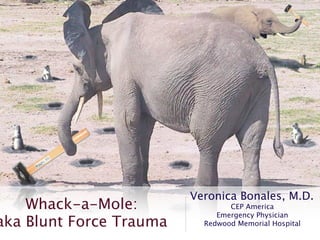
Veronica Bonales, M.D.
    Whack-a-Mole:                CEP America
                              Emergency Physician
aka Blunt Force Trauma     Redwood Memorial Hospital
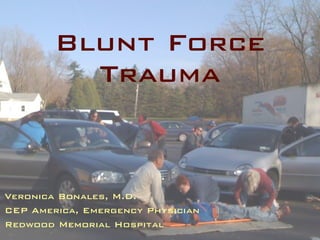
Blunt Force
          Trauma


Veronica Bonales, M.D.
CEP America, Emergency Physician
Redwood Memorial Hospital
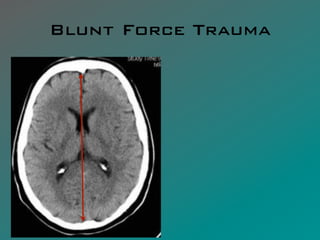
Blunt Force Trauma
Blunt Force Trauma

 Types
 Sample Injuries by
Anatomical Region
 Specific Syndromes
Blunt Force
              Compression
    Trauma
Blunt Force Trauma
  Injury due to pressure force
     Hit by moving object
     Hit or fall against solid
    object
     Object exerts pressure
   Tears and hematomas to
  solid organs
Blunt Force
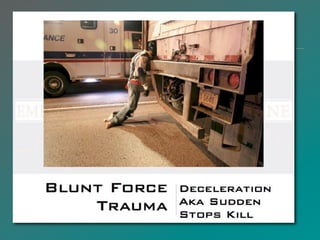
              Deceleration
    Trauma
Blunt Force Trauma
 Injury because of sudden
halt
    MVC most common
    Acceleration factor
  greatest in air travel
 Stretching & linear shearing
of fixed or free organs
Blunt Force Trauma


        Anatomical
      Considerations
Blunt Force   Head and Spine
    Trauma    Injuries
Blunt Force Trauma


Skull
 22 bones
  8 CRANIAL, 14 FACIAL
Blunt Force Trauma
Blunt Force Trauma
Blunt Force Trauma
Blunt Force Trauma
Blunt Force Trauma
Blunt Force Trauma
Blunt Force Trauma
Blunt Force Trauma
Basilar Skull
Fracture

  Battle’s
  Sign

  Raccoon
  Eyes

  CSF
  Otorrhea or
  rhinorrhea
Blunt Force Trauma
Blunt Force Trauma
Blunt Force Trauma
Blunt Force Trauma
Blunt Force Trauma
Blunt Force Trauma
         • Cranium
          – Brain
          – Attached by
            meninges
          – Surrounded by
            fluid
          – Surface blood
            vessels
Blunt Force Trauma


Coup and contrecoup injuries
Blunt Force Trauma
Blunt Force Trauma
Blunt Force Trauma
Blunt Force Trauma
Blunt Force Trauma
Blunt Force Trauma
Blunt Force Trauma
Blunt Force Trauma
Blunt Force Trauma
  Epidural hematoma
Blunt Force Trauma
  Epidural hematoma
Blunt Force Trauma
Blunt Force Trauma
Blunt Force Trauma
Blunt Force Trauma
Blunt Force Trauma
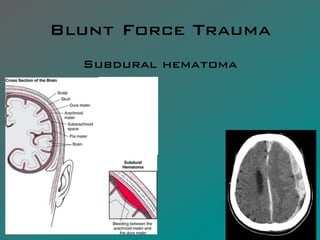
  Subdural hematoma
Blunt Force Trauma
  Subdural hematoma
Blunt Force Trauma
Blunt Force Trauma
Blunt Force Trauma
Blunt Force Trauma
Blunt Force Trauma
 Subarachnoid hematoma
Blunt Force Trauma
 Subarachnoid hematoma
Blunt Force Trauma
  Special Considerations
Blunt Force Trauma
  Special Considerations
Blunt Force Trauma
  Special Considerations
Blunt Force Trauma
  Special Considerations
Blunt Force Trauma

Cervical Spine
 7 vertebrae
  Axis
  Atlas
 Ligaments
  Anterior
  Posterior
Blunt Force Trauma
  Axial Load Injuries
Blunt Force Trauma


         Hyperextension
        injuries
         Hyperflexion
        injuries
Blunt Force Trauma
Blunt Force Trauma
Blunt Force Trauma
Blunt Force Trauma


           Hangman’s Fracture
            - Bilateral pedicle
                    Fx
           - Distraction C2-C3
             - Due to complete
                disruption
Blunt Force Trauma
Blunt Force Trauma
Blunt Force Trauma
C spine precautions placed when:
 – Any neck discomfort or numbness in
   extremities
 – Not fully alert or AMS
 – Other painful injuries
Blunt Force Trauma
C spine precautions placed when:
 – Any neck discomfort or numbness in
   extremities
 – Not fully alert or AMS
 – Other painful injuries
Blunt Force Trauma
Rigid collars, such as the Philadelphia
 and the extrication collars, reduce
 flexion and extension to about 30%
 normal and rotation and lateral
 movement to about 50%.
Blunt Force Trauma
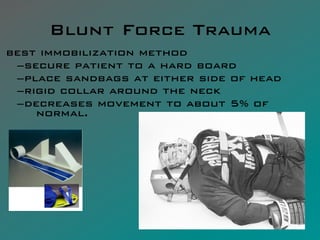
best immobilization method
 – secure patient to a hard board
 – place sandbags at either side of head
 – rigid collar around the neck
 – decreases movement to about 5% of
     normal.
Blunt Force Trauma
          Thoracic
          Spine
           12 vertebrae
           Attached to
           rib cage
           Ligaments
            Anterior
            Posterior
Blunt Force Trauma
• Axial loading
 – Burst fracture
 – Nerve findings common
Blunt Force Trauma
• Hyperextension injuries
 – Very unstable fracture
Blunt Force Trauma
Blunt Force Trauma
Blunt Force Trauma
        • Lumbar Spine
         –5 vertebrae
         –Fractures
          require
          significant
          mechanism
Blunt Force Trauma
Flexion injuries
 Wedge compression fracture
 Requires a high energy process
Head and Spine Injuries
         Look for motor or
         sensory deficits
         Deficit will point to
         location of injury
         Remember dual
         innervation of
         cervical cape
         Log roll & keep spine
         in neutral position
Blunt Force   Thoracic Injuries
    Trauma
Blunt Force Trauma


  Bony Injuries
  Pulmonary injuries
  Cardiac and
vascular injuries
 Diaphragmatic
injuries
Blunt Force Trauma


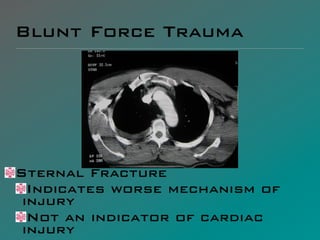
Sternal Fracture
  Indicates worse mechanism of
 injury
  Not an indicator of cardiac
 injury
Blunt Force Trauma


Sternal Fracture
  Indicates worse mechanism of
 injury
  Not an indicator of cardiac
 injury
Blunt Force Trauma
Blunt Force Trauma

Rib Fractures
   9 - 11 watch for intra-abdominal
 injuries
Blunt Force Trauma

Rib Fractures
   9 - 11 watch for intra-abdominal
 injuries
Blunt Force Trauma

Rib Fractures
   9 - 11 watch for intra-abdominal
 injuries

Flail Chest
 Three or more consecutive ribs
 Broken in 2 or more places
 Same side of chest
 Paradoxical Chest Movement
Blunt Force Trauma


Lung contusions
 More common in children
 Serious cause of morbidity
  Elderly
  COPD
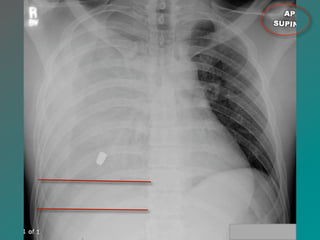
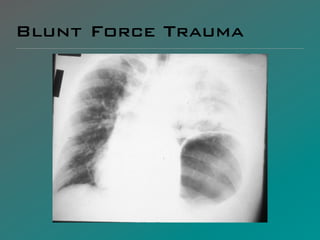
Pneumothorax
1
        2

    3
4

5
1
        2

    3
4

5
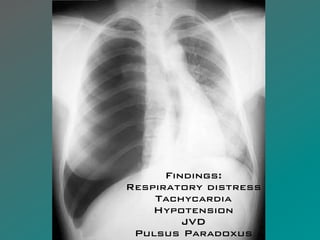
Findings:
Respiratory distress
    Tachycardia
    Hypotension
         JVD
 Pulsus Paradoxus
1
2


              Findings:
        Respiratory distress
            Tachycardia
            Hypotension
                 JVD
         Pulsus Paradoxus
1
2


              Findings:
        Respiratory distress
            Tachycardia
            Hypotension
                 JVD
         Pulsus Paradoxus
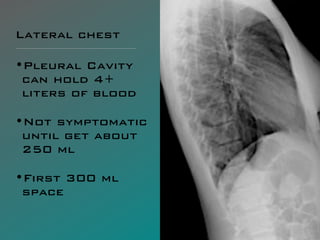
Lateral chest!

•Pleural Cavity
 can hold 4+
 liters of blood

•Not symptomatic
 until get about
 250 ml

•First 300 ml
 space
Lateral chest!

•Pleural Cavity
 can hold 4+
 liters of blood

•Not symptomatic
 until get about
 250 ml

•First 300 ml
 space
Lateral chest!

•Pleural Cavity
 can hold 4+
 liters of blood

•Not symptomatic
 until get about
 250 ml

•First 300 ml
 space
Lateral chest!

•Pleural Cavity
 can hold 4+
 liters of blood

•Not symptomatic
 until get about
 250 ml

•First 300 ml
 space
1200

900

600

300
Blunt Force Trauma
Blunt Force Trauma
           Cardiac Injuries
            life-threatening arrhythmias
            anomalies of conduction system
            congestive heart failure
            cardiogenic shock
            hemopericardium
            pericardial tamponade
            cardiac rupture
            valvular rupture
            intraventricular thrombus
            thromboemboli
            air emboli
            coronary artery occlusion
            ventricular aneurysm
            constrictive pericarditis
Blunt Force Trauma
Blunt Force Trauma
 Cardiac Injury
  9 - 34% of thoracic injuries
  Right atrium most susceptible
 to injury
  Will lead to EKG changes and
 Troponin elevations
  Contusio cordis vs commotio
 cordis
Blunt Force
Trauma

 Thoracic Aorta
Disruption
  2nd leading cause
 of death
  93% at desc.
 Aorta
  Widened
 mediastinum most
 common finding
 85%
Blunt Force
Trauma

 Thoracic Aorta
Disruption
  2nd leading cause
 of death
  93% at desc.
 Aorta
  Widened
 mediastinum most
 common finding
 85%
Blunt Force
Trauma

 Thoracic Aorta
Disruption
  2nd leading cause
 of death
  93% at desc.
 Aorta
  Widened
 mediastinum most
 common finding
 85%
Blunt Force Trauma
           Pericardial
           tamponade
            Tachy 77%

            JVD 76%

             Dec. Heart
            Sounds 28%

            Hypotension 26%
Blunt Force Trauma
           Pericardial
           tamponade
            Tachy 77%

            JVD 76%

             Dec. Heart
            Sounds 28%

            Hypotension 26%
Blunt Force Trauma
           Pericardial
           tamponade
            Tachy 77%

            JVD 76%

             Dec. Heart
            Sounds 28%

            Hypotension 26%
Blunt Force Trauma
Blunt Force Trauma
             Diaphragmatic
            injury
               Strong
              compressive
              forces
               Intrusion by
              abdominal
              viscera
               Injury mostly
              occurs on right
               Bowel sounds
              in the chest
Token Gory
medical photo
Blunt Force   Abdominal Injuries
    Trauma
Blunt Force Trauma
Most common type
   50 – 70%
  Liver & spleen
 most commonly
 injured
  may not manifest
 during initial
 assessment &
 treatment period
  1.5L before
 distention
 appears
Blunt Force Trauma
         Compression injuries
          Liver lacerations
          and hematomas
          Splenic lacerations
          and sequestration
         Deceleration injuries
          Kidney
          Bowel injuries
          Vascular injuries
Blunt Force Trauma
 Hollow organ
injuries
  Usually
  secondary to
  seatbelt
  Compressive
  forces increase
  pressure
  Deceleration
  disrupts blood
  supply from
  mesenteric vessels
Blunt Force Trauma
Blunt Force Trauma
           Spleen
             Most commonly
            injured solid
            organ
             Rich blood
            supply
             Pain in LUQ
            with left
            shoulder pain
Blunt Force Trauma
Blunt Force Trauma
Injured from trauma to:
  Eighth through twelfth ribs on
 right side of body
Upper central part of abdomen
  Tear at falciform or direct
 injury
Blood and bile will leak into
abdominal cavity
  Shock
  Peritoneal irritation
Blunt Force Trauma
Blunt Force Trauma
Kidney
 Firmly held in the
 retroperitoneum
 Severe
 compression or
 rib fractures
 Deceleration
 leads to shearing
 of arteries
 Spillage of blood
 and urine into
 retroperitoneum
Blunt Force Trauma
            Pelvic Organ
           Injuries
              Most commonly
             associated with
             pelvic fractures
              Urinary rupture
             if compressive
             force on full
             bladder
Blunt Force Trauma


            Focused
            Abdominal
            Sonography
             for
            Trauma
Blunt Force Trauma


            Focused
            Abdominal
            Sonography
             for
            Trauma
Blunt Force Trauma
Blunt Force Trauma
Blunt Force Trauma
Blunt Force Trauma
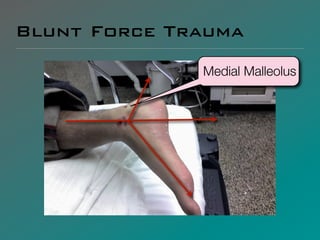
              Medial Malleolus
Blunt Force Trauma
              Medial Malleolus
Blunt Force Trauma
              Medial Malleolus
Blunt Force   Crush Syndromes
    Trauma
Blunt Force Trauma
occurs when body part subjected
to high degree of force or
pressure
Blunt Force Trauma
 Bleeding
 Bruising
 Fracture
 Laceration
 Compartment Syndrome
Blunt Force Trauma
Not an acute
occurrence
Symptoms:
 Pain out of
 proportion/passive
 motion
 Parasthesias/
 Paralysis
 Pallor
 Pulselessness
 Poiklothermia
Blunt Force Trauma
Compartment Pressures
Normal about zero; usually less than 10 mm Hg
Capillary blood flow compromised at >20 mm Hg
Muscles/nerves at risk for ischemic necrosis
>30 to 40 mm Hg.
Nerve is most sensitive, followed by muscle
tissue.
Blunt Force Trauma
Traumatic Asphyxia Syndrome
 Constrictive force to chest wall
 Can occur within two minutes
 Mechanism of injury - profound
 venous hypertension
 Cerebral hypoperfusion
Blunt Force Trauma
 Vital signs
  Tachycardia
  Tachypnea
  Signs of shock
    Hypotension
    Diaphoresis
    Slow cap refill
 Mental Status
 Neurodeficits
 Young will handle better than old
Luckiest Man Alive
Questions??
Questions??


Thank You!!
References
• ACS Surgery: Principles and Practice. Souba, et. al. Multiple chapters.

• Emergency Medicine: A Comprehensive Study Guide. Tintinalli, et. al. Multiple
  chapters.

• Howard-Nuss’ Clinical Practice of Emergency Medicine. Wolfson, et. al. Multiple
  chapters.

• Manual of Forensic Emergency Medicine. Riviello. Chapter 10: Blunt Force Trauma

• Mastery of Surgery, Vol. 1. Fischer and Bland. Part V: Breast, Chest and
  Mediastinum. Chapter 49 Thoracic Truama.

FCA 0111 - Blunt Force Trauma