MY INVENTION
<INSERT YOUR NAME>
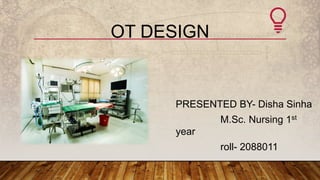
OT DESIGN
PRESENTED BY- Disha Sinha
M.Sc. Nursing 1st
year
roll- 2088011
At the end of the session, the students will be able to:
• Illustrate OT design
• Propose the history of OT design
• Discuss the layout of OT
• Consider the zones of OT
OUTLINES
WHO WILL USE MY INVENTION
• Who benefits from this invention? Why?
CONT.
Operation theatre as the name suggests are the units in health care
organization which are concerned with manipulation of human bodies for
the purpose of treatment or diagnosis of health disorders. These should be
planned and designed according to the appropriate architectural practices
observed.
The basic principle in designing an OT is that the patients and staff should
flow functionally and aseptically from and to the OT so that effectiveness,
efficiency and safety in achieving the service functions are achieved. It must
create healthy and aesthetic atmosphere and environment for clients, public
and staff.
HISTORY
HISTORY
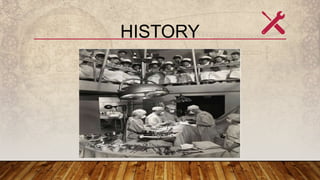
• In the past 300 years, the design of operation rooms and their
ancillary spaces has responded to changes in surgical needs and
practice.
• But in the 18th century the demonstration and teaching of surgery
became important, so dedicated rooms for surgical operations were
built. They were designed as theatres with accommodation for
spectators—based on the old anatomy theatres—such as the one
established at St Thomas’ Hospital, London, in 1751.
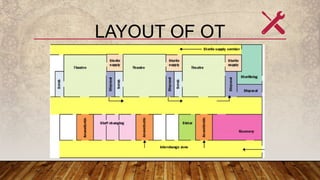
LAYOUT OF OT
LAYOUT OF OT
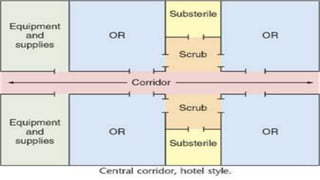
• Important design considerations include the mix of inpatient and
outpatient operations, patient flow, into and out of the operating
room (OR) area, the transportation of supplies and waste
materials to and from the OR, and flexibility to allow the
incorporation of new technologies.
• The operating theater should be zoned into aseptic and clean
areas in addition to being separated from the outer areas
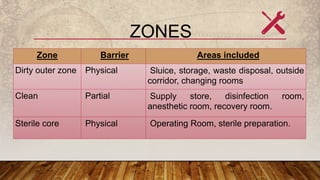
ZONES
Zone Barrier Areas included
Dirty outer zone Physical Sluice, storage, waste disposal, outside
corridor, changing rooms
Clean Partial Supply store, disinfection room,
anesthetic room, recovery room.
Sterile core Physical Operating Room, sterile preparation.
MINIMUM SERVICES
INCLUDE
• Major operating room
• Recovery room
• Sub-sterilizing area/ work area
• Sterile instrument, supply and
storage area
• Scrub-up area
• Clean-up area
• Male dressing room and
toilet
• Female dressing room and
toilet
• Nurse station/ work area
• Wheeled stretcher area
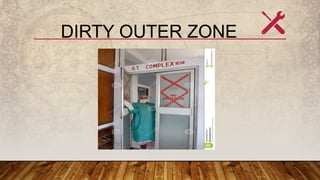
DIRTY OUTER ZONE
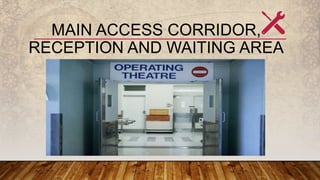
MAIN ACCESS CORRIDOR,
RECEPTION AND WAITING AREA
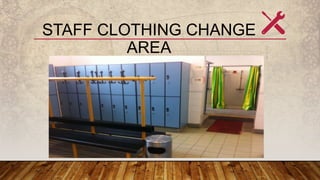
STAFF CLOTHING CHANGE
AREA
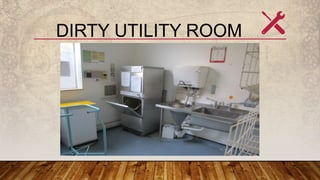
DIRTY UTILITY ROOM
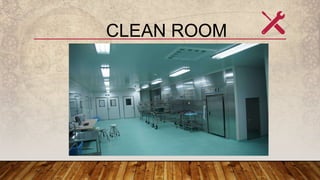
CLEAN ROOM
STERILE SUPPLY STORE
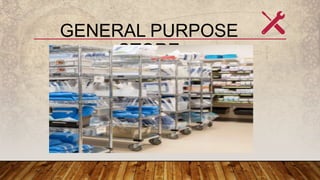
GENERAL PURPOSE
STORE
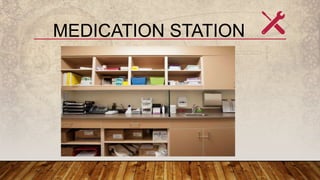
MEDICATION STATION
SUB-STERILE AREA
RECOVERY AREA
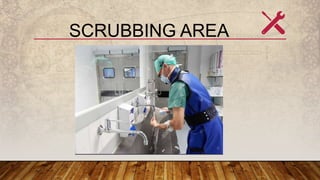
SCRUBBING AREA
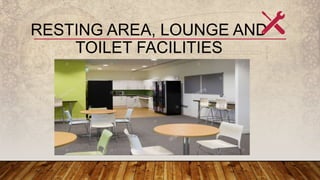
RESTING AREA, LOUNGE AND
TOILET FACILITIES
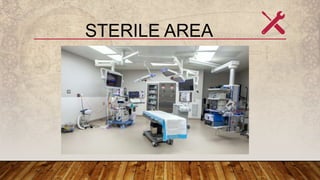
STERILE AREA
STERILE AREA
This zone is also called as the restricted zone and it is actual
operating section of an OT and in this the rooms should be
located and arranged in such a way that the non-related
members are prevented from passing through the room so that
this area can be maintained in sterile condition.
• Wear full PPE , scrub suits during any surgical procedure.
• Check for the COVID report and if emergency, then all sterile
antiseptic procedure to be maintained properly for the need of
COVID to not spread to any other.
• Sterilization or even discarding the instruments post surgery is
safe practice.
• Post surgery, OT is also sterilized through fumigation method.
- NIH, NCBI
RECENT CHANGES DUE TO
COVID
INVENTION DESIGN PROCESS
• Talk about the design process
• Did your first build work, or did
you have to change your ideas?
Why?
• Did you have to change the
materials you used as you tested
your invention? Why?
<Insert pictures or drawings of your invention design/building process>
*you can insert a new slide for these pictures/drawings if you need to!
MY INVENTION IN USE!
Talk about how people reacted to your invention
• Did it solve the problem/need you identified?
• Did it work as planned? Did it help whom it needed to help?
<Insert pictures or drawings of your invention being
used, with a description entered here>
*you can insert a new slide for these pictures/drawings if
you need to!
<Insert pictures or drawings of your invention being
used, with a description entered here>
*you can insert a new slide for these pictures/drawings if
you need to!
<Insert pictures or drawings of your invention being
used, with a description entered here>
*you can insert a new slide for these pictures/drawings if
you need to!
MY INVENTION IN USE!
Talk about how people reacted to your invention
• Did it solve the problem/need you identified?
• Did it work as planned? Did it help whom it needed to help?
<Insert pictures or drawings of your invention being
used, with a description entered here>
*you can insert a new slide for these pictures/drawings if
you need to!
<Insert pictures or drawings of your invention being
used, with a description entered here>
*you can insert a new slide for these pictures/drawings if
you need to!
<Insert pictures or drawings of your invention being
used, with a description entered here>
*you can insert a new slide for these pictures/drawings if
you need to!
The number of operating rooms and recovery beds and the sizes
of the service areas shall be based on the expected surgical load.
In the programe, the size, location, and configuration of the
surgical suit and support service departments shall reflect the
projected volume of outpatient. This may be achieved by
designing either an outpatient surgery facility, or a combined
inpatient-outpatient surgical suit. Therefore, clearly an OT design
is very important aspect in any surgical procedure.
ASSIGNMENT
What are the zones of OT? Explain.
• Black. (1997). Black ET Al medical surgical nursing 5e 2 volume set: Clinical management for
continuity of care, 5/e 2 volume set (5th ed.). London, England: W B Saunders, pp- 187-190.
• Osborn, K. S., Watson, A. S., & Wraa, C. E. (2009). Medical surgical nursing: Preparation for
practice, volume 1. Upper Saddle River, NJ: Pearson pp- 263-265.
• Kilpadi. (2004). Handbook of operation theatre techniques. New Delhi, India: Jaypee Brothers
Medical, pp- 176-177.
• Operating Theaters. (n.d.). Guidelines for Design of. Retrieved September 12, 2021, from
Icdkwt.com
website:http://www.icdkwt.com/pdf/policiesandguidelines/DesignandConstruction/GuidelinesforDe
signofOperatingTheater-2007.pdf
• (N.d.). Retrieved September 12, 2021, from Lindner-group.com website: https://www.lindner-
group.com/fileadmin/user_upload/intranet/dienste/marketing/techn_broschueren/reinraum/rrt_br_t
echn_op_ausbau--en.pdf
• surgerymgmcri. (n.d.). 1. operation theatre. Retrieved September 12, 2021, from Slideshare.net
website: https://www.slideshare.net/surgerymgmcri/1-operation-theatre
CUSTOMIZE THIS TEMPLATE
Template Editing
Instructions and
Feedback

OT design

  • 2.
  • 3.
    OT DESIGN PRESENTED BY-Disha Sinha M.Sc. Nursing 1st year roll- 2088011
  • 4.
    At the endof the session, the students will be able to: • Illustrate OT design • Propose the history of OT design • Discuss the layout of OT • Consider the zones of OT OUTLINES
  • 5.
    WHO WILL USEMY INVENTION • Who benefits from this invention? Why?
  • 6.
    CONT. Operation theatre asthe name suggests are the units in health care organization which are concerned with manipulation of human bodies for the purpose of treatment or diagnosis of health disorders. These should be planned and designed according to the appropriate architectural practices observed. The basic principle in designing an OT is that the patients and staff should flow functionally and aseptically from and to the OT so that effectiveness, efficiency and safety in achieving the service functions are achieved. It must create healthy and aesthetic atmosphere and environment for clients, public and staff.
  • 7.
  • 8.
    HISTORY • In thepast 300 years, the design of operation rooms and their ancillary spaces has responded to changes in surgical needs and practice. • But in the 18th century the demonstration and teaching of surgery became important, so dedicated rooms for surgical operations were built. They were designed as theatres with accommodation for spectators—based on the old anatomy theatres—such as the one established at St Thomas’ Hospital, London, in 1751.
  • 9.
  • 10.
    LAYOUT OF OT •Important design considerations include the mix of inpatient and outpatient operations, patient flow, into and out of the operating room (OR) area, the transportation of supplies and waste materials to and from the OR, and flexibility to allow the incorporation of new technologies. • The operating theater should be zoned into aseptic and clean areas in addition to being separated from the outer areas
  • 11.
    ZONES Zone Barrier Areasincluded Dirty outer zone Physical Sluice, storage, waste disposal, outside corridor, changing rooms Clean Partial Supply store, disinfection room, anesthetic room, recovery room. Sterile core Physical Operating Room, sterile preparation.
  • 12.
    MINIMUM SERVICES INCLUDE • Majoroperating room • Recovery room • Sub-sterilizing area/ work area • Sterile instrument, supply and storage area • Scrub-up area • Clean-up area • Male dressing room and toilet • Female dressing room and toilet • Nurse station/ work area • Wheeled stretcher area
  • 13.
  • 14.
  • 15.
  • 16.
  • 17.
  • 18.
  • 19.
  • 20.
  • 21.
  • 22.
  • 23.
  • 24.
    RESTING AREA, LOUNGEAND TOILET FACILITIES
  • 25.
  • 26.
    STERILE AREA This zoneis also called as the restricted zone and it is actual operating section of an OT and in this the rooms should be located and arranged in such a way that the non-related members are prevented from passing through the room so that this area can be maintained in sterile condition.
  • 27.
    • Wear fullPPE , scrub suits during any surgical procedure. • Check for the COVID report and if emergency, then all sterile antiseptic procedure to be maintained properly for the need of COVID to not spread to any other. • Sterilization or even discarding the instruments post surgery is safe practice. • Post surgery, OT is also sterilized through fumigation method. - NIH, NCBI RECENT CHANGES DUE TO COVID
  • 28.
    INVENTION DESIGN PROCESS •Talk about the design process • Did your first build work, or did you have to change your ideas? Why? • Did you have to change the materials you used as you tested your invention? Why? <Insert pictures or drawings of your invention design/building process> *you can insert a new slide for these pictures/drawings if you need to!
  • 29.
    MY INVENTION INUSE! Talk about how people reacted to your invention • Did it solve the problem/need you identified? • Did it work as planned? Did it help whom it needed to help? <Insert pictures or drawings of your invention being used, with a description entered here> *you can insert a new slide for these pictures/drawings if you need to! <Insert pictures or drawings of your invention being used, with a description entered here> *you can insert a new slide for these pictures/drawings if you need to! <Insert pictures or drawings of your invention being used, with a description entered here> *you can insert a new slide for these pictures/drawings if you need to!
  • 30.
    MY INVENTION INUSE! Talk about how people reacted to your invention • Did it solve the problem/need you identified? • Did it work as planned? Did it help whom it needed to help? <Insert pictures or drawings of your invention being used, with a description entered here> *you can insert a new slide for these pictures/drawings if you need to! <Insert pictures or drawings of your invention being used, with a description entered here> *you can insert a new slide for these pictures/drawings if you need to! <Insert pictures or drawings of your invention being used, with a description entered here> *you can insert a new slide for these pictures/drawings if you need to!
  • 31.
    The number ofoperating rooms and recovery beds and the sizes of the service areas shall be based on the expected surgical load. In the programe, the size, location, and configuration of the surgical suit and support service departments shall reflect the projected volume of outpatient. This may be achieved by designing either an outpatient surgery facility, or a combined inpatient-outpatient surgical suit. Therefore, clearly an OT design is very important aspect in any surgical procedure.
  • 32.
    ASSIGNMENT What are thezones of OT? Explain.
  • 34.
    • Black. (1997).Black ET Al medical surgical nursing 5e 2 volume set: Clinical management for continuity of care, 5/e 2 volume set (5th ed.). London, England: W B Saunders, pp- 187-190. • Osborn, K. S., Watson, A. S., & Wraa, C. E. (2009). Medical surgical nursing: Preparation for practice, volume 1. Upper Saddle River, NJ: Pearson pp- 263-265. • Kilpadi. (2004). Handbook of operation theatre techniques. New Delhi, India: Jaypee Brothers Medical, pp- 176-177. • Operating Theaters. (n.d.). Guidelines for Design of. Retrieved September 12, 2021, from Icdkwt.com website:http://www.icdkwt.com/pdf/policiesandguidelines/DesignandConstruction/GuidelinesforDe signofOperatingTheater-2007.pdf • (N.d.). Retrieved September 12, 2021, from Lindner-group.com website: https://www.lindner- group.com/fileadmin/user_upload/intranet/dienste/marketing/techn_broschueren/reinraum/rrt_br_t echn_op_ausbau--en.pdf • surgerymgmcri. (n.d.). 1. operation theatre. Retrieved September 12, 2021, from Slideshare.net website: https://www.slideshare.net/surgerymgmcri/1-operation-theatre
  • 35.
    CUSTOMIZE THIS TEMPLATE TemplateEditing Instructions and Feedback