What is meteorology?
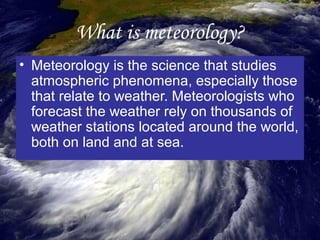
• Meteorology is the science that studies
atmospheric phenomena, especially those
that relate to weather. Meteorologists who
forecast the weather rely on thousands of
weather stations located around the world,
both on land and at sea.
HISTORYIn Bible times - "˜You are able to interpret the appearance of the sky but the sign of the times you
cannot interpret.” Book of Matthew
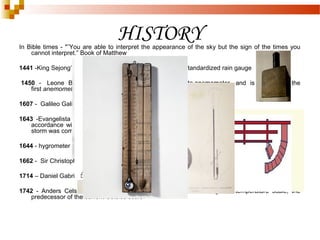
1441 -King Sejong’s son, Prince Munjong, invented the first standardized rain gauge
1450 - Leone Battista Alberti developed a swinging-plate anemometer, and is known as the
first anemometer.
1607 - Galileo Galilei constructs a thermoscope
1643 -Evangelista Torricelli invented the barometer,Torricelli noticed that air pressure changes in
accordance with changes in the weather. In fact a drop in pressure would often signal that a
storm was coming.
1644 - hygrometer was invented
1662 - Sir Christopher Wren invented the mechanical, self-emptying, tipping bucket rain gauge.
1714 – Daniel Gabriel Fahrenheit invented the mercury thermometer
1742 - Anders Celsius, a Swedish astronomer, proposed the 'centigrade' temperature scale, the
predecessor of the current Celsius scale
1765 - daily measurements of air pressure, moisture content, wind
speed and direction began to be made. This was first done by
French scientist Laurent Lavoisier who stated,"With all of this
information it is almost always possible to predict the weather one
or two days ahead with reasonable accuracy.”
1783 - the first hair hygrometer is demonstrated by Horace-Bénédict
de Saussure.
1806 - Francis Beaufort introduced his system for classifying wind
speeds
1854 - French warship and 38 merchant vessels sank in a fierce storm
off the Crimean port of Balaklava
April 1960 - launch of the first successful weather satellite, TIROS-1,
marked the beginning of the age where weather information
became available globally.
ELEMENTS OFELEMENTS OF
METEOROLOGYMETEOROLOGY
CloudsClouds
RainRain
WindWind
HumidityHumidity
InstrumentsInstruments
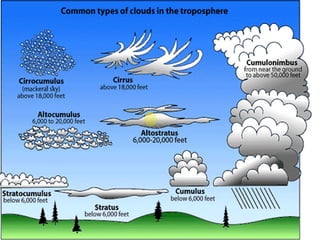
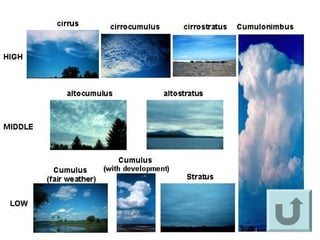
CloudsClouds
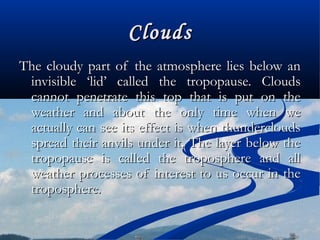
The cloudy part of the atmosphere lies below anThe cloudy part of the atmosphere lies below an
invisible ‘lid’ called the tropopause. Cloudsinvisible ‘lid’ called the tropopause. Clouds
cannot penetrate this top that is put on thecannot penetrate this top that is put on the
weather and about the only time when weweather and about the only time when we
actually can see its effect is when thundercloudsactually can see its effect is when thunderclouds
spread their anvils under it. The layer below thespread their anvils under it. The layer below the
tropopause is called the troposphere and alltropopause is called the troposphere and all
weather processes of interest to us occur in theweather processes of interest to us occur in the
troposphere.troposphere.
Rain
 Rain is the precipitation of liquid drops
of water. There are also other forms of
precipitation such as snow, sleet and
hail. Raindrops generally have a
diameter greater than 0.5 mm (0.02
in). They range in size up to about 3
mm (about 0.13 in) in diameter, and
their rate of fall increases, up to 7.6 m
(25 ft) per sec with their size.
 There are generally three types of
rainfall: orographic rain (also known
as relief rain), convectional
rain and frontal/cyclonic rain.
Types of rainfall
What are the
different
types of rain
and where do
they happen?
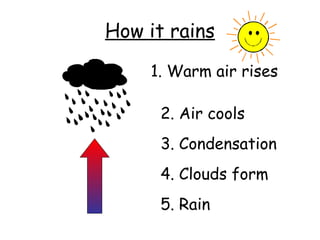
How it rains
1. Warm air rises
2. Air cools
3. Condensation
4. Clouds form
5. Rain
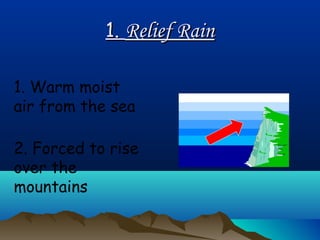
1.1. Relief RainRelief Rain
2. Forced to rise
over the
mountains
1. Warm moist
air from the sea
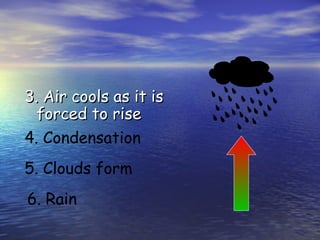
3. Air cools as it is3. Air cools as it is
forced to riseforced to rise
4. Condensation
5. Clouds form
6. Rain
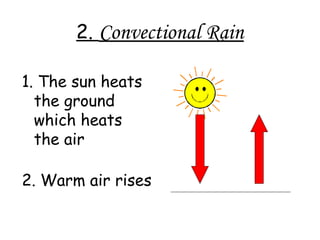
2. Convectional Rain
1. The sun heats
the ground
which heats
the air
2. Warm air rises
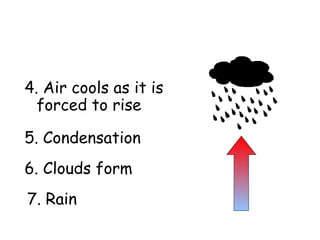
4. Air cools as it is
forced to rise
5. Condensation
6. Clouds form
7. Rain
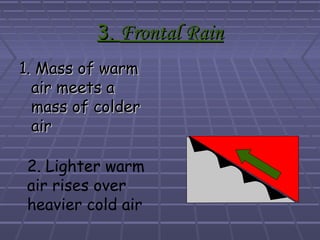
3.3. Frontal RainFrontal Rain
1. Mass of warm1. Mass of warm
air meets aair meets a
mass of coldermass of colder
airair
2. Lighter warm
air rises over
heavier cold air
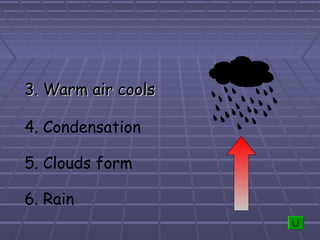
3. Warm air cools3. Warm air cools
4. Condensation
5. Clouds form
6. Rain
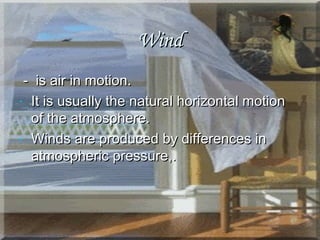
WindWind
- is air in motion.- is air in motion.
- It is usually the natural horizontal motionIt is usually the natural horizontal motion
of the atmosphere.of the atmosphere.
- Winds are produced by differences inWinds are produced by differences in
atmospheric pressure,.atmospheric pressure,.
Breeze Breeze 
 important factors in a location's prevailingimportant factors in a location's prevailing
winds.winds.
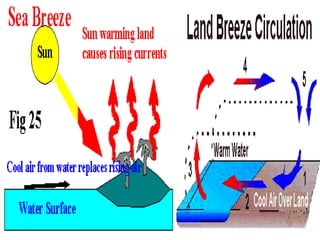
Sea breeze – movement of wind from sea toSea breeze – movement of wind from sea to
land that occurs during daytimeland that occurs during daytime
Land breeze – movement of air from land toLand breeze – movement of air from land to
sea that occurs during night timesea that occurs during night time
HumidityHumidity
Humidity is the measurement of the waterHumidity is the measurement of the water
vapour content in the atmosphere. As watervapour content in the atmosphere. As water
evaporates from lakes, seas and oceans andevaporates from lakes, seas and oceans and
vegetation loses water through transpiration, thevegetation loses water through transpiration, the
humidity of the air increases.humidity of the air increases.
The relative humidity of the air (ratio of theThe relative humidity of the air (ratio of the
amount of water vapour in the air to theamount of water vapour in the air to the
maximum amount of water vapour the air canmaximum amount of water vapour the air can
contain expressed as a percantage) iscontain expressed as a percantage) is
measured using ameasured using a hygrometerhygrometer..
Effects of humidityEffects of humidity
Animals and plantsAnimals and plants
Humidity is one of the fundamental abiotic factors that defines anyHumidity is one of the fundamental abiotic factors that defines any
habitat, and is a determinant of which animals and plants can thrivehabitat, and is a determinant of which animals and plants can thrive
in a given environment.in a given environment.
Human comfortHuman comfort
Humans are sensitive to humid air because the human body usesHumans are sensitive to humid air because the human body uses
evaporative cooling as the primary mechanism to regulateevaporative cooling as the primary mechanism to regulate
temperature.temperature.
ElectronicsElectronics
Many electronic devices have humidity specifications, for example,Many electronic devices have humidity specifications, for example,
5% to 95%. At the top end of the range, moisture may increase the5% to 95%. At the top end of the range, moisture may increase the
conductivity of permeable insulators leading to malfunction.conductivity of permeable insulators leading to malfunction.
Building constructionBuilding construction
Traditional building designs typically had weak insulation, and itTraditional building designs typically had weak insulation, and it
allowed air moisture to flow freely between the interior and exteriorallowed air moisture to flow freely between the interior and exterior
Instruments
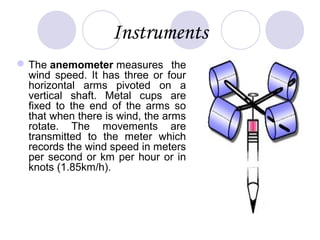
The anemometer measures  the 
wind  speed.  It  has  three  or  four 
horizontal  arms  pivoted  on  a 
vertical  shaft.  Metal  cups  are 
fixed  to  the  end  of  the  arms  so 
that when there is wind, the arms 
rotate.  The  movements  are 
transmitted  to  the  meter  which 
records the wind speed in meters 
per second or km per hour or in 
knots (1.85km/h). 
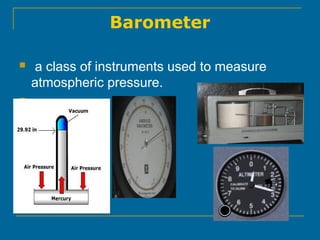
Barometer
  a class of instruments used to measure 
atmospheric pressure.
  
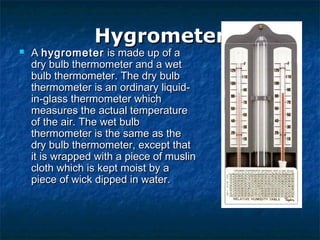
HygrometerHygrometer
 A A hygrometerhygrometer is made up of a is made up of a
dry bulb thermometer and a wetdry bulb thermometer and a wet
bulb thermometer. The dry bulbbulb thermometer. The dry bulb
thermometer is an ordinary liquid-thermometer is an ordinary liquid-
in-glass thermometer whichin-glass thermometer which
measures the actual temperaturemeasures the actual temperature
of the air. The wet bulbof the air. The wet bulb
thermometer is the same as thethermometer is the same as the
dry bulb thermometer, except thatdry bulb thermometer, except that
it is wrapped with a piece of muslinit is wrapped with a piece of muslin
cloth which is kept moist by acloth which is kept moist by a
piece of wick dipped in water.piece of wick dipped in water.
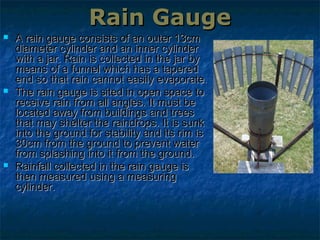
Rain GaugeRain Gauge
 A rain gauge consists of an outer 13cmA rain gauge consists of an outer 13cm
diameter cylinder and an inner cylinderdiameter cylinder and an inner cylinder
with a jar. Rain is collected in the jar bywith a jar. Rain is collected in the jar by
means of a funnel which has a taperedmeans of a funnel which has a tapered
end so that rain cannot easily evaporate.end so that rain cannot easily evaporate.
 The rain gauge is sited in open space toThe rain gauge is sited in open space to
receive rain from all angles. It must bereceive rain from all angles. It must be
located away from buildings and treeslocated away from buildings and trees
that may shelter the raindrops. It is sunkthat may shelter the raindrops. It is sunk
into the ground for stability and its rim isinto the ground for stability and its rim is
30cm from the ground to prevent water30cm from the ground to prevent water
from splashing into it from the ground.from splashing into it from the ground.
 Rainfall collected in the rain gauge isRainfall collected in the rain gauge is
then measured using a measuringthen measured using a measuring
cylinder.cylinder.
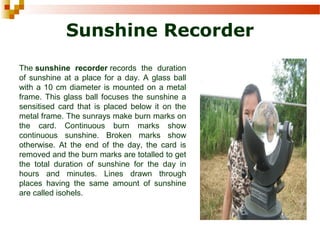
Sunshine Recorder
The sunshine recorder records  the  duration 
of sunshine at a place for a day. A glass ball 
with a 10 cm diameter is mounted on a metal 
frame. This glass ball focuses the sunshine a 
sensitised  card  that  is  placed  below  it  on  the 
metal frame. The sunrays make burn marks on 
the  card.  Continuous  burn  marks  show 
continuous  sunshine.  Broken  marks  show 
otherwise.  At  the  end  of  the  day,  the  card  is 
removed and the burn marks are totalled to get 
the  total  duration  of  sunshine  for  the  day  in 
hours  and  minutes.  Lines  drawn  through 
places  having  the  same  amount  of  sunshine 
are called isohels. 
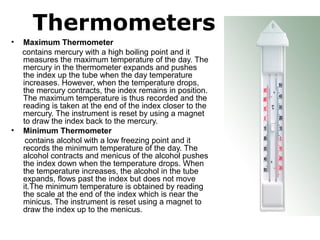
Thermometers
• Maximum Thermometer
     contains mercury with a high boiling point and it 
measures the maximum temperature of the day. The 
mercury in the thermometer expands and pushes 
the index up the tube when the day temperature 
increases. However, when the temperature drops, 
the mercury contracts, the index remains in position. 
The maximum temperature is thus recorded and the 
reading is taken at the end of the index closer to the 
mercury. The instrument is reset by using a magnet 
to draw the index back to the mercury.
• Minimum Thermometer
      contains alcohol with a low freezing point and it 
records the minimum temperature of the day. The 
alcohol contracts and menicus of the alcohol pushes 
the index down when the temperature drops. When 
the temperature increases, the alcohol in the tube 
expands, flows past the index but does not move 
it.The minimum temperature is obtained by reading 
the scale at the end of the index which is near the 
minicus. The instrument is reset using a magnet to 
draw the index up to the menicus. 
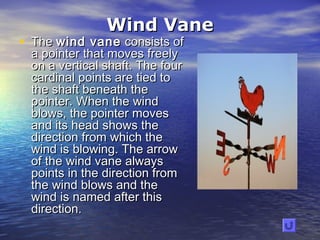
Wind VaneWind Vane
• The The wind vanewind vane consists of consists of
a pointer that moves freelya pointer that moves freely
on a vertical shaft. The fouron a vertical shaft. The four
cardinal points are tied tocardinal points are tied to
the shaft beneath thethe shaft beneath the
pointer. When the windpointer. When the wind
blows, the pointer movesblows, the pointer moves
and its head shows theand its head shows the
direction from which thedirection from which the
wind is blowing. The arrowwind is blowing. The arrow
of the wind vane alwaysof the wind vane always
points in the direction frompoints in the direction from
the wind blows and thethe wind blows and the
wind is named after thiswind is named after this
direction.direction.
APPLICATIONAPPLICATION
Weather ForecastingWeather Forecasting
Aviation MeteorologyAviation Meteorology
Agricultural MeteorologyAgricultural Meteorology
HydrometeorologyHydrometeorology
Nuclear MeteorologyNuclear Meteorology
Maritime MeteorologyMaritime Meteorology
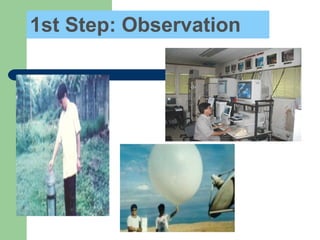
1st Step: Observation
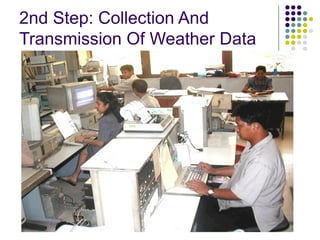
2nd Step: Collection And 
Transmission Of Weather Data
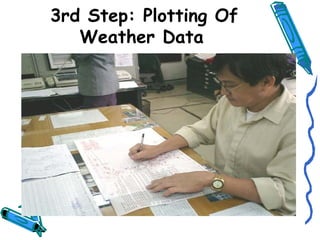
3rd Step: Plotting Of
Weather Data
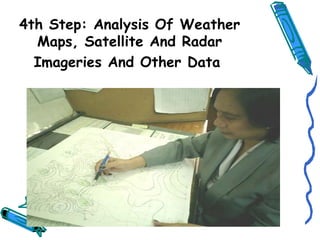
4th Step: Analysis Of Weather
Maps, Satellite And Radar
Imageries And Other Data
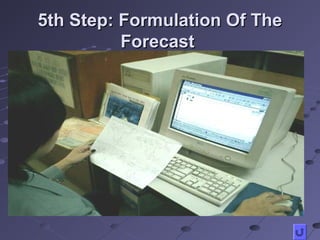
5th Step: Formulation Of The5th Step: Formulation Of The
ForecastForecast
AviationAviation
meteorologymeteorology
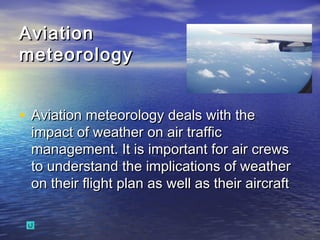
• Aviation meteorology deals with theAviation meteorology deals with the
impact of weather on air trafficimpact of weather on air traffic
management. It is important for air crewsmanagement. It is important for air crews
to understand the implications of weatherto understand the implications of weather
on their flight plan as well as their aircrafton their flight plan as well as their aircraft
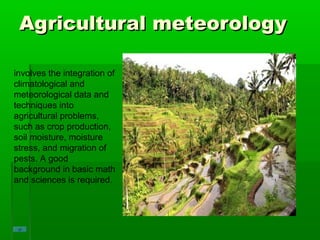
Agricultural meteorologyAgricultural meteorology
involves the integration of
climatological and
meteorological data and
techniques into
agricultural problems,
such as crop production,
soil moisture, moisture
stress, and migration of
pests. A good
background in basic math
and sciences is required.
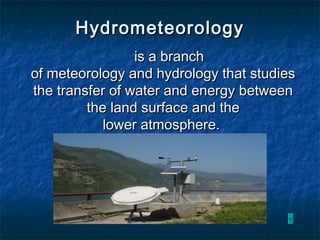
HydrometeorologyHydrometeorology
is a branchis a branch
of meteorology and hydrology that studiesof meteorology and hydrology that studies
the transfer of water and energy betweenthe transfer of water and energy between
the land surface and thethe land surface and the
lower atmosphere.lower atmosphere.
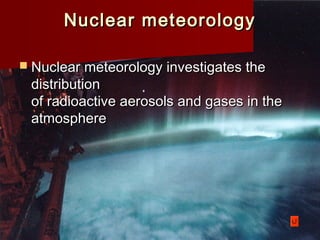
Nuclear meteorologyNuclear meteorology
 Nuclear meteorology investigates theNuclear meteorology investigates the
distributiondistribution
of radioactive aerosols and gases in theof radioactive aerosols and gases in the
atmosphereatmosphere
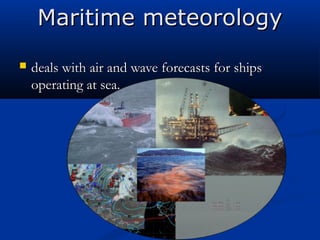
Maritime meteorologyMaritime meteorology
 deals with air and wave forecasts for shipsdeals with air and wave forecasts for ships
operating at sea.operating at sea.
Meteorology

Meteorology

  • 2.
    What is meteorology? •Meteorology is the science that studies atmospheric phenomena, especially those that relate to weather. Meteorologists who forecast the weather rely on thousands of weather stations located around the world, both on land and at sea.
  • 3.
    HISTORYIn Bible times- "˜You are able to interpret the appearance of the sky but the sign of the times you cannot interpret.” Book of Matthew 1441 -King Sejong’s son, Prince Munjong, invented the first standardized rain gauge 1450 - Leone Battista Alberti developed a swinging-plate anemometer, and is known as the first anemometer. 1607 - Galileo Galilei constructs a thermoscope 1643 -Evangelista Torricelli invented the barometer,Torricelli noticed that air pressure changes in accordance with changes in the weather. In fact a drop in pressure would often signal that a storm was coming. 1644 - hygrometer was invented 1662 - Sir Christopher Wren invented the mechanical, self-emptying, tipping bucket rain gauge. 1714 – Daniel Gabriel Fahrenheit invented the mercury thermometer 1742 - Anders Celsius, a Swedish astronomer, proposed the 'centigrade' temperature scale, the predecessor of the current Celsius scale
  • 4.
    1765 - dailymeasurements of air pressure, moisture content, wind speed and direction began to be made. This was first done by French scientist Laurent Lavoisier who stated,"With all of this information it is almost always possible to predict the weather one or two days ahead with reasonable accuracy.” 1783 - the first hair hygrometer is demonstrated by Horace-Bénédict de Saussure. 1806 - Francis Beaufort introduced his system for classifying wind speeds 1854 - French warship and 38 merchant vessels sank in a fierce storm off the Crimean port of Balaklava April 1960 - launch of the first successful weather satellite, TIROS-1, marked the beginning of the age where weather information became available globally.
  • 5.
  • 6.
    CloudsClouds The cloudy partof the atmosphere lies below anThe cloudy part of the atmosphere lies below an invisible ‘lid’ called the tropopause. Cloudsinvisible ‘lid’ called the tropopause. Clouds cannot penetrate this top that is put on thecannot penetrate this top that is put on the weather and about the only time when weweather and about the only time when we actually can see its effect is when thundercloudsactually can see its effect is when thunderclouds spread their anvils under it. The layer below thespread their anvils under it. The layer below the tropopause is called the troposphere and alltropopause is called the troposphere and all weather processes of interest to us occur in theweather processes of interest to us occur in the troposphere.troposphere.
  • 9.
    Rain  Rain isthe precipitation of liquid drops of water. There are also other forms of precipitation such as snow, sleet and hail. Raindrops generally have a diameter greater than 0.5 mm (0.02 in). They range in size up to about 3 mm (about 0.13 in) in diameter, and their rate of fall increases, up to 7.6 m (25 ft) per sec with their size.  There are generally three types of rainfall: orographic rain (also known as relief rain), convectional rain and frontal/cyclonic rain.
  • 10.
    Types of rainfall Whatare the different types of rain and where do they happen?
  • 11.
    How it rains 1.Warm air rises 2. Air cools 3. Condensation 4. Clouds form 5. Rain
  • 12.
    1.1. Relief RainReliefRain 2. Forced to rise over the mountains 1. Warm moist air from the sea
  • 13.
    3. Air coolsas it is3. Air cools as it is forced to riseforced to rise 4. Condensation 5. Clouds form 6. Rain
  • 14.
    2. Convectional Rain 1.The sun heats the ground which heats the air 2. Warm air rises
  • 15.
    4. Air coolsas it is forced to rise 5. Condensation 6. Clouds form 7. Rain
  • 16.
    3.3. Frontal RainFrontalRain 1. Mass of warm1. Mass of warm air meets aair meets a mass of coldermass of colder airair 2. Lighter warm air rises over heavier cold air
  • 17.
    3. Warm aircools3. Warm air cools 4. Condensation 5. Clouds form 6. Rain
  • 18.
    WindWind - is airin motion.- is air in motion. - It is usually the natural horizontal motionIt is usually the natural horizontal motion of the atmosphere.of the atmosphere. - Winds are produced by differences inWinds are produced by differences in atmospheric pressure,.atmospheric pressure,.
  • 19.
    Breeze Breeze   important factorsin a location's prevailingimportant factors in a location's prevailing winds.winds. Sea breeze – movement of wind from sea toSea breeze – movement of wind from sea to land that occurs during daytimeland that occurs during daytime Land breeze – movement of air from land toLand breeze – movement of air from land to sea that occurs during night timesea that occurs during night time
  • 21.
    HumidityHumidity Humidity is themeasurement of the waterHumidity is the measurement of the water vapour content in the atmosphere. As watervapour content in the atmosphere. As water evaporates from lakes, seas and oceans andevaporates from lakes, seas and oceans and vegetation loses water through transpiration, thevegetation loses water through transpiration, the humidity of the air increases.humidity of the air increases. The relative humidity of the air (ratio of theThe relative humidity of the air (ratio of the amount of water vapour in the air to theamount of water vapour in the air to the maximum amount of water vapour the air canmaximum amount of water vapour the air can contain expressed as a percantage) iscontain expressed as a percantage) is measured using ameasured using a hygrometerhygrometer..
  • 22.
    Effects of humidityEffects of humidity Animals and plantsAnimalsand plants Humidity is one of the fundamental abiotic factors that defines anyHumidity is one of the fundamental abiotic factors that defines any habitat, and is a determinant of which animals and plants can thrivehabitat, and is a determinant of which animals and plants can thrive in a given environment.in a given environment. Human comfortHuman comfort Humans are sensitive to humid air because the human body usesHumans are sensitive to humid air because the human body uses evaporative cooling as the primary mechanism to regulateevaporative cooling as the primary mechanism to regulate temperature.temperature. ElectronicsElectronics Many electronic devices have humidity specifications, for example,Many electronic devices have humidity specifications, for example, 5% to 95%. At the top end of the range, moisture may increase the5% to 95%. At the top end of the range, moisture may increase the conductivity of permeable insulators leading to malfunction.conductivity of permeable insulators leading to malfunction. Building constructionBuilding construction Traditional building designs typically had weak insulation, and itTraditional building designs typically had weak insulation, and it allowed air moisture to flow freely between the interior and exteriorallowed air moisture to flow freely between the interior and exterior
  • 24.
    Instruments The anemometer measures  the  wind  speed. It  has  three  or  four  horizontal  arms  pivoted  on  a  vertical  shaft.  Metal  cups  are  fixed  to  the  end  of  the  arms  so  that when there is wind, the arms  rotate.  The  movements  are  transmitted  to  the  meter  which  records the wind speed in meters  per second or km per hour or in  knots (1.85km/h). 
  • 25.
  • 26.
    HygrometerHygrometer  A A hygrometerhygrometer is madeup of a is made up of a dry bulb thermometer and a wetdry bulb thermometer and a wet bulb thermometer. The dry bulbbulb thermometer. The dry bulb thermometer is an ordinary liquid-thermometer is an ordinary liquid- in-glass thermometer whichin-glass thermometer which measures the actual temperaturemeasures the actual temperature of the air. The wet bulbof the air. The wet bulb thermometer is the same as thethermometer is the same as the dry bulb thermometer, except thatdry bulb thermometer, except that it is wrapped with a piece of muslinit is wrapped with a piece of muslin cloth which is kept moist by acloth which is kept moist by a piece of wick dipped in water.piece of wick dipped in water.
  • 27.
    Rain GaugeRain Gauge A rain gauge consists of an outer 13cmA rain gauge consists of an outer 13cm diameter cylinder and an inner cylinderdiameter cylinder and an inner cylinder with a jar. Rain is collected in the jar bywith a jar. Rain is collected in the jar by means of a funnel which has a taperedmeans of a funnel which has a tapered end so that rain cannot easily evaporate.end so that rain cannot easily evaporate.  The rain gauge is sited in open space toThe rain gauge is sited in open space to receive rain from all angles. It must bereceive rain from all angles. It must be located away from buildings and treeslocated away from buildings and trees that may shelter the raindrops. It is sunkthat may shelter the raindrops. It is sunk into the ground for stability and its rim isinto the ground for stability and its rim is 30cm from the ground to prevent water30cm from the ground to prevent water from splashing into it from the ground.from splashing into it from the ground.  Rainfall collected in the rain gauge isRainfall collected in the rain gauge is then measured using a measuringthen measured using a measuring cylinder.cylinder.
  • 28.
    Sunshine Recorder The sunshine recorder records the  duration  of sunshine at a place for a day. A glass ball  with a 10 cm diameter is mounted on a metal  frame. This glass ball focuses the sunshine a  sensitised  card  that  is  placed  below  it  on  the  metal frame. The sunrays make burn marks on  the  card.  Continuous  burn  marks  show  continuous  sunshine.  Broken  marks  show  otherwise.  At  the  end  of  the  day,  the  card  is  removed and the burn marks are totalled to get  the  total  duration  of  sunshine  for  the  day  in  hours  and  minutes.  Lines  drawn  through  places  having  the  same  amount  of  sunshine  are called isohels. 
  • 29.
    Thermometers • Maximum Thermometer      contains mercury with a high boiling point and it  measures the maximum temperature of the day. The  mercury in the thermometer expands and pushes  the index up the tube when the day temperature  increases. However, when the temperature drops,  the mercury contracts, the index remains in position.  The maximum temperature is thus recorded and the  reading is taken at the end of the index closer to the  mercury. The instrument is reset by using a magnet  to draw the index back to the mercury. •Minimum Thermometer       contains alcohol with a low freezing point and it  records the minimum temperature of the day. The  alcohol contracts and menicus of the alcohol pushes  the index down when the temperature drops. When  the temperature increases, the alcohol in the tube  expands, flows past the index but does not move  it.The minimum temperature is obtained by reading  the scale at the end of the index which is near the  minicus. The instrument is reset using a magnet to  draw the index up to the menicus. 
  • 30.
    Wind VaneWind Vane •The The wind vanewind vane consists of consists of a pointer that moves freelya pointer that moves freely on a vertical shaft. The fouron a vertical shaft. The four cardinal points are tied tocardinal points are tied to the shaft beneath thethe shaft beneath the pointer. When the windpointer. When the wind blows, the pointer movesblows, the pointer moves and its head shows theand its head shows the direction from which thedirection from which the wind is blowing. The arrowwind is blowing. The arrow of the wind vane alwaysof the wind vane always points in the direction frompoints in the direction from the wind blows and thethe wind blows and the wind is named after thiswind is named after this direction.direction.
  • 31.
  • 32.
  • 33.
  • 34.
    3rd Step: PlottingOf Weather Data
  • 35.
    4th Step: AnalysisOf Weather Maps, Satellite And Radar Imageries And Other Data
  • 36.
    5th Step: FormulationOf The5th Step: Formulation Of The ForecastForecast
  • 37.
    AviationAviation meteorologymeteorology • Aviation meteorologydeals with theAviation meteorology deals with the impact of weather on air trafficimpact of weather on air traffic management. It is important for air crewsmanagement. It is important for air crews to understand the implications of weatherto understand the implications of weather on their flight plan as well as their aircrafton their flight plan as well as their aircraft
  • 38.
    Agricultural meteorologyAgricultural meteorology involvesthe integration of climatological and meteorological data and techniques into agricultural problems, such as crop production, soil moisture, moisture stress, and migration of pests. A good background in basic math and sciences is required.
  • 39.
    HydrometeorologyHydrometeorology is a branchisa branch of meteorology and hydrology that studiesof meteorology and hydrology that studies the transfer of water and energy betweenthe transfer of water and energy between the land surface and thethe land surface and the lower atmosphere.lower atmosphere.
  • 40.
    Nuclear meteorologyNuclear meteorology Nuclear meteorology investigates theNuclear meteorology investigates the distributiondistribution of radioactive aerosols and gases in theof radioactive aerosols and gases in the atmosphereatmosphere
  • 41.
    Maritime meteorologyMaritime meteorology deals with air and wave forecasts for shipsdeals with air and wave forecasts for ships operating at sea.operating at sea.