YEAR 10:
RIGHTS AND
RESPONSIBILITIES
MODULE
IDENTITY & DIVERSITY
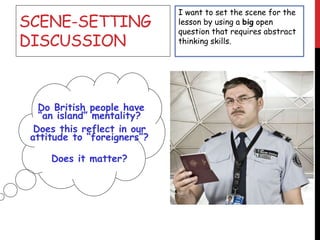
SCENE-SETTING
DISCUSSION
Do British people have
“an island” mentality?
Does this reflect in our
attitude to “foreigners”?
Does it matter?
I want to set the scene for the
lesson by using a big open
question that requires abstract
thinking skills.
WHAT IS THIS LESSON ABOUT?
IDENTITY
Noun: identity;
the fact of being who or what a
person or thing is.
“we know the identity (name) of
the person who threw the
snowball"
Plural noun: identities;
A collection of things that
identifies the individual.
“this person is in Year 10/ is a
boy/ has blonde hair/ plays
rugby/lives in Ilkley….."
DIVERSITY
Adjective: diverse
showing a great deal of
variety; very different.
"a culturally diverse
population"
Noun: diversity
the state of being diverse.
"there was considerable
diversity in the style of the
reports"
PUTTING THE LESSON INTO CONTEXT
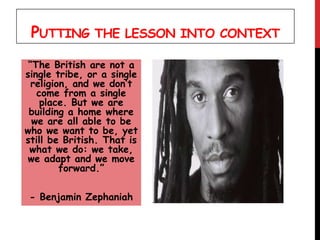
“The British are not a
single tribe, or a single
religion, and we don’t
come from a single
place. But we are
building a home where
we are all able to be
who we want to be, yet
still be British. That is
what we do: we take,
we adapt and we move
forward.”
- Benjamin Zephaniah
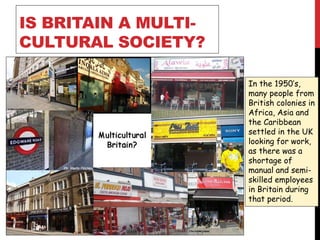
IS BRITAIN A MULTI-
CULTURAL SOCIETY?
In the 1950’s,
many people from
British colonies in
Africa, Asia and
the Caribbean
settled in the UK
looking for work,
as there was a
shortage of
manual and semi-
skilled employees
in Britain during
that period.
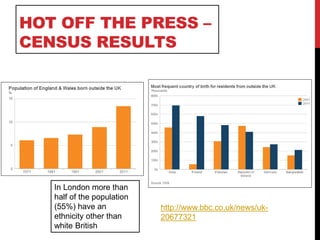
HOT OFF THE PRESS –
CENSUS RESULTS
In London more than
half of the population
(55%) have an
ethnicity other than
white British
http://www.bbc.co.uk/news/uk-
20677321
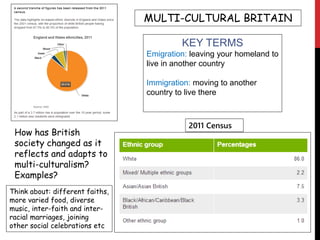
MULTI-CULTURAL BRITAIN
KEY TERMS
Emigration: leaving your homeland to
live in another country
Immigration: moving to another
country to live there
How has British
society changed as it
reflects and adapts to
multi-culturalism?
Examples?
Think about: different faiths,
more varied food, diverse
music, inter-faith and inter-
racial marriages, joining
other social celebrations etc
2011 Census
CONSIDER SOME
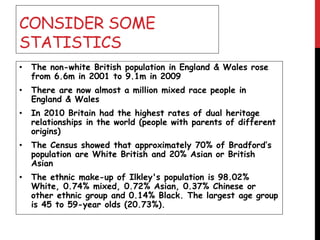
STATISTICS
• The non-white British population in England & Wales rose
from 6.6m in 2001 to 9.1m in 2009
• There are now almost a million mixed race people in
England & Wales
• In 2010 Britain had the highest rates of dual heritage
relationships in the world (people with parents of different
origins)
• The Census showed that approximately 70% of Bradford’s
population are White British and 20% Asian or British
Asian
• The ethnic make-up of Ilkley's population is 98.02%
White, 0.74% mixed, 0.72% Asian, 0.37% Chinese or
other ethnic group and 0.14% Black. The largest age group
is 45 to 59-year olds (20.73%).
PLEASE NOW COMPLETE THE
FIRST PART OF YOUR
WORKSHEET
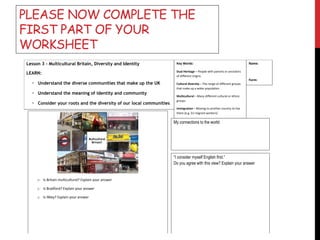
Lesson 3 - Multicultural Britain, Diversity and Identity
LEARN:
• Understand the diverse communities that make up the UK
• Understand the meaning of identity and community
• Consider your roots and the diversity of our local communities
My connections to the world:
Key Words:
Dual Heritage – People with parents or ancestors
of different origins
Cultural diversity – The range of different groups
that make up a wider population
Multicultural – Many different cultural or ethnic
groups
Immigration – Moving to another country to live
there (e.g. EU migrant workers)
Name:
Form:
o Is Britain multicultural? Explain your answer
o Is Bradford? Explain your answer
o Is Ilkley? Explain your answer
“I consider myself English first.”
Do you agree with this view? Explain your answer
CONSIDER YOUR IDENTITY & ROOTS
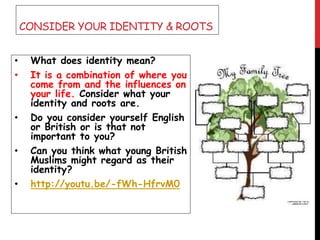
• What does identity mean?
• It is a combination of where you
come from and the influences on
your life. Consider what your
identity and roots are.
• Do you consider yourself English
or British or is that not
important to you?
• Can you think what young British
Muslims might regard as their
identity?
• http://youtu.be/-fWh-HfrvM0
WHO FEELS BRITISH?
Consider this research from 2012
https://www.iser.essex.ac.uk/2012/06/30/ethnic-
minorities-living-in-the-uk-feel-more-british-than-white-
britons
New research examining how British people feel about their nationality
has revealed that people from ethnic minority backgrounds identify
more closely with Britishness than their white counterparts.
The researchers also point to the significant numbers of White British
people who feel little or no association with “being British”.
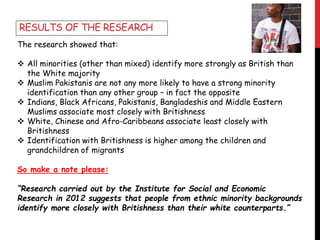
The research showed that:
 All minorities (other than mixed) identify more strongly as British than
the White majority
 Muslim Pakistanis are not any more likely to have a strong minority
identification than any other group – in fact the opposite
 Indians, Black Africans, Pakistanis, Bangladeshis and Middle Eastern
Muslims associate most closely with Britishness
 White, Chinese and Afro-Caribbeans associate least closely with
Britishness
 Identification with Britishness is higher among the children and
grandchildren of migrants
So make a note please:
“Research carried out by the Institute for Social and Economic
Research in 2012 suggests that people from ethnic minority backgrounds
identify more closely with Britishness than their white counterparts.”
RESULTS OF THE RESEARCH
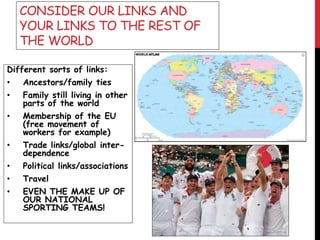
CONSIDER OUR LINKS AND
YOUR LINKS TO THE REST OF
THE WORLD
Different sorts of links:
• Ancestors/family ties
• Family still living in other
parts of the world
• Membership of the EU
(free movement of
workers for example)
• Trade links/global inter-
dependence
• Political links/associations
• Travel
• EVEN THE MAKE UP OF
OUR NATIONAL
SPORTING TEAMS!
PLEASE NOW COMPLETE THE
OTHER PARTS OF YOUR
WORKSHEET
Lesson 3 - Multicultural Britain, Diversity and Identity
LEARN:
• Understand the diverse communities that make up the UK
• Understand the meaning of identity and community
• Consider your roots and the diversity of our local communities
My connections to the world:
Key Words:
Dual Heritage – People with parents or ancestors
of different origins
Cultural diversity – The range of different groups
that make up a wider population
Multicultural – Many different cultural or ethnic
groups
Immigration – Moving to another country to live
there (e.g. EU migrant workers)
Name:
Form:
o Is Britain multicultural? Explain your answer
o Is Bradford? Explain your answer
o Is Ilkley? Explain your answer
“I consider myself English first.”
Do you agree with this view? Explain your answer
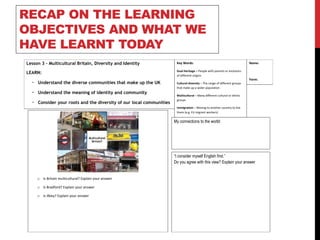
RECAP ON THE LEARNING
OBJECTIVES AND WHAT WE
HAVE LEARNT TODAY
Lesson 3 - Multicultural Britain, Diversity and Identity
LEARN:
• Understand the diverse communities that make up the UK
• Understand the meaning of identity and community
• Consider your roots and the diversity of our local communities
My connections to the world:
Key Words:
Dual Heritage – People with parents or ancestors
of different origins
Cultural diversity – The range of different groups
that make up a wider population
Multicultural – Many different cultural or ethnic
groups
Immigration – Moving to another country to live
there (e.g. EU migrant workers)
Name:
Form:
o Is Britain multicultural? Explain your answer
o Is Bradford? Explain your answer
o Is Ilkley? Explain your answer
“I consider myself English first.”
Do you agree with this view? Explain your answer
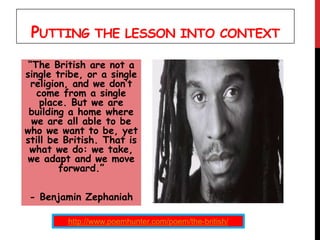
PUTTING THE LESSON INTO CONTEXT
“The British are not a
single tribe, or a single
religion, and we don’t
come from a single
place. But we are
building a home where
we are all able to be
who we want to be, yet
still be British. That is
what we do: we take,
we adapt and we move
forward.”
- Benjamin Zephaniah
http://www.poemhunter.com/poem/the-british/
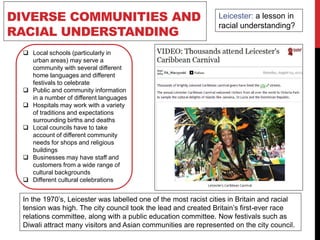
DIVERSE COMMUNITIES AND
RACIAL UNDERSTANDING
 Local schools (particularly in
urban areas) may serve a
community with several different
home languages and different
festivals to celebrate
 Public and community information
in a number of different languages
 Hospitals may work with a variety
of traditions and expectations
surrounding births and deaths
 Local councils have to take
account of different community
needs for shops and religious
buildings
 Businesses may have staff and
customers from a wide range of
cultural backgrounds
 Different cultural celebrations
Leicester: a lesson in
racial understanding?
In the 1970’s, Leicester was labelled one of the most racist cities in Britain and racial
tension was high. The city council took the lead and created Britain’s first-ever race
relations committee, along with a public education committee. Now festivals such as
Diwali attract many visitors and Asian communities are represented on the city council.
RECENT NEWS!
http://www.bbc.co.uk/news/uk-politics-21921089
http://www.bbc.co.uk/news/uk-politics-21850751
http://www.bbc.co.uk/news/uk-politics-25398612
WHOLE-CLASS APPROACH
TO EXAM STYLE QUESTION
QUESTION:
“Immigration benefits
a country”. Do you
agree with this
statement? Give
reasons for your
opinion showing you
have considered
another point of view.
http://youtu.be/MHplEJ
gevqM
As a Group, create a list (and copy this
up in your books) of:
• Ways in which immigrants benefit
from coming to the UK, along side…
• Ways in which they contribute to the
UK (in other words how do we benefit
from them?)
Think about:
• How do immigrants contribute to the world
of work?
• How do they contribute to the culture of
the UK?
• Does meeting people from other cultures
help us to understand the world better?
• Do we get on better if people from different
cultures mix together?

Identity, immigration and Britishness

  • 1.
  • 2.
    SCENE-SETTING DISCUSSION Do British peoplehave “an island” mentality? Does this reflect in our attitude to “foreigners”? Does it matter? I want to set the scene for the lesson by using a big open question that requires abstract thinking skills.
  • 3.
    WHAT IS THISLESSON ABOUT? IDENTITY Noun: identity; the fact of being who or what a person or thing is. “we know the identity (name) of the person who threw the snowball" Plural noun: identities; A collection of things that identifies the individual. “this person is in Year 10/ is a boy/ has blonde hair/ plays rugby/lives in Ilkley….." DIVERSITY Adjective: diverse showing a great deal of variety; very different. "a culturally diverse population" Noun: diversity the state of being diverse. "there was considerable diversity in the style of the reports"
  • 4.
    PUTTING THE LESSONINTO CONTEXT “The British are not a single tribe, or a single religion, and we don’t come from a single place. But we are building a home where we are all able to be who we want to be, yet still be British. That is what we do: we take, we adapt and we move forward.” - Benjamin Zephaniah
  • 5.
    IS BRITAIN AMULTI- CULTURAL SOCIETY? In the 1950’s, many people from British colonies in Africa, Asia and the Caribbean settled in the UK looking for work, as there was a shortage of manual and semi- skilled employees in Britain during that period.
  • 6.
    HOT OFF THEPRESS – CENSUS RESULTS In London more than half of the population (55%) have an ethnicity other than white British http://www.bbc.co.uk/news/uk- 20677321
  • 7.
    MULTI-CULTURAL BRITAIN KEY TERMS Emigration:leaving your homeland to live in another country Immigration: moving to another country to live there How has British society changed as it reflects and adapts to multi-culturalism? Examples? Think about: different faiths, more varied food, diverse music, inter-faith and inter- racial marriages, joining other social celebrations etc 2011 Census
  • 8.
    CONSIDER SOME STATISTICS • Thenon-white British population in England & Wales rose from 6.6m in 2001 to 9.1m in 2009 • There are now almost a million mixed race people in England & Wales • In 2010 Britain had the highest rates of dual heritage relationships in the world (people with parents of different origins) • The Census showed that approximately 70% of Bradford’s population are White British and 20% Asian or British Asian • The ethnic make-up of Ilkley's population is 98.02% White, 0.74% mixed, 0.72% Asian, 0.37% Chinese or other ethnic group and 0.14% Black. The largest age group is 45 to 59-year olds (20.73%).
  • 9.
    PLEASE NOW COMPLETETHE FIRST PART OF YOUR WORKSHEET Lesson 3 - Multicultural Britain, Diversity and Identity LEARN: • Understand the diverse communities that make up the UK • Understand the meaning of identity and community • Consider your roots and the diversity of our local communities My connections to the world: Key Words: Dual Heritage – People with parents or ancestors of different origins Cultural diversity – The range of different groups that make up a wider population Multicultural – Many different cultural or ethnic groups Immigration – Moving to another country to live there (e.g. EU migrant workers) Name: Form: o Is Britain multicultural? Explain your answer o Is Bradford? Explain your answer o Is Ilkley? Explain your answer “I consider myself English first.” Do you agree with this view? Explain your answer
  • 10.
    CONSIDER YOUR IDENTITY& ROOTS • What does identity mean? • It is a combination of where you come from and the influences on your life. Consider what your identity and roots are. • Do you consider yourself English or British or is that not important to you? • Can you think what young British Muslims might regard as their identity? • http://youtu.be/-fWh-HfrvM0
  • 11.
    WHO FEELS BRITISH? Considerthis research from 2012 https://www.iser.essex.ac.uk/2012/06/30/ethnic- minorities-living-in-the-uk-feel-more-british-than-white- britons New research examining how British people feel about their nationality has revealed that people from ethnic minority backgrounds identify more closely with Britishness than their white counterparts. The researchers also point to the significant numbers of White British people who feel little or no association with “being British”.
  • 12.
    The research showedthat:  All minorities (other than mixed) identify more strongly as British than the White majority  Muslim Pakistanis are not any more likely to have a strong minority identification than any other group – in fact the opposite  Indians, Black Africans, Pakistanis, Bangladeshis and Middle Eastern Muslims associate most closely with Britishness  White, Chinese and Afro-Caribbeans associate least closely with Britishness  Identification with Britishness is higher among the children and grandchildren of migrants So make a note please: “Research carried out by the Institute for Social and Economic Research in 2012 suggests that people from ethnic minority backgrounds identify more closely with Britishness than their white counterparts.” RESULTS OF THE RESEARCH
  • 13.
    CONSIDER OUR LINKSAND YOUR LINKS TO THE REST OF THE WORLD Different sorts of links: • Ancestors/family ties • Family still living in other parts of the world • Membership of the EU (free movement of workers for example) • Trade links/global inter- dependence • Political links/associations • Travel • EVEN THE MAKE UP OF OUR NATIONAL SPORTING TEAMS!
  • 14.
    PLEASE NOW COMPLETETHE OTHER PARTS OF YOUR WORKSHEET Lesson 3 - Multicultural Britain, Diversity and Identity LEARN: • Understand the diverse communities that make up the UK • Understand the meaning of identity and community • Consider your roots and the diversity of our local communities My connections to the world: Key Words: Dual Heritage – People with parents or ancestors of different origins Cultural diversity – The range of different groups that make up a wider population Multicultural – Many different cultural or ethnic groups Immigration – Moving to another country to live there (e.g. EU migrant workers) Name: Form: o Is Britain multicultural? Explain your answer o Is Bradford? Explain your answer o Is Ilkley? Explain your answer “I consider myself English first.” Do you agree with this view? Explain your answer
  • 15.
    RECAP ON THELEARNING OBJECTIVES AND WHAT WE HAVE LEARNT TODAY Lesson 3 - Multicultural Britain, Diversity and Identity LEARN: • Understand the diverse communities that make up the UK • Understand the meaning of identity and community • Consider your roots and the diversity of our local communities My connections to the world: Key Words: Dual Heritage – People with parents or ancestors of different origins Cultural diversity – The range of different groups that make up a wider population Multicultural – Many different cultural or ethnic groups Immigration – Moving to another country to live there (e.g. EU migrant workers) Name: Form: o Is Britain multicultural? Explain your answer o Is Bradford? Explain your answer o Is Ilkley? Explain your answer “I consider myself English first.” Do you agree with this view? Explain your answer
  • 16.
    PUTTING THE LESSONINTO CONTEXT “The British are not a single tribe, or a single religion, and we don’t come from a single place. But we are building a home where we are all able to be who we want to be, yet still be British. That is what we do: we take, we adapt and we move forward.” - Benjamin Zephaniah http://www.poemhunter.com/poem/the-british/
  • 17.
    DIVERSE COMMUNITIES AND RACIALUNDERSTANDING  Local schools (particularly in urban areas) may serve a community with several different home languages and different festivals to celebrate  Public and community information in a number of different languages  Hospitals may work with a variety of traditions and expectations surrounding births and deaths  Local councils have to take account of different community needs for shops and religious buildings  Businesses may have staff and customers from a wide range of cultural backgrounds  Different cultural celebrations Leicester: a lesson in racial understanding? In the 1970’s, Leicester was labelled one of the most racist cities in Britain and racial tension was high. The city council took the lead and created Britain’s first-ever race relations committee, along with a public education committee. Now festivals such as Diwali attract many visitors and Asian communities are represented on the city council.
  • 18.
  • 19.
    WHOLE-CLASS APPROACH TO EXAMSTYLE QUESTION QUESTION: “Immigration benefits a country”. Do you agree with this statement? Give reasons for your opinion showing you have considered another point of view. http://youtu.be/MHplEJ gevqM As a Group, create a list (and copy this up in your books) of: • Ways in which immigrants benefit from coming to the UK, along side… • Ways in which they contribute to the UK (in other words how do we benefit from them?) Think about: • How do immigrants contribute to the world of work? • How do they contribute to the culture of the UK? • Does meeting people from other cultures help us to understand the world better? • Do we get on better if people from different cultures mix together?