English identity and ethnic diversity in the context
of UK constitutional change
 A presentation by Elliott Dillon, Catherine Smith & Zeyuan Liu
Changes in British Identity
 Following the establishment of the Scottish
Parliament and National Assembly of Wales in 1999,
many believe this development of national
independence for these nations has hampered the
concept of a ‘British identity’.
 This is because with Scotland and Wales having
more control over their nations politically, more of
their population now identify with their home
country rather than Britain.
What is it to be British?
 There are a variety of definitions according to
different people in regards to being ‘British’ but the
general modern notion argues ‘being British’ is
‘multicultural, multiracial and multifaith’. This
leaves being British as a very open identity which
many people of entirely different backgrounds can
share.
 However, to be Welsh for example if a much more
closed identity as it tends to require a ‘shared
descent, history, culture and religion’, which people
cannot claim to be so simply.
Has being British changed over time?
 Being British has long been seen as ‘unity in diversity’ –
viewed by many as a more moral and politically accepted
concept than cultural or racial essentialisms.
 Therefore today, in our more tolerant politically sensitive
society, the notion of being ‘British’ is seen to be much more
popular and inclusive.
 As a result, today’s multiculturalism can be seen as
‘progressive historical developments’ while ‘enduring moral
order’ by uniting people different backgrounds into one
shared identity in as shared society.
 Between the Victorian era and up until the aftermath of the
WWII, the British identity was a homogenous one, but in
today’s multicultural society its developed into a much more
heterogeneous character, meaning diverse.
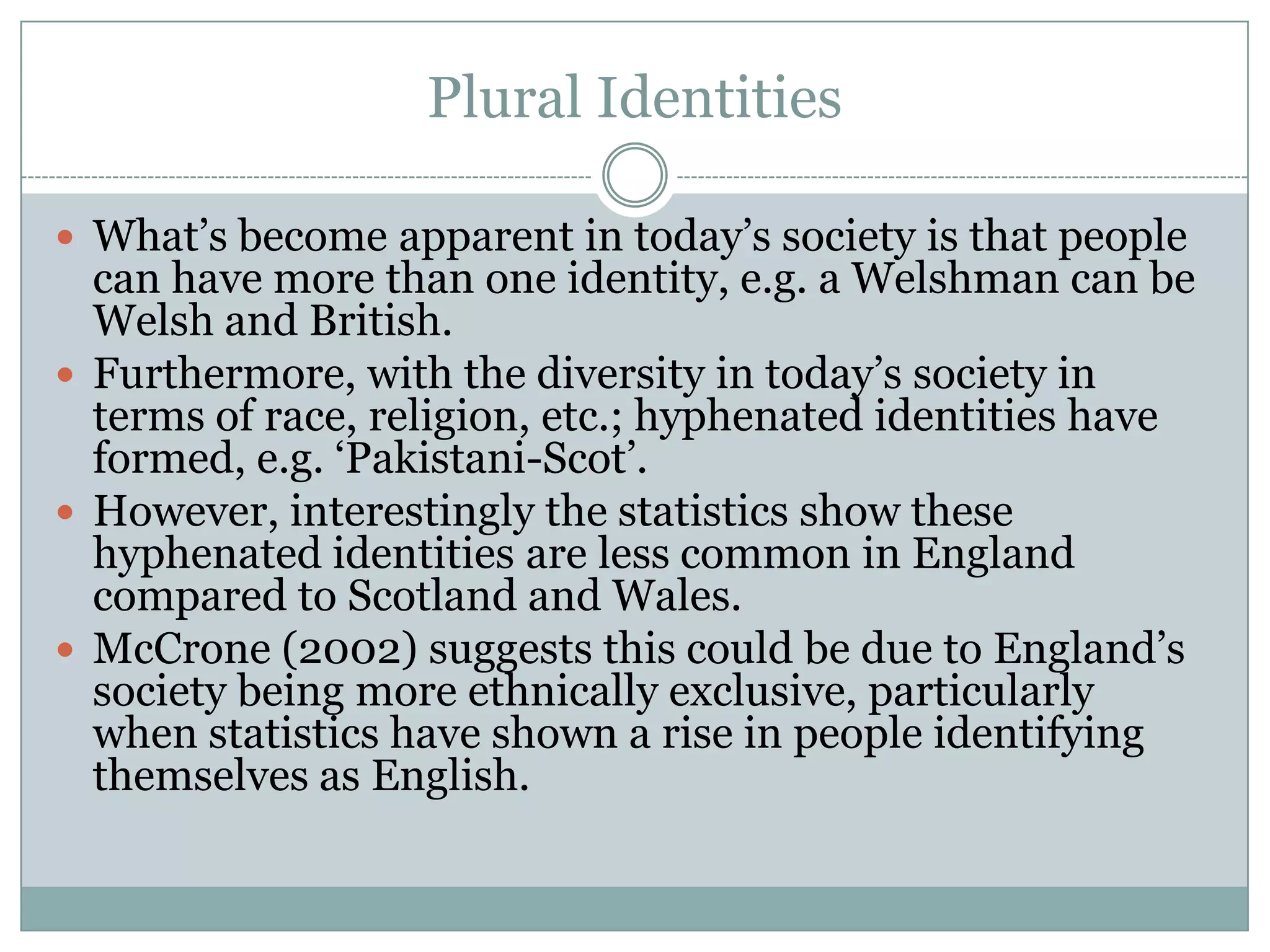
Plural Identities
 What’s become apparent in today’s society is that people
can have more than one identity, e.g. a Welshman can be
Welsh and British.
 Furthermore, with the diversity in today’s society in
terms of race, religion, etc.; hyphenated identities have
formed, e.g. ‘Pakistani-Scot’.
 However, interestingly the statistics show these
hyphenated identities are less common in England
compared to Scotland and Wales.
 McCrone (2002) suggests this could be due to England’s
society being more ethnically exclusive, particularly
when statistics have shown a rise in people identifying
themselves as English.
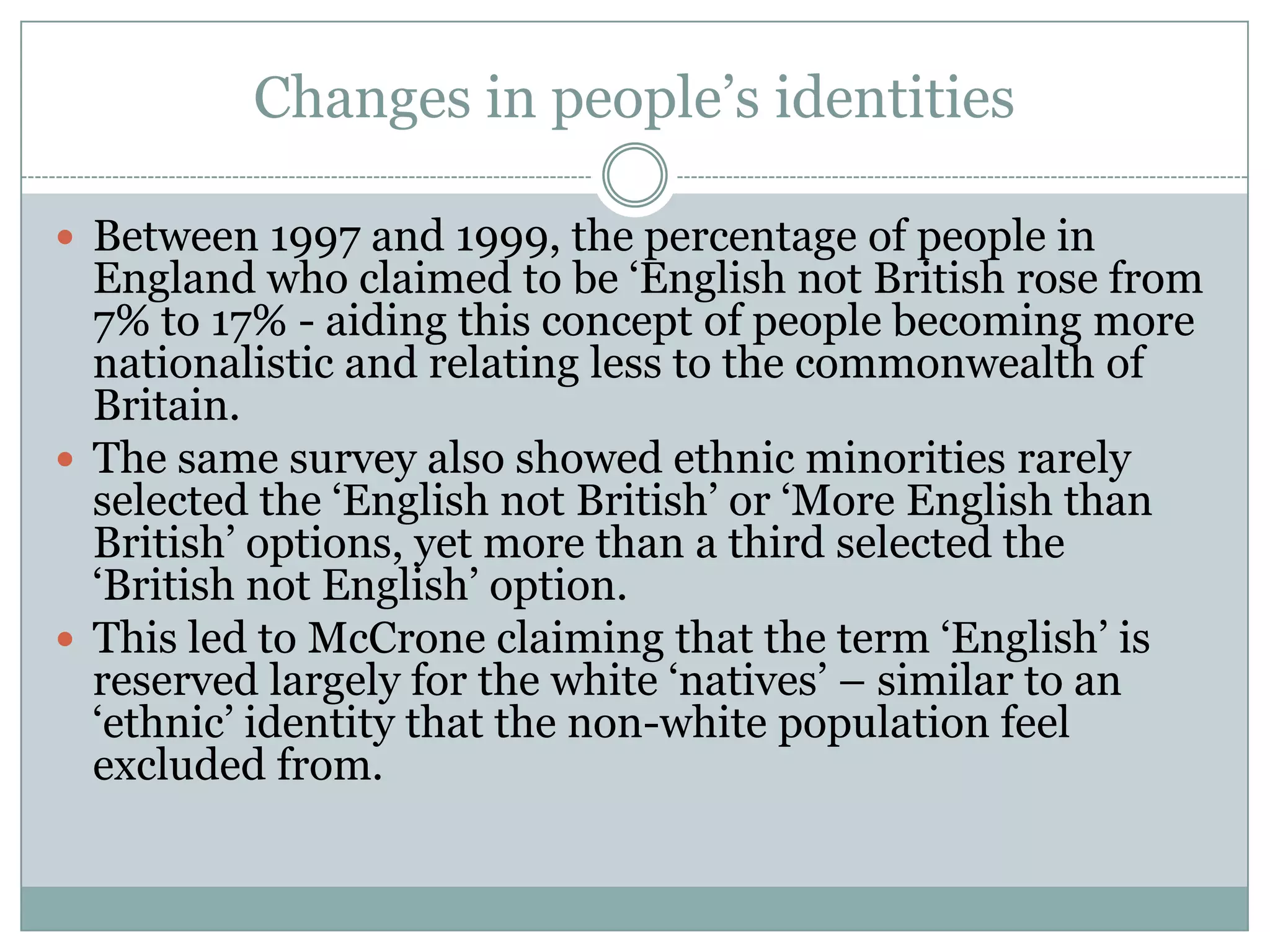
Changes in people’s identities
 Between 1997 and 1999, the percentage of people in
England who claimed to be ‘English not British rose from
7% to 17% - aiding this concept of people becoming more
nationalistic and relating less to the commonwealth of
Britain.
 The same survey also showed ethnic minorities rarely
selected the ‘English not British’ or ‘More English than
British’ options, yet more than a third selected the
‘British not English’ option.
 This led to McCrone claiming that the term ‘English’ is
reserved largely for the white ‘natives’ – similar to an
‘ethnic’ identity that the non-white population feel
excluded from.
Changing Ethnic Identities
 Joly (2001) claimed ‘all of us in this room were born
in England, and we’ve taken on English personalities’
– suggesting perhaps people don’t realise just how
‘English’ they are or have become.
The problems with the survey
 People have so many ways to represent their English
identity: their place of birth, the blood, adoption of
English cultural practices, etc.
 The actual definition of being ‘English’ or ‘British’ is
a disputed one, leaving people unsure of what they
are.
QUALITATIVE INTERVIEW ACCOUNTS OF ENGLISH
IDENTITY AMONG YOUNG ADULTS OF PAKISTANI-ORIGIN
IN GREATER MANCHESTER
In this section, we focus on the different ways in
which english identity may be understood even
within A relatively restricted population.
Methods
 Sample: Participants were 15 men and 20 women
aged 17–34 living in the Greater Manchester
Metropolitan area.
 Interviews: The interviews were generally
relatively informal and these topics tended to be
introduced in a conversational style.
 Analytic techniques: All interview transcripts
were initially indexed for thematic content using
ATLAS.ti software
‘English’ as a racial and cultural referent
• Those respondents who did display a measure of
spontaneous concern over the distinction between the
terms English and British tended to have relatively
high levels of educational attainment or strong
political views.
• Unsurprisingly, when respondents presented a
rational justification for calling themselves British in
preference to English they often referred to the
different racial or cultural significations of the labels.
Even in these cases, however, there was a measure of
variation in how, precisely, this was formulated.
Ethnic Englishness and imagined
community
 In such cases, the category ‘English’ was commonly used to
refer to the members and culture of the ‘white community’.
 At the same time, however, respondents oriented to norms
promoting interpersonal contact and ‘mixing’ between
individual members of different ethnic communities in the
interests of the ‘community as a whole’.
 This kind of construction of the local, the national and the
international spheres, as ‘communities of communities’ was
in turn associated with a normative injunction against
external attribution of responsibility and displays of
concern over the particular responsibility of members of
their own community to ‘make the first move’.
‘English’ as a territorial referent
 respondents could also use the term as a
geographical referent
 The term English, in contrast, is treated as a
reference to place (a country) rather than to polity,
and as such is cast as relatively socially
inconsequential.
Flexibility in use of the label ‘English’
 ‘England’ is recast as an institution, which is in turn
elided with the singular will of the (by inference,
singular and homogenous) white ethnic majority,
defined precisely in opposition to the ‘black and
Asian communities’.
 In the interview accounts, this kind of referent
flexibility was often reflected in a disparity between
the way in which a speaker reported describing
themselves in principle and their use of mundane
linguistic deixis
Flexibility in use of the label ‘English’
 It was relatively common for a speaker who claimed
not to call themselves English as a matter of
principle to adopt an English national ‘we’ or ‘us’ in
the course of conversation. One reason for this shift
in orientation was that the speakers were often
interpreting the referent of the term English in
different ways in the two contexts.
 When labelling self’s as an identity the decision people
made was seen to be associated with mainly political
action
 However other members chose their label based on an
emotional relationship with local places. (There feeling of
home)
 In the survey it was found that many people did not
regard themselves as ‘English’ this was due to
commitments to faiths and religion.
 It was also found that the label people placed on their
identity symbolized their generation. Developing a
westernised way of life people would regard themselves
as ‘british’
Concluding points
 There are many different definitions held when
looking at what it means to be british. The over view
of the definition is very open and allows the inclusive
of many people from different backgrounds,cultures
and religons.
 Due to the inclusion of so many within defining
what it is to be British, it is seen to bring people
together into one united society
 More generally, analysis of everyday understandings
of national identity or the perceived boundaries of
social and political community may effectively
displace questions concerning social integration,
structural inequality, discrimination or oppression.
 This is the case whether imagined as a culturally
diverse collection of individuals or a multiethnic
community of communities –
Concluding points
 The question of how people understand themselves
and others in national terms and how they
understand them- selves and others as the subjects
and objects of democratic governance, are important
questions in their own right.
 It is also important to recognize that ethnically
inclusive constructs of national identity – whether
English, Scottish, Welsh or British – by themselves
guarantee neither the absence of racist
discrimination nor the existence of effective social
integration or substantive ethnic equality.

English identity and ethnic diversity in the context of UK constitutional change

  • 1.
    English identity andethnic diversity in the context of UK constitutional change  A presentation by Elliott Dillon, Catherine Smith & Zeyuan Liu
  • 2.
    Changes in BritishIdentity  Following the establishment of the Scottish Parliament and National Assembly of Wales in 1999, many believe this development of national independence for these nations has hampered the concept of a ‘British identity’.  This is because with Scotland and Wales having more control over their nations politically, more of their population now identify with their home country rather than Britain.
  • 3.
    What is itto be British?  There are a variety of definitions according to different people in regards to being ‘British’ but the general modern notion argues ‘being British’ is ‘multicultural, multiracial and multifaith’. This leaves being British as a very open identity which many people of entirely different backgrounds can share.  However, to be Welsh for example if a much more closed identity as it tends to require a ‘shared descent, history, culture and religion’, which people cannot claim to be so simply.
  • 4.
    Has being Britishchanged over time?  Being British has long been seen as ‘unity in diversity’ – viewed by many as a more moral and politically accepted concept than cultural or racial essentialisms.  Therefore today, in our more tolerant politically sensitive society, the notion of being ‘British’ is seen to be much more popular and inclusive.  As a result, today’s multiculturalism can be seen as ‘progressive historical developments’ while ‘enduring moral order’ by uniting people different backgrounds into one shared identity in as shared society.  Between the Victorian era and up until the aftermath of the WWII, the British identity was a homogenous one, but in today’s multicultural society its developed into a much more heterogeneous character, meaning diverse.
  • 5.
    Plural Identities  What’sbecome apparent in today’s society is that people can have more than one identity, e.g. a Welshman can be Welsh and British.  Furthermore, with the diversity in today’s society in terms of race, religion, etc.; hyphenated identities have formed, e.g. ‘Pakistani-Scot’.  However, interestingly the statistics show these hyphenated identities are less common in England compared to Scotland and Wales.  McCrone (2002) suggests this could be due to England’s society being more ethnically exclusive, particularly when statistics have shown a rise in people identifying themselves as English.
  • 6.
    Changes in people’sidentities  Between 1997 and 1999, the percentage of people in England who claimed to be ‘English not British rose from 7% to 17% - aiding this concept of people becoming more nationalistic and relating less to the commonwealth of Britain.  The same survey also showed ethnic minorities rarely selected the ‘English not British’ or ‘More English than British’ options, yet more than a third selected the ‘British not English’ option.  This led to McCrone claiming that the term ‘English’ is reserved largely for the white ‘natives’ – similar to an ‘ethnic’ identity that the non-white population feel excluded from.
  • 7.
    Changing Ethnic Identities Joly (2001) claimed ‘all of us in this room were born in England, and we’ve taken on English personalities’ – suggesting perhaps people don’t realise just how ‘English’ they are or have become.
  • 8.
    The problems withthe survey  People have so many ways to represent their English identity: their place of birth, the blood, adoption of English cultural practices, etc.  The actual definition of being ‘English’ or ‘British’ is a disputed one, leaving people unsure of what they are.
  • 9.
    QUALITATIVE INTERVIEW ACCOUNTSOF ENGLISH IDENTITY AMONG YOUNG ADULTS OF PAKISTANI-ORIGIN IN GREATER MANCHESTER In this section, we focus on the different ways in which english identity may be understood even within A relatively restricted population.
  • 10.
    Methods  Sample: Participantswere 15 men and 20 women aged 17–34 living in the Greater Manchester Metropolitan area.  Interviews: The interviews were generally relatively informal and these topics tended to be introduced in a conversational style.  Analytic techniques: All interview transcripts were initially indexed for thematic content using ATLAS.ti software
  • 11.
    ‘English’ as aracial and cultural referent • Those respondents who did display a measure of spontaneous concern over the distinction between the terms English and British tended to have relatively high levels of educational attainment or strong political views. • Unsurprisingly, when respondents presented a rational justification for calling themselves British in preference to English they often referred to the different racial or cultural significations of the labels. Even in these cases, however, there was a measure of variation in how, precisely, this was formulated.
  • 12.
    Ethnic Englishness andimagined community  In such cases, the category ‘English’ was commonly used to refer to the members and culture of the ‘white community’.  At the same time, however, respondents oriented to norms promoting interpersonal contact and ‘mixing’ between individual members of different ethnic communities in the interests of the ‘community as a whole’.  This kind of construction of the local, the national and the international spheres, as ‘communities of communities’ was in turn associated with a normative injunction against external attribution of responsibility and displays of concern over the particular responsibility of members of their own community to ‘make the first move’.
  • 13.
    ‘English’ as aterritorial referent  respondents could also use the term as a geographical referent  The term English, in contrast, is treated as a reference to place (a country) rather than to polity, and as such is cast as relatively socially inconsequential.
  • 14.
    Flexibility in useof the label ‘English’  ‘England’ is recast as an institution, which is in turn elided with the singular will of the (by inference, singular and homogenous) white ethnic majority, defined precisely in opposition to the ‘black and Asian communities’.  In the interview accounts, this kind of referent flexibility was often reflected in a disparity between the way in which a speaker reported describing themselves in principle and their use of mundane linguistic deixis
  • 15.
    Flexibility in useof the label ‘English’  It was relatively common for a speaker who claimed not to call themselves English as a matter of principle to adopt an English national ‘we’ or ‘us’ in the course of conversation. One reason for this shift in orientation was that the speakers were often interpreting the referent of the term English in different ways in the two contexts.
  • 16.
     When labellingself’s as an identity the decision people made was seen to be associated with mainly political action  However other members chose their label based on an emotional relationship with local places. (There feeling of home)  In the survey it was found that many people did not regard themselves as ‘English’ this was due to commitments to faiths and religion.  It was also found that the label people placed on their identity symbolized their generation. Developing a westernised way of life people would regard themselves as ‘british’
  • 17.
    Concluding points  Thereare many different definitions held when looking at what it means to be british. The over view of the definition is very open and allows the inclusive of many people from different backgrounds,cultures and religons.  Due to the inclusion of so many within defining what it is to be British, it is seen to bring people together into one united society
  • 18.
     More generally,analysis of everyday understandings of national identity or the perceived boundaries of social and political community may effectively displace questions concerning social integration, structural inequality, discrimination or oppression.  This is the case whether imagined as a culturally diverse collection of individuals or a multiethnic community of communities –
  • 19.
    Concluding points  Thequestion of how people understand themselves and others in national terms and how they understand them- selves and others as the subjects and objects of democratic governance, are important questions in their own right.  It is also important to recognize that ethnically inclusive constructs of national identity – whether English, Scottish, Welsh or British – by themselves guarantee neither the absence of racist discrimination nor the existence of effective social integration or substantive ethnic equality.