Welcome
MEDICAL CODING
LIKHITHA N
MSc BIOTECHNOLOGY
033/022023
5/5/2023
www.clinosol.com | follow us on social media
@clinosolresearch
1
INDEX
• Introduction
• Brief history
• Types of codes
• Basic steps in coding
• Skills required by a coder
• Reference
5/5/2023
www.clinosol.com | follow us on social media
@clinosolresearch
2
INTRODUCTION
5/5/2023
www.clinosol.com | follow us on social media
@clinosolresearch
3
Medical coding is defined as the transformation of healthcare diagnosis, procedures,
medical services and equipment into universal medical alpha-numeric codes.
It standardizes the language and presentation of all these elemants so they can be easily
understood, tracked and modified.
It is performed all over the world, with most countries using ICD.
IMPORTANCE
• Collection of general medical statistical data
• Medical reimbursement
• Hospital payment
• Quality review
• Benchmarking measurement
BRIEF HISTORY
• Originated in England during 17TH century.
• Statistical data was collected from a system called the London Bills of Mortality, and the data
was organized into numerical codes.
• The codes were then used to estimate the most recurrent causes of death.
• Statistical examination of the mortality rate was the organized into “International list of
causes of death”.
• WHO uesd this list in tracking the mortality rates and the international health developments.
• The list was later developed into the International Classification of Diseases, its 10th edititon
is ICD-10-CM.
• In 1997, the global medical community accepted the ICD system, which compelled the
NCHS to extend ICD by including cause of death and clinical diagnosis
• This way to catalog the medical records, make medical evaluations quick and easier.
5/5/2023
www.clinosol.com | follow us on social media
@clinosolresearch
4
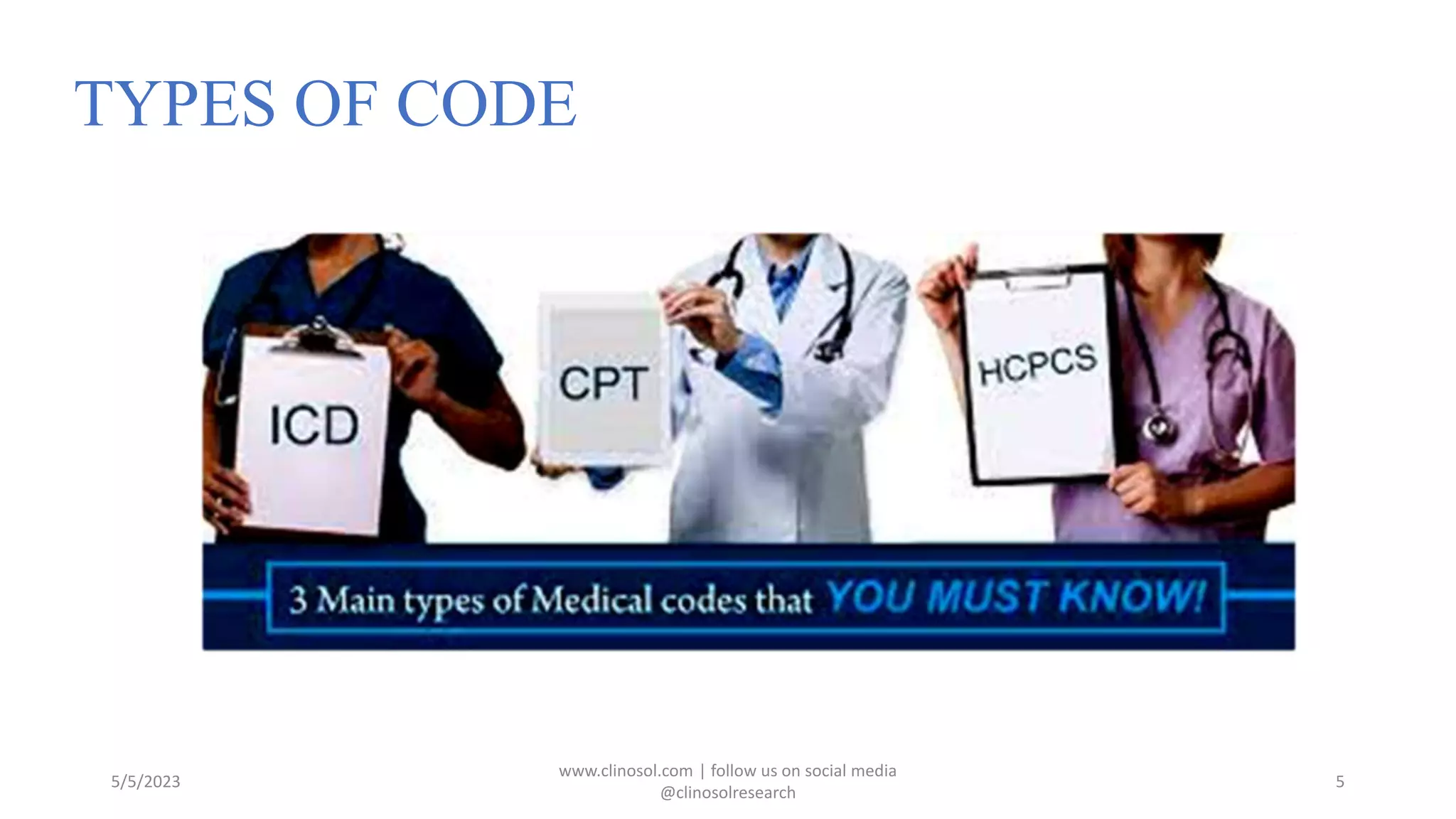
TYPES OF CODE
5/5/2023
www.clinosol.com | follow us on social media
@clinosolresearch
5
ICD (International Classification of Diseases)
• This code was established by the WHO in late 1940s
• These are diagnostic codes that create a uniform vocabulary for describing the cause of
injury, illnes and death.
• It has been updated several times since its inception. For eg, ICD-10-CM. The code that’s
currently in use in the United States is ICD-10-CM. This means it’s the 10th revision of
the ICD code.
• The “-CM” at the end stands for “clinical modification.”
• ICD codes are used to represent a doctor’s diagnosis and the patient’s condition.
• In the billing process, these codes are used to determine medical necessity.
5/5/2023
www.clinosol.com | follow us on social media
@clinosolresearch
6
CPT (Current Procedure Terminology)
• CPT are used to document the majority of the medical procedure performed in a physician’s
office.
• Published and maintained by American Medical Association (AMA).
• CPT codes are 5 digi tnumeric codes that are divided into 3 categories:
Category 1: used most often, and divided into 6 ranges that corresponds to 6 major
medical fields.
Category 2: corresponds to performance measuremnet, laboratory or radiology test results .
Categoty 3: corresponds to emerging medical technology.
5/5/2023
www.clinosol.com | follow us on social media
@clinosolresearch
7
HCPCS (Healthcare common procedure Coding System)
• Developed by CMS (Centre for medicine and medicaid services) and maintained by
AMA
• Corresponds to services, procedures and equipments not covered by CPT.
• It is the official code set for outpatient hospital care, chemotherapy drugs, among
other services
• HCPCS code set is divided into 2 levels:
Level 1: identical to CPT
Level 2: set of alphanumeric codes that is divided into 17 sections, each based on
area of specificity, like medical and laboratory or rehabilitative services.
5/5/2023
www.clinosol.com | follow us on social media
@clinosolresearch
8
BASIC STEPS IN CODING
• Review the health record
• Identify the principle diagonses and procedures to be coded.
• Identify the main terms in the alphabetic index
• Review any sub terms under the main term in the index
• Follow any cross reference instructions, such as “see also”
• Verify in the tabular list the codes selected from the index
• Refer to any instructional notation in the tabular column
• Assign codes to the highest level of specificity.
• Assign codes to the diagnoses and procedures, reporting all aplicable codes and sequences in
accordance with the guidelines
5/5/2023
www.clinosol.com | follow us on social media
@clinosolresearch
9
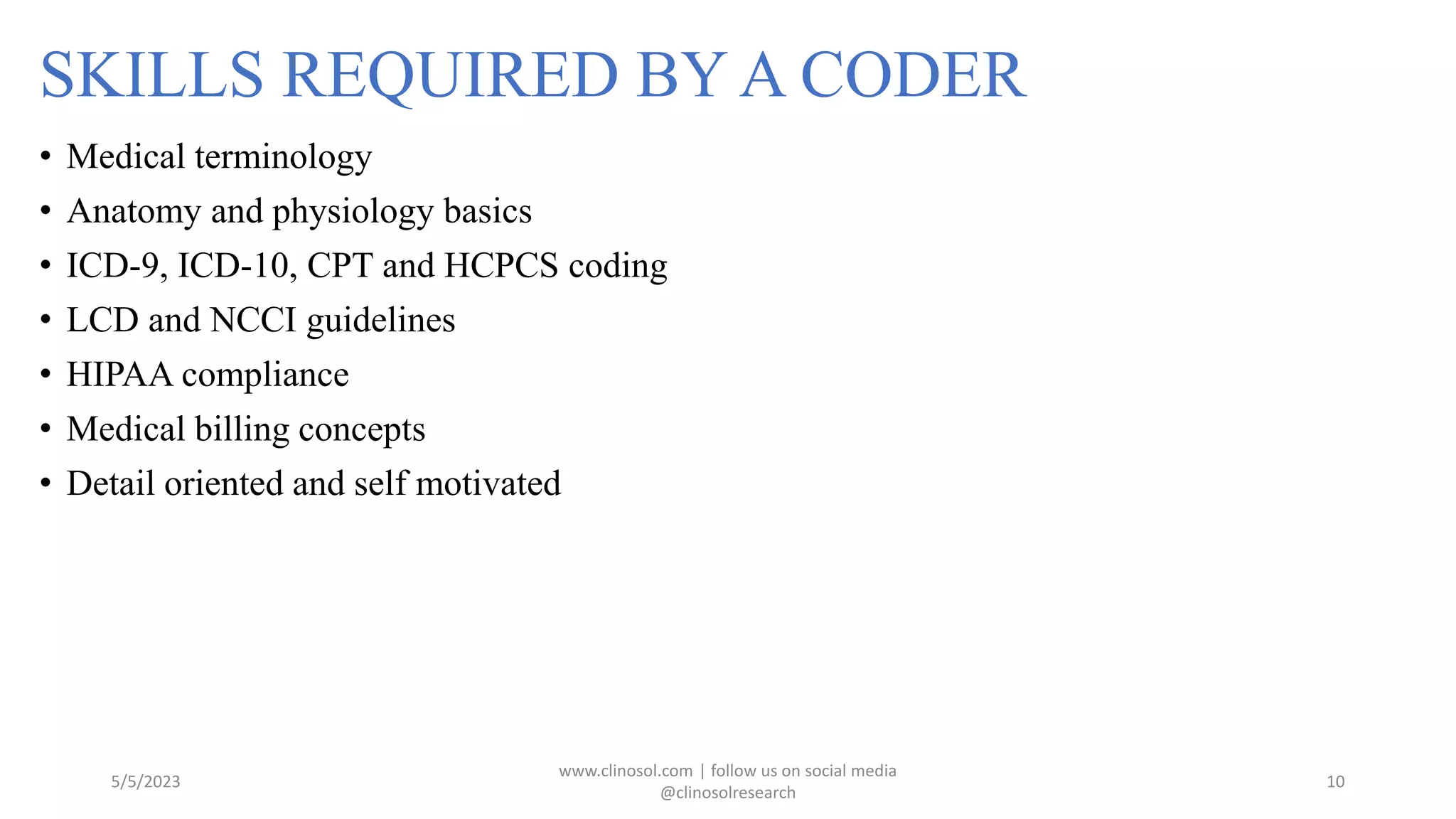
SKILLS REQUIRED BY A CODER
• Medical terminology
• Anatomy and physiology basics
• ICD-9, ICD-10, CPT and HCPCS coding
• LCD and NCCI guidelines
• HIPAA compliance
• Medical billing concepts
• Detail oriented and self motivated
5/5/2023
www.clinosol.com | follow us on social media
@clinosolresearch
10
REFERENCES
• https://www.slideshare.net/MushtaqAhmadWani3/medical-coding-71919467
• https://www.aapc.com/medical-coding/medical-coding.aspx
5/5/2023
www.clinosol.com | follow us on social media
@clinosolresearch
11
Thank You!
www.clinosol.com
(India | Canada)
9121151622/623/624
info@clinosol.com
5/5/2023
www.clinosol.com | follow us on social media
@clinosolresearch
12

Medical Coding

  • 1.
    Welcome MEDICAL CODING LIKHITHA N MScBIOTECHNOLOGY 033/022023 5/5/2023 www.clinosol.com | follow us on social media @clinosolresearch 1
  • 2.
    INDEX • Introduction • Briefhistory • Types of codes • Basic steps in coding • Skills required by a coder • Reference 5/5/2023 www.clinosol.com | follow us on social media @clinosolresearch 2
  • 3.
    INTRODUCTION 5/5/2023 www.clinosol.com | followus on social media @clinosolresearch 3 Medical coding is defined as the transformation of healthcare diagnosis, procedures, medical services and equipment into universal medical alpha-numeric codes. It standardizes the language and presentation of all these elemants so they can be easily understood, tracked and modified. It is performed all over the world, with most countries using ICD. IMPORTANCE • Collection of general medical statistical data • Medical reimbursement • Hospital payment • Quality review • Benchmarking measurement
  • 4.
    BRIEF HISTORY • Originatedin England during 17TH century. • Statistical data was collected from a system called the London Bills of Mortality, and the data was organized into numerical codes. • The codes were then used to estimate the most recurrent causes of death. • Statistical examination of the mortality rate was the organized into “International list of causes of death”. • WHO uesd this list in tracking the mortality rates and the international health developments. • The list was later developed into the International Classification of Diseases, its 10th edititon is ICD-10-CM. • In 1997, the global medical community accepted the ICD system, which compelled the NCHS to extend ICD by including cause of death and clinical diagnosis • This way to catalog the medical records, make medical evaluations quick and easier. 5/5/2023 www.clinosol.com | follow us on social media @clinosolresearch 4
  • 5.
    TYPES OF CODE 5/5/2023 www.clinosol.com| follow us on social media @clinosolresearch 5
  • 6.
    ICD (International Classificationof Diseases) • This code was established by the WHO in late 1940s • These are diagnostic codes that create a uniform vocabulary for describing the cause of injury, illnes and death. • It has been updated several times since its inception. For eg, ICD-10-CM. The code that’s currently in use in the United States is ICD-10-CM. This means it’s the 10th revision of the ICD code. • The “-CM” at the end stands for “clinical modification.” • ICD codes are used to represent a doctor’s diagnosis and the patient’s condition. • In the billing process, these codes are used to determine medical necessity. 5/5/2023 www.clinosol.com | follow us on social media @clinosolresearch 6
  • 7.
    CPT (Current ProcedureTerminology) • CPT are used to document the majority of the medical procedure performed in a physician’s office. • Published and maintained by American Medical Association (AMA). • CPT codes are 5 digi tnumeric codes that are divided into 3 categories: Category 1: used most often, and divided into 6 ranges that corresponds to 6 major medical fields. Category 2: corresponds to performance measuremnet, laboratory or radiology test results . Categoty 3: corresponds to emerging medical technology. 5/5/2023 www.clinosol.com | follow us on social media @clinosolresearch 7
  • 8.
    HCPCS (Healthcare commonprocedure Coding System) • Developed by CMS (Centre for medicine and medicaid services) and maintained by AMA • Corresponds to services, procedures and equipments not covered by CPT. • It is the official code set for outpatient hospital care, chemotherapy drugs, among other services • HCPCS code set is divided into 2 levels: Level 1: identical to CPT Level 2: set of alphanumeric codes that is divided into 17 sections, each based on area of specificity, like medical and laboratory or rehabilitative services. 5/5/2023 www.clinosol.com | follow us on social media @clinosolresearch 8
  • 9.
    BASIC STEPS INCODING • Review the health record • Identify the principle diagonses and procedures to be coded. • Identify the main terms in the alphabetic index • Review any sub terms under the main term in the index • Follow any cross reference instructions, such as “see also” • Verify in the tabular list the codes selected from the index • Refer to any instructional notation in the tabular column • Assign codes to the highest level of specificity. • Assign codes to the diagnoses and procedures, reporting all aplicable codes and sequences in accordance with the guidelines 5/5/2023 www.clinosol.com | follow us on social media @clinosolresearch 9
  • 10.
    SKILLS REQUIRED BYA CODER • Medical terminology • Anatomy and physiology basics • ICD-9, ICD-10, CPT and HCPCS coding • LCD and NCCI guidelines • HIPAA compliance • Medical billing concepts • Detail oriented and self motivated 5/5/2023 www.clinosol.com | follow us on social media @clinosolresearch 10
  • 11.
  • 12.
    Thank You! www.clinosol.com (India |Canada) 9121151622/623/624 info@clinosol.com 5/5/2023 www.clinosol.com | follow us on social media @clinosolresearch 12