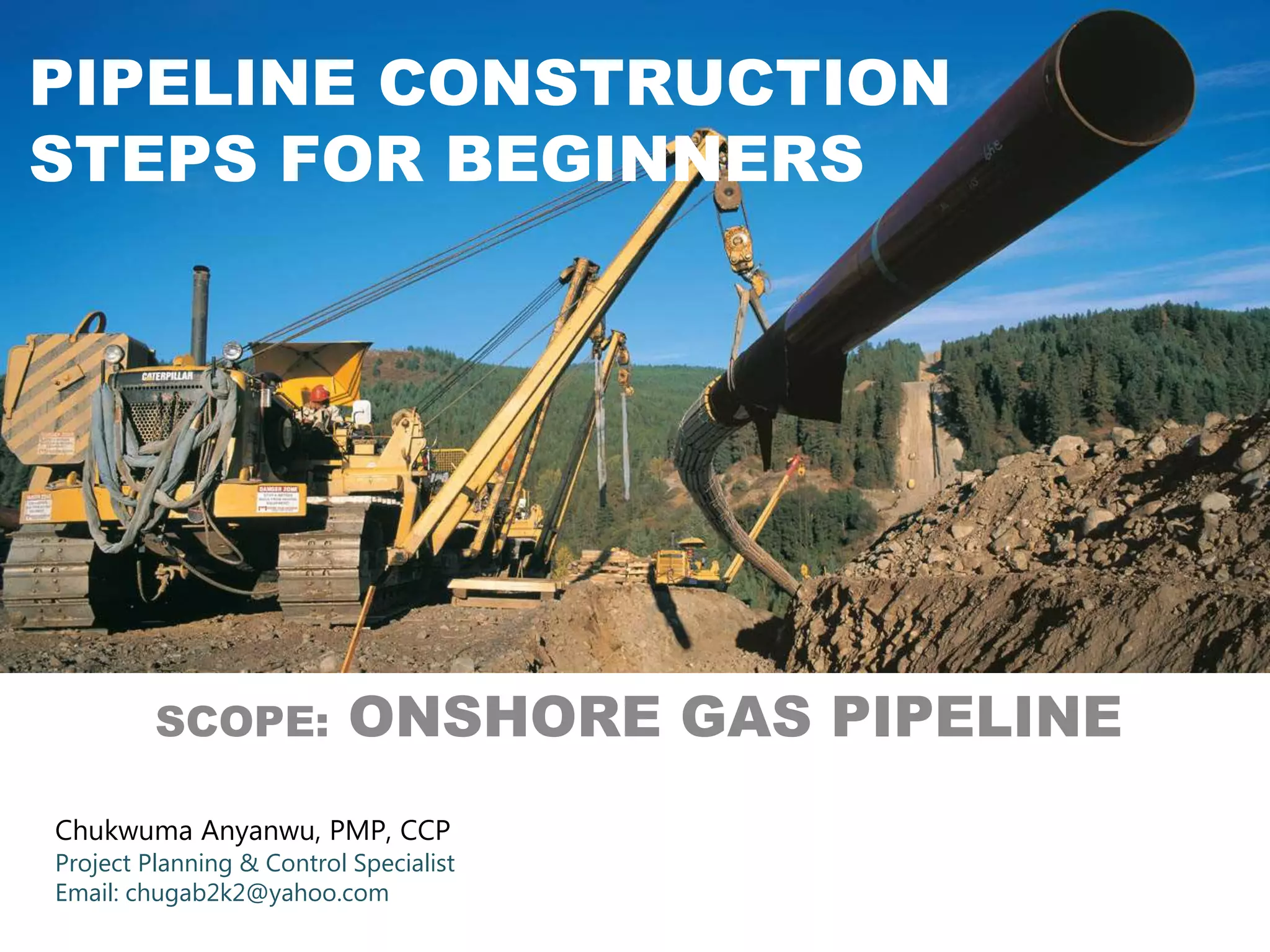
PIPELINE CONSTRUCTION
STEPS FOR BEGINNERS
SCOPE: ONSHORE GAS PIPELINE
Chukwuma Anyanwu, PMP, CCP
Project Planning & Control Specialist
Email: chugab2k2@yahoo.com
The construction of a pipeline looks much like a
moving assembly line. A large project typically is
broken into manageable lengths called
“spreads,” and utilizes highly specialized and
qualified workgroups. Each spread is composed
of various crews, each with its own
responsibilities. As one crew completes its work,
the next crew moves into position to complete
its piece of the construction process. Here are
the stages of the construction process.
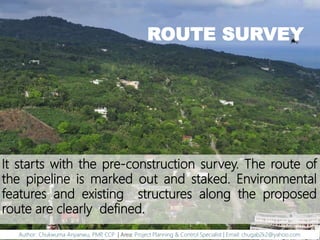
ROUTE SURVEY
It starts with the pre-construction survey. The route of
the pipeline is marked out and staked. Environmental
features and existing structures along the proposed
route are clearly defined.
Author: Chukwuma Anyanwu, PMP, CCP | Area: Project Planning & Control Specialist | Email: chugab2k2@yahoo.com
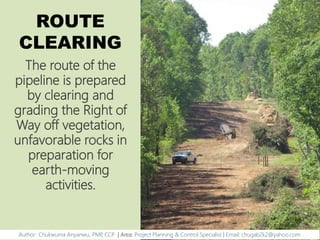
ROUTE
CLEARING
The route of the
pipeline is prepared
by clearing and
grading the Right of
Way off vegetation,
unfavorable rocks in
preparation for
earth-moving
activities.
Author: Chukwuma Anyanwu, PMP, CCP | Area: Project Planning & Control Specialist | Email: chugab2k2@yahoo.com
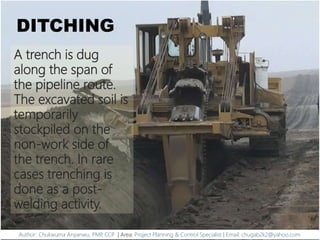
DITCHING
A trench is dug
along the span of
the pipeline route.
The excavated soil is
temporarily
stockpiled on the
non-work side of
the trench. In rare
cases trenching is
done as a post-
welding activity.
Author: Chukwuma Anyanwu, PMP, CCP | Area: Project Planning & Control Specialist | Email: chugab2k2@yahoo.com
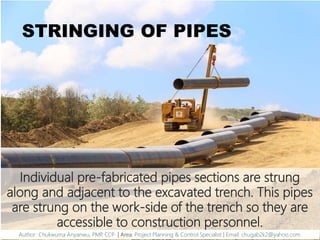
STRINGING OF PIPES
Individual pre-fabricated pipes sections are strung
along and adjacent to the excavated trench. This pipes
are strung on the work-side of the trench so they are
accessible to construction personnel.
Author: Chukwuma Anyanwu, PMP, CCP | Area: Project Planning & Control Specialist | Email: chugab2k2@yahoo.com
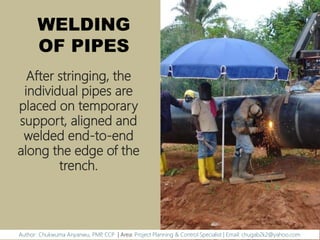
WELDING
OF PIPES
After stringing, the
individual pipes are
placed on temporary
support, aligned and
welded end-to-end
along the edge of the
trench.
Author: Chukwuma Anyanwu, PMP, CCP | Area: Project Planning & Control Specialist | Email: chugab2k2@yahoo.com
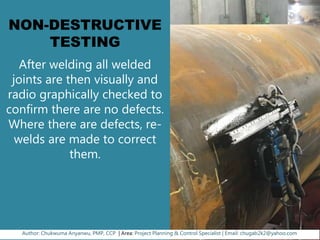
NON-DESTRUCTIVE
TESTING
After welding all welded
joints are then visually and
radio graphically checked to
confirm there are no defects.
Where there are defects, re-
welds are made to correct
them.
Author: Chukwuma Anyanwu, PMP, CCP | Area: Project Planning & Control Specialist | Email: chugab2k2@yahoo.com
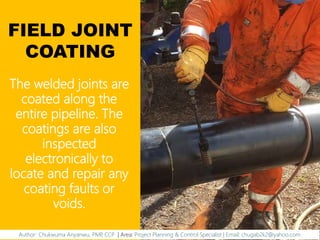
FIELD JOINT
COATING
The welded joints are
coated along the
entire pipeline. The
coatings are also
inspected
electronically to
locate and repair any
coating faults or
voids.
Author: Chukwuma Anyanwu, PMP, CCP | Area: Project Planning & Control Specialist | Email: chugab2k2@yahoo.com
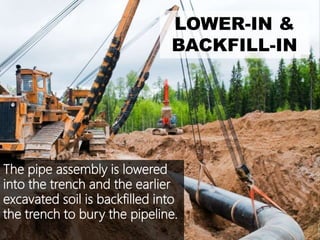
LOWER-IN &
BACKFILL-IN
The pipe assembly is lowered
into the trench and the earlier
excavated soil is backfilled into
the trench to bury the pipeline.
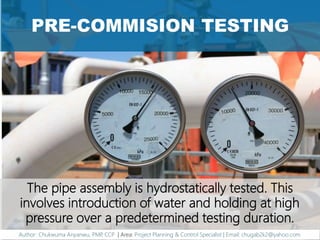
PRE-COMMISION TESTING
The pipe assembly is hydrostatically tested. This
involves introduction of water and holding at high
pressure over a predetermined testing duration.
Author: Chukwuma Anyanwu, PMP, CCP | Area: Project Planning & Control Specialist | Email: chugab2k2@yahoo.com
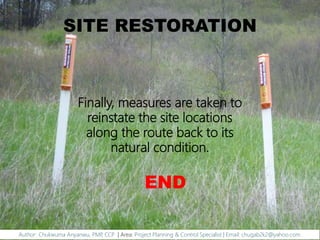
SITE RESTORATION
Finally, measures are taken to
reinstate the site locations
along the route back to its
natural condition.
Author: Chukwuma Anyanwu, PMP, CCP | Area: Project Planning & Control Specialist | Email: chugab2k2@yahoo.com
END

Pipeline construction steps for beginners

  • 1.
    PIPELINE CONSTRUCTION STEPS FORBEGINNERS SCOPE: ONSHORE GAS PIPELINE Chukwuma Anyanwu, PMP, CCP Project Planning & Control Specialist Email: chugab2k2@yahoo.com
  • 2.
    The construction ofa pipeline looks much like a moving assembly line. A large project typically is broken into manageable lengths called “spreads,” and utilizes highly specialized and qualified workgroups. Each spread is composed of various crews, each with its own responsibilities. As one crew completes its work, the next crew moves into position to complete its piece of the construction process. Here are the stages of the construction process.
  • 3.
    ROUTE SURVEY It startswith the pre-construction survey. The route of the pipeline is marked out and staked. Environmental features and existing structures along the proposed route are clearly defined. Author: Chukwuma Anyanwu, PMP, CCP | Area: Project Planning & Control Specialist | Email: chugab2k2@yahoo.com
  • 4.
    ROUTE CLEARING The route ofthe pipeline is prepared by clearing and grading the Right of Way off vegetation, unfavorable rocks in preparation for earth-moving activities. Author: Chukwuma Anyanwu, PMP, CCP | Area: Project Planning & Control Specialist | Email: chugab2k2@yahoo.com
  • 5.
    DITCHING A trench isdug along the span of the pipeline route. The excavated soil is temporarily stockpiled on the non-work side of the trench. In rare cases trenching is done as a post- welding activity. Author: Chukwuma Anyanwu, PMP, CCP | Area: Project Planning & Control Specialist | Email: chugab2k2@yahoo.com
  • 6.
    STRINGING OF PIPES Individualpre-fabricated pipes sections are strung along and adjacent to the excavated trench. This pipes are strung on the work-side of the trench so they are accessible to construction personnel. Author: Chukwuma Anyanwu, PMP, CCP | Area: Project Planning & Control Specialist | Email: chugab2k2@yahoo.com
  • 7.
    WELDING OF PIPES After stringing,the individual pipes are placed on temporary support, aligned and welded end-to-end along the edge of the trench. Author: Chukwuma Anyanwu, PMP, CCP | Area: Project Planning & Control Specialist | Email: chugab2k2@yahoo.com
  • 8.
    NON-DESTRUCTIVE TESTING After welding allwelded joints are then visually and radio graphically checked to confirm there are no defects. Where there are defects, re- welds are made to correct them. Author: Chukwuma Anyanwu, PMP, CCP | Area: Project Planning & Control Specialist | Email: chugab2k2@yahoo.com
  • 9.
    FIELD JOINT COATING The weldedjoints are coated along the entire pipeline. The coatings are also inspected electronically to locate and repair any coating faults or voids. Author: Chukwuma Anyanwu, PMP, CCP | Area: Project Planning & Control Specialist | Email: chugab2k2@yahoo.com
  • 10.
    LOWER-IN & BACKFILL-IN The pipeassembly is lowered into the trench and the earlier excavated soil is backfilled into the trench to bury the pipeline.
  • 11.
    PRE-COMMISION TESTING The pipeassembly is hydrostatically tested. This involves introduction of water and holding at high pressure over a predetermined testing duration. Author: Chukwuma Anyanwu, PMP, CCP | Area: Project Planning & Control Specialist | Email: chugab2k2@yahoo.com
  • 12.
    SITE RESTORATION Finally, measuresare taken to reinstate the site locations along the route back to its natural condition. Author: Chukwuma Anyanwu, PMP, CCP | Area: Project Planning & Control Specialist | Email: chugab2k2@yahoo.com END