SIX SIGMA
History of six sigma:
Six Sigma is a set of techniques and tools for process improvement . It was introduced by
engineer Bill Smith while working at Motorola in 1986.
In 1980’s Motorola was developing Quasar televisions
which were famous but with the time there were lot of
defects which came up on that due to picture quality and
sound variations.
By using the same raw material, machinery and work force a Japanese form took over Quasar
television production and with in a few months time they produced Quasar TV's Sets which
has less errors. This was obtained by improving the management techniques.
Six Sigma was adopted by Bob Galvin the ceo of Motorola in 1986 and registered as a
Motorola trademark on December 28, 1993 then it became a quality leader.
QUALITY:
Quality traditionally conformance to internal requirements, which is expressed as
potential quality and actual quality.
QUALITY
ACTUAL QUALITYPOTENTIAL QUALITY
Current value added per unit of input
Maximum possible values added per
unit of input
 The difference between the potential quality and the actual quality is the waste
PQ-AQ = WASTE
• If there is more waste in the product there is a huge loss.
• By implementing six sigma we reduce the waste and improve the quality by raising the actual
quality bar to potential quality.
• When six sigma associates with the quality we get new definition of quality which is value
added by productive endeavor.
What is six sigma:
Six Sigma is the process of improving the quality of the output by identifying and
removing the causes of defects and minimizing variability in manufacturing and business
processes. The maturity of a manufacturing process can be described by a sigma rating
indicating its percentage of defect-free products it creates. A six sigma process is one in
which 99.99966% of all opportunities to produce some feature of a part are statistically
expected to be free of defects (3.4 defective features per million opportunities).
FEATURES OF SIX SIGMA:
• Six Sigma's aim is to eliminate waste and inefficiency, thereby increasing customer satisfaction by
delivering what the customer is expecting.
• Six Sigma follows a structured methodology, and has defined roles for the participants.
• Six Sigma is a data driven methodology, and requires accurate data collection for the processes
being analyzed.
• Six Sigma is about putting results on Financial Statements.
• Six Sigma is a business-driven, multi-dimensional structured approach for
IMPROVING
PROCESSES
LOWERING
DEFECT
REDUCING
PROCESS
VARIABILITY
REDUCING
COST
INCREASING
CUSTOMER
SATISFACTION
INCREASING
PROFITS
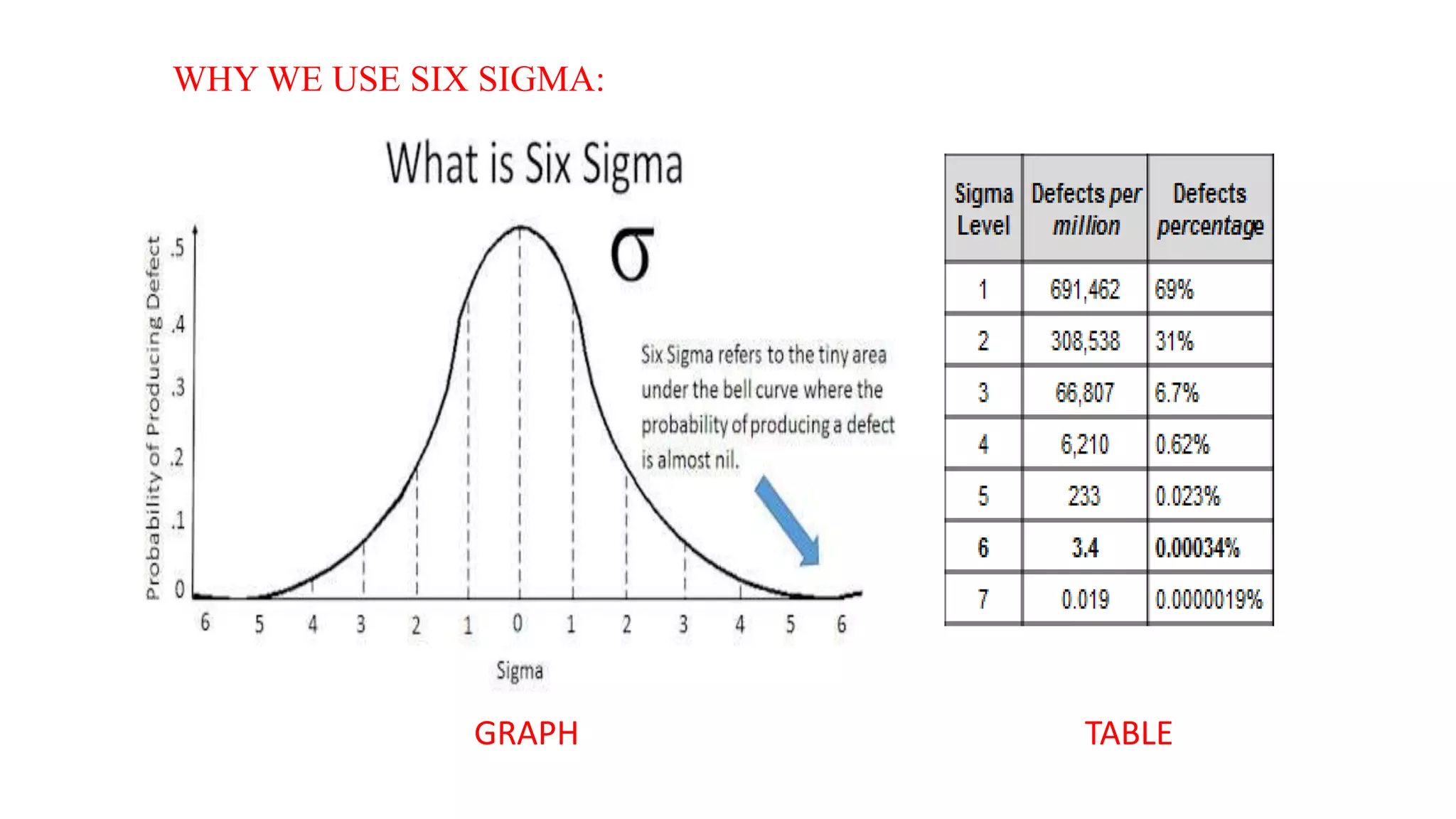
WHY WE USE SIX SIGMA:
GRAPH TABLE
EVOLUTION OF QUALITY MANAGEMENT:
Quality inspection are measures aimed at checking, measuring, or testing of one or more product
characteristics and to relate the results to the requirements to confirm compliance. This task is
usually performed by specialized personnel and does not fall within the responsibility of
production workers
STATISTICAL PROCESS CONTROL:
Statistical Process Control (SPC) is an industry-standard methodology for measuring and
controlling quality during the manufacturing process.
DESIGN OF EXPERIMENTS:
Design of experiments (DOE) is a systematic method to determine the relationship between
factors affecting a process and the output of that process it is used to find cause-and-effect
relationships.
INSPECTION:
TAGUCHI’S FUNCTION:
The Taguchi method which emphasizes the roles of research and development, product design and
product development in reducing the occurrence of defects and failures in products.
QUALITY MANAGEMENT SYSTEM:
A Quality management system (QMS) helps coordinate and direct an organization’s activities to
meet customer and regulatory requirements and improve its effectiveness and efficiency on a
continuous basis.
SIX SIGMA:
Six Sigma is the process of improving the quality of the output by identifying and removing the
causes of defects and minimizing variability in manufacturing and business processes.
SIX SIGMA METHODOLOGIES:
DMAIC: It refers to a data-driven quality strategy for improving processes. This methodology is
used to improve an existing business process.
DMADV: It refers to a data-driven quality strategy for designing products and processes. This
methodology is used to create new product designs or process designs in such a way that it results in
a more predictable, mature and defect free performance.
WHAT IS DMAIC
DEFINE:
The Define phase of the book covers process mapping and flow charting, project charter
development, problem solving tools, and the so-called 7M tools. .
MEASURE:
Measure covers the principles of measurement, continuous and discrete data, scales of measurement,
an overview of the principles of variation, and repeatability-and-reproducibility (RR) studies for
continuous and discrete data.
ANALYZE:
Analyze covers establishing a process base line, how to determine process improvement goals,
knowledge discovery, including descriptive and exploratory data analysis and data mining tools, the
basic principles of statistical process control (SPC), specialized control charts, process capability
analysis, correlation and regression analysis, analysis of categorical data, and non-parametric
statistical methods.
IMPROVE:
Improve covers project management, risk assessment, process simulation, design of experiments
(DOE), robust design concepts (including Taguchi principles), and process optimization.
CONTROL:
Control covers process control planning, using SPC for operational control, and PRE-control.
WHAT IS DMADV
DEFINE: Define the Problem or Project Goal that needs to be
addressed.
MEASURE: Measure and determine customers’ needs and
specifications.
ANALYZE: Analyze the process to meet the customer needs.
DESIGN: Design a process that will meet customers’ needs.
VERIFY: Verify the design performance and ability to meet
customer needs.
DMAIC & DMADV
TOOLS USED IN SIX SIGMA
1. QUALITY FUNCTION DEVELOPMENT
2. PROCESS MAP
3. FISH BONE DIAGRAM
4. PARETO DIAGRAM
QUALITY FUNCTION DEVELOPMENT:
The purpose of the QFD is to translate customer CTQs into a measurable sub-process or
product characteristic.
A series of QFDs help to narrow the focus of a project by allowing you to brainstorm internal
Processes or characteristics that relate to desire out come.
PROCESS MAP:
Process mapping is graphical representation of steps ,events, operations and
relationship of resource with in a process.
Processes are mapped using standard symbols so they can be quickly understood.
FISH BONE DIAGRAM:
It is called as a cause and effect diagram. It gives you structure for looking at an effect
brainstorming the cause of that effect.so we can find the effect easily and can be quickly
completed.
PARETO CHART:
It is a quantitative tool used to identify the focus area.It operates on a principle that there can
be many factors in process but only a vital few have real important on the performance.
EXTENDED DEFINITIONS OF ROLES – BELT COLORS
YELLOW BELT:
Yellow belt is all about training in overall methodology and basic problem solving concepts and
which is all about the importance of lean six sigma and how to reduce seven types of waste.
Motion, Transportation ,Waiting ,Over processing, Inventory, Over production, Rework.
GREEN BELT:
They focus on tools usage DMIAC and Lean application. The Green Belt designation can also
belong to the team leader or to a member of the team working directly with the team leader.
BLACK BELT:
The person possessing this belt has achieved the highest skill level and is an experienced expert in
various techniques. As applied to the Six Sigma program, the individual designated as a Black Belt
has completed a thorough internal training program and has the experience of working on several
projects.
MASTER BLACK BELT:
A person who deals with the team or its leadership; but is not a direct member of the team itself. This
may be equivalent to the role played by the coach, or for more technical and complex projects. The
Master Black Belt is available to answer procedural questions and to resolve the technical issues that
come up.
HOW TO START SIX SIGMA:
PLAN YOUR OWN ROUTE:
There may be many paths to Six Sigma but the best is the one that works for your organization.
DEFINE YOUR OBJECTIVE:
It is important to decide what you want to achieve, and priorities are important.
STICK TO WHAT IS FEASIBLE:
Set up your plans so that they can match your influences, resources and scope.
PREPARING LEADERS:
They are required to launch and guide the Six Sigma Effort.
CREATING SIGMA ORGANIZATION:
This includes preparing Black Belts and other roles and assigning them their responsibilities.
TRAINING THE ORGANIZATION: Apart from having black belts, it is required to impart
training of Six Sigma to all the employees in the organization.
PILOTING SIX SIGMA EFFORT: Piloting can be applied to any aspect of Six Sigma
including solutions derived from process improvement or design redesign projects.
SUMMARYA
 Six Sigma is a philosophy of quality improvement.
 Six Sigma is 3.4 defects in one million opportunities (DPMO).
 Components of Six Sigma are Customer, Process, and Employees.
 Six Sigma implementation requires the following roles:
Business Leader
Sponsor
Black Belt
Master Black Belt
Green Belt
 The generic cycle of Six Sigma includes the following phases: Define, Measure, Analyze, Improve, and
Control.
 Six Sigma is dedicated to ‘Customer Focus’.
BY: CHAITANYA CHENNA

Six sigma

  • 1.
  • 2.
    History of sixsigma: Six Sigma is a set of techniques and tools for process improvement . It was introduced by engineer Bill Smith while working at Motorola in 1986. In 1980’s Motorola was developing Quasar televisions which were famous but with the time there were lot of defects which came up on that due to picture quality and sound variations. By using the same raw material, machinery and work force a Japanese form took over Quasar television production and with in a few months time they produced Quasar TV's Sets which has less errors. This was obtained by improving the management techniques. Six Sigma was adopted by Bob Galvin the ceo of Motorola in 1986 and registered as a Motorola trademark on December 28, 1993 then it became a quality leader.
  • 3.
    QUALITY: Quality traditionally conformanceto internal requirements, which is expressed as potential quality and actual quality. QUALITY ACTUAL QUALITYPOTENTIAL QUALITY Current value added per unit of input Maximum possible values added per unit of input
  • 4.
     The differencebetween the potential quality and the actual quality is the waste PQ-AQ = WASTE • If there is more waste in the product there is a huge loss. • By implementing six sigma we reduce the waste and improve the quality by raising the actual quality bar to potential quality. • When six sigma associates with the quality we get new definition of quality which is value added by productive endeavor.
  • 5.
    What is sixsigma: Six Sigma is the process of improving the quality of the output by identifying and removing the causes of defects and minimizing variability in manufacturing and business processes. The maturity of a manufacturing process can be described by a sigma rating indicating its percentage of defect-free products it creates. A six sigma process is one in which 99.99966% of all opportunities to produce some feature of a part are statistically expected to be free of defects (3.4 defective features per million opportunities).
  • 6.
    FEATURES OF SIXSIGMA: • Six Sigma's aim is to eliminate waste and inefficiency, thereby increasing customer satisfaction by delivering what the customer is expecting. • Six Sigma follows a structured methodology, and has defined roles for the participants. • Six Sigma is a data driven methodology, and requires accurate data collection for the processes being analyzed. • Six Sigma is about putting results on Financial Statements. • Six Sigma is a business-driven, multi-dimensional structured approach for IMPROVING PROCESSES LOWERING DEFECT REDUCING PROCESS VARIABILITY REDUCING COST INCREASING CUSTOMER SATISFACTION INCREASING PROFITS
  • 7.
    WHY WE USESIX SIGMA: GRAPH TABLE
  • 8.
  • 9.
    Quality inspection aremeasures aimed at checking, measuring, or testing of one or more product characteristics and to relate the results to the requirements to confirm compliance. This task is usually performed by specialized personnel and does not fall within the responsibility of production workers STATISTICAL PROCESS CONTROL: Statistical Process Control (SPC) is an industry-standard methodology for measuring and controlling quality during the manufacturing process. DESIGN OF EXPERIMENTS: Design of experiments (DOE) is a systematic method to determine the relationship between factors affecting a process and the output of that process it is used to find cause-and-effect relationships. INSPECTION:
  • 10.
    TAGUCHI’S FUNCTION: The Taguchimethod which emphasizes the roles of research and development, product design and product development in reducing the occurrence of defects and failures in products. QUALITY MANAGEMENT SYSTEM: A Quality management system (QMS) helps coordinate and direct an organization’s activities to meet customer and regulatory requirements and improve its effectiveness and efficiency on a continuous basis. SIX SIGMA: Six Sigma is the process of improving the quality of the output by identifying and removing the causes of defects and minimizing variability in manufacturing and business processes.
  • 11.
    SIX SIGMA METHODOLOGIES: DMAIC:It refers to a data-driven quality strategy for improving processes. This methodology is used to improve an existing business process. DMADV: It refers to a data-driven quality strategy for designing products and processes. This methodology is used to create new product designs or process designs in such a way that it results in a more predictable, mature and defect free performance.
  • 12.
  • 13.
    DEFINE: The Define phaseof the book covers process mapping and flow charting, project charter development, problem solving tools, and the so-called 7M tools. . MEASURE: Measure covers the principles of measurement, continuous and discrete data, scales of measurement, an overview of the principles of variation, and repeatability-and-reproducibility (RR) studies for continuous and discrete data. ANALYZE: Analyze covers establishing a process base line, how to determine process improvement goals, knowledge discovery, including descriptive and exploratory data analysis and data mining tools, the basic principles of statistical process control (SPC), specialized control charts, process capability analysis, correlation and regression analysis, analysis of categorical data, and non-parametric statistical methods.
  • 14.
    IMPROVE: Improve covers projectmanagement, risk assessment, process simulation, design of experiments (DOE), robust design concepts (including Taguchi principles), and process optimization. CONTROL: Control covers process control planning, using SPC for operational control, and PRE-control.
  • 15.
  • 16.
    DEFINE: Define theProblem or Project Goal that needs to be addressed. MEASURE: Measure and determine customers’ needs and specifications. ANALYZE: Analyze the process to meet the customer needs. DESIGN: Design a process that will meet customers’ needs. VERIFY: Verify the design performance and ability to meet customer needs.
  • 17.
  • 18.
    TOOLS USED INSIX SIGMA 1. QUALITY FUNCTION DEVELOPMENT 2. PROCESS MAP 3. FISH BONE DIAGRAM 4. PARETO DIAGRAM
  • 19.
    QUALITY FUNCTION DEVELOPMENT: Thepurpose of the QFD is to translate customer CTQs into a measurable sub-process or product characteristic. A series of QFDs help to narrow the focus of a project by allowing you to brainstorm internal Processes or characteristics that relate to desire out come.
  • 20.
    PROCESS MAP: Process mappingis graphical representation of steps ,events, operations and relationship of resource with in a process. Processes are mapped using standard symbols so they can be quickly understood.
  • 21.
    FISH BONE DIAGRAM: Itis called as a cause and effect diagram. It gives you structure for looking at an effect brainstorming the cause of that effect.so we can find the effect easily and can be quickly completed.
  • 22.
    PARETO CHART: It isa quantitative tool used to identify the focus area.It operates on a principle that there can be many factors in process but only a vital few have real important on the performance.
  • 23.
    EXTENDED DEFINITIONS OFROLES – BELT COLORS
  • 24.
    YELLOW BELT: Yellow beltis all about training in overall methodology and basic problem solving concepts and which is all about the importance of lean six sigma and how to reduce seven types of waste. Motion, Transportation ,Waiting ,Over processing, Inventory, Over production, Rework. GREEN BELT: They focus on tools usage DMIAC and Lean application. The Green Belt designation can also belong to the team leader or to a member of the team working directly with the team leader.
  • 25.
    BLACK BELT: The personpossessing this belt has achieved the highest skill level and is an experienced expert in various techniques. As applied to the Six Sigma program, the individual designated as a Black Belt has completed a thorough internal training program and has the experience of working on several projects. MASTER BLACK BELT: A person who deals with the team or its leadership; but is not a direct member of the team itself. This may be equivalent to the role played by the coach, or for more technical and complex projects. The Master Black Belt is available to answer procedural questions and to resolve the technical issues that come up.
  • 26.
    HOW TO STARTSIX SIGMA: PLAN YOUR OWN ROUTE: There may be many paths to Six Sigma but the best is the one that works for your organization. DEFINE YOUR OBJECTIVE: It is important to decide what you want to achieve, and priorities are important. STICK TO WHAT IS FEASIBLE: Set up your plans so that they can match your influences, resources and scope. PREPARING LEADERS: They are required to launch and guide the Six Sigma Effort.
  • 27.
    CREATING SIGMA ORGANIZATION: Thisincludes preparing Black Belts and other roles and assigning them their responsibilities. TRAINING THE ORGANIZATION: Apart from having black belts, it is required to impart training of Six Sigma to all the employees in the organization. PILOTING SIX SIGMA EFFORT: Piloting can be applied to any aspect of Six Sigma including solutions derived from process improvement or design redesign projects.
  • 28.
    SUMMARYA  Six Sigmais a philosophy of quality improvement.  Six Sigma is 3.4 defects in one million opportunities (DPMO).  Components of Six Sigma are Customer, Process, and Employees.  Six Sigma implementation requires the following roles: Business Leader Sponsor Black Belt Master Black Belt Green Belt  The generic cycle of Six Sigma includes the following phases: Define, Measure, Analyze, Improve, and Control.  Six Sigma is dedicated to ‘Customer Focus’.
  • 29.