Basic Elements of
Music
Melody, Harmony, Scales
Melody
A timely arranged linear sequence of pitched
sounds that listeners perceive as a single entity.
Listening Activity
Define melody and harmony of the following
composition in your own words.
A. Vivaldi, Concerto “Spring” from the “Four
Seasons,” 1st movement,
Allegrohttp://magnatune.com/artists/albums/lara-fourseasons/
Range
The distance between the lowest and the
highest notes in the melody.
Wide Range
Bach, Brandenburg Concerto No. 5, in D Major, 1st Movement
http://content.thespco.org/music/compositions/brandenburg-
concerto-no-5-in-d-johann-sebastian-bach/
Narrow Range
Brahms, Violin Concerto in D, 3rd movement
http://content.thespco.org/music/compositions/violin-
concerto-in-d-johannes-brahms/
Melodic Motion
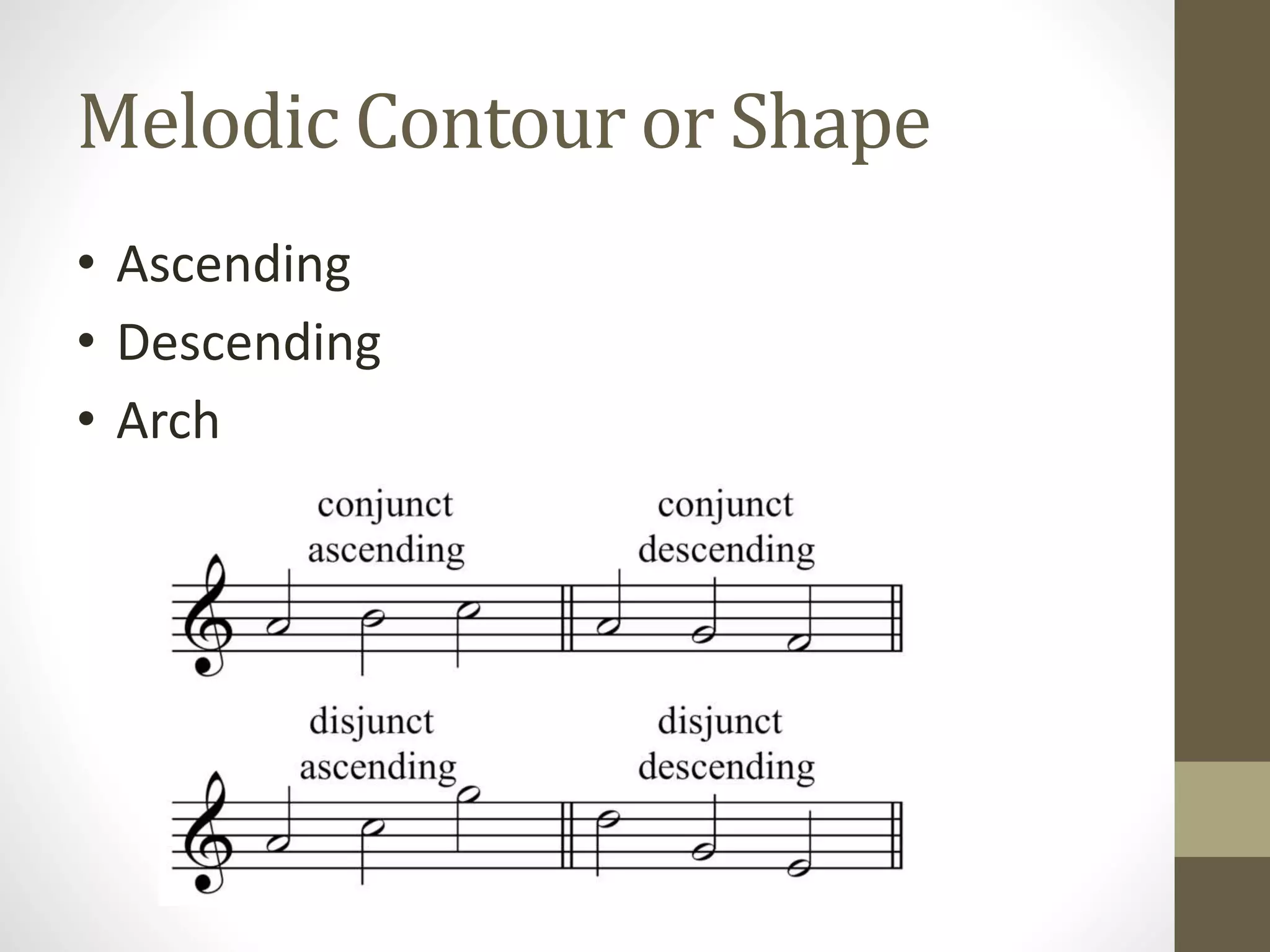
Disjunct—melody moves by large leaps.
Conjunct—melody rises and falls slowly, with only small changes between one
note and the next.
Conjunct Motion
Beethoven, “Ode to Joy” from Symphony No. 9
Start listening at 2:30 mark.
http://www.youtube.com/watch?v=ljGMhDSSGFU
Disjunct Motion
Piazzolla, “Spring”
http://www.youtube.com/watch?v=HJzogioRx6A
Listening Activity
Define the melodic motion of the following composition. Is it
conjunct, disjunct, or a combination of both?
F. Chopin, “Nocturne in E-Flat Major,” op. 9 no. 2
http://www.youtube.com/watch?v=--ykTqoQnqI
Melodic Contour or Shape
• Ascending
• Descending
• Arch
Ascending Melody
R. Strauss, “Don Juan”
http://www.youtube.com/watch?v=66zOdfCWEqA
Descending Melody
Handel, “Joy to the World”—the opening of the melody.
http://www.youtube.com/watch?v=wKW_az2HVfk
Arch
D. Shostakovich, “Romance from The Gadfly”
http://www.youtube.com/watch?v=QDW4VJGKLAQ
Listening Activity
Define the melody of this composition in terms of range,
motion, and contour.
J. S. Bach, Brandenburg Concerto No. 6, 1st Movement
http://www.youtube.com/watch?v=Kj1VvTTTO7Q
Harmony
Two or more notes played together at the same time.
• Two notes played at the same time—an interval.
• More than two notes played at the same time—a chord.
Intervals
Please read and study page 1, Intervals:
http://www.bbc.co.uk/schools/gcsebitesize/music/elements_of
_music/melody1.shtml
Consonant Intervals
Consonance in music—a combination of notes that
sounds pleasant.
Please replay the following intervals:
• Unison
• Major and Minor Thirds
• Perfect Fourth
• Perfect Fifth
• Major and Minor Sixths
• Octave
http://www.bbc.co.uk/schools/gcsebitesize/music/elements_of_music
/harmony_and_tonality1.shtml
Dissonant Intervals
Dissonance—a combination of notes that
sounds unpleasant or harsh.
Please replay the following intervals:
• Major and Minor Seconds
• Tritone
• Major and Minor Sevenths
http://www.bbc.co.uk/schools/gcsebitesize/music/elements_of
_music/harmony_and_tonality1.shtml
Chords
Please read all four pages on the Harmony and Tonality section
of this website:
• http://www.bbc.co.uk/schools/gcsebitesize/music/elements_
of_music/harmony_and_tonality1.shtml
Scales
Scales are various combinations of musical intervals.
Please study the following:
http://www.bbc.co.uk/schools/gcsebitesize/music/elements_of
_music/melody2.shtml
Diatonic Scales
• Major—happy.
• Chopin, Etude in G Flat
Majorhttp://www.youtube.com/watch?v=4pyqLbi2wLU
• Minor—sad.
• Rachmaninov, Prelude in C Sharp
Minorhttp://www.youtube.com/watch?v=wXQCPAR0EHo
Pentatonic Scale
Is widely used in music around the world, especially in folk
music.
Watch from 3:00 to 6:30:
http://www.youtube.com/watch?v=PnbOWi6f_IM
Gang and Zhanhao, “Butterfly Lovers” Violin Concerto, start
listening at 1:50
http://www.youtube.com/watch?v=K_qd-9wD6qA
Traditional music from Uganda
http://www.youtube.com/watch?v=363Nv-5oYBA
Chromatic Scale
Is not happy or sad
http://www.youtube.com/watch?v=sr2rXc9Qu4A
Schoenberg, Piano Concerto—is based on series of chromatic
tones.
http://www.youtube.com/watch?v=O_dnflTagHM
Rimsky-Korsakoff, Flight of the Bumblebee—the melody is based
on a chromatic scale.
http://www.youtube.com/watch?v=-yZPrrboTkY
http://www.youtube.com/watch?v=MK0z3LS45xU
Other Scale Types
Whole Tone Scale—based on whole steps
• Debussy, “Volies”
http://www.youtube.com/watch?v=FVV0jkZC4jI
Microtone Scale—a scale based on the intervals that are less
that ½ step.
• Composer Harry Partch created a 43-note scale and new
instruments. Please watch various selections from this
documentary.
http://www.youtube.com/watch?v=HfCjWIQtm-
M&list=PL325E98023B8838E2
Listening Activity
Define the melody and harmony in the following example using
terms discussed in this part.
J. S. Bach’s “Air on the G String”
http://www.youtube.com/watch?v=E2j-frfK-yg
Required Readings
• http://en.wikipedia.org/wiki/Melody
• http://openhighschoolcourses.org/mod/page/view.php?id=11
834
• http://www.bbc.co.uk/schools/gcsebitesize/music/elements_
of_music/melody1.shtml
• http://www.musictheory.net/lessons/30
• http://www.musictheory.net/lessons/31
• http://cnx.org/content/m10851/latest/
• http://en.wikipedia.org/wiki/Harmony
• http://www.musictheory.net/lessons/40
• http://www.musictheory.net/lessons—read (1)The Staff, Clefs,
and Ledger Lines and (2)Steps and Accidentals in the Basics
area

Melody, Harmony, and Scales

  • 1.
  • 2.
    Melody A timely arrangedlinear sequence of pitched sounds that listeners perceive as a single entity.
  • 3.
    Listening Activity Define melodyand harmony of the following composition in your own words. A. Vivaldi, Concerto “Spring” from the “Four Seasons,” 1st movement, Allegrohttp://magnatune.com/artists/albums/lara-fourseasons/
  • 4.
    Range The distance betweenthe lowest and the highest notes in the melody.
  • 5.
    Wide Range Bach, BrandenburgConcerto No. 5, in D Major, 1st Movement http://content.thespco.org/music/compositions/brandenburg- concerto-no-5-in-d-johann-sebastian-bach/
  • 6.
    Narrow Range Brahms, ViolinConcerto in D, 3rd movement http://content.thespco.org/music/compositions/violin- concerto-in-d-johannes-brahms/
  • 7.
    Melodic Motion Disjunct—melody movesby large leaps. Conjunct—melody rises and falls slowly, with only small changes between one note and the next.
  • 8.
    Conjunct Motion Beethoven, “Odeto Joy” from Symphony No. 9 Start listening at 2:30 mark. http://www.youtube.com/watch?v=ljGMhDSSGFU
  • 9.
  • 10.
    Listening Activity Define themelodic motion of the following composition. Is it conjunct, disjunct, or a combination of both? F. Chopin, “Nocturne in E-Flat Major,” op. 9 no. 2 http://www.youtube.com/watch?v=--ykTqoQnqI
  • 11.
    Melodic Contour orShape • Ascending • Descending • Arch
  • 12.
    Ascending Melody R. Strauss,“Don Juan” http://www.youtube.com/watch?v=66zOdfCWEqA
  • 13.
    Descending Melody Handel, “Joyto the World”—the opening of the melody. http://www.youtube.com/watch?v=wKW_az2HVfk
  • 14.
    Arch D. Shostakovich, “Romancefrom The Gadfly” http://www.youtube.com/watch?v=QDW4VJGKLAQ
  • 15.
    Listening Activity Define themelody of this composition in terms of range, motion, and contour. J. S. Bach, Brandenburg Concerto No. 6, 1st Movement http://www.youtube.com/watch?v=Kj1VvTTTO7Q
  • 16.
    Harmony Two or morenotes played together at the same time. • Two notes played at the same time—an interval. • More than two notes played at the same time—a chord.
  • 17.
    Intervals Please read andstudy page 1, Intervals: http://www.bbc.co.uk/schools/gcsebitesize/music/elements_of _music/melody1.shtml
  • 18.
    Consonant Intervals Consonance inmusic—a combination of notes that sounds pleasant. Please replay the following intervals: • Unison • Major and Minor Thirds • Perfect Fourth • Perfect Fifth • Major and Minor Sixths • Octave http://www.bbc.co.uk/schools/gcsebitesize/music/elements_of_music /harmony_and_tonality1.shtml
  • 19.
    Dissonant Intervals Dissonance—a combinationof notes that sounds unpleasant or harsh. Please replay the following intervals: • Major and Minor Seconds • Tritone • Major and Minor Sevenths http://www.bbc.co.uk/schools/gcsebitesize/music/elements_of _music/harmony_and_tonality1.shtml
  • 20.
    Chords Please read allfour pages on the Harmony and Tonality section of this website: • http://www.bbc.co.uk/schools/gcsebitesize/music/elements_ of_music/harmony_and_tonality1.shtml
  • 21.
    Scales Scales are variouscombinations of musical intervals. Please study the following: http://www.bbc.co.uk/schools/gcsebitesize/music/elements_of _music/melody2.shtml
  • 22.
    Diatonic Scales • Major—happy. •Chopin, Etude in G Flat Majorhttp://www.youtube.com/watch?v=4pyqLbi2wLU • Minor—sad. • Rachmaninov, Prelude in C Sharp Minorhttp://www.youtube.com/watch?v=wXQCPAR0EHo
  • 23.
    Pentatonic Scale Is widelyused in music around the world, especially in folk music. Watch from 3:00 to 6:30: http://www.youtube.com/watch?v=PnbOWi6f_IM Gang and Zhanhao, “Butterfly Lovers” Violin Concerto, start listening at 1:50 http://www.youtube.com/watch?v=K_qd-9wD6qA Traditional music from Uganda http://www.youtube.com/watch?v=363Nv-5oYBA
  • 24.
    Chromatic Scale Is nothappy or sad http://www.youtube.com/watch?v=sr2rXc9Qu4A Schoenberg, Piano Concerto—is based on series of chromatic tones. http://www.youtube.com/watch?v=O_dnflTagHM Rimsky-Korsakoff, Flight of the Bumblebee—the melody is based on a chromatic scale. http://www.youtube.com/watch?v=-yZPrrboTkY http://www.youtube.com/watch?v=MK0z3LS45xU
  • 25.
    Other Scale Types WholeTone Scale—based on whole steps • Debussy, “Volies” http://www.youtube.com/watch?v=FVV0jkZC4jI Microtone Scale—a scale based on the intervals that are less that ½ step. • Composer Harry Partch created a 43-note scale and new instruments. Please watch various selections from this documentary. http://www.youtube.com/watch?v=HfCjWIQtm- M&list=PL325E98023B8838E2
  • 26.
    Listening Activity Define themelody and harmony in the following example using terms discussed in this part. J. S. Bach’s “Air on the G String” http://www.youtube.com/watch?v=E2j-frfK-yg
  • 27.
    Required Readings • http://en.wikipedia.org/wiki/Melody •http://openhighschoolcourses.org/mod/page/view.php?id=11 834 • http://www.bbc.co.uk/schools/gcsebitesize/music/elements_ of_music/melody1.shtml • http://www.musictheory.net/lessons/30 • http://www.musictheory.net/lessons/31 • http://cnx.org/content/m10851/latest/ • http://en.wikipedia.org/wiki/Harmony • http://www.musictheory.net/lessons/40 • http://www.musictheory.net/lessons—read (1)The Staff, Clefs, and Ledger Lines and (2)Steps and Accidentals in the Basics area

Editor's Notes

  • #6 Brandenburg Concerto No.5 in D major, BWV 1050. Authored by: Johann Sebastian Bach. License: Public Domain
  • #7 Violin Concerto in D major. Authored by: Johannes Brahms. License: Public Domain
  • #12 Melodic Motion 2x2. Authored by: Hyacinth. Located at: https://commons.wikimedia.org/wiki/File:Melodic_motion_2x2.png. License: CC BY-SA
  • #25 Chromatic Scale. Authored by: Subitosera. Located at: https://commons.wikimedia.org/wiki/File:Chromatic-scale.png. License: Public Domain