Pitch & Melody
Pitch: the quality of a sound governed by the rate
of vibrations producing it; the degree of highness
or lowness of a tone
Melody: a coherent sequence of pitches
Why Pitch & Melody Are
Important

Pitch is important because it explains to us
how different notes are created and labeled

Pitch is also important when it comes to
learning the physical science behind
sounds, notes, harmony, and melodies

Melody is important because it brings most
of the tunefulness to a song and is usually
the first thing that draws our attention to a
song
What You Will Learn

How to identify different pitches, dynamics,
melodic contours, and tunefulness

How notes, whole/half steps, tonic pitch,
octaves, and scales relate to each other

The difference between conjunct & disjunct
Pitch

https://www.youtube.com/watch?v=A43O79uVUKs&spfreload=10

Listen to the different steady vibrations being
emitted from the wine glasses, these are different
pitches. The wine glasses with the same note but
different frequencies are octaves.

The frequency concerns how fast the waves
move. We separate notes and label them by their
specific frequencies

An octave is two notes, one having twice or half
the frequency of vibration of the other.
Dynamics

https://www.youtube.com/watch?v=Faq7pvzTnmk

Dynamics: how soft or loud the music is.

Watch the video to learn and understand
the terms of dynamics.

https://www.youtube.com/watch?v=MuAGGZNfUkU

Listen to the dynamics of Time by Hans Zimmer.
Notice how the dynamics crescendo from
pianissimo to fortissimo then back down to
pianissimo throughout the song
The Major Scale

https://www.youtube.com/watch?v=XVrUc_rJ_g0

In this video you will learn what a scale is,
tonic pitch, half & whole steps, the major
scale in half & whole steps, and the C major
scale.
Melodic Contour

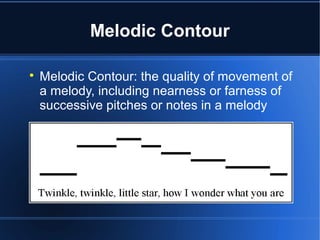
Melodic Contour: the quality of movement of
a melody, including nearness or farness of
successive pitches or notes in a melody
Conjunct Vs. Disjunct

A conjunct melody is one where the notes
are generally together; a disjunct melody
features angular leaps

https://www.youtube.com/watch?v=M1FSv1zg7z4

https://www.youtube.com/watch?v=q24wiNWmhFc

The first video is a conjunct melody

The second video has a disjunct melody.
Ignore the beat and just listen to the meoldy.
Tunefulness

To say that a melody is tuneful means that it
is catchy and easy to repeat.

https://www.youtube.com/watch?v=68ugkg9RePc

Listen to Blue by Eiffel 65 and you can see
how a catchy melody sticks in peoples
heads well after the song is done. Listen to
it once and you may find yourself singing
“Da Ba Dee Dabba” Da all day.
The End
Thank you for your participation

Pitch & melody

  • 1.
    Pitch & Melody Pitch:the quality of a sound governed by the rate of vibrations producing it; the degree of highness or lowness of a tone Melody: a coherent sequence of pitches
  • 2.
    Why Pitch &Melody Are Important  Pitch is important because it explains to us how different notes are created and labeled  Pitch is also important when it comes to learning the physical science behind sounds, notes, harmony, and melodies  Melody is important because it brings most of the tunefulness to a song and is usually the first thing that draws our attention to a song
  • 3.
    What You WillLearn  How to identify different pitches, dynamics, melodic contours, and tunefulness  How notes, whole/half steps, tonic pitch, octaves, and scales relate to each other  The difference between conjunct & disjunct
  • 4.
    Pitch  https://www.youtube.com/watch?v=A43O79uVUKs&spfreload=10  Listen to thedifferent steady vibrations being emitted from the wine glasses, these are different pitches. The wine glasses with the same note but different frequencies are octaves.  The frequency concerns how fast the waves move. We separate notes and label them by their specific frequencies  An octave is two notes, one having twice or half the frequency of vibration of the other.
  • 5.
    Dynamics  https://www.youtube.com/watch?v=Faq7pvzTnmk  Dynamics: how softor loud the music is.  Watch the video to learn and understand the terms of dynamics.  https://www.youtube.com/watch?v=MuAGGZNfUkU  Listen to the dynamics of Time by Hans Zimmer. Notice how the dynamics crescendo from pianissimo to fortissimo then back down to pianissimo throughout the song
  • 6.
    The Major Scale  https://www.youtube.com/watch?v=XVrUc_rJ_g0  Inthis video you will learn what a scale is, tonic pitch, half & whole steps, the major scale in half & whole steps, and the C major scale.
  • 7.
    Melodic Contour  Melodic Contour:the quality of movement of a melody, including nearness or farness of successive pitches or notes in a melody
  • 8.
    Conjunct Vs. Disjunct  Aconjunct melody is one where the notes are generally together; a disjunct melody features angular leaps  https://www.youtube.com/watch?v=M1FSv1zg7z4  https://www.youtube.com/watch?v=q24wiNWmhFc  The first video is a conjunct melody  The second video has a disjunct melody. Ignore the beat and just listen to the meoldy.
  • 9.
    Tunefulness  To say thata melody is tuneful means that it is catchy and easy to repeat.  https://www.youtube.com/watch?v=68ugkg9RePc  Listen to Blue by Eiffel 65 and you can see how a catchy melody sticks in peoples heads well after the song is done. Listen to it once and you may find yourself singing “Da Ba Dee Dabba” Da all day.
  • 10.
    The End Thank youfor your participation