The Child Status Index: A Paradigm Shift in
  Assessing Highly Vulnerable Children in LMIC
• Collaboration among Duke University, Measure Evaluation, &
  USAID
    O’Donnell K, Nyangara F, Murphy, R, & Nyberg B

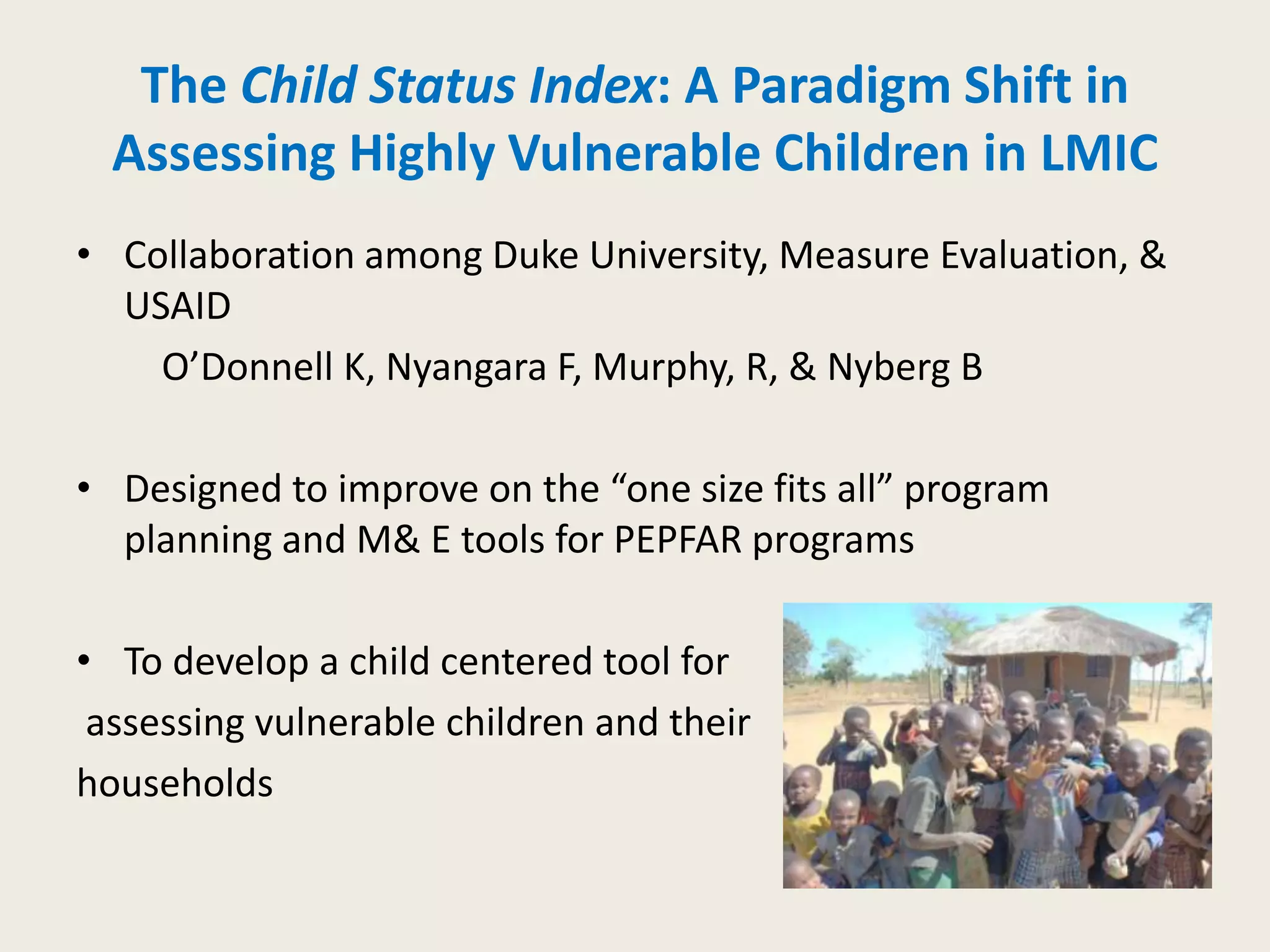
• Designed to improve on the “one size fits all” program
  planning and M& E tools for PEPFAR programs

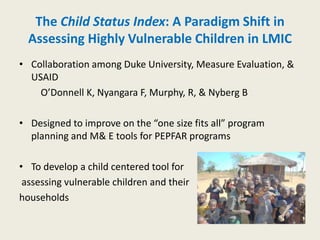
• To develop a child centered tool for
 assessing vulnerable children and their
households
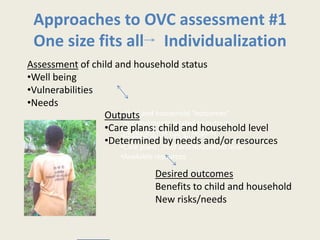
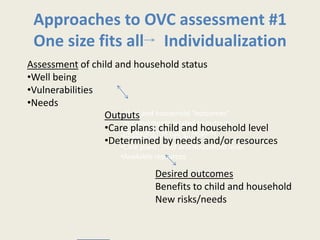
Approaches to OVC assessment #1
 One size fits all Individualization
Assessment of child and household status
•Well being
•Vulnerabilities
•Needs
                 Outputs and household “outcomes”
                      Child
                      Improvements related to outputs
                 •Care plans:risk (other factors)
                      Increased child and household level
                 •Determined by“Outputs”:
                     Program plans:
                                    needs and/or resources
                     •Care plans: child and household level
                     •Available resources

                               Desired outcomes
                               Benefits to child and household
                               New risks/needs
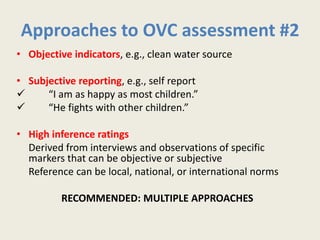
Approaches to OVC assessment #2
• Objective indicators, e.g., clean water source

• Subjective reporting, e.g., self report
     “I am as happy as most children.”
     “He fights with other children.”

• High inference ratings
  Derived from interviews and observations of specific
  markers that can be objective or subjective
  Reference can be local, national, or international norms

          RECOMMENDED: MULTIPLE APPROACHES
CSI development: To determine what are the
important factors to assess about a vulnerable
                 child’s life?
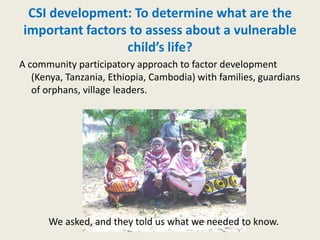
A community participatory approach to factor development
   (Kenya, Tanzania, Ethiopia, Cambodia) with families, guardians
   of orphans, village leaders.


      We asked, and they told us what we needed to know.
Nutrition, shelter, abuse and
  protection, health, psychosocial, learning and
                   education…
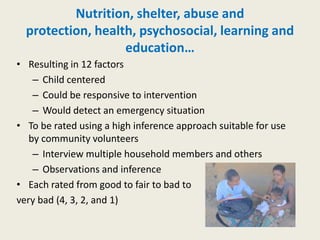
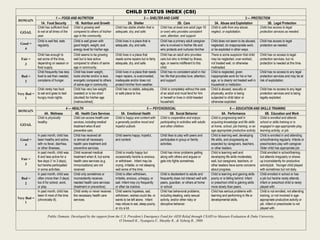
• Resulting in 12 factors
    – Child centered
    – Could be responsive to intervention
    – Would detect an emergency situation
• To be rated using a high inference approach suitable for use
   by community volunteers
    – Interview multiple household members and others
    – Observations and inference
• Each rated from good to fair to bad to
very bad (4, 3, 2, and 1)
CHILD STATUS INDEX (CSI)
                                1 — FOOD AND NUTRITION                                            2 — SHELTER AND CARE                                                            3 — PROTECTION
DOMAIN
                  1A. Food Security        1B. Nutrition and Growth                  2A. Shelter                           2B. Care                       3A. Abuse and Exploitation            3B. Legal Protection
               Child has sufficient food   Child is growing well           Child has stable shelter that is  Child has at least one adult (age 18        Child is safe from any abuse,     Child has access to legal
  GOAL         to eat at all times of the compared to others of his/her   adequate, dry, and safe.          or over) who provides consistent            neglect, or exploitation.         protection services as needed.
               year.                      age in the community.                                             care, attention, and support.
               Child is well fed, eats    Child is well grown with        Child lives in a place that is    Child has a primary adult caregiver         Child does not seem to be abused,        Child has access to legal
  Good =       regularly.                 good height, weight, and        adequate, dry, and safe.          who is involved in his/her life and         neglected, do inappropriate work,        protection as needed.
    4                                     energy level for his/her age.                                     who protects and nurtures him/her.          or be exploited in other ways.
               Child has enough to        Child seems to be growing       Child lives in a place that       Child has an adult who provides             There is some suspicion that child       Child has no access to legal
  Fair =       eat some of the time,      well but is less active         needs some repairs but is fairly care but who is limited by illness,          may be neglected, over-worked,           protection services, but no
    3          depending on season or compared to others of same          adequate, dry, and safe.          age, or seems indifferent to this           not treated well, or otherwise           protection is needed at this time.
               food supply.               age in community.                                                 child.                                      maltreated.
               Child frequently has less Child has lower weight,          Child lives in a place that needs Child has no consistent adult in his/       Child is neglected, given                Child has no access to any legal
  Bad =        food to eat than needed, looks shorter and/or is less      major repairs, is overcrowded,    her life that provides love, attention,     inappropriate work for his or her        protection services and may be at
    2          complains of hunger.       energetic compared to others    inadequate and/or does not        and support.                                age, or is clearly not treated well in   risk of exploitation.
                                          of same age in community.       protect him/her from weather.                                                 household or institution.
               Child rarely has food      Child has very low weight       Child has no stable, adequate,    Child is completely without the care        Child is abused, sexually or             Child has no access to any legal
Very Bad =     to eat and goes to bed     (wasted) or is too short        or safe place to live.            of an adult and must fend for him           physically, and/or is being              protection services and is being
    1          hungry most nights.        (stunted) for his/her age                                         or herself or lives in child-headed         subjected to child labor or              legally exploited.
                                          (malnourished).                                                   household.                                  otherwise exploited.
                                    4 — HEALTH                                                    5 — PSYCHOSOCIAL                                                       6 — EDUCATION AND SKILLS TRAINING
DOMAIN
                    4A. Wellness           4B. Health Care Services           5A. Emotional Health                5B. Social Behavior                              6A. Performance                6B. Education and Work
               Child is physically       Child can access health care     Child is happy and content with Child is cooperative and enjoys               Child is progressing well in         Child is enrolled and attends
               healthy.                  services, including medical      a generally positive mood and   participating in activities with adults       acquiring knowledge and life skills  school or skills training or is
 GOAL                                    treatment when ill and           hopeful outlook.                and other children.                           at home, school, job training, or an engaged in age-appropriate play,
                                         preventive care.                                                                                               age-appropriate productive activity. learning activity, or job.
           In past month, child has      Child has received all           Child seems happy, hopeful,          Child likes to play with peers and       Child is learning well, developing   Child is enrolled in and attending
 Good =    been healthy and active, or almost all necessary               and content.                         participates in group or family          life skills, and progressing as      school/training regularly. Infants or
     4     with no fever, diarrhea,      health care treatment and                                             activities.                              expected by caregivers, teachers,    preschoolers play with caregiver.
           or other illnesses.           preventive services.                                                                                           or other leaders.                    Older child has appropriate job.
           In past month, child was Child received medical                Child is mostly happy but            Child has minor problems getting         Child is learning well and           Child enrolled in school/training
           ill and less active for a     treatment when ill, but some     occasionally he/she is anxious,      along with others and argues or          developing life skills moderately    but attends irregularly or shows
  Fair =
           few days (1 to 3 days),       health care services (e.g.       or withdrawn. Infant may be          gets into fights sometimes.               well, but caregivers, teachers, or   up inconsistently for productive
     3     but he/she participated       immunizations) are not           crying, irritable, or not sleeping                                            other leaders have some concerns activity/job. Younger child played
           in some activities.           received.                        well some of the time.                                                        about progress.                      with sometimes but not daily.
           In past month, child was Child only sometimes or               Child is often withdrawn,            Child is disobedient to adults and       Child is learning and gaining skills Child enrolled in school or has
  Bad =    often (more than 3 days) inconsistently receives               irritable, anxious, unhappy, or      frequently does not interact well with   poorly or is falling behind. Infant  a job but he/she rarely attends.
     2     too ill for school, work,     needed health care services      sad. Infant may cry frequently       peers, guardian, or others at home       or preschool child is gaining skills Infant or preschool child is rarely
           or play.                      (treatment or preventive).       or often be inactive.                or school.                               more slowly than peers.              played with.
           In past month, child has      Child rarely or never receives   Child seems hopeless, sad,           Child has behavioral problems,           Child has serious problems with      Child is not enrolled, not attending
           been ill most of the time     the necessary health care        withdrawn, wishes could die, or      including stealing, early sexual         learning and performing in life or   training, or not involved in age-
Very Bad = (chronically ill).            services.                        wants to be left alone. Infant       activity, and/or other risky or          developmental skills.                appropriate productive activity or
     1                                                                    may refuse to eat, sleep poorly,     disruptive behavior.                                                          job. Infant or preschooler is not
                                                                          or cry a lot.                                                                                                      played with.

                      Public Domain: Developed by the support from the U.S. President’s Emergency Fund for AIDS Relief through USAID to Measure Evaluation & Duke University.
                                                                      O’Donnell K., Nyangara F., Murphy R., & Nyberg B., 2008
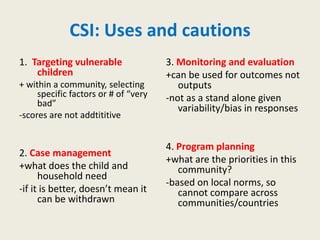
CSI: Uses and cautions
1. Targeting vulnerable               3. Monitoring and evaluation
    children                          +can be used for outcomes not
+ within a community, selecting          outputs
     specific factors or # of “very   -not as a stand alone given
     bad”
                                         variability/bias in responses
-scores are not addtititive


                                      4. Program planning
2. Case management
                                      +what are the priorities in this
+what does the child and                 community?
      household need
                                      -based on local norms, so
-if it is better, doesn’t mean it        cannot compare across
      can be withdrawn                   communities/countries
Approaches to OVC assessment #1
 One size fits all Individualization
Assessment of child and household status
•Well being
•Vulnerabilities
•Needs
                 Outputs and household “outcomes”
                      Child
                      Improvements related to outputs
                 •Care plans:risk (other factors)
                      Increased child and household level
                 •Determined by“Outputs”:
                     Program plans:
                                    needs and/or resources
                     •Care plans: child and household level
                     •Available resources

                               Desired outcomes
                               Benefits to child and household
                               New risks/needs
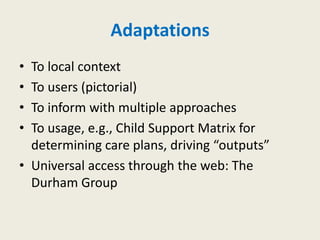
Adaptations
• To local context
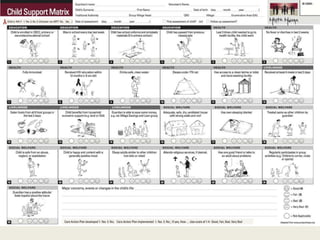
• To users (pictorial)
• To inform with multiple approaches
• To usage, e.g., Child Support Matrix for
  determining care plans, driving “outputs”
• Universal access through the web: The
  Durham Group
This (CSI) has completely changed our
approach.
Previously, we thought that all poor children had
the same needs but now we find that each one is
different...

We also see how the activities we plan work
together, sometimes affecting just one child and
sometimes the whole family."
                           Community volunteer,
                           West Oromia village, Ethiopia

Assessing Child/Household Needs and Well Being_ODonnell_5.2.12

  • 1.
    The Child StatusIndex: A Paradigm Shift in Assessing Highly Vulnerable Children in LMIC • Collaboration among Duke University, Measure Evaluation, & USAID O’Donnell K, Nyangara F, Murphy, R, & Nyberg B • Designed to improve on the “one size fits all” program planning and M& E tools for PEPFAR programs • To develop a child centered tool for assessing vulnerable children and their households
  • 2.
    Approaches to OVCassessment #1 One size fits all Individualization Assessment of child and household status •Well being •Vulnerabilities •Needs Outputs and household “outcomes” Child Improvements related to outputs •Care plans:risk (other factors) Increased child and household level •Determined by“Outputs”: Program plans: needs and/or resources •Care plans: child and household level •Available resources Desired outcomes Benefits to child and household New risks/needs
  • 3.
    Approaches to OVCassessment #2 • Objective indicators, e.g., clean water source • Subjective reporting, e.g., self report  “I am as happy as most children.”  “He fights with other children.” • High inference ratings Derived from interviews and observations of specific markers that can be objective or subjective Reference can be local, national, or international norms RECOMMENDED: MULTIPLE APPROACHES
  • 4.
    CSI development: Todetermine what are the important factors to assess about a vulnerable child’s life? A community participatory approach to factor development (Kenya, Tanzania, Ethiopia, Cambodia) with families, guardians of orphans, village leaders. We asked, and they told us what we needed to know.
  • 5.
    Nutrition, shelter, abuseand protection, health, psychosocial, learning and education… • Resulting in 12 factors – Child centered – Could be responsive to intervention – Would detect an emergency situation • To be rated using a high inference approach suitable for use by community volunteers – Interview multiple household members and others – Observations and inference • Each rated from good to fair to bad to very bad (4, 3, 2, and 1)
  • 6.
    CHILD STATUS INDEX(CSI) 1 — FOOD AND NUTRITION 2 — SHELTER AND CARE 3 — PROTECTION DOMAIN 1A. Food Security 1B. Nutrition and Growth 2A. Shelter 2B. Care 3A. Abuse and Exploitation 3B. Legal Protection Child has sufficient food Child is growing well Child has stable shelter that is Child has at least one adult (age 18 Child is safe from any abuse, Child has access to legal GOAL to eat at all times of the compared to others of his/her adequate, dry, and safe. or over) who provides consistent neglect, or exploitation. protection services as needed. year. age in the community. care, attention, and support. Child is well fed, eats Child is well grown with Child lives in a place that is Child has a primary adult caregiver Child does not seem to be abused, Child has access to legal Good = regularly. good height, weight, and adequate, dry, and safe. who is involved in his/her life and neglected, do inappropriate work, protection as needed. 4 energy level for his/her age. who protects and nurtures him/her. or be exploited in other ways. Child has enough to Child seems to be growing Child lives in a place that Child has an adult who provides There is some suspicion that child Child has no access to legal Fair = eat some of the time, well but is less active needs some repairs but is fairly care but who is limited by illness, may be neglected, over-worked, protection services, but no 3 depending on season or compared to others of same adequate, dry, and safe. age, or seems indifferent to this not treated well, or otherwise protection is needed at this time. food supply. age in community. child. maltreated. Child frequently has less Child has lower weight, Child lives in a place that needs Child has no consistent adult in his/ Child is neglected, given Child has no access to any legal Bad = food to eat than needed, looks shorter and/or is less major repairs, is overcrowded, her life that provides love, attention, inappropriate work for his or her protection services and may be at 2 complains of hunger. energetic compared to others inadequate and/or does not and support. age, or is clearly not treated well in risk of exploitation. of same age in community. protect him/her from weather. household or institution. Child rarely has food Child has very low weight Child has no stable, adequate, Child is completely without the care Child is abused, sexually or Child has no access to any legal Very Bad = to eat and goes to bed (wasted) or is too short or safe place to live. of an adult and must fend for him physically, and/or is being protection services and is being 1 hungry most nights. (stunted) for his/her age or herself or lives in child-headed subjected to child labor or legally exploited. (malnourished). household. otherwise exploited. 4 — HEALTH 5 — PSYCHOSOCIAL 6 — EDUCATION AND SKILLS TRAINING DOMAIN 4A. Wellness 4B. Health Care Services 5A. Emotional Health 5B. Social Behavior 6A. Performance 6B. Education and Work Child is physically Child can access health care Child is happy and content with Child is cooperative and enjoys Child is progressing well in Child is enrolled and attends healthy. services, including medical a generally positive mood and participating in activities with adults acquiring knowledge and life skills school or skills training or is GOAL treatment when ill and hopeful outlook. and other children. at home, school, job training, or an engaged in age-appropriate play, preventive care. age-appropriate productive activity. learning activity, or job. In past month, child has Child has received all Child seems happy, hopeful, Child likes to play with peers and Child is learning well, developing Child is enrolled in and attending Good = been healthy and active, or almost all necessary and content. participates in group or family life skills, and progressing as school/training regularly. Infants or 4 with no fever, diarrhea, health care treatment and activities. expected by caregivers, teachers, preschoolers play with caregiver. or other illnesses. preventive services. or other leaders. Older child has appropriate job. In past month, child was Child received medical Child is mostly happy but Child has minor problems getting Child is learning well and Child enrolled in school/training ill and less active for a treatment when ill, but some occasionally he/she is anxious, along with others and argues or developing life skills moderately but attends irregularly or shows Fair = few days (1 to 3 days), health care services (e.g. or withdrawn. Infant may be gets into fights sometimes. well, but caregivers, teachers, or up inconsistently for productive 3 but he/she participated immunizations) are not crying, irritable, or not sleeping other leaders have some concerns activity/job. Younger child played in some activities. received. well some of the time. about progress. with sometimes but not daily. In past month, child was Child only sometimes or Child is often withdrawn, Child is disobedient to adults and Child is learning and gaining skills Child enrolled in school or has Bad = often (more than 3 days) inconsistently receives irritable, anxious, unhappy, or frequently does not interact well with poorly or is falling behind. Infant a job but he/she rarely attends. 2 too ill for school, work, needed health care services sad. Infant may cry frequently peers, guardian, or others at home or preschool child is gaining skills Infant or preschool child is rarely or play. (treatment or preventive). or often be inactive. or school. more slowly than peers. played with. In past month, child has Child rarely or never receives Child seems hopeless, sad, Child has behavioral problems, Child has serious problems with Child is not enrolled, not attending been ill most of the time the necessary health care withdrawn, wishes could die, or including stealing, early sexual learning and performing in life or training, or not involved in age- Very Bad = (chronically ill). services. wants to be left alone. Infant activity, and/or other risky or developmental skills. appropriate productive activity or 1 may refuse to eat, sleep poorly, disruptive behavior. job. Infant or preschooler is not or cry a lot. played with. Public Domain: Developed by the support from the U.S. President’s Emergency Fund for AIDS Relief through USAID to Measure Evaluation & Duke University. O’Donnell K., Nyangara F., Murphy R., & Nyberg B., 2008
  • 7.
    CSI: Uses andcautions 1. Targeting vulnerable 3. Monitoring and evaluation children +can be used for outcomes not + within a community, selecting outputs specific factors or # of “very -not as a stand alone given bad” variability/bias in responses -scores are not addtititive 4. Program planning 2. Case management +what are the priorities in this +what does the child and community? household need -based on local norms, so -if it is better, doesn’t mean it cannot compare across can be withdrawn communities/countries
  • 8.
    Approaches to OVCassessment #1 One size fits all Individualization Assessment of child and household status •Well being •Vulnerabilities •Needs Outputs and household “outcomes” Child Improvements related to outputs •Care plans:risk (other factors) Increased child and household level •Determined by“Outputs”: Program plans: needs and/or resources •Care plans: child and household level •Available resources Desired outcomes Benefits to child and household New risks/needs
  • 9.
    Adaptations • To localcontext • To users (pictorial) • To inform with multiple approaches • To usage, e.g., Child Support Matrix for determining care plans, driving “outputs” • Universal access through the web: The Durham Group
  • 11.
    This (CSI) hascompletely changed our approach. Previously, we thought that all poor children had the same needs but now we find that each one is different... We also see how the activities we plan work together, sometimes affecting just one child and sometimes the whole family." Community volunteer, West Oromia village, Ethiopia