Global Yield Assessment
Description and data requirements of the global 
dynamic vegetation model LPJmL
Katharina Waha
Workshop Beyond Diagnostics: Insights and Recommendations for 
Remote Sensing, 14./15. December 2013
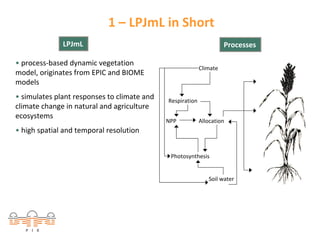
1 – LPJmL in Short
LPJmL

Processes

• process‐based dynamic vegetation
model, originates from EPIC and BIOME 
models
• simulates plant responses to climate and 
climate change in natural and agriculture
ecosystems

Climate

Respiration
NPP

Allocation

• high spatial and temporal resolution
Photosynthesis

Soil water
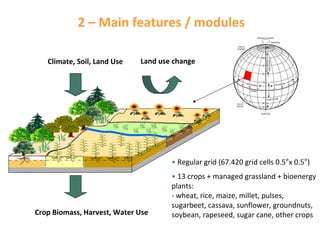
2 – Main features / modules
Climate, Soil, Land Use

Land use change

• Regular grid (67.420 grid cells 0.5°x 0.5°)

Crop Biomass, Harvest, Water Use

• 13 crops + managed grassland + bioenergy 
plants: 
‐ wheat, rice, maize, millet, pulses, 
sugarbeet, cassava, sunflower, groundnuts, 
soybean, rapeseed, sugar cane, other crops
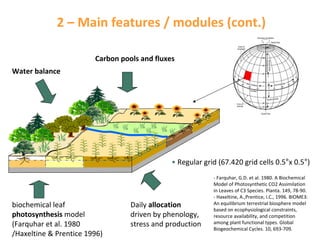
2 – Main features / modules (cont.)
Carbon pools and fluxes
Water balance

• Regular grid (67.420 grid cells 0.5°x 0.5°)

biochemical leaf
photosynthesis model
(Farquhar et al. 1980 
/Haxeltine & Prentice 1996)

Daily allocation
driven by phenology, 
stress and production

‐ Farquhar, G.D. et al. 1980. A Biochemical 
Model of Photosynthetic CO2 Assimilation 
in Leaves of C3 Species. Planta. 149, 78‐90.
‐ Haxeltine, A.,Prentice, I.C., 1996. BIOME3: 
An equilibrium terrestrial biosphere model 
based on ecophysiological constraints, 
resource availability, and competition 
among plant functional types. Global 
Biogeochemical Cycles. 10, 693‐709.
3 – Crop management
•

Management modules (climate‐driven, input‐driven)
+ often more important than climate and soils
‐> Computed internally
+ Planting dates (Waha et al. 2012) 
+ Available irrigation water (Biemans et al. 2011)
+ Variety characteristics (Bondeau et al. 2008, van Bussel 2011)
‐> Prescribed
+ Annual land‐use patterns (Fader et al. 2010)
+ Irrigation (yes/no)
+ Intercrops 
+ Residue management
+ Management 
Intensity (Fader et al. 2010)

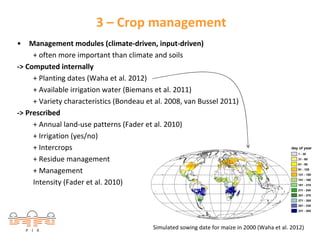
Simulated sowing date for maize in 2000 (Waha et al. 2012)
4 – Model Input
•

Soils
+ FAO Harmonized Soil Database (13 soil texture classes ‐> water holding capacity)

•

Climate
+ current and past climate: 
monthly: CRU TS 3.21 (1901‐2012)
daily: GPCC (1901‐2007), WATCH (1901‐2001)
+ future climate: climate projections from
GCMs via CMIP5 project

•

Landuse
+ generated from 3 land use data sets
+ rainfed and irrigated cropland in 
1700 – 2005 for 13 crops

CRU ‐ Climate Research Unit, University of East Anglia, 
GPCC ‐ Global Precipitation Climatology Centre          
WATCH ‐ WATCH Forcing Data 20th Century                    
GCM ‐ General Circulation Model                                     
CMIP5 ‐ Coupled Model Intercomparison Project Phase 5 

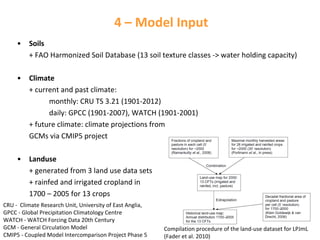
Compilation procedure of the land‐use dataset for LPJmL 
(Fader et al. 2010)
5 – Model Output: Crop Yields
National and grid‐cell yields

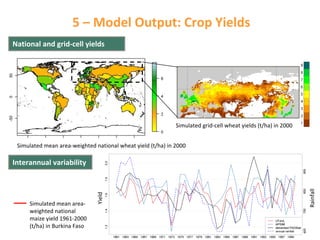
Simulated grid‐cell wheat yields (t/ha) in 2000
Simulated mean area‐weighted national wheat yield (t/ha) in 2000

Rainfall

Simulated mean area‐
weighted national 
maize yield 1961‐2000 
(t/ha) in Burkina Faso

Yield

Interannual variability
5 – Model Output: Crop yields under climate change

With CO2 fertilization

Without CO2 fertilization

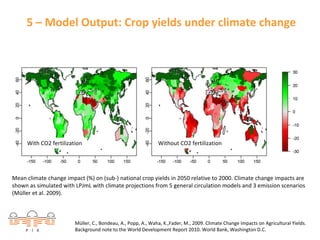
Mean climate change impact (%) on (sub‐) national crop yields in 2050 relative to 2000. Climate change impacts are 
shown as simulated with LPJmL with climate projections from 5 general circulation models and 3 emission scenarios 
(Müller et al. 2009).

Müller, C., Bondeau, A., Popp, A., Waha, K.,Fader, M., 2009. Climate Change Impacts on Agricultural Yields. 
Background note to the World Development Report 2010. World Bank, Washington D.C.
6 – Under development and future plans (examples)
• Refine management modules (irrigation, rainwater harvesting and vapor
shift techniques, multiple cropping)
• Add more crops (potato, cotton, date palm, citrus, …)
• Continue development of bioenergy plants
• Add nitrogen cycle
• Understand uncertainty in CO2 fertilization effect (coupled effects from
increased temperatures and CO2)
• Improve grassland management and representation of livestock
• Revise simulated impacts of extreme temperature and precipitation
Thank you
http://www.pik‐potsdam.de/research/projects/lpjweb
Dr Katharina Waha
Climate Impacts & Vulnerabilities
tel: +49 331 288 26 27 
e‐mail: katharina.waha@pik‐potsdam.de
Literature
key model components, LPJmL as LPJ‐DGVM:
•
Collatz, G.J., Ribas‐Carbo, M.,Berry, J.A. 1992. Coupled Photosynthesis‐Stomatal Conductance Model for Leaves of C4 Plants, 
pp. 519‐538, Vol. 19.
•
Sitch, S., Smith, B., Prentice, I.C., Arneth, A., Bondeau, A., Cramer, W., Kaplan, J.O., Levis, S., Lucht, W., Sykes, M.T., Thonicke, 
K.,Venevsky, S., 2003. Evaluation of ecosystem dynamics, plant geography and terrestrial carbon cycling in the LPJ dynamic
global vegetation model. Global Change Biology. 9, 161‐185.
agricultural vegetation:
•
Bondeau, A., Smith, P.C., Zaehle, S., Schaphoff, S., Lucht, W., Cramer, W., Gerten, D., Lotze‐Campen, H., Müller, C., Reichstein, 
M.,Smith, B., 2007. Modelling the role of agriculture for the 20th century global terrestrial carbon balance. Global Change 
Biology. 13, 679‐706.
hydrology, river routing:
•
Biemans, H., Haddeland, I., Kabat, P., Ludwig, F.,Hutjes, R.W.A., 2011. Impact of reservoirs on river discharge and irrigation
water supply during the 20th century. Water Resources Research. 47, W03509.
•
Gerten, D., Schaphoff, S., Haberlandt, U., Lucht, W.,Sitch, S., 2004. Terrestrial vegetation and water balance ‐ hydrological
evaluation of a dynamic global vegetation model. Journal of Hydrology. 286, 249‐270.
water management in agricultural, virtual water, land‐use data set and management intensity:
•
Fader, M., Rost, S., Müller, C., Bondeau, A.,Gerten, D., 2010. Virtual water content of temperate cereals and maize: Present and 
potential future patterns. Journal of Hydrology. 384, 218‐231.
•
Rost, S., Gerten, D., Bondeau, A., Lucht, W., Rohwer, J.,Schaphoff, S., 2008. Agricultural green and blue water consumption and 
its influence on the global water system. Water Resources Research. 44, W09405 (17pp).
permafrost, soil hydrology update:
•
Schaphoff, S., Heyder, U., Ostberg, S., Gerten, D., Heinke, J.,Lucht, W., 2013. Contribution of permafrost soils to the global 
carbon budget. Environmental Research Letters. 8, 014026.
crop phenology, sowing and harvest dates
•
Van Bussel, L.G.J., 2011. From field to globe: upscaling of crop growth modelling., Dissertation, Wageningen University, 
Wageningen.
•
Waha, K., van Bussel, L.G.J., Müller, C.,Bondeau, A., 2012. Climate‐driven simulation of global crop sowing dates. Global 
Ecology and Biogeography. 21, 247–259.
bioenergy:
•
Beringer, T.I.M., Lucht, W.,Schaphoff, S., 2011. Bioenergy production potential of global biomass plantations under
environmental and agricultural constraints. GCB Bioenergy.

Global Yield Assessment: Description and data requirements of the global dynamic vegetation model LPJmL

  • 1.
    Global Yield Assessment Description and datarequirements of the global  dynamic vegetation model LPJmL Katharina Waha Workshop Beyond Diagnostics: Insights and Recommendations for  Remote Sensing, 14./15. December 2013
  • 2.
    1 – LPJmL in Short LPJmL Processes • process‐baseddynamic vegetation model, originates from EPIC and BIOME  models • simulates plant responses to climate and  climate change in natural and agriculture ecosystems Climate Respiration NPP Allocation • high spatial and temporal resolution Photosynthesis Soil water
  • 3.
    2 – Main features / modules Climate, Soil, Land Use Land usechange • Regular grid (67.420 grid cells 0.5°x 0.5°) Crop Biomass, Harvest, Water Use • 13 crops + managed grassland + bioenergy  plants:  ‐ wheat, rice, maize, millet, pulses,  sugarbeet, cassava, sunflower, groundnuts,  soybean, rapeseed, sugar cane, other crops
  • 4.
    2 – Main features / modules(cont.) Carbon pools and fluxes Water balance • Regular grid (67.420 grid cells 0.5°x 0.5°) biochemical leaf photosynthesis model (Farquhar et al. 1980  /Haxeltine & Prentice 1996) Daily allocation driven by phenology,  stress and production ‐ Farquhar, G.D. et al. 1980. A Biochemical  Model of Photosynthetic CO2 Assimilation  in Leaves of C3 Species. Planta. 149, 78‐90. ‐ Haxeltine, A.,Prentice, I.C., 1996. BIOME3:  An equilibrium terrestrial biosphere model  based on ecophysiological constraints,  resource availability, and competition  among plant functional types. Global  Biogeochemical Cycles. 10, 693‐709.
  • 5.
    3 – Crop management • Management modules(climate‐driven, input‐driven) + often more important than climate and soils ‐> Computed internally + Planting dates (Waha et al. 2012)  + Available irrigation water (Biemans et al. 2011) + Variety characteristics (Bondeau et al. 2008, van Bussel 2011) ‐> Prescribed + Annual land‐use patterns (Fader et al. 2010) + Irrigation (yes/no) + Intercrops  + Residue management + Management  Intensity (Fader et al. 2010) Simulated sowing date for maize in 2000 (Waha et al. 2012)
  • 6.
    4 – Model Input • Soils + FAO Harmonized SoilDatabase (13 soil texture classes ‐> water holding capacity) • Climate + current and past climate:  monthly: CRU TS 3.21 (1901‐2012) daily: GPCC (1901‐2007), WATCH (1901‐2001) + future climate: climate projections from GCMs via CMIP5 project • Landuse + generated from 3 land use data sets + rainfed and irrigated cropland in  1700 – 2005 for 13 crops CRU ‐ Climate Research Unit, University of East Anglia,  GPCC ‐ Global Precipitation Climatology Centre           WATCH ‐ WATCH Forcing Data 20th Century                     GCM ‐ General Circulation Model                                      CMIP5 ‐ Coupled Model Intercomparison Project Phase 5  Compilation procedure of the land‐use dataset for LPJmL  (Fader et al. 2010)
  • 7.
    5 – Model Output: Crop Yields National and grid‐cellyields Simulated grid‐cell wheat yields (t/ha) in 2000 Simulated mean area‐weighted national wheat yield (t/ha) in 2000 Rainfall Simulated mean area‐ weighted national  maize yield 1961‐2000  (t/ha) in Burkina Faso Yield Interannual variability
  • 8.
    5 – Model Output: Crop yieldsunder climate change With CO2 fertilization Without CO2 fertilization Mean climate change impact (%) on (sub‐) national crop yields in 2050 relative to 2000. Climate change impacts are  shown as simulated with LPJmL with climate projections from 5 general circulation models and 3 emission scenarios  (Müller et al. 2009). Müller, C., Bondeau, A., Popp, A., Waha, K.,Fader, M., 2009. Climate Change Impacts on Agricultural Yields.  Background note to the World Development Report 2010. World Bank, Washington D.C.
  • 9.
    6 – Under developmentand future plans (examples) • Refine management modules (irrigation, rainwater harvesting and vapor shift techniques, multiple cropping) • Add more crops (potato, cotton, date palm, citrus, …) • Continue development of bioenergy plants • Add nitrogen cycle • Understand uncertainty in CO2 fertilization effect (coupled effects from increased temperatures and CO2) • Improve grassland management and representation of livestock • Revise simulated impacts of extreme temperature and precipitation
  • 10.
  • 11.
    Literature key model components, LPJmL as LPJ‐DGVM: • Collatz, G.J., Ribas‐Carbo, M.,Berry, J.A. 1992. CoupledPhotosynthesis‐Stomatal Conductance Model for Leaves of C4 Plants,  pp. 519‐538, Vol. 19. • Sitch, S., Smith, B., Prentice, I.C., Arneth, A., Bondeau, A., Cramer, W., Kaplan, J.O., Levis, S., Lucht, W., Sykes, M.T., Thonicke,  K.,Venevsky, S., 2003. Evaluation of ecosystem dynamics, plant geography and terrestrial carbon cycling in the LPJ dynamic global vegetation model. Global Change Biology. 9, 161‐185. agricultural vegetation: • Bondeau, A., Smith, P.C., Zaehle, S., Schaphoff, S., Lucht, W., Cramer, W., Gerten, D., Lotze‐Campen, H., Müller, C., Reichstein,  M.,Smith, B., 2007. Modelling the role of agriculture for the 20th century global terrestrial carbon balance. Global Change  Biology. 13, 679‐706. hydrology, river routing: • Biemans, H., Haddeland, I., Kabat, P., Ludwig, F.,Hutjes, R.W.A., 2011. Impact of reservoirs on river discharge and irrigation water supply during the 20th century. Water Resources Research. 47, W03509. • Gerten, D., Schaphoff, S., Haberlandt, U., Lucht, W.,Sitch, S., 2004. Terrestrial vegetation and water balance ‐ hydrological evaluation of a dynamic global vegetation model. Journal of Hydrology. 286, 249‐270. water management in agricultural, virtual water, land‐use data set and management intensity: • Fader, M., Rost, S., Müller, C., Bondeau, A.,Gerten, D., 2010. Virtual water content of temperate cereals and maize: Present and  potential future patterns. Journal of Hydrology. 384, 218‐231. • Rost, S., Gerten, D., Bondeau, A., Lucht, W., Rohwer, J.,Schaphoff, S., 2008. Agricultural green and blue water consumption and  its influence on the global water system. Water Resources Research. 44, W09405 (17pp). permafrost, soil hydrology update: • Schaphoff, S., Heyder, U., Ostberg, S., Gerten, D., Heinke, J.,Lucht, W., 2013. Contribution of permafrost soils to the global  carbon budget. Environmental Research Letters. 8, 014026. crop phenology, sowing and harvest dates • Van Bussel, L.G.J., 2011. From field to globe: upscaling of crop growth modelling., Dissertation, Wageningen University,  Wageningen. • Waha, K., van Bussel, L.G.J., Müller, C.,Bondeau, A., 2012. Climate‐driven simulation of global crop sowing dates. Global  Ecology and Biogeography. 21, 247–259. bioenergy: • Beringer, T.I.M., Lucht, W.,Schaphoff, S., 2011. Bioenergy production potential of global biomass plantations under environmental and agricultural constraints. GCB Bioenergy.