CARARE 2.0: developing the
metadata schema
Kate Fernie, 2Culture Associates
Background
• CARARE developed its metadata schema to
support harvesting of archaeology and
architecture content for Europeana
• The schema was based on:
• MIDAS heritage
• LIDO
• CIDOC data standards
• Mapped to Europeana Data Model (EDM)
The CARARE schema provides
•Familiar concepts
•Rich where the domain calls for it, e.g.:
•Time – from earliest prehistory to modern dates
•Space – place names, coordinates, bounding
boxes and polygons
•Monument character
•Includes events and collection information
CARARE provided 2 million rich records
to Europeana using v1 CARARE schema
Developments
•The experience of supplying data to Europeana
suggested areas where the CARARE schema
might be simplified and improved
•3D ICONS project adopted the CARARE schema
•Adding some requirements for 3D content
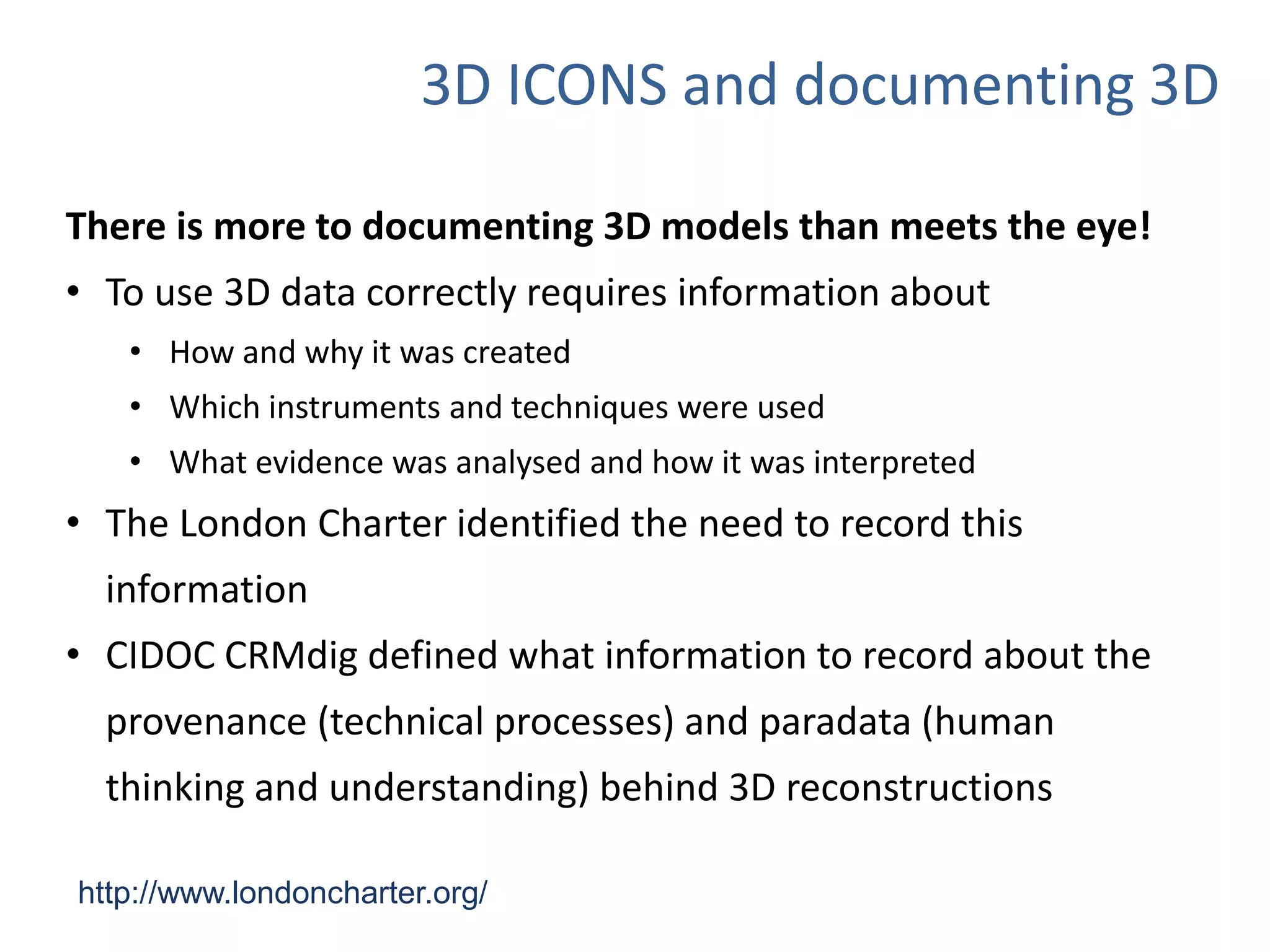
3D-ICONS context
3D-ICONS was a 3D digitisation project funded by the
EC’s CIP-ICT PSP programme (2012-2015)
16 partners in 11 countries
Digitising world heritage sites and archaeological
objects
Establishing a pipeline for capture, processing and
publishing of 3D content online
– in user friendly formats
– with metadata
– For Europeana
3D ICONS and documenting 3D
http://www.londoncharter.org/
There is more to documenting 3D models than meets the eye!
• To use 3D data correctly requires information about
• How and why it was created
• Which instruments and techniques were used
• What evidence was analysed and how it was interpreted
• The London Charter identified the need to record this
information
• CIDOC CRMdig defined what information to record about the
provenance (technical processes) and paradata (human
thinking and understanding) behind 3D reconstructions
Developing CARARE 2.0
In 3D-ICONS we developed V2.0 of the CARARE
Schema to take on board:
– Lessons learned during the CARARE project
– Developments in EDM
– the recommendations in CIDOC CRMdig;
– and to support the provenance and paradata required for
quality assurance of 3D models
The main changes
• Heritage Asset
• Scope has been broadened to include printed materials, archives and
born-digital objects relating to the archaeological and architectural
heritage
• Becomes mandatory; there must be one in each CARARE object
• The references section has been simplified
• Provenance has been added
• Digital Resource
• Has been simplified to focus on the type, format and location of the online
resource.
• It remains mandatory; there must be at least one in each CARARE object.
• Record information has been simplified.
• Rights statements have been simplified and metadata rights clarified.
• Spatial information has been updated.
• Elements for types of relations from heritage assets, digital resources and
activities have been specified for clarity
Documenting a heritage object using
the CARARE 2.0 schema
- a quick guide!
CARARE 2.0 approach
• Distinguishes “heritage assets” – a painting, book, drawing, image, film,
3D reconstruction or real-world archaeological monument/ historic building
from
• Digital representations (or digital resources) of the heritage asset which
can be found online
• Allows for events (historical, field activities, laboratory work) to be related
to heritage assets or digital resources
• Includes collection and other contextual information
• Allows one heritage asset to be related to another (whole/part,
parent/child, predecessor/successor, version) allowing for alternate
interpretations to be offered.
Heritage asset
Core details:
• Title
• Description
• General type
• Character (subject, time period, etc)
• Spatial location (place name coordinates)
• Rights
• Provenance
• Actors
• Relation to digital resource
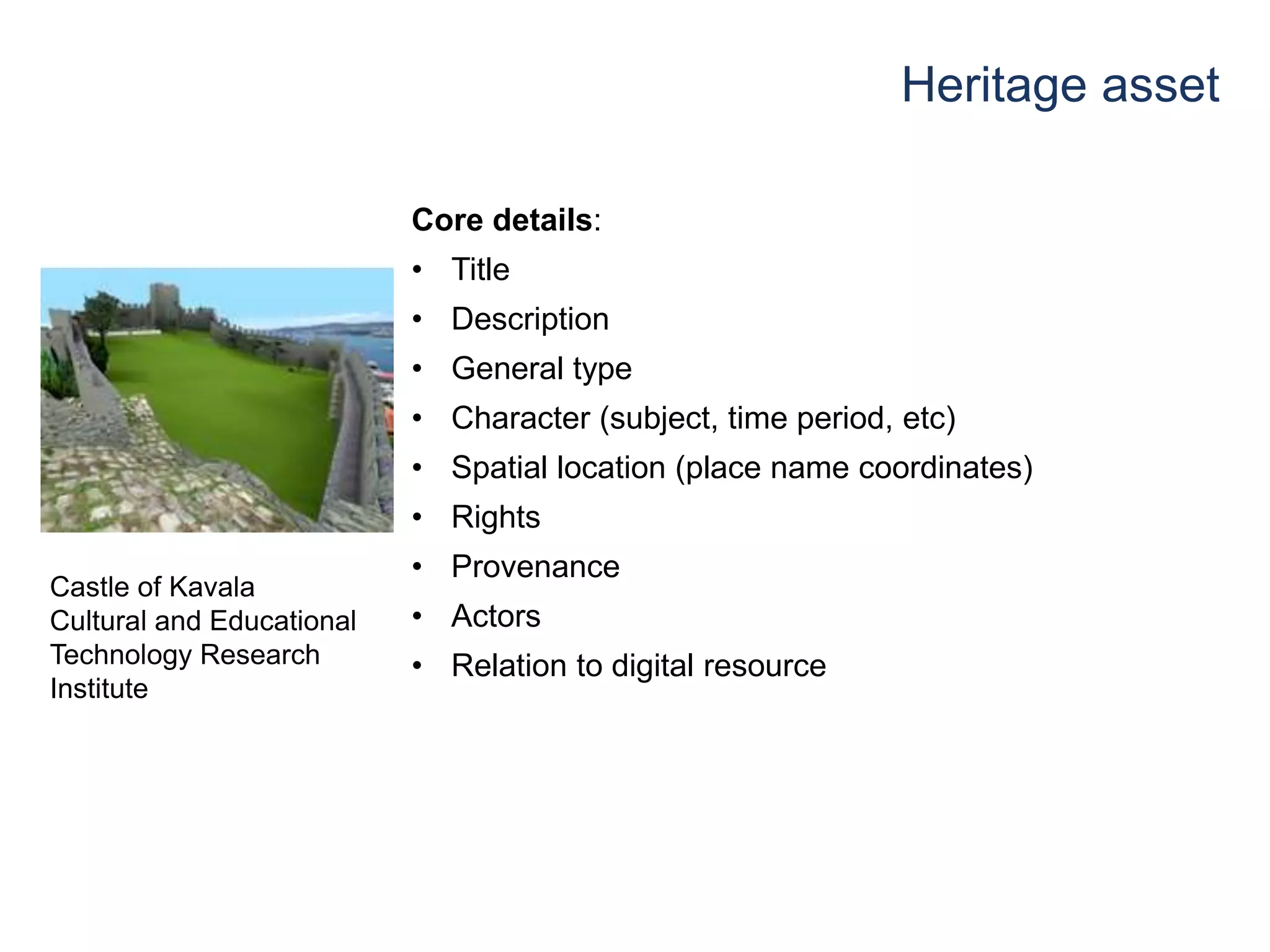
Castle of Kavala
Cultural and Educational
Technology Research
Institute
Digital Resource
Core details:
• Title
• Description
• Type and format
• Location of the resource online
(URL, URI)
• Rights
• Relation to heritage asset
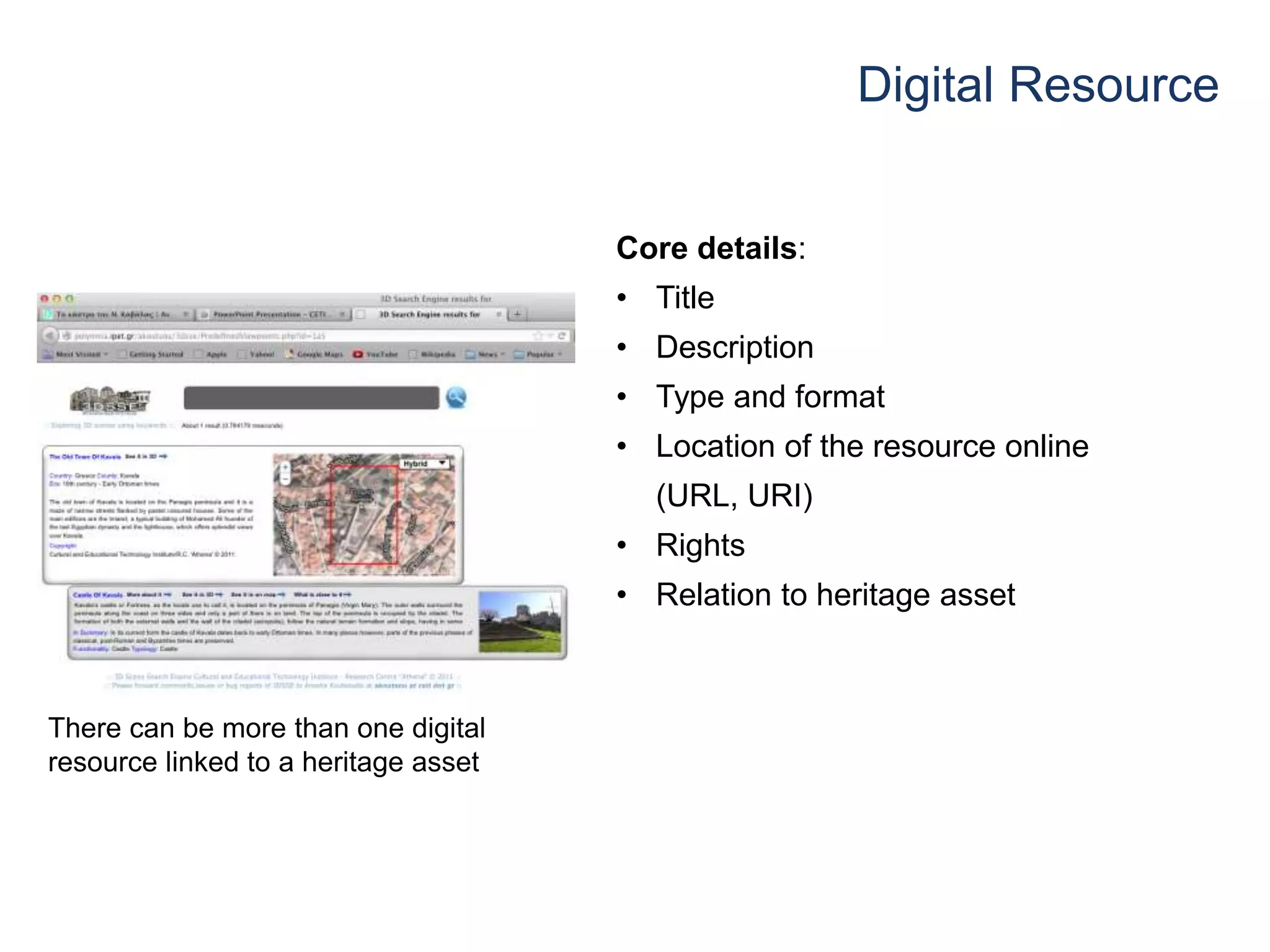
There can be more than one digital
resource linked to a heritage asset
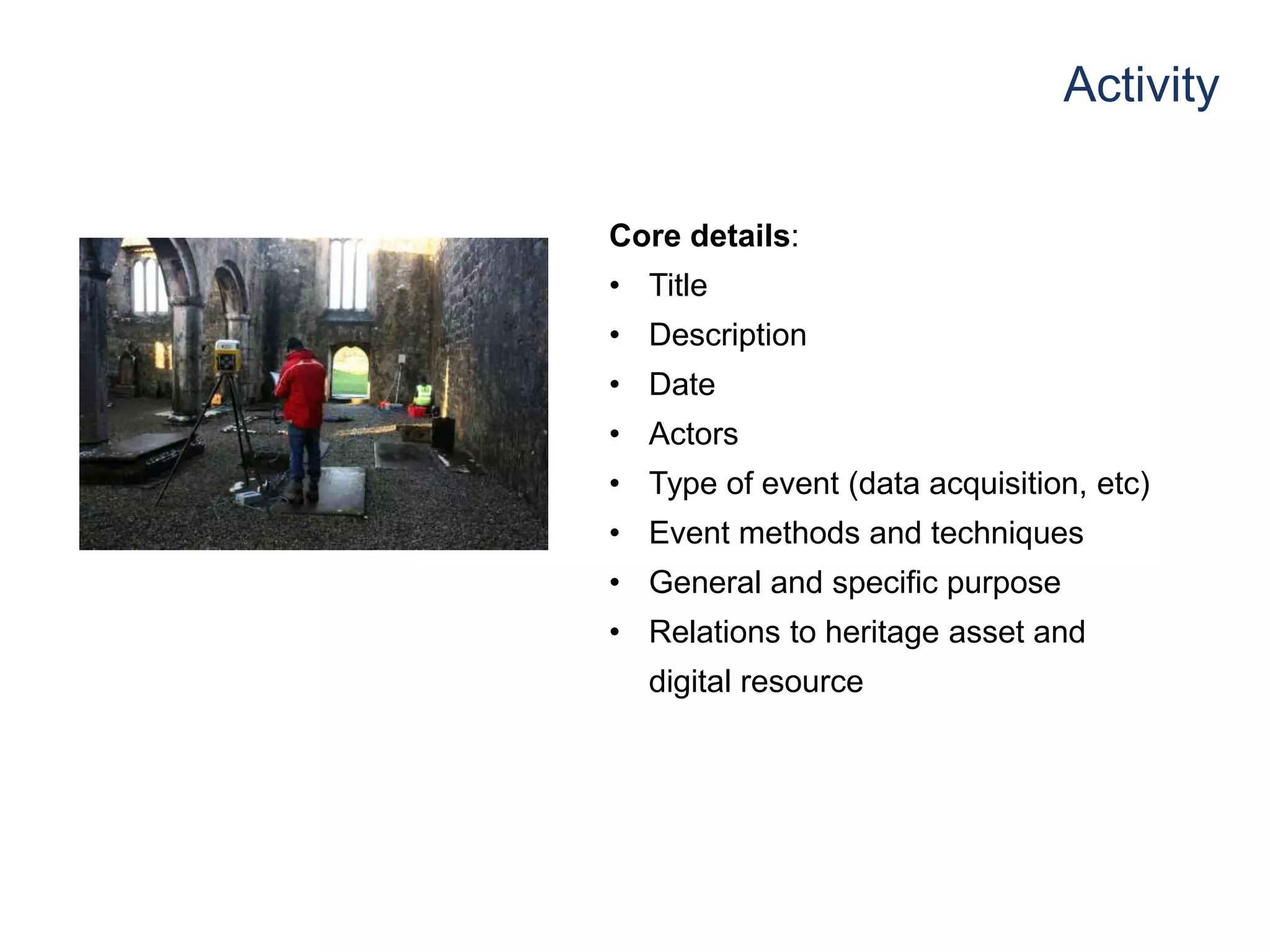
Activity
Core details:
• Title
• Description
• Date
• Actors
• Type of event (data acquisition, etc)
• Event methods and techniques
• General and specific purpose
• Relations to heritage asset and
digital resource
Any questions?
Kate Fernie
kfernie27@gmail.com

Carare 2.0: Developing a metadata schema

  • 1.
    CARARE 2.0: developingthe metadata schema Kate Fernie, 2Culture Associates
  • 2.
    Background • CARARE developedits metadata schema to support harvesting of archaeology and architecture content for Europeana • The schema was based on: • MIDAS heritage • LIDO • CIDOC data standards • Mapped to Europeana Data Model (EDM)
  • 3.
    The CARARE schemaprovides •Familiar concepts •Rich where the domain calls for it, e.g.: •Time – from earliest prehistory to modern dates •Space – place names, coordinates, bounding boxes and polygons •Monument character •Includes events and collection information CARARE provided 2 million rich records to Europeana using v1 CARARE schema
  • 4.
    Developments •The experience ofsupplying data to Europeana suggested areas where the CARARE schema might be simplified and improved •3D ICONS project adopted the CARARE schema •Adding some requirements for 3D content
  • 5.
    3D-ICONS context 3D-ICONS wasa 3D digitisation project funded by the EC’s CIP-ICT PSP programme (2012-2015) 16 partners in 11 countries Digitising world heritage sites and archaeological objects Establishing a pipeline for capture, processing and publishing of 3D content online – in user friendly formats – with metadata – For Europeana
  • 6.
    3D ICONS anddocumenting 3D http://www.londoncharter.org/ There is more to documenting 3D models than meets the eye! • To use 3D data correctly requires information about • How and why it was created • Which instruments and techniques were used • What evidence was analysed and how it was interpreted • The London Charter identified the need to record this information • CIDOC CRMdig defined what information to record about the provenance (technical processes) and paradata (human thinking and understanding) behind 3D reconstructions
  • 7.
    Developing CARARE 2.0 In3D-ICONS we developed V2.0 of the CARARE Schema to take on board: – Lessons learned during the CARARE project – Developments in EDM – the recommendations in CIDOC CRMdig; – and to support the provenance and paradata required for quality assurance of 3D models
  • 8.
    The main changes •Heritage Asset • Scope has been broadened to include printed materials, archives and born-digital objects relating to the archaeological and architectural heritage • Becomes mandatory; there must be one in each CARARE object • The references section has been simplified • Provenance has been added • Digital Resource • Has been simplified to focus on the type, format and location of the online resource. • It remains mandatory; there must be at least one in each CARARE object. • Record information has been simplified. • Rights statements have been simplified and metadata rights clarified. • Spatial information has been updated. • Elements for types of relations from heritage assets, digital resources and activities have been specified for clarity
  • 9.
    Documenting a heritageobject using the CARARE 2.0 schema - a quick guide!
  • 10.
    CARARE 2.0 approach •Distinguishes “heritage assets” – a painting, book, drawing, image, film, 3D reconstruction or real-world archaeological monument/ historic building from • Digital representations (or digital resources) of the heritage asset which can be found online • Allows for events (historical, field activities, laboratory work) to be related to heritage assets or digital resources • Includes collection and other contextual information • Allows one heritage asset to be related to another (whole/part, parent/child, predecessor/successor, version) allowing for alternate interpretations to be offered.
  • 11.
    Heritage asset Core details: •Title • Description • General type • Character (subject, time period, etc) • Spatial location (place name coordinates) • Rights • Provenance • Actors • Relation to digital resource Castle of Kavala Cultural and Educational Technology Research Institute
  • 12.
    Digital Resource Core details: •Title • Description • Type and format • Location of the resource online (URL, URI) • Rights • Relation to heritage asset There can be more than one digital resource linked to a heritage asset
  • 13.
    Activity Core details: • Title •Description • Date • Actors • Type of event (data acquisition, etc) • Event methods and techniques • General and specific purpose • Relations to heritage asset and digital resource
  • 14.

Editor's Notes

  • #6 3D ICONS, a project funded by the European Commission’s ICT Policy Support programme, has brought together partners expert in 3D digitization of the archaeological and architectural heritage to contribute content to Europeana [1]. A main objective of the 3D ICONS project has been to establish is a pipeline for the capture, processing and publication of 3D models, which incorporates quality control of the digital data being produced.