





Failure to Connect
Why You're Not Getting More From SharePoint
LISTEN
KNOW
UNDERSTAND
CONNECT
22
Non Disclosure Agreement
For the purposes of this document, and except as otherwise expressly provided in this
document, "Confidential Information" means any information that C5 Insight, Inc. (“C5
Insight”) desires to protect against unrestricted disclosure by the receiving party
(“Recipient”).
The Recipient agrees that it will hold in confidence the Confidential Information disclosed
within this document and any documents, presentations, software, methods or other
information shared by C5 Insight in print, electronic, verbal or any other format. The
Recipient shall exercise reasonable care to protect the Confidential Information from
unauthorized disclosure, which care shall in no event be less than the Recipient takes to
protect its own Confidential Information of a like nature. The Recipient may disclose
Confidential Information only to its employees or agents who need to know such information
for purposes of this agreement, and shall inform such employees and agents, by way of
policy and agreement, that they are bound by obligations of confidentiality.
The entire content of this statement of work is classified as Confidential Information and by
reading any further content within this document, the recipient is bound by the terms of this
non-disclosure agreement.
3
Curtis@C5Insight.com
Curtis Hughes
Managing Partner
C5 Insight
About Me
/in/curtishughes
@C5Curtis
Get Social
@C5Curtis
@C5Insight
#FailureToConnect
#WorkTogetherBetter
AIIM
WE KNOW THE REASONS WHY
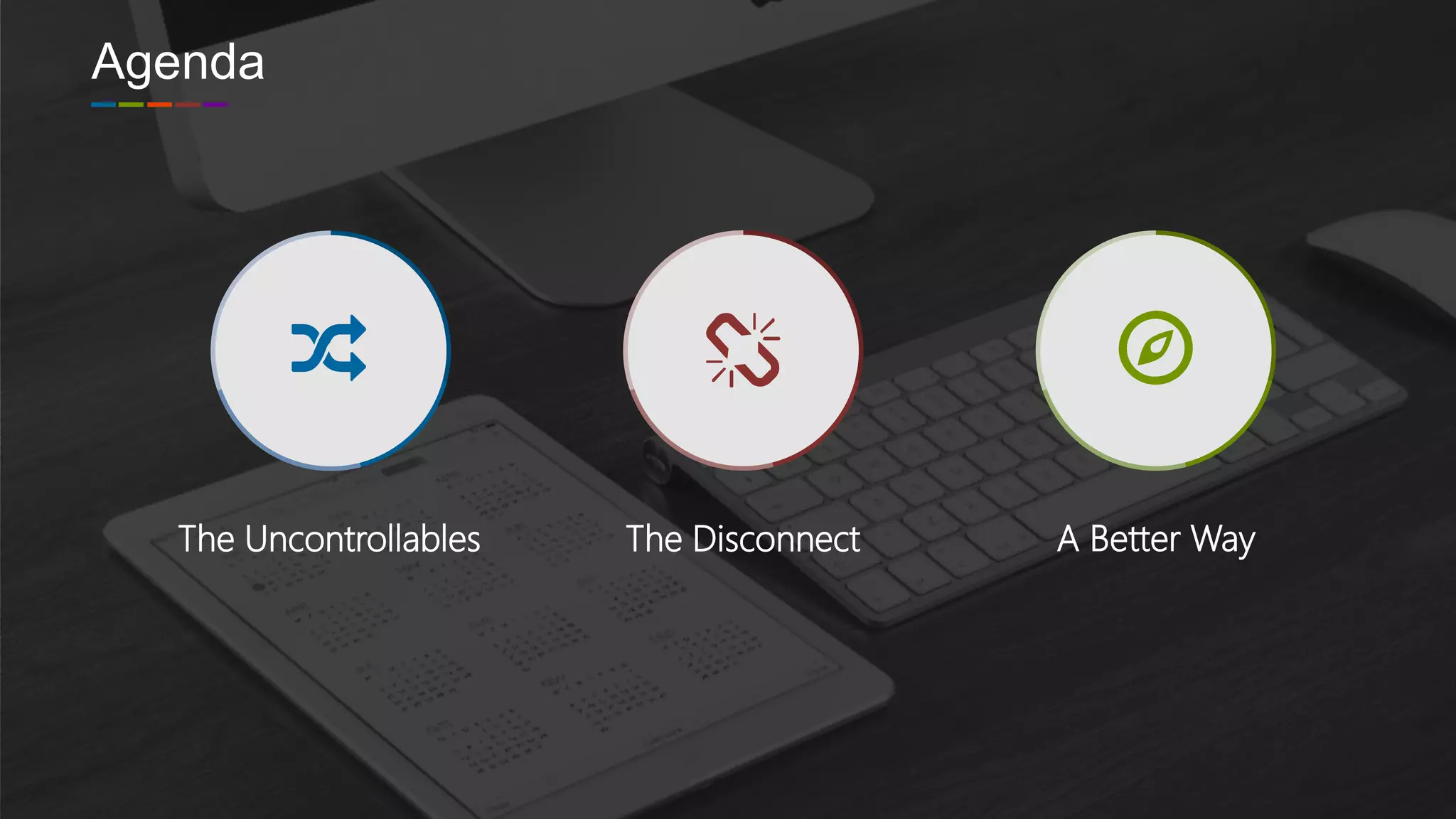
Agenda
The Uncontrollables The Disconnect A Better Way
Understanding What You’re Up Against
THE UNCONTROLLABLES
9
Atlasssian
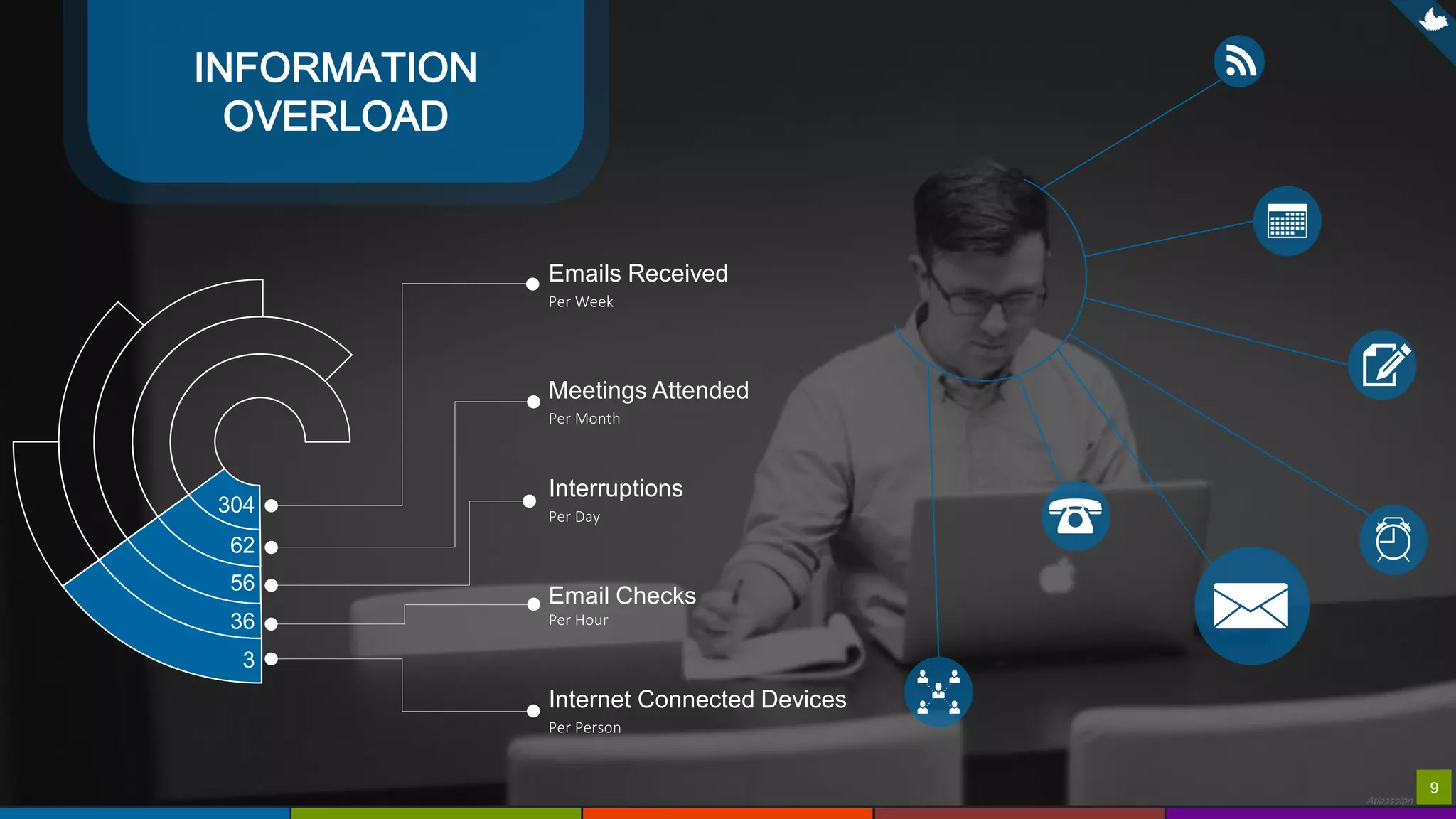
INFORMATION
OVERLOAD
Emails Received
Per Week
Meetings Attended
Per Month
Interruptions
Per Day
Email Checks
Per Hour
Internet Connected Devices
Per Person
304
62
56
36
3
9
10
Global Leadership Summit; Fast Company – Future of Work; STC Services; Ad Week – Social Media Addiction;
A NEW WAY
OF WORKING
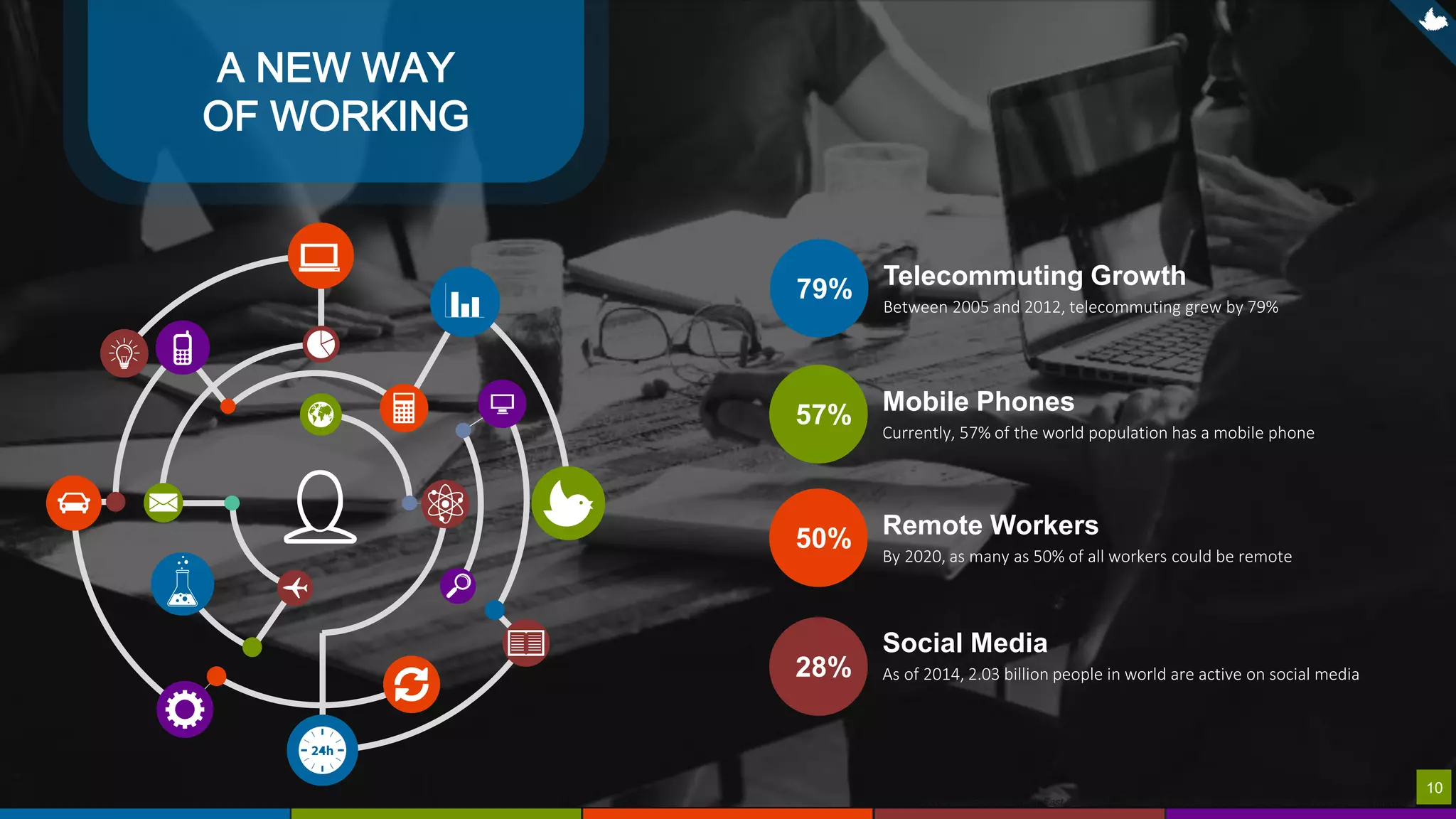
Telecommuting Growth
Between 2005 and 2012, telecommuting grew by 79%
79%
Remote Workers
By 2020, as many as 50% of all workers could be remote
57% Mobile Phones
Currently, 57% of the world population has a mobile phone
50%
Social Media
As of 2014, 2.03 billion people in world are active on social media28%
10
11
Millennial Branding – The Cost of Millennial Retention Study
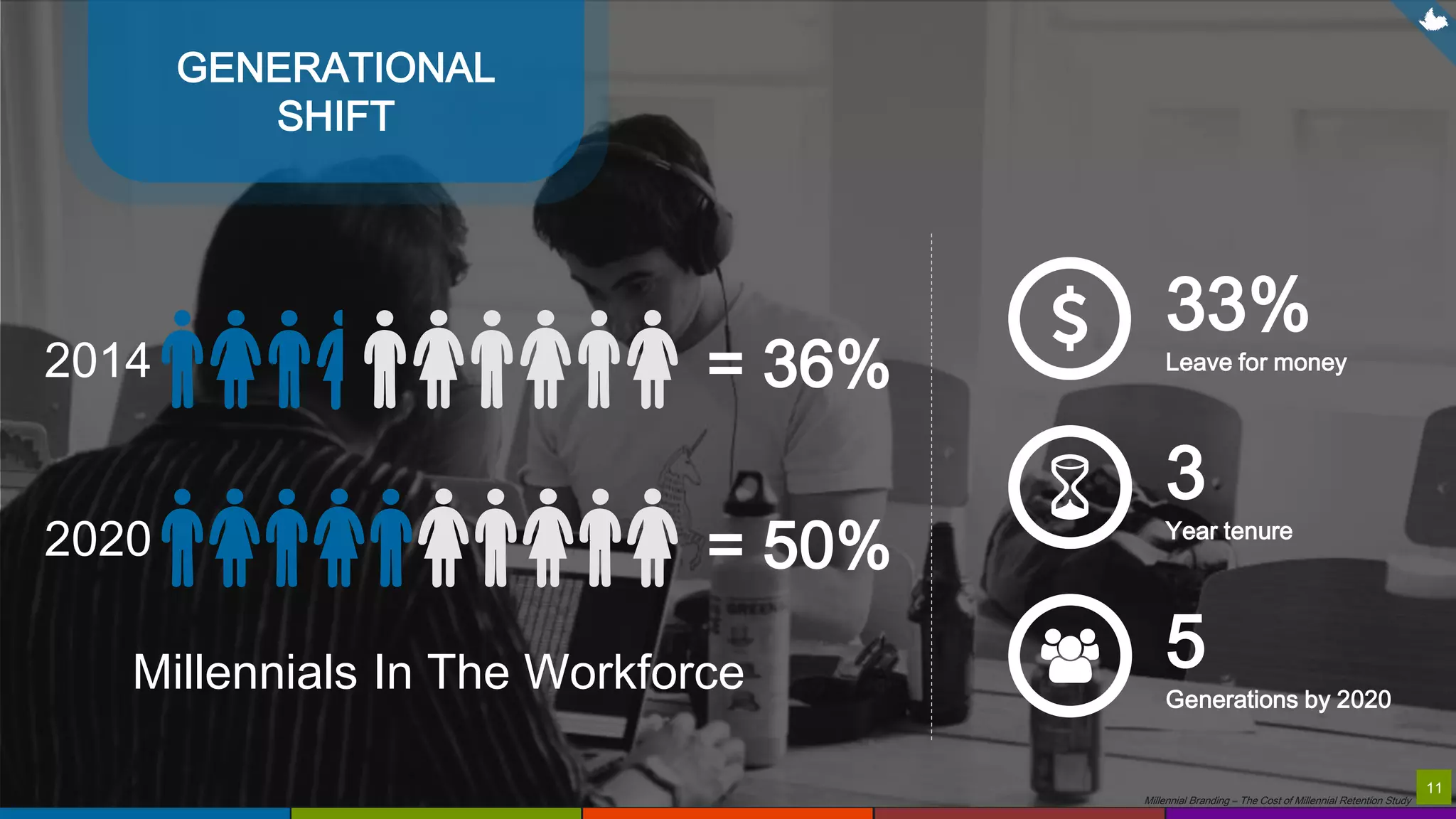
2014
2020
= 36%
= 50%
Millennials In The Workforce
11
3
Year tenure
33%
Leave for money
5
Generations by 2020
GENERATIONAL
SHIFT
Why Organizations Are Missing The Mark With SharePoint
THE DISCONNECT
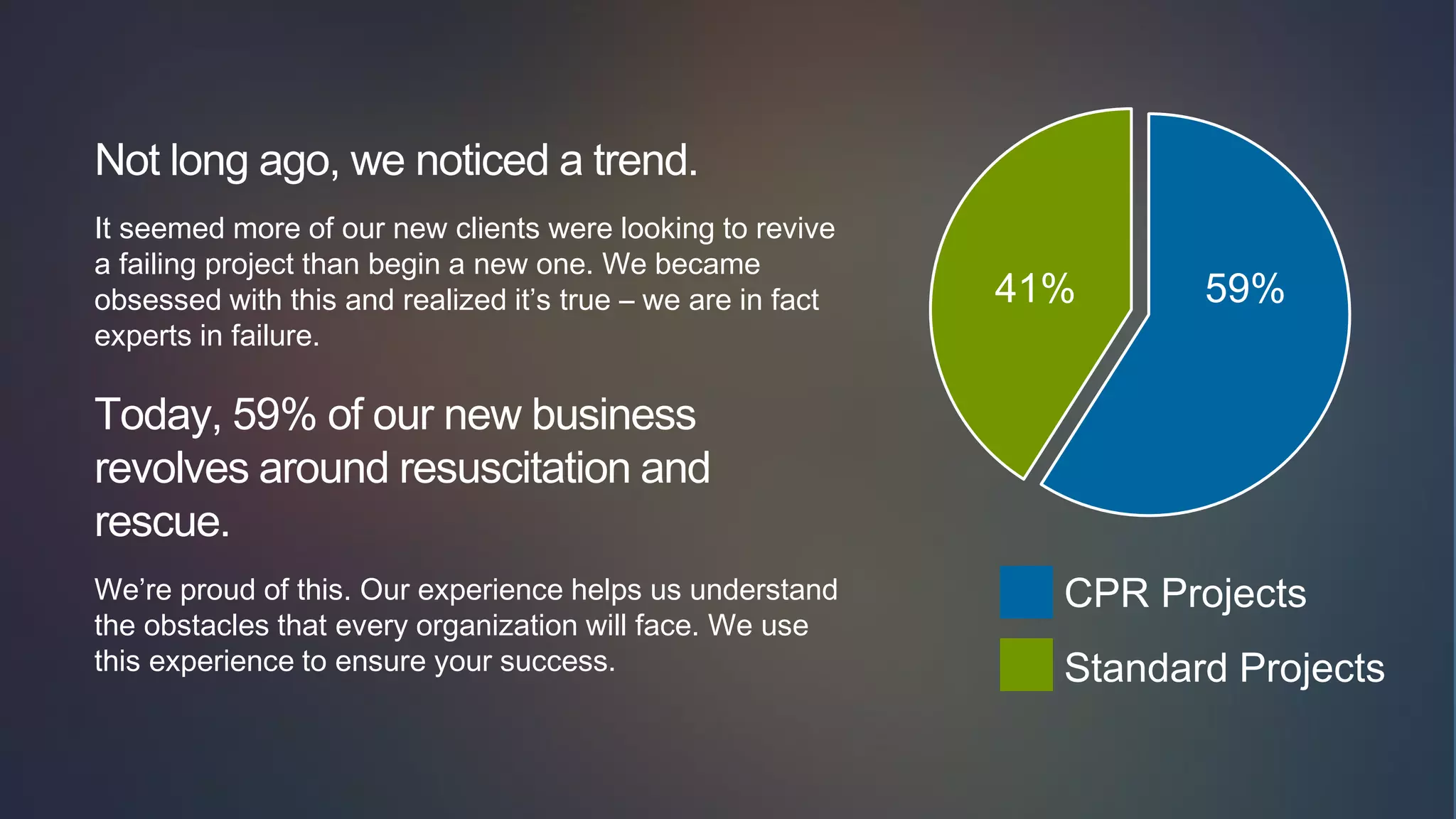
41% 59%
CPR Projects
Standard Projects
Not long ago, we noticed a trend.
It seemed more of our new clients were looking to revive
a failing project than begin a new one. We became
obsessed with this and realized it’s true – we are in fact
experts in failure.
Today, 59% of our new business
revolves around resuscitation and
rescue.
We’re proud of this. Our experience helps us understand
the obstacles that every organization will face. We use
this experience to ensure your success.
UNCLEAR
ROADMAP
OR
UNMEASURABLE
GOALS
Decisions
Decision Decision
Decision
Decision
Decision
Decision
Decision
Decision
Decision
Decision
Decision
Decision
Decision
Decision
Decision
Decision
Decision
Decision Decision
Decision
Decision
Decision Decision
Decision
Decision
Decision
Decision
Decision
Decision Decision
Decision
Decision
Decision
Decision
Decision
Decision
Decision
Decision
Decision
Decision
Decision
Decision
Decision
Decisions
Decision Decision
Decision
Decision
Decision
Decision
Decision
Decision
Decision
Decision
Decision
Decision
Decision
Decision
Decision
Decision
Decision
Decision Decision
Decision
Decision
Decision Decision
Decision
Decision
Decision
Decision
Decision
Decision Decision
Decision
Decision
Decision
Decision
Decision
Decision
Decision
Decision
Decision
Decision
Decision
Decision
Decision
Task 1
Task 2
Task 3
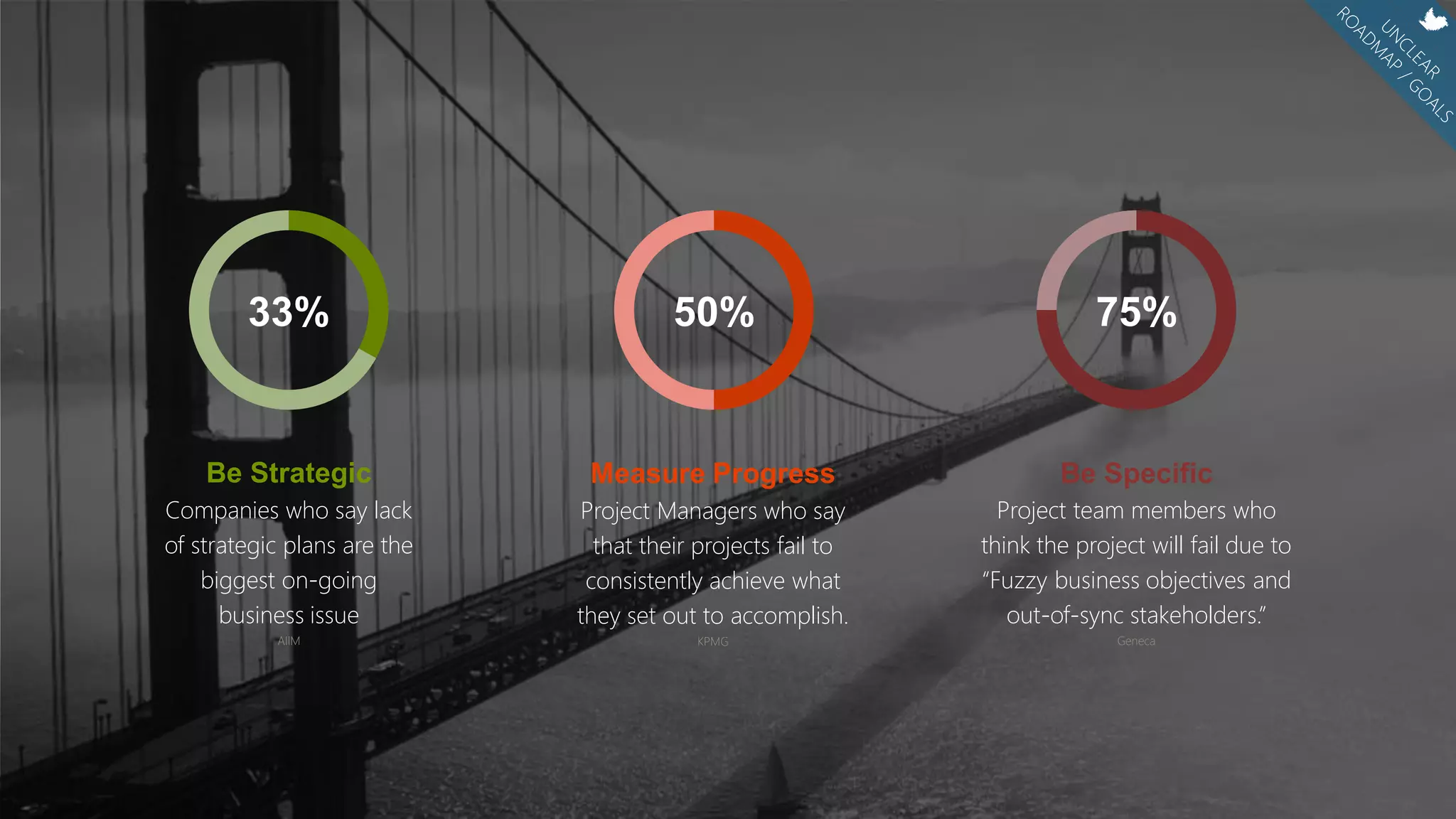
33%
Companies who say lack
of strategic plans are the
biggest on-going
business issue
AIIM
Be Strategic
50%
Measure Progress
Project Managers who say
that their projects fail to
consistently achieve what
they set out to accomplish.
KPMG
75%
Be Specific
Project team members who
think the project will fail due to
“Fuzzy business objectives and
out-of-sync stakeholders.”
Geneca
UNREALISTIC
EXPECTATIONS
FOCUSING
ON THE
TOOLS
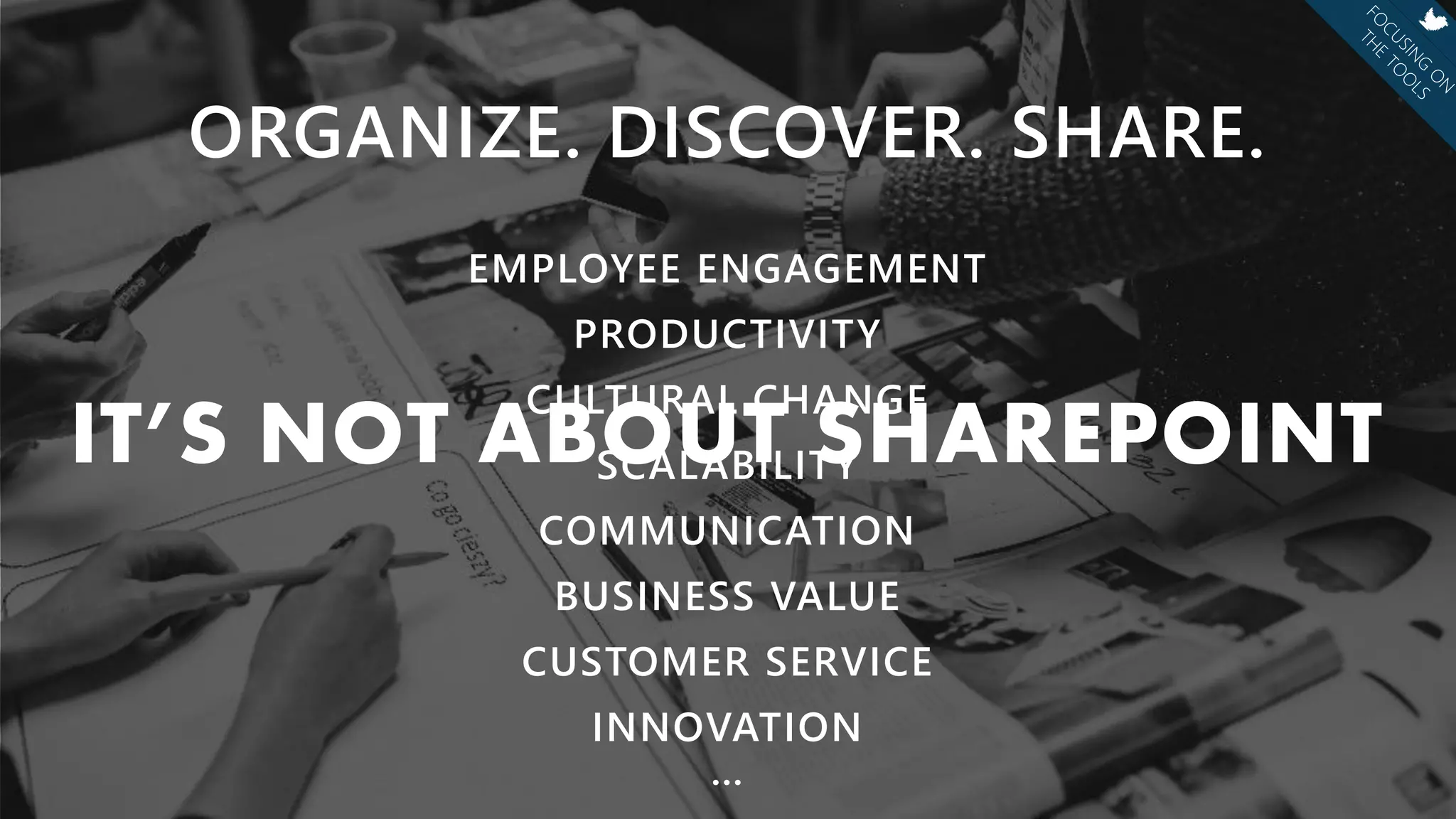
IT’S NOT ABOUT SHAREPOINT
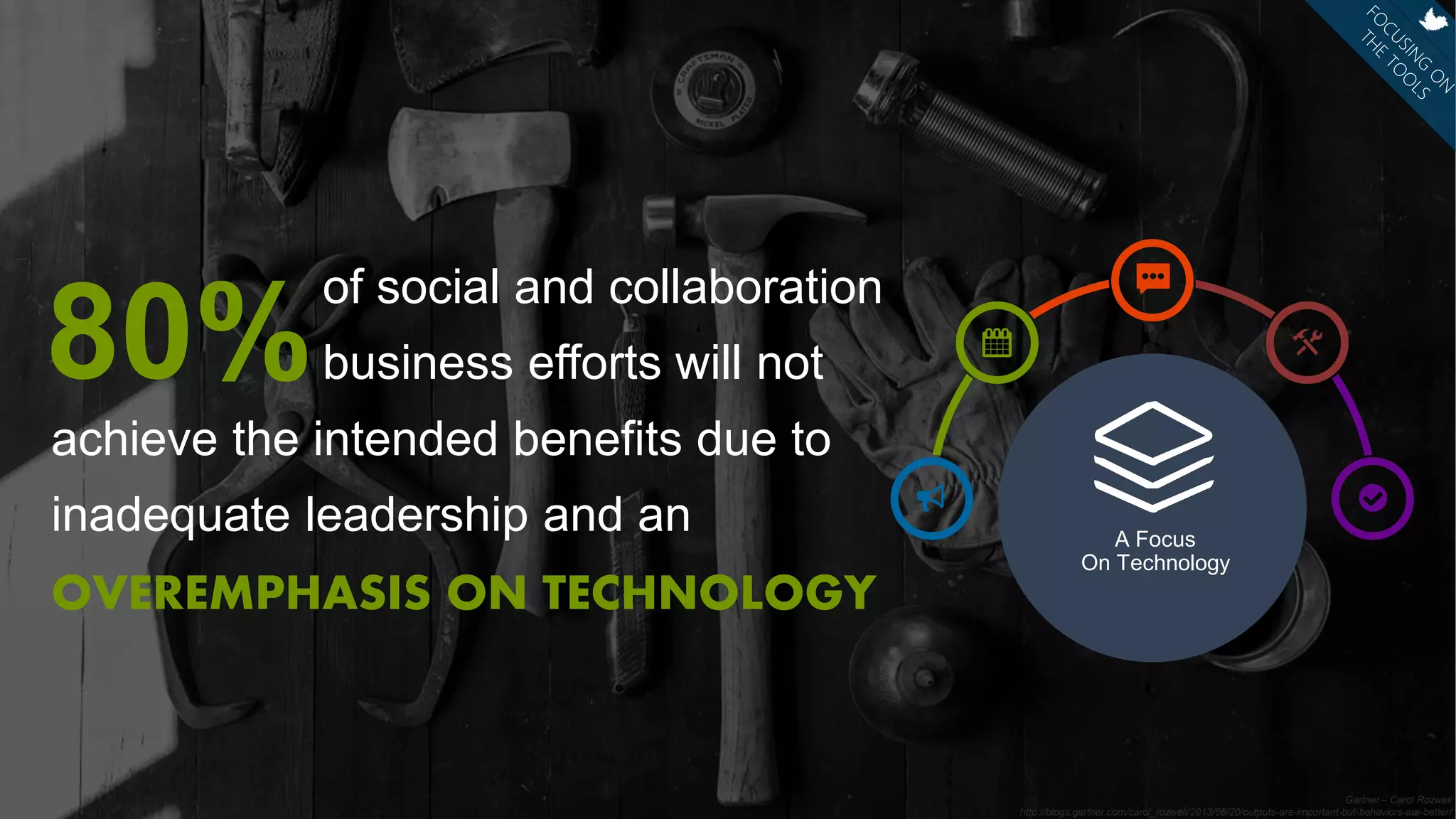
Gartner – Carol Rozwell
http://blogs.gartner.com/carol_rozwell/2013/08/20/outputs-are-important-but-behaviors-are-better/
of social and collaboration
business efforts will not
A Focus
On Technology
80%
achieve the intended benefits due to
inadequate leadership and an
OVEREMPHASIS ON TECHNOLOGY
FORGETTING
ABOUT
PEOPLE
Gartner Research
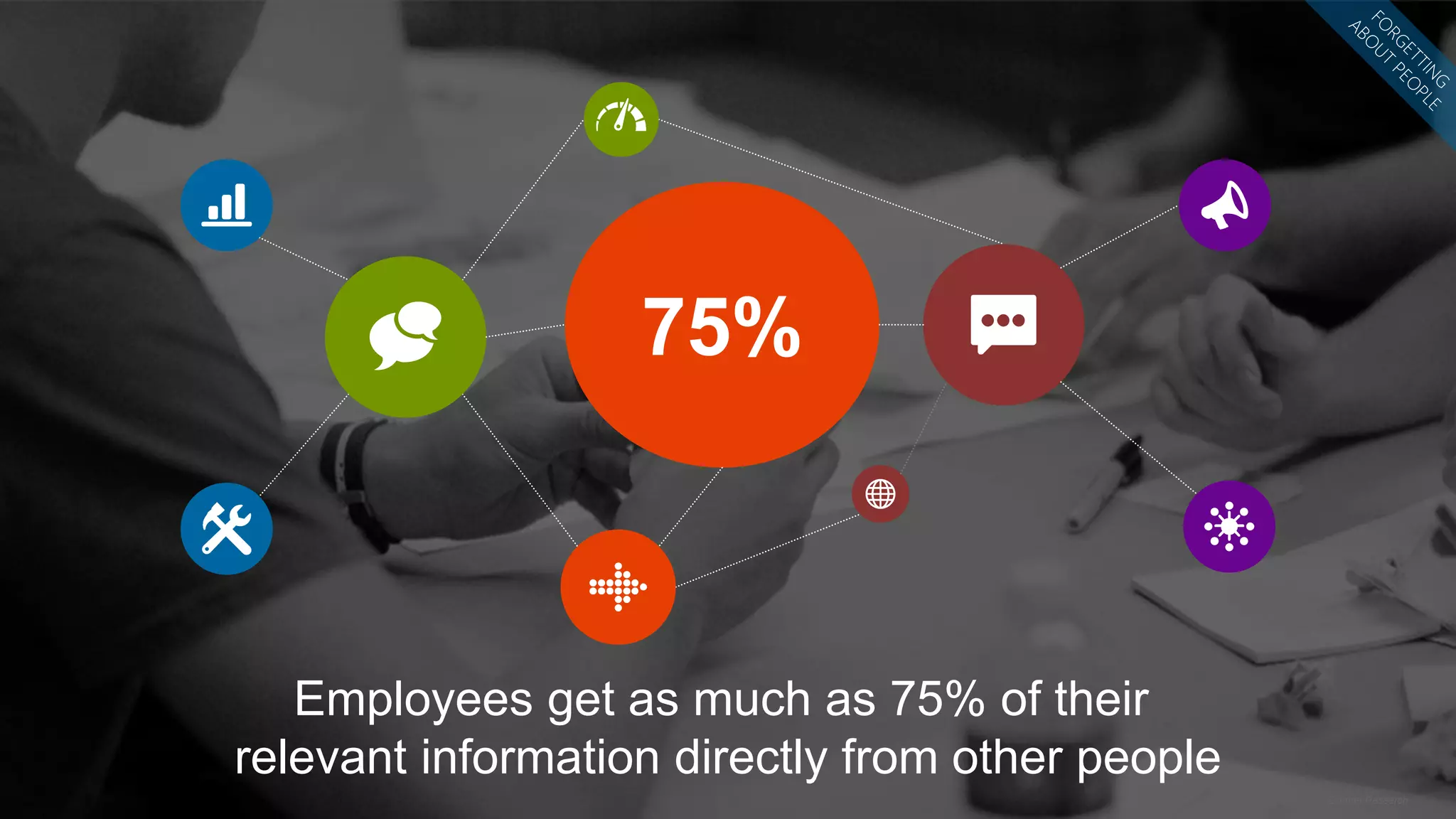
Employees get as much as 75% of their
relevant information directly from other people
75%
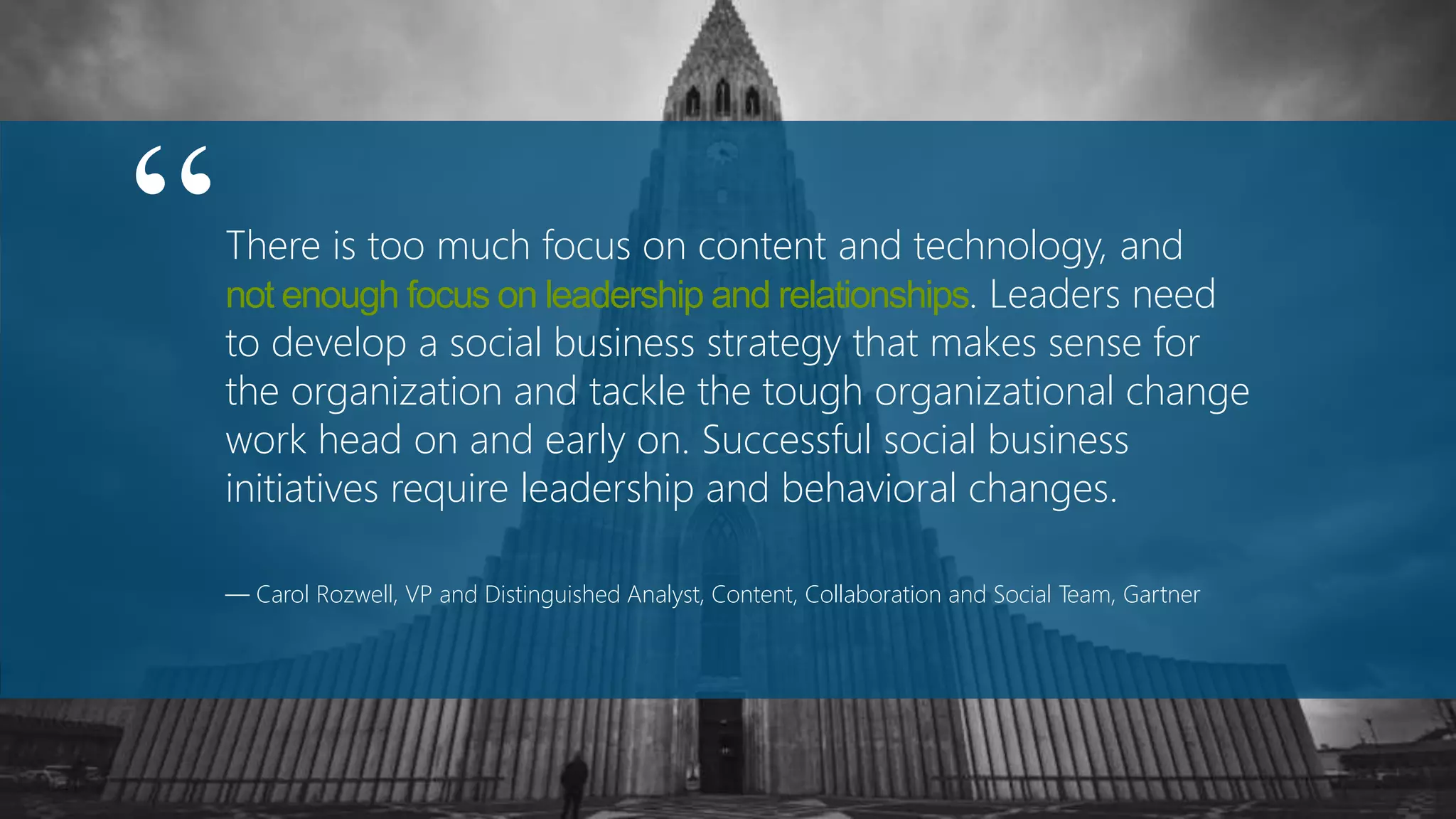
There is too much focus on content and technology, and
not enough focus on leadership and relationships. Leaders need
to develop a social business strategy that makes sense for
the organization and tackle the tough organizational change
work head on and early on. Successful social business
initiatives require leadership and behavioral changes.
— Carol Rozwell, VP and Distinguished Analyst, Content, Collaboration and Social Team, Gartner
“
TAKING HANDS
OFF
THE WHEEL
UNBALANCED
GOVERNANCE
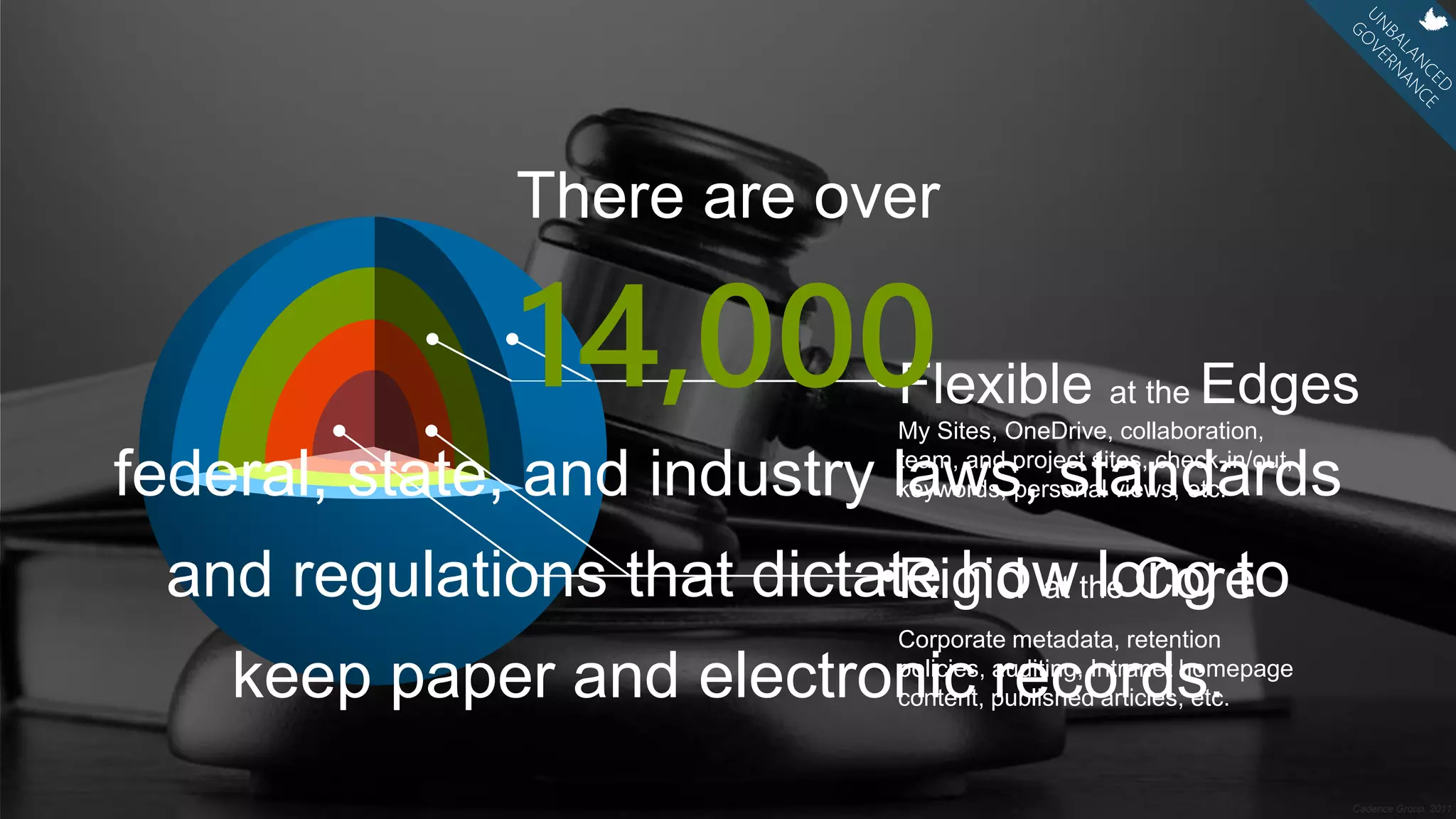
Cadence Group, 2011
Rigid at the Core
Flexible at the Edges
There are over
federal, state, and industry laws, standards
and regulations that dictate how long to
keep paper and electronic records.
14,000
Corporate metadata, retention
policies, auditing, Intranet homepage
content, published articles, etc.
My Sites, OneDrive, collaboration,
team, and project sites, check-in/out,
keywords, personal views, etc.
We can't solve problems by using the
same kind of thinking we used when
we created them.
— Albert Einstein
“
How Organizations Can Find Their Way To SharePoint Success
A BETTER WAY
32
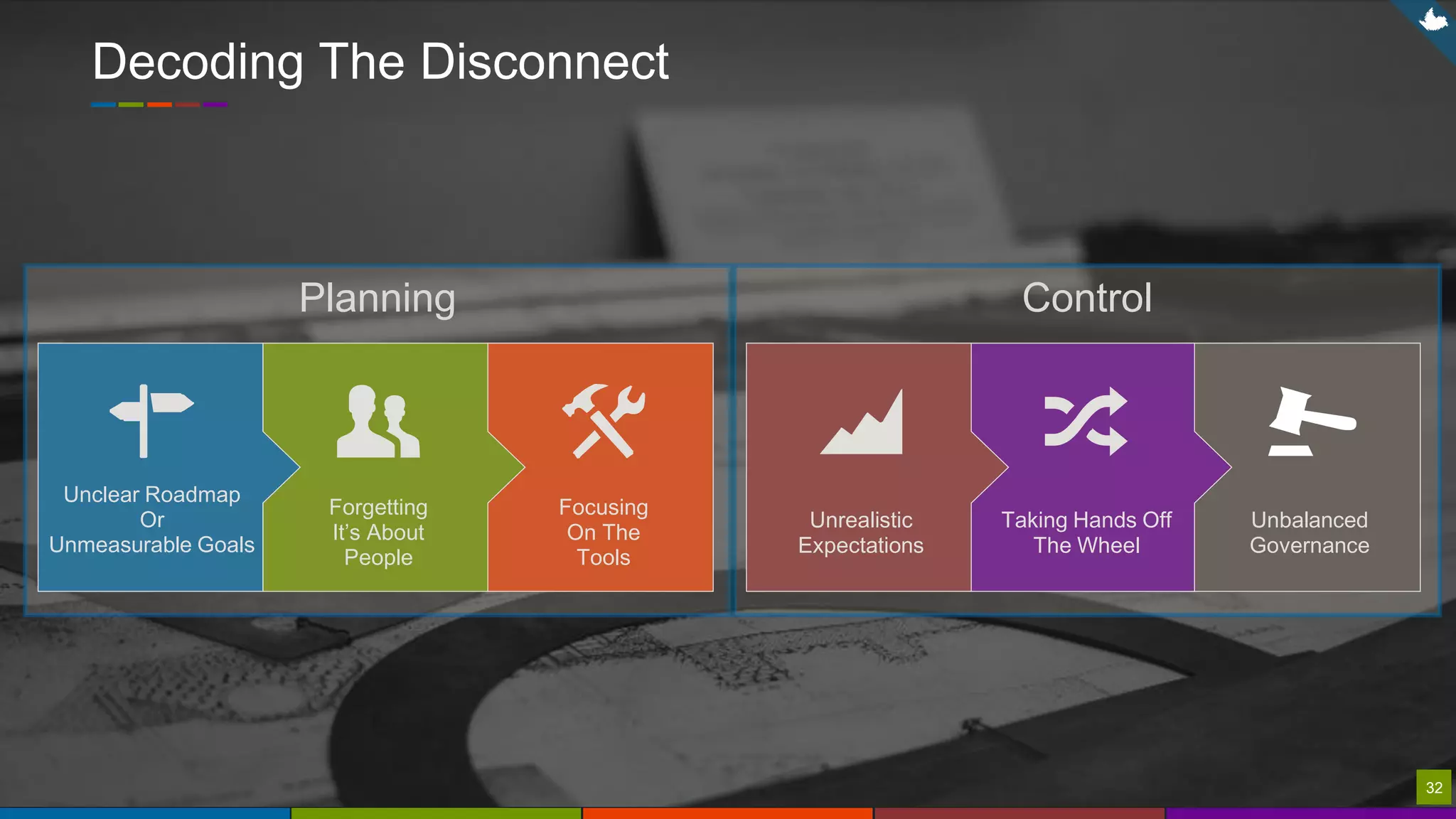
Decoding The Disconnect
32
Unrealistic
Expectations
Taking Hands Off
The Wheel
Unbalanced
Governance
Unclear Roadmap
Or
Unmeasurable Goals
Forgetting
It’s About
People
Focusing
On The
Tools
Planning Control
33
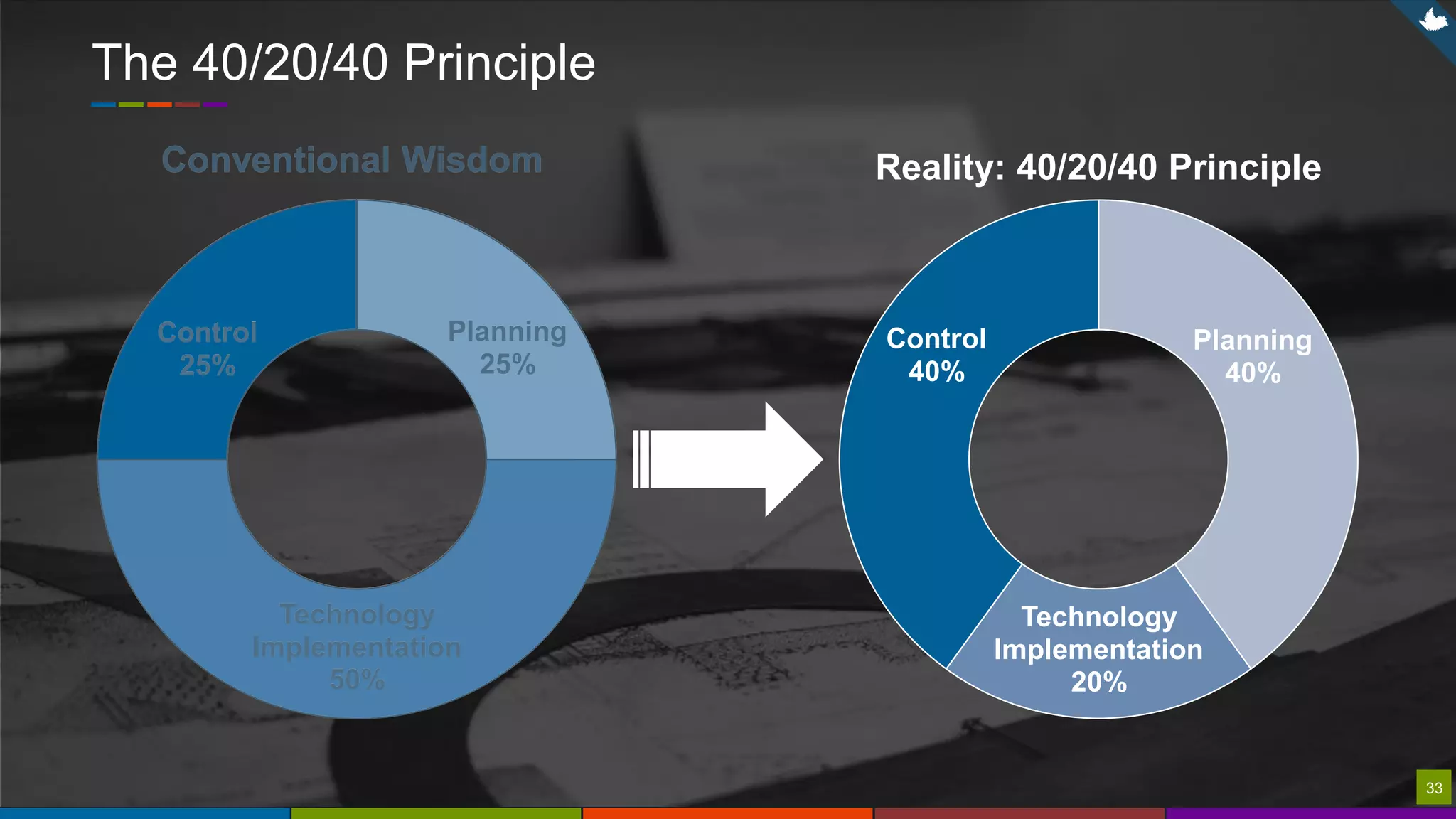
Planning
25%
Technology
Implementation
50%
Control
25%
Planning
40%
Technology
Implementation
20%
Control
40%
Planning
25%
Technology
Implementation
50%
Control
25%
Conventional Wisdom Reality: 40/20/40 PrincipleConventional Wisdom
The 40/20/40 Principle
33
34
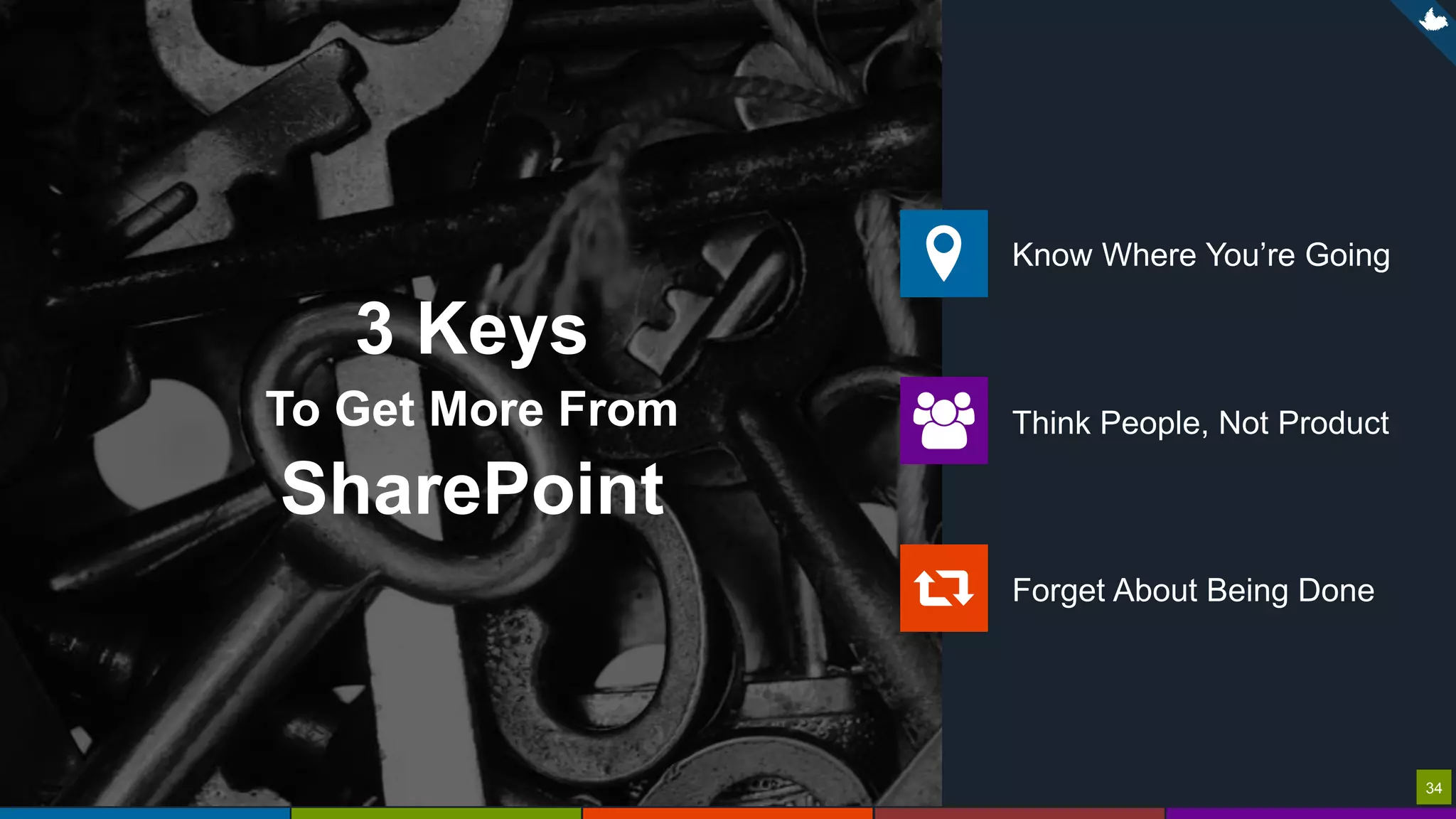
3 Keys
To Get More From
SharePoint
Know Where You’re Going
Think People, Not Product
Forget About Being Done
KNOW WHERE
YOU’RE GOING
36
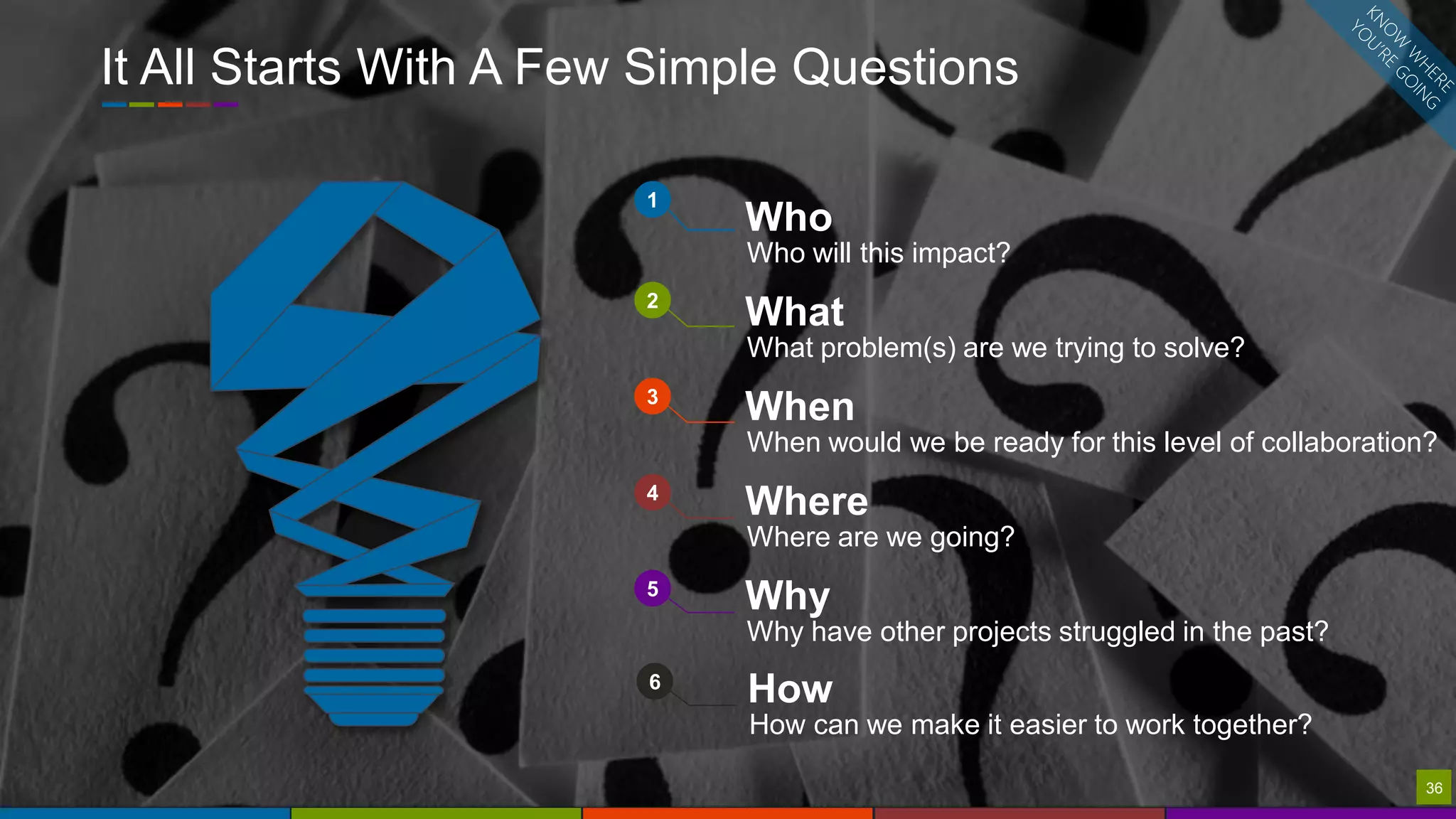
It All Starts With A Few Simple Questions
36
2
What
What problem(s) are we trying to solve?
3
When
When would we be ready for this level of collaboration?
1
Who
Who will this impact?
4
Where
Where are we going?
5
Why
Why have other projects struggled in the past?
6
How
How can we make it easier to work together?
37
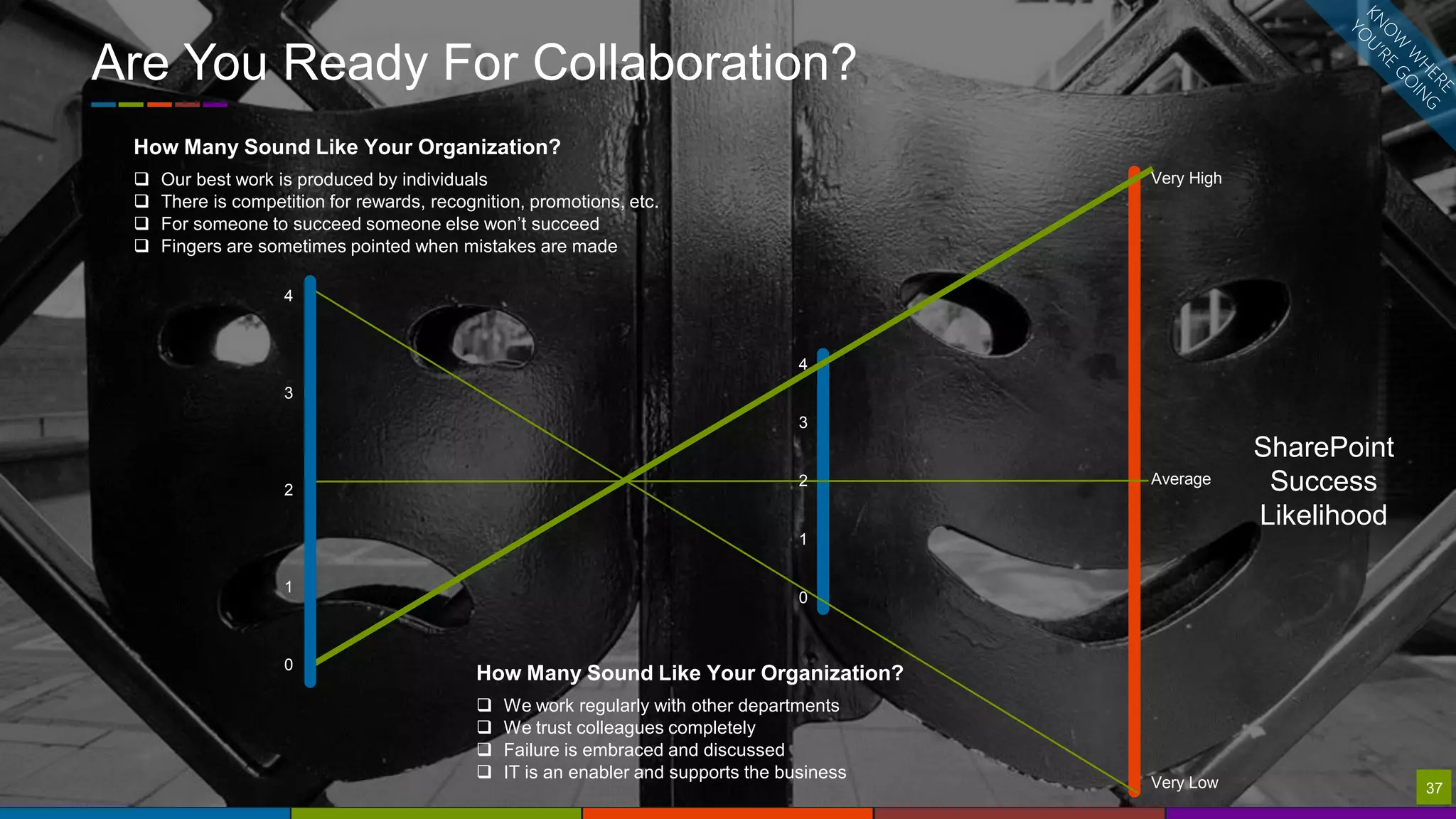
How Many Sound Like Your Organization?
 We work regularly with other departments
 We trust colleagues completely
 Failure is embraced and discussed
 IT is an enabler and supports the business
4
3
2
1
0
4
3
2
1
0
Very High
Average
Very Low
How Many Sound Like Your Organization?
 Our best work is produced by individuals
 There is competition for rewards, recognition, promotions, etc.
 For someone to succeed someone else won’t succeed
 Fingers are sometimes pointed when mistakes are made
SharePoint
Success
Likelihood
Are You Ready For Collaboration?
37
THINK PEOPLE,
NOT PRODUCT
41
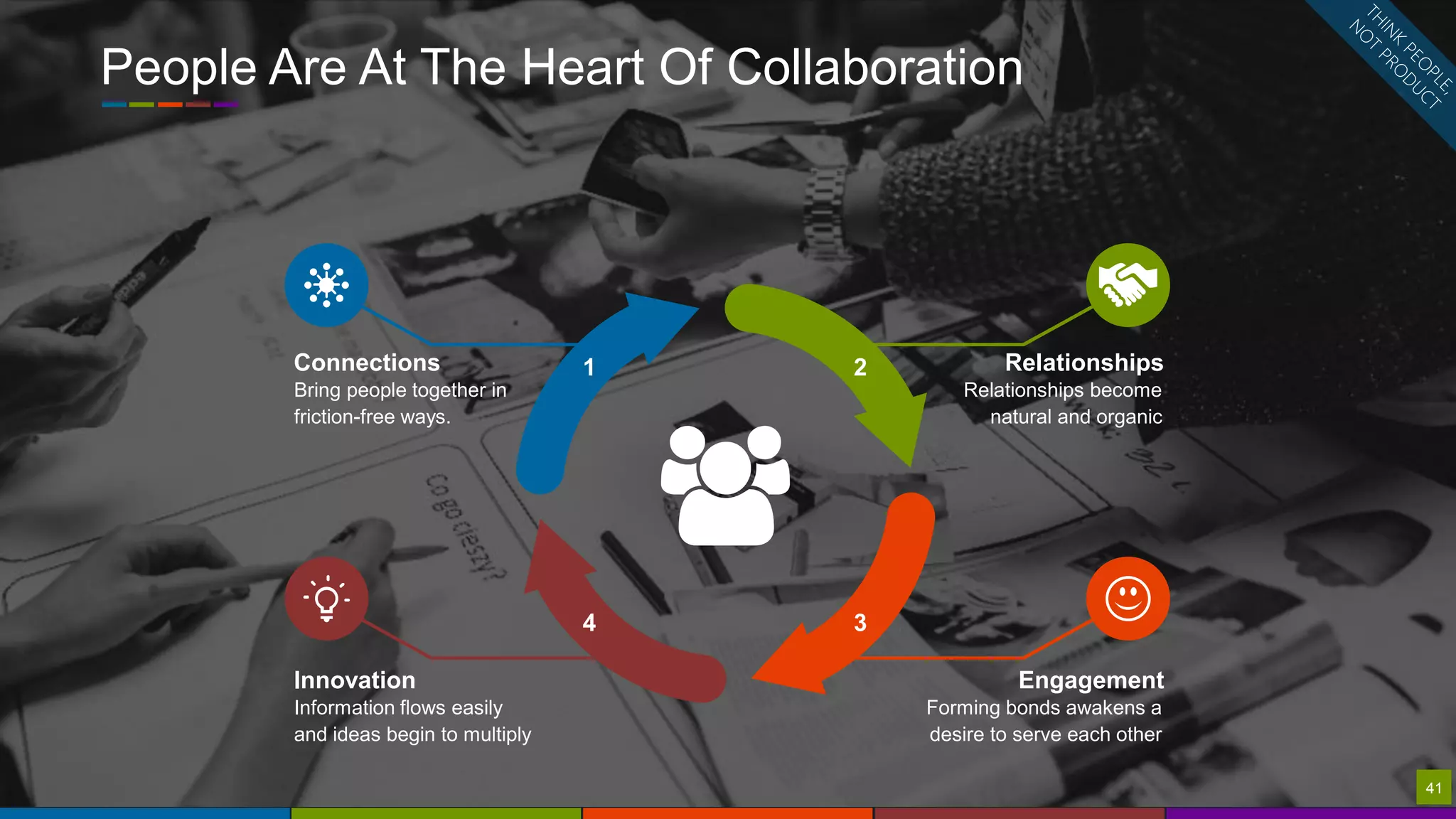
People Are At The Heart Of Collaboration
Engagement
Forming bonds awakens a
desire to serve each other
1
Information flows easily
and ideas begin to multiply
Relationships
Relationships become
natural and organic
Connections
Bring people together in
friction-free ways.
2
34
Innovation
41
42
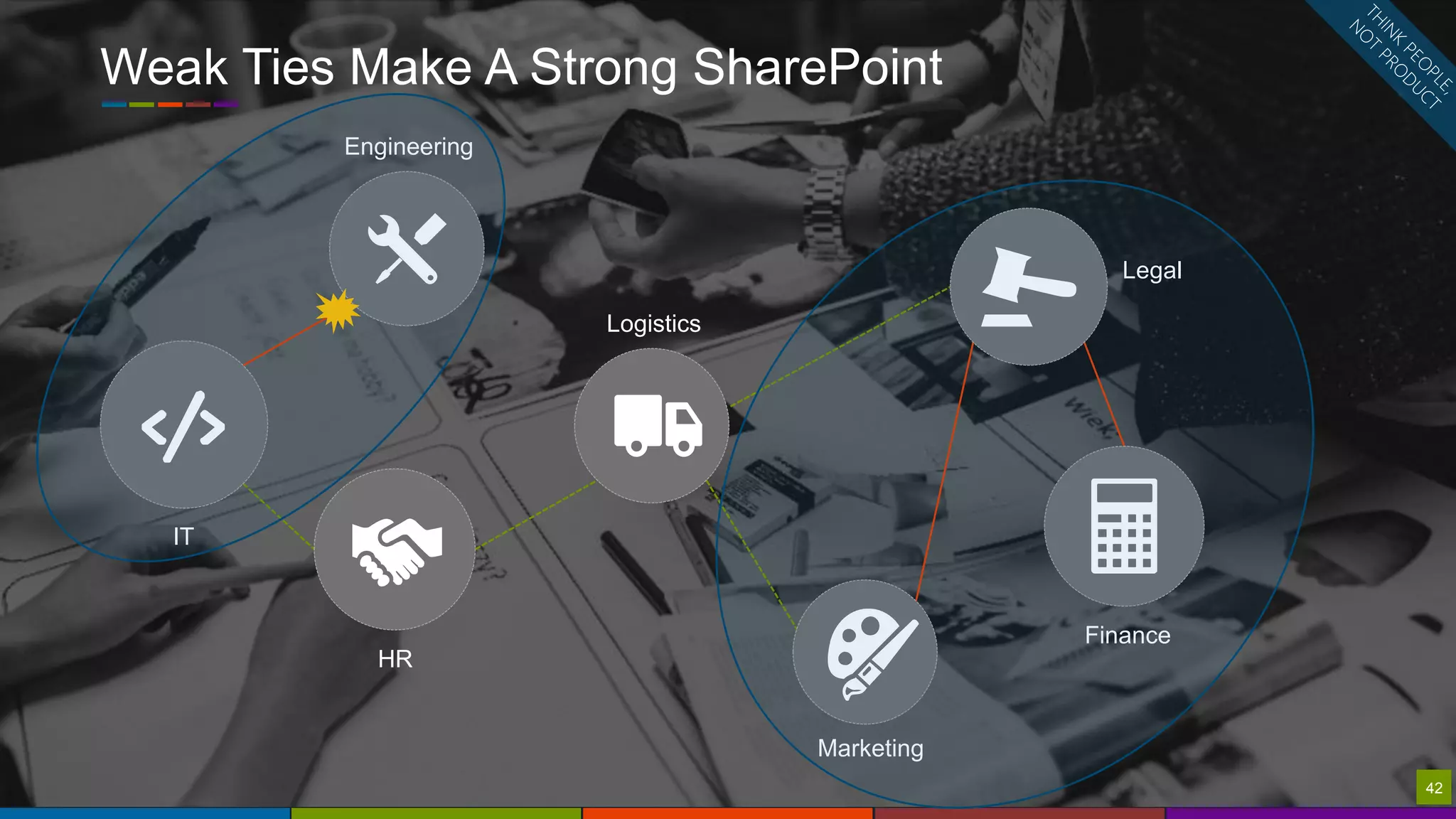
Weak Ties Make A Strong SharePoint
Marketing
IT
HR
Logistics
Legal
Finance
42
Engineering
44
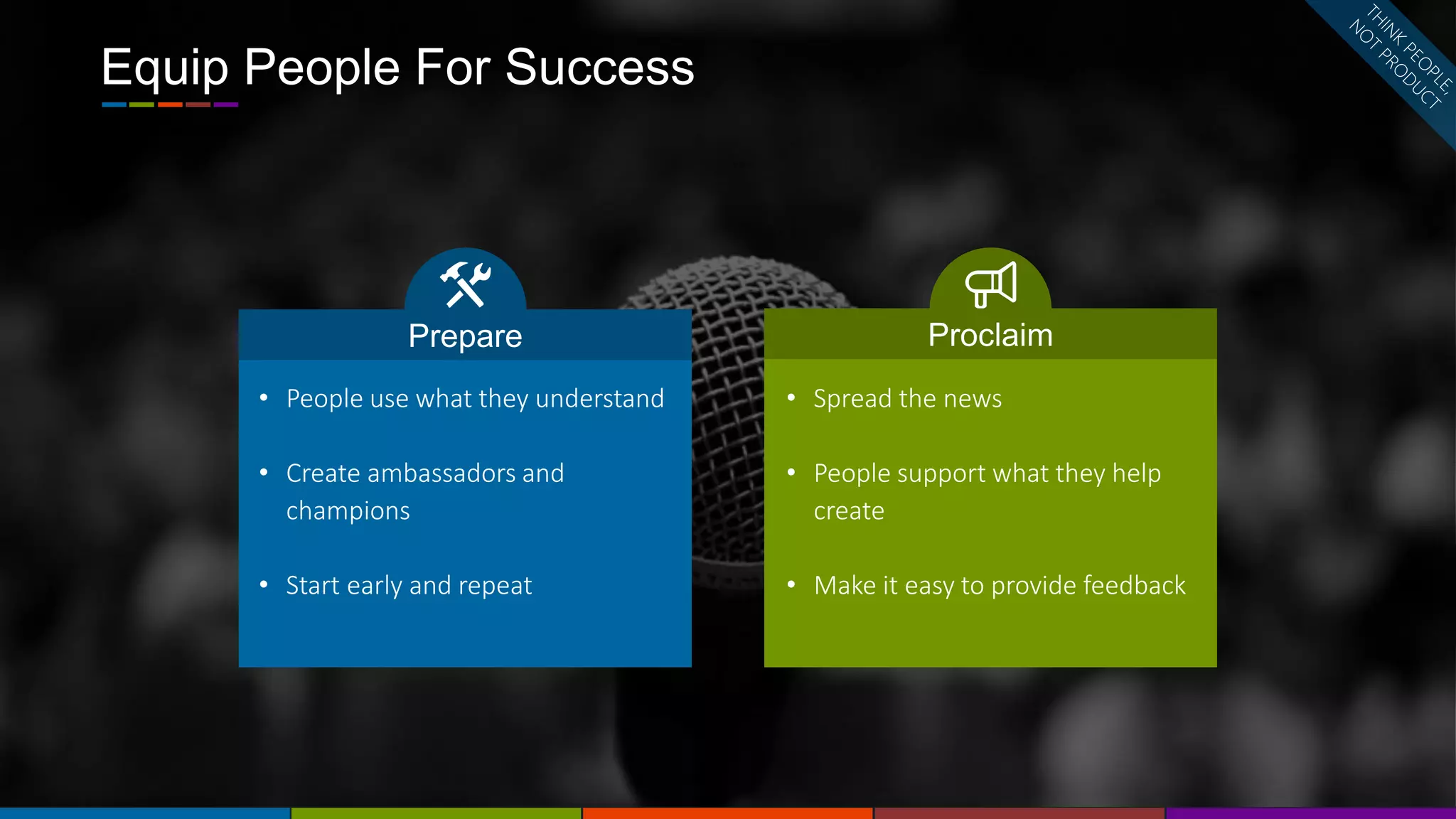
• Spread the news
• People support what they help
create
• Make it easy to provide feedback
Proclaim
• People use what they understand
• Create ambassadors and
champions
• Start early and repeat
Prepare
Equip People For Success
FORGET ABOUT
BEING DONE
It is not necessary to change.
Survival is not mandatory.
— William Edwards Deming
“
4747
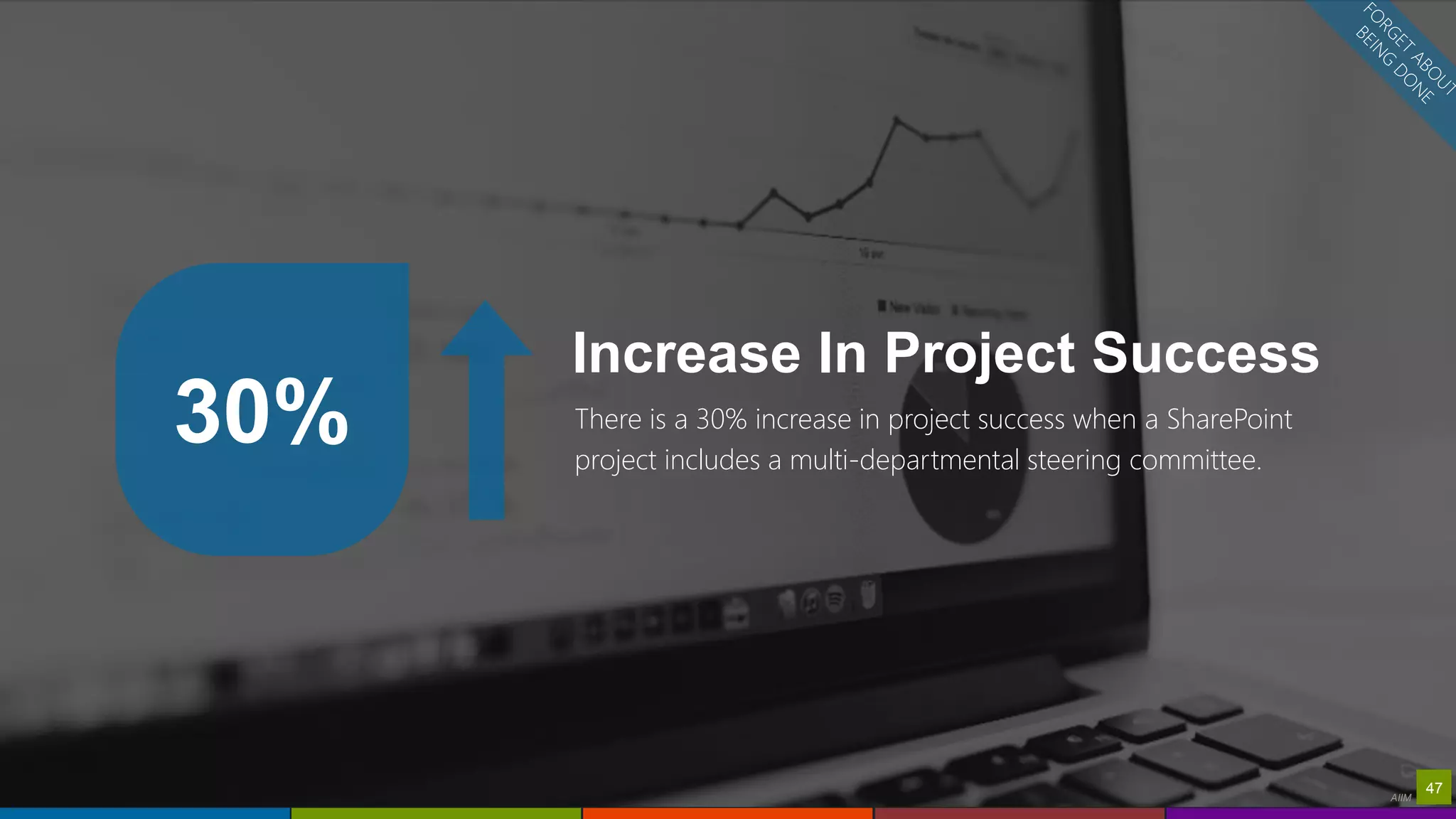
30%
Increase In Project Success
There is a 30% increase in project success when a SharePoint
project includes a multi-departmental steering committee.
AIIM
4848
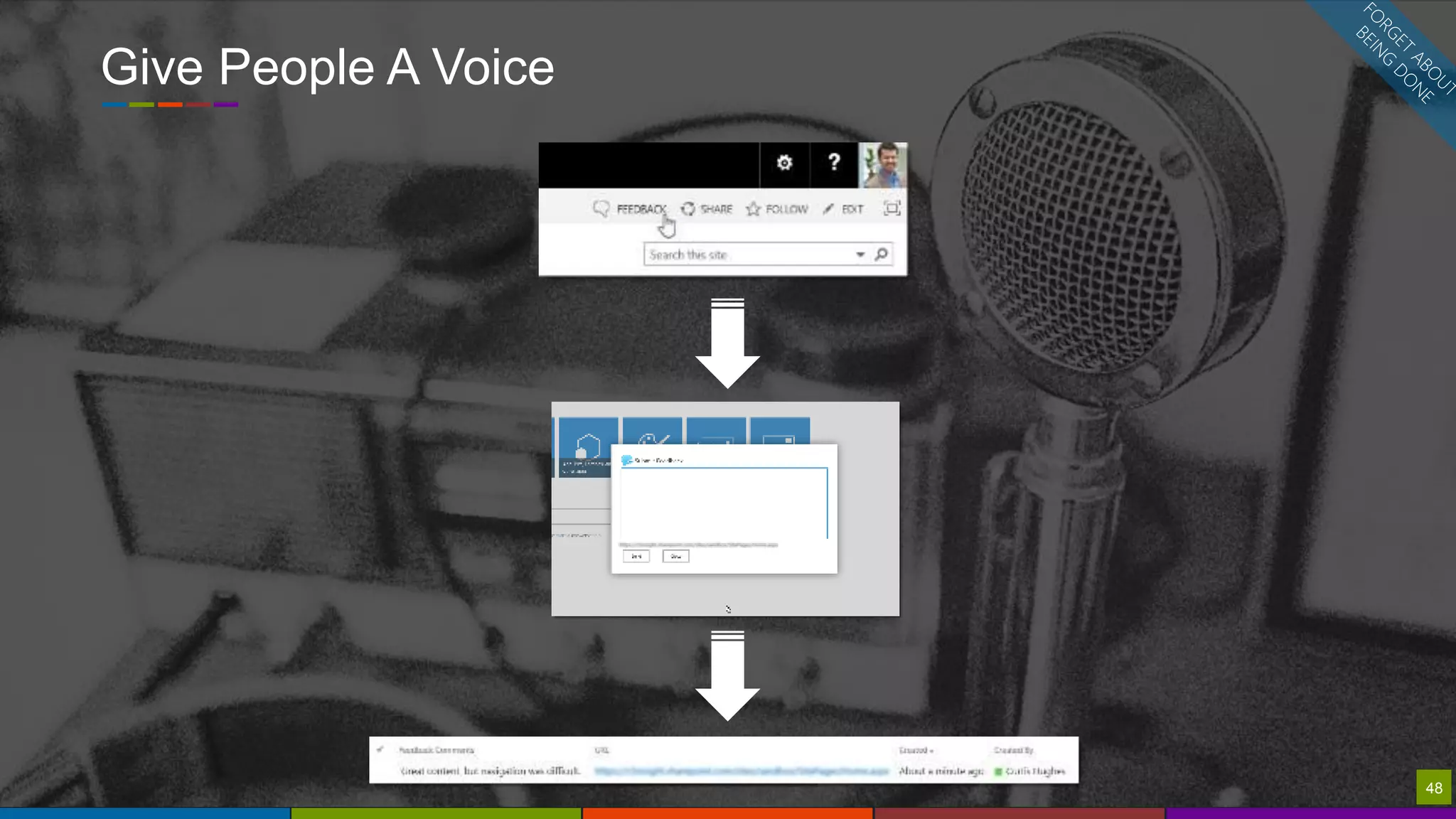
Give People A Voice
Failure is only the opportunity to begin again
more intelligently.
— Henry Ford
“
51
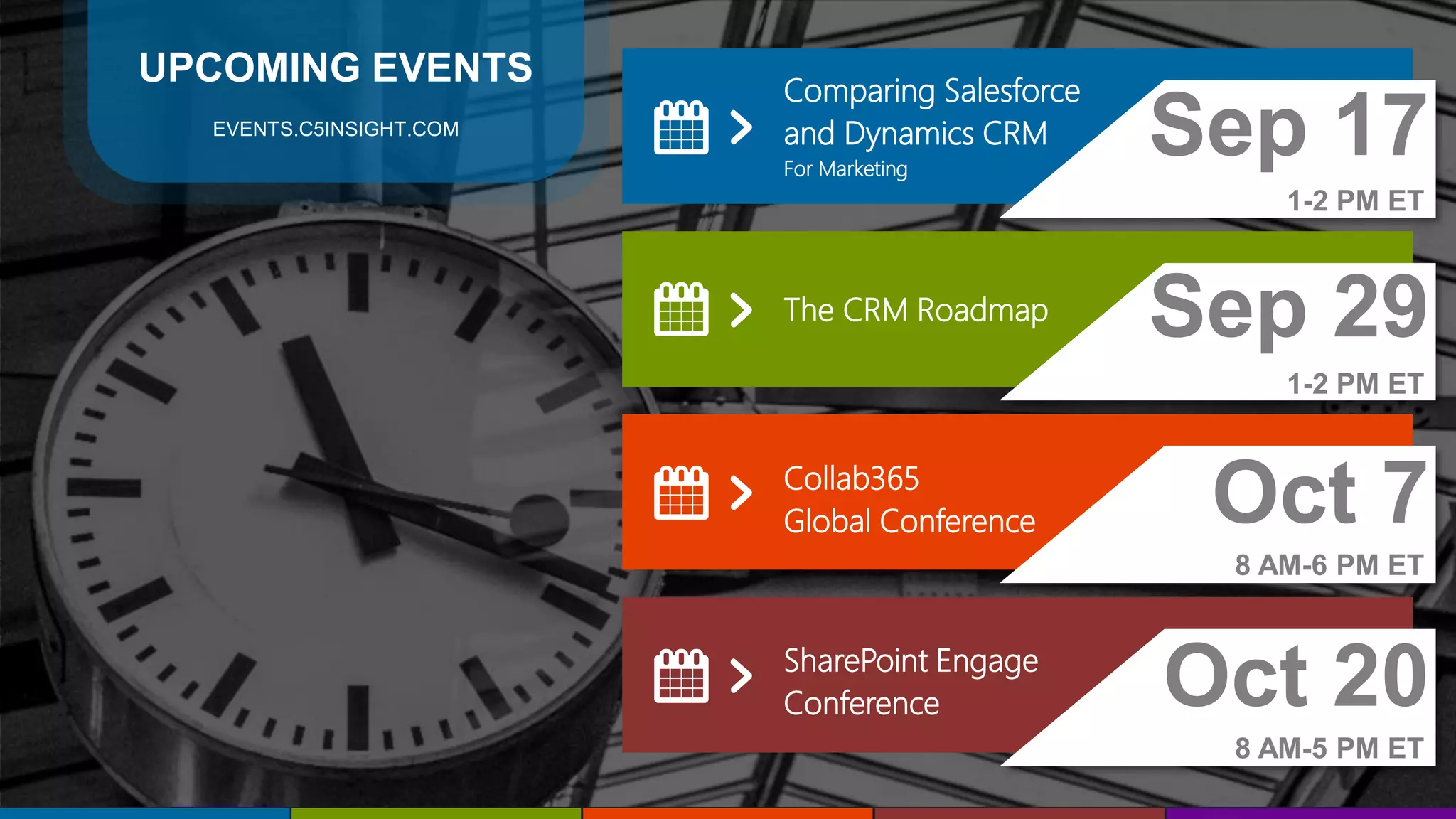
The CRM Roadmap Sep 29
1-2 PM ET
Collab365
Global Conference Oct 7
8 AM-6 PM ET
Comparing Salesforce
and Dynamics CRM
For Marketing
Sep 17
1-2 PM ET
SharePoint Engage
Conference Oct 20
8 AM-5 PM ET
UPCOMING EVENTS
EVENTS.C5INSIGHT.COM
52
luck@c5insight.com 704.895.2500 www.c5insight.com
C5 Insight
9319 Robert D. Snyder Rd.
PORTAL Building, Suite 348
Charlotte, NC 28223
CONTACT US
/C5-Insight @C5Insight /C5Insight

Failure to Connect: Why You're Not Getting More From SharePoint

  • 1.
    Failure to Connect WhyYou're Not Getting More From SharePoint LISTEN KNOW UNDERSTAND CONNECT
  • 2.
    22 Non Disclosure Agreement Forthe purposes of this document, and except as otherwise expressly provided in this document, "Confidential Information" means any information that C5 Insight, Inc. (“C5 Insight”) desires to protect against unrestricted disclosure by the receiving party (“Recipient”). The Recipient agrees that it will hold in confidence the Confidential Information disclosed within this document and any documents, presentations, software, methods or other information shared by C5 Insight in print, electronic, verbal or any other format. The Recipient shall exercise reasonable care to protect the Confidential Information from unauthorized disclosure, which care shall in no event be less than the Recipient takes to protect its own Confidential Information of a like nature. The Recipient may disclose Confidential Information only to its employees or agents who need to know such information for purposes of this agreement, and shall inform such employees and agents, by way of policy and agreement, that they are bound by obligations of confidentiality. The entire content of this statement of work is classified as Confidential Information and by reading any further content within this document, the recipient is bound by the terms of this non-disclosure agreement.
  • 3.
    3 Curtis@C5Insight.com Curtis Hughes Managing Partner C5Insight About Me /in/curtishughes @C5Curtis
  • 4.
  • 5.
  • 6.
    WE KNOW THEREASONS WHY
  • 7.
    Agenda The Uncontrollables TheDisconnect A Better Way
  • 8.
    Understanding What You’reUp Against THE UNCONTROLLABLES
  • 9.
    9 Atlasssian INFORMATION OVERLOAD Emails Received Per Week MeetingsAttended Per Month Interruptions Per Day Email Checks Per Hour Internet Connected Devices Per Person 304 62 56 36 3 9
  • 10.
    10 Global Leadership Summit;Fast Company – Future of Work; STC Services; Ad Week – Social Media Addiction; A NEW WAY OF WORKING Telecommuting Growth Between 2005 and 2012, telecommuting grew by 79% 79% Remote Workers By 2020, as many as 50% of all workers could be remote 57% Mobile Phones Currently, 57% of the world population has a mobile phone 50% Social Media As of 2014, 2.03 billion people in world are active on social media28% 10
  • 11.
    11 Millennial Branding –The Cost of Millennial Retention Study 2014 2020 = 36% = 50% Millennials In The Workforce 11 3 Year tenure 33% Leave for money 5 Generations by 2020 GENERATIONAL SHIFT
  • 12.
    Why Organizations AreMissing The Mark With SharePoint THE DISCONNECT
  • 13.
    41% 59% CPR Projects StandardProjects Not long ago, we noticed a trend. It seemed more of our new clients were looking to revive a failing project than begin a new one. We became obsessed with this and realized it’s true – we are in fact experts in failure. Today, 59% of our new business revolves around resuscitation and rescue. We’re proud of this. Our experience helps us understand the obstacles that every organization will face. We use this experience to ensure your success.
  • 14.
  • 15.
    Decisions Decision Decision Decision Decision Decision Decision Decision Decision Decision Decision Decision Decision Decision Decision Decision Decision Decision Decision Decision Decision Decision DecisionDecision Decision Decision Decision Decision Decision Decision Decision Decision Decision Decision Decision Decision Decision Decision Decision Decision Decision Decision Decision Decision Decisions Decision Decision Decision Decision Decision Decision Decision Decision Decision Decision Decision Decision Decision Decision Decision Decision Decision Decision Decision Decision Decision Decision Decision Decision Decision Decision Decision Decision Decision Decision Decision Decision Decision Decision Decision Decision Decision Decision Decision Decision Decision Decision Decision Task 1 Task 2 Task 3
  • 16.
    33% Companies who saylack of strategic plans are the biggest on-going business issue AIIM Be Strategic 50% Measure Progress Project Managers who say that their projects fail to consistently achieve what they set out to accomplish. KPMG 75% Be Specific Project team members who think the project will fail due to “Fuzzy business objectives and out-of-sync stakeholders.” Geneca
  • 17.
  • 19.
  • 20.
    IT’S NOT ABOUTSHAREPOINT
  • 21.
    Gartner – CarolRozwell http://blogs.gartner.com/carol_rozwell/2013/08/20/outputs-are-important-but-behaviors-are-better/ of social and collaboration business efforts will not A Focus On Technology 80% achieve the intended benefits due to inadequate leadership and an OVEREMPHASIS ON TECHNOLOGY
  • 22.
  • 23.
    Gartner Research Employees getas much as 75% of their relevant information directly from other people 75%
  • 24.
    There is toomuch focus on content and technology, and not enough focus on leadership and relationships. Leaders need to develop a social business strategy that makes sense for the organization and tackle the tough organizational change work head on and early on. Successful social business initiatives require leadership and behavioral changes. — Carol Rozwell, VP and Distinguished Analyst, Content, Collaboration and Social Team, Gartner “
  • 25.
  • 26.
  • 27.
    Cadence Group, 2011 Rigidat the Core Flexible at the Edges There are over federal, state, and industry laws, standards and regulations that dictate how long to keep paper and electronic records. 14,000 Corporate metadata, retention policies, auditing, Intranet homepage content, published articles, etc. My Sites, OneDrive, collaboration, team, and project sites, check-in/out, keywords, personal views, etc.
  • 28.
    We can't solveproblems by using the same kind of thinking we used when we created them. — Albert Einstein “
  • 29.
    How Organizations CanFind Their Way To SharePoint Success A BETTER WAY
  • 30.
    32 Decoding The Disconnect 32 Unrealistic Expectations TakingHands Off The Wheel Unbalanced Governance Unclear Roadmap Or Unmeasurable Goals Forgetting It’s About People Focusing On The Tools Planning Control
  • 31.
  • 32.
    34 3 Keys To GetMore From SharePoint Know Where You’re Going Think People, Not Product Forget About Being Done
  • 33.
  • 34.
    36 It All StartsWith A Few Simple Questions 36 2 What What problem(s) are we trying to solve? 3 When When would we be ready for this level of collaboration? 1 Who Who will this impact? 4 Where Where are we going? 5 Why Why have other projects struggled in the past? 6 How How can we make it easier to work together?
  • 35.
    37 How Many SoundLike Your Organization?  We work regularly with other departments  We trust colleagues completely  Failure is embraced and discussed  IT is an enabler and supports the business 4 3 2 1 0 4 3 2 1 0 Very High Average Very Low How Many Sound Like Your Organization?  Our best work is produced by individuals  There is competition for rewards, recognition, promotions, etc.  For someone to succeed someone else won’t succeed  Fingers are sometimes pointed when mistakes are made SharePoint Success Likelihood Are You Ready For Collaboration? 37
  • 37.
  • 38.
    41 People Are AtThe Heart Of Collaboration Engagement Forming bonds awakens a desire to serve each other 1 Information flows easily and ideas begin to multiply Relationships Relationships become natural and organic Connections Bring people together in friction-free ways. 2 34 Innovation 41
  • 39.
    42 Weak Ties MakeA Strong SharePoint Marketing IT HR Logistics Legal Finance 42 Engineering
  • 40.
    44 • Spread thenews • People support what they help create • Make it easy to provide feedback Proclaim • People use what they understand • Create ambassadors and champions • Start early and repeat Prepare Equip People For Success
  • 41.
  • 42.
    It is notnecessary to change. Survival is not mandatory. — William Edwards Deming “
  • 43.
    4747 30% Increase In ProjectSuccess There is a 30% increase in project success when a SharePoint project includes a multi-departmental steering committee. AIIM
  • 44.
  • 45.
    Failure is onlythe opportunity to begin again more intelligently. — Henry Ford “
  • 46.
    51 The CRM RoadmapSep 29 1-2 PM ET Collab365 Global Conference Oct 7 8 AM-6 PM ET Comparing Salesforce and Dynamics CRM For Marketing Sep 17 1-2 PM ET SharePoint Engage Conference Oct 20 8 AM-5 PM ET UPCOMING EVENTS EVENTS.C5INSIGHT.COM
  • 47.
    52 luck@c5insight.com 704.895.2500 www.c5insight.com C5Insight 9319 Robert D. Snyder Rd. PORTAL Building, Suite 348 Charlotte, NC 28223 CONTACT US /C5-Insight @C5Insight /C5Insight

Editor's Notes

  • #4 1 MINUTE
  • #5 1 MINUTE
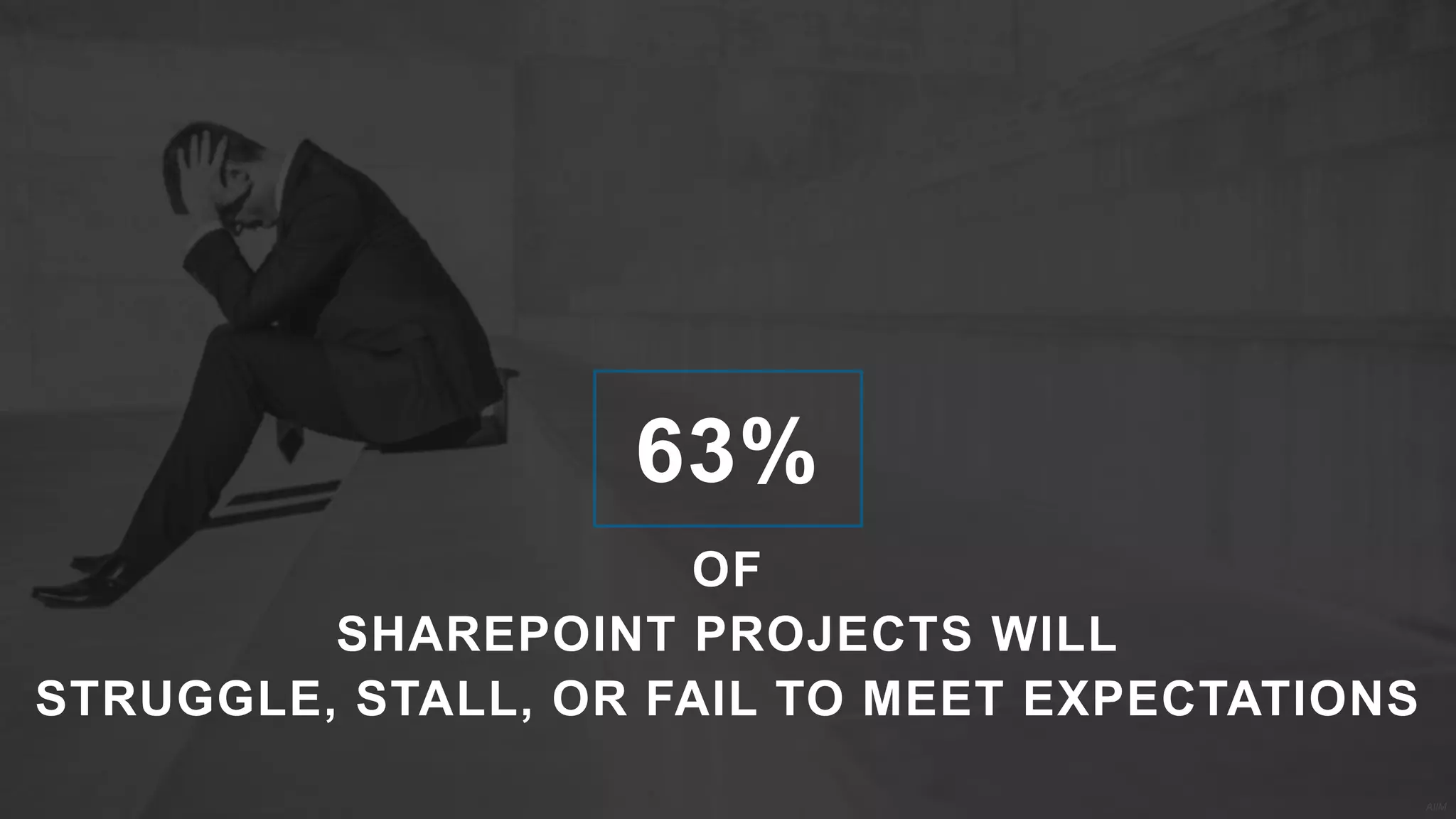
  • #6 1 MINUTE Obviously we’re going to be talking about collaboration today, but you should know that over 60% of all SharePoint initiatives fail to meet expectations. This is an AIIM stat, not a C5 stat. In fact, Gartner even has this number as high as 80%. At least 3:5 of you will struggle with SharePoint, if you aren’t already. In 2013, this was 61% (so what’s going on)? Source: AIIM, Gartner
  • #7 1 MINUTE - Over the next hour or so, I’m going to share with you what we have found to be some of the primary reasons why organizations are not getting more from SharePoint. CLICK
  • #8 1 MINUTE
  • #9 START TIME 1:05 2 MINUTES What’s happening in the world around us impacts collaboration and SharePoint – and some of these things you can do nothing about. So why talk about them? Like it or not, uncontrollable things do affect the way we work, and ignoring them or not talking about them does not make them go away. HUMOR OPTION #1: If my 3 year old throws a temper tantrum, trust me, ignoring it doesn’t make it go away or make it better in the long run HUMOR OPTION #2: BTW - If you are the one who controls the traffic in the morning, raise your hand now, I’d like to have a word with you These things exist, they are very real, and they are affecting your project, whether you know about them or not – so let’s talk about them, shall we? CLICK
  • #10 2 MINUTES QUESTION: How many of you would say, this looks like me? Heck, with this much going on, it sure seems like we’re collaborating…but this is not collaborating…this is chaos. Today, we are INUNDATED with information…and the truth is, this isn’t going to get any better. Understanding how people are responding to this information overload - and how it is actually changing how we work - is where most organizations get lost? In fact, did you know that humans now have a shorter attention span than a goldfish? Don’t believe me - look it up! Our attention span has dropped 25% in the last decade, due primarily to the nature of how we receive and contribute to this information. Frankly, I’m surprised anyone is still listening to me on this webinar! CLICK http://www.scmagazine.com/2013-mobile-device-survey/slideshow/1222/#1 http://www.informationweek.com/it-life/microsoft-says-short-attention-spans-are-fine/a/d-id/1320433 12 seconds in 2000 to 8 seconds now – 1 second less than that of a goldfish! Better at multi-tasking
  • #11 2 MINUTES Just as information and our reaction to it is evolving, so are our teams today These aren’t the organizations or teams of yesteryear (or even yesterday) They are often short-lived Very much project-based We’re seeing teams become very fluid – no longer is it 1 department or 1 group of people working on a project We’re also not coming into the office as much This is a new age of working – We’re a part of a new generation of collaboration… Speaking of generation… CLICK http://www.fastcompany.com/3034286/the-future-of-work/will-half-of-people-be-working-remotely-by-2020 http://www.stcservices.com/blog/unified-communications/remote-workers-to-be-50-of-workforce-by-2020-is-virtual-becoming-reality/ http://www.adweek.com/socialtimes/social-media-addiction-stats/504131
  • #12 2 MINUTES You guys have probably seen or read articles on the rise of millennials in the workforce, and it’s true - by 2020, they will be the majority in our organizations Why does this matter? 1) The people we work with is changing – and in a sense, the very DNA of our organizations are changing 2) The stats about the next generations are worth looking at Did you guys know that only 1/3 of Millennials leave for more money? And when they do choose to leave, it’s only after about 3 years? And that if these 2 things weren’t enough, about the time that millennials make up the majority of our workforce, we’ll have yet ANOTHER generation entering the workforce – and these employees literally grew-up knowing only about the Internet, social media, etc. How will these generations work together? Think technology will automatically make a 65 year old work seamlessly with a 22 year old? Think again. Generational changes are some of the most frequent conversations we’re having today with our clients CLICK
  • #13 1 MINUTE - And so many others have failed as well, like: Walt Disney Beethoven Einstein Edison And the list goes on and on…. So while we talk through this, keep in mind that what we are doing here is LEARNING from the mistakes of others – and you’ll hopefully see some mistakes you are making as well. CLICK
  • #14 START TIME 1:15 Over the next few minutes, I’m going to share with you 6 specific areas where we see this disconnect manifesting itself in today’s organizations. But before we get to those, I want to spend just a minute telling you how this session came about… CLICK
  • #15 1 MINUTE - We didn’t make this stuff up
  • #16 1 MINUTE What does done look like? Are your goals actually measurable? How do you know when you’re done and have met the goals? What do you do if you had no goals and you’re trying to recover; how do you know if you are off track? Example: “We need an new Intranet” Why? What does “Intranet” mean to your organization?
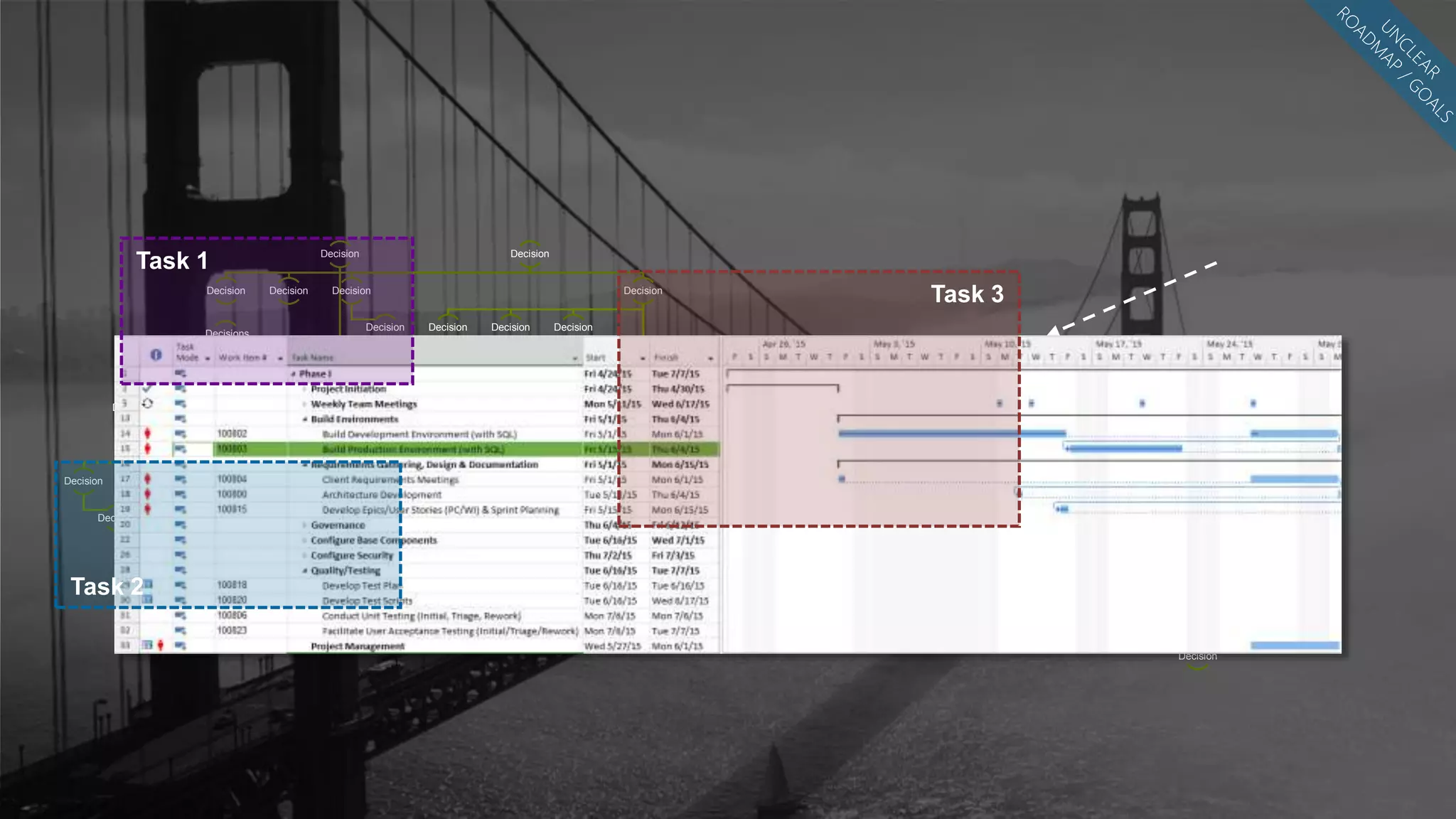
  • #17 1 MINUTE When most organizations hear “planning” they think requirements, what do we need to do, etc. So they quickly move from an idea to what needs to be built, and finally develop a project plan with some tasks on it that looks like the Gantt chart here. But what we’ve found is this is not entirely true and actually contributes to the failures. ----------------------------------- On average, 2 decisions per $1,000 in LABOR costs. Of course, this is not a definitive law, and also depends on the status of the organization, structure, etc. EXAMPLE: $100,000 = 200 individual decisions So what was maybe 15-30 individual tasks is now 200+ decisions.
  • #18 1 MINUTE On average, 2 decisions per $1,000 in LABOR costs. Of course, this is not a definitive law, and also depends on the status of the organization, structure, etc. EXAMPLE: $100,000 = 200 individual decisions So what was maybe 15-30 individual tasks is now 200+ decisions.
  • #19 1 MINUTE Just to further illustrate this point, here are some stats on just how important it is to have proper planning and to know where you are going CLICK
  • #20 1 MINUTE Wrong expectations always leads to disappointments We hear things like: “This will make us so much more productive right away.” “We don’t seem to be collaborating like they are. Why is it working so well for them?” “We have smart people, very technical people, a day of training should be plenty.” (or, there's no way we'll get them for that long) “The old way was more comfortable for me.” “I developed the old way and I know how it works – I can’t get my head around this new way of doing things.” - CLICK
  • #21 2 MINUTES Most organizations grow processes over a long period of time They were made to deal with the realities of the landscape and the limitations of a small or growing company that had to get a process in place quickly But as they grew, they found that the processes didn’t scale – and they were slowing them down So they start to envision automating them so they that narrow and curvy path becomes a superhighway And they look for shortcuts. Something that they can just install and quickly configure that will solve their problem. It’s easy to get caught up in the promise of something that can do this without realizing that there’s really nothing new under the sun. The laws of successful projects change about as fast as the laws of economics. So when they try to quickly pave over those old well worn paths, CLICK they end up with something like this! The reality is that it takes a lot of careful planning to go from the footpath to the superhighway, and with the right planning approach in place, CLICK you’ll have something that looks like this for a while Just like a highway project – it’ll be important that you manage it in phases so work can still get done, but you gradually introduce the processes across everyone in the organization Possibly a good place to say… What we often see is an expectation that you’ll go from a footpath to a superhighway But instead you end up with a permanent traffic jam Another way to think of this is like building a house If you don’t know where you’re going, you may not have the right plumbing, the right foundation … and you may be enabling your workers to build on top of a foundation that will collapse under them.
  • #22 1 MINUTE One thing we have found to be certain is that focusing on technology always leads to disappointments. Throwing tools at it – most organizations are really looking for a technology “quick fix” - it just doesn’t work like that Garage analogy Silver Bullet – hammer and nail CLICK
  • #23 2 MINUTES So, let’s just be honest, you guys aren’t really doing a SharePoint project. You know that right? It’s never been about SharePoint (or at least it shouldn’t have been). Forgot why we were doing these projects CLICK
  • #24 1 MINUTE So if we’re not focusing on tools, then what should we focus on? CLICK http://blogs.gartner.com/carol_rozwell/2013/08/20/outputs-are-important-but-behaviors-are-better/ http://www.mycustomer.com/topic/social-crm/gartner-80-social-business-efforts-will-not-succeed-through-2015/161754 http://www.gartner.com/newsroom/id/2319215 More detailed analysis is available in the report "Predicts 2013: Social and Collaboration Go Deeper and Wider." The report is available on Gartner's website at http://www.gartner.com/resId=2254316.  However, whilst adoption is set to escalate, Gartner estimates that through 2015, 80% of social business efforts will not achieve the intended benefits due to inadequate leadership and an overemphasis on technology. Carol Rozwell, VP and distinguished analyst at Gartner, explained: “Businesses need to realize that social initiatives are different from previous technology deployments. Traditional technology rollouts, such as ERP or CRM, followed a ‘push’ paradigm. Rozwell added: “There is too much focus on content and technology, and not enough focus on leadership and relationships. Leaders need to develop a social business strategy that makes sense for the organization and tackle the tough organizational change work head on and early on. Successful social business initiatives require leadership and behavioral changes. Just sponsoring a social project is not enough — managers need to demonstrate their commitment to a more open, transparent work style by their actions.”
  • #25 1 MINUTE People are at the heart of every SharePoint project. Again, along the way we forgot why we were doing these things. You’ll probably hear me say this again before the session is over, but without people using your “awesome SharePoint”, all you have is a tool gathering dust Exercise equipment a home? Now, how many of you have lost weight or gotten in shape just by walking by it and smiling? Questions: What do people need to do their job better? What are they struggling with? What complaints do I hear? Who should we get involved? Do we have buy-in or is this just something we want to do? People are who it’s for People are what make it happen Remove people, and you have nothing. Period. CLICK
  • #26 1 MINUTE Here’s why this is important CLICK
  • #27 1 MINUTE If you’re still scratching you’re head and not sure if all of this really makes a difference, don’t take it from me… Carol Rozwell of Gartner has this great quote from a study they did in the last couple of years regarding collaboration and technology projects.
  • #28 2 MINUTES Doesn’t mean you can’t set the cruise control, automate some processes, make the trip a little better, but you still have to steer and always make sure you are pointing toward your destination. QUESTION: Run out of projects at home? SharePoint (and collab) is one initiative that should never be “finished” There has to be a process for continuous improvement Changing, adapting, new employees, new generations, new ways of communicating Do you have a strategy and process for ensuring you continue to improve? This is a sophisticated platform, but it needs maintenance like everything else in life. Forget to change with the times You’re never really finished (training, adoption, improvements, leveraging new technologies/processes) CLICK
  • #29 1 MINUTES The last think I want to talk about is having an unbalanced view of governance. Enron (SOX, HIPAA, etc.) (I think I just heard the collective gasp) We see this in so many organizations With so much compliance these days, I think we’ve gone to the extreme GOVERNANCE TOOLKIT CLICK In fact, did you know that…
  • #30 1 MINUTE You don’t have to implement every one…I promise! We have to find the balance Generational changes (25 year olds and 65 year olds working together) CLICK Examples: Rigid Core: Retention of 7 years Flexible Edges: Check in/out policy CLICK
  • #31 1 MINUTE So as we move from disconnect and struggles to getting more out of SharePoint, I think Einstein says it best… We have to think differently – and that’s what we try to do. CLICK
  • #32 START TIME 1:35 1 MINUTE So as we close this session, let’s leave the doom and gloom behind and now talk about how we can do better and make the most of SharePoint CLICK
  • #33 2 MINUTES One thing that we noticed as we began to look at these 6 areas was that they fell into basically 2 categories: CLICK Planning and Control Over the final 15 minutes or so, my goal is to shed some light on these 6 areas and hopefully provide practical ways for how you can avoid these or begin to address them immediately So, the first practical tip I want to share with you is what we call the 40/20/40 principle CLICK
  • #34 2 MINUTES If it hasn’t been obvious yet, let’s be brutally honest - the majority of SharePoint projects that struggle, do not struggle because of technology, bad configuration or for some other technical reason. It’s rare. What we often see are things like no (or little) adoption, using the wrong tool, we got lost at sea (never really finished – ongoing for 3 years), fizzle out, people using it wrong. CLICK
  • #35 1 MINUTES So over the final few minutes of this session, I’m going to try to answer the natural question you probably have right now “Ok, so if these 6 things prevent organizations from getting more out of SharePoint, then how do we avoid them like the plague?” So, to keep this simple I want to share with you 3 keys (strategies if you will) that should help you avoid all 6 of these items. CLICK So let’s jump right in… CLICK
  • #36 1 MINUTE If you guys were going on vacation, maybe traveling cross-country by car, wouldn't you have a map? You’d probably also have the roads you were taking, where you’d stop along the way, and probably even check the weather for the journey. So why don’t we do this with our projects? Especially SharePoint. That’s what this is about – know where you’re going, what obstacles lie in your way, how will you know when you are done, etc. Areas it addresses: Unclear Roadmap Unrealistic Expectations Focusing on the tools Forgetting about people CLICK
  • #37 2 MINUTES So let’s begin with some pretty straightforward questions. And no, these aren’t all inclusive – there are hundreds more questions we could ask, but these will certainly get you started. Now, if you’re being honest, some of you may admit (not out loud) that you have never asked these questions. Don’t worry - YOU’RE NOT ALONE. That’s why you're here – start now! CLICK
  • #38 2 MINUTES Answering those questions is a great start, but one trend we’re starting to notice now is a mismatch between the company culture and project goals. So I came up with this quick, 60-second collaboration readiness assessment that is not scientific, but will give you a “quick and dirty” gauge of how likely you are to succeed with SharePoint. The truth is, if you don't have a culture of sharing, collaborating and working together, then no tool in and of itself is going to magically fix that. Here’s how it works: In the first section, check how many sound like your org? In the second section, check how many sound like your org? Draw a line between the 2 numbers This is a quick and dirty assessment of how likely your org is to succeed at collaboration Again – not a mention of tools…see a trend here?
  • #39 1 MINUTE Before you start doing anything, it’s always a good idea to understand both the risks and the rewards. STAT: In fact, 60% of all SharePoint and Collaboration projects are struggling or flat-out failed I won’t read all of these aloud to you, but in addition to great increases in productivity and serving clients… The two greatest priorities continue to be lack of executive support and “other bigger priorities”: 22% cite lack of executive support as the primary barrier to implementation. 18% cite “other, bigger priorities” preventing them from implementation. http://www.prescientdigital.com/downloads/2012%20Social%20Intranet%20Study_Summary_Prescient%20Digital%20Media.pdf Talk about CPR session tomorrow
  • #40 1 MINUTE CLICK
  • #41 1 MINUTE Who should be on the project team? Core, extended? What do our people need to do their jobs better (is it SharePoint?) How do we get them ready to use SharePoint? How should we manage expectations? Do we even know what their expectations are? What rules do our people need in place? Governance. Areas it addresses: Unrealistic Expectations Focusing on tools Forgetting about people Taking Hands Off Wheel Unbalanced Governance
  • #42 2 MINUTES Since without people, none of us would have any reason to implement SharePoint and b) have anyone to actually implement SharePoint The culmination of all of this hard work to bring people together, form relationships, and achieve engagement, ultimately bears the fruit of innovation and ideas Or put another way: new products, better customer service, more efficient processes, more customers This is the collaboration nirvana that every organization wants, but as you can see, technology is nowhere to be found in this lifecycle. It can help – as a tool – but it’s not the core driver for this. CLICK
  • #43 2 MINUTES Mark Granovetter strong ties and weak ties CLICK These are depts. In your organizations Let’s assume there are strong ties between these groups Strong ties are the people you work with daily, work beside, go to lunch with, close friends, etc. Take more work so you have fewer No new info - The information they receive overlaps with what we already know CLICK Whether you know it or not, clusters of information exist within your org When this happens, naturally things outside of these clusters create silos of information Weak ties are the people or groups with whom you speak occasionally – break room, CCed on an occasional email, etc. LINKED IN is great example Can have more of these because the take less work to maintain Bridges between networks or clusters CLICK As an example, what if we connect Logistics  Legal (delivery policy creation) Now, if that doesn’t work for you, maybe you try to bring Marketing  Logistics (new sales piece) By doing this, you’ve introduced logistics to an entire network or cluster within your org, and now information can flow more easily CLICK On the other side, what if we found a way to bring HR  Logistics (planning a company party) Now HR would have a pretty large network through which information and new ideas can flow CLICK Lastly, what if we connected IT  HR (unlikely, but let’s assume) CLICK Now, what was once silos and clusters is an open network within your organization, and then what happens is information can flow freely through your organization, creating innovation, ideas, collaboration, etc.
  • #44 2 MINUTES Mark Granovetter (sociologist) in 1973 – published paper Strong Ties Your close friends, family, and in an organization, the people that sit next to you, in your dept that you work with daily, etc. Generally, we can only have so many of these strong ties – they take a lot of effort to maintain Because our strong ties tend to move in the same circles that we do, the information they receive overlaps considerably with what we already know Weak Ties Acquaintances know people we do not know, and allow us to receive more unknown information Imagine you are in the risk department If you have an acquaintance in the marketing department, then you have a weak tie to that person, and more importantly a weak tie to her entire network, and the network of her strong ties. So think of weak ties as BRIDGES – they help you cross the gap of knowledge that may exist Once you cross this gap, you have the ability to generate new ideas, opportunities, cost-cutting strategies, etc. Before collaborative solutions, it was very difficult to build weak ties. You basically had your close group and that was it. Now, we have the ability to tap into networks and knowledge of people that we never had access to before. Think LinkedIn, Twitter, Facebook. If a weak tie is severed/leaves company, you have additional weak ties. It mitigates the risk of knowledge walking out the door.
  • #45 2 MINUTES If people are at the heart of collaboration, then along with planning, it only makes sense that you spend time helping them understand the value of what you are doing One way we do this is by what we call Prepare and Proclaim Prepare Training Understanding of not only the what, and how but the WHY (adoption, change mgmt) On-going Project team (core, extended, etc) Proclaim Communication plan (banners in breakroom, email blasts, videos, contests, etc.) Get people excited Get people involved (project team) Make it easy to provide feedback (I’ll talk about that ) People support what they help create CLICK
  • #46 1 MINUTE Last thing… Now that we know we need to plan and focus on people, the final key is to never stop – just rinse and repeat. In other words, once we get these wheels in motion, let’s figure out how to keep them in motion. Another way I like to say this is, when you make your plan, don’t use end dates, use milestones. IN other words, SharePoint and collaboration should be a perpetual initiative. This involves setting-up good processes for not only managing the project, but gathering feedback, having a committee or team that is continuously assessing success, getting feedback from users, prioritizing this feedback, etc. Areas it addresses: Unrealistic Expectations Focusing on tools Forgetting about people Taking Hands Off Wheel Unbalanced Governance
  • #47 1 MINUTE I love this quote by William Edwards Deming and I think it speak directly to what we’re talking about here. You don’t have to change anything, but if you want your SharePoint to survive, you better consider it. William Edwards Deming was an American engineer, statistician, professor, author, lecturer, and management consultant. Wikipedia
  • #48 1 MINUTE - One final stat I want to share is this one that speaks directly to the point of not just having a steering committee, but having one that spans multiple departments.
  • #49 1 MINUTE Talk about feedback solution, knowing what users think, etc. Create a parking lot/grass catcher/wish list to capture future items and wants -------------- Now, for those of you who are really struggling, frustrated, wondering if there is hope, I leave you with this… CLICK
  • #50 START TIME 1:55 1 MINUTE Few failed as many times as Henry Ford, and I think it’s easy to forget about the ones who came before us, but SharePoint, or whatever you are doing is no difference. We are in a new age, breaking new ground, and when you stub your toe and wonder if this thing is a lost cause, get up, re-watch this webinar, and begin again! Downloads: Link to roadmap and governance outline 60-second collaboration assessment PDF Feedback solution
  • #51 START TIME 1:35 1 MINUTE We’ve been talking about this for years and have seen it in many organizations that have come to us for help But don’t just take it from me - A study that came out earlier this year by AIIM echoes what we’re seeing
  • #52 MENTION CLOSING EVALUATION