Ectotherms vs
Endotherms
Ectotherms
The name ectotherm comes from the Greek “ektos”
meaning outside and “therm” meaning heat.
These are organisms which control their body
temperature through external means
They depend on environmental heat sources
Their body temperature rises and falls with their
environment
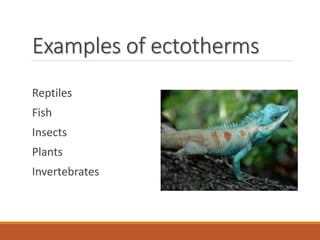
Examples of ectotherms
Reptiles
Fish
Insects
Plants
Invertebrates
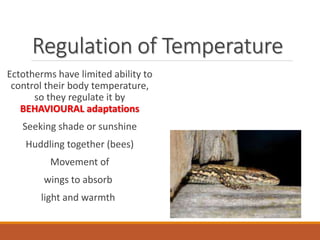
Regulation of Temperature
Ectotherms have limited ability to
control their body temperature,
so they regulate it by
BEHAVIOURAL adaptations
Seeking shade or sunshine
Huddling together (bees)
Movement of
wings to absorb
light and warmth
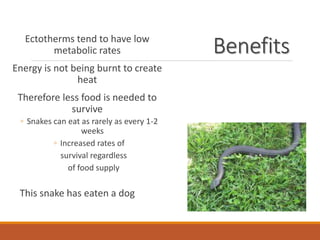
BenefitsEctotherms tend to have low
metabolic rates
Energy is not being burnt to create
heat
Therefore less food is needed to
survive
◦ Snakes can eat as rarely as every 1-2
weeks
◦ Increased rates of
survival regardless
of food supply
This snake has eaten a dog
Disadvantages
When it is very cold, ectotherms become sluggish.
◦ They may not be able to escape from predators as easily
When it is very warm, ectotherms require
more food as their metabolic rate
increases
◦ They may be able to mitigate this by finding a cool place to rest
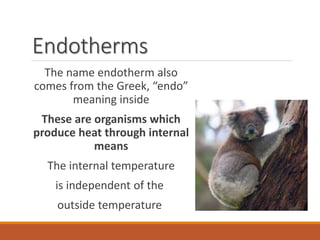
Endotherms
The name endotherm also
comes from the Greek, “endo”
meaning inside
These are organisms which
produce heat through internal
means
The internal temperature
is independent of the
outside temperature
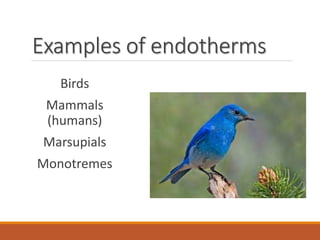
Examples of endotherms
Birds
Mammals
(humans)
Marsupials
Monotremes
Regulation of Temperature
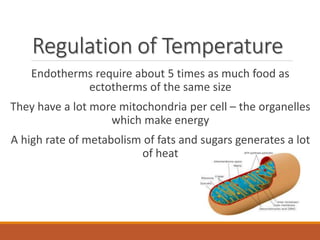
Endotherms require about 5 times as much food as
ectotherms of the same size
They have a lot more mitochondria per cell – the organelles
which make energy
A high rate of metabolism of fats and sugars generates a lot
of heat
Advantages
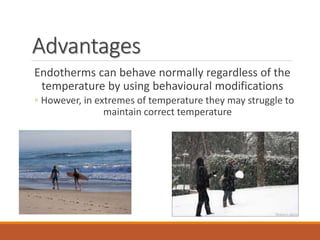
Endotherms can behave normally regardless of the
temperature by using behavioural modifications
◦ However, in extremes of temperature they may struggle to
maintain correct temperature
Disadvantages
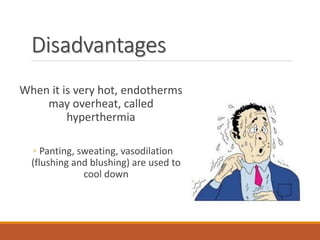
When it is very hot, endotherms
may overheat, called
hyperthermia
◦ Panting, sweating, vasodilation
(flushing and blushing) are used to
cool down
Disadvantages
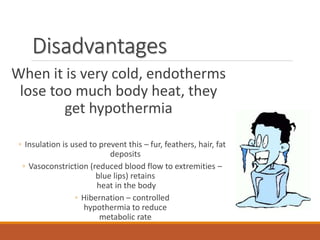
When it is very cold, endotherms
lose too much body heat, they
get hypothermia
◦ Insulation is used to prevent this – fur, feathers, hair, fat
deposits
◦ Vasoconstriction (reduced blood flow to extremities –
blue lips) retains
heat in the body
◦ Hibernation – controlled
hypothermia to reduce
metabolic rate
Hibernation
Physiological conditions during hibernation:
◦ Metabolic rate decreases
◦ Heart beat slows down to as low as 3bpm
◦ Breathing rate drops
◦ Body temperature decreases to close to ambient
temperature
◦ Must always remain above 0°C – why?
Hibernation
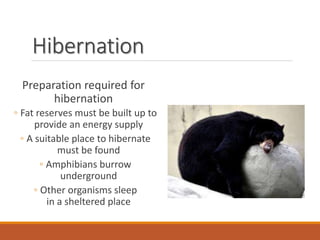
Preparation required for
hibernation
◦ Fat reserves must be built up to
provide an energy supply
◦ A suitable place to hibernate
must be found
◦ Amphibians burrow
underground
◦ Other organisms sleep
in a sheltered place
Review
Why might endotherms migrate between different
areas in summer and winter?
Why might some endotherms display nocturnal
behaviour?
Review
Is hibernation used only by endotherms or by
ectotherms as well?
Why is it important to find a suitable place to
hibernate?

Lecture 5 ectotherms vs endotherms

  • 1.
  • 2.
    Ectotherms The name ectothermcomes from the Greek “ektos” meaning outside and “therm” meaning heat. These are organisms which control their body temperature through external means They depend on environmental heat sources Their body temperature rises and falls with their environment
  • 3.
  • 4.
    Regulation of Temperature Ectothermshave limited ability to control their body temperature, so they regulate it by BEHAVIOURAL adaptations Seeking shade or sunshine Huddling together (bees) Movement of wings to absorb light and warmth
  • 5.
    BenefitsEctotherms tend tohave low metabolic rates Energy is not being burnt to create heat Therefore less food is needed to survive ◦ Snakes can eat as rarely as every 1-2 weeks ◦ Increased rates of survival regardless of food supply This snake has eaten a dog
  • 6.
    Disadvantages When it isvery cold, ectotherms become sluggish. ◦ They may not be able to escape from predators as easily When it is very warm, ectotherms require more food as their metabolic rate increases ◦ They may be able to mitigate this by finding a cool place to rest
  • 7.
    Endotherms The name endothermalso comes from the Greek, “endo” meaning inside These are organisms which produce heat through internal means The internal temperature is independent of the outside temperature
  • 8.
  • 9.
    Regulation of Temperature Endothermsrequire about 5 times as much food as ectotherms of the same size They have a lot more mitochondria per cell – the organelles which make energy A high rate of metabolism of fats and sugars generates a lot of heat
  • 10.
    Advantages Endotherms can behavenormally regardless of the temperature by using behavioural modifications ◦ However, in extremes of temperature they may struggle to maintain correct temperature
  • 11.
    Disadvantages When it isvery hot, endotherms may overheat, called hyperthermia ◦ Panting, sweating, vasodilation (flushing and blushing) are used to cool down
  • 12.
    Disadvantages When it isvery cold, endotherms lose too much body heat, they get hypothermia ◦ Insulation is used to prevent this – fur, feathers, hair, fat deposits ◦ Vasoconstriction (reduced blood flow to extremities – blue lips) retains heat in the body ◦ Hibernation – controlled hypothermia to reduce metabolic rate
  • 13.
    Hibernation Physiological conditions duringhibernation: ◦ Metabolic rate decreases ◦ Heart beat slows down to as low as 3bpm ◦ Breathing rate drops ◦ Body temperature decreases to close to ambient temperature ◦ Must always remain above 0°C – why?
  • 14.
    Hibernation Preparation required for hibernation ◦Fat reserves must be built up to provide an energy supply ◦ A suitable place to hibernate must be found ◦ Amphibians burrow underground ◦ Other organisms sleep in a sheltered place
  • 15.
    Review Why might endothermsmigrate between different areas in summer and winter? Why might some endotherms display nocturnal behaviour?
  • 16.
    Review Is hibernation usedonly by endotherms or by ectotherms as well? Why is it important to find a suitable place to hibernate?