Subhradeep Sarkar
M.Sc. in Applied Genetics
CONTENTS
1. Introduction
2. Thermoregulation
3. Vant Hoff equation
4. Temperature effect on cells
5. Extreme cold : resistance and death
6. Extreme heat : resistance and lethal death
7. Conclusion.
8. Reference
INTRODUCTION
Biokinetic zone :
Area on the earth that provides suitable temperature
for living organism.
Every living organisms differ on the differential
range of temperature in the body.
Discovered by Shelford and also called Shelford
law of tolerance.
Thermoregulation:
Maintaining a body temperature within limited
range which vary from organism to organism is called
thermoregulation.
Types of thermoregulation:
Thermoregulation in organisms runs along a
spectrum from endothermal to ectothermal.
Endotherms create most of their heat via metabolic
processes, and are referred to as "warm-blooded."
• Ectotherms use external sources of temperature to
regulate their body temperatures.
• Ectotherms are referred to as "cold-blooded" even
though their body temperatures often stay within the same
temperature ranges as warm-blooded animals.

Ectothermal
• An ectothermal, is an organism in which internal
physiological sources of heat are of relatively small or
quite negligible importance in controlling body
temperature.
• Since ectotherms rely on environmental heat sources,
they can operate at economical metabolic rates.
• Ectotherms usually live in environments in which
temperatures are constant, such as the tropics or ocean.
• Ectotherms have developed several behavioral
thermoregulation mechanisms, such as basking in the sun
to increase body temperature or seeking shade to decrease
body temperature.
Endotherms
• Endotherms regulate their own body temperature
through internal metabolic processes and usually
maintain a narrow range of internal temperatures.
• Heat is usually generated from the animal's normal
metabolism, but under conditions of excessive cold or
activity, an endotherm generate additional heat by
shivering.
• Many endotherms have a larger number of
mitochondria per cell than ectotherms.
• These mitochondria enables them to generate heat by
increasing the rate at which they metabolize fats and
sugars.
• However, endothermic animals must sustain their
higher metabolism by eating more food more often.
• For example, a mouse (endotherm) must consume
food every day to sustain high its metabolism, while a
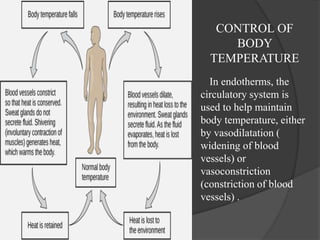
CONTROL OF
BODY
TEMPERATURE
In endotherms, the
circulatory system is
used to help maintain
body temperature, either
by vasodilatation (
widening of blood
vessels) or
vasoconstriction
(constriction of blood
vessels) .
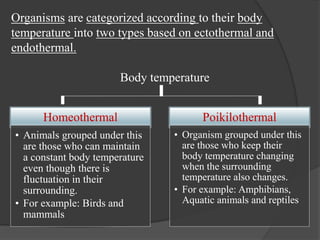
Organisms are categorized according to their body
temperature into two types based on ectothermal and
endothermal.
Body temperature
Homeothermal
• Animals grouped under this
are those who can maintain
a constant body temperature
even though there is
fluctuation in their
surrounding.
• For example: Birds and
mammals
Poikilothermal
• Organism grouped under this
are those who keep their
body temperature changing
when the surrounding
temperature also changes.
• For example: Amphibians,
Aquatic animals and reptiles
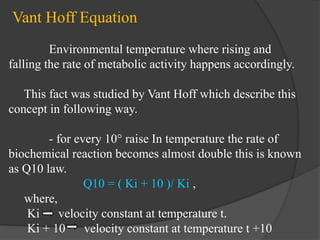
Vant Hoff Equation
Environmental temperature where rising and
falling the rate of metabolic activity happens accordingly.
This fact was studied by Vant Hoff which describe this
concept in following way.
- for every 10° raise In temperature the rate of
biochemical reaction becomes almost double this is known
as Q10 law.
Q10 = ( Ki + 10 )/ Ki ,
where,
Ki velocity constant at temperature t.
Ki + 10 velocity constant at temperature t +10
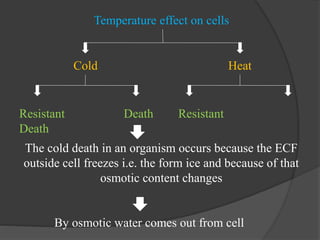
Temperature effect on cells
Cold Heat
Resistant Death Resistant
Death
The cold death in an organism occurs because the ECF
outside cell freezes i.e. the form ice and because of that
osmotic content changes
By osmotic water comes out from cell
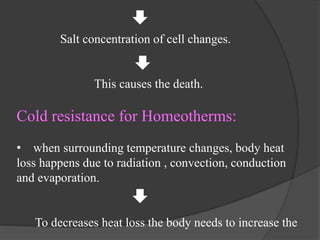
Salt concentration of cell changes.
This causes the death.
Cold resistance for Homeotherms:
• when surrounding temperature changes, body heat
loss happens due to radiation , convection, conduction
and evaporation.
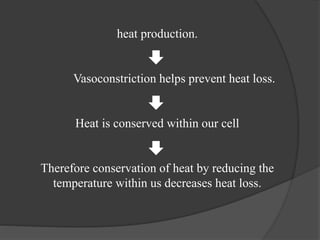
To decreases heat loss the body needs to increase the
heat production.
Vasoconstriction helps prevent heat loss.
Heat is conserved within our cell
Therefore conservation of heat by reducing the
temperature within us decreases heat loss.
• Heat can be lost by conduction which is done by fat
layers which act as insulators.
• When this regulatory mechanism breaks down ,
death result.
Cold resistance for poikilotherms:
• When surrounding temperature decreases, body
temperature decrease this can result in death.
• To avoid this they have an antifreezing substance
like glycerol, glycoprotein, increases osmotic content and
lower the freezing point.
• Cold-blooded i.e. ectothermal animals store less fat
than warm-blooded i.e. endothermal animals because they
require less energy.
• Turtles and frogs bury themselves in mud under
lakes and ponds for up to six months at a time, and for all
practical purposes, they appear dead. There are no
external signs of life .
• When many cold-blooded animals hibernate,
something interesting happens at the cellular level.
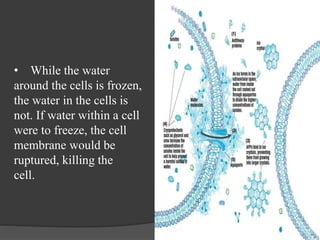
• The fluid around the cells, but not in the cells, is
frozen solid.
• As water freezes outside the cell, water from within
the cell is drawn out through osmosis.
• Osmosis is a process in which water moves across a
semi permeable membrane—in this case, the cell
membrane—from an area of low solute concentration to
an area of high solute concentration.
• As water freezes outside of the cell, the solute
concentration increases, because the quantity of liquid
water decreases while the amount of solute stays the
same.
• As a result, water flows out of the cell to equalize
the concentrated solution outside of the cell
• At the same time water is leaving the cells, glucose
migrates into the cells in copious amounts.
• By removing water and adding glucose, the
concentration of dissolved solute within the cell
increases—a lot.
• The glucose acts as a natural antifreeze, as any solute
will lower the freezing point of a given solvent—in this
case, water.
•The presence of high concentrations of solutes in the
cells allows animals such as frogs to hibernate at
temperatures below freezing and still survive.
• While the water
around the cells is frozen,
the water in the cells is
not. If water within a cell
were to freeze, the cell
membrane would be
ruptured, killing the
cell.
• For example :
1) Willow galfy
• Glycerol is found in high concentration which can
help them survive the winter in Alaska down to the
temperature of about – 60°C. Glycerol lowers freezing
and super cooling points improves the tolerance to
freezing in animals that tolerates the ice formation.
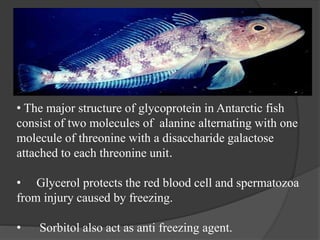
2) Antarctic Fish Trematomus
• It contains glycoprotein's that act as an antifreezing
substance. This allows the fish to swim in water at a
temperature of -1.8°C.
• The major structure of glycoprotein in Antarctic fish
consist of two molecules of alanine alternating with one
molecule of threonine with a disaccharide galactose
attached to each threonine unit.
• Glycerol protects the red blood cell and spermatozoa
from injury caused by freezing.
• Sorbitol also act as anti freezing agent.
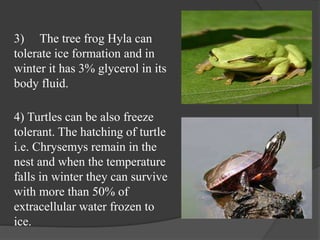
3) The tree frog Hyla can
tolerate ice formation and in
winter it has 3% glycerol in its
body fluid.
4) Turtles can be also freeze
tolerant. The hatching of turtle
i.e. Chrysemys remain in the
nest and when the temperature
falls in winter they can survive
with more than 50% of
extracellular water frozen to
ice.
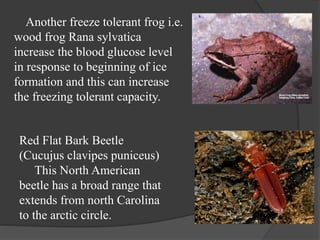
Another freeze tolerant frog i.e.
wood frog Rana sylvatica
increase the blood glucose level
in response to beginning of ice
formation and this can increase
the freezing tolerant capacity.
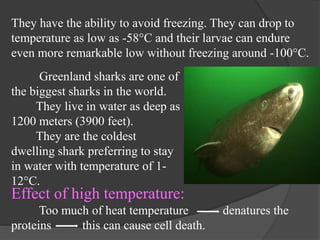
Red Flat Bark Beetle
(Cucujus clavipes puniceus)
This North American
beetle has a broad range that
extends from north Carolina
to the arctic circle.
Effect of high temperature:
Too much of heat temperature denatures the
proteins this can cause cell death.
They have the ability to avoid freezing. They can drop to
temperature as low as -58°C and their larvae can endure
even more remarkable low without freezing around -100°C.
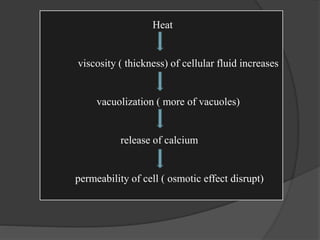
Greenland sharks are one of
the biggest sharks in the world.
They live in water as deep as
1200 meters (3900 feet).
They are the coldest
dwelling shark preferring to stay
in water with temperature of 1-
12°C.
Heat
viscosity ( thickness) of cellular fluid increases
vacuolization ( more of vacuoles)
release of calcium
permeability of cell ( osmotic effect disrupt)
Example of Heat resistance : fluttering of wings.
Lethal temperature or heat death:
It is defined as that temperature at which 50% of
animal die and 50% survive ant is denoted as TL 50.
Lethal temperature and cause of heat death:
Examples:
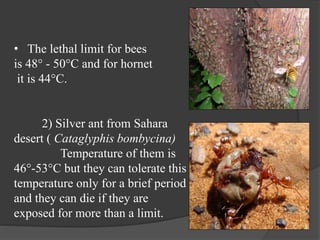
1) Japanese honeybees Apis cerana japonica
when these Apis are attacked by predator hornet
Vespa the bees kill the hornet by engulfing them in a ball
and the temperature rises to 48°C which is lethal to the
hornet but not the bees.
• The lethal limit for bees
is 48° - 50°C and for hornet
it is 44°C.
2) Silver ant from Sahara
desert ( Cataglyphis bombycina)
Temperature of them is
46°-53°C but they can tolerate this
temperature only for a brief period
and they can die if they are
exposed for more than a limit.
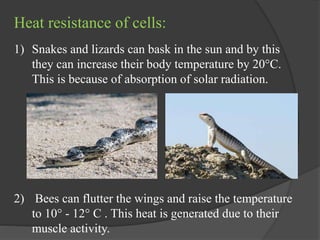
Heat resistance of cells:
1) Snakes and lizards can bask in the sun and by this
they can increase their body temperature by 20°C.
This is because of absorption of solar radiation.
2) Bees can flutter the wings and raise the temperature
to 10° - 12° C . This heat is generated due to their
muscle activity.
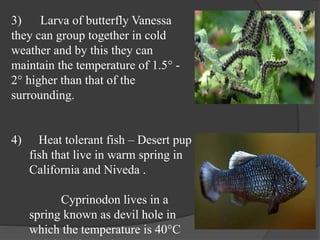
3) Larva of butterfly Vanessa
they can group together in cold
weather and by this they can
maintain the temperature of 1.5° -
2° higher than that of the
surrounding.
4) Heat tolerant fish – Desert pup
fish that live in warm spring in
California and Niveda .
Cyprinodon lives in a
spring known as devil hole in
which the temperature is 40°C
in the temperature for 30000 years.
• The upper limit for this fish is 40°C.
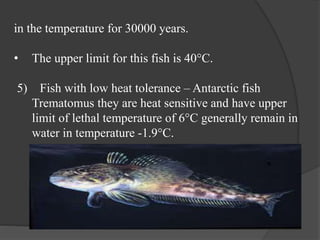
5) Fish with low heat tolerance – Antarctic fish
Trematomus they are heat sensitive and have upper
limit of lethal temperature of 6°C generally remain in
water in temperature -1.9°C.
Conclusion:
Thermoregulation is the ability of an endothermic
organism to maintain relatively constant body
temperature, Despite fluctuation in temperature of
the external environment. This is the vital part of
Homeostasis. And hence by these various animals
maintain their body temperature by behavioural
adjustments.
Hibernation occurs in some species in order to allow
survival during times of limited food resources
And low temperatures.
Reference
1) Guyton , A.C., and Hall J.E. (2006). Textbook of
medical physiology (11th edition) . Philadelphia:
Elsevier Saunders. P. 890
2 ) Mone, G. 20 Things You Didn’t Know About…
Hibernation. Discover, March 2013, p 74.
3) Knut Schmidt – Nielsen .(1997). Textbook of
Animal Physiology (5th edition). Tolerance to high
temperature, p 222.

Temperature Effect on cell

  • 1.
  • 2.
    CONTENTS 1. Introduction 2. Thermoregulation 3.Vant Hoff equation 4. Temperature effect on cells 5. Extreme cold : resistance and death 6. Extreme heat : resistance and lethal death 7. Conclusion. 8. Reference
  • 3.
    INTRODUCTION Biokinetic zone : Areaon the earth that provides suitable temperature for living organism. Every living organisms differ on the differential range of temperature in the body. Discovered by Shelford and also called Shelford law of tolerance.
  • 4.
    Thermoregulation: Maintaining a bodytemperature within limited range which vary from organism to organism is called thermoregulation. Types of thermoregulation: Thermoregulation in organisms runs along a spectrum from endothermal to ectothermal. Endotherms create most of their heat via metabolic processes, and are referred to as "warm-blooded."
  • 5.
    • Ectotherms useexternal sources of temperature to regulate their body temperatures. • Ectotherms are referred to as "cold-blooded" even though their body temperatures often stay within the same temperature ranges as warm-blooded animals. Ectothermal • An ectothermal, is an organism in which internal physiological sources of heat are of relatively small or quite negligible importance in controlling body temperature. • Since ectotherms rely on environmental heat sources, they can operate at economical metabolic rates.
  • 6.
    • Ectotherms usuallylive in environments in which temperatures are constant, such as the tropics or ocean. • Ectotherms have developed several behavioral thermoregulation mechanisms, such as basking in the sun to increase body temperature or seeking shade to decrease body temperature. Endotherms • Endotherms regulate their own body temperature through internal metabolic processes and usually maintain a narrow range of internal temperatures. • Heat is usually generated from the animal's normal metabolism, but under conditions of excessive cold or
  • 7.
    activity, an endothermgenerate additional heat by shivering. • Many endotherms have a larger number of mitochondria per cell than ectotherms. • These mitochondria enables them to generate heat by increasing the rate at which they metabolize fats and sugars. • However, endothermic animals must sustain their higher metabolism by eating more food more often. • For example, a mouse (endotherm) must consume food every day to sustain high its metabolism, while a
  • 8.
    CONTROL OF BODY TEMPERATURE In endotherms,the circulatory system is used to help maintain body temperature, either by vasodilatation ( widening of blood vessels) or vasoconstriction (constriction of blood vessels) .
  • 9.
    Organisms are categorizedaccording to their body temperature into two types based on ectothermal and endothermal. Body temperature Homeothermal • Animals grouped under this are those who can maintain a constant body temperature even though there is fluctuation in their surrounding. • For example: Birds and mammals Poikilothermal • Organism grouped under this are those who keep their body temperature changing when the surrounding temperature also changes. • For example: Amphibians, Aquatic animals and reptiles
  • 10.
    Vant Hoff Equation Environmentaltemperature where rising and falling the rate of metabolic activity happens accordingly. This fact was studied by Vant Hoff which describe this concept in following way. - for every 10° raise In temperature the rate of biochemical reaction becomes almost double this is known as Q10 law. Q10 = ( Ki + 10 )/ Ki , where, Ki velocity constant at temperature t. Ki + 10 velocity constant at temperature t +10
  • 11.
    Temperature effect oncells Cold Heat Resistant Death Resistant Death The cold death in an organism occurs because the ECF outside cell freezes i.e. the form ice and because of that osmotic content changes By osmotic water comes out from cell
  • 12.
    Salt concentration ofcell changes. This causes the death. Cold resistance for Homeotherms: • when surrounding temperature changes, body heat loss happens due to radiation , convection, conduction and evaporation. To decreases heat loss the body needs to increase the
  • 13.
    heat production. Vasoconstriction helpsprevent heat loss. Heat is conserved within our cell Therefore conservation of heat by reducing the temperature within us decreases heat loss.
  • 14.
    • Heat canbe lost by conduction which is done by fat layers which act as insulators. • When this regulatory mechanism breaks down , death result. Cold resistance for poikilotherms: • When surrounding temperature decreases, body temperature decrease this can result in death. • To avoid this they have an antifreezing substance like glycerol, glycoprotein, increases osmotic content and lower the freezing point.
  • 15.
    • Cold-blooded i.e.ectothermal animals store less fat than warm-blooded i.e. endothermal animals because they require less energy. • Turtles and frogs bury themselves in mud under lakes and ponds for up to six months at a time, and for all practical purposes, they appear dead. There are no external signs of life . • When many cold-blooded animals hibernate, something interesting happens at the cellular level. • The fluid around the cells, but not in the cells, is frozen solid.
  • 16.
    • As waterfreezes outside the cell, water from within the cell is drawn out through osmosis. • Osmosis is a process in which water moves across a semi permeable membrane—in this case, the cell membrane—from an area of low solute concentration to an area of high solute concentration. • As water freezes outside of the cell, the solute concentration increases, because the quantity of liquid water decreases while the amount of solute stays the same. • As a result, water flows out of the cell to equalize the concentrated solution outside of the cell
  • 17.
    • At thesame time water is leaving the cells, glucose migrates into the cells in copious amounts. • By removing water and adding glucose, the concentration of dissolved solute within the cell increases—a lot. • The glucose acts as a natural antifreeze, as any solute will lower the freezing point of a given solvent—in this case, water. •The presence of high concentrations of solutes in the cells allows animals such as frogs to hibernate at temperatures below freezing and still survive.
  • 18.
    • While thewater around the cells is frozen, the water in the cells is not. If water within a cell were to freeze, the cell membrane would be ruptured, killing the cell.
  • 19.
    • For example: 1) Willow galfy • Glycerol is found in high concentration which can help them survive the winter in Alaska down to the temperature of about – 60°C. Glycerol lowers freezing and super cooling points improves the tolerance to freezing in animals that tolerates the ice formation. 2) Antarctic Fish Trematomus • It contains glycoprotein's that act as an antifreezing substance. This allows the fish to swim in water at a temperature of -1.8°C.
  • 20.
    • The majorstructure of glycoprotein in Antarctic fish consist of two molecules of alanine alternating with one molecule of threonine with a disaccharide galactose attached to each threonine unit. • Glycerol protects the red blood cell and spermatozoa from injury caused by freezing. • Sorbitol also act as anti freezing agent.
  • 21.
    3) The treefrog Hyla can tolerate ice formation and in winter it has 3% glycerol in its body fluid. 4) Turtles can be also freeze tolerant. The hatching of turtle i.e. Chrysemys remain in the nest and when the temperature falls in winter they can survive with more than 50% of extracellular water frozen to ice.
  • 22.
    Another freeze tolerantfrog i.e. wood frog Rana sylvatica increase the blood glucose level in response to beginning of ice formation and this can increase the freezing tolerant capacity. Red Flat Bark Beetle (Cucujus clavipes puniceus) This North American beetle has a broad range that extends from north Carolina to the arctic circle.
  • 23.
    Effect of hightemperature: Too much of heat temperature denatures the proteins this can cause cell death. They have the ability to avoid freezing. They can drop to temperature as low as -58°C and their larvae can endure even more remarkable low without freezing around -100°C. Greenland sharks are one of the biggest sharks in the world. They live in water as deep as 1200 meters (3900 feet). They are the coldest dwelling shark preferring to stay in water with temperature of 1- 12°C.
  • 24.
    Heat viscosity ( thickness)of cellular fluid increases vacuolization ( more of vacuoles) release of calcium permeability of cell ( osmotic effect disrupt)
  • 25.
    Example of Heatresistance : fluttering of wings. Lethal temperature or heat death: It is defined as that temperature at which 50% of animal die and 50% survive ant is denoted as TL 50. Lethal temperature and cause of heat death: Examples: 1) Japanese honeybees Apis cerana japonica when these Apis are attacked by predator hornet Vespa the bees kill the hornet by engulfing them in a ball and the temperature rises to 48°C which is lethal to the hornet but not the bees.
  • 26.
    • The lethallimit for bees is 48° - 50°C and for hornet it is 44°C. 2) Silver ant from Sahara desert ( Cataglyphis bombycina) Temperature of them is 46°-53°C but they can tolerate this temperature only for a brief period and they can die if they are exposed for more than a limit.
  • 27.
    Heat resistance ofcells: 1) Snakes and lizards can bask in the sun and by this they can increase their body temperature by 20°C. This is because of absorption of solar radiation. 2) Bees can flutter the wings and raise the temperature to 10° - 12° C . This heat is generated due to their muscle activity.
  • 28.
    3) Larva ofbutterfly Vanessa they can group together in cold weather and by this they can maintain the temperature of 1.5° - 2° higher than that of the surrounding. 4) Heat tolerant fish – Desert pup fish that live in warm spring in California and Niveda . Cyprinodon lives in a spring known as devil hole in which the temperature is 40°C
  • 29.
    in the temperaturefor 30000 years. • The upper limit for this fish is 40°C. 5) Fish with low heat tolerance – Antarctic fish Trematomus they are heat sensitive and have upper limit of lethal temperature of 6°C generally remain in water in temperature -1.9°C.
  • 30.
    Conclusion: Thermoregulation is theability of an endothermic organism to maintain relatively constant body temperature, Despite fluctuation in temperature of the external environment. This is the vital part of Homeostasis. And hence by these various animals maintain their body temperature by behavioural adjustments. Hibernation occurs in some species in order to allow survival during times of limited food resources And low temperatures.
  • 31.
    Reference 1) Guyton ,A.C., and Hall J.E. (2006). Textbook of medical physiology (11th edition) . Philadelphia: Elsevier Saunders. P. 890 2 ) Mone, G. 20 Things You Didn’t Know About… Hibernation. Discover, March 2013, p 74. 3) Knut Schmidt – Nielsen .(1997). Textbook of Animal Physiology (5th edition). Tolerance to high temperature, p 222.