Responses to temperature for
ectoderms and endotherms
temperature
why is temperature important?
Needed to regulate enzyme activity, as it affects the peptide bonds in
the protein
Many reactions in the body are enzyme controlled
What does optimum temperature mean?
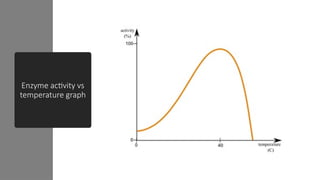
the temperature at which reactions are at a maximum rate.
37 degrees
Effect of low temperature
• At lower temperatures molecules move relatively slowly
• So, a lower frequency of successful collisions between
substrate molecules and active site of enzyme
• The substrate and enzymes collide with less energy, making
it less likely for bonds to be formed
• Less frequent enzyme-substrate complexes forming
Effect of high temperature
• Molecules move more quickly due to having greater kinetic
energy
• higher frequency of successful collisions between
substrate molecules and the active sites of enzymes
• More frequent enzyme-substrate complex formation occurs
as a result
• Substrates and enzymes collide with more energy, making
it more likely for bonds to be formed or broken
What causes denaturation?
• Bonds (eg. hydrogen bonds) holding the enzyme molecule in its precise
shape start to break because of very high temperatures
• This causes the tertiary structure of the protein (ie. the enzyme) to change
• This permanently damages the active site, changing the active site shape
• The changed active site shape means it is not complementary to the
substrate anymore- they cannot bind to each other
• Denaturation has occurred if the substrate can no longer bind
Enzyme activity vs
temperature graph
Endotherms- what are they?
Animals that possess physiological mechanisms to control
their internal body temperature
What does physiological mean here?
They maintain their body temperatures using heat generated
within their body tissues
Eg mammals and birds
Thermoregulation in endotherms
Endotherms detect temperatures via receptors
What kind of receptors would they be, and where are they found?
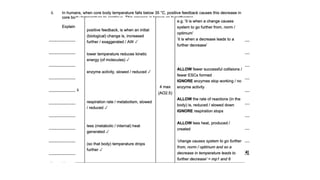
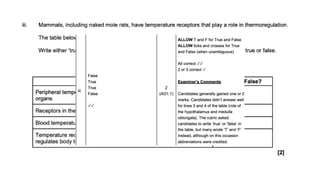
Thermoreceptors in the:
• skin
• mucous membranes
• hypothalamus
What structure in the brain are these signals brought to?
The hypothalamus which then brings about a physiological
homeostatic response to changing external temperatures
Thermoreceptors in hypothalamus monitor the temperature of the
blood flowing through it
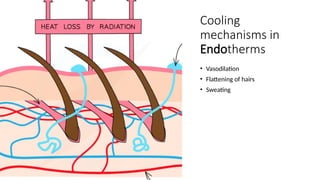
Cooling
mechanisms in
Endotherms
• Vasodilation
• Flattening of hairs
• Sweating
Vasodilation
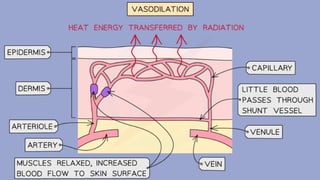
To supply capillaries in the skin with a greater volume of
blood, which loses heat to the environment via radiation
• Arterioles (what are arterioles?) have muscles in their walls
• During vasodilation, these muscles relax, causing the
arterioles near the skin to dilate and allowing more blood to
flow through capillaries
What is radiation?
Heat transfer due to emission of infrared waves through space
Flattening of Hairs
• The hair erector muscles (effectors) in the skin relax, causing
hairs to lie flat
• This stops them from forming an insulating layer by
trapping air and allows air to circulate over skin and heat to
leave by radiation
Sweating
• Sweat is secreted by sweat glands
• cools the skin by evaporation - uses heat energy from the body to
convert liquid water into water vapour
How effective is sweating in humid environments?
• There is a reduced concentration gradient since humid air has
more water vapour
• So there it is less effective at evaporating water
Ectoderms
Animals that rely on behavioural adaptations to ensure
their internal body temperature does not get too high or low
Where do they absorb heat from?
Their environment
e.g. reptiles and amphibians
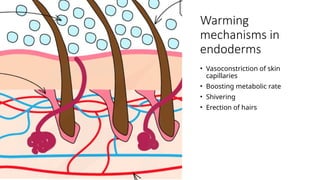
Warming
mechanisms in
endoderms
• Vasoconstriction of skin
capillaries
• Boosting metabolic rate
• Shivering
• Erection of hairs
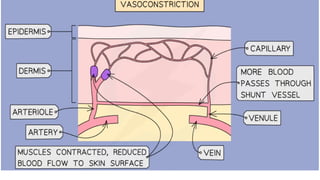
Vasoconstriction
Supplying capillaries in the skin with a smaller volume of
blood to minimise heat loss to the environment via radiation
• muscles in the arteriole walls contract, causing them to
constrict so there’s less blood flow through capillaries
• Blood is diverted through shunt vessels and therefore do
not lose heat to the environment
Boosting metabolic rate
• Most metabolic reactions in the body are exothermic (heat-
producing)
• This provides warmth to the body
• In cold environments, the hormone thyroxine increases the
basal metabolic rate (BMR), increasing heat production in
the body
Where is thyroxine released from?
The thyroid gland
Shivering
• A reflex action in response to a decrease in core body temperature
• Skeletal muscles are the effectors - they contract in a rapid and
regular manner
• The metabolic reactions required to power this shivering generate
sufficient heat to warm the blood and raise the core body
temperature
What is an example of a metabolic reaction used to power shivering?
Respiration
Erection of hairs
• Hair erector muscles in the skin contract, causing hairs to
stand on end
• This forms an insulating layer over the skin's surface by
trapping air between the hairs and stops heat from being
lost by radiation
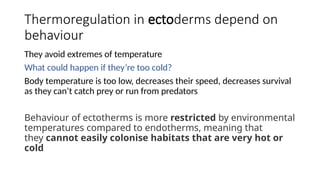
Thermoregulation in ectoderms depend on
behaviour
They avoid extremes of temperature
What could happen if they’re too cold?
Body temperature is too low, decreases their speed, decreases survival
as they can’t catch prey or run from predators
Behaviour of ectotherms is more restricted by environmental
temperatures compared to endotherms, meaning that
they cannot easily colonise habitats that are very hot or
cold
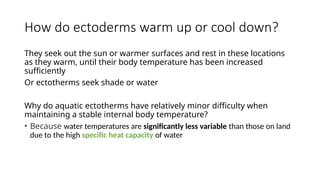
How do ectoderms warm up or cool down?
They seek out the sun or warmer surfaces and rest in these locations
as they warm, until their body temperature has been increased
sufficiently
Or ectotherms seek shade or water
Why do aquatic ectotherms have relatively minor difficulty when
maintaining a stable internal body temperature?
• Because water temperatures are significantly less variable than those on land
due to the high specific heat capacity of water
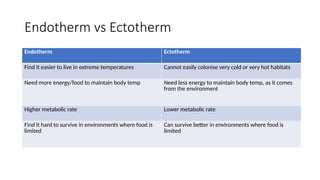
Endotherm vs Ectotherm
Endotherm Ectotherm
Find it easier to live in extreme temperatures Cannot easily colonise very cold or very hot habitats
Need more energy/food to maintain body temp Need less energy to maintain body temp, as it comes
from the environment
Higher metabolic rate Lower metabolic rate
Find it hard to survive in environments where food is
limited
Can survive better in environments where food is
limited
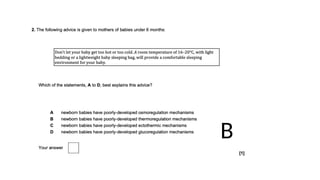
B
B
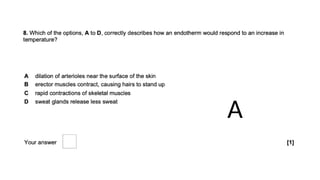
A
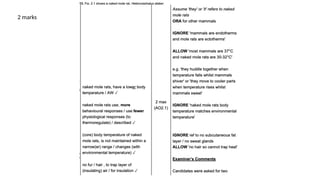
2 marks
endoderm and ectoderms a level biology AQA .pptx

endoderm and ectoderms a level biology AQA .pptx

  • 1.
    Responses to temperaturefor ectoderms and endotherms
  • 2.
    temperature why is temperatureimportant? Needed to regulate enzyme activity, as it affects the peptide bonds in the protein Many reactions in the body are enzyme controlled What does optimum temperature mean? the temperature at which reactions are at a maximum rate. 37 degrees
  • 3.
    Effect of lowtemperature • At lower temperatures molecules move relatively slowly • So, a lower frequency of successful collisions between substrate molecules and active site of enzyme • The substrate and enzymes collide with less energy, making it less likely for bonds to be formed • Less frequent enzyme-substrate complexes forming
  • 4.
    Effect of hightemperature • Molecules move more quickly due to having greater kinetic energy • higher frequency of successful collisions between substrate molecules and the active sites of enzymes • More frequent enzyme-substrate complex formation occurs as a result • Substrates and enzymes collide with more energy, making it more likely for bonds to be formed or broken
  • 5.
    What causes denaturation? •Bonds (eg. hydrogen bonds) holding the enzyme molecule in its precise shape start to break because of very high temperatures • This causes the tertiary structure of the protein (ie. the enzyme) to change • This permanently damages the active site, changing the active site shape • The changed active site shape means it is not complementary to the substrate anymore- they cannot bind to each other • Denaturation has occurred if the substrate can no longer bind
  • 6.
  • 7.
    Endotherms- what arethey? Animals that possess physiological mechanisms to control their internal body temperature What does physiological mean here? They maintain their body temperatures using heat generated within their body tissues Eg mammals and birds
  • 8.
    Thermoregulation in endotherms Endothermsdetect temperatures via receptors What kind of receptors would they be, and where are they found? Thermoreceptors in the: • skin • mucous membranes • hypothalamus What structure in the brain are these signals brought to? The hypothalamus which then brings about a physiological homeostatic response to changing external temperatures Thermoreceptors in hypothalamus monitor the temperature of the blood flowing through it
  • 9.
  • 10.
    Vasodilation To supply capillariesin the skin with a greater volume of blood, which loses heat to the environment via radiation • Arterioles (what are arterioles?) have muscles in their walls • During vasodilation, these muscles relax, causing the arterioles near the skin to dilate and allowing more blood to flow through capillaries What is radiation? Heat transfer due to emission of infrared waves through space
  • 12.
    Flattening of Hairs •The hair erector muscles (effectors) in the skin relax, causing hairs to lie flat • This stops them from forming an insulating layer by trapping air and allows air to circulate over skin and heat to leave by radiation
  • 13.
    Sweating • Sweat issecreted by sweat glands • cools the skin by evaporation - uses heat energy from the body to convert liquid water into water vapour How effective is sweating in humid environments? • There is a reduced concentration gradient since humid air has more water vapour • So there it is less effective at evaporating water
  • 14.
    Ectoderms Animals that relyon behavioural adaptations to ensure their internal body temperature does not get too high or low Where do they absorb heat from? Their environment e.g. reptiles and amphibians
  • 15.
    Warming mechanisms in endoderms • Vasoconstrictionof skin capillaries • Boosting metabolic rate • Shivering • Erection of hairs
  • 16.
    Vasoconstriction Supplying capillaries inthe skin with a smaller volume of blood to minimise heat loss to the environment via radiation • muscles in the arteriole walls contract, causing them to constrict so there’s less blood flow through capillaries • Blood is diverted through shunt vessels and therefore do not lose heat to the environment
  • 18.
    Boosting metabolic rate •Most metabolic reactions in the body are exothermic (heat- producing) • This provides warmth to the body • In cold environments, the hormone thyroxine increases the basal metabolic rate (BMR), increasing heat production in the body Where is thyroxine released from? The thyroid gland
  • 19.
    Shivering • A reflexaction in response to a decrease in core body temperature • Skeletal muscles are the effectors - they contract in a rapid and regular manner • The metabolic reactions required to power this shivering generate sufficient heat to warm the blood and raise the core body temperature What is an example of a metabolic reaction used to power shivering? Respiration
  • 20.
    Erection of hairs •Hair erector muscles in the skin contract, causing hairs to stand on end • This forms an insulating layer over the skin's surface by trapping air between the hairs and stops heat from being lost by radiation
  • 21.
    Thermoregulation in ectodermsdepend on behaviour They avoid extremes of temperature What could happen if they’re too cold? Body temperature is too low, decreases their speed, decreases survival as they can’t catch prey or run from predators Behaviour of ectotherms is more restricted by environmental temperatures compared to endotherms, meaning that they cannot easily colonise habitats that are very hot or cold
  • 22.
    How do ectodermswarm up or cool down? They seek out the sun or warmer surfaces and rest in these locations as they warm, until their body temperature has been increased sufficiently Or ectotherms seek shade or water Why do aquatic ectotherms have relatively minor difficulty when maintaining a stable internal body temperature? • Because water temperatures are significantly less variable than those on land due to the high specific heat capacity of water
  • 23.
    Endotherm vs Ectotherm EndothermEctotherm Find it easier to live in extreme temperatures Cannot easily colonise very cold or very hot habitats Need more energy/food to maintain body temp Need less energy to maintain body temp, as it comes from the environment Higher metabolic rate Lower metabolic rate Find it hard to survive in environments where food is limited Can survive better in environments where food is limited
  • 24.
  • 25.
  • 26.
  • 28.