











NEURAL MODELS FOR
DOCUMENT RANKING
BHASKAR MITRA
Principal Applied Scientist
Microsoft Research and AI
Research Student
Dept. of Computer Science
University College London
Joint work with Nick Craswell, Fernando Diaz,
Federico Nanni, Matt Magnusson, and Laura Dietz
PAPERS WE WILL DISCUSS
Learning to Match Using Local and Distributed Representations of
Text for Web Search
Bhaskar Mitra, Fernando Diaz, and Nick Craswell, in Proc. WWW, 2017.
https://dl.acm.org/citation.cfm?id=3052579
Benchmark for Complex Answer Retrieval
Federico Nanni, Bhaskar Mitra, Matt Magnusson, and Laura Dietz, in Proc. ICTIR, 2017.
https://dl.acm.org/citation.cfm?id=3121099
THE DOCUMENT RANKING TASK
Given a query rank documents
according to relevance
The query text has few terms
The document representation can be
long (e.g., body text) or short (e.g., title)
query
ranked results
search engine w/ an
index of retrievable items
This talk is focused on ranking documents
based on their long body text
CHALLENGES IN SHORT VS. LONG
TEXT RETRIEVAL
Short-text
Vocabulary mismatch more serious problem
Long-text
Documents contain mixture of many topics
Matches in different parts of a long document contribute unequally
Term proximity is an important consideration
MANY DNN MODELS FOR SHORT TEXT RANKING
(Huang et al., 2013)
(Severyn and Moschitti, 2015)
(Shen et al., 2014)
(Palangi et al., 2015)
(Hu et al., 2014)
(Tai et al., 2015)
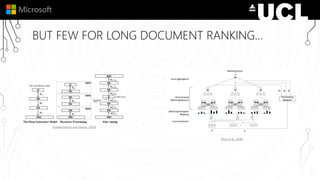
BUT FEW FOR LONG DOCUMENT RANKING…
(Guo et al., 2016)
(Salakhutdinov and Hinton, 2009)
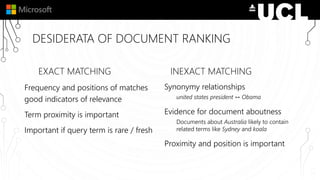
DESIDERATA OF DOCUMENT RANKING
EXACT MATCHING
Frequency and positions of matches
good indicators of relevance
Term proximity is important
Important if query term is rare / fresh
INEXACT MATCHING
Synonymy relationships
united states president ↔ Obama
Evidence for document aboutness
Documents about Australia likely to contain
related terms like Sydney and koala
Proximity and position is important
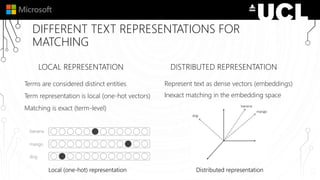
DIFFERENT TEXT REPRESENTATIONS FOR
MATCHING
LOCAL REPRESENTATION
Terms are considered distinct entities
Term representation is local (one-hot vectors)
Matching is exact (term-level)
DISTRIBUTED REPRESENTATION
Represent text as dense vectors (embeddings)
Inexact matching in the embedding space
Local (one-hot) representation Distributed representation
A TALE OF TWO QUERIES
“PEKAROVIC LAND COMPANY”
Hard to learn good representation for
rare term pekarovic
But easy to estimate relevance based
on patterns of exact matches
Proposal: Learn a neural model to
estimate relevance from patterns of
exact matches
“WHAT CHANNEL ARE THE SEAHAWKS ON
TODAY”
Target document likely contains ESPN
or sky sports instead of channel
An embedding model can associate
ESPN in document to channel in query
Proposal: Learn embeddings of text
and match query with document in
the embedding space
The Duet Architecture
Use a neural network to model both functions and learn their parameters jointly
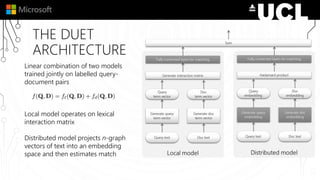
THE DUET
ARCHITECTURE
Linear combination of two models
trained jointly on labelled query-
document pairs
Local model operates on lexical
interaction matrix
Distributed model projects n-graph
vectors of text into an embedding
space and then estimates match
LOCAL
SUB-MODEL
Focuses on patterns of
exact matches of query
terms in document
INTERACTION MATRIX OF QUERY-DOCUMENT
TERMS
𝑋𝑖,𝑗 =
1, 𝑖𝑓 𝑞𝑖 = 𝑑𝑗
0, 𝑜𝑡ℎ𝑒𝑟𝑤𝑖𝑠𝑒
In relevant documents,
→Many matches, typically in clusters
→Matches localized early in
document
→Matches for all query terms
→In-order (phrasal) matches
ESTIMATING RELEVANCE FROM INTERACTION
MATRIX
← document words →
Convolve using window of size 𝑛 𝑑 × 1
Each window instance compares a query term w/
whole document
Fully connected layers aggregate evidence
across query terms - can model phrasal matches
LOCAL
SUB-MODEL
Focuses on patterns of
exact matches of query
terms in document
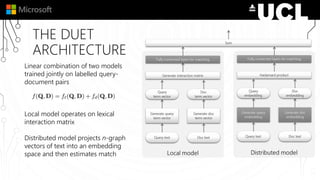
THE DUET
ARCHITECTURE
Linear combination of two models
trained jointly on labelled query-
document pairs
Local model operates on lexical
interaction matrix
Distributed model projects n-graph
vectors of text into an embedding
space and then estimates match
DISTRIBUTED
SUB-MODEL
Learns representation of
text and matches query
with document in the
embedding space
INPUT REPRESENTATION
dogs → [ d , o , g , s , #d , do , og , gs , s# , #do , dog , ogs , gs#, #dog, dogs, ogs#, #dogs, dogs# ]
(we consider 2K most popular n-graphs only for encoding)
d o g s h a v e o w n e r s c a t s h a v e s t a f f
n-graph
encoding
concatenate
Channels=2K
[words x channels]
convolutio
n
pooling
Query
embedding
…
…
…
HadamardproductHadamardproductFullyconnected
query document
ESTIMATING RELEVANCE FROM TEXT
EMBEDDINGS
Convolve over query and
document terms
Match query with moving
windows over document
Learn text embeddings
specifically for the task
Matching happens in
embedding space
* Network architecture slightly
simplified for visualization – refer paper
for exact details
PUTTING THE TWO MODELS
TOGETHER…
THE DUET
MODEL
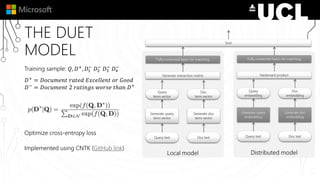
Training sample: 𝑄, 𝐷+, 𝐷1
−
𝐷2
−
𝐷3
−
𝐷4
−
𝐷+
= 𝐷𝑜𝑐𝑢𝑚𝑒𝑛𝑡 𝑟𝑎𝑡𝑒𝑑 𝐸𝑥𝑐𝑒𝑙𝑙𝑒𝑛𝑡 𝑜𝑟 𝐺𝑜𝑜𝑑
𝐷−
= 𝐷𝑜𝑐𝑢𝑚𝑒𝑛𝑡 2 𝑟𝑎𝑡𝑖𝑛𝑔𝑠 𝑤𝑜𝑟𝑠𝑒 𝑡ℎ𝑎𝑛 𝐷+
Optimize cross-entropy loss
Implemented using CNTK (GitHub link)
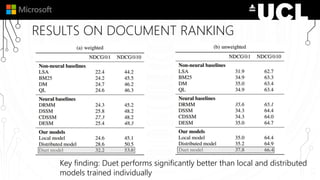
RESULTS ON DOCUMENT RANKING
Key finding: Duet performs significantly better than local and distributed
models trained individually
DUET ON
OTHER IR TASKS
Promising early results on TREC
2017 Complex Answer Retrieval
(TREC-CAR)
Duet performs significantly
better when trained on large
data (~32 million samples)
RANDOM NEGATIVES VS. JUDGED NEGATIVES
Key finding: training w/ judged
bad as negatives significantly
better than w/ random negatives
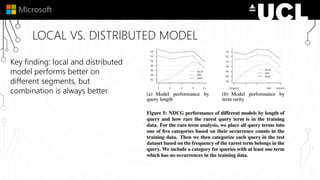
LOCAL VS. DISTRIBUTED MODEL
Key finding: local and distributed
model performs better on
different segments, but
combination is always better
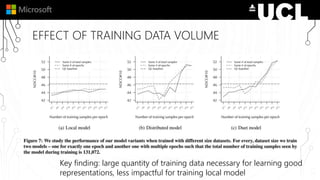
EFFECT OF TRAINING DATA VOLUME
Key finding: large quantity of training data necessary for learning good
representations, less impactful for training local model
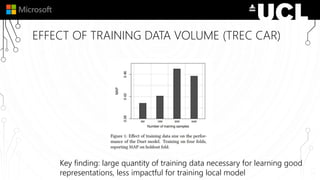
EFFECT OF TRAINING DATA VOLUME (TREC CAR)
Key finding: large quantity of training data necessary for learning good
representations, less impactful for training local model
TERM IMPORTANCE
LOCAL MODEL DISTRIBUTED MODEL
Query: united states president
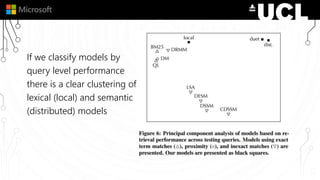
If we classify models by
query level performance
there is a clear clustering of
lexical (local) and semantic
(distributed) models
GET THE CODE
Implemented using CNTK python API
https://github.com/bmitra-msft/NDRM/blob/master/notebooks/Duet.ipynb
Download
AN INTRODUCTION TO NEURAL
INFORMATION RETRIEVAL
Manuscript under review for
Foundations and Trends® in Information Retrieval
Pre-print is available for free download
http://bit.ly/neuralir-intro
(Final manuscript may contain additional content and changes)
THANK YOU

Neural Models for Document Ranking

  • 1.
    NEURAL MODELS FOR DOCUMENTRANKING BHASKAR MITRA Principal Applied Scientist Microsoft Research and AI Research Student Dept. of Computer Science University College London Joint work with Nick Craswell, Fernando Diaz, Federico Nanni, Matt Magnusson, and Laura Dietz
  • 2.
    PAPERS WE WILLDISCUSS Learning to Match Using Local and Distributed Representations of Text for Web Search Bhaskar Mitra, Fernando Diaz, and Nick Craswell, in Proc. WWW, 2017. https://dl.acm.org/citation.cfm?id=3052579 Benchmark for Complex Answer Retrieval Federico Nanni, Bhaskar Mitra, Matt Magnusson, and Laura Dietz, in Proc. ICTIR, 2017. https://dl.acm.org/citation.cfm?id=3121099
  • 3.
    THE DOCUMENT RANKINGTASK Given a query rank documents according to relevance The query text has few terms The document representation can be long (e.g., body text) or short (e.g., title) query ranked results search engine w/ an index of retrievable items
  • 4.
    This talk isfocused on ranking documents based on their long body text
  • 5.
    CHALLENGES IN SHORTVS. LONG TEXT RETRIEVAL Short-text Vocabulary mismatch more serious problem Long-text Documents contain mixture of many topics Matches in different parts of a long document contribute unequally Term proximity is an important consideration
  • 6.
    MANY DNN MODELSFOR SHORT TEXT RANKING (Huang et al., 2013) (Severyn and Moschitti, 2015) (Shen et al., 2014) (Palangi et al., 2015) (Hu et al., 2014) (Tai et al., 2015)
  • 7.
    BUT FEW FORLONG DOCUMENT RANKING… (Guo et al., 2016) (Salakhutdinov and Hinton, 2009)
  • 8.
    DESIDERATA OF DOCUMENTRANKING EXACT MATCHING Frequency and positions of matches good indicators of relevance Term proximity is important Important if query term is rare / fresh INEXACT MATCHING Synonymy relationships united states president ↔ Obama Evidence for document aboutness Documents about Australia likely to contain related terms like Sydney and koala Proximity and position is important
  • 9.
    DIFFERENT TEXT REPRESENTATIONSFOR MATCHING LOCAL REPRESENTATION Terms are considered distinct entities Term representation is local (one-hot vectors) Matching is exact (term-level) DISTRIBUTED REPRESENTATION Represent text as dense vectors (embeddings) Inexact matching in the embedding space Local (one-hot) representation Distributed representation
  • 10.
    A TALE OFTWO QUERIES “PEKAROVIC LAND COMPANY” Hard to learn good representation for rare term pekarovic But easy to estimate relevance based on patterns of exact matches Proposal: Learn a neural model to estimate relevance from patterns of exact matches “WHAT CHANNEL ARE THE SEAHAWKS ON TODAY” Target document likely contains ESPN or sky sports instead of channel An embedding model can associate ESPN in document to channel in query Proposal: Learn embeddings of text and match query with document in the embedding space The Duet Architecture Use a neural network to model both functions and learn their parameters jointly
  • 11.
    THE DUET ARCHITECTURE Linear combinationof two models trained jointly on labelled query- document pairs Local model operates on lexical interaction matrix Distributed model projects n-graph vectors of text into an embedding space and then estimates match
  • 12.
    LOCAL SUB-MODEL Focuses on patternsof exact matches of query terms in document
  • 13.
    INTERACTION MATRIX OFQUERY-DOCUMENT TERMS 𝑋𝑖,𝑗 = 1, 𝑖𝑓 𝑞𝑖 = 𝑑𝑗 0, 𝑜𝑡ℎ𝑒𝑟𝑤𝑖𝑠𝑒 In relevant documents, →Many matches, typically in clusters →Matches localized early in document →Matches for all query terms →In-order (phrasal) matches
  • 14.
    ESTIMATING RELEVANCE FROMINTERACTION MATRIX ← document words → Convolve using window of size 𝑛 𝑑 × 1 Each window instance compares a query term w/ whole document Fully connected layers aggregate evidence across query terms - can model phrasal matches
  • 15.
    LOCAL SUB-MODEL Focuses on patternsof exact matches of query terms in document
  • 16.
    THE DUET ARCHITECTURE Linear combinationof two models trained jointly on labelled query- document pairs Local model operates on lexical interaction matrix Distributed model projects n-graph vectors of text into an embedding space and then estimates match
  • 17.
    DISTRIBUTED SUB-MODEL Learns representation of textand matches query with document in the embedding space
  • 18.
    INPUT REPRESENTATION dogs →[ d , o , g , s , #d , do , og , gs , s# , #do , dog , ogs , gs#, #dog, dogs, ogs#, #dogs, dogs# ] (we consider 2K most popular n-graphs only for encoding) d o g s h a v e o w n e r s c a t s h a v e s t a f f n-graph encoding concatenate Channels=2K [words x channels]
  • 19.
    convolutio n pooling Query embedding … … … HadamardproductHadamardproductFullyconnected query document ESTIMATING RELEVANCEFROM TEXT EMBEDDINGS Convolve over query and document terms Match query with moving windows over document Learn text embeddings specifically for the task Matching happens in embedding space * Network architecture slightly simplified for visualization – refer paper for exact details
  • 20.
    PUTTING THE TWOMODELS TOGETHER…
  • 21.
    THE DUET MODEL Training sample:𝑄, 𝐷+, 𝐷1 − 𝐷2 − 𝐷3 − 𝐷4 − 𝐷+ = 𝐷𝑜𝑐𝑢𝑚𝑒𝑛𝑡 𝑟𝑎𝑡𝑒𝑑 𝐸𝑥𝑐𝑒𝑙𝑙𝑒𝑛𝑡 𝑜𝑟 𝐺𝑜𝑜𝑑 𝐷− = 𝐷𝑜𝑐𝑢𝑚𝑒𝑛𝑡 2 𝑟𝑎𝑡𝑖𝑛𝑔𝑠 𝑤𝑜𝑟𝑠𝑒 𝑡ℎ𝑎𝑛 𝐷+ Optimize cross-entropy loss Implemented using CNTK (GitHub link)
  • 22.
    RESULTS ON DOCUMENTRANKING Key finding: Duet performs significantly better than local and distributed models trained individually
  • 23.
    DUET ON OTHER IRTASKS Promising early results on TREC 2017 Complex Answer Retrieval (TREC-CAR) Duet performs significantly better when trained on large data (~32 million samples)
  • 24.
    RANDOM NEGATIVES VS.JUDGED NEGATIVES Key finding: training w/ judged bad as negatives significantly better than w/ random negatives
  • 25.
    LOCAL VS. DISTRIBUTEDMODEL Key finding: local and distributed model performs better on different segments, but combination is always better
  • 26.
    EFFECT OF TRAININGDATA VOLUME Key finding: large quantity of training data necessary for learning good representations, less impactful for training local model
  • 27.
    EFFECT OF TRAININGDATA VOLUME (TREC CAR) Key finding: large quantity of training data necessary for learning good representations, less impactful for training local model
  • 28.
    TERM IMPORTANCE LOCAL MODELDISTRIBUTED MODEL Query: united states president
  • 29.
    If we classifymodels by query level performance there is a clear clustering of lexical (local) and semantic (distributed) models
  • 30.
    GET THE CODE Implementedusing CNTK python API https://github.com/bmitra-msft/NDRM/blob/master/notebooks/Duet.ipynb Download
  • 31.
    AN INTRODUCTION TONEURAL INFORMATION RETRIEVAL Manuscript under review for Foundations and Trends® in Information Retrieval Pre-print is available for free download http://bit.ly/neuralir-intro (Final manuscript may contain additional content and changes) THANK YOU