Macro Features
By Ben Atherton
What are macro features?
The definition of macro would be large, so macro features are the biggest
elements in a film. These macro features would be seen as the opposite to
micro features since micro features zoom in on a specific part of a film.
Main Important Macro Features
Genre
Narrative
Representation
Star
Genre
When analysing a film based on its genre, you have to consider:
What is the genre of the film?
An example is that if the film being analysed was This Is England, then the
genre would be crime/drama.
What features in the film are typical of
the genre?
For example, films in the horror genre would typically have iconography of
things such as blood, weapons and dark places.
Do the characters seem typical of the
genre?
For example, in a horror film the female character is normally victimised, while
the male character is normally a villain.
Narrative
Analysing narrative can also be referred to as the study of stories.
When analysing the narrative, consider:
What happens- the plot.
The role that each character plays.
The shape of the story.
The person that wrote the story
Significant locations in the film.
The journeys that the different characters have.
Narrative Theorists
There are a few main narrative theories which have been made by different
theorists. When analysing the narrative of a film, it is good to compare how
similar the narrative of the film is to the theories.
Vladimir Propp
Propp suggested that every narrative had 8 different character types:
The Villain- character who is against the hero.
The Dispatcher- character who sends the hero off.
The Helper- helps the hero in their quest.
The Princess- character or thing the hero fights for.
The Donor- character who prepares the hero.
The Hero- character who goes against the villain and weds the princess.
The False Hero- character who attempts to take credit for the hero’s actions
and tries to marry the princess.
Tzvetan Todorov
Todorov believed that films follow the same structure cycle of:
A state of equilibrium.
A disruption to the equilibrium.
Recognition that the disorder has occurred.
Attempt to repair the damage.
Return to a new equilibrium.
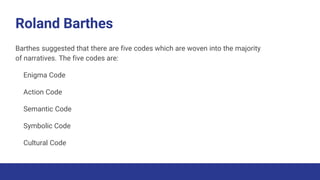
Roland Barthes
Barthes suggested that there are five codes which are woven into the majority
of narratives. The five codes are:
Enigma Code
Action Code
Semantic Code
Symbolic Code
Cultural Code
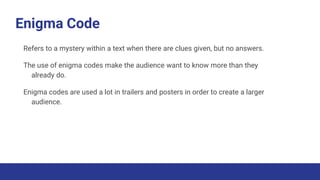
Enigma Code
Refers to a mystery within a text when there are clues given, but no answers.
The use of enigma codes make the audience want to know more than they
already do.
Enigma codes are used a lot in trailers and posters in order to create a larger
audience.
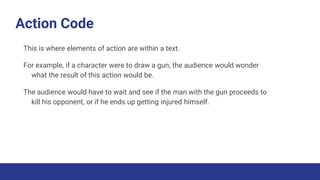
Action Code
This is where elements of action are within a text.
For example, if a character were to draw a gun, the audience would wonder
what the result of this action would be.
The audience would have to wait and see if the man with the gun proceeds to
kill his opponent, or if he ends up getting injured himself.
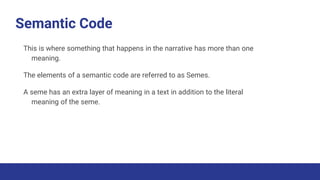
Semantic Code
This is where something that happens in the narrative has more than one
meaning.
The elements of a semantic code are referred to as Semes.
A seme has an extra layer of meaning in a text in addition to the literal
meaning of the seme.
Symbolic Code
This code is to do with symbolism within a text.
Opposites are shown in order to contrast a greater meaning within a
narrative.
A symbolic code has quite a few similarities with a semantic code.
Cultural Code
This refers to an external body of knowledge within a text.
This can include scientific, historic and cultural knowledge.
Representation
This is how a film reflects or challenges social values, attitudes and beliefs.
One of the main representation theorists is Laura Mulvey who came up with a
theory called “The Male Gaze”.
This refers to how an audience views the people presented in a film.
Mulvey believes that in films, audiences have to view characters from the
POV of a heterosexual man.
For example, the camera will sometimes linger on the curves of the female
body.
The problem with films representing women in this way is that it gives
women the status of “objects”.
Star
This is to do with the significance of stars in a film, and how different stars
will attract audiences differently,
For example, if a big name such as Tom Cruise is in the cast of a film, then
there is a high chance that the amount of people who watch the film will
increase.
If there are no big names in a film, then the audience will most likely not be
quite as big as it could have been.
When analysing how successful a film was, be sure to consider how
popular/famous the cast is. This is because the success of a film and the
cast of a film normally have direct correlation.

Macro features Film Studies

  • 1.
  • 2.
    What are macrofeatures? The definition of macro would be large, so macro features are the biggest elements in a film. These macro features would be seen as the opposite to micro features since micro features zoom in on a specific part of a film.
  • 3.
    Main Important MacroFeatures Genre Narrative Representation Star
  • 4.
    Genre When analysing afilm based on its genre, you have to consider:
  • 5.
    What is thegenre of the film? An example is that if the film being analysed was This Is England, then the genre would be crime/drama.
  • 6.
    What features inthe film are typical of the genre? For example, films in the horror genre would typically have iconography of things such as blood, weapons and dark places.
  • 7.
    Do the charactersseem typical of the genre? For example, in a horror film the female character is normally victimised, while the male character is normally a villain.
  • 8.
    Narrative Analysing narrative canalso be referred to as the study of stories.
  • 9.
    When analysing thenarrative, consider: What happens- the plot. The role that each character plays. The shape of the story. The person that wrote the story Significant locations in the film. The journeys that the different characters have.
  • 10.
    Narrative Theorists There area few main narrative theories which have been made by different theorists. When analysing the narrative of a film, it is good to compare how similar the narrative of the film is to the theories.
  • 11.
    Vladimir Propp Propp suggestedthat every narrative had 8 different character types: The Villain- character who is against the hero. The Dispatcher- character who sends the hero off. The Helper- helps the hero in their quest. The Princess- character or thing the hero fights for. The Donor- character who prepares the hero. The Hero- character who goes against the villain and weds the princess. The False Hero- character who attempts to take credit for the hero’s actions and tries to marry the princess.
  • 12.
    Tzvetan Todorov Todorov believedthat films follow the same structure cycle of: A state of equilibrium. A disruption to the equilibrium. Recognition that the disorder has occurred. Attempt to repair the damage. Return to a new equilibrium.
  • 13.
    Roland Barthes Barthes suggestedthat there are five codes which are woven into the majority of narratives. The five codes are: Enigma Code Action Code Semantic Code Symbolic Code Cultural Code
  • 14.
    Enigma Code Refers toa mystery within a text when there are clues given, but no answers. The use of enigma codes make the audience want to know more than they already do. Enigma codes are used a lot in trailers and posters in order to create a larger audience.
  • 15.
    Action Code This iswhere elements of action are within a text. For example, if a character were to draw a gun, the audience would wonder what the result of this action would be. The audience would have to wait and see if the man with the gun proceeds to kill his opponent, or if he ends up getting injured himself.
  • 16.
    Semantic Code This iswhere something that happens in the narrative has more than one meaning. The elements of a semantic code are referred to as Semes. A seme has an extra layer of meaning in a text in addition to the literal meaning of the seme.
  • 17.
    Symbolic Code This codeis to do with symbolism within a text. Opposites are shown in order to contrast a greater meaning within a narrative. A symbolic code has quite a few similarities with a semantic code.
  • 18.
    Cultural Code This refersto an external body of knowledge within a text. This can include scientific, historic and cultural knowledge.
  • 19.
    Representation This is howa film reflects or challenges social values, attitudes and beliefs. One of the main representation theorists is Laura Mulvey who came up with a theory called “The Male Gaze”. This refers to how an audience views the people presented in a film. Mulvey believes that in films, audiences have to view characters from the POV of a heterosexual man. For example, the camera will sometimes linger on the curves of the female body. The problem with films representing women in this way is that it gives women the status of “objects”.
  • 20.
    Star This is todo with the significance of stars in a film, and how different stars will attract audiences differently, For example, if a big name such as Tom Cruise is in the cast of a film, then there is a high chance that the amount of people who watch the film will increase. If there are no big names in a film, then the audience will most likely not be quite as big as it could have been. When analysing how successful a film was, be sure to consider how popular/famous the cast is. This is because the success of a film and the cast of a film normally have direct correlation.