



WHAT IS THE DIFFERENCE
BETWEEN A GOOD AND A BAD
  PHOTOGRAPH/FRAME?
  What makes a picture attractive is
   the usage of certain techniques
  which make an immediate impact
           on the viewer.
       These are Basic rules of
            composition
Elements of good
                  composition:
2.   rule of the thirds
3.   simplicity
4.   use shape and form
5.   sweeping curves
6.   use lines
7.   positive and negative space
8.   symmetry or asymmetry


9. shadows and reflections
10.frame
11.color scheme
12.contrast
13.Usage of appropriate camera angle
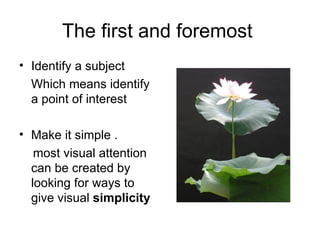
The first and foremost
• Identify a subject
  Which means identify
  a point of interest

• Make it simple .
   most visual attention
  can be created by
  looking for ways to
  give visual simplicity
Basic rules to get a good
             photograph
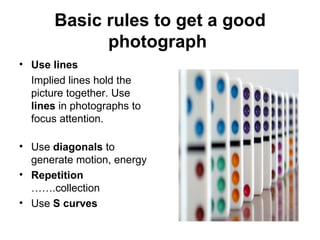
• Use lines
  Implied lines hold the
  picture together. Use
  lines in photographs to
  focus attention.

• Use diagonals to
  generate motion, energy
• Repetition
  …….collection
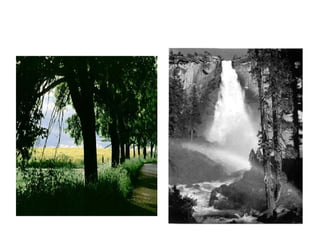
• Use S curves
Basic rules to get a good
            photograph
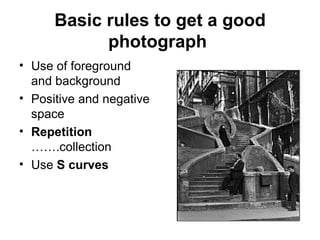
• Use of foreground
  and background
• Positive and negative
  space
• Repetition
  …….collection
• Use S curves
Basic rules to get a good
            photograph

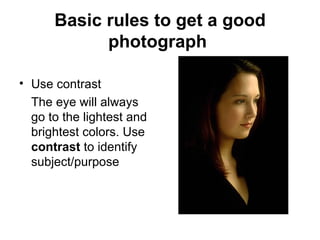
• Use contrast
  The eye will always
  go to the lightest and
  brightest colors. Use
  contrast to identify
  subject/purpose
Basic rules to get a good
           photograph


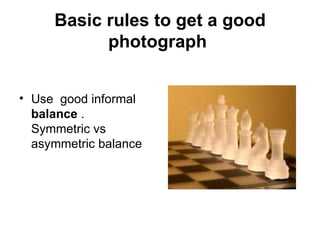
• Use good informal
  balance .
  Symmetric vs
  asymmetric balance
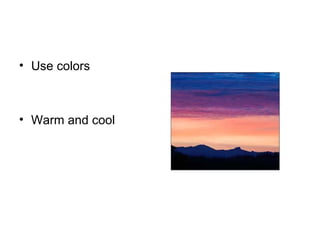
• Use colors


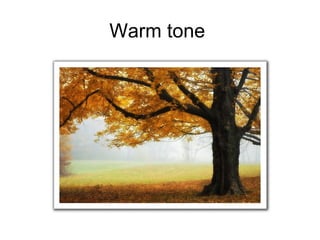
• Warm and cool
Warm tone
Basic rules to get a good
          photograph
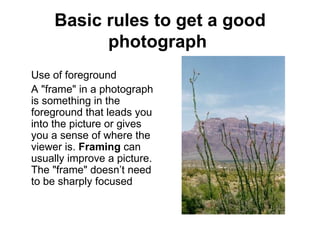
Use of foreground
A "frame" in a photograph
is something in the
foreground that leads you
into the picture or gives
you a sense of where the
viewer is. Framing can
usually improve a picture.
The "frame" doesn’t need
to be sharply focused
Basic rules to get a good
               photograph

• The visual "center" of a picture is not the "bull's eye center", but the
  intersection of vertical and horizontal thirds. Use thirds.

• Use concept of lead room
  When the subject is capable of movement, such as an animal or
  person, it is best to leave space in front of the subject so it
  appears to be moving into, rather than out of, the photograph.

• Avoid mergers—plants sticking out of people's heads, telephone
  poles "rising" from shoulders, etc.
The big rule

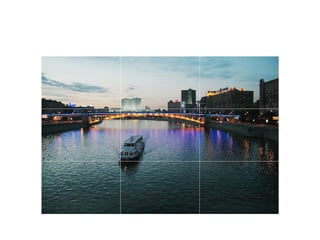
• Rule of Thirds
Rule of Thirds

• The Rule of Thirds is based on the fact
  that the human eye is naturally drawn to a
  point about two-thirds up a page.
• the main subjects should be located
  around one of the intersection points
  rather than in the center of the image
Why the thirds ?

• aligning a photograph with these points
  creates more energy and interest in the
  photo
• The application of the rule of thirds to
  photographs is considered by many to
  make them more aesthetically pleasing
  and professional-looking
EXTRAS
• Texture

• Pattern

• Shapes
Good depth and good angle
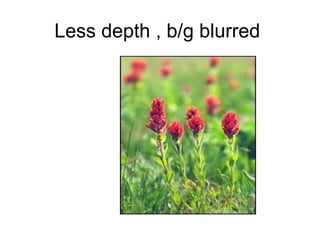
Less depth , b/g blurred

Class 10 composition

  • 1.
    WHAT IS THEDIFFERENCE BETWEEN A GOOD AND A BAD PHOTOGRAPH/FRAME? What makes a picture attractive is the usage of certain techniques which make an immediate impact on the viewer. These are Basic rules of composition
  • 2.
    Elements of good composition: 2. rule of the thirds 3. simplicity 4. use shape and form 5. sweeping curves 6. use lines 7. positive and negative space 8. symmetry or asymmetry 9. shadows and reflections 10.frame 11.color scheme 12.contrast 13.Usage of appropriate camera angle
  • 3.
    The first andforemost • Identify a subject Which means identify a point of interest • Make it simple . most visual attention can be created by looking for ways to give visual simplicity
  • 4.
    Basic rules toget a good photograph • Use lines Implied lines hold the picture together. Use lines in photographs to focus attention. • Use diagonals to generate motion, energy • Repetition …….collection • Use S curves
  • 6.
    Basic rules toget a good photograph • Use of foreground and background • Positive and negative space • Repetition …….collection • Use S curves
  • 8.
    Basic rules toget a good photograph • Use contrast The eye will always go to the lightest and brightest colors. Use contrast to identify subject/purpose
  • 9.
    Basic rules toget a good photograph • Use good informal balance . Symmetric vs asymmetric balance
  • 10.
    • Use colors •Warm and cool
  • 11.
  • 12.
    Basic rules toget a good photograph Use of foreground A "frame" in a photograph is something in the foreground that leads you into the picture or gives you a sense of where the viewer is. Framing can usually improve a picture. The "frame" doesn’t need to be sharply focused
  • 14.
    Basic rules toget a good photograph • The visual "center" of a picture is not the "bull's eye center", but the intersection of vertical and horizontal thirds. Use thirds. • Use concept of lead room When the subject is capable of movement, such as an animal or person, it is best to leave space in front of the subject so it appears to be moving into, rather than out of, the photograph. • Avoid mergers—plants sticking out of people's heads, telephone poles "rising" from shoulders, etc.
  • 15.
    The big rule •Rule of Thirds
  • 16.
    Rule of Thirds •The Rule of Thirds is based on the fact that the human eye is naturally drawn to a point about two-thirds up a page. • the main subjects should be located around one of the intersection points rather than in the center of the image
  • 18.
    Why the thirds? • aligning a photograph with these points creates more energy and interest in the photo • The application of the rule of thirds to photographs is considered by many to make them more aesthetically pleasing and professional-looking
  • 19.
  • 20.
    Good depth andgood angle
  • 22.
    Less depth ,b/g blurred