Unit 5
MARKET
Dr. Babasaheb Jadhav
Associate Professor
Outline of the Unit:
• Market
• Market structure
• Characteristics of perfect competition
• Monopoly
• Monopolistic competition
Concept of Market:
“An arrangement whereby buyers and sellers come in close
contact with each other directly or indirectly to sell and buy
goods is called as market”.
Analytically markets may be categorised into:
a) Product market: Product market or commodity market refers
to an arrangement in effecting buying and selling of commodities
or products.
b) Factor market: Factor market refers to the factors of
production such as land, labour & capital are transacted.
Classification of market structures:
The markets may be classified on the basis of different criteria
such as Geographical space or area, Time element and the nature
of Competition.
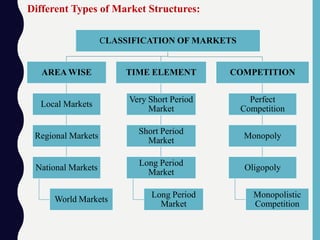
Different Types of Market Structures:
CLASSIFICATION OF MARKETS
AREA WISE
Local Markets
Regional Markets
National Markets
World Markets
TIME ELEMENT
Very Short Period
Market
Short Period
Market
Long Period
Market
Long Period
Market
COMPETITION
Perfect
Competition
Monopoly
Oligopoly
Monopolistic
Competition
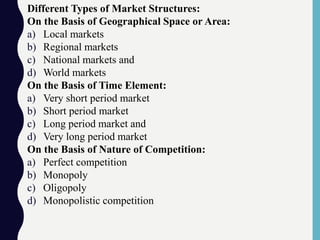
Different Types of Market Structures:
On the Basis of Geographical Space or Area:
a) Local markets
b) Regional markets
c) National markets and
d) World markets
On the Basis of Time Element:
a) Very short period market
b) Short period market
c) Long period market and
d) Very long period market
On the Basis of Nature of Competition:
a) Perfect competition
b) Monopoly
c) Oligopoly
d) Monopolistic competition
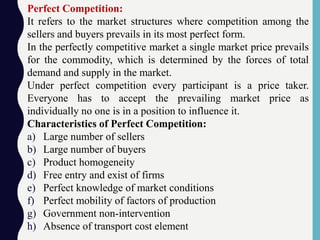
Perfect Competition:
It refers to the market structures where competition among the
sellers and buyers prevails in its most perfect form.
In the perfectly competitive market a single market price prevails
for the commodity, which is determined by the forces of total
demand and supply in the market.
Under perfect competition every participant is a price taker.
Everyone has to accept the prevailing market price as
individually no one is in a position to influence it.
Characteristics of Perfect Competition:
a) Large number of sellers
b) Large number of buyers
c) Product homogeneity
d) Free entry and exist of firms
e) Perfect knowledge of market conditions
f) Perfect mobility of factors of production
g) Government non-intervention
h) Absence of transport cost element
Price Determination Under Perfect Competition:
In a market the exchange value of a product expressed in terms of
money is called as price.
In a market economy the equilibrium market price is determined by the
market forces.
Under perfect competition, there is a single ruling price-the equilibrium
price determined by the interaction of forces of total demand and
supply in the market.
Thus both the market or equilibrium price and the volume of
production in a market under perfect competition are determined by the
intersection of total demand and supply.
Possible Price
(Rs. Per kg.)
Total Demand
(kg. Per week)
Total Supply
(kg. Per week)
Pressure on
price
20 1000 10000 Downward
19 3000 8000 Downward
18 4000 6000 Downward
17 5000 5000 Neutral
16 7000 4000 Upward
15 10000 2000 Upward
Monopoly:
Monopoly is the other extreme form of market situation.
Pure monopoly is just opposite of perfect or pure competition.
Pure monopoly is a market structure in which there is only one
seller . He controls the entire market supply of a product. Because
there is no rival producing a close substitute, the monopoly firm
itself is an industry, so its output constitutes the total market
supply
Characteristics of Perfect Competition:
a) There exists only one seller but there are many buyers.
b) The monopoly firm is the industry.
c) There are many entry barriers such as STEPIN which do not
allow competitors to enter in the market.
d) Monopoly firm is a price maker
e) There are no closely competitive substitutes for the product
f) Monopoly is a complete negation of competition
g) Monopolist has a complete control over the market supply in
the absence of close substitute for his product
Types of Monopoly:
a) Pure Monopoly and Imperfect Monopoly
b) Legal, Natural, Technological & Joint Monopolies
c) Simple Monopoly and Discriminating Monopoly
d) Private Monopoly and Public or Social Monopoly
Monopoly Equilibrium in the Short Run:
The conditions for Equilibrium in Monopoly are the same as
those under perfect competition. The marginal cost (MC) is equal
to the marginal revenue (MR) and the MC curve cuts the
MR curve from below.
Monopolistic Competition:
It refers to the market structure in which there are a large number
of firms producing similar but identical products.
It is a blend of monopoly and competition.
It is similar to perfect competition in that it has a large number of
sellers but dissimilarities lie in its product differentiation.
Characteristics of Monopolistic Competition:
a) There are large number of sellers
b) There are large number of buyers
c) There is product differentiation.
d) Each seller resorts to advertising and sales promotion efforts.
e) It has two aspects i.e. Price competition and Non-price
competition.
f) Free entry
g) Selling costs
h) The group (Automobiles, Textiles, Footwear, Soaps,
Electronics, Computers, Cement, construction etc.)
Short-run Equilibrium of the Firm Under Monopolistic
Competition:
The firm maximizes its profits and produces a quantity where the
firm's marginal revenue (MR) is equal to its marginal cost (MC).
The firm no longer sells its goods above average cost and can no
longer claim an economic profit.
Long-run Equilibrium of the Firm Under Monopolistic
Competition:
In the long run, a firm in a monopolistic competitive market
will product the amount of goods where the long run marginal
cost (LRMC) curve intersects marginal revenue (MR). The price
will be set where the quantity produced falls on the average
revenue (AR) curve.
THANK YOU

Unit 5

  • 1.
    Unit 5 MARKET Dr. BabasahebJadhav Associate Professor
  • 2.
    Outline of theUnit: • Market • Market structure • Characteristics of perfect competition • Monopoly • Monopolistic competition
  • 3.
    Concept of Market: “Anarrangement whereby buyers and sellers come in close contact with each other directly or indirectly to sell and buy goods is called as market”. Analytically markets may be categorised into: a) Product market: Product market or commodity market refers to an arrangement in effecting buying and selling of commodities or products. b) Factor market: Factor market refers to the factors of production such as land, labour & capital are transacted. Classification of market structures: The markets may be classified on the basis of different criteria such as Geographical space or area, Time element and the nature of Competition.
  • 4.
    Different Types ofMarket Structures: CLASSIFICATION OF MARKETS AREA WISE Local Markets Regional Markets National Markets World Markets TIME ELEMENT Very Short Period Market Short Period Market Long Period Market Long Period Market COMPETITION Perfect Competition Monopoly Oligopoly Monopolistic Competition
  • 5.
    Different Types ofMarket Structures: On the Basis of Geographical Space or Area: a) Local markets b) Regional markets c) National markets and d) World markets On the Basis of Time Element: a) Very short period market b) Short period market c) Long period market and d) Very long period market On the Basis of Nature of Competition: a) Perfect competition b) Monopoly c) Oligopoly d) Monopolistic competition
  • 6.
    Perfect Competition: It refersto the market structures where competition among the sellers and buyers prevails in its most perfect form. In the perfectly competitive market a single market price prevails for the commodity, which is determined by the forces of total demand and supply in the market. Under perfect competition every participant is a price taker. Everyone has to accept the prevailing market price as individually no one is in a position to influence it. Characteristics of Perfect Competition: a) Large number of sellers b) Large number of buyers c) Product homogeneity d) Free entry and exist of firms e) Perfect knowledge of market conditions f) Perfect mobility of factors of production g) Government non-intervention h) Absence of transport cost element
  • 7.
    Price Determination UnderPerfect Competition: In a market the exchange value of a product expressed in terms of money is called as price. In a market economy the equilibrium market price is determined by the market forces. Under perfect competition, there is a single ruling price-the equilibrium price determined by the interaction of forces of total demand and supply in the market. Thus both the market or equilibrium price and the volume of production in a market under perfect competition are determined by the intersection of total demand and supply. Possible Price (Rs. Per kg.) Total Demand (kg. Per week) Total Supply (kg. Per week) Pressure on price 20 1000 10000 Downward 19 3000 8000 Downward 18 4000 6000 Downward 17 5000 5000 Neutral 16 7000 4000 Upward 15 10000 2000 Upward
  • 9.
    Monopoly: Monopoly is theother extreme form of market situation. Pure monopoly is just opposite of perfect or pure competition. Pure monopoly is a market structure in which there is only one seller . He controls the entire market supply of a product. Because there is no rival producing a close substitute, the monopoly firm itself is an industry, so its output constitutes the total market supply Characteristics of Perfect Competition: a) There exists only one seller but there are many buyers. b) The monopoly firm is the industry. c) There are many entry barriers such as STEPIN which do not allow competitors to enter in the market. d) Monopoly firm is a price maker e) There are no closely competitive substitutes for the product f) Monopoly is a complete negation of competition g) Monopolist has a complete control over the market supply in the absence of close substitute for his product
  • 10.
    Types of Monopoly: a)Pure Monopoly and Imperfect Monopoly b) Legal, Natural, Technological & Joint Monopolies c) Simple Monopoly and Discriminating Monopoly d) Private Monopoly and Public or Social Monopoly
  • 11.
    Monopoly Equilibrium inthe Short Run: The conditions for Equilibrium in Monopoly are the same as those under perfect competition. The marginal cost (MC) is equal to the marginal revenue (MR) and the MC curve cuts the MR curve from below.
  • 12.
    Monopolistic Competition: It refersto the market structure in which there are a large number of firms producing similar but identical products. It is a blend of monopoly and competition. It is similar to perfect competition in that it has a large number of sellers but dissimilarities lie in its product differentiation. Characteristics of Monopolistic Competition: a) There are large number of sellers b) There are large number of buyers c) There is product differentiation. d) Each seller resorts to advertising and sales promotion efforts. e) It has two aspects i.e. Price competition and Non-price competition. f) Free entry g) Selling costs h) The group (Automobiles, Textiles, Footwear, Soaps, Electronics, Computers, Cement, construction etc.)
  • 13.
    Short-run Equilibrium ofthe Firm Under Monopolistic Competition: The firm maximizes its profits and produces a quantity where the firm's marginal revenue (MR) is equal to its marginal cost (MC). The firm no longer sells its goods above average cost and can no longer claim an economic profit.
  • 14.
    Long-run Equilibrium ofthe Firm Under Monopolistic Competition: In the long run, a firm in a monopolistic competitive market will product the amount of goods where the long run marginal cost (LRMC) curve intersects marginal revenue (MR). The price will be set where the quantity produced falls on the average revenue (AR) curve.
  • 15.