







Combinatorial
Chemistry
HARENDRA BISHT
M. PHARMACY (PHARMACEUTICAL CHEMISTRY)
DEPARTMENT OF PHARMACEUTICAL SCIENCE,
SIR J.C. BOSE TECHNICAL CAMPUS BHIMTAL
MAIL: HSB.BISHT40@GMAIL.COM
Table of content
 Introduction
 Definition
 Combinatorial chemistry with Drug Design
 Why Combinatorial Chemistry
 Principle of Combinatorial Chemistry
 Techniques of Combinatorial Chemistry
 Application
 References
Introduction
 Combinatorial chemistry is a new method developed by academics and researchers to
reduce the time and cost of producing effective, marketable and competitive new drug.
 Scientists use combinatorial chemistry to create large numbers of molecules in short
period of time that can be detected efficiently. The full set produced in this way is called
a library.
 This technique has captured the attention of many areas such as Pharmaceutical
chemistry, Biotechnology and Argo chemistry.
Definition
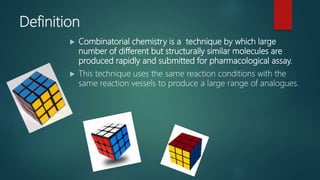
 Combinatorial chemistry is a technique by which large
number of different but structurally similar molecules are
produced rapidly and submitted for pharmacological assay.
 This technique uses the same reaction conditions with the
same reaction vessels to produce a large range of analogues.
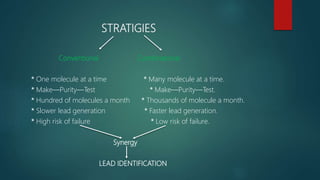
STRATIGIES
Conventional Combinatorial
* One molecule at a time * Many molecule at a time.
* Make—Purity—Test * Make—Purity—Test.
* Hundred of molecules a month * Thousands of molecule a month.
* Slower lead generation * Faster lead generation.
* High risk of failure * Low risk of failure.
Synergy
LEAD IDENTIFICATION
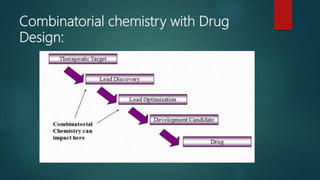
Combinatorial chemistry with Drug
Design:
Why Combinatorial chemistry
 Preparation of large number of compounds at the same time.
 High throughput (rate of) screening provide the most promising
substance.
 Combinatorial library methods were first applied to peptides and
oligonucleotides.
 Combinatorial libraries are collection of finally synthesized compounds
depending on the number of building blocks used as per reaction and the
number of reaction steps, in which a new building block is introduced.
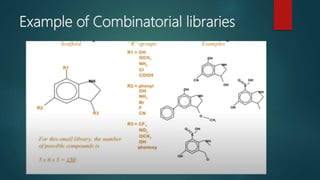
 Combinatorial chemistry libraries are usually represented by one or more
structures with a small number of R-group positions. For each R-group
there are lists of alternative groups.
 Parallel synthesis of Combinatorial libraries can be achieved manually or
robotically, in solution or on solid support.
Example of Combinatorial libraries
 The use of peptide libraries was greatly accelerated by the introduction of
biological methods for library preparation.
 Then the field has been expanded to include proteins, synthetic oligomers,
small molecules and oligosaccharides.
 The method of library preparation is dependent on the type of library
desired.
 All combinatorial library methods involve three main steps:
 Preparation of the library.
 Screening of library compounds.
 Determination of the chemical structures of active compounds.
Source of Molecular Diversity
 Plant extracts
 Microbial Extracts
 Collection of chemical compounds (synthetic)
 Oligonucleotide libraries (biological or synthetic)
 Oligosaccharides libraries
 Chemical compound libraries (synthetic)
 Peptides libraries (biological or synthetic)
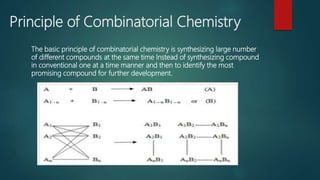
Principle of Combinatorial Chemistry
The basic principle of combinatorial chemistry is synthesizing large number
of different compounds at the same time Instead of synthesizing compound
in conventional one at a time manner and then to identify the most
promising compound for further development.
Techniques of Combinatorial Chemistry
 Solid phase synthesis
 Solution phase synthesis
 Parallel synthesis
 Mixed combinatorial synthesis
 Solid phase Synthesis
In solid phase Combinatorial chemistry or technique the starting compound
is attached to an insoluble resin bead, reagents are added to the solution in
excess, and the resulting product can be isolated by simple filtration, which
traps the beads while the excess reagent is washed away.
STEPS: 1. Attach the starting molecule to an inert solid/ resin bead.
2. Addition of excess of reagents to the solution.
3. Separation of product (Attached to resin beads) by simple
filtration.
4. Cleavage and isolation of products from the beads.
Equipment for Solid phase synthesis
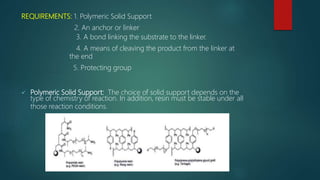
REQUIREMENTS: 1. Polymeric Solid Support
2. An anchor or linker
3. A bond linking the substrate to the linker.
4. A means of cleaving the product from the linker at
the end
5. Protecting group
 Polymeric Solid Support: The choice of solid support depends on the
type of chemistry of reaction. In addition, resin must be stable under all
those reaction conditions.
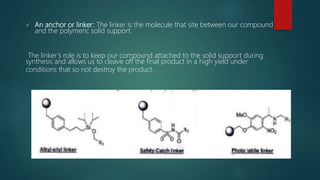
 An anchor or linker: The linker is the molecule that site between our compound
and the polymeric solid support.
The linker’s role is to keep our compound attached to the solid support during
synthesis and allows us to cleave off the final product in a high yield under
conditions that so not destroy the product.
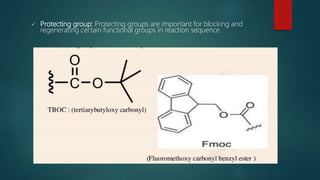
 Protecting group: Protecting groups are important for blocking and
regenerating certain functional groups in reaction sequence.
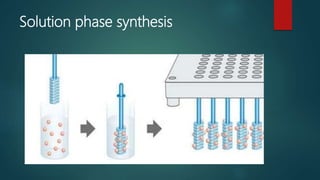
Solution phase synthesis
Equipment for Solution phase
synthesis
Parallel synthesis
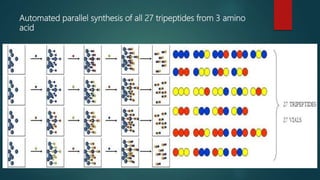
 To use a standard synthetic route to produce a range of analogues, with a
different analogue in each reaction vessel or tube.
 To identify each structure is known.
 Useful for producing a range of analogue for SAR or drug optimization.
Automated parallel synthesis of all 27 tripeptides from 3 amino
acid
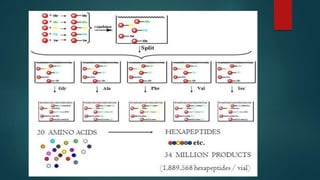
Mixed combinatorial synthesis
 To use a standard synthetic route to produce a large variety of different
analogues where each reaction vessel or tube contains a mixture of
products.
 Useful for finding a lead compound.
 Capable of synthesizing large number of compounds Quickly.
 Each mixture is tested for activity as the mixture.
 Inactive mixture are stored in combinatorial libraries.
 Active mixture are studied further to identify active Compound.
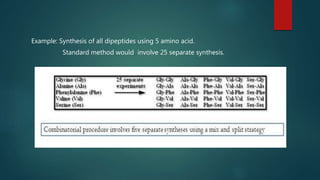
Example: Synthesis of all dipeptides using 5 amino acid.
Standard method would involve 25 separate synthesis.
Application
 Application of combinatorial chemistry are very wide scientists use
combinatorial chemistry to create a larger molecules that can be screened
efficiently.
 By producing larger, more diverse compound libraries, companies increase
the probability that they will find novel compounds of significant
therapeutic and commercial value.
 Provide a stimulus for Robot-controlled and immobilization strategies that
allow High-throughput and multiple parallel approaches to drug discovery.
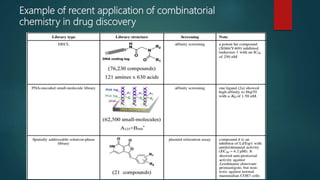
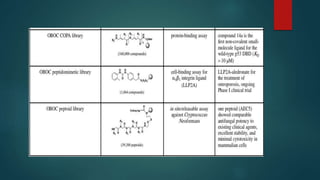
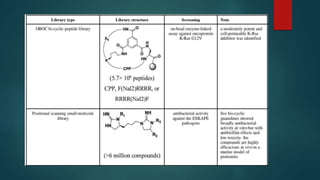
Example of recent application of combinatorial
chemistry in drug discovery
References
 Graham L. Patrick., An introduction to medicinal Chemistry-4th edition.
 Thomas L. Lemke, David A. Williams, Victoria F. Roche, S. William Zito.,
Foye’s principle of Medicinal Chemistry-6th edition.
 Gareth Thomas, Medicinal Chemistry- An Introduction-2nd Edition.
 Medicinal Chemistry-Ashutosh kar-4th Edition.
 John H. Block, John M. Beale, Jr, Organic Medicinal & Pharmaceutical
Chemistry-11th Edition.
Combinatorial chemistry

Combinatorial chemistry

  • 1.
    Combinatorial Chemistry HARENDRA BISHT M. PHARMACY(PHARMACEUTICAL CHEMISTRY) DEPARTMENT OF PHARMACEUTICAL SCIENCE, SIR J.C. BOSE TECHNICAL CAMPUS BHIMTAL MAIL: HSB.BISHT40@GMAIL.COM
  • 2.
    Table of content Introduction  Definition  Combinatorial chemistry with Drug Design  Why Combinatorial Chemistry  Principle of Combinatorial Chemistry  Techniques of Combinatorial Chemistry  Application  References
  • 3.
    Introduction  Combinatorial chemistryis a new method developed by academics and researchers to reduce the time and cost of producing effective, marketable and competitive new drug.  Scientists use combinatorial chemistry to create large numbers of molecules in short period of time that can be detected efficiently. The full set produced in this way is called a library.  This technique has captured the attention of many areas such as Pharmaceutical chemistry, Biotechnology and Argo chemistry.
  • 4.
    Definition  Combinatorial chemistryis a technique by which large number of different but structurally similar molecules are produced rapidly and submitted for pharmacological assay.  This technique uses the same reaction conditions with the same reaction vessels to produce a large range of analogues.
  • 5.
    STRATIGIES Conventional Combinatorial * Onemolecule at a time * Many molecule at a time. * Make—Purity—Test * Make—Purity—Test. * Hundred of molecules a month * Thousands of molecule a month. * Slower lead generation * Faster lead generation. * High risk of failure * Low risk of failure. Synergy LEAD IDENTIFICATION
  • 6.
  • 7.
    Why Combinatorial chemistry Preparation of large number of compounds at the same time.  High throughput (rate of) screening provide the most promising substance.  Combinatorial library methods were first applied to peptides and oligonucleotides.
  • 8.
     Combinatorial librariesare collection of finally synthesized compounds depending on the number of building blocks used as per reaction and the number of reaction steps, in which a new building block is introduced.  Combinatorial chemistry libraries are usually represented by one or more structures with a small number of R-group positions. For each R-group there are lists of alternative groups.  Parallel synthesis of Combinatorial libraries can be achieved manually or robotically, in solution or on solid support.
  • 9.
  • 10.
     The useof peptide libraries was greatly accelerated by the introduction of biological methods for library preparation.  Then the field has been expanded to include proteins, synthetic oligomers, small molecules and oligosaccharides.  The method of library preparation is dependent on the type of library desired.  All combinatorial library methods involve three main steps:  Preparation of the library.  Screening of library compounds.  Determination of the chemical structures of active compounds.
  • 11.
    Source of MolecularDiversity  Plant extracts  Microbial Extracts  Collection of chemical compounds (synthetic)  Oligonucleotide libraries (biological or synthetic)  Oligosaccharides libraries  Chemical compound libraries (synthetic)  Peptides libraries (biological or synthetic)
  • 12.
    Principle of CombinatorialChemistry The basic principle of combinatorial chemistry is synthesizing large number of different compounds at the same time Instead of synthesizing compound in conventional one at a time manner and then to identify the most promising compound for further development.
  • 13.
    Techniques of CombinatorialChemistry  Solid phase synthesis  Solution phase synthesis  Parallel synthesis  Mixed combinatorial synthesis
  • 14.
     Solid phaseSynthesis In solid phase Combinatorial chemistry or technique the starting compound is attached to an insoluble resin bead, reagents are added to the solution in excess, and the resulting product can be isolated by simple filtration, which traps the beads while the excess reagent is washed away. STEPS: 1. Attach the starting molecule to an inert solid/ resin bead. 2. Addition of excess of reagents to the solution. 3. Separation of product (Attached to resin beads) by simple filtration. 4. Cleavage and isolation of products from the beads.
  • 15.
    Equipment for Solidphase synthesis
  • 16.
    REQUIREMENTS: 1. PolymericSolid Support 2. An anchor or linker 3. A bond linking the substrate to the linker. 4. A means of cleaving the product from the linker at the end 5. Protecting group  Polymeric Solid Support: The choice of solid support depends on the type of chemistry of reaction. In addition, resin must be stable under all those reaction conditions.
  • 17.
     An anchoror linker: The linker is the molecule that site between our compound and the polymeric solid support. The linker’s role is to keep our compound attached to the solid support during synthesis and allows us to cleave off the final product in a high yield under conditions that so not destroy the product.
  • 18.
     Protecting group:Protecting groups are important for blocking and regenerating certain functional groups in reaction sequence.
  • 19.
  • 20.
  • 21.
    Equipment for Solutionphase synthesis
  • 22.
    Parallel synthesis  Touse a standard synthetic route to produce a range of analogues, with a different analogue in each reaction vessel or tube.  To identify each structure is known.  Useful for producing a range of analogue for SAR or drug optimization.
  • 23.
    Automated parallel synthesisof all 27 tripeptides from 3 amino acid
  • 24.
    Mixed combinatorial synthesis To use a standard synthetic route to produce a large variety of different analogues where each reaction vessel or tube contains a mixture of products.  Useful for finding a lead compound.  Capable of synthesizing large number of compounds Quickly.  Each mixture is tested for activity as the mixture.  Inactive mixture are stored in combinatorial libraries.  Active mixture are studied further to identify active Compound.
  • 25.
    Example: Synthesis ofall dipeptides using 5 amino acid. Standard method would involve 25 separate synthesis.
  • 27.
    Application  Application ofcombinatorial chemistry are very wide scientists use combinatorial chemistry to create a larger molecules that can be screened efficiently.  By producing larger, more diverse compound libraries, companies increase the probability that they will find novel compounds of significant therapeutic and commercial value.  Provide a stimulus for Robot-controlled and immobilization strategies that allow High-throughput and multiple parallel approaches to drug discovery.
  • 28.
    Example of recentapplication of combinatorial chemistry in drug discovery
  • 31.
    References  Graham L.Patrick., An introduction to medicinal Chemistry-4th edition.  Thomas L. Lemke, David A. Williams, Victoria F. Roche, S. William Zito., Foye’s principle of Medicinal Chemistry-6th edition.  Gareth Thomas, Medicinal Chemistry- An Introduction-2nd Edition.  Medicinal Chemistry-Ashutosh kar-4th Edition.  John H. Block, John M. Beale, Jr, Organic Medicinal & Pharmaceutical Chemistry-11th Edition.