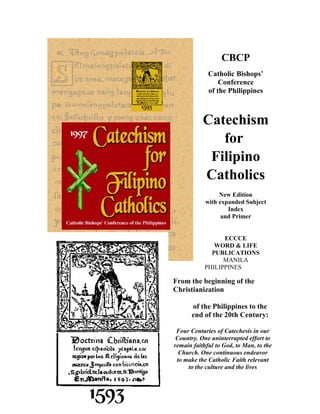
CBCP
             Catholic Bishops’
                 Conference
             of the Philippines


           Catechism
              for
            Filipino
           Catholics
                 New Edition
            with expanded Subject
                    Index
                  and Primer


                 ECCCE
              WORD & LIFE
             PUBLICATIONS
                 MANILA
           PHILIPPINES

From the beginning of the
Christianization

      of the Philippines to the
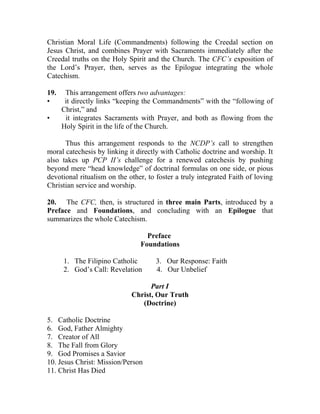
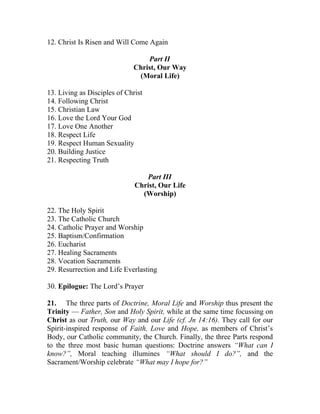
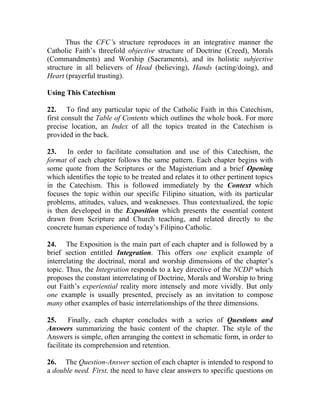
      end of the 20th Century:

 Four Centuries of Catechesis in our
 Country. One uninterrupted effort to
remain faithful to God, to Man, to the
  Church. One continuous endeavor
 to make the Catholic Faith relevant
     to the culture and the lives
of our Filipino People.


       PREFACE
TABLE OF CONTENTS
  SUBJECT INDEX
     GLOSSARY
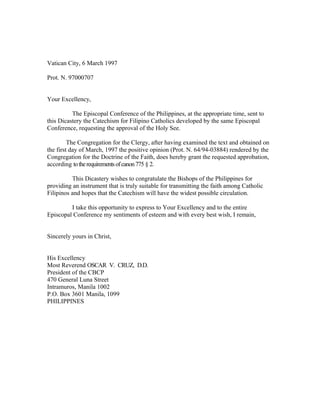
Vatican City, 6 March 1997

Prot. N. 97000707


Your Excellency,

          The Episcopal Conference of the Philippines, at the appropriate time, sent to
this Dicastery the Catechism for Filipino Catholics developed by the same Episcopal
Conference, requesting the approval of the Holy See.

         The Congregation for the Clergy, after having examined the text and obtained on
the first day of March, 1997 the positive opinion (Prot. N. 64/94-03884) rendered by the
Congregation for the Doctrine of the Faith, does hereby grant the requested approbation,
according to the requirements of canon 775 § 2.

          This Dicastery wishes to congratulate the Bishops of the Philippines for
providing an instrument that is truly suitable for transmitting the faith among Catholic
Filipinos and hopes that the Catechism will have the widest possible circulation.

         I take this opportunity to express to Your Excellency and to the entire
Episcopal Conference my sentiments of esteem and with every best wish, I remain,


Sincerely yours in Christ,


His Excellency
Most Reverend OSCAR V. CRUZ, D.D.
President of the CBCP
470 General Luna Street
Intramuros, Manila 1002
P.O. Box 3601 Manila, 1099
PHILIPPINES
Preface

1.    This is the official Vatican approved National Catholic Catechism for
the Philippines, entitled Catechism for Filipino Catholics [CFC]. As a
national catechism, one major function of the CFC has been to draw together
two major current sources for our “renewed catechesis.” The first is the
official Catholic teaching of the universal Church as proposed in the
Catechism of the Catholic Church [CCC], promulgated by the Holy Father
in 1992. The second is the Acts and Decrees of the 2nd Plenary Council of
the Philippines [PCP II], with its supplement, the National Pastoral Plan
[NPP], which together present a comprehensive view of the national culture
and specific catechetical situation of the Philippine Church.

2.   This officially approved edition of the CFC is offered by the Catholic
Bishop’s Conference of the Philippines [CBCP] as a major effort in
implementing PCP II’s urgent call for a triple renewal: a renewed
“Catechesis” which in turn will contribute substantially to a renewed
“Worship” and “Social Apostolate.”


Why a New Catechism?

3.    The most basic reason for this new Catechism is simply the mission
which the Risen Christ entrusted to His apostles. “Make disciples of all the
nations . . . . Teach them to carry out everything I have commanded you”
(Mt 28:19-20). The practical goal of this Catechism, then, is to provide an
effective instrument for creatively handing on the Catholic Faith to
Filipinos. It thus aims to contribute effectively “Toward a Renewed Integral
Evangelization,” developed in PCP II’s National Pastoral Plan [NPP].

4.    The CFC was actually developed according to the NPP’s flow chart. It
was conceived in response to the call for catechetical renewal experienced in
the Church of the Poor. It was formed by following NCDP’s orientational
principles for Philippine catechesis. It presents the operational principles and
content for an integral renewed catechesis. And it envisions the same goal
of a Community of Disciples of the Lord.
5.        Actually there are many catechisms in circulation throughout the Philippines
today. In addition, various religion textbook series have been published for different
levels of school religious instruction. Nevertheless, PCP II’s call for a renewed
integral catechesis has intensified the widely-felt need for a new, up-to-date,
officially approved, exposition of the Catholic Faith. We need a catechism that is
specifically written for Filipinos, in our actual, concrete Philippine situation. In many
parts of our country there are no easily available Catholic catechisms. Even where
some do exist, they are frequently out-of-date, or partial, one-sided accounts, or
foreign works, not written for Filipinos. Even the Vatican’s Catechism of the
Catholic Church [CCC], “a sure and authentic reference text for teaching Catholic
doctrine,” needs to be translated into our Filipino context for a truly inculturated
catechesis.

6.     Thus there is an urgent demand, first of all, for a catechism that
addresses itself to our Philippine context, with its particular needs,
characteristics and crises. The NCDP places great stress on a truly
inculturated catechesis which responds to the concrete situation and culture
of Filipino Catholics and families today, in terms of our own Filipino culture
and values. At the same time, the local and regional contexts must be seen in
terms of the whole Philippine Church, and its catechetical content constantly
related to the CCC’s authoritative presentation of the universal doctrine,
morals, and worship of the Catholic Faith.

7.    The nature and conditions of the Filipino family, and of Filipino value
and belief systems, are undergoing radical changes, amidst our growing
modernization with its economic and political upheavals. This radically
affects the proclamation of Christ’s Good News to today’s Filipino. A
national catechism, therefore, prepared by the CBCP and officially
approved by the proper Vatican Congregations, represents a significant
advance over the many partial, regionally-limited expositions of the Faith.

8.    A second demand arises from the situation of wide diversity and pluralism in
the post-Vatican II era. Bible study, liturgical changes, value education, the
thrust for justice — all have shaped this new “climate.” The sheer number of
different groups, often urging conflicting doctrines and actions, has confused
many regarding even the essentials of the Faith. Some have retreated to a
basically fundamentalist position, in fear of losing their Catholic Faith. Others
have been enticed by new prayer or charismatic sects to abandon the Catholic
Church for more “personable,” warmer socio-religious groups. Many others
are simply disturbed, seeking how they should react to these new challenges
(cf. PCP II 216-28).

9.     In such a situation, shared by Catholics all over the world, this new,
up-to-date Catechism for Filipino Catholics responds to three basic needs.
The first is, that in the face of all the proselytizing and pressure propaganda, Filipino
Catholics look for the reliable Catholic word, especially in family and youth
catechesis. Second, to reject today’s common pursuit of self-centered freedom and
ever richer life-styles, Catholics seek a clear sense of Christian moral values and
responsibility. Today’s morality must be inspired by the Gospel priority of service,
especially to the poor. Third, amidst the anxious search for new prayer forms and
novel faith-experiences, Catholics seek their roots in the Catholic tradition of
community worship (cf. NCDP 54).

Characteristics of This Catechism

10. Given these three basic needs, the mission of the Church to proclaim
Christ’s Gospel calls today for a new type of catechism, adapted to our
times. This new catechism stresses four characteristics.

      Focus on the Essentials

11. The first is its focus on the Essentials of the Faith. The Catechism
can not possibly offer a complete, comprehensive account of all aspects and
elements of the Faith. Rather, it aims at presenting the basics of the Church’s
faith in Christ by drawing directly on the Creed, the Commandments, and
the Sacraments, not on any particular theological school or trend.
       This Faith is proposed in the CCC. Filipino Catholics professed this
Faith in proclaiming the Creed at Sunday Mass. They live out this Catholic
commitment to Christ by obeying the Commandments in their Christian
moral service. And they celebrate it in Catholic sacramental worship. Thus
they express in daily life the greatest of the Christian virtues __ Faith, Hope,
and Love.

12.      These essentials of Faith in Christ must be expressed in an organic and
systematic manner, which is both concentrated yet attractive (cf. PCP II
163; CCC 5). This involves an integrated approach, which constitutes the first
methodological principle of our catechesis (cf. NCDP 75, 414-25). Catholic Faith
is a living integrated whole both in its objective content – Doctrine, Morals, and
Worship, as well as in every subject, every believer. To respond to Christ’s personal
call to discipleship means to believe, act, and worship with all the energies of
one’s head, will, and heart, in Christ’s own community, the Church.

      Experiential/Filipino

13.     Second, believing in Christ must be related directly to the daily
Filipino human experience of living as Christ’s disciple. Such human
experience is found on every page of the Bible, in Church teaching, in the
signs of the times. But it is especially the typical personal experience, culture, and
values of today’s Filipino Catholic that must be evident in the Catechism.
This follows the second catechetical principle of stressing experience and
inculturation (cf. NCDP 401-4; 426-33).

      Catholic

14.      Third, this is to be an explicitly Catholic catechism. This is meant not in
any negative sense of questioning the sincerity or value of other faiths, but
positively in terms of its sources, content and goal. Its sources are Sacred Scripture,
Catholic tradition, especially as presented in The Catechism of the Catholic Church,
and the human experience of Filipinos in their Catholic community. Its content for a
Renewed Integral Evangelization includes the doctrinal truths, moral principles and
values, and liturgical life of that community. Its goal is to build up the Community of
Disciples of the Lord. This constitutes the third basic methodological principle of
our catechetical ministry (cf. NPP; NCDP 434-50).

      Practical

15. Fourth, this Catechism is a book to be used, a source to be consulted
in practical questions about the Faith. Thus it consciously works at integrating
Doctrine (orthodoxy) with Catholic Moral conduct and attitudes, as well as with
Catholic Worship (orthopraxis). But beyond illuminating the Faith, this
Catechism aims at inspiring and motivating its readers to actual personal
commitment to Jesus Christ, within our Catholic community. It invites and
challenges the reader to “come and see” (Jn 1:39), and experience the life of
Faith, Love, and Hope to which Jesus calls every one who listens to his
voice (cf. Lk 11:28).

For Whom the Catechism Is Intended
16. The CFC is expressly directed to all who are actively engaged in
communicating or studying the Faith: priests, religious, catechists, religion
teachers—and perhaps most of all, parents. It is an adult catechism in the
sense that it provides a source book for those who address the typical
Sunday Mass congregation of an ordinary Filipino parish. Therefore, this is
not a parish or school religion textbook. It is intended to serve as a
proximate source for parish catechesis, and for creating religion textbooks
suited to the primary, secondary or college levels.

17.     This Catechism is addressed primarily to committed Filipino
Catholics, rather than to winning new converts to the Catholic Faith.
Nevertheless, it can be very useful for anyone desiring to know more about
the Catholic Faith. Because of its Scripturally based exposition of the Faith,
and its Creedal structure, the Catechism can foster fruitful ecumenical
dialogue with other Christians. Because of its stress on the living Tradition
of the local Catholic Church, it highlights both the basics of the CCC,
especially the teaching of Vatican II, and the pronouncements of the
Catholic Philippine hierarchy [CBCP].
       Thus the Catechism provides Filipino Catholics with a sound
apologetic by giving “the reason for the hope” that Faith instills in them (cf.
1 Pt 3:15). It encourages its readers to “hold fast to the authentic message,
so that [they] will be able both to encourage men to follow sound doctrine
and to refute those who contradict it” (Ti 1:9).

Basic Structure of the Catechism

18. The CFC is structured according to a Trinitarian vision of the Faith
that is at the same time truly Christ-centered. Moreover, the Blessed Virgin
Mary, Mother of our Savior and his perfect disciple, has served as its
inspirational model, just as she has done for countless Filipino Catholics
through the ages. Most important, however, is the need to understand CFC’s
basic structure — both WHAT is its structure, and WHY this structure was
chosen.
       Like the Vatican’s CCC, the CFC is based on “four pillars”: the
baptismal profession of Faith (the Creed), the Sacraments of faith, the life of
Faith (the commandments), and the prayer of the believer (the Lord’s
prayer). (cf. CCC 13)
       Unlike the CCC, however, which simply arranges the four pillars one
after another [1) Creed, 2) Sacraments, 3) Commandments, and 4) Prayer],
the CFC structures the WHOLE Catechism on the Creed. It inserts
Christian Moral Life (Commandments) following the Creedal section on
Jesus Christ, and combines Prayer with Sacraments immediately after the
Creedal truths on the Holy Spirit and the Church. The CFC’s exposition of
the Lord’s Prayer, then, serves as the Epilogue integrating the whole
Catechism.

19.    This arrangement offers two advantages:
•      it directly links “keeping the Commandments” with the “following of
      Christ,” and
•      it integrates Sacraments with Prayer, and both as flowing from the
      Holy Spirit in the life of the Church.

      Thus this arrangement responds to the NCDP’s call to strengthen
moral catechesis by linking it directly with Catholic doctrine and worship. It
also takes up PCP II’s challenge for a renewed catechesis by pushing
beyond mere “head knowledge” of doctrinal formulas on one side, or pious
devotional ritualism on the other, to foster a truly integrated Faith of loving
Christian service and worship.

20. The CFC, then, is structured in three main Parts, introduced by a
Preface and Foundations, and concluding with an Epilogue that
summarizes the whole Catechism.

                                  Preface
                                Foundations

      1. The Filipino Catholic        3. Our Response: Faith
      2. God’s Call: Revelation       4. Our Unbelief

                                   Part I
                             Christ, Our Truth
                                (Doctrine)

5. Catholic Doctrine
6. God, Father Almighty
7. Creator of All
8. The Fall from Glory
9. God Promises a Savior
10. Jesus Christ: Mission/Person
11. Christ Has Died
12. Christ Is Risen and Will Come Again

                                 Part II
                             Christ, Our Way
                              (Moral Life)

13. Living as Disciples of Christ
14. Following Christ
15. Christian Law
16. Love the Lord Your God
17. Love One Another
18. Respect Life
19. Respect Human Sexuality
20. Building Justice
21. Respecting Truth

                                 Part III
                              Christ, Our Life
                                (Worship)

22. The Holy Spirit
23. The Catholic Church
24. Catholic Prayer and Worship
25. Baptism/Confirmation
26. Eucharist
27. Healing Sacraments
28. Vocation Sacraments
29. Resurrection and Life Everlasting

30. Epilogue: The Lord’s Prayer

21. The three parts of Doctrine, Moral Life and Worship thus present the
Trinity — Father, Son and Holy Spirit, while at the same time focussing on
Christ as our Truth, our Way and our Life (cf. Jn 14:16). They call for our
Spirit-inspired response of Faith, Love and Hope, as members of Christ’s
Body, our Catholic community, the Church. Finally, the three Parts respond
to the three most basic human questions: Doctrine answers “What can I
know?”, Moral teaching illumines “What should I do?”, and the
Sacrament/Worship celebrate “What may I hope for?”
Thus the CFC’s structure reproduces in an integrative manner the
Catholic Faith’s threefold objective structure of Doctrine (Creed), Morals
(Commandments) and Worship (Sacraments), and its holistic subjective
structure in all believers of Head (believing), Hands (acting/doing), and
Heart (prayerful trusting).

Using This Catechism

22. To find any particular topic of the Catholic Faith in this Catechism,
first consult the Table of Contents which outlines the whole book. For more
precise location, an Index of all the topics treated in the Catechism is
provided in the back.

23.    In order to facilitate consultation and use of this Catechism, the
format of each chapter follows the same pattern. Each chapter begins with
some quote from the Scriptures or the Magisterium and a brief Opening
which identifies the topic to be treated and relates it to other pertinent topics
in the Catechism. This is followed immediately by the Context which
focuses the topic within our specific Filipino situation, with its particular
problems, attitudes, values, and weaknesses. Thus contextualized, the topic
is then developed in the Exposition which presents the essential content
drawn from Scripture and Church teaching, and related directly to the
concrete human experience of today’s Filipino Catholic.

24. The Exposition is the main part of each chapter and is followed by a
brief section entitled Integration. This offers one explicit example of
interrelating the doctrinal, moral and worship dimensions of the chapter’s
topic. Thus, the Integration responds to a key directive of the NCDP which
proposes the constant interrelating of Doctrine, Morals and Worship to bring
out Faith’s experiential reality more intensely and more vividly. But only
one example is usually presented, precisely as an invitation to compose
many other examples of basic interrelationships of the three dimensions.

25.     Finally, each chapter concludes with a series of Questions and
Answers summarizing the basic content of the chapter. The style of the
Answers is simple, often arranging the context in schematic form, in order to
facilitate its comprehension and retention.

26. The Question-Answer section of each chapter is intended to respond to
a double need. First, the need to have clear answers to specific questions on
points of the Faith that are under attack from non-Catholics, or are widely
misunderstood even among the faithful. The Question-Answer section of
this Catechism attempts to deal with such real, genuine questions of adult
Filipino Catholics today. Second, the Question-Answer section aims at
presenting what is most important and central to each chapter, summarizing
its essential matter. Thus the Questions-Answers offer what is recommended
for learning by heart through memorization.

27. Synthesis. This Catechism, then, can be described in summary terms
as follows:

What? A National Catechism presenting the essentials of the Catholic
    Faith, prepared by the CBCP, following the guidelines of the NCDP,
    and drawing on the Catechism of the Catholic Church [CCC] and the
    2nd Plenary Council of the Philippines [PCP II] with its National
    Pastoral Plan [NPP];

Why? in order to present the essentials of the Catholic Faith, in an up-to-
    date, inculturated, organic, and systematic exposition;

How?     by grounding its message firmly and consistently on Scripture and
       Church Teaching, in unceasing interplay with Filipino experience and
       culture, both personal and social;

For?    Filipino Catholics engaged in communicating the Faith, and all who
       wish to know more about the Catholic Faith today;

In What Shape?
    • structured according to the Trinitarian exposition of the Faith, that
      is Christ-centered by focusing directly on Jesus Christ, our Truth,
      our Way and our Life; and calling for a life-response of Faith, Hope
      and Love, animated by the example of Mary, the mother of our
      Savior and his perfect disciple.
    •   organized in 29 chapters, each with an Opening, a Context, a
      detailed Exposition, a specific example of Integration, and
      concluding with a synthesis in Question-Answer form.
    • with a concluding chapter, the Epilogue, which synthesizes the
      whole work.
Catechism for Filipino Catholics
        Table of Contents

      Chapter 1 : Who is the Filipino Catholic
      Chapter 2 : God's Call : Revelation
      Chapter 3 : Our Response : We Believe
      Chapter 4 : Our Unbelief
      Chapter 5 : Catholic Doctrine : Christ- Our Truth
      Chapter 6 : God - The Father Almighty
      Chapter 7 : Creator of Heaven and Earth
      Chapter 8 : The Fall From Glory
      Chapter 9 : God Promises a Savior
      Chapter 10 : Jesus Christ : Mission and Person
      Chapter 11 : Christ Has Died
      Chapter 12 : Christ is Risen and Will Come Again
      Chapter 13 : Living as Disciples of Christ
      Chapter 14 : The Challenge of Following Christ
      Chapter 15 : The Christian Law of Life-Giving
      Love
      Chapter 16 : Love the Lord Your God
      Chapter 17 : Love One Another
      Chapter 18 : Respect God's Gift : Life
      Chapter 19 : Respecting Human Sexuality
      Chapter 20 : Building Justice
      Chapter 21 : Respecting Truth
      Chapter 22 : The Holy Spirit : The Giver of Life
      Chapter 23 : The Catholic Church : Nature and
      Mission
      Chapter 24 : Catholic Prayer and Worship
      Chapter 25 : New Life in Christ : Baptism and
      Confirmation
      Chapter 26 : Christ - the Living Bread of Life :
      The Eucharist
      Chapter 27 : Christ's Healing : Reconciliation and
      Anointing
Chapter 28 : Vocations in Christ : Marriage and
                         Holy Orders
                         Chapter 29 : FINAL GOAL : Resurrection of the
                         Body and Life Everlasting
                         Chapter 30 : EPILOGUE : The Lord's Prayer


                              Chapter 1
                 Who is the Filipino Catholic?

      The Word became flesh, and made his
      dwelling among us, and we have seen
      his glory, the glory of an only Son,
      coming from the Father, filled with
      enduring love.
                                     (Jn 1:14)

      We Filipinos are followers of Christ, his
      disciples. To trace his footsteps in our
      times means to utter his word to others,
      to love with his love, to live with his
      life; . . . To cease following him is to
      betray our very identity.

                                                         (PCP II 34)


                              OPENING

28. This is a book about life in Christ, life lived according to the Gospel.
The “Good News” is that God has become man in Jesus Christ our Lord,
who came to save us from sin and bring us to fullness of life. This is the
Gospel which we Filipinos have accepted. As PCP II proudly declares: “For
us Filipinos, the first century of the coming millennium will mark the 500th
year since we as a people accepted the Faith” (PCP II 3). It makes us the
only Christian nation among our Asian brethren. There are deep affinities
between Christ’s message and the Filipino’s inmost ways of thinking and
acting. “Much of the Gospel has become part of us __ compassion,
forgiveness, caring, piety __ and makes of us a basically decent people (PCP
II 15). Through the past centuries, right up to our present critical times,
growing more mature in the following of Christ has meant becoming more
truly and authentically Filipino.

29.      Vatican II teaches that Catholics “must give expression to this
newness of [Christian] life in their own society and culture and in a manner
that is in keeping with the traditions of their own land.” As addressed to us Filipino
Catholics, therefore, the Council declares that we

     must be familiar with our culture, we must purify and guard it, develop
     it in accordance with present-day conditions. We must perfect it in
     Christ so that the faith of Christ and the life of the Church will not be
     something foreign to the society in which we live, but will begin to
     transform and permeate it. (AG 21)

30. PCP II insisted on the mutual interaction between Christian Faith and
Filipino culture. “Hence we must take a closer look at how the values that
we have from our Christian Faith can strengthen the good in our cultural
values and correct what is excessive in them and supply for their
deficiencies” (PCP II 22). Likewise,

     for Faith to mature in love, it must be interiorized. Church teachings
     and practices must be personally appreciated and appropriated by us, as
     a people with our own particular culture, with our own ways of thinking
     and valuing. Faith must take root in the matrix of our Filipino being so
     that we may truly believe and love as Filipinos (PCP II 72).


                                   CONTEXT
31. We Filipinos have had a long history of very sharp and colorful
religious experiences: From our pre-Christian times, through the centuries of
Spanish Christian evangelization, to the American Protestant influx in the
Commonwealth era, and the Japanese occupation during World War II, right
up past Vatican II’s “Second Pentecost,” to “People Power” and today’s
“Basic Christian Communities,” and the 2nd Plenary Council of the
Philippines [PCP II]. Our understanding and love of Jesus Christ has been
colored by our personal and national historical experiences of pain and
struggle, of victory and celebration. Our faith in Jesus is marked by our deep
devotion to Mary, his Mother, and our Mother and Model. All these
experiences have somehow defined and clarified our unique identity as
persons, as Christians, as Filipinos, as a nation.

32. PCP II was held “to take stock of where we are; to look where we are
going; to reanimate our life in Christ; to unite all things in Him (PCP II 7).
Our Catholic Faith, therefore, must be “inculturated” within our specific and
unique Filipino character which has in part shaped our faith-experiences
through the years. This Catechism represents a serious effort at just such an
inculturated presentation of the essentials of the Faith to the Catholic
Filipino of today.


                              EXPOSITION


33. To identify what it means to be a “Filipino Catholic” we ask: From
whom do we naturally draw our self-identity? Where do we find the deepest
meaning in our lives? How do we react to suffering? How do we commit
ourselves to our ideals in life? What is our view of the world in all its depth
and hidden reality? Brief answers to these questions can be sketched by
selecting a series of five predominant Filipino characteristics, together with
five essential traits of Jesus Christ, both assumed within the typical “Filipino
way” to Jesus. This will at once define the Filipino Catholic as well as show
that in our country, to become more deeply Christian is to become more
truly and authentically Filipino.
A.    Self-identity

34.      First, we Filipinos are family-oriented. The anak-magulang relationship is of
primary importance to us Filipinos. Ama, ina, and anak are culturally and emotionally
significant to us Filipinos who cherish our filial attachment not only to our immediate
family, but also to our extended family (ninongs, ninangs, etc.). This family-
centeredness supplies a basic sense of belonging, stability and security. It is from our
families that we Filipinos naturally draw our sense of self-identity.

35. Jesus as both the Son of God (Anak ng Amang Diyos) and the Son of
Man (Anak ng Tao) endears himself naturally to us family-oriented
Filipinos. As Son of Man, Jesus leads us to his Mother Mary (Ina ng Diyos)
whom he shares with us (cf. Jn 19:26-27). He thus welcomes us into his own
household, offers himself as our brother (kapatid), and draws us through the
Sacrament of Baptism to a new identity and into the family life of his
heavenly Father (cf. Jn 3:5-7).

36. What can better remind us Filipinos of our early childhood, or respond
more directly to our traditional love for children, than Jesus, the Sto. Niño?
At twelve, Jesus was a discerning and daring child, who nonetheless
remained obedient to his parents (cf. Lk 2:41-51). In his public life, Jesus
embraced little children and admonished his disciples to become child-like
in openness and simplicity (cf. Mt 18:2-4). In our family-orientedness, then,
we Filipinos are naturally attracted to Jesus of Nazareth, Son of God and
Son of Man. Thus, PCP II 46-48 stress the exceptional importance of our
Filipino family as both subject and object of evangelization.

B.    Meaning in Life

37. Second, we Filipinos are meal-oriented (salu-salo, kainan). Because Filipinos
consider almost everyone as part of their family (parang pamilya), we are known for
being gracious hosts and grateful guests. Serving our guests with the best we have is an
inborn value to Filipinos, rich and poor alike. We love to celebrate any and all events
with a special meal. Even with unexpected guests, we Filipinos try our best to offer
something, meager as it may be, with the traditional greeting: “Come and eat with us.”
(Tuloy po kayo at kumain muna tayo.)

38. Jesus as Eucharist is not only the host of the new Paschal Meal (cf. 1
Cor 11:23-26), and the food, the bread of life (cf. Jn 6:48-58), but even the guest in
every gathering (cf. Mt 18:20; Rev 3:20). The New Testament refers more than twenty-
five times to eating (kainan). Eating together in table fellowship with the presence of the
risen Christ (cf. 1 Cor 10:17), “Communion,” in other words, constitutes the core-
witness of the early Church as a Eucharistic community. So we Filipinos feel naturally
“at home” in breaking bread together with Jesus. PCP II’s “spirituality of social
transformation finds in the Eucharist not only its full nourishment but also its total
prayerful communion with the Lord of salvation and liberation” (PCP II
281).

C.    Sufferings in Life

39. Third, we Filipinos are kundiman-oriented. The kundiman is a sad
Filipino song about wounded love. Filipinos are naturally attracted to heroes
sacrificing everything for love. We are patient and forgiving to a fault
(“magpapaka-alipin ako nang dahil sa iyo”). This acceptance of suffering
manifests a deep, positive spiritual value of Filipinos’ kalooban.

40. Jesus, the Suffering Servant of the prophet Isaiah, is portrayed through
our favorite Filipino images of Padre Hesus Nazareno, the Santo Entierro or
the Sacred Heart. Through these images, Jesus appears as one of “the least of our
brethren”: the hungry and thirsty, the naked, the sick, the lonely stranger and
the prisoner (cf. Mt 25:31-46). Jesus the Suffering Servant can thus reach out to us
Filipinos as a healing and forgiving Savior who understands our weaknesses, our
failures, our feelings of depression, fear and loneliness. He has been through it all
himself! To us Filipinos who can even celebrate the sufferings and hardships of
life in song, Jesus Christ calls: “Come to me, all you who are weary and find
life burdensome, and I will refresh you” (Mt 11:28).

D.    Life-Commitment

41.     Fourth, we Filipinos are bayani-oriented. A bayani is a hero. We Filipinos
are natural hero-followers. For all our patience and tolerance, we will not accept
ultimate failure and defeat. We tend instinctively to always personalize any good
cause in terms of a leader, especially when its object is to defend the weak and the
oppressed. To protect this innate sense of human dignity, Filipinos are prepared to
lay down even their lives.

42.     Jesus as Christ the King (Cristo Rey) responds well to the bayani-oriented
Filipino. As born social critics, organizers and martyrs, we Filipinos see
Jesus Christ as the Conqueror of the world by his mission as prophet, king
and priest (cf. PCP II 57-61). Jesus came as one sent by the Father, to do the
Father’s will (cf. Jn 5:30). He was “to bring glad tidings to the poor, to
proclaim liberty to captives, recovery of sight to the blind, and release to
prisoners” (Lk 4:18). Although a “sign of contradiction” himself (Lk 2:34),
Jesus made the Kingdom of God present among his people by his teaching
(cf. Mt 7:29) and signs. “The blind recover their sight, cripples walk, lepers
are cured, the deaf hear, dead men are raised to life, and the poor have the
good news preached to them” (Lk 7:22). So as bayani-oriented, we Filipinos
enthrone our image of Cristo Rey. He assures us that everything will be
alright in the end. Christ the King has won the ultimate victory over evil.
E.    World View

43.     Fifth, we Filipinos are spirit-oriented. We are often said to be
naturally psychic. We have a deep-seated belief in the supernatural and in all
kinds of spirits dwelling in individual persons, places and things. Even in
today’s world of science and technology, Filipinos continue to invoke the
spirits in various undertakings, especially in faith-healings and exorcisms.

44.     Jesus the “miracle-worker” who promised to send his Spirit to his disciples
to give them new life (cf. Jn 15:26; 16:7; 13-14), is thus very appealing to
us Filipinos. The Holy Spirit, sent by the Father and the Risen Christ, draws
us Filipinos into a community wherein superstition and enslaving magic are
overcome by authentic worship of the Father “in spirit and truth” (cf. Jn
4:23). In Christ’s community, the Church, “to each person the manifestation
of the Spirit is given for the common good” (1 Cor 12:7). This same Spirit,
which empowered Jesus the miracle worker, is active in his disciples,
uniting them in the teaching of the apostles, and in community fellowship of
the breaking of bread and prayer through Christ their Lord (LG 13).

F.    The Filipino Way

45.    But accepting Jesus Christ as responding to these essential Filipino
traits has historically come about and continued in a typical “Filipino”
manner. The outstanding characteristic of the Church in the Philippines is to
be a “pueblo amante de Maria” __ a people in love with Mary. Even before the
coming of the Spanish missionaries, there was a small dark image of the
Blessed Virgin, known only as coming “from the sea,” venerated on the
shores of Manila Bay. Thus originated the devotion to Nuestra Señora de Guia,
Our Lady, Guide of the Way, the oldest extant image of Mary in the
Philippines (PCP II 153).
46. The typically “Filipino” approach to Christ, therefore, is with and
through Mary. Devotion to Mary has always been intimately intertwined
with Christ. The two central mysteries of our Faith in Christ: the mystery of
the Incarnation celebrated at Christmas, and of Redemption celebrated
during Holy Week, are deeply marked by the veneration of Mary. This is
portrayed graphically in the Simbang Gabi (Misa de Gallo or de Aguinaldo)
and the panunuluyan at Christmas time, and the Salubong in Easter Sunday
morning (NCDP 242).

47.    Marian devotion and piety seem co-natural to us Filipinos. Mary is
deeply involved in each of the five Filipino characteristics leading us to
Christ. The “family altar” in so many Filipino homes witnesses to Mary as
mother of Jesus and our spiritual mother. Thus she is at the center of our family-
orientedness. As celebration and meal-oriented, Mary’s month of May is noted for
the fiestas in her honor and pilgrimages to her shrines. For suffering in life, Mary
is venerated as the Mater Dolorosa, the Sorrowful Mother, whose “Perpetual Help,”
compassion and love is sought through popular novenas and devotions.
 As bayani-oriented, we have Mary as our Queen, the loving mother of
Christ our King. Moreover, she is the young maiden whose life commitment:
“Be it done to me according to your word,” is repeated thrice everyday in the
Angelus. Finally, as spirit-oriented, Mary is venerated precisely as the
woman upon whom the Holy Spirit came, that her offspring would be called
Son of God (cf. Lk 1:35). The many Lourdes “grottos” throughout our
country testify to our Filipino attraction to her many apparitions.

48. Devotion to the Blessed Virgin Mary, Ang Mahal na Birhen, has
greatly helped many simple Filipinos to remain Catholics. Their deep
devotion to the Mother of God has been the strongest force keeping their faith
alive (cf. AMB 67). Mary has been and remains the central inspiring force in
bringing about a deeper evangelization of the masses of our people, “the
safeguard for the preservation of our Catholic Faith, and the principle of deeper
and fuller evangelization” (AMB 72-73).
G.    The Filipino Catholic

49. From this Marian approach to the series of five Filipino characteristics
inter-related with essential traits of Jesus Christ, a rough sketch of us
Filipino Catholics can be drawn. We are first of all family-centered Filipinos
who can easily talk to God the Father through His only begotten Son-made-
man, our Lord Jesus Christ. Our devotion to the Sto. Niño and the Mahal na
Birhen reveals fundamental depths of our own self-identity. Secondly, we
find meaning in our lives and learn to face the hunger and poverty around us
in encountering Jesus as Eucharist in our parish community. “Around the
table of the Lord,” we Filipino Catholics are drawn by prayer to share our
time, energy and very lives, for the service of our needy brethren and for the
building-up of truly Christian communities of justice, love and healing.

50. Third, as Filipino Catholics, because we have met Christ the Suffering
Servant in his Passion, we can pray about sin and forgiveness, about justice
and reconciliation, about the suffering and Passion of our own Filipino
people today. We have the strength to offer ourselves as “bread broken for
the world,” together with Jesus, because we believe with unshakeable hope
that the Crucified One is Risen from the dead, victorious over sin, death and
the world.

51. Fourth, we Catholic Filipinos, resilient as the bamboo (kawayan) and
sturdy as the narra, commit ourselves to Christ, our hero-king, in deep
gratitude for the gift of faith and for being Filipino. Lastly, our world vision
as Catholic Filipinos is gradually transformed by Christ’s Spirit-in-the-world
in our Church community.
      In the depths of the Filipino spirit is a longing for kaayusan, for order
out of chaos, a longing for the life that the creative Spirit of Jesus gives as a
gift, a gift which is likewise a challenge (cf. PCP II 257). Through
sacramental encounters with the Risen Lord, we experience his Spirit’s
healing and strengthening power. In Christ’s Spirit, we Catholic Filipinos,
inspired by Mary, the Holy Virgin, our Mother, are confirmed in our witness
to Jesus by our service of our brethren, and our persevering prayer for our
beloved dead.

52.     Who, then, are Filipino Catholics? We are a people who have
experienced in one way or another that our Filipino identity, meaning,
suffering, commitment and world-view are all tied to Jesus Christ. Like a
diamond with a thousand facets, Christ is able to reveal to every person and
nation, their very own unity, truth and value. Thus we Filipino Catholics are
people who:

•     as baptized into discipleship of Jesus Christ, discover our identity as
     adopted children of our Father and as members of Christ’s Body, the
     Church, inspired by Mary our Mother;
•     in the breaking of bread around the table of the Lord, find meaning in
     sharing ecclesial fellowship with one another and with Christ, their
     Priest and Eucharist;
•      in meeting the Crucified Savior are sustained in the sufferings and
     hardships of life, and receive forgiveness for their sins through his
     Sacraments;
•     commit ourselves to our Risen Lord and his mission through the gift of
     Faith, celebrated in great Hope in the Sacraments, and lived out in Love
     and service of their fellowmen;
•       form our world-vision led by the Spirit of the Risen Christ,
     experienced in the Christian community, the Church, which sustains us
     in our pilgrimage of life-in-Christ; and
•     approach and live out this Christian life within the powerful inspiring
     presence of Mary, our Mother and Model.


                               INTEGRATION


53. This “doctrine” about the identity, meaning, suffering, commitment
and world view of Filipino Catholics is lived out according to Christian
morality, especially Christ’s basic commandment of love. We Filipinos are by
nature person-centered, spontaneously giving priority to personal feelings, emotions,
relationships, beyond any legal demands or impersonal tasks. Christ’s message
and Spirit continue to purify this natural personalism of undue family-
centeredness and elitist tendencies. For while our natural environment as
Filipinos is always the family, the barkada, relatives and friends, Christian
social morality leads us beyond these limited groups to the larger
community’s common good.

54. Even more striking is our love for celebrating. Our Christian identity
as Filipinos is naturally bound up with Christian worship in our celebration
of Christmas, Holy Week, fiestas and Marian Feasts __ each in a very special
Filipino manner. Again, Christ’s Spirit works from within to purify the
warm piety of Catholic Filipino devotions from all superstitious practices
and magical faith-healers. Authentic Spirit-inspired Christian prayer helps
direct these simple expressions of heartfelt love through Christ to the Father.
Of particular importance are the traditional Filipino Marian devotions which
draw on and express the deep yearnings of the Catholic Filipino.


                    QUESTIONS AND ANSWERS


55.     Who are Christians?
       Christians are men and women who are baptized in the faith that Jesus
      Christ is the Son of God who became man to be Savior of all. United in
      the Church as Christ’s “people of God,” they live out this faith in
      personal conviction, committed witness, and Spirit-inspired worship of
      God their Father.

56.     How can we become more truly Filipino by becoming more truly
      Christian?
       By discovering and proclaiming Jesus Christ in our personal and
      national Filipino culture, we Filipino Catholics invite Christ to purify
      and heal us, and enrich us with fuller life in his Spirit in the Church.

57.     How does the Church relate “being Christian” with our Filipino
      culture?
       There is a mutual relationship:
      • “being Christian” is part of our Filipino identity,
      • maturing in Christian Faith comes only from personally interiorizing
         Jesus’ message in our Filipino ways of thinking, loving and valuing.
       The Church teaches that we Filipino Christians must know our own
      culture, and by our Christian Faith in Christ, purify, guard, develop, and
      perfect it.
       Likewise, we must “inculturate” our Catholic Faith into our Filipino
      ways. (Cf. AG 21; PCP II 202-11.)

58.    What are some of the basic characteristics of the Filipino?
        Filipinos are family-oriented, meal-oriented, patient and long-
      suffering, hero-followers, and firm believers in the spiritual world.
59.     How does Jesus Christ as presented in Catholic teaching correspond
      to Filipino character traits?
       Jesus Christ as Son of God and Son of Man:
      • brings us into the family of God our Father;
      • nourishes us as Eucharist;
      • redeems us as Suffering Servant;
      • calls us to personal commitment to Him as our Risen Hero-King;
      • is experienced in his community, the Church;
      • gives us his Mother Mary to be our Mother in grace.

60.     What is our vocation as Catholic Filipinos in Asia?
       We are called both personally, as individual believers, and ecclesially,
      as members of the Church, to share Jesus Christ with our Asian
      brethren by word and witness, through active commitment to truth,
      justice, freedom and universal Christian love.
            This means “going forth in-spirited to renew the face of the world
      __ the wider world of Asia and beyond, giving of ourselves unto the
      renewal and unity of God’s whole creation” (PCP II 7).
            Our vocation is to move from being truly “Church of the Poor,”
      through “Renewed Integral Evangelization,” toward becoming a real
      “Community of Disciples of Christ” before the world (cf. NPP).


                                 Chapter 2

                        God’s Call: Revelation


       Eternal life is this: to know you, the only true God, and
       him whom you have sent, Jesus Christ.
                                                              (Jn 17:3)

       Blessed be the God and Father of our Lord Jesus
       Christ, who has bestowed on us in Christ every spiritual
       blessing in the heavens! God has given us the wisdom to
       understand fully the mystery, the plan he was pleased to
       decree in Christ, to be carried out in the fullness of
time: namely, to bring all things in the heavens and on
       earth into one under Christ’s headship. In Him you too
       were chosen.
                                                        (Eph 1:3,9-10,13)


                                  OPENING


61. “It pleased God, in His goodness and wisdom to reveal Himself . . . By
this revelation, then, the invisible God, from the fullness of His love,
addresses men as His friends, and moves among them in order to invite and
receive them in His own company” (DV 2). Christian life is based on the
conviction that God has spoken to us and that the central truths of our Faith
are given in this revelation. The Christian Scriptures attest that “in times past
God spoke in varied ways to our fathers through the prophets; in this, the
final age, He has spoken to us through His Son” (Heb 1:1-2).


                                  CONTEXT


62. But how does this idea of “revelation” relate to ordinary Filipino life?
The answer is in our personal relationships. One of the best things you can say
about a Filipino is: “Marami siyang kakilala” (He knows many people), or
“Maraming nakakakilala sa kanya” (Many people know him). On the other hand,
one of the worst things to say about a Filipino is “Wala siyang kakilala” (Nobody
knows him), or “Walang kumikilala sa kanya” (No one gives him recognition). So
in our family relationships and friendships we reveal our personal selves to others,
and openly receive their self-giving to us. This is what uplifts the Filipino.

63. Now the first one to know us, the first one to show us recognition and
reach out to establish a personal relationship with us __ to become our
kakilala __ is God. Only in relation to God do we become our full selves.
Only in coming to know God do we grow to the full stature of our true
selves. But how do we come to know the one true God?
64. Perhaps few countries in the world can compare to the Philippines when
it comes to trying to make God known. Newspapers, radio, TV and movies
are filled with new preachers, religious celebrations, public devotions, and
never-ending appeals for new chapels and churches. Faith healers abound in
every community. Self-proclaimed mediums claim to lead their gullible
devotees in mysterious ways to supposedly closer contact with God, or the
Sto. Niño, or the Blessed Virgin Mary. With so many different people
claiming to reveal God, who can we believe? How does the one true God
actually reveal Himself to us today?


                              EXPOSITION


                       I. GOD REVEALS HIMSELF

A. In Creation

65. The first way God reveals Himself to us is through creation. “The
heavens declare the glory of God, and the firmament proclaims His handiwork” (Ps
19:1). In creation, man holds a special place. God said: “Let us make man in our
image, after our likeness” (Gn 1:26). God even gives us a share in His own
creativity: “Be fertile and multiply; fill the earth and subdue it” (Gn 1:28).
God creates the whole world for us, to support us in life and reveals Himself
to us through His handiwork. “Since the creation of the world. . . God’s
eternal power and divinity have become visible, recognized through the
things He has made” (Rom 1:20).

66. Our Fourth Eucharistic Prayer clearly expresses this recognition of
God’s Self-revelation through creation:

        Father in heaven, You are the one God, living and true . . .
        Source of life and goodness,
        You have created all things
        To fill Your creatures with every blessing
        And lead all men to the joyful vision of Your light . . .
        Father, we acknowledge Your greatness:
        All Your actions show Your wisdom and love,
You formed man in Your own likeness,
            and set him over the whole world
        To serve You, his Creator, and to rule over all creatures.

     Natural Signs

67. For us Filipinos, then, the world and everything in it are natural signs of
God __ the initial way God makes Himself known to us. Yet in our everyday
experience, we meet not only love, friendship, the good and the beautiful,
but also suffering, temptation and evil. All creation has become affected by
sin __ “sin entered the world, and with sin death” (Rom 5:12). The “natural
signs” of the Creator have thus become disfigured by pollution, exploitation,
injustice, oppression and suffering. So God chose to reveal Himself in a
second, more intimate way, by entering into the history of the human race
He had created.

B.   In Scripture, through Salvation History

68. The Bible records God’s entering into a special covenant relationship
with His chosen people, the race of Abraham, the people of Israel. “I will
dwell in the midst of the Israelites and will be their God” (Ex 29:45). Again,
we pray in the Eucharistic Prayer IV:

        Even when man disobeyed you and lost your friendship,
        You did not abandon him to the power of death,
        But helped all men to seek and find you.
        Again and again you offered a covenant to man,
           and through the prophets taught him to hope for salvation.

     Biblical Signs

69. God revealed Himself in stages. In the Old Testament, God revealed
Himself through biblical signs made up of both deeds and words. He made
covenants with Noah, with Abraham, and with Moses. He performed great
works for His Chosen People, and proclaimed their saving power and truth
through the prophets’ words (cf. DV 2; CCC 56-64). Through chosen men
and women __ kings, judges, prophets, priests and wisemen, God led,
liberated, and corrected His people. He forgave their sins. He thus revealed
Himself as Yahweh, He-who-is-with His people. He is “the Lord, a merciful
and gracious God, slow to anger and rich in kindness and fidelity” (Ex
34:6). Today, through His inspired word in the Old Testament, God still
reveals Himself to us, and inspires us to respond to His covenant.

70. Yet, even God’s revelation in history was weakened by the infidelities
and hardness of heart of His Chosen People. But God so loved the world,
that in the fullness of time, He sent His only Son to be our Savior, like us in
all things except sin (cf. Jn 3:16; Gal 4:4; Heb 4:15; CCC 65). Jesus Christ
“completed and perfected God’s revelation by words and works, signs and
miracles, but above all by his death and glorious resurrection from the dead”
(DV 4). Thus the Risen Christ, prefigured in the Old Testament and
proclaimed by the apostles, is the unique, irrevocable and definitive
revelation of God.

C. In the Church

71. But God’s definitive revelation in Jesus Christ did not stop with
Christ’s ascension to his Father. Jesus himself had gathered around him a
group of disciples who would form the nucleus of his Church. In this
Church, the “Good News” of Jesus Christ would be proclaimed and spread
to the ends of the earth by the power of the Holy Spirit, sent down upon the
apostles at Pentecost (cf. Acts 1:8). “What was handed on by the apostles
comprises everything that serves to make the People of God live their lives
in holiness and increase their faith. In this way the Church in her doctrine,
life and worship, perpetuates and transmits to every generation all that she
herself is, all that she believes” (DV 8; cf. CCC 77-79). PCP II summarizes
this by stating that Sacred Scripture and the living tradition of the Church
transmit to us the teachings of Jesus” (PCP II 65).

    Liturgical/Ecclesial Signs

72. God continues to manifest Himself today through the Holy Spirit in the
Church. He is present in the Church’s preaching the truth of Scripture, in its
witness of loving service, and through the celebration of its Christ-given
Sacraments. Christ’s revelation in the Church is “the new and definitive
covenant [which] will never pass away. No new public revelation is to be
expected before the glorious manifestation of our Lord, Jesus Christ (1 Tim
6:14; Ti 2:13)” (DV 4).

73. In summary, then, Filipino Catholics experience God’s Self-revelation
today. First, God shows Himself in the natural signs of the beauty and
abundance of our natural resources and our rich Filipino culture. Second, the
biblical signs in God’s inspired Word in Scripture, the book of the Church,
reveal Him. Third, through the Church’s liturgical signs, we encounter the
Risen Christ in the Sacraments. Finally, God makes Himself known to us
through the ecclesial signs of the Church’s proclamation of the Creed and in
her moral teachings and commitment to service.


D. In Other Religions

74. But many Filipino Catholics ask if non-Christians receive God’s
revelation. The Church, in her prophetic mission of “reading the signs of the
times and of interpreting them in the light of the Gospel” (GS 4), discerns
the seeds of the Word in the history and culture of all men of good will.
Thus, even non-Christians “who do not know the Gospel of Christ or his
Church, but who nevertheless seek God with a sincere heart, and, moved by
grace, try in their actions to do His will as they know it through the dictates
of their conscience, may achieve eternal salvation” (LG 16).

75. For whatever is true and holy in non-Christian cultures and religions is
accepted by the Catholic Church since it “often reflect[s] a ray of that truth
which enlightens all men.” Filipino Catholics, therefore, should
“acknowledge, preserve and encourage the spiritual and moral truths found
among non-Christians, also their social life and culture” (NA 2).
     PCP II provides guidelines for this inter-religious dialogue. It must be
based firmly on the fact that salvation in Jesus Christ is offered to all, and
that the Church is the ordinary means of salvation since she possesses the
fullness of the means to salvation (cf. UR 3). This makes possible “openness
in understanding the religious convictions of others. [For] ‘dialogue based
on hope and love will bear fruit in the Spirit’ (RMi 56)” [PCP II 112-13].


                    II. JESUS CHRIST:
         AGENT, CONTENT AND GOAL OF REVELATION

76. Nevertheless we Catholics must “witness to [our] own faith and way of
life” in the Catholic Church which “proclaims, and is duty-bound to
proclaim, without fail, Christ who is the way, the truth and the life” (NA 2).
Jesus Christ is “himself both the mediator and the fullness of all Revelation”
(DV 2; cf. CCC 65).
PCP II puts it sharply: “We are followers of Christ, his disciples. We trace
his footsteps in our times, to utter his word to others. To love with his love.
To live with his life . . . To cease following him is to betray our very
identity” (PCP II 34). Filipino Catholics, therefore, recognize in Jesus Christ
the goal, the content, and the agent of God’s Self-revelation.

A. Goal

77. As goal, Jesus is “the key, the center and the purpose of the whole of
man’s history” (GS 10), in whose image we all are to be conformed (cf. Rom
8:29). For it is through the Risen Christ that we shall share the Trinitarian
divine life of Father, Son and Holy Spirit. Therefore our present earthly life
is a challenge to “put on the Lord Jesus Christ,” as St. Paul admonishes us
(cf. Rm 13:14).

B.   Content

78. But Christ is not only the goal of God’s revelation, He is also its
content, the Revealed One. In himself, Jesus reveals both God and ourselves.
“Christ, the new Adam, in the very revelation of the mystery of the Father
and of His love, fully reveals man to himself and brings to light his most
high calling” (GS 22). Our Faith centers on Christ precisely because we
believe we “are called to union with him, who is the light of the world, from
whom we go forth, through whom we live, and towards whom our whole
life is directed” (LG 3).

C. Agent

79. Finally, besides being the goal and content of Revelation, Christ is also
its agent, the mediator (cf. DV 2). “God is one. One also is the mediator
between God and men, the man Christ Jesus, who gave himself as a ransom
for all” (1 Tim 2:5-6). Christ is revealer through his part in creation, through
his becoming man, through his hidden and public life, and especially
through his passion, death and resurrection. After his resurrection, the Risen
Christ continues his revelation by sending us his Holy Spirit, the Spirit of
truth (cf. DV 4).

80. But how does the revealing Christ touch the Filipino Catholic today? Clearly,
through his Church, the people of God, united in his name. “The one mediator,
Christ, established and ever sustains here on earth his holy Church, the community
of faith, hope and charity, as a visible organization through which he communicates
truth and grace to all men” (LG 8). The Church herself receives Christ’s revelation.
She regards “the Scriptures, taken together with sacred Tradition, as the supreme
rule of her faith.” For they present “God’s own Word in an unalterable form, and
make the voice of the Holy Spirit sound again and again in the words of the
prophets and apostles” (DV 21).


              III. WHERE WE FIND GOD’S REVELATION

A. Scripture and Tradition

81. The Sacred Scriptures, collected in the Bible, are the inspired record of
how God dealt with His people, and how they responded to, remembered,
and interpreted that experience. The Scriptures arose, then, as the expression
of the people’s experience of God, and as a response to their needs.
Collectively, the Scriptures form “The Book of the People of God” __ the
book of the Church. The Bible was written by persons from the people of
God, for the people of God, about the God-experience of the people of God”
(NCDP 131).

82. The Scriptures, then, are never to be separated from the people of God
whose life and history (Tradition) formed the context of their writing and
development. This is best shown in the three stages of how the Gospels
were formed.
     First stage, the life and teaching of Jesus — what Jesus, while he lived
among us, really did and taught for our eternal salvation, until the day he
was taken up. Second stage, oral tradition. After Jesus’ Ascension, the
apostles handed on to their hearers what Jesus had said and done. Third
stage, the written Gospels. “The sacred authors, in writing the four Gospels,
selected certain elements that had been handed on orally or already in
written form, others they synthesized or explained in view of the situation of
their churches, while preserving the form of proclamation. But always in
such a way that they have told us the honest truth about Jesus” (DV 19; cf.
CCC 126).
     This shows how the written Gospels grew out of oral tradition, and
were composed in view of the concrete “people of God” of the early
Christian communities. Through His inspired Word in Scripture, God
continues to reveal Himself to us today.
83. Sacred Tradition and Sacred Scripture, then, are bound closely together.
. . flowing out from the same divine well spring, moving towards the same
goal and making up a single sacred deposit of the Word of God (cf. DV 9, 10).
Tradition can be taken either as the process by which divine revelation, coming
from Jesus Christ through the apostles, is communicated and unfolded in the
community of the Church, or as the content of the revelation so
communicated. Thus the living Tradition of the Church, which includes the
inspired word of God in Sacred Scripture, is the channel through which God’s
self-revelation comes to us.

84. As Sacred Scripture grew from Tradition, so it is interpreted by
Tradition __ the life, worship, and teaching of the Church. Tradition depends
on Scripture as its normative record of Christian origins and identity, while
Scripture requires the living Tradition of the Church to bring its Scriptural
message to the fresh challenges and changing contexts confronting
Christians in every age.

    Biblical Inspiration

85. The Sacred Scriptures are said to be “inspired” in a special sense __ not
just as some artist or author may be “inspired” to paint or compose. Rather,
biblical inspiration means that the sacred and canonical books of the Old
and New Testaments, whole and entire, were written under the inspiration of
the Holy Spirit, so that we can call God their “author” and the Bible “the
Word of God” (cf. DV 11; CCC 105-6). God chose certain human authors,
who as true authors made full use of their human powers and faculties, yet
were so guided by the Holy Spirit who so enlightened their minds and
moved their wills, that they put down in writing what God wanted written.

86. Biblical inspiration, then, is a charism referring to the special divine
activity, communicated to individual authors, editors, and compilers
belonging to the community, for the sake of the community. It produced the
sacred texts both of the Old Testament and the New. These texts ground the
apostolic Church which remains uniquely authoritative for us and for all
generations of Christians.

87. But the Holy Spirit’s work in Scripture touches more than its human
authors: in some fashion it also touches both the proclaimers and the
hearers of the word. “In the sacred books the Father who is in heaven comes
lovingly to meet His children, and talks with them” (DV 21). Scripture thus
supports and invigorates the Church (cf. CCC 131-33). It strengthens our
faith, offers food for our souls, and remains a pure and lasting fount for our
spiritual lives. Through the Spirit “God’s word is living and effective” (Heb
4:12). But we realize that what was written in the Spirit must be proclaimed
and heard in the Spirit.

    The Canon of Scripture

88. Because of disputes, the Church found it necessary to make a definitive
list, a “canon” of the books which have been truly inspired by God and thus
have God for their author (cf. CCC 120). The Canon of Scripture is divided
into the books written before Jesus’ life (the Old Testament) and those
written after (the New Testament). Guided by the Holy Spirit, the Church
determined the inspired and normative NT books in terms of their apostolic
origin, coherence with the essential Gospel message, and constant use in the
Church’s liturgy. After a long development, the Church finally accepted as
inspired, sacred, and canonical, the 46 books of the Old Testament and the
27 books of the New Testament that we find in our Catholic Bible.

    Inerrant Saving Truth

89. Since all of Scripture was written, compiled and edited under the
inspiration of the Holy Spirit, “we must acknowledge that the books of
Scripture, firmly, faithfully and without error, teach that truth which God,
for the sake of our salvation, wished to see confided to the Sacred
Scriptures” (DV 11; cf. CCC 107). In recognizing the Bible as normative, the
Church confesses that when properly used, Scripture imparts saving truth
that can be relied upon to bring us into deeper communion with God.

90. But we must recognize that the Bible is a collection of historical
accounts, doctrinal teachings, poems, parables, ethical exhortations,
apocalyptic visions and many other forms. It was written over a period of
more than a thousand years, separated from us by almost twenty centuries.
Therefore, it is not easy to determine precisely what is the “saving truth”
which God wills to impart to us through a particular book or text of
Scripture.
     In addition, the Catechism of the Catholic Church reminds us that

    the Christian Faith is not a ‘religion of the Book.’ Christianity is the religion of
    the Word of God, ‘not a written word unable to speak, but the incarnate and
living Word.’ So that the Scriptures do not remain a dead letter, it is necessary
     that Christ, the eternal Word of the living God, by the Holy Spirit, opens our
     minds to understand them (CCC 108).

B.   Interpreting Scripture

91. St. Paul tells us that “all Scripture is inspired by God and is useful for
teaching __ for reproof, correction, and training in holiness so that the man of
God may be fully competent and equipped for every good work” (2 Tim
3:16-17). But the problem, of course, is how to faithfully and accurately
interpret Scripture. For the Filipino Catholic, the answer is clear. “The task
of giving an authentic interpretation of the Word of God has been entrusted
to the living teaching office of the Church alone” (DV 10).

     Four Factors

92. At least four factors play a significant part in interpreting Scripture: (1)
the inspired human author’s intention; (2) the text itself; (3) the reader of the
text; and (4) the common horizon connecting the original community context
of the text with our Christian community reading it today.

93. First, the human author. Common sense tells us to find out what the
inspired human author had in mind when interpreting a text. This involves
some basic idea of the social, economic, and religious conditions of the
authors in their particular historical situations (cf. DV 12; CCC 110).

94. Second, the text itself. We have to look at its literary form (e.g.,
historical narratives, prophetic oracles, poems or parables) which the author
is using (cf. DV 12.)
     In addition, the text must be viewed within the unity of the whole Bible (cf.
CCC 112). Both Old and New Testaments are read by Christians in the light of the
Risen Crucified Christ. The New Testament’s own use of Old Testament events,
persons and things as “types” foreshadowing its own, exemplifies this dynamic unity
of the two Testaments. For example, Adam and Melchisedek are types of Christ (cf.
Heb 6:20-28); the flood foreshadows Baptism (cf. 1 Pt 3:20-21); manna in the
desert is the “type” of the Eucharist (cf. Jn 6:48-51, CCC 128-30).
     Something of the history of the text’s interpretations, especially its use
in the Church’s liturgy, can be very helpful.*
95. Third, the readers/hearers. We are constantly asking Scripture new
questions and problems, drawn from our own experience. Every Filipino
Catholic wants to know what the Scripture means “to me/us.” At the same
time we recognize that the Bible brings its own culture of meanings and
framework of attitudes that help form, reform and transform us, the readers,
into the image of Christ. We must let the Bible “form” us, even while
conscious that we are reading it in the light of our own contemporary
experience.
     In seeking what the Scripture text means “for me/us,” we need to consider the
witness offered in the lives of holy men and women in the Church through the
centuries. Any authentic interpretation of the text for the Christian community today
must be in continuity and harmonize with this tradition of meaning that has grown
out of the text’s impact on Christian communities through the ages (cf. DV 21;
CCC 131-33).

96. Fourth, is the common horizon which first unites all the books of the
Bible into a basic unity, and second, links together the context of the
Scriptural text and its tradition with our present reading context today. This
horizon is the new and eternal covenant God has established with us in His
Incarnate Son, Jesus Christ. In interpreting Scripture, we seek the truth that
God wishes to communicate to us today, through Scripture. In this we are
guided by the living teaching office of the Church which “exercises its
authority in the name of Jesus Christ, not as superior to the Word of God,
but as its servant” (DV 10).

97. Thus we see that “in the supremely wise arrangement of God, Sacred
Tradition, Sacred Scripture and the teaching office (Magisterium) of the
Church are so connected and associated that one of them cannot stand
without the others. Working together, each in its own way under the action
of the one Holy Spirit, they all contribute effectively to our salvation” (DV
10).


                               INTEGRATION


98. The danger is that all this “doctrine” about Revelation and its sources in
Scripture and Tradition will remain only as “head knowledge,” left behind
in our daily living. But God is touching us, calling us to relate to Him in
thought, word and deed. It is in and through our daily life-experiences __ our
everyday dealings in family, work and recreation __ as well as in prayer and
the Sacraments, that God is close to us. Scripture and Tradition illumine our
experiences in two ways: 1) by showing us how to act as disciples of Jesus
Christ, and 2) by helping us discern God’s action in our daily lives.

99. “Showing us how to act as believers in Jesus Christ” is the goal of
Catholic moral teaching. The Filipino Catholic’s conscience is gradually
formed through Scripture and the Church’s living tradition. We are drawn to
the lifestyle of a son/daughter of the heavenly Father, following Jesus
Christ, the Incarnate Son, strengthened and inspired by the indwelling Spirit,
and living in the Church, Christ’s own community. The Commandments of
God and Christ’s Beatitudes do not impose burdensome obligations that
restrict our genuine freedom. Rather, they reveal and protect our inalienable
dignity as human persons by specifying the moral duties of each and
everyone. God’s call to justice and honesty creates our authentic freedom.

100. “To discern God’s action in our daily lives” demands a spiritual
sensitivity that comes only from authentic Christian prayer and worship.
This means that our personal prayer is grounded in God’s revelation in
Scripture and the Church’s living tradition. Only then are we sure to worship
“in Spirit and in truth” (Jn 4:24). All the typical Filipino devotions and
forms of religiosity must ultimately be viewed in the light of the Gospel. For
Jesus Christ taught us to pray “Our Father” (cf. Mt 6:9-13) and gave us the
sacrament of his love to be our sacrificial worship of his Father in the Holy
Spirit.


                   QUESTIONS AND ANSWERS

101. What is “Revelation”?
     Revelation is God’s personal loving communication to us of who He is
     and His plan to save us all in His love. It is God’s reaching out to us in
     friendship, so we get to know and love Him.

102. How does God reveal Himself?
     God reveals Himself in:
• Creating us and everything we see, hear and touch __ from the
       beginning till now [natural signs];
     • His words and deeds in Sacred Scripture’s record of salvation
       history, completed and perfected in His Son-made-man, Jesus Christ
       [Biblical signs];
     • His continuing presence by the Holy Spirit in His people, the
       Church; [ecclesial signs];
     • The prayer and sacramental worship, doctrine, and moral service of
       the Church; [liturgical signs];
     • His interior presence (Grace) in our conscience and in all the events
       of our daily lives, world events, recognized in the “signs of the
       times.”

103. How can the Infinite, Pure Spirit, God, communicate Himself to us in
     this life?
     God reveals Himself to us through the deeds He performed in history
     and the words which proclaim the deeds and clarify their true meaning
     (cf. DV 2.). These words and deeds show God’s presence among us and
     His saving purpose for us.

104. How important is Jesus Christ in God’s Revelation?
     For Christians, it is Jesus who is:
     • the Revealer of God our Father,
     • himself the Image and Word of God; and
     • the Final Goal of God’s revelation, our ultimate destiny.

105. How does Christ reveal God to us today?
     Christ reveals God to us primarily through the Church, its Sacred
     Scripture and living Tradition, through which the Holy Spirit comes to
     us.

106. To whom does God reveal Himself?
     God “wants all men to be saved and come to know the truth” (1 Tim
     2:4), and in ways both hidden and clear, calls all to Christ, who is the
     goal, the object, and the agent of God’s Self-revelation, and “the real light
     which enlightens every man” (Jn 1:9).

107. How are we to understand God’s inspired Word in Scripture?
Under the inspiration of the Holy Spirit, Scripture grew from the life,
    worship and teaching of the early Church. So the Church is its authentic
    interpreter, under the active help of the same Holy Spirit.

108. What do we mean by the Bible’s inerrant saving truth?
     Through the Holy Spirit’s charism of inspiration, the human authors of
     the Bible set down faithfully and without error the truth God wished to
     convey for our salvation (cf. DV 11; 2 Tim 3:16-17).

109. How do we Catholics get to know Sacred Scripture/the Bible?
     Catholics hear the Bible proclaimed at every Mass. Readings from both
     Old and New Testaments are carefully selected and arranged according
     to the Church’s liturgical year.
     In addition, parishes sponsor Bible study groups and encourage a
     Catholic Bible in every home for family reading and prayer.

110. How were the Gospels formed?
     The Gospels were formed in three stages: first, Jesus’ own teaching in
     his earthly lifetime; second, the oral tradition in which the apostles
     passed on what Jesus had said and done; and third, the putting into
     writing of the Gospels that we have till this day.

111. How do we Catholics interpret Scripture?
     In interpreting Sacred Scripture, we search out: (1) the human author’s
     meaning; (2) the context of the text in relation to the whole Bible; 3)
     within our own search for meaning; (4) under the guidance of the Holy
     Spirit through the authentic interpretation of the Magisterium, the
     teaching Church.

112. How important is Sacred Scripture in our daily lives?
     God continues to speak to us personally through His inspired Word in
     Scripture, thereby
     • helping us to understand the true meaning of the daily happenings in
       our lives,
     • guiding our moral behavior toward authentic freedom and loving
       service of others, and
     • drawing us into prayerful union with Christ, our Way, our Truth and
       our Life, in his Church.

113. How has the Bible come to us?
“Bible” comes from the Greek word “Biblia”, meaning “books.” So the
     Bible is really a collection of “books.” The content was first passed on
     by oral tradition over a long period of time before it was put in written
     form.
     The Old Testament was composed in Hebrew and translated into Greek
     around the 2nd and 3rd centuries before Christ. The New Testament
     was composed in Greek during the 2nd half of the 1st century A.D.


----------
* Traditionally four ‘senses’ of Scripture have been distinguished: literal:
  the meaning intended by the original author, providing the basis for all
  other senses; allegorical: a point by point interpretation of the text’s series
  of actions as symbolic of a meaning metaphorically implied but not
  expressly stated; moral: the meaning for our instruction, “as a lesson to us” (1
  Cor 10:11); anagogic: the mystical meaning, interpreted in the light of its
  eternal significance. The four senses were summarized: the literal, teaches
  what happened; the allegorical, what is to be believed; the moral, what is
  to be done, the anagogic, towards what we must strain (cf. CCC 115-19).

                                Chapter 3
                   Our Response: We Believe


      Faith is confident assurance concerning what we hope for,
      and conviction about things we do not see.
                                                     (Heb 11:1)

      Faith is a personal relationship with Jesus Christ as Lord
      and Savior, and through him, with the Father, through the
      Holy Spirit, a decision to commit oneself to Christ, follow
      him, strive to know and accept the truths he continues to
      teach through his Church.
                                               (Cf. PCP II 64-65)


                                 OPENING
114. For most people, faith simply means “believing in God.” Christian
Faith is believing in the God revealed by Jesus Christ. Catholic Christian
Faith means believing that Christ reveals God to us in and through the
Catholic Church, the body of Christ, united in the Holy Spirit. “Believing”
here means realizing that God is calling us to share His divine life __ that is
His pagpapakilala to us. Faith is our personal response as “disciples of Christ”
of accepting him “as Lord and Savior.” “It is our ‘Please come in!’ to Christ
who stands at the door and knocks (Rv 3:20)” (PCP II 64). But how do we
come to know the way to respond to Him? What is this response we call
“faith”?

115. We use “faith” today to mean different things. Sometimes it means our
total response to God’s revelation. “It is to know, to love, to follow Christ in
the Church he founded” (PCP II 36). Or we can use “faith” to mean the
virtue (believing) as distinct from hoping and loving. Faith in this sense
means our personal knowledge of God in Christ, expressed in particular
beliefs in specific truths by which we adhere to Christ. In this chapter we
take faith to mean our whole life in Christ, but with primary focus on
personally knowing Christ as our Truth. The moral activity of love will be
the focus of Part II of this Catechism, Christ our Way, while our Christian
hope will be developed especially in Part III, Christ our Life.


                                    CONTEXT


116. The Philippines is noted for being the only Christian country in Asia. Christian
Faith is one of the distinguishing characteristics of our people. Yet today it is
common to hear Filipino Catholics acknowledging how little they know of their
Christian Faith. Many admit they take their Christian Faith for granted. It enters their
lives mostly through religious ceremonies attached to family celebrations such as
baptisms, marriages, funerals, and house blessings. It is a faith of traditional pious
practices, and sometimes even of superstitions, drawn from our Filipino social,
religious, and cultural environment. Such a faith is dangerously open to proselytizing
by other religious sects of all kinds, or corrupted by the attractions of worldly
secularism (cf. Mt 13:4-9, 18-23).
117. PCP II describes this situation:

    For most of our people today the faith is centered on the practice of
    rites of popular piety. Not on the Word of God, doctrines, sacramental
    worship (beyond baptism and matrimony). Not on community. Not on
    building up our world unto the image of the Kingdom. And we say it is
    because the ‘unchurched,’ the vast majority of our people, greatly lack
    knowledge of and formation in the faith (PCP II 13).

Often this is called “Folk Catholicism.”

118. Today many Filipino Catholics yearn for a more mature Catholic faith
and prayer life. But certain divisive trends and attitudes are also widespread.
Some preach Christian doctrine in such a fundamentalist way that they
ignore the wider demands of Christian charity and service. Others so stress
active ideological commitment to “justice and the poor” as to practically deny
all value to prayer and worship. Finally, still others’ faith is marked by an
individualistic piety, often accompanied by an exaggerated bahala na
fatalism. These excesses or distortions give a false picture of authentic
Catholic Faith. They also show how important it is to understand what
Catholic Faith really is, and how it should operate in our daily lives.


                              EXPOSITION


                   I. FAITH IN HUMAN RELATIONS

119. Faith in its broadest sense is a central reality in Filipino life. It is an
everyday “natural” factor in all our human relationships and daily actions.
For example, in accepting the word of others, we already show our faith
(paniniwala) in them. We readily obey the directions of those over us, at
home, at work, in our communities (pagsunod). We even entrust ourselves
and our welfare to others: doctors, teachers, judges, civic leaders, not to
mention cooks, jeepney drivers, etc. Without such basic human faith which
includes believing acceptance, obedient action and personal entrusting,
human life would be impossible. Faith as a human reality, therefore, is
central to our daily lives.
120. For Filipinos, this can be seen most clearly in our family life and
friendships. We grow up, nurtured and supported by the trust, love and
fidelity of our family. We mature through a process of forming personal
friendships, first as children, then as teenagers, finally as adults. But in each
case, there is a gradual revelation of our own inner self to our friend, and a
free acceptance of our friend’s self-revelation. If this friendship is to grow
and mature, it must include a “turning toward” the other, a conversion. We
acknowledge our need and trust in the other’s friendship by listening to and
identifying with our friend.

121. Filipinos do all this spontaneously, naturally, but not without difficulty.
Sometimes we turn away, or refuse to listen, or are rejected by the other. But
genuine friendships create mutual loving knowledge of each other. In them
we experience something that liberates us from our own narrowness, and
opens us to fuller life and love. We realize that friendship freely offered us
by another, also demands our free response. It is a response that is never just
one act, but a long process of growing intimacy with our friend. Inevitably,
others among our families and associates are eventually involved. Especially
God.

                              II. FAITH IN GOD

122. Faith in God is grounded in God’s own revelation through his words
and deeds in salvation history. It is confirmed by the many reasons for
believing that have been worked out throughout the centuries, responding to
the biblical challenge: “Always be ready to give an explanation to anyone
who asks you for a reason for your hope” (1 Pt 3:15).

A. Characteristics of Christian Faith

     Total and Absolute

123. Already the Old Testament contrasted faith “in man in whom there is no
salvation” with faith in “the Lord who made heaven and earth . . . who shall reign
forever” (cf. Ps 146:3,5-6,10; Jer 17:5-8). Only Faith in God calls for a total and
absolute adherence (cf. CCC 150). Christ himself provides, especially in his
Passion, Death and Resurrection, the best example of this total and absolute
commitment to God.
Trinitarian

124. For us Christians, Faith is our adherence to the Triune God revealed
through Jesus Christ our Lord. It is our friendship with Christ and through
Christ with the Father, in their Holy Spirit. Through Christ’s witness to his
Father in his teaching, preaching, miracles, and especially in his Passion,
Death and Resurrection, we come to believe in Christ our Savior, in the
Father, and in the Holy Spirit sent into our hearts. Our Faith as Catholics,
then, consists in our personal conviction and belief in God our Father,
revealed by Jesus Christ, His own divine Son-made-man, and their presence
to us through the Holy Spirit, in the Church (cf. PCP II 64; CCC 151-52).

     Loving, Maturing and Missionary

125. Our Christian Faith is truly life-giving and mature only through love,
for “the man without love has known nothing of God, for God is love” (1 Jn
4:8). And to be Christian, this love must be inseparably love of God and
love of neighbor, like Christ’s. It thus impels us to mission, to evangelize,
by bringing others the Good News (cf. 1 Cor 9:16). Such a missionary spirit
is the test of authentic Faith because it is unthinkable that a person should
believe in Christ’s Word and Kingdom without bearing witness and
proclaiming it in his turn (cf. EN 24; PCP II 67-71, 402). This means we are
all called to share in Christ’s own three-fold mission as priest, prophet and
king (cf. PCP II 116-21; LG 10-13).

     Informed and Communitarian

126. PCP II insists that Catholic Faith must be “informed,” that is
“believing Jesus’ words, and accepting his teachings, trusting that he has
“the words of eternal life” (cf. Jn 6:68; NCDP 147). It must be
“communitarian” since it is the Church that transmits to us Christ’s
revelation through Sacred Scripture and its living Tradition, and alone
makes possible for us an adequate faith-response (cf. PCP II 65).

     Inculturated

127. This Catholic faith in God and in Jesus Christ is never separated from
the typical Filipino faith in family and friends. On the one hand, we live out our
faith in God precisely in our daily relationships with family, friends, fellow workers,
etc. On the other hand, each of these is radically affected by our Catholic Faith
in God our Father, in Jesus Christ His only begotten Son, our Savior, and in
their Holy Spirit dwelling within us in grace. “This is how all will know you
for my disciples: your love for one another” (Jn 13:35; cf. PCP II 72-73,
162, 202-11).


B.   The Three Essential Dimensions of Faith

128. Vatican II explains this faith-response as follows: “By faith man freely
commits his entire self to God, making ‘the full submission of his intellect
and will to God who reveals,’ and willingly assenting to the Revelation
given by Him” (DV 5). Christian Faith, then, touches every part of us: our
minds (believing), our wills (doing), and our hearts (trusting). Let us briefly
examine each aspect in turn.

     Believing

129. Faith involves our basic convictions as Christians. “For if you confess
with your lips that Jesus is Lord, and believe in your heart that God raised
him from the dead; you will be saved” (Rom 10:9). John sums up his Gospel
with: “These things have been recorded to help you believe that Jesus is the
Messiah, the Son of God, so that through this faith you may have life in his
name” (Jn 20: 31).
     Faith, then, is knowing, but not mere “head knowledge” of some
abstract truths. It is like the deep knowledge we have of our parents, or of
anyone we love dearly. Christian Faith, then, is personal knowledge of
Jesus Christ as “my Lord and my God” (Jn 20:28). Christ solemnly assures
each of us: “Here I stand knocking at the door. If anyone hears me calling
and opens the door, I will enter his house, and have supper with him, and he
with me” (Rv 3:20).

     Doing

130. But besides believing, faith is also doing. As St. James writes: “My
brothers, what good is it to profess faith without practicing it?” (Jas 2:14).
Christ himself taught: “None of those who cry out ‘Lord, Lord’ will enter
the Kingdom of God, but only the one who does the will of my Father in
heaven” (Mt 7:21). Faith, then, is a commitment to follow (obey) God’s will
for us. This we see exemplified in Mary’s “I am the servant of the Lord. Let
it be done to me as you say” (Lk 1:38).
PCP II brings out this “doing” dimension of faith as “witnessing”
through “loving service” of our needy neighbors. In our concrete situation,
particularly urgent is the call for: 1) deeds of justice and love; and 2) for
protecting and caring for our endangered earth’s environment (cf. PCP II
78-80).

131. Of course, we realize that we often do not do what we affirm in faith.
But this awareness of our failures emphasizes all the more the essential place
of behavior in authentic Christian Faith. It also makes us more conscious of
our need for Christ’s Spirit to live out our faith in our actions. “For apart
from me you can do nothing” (Jn 15:5). “Before this faith can be exercised,
man must have the grace of God to move and assist him; he must have the
interior helps of the Holy Spirit, who moves the heart and converts it to
God” (DV 5).

     Entrusting/Worshipping

132. Beyond believing and doing, faith is also entrusting oneself into God’s
hands. Abraham, our father in faith, at God’s command left everything to set
out for a foreign land. Against all human odds Moses trusted Yahweh to free
the Hebrews from their slavery in Egypt. In the New Testament, Jesus
worked signs and cures only with those who trusted in him. He promised the
possessed boy’s father: “Everything is possible to a man who trusts” (Mk
9:23).

133. Faith, then, is from the heart __ the loving, trusting, and hoping in the
Lord that comes from God’s own love flooding our hearts. This trusting
Faith “lives and grows through prayer and worship” __ personal heartfelt
conversation with God that is the opposite of mindless, mechanical
repetition of memorized formulas. Genuine personal prayer and group
prayer find both their inspirational source and summit of perfection in the
Liturgy, the Catholic community’s official public Trinitarian worship of the
Father, through Jesus Christ our Lord, in the Holy Spirit (cf. PCP II 74-77).


C. Faith and Three Classic Questions

134. These three aspects of our Christian Faith __ believing, doing, prayerful
trusting __ respond to the three classical questions posed to every person in life, and
to St. Augustine’s famous triple definition of faith. To the question “What can I
know?” Christian faith responds that we can know God as Our Father and Christ
as Our Lord (credere Deum/Christum). “Know that we belong to God . . . that the
Son of God has come and has given us discernment to recognize the One who is
true” (1 Jn 5:19-20). Pagkilala sa Ama, sa Anak at sa Espiritu Santo.

135. “What should I do?” is answered curtly by “Keep His commandments” (1 Jn
2:3), which means to “love in deed and truth and not merely talk about it” (1 Jn
3:18). This demands acting on the credibility of God’s teachings in Christ as
true and dependable (credere Deo/Christo).

136. Finally, to the question “What may we hope for?” Christian Faith celebrates
in prayer and sacrament the unshakeable hope that “neither death nor life, neither
angels nor principalities, neither the present nor the future, nor powers;
neither height nor depth nor any other creature, will be able to separate us
from the love of God that comes to us in Christ Jesus, our Lord” (Rom 8:38-
39). In brief, this hope means to believe in God “with your whole heart, with your
whole soul, and with all your mind” (Mt 22:37), entrusting ourselves to Him in love
(credere in Deum/Christum).


D. Faith and Salvation

137. But faith is not some “answer box” __ it is not some “thing” we have,
keep, and own. Rather, real faith is a force within us that by the power of
Christ’s Holy Spirit gradually works a transformation in our daily thoughts,
hopes, attitudes and values.
     In religious terms, we know that faith is necessary for salvation __ it is
the “beginning of our salvation” (cf. Trent, ND 1935; CCC 161). For
“without faith it is impossible to please God” (Heb 11:6). From experience
we realize that faith brings us fuller life which can be described by three
basic values: genuine personal maturity, freedom and happiness.

     Maturity

138. Faith is a growth in personal maturity because it helps us “put childish
ways aside” (1 Cor 13:11). It develops a basic honesty in us before God and
man by making us aware of the sacrifices demanded by authentic human
love. It grounds our own self-identity in the fact that we are sons and
daughters of the Father, redeemed by the Blood of Christ our Savior, and
inspired by their indwelling Holy Spirit.
Freedom

139. Faith in Christ frees us from preferring “darkness rather than light” (Jn
3:19), “the praise of men to the glory of God” (Jn 12:43). Without faith in
God, we are at the mercy of “carnal allurements, enticements for the eye, the
life of empty show” so that “the Father’s love has no place in us” (1 Jn 2:15-
16). As Scripture warns us: “the world with its seductions is passing away,
but the man who does God’s will endures forever” (1 Jn 2:17).

     Spiritual Joy

140. In so liberating us, faith in Christ fosters the value of spiritual joy. So
Mary proclaimed: “My soul proclaims the greatness of the Lord, and my
spirit rejoices in God my Savior” (Lk 1:46-47). John the Baptist was
“overjoyed” to hear Christ’s voice __ “that is my joy, and it is complete” (Jn
3:29). Christ himself taught his disciples “so that my joy may be yours, and
your joy may be complete” (Jn 15:11), a “joy no one can take from you” (Jn
16:22). For Christian Faith is our response to Christ’s “Good News,” lived
in the Spirit whose fruits are “love, joy, peace, patience, endurance,
kindness, generosity, faith, mildness and chastity” (Gal 5:22).


III. PARADOXICAL CHARACTERISTICS OF FAITH

141. Christian Faith presents us with a number of paradoxes that help us
grasp its complex reality.

A. Certain, Yet Obscure

142. The first is that Faith is both most certain yet obscure (cf. CCC 157-
58, 164). In common usage we speak of “taking things on faith” when we
are not sure. We live in a secular age where “to be sure” means being able to
prove it by experiment and “scientific” means. But this is a rationalistic
illusion. We have been “brainwashed” by our own creation of today’s
scientific technology.

143. As Filipinos, we realize that none of our major personal decisions, nor our
basic ideals and attitudes towards life, freedom, love, etc. could ever be “proven”
by scientific experiment. Our family, our friends, our community, our
vocation in life __ all depend on the vision, inspiration and strength we call
“faith”. It is the most “certain” of all we know because it is the foundation
upon which we build our lives. But how are we sure of this “faith-
foundation”?

144. Such a sure foundation could never come from ourselves, or from other limited
men or women. It could never arise from some self-evident truth, or some logical
deduction that compels assent (CCC 156). All these need to be, themselves,
grounded on some unshakeable foundation. Only the very Word of God could
possibly offer such a foundation. Faith is certain because it rests on God who
reveals Himself in the person of Jesus Christ, present to us in His Spirit. We are
certain of our Faith because it is our personally committed loving knowledge
based on the convincing signs of God revealing Himself in Jesus Christ, and
present to us in His Church through word, service, fellowship, and
sacrament.

145. But this certainty of Faith does not mean everything is clear and
obvious. On the contrary, we believe God is “Mystery”, that is, He is always
more than we can ever fully comprehend. St. Paul teaches us: “Now we see
indistinctly, as in a mirror” (1 Cor 13:12). “We walk by faith, not by sight” (2
Cor 5:7). But this obscurity which we experience even in our deepest human
relations does not destroy faith’s firmness. We instinctively recognize that
persons, and especially the all-personal God, can never be reduced to being
“proven” by scientific experiment.

B.   Free, Yet Morally Obliging

146. Faith’s second paradox is that it is both free and morally obliging (cf.
CCC 160). Our Christian Faith is a free response. No one, not even God,
forces us to believe.

     God calls men to serve Him in Spirit and in truth. Consequently they are
     bound to Him in conscience but not coerced. God has regard for the
     dignity of the human person which He himself created: the human person is
     to be guided by his own judgment and to enjoy freedom (DH 11).

     We Filipinos experience this paradoxical combination of freedom and
obligation in our family relationships and friendships. Persons who love us
the most have the most claim on us, yet force us the least. We naturally
respond to them in love. God, who by loving us the most has the greatest
claim on us, leaves and keeps us most free.

C. Reasonable, Yet Beyond Natural Reason

147. A third paradox is that Christian Faith is both reasonable, yet more
than natural reason (cf. CCC 155-56). Christian Faith is in no conflict with our
reason. On the contrary, only rational creatures can believe. Yet faith itself is a grace
that enlightens our minds. “Unless you believe, you will not understand”
(Augustine’s quote of Is 7:9). Our faith in Christ illumines our reason because we
believe him who claims “I am the light of the world. No follower of mine shall ever
walk in darkness; no, he shall possess the light of life” (Jn 8:12; cf. Vatican I, ND
135).

D. An Act, Yet a Process

148. A fourth paradox highlights Faith as both a particular act, yet
perseverance in a life-long process that is the beginning of eternal life (cf.
CCC 162-63). John’s Gospel declares: “Eternal life is this: to know you, the
only true God, and him whom you have sent, Jesus Christ.” (Jn 17:3). But
this faith in Christ is much more than a single, personal decision for Christ.
It is an enduring way of life within the Christian community, the Church. In
fact it is the principle of our new life in Christ, which gives us a foretaste of life-
with-him in heaven. St. Paul wrote: “The life that I now live is not my own; Christ
is living in me. I still live my human life, but it is a life of faith in the Son of God,
who loved me and gave himself for me” (Gal 2:20). Faith as “following Christ”
must be gradually and perseveringly developed so that it comes to touch every
aspect of our lives, throughout our whole lives.

E.   A Gift, Yet Our Doing

149. Faith’s fifth paradox is that it is both a gift, a grace from God, yet
something we do (cf. PCP II 68; CCC 153-55). It is a gift because “No one
can come to me,” Jesus said, “unless the Father who sent me draws him” (Jn
6:44). St. Paul confirms this: “No one can say ‘Jesus is Lord,’ except in the
Holy Spirit” (1 Cor 12:3). Our Christian Faith, then, is not merely of our
own doing. It depends upon God for two things: first, God’s free gift of
revealing Himself throughout salvation history; second, for the grace of the
Holy Spirit’s interior illumination and inspiration which “gives to all joy in
assenting to the truth and believing in it” (Vat. I, DS 3010; ND 120).
150. But God’s “gift” of faith demands our free cooperation with others. St.
Paul explains this: “Faith, then, comes through hearing, and what is heard is the
word of Christ” (Rom 10:17). Our hearing of Christ’s word today depends on the
preaching and teaching just as it did in the time of the Apostles (cf. Mt
28:20; Acts 2:42; 4:25). This “hearing” means not only listening to the
Word of God in Scripture and to Church teaching. It also involves
discerning God’s presence to us through events in our lives, our
companions, our inner thoughts, yearnings and fears, etc. In brief, faith is
also our active response to the witness to Christ and the Gospel given us by
others. This active response is motivated and inspired by the prayer and
worship we share with our fellow members of Christ’s Church.

F.   Personal, Yet Ecclesial

151. Faith’s sixth paradox is its personal yet ecclesial nature. It is first of all
the Church who believes and thus supports and nourishes our faith (cf. CCC
168-69). We received the grace of faith when we were baptized and received
into the Christian community, the Church. Within our Christian families and
our parish community, the faith implanted in Baptism grows and matures.
Through catechesis, through the Sacrament of Confirmation, through the
Word of God preached and explained, and especially through the Eucharistic
celebration of Christ’s Paschal sacrifice, we grow in faith.
      Our personal faith in Christ is supported and intensified by our fellow
members in the parish or BCC, according to God’s own plan. For “He has
willed to make men holy and save them, not as individuals without any bond
or link between them, but rather to make them into a people” (LG 9).

152. Christian faith has many different adherents and forms, even in our
country. But a central feature of Catholic Faith is its ecclesial structure. God
always revealed Himself in the Old and New Testaments in terms of a
community. Moreover, this revelation has been handed down through the
Church’s tradition to us today. It is in the Church that we Catholics
experience the power of the Risen Christ through the gift of the Holy Spirit.
It is in the Church, the body of Christ, that the Catholic Filipino meets Christ
in God’s Word in Scripture, in Church teaching, in the liturgical,
sacramental praise and worship of God, and in the ministry of service of one
another.
153. Christ is personal Savior to Filipino Catholics not as private individuals,
but as members of a community of salvation wherein we meet Jesus and
experience his saving power. Faith is never just something private or
individualistic, but a sharing in the Christian community’s faith. This faith is
in living continuity with the Apostolic Church, as well as being united to all
the Catholic communities today the world over. Vatican II well describes the
origins of this ecclesial dimension of faith:

154. “As the firstborn of many brethren, and by the gift of his Spirit, Christ
established, after his Death and Resurrection, a new brotherly communion
among all who received him in faith and love; this is the communion of his
own body, the Church, in which everyone as members would render mutual
service in the measure of the different gifts bestowed on each” (GS 32).


                      IV. MARY: MODEL OF FAITH

155. Many Filipino Catholics probably learn more about Faith from their
devotion to the Virgin Mary than any other way. This is perfectly grounded
in Scripture which portrays Mary as the exemplar of faith. Through her
“Yes” at the Annunciation, Mary “becomes the model of faith” (AMB 35; cf.
CCC 148). Luke stresses the contrast between Mary’s faith and the disbelief
of Zachary by Elizabeth’s greeting. “Blest is she who trusted that Lord’s
words to her would be fulfilled” (Lk 1:20, 45). John Paul II writes that “in
the expression ‘Blest are you who believed’ we can rightly find a kind of
‘key’ which unlocks for us the innermost reality of Mary, whom the angel
hailed as ‘full of grace’ ” (cf. RMa 19).

156. Mary perfectly exemplified the common definitions of faith as “full
submission of intellect and will” and the “obedience of faith” (Rom 16:26;
1:5; cf. DV 5). But she did it personally,

    with all her human and feminine “I”, and this response of faith included both
    perfect cooperation with the “grace of God that precedes and assists,” and
    perfect openness to the action of the Holy Spirit, who constantly brings faith to
    completion by his gifts (DV 5; cf. LG 56).

Luke carries this theme of Mary’s faith into his second inspired book where
he describes her presence among “those who believed” in the apostolic
community after the Resurrection (cf. Acts 1:14).
157. Mary is truly an effective inspiration to us because she constantly
exercised faith in all the realities of ordinary, daily living, even in family
crises. Luke’s account of the “finding in the Temple” offers a perfect
example (cf. Lk 2:41-52). There is the first stage of astonishment at seeing
Jesus in the temple, in the midst of the teachers. Astonishment is often the
beginning of faith, the sign and condition to break beyond our “mind-set”
and learn something new. Mary and Joseph learned something from Jesus
that day.

158. Second, there is distress and worry, real anguish and suffering. As with
the prophets, God’s Word brings good and bad fortune. Mary was already
“taking up the Cross” of the disciple of Christ. Third, there is often a lack of
understanding. Both Mary and Joseph, and later “the Twelve,” could not
understand what Jesus meant. Faith is not “clear insight” but “seeing
indistinctly, as in a mirror” (1 Cor 13:12).
     Finally, there is the fourth stage of search wherein Mary did not drop
the incident from her mind, but rather “kept all these things in her heart.”
Faith is a continual search for meaning, for making sense of what is
happening by uncovering what links them together. Like the “scribe who is
learned in the reign of God” Mary acted like “the head of a household who
brings from his storeroom both the new and the old” (Mt 13:52).

159. Since faith is the key to Mary’s whole life, from her divine motherhood
to her “falling asleep in the Lord,” her life is a real “pilgrimage of faith”
(LG 58). That makes her our model and support in faith. But beyond our
individual ‘faith lives,’ John Paul II has brought out its wider significance.

     I wish to draw on the ‘pilgrimage of faith’ on which the Blessed Virgin
     advanced . . . This is not just a question of the Virgin Mother’s life-
     story, of her personal journey of faith . . . It is also a question of the
     history of the whole people of God, of all who take part in the same
     ‘pilgrimage of faith’ (RMa 5; cf. 14-18).


                             INTEGRATION
160. Faith is a reality touching our whole selves __ our minds (convictions),
our hands and will (committed action) and our hearts (trust). The objective
aspects of Christian faith, exemplified in doctrine (the Creed), morals (the
Commandments) and worship (the Sacraments), also manifest faith as an
integral whole. Christian Faith, then, is not something fragmented. It is a
living way of life that integrates our minds, wills, and hearts with its
doctrine, morals, and worship, within a sustaining community of fellow
disciples of Christ.

161. To understand the “doctrine” or truth of what faith is, then, demands
recognizing its moral and worship dimensions (doing and praying).
Scripture constantly insists on this. “The way we can be sure of our
knowledge of Christ is to keep his commandments” (1 Jn 2:3). And the way
to pray is “through him, with him, in him, in the unity of the Holy Spirit, all
glory and honor is yours, almighty Father, for ever and ever. Amen.”


                     QUESTIONS AND ANSWERS


162. What does “faith” mean in daily life?
     Faith in general means the way we know, accept, and relate positively to
     others, especially the mutual trust, love, and fidelity we experience in family
     and friendships.

163. What is meant by “Catholic faith”?
     Catholic Faith is “to know, love, and follow Jesus Christ in his Body,
     the Church” (PCP II 36).
     It is that attitude, activity, and process by which we, empowered by
     God’s grace:
     • freely commit our entire selves to God,
     • offer our liberty, our understanding and our whole will to God who
        reveals Himself and His plan, and
     • willingly assent to His Revelation (cf. DV 5).

164. What does faith as “committing our entire selves to God” entail?
     Faith as a living response to God includes:
     • our minds, believing in God who calls us to salvation in Jesus;
     • our will and hands, doing God’s will, and
• our hearts, entrusting ourselves to God in prayer and worship.

165. What are some basic characteristics of Christian Faith?
     Christian Faith is:
     • total, absolute commitment,
     • to the Blessed Trinity: our heavenly Father, Jesus Christ, his own
       divine Son-made-man, and their Holy Spirit,
     • in a “loving knowledge”
     • that helps us grow and mature as Filipinos,
     • within our Filipino culture and values, and
     • “sends” us forth to spread the Gospel.

166. How important is Faith?
     Faith is necessary to become our true selves and thus gain our salvation,
     that is, union with God: Father, Son and Holy Spirit.
     To the three human classic questions Faith responds
     • What can I know? God our Father and Christ our Lord.
     • What should I do? Love others as Christ does.
     • What may I hope for? Christ’s presence and life everlasting.

167. What does faith in Christ do for us?
     Faith in Jesus Christ:
     • helps us to grow into adult persons who can relate to others
       responsibly and maturely;
     • liberates us from being enslaved by sin; and
     • opens us to deep joy and happiness in the Lord.

168. What are the paradoxical characteristics of Faith?
     Our Christian Faith is at once both:
     • certain enough to die for, yet a “mystery” because like love, there is
       always more to understand;
     • a free personal response to God, yet morally binding in conscience;
     • reasonable, yet beyond our natural ways of knowing;
     • an individual act of our graced reason, yet also a life-long process;
     • a gift of God through both Revelation and interior inspiration, yet
       something we do nobody can “believe” for us;
     • a personal individual response, yet only possible as a member of the
       Christian community, the Church.

169. How can we be sure of our faith?
Faith is something like the loving knowledge we have of our family and
friends. We are “sure” of their love and we try to respond to them.
Likewise, through God’s Revelation in Christ, we are absolutely sure of
His love for us, and try to respond through the gift of faith.


                         Chapter 4

                       Our Unbelief

 “What an unbelieving lot you are! . . . how
 long can I endure you? . . . Everything is
 possible to a man who trusts.” Then the father
 cried out: “I do believe, help my lack of
 trust!”
                              (Mk 9:19, 23-24)

 “Stop murmuring,” Jesus told them. “No one
 can come to me unless the Father who sent
 me draws him; I will raise him up on the last
 day. . .You will surely die in your sins unless
 you come to believe that I Am.”
                                (Jn 6:43f; 8:24)


                          OPENING
170.    Christ, throughout the Gospels, constantly called for faith. Jesus
praised the Roman centurion for his great faith (cf. Mt 8:8-10). He chided
those who worried too much about food and clothing for their weak faith (cf.
Mt 6:30). He could not work miracles among the Nazareans because of their
lack of faith (cf. Mk 6:5). On the stormy lake, Jesus asked his terrified
apostles: “Why are you lacking in faith?” (Mk 4:40). And at his Last Supper,
Jesus said to Peter: “I have prayed for you that your faith may not fail” (Lk
22:32).

171. We know from experience that Christian Faith meets all kinds of
different receptions among us, and within us, throughout our lives.
Sometimes in our thinking we put conditions to believing, like the doubting
Thomas: “I will never believe it without probing the nailprints in his hands .
. .” (Jn 20: 25). At other times, our actions belie our faith, like St. Peter’s
triple “I do not know the man” (Mt 26:72). Or perhaps in our trusting and
hoping, we begin to doubt, like the disciples of John the Baptist: “Are you
‘he who is to come,’ or are we to look for someone else?” (Lk 7:20).


                                 CONTEXT


172. The faith of the Filipino Catholic today is exposed to many pressures
and temptations toward unbelief. Our whole social context of Christian faith
and the Church has changed. Before, Filipinos lived in a more stable society
in which the Church held a dominant position. Unbelief was generally
restricted to certain non-practicing individuals who were pursued pastorally
by the Church to return to the sacraments. Today we Filipinos live in a
society in transition, in which many religious and anti-religious voices are
raised throughout the land. Whole sub-groups are drawn away from the
Catholic Faith. The Church’s pastoral response is focused on creating new
parish and Church structures, such as “Basic Christian Communities,” to
communicate the Gospel more effectively.

173.     Vatican II described this very situation:

       greater numbers are falling away from the practice of religion. In the
       past, it was the exception to repudiate God and religion to the point of
abandoning them, and then only in individual cases; but nowadays it
     seems a matter of course to reject them as incompatible with scientific
     progress and a new kind of humanism (GS 7).

174.       In the Philippines, our problems of unbelief often result from
overstressing one essential dimension of the faith, while neglecting another equally
basic dimension. Fundamentalists are strong on Jesus as their personal Savior, on
love of the Bible and care for their members, but are frequently closed to Catholic
tradition, development of doctrine, sacramental life and the wider social concerns (cf.
PCP II 219, 223-28). Activists take up the thrust for justice and identification
with the poor with such zeal that they find little time for prayer or
sacramental worship. Some Charismatics are so dedicated to Spirit-filled
celebrations that the service of neighbor is neglected. All three groups
frequently lack the balance and proportion that is one mark of authentic
Catholic Faith.


                                 EXPOSITION


175. What, then, are the principal obstacles to authentic Christian Faith in the
Philippines today? The paradoxes of Faith described in Chapter 3 indicate some of
them. Faith’s certitude and reasonableness can lead some to rationalistic
dogmatism, while its obscurity opens others to superstition. Faith as a gift
sometimes induces a “bahala na” fideism. Stressing the freedom of faith has
led some to a self-centered, subjectivistic faith. Even the personal character
of faith can be misunderstood to mean “private,” rejecting any
communitarian dimension.
      The obstacles to authentic faith today among Filipinos can be grouped
according to how they touch each of the three basic dimensions of faith
itself: believing, doing, and worshipping.


                      I. OBSTACLES TO BELIEVING,
                          DOING, WORSHIPPING

A.   Unbelief vs. Believing
176. In Scripture, the problem of unbelief among the people of God, as
distinct from the idolatry of the pagans, is a constant scandal. Three
principal types of “not believing” can be picked out which remain relevant
today. First is the simple denial that God exists, or that Jesus Christ is Lord,
the only begotten Son. “The fool says in his heart, ‘There is no God’ ” (Ps
14:1). “Who is the liar? He who denies that Jesus is the Christ” (1 Jn 2:22).
Usually such denials are caused by erroneous ideas about both human
beings and God (cf. CCC 2126). “Their exaggerated idea of being human
causes their faith to languish. . . . Others have such a faulty notion of God
that . . . their denial has no reference to the God of the Gospels” (GS 19).

177.     Second, the opposite type of unbelieving is seeking “special
knowledge” into one’s fate and future. Divination, sorcery and magic have
always been condemned. “Let there not be found among you . . . a fortuneteller,
soothsayer, charmer, diviner, or caster of spells, nor one who consults ghosts
and spirits or seeks oracles from the dead” (Dt 18:10-11; cf. CCC 2115-17).
Today we still have faith healers, private visionaries and the like, who play
upon the credulity of simple Christians and draw them into such
“abominations to the Lord” (Dt 18:12; cf. NCDP 136).

178.     A third obstacle to Christian believing is the “natural” self-
centeredness or pride that tempts everyone to see any dependence on God as
against human freedom and self-fulfillment. From this attitude arises current
skepticism, doubts and incredulity. “They” say: “what ‘modern’ person
could possibly accept such old-fashioned beliefs!” (cf. CCC 2088-89).
     This mind-set is based on a false image: 1) of God as some authoritarian
Judge, arbitrarily imposing His will on us; and 2) of our freedom as totally
independent of God.

    Response

179.     PCP II has proposed that the basic help we need to face these
challenges is clearly a “Renewed Catechesis” that grounds renewal in social
apostolate and worship. Basically this involves a catechesis that is Christ-
centered, rooted in the living Word of Scripture, and authentically Filipino
and systematic (cf. PCP II 156-64). The aim is to communicate the “true
teaching” of the Gospel message presented in a fitting manner (cf. GS 21).
The basic “truth” presented in Scripture is that God created us free with
relative autonomy. God wills our own good. But this in no way denies our
complete dependence on God. Without the Creator there can be no created
world (cf. GS 36).

180. Only in seeing every person in relation to God who is the author and
final goal of all, is true human dignity preserved. Our true dignity rests on
the fact that we are called to communion with God. As Vatican II stated:

     If we exist, it is because God has created us through love, and through
     love continues to hold us in existence. We cannot live fully according to
     truth unless we freely acknowledge that love and entrust ourselves to
     our Creator (GS 19).

181. The Risen Christ shows us how to carry on a “renewed catechesis” in
a fitting manner in his encounter with the two disciples on the way to
Emmaus. Christ first walked along with the two doubting disciples, listening
to their story. Second he “interpreted for them every passage of Scripture
which referred to him” (Lk 24:27). Finally, in breaking bread with them, he
offered them the choice of believing.
     So Christ today leaves to his followers his word and “food for the journey in
the sacrament of faith in which natural elements, the fruits of our cultivation,
are changed into his glorified Body and Blood, as a supper of human
fellowship and a foretaste of the heavenly banquet” (GS 38).

182. In summary, then, Christian doctrine or teaching is a living and life-
giving reality that develops through the ages under the inspiration of the
Holy Spirit. Furthermore, believing in Christ can never be reduced to mere
acceptance of “true teaching.” For in Christ the believer sees salvation:
“Although you have never seen him, you love him, and without seeing, you
now believe in him, and rejoice with inexpressible joy touched with glory,
because you are achieving faith’s goal, your salvation” ( 1 Pt 1:8-9).
    This salvation is a present reality, affecting everything we think, and do,
and hope for, every day of our lives.

B.   Unbelief vs. Doing

183.    But there is a “practical atheism” that has always been more
common than any theoretical unbelief: Filipinos who live their lives as if
God did not exist. Like the Hebrews of old, they do not ask the speculative
question: “Does God exist?” Rather they are concerned with the practical:
“Is the Lord in our midst or not?” (Ex 17:7) “Do we have to worry about
Him?” “Will God hurt us in any way?”
     These “practical” atheists are indifferent to God’s love. This shows in
their ingratitude, tepidity and spiritual sloth (cf. CCC 2094). They fail to
recognize the signs of God’s presence. “How long will they refuse to believe
in Me, despite all the signs I have performed among them?” (Nm 14:11).
Today this blindness can often be traced to two general causes.

184. First, there is the pragmatic, secularistic mentality that measures all
human success in terms of “economic and social emancipation” (GS 20).
PCP II speaks of a “prevailing consumerism in our society” (PCP II 634).
St. John describes the basic abiding causes within each of us — our
“concupiscence”— of this “worldly view”: “Carnal allurements, enticements
for the eye, the life of empty show __ all these are from the world” (1 Jn
2:16).

185. Second, even more pertinent to our Philippine context as causing
unbelief in behavior is the poverty and injustice among us. PCP II has strong
words to say about these national causes for our sinfulness: “In the poverty
and underdevelopment of our nation, in its conflicts and divisions, we see
the hand of human sinfulness, particularly the grasping paws of greed for
profit and power” (PCP II 266).

186. “Great numbers of people are acutely conscious of being deprived of the
world’s goods through injustice and unfair distribution” (GS 9). “In the midst
of huge numbers deprived of the absolute necessities of life there are some who live
in riches and squander their wealth. . . . Luxury and misery exist side by side”
(GS 63). PCP II speaks of how

     the Christian conscience must recoil at the sins committed against the
     poor: so many workers denied just wages to maintain living standards
     of the few. . . so many poor farmers tilling lands they will never own
      . . . so much economic and political power used selfishly to serve the
     few . . . (PCP II 267).

187. Such injustice is a major cause of unbelief not only in the exploited
and oppressed, but also in those who commit the injustices. These exploiters
deny God in practice by rejecting the God-given rights of their victims. The
oppressed, for their part, come to deny God because they cannot see the
truth of the Christian vision and promise in their daily lives. Unbelief in
doing, then, gradually becomes a cultural reality for people suffering
widespread injustices.

188. This culture of unbelief can take on systematic form in political or
economic structures which deny basic human rights. Filipino Marxists
blame religious faith together with feudalism, bureaucratic capitalism and
imperialism for the problems of Philippine society (cf. PCP II 265). They
claim that religion is a social pacifier, promising the poor and oppressed a
heavenly reward if they only remain subservient now.

    Response

189. The help prescribed by PCP II to face this unbelief in “doing” our faith is a
“Renewed Social Apostolate” towards “Social Transformation” (cf. PCP II Decree
Arts. 15; 20-27; and PCP II Document 165-66; 256-329). To the Marxists we reply
that Christ never promised a heavenly reward to “do-nothing” followers, (those who
cry out “Lord, Lord”). Reward is only for those who do the will of the Father (cf.
Mt 7:21).
      Genuine Christian Faith, in its ethical-prophetic role, fosters basic
human personal and social values. It shapes the lifestyle of Christians
according to Gospel priorities and authentic human responsibility and
justice. Outside of such faith, there is little that can check the “sin of the
world” which remains the perduring, universal source of man’s exploitation
of man.

190. PCP II not only presents the current social teachings of the Church in
a manner relevant to our concrete Philippine situation. It also stresses the
actual witness and concrete contributions already being offered by so many
individuals, BCCs, NGOs, etc (cf. PCP II Decrees Art. 42, 4; and PCP II
Document 390).
      Besides the material help thus offered, the deeper, more lasting
contribution may well be in showing “good example” by putting the faith
into practice. Such “good example” is especially effective when joined with
reliable guidance and direction in essential Christian attitudes and responses
to today’s challenges. The Catholic Church in the Philippines can rightfully
claim to be especially blessed on both accounts.


C. Unbelief vs. Trusting/Worshipping
191. In this third area of faith — worship — one common attack comes
from some contemporary psychologies which charge that religion is an
illusion, an infantile projection of the lost father feature. They claim that we
invent a father-god to provide security against our fears in this hostile world.
Consequently they attack the ground for Christian Hope, thus leading some
to discouragement and even despair. Others are tempted to presumption:
either presuming on human capacities alone, or on divine mercy without
repentance and conversion of heart (cf. CCC 2091-92).

192. PCP II presents an opposite form of unbelief relative to worship.
      In the Philippines worship has, unfortunately, been often separated from
the totality of life. The liturgy is not seen as the source and apex of the
Church’s life. Rather it is seen as one department of life, without an intimate
connection with social, economic and political life (PCP II 167).
It is also true that too often certain popular pious practices and customs may
appear more like superstition and self-centered, privatized attitudes than
authentic Christian prayer.

    Response

193. The way to respond to unbelief attacks against faith as worship is
obviously “A Renewed Worship” (cf. PCP II 167-81). The Plenary Council
prescribed one aspect of the needed remedy:

         There is an urgent need to stress to Filipino Catholics that the whole
     of life must be an act of worship, as St. Paul points out (cf. Rom 12:1).
     We cannot worship God in our churches and shrines, and then disregard
     Him in the daily business of life (PCP II 168).

194. Renewing the worship of our people requires renewing their prayer
life and popular religious practices. Regarding the latter, PCP II counsels that

     our attitude has to be one of critical respect, encouragement and renewal.
     These practices must lead to the liturgy. They have to be vitally related to
     Filipino life, and serve the cause of full human development, justice, peace and
     the integrity of creation. We must have the courage to correct whatever leads
     to fanaticism or maintains people infantile in their faith.
Yet, it adds, “at the same time, seeing how many of our people cherish these
religious practices, we must use them as vehicles of evangelization toward
worship in Spirit and truth” (PCP II 175).
     Now the basis for renewing our prayer life and religious practices is
surely the Church’s Trinitarian prayer.

195. Trinitarian Prayer/Worship. “The function of the Church is to
render God the Father and His Incarnate Son present and as it were visible,
while ceaselessly renewing and purifying herself under the guidance of the
Holy Spirit” (GS 21). It is the Catholic worship of Father, Son and Spirit in
the Christian community that can most effectively purify and heal our prayer
of “illusion” and individualistic self-centeredness. For Trinitarian prayer
calls us away from inauthentic “faith” seeking private security, to outgoing
self-giving in sharing Christ’s and the Church’s saving mission of loving
service.
 “This is how all will know you for my disciples: your love for one another”
(Jn 13:35) shown in the service of each “one of my least brothers” (Mt
25:40).

196. Christian prayer, then, is no childish projection of a “father-idol” or a
“Baby Jesus” serving as escape images from the pain of growth and love in the
real world. Secular psychology’s objection actually touches the abuse of
religious faith rather than its authentic reality. Genuine Christian prayer and
hope are based, rather, on mature personal realization of God’s PRESENCE,
and our consequent gratitude, thanksgiving, adoration and love of Him.

197. Trinitarian prayer draws the Catholic Filipino, by the indwelling
Holy Spirit, into sharing Christ’s own experience of Abba, Father, whose
“will be done on earth as in heaven” (Lord’s Prayer). Being rooted in the
Church’s worship of Father, Son and Spirit, the Catholic Filipino is
motivated to the greatest social responsibility, inspired by the Trinity’s
infinite interpersonal, creative, and redeeming love. Filled with this Love,
Catholics together in the liturgy respond with a resounding “Amen!” to the
finale of all the Eucharistic Prayers:

    Through him [Risen Incarnate Son], with him and in him,
    in the unity of the Holy Spirit,
    all glory and honor is yours, Almighty Father,
    for ever and ever.
198.    Trinitarian prayer can also help Filipino Catholics in the “inter-
religious dialogue” discussed in PCP II. While the Plenary Council focused
on the principles for the evangelizing mission to Filipino Muslims,
Buddhists, Taoists, etc, (cf. PCP II 110-15), it implied the larger mission
extending to all our fellow Asians who follow the great traditional religious
cultures of the East.
      Commitment to Christ, the Incarnate Word of God, grounds the
Christian dialogue with both Muslim and Jew who also revere God’s Word.
The Buddhist goal is release from all human desires into the silent stillness
of Nirvana. This relates to the Christian worship of the Father, whom “no
one has ever seen” (Jn 1:18) and whom Christian mystics have experienced
as “nothing, nothing, nothing. . .” of our worldly consciousness. Finally,
Advaitan Hinduism can be approached through the Christian experience of
the Holy Spirit, the source of oneness between the self and God who draws
all men to greater communion in love.


          II. OBSTACLES TO BELIEF IN SELF-BECOMING

199.     Besides the obstacles to authentic faith’s three basic objective
dimensions (what we believe, do and worship), others touch the subjective
factors (how we believe, do and worship) in our natural process of maturing
in the Faith. Worthy of note is the common misconception among many
Filipino youth that “questioning in matters of faith” is sinful. This arises
from a false view, commonly instilled by good-intentioned but erroneous
religious instruction, that faith is something to be simply “accepted” from
higher authorities. In actual practice, since this view is most often imbibed in
childhood, it later becomes an easy excuse for not taking personal
responsibility for one’s own religious convictions.

    Response

200. What helps the most here is our on-going initiation into the Christian
Faith involving the active participation of family, friends, BCCs, parish,
Catholic community, etc. Christ and the Church call us to intelligent
discipleship, in which we use all our faculties of mind, will, imagination and
affections.
     We must clearly distinguish between two different mind-sets. The first
is honest questioning that seeks through personal study, reflection and
dialogue, to know our Lord better so we can love Him more ardently and
follow Him more closely. The second is a self-centered attitude of real
doubting, when, like doubting Thomas, we put prior conditions to believing
in God (“I will not believe it unless . . . [Jn 20:25]).

201. Our life of faith challenges us to constant growth in religious
understanding, moral vision and practice, and authentic prayer. This is made
possible for us when we are strengthened and confirmed by our fellow
Catholics united in the local Church, Christ’s own community of disciples.


                            INTEGRATION

202. The Exposition has shown that challenges to authentic faith can arise
from any of its three basic objective dimensions of doctrine, morals and
worship. The obstacles touch Faith precisely as lived out in our particular
personal and social environment. We are Filipinos of the 20th century, living
in a specific economic, political, social, cultural, and religious context. The
challenges to authentic faith for us take on very definite “faces.” It is in
courageously confronting these together in our Christian communities that
we respond to the loving call of Christ our Lord.

203. If we do not “believe” basic Catholic doctrine we certainly will not
be motivated to obey fundamental Catholic moral principles, nor participate
meaningfully in Catholic worship. Whether because of pride, distrust, or
indifferent negligence, we will not commit ourselves to the service of others
for Christ’s sake, nor be concerned for authentic worship of the living God
revealed by Jesus Christ. Thus, rejecting belief in God, Christ and the
Church involves many evil consequences for individuals, families, and the
community at large.

204. So we ask God to “help for our lack of faith” as the only means of
coming gradually to the “truth” of ourselves, of others, and of God, in our
thoughts, our moral acts, and our prayer. Only in Christ and the Spirit can
we perseveringly respond to the challenges of “life in Christ” today.


                   QUESTIONS AND ANSWERS
205. Does everybody have faith?
    Everyone has natural faith, believing in something or someone.
    Believing in God is God’s gift which He offers to everyone in different
    ways. God “wants all men to be saved and come to know the truth” (1
    Tim 2:4).
    But experience shows we can misuse our human freedom and reject
    God’s offer, or turn away from God through sin.

206. What challenges confront our life of faith in Christ?
    Our life of faith in Christ is challenged by
    • our own pride and sinful self-centeredness;
    • the poverty, suffering and injustice of so many, contrasted with the
      indifference and bad example of others;
    • religious ignorance, misrepresentation of the Gospel, one-sided
      practices, and
    • atheistic doctrines and consumerist attitudes and values pervading
      our environment.

207. How is faith hindered by one-sided practices?
    Exaggerated stress on one dimension of the Faith tends to misrepresent
     that very dimension and ignore the others.
    If Faith is reduced to only:
     • doctrine, an insensitive prayerless dogmatism, out of touch with real
        life, often results;
     • an activist thrust for justice, faith can become an ideological, unjust
        pursuit of one’s own ends;
     • prayers, devotions, and church-going, faith becomes a substitute for
        real practical Christian charity.

208. Who are today’s “unbelievers”?
    “Unbelievers” today are:
    • either “practical atheists” so intent on acquiring riches, reputation or
      power that they have no time for God;
    • or others who claim special knowledge and power from God, beyond
      the ordinary.
    Neither represent authentic Christian Faith in Jesus Christ.

209. How can we respond to doctrinal unbelief?
    We need a renewed catechesis in the truth of the Christ-centered
    Gospel, calling us to respond in Christian service of our neighbor and
authentic worship of our loving Father in Spirit and truth, in the
    Christian community.

210. How can we respond to the unbelief of “NOT doing”?
    A “renewed social apostolate” shows the essential human value of
    following Christ today in concrete service of the poor and oppressed
    that leads toward social transformation.

211. How can we respond to the unbelief of “NO worship”?
     PCP II’s call for a “renewed worship” means helping all Filipino
    Catholics to truly understand Christian worship of God our Father,
    through Christ His Son-made-man, in their Holy Spirit.
    It means learning to integrate our personal “popular religiosity” with the
    Church’s liturgical worship. This is achieved only if we worship God in
    faith, by relating personally to Jesus Christ as members of His Body,
    the Church, and not merely going through some external rituals.

212. What helps us respond to the challenges of faith?
    We can respond adequately to the challenges of faith only through the
    Holy Spirit, working within us; through our family and friends, and
    through the Church’s teaching and its sacraments, especially the
    Eucharist.

213. How do we grow in faith?
    We grow in our Catholic faith by deepening our understanding of
    Christ’s saving message (believing), by “doing” the truth in Christian
    service, and by “celebrating” in authentic prayer and sacramental
    worship through Christ in the Holy Spirit.

214. How can we help those who sincerely doubt and question Christian
    faith?
    We can help those who doubt about faith by:
    • clarifying the very act of believing, through common examples
       drawn from their own interpersonal relations in family life and
       friendships;
    • explaining the chief truths of our faith (the Creed) and how they are
       lived in Christian moral values and sacramental worship; and
    • showing them how the Christian Faith grounds and develops basic
       Filipino cultural values, both personal and social.
215. Does Christian Faith change?
    The basic truths of Christian Faith remain but as living and vital, not
    static and dead. As living, authentic Faith is constantly led by the Spirit
    to respond to the new challenges in the world, with new expressions
    and new emphases, precisely in order to remain faithful to the abiding
    truth of the Gospel.


                                Chapter 5

                         Catholic Doctrine:
                         Christ Our Truth

      “If you live according to my teaching, you are truly my
      disciples; then you will know the truth, and the truth will set
      you free.”
                                                        (Jn 8:31-32)

      “This is the Christ we proclaim, while we admonish all men
      and teach them in the full measure of wisdom, hoping to make
      every man complete in Christ.”
                                                         (Col 1:28)


                                  OPENING


216. Christian Faith is centered on Jesus Christ, who is himself “the Way, the
Truth, and the Life” (Jn 14:6). As the Truth, Christ is the “real light which gives
light to every man coming into the world” (Jn 1:9). He reveals the Father
(cf. Jn 14:6) and sends the Holy Spirit, the Spirit of Truth (cf. Jn 14:17) who
guides us to all truth (cf. Jn 16:13). Through Christ we become “consecrated
in truth” (cf. Jn 17:19), walk in the path of truth (cf. 2 Jn 4), act in truth (cf.
Jn 3:21), share in the work of truth (cf. 3 Jn 8) and worship in Spirit and
truth (cf. Jn 4:24).

217. Catholic doctrine expresses the truth that Christ our Lord brings us.
This truth does not resolve all the problems and riddles of our daily lives. It
does not take the place of our planning what we should do, or sharing our
experiences with others, and learning from them. But, as Christians who are
open to Christ’s truth in faith, we have a direction and a basic insight into
life. We are better able to work out our own pesonal response to the basic
human questions: “Who am I?”, “Why am I here?”, “How am I to relate to
others?”. . . Christ’s truth gives each person “the strength to measure up to
his supreme destiny” (GS 10).


                                CONTEXT

218. There is a real challenge today for the Catholic Filipino. From all sides
questions are being asked about the Catholic Faith that up to fairly recently
was accepted by most Filipinos. “Why do you worship the Blessed Virgin
Mary?” Catholics are asked. “Why do you collect statues of Sto. Niño?”
“Why confess to a priest?” “Is Jesus really divine?” “Why interfere in politics
and take part in demonstrations and strikes in business affairs?”. . .

219. The need to understand the practice of the Catholic Faith, then, has
become suddenly urgent. In the First Letter of Peter we are admonished:
“Should anyone ask you the reason for this hope of yours, be ever ready to
reply, but speak gently and respectfully” (1 Pt 3:15-16a). No longer is it
enough for a Catholic to say: “I don’t know why, but that’s just the way we
do it here.” Moreover, knowing “why” we Catholics practice our Catholic
Faith in this way obviously does not come from memorizing prepared
formulas. Rather, it means growing and maturing in our personal faith in
Christ our Lord, within his Body, the Catholic community.


                              EXPOSITION
220. The truth that Christ brings us is both a gift of God and a task. As gift,
Christ’s truth is both life-giving and liberating. “If the Son frees you, you will really
be free” (Jn 8:36). At the same time, it is an ongoing task of 1) discerning the
truth, and 2) professing it with courage. Moreover we have to gradually
learn to “distinguish the spirit of truth from the spirit of deception” (1 Jn
4:6). “The natural man does not accept what is taught by the Spirit of God. .
. . The spiritual man, on the other hand, can appraise everything” (1 Cor
2:14-15). Once recognized, we must “profess the truth in love and grow to
the full maturity of Christ the head” (Eph 4:15).

221. Catholic doctrine brings us the truth of Christ. It is this truth which
grounds our moral behavior and our prayer/worship. First, regarding
morality, we know we are committed to the truth when we keep God’s
commandments. “His commandment is this: we are to believe in the name of
His Son, Jesus Christ and are to love one another as He commanded us” (1
Jn 3:23). “Faith that does nothing in practice is thoroughly lifeless” (Jas
2:17). Second, as Catholics we “must worship in Spirit and truth” (Jn 4:24).
True worship is offered only through Christ, for “no one has ever seen God.
It is God the only Son, ever at the Father’s side, who has revealed Him” (Jn
1:18).

222. For the Filipino Catholic, therefore, to believe in Christ means acting,
feeling, hoping, trusting, loving, praying __ all supported and inspired by one
basic conviction: “God is one. One also is the mediator between God and
men, the man Christ Jesus, who gave himself as a ransom for all” (1 Tm 2:5-
6). Or more simply: “Jesus is Lord” (1 Cor 12:3). “And no one can say
‘Jesus is Lord’ except in the Holy Spirit” (1 Cor 12:3). Faith in Christ, then,
is essentially Trinitarian. Thus PCP II concludes:

     We must return to Christ, center our life of discipleship wholly in Him,
     become a community after the image of the Divine Trinity itself __ that
     we may become truly His people (PCP II 660).


                        I. HISTORY OF THE CREEDS

223. It is at our Baptism that we first received the rule of Faith, the Creed.
“Creed,” from the Latin “Credo” which means “I believe,” presents the
essential truths of the Christian Faith. The two principal Catholic Creeds,
presented side-by-side in the Vatican’s Catechism of the Catholic Church,
are: 1) the Apostles’ Creed, recited at Sunday Mass in the Philippines, which
is an elaboration of the early “Roman Creed” of the third century; and 2) the
Nicene Creed, which was promulgated by the First Council of
Constantinople in 381. It “confirmed the faith of Nicea,” the first
Ecumenical Council held in 325 (cf. CCC 185,194-96). These Creeds were
created and handed down through Catholic Tradition by the Magisterium,
the teaching Church. Through them we touch the living core of the Christian
proclamation.

A. Biblical Creeds

224. Most Filipino Catholics receive the Creed in infant baptism through our
parents. In adult baptism we can receive it personally. The Catholic Creeds have had
a long history in Scripture and Tradition. First there are the Biblical Creeds or
professions of faith from the Old Testament times. “Indeed the Lord will be there
with us, majestic; yes, the Lord our judge, the Lord our lawgiver, the Lord our king,
He it is who will save us” (Is 33:22). “The Lord is God and there is no other” (Dt
4: 35).
     In the New Testament, the early proclamations of faith centered on the
Risen Christ: “The God of our fathers has raised up Jesus whom you put to
death, hanging him on a tree. He whom God has exalted at His right hand as
ruler and savior is to bring repentance to Israel and forgiveness of sins”
(Acts 5:30-31).

B.   Liturgical and Catechetical Creeds

225. Out of the early preaching of the Good News of Christ’s resurrection
developed the liturgical acclamations of the early Christian communities: “There is
one Lord, one faith, one baptism; one God and Father of all, who is over all, and
works through all, and is in all” (Eph 4:5-6). As the early churches developed, so
did the creeds. For they were needed in catechetical instruction to prepare converts
for baptism. These creeds quickly took on a fixed form as St. Paul explicitly states:

     Brothers, I want to remind you of the gospel I preached to you, which
     you received and in which you stand firm. You are being saved by it at
     this very moment if you hold fast to it as I preached it to you. Otherwise
     you have believed in vain. I handed on to you first of all what I myself
     received, that Christ died for our sins in accordance with the Scriptures;
     that he was buried and, in accordance with the Scriptures, rose on the third
     day; that he was seen by Cephas, then by the Twelve (1 Cor 15:1-5).
226. The early creeds were “professions of faith” used in Baptisms that
narrated the saving events which grounded the faith of the Christian
communities (cf. CCC 187-89). Three events dominated the Christian story:
God’s creating act, His redeeming act in Jesus Christ, and His sanctifying
presence in all in the Holy Spirit. From these narrative elements grew the
Trinitarian pattern of the classic Creeds. First the Father as Creator, then
the Son, who became man, died and rose from the dead for our redemption,
and third, the Holy Spirit uniting us in Christ’s Church (cf. CCC 190-91).
But this Trinity is seen through a Christocentric focus, for it is through,
with, and in Christ that we learn and experience the Father and Holy Spirit.

C. The Creed Today

227. But for most Filipino Catholics, the Creed is usually just something
memorized as children in school or with the local parish catechist. It is
recited __ more or less attentively, together at Sunday Mass. Rarely perhaps
have Filipinos been taught how the twelve articles of the Creed form an
organic unity. That is, how they fit together in wonderful harmony and
coherence. Nor have ordinary Filipino Catholics been catechized in how the
creedal statements are not dead propositions but living truths which have developed
through the history of Christian communities, the Church. Unfortunately, few
Filipino Catholics have been taught how relevant the Creedal truths are today
for us because they are saving, liberating truths (cf. NCDP 172-79).


                     II. OBJECTIONS TO THE CREED

228. One basic objection today is that for many Filipino Catholics the Creed
remains too often merely an impersonal, abstract, and irrelevant dead
formula. Through a renewed catechesis that PCP II is calling for, we must
be able to show how the Creed is an irreplaceable means for renewing our
Faith. It proclaims a personal and communitarian faith-narrative of the
mighty acts of God, in striking images and story, drawn from God’s own
inspired biblical word.

229. Others object that the Creed and Catholic doctrine in general impede Christian
unity. “Doctrine divides, service unites,” they claim. But to neglect the truths
proclaimed in the Creed can soon lead to mindless activism that cannot sustain itself
because it lacks a solid foundation. The Creedal truths provide the basic ground for
the Christian moral criteria needed for judging what is morally right and justified
and what is not. Creed, in Latin: Credo, has been likened to the Latin cardo,
meaning “hinge”, that upon which everything in the Christian Faith turns.

230. A more serious objection against the Creed is that it makes Catholic
Faith seem like a list of doctrines rather than a personal commitment to
Jesus Christ. But this mistakenly separates “personal” from truth, pious
enthusiasm from God’s own self-revelation in Christ Jesus. What is true,
however, is that many who recite the Creed in public together do not seem to
relate it to the Bible. They do not see the connection between the Gospel and the
personal/ communitarian Creedal proclamation of God in Christ. In this they fail to
follow St. Paul:
     We proclaim the truth openly. . .the splendor of the gospel showing forth the
     glory of Christ, the image of God. . . For God. . . has shone in our
     hearts, that we in turn might make known the glory of God shining on
     the face of Christ (2 Cor 4:2,4,6).

231. The Creed, then, brings us to Jesus by situating him in the great acts of
God, and so liberating us from misguided piety and possible superstitions. The
Creed is like a skeleton, a framework of truths that undergirds our relation to
Jesus, to God, to our fellowmen, and to our whole life. A human skeleton is
not the whole living person, but gives a framework and rigidity without
which no one could live or move. Likewise the Creed is not the whole of our
living faith. But its twelve articles or “joints” give the structural support necessary
for the authentic growth and vitality of our personal commitment to Christ (cf. CCC
191).


                     III. FUNCTIONS OF THE CREED

232. Through the centuries the Creed has served the Church and individual
Catholic believers in many different ways. Three functions have been
especially valuable: 1) as a summary of Catholic beliefs; 2) as a pledge of
loyalty to God and Church; and 3) as a proclamation of self-identity. Each of
these main functions covers a number of particular roles which the Creed
has played in Christian tradition.

A. Summary of Beliefs
233. As a summary of basic Catholic beliefs, the Creed has been an
indispensable means of Faith for both the Church and the individual
Catholics. For the Church, the Creed was created: 1) for communicating the
Christian message to the world; 2) for grounding its own ever deepening
insight into Christ’s truth; 3) for uniting Catholics in their common
commitment to Christ; and 4) for inter-religious dialogue with non-
Christians (cf. NCDP 169).

234. The history of the Creeds actually manifests three basic aspects of Catholic
doctrine. First, the Creeds bring out in a unique way the inner unity and coherence
of the doctrines of the Faith. Second, they show the doctrinal development. As the
early Church moved from proclaiming Christ as the Risen Savior to a more
developed teaching, so credal statements developed from the kerygmatic to the
catechetical. Third, the Creeds have proven their “relevance” to every age. The
Creeds of the early Church councils became accepted as the standard or “rule of
faith,” flowing from the New Testament’s insistence on “sound doctrine” (cf. 1 Tim
4:6; 6:20; 2 Tim 1:13f; 4:3). They have consistently fulfilled this function up to the
present day (cf. NCDP 172-76).

B.   Pledge of Loyalty

235. The Creed functions as a pledge of loyalty to God and the Church. The
Creeds are public confessions of Christian faith in the Triune God. “For if you
confess with your lips that Jesus is Lord, and believe in your heart that God raised
him from the dead, you will be saved” (Rom 10:9). Thus the Creed offers praise
and thanksgiving since it proclaims the truth of Christ “so that at Jesus’ name, every
knee must bend, in the heavens, on the earth, and under the earth, and every tongue
proclaim to the glory of God the Father: Jesus Christ is Lord!” (Phil 2:10-11)

236. Besides praising God, the Creed also professes loyalty to the “Church
of the living God, the pillar and bulwark of truth” (1 Tim 3:15). In this sense
the Creed becomes an apologetic for the Church’s faith, giving “reason for
this hope” (1 Pt 3:15) and defending the faith against all who would “oppose
the truth, and with perverted minds falsify the faith” (2 Tim 3:8).

     The Creed thus responds to PCP II’s insistence on an “apologetic
     catechesis”: Since its birth, Christianity has been the subject of attacks
     from which it has had to defend itself. Jesus had to answer to objections
     to his teachings, as the Gospel testifies. St. Paul had to answer early
     Christian errors, and charged his disciples to protect the faithful from
them while keeping pure the deposit of faith. Apologetics has always
     been part of the pastoral and theological tradition of the Church. We
     must today be willing and able to defend our teaching in public fora.
     (PCP II 222)

C. Proclamation of Identity

237. The Creed helps ground the Catholic believer’s self-identity. In
proclaiming the Creed, we Filipino Catholics acknowledge that our basic
personal identity is drawn from God’s initiative in recreating us through
Christ and the Holy Spirit into one community. Each of us, as baptized
Catholics, can declare with St. Paul: “The life I live now is not my own; Christ is
living in me. I still live my human life, but it is a life of faith in the Son of God,
who loved me and gave himself for me” (Gal 2:20). To each of his disciples Christ
says: “It was not you who chose me, it was I who chose you to go forth and
bear fruit” (Jn 15:16).

238. For individual Filipino Catholics, the Creed, then, identifies who we
Catholics are and what we stand for as disciples of Christ, united in his
Church. In this function, the public recitation of the Creed at Sunday Mass
helps us in a number of ways. First, it unites us into one wor-shipping
Catholic community which offers each of us strength and support. Second, it
supplies the basis for guiding our affective religiosity and devotional piety,
and for judging the numerous religious groups and sects that have multiplied
so quickly in our country in recent years. Third, it helps especially in
interpreting our daily life-experiences in a truly Catholic manner. Fourth, it
grounds an open and free dialogue with non-Christian Filipino groups and
individuals (cf. NCDP 170).

239. Proclaiming together our common heritage as Catholics in the Creed
can unite us as few other things could. We have the assurance in standing
before others of enjoying a common ground that is deeper and more lasting
than anything we could possibly create ourselves. The Creed can be an
effective means by which we gradually develop a real personal “sense of
belonging” in the Catholic Church, a feeling of “being at home.”


                               INTEGRATION
240. Catholic doctrine presenting the truth of Christ, as summarized in the
Creed, has already been shown, by its very nature, to be linked to public
worship and thanksgiving to God. Without solid grounding in Christ’s truth,
prayer and worship inevitably slide into pious sentimentalism, ritualism, and
even superstitious idolatry. On the other hand, without sincere, authentic
prayer and worship, many are led “to give credence to falsehood, because
they have not opened their hearts to the truth in order to be saved” (2 Thes
2:11, 10).

241. The inner link between the doctrinal truth of Christ and Christian
moral behavior is well stressed by St. Paul. He contrasts how pagans live
with empty minds and darkened understanding with the Ephesians who have
been taught the truth that is in Jesus, namely:

     that you must lay aside your former way of life and the old self which
     deteriorates through illusion and desire, and acquire a fresh, spiritual
     way of thinking. You must put on that new man created in God’s
     image, whose justice and holiness are born of truth. (Eph 4:21-24).

242. A Scriptural example of this integration can be easily composed: to
“believe in the Lord Jesus” (Acts 16:31) means to “keep his commandments”
(1 Jn 2:3), and to pray “through him, with him, and in him” (Eucharistic
Prayer), repeating the ancient Christian plea “Come, Lord Jesus” (Rv
22:20).


                    QUESTIONS AND ANSWERS

243. Where do Catholics find the basic truths of their lives?
     Catholic doctrine expresses how we Catholics find in Jesus Christ and in the
     Holy Spirit, both sent to us by our heavenly Father in the Church, the
     basis of who we are, why and how we are to live, and where our final
     destiny is.

244. Is it not enough to love one another, without knowing Catholic
     doctrine?
No, we need to know Catholic doctrine to be able to:
     • determine how to love authentically as Christians;
     • give reason for our service and worship as Catholics;
     • grow in our relation to Christ and one another, and so build up the
        Christian community.
     [“By obedience to the truth you have purified yourselves for a genuine
     love of your brothers” (1 Pt 1:22).]

245. What is Catholic doctrine?
     Catholic doctrine is the expression of the truth which Christ brings us,
     addressed to our minds (what really is), our wills (how to do the truth, act in
     truth) and our hearts (true love and worship).
     [“Let us love in deed and in truth, and not merely talk about it” (1 Jn
     3:18).]

246. What are the basic Catholic doctrines?
     The basic Catholic doctrines are summarized in the Creed which,
     grounded in Sacred Scripture, presents God as Father Creator, who
     sent His Son Jesus Christ to redeem us, and the Holy Spirit in the
     Church to draw us to life everlasting.

247. Why is the Creed important?
     Creeds have had an important role in evangelizing “all nations” in the
     Christian Faith, as the New Testament and Church liturgy and
     catechesis clearly testify. All Creeds manifest the same Trinitarian
     pattern, and Christocentric focus.

248. How are Catholics initiated into Catholic truths?
     At Baptism, the Creed is used to express the new life of commitment to
     Christ in the Holy Spirit, within the Christian community, the Church.
     The Creed proclaims the truths upon which our lives as sons and
     daughters of the Father depend.

249. How does the Creed relate us to Christ?
     The Creed presents the Blessed Trinity, Father, Son and Holy Spirit,
     from a Christocentric perspective. It highlights Christ’s saving Paschal
     Mystery as the key to understand God’s total relationship with us, from
     creation to our final destiny.

250. Why do some raise objections against the Creed?
Some reject the Creed as a collection of impersonal, abstract and
    irrelevant dead formulas that make Christian Faith into a list of “things
    to believe”.
    These objections completely misunderstand the true nature of the
    Creed. Yet, unfortunately, they represent how the Creed appears to
    many of the faithful.

251. How do we respond to these objections?
     Our response is simply to show how the Christian communities from
     the New Testament times used the Creeds to evangelize, proclaim their
     Faith in Christ, and discern between Gospel truth and error.

252. What does the Creed do for our life of faith?
     The Creed acts like a skeleton supplying the framework and support
     needed for living and growing (maturing) in our Catholic Faith.

253. What are the principal functions of the Creed?
     The Creed functions in three principal ways:
     • as a summary of Catholic truths needed to communicate and instruct
       in the Gospel;
     • as profession of loyalty to God and to the Church; and
     • as a declaration of our own self-identity as disciples of Christ, reborn
       in his Spirit within his body, the Church.

254. How does the Creed foster Christian living?
     The Creed provides the basic doctrinal ground for authentic Christian
     living. This includes:
     • our loving service of one another in building up the local Christian
        community, and
     • our sacramental worship of God in Spirit and truth.


                               Chapter 6


                   God, the Father Almighty
“I am God the Almighty. Walk in my presence . . . ”
                                                            (Gen 17:1)

      “For us there is one God: the Father, from whom all things
      come and for whom we live; and one Lord, Jesus Christ. . . ”
                                                            (1 Cor 8:6)


                                OPENING

255. The central focus of religious Faith is God, “the first and the last” (Is
44:6). All important, then, is how we perceive and “picture” God. From the
Mosaic Covenant at Mount Sinai, Christians inherit a very positive image of
God. “The Lord, the Lord, a merciful and gracious God, slow to anger and rich in
kindness and fidelity” (Ex 34:6). The Psalmist sings “Praise the Lord, for he is
good. . . . Great is our Lord and mighty in power” (Ps 147:1,5; cf. Rv 15:3-4).
Today more than ever an accurate personal understanding of God is urgently
needed.

256. The Christian Creed, of course, presents a Triune God: Father, Son, and
Holy Spirit. The three Divine Persons structure the Creed and this whole
Catechism: the Father in this Part 1, with the Son, whose moral teaching is
taken up in Part 2, and the Holy Spirit in Part 3. Like the Creed, we begin
immediately with God the Father, to whom Christ our Lord taught us to pray
(cf. Lk 11:2).


                               CONTEXT

257. One thing noticeable about Filipinos is how spontaneously they relate
to God. A typical example of this is the following excerpt from the Tagalog
Pasion.*

    O Dios sa Kalangitan,        O God in heaven
    Hari ng Sangkalupaan,        King of the universe,
    Dios na walang kapantay,     God without equal,
    Mabait, lubhang maalam       Kind, wise
At puno ng karunungan.      And full of knowledge.

    Ikaw ang Amang tibobos      Thou art the Absolute Father
    Na nangungulilang lubos,    [Who art] completely alone
    Amang di matapus-tapos,     Father eternal,
    Maawai’t mapagkupkop        Merciful and adoptive
    Sa taong lupa’t alabok.     Towards earthen men.

258. Nor is this God-relatedness only a thing of the past. Even now,
wherever you see a new housing development going up, a chapel is sure to
rise. There seems to be no limit to the number of different religious groups
throughout the land. Among Filipinos, it is taken for granted that God is
central to their community life and welfare, as well as family and individual
interests.

259. But who is this God so central to life? How is He served and
worshipped? Some who contribute to building a church or chapel are rarely
seen afterwards in Church worship or activities. The old phrase “Kasal,
Binyag, Libing Christians” describes not only these generally absentee
believers. It also points out the common fact that so many Filipinos have
never been properly catechized in their Christian Faith. Many complain “I
never understood what we were doing.” For such Christians, who is this God
that is so taken for granted that He is often seemingly ignored?

260. The Creed is presumed to be the official source for clarifying who God
is, and how we are related to Him. But the reality is often quite different.
When Filipinos are catechized in the authentic Christian image of God and
of His worship, they are usually surprised to discover so many of their
Filipino cultural values within the basic Christian catechesis. For example,
children’s respect and “utang na loob” to their parents exemplify our
common human gratitude to our heavenly Father. “Bahala na,” understood
positively, relates the Filipino to God’s providential care. “Malasakit”
pictures well God’s unrelenting care for man, his creature. Even our value of
“kagandahang-loob” expresses God’s perfect interior goodness that ever
seeks to bring out the best in us.

261. The opening line of the Creed presents us with three descriptions of
God: God is the Father, the Almighty, and the Creator of heaven and earth.
In this chapter we shall focus on the first two, Father and Almighty, leaving
the detailed treatment of “Creator” for Chapter 7. But three preliminary
points must first be made.
EXPOSITION

                        I. PRELIMINARY POINTS

262. The first point is the power of these descriptions to lift us out of
ourselves and focus our eyes on God, and what He has done for us through
history. There is no false religious sentiment about what we do for God, or
on our obligations. The Creed liberates us from such self-centeredness by
directing all our attention to the ONE GOD who is Love. As a prayer, the
Creed teaches us to believe, to trust, to ground ourselves not in what we feel,
we do, we want, or we are, but rather in what God is, God does, God wills,
and God offers in us and for us.

263. The second preliminary observation concerns the proper identity of
God described by these terms. It is true that the Creed responds to the
general, universal human need for God. “As the deer longs for the running
waters, so my soul longs for you, O God. Athirst is my soul for God, the
living God” (Ps 42:2-3). Throughout history, men and women have related
to God as they have experienced Him in the beauty and goodness of nature
and in their own history (cf. Rom 1:20).

264. Old Testament. Moreover God has specially revealed Himself in
salvation history to the Israelites as recorded in the Old Testament. There is
but One God who is to be loved (Dt 6:4-5), who reveals His Name — “I
Am” — (cf. Ex 3:14), who is Truth (2 Sm 7:28) and Love (cf. Hos 11:1;
CCC 200-21). To believe in such a God affects our whole life tremendously.
It means realizing the majestic grandeur of God (cf. Jb 36:26), living within
the action of His grace (cf. Ps 116:12), with complete confidence in His
Providence, recognizing the unity and dignity of every person (cf. Gn 1:26),
and the task of caring for all creation (cf. CCC 222-27).

265. But the God of the Creed, while firmly based on this Old Testament
revelation, is specifically the God revealed in the concrete experiences of
Easter and Pentecost, the God revealed by Jesus Christ. He is the God
experienced by the disciples of the Risen Christ, in the Spirit. “Father” in the
Creed means first and foremost “Father of our Lord Jesus Christ,” and
only in view of that, Father of all men.
266. Identifying the Creed’s “Father” thus expresses the biblical portrayal of
Jesus’ unique relation to the Father. When Philip asked Jesus: “Show us the
Father and that will be enough for us,” Jesus replied: “Whoever has seen me
has seen the Father. . . . Do you not believe that I am in the Father and the
Father is in me?. . . it is the Father who lives in me accomplishing His
works” (Jn 14:9-10). This brings us to the third preliminary point, namely,
the Trinity as the specific “Christian” image of God.

267. Blessed Trinity/Grace. The God revealed by Jesus Christ is, of course,
the Blessed Trinity, the central Mystery of the Christian Faith and of our
Christian life. “No one has ever seen God. It is God the only Son, ever at the
Father’s side, who has revealed Him” (Jn 1:18). Jesus, the Incarnate Son,
reveals to us the Eternal Father, and his own unity with the Father (cf. Jn
10:30). Together with the Father, the Risen Christ sends their Holy Spirit, “a
spirit of adoption through which we cry, Abba, ‘Father!’ The Spirit itself
gives witness with our spirit that we are children of God . . . heirs of God,
joint heirs with Christ” (Rom 8:15-17; cf. CCC 232-67).

268. This Trinitarian image of God is present to us from the very inception
of our Christian life. We were baptized in the name of Father, Son, and Spirit
(cf. CCC 249). Baptism is a continuing reality in our lives through which we are
called to share their divine life of love even now on earth through Grace, in
the obscurity of faith, and after death in the eternal light of heaven (cf. CCC
265). Meanwhile our every prayer as Catholics is begun with the Sign of the
Cross: “In the name of the Father, and of the Son, and of the Holy Spirit”
(CCC 232). And our community Eucharistic celebrations begin with a
greeting such as: “The grace of the Lord Jesus Christ, the love of God, and
the fellowship of the Holy Spirit, be with you all” (2 Cor 13:13). In brief,
our whole Christian life is marked by the Trinity.

269. With this general background on God in Old Testament and Christian
perspectives, we can now begin to study the meaning of the Creed’s
“Father” and “Almighty.”


                        II. GOD AS OUR FATHER

270. How is it possible, proper, and true to call God our “Father?” Five
basic reasons can be given why God is our Father.

     Our Creator
271. First, the most obvious reason is because He created us. “Thus says
God, the Lord, who created the heavens and stretched them out, . . . Who
gives breath to its people and spirit to those who walk on it: I, the Lord, have
called you . . . I have grasped you by the hand; I formed you” (Is 42:5-6).
     As Christians, we know further that “we are truly [God’s] handiwork,
created in Christ Jesus” (Eph 2:10).

     Our Provider

272. Second, God is our Father because He provides for our needs. The
Psalmist acclaims: “The Lord is my shepherd; I shall not want” (Ps 23:1).
He sent us Jesus, “the Good Shepherd,” who taught: “If God clothes in such
splendor the grass of the field . . . how much more will he provide for you, O
weak in faith!” (Lk 12:28)

     Our Redeemer

273. Third, God is our Father because He has redeemed us. “You, Lord, are
our Father, our Redeemer you are named forever” (Is 63:16). This
redemption is a further sign of our Father’s love. “God so loved the world
that He gave His only Son, that whoever believes in him may not die, but
may have eternal life” (Jn 3:16).

     God’s Indwelling Spirit

274. Fourth, as our Father, God sends His Spirit to share His divine life with us.
“If we love one another, God dwells in us, and His love is brought to
perfection in us. The way we know we remain in Him and He in us is that
He has given us of His Spirit” (1 Jn 4:12-13).

     Our Self-Identity/Destiny

275. Lastly, as with Jesus himself, God as our Father grounds our own self-
identity. For we are all essentially children of God, destined for life eternal
with Him. “Abba, Father” captures in a word that unique relationship to God
enjoyed by Jesus Christ. In this relationship Jesus invites all of us to share.
To be a Christian, then, means to acknowledge that all persons are called to
be adopted sons/daughters of the Father, in Christ Jesus. Thus filial love of
God our Father calls for loving service of our fellowmen.

     Our Motherly Father
276. These reasons why God is “Father” are certainly not affirming that God
is sexual, that is, masculine rather than feminine. God’s fullness of life
embraces both the paternal and maternal dimensions of love, and infinitely
more! Isaiah describes how God promises “as a mother comforts her son, so
will I comfort you” (Is 66:13). Christ described his desire to gather
Jerusalem’s children together as “a mother bird gathers her young under her
wings” (Mt 23:37).
     But to really appreciate that God is truly our Father, we have to go
back to the biblical narrative of the great events of salvation history.


        III. GOD REVEALED AS “FATHER” IN SCRIPTURE

A. Yahweh in the Old Testament

277. The Old Testament presents the inspired story of God forming His own
people by establishing a special relationship with them. This covenant was a
call to fuller life and salvation. First God called Abraham out of his
homeland and promised him: “I will make of you a great nation, and I will
bless you” (Gn 12:1-2). Through Abraham, God promised: “all the nations
of the earth shall find blessing all this because you obeyed my command”
                                __


(Gn 22:18). Thus God showed Himself to be a personal God, eager to
endow his people with land, material possessions and countless descendants.

278. The call of Moses gives an even sharper picture of God as liberating
His people. Out of the burning bush the Lord said: “I have witnessed the
affliction of my people in Egypt and have heard their cry of complaint
against their slave drivers. . . . Come now, I will send you to Pharaoh to lead
my people out of Egypt” (Ex 3:7,10). God showed Himself “Father” to the
Israelites by choosing them “to be a people peculiarly His own.” This was
not because they were the largest of all nations, but solely because He “set
His heart” on them and loved them (cf. Dt 7:6-8). For their part, the
Israelites were to observe God’s commandments, the “Ten Words,” to guide
them toward fuller freedom as His children (cf. Ex 20:1-17).

279. The subsequent history of the Israelites showed the same infidelities
which we ourselves experience today in our relationship with God. Yet,
despite their stubborn unfaithfulness, God remained faithful. He established
a covenant with David and promised him: “I will raise up your heir after
you. . . I will be a father to him and he shall be a son to me” (2 Sm 7:12,14).
After the Exile, God promised through the prophets a New and Eternal
Covenant: “I will be their God, and they shall be my people” (cf. Jer 31:31-
34).
     This is the image of God given us in the Old Testament and described
in the Fourth Eucharistic Prayer:

     Father, we acknowledge your greatness.
     All your actions show your wisdom and love . . .
     Even when we disobeyed you and lost your friendship
     You did not abandon us to the power of death,
        but helped us all to seek and find you.
     Again and again you offered a covenant to us,
     And through the prophets taught us to hope for salvation.

This is the image of God that Jesus came to bring to fulfillment.

B.   Jesus’ “Abba” Relationship

280. Jesus’ relation to the Father is unique. The Old Testament commonly
referred to “the God of our Fathers.” It names God as “Father” only in
eleven places, and never in direct address. But Jesus constantly speaks of
God as Father (over 170 times in the New Testament). This is especially true
at crucial points in our Lord’s life his Baptism, his Transfiguration, his Last
                                   __


Supper with his apostles, and especially in his Passion and Death. In each of
these critical moments, Jesus experienced this special relation to God, his
“Abba.” He lived as Son of his Father by his filial love, obedience, and
complete dedication to his Father’s will. Jesus also realized that this
experience was unique to him: “No one knows the Father but the Son and    __


anyone to whom the Son wishes to reveal Him” (Mt 11:27).

281. Jesus taught that God is the Father of all, and instructed his disciples to
pray to God as “Our Father” (Mt 6:9). In this he revolutionized the idea and
image of God. For Jesus, the Father was not an authoritarian paternalistic
God, but a God incredibly committed to us, His adopted children. He rains
down the Just One, Immanuel, God-with-us. He is a forgiving Father who
runs out to greet His prodigal repentant son (cf. Lk 15:20). He is a Father
who cannot be bribed, or cajoled, or fooled in any way. But his love for us
goes beyond all bounds. He even sends His only begotten Son to die on the
Cross to bring salvation and new life to us all.
282. Proclaiming God as Father, as Ama, Tatay, is to realize God’s place in
our own self-identity. Our deepest self is to be His adopted son or daughter.
We recognize the tremendous utang na loob we owe God our Father who
sustains us every moment of our lives. But we also come to realize our
responsibility to order our lives according to God’s loving will. His Fatherly
love desires only our utmost good. God’s will is that we grow into the
fullness of our capacities, unto our perfect happiness. Thus we are most our
true selves, most creative, when we obey His will. Trusting completely in
His Fatherly Providence frees us from all depressing fear, through an
authentic, positive “bahala na” attitude.


                              IV. ALMIGHTY

283. God the Father is described as “Almighty,” the only divine attribute
cited in the Creed. Its importance can be explained under three specific
qualities. We believe God’s power is: 1) universal; 2) loving; and 3) a
mystery (cf. CCC 268).

284. Universal. God the Father’s power is universal because He is
PANTOKRATOR, the Creator and ruler of all things, infinitely beyond any
human father we experience on earth (cf. CCC 268). This stops us from
falling into any false sentimentalism regarding God our loving Father. We
believe: “He rules and compasses all things, for the heights of the heavens
and the depths of the abysses and the limits of the world are in His Hand”
(St. Theophilus of Antioch).

285. So in the Old Testament we read of Yahweh Sabaoth, “Lord of Hosts,”
and El Shaddai, “Lord of the mountain,” who showed His power particularly
in the Exodus liberation. “With strong hand and outstretched arm you
brought your people Israel out of Egypt amid signs and wonders and great
terror” (Jer 32:21). In the New Testament God’s power is revealed in
Christ’s “signs” or miracles, and especially in his Resurrection (cf. CCC
269).

286. God’s almighty power is manifested as universal in that He is both utterly
beyond us (transcendent), and yet more intimately within us (immanent)
than we are to ourselves. His utter transcendence is expressed by Isaiah the
prophet: “As high as the heavens are above the earth, so high are my ways
above your ways, and my thoughts above your thoughts” (Is 55:8-9). But the
same prophet sees this transcendence in God’s holiness: “Holy, holy, holy is the
Lord of hosts!” (Is 6:3) This we repeat in the Sanctus of every Mass.
     This same quality of holiness brings out God’s universal immanent
presence. So the Sanctus continues Isaiah’s text: “All the earth is filled with
his glory!” (Is 6:3).

287. Loving. Now since we all expect God to be all-powerful, almighty, we
might miss what is most striking about the divine power in the Bible. For as
with the idea of “Father,” the Bible actually revolutionizes the notion of God as
‘almighty.’ The biblical ‘almighty’ is not some impersonal, arbitrary, self-
seeking force, imposing terror on all creatures. Rather, the Father’s almighty
power is the re-creating personal energy of non-violent Love.

288. This “loving power” of the Father, His “kagandahang-loob,” is
revealed especially in Christ our Lord, present among us in the Spirit. God
keeps us as His “segullah” the apple of His eye. His almighty love is
                                 __


forever yearning to do more for us, in the spirit of “malasakit,” as Christ
pictured for all in his parable of the Good Shepherd (cf. Jn 10:11; CCC
270).

289. A Mystery. Yet proclaiming God as Father Almighty does not blind the
Christian to all the evil in the world. Sin and the suffering of countless
people are much too real to make light of, or explain away by some flimsy
excuse. Thus the ever-persistent question: If God is really all-powerful, why
can’t He wipe out all evil? Our Christian Faith does not give us any easy
“answer” to this mystery. But it does offer us some basic truths to fortify us
against meaningless, despairing suffering (cf. CCC 309).

290. Mystery of God’s Powerlessness. God’s power is “mystery” because it
so often appears as powerlessness. This is most sharply manifested in the
Passion and Death of Christ. With St. Paul we “proclaim Christ crucified, a
stumbling block to Jews and foolishness to Gentiles, but to those who are called. . .
Christ the power of God and the wisdom of God. For the foolishness of God is
wiser than human wisdom, and the weakness of God is stronger than human
strength” (1 Cor 1:23-25). Thus, God’s “powerlessness” calls forth the exclamation:
      May you know. . . the immeasurable scope of his power in us who
      believe. It is like the strength he showed in raising Christ from the dead
      and seating him at his right hand in heaven, high above every
      principality, power virtue, and domination, and every name that can be
      given in this age or in the age to come. He has put all things under
Christ's feet and has made him, thus exalted, head of the Church” (Eph
     1:19-22; cf. CCC 272).

     Moreover, we firmly believe that “God, who raised up the Lord, will
raise us also by His power” (1 Cor 6:14).

291. Mystery of Evil. In approaching this mystery of evil, we first affirm
our unshakeable belief that God our Father is concerned precisely with each
and every one of us, here and now, in all our troubles and sufferings.
Second, our Faith tells us that evil originated in the Fall of the first persons,
and not from any defect in God or his creative power. Third, by picturing the
Fall of Adam as a dramatic event, the Bible situates moral evil in the
mystery of freedom, not in the limitations of all creatures. Sin is the result
not of our being “tao lamang” — only a limited human person! — but of
our free choice of evil (cf. CCC 311).

292. The broader mystery of all suffering and evil in the world, physical as
well as moral, has to be viewed in terms of our interrelated “world-in-
process.” We realize the world is developing through an evolutionary
process which involves our own free self-development in society. The only
power that prevents the evils of the world from becoming intolerable and
totally devastating, is God’s.
 God the Father has entered into this process by sending His Son on His
redemptive mission, and sending the Holy Spirit to continue Christ’s work
on earth. He continues to take upon himself the sin and suffering of the
world, and thus transforms what would be the cause of ultimate despair into
a source of hope, now and for eternal life.

293. Our Christian faith thus offers us spiritual strength to face “the human
condition” rather than any intellectual “solution.” The evil in the world is
not some “problem” to be solved, but a “mystery” to be faced. Three
“faces” of evil fate, sin and death can never be answered by any
                  __                       __


rationalistic “head knowledge.” What alone is effective is a vibrant spiritual
life of believing, hoping and loving God, our Father Almighty, through
Christ Jesus our Lord and Savior, in their indwelling Holy Spirit.
     So we can point to the Old Testament narration of Joseph (cf. Gn 45:8;
50:20), and Christ’s Paschal Mystery in the New Testament, to show how
God can draw good from evil. Since we rely on His infinite loving power and
mercy. “we know that God makes all things work for good, for those who love
God” (Rom 8:28; cf. CCC 312-14).
INTEGRATION

294. When we proclaim in the Creed the truth that God is Father and
Almighty, we commit ourselves to a certain vision and style of life. The
conviction that God is our Almighty Father provides the basis not only for
all meaning in life, but also for our moral action and behavior, and our total
prayer life. God is proclaimed as the ground for all our most precious
values: how we want to think and act, be and pray.

295. Moral Life. The first Commandment gives us a perfect example of this
connection between believing in God our almighty Father, and acting
accordingly. First, the truth: “I, the Lord am your God, who brought you out
of the land of Egypt, that place of slavery” (Ex 20:2; Dt 5:6). Then the
action: “You shall not have other gods besides me”(Ex 20:3).
     Our utang na loob before God our Father means rejecting all other
“gods” whether they be wealth and possessions, reputation before men, or
       __


worldly power and success (cf. Mt 4:1-11). It means rejecting the split-level
type of life of the Christian who gives lip service to the Lord one day a week
(or less!) and acts no better than a pagan the rest of the time. Believing in
God our almighty Father demands a real conversion of heart which alone
can motivate the radical change in life-style that constitutes authentic
Christian life.

296. The social dimension of this authentic life-style rejects all exclusivism
                                                                             __


caring only for our own family, barkada, group or region. For this denies
that we are all brothers and sisters under God, our heavenly Father. Christian
Faith calls for social maturity that recognizes our responsibilities in the
community. Pakikisama must be balanced by bayanihan.

297. Prayer Life. The place of God as Father almighty is central to all
Christian prayer. In the Eucharistic Celebration we begin with confessing
our sins to “almighty God.” In the Gloria we worship, give thanks and praise
the “almighty God and Father.” This is the worship “in Spirit and in truth”
(Jn 4:24) that Christ proclaimed. This is the way our utang before God is
expressed in prayer and worship.
      PCP II has challenged Filipino Catholics to root out all superstitious
practices and belief in occult powers and spirits. Christ came to liberate us
from such fears and idolatries. They not only enslave us, but open our faith
to ridicule before others.
298. Our private devotions must be grounded in the authentic liturgical prayer of
the Church, for there is only ONE GOD and “Him alone shall you adore”
(Mt 4:10; Dt 6:13). The Church’s prayer insures that our private devotions
are not completely taken up with constant petitions, but include the essential
dimensions of adoration, thanksgiving and praise. Finally, sincere personal
conviction that God is truly our almighty Father may be the best safeguard
against “empty ritualism.” Instead of focusing on the external rituals, or on
superficial emotional sentimentalism, strong attachment to our almighty Father
inspires authentic spiritual movements of the heart (cf. NCDP 103, 167, 327,
430).


                 QUESTIONS AND ANSWERS

299. How do most Filipinos relate to God?
     In general, most Christian Filipinos think of God as their all-powerful
     Father who is the Lord of all.
     This image conforms well with many traditional Filipino cultural
     values.

300. How does the Creed describe God?
     The Creed affirms God as Almighty Father, Creator of all things, with
     the divine Son-made-man Jesus Christ, and the Holy Spirit, thus
     presenting the Holy Trinity.

301. What is the special value of the Creed’s first assertion?
     By proclaiming belief in “God, the Father Almighty,” the Creed lifts us
     out of ourselves and centers us on the ONE GOD who is LOVE, and
     not on our meager selves.

302. How does God enter into our lives?
     God enters our lives in our experiencing:
     • our own inner search for meaning and happiness;
     • the beauty and goodness of nature and our family, friends and
       neighbors around us;
     • our Filipino history and culture; and especially,
     • God’s public Revelation in salvation history as recorded in the Old
       and New Testaments, and climaxed in Jesus Christ.
“From the greatness and the beauty of created things their original
    author, by analogy, is seen” (Wis 13:5).
    “Since the creation of the world, invisible realities: God’s eternal power
    and divinity, have become visible, recognized through the things he has
    made” (Rom 1:20).
    “The heavens declare the glory of God, and the firmament proclaims
    His handiwork” (Ps 19:2).

303. What are some of the Bible’s most basic faith affirmations about God?
     Scripture affirms: “Hear, O Israel, the Lord is our God, the Lord alone!”
     (Dt 6:4), and “I am the Lord your God. . . you shall have no other gods
     besides me” (Ex 20:2-3; Dt 5: 6-7). The one God is a saving God. “This
     is eternal life: to know you, the only true God, and him whom you have
     sent, Jesus Christ” (Jn 17:3).
        Church teaching summarizes a description of God as follows:

        There is one true and living God, Creator and Lord of heaven and
        earth, almighty, eternal, immeasurable, incomprehensible, infinite in
        intellect and will and in every perfection . . . one unique spiritual
        substance, entirely simple and unchangeable . . . really and
        essentially distinct from the world, most blessed in and of Himself,
        and inexpressibly exalted above all things that exist or can be
        conceived other than Himself (Vat. I, DS 3001, ND 327).

304. How did God reveal Himself in salvation history?
     First, through the Covenant He made with the Israelites through Moses,
     Yahweh revealed Himself as the One God who is Truth and Love.
     Second, through his personal knowledge and intimacy, Jesus, the only
     begotten Son, taught us that God is our Father.
     Moreover, the Father and Christ are present to us by sending their Spirit
     into our hearts.

305. How do we exercise this “Trinitarian” relationship?
     Our constant and continual relation to the Blessed Trinity:
     • started with our Baptism in the name of Father, Son, and Holy Spirit;
     • continues in every Christian prayer begun with the “Sign of the
       Cross,” marked by our “Glory be. . .” and
     • is strengthened in our Eucharist/thanksgiving to the Father, through
       memory of His Son’s Passion, Death and Resurrection, made present
       through the power of the Holy Spirt.
306. Why do Christians affirm that God is “Father”?
     The Creed affirms God is Father because Jesus taught us to relate to
     God as “Our Father” (Mt 6:9). Jesus’ own experience of God as
     “Abba” (Father), was the basis for his teaching. “No one has ever seen
     God. It is God the only Son, ever at the Father’s side, who has revealed
     Him” (Jn 1:18).

307. What does the name “Father” tell us of God?
     “Father” tells us that God is personal, close to us, not an impersonal
     force, distant and far off. He cares for us even with motherly love (cf. Is
     66:13; 49:15; Hos 11). God the Father therefore is not a patriarchal or
     paternalistic authoritarian God. Rather He is a God who welcomes and
     celebrates the return of every son or daughter who was dead and has
     come back to life, who was lost and is found (cf. Lk 15:24, 32).

308. What does “almighty” tell us of God?
     “Almighty” affirms God as all-powerful, first as Creator, able “to do all
     things” (cf. Jb 42:2) and Ruler of all things (Pantokrator), secondly as
     Love shown in Christ’s Cross and Resurrection, subjecting all other
     powers to the ultimate sustaining presence of His love.

        “Ah Lord God, you have made heaven and earth by your great
     might, with your outstretched arm; nothing is impossible to you” (Jer
     32:17).

        “As high as the heavens are above the earth, so high are my ways
     above your ways, and my thoughts above your thoughts” (Is 55:9).

309. If God is “Father” and “Almighty”, why does He allow so much evil
     and suffering?
     First, much evil in the world, especially physical evil, results from the
     kind of limited universe in which we live.
     Second, moral evil and much of human suffering come from man’s
     abuse of his freedom in sin.
     Third, much courage, generosity, forgiveness, hope and sacrifice arise
     from the world’s sufferings and evils.
     Finally, Christ’s Paschal Mystery shows how God draws out of the
     depths of evil the victory of the Risen Christ and his transforming love.

     “Through Christ and in Christ, light is thrown on the riddle of suffering
     and death, which apart from his gospel, overwhelms us” (GS 22).
“We know that God makes all things work together for the good of
    those who love Him” (Rom 8:28).

                               Chapter      7
                        Creator of Heaven
                            and Earth

      In the beginning, God created the heavens and the earth . . .
      The heavens declare the glory of God, and the firmament
      proclaims His handiwork.
                                                   (Gn 1:1; Ps 19:2)

      He [Christ] is the firstborn of all creation. In him everything
      in heaven and on earth was created . . . all were created
      through him and for him, . . . In Him everything continues in
      being.
                                                       (Col 1:15-17)


                                OPENING


310. We all ask, at one time or another, “Where does everything come
from?” The Psalmist replies: “By the word of the Lord the heavens were
made; by the breath of His mouth all their host. . . He spoke, and it was
made; He commanded, and it stood forth” (Ps 33:6,9).
     We ask: “What is the purpose of it all? What is the meaning of our life
and of death?” (Cf. CCC 282.) Christian doctrine affirms that “the most
perfect answer to these questionings is to be found in God alone, who
created us in His own image . . . and this answer is given in the revelation of
Christ His Son who became one of us” (GS 41).


                                CONTEXT
311. The most spontaneous Filipino image of God is that of Creator (cf.
NCDP 199). Many Filipino folk legends describe God’s creativity. One tale
narrates how, after God had molded all the other parts of the world, He
shook his hands free of clay, and so formed the 7,141 islands of the
Philippines. Another tale humorously describes how after “baking” the black
and white races, God produced the perfect human person, the Filipino
“kayumanggi.” These and other Filipino creation myths indicate how
indigenous to Filipino culture is God the Creator.

312. But today the Filipino Catholic’s belief in God as Creator of heaven and
earth faces new challenges. For example, how can the Genesis account of
creation in six days be reconciled with the modern scientific theory of
evolution? Or, if God creates and sustains everything, then bahala na, all is
decided already. Or again, even if God created the world at the beginning of
time, what has that got to do with our opportunities and problems today?

313. Such difficulties indicate the urgent need for a better understanding of
what the Creed means: 1) in proclaiming God as Creator and stressing His
creative action; 2) in describing what He created as “heaven and earth”; and
3) in proposing this not as something proven by scientific reason, but as
basic convictions in our personal act of faith as Christians.


                                 EXPOSITION


314. The Catholic doctrine of creation basically affirms that: 1) the world
and everything in it comes from the loving power of God who is its ultimate
Origin, Ruler, and Goal; 2) all created things and human history have a
meaning, purpose, and destiny; and 3) the life of every person is not a
“private” possession, but is created, sustained and guided now by the
creative, saving will and love of Almighty God.
      Creation is the foundation of God’s saving plan and the beginning of
salvation history which culminates in Christ (cf. CCC 280). The revelation of God’s
creating everything is inseparable from the revelation and realization of His covenant
with His people (cf. CCC 288).

                                  I. CREATOR
315. “Creator” is perhaps the most fundamental image we can have of God.
It sets God apart from all created things as the only Uncreated Reality. At
the same time, it relates Him to every person, place or thing as their Primary
Cause for existing. Thus God the Creator is both transcendent (beyond) all
He made, yet immanent (remaining) in it, constantly sustaining it in
existence (cf. CCC 300).

316. But the Creator we proclaim by faith in the Creed is not simply some
philosophical First Cause. He is rather the saving God of the Covenant. Thus
the Psalmist sings: “How manifold are your works, O Lord! In wisdom you
have wrought them all __ the earth is full of your creatures” (Ps 104:24). And
“May the Lord bless you from Zion, the maker of heaven and earth” (Ps
134:3; cf. CCC 287).

317. Likewise the prophet Isaiah presents the oracle of the Lord: “Thus says
the Lord, your redeemer, who formed you from the womb: I am the Lord
who made all things” (Is 44:24). Again, even more forcefully, the prophet
declares:

    For thus says the Lord, the Creator of the heavens, who is God, the
    designer and maker of the earth, who established it . . . I am the Lord,
    and there is no other . . . There is no just and saving God but me. Turn
    to me and be safe, all you ends of the earth, for I am God; there is no
    other! (Is 45:18,22).

The Blessed Trinity Is the Creator

318. The Creed links “Creator” directly with “Father Almighty”. This has
led to the over-simplified, mistaken idea that the Father alone creates (and
the Son alone redeems, and the Holy Spirit alone sanctifies). Actually,
Christian Faith teaches that all three Divine Persons act together as ONE
GOD in creating, redeeming and sanctifying. Here we affirm God the
Father creates through His Son, Jesus Christ, in the Holy Spirit. Thus St.
Paul wrote: “For us there is one God, the Father, from whom all things
come, and for whom we live; and one Lord Jesus Christ through whom
everything was made and through whom we live,” and the Holy Spirit who
“gives life” (1 Cor 8:6; 2 Cor 3:6; cf. Jn 1:1-3; Col 1:15-17).
319. St. Irenaeus explained how God is Father, Creator, Author, who made
all things through His Word (Son) and Wisdom (Spirit), who are like His
“two hands” (CCC 292).

     For with Him (Father) were always present the Word and Wisdom, the
     Son and Spirit, by whom and in whom, freely and spontaneously, He
     made all things, saying “Let us make man after our image and likeness”
     (Adv. Her., Bk. 3, Chap. 20, sec. 1).

320. Church teaching confirms that “the one true God: Father, Son, and Holy
Spirit, is the Creator of all things” (Council of Florence, ND 408). “The works
of the Trinity, in fact,” states Leo XIII, “are undivided just as undivided is the
essence of the Trinity, because as the three Divine Person cannot be separated, they
likewise operate inseparably.” (Encyclical Divinum illud, May 9, 1897. Cf. DS
3326). Therefore, “though the work of creation is altributed to the Father in
particular, it is equally a truth of faith that the Father, Son and Holy Spirit
together are the one, individual principle of creation (CCC 3166).


                      II. GOD’S CREATIVE ACTION

321. God commits Himself to us by His free creative activity. Genesis
describes creation in two accounts. In the first (Gen 1:1-2:4a) God appears
as the sovereign Lord who establishes creation in a formal six-day pattern.
The second account (Gen 2:4b-25) presents God in a closer relationship with
human beings. He creates and settles them in the Garden of Eden, and puts
them over all other creatures. Both accounts are obviously not modern
scientific descriptions of how everything came to be. Rather, they present
the religious faith insight into why all things exist, and what is their ultimate
meaning and significance.

322. Another picturesque biblical image of the Creator, close to the Filipino
creation myths, is that of the potter forming clay into whatever kind of
object he desires. “ ‘Can I not do to you, house of Israel, as this potter has
done?’ says the Lord. ‘Indeed, like clay in the hand of the potter, so are you
in My hand, house of Israel’ ” (Jer 18:6).

A. Biblical and Scientific Accounts
323. The difference between these biblical accounts and a scientific
explanation of creation can be compared to two ways of describing a work
of art, for example, a beautiful portrait painting. The “how” (scientific)
explanation focuses on the materials used, the size, weight, age, colors and
the whole mechanics of portrait painting. A different type of explanation is
the “why” which interprets both the artist’s motivations and intentions, and
the “meaning and truth” of the portrait itself. The portrait “reveals” the
character and personality of the person portrayed.
     Both types of “explanation” are valid and necessary. They complement
each other and together give a fuller understanding of the painting.

324. The Genesis accounts of creation focus on the “why,” the meaning and
purpose of everything. The Bible does not teach how heaven was
constructed but how to get there, as John Paul II once remarked. The
Genesis accounts neither teach nor oppose the scientific theory of evolution.
The six “days” do not mean 24 hour solar days (the sun was not made till the
“4th day”). They are simply the inspired author’s way of presenting in a
Biblical poem the religious truths which Genesis proclaims. Today we could
do no better.

325. The Bible presents God’s creative activity as a simple act of speech.
“God said ‘Let there be light’ ” (Gn 1:3). “For He spoke, and it was made;
He commanded, and it stood forth” (Ps 33:9). This clearly rejects the pagan
myths about the gods’ mortal combat with evil forces and powers, or of
some blind, aimless cosmic generation of everything by chance. Instead, the
Bible proclaims one Creator, source of all that exists, by a free loving act of
His divine will and wisdom. “How manifold are your works, O Lord! In
wisdom You have wrought them all!” (Ps 104:24)
     “O Lord our God, You are worthy to receive glory and honor . . . for
You have created all things; by Your will they came to be and were made!”
(Rv 4:11; cf. CCC 295).


B.   Church Teaching

326. The Church’s teaching on creation is clearly set forth by the First
Vatican Council:

     This one and only true God, of His own goodness and almighty power,
     not for the increase of His own happiness, nor for the acquirement of
His perfection, but in order to manifest His perfection . . . with absolute
     freedom of counsel, from the beginning of time made at once out of
     nothing both orders of creatures, the spiritual and the corporeal, . . . and
     then the human creature, who as it were shares in both orders, being
     composed of spirit and body (ND 412).

327. This teaches, first, that God creates out of His divine goodness, to share
His goodness with others, not because of any need or imperfection. Second, He
creates by a free, intentional, purposeful act, not by any sort of natural
emanation such as the pantheists propose, or by any “natural” evolution that
would deny God’s freedom. Third, He creates “out of nothing,” that is, not
from any matter or any gods already existing (cf. CCC 296-98). All so-called
“dualistic” views (matter as evil vs. spirit as good) are rejected. Both spiritual
and corporeal creatures are good.
     But what precisely has God created? What is the object of his creative
act?

                         III. CREATED REALITY

328. Contrary to some Asian religious views, our Christian faith proclaims
all creation as real (not an illusion), intelligible (not meaningless and
purposeless) and good (nothing created is intrinsically evil) (cf. CCC 299).
     This Christian vision can be summarized as follows:
     1) as a product of divine wisdom, creation is intelligible and
        meaningful; therefore
     2) evil is not an essential or necessary dimension of our existence; and
        thus
     3) creation is open to God’s saving activity, and
     4) our present lives have an inner divine purpose which we can discern
        in faith.

A. Two Consequences

329. All creation, then, is both utterly dependent upon God (contingent), and
at the same time, precisely because of that dependence, real and good in
itself. This means that there is nothing in the world that must be feared, but
also there is nothing that should be worshipped! We can explain this briefly
as follows.
330. First, since everything depends on God, there is no power in creation
that can rival God. “For I am certain that neither death nor life, neither angels
nor principalities, neither the present nor the future, nor powers; neither height nor
depth nor any other creature will be able to separate us from the love of God in
Christ Jesus, our Lord” (Rom 8:38-39). Therefore Christians are liberated from the
anxious dread of any power or force in the world, visible or invisible, or any
magical snare.

331. But second, neither is there in all creation anything to be worshipped.
Idolatry has been the mark of our infidelity before God since the beginning.
Today in our increasingly secularistic environment, the temptation to idolize
wordly success is greater than ever. Yet rejecting such temptations must not
lead us to denying the rightful autonomy of created things, as proposed by
Church teaching.

332. Vatican II expresses it this way:

     Created things and societies have their own laws and values which we
     must gradually come to know, use and organize; this is in accordance
     with the will of the Creator. It is by virtue of their very creation that all
     things are provided with a stability, truth and goodness of their own,
     with their own laws and order. We must respect all this . . . (GS 36; cf.
     CCC 339-40).

333. This does not, of course, deny the essential dependence of all things on
God, and more importantly, of our conscious reference to the Creator in our
use of them. For without God, creatures vanish into nothingness (cf. CCC
338).

B.   Man as Crown of Creation

334. Christian faith teaches that man is the crown and key to God’s creation.
“According to the almost unanimous opinion of believers and unbelievers
alike, all things on earth should be related to human persons as their center
and crown” (cf. GS 12; cf. CCC 343, 356ff). The Psalmist expresses this
vividly:
     “Truly you have formed my inmost being;
     you knit me in my mother’s womb.
     I give you thanks that I am fearfully, wonderfully made.”
                                  (Ps 139:13-14)
And again:

     What is man that you should be mindful of him,
       or the son of man that you should care for him?
     You have made him little less than the angels,
             and crowned him with glory and honor.
     You have given him rule over the works of your hands,
       putting all things under his feet (Ps 8:5-7).

C. Visible and Invisible: Angels

335. To the phrase “heaven and earth” the Nicene Creed adds “all things
visible and invisible.” This implies that “earth” refers not only to our planet,
but to all reality “visible” to us. In contrast, “heaven” signifies the invisible
spiritual world of God, such as the angels. Angels are said to be pure spirits,
centered on Christ (cf. Mt 25:31; Heb 1:6). St. Augustine explains that the
term “angel” does not designate their nature, but rather their function as
“ministering spirits sent to serve those who are to inherit salvation” (Heb
1:14). The Gospels speak of the care of angels (Mt 4:11; l8:10; 26:53). “As
purely spiritual creatures angels have intelligence and will: they are personal
and immortal creatures, surpassing in perfection all visible creatures, as the
splendor of their glory bears witness” (CCC 330).
      Angels had a vital role in the history of salvation. The Old Testament
gives these powerful spiritual creatures different names which reveal both
their function and their different degree of perfection. They are called: angels,
archangels, cherubim, seraphim. They play important roles both in the life of
individuals like Lot, Abraham, Isaac, Jacob, Tobiah (cf. the book of Genesis
and of Tobit). . . and in the life of the People of God, especially by
protecting them during the Exodus (cf., for instance, Ex 14:19-20). Indeed,
angels and archangels, throughout the Old testament, are not only members
of God’s court in heaven, but also signs and instruments of God’s love and
care for His people.

336. Angels were also closely associated with the earthly existence and
mission of our Lord. “From the Incarnation to the Ascension, the life of the
Word Incarnate is surrounded by the adoration and service of angels. . .
They protect the child Jesus in his infancy, serve him in the desert,
strengthen him in his agony in the Garden” (CCC 333). Jesus is their Lord
who could call legions of them in his defense (cf. Mt 26:53). When he rose
from death, it was some angels who announced to the women the great event
(cf. Lk 24:4-6 and parallels). They will escort the glorious Son of Man at
the end of time when he will come to judge all human beings (cf. Mt 25:31).
     The infant Church experienced the protection of God’s angels
especially in time of persecution or difficulties, like in the case of Peter
saved from jail and Paul strengthened against forthcoming trials (cf. Acts
12:6-11, and 27:23-25). All through the centuries the Church has enjoyed
the protection and guidance of angels, whether as God’s People, or as
communities and individuals in difficulty. In response that the Church
honors the angels in the liturgy and encourages all believers to trust in their
help and live in their presence.

337. God’s absolutely “individualized” and “personal” love for every human
being is manifested also in his assigning to each of us an angel to be our
guardian and mentor “Beside each believer,” wrote St. Basil, “stands an
angel as protector and sheperd, leading him to life” (cf. CCC 336). The
reality of the guardian angels is one of the most consoling and inspiring
truths of our faith. “From infancy to death human life is surrounded by their
watchful care and intercession” (CCC 336).
      Love, obedience and gratitude to the guardian angel is by no means
something “for children only.” It is for all those who care for their own
good, and how to appreciate the signs of God’s love. In our spontaneous
openness to the supernatural and the world of spirits, we Filipinos have no
difficulty in accepting the existence of the angels and revering them. Many
of us, at Baptism, are given the names Angelo, Angela, Gabriel, Raphael,
and especially Miguel. We trust in the protection and guidance of our
guardian angels, particularly in moments of need.

D. New Creation

338. From a Christian perspective, all creation is seen as ordered to, and
perfected in, the New Creation brought about by the Passion-Death-
Resurrection of Christ our Lord, “the Alpha and Omega, the Beginning and
the End” (Rv 21:6; cf. 2 Pt 3:13). “This means that if anyone is in Christ, he
is a new creation. The old order has passed away; now all is new. All this
has been done by God who has reconciled us to Himself through Christ . . .”
(2 Cor 5:17).


                     IV. MEANING OF CREATION
                         FOR HUMAN PERSONS
339. We Filipinos naturally tend to take everything personally. Creation
therefore becomes more meaningful for us when seen from a personal
perspective. From this view, three personal aspects of creation are
particularly helpful in leading us to a more dynamic understanding of
creation.
     First, most striking is the sense of God’s continuing creativity, as going
on now (cf. CCC 301). Our Creator “calls into being those things which had
not been” (Rom 4:17). He is the God “who gives to all life and breath and
everything else . . . . In Him we live and move and have our being” (Acts
17:25, 28). The first personal aspect of the doctrine of creation, then, is that
God is creating, sustaining each of us in existence, now! “How could a thing
remain, unless you willed it; or be preserved, had it not been called forth by
you?” (Wis 11:25).
     A second personal dimension is the responsibility with which all human
persons are invested: “Let us make man in our image, after our likeness. Let
them have dominion over the fish of the sea, the birds of the air . . . all the
creatures that crawl on the ground” (Gn 1:26). God puts purpose into
creation, and human persons constitute its organizing force.

340. PCP II lays great stress on the “Universal Purpose of Earthly Goods” and the
“Integrity of Creation.” With both it details our responsibilities as Filipino Catholics
regarding private property and ecological care of the earth (cf. PCP II 297-303;
321-24). Vatican II has proposed the basic grounds given us by our Creator for this
responsibility:

     Created in God’s image, we were commanded to conquer the earth with
     all it contains, and to rule the world in justice and holiness; we were to
     acknowledge God as Creator of all things and relate ourselves and the
     totality of creation to Him, so that through our dominion over all things,
     the name of God would be majestic in all the earth (GS 34).

341. This “responsibility”, then, also involves our human “solidarity”, that
“firm and persevering determination to commit oneself to the common good,
i.e., the good of all and of each individual, because we are really responsible
for all” (PCP II 295; cf. SRS 38). We are called to exercise responsible
STEWARDSHIP over all creation. Such a stewardship is exercised in our
daily activities which we can rightfully consider as a prolongation of God’s
continuing work of creating, and a service to our fellow men and women. One
sign of “living Faith” is that we realize God’s graceful, supporting presence in all
our good thoughts, words, and deeds. Far from being “in competition with God,”
we recognize in the depths of our hearts and minds, the truth of Christ’s simple
assertion: “apart from me you can do nothing” (Jn 15:5).

342. A third personal characteristic of the Christian doctrine of creation is
the Creator’s promise to be with His creatures. “Fear not, I am with you; be
not dismayed, I am your God” (Is 41:10). So the Psalmist can confidently sing:
“Our help is in the name of the Lord, who made heaven and earth” (Ps 124:8).
Against all the deep-set fears and anxieties besetting us all, our loving Creator offers
us: 1) a hope of ultimate fulfillment of all our yearnings; 2) a basic vision or
pattern of the relative importance of things, so we can order our lives accordingly,
and 3) a promise of inner strength and peace of soul unifying our lives.


                           V. DIVINE PROVIDENCE

343. We Filipino Christians have deep trust in God’s all-knowing and loving
Providence. For He is the Creator, who “covers the heavens with clouds, who
provides rain for the earth; who makes the grass sprout on the mountains, and herbs
for the service of men” (Ps 147:8). By His providence God protects and governs all
things which He has made. He “reaches from end to end mightily and governs all
things well” (Wis 8:1; cf. CCC 302). For “nothing is concealed from Him; all lies
bare and exposed to the eyes of Him to whom we must render an account (Heb
4:l3). This includes even “those things which are yet to come to existence through
the free action of creatures” (Vatican I, ND 413).

344. The special Providence of God concerns man, the crown of His
creation (cf. CCC 307). Some have explained how we are the “image of
God” by reason of our rationality, or because of our spiritual soul, or in view
of our capacity to make moral judgments. Vatican II put the stress on man’s
interrelationships, man-in-community, starting with the most basic human
community described in Genesis: “male and female He created them” (Gen
1:27). “For by his innermost nature man is a social being, and unless he
relates himself to others he can neither live nor develop his potential” (GS
12).

345. God’s special Providence relative to man’s social nature is especially
evident today in the common thrust toward unity __ despite all the tragic
obstacles impeding its accomplishment. So Vatican II stresses this basic
unity of the human family under God:
All peoples form a single community; their origin is one, for God made the
whole human race to dwell over the entire face of the earth. One also is their
final goal, God. His providence, the manifestations of His goodness, His
plan of salvation, extend to all men (cf. 1 Tim 2:4) until the moment when
the elect will be gathered in the Holy City whose light shall be the glory of
God, when the nations will walk in His light (cf. Rv 21:23f; NA 1).

346. We know that God’s providence does not abolish all evil and suffering
from the world. But it does offer the believing Christian the spiritual
strength and hope needed to face these evils and refuse to be overcome by
them (cf. CCC 309-14). And so we pray: “But deliver us from evil. Amen”
(Mt 6:13).


                              INTEGRATION


347. Moral Dimensions. PCP II gives “being created in the image and
likeness of God” as sure Christian basis for our inalienable dignity and our
social responsibilities (cf. PCP II 296; PP). We are called to “imitate God
our Creator both in working and also in resting, since God Himself wished
to present His own creative activity under the form of work and rest” (LE
25).
       Thus the conviction that God is creating every human person
continually in His own image and likeness is the immediate source for the
second of the “great commandments”: “You shall love your neighbor as
yourself” (Mt 22:37-38).

348. The ecology crisis today highlights further our moral obligation,
flowing from our God-given stewardship over the earth, not only to use its
goods responsibly, but to treat them with real respect as gifts from our
Creator. The tremendous advances in modern science and technology have
heightened this moral responsibility immeasurably, since now, for the first time in
history, we have the physical capacity to improve or completely destroy
our earthly home. PCP II has called for a “comprehensive theology of
STEWARDSHIP [which] makes ecology a special concern of the social
action apostolate. . . in view of making everyone a true steward of God’s
creation” (PCP II Decrees, Art. 31,1).
349. Worship Dimensions. Vatican II declares: “The faithful must learn the
deepest meaning and value of all creation, and its orientation to the praise of
God” (LG 36). This is expressed in the liturgy where the doctrine of God,
Maker of heaven and earth, is repeated constantly. Two examples will suffice.
In the Offertory of the Mass the celebrant prays: “Blessed are you, Lord God of all
creation, through your goodness we have this bread to offer, which earth has given
and human hands have made.” Again at the Sanctus, the whole congregation prays:
“Holy, holy, holy Lord, God of power and might, heaven and earth are full of your
glory.” Clearly God as Creator is central to the liturgy.

350. The specifically Christian insight into the worship dimension of
creation is expressed in the Paschal Mystery. Thus “we are truly His
handiwork, created in Christ Jesus to lead the life of good deeds which God
prepared for us in advance” (Eph 2:10). The “good works” of this new
worship for all those who are re-created in Christ are nowhere summarized
more simply and sharply than in the ancient prayer: soli Deo gloria __ to God
alone be the glory!


                    QUESTIONS AND ANSWERS


351. What does “God is Creator of heaven and earth” mean?
     To “create” means to put and keep something in existence. God is
     Creator because He puts and sustains everything in existence. He is the
     maker and final goal of everything that exists, all things visible and
     invisible.

352. Why is the doctrine of creation important for us today?
     The truth of creation means that God’s loving creativity builds into each
     of us a meaning, purpose and destiny which nothing can take away
     from us.

353. What does the term “Creator” tell us about God?
     “Creator” means God is absolutely unique and different from
     everything else as the only Uncreated Reality, but also related
     intimately to everything that exists by His sustaining creative power.
354. Who is God the Creator?
     The Triune God: Father, Son and Spirit, is the Creator. The Father
     creates through his Word (Son) in their Holy Spirit.

355. Do Christians hold a special idea of creation?
     Yes, for Christians “everything in heaven and on earth was created in
     Christ, . . . all were created through him, and for him. He is before all
     else that is. In him everything continues in being” (Col 1:16-17).

356. Is God creating now?
     Yes, God continues to create and to sustain in existence the whole
     world and everything in it. At every moment of their existence, God is
     the ultimate origin and source, unifying center, and final goal of all
     things.

357. Does the Genesis account of creation contradict the scientific theory of
     evolution?
     No. In affirming that God is the ultimate cause of all that exists,
     Genesis gives its ultimate meaning and purpose —“Why” the world
     exists. It does not treat “how” the physical world came to be in its
     present condition, which is what the theory of evolution tries to explain.

358. Why does God create?
     God freely creates out of sheer love, to share His own divine life and
     goodness. Creation is the first step in God’s plan of salvation for all
     through Jesus Christ.

359. How does God create?
     God the Father creates through a simple act of His divine Word, the
     Son, in the power of the Holy Spirit. Each divine Person in the Blessed
     Trinity is active in the one divine creative act.
     “Through Him [the Word] all things came into being, and apart from
     Him nothing came to be” (Jn 1:3).

360. What effect does “being created” have on everything?
     Being created means all things are equal in being totally dependent on
     God for their very existence, and therefore
     • not to be feared or worshipped, but
     • respected for their own God-given, built-in stability, truth and
       goodness, with their own laws and values.
361. Who is at the top of all creatures?
     Christian Faith teaches that human persons are the center and crown of
     all things on earth.
     This is confirmed by Christ’s coming to save us all from sin and raise
     all to a “New Creation” through his Passion-Death-Resurrection.

362. How is creation a “personal truth” for us?
     God is personally present and sustaining each of us now in our daily
     lives. Moreover He calls each of us to personal responsibility in
     solidarity with others for the common good of all and of the earth itself.

363. Are there invisible, spiritual realities?
     Scripture affirms that God’s creation includes pure spirits, angels, who
     serve God as instruments of His Divine Providence for us.
     Angels played an active role in the Old Testament, in the life of Jesus
     and of the Church. God entrusts each human being to the guidance and
     protection of a guardian angel.

364. What is “Divine Providence”?
     God continues to sustain and care for everything He created (general
     Providence), with special Providence in drawing sinful mankind back
     to Himself through the redemptive sacrifice of Christ and the grace of
     the Holy Spirit.

    “We know that God makes all things work together for the good of
    those who have been called according to His decree. . . For I am certain
    that neither life nor death . . . nor any other creature will be able to
    separate us from the love of God that comes to us in Christ Jesus, our
    Lord” (Rom 8:28, 38-39).


                               Chapter 8

                       The Fall from Glory

      They certainly had knowledge of God, yet they did not glorify
      Him as God or give Him thanks; . . . their senseless hearts
were darkened . . . they exchanged the glory of the immortal
      God for images representing mortal man, birds, beasts, and
      snakes.
                                                      (Rom 1:21-23)

      The secret force of lawlessness is already at work. . . We are
      bound to thank God for you always, beloved brothers in the
      Lord, because you are the first fruits of those whom God has
      chosen for salvation, in holiness of spirit and fidelity to truth.
      He called you through our preaching of the good news so that
      you might achieve the glory of our Lord Jesus Christ.
                                                 (2 Thes 2:7,13-14)


                                 OPENING


365. The preceding chapter described the goodness of all creation, and
especially of human persons created in God’s own image, “crowned with
glory” (Ps 8:6). God is infinitely good, and all His works are good. Yet our
daily experience manifests so much in us that is not good — our sinfulness
(cf. CCC 385). Our happiness in goodness and virtue is countered by the
misery of evil and sin (cf. GS 13).
     Moreover, the evil we experience is not just our own individual sins.
PCP II alerts us to “sinful social structures __ habitual patterns of human
interaction are infected by sin” (PCP II 82). We become aware of a whole
network that oppresses and enslaves: the structures of violence and brutality,
prostitution and adultery, poverty and injustice. These are some of the
devastating consequences of what Catholic doctrine calls “original sin.”

366. Vatican II briefly recounted the Genesis narrative of the origin of this
situation. Although set by God in a state of rectitude, the first human beings,
enticed by the Evil One, abused their freedom at the very start of history. They
lifted themselves against God, and sought to attain their goal apart from Him.
Although they had known God, they did not glorify Him as God, but their
senseless hearts were darkened, and they served the creature rather than the
Creator (cf. GS 13).
CONTEXT


367. Usually we Filipinos are ever ready to excuse our own and others’
faults: “Sapagkat tayo’y tao lamang.” While this is admirable for patience
and forbearance, it too easily avoids honestly facing evil and sin. It makes
light of the real personal harm caused by sins to persons, families and whole
communities. We often interpret our misfortunes as punishment from God
for our sins (tadhana), or as a test from God (pagsubok). But this can lead us
to concentrate on the punishment rather than the real evil of sin itself.

368. What really bothers most of us is not so much the moral evil of sin as
the feeling of shame (hiya), of losing face before others. The exclamation
“Sorry!” is used so frequently in common speech to mean something like
“pasensiya” that it no longer expresses any genuine sorrow or contrition,
with firm intention of changing one’s ways.

369. But perhaps the more common obstacle to living as outgoing,
charitable, forgiving Christians in daily life is the intense concern we
normally feel for family, friends and relatives — “kamag-anak”.
Unfortunately, this often is combined with complete unconcern for others.
Another common problem arises when, with the familiar bayanihan spirit,
some socially oriented project is begun. Too often it fails because of the
“ningas-kugon” defect of not following through when the initial enthusiasm
wanes.


                               EXPOSITION

370. The most fundamental aspect of the Church’s doctrine of original sin is not so
much “universal sinfulness” as “universal salvation.” The sinfulness is the tragic
background needed to understand God’s loving plan to save all men. Only in
the light of this Revelation of God’s incredible love for us can we clearly see the
reality of sin (cf. CCC 387). This focus on God’s redeeming love flows from
the earliest tradition handed on by St. Paul: “Christ died for our sins in
accordance with the Scriptures” (1 Cor 15:3). The “Good News” is not about
original sin but of God’s redeeming love through Jesus Christ in the Holy
Spirit.

371. Thus the Church chants on the most solemn vigil of the Liturgical Year,
the Vigil of Easter:

        Father, how wonderful your care for us!
        How boundless your merciful love!
        To ransom a slave you gave away your Son.
        O happy fault, O necessary sin of Adam,
        which gained for us so great a Redeemer!


               I. SCRIPTURE ON OUR HUMAN “FALL”

A. Genesis

372. What the book of Genesis presents to us, then, is the story of the Fall of
the human race within God’s plan of creation and redemption. Genesis
describes how, at the origin of our race, man and woman turned away from
God their Creator in disobedience and pride, thus rejecting God’s friendship.
They wanted to be “like God” (Gn 3:5), but “without God, ahead of God,
and not according to God” (CCC 398).
     Behind the disobedient choice of our first parents, Scripture and Church
Tradition see imaged in “the serpent” (Gn 3:1-5), an evil force called
“Satan” or the “devil.” Jesus himself was tempted by the devil (Mt 4:1-11)
whom he called “murderer from the beginning, a liar and the father of lies”
(Jn 8:44). “The devil and the other demons were indeed created naturally
good by God, but they became evil by their own doing” (CCC 391).
Scripture gives witness to the disastrous influence, of these created personal
beings called also “fallen angels.” Their power is limited by the providence
of God who “makes all things work together for the good of those who have
been called according to his purpose” (Rom 8:28). (CCC 391-95)
373. In rebelling against God, man and woman destroyed their original
harmony with:
     • each other (“they realized they were naked”),
     • others (Cain’s murder of his brother Abel),
     • the community (Tower of Babel),
     • nature (“cursed be the ground . . .”) (cf. CCC 400f)
Finally, since man and his wife were now excluded from partaking of
the fruit of the tree of life (cf. Gn 3:22-24), death will be theirs, “For you are
dirt, and to dirt you shall return” (Gn 3:19).

374. The Genesis narrative presents three moments with which we are all
very familiar: temptation, sin, and judgment. But we must not imagine that
the author of Genesis was somehow present in the Garden of Eden. Rather,
his account is a divinely inspired interpretation of the situation of sin in the
world of his own day. Where did all this evil come from? What is the origin
of this condition of universal sinfulness? (cf. CCC 401)
     The Genesis narrative of “The Fall” is the inspired Scriptural response
to this fundamental human question of every age. Not God, but the original
man and woman, are the source of moral evil. And not just “Everyman” like
the Medieval plays, but the first members, the origin, of our human race.
This alone can explain the universality of evil in our race, and the moral evil
which we experience in our world today. Yet the final biblical word is not
that “human beings are evil” but that “God is Savior.”

B.   St. Paul

375. In addition to the Genesis account of the Fall, St. Paul insists strongly
on the fact that “All have sinned and are deprived of the glory of God” (Rom
3:23; cf. 5:12). But he is equally insistent that “Just as in Adam all die, so in
Christ all will come to life again” (1 Cor 15: 22). “For if by the offense of
the one person all died, much more did the grace of God and the gracious
gift of the one person Jesus Christ abound for all” (Rom 5:15; cf. CCC 399-
401).


             II. CHURCH TEACHING ON ORIGINAL SIN

376. From such biblical sources the Church teaches that “Adam, the first man,
by transgressing God’s commandment in paradise, at once lost the holiness and
justice in which he had been constituted; and drew upon himself . . . death.” The
holiness and justice received from God was lost not only for him but also for his
descendents (Trent, cf. ND 508-9; CCC 404). We Filipinos today, as
members of the race of Adam, do not inherit his personal sin, but rather the
sinful condition started by his “originating sin.” It is a condition in which
each of us is personally involved. What we inherit, the “kasalanang mana,”
is the state of sinfulness in which we all are born.
This universal sinfulness is confirmed by the clear Gospel proclamation
that all are redeemed by Christ. Put briefly, it is a dogma of our Christian
Faith that we all need to be redeemed.

377. First of all, in describing original sin today we speak of the “sin of the
world” (Jn 1:29; CCC 408). This means the “polluted atmosphere” into
which we all are born. It is the social dimension of original sin: the “sinful
structures” of injustice, oppression and exploitation that PCP II so
emphasizes today in its thrust for social renewal and transformation (cf.
PCP II 261-71).

378. Second, there is the personal interior dimension of original sin, the
“heart of darkness within us” which is “in all men, proper to each” (Trent,
ND 510). We experience this aspect of original sin especially in one of its
effects that remains even after Baptism, called concupiscence.
Concupiscence itself is not sin, but is rather the “inclination which comes
from sin and inclines to sin” (ND 512; cf. CCC 405-6).
     This indicates that the sacred history narrated in the Bible is re-enacted
in some way in each of us. Through the grace of the redeeming Christ
received in Baptism, we are called to “wrestle with, manfully resist” this
situation and interior inclination to sin (ND 512).

379. This Church doctrine merely echoes the Biblical exhortation: “Let us
lay aside every encumbrance of sin which clings to us and persevere in
running the race which lies ahead; let us keep our eyes fixed on Jesus, who
inspires and perfects our faith” (Heb 12:1-2).

380. Third, there is the “ratification” of original sin by our personal sinful
thoughts, words and deeds. Our sins constitute a real part of the “sin of the
world” for others, just as their personal sins are part of the “sin of the world”
for us (cf. NCDP 221).

381. For ourselves, our concupiscence manifests itself in certain sources or
roots of sins traditionally called the “seven capital sins” from which many
sins spring. These sins plague not only individual sinners, but also have a
corporate dimension. They thrive in various ways among social groups,
institutions and various social structures.
      The sins usually identified as “capital” include: pride: exalting oneself
beyond what is due and true; lust: disordered desire for, or inordinate
enjoyment of sexual pleasure; anger: destructive aggressiveness; gluttony:
excessive indulgence in food or drink; envy: begrudging others their talents,
success and wishing them evil; covetousness: desiring what belongs to
others, leading to dishonesty, stealing, and injustice; and sloth: laziness and
escape from exerting due effort.

382. These “capital sins” can be compared to the “works of the flesh” which
St. Paul enumerates: “lewd conduct, impurity, licentiousness, idolatry,
sorcery, hostilities, bickering, jealousy, outbursts of rage, selfish rivalries,
dissensions, factions, envy, drunkenness, orgies, and the like” (Gal 5:19-
21).

Descriptive Definition of Original Sin

383. Original sin can be described as the state in which we are born as
members of the human race. We are thus situated in a sinful history that
affects our capacity to love God above all, to become our true full selves,
and achieve our destiny.
•    It is called “original” since it dates from the origin of our human race.
     This means it is universal: all need to be redeemed.
•    It is called “sin” not because it is a personal sinful thought, word, or
     action on our part, but because it is a state contrary to God’s will. It is
     an obstacle to that positive loving relation to Him and His whole
     creation for which we are created.

384. This Catholic doctrine should not be difficult to understand since we all
experience this inclination to evil and a lack of harmony within ourselves,
with others and with all created things. Genesis describes these
consequences of the Fall as the direct result of the refusal to acknowledge
God as the creative source of all and final destiny for every human person.
The Bible frequently highlights this experience of disharmony by describing
life as a dramatic struggle between good and evil, between light and
darkness (Ecclesiastes; Isaiah; Romans.)

385. Our experience of this personal disharmony within us is strikingly
described by St. Paul’s cry of anguish: “What happens is that I do, not the
good I will to do, but the evil I do not intend. . . What a wretched man I am!
Who can free me from this body under the power of death?” Yet Paul’s
answer comes immediately: “All praise to God, through Jesus Christ our
Lord!” (Rom 7:19-20, 24-25).
386. More emphasized today are the social consequences of original sin. Yet
in many current efforts to bring peace, justice, and economic betterment to
all, the obstacle of sin tends to be passed over. Sin is not an active category
in current social sciences, which even some well-meaning Christians seem
to think will bring salvation.
 But to so ignore the fact of our wounded human nature, our inclination to self-
centeredness and pride has led to “grave errors in the areas of education, politics,
social action and morals” (CCC 407-9; cf. CA 25).

387. As Filipinos with a deep cultural Catholic tradition, we should be able
to recognize the very fruitful contributions of the social sciences without
idolizing them. We will not ultimately be “saved” by any new five-year
economic plan, or novel political stratagem. Only by responding as best we
can to the grace of Christ our Lord, will all our economic, social and
political activities be salvific.

388. Vatican II gives us a glimpse of the depth and extent of this response:
     For a monumental struggle against the powers of darkness pervades our
     whole human history. The battle was joined from the very origins of the
     world and will continue until the last day (cf. Mt 24:13; 13:24-30).
     Caught in this conflict, we are obliged to wrestle constantly if we are to
     cling to what is good. Nor can we achieve our own integrity without
     valiant efforts and the help of grace (GS 37).

389. Finally, we all must face the ultimate test of our lives: death. Our
natural deep fear and dread of total annihilation and extinction can make
death a traumatic test. Bodily death as we now experience it is due to the
Fall:
      Because God did not make death, nor does He rejoice in the destruction
      of the living. For He fashioned all things that they might have being . . .
      It was the wicked who with hands and words invited death, and
      considered it a friend, and pined for it, and made a covenant with it,
      because they deserve to be in its possession (Wis 1:13-14, 16).

390. St. Paul also brings out clearly the relation of death to sin: “Just as
through one man sin entered the world, and with sin death, death thus
coming to all men inasmuch as all sinned” (Rom 5:12). But he does this to
show “that as sin reigned through death, grace also may reign by way of
justice leading to eternal life through Jesus Christ our Lord” (Rom 5:21).
Vatican II repeats this message:
“God has called us, and still calls us, to cleave with all our being to Him
    in sharing forever a life that is divine and free from all decay. Christ
    won this victory when he rose to life, for by his death he freed us from
    death” (GS 18).

                  III. ORIGINAL SIN AND FILIPINO
                           CATHOLIC LIFE

391. The reality of original sin is brought home to most Filipinos by two
prominent aspects of our Catholic life. The first is our practice of infant
Baptism. Infants “who of themselves cannot have yet committed any sin are
truly baptized for the remission of sins” (Trent, ND 511). This is because as
members of the race of Adam they are affected by its sinfulness. They are
influenced both interiorly as they grow up, and exteriorly through the whole
sinful situational environment.
     In the sacrament of Baptism, the child is blessed in the name of the
Most Holy Trinity. This binds the infant through the Risen Christ in the
power of the Holy Spirit to the “people of God,” the Church, represented by
the parents, the sponsors, the whole family and friends, and the local
Christian community.

392. Baptism “wipes away original sin” in the sense that the baptized
receives the Holy Spirit who makes present the salvific love of the Risen
Christ and the Father. This grace enables the baptized to grow up in a
Christian way of life: Christ is Head, the Spirit is inner force, the heavenly
Father is creative source and final destiny, and the local Church is the place
of redemption.

393. Vatican II describes the Christian perspective into which the baptized is
introduced.

    All human activity, constantly imperiled by our pride and deranged
    self-love, must be purified and perfected by the power of Christ’s cross
    and resurrection. For, redeemed by Christ and made new creatures in
    the Holy Spirit, we are able, and indeed ought, to love the things
    created by God . . . receive them from God, and respect and reverence
    them as flowing constantly from the hand of God (GS 37).

394. The second aspect of Filipino Catholic life that brings out the reality of
original sin is devotion to Mary, the Immaculate Conception. Despite many
common misunderstandings of this Catholic doctrine, Filipino Catholics are
taught to pray to Mary “conceived without original sin.” Mary was, from the
first moment of her conception in the womb of her mother, “graced” by God
in view of her mission to become the mother of God’s only begotten Son
according to the flesh. At no moment was she under the power of sin. This
“singular grace and privilege” of Mary was accomplished by “almighty God
in view of the merits of Jesus Christ the Savior of the human race” (ND
709).

395. Mary’s Immaculate Conception, therefore, shows Christ’s power in
overcoming sin, and holds out the promise to us all. For if we try to imitate
Mary’s perfect loving fidelity to God by struggling valiantly in the power of
the Spirit to avoid sin and follow Christ faithfully in our daily lives, we too
may one day be freed from sin and live fully in God’s love. Catholics the
world over, through the centuries, have found that sincere devotion to and
veneration of Mary is an extraordinarily efficacious means toward that goal.


                               INTEGRATION


396. The Catholic doctrine on original sin naturally goes with creation, since it
modifies the believers’ view of all reality. As with creation, it is Christ our Lord
who offers the real insight into this reality. For not only do we see Christ in
sharper light as “the Lamb of God who takes away the sin of the world” (Jn
1:29) __ our Savior. We also see ourselves and our sinful world, with all its
tragedies, trials and frustrations, as immediately touched by God our Father,
through His only begotten Son-made-man, Risen from the dead, and in Their
Holy Spirit. God our Savior is with us precisely in our experience of combatting this
universal sinfulness.

397. This doctrine of original sin radically affects our moral perspective and
vision. We begin to understand the depth of the “power of evil” ranged
against our attempts to follow Christ faithfully through thought, word and
deed. The personal and social demands of responsible Christian living would
be overwhelming if it were not for Christ’s promise to be with us always in
his Spirit. And this presence of Christ and his Spirit is felt only through an
active prayer and sacramental life.
398. In worship, a more accurate understanding of original sin would help
the Filipino Catholic toward a far deeper appreciation of Baptism. Instead of
a “social” ceremonial ritual which by some magic supposedly “washes
away” sin from an apparently innocent child, Baptism would be seen as a
real force throughout our Christian lives. Baptism calls for our persevering
effort to follow Christ in everything we do. Our Baptismal vows, repeated
every Easter, must be taken seriously as a realistic commitment to Christ.
Only through the power and inspiration of the Spirit, sent by the Risen
Christ and the Father, can we be faithful to them. We make them as
members of the local Church, the Christian community whose strength and
support are absolutely essential for our active Catholic life.

399. A better grasp of the reality of original sin would also both inspire a more
intense prayer life as well as help purify it from self-centeredness. A “pure and open
heart,” “child-like simplicity,” and “intense sorrow for sin and firm purpose of
amendment,” are not qualities that “come naturally.” When present, we recognize
them as gifts of the Spirit. Thus, the worship dimension of our Catholic Faith is also
intrinsically influenced by the condition described by the doctrine of original sin.


                     QUESTIONS AND ANSWERS


400. Why is there sin and evil in the world?
     The Bible teaches that sin and evil come not from God who created
     everything good, but from the willful disobedience of man who abused
     his God-given freedom at the dawn of history.

401. What does “original sin” mean?
     “Original sin” can refer to two things:
     • the first “originating sin” which brought evil and brokenness into the
       world; or
     • “originated sin,” or the actual sinful state into which we are born, the
       essence of which is the privation of sanctifying grace, and some of
       whose consequences are evident in the outside sinful situation (sin of
       the world), and the inner effect of disordered desires
       (concupiscence) we all experience within us.

402. Why does the Bible treat of original sin?
The Bible’s “Good News” narrates the history of sin in the world to
     bring out our need for God’s redeeming love through Jesus Christ in the
     Holy Spirit.

403. What does Genesis teach about original sin?
     Genesis narrates the primordial account of the “originating sin” of
     Adam and Eve and its consequences for them as well as in the spread of
     evil in order to account for the evil which we all experience today.

404. What does St. Paul teach about original sin?
     St. Paul teaches that “just as through one man’s [Adam’s] disobedience
     all became sinners, so through one man’s [Christ’s] obedience all shall
     become just” (Rom 5:19).

405. How does Church teaching explain original sin?
     The Church clarifies that we do not inherit Adam’s personal sin, but its
     consequences, that is that as members of the human race, we are born
     deprived of sanctifying grace, into the sinful condition in the world with
     our weakened human nature resulting from his sin.

406. In what does original sin consist and what is related to it?
     Original sin essentially consists in the privation of sanctifying grace, the
     condition in which all human beings are born.
     Related to it are:
     • “the sin of the world” (Jn 1:29) describing the sinful environment
        into which we are born;
     • the “heart of darkness” in us which we experience in concupiscence;
        and
     • the connection between original sin and personal sins.

407. Why is it called “original sin”?
     It is called
     • “original” because its roots in the origins of the human race alone
         explain its universality;
     • “sin” not because it is a personal sinful thought, word or deed, but
         because it is a state contrary to God’s will. It affects our capacity to
         love God, become our true selves, and achieve our destiny with our
         fellow men and women.
408. How do we experience this “heart of darkness” within us due to
     original sin?
     St. Paul aptly describes this experience: “I do, not the good I will to do,
     but the evil I do not intend” (Rom 7:19). “The desire to do right is there
     but not the power” (Rom 7:18).

409. What is meant by “concupiscence”?
     Concupiscence is that deep-seated disorder in our appetites and drives
     that is the root-cause of many of our personal sins; through God’s
     redeeming grace we are strengthened to overcome this disorder within
     us.

410. What is meant by “capital sins”?
     Capital or “root sins” are basic evil inclinations or disvalues (pride, lust,
     anger, gluttony, envy, covetousness, sloth) which are the origin of many
     sinful thoughts, words or deeds. They manifest the evil tendencies
     within each of us which are the effect of original sin.

411. How does Baptism “take away original sin”?
     Baptism “takes away original sin” by bringing to the baptized the gift of
     the Holy Spirit, God’s saving, sanctifying presence.
     The indwelling Holy Spirit in the baptized makes them adopted
     sons/daughters of the Father, coheirs with Jesus Christ, and incorporates
     them into his Body the Church.

412. Why do we baptize innocent babies?
     Infant baptism is not to take away any personal sins __ the baby
     obviously cannot have committed sin.
       Rather, Baptism is to grace the child with the gift of the Holy Spirit,
within the Christian community of parents, sponsors and neighbors, to
effectively symbolize the Christian atmosphere needed for growing up as a
disciple of Christ in faith, hope and love.


                                 Chapter 9

                      God Promises a Savior
You will know that I, the Lord, am your God when I free you
      from the labor of the Egyptians and bring you to the land
      which I swore to give.
                                                              (Ex 6:7-8)

      With the Lord is kindness and plenteous redemption.
      He will redeem Israel from all their iniquities.
                                                       (Ps 130:7-8)


                                  OPENING


413. “Promise” is one of the key words of love. The Old Testament story of
God’s love for His people centers on His promise of salvation. “I have
witnessed the affliction of my people . . . I have heard their cry . . . so I
know well what they are suffering. Therefore I will come down to rescue
them” (Ex 3:7-8). That God knows the suffering of His people shows Him as
one who loves and cares for the oppressed, the afflicted, the poor and the
hungry.

414. Immediately after narrating the Fall of man and woman, and the spread
of wickedness throughout the world, with the covenant of Noah after the
Flood, the book of Genesis shows God’s concern for all mankind (cf. Gn 9:9-
11.1). His love encompasses all nations in spite of their sinfulness and divisions.
His plan is to gather them all in one holy people. And he begins to actualize his
plan with the call of Abraham and the threefold promise of land, of
descendants, and of a mission. These three elements show that God is not
limited by place or time, but acts on a universal scale, covering all peoples
on the face of the earth. The God who saves is to be found where suffering
and brokenness are most severe, and where the need for His grace is
greatest.


                                 CONTEXT
415. Most Filipinos have a natural attraction for the Word of God in the Old
Testament. In their early years they love to hear the Bible stories of the great
figures like Moses, Jonah, David, Samson, Solomon and the like. At Sunday
Mass they hear readings from the Old Testament. Today, Bible study groups
(Bibliarasal) are quite popular, and Bible preachers of all kinds are heard
constantly throughout the land. PCP II boasts of “Lay Ministers of the
Word” in many Basic Ecclesial Communities, particularly those who have
been commissioned after appropriate training in Regional Bible Centers (cf.
PCP II 605).

416. But how well prepared are most Filipino Catholics to respond to the
aggressive proselytizing of many “Born Again” and biblical
fundamentalists? These active evangelists often disturb the typical Filipino
Catholic with a flood of biblical texts quoted from memory, often taken out
of context and interpreted according to a pre-set anti-Catholic bias. Thus
they charge Catholics with not observing the Sabbath as the day of worship,
or with violating the Biblical prohibition against making images of God and
any other creature, or of eating blood (cf. PCP II 218-19).

417. Many Catholic Filipinos find difficulty in responding to these
challenges since their familiarity with the Old Testament is often dominated
by literal acceptance of “what the Bible says.” The biblical dramas are taken
as simple stories, without discerning the underlying deeper meaning. Thus,
distorted ideas arise about God as being a fearful Judge exacting dire
punishment for every sin. Or about Old Testament morality erroneously
conceived in terms of “an eye for an eye, a tooth for a tooth” (Ex 21: 24).

418. Some react by rejecting the validity of the whole Old Testament for us
today. Others want to know which parts remain binding on us. For many, the
Old Testament is simply obsolete since we already have the fulfillment of
God’s Promise of a Redeemer in Jesus Christ. Besides, they see little
relevance for themselves in the ancient history of a far off people who have
little in common with Filipinos of the 20th century, fast approaching the
21st!
 PCP II, in recognizing the problem, spoke of “the challenge to read and
study, pray over and live the written Word of God.” It expressed the strong
desire that “the Bible, read in the Church, occupy the place of honor it
deserves in every Catholic heart, home and parish” (PCP II 224:1).
EXPOSITION


                 I. VALUE OF THE OLD TESTAMENT

419. The truth is that the Old Testament is the living Word of God, “sharper
than any two-edged sword. It penetrates and divides soul and spirit, joints
and marrow; it judges the reflections and thoughts of the heart” (Heb 4:12).
The “Promise” of salvation is as important for us today as it was for the
Israelites because salvation is not a thing, a material gift, but the living,
transforming presence of God within us. We are pilgrims, journeying in the
light and by the strength of God’s abiding promise: “I will be with you” (Ex
3:12).

420. Thus God’s Old Testament Word is necessary for us today, and
throughout our lives to understand Christ our Savior more fully. PCP II
insisted that

     nothing and no one speaks better of the Incarnate Word of God than the
     Scripture as Word of God. When the Bible is read in the Church, it is
     Christ himself who speaks to us (cf. SC 7). The Bible must once again
     become the primary catechetical book. Familiarity with the Bible
     through prayerful use and study of it should characterize the Catholic
     faithful, for “ignorance of the Scriptures is ignorance of Christ” (DV 5;
     PCP II 159).

421. Jesus himself thus taught the Emmaus disciples, “beginning with Moses
and all the prophets, interpreting every passage of Scripture that referred to
him” (Lk 24:27). The basic reason for this insistence on the Scriptures is not
the Fundamentalists’ attack, but the fact that “the plan of salvation is found as
the true Word of God in the Old Testament books which, written under divine
inspiration, remain permanently valuable” (DV 14).


                 II. CANON OF THE OLD TESTAMENT
422. The biblical Promise of Salvation in the Old Testament is not primarily
a question of an individual text or even a series of texts. Rather, the whole
Old Testament is a three-part presentation of the saving acts of God. First,
there is the Torah, the historical books revealing God in the history of His
Covenant Promises to Israel. Second, the prophets’ “Word of the Lord”
promises deliverance from slavery and exile. Third, the writings of the
sages, the poets and the visionaries offer inspired means for discerning
God’s saving presence in daily life (cf. CCC 702).
     This Old Testament “canon” is summarized in Jeremiah:

        “It will not mean the loss
        of instruction [Torah] from the priests,
        nor of messages [word] from the prophets,
        nor of counsel from the wise” (Jer 18:18).

A. Torah/Historical Books

423. The first five books of the OT, called the Pentateuch, constitute the
core of the Torah, or Law. But unlike our laws today, the Old Testament
Torah was formed gradually as a narrative memory of God’s covenant with
His people. It is the authoritative response to questioning: “Later on, when
your son asks you what these ordinances, statutes and decrees mean which
the Lord has enjoined on you, you shall say to your son:

    We were once slaves of Pharaoh in Egypt, but the Lord brought us out
    of Egypt with his strong hand, and wrought before our eyes signs and
    wonders . . . to lead us into the land He promised on oath to our fathers.
    Therefore the Lord commanded us to observe all these statutes in fear
    of the Lord, our God, that we may always have as prosperous and
    happy a life as we have today. . . (Dt 6:20-24).

424. Vocation. Torah or “Law” here signifies a “moral binding” that is at
once a vocation, a gift and a way of life. The Old Testament Torah is an
open-ended, imaginative narrative of Israel’s historical public experience of
their Covenant God. To anyone today who thinks life is made up only of
one’s own immediate private experiences, the Torah insists on the essential
place of the community’s heritage and the “handing down” of a living
tradition.
425. At the center of Israel’s memory is the Covenant Maker, God who is
with His people and for His people.
     “Hear, O Israel! . . . Be not weakhearted or afraid; be neither alarmed
     nor frightened . . . For it is the Lord, your God who goes with you to
     fight for you against your enemies” (Dt 20:3-4).

     The decisive event in Israel’s history was the Exodus from Egypt and
the Sinai Covenant. The Israelites were commanded by God to relive this
great covenant moment of liberation each year by celebrating the Feast of
the Passover.
     “You shall observe this as a perpetual ordinance for yourselves and your
     descendants. . . .When your children ask you, ‘What does this rite of yours
     mean?’ you shall reply: ‘This is the Passover sacrifice of the Lord, who passed
     over the houses of the Israelites in Egypt’ ” (Ex 12:24-27).

426. Commandments. For their part of the Covenant, the Israelites were
called to keep the “Ten Words” given to Moses at Mount Sinai (cf. Ex 20;
Dt 5:6-21). These Commandments were to liberate them, as their preface
declares: “I, the Lord, am your God, who brought you out of the land of
Egypt, that place of slavery” (Ex 20:2). But they also demanded of the
people a fateful decision: a persevering commitment to the liberating
Covenant God:
     “Here, then, I have today set before you life and prosperity, death and
     doom. If you obey the commandments of the Lord your God . . . you
     will live. If, however, you turn away your hearts and will not listen . . .
     you will certainly perish” (Dt 30:15-18).

427. In brief, the God of the Covenant brought salvation to His people by
His active presence. When infidelities weakened this presence, God
promised a New Presence in a New Covenant, fashioned by a Promised
Savior. As Christians we enter this New Paschal Covenant made in Christ
through our Baptism. But unfortunately, like the Israelites of old, the
Covenant God’s Promise of life is often forgotten or taken for granted, and
our Covenant response in our Baptismal Promises only rarely recalled.

B.   The Word of the Prophets

428. We often confuse “prophet” with a fortune teller (manghuhula) who predicts
what the future holds in store for us. But the Old Testament prophets were not like
that. They were men called by God to speak His word to the people, interpreting
their present situation in the sight of God and telling them what He would do with
them. Most of all, the prophets called the people back to the Covenant. For despite
God’s constant fidelity, Israel’s history is a series of infidelities. After the first stage
of God’s saving acts in liberating His people from their slavery in Egypt, a second
stage concerns their deliverance proclaimed by the prophets, both before and
after the Exile, if only they would turn back to the Lord.

429. Conversion. This prophetic “word” comes as a surprise; it is a word of
passion, bringing new hope at the very time when things were completely
hopeless. It is the “word of the Lord,” free and unaccommodating, breaking
all conventional expectations. It is a word of conversion: turn back to God.
Amos admonishes:

        “Seek the Lord, that you may live . . .
        Seek good and not evil;
        Then truly will the Lord, the God of hosts,
             be with you as you claim!” (Am 5:6, 14)
     Isaiah echoes the same call to conversion:
        “Wash yourselves clean!
        Put away your misdeeds from before my eyes;
        Cease doing evil; learn to do good.
        Make justice your aim: redress the wronged,
        Hear the orphan’s plea, defend the widow” (Is 1:16-17).

430. The people’s “conversion” is not just self-made. Rather, it is also the
work of their saving God: “Fear not, for I have redeemed you; I have called
you by name: you are mine” (Is 43:1). Within this grace of conversion is the
promise of forgiveness. Isaiah gives God’s side:

     “Come now, let us set things right, says the Lord. Though your sins be
     like scarlet, they may become white as snow; though they be crimson
     red, they may become white as wool” (Is 1:18).

The prophet Joel highlights the need for genuine interior repentance to gain
God’s mercy:

     “Return to me with your whole heart, with fasting,
       and weeping, and mourning;
     Rend your hearts, not your garments,
       and return to the Lord your God.
For gracious and merciful is He, slow to anger,
        rich in kindness, and relenting in punishment” (Jl 2:12-13).

431. God’s call through the prophets to repentance ends with an incredible
promise. Ezekiel describes Yahweh’s promise thus:

     “I will give you a new heart
     and place a new spirit within you,
     taking from your bodies your stony hearts
     and giving you natural hearts.
     I will put my spirit within you
     and make you live by my statutes” (Ez 36:26-27).

    Moreover, this deep interior renewal activated by God’s grace is
worked not just within the individual alone, but especially among the whole
people. “The days are coming, says the Lord, when I will make a new
covenant with the house of Israel” (Jer 31:31).

432. The messianic prophecies foretell in greater detail the Savior who will
bring about the promised new Covenant. This Savior will show a special
love for the poor and justice will be his concern. “He shall judge the poor
with justice, and decide aright for the land’s afflicted” (Is 11:4). “This is the
name they give him: ‘The Lord our justice’ ” (Jer 23:6). “See, your king
shall come to you; a just Savior is he, meek, and riding on an ass” (Zech
9:9).

433. Servant Songs. Isaiah presents four “Servant songs” which provide a
startling new image of how God will realize His promise of salvation. The
mission of this suffering Servant is to establish justice:
         “Here is my servant whom I uphold,
         My chosen one with whom I am pleased,
         Upon whom I have put my spirit;
         He shall bring forth justice to the nations” (Is 42:1).

     The scope of his saving work is universal:

        “I will make you a light to the nations,
        that my salvation may reach to the ends of the earth” (Is 49:6).
434. Most striking of all is the characteristic life-style of this Servant: his
willingness to suffer.

        “I gave my back to those who beat me,
             my cheeks to those who plucked my beard.
        My face I did not shield from buffets and spitting” (Is 50:6) .

     The Servant’s suffering was not for his personal sin, but for the sins of
others.

        He was pierced for our offenses,
             crushed for our sins;
        Upon him was the chastisement that makes us whole,
             by his stripes we were healed.
        We had all gone astray like sheep,
             each following his own way;
        But the Lord laid upon him the guilt of us all (Is 53:5f).

435. But the prophets did more than prophesy a Messiah King and Suffering
Servant.” Their call to conversion was a radical upheaval. The Lord touched
Jeremiah’s mouth and told him: “This day I set you over nations and
kingdoms, to root up and to tear down, to destroy and to demolish, to build
and to plant” (Jer 1:10). The old world is coming to an end: rooted up and
torn down, destroyed and demolished. God is bringing a new world into
existence: building and planting it. “This is the plan proposed for the whole
earth. . . The Lord of hosts has planned, who can thwart him?” (Is 14:26-27)

436. Prophetic Hope. There are always those who, overcome by the
tragedies of life, claim such a new world is impossible even for God. To
them the Lord replied through the prophet: “I am the Lord, the God of all
mankind! Is anything impossible to Me?” (Jer 32:26-27). Thus God makes
Himself the firm foundation for the hope held out to the people by the
prophets.

437. This prophetic hope is, first of all, grounded on the memory of God’s
great saving acts in the past. “Look to the rock from which you were hewn,
to the pit from which you were quarried. Look to Abraham, your father, and
to Sarah, who gave you birth” (Is 51:1-2). Thus grounded, hope works
against the rootlessness with which modern secularism plagues us all.
Second, prophetic hope looks essentially also to the future and to posterity. It
thus helps us to overcome our excessive individualism. “My salvation shall
remain forever, and my justice shall never be dismayed” (Is 51:6). Third, in
freeing us from the guilt of sin, the prophets’ promise of God’s forgiveness
brings comfort. “Comfort, give comfort to my people, says your God. Speak
tenderly to Jerusalem . . . her guilt is expiated” (Is 40: 1-2).

438. Fourth, the prophetic hope sketches a new life that drives out
resignation and despair.

     “They that hope in the Lord will renew their strength,
       they will soar as with eagles’ wings;
     They will run and not grow weary,
     walk and not grow faint” (Is 40:31).

439. Lastly, the prophetic hope bursts out of all narrow pragmatic, utilitarian
views by offering a vision of the future that only God can create.

     “Lo, I am about to create new heavens and a new earth;
     The things of the past shall not be remembered or come to mind.
     Instead, there shall always be rejoicing and happiness in what I create”
     (Is 65:17-18).

440. God is speaking to us today through the Old Testament prophets as
much as in the days of old. The prophetic message is inspiring an
extraordinarily active ministry of the Catholic Church in the Philippines in its thrust
for justice through a preferential option for the poor. The prophetic message of
conversion, of hope in the Lord, of fidelity to the Covenant with God our Savior,
remains ever new and ever relevant.
      Recognizing this, PCP II decreed that
      a syllabus of biblical catechesis for social involvement must be under-
      taken. This biblical catechesis should be promoted and given
      prominence in evangelization work and in the Church’s programs of
      formation and action for social awareness” (PCP II Decrees, Art. 21, 3-
      4).

C. The Counsel of the Wise

441. The third part of the Old Testament, called the “Writings,” presents the
discernment needed for ordinary day-to-day living. The Psalms and the
Wisdom literature present how the faithful can discern the presence of God
in their daily lives. “How are things inter-connected?” the wise man asks.
Can God, through His Covenant Torah and His prophetic Word, bring
salvation to ordinary daily life? “Whence can wisdom be obtained,
and where is the place of understanding?” (Jb 28:12).

442. In the Wisdom Literature, Job responds by looking not only back to the
confident experience of God’s saving presence in the past. He also looks
forward to the divine inscrutability: “The Lord gave and the Lord has taken
away” (Jb 1:21). There is much to learn from the counsels of the wise. “Be
not wise in your own eyes, fear the Lord and turn away from evil” (Prv 3:7).
On work and leisure: “He who tills his own land has food in plenty, but he
who follows idle pursuits is a fool” (Prv 12:11). On relating to people: “A
mild answer calms wrath, but a harsh word stirs up anger” (Prv 15:1).

443. Some advice “liberates” by exposing evils that enslave. “There are six
things the Lord hates, yes, seven are an abomination to Him; haughty eyes, a
lying tongue, and hands that shed innocent blood; a heart that plots wicked
schemes, feet that run swiftly to evil, the false witness who utters lies, and
he who sows discord among brothers” (Prv 6:16-19). Others provide
something like today’s “value clarification.” “It is bet-ter to harken to the
wise person’s rebuke than to harken to the song of fools” (Eccl 7:5).

444. Job’s question, then, is answered by the vital interaction of life-
experience and Lord-experience. Both come together in: “Behold, the fear
of the Lord is wisdom, and avoiding evil is understanding” (Jb
28:28). The best human knowledge of salvation is discerning obedience to
the Lord.

445. The Psalms present another dimension of salvation. Characteristic of
the Psalms is their direct personal address to God, expressing deep faith and
trust in the Lord. In the Psalms all aspects of daily life are encountered:
•    all places like houses, fields, roads, workshops and sickbeds;
•    all occupations like eating, drinking, sleeping, getting up, working,
     recreating;
•    all ages of life, from childhood to old age, with all forms of personal
     relations: man and woman, parents and children, brothers and friends.

    The Psalms repeat Israel’s unique history, and even include the whole
of creation: the stars of heaven and earth, winds and clouds, trees and
flowers.
446. Psalms of praise express thanksgiving for the saving acts of God, with a
plea for His continued care. Psalms of lament speak of the deliverance God
works for His people. Both manifest the sharp conviction that we exist and
live only as participating in a community and in direct relationship with
God. Salvation comes from God to us as community members, not as self-
made liberators. Filipinos are naturally drawn to the psalms to express their
“utang na loob” for God’s tremendous “kagandahang-loob” with them.

447. Deep trust in God and His power to save is the basic theme of these
Psalms. On one hand there is bold, unreserved oneness with God.

        “Though my flesh and my heart waste away,
        God is the rock of my heart and my portion forever” (Ps 73:26).

     On the other hand, a tough quality is present: the making of a decision,
the choosing of sides and standing firm against others.

    “Help us, O God our Savior, because of the glory of your name;
    Deliver us and pardon our sins for your name’s sake;
    Why should the nations say, “Where is their God?”
    Let it be known among the nations in our sight
    that you avenge the shedding of your servants’ blood” (Ps 79:9-10).

448. The final salvific message of the Psalms, then, can be summed up by
two notions: total commitment to the mystery of God’s nearness, and
concrete daily obedience to His Torah, His Commandments. This repeats the
distinctive marks of Israel in Deuteronomy:

    “For what great nation is there that has gods so close to it as the Lord,
    our God, is to us whenever we call upon Him? Or what great nation has
    statutes and decrees that are as just as this whole law which I am setting
    before you today?” (Dt 4:7-8).

449. A God so near and a Torah so righteous __ these are the grounds for the
promised salvation. “You, O Lord, are near, and all Your commandments
are permanent” (Ps 119:151). The promise of salvation means this:

    “Let Your kindness come to me, O Lord,
       Your salvation according to Your promise. . .
And I will keep Your law continually forever and ever.
     And I will walk at liberty because I seek Your precepts” (Ps 119:41-45).

450. In the New Testament, we meet Christ our Lord responding in similar
fashion to the same question about salvation. When the rich young man asked,
“What must I do to inherit eternal life?” Jesus replied: “Keep the commandments”
[a Torah so righteous]. . . “If you wish to be perfect, . . . come, follow me!” [a God
so near] (Mk 10:17-22). In Jesus Christ our Savior, God is with us, for us. Therefore
obey Him!


                               INTEGRATION


451. The Old Testament obviously serves with the New as the major source
of all three basic dimensions of the Catholic Faith: doctrine, morals, and
worship. It is tempting to link the three-part Old Testament canon (the Torah,
the Prophets and the Writings) to doctrine, morals and worship respectively. But
this will not do: each major part of the Old Testament contains elements of
all three dimensions of our Faith.

452. Moreover, there is good reason for not trying to keep the three parts of
the Old Testament canon too clearly apart. For all three parts are so
intimately related that in the complex editing process of creating the Old
Testament in its final written form, much overlapping resulted. For example,
the claims of the Torah moved into the Prophetic books, while the prophetic
word became important for interpreting both the Torah and the Writings.
Finally, the Wisdom books and the Psalms help to appreciate both the Torah
and the Prophets.

453. Doctrinal Dimension. Nevertheless, the Old Testament’s inspired
narrative grounds most of the basic doctrines of our Catholic Faith. For
example, regarding God, He is the Father and Creator, who will send a
Savior to redeem us from sin, and create within a new heart and among us a
new people, through His Spirit.
     Therefore we recognize today how one-sided and unbalanced it was to
picture the Old Testament God as the great avenging, vindictive Jehovah.
Rather we find
• Yahweh the shepherd who “seeks out the lost, brings back the
       strayed” (Ez 34:16),
     • a vinekeeper caring for his vineyard (cf. Is 5: 1-7),
     • the savior who loved Israel as a father loves his son (cf. Hos 11:1),
       and with the tenderness of a mother for the child of her womb (cf. Is
       49:15).

Yet all this prepares for a greater revelation, for ultimately only Jesus Christ,
“the Son, ever at the Father’s side” (Jn 1:18) can reveal the full mystery of
the living God.

454. Moral Dimension. The moral code of the “Ten Words” at Sinai still
grounds the New Covenant’s moral stance, as Jesus himself presented it.
Moreover, the mystery of moral evil, sin, is dramatically presented in
Genesis and throughout the Old Testament. Perhaps even more important is
how sin’s social nature, and the corresponding call to liberating action are
most powerfully described by the prophets, as today’s liberation theology
clearly manifests. In addition, the book of Proverbs provides ample
examples of common sense advice for “training in wise conduct, in what is
right, just and honest” (Prv 1:3).

455. Worship Dimension. The Church’s liturgical worship in the Eucharist
celebration draws directly on the Jewish synagogue service of God’s Word
in Sacred Scripture, and especially on Israel’s great feast of the Passover.
This practice simply builds on Christ’s own example at the Last Supper.
Moreover, especially in Israel’s songs, the Psalms, the Catholic Church finds
the inspired expression of her deepest spiritual longings.


                    QUESTIONS AND ANSWERS


456. What is the value of the Old Testament for Christians today?
     The Old Testament gives us the living Word of God that brings God’s
     promise of salvation to us. Salvation is not a material thing, but a
     spiritual reality only gradually understood through its promise.
     The OT provides the background for interpreting our own experience as
     well as the words, example, and presence of Christ our Savior.
“When the holy Scriptures are read in the Church, it is Christ himself
    who speaks to us” (SC 7).

457. Where is God’s Promise of salvation found in the OT?
     God’s Promise of salvation is found in all three parts of the OT: the
     Law (Torah), the Prophets, and the Writings (the Wisdom books and
     Psalms).

458. What does the Law teach us today about God’s Promise?
     The OT Covenant Law was God’s great gift to His people, offering
     them a special vocation and way of life as a community heritage.
     The Law reveals a God for and with His people, whose commandments
     are meant to liberate His people, despite their infidelities toward Him.

459. What do the Prophets say of God’s Promise?
     The prophets interpret the present situation as viewed by God. They
     constantly call for conversion of heart worked within His people by
     God Himself.

460. How, according to the Prophets, would God accomplish this?
     The messianic prophecies foretell a Messiah King who brings salvation
     to his people precisely as a “Suffering Servant.”
     They call the people to radical conversion, to turn back to Yahweh’s
     Covenant by renouncing evil and doing justice.

461. What is meant by “prophetic hope”?
     The prophets grounded the hope of salvation on God Himself, based on
     the memory of Yahweh’s saving acts in the past, but always looking
     toward a future new life that, through God’s creative power, drives out
     all resignation and despair.

462. What promise of salvation do the “Writings” give?
     The Wisdom books remind us how to be faithful to God in daily actions
     and events.
     • Proverbs take up the practical moral wisdom in ordinary daily life.
     • Job wrestles with the deepest mysteries of evil and death.

463. What is the special value of the Psalms for the Christian?
     The Church has adopted the Psalms, the prayers Christ used, to express
     the New Covenant created by the Triune God.
The Psalms are song-poems of praise, lament, thanksgiving, repentance
    __
       arising from the deepest longings of the human heart and drawing on
    God’s saving acts among His people.
    They express total personal commitment_to God, the Savior of His
    people, in daily obedience to His Law.


                             Chapter 10
                         Jesus Christ:
                       Mission and Person

      “And you,” he said to them, “who do you say that I am?”
      Simon Peter answered, “You are the Messiah, the Son of the
      living God!”
                                                      (Mt 16:15-16)

      Thomas said, “My Lord and my God!”
                                                          (Jn 20:28)


                                OPENING


464. The center of our Christian Faith is Jesus Christ. Hence he is the
heart and center of catechesis (cf. PCP II 157-9; CCC 426-29). Thus the
chief aim of this Catechism is to put Filipinos “not only in touch but in
communion, in intimacy, with Jesus Christ: only He can lead us to the love
of the Father in the Spirit and make us share in the life of the Holy Trinity”
(CT 5). Like PCP II, this Catechism intends to be a venue for “meeting with
Christ.” It is directed “toward a New Evangelization based on the preaching
of Christ Crucified to today’s Filipinos and Asians. . . To proclaim the
wonderful redemptive acts of Christ our Lord, from Aparri to Jolo. To re-
animate our life in Christ Jesus; to unite all things in him” (cf. Message of
the Council; PCP II 7).
This is the first of three chapters focusing directly on Jesus as he is
presented to us today through the teaching, witness and prayer life of the
Catholic “People of God,” the Church.

465. At a critical point in his public ministry, Jesus asked his disciples:
“Who do you say that I am?” (Mt 16:15) This same question is posed to each
and every Christian Filipino today. Its unique importance is that our own
self-identity and life-meaning as persons, Filipinos and Catholics, rests on
our personal response. To truly know ourselves and the ultimate meaning of
our lives “we need to contemplate the face and the heart of Christ” (PCP II
36).
 This chapter takes up the mission and identity of Jesus Christ. The two
following chapters develop the central truths of his Paschal Mystery as
proclaimed in the Eucharistic acclamation: “Christ has died, Christ is risen,
Christ will come again.”


                                CONTEXT


466. As the only “Christian nation” of Southeast Asia, we Filipinos can be
proud of our faith in Jesus Christ. Chapter 1 pictured the Catholic Filipino in
terms of five images of Christ: as Son of God and Son of Man, as Eucharist,
as Suffering Servant, as King, and as “Miracle worker,” within a Mary-
inspired approach. Here we wish to focus on how to come to a deeper, truer
understanding of what Jesus Christ does and who he is. This tells us
something of both the real Jesus Christ living today, and of our deep-felt
values and needs as Filipinos, our kalooban, as redeemed “disciples of
Christ” (PCP II 34).

467. Three popular Filipino images of Christ are particularly expressive.
First is the Santo Niño (the Holy Child) imaging the innocence, simplicity,
child-like wonder of Christ. While responding to the Filipino’s natural love
for children, the child image of Christ can sometimes foster a one-sided
focus which neglects the mature, adult Christ and the demands of
responsible discipleship.
     A second common image is Hesus Nazareno, picturing the suffering
Jesus and inspiring many folk devotional panata. This image of Jesus’
suffering love is very consoling to numberless Filipinos in dire poverty and
hardships. Yet, unless it is balanced by the image of the Risen Christ, the
Victor over sin and death itself, it can foster a certain self-centered, passive
fatalistic attitude that impedes free, creative response to everyday
challenges.

468. A third popular image of Christ, common in jeepneys and tricycles, is
the Sacred Heart, whose meek and mild countenance invites like attitudes in
his followers. Traditional Filipino courtesy and patience in the face of
suffering are thus religiously grounded. But this serene image needs to be
related to Christ the Liberator, inspired by his mission to “light a fire on the
earth” (Lk 12:49). It is this image of Christ, liberating us both within our
personal lives and social structures, that has captured the special attention of
many Filipinos today.

469. Two realities dominate the present Philippine context of preaching
Christ. On the one hand, the startling growth of “Born Again” and
Fundamentalist groups indicates a widespread yearning among Filipinos for
a closer, more personal, intimate relationship with Jesus Christ. PCP II does
not hesitate to admit that “the Church has failed in many ways to satisfy the
spiritual hunger of many of the faithful. This we must correct” (PCP II 223).
      On the other hand, the continuing violence in armed conflicts and
kidnapping manifests the deep-set cry of so many Filipinos today for social
liberation. They are seeking a way to break out of the injustices and
oppressive structures that exploit them. It is in this concrete Philippine
context that Jesus Christ must be approached today. As “Church of the
Poor,” we Filipino Catholics must be “willing to follow Jesus Christ through
poverty and oppression in order to carry out the work of salvation” (PCP II
135).


                              EXPOSITION

                          I. PRESUPPOSITIONS

470. First, we must recognize that to really know Jesus Christ is a life-long
task. This is the experience of all who believe in him. It is life-long because
to know Jesus is to know the only one whom “God has raised up” (Acts
2:32), who “takes away the sin of the world” (Jn 1:29), who is the “only Son
of the Father, full of grace and truth” (Jn 1:14). It is life-long, too, because
only in Jesus Christ do we come to know our own true selves, and the
deepest meaning and destiny of our lives (cf. GS 22; PCP II 34).

471. Second, knowing Jesus is a living, changing, growing and deepening
experience. It is not like knowing some fact of information, or knowing how
to do something, some skill. Rather, knowing Jesus means entering into a
personal relationship with him. As PCP II declares, “the believer lives in
Jesus and Jesus lives in him” (PCP II 66). “Knowing him” animates and
liberates us in a way like no other relationship could possibly do.
     Concretely, most Filipino Catholics learn of Jesus when taught their
prayers as young children. We learn about Jesus, born of the Virgin Mary,
his mother, and recite the Hail Mary. Our parents take us to Sunday Mass
where we learn to listen to Christ’s teaching and his works of power by
hearing the proclamation of the Gospel’s Good News. We pray the Creed
together with the whole congregation.

472. Third, the Jesus we come to know is both the historical earthly Jesus
and the Risen Christ of faith. One cannot be separated from the other. St.
Paul exemplifies this in his description of the Gospel:
     the gospel concerning His Son, who was descended from David according to
     the flesh but was made Son of God in power according to the spirit of
     holiness, by his resurrection from the dead: Jesus Christ our Lord
      (Rom 1:3-4).

473. Fourth, to know Jesus means being committed to following him, being
his disciple (cf. PCP II 34, 44). As expressed in a popular song a few years
ago, “to see” Christ more clearly involves “loving him more dearly” and
“following him more nearly.” There is no authentic “knowing Jesus Christ” outside
of personal commitment to his teaching and way of life. Knowing Jesus must make
a difference in our lives. It must accompany loving service of others in living faith
(cf. Jas 2:17). Otherwise it is knowledge that “puffs up,” rather than “builds up” (1
Cor 8:1). PCP II declares: “expressing our faith through deeds of justice and love
is particularly urgent in the Philippines” (PCP II 80).

474. From this practical necessity of following Jesus in order to know him
adequately flows a fifth basic principle: that we come to know who Jesus is
from what he did, his salvific mission. This is exemplified by one
Eucharistic acclamation which proclaims: “Lord, by your Cross and
Resurrection you have set us free. You are the Savior of the world!” John’s
Gospel was written according to the same principle: “Jesus performed many
other signs as well. . . . But these have been recorded to help you believe that
Jesus is the Messiah, the Son of God, so that through this faith you may have
life in his name” (Jn 20:30-31). So we turn to the Gospels, which “faithfully
hand on what Jesus, the Son of God, while he lived among us, really did and
taught for our eternal salvation” (DV 19).

             II. MINISTRY OF THE HISTORICAL JESUS

475. The irreplaceable starting point for knowing Christ is the historical
Jesus. So it was with the first disciples of Christ, whose Easter proclamation
asserted that “the God of our fathers has glorified his Servant Jesus, whom
you handed over and disowned in Pilate’s presence” (Acts 3:13). So it is
with us Filipino Catholics today: we come to personal faith through the
Christian community’s witness to Jesus’ historical life, interpreted with the
help of the inspired Scriptures and of the continued inspiration of the Holy
Spirit in the living Tradition of the Church. The life and work of the
historical Jesus alone provides the basic ground for confessing Jesus as
Christ the Lord.

476. Why the Historical Jesus? We proclaim in the Creed that the Son of
God came down from heaven “for us and our salvation.” Scripture likewise
declares: “The Father sent His Son as Savior of the world” (1 Jn
4:14). This means first, that God sent His Son as an offering for our sins (cf.
1 Jn 4:10). Second, he came to reveal to us God’s love, that we might have
life through him (cf. Jn 3:16). Third, he came to be our model for sanctity,
so that, fourth, we could share in his divine sonship (cf. 2 Pt 1:4; CCC 456-
60).
      At Christmas St. Augustine preached: “He who was the Son of God, for
you has become the Son of man, so that you who were children of men,
might become the children of God. That he might give us of his good things,
he shared with us our infirmities.”

477. After situating its work in the “Lights and Shadows” of the Philippines,
PCP II chose to present its Message with “The Way of Jesus,” followed by
“The Call of Jesus Today,” to ground our Christian life of “Discipleship in
Community __ The Church” (PCP II 37-144). The actual work or ministry of
Jesus was summed up by Vatican II in the following description:

    Jesus Christ speaks the words of God (cf. Jn 3:34), and accomplishes
    the saving work which the Father gave him to do. . . . He did this by the
total fact of his presence and self-manifestation __ by words and works,
    signs and miracles, but above all by this death and resurrection from the
    dead, and finally by sending the Spirit of truth (DV 4).

478. Following Vatican II, PCP II described Christ as prophet, priest and
king (cf. LG 10-13; PCP II 57-61). In this chapter we shall sketch the
ministry of the historical Jesus under two main headings: prophet and
Savior. The exposition of Jesus as King will be developed in terms of Christ
our Moral Norm in Chap. 15. Jesus as Priest is explained in the section of
Chapter 28 entitled “Jesus Christ, the One Mediator/Priest.”

A. Jesus as Prophet

479. The vocation of a biblical prophet often embraces three typical tasks: 1)
to proclaim the word of God with authority; 2) to accompany this word with
signs and wonders (deeds); and 3) to suffer a martyr’s fate, death. This is the
pattern of Jesus’ ministry that we find in the Gospel of Mark. Jesus is “a
prophet equal to any of the prophets” (Mk 6:15). His ministry incited the
Pharisees to ask for signs (cf. Mk 8:11), and he was put to death for being a
false prophet (cf. Mk 14:65).

480. Jesus himself spoke of his own experience in terms of a prophet’s
rejection by his own people (cf. Mk 6:4) and compared his own fate to a
prophet’s death in Jerusalem (cf. Lk 13:33). But most of all, Jesus lived a
prophetic mission by reason of his possession of the Spirit. In the synagogue
of Nazareth, Jesus calmly appropriates to himself the text of Isaiah: “The
spirit of the Lord is upon me; therefore He has anointed me. He has sent me
to bring good tidings to the poor . . .” (Lk 4:18). When asked by John the
Baptist’s disciples “Are you ‘He who is to come’? ” Jesus responds by citing
his works of the Spirit:

    “Go back and report to John what you hear and see: the blind recover
    their sight, cripples walk, lepers are cured, the deaf hear, dead men are
    raised to life, and the poor have the good news preached to them” (Mt
    11:4-5).

     We shall briefly develop each of the three dimensions of the prophet’s
task __ word, deeds, and fate __ as Jesus gives them their fullest meaning in
his own ministry.
Word

481. The teaching and preaching of Jesus centered on the “Kingdom of
God,” a dynamic symbol of God’s active presence among His people. For
Christ, this Kingdom, was grounded in the Old Testament hope for
Yahweh’s presence (cf. Ps 91:1, 96:10; 97:1; 99:1 etc). This hope was
eschatological, that is, something already present but not yet fully (cf. Mk
1:14f; Mt 4:17). Without ever defining precisely what the Kingdom of
God is, Jesus uses it to embrace all the blessings of salvation, a salvation of
God’s active presence within people’s daily life, liberating them from the
enslaving power of evil, for loving service of their fellowmen.
     For Filipino Christians today, PCP II sketches the essentials of the
Kingdom as a “gift of God,” made present in Jesus, as a “Task” and as a
“Promise” (cf. PCP II 39-43).

482. Christ’s typical method of communicating his word about the Kingdom
was by telling stories, parables. In them he focused on the common life of
his listeners, and drew them into recognizing God’s presence therein. Jesus
taught the people that God was their Father, not in competition with them. That
He was not calling them out of their own humanity, but rather making their
own creative human efforts possible by His divine presence.

483. Another characteristic of Jesus’ preaching was his peculiar use
of “Amen.” While “Amen” was customary in responding to another’s
assertion, Jesus used it rather to introduce his own message. Jesus’ Amen
expressed a unique blend of certainty, authority and power.
     Certainty, because Jesus claimed to be expressing only what he hears
from the Father. “I do nothing by myself. I say only what the Father has
taught me” (Jn 8:26-28).
     Authority, because unlike the prophets of old, Jesus spoke in his own
name: “I solemnly assure you . . .” (cf. Jn 3:3,11; 5:19,24, etc.) Jesus puts
his word above Moses and the Law. “You have heard the commandment
imposed on your forefathers . . . What I say to you is. . .” (Mt 5:21-48).
     Power, because Jesus claimed a unique filial relationship with God his
“Abba,” Father. And he claimed the power to share this relationship with
others:

    “Everything has been given over to me by my Father. No one knows
    the Son but the Father, and no one knows the Father but the Son, and
    anyone to whom the Son wishes to reveal Him” (Mt 11:27).
Deeds

484. Peter’s Pentecost discourse began with: “Men of Israel, listen to me!
Jesus the Nazorean was a man whom God sent to you with miracles,
wonders, and signs as his credentials. These God worked through him in
your midst, as you well know” (Acts 2:22). But Jesus was not the typical
“wonder-worker” creating a big show to draw crowds of followers. Rather
he worked a healing ministry which constantly called to personal faith and
discipleship (cf. PCP II 84).

485. The direct connection between faith and healing works is clearly
affirmed by Christ in many of his signs. For instance:

     • when he cured the paralytic (cf. Mk 2:1-12), and the woman with the
       issue of blood (cf. Mk 5:25-34);
     • when he gave sight to the blind Bartimaeus (cf. Mk 10:46-52), and restored
       to life Jairus’ daughter (cf. Mk 5:21-24,35-43);
     • when he cured the centurion’s servant boy at Capernaum (cf. Mt 8:5-
       13), and the daughter of the persistent Canaanite woman (cf. Mt
       15:21-28);
     • when he cleansed the ten lepers, of whom only the one Samaritan
       returned to give thanks (cf. Lk 17:11-19).

     In all these cases, Christ’s message was the same: “Your faith has been
your salvation. Go in peace” (Lk 7:50). In contrast, in his own home town of
Nazareth, Jesus could work no miracle, “so much did their lack of faith
distress him” (Mk 6:5-6).

486. The faith which Jesus praised throughout his ministry was not the self-
righteous, legalistic faith of the Scribes and Pharisees. Rather, for those who
knew their own helplessness, it was the open acceptance of God’s free gift
of loving, healing presence among them in Christ. “Believing” meant
reaching out beyond themselves and their need to embrace the free gift of
Christ’s life-giving and healing love. This is the faith that “saves” because it
shares in the very power of God, active within our daily lives.

487. But beyond open acceptance, this faith which Jesus praises also
involves discipleship: an implicit commitment. Each is called to live out the
gift of life freely given, in all the concrete circumstances of one’s daily life,
by following Jesus’ way. This is what coming to know Jesus Christ demands
of every believer. Each has a mission as Christ himself had, from the Father.
To personally know Christ, then, is to understand the meaning of one’s own
concrete life in view of the larger perspective of the Kingdom of God: of our
graced union with God (cf. PCP II 62,67,79,85).

488. Besides his healing, Christ’s ministry was noted for his celebration of
the Kingdom in table-fellowship. He not only forgave sinners and associated
with tax collectors and outcasts (cf. Mk 2:15-17); he even scandalized his
pious contemporaries by dining with them. Such table-fellowship
symbolized Christ’s whole mission and message of drawing all into his
Father’s Kingdom. “I have come to call sinners, not the self-righteous” (Mk
2:17). It prefigures the eternal banquet in the Kingdom of God in which
“many will come from the east and the west and will find a place, while the
natural heirs will be driven out into the dark” (Mt 8:11-12).

489. The importance of this table-fellowship in Jesus’ ministry is confirmed
by two things. The first is the special importance among the early disciples
of the “breaking of bread” (Lk 24:35; Acts 2:46). This must have come from
Jesus’ own mannerism. The second is the Lord’s prayer which Christ taught
his disciples. It summarizes the ministry of Christ in terms of “Abba”
(Father), the Kingdom, bread, forgiveness and the final test. All of these
refer in one way or another to table-fellowship and more. Not just voluntary
“coming together” but the koinonia, the transforming communion we have
in the Eucharistic celebration as members of Christ’s Body.

     Fate

490. Finally we come to the third dimension of the prophet, to suffer a martyr’s
death. Jesus referred to such a fate (cf. Lk 13:33-34). Moreover, he had the example
of John the Baptist before him. Jesus himself was accused of blasphemy because he
proclaimed the forgiveness of sins, and of casting out devils by the power of
Beelzebub (cf. Mk 3:22).
      Jesus was constantly under attack by the Jewish religious authorities.
This was because he overturned the priorities of their religious practice,
especially in regard to the Sabbath Law and the Temple. He claimed
authority over the Sabbath Law (cf. Mk 2:28; Lk 6:5), and challenged the
legalistic approach to its observance (cf. Lk 13:10-17; 14:1-6). Likewise, by
his symbolic cleansing of the Temple, he exercised a similar command over
it (cf. Jn 2:13-22).
B.   Jesus as Savior/Redeemer

491. More than being a “prophet,” Jesus was proclaimed Savior/Redeemer
even before his birth. “You are to name him “Jesus” because he will save his
people from their sins” (Mt 1:21). The very name “Jesus” means “God is
salvation.” Today many Filipinos are strongly attracted to Jesus as their
personal Savior “who gave himself up for me” (Gal 2:20). In one Eucharistic
acclamation we proclaim: “Lord, by your Cross and Resurrection you have
set us free. You are the Savior of the world!” Thus both Scripture and the
liturgy invite us to see Christ our Lord in terms of his saving work.

492. But with all the injustice, violence and senseless suffering rampant
throughout the world today, how can we honestly acclaim Jesus as Savior? What
does Christ save us from? To reply effectively, two basic insights are essential.
First, Christ “saves” by touching the spiritual root of all these evils experienced
today, namely, SIN __ people’s proud, self-seeking moral attitudes and acts before
God and with one another. Selfishness enslaves. “Everyone who lives in sin is the
slave of sin. . . . That is why, if the Son frees you, you will really be free” (Jn 8:34-
36).

493. Second, the salvation which Christ has already won for all is not yet
complete. It must be accepted, embraced and acted out in the free lives of
believers today.

     For freedom Christ set us free; so stand firm and do not submit again to
     the yoke of slavery. . . . For you were called for freedom __ but not a
     freedom that gives free rein to the flesh; rather, serve one another
     through love (Gal 5:1,13; cf. 1 Pt 5:6-10).

494. Christ’s saving work in his Paschal Mystery is taken up in detail in the
two following chapters. Here we only sketch briefly the work of Jesus as
Savior by indicating three basic dimensions of Christian salvation as
presented in Scripture. As throughout salvation history, Filipinos today seek
salvation: 1) from the cosmic demonic powers of evil; 2) from enslaving,
oppressive forces in the economic, socio-political areas; and 3) from the
absurdity and meaninglessness of personal life. In each area Christ has
worked his unique salvation.

     Saving from Cosmic Evil
495. In his public ministry Jesus was noted for casting out evil spirits. “What
do you want of us, Jesus of Nazareth? Have you come to destroy us? I know
who you are __ the Holy One of God!” (Mk 1:24) “To be saved” here means
to be a “new creation” in Christ. “If anyone is in Christ, he is a new
creation” (2 Cor 5:17).

     God gave you new life in company with Christ. He cancelled the bond
     that stood against us with all its claims, snatching it up and nailing it to
     the cross. Thus did God disarm the principalities and powers. He made
     a public show of them, and leading them off captive, triumphed in the
     person of Christ (Col 2:14-15).

Yet the fight versus evil spirits continues as St. Peter warns us:

     Stay sober and alert. Your opponent the devil is prowling like a roaring
     lion looking for someone to devour. Resist him, steadfast in your faith .
     . . The God of all grace who called you to his everlasting glory in
     Christ, will himself restore, confirm, strengthen, and establish those
     who have suffered for a little while (1 Pt 5:8-10).

     Saving from Socio-Political Oppression

496. The Exodus liberation of the Old Testament is the background for
Jesus’ saving work as the new Moses. He teaches a new hierarchy of values
that undermined the oppressive social structures of his day (cf. Lk 16:14-15).
But how did Jesus actually liberate? First, he exposed the enslaving,
corrupting power of riches. Jesus showed that giving was better than taking,
sharing more liberating than hoarding (cf. Lk 6:29-30; 14:13-14; Acts
20:35).
     For Jesus, the key to economic liberation was twofold: 1) to free human
hearts from their greed and self-seeking; and 2) to inspire them with respect
for others, sensitivity and compassion for the needy, and a generous,
outgoing love for those in want.

497. Second, Jesus taught that any power not rooted in mutual service was
enslaving and oppressive. “Whoever wants to rank first among you must
serve the needs of all” (Mk 10:42-45). Love is ultimately the only power
that sets people free.
Third, Jesus liberated his followers from the common social prejudices
that bound them. These were the customary ways of honoring the wise and
the rich while discriminating against foreigners, women, public sinners and
outcasts. He taught concern for “the little ones” of the Kingdom (cf. Mt
18:10).

498. Finally, Jesus freed his contemporaries from mere external, lega1istic
religious obedience to the Law by interiorizing and prioritizing its
obligations.

    Woe to you, scribes and Pharisees, you hypocrites! You pay tithes on
    mint and herbs and seeds, while neglecting the weight, matters of the
    law: justice and mercy and good faith. It is these you should have
    practiced, without neglecting the others. Blind guides, you strain out the
    gnat and swallow the camel! (Mt 23:23f)

    Saving from Life’s Meaninglessness

499. Christ saved by being the revelation of the Father. To his followers
Jesus promised: “If you live according to my teaching, you are truly my
disciples; then you will know the truth, and the truth will set you free” (Jn
8:31f). His teachings set us free because they offer meaning and purpose in
life, dispelling the darkness of ignorance and despair. Jesus taught: “I am the
light of the world. No follower of mine shall ever walk in darkness; no, he
shall posses the light of life” (Jn 8:12). “I have come into the world as its
light, to keep anyone who believes in me from remaining in the dark” (Jn
12:46).


                      III. THE PERSON OF JESUS

500. From this biblical sketch of Jesus as Prophet and Savior, what can we
answer to Jesus’ own question: “Who do you say that I am?” (Mk 8:29). We
could begin by answering with Peter: “You are the Christ.” We thus affirm
that the historical Jesus of Nazareth is the Messiah, foretold by the prophets
(cf. Acts 2:29-32), anointed by the Holy Spirit as prophet, priest and king.
(cf. Acts 10:38). He was sent by God to bring salvation to the world and
fulfill all history (cf. CCC 436-40).
      But to fulfill that mission, who must Jesus BE? From what he has done,
can we discover who he IS? The Scriptures ground three fundamental truths
about the Person of Jesus: Jesus is true man, true God, and one. (cf. CCC
480; NCDP 189).

A. Jesus Our Brother: True Man

501. The Scriptures and constant teaching of the Church are one in asserting
that Jesus is truly a man. So the Creed proclaims: “He was conceived by the
power of the Holy Spirit, and born of the Virgin Mary” (cf. CCC 484-87). To be
our Savior, Jesus “had to become like his brothers in every way, that he might be a
merciful and faithful high priest before God on their behalf, to expiate the sins of the
people” (Heb 2:17). “Born of a woman, born under the law” (Gal 4:4). Jesus
“progressed steadily in wisdom and age and grace before God and men” (Lk
2:52). He experienced hunger (cf. Lk 4:2), thirst (cf. Jn 4:7), temptation (cf.
Mt 4:1-11), deep emotions (cf. Jn 11:33), and great pity for the people (cf.
Mt 15:32). In brief, Scripture presents Jesus as fully human.

502. In a memorable passage, Vatican II has stressed Christ’s humanity:

     He who is ‘the image of the invisible God’ is himself the perfect man . .
     . For by his incarnation, the Son of God has united himself in some
     fashion with every man. He worked with human hands, he thought with
     a human mind, acted by human choice, and loved with a human heart.
     Born of the Virgin Mary, he has truly been made one of us, like us in all
     things, except sin (GS 22).

503. There can be no doubt, therefore, about the Catholic Faith’s insistence
on Jesus’ true humanity. But for many Filipinos, Jesus as truly human is not
a familiar image (cf. NCDP 182). The actual problem is not with the truth of
Jesus as man, but with translating this truth into an ever-deepening personal
relation with Jesus, in our thinking, doing and praying.

B.   “One Lord, Jesus, the Only Son of God”

504. The Christian Faith stands or falls on the confession of Jesus as the only
Son of God, our Lord (cf. CCC 441-50). Scripture grounds this confession in
two ways. First, Jesus as God’s Eternal Word coming down to take on
human nature in the Incarnation. “The Word became flesh, and made his
dwelling among us, and we have seen his glory, the glory of an only Son
coming from the Father, filled with enduring love” (Jn 1:14; cf. CCC 461-
63).
Second, Jesus as “lifted up” at the Resurrection. “This is the Jesus God
has raised up, and we are his witnesses. Exalted at God’s right hand, . . .
know beyond any doubt that God has made both Lord and Messiah this
Jesus whom you crucified” (Acts 2:32f,36).
     But both approaches lead to Jesus Christ, one person who is truly man
and truly God.

505. Two great hymns of the New Testament proclaim Christ’s divinity for all
time. The first is in Paul’s Letter to the Philippians, where he quotes a Baptismal
hymn already in use in the early Church. The hymn covers three states of Jesus.
First, his prior heavenly existence: “Though he was in the form of God, he did not
deem equality with God something to be grasped at” (Phil 2:6).
      Second, his earthly status: “He emptied himself and took the form of a slave,
being born in the likeness of men, . . . he humbled himself, becoming obedient to
death, even death on a cross!” (Phil 2: 7-8)
      And third, his exaltation: “Because of this, God highly exalted him and
bestowed on him the name above every other name, that at the name of
Jesus, every knee should bend, in the heavens, on the earth, and under the
earth, and every tongue confess, to the glory of God the Father, that JESUS
CHRIST IS LORD!” (Phil 2:9-11).

506. The second hymn (Col 1:15-20) synthesizes the growing awareness in
New Testament times of the Person of Christ. First, He is the “new Adam”,
“the image of the invisible God, the first born of all creatures” (Col 1:15).
Second, he is divine, “For in him everything in heaven and on earth was
created . . . all were created through him and for him. He is before all else
that is. In him everything continues in being” (Col 1:16-17). Third, Christ
possesses the primacy and fullness: “It pleased God to make absolute
fullness reside in him and, by means of him, to reconcile everything in his
person, both on earth and in the heavens” (Col 1:19-20).

507. This New Testament assertion of Christ’s divinity underwent a
turbulent history in post-apostolic times. Through the centuries the Church
gradually came to greater clarity and precision in proclaiming the divinity of
Christ, and created the Creeds which we use to the present day. The Council
of Nicea (325) rejected the heresy of Arius and proclaimed faith in “one
Lord Jesus Christ, the Son of God, the only begotten generated from the
Father, God from God, Light from Light, true God from true God, begotten,
not made, one in being with the Father” (ND 7).
508. St. Augustine comments on the Nicean Creed’s “Light from Light”:

     Just as the Father is ageless, so the Son does not grow; the Father has not
     grown old, nor has the Son increased. Rather Equal begot Equal; the Eternal
     begot the Eternal. Like a temporal flame generates temporal light: the flame
     which generates the light is coterminous with the light which it generates.
     From the moment the flame begins, there is light. Show me a flame without
     light, and I will show you the Father without the Son (Tracts on the
     Gospel of John, 20:8).

509. But controversies continued through the following century as various
heresies regarding Christ appeared. An orthodox consensus was finally
reached at the Council of Chalcedon (451) which defined the person of
Christ as:
     One and the same Son, our Lord Jesus Christ, . . . the same truly God
     and truly man, . . . the same one in being with the Father as to the
     divinity and one in being with us as to the humanity, like us in all things
     but sin. The same begotten from the Father before the ages as to the
     divinity, and in the latter days for us and our salvation was born as to
     his humanity from Mary, the Virgin Mother of God (ND 614).

C. Jesus Is One Person

510. The Scriptures clearly affirm “there is only one mediator between God
and men, the man, Christ Jesus, who gave himself as ransom for all” (1 Tim
2:5). Easter shows how Jesus is both God’s own Self-gift to us, and the
perfect human response to God. For it is precisely Jesus the Crucified one
who is risen (cf. Mt 28:5-6). Paul writes of the wonderful exchange: “You
are well acquainted with the favor shown you by our Lord Jesus Christ:
how for your sake he made himself poor, though he was rich, so that
you might become rich by his poverty” (2 Cor 8:9).

511. The basic reasoning here is straightforward:

     • Unless Jesus was truly man, he could not save us. “He had to become
       like his brothers in every way, that he might. . . expiate the sins of
       the people” (Heb 2:17).
     • Unless he was God, he could not redeem us, for only an all holy,
       immortal God can:
       1) free the whole human race from sin and death, and
2) give us a share in the fullness of divine life.

512. Jesus, then, cannot be divided. He is one Person, for this man Jesus is
the Eternal Son of God made man. This is the “Good News” which the
Catholic Faith proclaims. This man Jesus is the Son of God who knows us
and loves us. We can adore the man Jesus, and promote devotion to his
Sacred Heart, precisely because he is not separated from God. Before him
with Thomas we pray: “My Lord and my God!” (Jn 20:28).

              IV. MARY, MOTHER OF THE SON OF GOD

513. For many Filipino Catholics, Jesus Christ has become a real Person in
their lives through their devotion to Mary his mother, who knows him best.
Chapter 1 described how we Filipinos approach Christ with and through our
devotion to the Blessed Virgin Mary, Ang Mahal na Birhen. Recently, our
Catholic devotion to Mary has come under increasing attack. We are
therefore called upon to deepen our understanding of the solid biblical,
doctrinal and liturgical foundations which ground our traditional Marian
piety (cf. AMB 78). Here we shall briefly take up Mary as presented: in
Scripture, and in the doctrinal teaching of the Church, regarding her relation
to Christ.

A. Mary in Scripture

514. Both Matthew and Luke present Mary with many allusions to great
figures in the Old Testament. Matthew recounts Mary’s virginal conception of Jesus
as fulfilling Isaiah’s prophecy (cf. Mt 1:23; Is 7:14). Luke describes God’s call to
the Virgin Mary to become, through the Holy Spirit, the power of the Most High,
the mother of Jesus, Son of God (cf. Lk 1:26-38; CCC 487, 495). The angel’s
greeting to Mary relates her to the “Daughter of Zion” (Zep 3:14-17). The coming
of the Holy Spirit upon her, and her carrying the Child in her womb, pictures
Mary as the living Ark of the New Covenant in Christ her Son.

515. Luke’s account inspired the Fathers to compare Mary with Eve. As Eve
accepted the word of the serpent and gave birth to disobedience and death, the
Virgin Mary, the New Eve, obediently received the word of the angel, and through
the power of the Holy Spirit gave birth to the living salvation of all through the Son
of God (cf. LG 56; CCC 411,726; AMB 55). Mary’s faith in accepting her
virginal conception of Jesus relates her to Abraham, our father in faith, and
the birth of his son Isaac, the child of the promise (cf. CCC 165). Luke
confirms this by relating Mary to the perfect disciple who hears the word of
God and keeps it (cf. Lk 8:21; 11:27-28).

516. Early in John’s Gospel, Mary is described as “the Mother of Jesus.”
Her request prompted the first of the ‘Signs’ of Jesus and the “manifestation
of his glory” so that his disciples “believed in him” (cf. Jn 2:1-11). Jesus
replied, addressing her as ‘Woman’, that his “Hour” had not yet come. But
Mary, in great faith, already assumed her future role as sharing in her Son’s
saving mission. She asked for a sign of the messianic benefits, at that
“wedding feast.” Jesus complied.
     Late in John’s Gospel, Jesus’ “Hour” had come. Mary, standing at the
foot of the Cross, is again addressed as ‘Woman,’ and given as “Mother to
the beloved disciple” by the crucified Jesus (cf. Jn 19:25-27).

517. Thus Mary, the physical mother of Jesus our Savior, becomes the
spiritual mother in the order of grace of all, particularly of the disciples of
Christ (LG 54, 61). “She is clearly the mother of the members of Christ . . .
since she cooperated out of love so that there might be born in the Church
the faithful who are members of Christ their Head” (LG 53, quoting St.
Augustine; cf. CCC 963).
      The conclusion of this brief Scriptural overview of Mary is that there is
solid biblical foundation for our traditional Catholic Marian piety.


B.   Mary in Catholic Doctrine

518. Our Filipino Marian piety is also solidly grounded on the doctrinal teaching of
the Church. Vatican II presents the Blessed Virgin Mary in the final chapter of its
Dogmatic Constitution on the Church (Lumen Gentium). The Church’s teaching on
Mary is presented in four sections:
     • the Role of the Blessed Virgin in the Plan of Salvation;
     • the Blessed Virgin and the Church;
     • Devotion to the Blessed Virgin in the Church; and
     • Mary, a Sign of Sure Hope and Solace for the Pilgrim People of
        God.
     Here we shall briefly develop only Mary’s role with Christ in God’s
Plan of Salvation. Chapter 23 will take up her role in the Church, and
chapter 24, devotion to Mary and source of hope for the pilgrim Church.

     Mother of God
519. The title of Vatican II’s exposition of Mary is: “The Role of the Blessed
Virgin Mary, Mother of God, in the Mystery of Christ and the Church” (LG
Chap. 8). It begins with perhaps the oldest Biblical testimony: “when the
designated time had come, God sent forth His Son, born of a woman . . . that we
might receive our status as adopted sons” (Gal 4:4-5; LG 52). The most basic
truth and the essential core of Mary’s unique dignity and role in God’s
salvific plan is sharply etched:

    The Virgin Mary is acknowledged and honored as being truly the
    Mother of God and of the Redeemer. Redeemed in a more exalted
    fashion, by reason of the merits of her Son and united to him by a close
    and indissoluble tie, she is endowed with the high office and dignity of
    the Mother of the Son of God, and therefore she is also the beloved
    daughter of the Father and the temple of the Holy Spirit (LG 53).

520. Everything we know and revere about Mary, then, depends upon her
unique, God-given vocation to be the “Mother of God and of the
Redeemer.” This doctrine is expressed everytime we pray the Hail Mary:
“Holy Mary, Mother of God” (cf. CCC 495). This asserts not that Mary is a
“goddess,” but that her Son is truly God. Mary gives Jesus what any human
mother gives her baby. Through her, Jesus is truly man. “The Son of Mary
and the Son of God IS one and the same person, Emmanuel” (AMB 52).
     What is unique here is God’s action: the Eternal Son of God united to His
Person the baby conceived in Mary’s womb by the power of the Holy Spirit. The
baby born of Mary was the God-man, Jesus. “Thus the holy Fathers have
unhesitatingly called the holy Virgin ‘Mother of God’ (Theotokos, ‘God-bearer’)”
(Council of Ephesus; ND 605).

    Blessed Virgin

521. Mary, Virgin and Mother, manifests God’s perfectly free initiative in
the Incarnation (God’s Word/Son becoming enfleshed, Jn 1:14). Mary’s
perpetual virginity is not simply abstention from sexual intercourse, but the
positive value of perfect personal integrity in her total gift of self to God.
Mary’s virginity flowered into maternity not only for Jesus, the first-born of
all creation (cf. Rom 8:29; Col 1:15,18), but also for all who would be born
again to new life in him (cf. Jn 3:3; 1 Jn 5:11; LG 57; CCC 499-501).
      The Virgin Birth, then, is not a privilege affecting only Jesus and Mary,
but a positive sign of the Father’s gracious saving love which adopts us all in
sending His Son, and the Spirit’s building a new People of God, the Body of
Christ, the Church.

522. Against current attacks and doubts both within and without the Church,
about Mary’s virginal conception and motherhood, a Catholic profession of
faith could calmly respond that Mary’s virginal conception is not just a
symbolic description or literary device of Matthew and Luke to describe
God’s intervention, nor is it merely a human construct to insist on Jesus
“divinity. ” Rather, it is simply the way God in fact chose to send His Son
into the world when the fullness of time had come (Gal 4:4). We Filipino
Catholics believe this both from Scripture and from the constant and
consistent teaching of the Church.

    The Immaculate Conception

523. Mary, therefore, had the unique mission from God to be Mother of His
Son-made-man, the Redeemer. She thus shares in a special way Jesus’
salvific mission. From this mission flows her singular grace and privilege of
the Immaculate Conception (cf. CCC 490). This signifies that Mary was,
“from the first moment of her conception, in view of the merits of Christ
Jesus the Savior of the human race, preserved immune from all stain of
original sin” (ND 709).
     The “Immaculate Conception” as God’s gift to Mary, therefore, is
doubly Christ-centered: first, as given because she would be Mother of
Christ; second, as showing that no one is saved apart from Christ, even those
who lived centuries before him. “In view of the merits of Christ” means
Mary was made holy by her immediate relationship to Christ, the source of
grace, for whom and towards whom all things are created (cf. Col 1:15-17).

    The Assumption

524. Moreover, thus “preserved free from all guilt of original sin, the
Immaculate Virgin was taken up body and soul into heavenly glory
[Assumption] upon the completion of her earthly sojourn” (LG 59; cf. ND
715; CCC 966). With her Assumption to join her Son, the Risen Christ, in
the fullness of her personality, Mary reveals the fullness of God’s
redeeming work for all of us, “a sign of certain hope and comfort to the
pilgrim People of God” (LG 68).
525. Both privileges of Mary, her Immaculate Conception and her
Assumption, are not exceptions that separate Mary from us. They are rather
privileges of fullness and completion. Mary’s grace is universally shared;
her privilege is that of fullness. Both privileges are constituted by the Spirit’s
presence, in whom we are all called to share. Thus they put Mary at the
inmost core of all human persons and of the Church.
      Practically speaking, this meant that, sinless like Christ himself, Mary
was not blinded or confused by pride or false self-centeredness. More fully
and truly “human” than we are, Mary then can truly appreciate our human
trials and failures.
      These graces were given to Mary precisely in view of her unique role in
God’s plan to save all through Christ’s redemptive mission.

     Mediatrix

526. Authentic Catholic doctrine teaches that Mary’s intercession does not in any
way detract from, or add to, the unique mediation of Christ (cf. 1 Tim 2:5-6). Two
analogies help us to understand this. First, in God’s continuing act of
Creating, the one goodness of God is communicated diversely to all
creatures. Second, the priesthood of Christ is shared in various ways both by
sacred ministers and by all the baptized. Hence, in like manner, the unique
mediation of Christ is shared by all, since God calls all to cooperate, in
manifold human ways, in Christ’s redemptive mission (cf. LG 62). Catholics
see in Mary a special cooperation due to her God-given role within His
saving work through Christ and the Spirit.


                              INTEGRATION


527. Every Sunday during the Eucharistic celebration, Filipino Catholics
proclaim their faith in Jesus Christ, the only Son, our Lord. The doctrine of
the mission and identity of Jesus Christ is the core of every Christian Creed.
To affirm “Jesus is Lord” is the central conviction of the Christian
community. On the truth of Christ as Son and Savior depend all the basic
Catholic doctrines: of God as Triune Creator, of the Church as Christ’s
Mystical Body, of redemption from sin by Christ’s Paschal Mystery, of our
life of grace in the Holy Spirit, and of our final destiny with God in eternal
life.

528. The moral dimensions of Christ’s mission and identity are innumerable.
Christ as Son and Savior becomes in person the fundamental moral norm for
Christian action. At his Transfiguration, the link between doctrinal truth and
moral action is explicitly made. The truth, “This is my beloved Son,” is
followed immediately by the moral command, “Listen to him!” (Mk 9:7).
Christ as prophet and Savior not only left us with moral teachings, especially
in his great Sermon on the Mount (cf. Mt 5-7). More importantly, he inspired
a unique moral vision of loving service, and offered the interior power of his
Holy Spirit to pursue that vision. “The way we can be sure of our knowledge
of Jesus is to keep his commandments. The man who claims, ‘I have known
him,’ without keeping his commandments, is a liar; in such a one there is no
truth” (1 Jn 2:3-4).

529. The basic worship dimension of Christ’s mission and person is felt in
two areas. There is first the place of Christ in all Christian worship. The
center of the Church’s liturgy is the Eucharistic Sacrifice of his Body and
Blood, the sacramental representation and application of Christ’s sacrifice
on the Cross (cf. LG 28; SC 7,47; PCP II 77, 180). Christ himself, as Son
and Savior, is in Person the Primordial Sacrament of God’s presence among
us. Second, there is the yearning prayer to Christ himself, expressed in the
ancient liturgical refrain: “Marana tha! O Lord come!” (1 Cor 16:22; cf. Rv
22:20). Many of us Catholic Filipinos find devotion to Mary, Mother of
Christ and our Mother in grace, a natural way to Christ.


                     QUESTIONS AND ANSWERS


530. What conditions indicate a special yearning for Christ in the
     Philippines today?
     The thirst for a personal relationship with Christ our Savior (e.g., in the “Born
     Again”), and for Christ the Liberator among the oppressed and
     exploited, indicates a strong yearning for Christ among many Filipinos
     today.
531. What does “knowing” Jesus Christ entail?
     Getting to know Christ is a gradual, life-long, ever-deepening personal
     relationship with the Jesus of the Gospels, present to us now in multiple
     ways as the Risen Christ.
     Moreover, “knowing Christ” means being committed to him, being his
     disciple.

532. How do we come to know WHO Jesus is?
     We come to know who Jesus IS, from what he DID and continues to
     DO.
     Therefore, it is important to know the historical life and work of Jesus
     through constant contact with the Gospels, in order to know in faith that
     “Jesus Christ is Lord” (Phil 2:11).

533. Why did God become one of us in Jesus Christ?
     God the Son became one of us:
     • for our salvation, that is: to save us from the slavery of sin;
     • to reveal to us God’s unending love for us;
     • to be our model, as the Way, Truth and the Life;
     • to actually share His divine sonship with us.

534. How was Jesus a prophet?
     Jesus, the “Beloved Son” of the Father and filled with the Holy Spirit,
     perfectly fulfilled the task of a prophet:
     • to proclaim the Word of God;
     • support it by signs and wonders, and
     • seal it with his own blood.

535. What did Jesus proclaim?
     Jesus proclaimed the “Kingdom of God,” already present and “at hand”
     through him, but not yet realized fully, as it will be at the end of time.
     This “Kingdom” summarized all the blessings of God’s presence
     among His people, liberating them from sin, for loving service of one
     another.

536. How did Jesus preach and teach the “Kingdom”?
     Jesus preached and taught with:
     • certainty, because he taught only what he heard from his Father;
     • authority, because he spoke in his own name, of what he knew
        personally;
• power because he claimed a unique filial relationship with God, his
      “Abba,” Father.

537. What signs and wonders did Jesus perform?
     Jesus worked many miracles, wonders and signs, healing the sick,
     freeing the possessed, raising the dead to life.
     Through these signs he called all to faith in him and to discipleship
     which consists in following him in building the Kingdom through
     loving service of others.

538. What was Jesus’ fate as a prophet?
     Jesus suffered a martyr’s death at the hands of his own, “who killed
     both the Lord Jesus and the prophets” (1 Thes 2:15).
     “The God of our fathers has raised up Jesus whom you put to death,
     hanging him on a tree” (Acts 5:30; 10:39).

539. Why is Jesus called “Savior”?
     As announced even before his birth, the Child is to be named Jesus
     because “he will save his people from their sins” (Mt 1:21).
     “Lord by your Cross and Resurrection, you have set us free. You are the
     Savior of the world.”

540. How does Jesus “save”?
     Jesus saves by making it possible for us to work throughout our lives
     against SIN, the spiritual root of all the evils which we experience. He
     calls us to embrace and exercise his liberating grace in all our moral
     actions, especially by working for justice and peace.

541. How does Jesus liberate from socio-economic oppression?
     Jesus liberates in this area by exposing the corrupting force of:
     • riches that enslave;
     • self-seeking ambition that knows no bounds;
     • social prejudices that oppress and exploit others;
     • a legalistic attitude toward law that makes even God’s
        commandments oppressive and exploitative.
     Positively, through word and example, Christ saved by inspiring men
     and women with the ideal of loving service.

542. How did Jesus save from the “meaninglessness” of life?
Jesus saved by dissipating the darkness of ignorance and prejudice
    through the light of his Truth, and by giving meaning and purpose to
    human life, even its sufferings.

543. From all Jesus did, what can we say of who he IS?
     Sacred Scripture grounds three fundamental truths about the person of
     Jesus. He is:
     • truly human, like us in all things but sin (cf. Heb 2:17; 4:15);
     • truly divine, God’s eternal Word, the only Son of the Father, full of
        grace and truth, ever at the Father’s side, who has revealed Him to us
        (cf. Jn 1:14,18);
     • one, the “one mediator between God and men” (1 Tim 2:5). He
        cannot be divided.
     “When the designated time had come, God sent forth His Son, born of a
     woman, born under the law, to deliver from the law those who were
     subjected to it that we might receive our status as adopted sons” (Gal
     4:4-5).
     “Simon Peter said in reply, ‘You are the Messiah, the Son of the living
     God’” (Mt 16:16).

544. Was the truth that Jesus is true God and true man easily understood?
     The early Church only gradually came to an accurate expression of the
     divinity of Jesus, culminating in the Nicene Creed’s profession of:

        “One Lord Jesus Christ, the only Son of God,
        eternally begotten of the Father,
        God from God, Light from Light, true God from true God,
        begotten, not made, one in being with the Father.”

    The Council of Chalcedon further defined Jesus as:

        “begotten from the Father before the ages as to the divinity, and in the
        latter days for us and our salvation was born as to his humanity from
        Mary, the Virgin Mother of God” (ND 614).

545. Why do Catholics venerate Mary as “Mother of God”?
     The Gospels clearly teach that Mary was chosen by God to conceive
     and bear a son, Jesus, who will be called Son of the Most High. (Cf. Lk
     1:31.) Mary is the mother of God because she is the mother of Jesus,
     the God-man.
“Elizabeth, filled with the Holy Spirit, cried out in a loud voice, ‘. . .
     blessed is the fruit of your womb. But who am I that the mother of my
     Lord should come to me?’ ” (Lk 1:41-43)

546. Why is Mary exalted as “the Blessed Virgin Mary”?
     Mary’s virginity manifests both God’s free initiative in effecting the
     Incarnation of His Son, and Mary’s complete gift of self to God.

547. How is Mary “our Mother”?
     Besides being the virgin mother of Jesus, Mary was given by Christ on
     the Cross to be the spiritual mother in grace of all his disciples. (Cf. Jn
     19:25-27.)

548. What is the meaning and significance of the Immaculate Conception
     and the Assumption?
     Chosen to be the Mother of Jesus our Savior, Mary was conceived in
     her mother’s womb “preserved free from all stain of original sin”
     (Immaculate Conception). At her death, she was taken up body and soul
     into heaven (Assumption).
     Both graces are not exceptions separating Mary from us, but privileges
     of perfection and completion that enable Mary to fulfill her unique role
     in God’s plan to save all through Christ, the one Mediator.

549. How is Mary “Advocate” and “Mediatrix”?
     St. Paul clearly affirms “there is ONE mediator between God and men,
     Christ Jesus” (1 Tim 2:5). But just as Jesus calls all to follow him and
     share in his mission as Prophet, Priest, and King, so he gave Mary, his
     Mother, the unique mission of being mother to all his disciples (cf. Jn
     19:26). Thus Jesus makes Mary share in his own saving mediatorship,
     neither adding nor detracting from it in any way.


                              Chapter 11
                           Christ Has Died

                                                                    __
      The Son of Man has come not to be served but to serve              to
      give his life in ransom for the many.
(Mk 10:45)

      I solemnly assure you, unless the grain of wheat falls to the
      earth and dies, it remains just a grain of wheat. But if it dies,
      it produces much fruit.
                                                              (Jn 12:24)


                                  OPENING

550. Having seen the mission and Person of Christ in Chap. 10, we now
focus on his Passion and Death, and their meaning for Filipino Christian
life. For suffering and death are two inescapable realities which every
human person has to face. Does Jesus Christ help us accept these realities
and even find meaning in them?

551. The whole earthly life of Christ came to its climax in his Paschal
Mystery, his suffering, Death and Resurrection (cf. CCC 571f; PCP II 55,
85, 413). This chapter focuses on his suffering and Death, while his
Resurrection and glorification are treated in the next. Both chapters are
positive, presenting the saving love of God in Jesus Christ.
     For even the Cross is uplifting. In a secular sense, it was the means of the
most painful and degrading death. But for us Christians, the Cross of Christ is the
symbol of salvation. At Baptism we are marked with the sign of the Cross.
Throughout life we are blessed with this sign, and sign ourselves with it in
prayer. St. Paul wrote the Corinthians that he “would speak of nothing but
Jesus Christ and him crucified” (1 Cor 2:2).

552. Nevertheless, the Cross has always been, and remains for many today,
a scandal. Paul wrote: “We proclaim Christ crucified, a stumbling block to
the Jews and an aburdity to Gentiles.” Yet he continued: “but to those who
are called, Jews, and Gentiles alike, Christ is the power of God and the
wisdom of God” (1 Cor 1:23f).
     The Cross is the symbol not only of Christ’s saving power, but also of
our true selves. For it is the exemplar for all time of Jesus’ great
“Paradox,” recorded in all four Gospels: “Whoever would preserve his life
will lose it, but whoever loses his life for my sake and that of the Gospel will
save it” (Mk 8:35; cf. Mt 10:39; Lk 9:24; Jn 12:25; PCP II 86).
CONTEXT


553. Devotion to the suffering Jesus (Padre Jesus Nazareno) and the dead
Jesus, taken down from the Cross (Santo Entierro) is very popular among us
Filipinos. This can be seen in many different Lenten and Holy Week
practices, especially those focusing on Good Friday. There are the Stations
of the Cross, the flagellantes, the Pasyon chanted throughout Holy Week,
and the Senakulo dramatizations of Christ’s final week. Lent and Holy Week
are also favorite times for Filipinos to make spiritual retreats and days of
recollections.
     The suffering and dead Jesus obviously strikes a very responsive chord
in the heart of us Filipinos. We see in this Jesus one who can identify with
us in our poverty, sufferings, and oppression; one who can reach out to us as
a forgiving and healing Savior in our weaknesses and failings.

554. But the very intensity of these devotions to the suffering Christ
unfortunately leads at times to exaggerations, and even superstitions. “We
must have the courage to correct what leads to fanaticism or maintains
people infantile in their faith” (PCP II 175; cf. 12). These pious practices
can give a very one-sided image of Christ which tends to enslave the
devotees rather than heal and liberate them.

555. What, then, is the true meaning of Christ’s suffering and death for us,
Filipino Christians of today? Two contradictory but widely shared attitudes
seem most common. One “piously” makes suffering something to be sought
in itself. The other, in worldly fashion, sees it as something to be avoided at
all costs. Both gravely misunderstand the authentic Christian approach to
suffering and death.
      In the face of such misleading views, it is all the more important for us
to develop an accurate and ever-deepening personal understanding of the
suffering and death of Jesus Christ.


                             EXPOSITION
556. The Creed puts great stress on Christ’s passion and death. Immediately
following “born of the Virgin Mary,” it proclaims five actions undergone by
Jesus: suffered, was crucified, died, was buried, and descended to the dead.
     This chapter takes up these five actions of Christ our Lord under five
general themes. First, an introductory section on the Cross, symbol of saving
Love; second, Christ’s view of his suffering and death; third, its
characteristics; fourth, its profound effects of salvation and radical
conversion; and finally, Christ’s descent to the Dead.

              I. THE CROSS: SYMBOL OF SAVING LOVE

557. St. Paul expressed the core of the “Good News” given him as follows: “For I
handed on to you as of first importance what I also received: that Christ died for our
sins in accordance with the Scriptures” (1 Cor 15:3; cf. CCC 601). Far from being
a negative, depressing reality, the suffering and death of Christ help us “to grasp
fully, with all the holy ones, the breadth and length and height and depth of Christ’s
love, and experience this love which surpasses all knowledge” (Eph 3:18-
19). The innocent Christ’s personal pain and suffering brings home to us, in
a way nothing else possibly could, the evil and ugliness of sin and its power
in creating poverty, disease, hunger, ignorance, corruption and death. A truly
“Christian” sense of sin is a grace received at the foot of the Cross, within
the felt-experience of God’s overwhelming forgiving Love in Christ Jesus.

558. Clearly it is not the very sufferings and death of Christ that save us, for
this would make his torturers and executioners our saviors. Rather, we are
saved by Jesus’ perfect self-giving love for his Father and for us, a love
lived out to the death. In John’s Gospel Jesus declares: “The Father loves me for
this: that I lay down my life to take it up again. No one takes it from me: I lay it
down freely” (Jn 10:17-18). Paul quotes an early liturgical hymn: “He humbled
himself, obediently accepting even death, death on a cross!” (Phil 2:8)
      Today’s liturgy expresses how Christ, in fulfillment of his Father’s will,
“gave himself up to death . . . a death he freely accepted . . . For our sake he
opened his arms on the Cross” (EP IV and II).

559. The Cross, then, does not exalt passive suffering or weakness, as some
have exploited it in order to dominate others. It is, rather, the
transformation of suffering and weakness through active, total self-giving
love. “For God’s folly is wiser than men, and his weakness more powerful
than men” (1 Cor 1:25). Gregory the Great describes this wondrous
exchange:
He was made flesh that we might possess the Spirit.
     He was brought low that we might be raised up.
     He endured blows that we might be healed.
     He was mocked to free us from eternal damnation.
     He died to give us life. (Homilies on Ezekiel, II:4,20)

                           II. CHRIST’S VIEW
                     OF HIS SUFFERING AND DEATH

560. In our present times, some have tried to explain Christ’s suffering and
death merely as the political execution of a non-conformist revolutionary by
the Roman colonial powers. Doubtless there was a political aspect to the
Cross, but it surely was not its essential meaning as interpreted in the
inspired writings of the New Testament.
     The Apostolic Faith expressed in the New Testament sees in Jesus’
passion and death not just some incidental historical event of Jews and
Romans, but the saving act of God in Jesus’ free self-sacrifice. Thus Peter
preached on the first Pentecost: “This man [Jesus] . . . was delivered up by the
set purpose and plan of God; you even made use of pagans to crucify and kill him.
. .” (Acts 2:23; cf. 4:27f; CCC 599). Jesus himself clearly understood his
Passion and Death as his mission from the Father, interpreted in the light of
the Old Testament prophets.

561. As His Mission. The Synoptic Gospels ‘record Jesus’ triple pre-diction
of his suffering and death (cf. Mk 8:31; 9:31; 10:33f). “He began to teach them that
the Son of Man had to suffer much, be rejected by the elders, the chief priests, and
the scribes, be put to death, and rise three days later” (Mk 8:31). These predictions
correspond with other sayings of Jesus. “Can you drink the cup I shall drink or be
baptized in the same bath of pain as I?” (Mk 10:38) “I have a baptism to receive.
What anguish I feel till it is over” (Lk 12:50). And in his parable of the tenants
Jesus portrays the death of the Son at the hands of the vineyard’s wicked
tenants (cf. Mt 21:33-46).

562. Following the OT Prophets. Jesus interpreted his coming death in line
with the Old Testament prophets. “O Jerusalem, Jerusalem, you slay the
prophets and stone those who are sent to you!” (Lk 13:34; cf. 11:47, 49). His
death was “necessary” to fulfill the Scripture: “How slow you are to believe
all that the prophets have announced! Was it not necessary that the Messiah
should suffer these things and enter into his glory?” (Lk 24:25b-26) He saw
his suffering and death as part of the coming of the Kingdom, the “test” he
taught his followers to pray about: “Subject us not to the test” (Lk 11:4).


                   III. CHARACTERISTICS OF
                 CHRIST’S SUFFERING AND DEATH

A. Redemptive

563. Jesus saw his Passion and Death as redemptive, his ultimate service in
the Kingdom. “The Son of Man has not come to be served but to serve — to give
his life in ransom for the many” (Mk 10:45). The center of the ‘Good News’
focused sharply on “the redemption wrought in Christ Jesus. Through his
blood, God made him the means of expiation for all who believe” (Rom 3:24-
25a). “It was he who sacrificed himself for us, to redeem us from all
unrighteousness and to cleanse for himself a people of his own, eager to do
what is right” (Ti 2:14).

564. That his Passion and Death are “redemptive” is shown by Christ most
clearly in his Last Supper. John introduces his account with Jesus washing
his disciples’ feet. “Jesus realized that the hour had come for him to pass
from this world to the Father. He loved his own in this world, and would
show his love for them to the end” (Jn 13:1). And for John, “no one has
greater love than this, to lay down one’s life for one’s friends” (Jn 15:13).
Matthew’s account of Christ’s institution of the Eucharist explicitly asserts
its redemptive value: “This is my blood, the blood of the covenant, to be
poured out in behalf of many for the forgiveness of sins” (Mt 26:28). Christ
is the New Paschal Lamb, sacrificed to redeem the people (cf. Jn 19:36;
1:29,36).

565. Church tradition has stressed this redemptive and sacrifical character
of Christ’s Passion and Death. “Our Lord Jesus was once and for all to offer
himself to God the Father by his death on the altar of the cross, to
accomplish an everlasting redemption” (Trent; ND 1546). And again, “At
the Last Supper, on the night he was betrayed, our Savior instituted the
Eucharistic Sacrifice of his Body and Blood. This he did in order to
perpetuate the sacrifice of the Cross throughout the ages until he should
come again” (SC 47).

566. Thus, in her liturgy the Church prays in the 5th Easter Preface:
Father, we praise you with greater joy than ever in this Easter Season
     When Christ became our Paschal Sacrifice.
     As he offered his body on the Cross,
     His perfect sacrifice fulfilled all others.
     As he gave himself into your hands for our salvation.
     He showed himself to be the priest, the altar, and the lamb of sacrifice.

B.   From Sin

567. Christ’s coming, then, was “to expiate the sins of the people” (Heb
2:17; cf. CCC 601, 606). Paul summarizes Jesus’ saving work in four steps.
First, Jesus offered a sacrifice as both priest and victim. “Christ our Paschal
Lamb has been sacrificed” (1 Cor 5:7). Second, he “gave himself for our
sins, to rescue us from the present evil age” (Gal 1:4). Third, he thus created
a new Covenant with God. “This cup is the new covenant in my blood” (1
Cor 11:25). Fourth, all this for us and our salvation. “When we were still
powerless, Christ died for us godless men” (Rom 5:6; cf. Eph 5:2; 1 Thes
5:10).

568. Jesus redeems sinners in two ways. First, he removes their subjective
guilt by bringing them God’s pardon and forgiveness. Thus he restores their
relationship of friendship to God which sin had destroyed. Second, Jesus
repairs the objective moral harm and contamination caused by sin, through
his own act of reparation and expiation which makes possible the sinners’
own acts of expiation.
      Both these dimensions are clearly indicated in Christ’s encounter with
Zacchaeus, the wealthy tax collector. In visiting the house of Zacchaeus,
Jesus liberated him from his guilt of sin: “Today salvation has come to this
house. . . The Son of Man has come to search out and save what was lost.”
This inspired Zacchaeus to make up for the objective harm he had caused: “I
give half my belongings, Lord, to the poor. If I have defrauded anyone in the
least, I pay him back fourfold” (cf. Lk 19:1-10).

569. Clarification. Some have gravely misunderstood Christ’s expiation as
picturing the Father punishing him cruelly for our sins, even though he is
completely innocent. This is a monstrous view of God the Father, and badly
misinterprets the New Testament. The Father hates sin, not Jesus. Jesus is the
Father’s “beloved” (Mk 1:11 et passim). His whole life was a perfect offering to the
Father (cf. Jn 4:34; 6:38; CCC 606).
The truth is that Jesus shares the Father’s love for us sinners, and
freely accepted the “cup” the Father has given him (cf. Jn 18:11; CCC 609).
Jesus suffered with sinners, as a victim for sin and sinners, and as a victim of
the Law and sin (cf. 2 Cor 5:21; Gal 3:13; Rom 8:3; PCP II 84).

C. For Us

570. But how can Christ’s Sufferings and Death affect us sinners? The key
to the answer lies in the biblical notion of corporate solidarity. Isaiah’s four
‘Servant Songs’ (cf. Is 42:1-4; 49:1-6; 50:4-9; 52:13-53:12) present a
mysterious figure chosen by God to “give his life as an offering for sin, . . .
through his suffering my servant shall justify many, and their guilt he shall
bear” (Is 53:10-11). Christ, one of us, could take upon himself “the sin of the
world” (Jn 1:29) and offer him-self as a “Lamb of expiation” (cf. Lv 14).
 Today the notion of “solidarity” has come into new prominence relative to
social transformation, and humanity’s relation to the Blessed Trinity (cf.
SRS 38-40; PCP II 32, 139, 294-96, 306f, 313, 320, 353).

571. The Good Friday liturgy stresses Christ’s corporate solidarity with us
sinners and his suffering for us, quoting Isaiah:

     It was our infirmities that he bore,
     our sufferings that he endured, . . .
     He was pierced for our offenses, crushed for our sins;
     Upon him was the chastisement that makes us whole,
     by his stripes we were healed.
     We had all gone astray like sheep, each following his own way;
     But the Lord laid upon him the guilt of us all (Is 53:4-6).

572. St. Paul used this principle of solidarity to explain both our human sinfulness
and our salvation in Christ (cf. Chap. 8 on Original Sin).

     Just as through one man [Adam] sin entered the world, and with sin
     death, death thus coming to all men inasmuch as all sinned . . . much
     more did the grace of God and the gracious gift of the one man, Jesus
     Christ, abound for all (Rom 5:12,15).

573. “Christ died for our sins” (1 Cor 15:3), then, means two things. First,
Jesus died because of our human sinfulness. Second, he died to show us, and
empower us, to overcome sin and its effects in our broken world. Christ is the Way
we are enabled to bear the sins of many, not returning evil for evil, nor violence for
violence in a vicious cycle of revenge (cf. Mt 5:38-42). Christ’s love gives us a
chance to love even our enemies (cf. Mt 5:44), for he has sent us his Spirit of
love.

574. But Christ’s redemption in no way makes us passive recipients.
Scripture clearly affirms:

     Christ suffered for you. . . and left you an example, to have you follow
     in his footsteps. . . He himself bore our sins in his body on the cross, so
     that, free from sin, we might live in accord with God’s will. By his
     wounds you have been healed (1 Pt 2:21, 24).

And again: “You have been purchased, and at a price. So glorify God in
your body ” (1 Cor 6:20 ).

575. It is true that Jesus acted on our behalf: “While we were still sinners,
Christ died for us” (Rom 5:8). But his great Sacrifice does not make our own
sacrifices unnecessary. Rather, it makes them possible as saving
realities. We are called by Christ to share in his sacrifice (cf. CCC
618). PCP II explains how in the Paschal Mystery

     Jesus brought us into his passover from suffering to glory, from death to
     life, from our human sinfulness to his grace. In this mystery we as his
     disciples need to share, finding in it the rhythm and pattern of our own
     life. . . By losing our life this way, we save it and grow in our
     discipleship of Jesus (PCP II 85-86).

576. To know Jesus as our Redeemer, for St. Paul, meant sharing in his
sufferings. To the Philippians he wrote: “I wish to know Christ and the
power flowing from his resurrection; likewise to know how to share in his
sufferings by being formed into the pattern of his death” (Phil 3:10). Thus
Paul could boast: “Even now I find joy in the suffering I endure for you. In
my own flesh I fill up what is lacking in the sufferings of Christ for the sake
of his body, the Church” (Col 1:24).


           IV. PROFOUND EFFECTS OF CHRIST’S DEATH

A. Universal, Eschatological, Empowering Salvation
577. But what makes Christ’s saving love unique? How is Christ different
from all other martyrs through the ages? The answer lies in three
fundamental qualities of Christ’s saving love. It is: 1) universal, 2)
eschatological, and 3) empowering.
      First, Jesus died “not for our sins alone, but for those of the whole
world” (1 Jn 2:2; cf. CCC 604). St. Paul explains: “He indeed died for all,
so that those who live, might no longer live for themselves, but for him who
for their sakes died and was raised up” (2 Cor 5:14-15). So it is Christ’s love
that transforms us so we can really lead a new way of life. “If God has loved
us so, we must have the same love for one another” (1 Jn 4:11).

578. Christ’s Cross on Calvary stands as a symbol of his universal
redeeming love. The horizontal bar stretches Christ’s arms to embrace the
whole world of human suffering, while the vertical column points him
toward his heavenly Father, beyond the bounds of time and space. The “two
others crucified with him, one on either side” (Jn 19:18) show Jesus’
solidarity with the whole history of human suffering. The crucified body of
Jesus Christ speaks a universal language to all men and women for all time.

579. Second, this saving love of Christ is “eschatological.” Jesus did not die
simply to raise our standard of living, or make life easier. He died that those
who follow him will receive “eternal life in the age to come” (Mk 10:30).
Moreover, third, this dimension is “already” present in us in grace,
empowering us so that all our actions can have “saving” power. “The Father
sent His Son as savior of the world. When anyone acknowledges that Jesus
is the Son of God, God remains in him and he in God. . . The way we know
that we remain in him and he in us is that he has given us of his Spirit” (1 Jn
4:14,13). Put briefly, “God gave us eternal life, and this life is in His Son.
Whoever possesses the Son has life. Whoever does not possess the Son of
God, does not possess life” (1 Jn 5:11-12).

580. The essence of the New Testament theology of salvation in Christ can
be sketched in four truths. First, Jesus Christ is the Savior of the world;
there is no salvation apart from Jesus. Second, through his sufferings and
death he has won for us sinners “objective redemption,” that is, reconciled
all with the Father. Third, he did this in loving obedience to his Father’s
will and love for us. Finally, he calls us to personal interior repentance for
our sins and a life of loving service of others, that is, “subjective
redemption.”
581. Vatican II provides a similar description of Christ’s redemptive work
and its effects:

     As an innocent lamb he merited life for us by his blood which he freely
     shed. In him God reconciled us to himself and to one another, freeing us from
     the bondage of the devil and of sin, so that each of us could say with the
     apostle: “the Son of God loved . . . me and gave himself for me” (Gal 2:20).
     By suffering for us he not only gave us an example so that we might follow in
     his footsteps, but he also opened up a way. If we follow this path, life and
     death are made holy and acquire a new meaning.
     Conformed to the image of the Son, Christians receive the “first fruits of the
     Spirit” (Rom 8:23) by which they are able to follow the new law of love (GS
     22).

582. Two ways of summarizing Christ as Savior also help in relating to the
wider perspectives of our Faith. The first is focusing on “the blood of Jesus.”
Throughout Old Testament salvation history, blood was highly symbolic. It could
refer to deliverance from death (cf. Ex 12:7, 13, 22f) and life itself (cf. Lv 17:11-
14). Or it could mean sin-offering, cleansing from sin (cf. Lv. 16). Or blood
could mean the seal of the Covenant at Sinai (cf. Ex 24:6-8).
      These three meanings were supremely realized in Christ, the Paschal
Lamb, whose blood a) brings life (cf. Jn 6:53-56), b) cleansing us from all
sin (cf. 1 Jn 1:7) and c) creating a new Covenant (cf. Mk 14:24).
      The hymn to Christ in the Letters to the Colossians summarizes these
dimensions neatly:

     It pleased God to make absolute fullness reside in him [a], and by means of
     him, to reconcile everything in his person, both on earth and in the heavens
     [b], making peace [c] through the blood of his cross (Col 1:19f)

583. A second way of summarizing Christ’s redemptive work is to relate
our basic human yearnings for life, for meaning, and for loving fellowship
to the Triune God. For our drive for life is fulfilled by God the Father, “the
living and true God” (1 Thes 1:9). By sending His Son, the wisdom of God,
He gives meaning and purpose to our lives (Jn 14:6). And this inspires
“fellowship” by pouring out His “love in our hearts through the Holy Spirit”
(Rom 5:5; cf. 2 Cor 13:13).

B.   Radical Conversion
584. But what is the experience of this salvation that Christ calls us to? The
answer lies in a radical conversion of heart. We can illustrate what this
means in four common Filipino types. First, some Filipinos don’t really
believe that God loves them, accepts them and cares for them. They cannot
“trust” God. To them Christ reveals that God really is their “loving Father”
who is truly compassionate (cf. Lk 6:36). His “love was revealed in our
midst in this way: He sent His only Son to the world that we might have life
through Him” (1 Jn 4:9).

585. Second, others lack all self-confidence. Their poor self-image makes
them hesitant to reach out and share with others. They are always afraid of
what others might say. Christ “saves” them by revea-ling their inner
goodness. His life and death prove how much they mean to God. In bringing
them God’s forgiveness and acceptance, Christ radically grounds their new
positive self-image.

586. Third, some Filipinos find it hard to get along with others. They tend to
hold grudges against anyone who hurt them. Christ “liberates” them by
calling them to turn toward being a “man/woman-for-others” in self-giving
service. Through word and example, Christ taught that true happiness and
self-fulfillment come from forgiving others, and helping the poor and needy.
Moreover, he empowers them for this service by sending them his own
loving Spirit. It is Christ’s Spirit that brings deep “love, joy, peace, patient
endurance, kindness, generosity, faith, mildness and chastity” (Gal 5:22-23).

587. Lastly, to those who seek happiness in riches, reputation and power,
Christ gave the example of rejecting these temptations (cf. Mt 4:1-11) and
urging simplicity of life (cf. Mt 6). He called the poor “blessed” because they could
more easily recognize their dependence on God. He warned the rich against being
tied down by concern for their wealth. He asks: “what profit does a man show who
gains the whole world and destroys himself in the process?” (Mk 8:36) His answer
was to picture the poor Lazarus in the bosom of Abraham, while the rich man
suffered the torments of the damned (cf. Lk 16:19-31).

588. In brief, then, we experience our sinfulness in our inability to 1) trust
God, 2) accept ourselves, 3) relate positively to others, and 4) control our
basic drives toward riches, reputation and power. Christ “saves” us by:

     • re-imaging God as our loving Father,
• grounding our own inalienable self-worth in God, as well as
    • the dignity of every other person; and
    • clarifying the authentic hierarchy of values in life.

      Jesus could do this because he lived totally for his heavenly Father, in
complete self-giving service for others. He was the “Sacrament” of God’s
loving presence and power. “Whoever has seen me has seen the Father,” he
told Philip (Jn 14:9). Christ showed us what it means to be: 1) free from
servile fear of God, 2) free from self-doubt, 3) free from negative
relationships with others, and 4) free from our own greed for riches,
reputation and power.

589. But how does this saving power of the “free” Jesus touch ordinary
Filipino Catholics today? The answer is multiplex. Christ comes to us: 1) in
his inspired Word of the Bible, 2) in his saving symbolic acts, the
Sacraments, 3) in the community of his disciples, the “People of God,” the
Church; and most of all, 4) in his Holy Spirit, indwelling within us in grace.


                V. CHRIST’S DESCENT TO THE DEAD

590. The last action of Christ’s Passion and Death proclaimed in the Creed
is: “He descended to the dead.” The first meaning of this expression may
simply be a confirmation of “died and was buried.” Christ truly and fully
underwent the final test of all humans, death (cf. CCC 632). But the scriptural
basis implies a second meaning, namely, Christ’s salvific work on behalf of the
just who had died before his coming (cf. CCC 633). In 1 Peter we read that
Christ “went to preach to the spirits in prison.” “The reason the Gospel was
preached even to the dead was that, although condemned in the flesh in the
eyes of men, they might live in the spirit in the eyes of God” (1 Pt 3:19; 4:6
).

591. A reading from the liturgy of the Hours on Holy Saturday beautifully
expresses this second meaning of Christ’s salvific work among the dead:

    There is a great silence on the earth today. The earth trembled and is
    still because God has fallen asleep in the flesh and he has raised up all
    who have slept ever since the world began. Greatly desiring to visit
    those who live in darkness and in the shadow of death, he has gone to
    free from sorrow the captives Adam and Eve, he who is both God and
the son of Eve. The Lord approached them bearing the Cross, the
     weapon that had won him the victory. . . . I am your God, who for your
     sake have become your son. I order you, O sleeper, to awake. I did not
     create you to be held a prisoner in hell. Rise, let us leave this place. The
     enemy led you out of the earthly paradise. I will not restore you to that
     paradise, but I will enthrone you in heaven.

592. A third implication of Christ’s descent to the dead is the fundamental
Christian truth that all who are saved are redeemed by Christ’s Passion and
Death, whose effects are not limited by time or space (cf. CCC 634-35).
This universal scope of Christ’s redemptive work grounds the possibility of
salvation even for those who have never heard of the “Good News” nor
known Jesus Christ (cf. LG 16; NA 2).

593. Finally, we know that Jesus Christ, the Son of God-made-man, is “the
first-born of the dead” (Col 1:18). For St. Paul explains how Christ, raised
from the dead, is “the first fruits of those who have fallen asleep. Just as in
Adam all die, so in Christ all will come to life again, but each one in proper
order: Christ the first fruits and then, at his coming, all those who belong to
him” (1 Cor 15:20, 23).


                              INTEGRATION


594. The Creedal doctrine on the Sufferings and Death of Christ proclaims
central truths of our Christian Faith: God as redeeming Love, and Christ our
Savior, responding to our sinful human condition. Christ, the Word-made-
flesh, whose glory is that of the Father’s only Son (Jn 1:14), never reveals
the Father more intensely than when dying on the Cross, loving to the end,
crying out “Father, into your hands I commend my spirit” (Lk 23:46). The
glory of God shines through the Crucified Christ as nowhere else! “When
you lift up the Son of Man, then you will realize that I AM. . . .The One who
sent me is with me. He has not left me alone.” “And when I am lifted up
from the earth, I will draw everyone to myself” (Jn 8:28; 12:32).

595. Christ’s redemptive Death is, of course, the ground for the center of Christian
worship, the Eucharist. The Easter Prefaces proclaim that Christ, our Paschal
sacrifice, is “the true Lamb who took away the sins of the world. By dying he
destroyed our death; by rising he restored our life.” The Easter Proclamation
(Exsultet) even dares to proclaim:

     Father, how wonderful your care for us!
     How boundless your merciful love!
     To ransom a slave you gave away your Son.
     O happy fault, O necessary sin of Adam,
     Which gained for us so great a Redeemer!

596. By his Passion and Death Christ reached down into the deepest roots of
human alienation — our separation from God, from ourselves, and from one
another. The love of the crucified Christ becomes the norm, the source, the
means, and the final goal of all Christian morality. Christ tells us: “If a man wishes
to come after me, he must deny his very self, take up his cross, and follow in my
steps” (Mk 8:34). For “This is my commandment: love one another as I have loved
you” (Jn 15:12).


                     QUESTIONS AND ANSWERS

597. What is characteristic of the Christian “Good News” of salvation?
     Central to the Gospel is Christ’s Cross of salvation. The Cross is the
     symbol of Christ’s Paschal Mystery (dying to rise to new life) and
     Christian discipleship:
     “Whoever wishes to come after me must deny himself, take up his cross
     each day and follow me. For whoever wishes to save his life will lose it,
     but whoever loses his life for my sake will find it” (Lk 9:23-24).

598. How did St. Paul summarize the Gospel?
     St. Paul summed up the Gospel he preached and had received by
     stating:
     “Christ died for our sins in accordance with the Scriptures, . . . he was
     buried; . . . he rose on the third day in accordance with the Scriptures”
     (1 Cor 15:1-5).
     “We proclaim Christ crucified, a stumbling block to Jews and an
     absurdity to Gentiles, but to those who are called, Jews and Gentiles
     alike, Christ the power of God and the wisdom of God” (1 Cor 1:23-
     24).
599. How do the sufferings of Christ save us?
     Christ saved us not by the physical sufferings taken separately, but by
     his perfect love for his Father and for us which was expressed in his
     sufferings and death for us.

600. Why did Christ suffer and die?
     Jesus freely and consciously went to his death to fulfill the mission he
     had from his Father. He saw himself fulfilling the Old Testament
     prophecies by “giving his life in ransom for the many” (Mk 10:45).
     “Our Savior Christ Jesus. . . sacrificed himself for us, to redeem us from
     all unrighteousness and to cleanse for himself a people of his own,
     eager to do what is right” (Ti 2:14).

601. How does the Creed describe Christ’s redemptive sacrifice?
     The Creed describes five acts of Jesus’ redeeming sacrifice: he
     suffered, was crucified, died, was buried, and descended to the dead.

602. How did St. Paul summarize Jesus’ saving work?
     St. Paul described “the redemption wrought in Christ Jesus” in four
     steps:
     • Jesus offered a sacrifice as both priest and victim;
     • to expiate for our sins (cf. 1 Cor 5:7; Gal 1:4);
     • creating a new Covenant with God in his blood;
     • for us and for our salvation (cf. 1 Cor 11:25; Rom 5:6).

603. How does Christ’s saving love redeem us?
     Christ redeems us in two basic acts:
     • He removes our subjective guilt by bringing us God’s pardon and
       forgiveness, and
     • He restores the objective moral order broken by our sins through his
       loving act of reparation.

604. How can Jesus’ Suffering and Death save us?
     Because of his corporate solidarity with us sinners, Jesus could take
     away “the sin of the world” (Jn 1:29) as the “suffering Servant”
     foretold by the prophet Isaiah.

605. What is the meaning of the sentence “Christ died for our sins”?
It means Christ died because of our sins, and to overcome our sinfulness
     and its effects in the world. Thus he made possible our own repentance
     and sacrifices, to share in his redemptive work.

606. What special qualities mark Christ’s Redemption?
     Christ’s redemptive Death is different from all others in that its effect
     is: a) universal, touching all; b) eschatological, reaching to eternal life;
     and c) empowering us to share in his redemptive work.

607. What is the significance of “universal” in describing Christ’s
     Redemption?
     Christ died “not for our sins alone, but for those of the whole world” (1
     Jn 2:2). Thus,
     • there is no salvation apart from Jesus Christ,
     • who won objective redemption for all sinners,
     • by his loving obedience to his Father’s will and his love for all
        mankind;
     • calling all to true subjective repentance for sin and loving service of
        their neighbor.

608. Why does Scripture emphasize redemption through the “blood of
     Christ”?
     In the Old Testament blood symbolizes life, cleansing from sin, and
     seal of the Covenant with God.
     In the New Testament, Christ’s blood brings new life, taking away the
     sin of the world, and establishing the New Covenant (cf. Mk 14:24).

609. Is it Jesus alone who saves us?
     No, it is the Father who sends His only begotten Son to redeem us from
     our sins, and to give meaning and purpose to our lives through the
     fellowship inspired by the Holy Spirit.
     Thus our redemption, like our creation and sanctification, is a work of
     the Triune God: Father, Son and Spirit.

610. What does Jesus’ redemption demand of us?
     We are called to radical conversion of heart:
     • trusting in God, our loving Father,
     • who grounds our own innate dignity and worth,
     • as well as that of all persons, and
• calls us to follow Christ His Son in self-giving service and simplicity
      of life.

611. How does Jesus help us toward this radical conversion?
     Jesus leads us to:
     • basic trust in God as our heavenly Father,
     • deeper, more authentic self-respect,
     • acceptance of others as His beloved children, and
     • authentic hierarchy of values in everyday life.

612. How does this help of Jesus reach us today?
     Jesus “frees” us today by touching us
     • through his inspired Word in Scripture;
     • in his saving symbolic acts, the Sacraments;
     • through the service and witness of his disciples in the Christian
        community; and
     • especially through his Holy Spirit, indwelling in each of us.

613. What is the meaning of “Christ descended to the dead?”
     This means that Christ really and fully entered into the human
     experience of death, that his salvific ministry is universal, extending to
     all who had died before him, and that he is truly the Savior of all,
     including even those who have never heard of his “Good News.”


                              Chapter 12
                        Christ Is Risen
                      and Will Come Again

      This is the Jesus God has raised up, and we are his witnesses.
      Exalted at God's right hand, he first received the promised
      Holy Spirit from the Father, then poured this Spirit out on us.
      This is what you now see and hear.
                                                      (Acts 2:32-33)
If Christ was not raised, your faith is worthless. You are still
      in your sins. . . If our hopes in Christ are limited to this life
      only, we are the most pitiable people.
                                                  (1 Cor 15:17,19)


                               OPENING


614. The Resurrection of Jesus Christ is the primordial Christian
proclamation. The early Christian kerygma stands or falls with the
resurrection and exaltation of the crucified Jesus as LORD (cf. CCC 638).
Even today, when we read the Gospel accounts of Christ raised from the
dead, we experience the incredible joy and excitement of that unique, world-
shaking event. “The Lord has been raised! It is true! He has appeared to
Simon” (Lk 24:34).
     This chapter presents the Resurrection and Ascension, the climax of our
Lord’s Paschal Mystery, together with the creedal truth of Christ’s Second
Coming at the Parousia.

615. Christ’s Resurrection is far from being merely the personal miraculous
return from the dead which one might expect of the crucified God-man. The
actual event of Christ rising from the dead was the real starting point and
foundation for the beginnings of the Christian Faith:
      • for the Christian community, the Church;
      • for adequate understanding of Christ, his Passion and Death;
      • for how Christ fulfilled the Old Testament prophecies;
      • for the apostolic commission to preach Christ to the whole world.
Simply put, without Christ risen from the dead, there would be no
Christian Faith.


                               CONTEXT


616. We have seen how many Filipino Catholics focus almost uniquely
on the crucified Jesus. This is understandable, given our own situation of
poverty and suffering. Nevertheless it can obscure the full, adequate
understanding of Christ, our Risen Savior. We have developed some
beautiful religious celebrations at Easter. There is the Salubong, which
dramatizes the meeting of the Risen Christ with the Blessed Virgin Mary,
his Mother. In it, we can see how Mary’s deep sorrow is turned to
inexpressible joy. Or the custom of depicting the sleeping Roman soldiers,
awakened by the chanting of the Easter “Glory” and the great noise of the
ringing Church bells announcing: “Jesus has Risen!” The soldiers run out of
the Church in great fright and consternation.

617. But these Easter celebrations lack the sharp, personally-felt dimension
so prominent in Good Friday celebrations, and Christmas devotions. We
Filipinos can instinctively “compassionate” with a suffering Savior, and a
young Mother with her new-born Babe. But the once-and-for-all event of
Christ rising from the dead and appearing to his disciples is different. It is
not something “familiar” to our ordinary experience. So a special effort is
needed by us Filipino Catholics of today if we are to become more aware of
the full truth and reality of Christ’s Resurrection. For this is the unique key
to deeper personal understanding of the living Christ, and of our authentic
living out the Catholic Faith.

618. Another aspect of our present Philippine context is the strident teaching
and preaching of various Fundamentalist groups. They seem particularly
fascinated by the Second Coming of Christ, and create imaginative scenarios
concocted from various biblical texts about Armageddon and the end of the
world. An accurate Catholic understanding of the Creed’s “He will come
again to judge the living and the dead” will greatly help to dissipate the
nervous anxiety and unrest such teaching can cause.


                              EXPOSITION


619. The following pages shall first take up the importance and nature of
Christ’s Resurrection; second, investigate its New Testament witness; third,
study Christ’s Ascension; and finally, look at Christ’s promised Second
Coming.

                    I. IMPORTANCE AND NATURE
OF THE RESURRECTION

A. Salvific Importance

620. St. Paul clearly affirmed the singular importance of the Resurrection in
declaring: “If Christ was not raised, your faith is worthless” (1 Cor 15:17).
This means that if Christ is not risen, Paul and all Christians would “then be
exposed as false witnesses of God, for we have borne witness before Him
that He raised up Christ” (1 Cor 15:15). In brief, if Christ be not risen, we
are all idolaters!
     But the truth is: Christ IS risen, and his resurrection has revolutionized
both the very notion and image of God, and the ultimate meaning and goal
of our very own lives.

621. We can sketch the meaning and salvific importance of Christ’s
Resurrection in five points (cf. CCC 651-55). First, his Resurrection
confirmed everything Christ had done and taught. It fulfilled both Jesus’
triple prediction of his Passion, Death and Resurrection in the Synoptics (cf.
Mk 8:31; 9:30; 10:32), and his triple prediction of being “lifted up” in
John’s Gospel (cf. Jn 3:14; 8:28; 12:32). Christ’s exaltation vindicated all
he claimed to be, as he himself asserted in his trial before the high priest (cf.
Mk 14:61f).

622. Second, through his Resurrection, Christ fulfilled the Old Testament
prophecies promising a Savior for all the world (cf. Ps 110; Dn 7:13). The
history of God’s Self-revelation, begun with Abraham and continuing
through Moses, the Exodus, and the whole Old Testament, reached its
climax in Christ’s Resurrection, something unprecedented, totally new.

623. Third, the Resurrection confirmed Jesus’ divinity. St. Paul preached
that Jesus was “designated Son of God in power according to the Spirit of
holiness by his resurrection from the dead” (Rom 1:4; cf. Phil 2:7-8). Upon
seeing the Risen Jesus, Thomas cried out, “My Lord and my God!” (Jn
20:28).

624. Fourth, Christ’s death freed us from sin, and his Resurrection brought
us a share in the new life of adopted sons/daughters of the Father in the
Holy Spirit. “If then we have died with Christ [freed from sin], we believe
that we shall also live with him” (Rom 6:8).
625. Finally, the Risen Christ is the principle and source of our future
resurrection. This means Jesus rose not only to a “glorious” higher state of
life himself, but also to become the source of this new life for all. “He will
change our lowly body to conform with his glorified body by the power that
enables him also to bring all things into subjection to himself” (Phil 3:21).
“In Christ all will come to life again” (1 Cor 15:22; cf. CCC 651-55).

626. This importance of the Resurrection is often missed. Two practical
problems indicate this. Many Filipino Catholics today seem to feel uneasy if asked
to explain the meaning and implications of Christ’s Resurrection. This may indicate
that, many merely accept the fact that Christ has risen from the dead. But they have
no idea of what this means nor do they know how to “live out” its implication in
their lives. No one has helped them see how Jesus’ Resurrection can be the basic
principle and animating force for a truly Christian way of life. We are saved only
if we not only “confess with our lips that Jesus is Lord” but also “believe in our
hearts that God raised him from the dead” (Rom 10:9).

627. The importance of the Resurrection also calls for the clarification of
some common misleading conceptions. Some Christians treat the
Resurrection simply as a factual “proof” of the Gospel message, with no
particular meaning in itself. But in the New Testament, Jesus’ Resurrection
is not only a proof of the Gospel message __ it IS also the message!
     Neither can the Resurrection be reduced to “making-up” for the
crucifixion, as if Easter were like some recompence for Good Friday! On the
contrary, Christ’s Resurrection is the central event of God’s whole plan of
salvation. This is how God wills to save all persons for all time. In the Risen
Christ “a new age has dawned, the long reign of sin is ended, a broken world
has been renewed, and we are once again made whole” (Easter Pref. IV).


B.   Nature of the Resurrection

628. The Resurrection was basically Jesus’ passage from death to new,
definitive glorified life. Thus it can be described from three points of view:

     1) as passage: an event in human history;
     2) as the glorified life of the Risen Christ; and
     3) as effected by the Blessed Trinity.
629. First, as an event, Christ’s Resurrection is both historical and trans-
historical. It is historical in terms of the testimony of witnesses to the Risen
Christ, the empty tomb, etc. But it surpasses and transcends history in that
no one claimed to see the event, no one described how it took place, no one
can explain what “risen, glorified existence” is essentially. Therefore, the
passage to such a new state of life is necessarily a reality discerned through
the eyes of Faith, not by the senses (cf. CCC 639, 647).

630. Second, the glorified state of the Risen Christ is both like and unlike
the historical, earthly Jesus. He has personal continuity with his prior
earthly bodily existence. The Risen Christ re-established direct relations
with his disciples, even with the marks of his Passion. For it was the
Crucified one whom “God freed from death’s bitter pangs and raised up
again” (Acts 2:24).
      Yet, the Risen Christ also showed a clear discontinuity with his earthly state. In
his risen state he transcends the bodily limits of time and space, and inaugurates the
new and final creation, the final destiny of all. The Risen Christ is the “first fruits of
those who have fallen asleep . . . in Christ all will come to life again” (1 Cor 15:20,
22; cf. CCC 645).

631. Therefore, Christ’s Resurrection did not mean a return to earthly life. The
Risen Christ is not like Lazarus, the son of the widow of Naim or the daughter of
Jairus (cf. Jn 11:43f; Lk 7:15; Mk 5:41f). They were revived from death to
resume their earthly existence, only to die again (cf. Jn 11:43-44; CCC 646).
Christ arose to an entirely new “glorified” existence. We recognize this in
the fact that “Christ, raised from the dead, dies no more; death no longer has
power over him” (Rom 6:9). Thus we pray: “Christ is the victim who dies no
more; the Lamb, once slain, who lives for ever” (Easter Pref. III).

632. Third. As effected by the Trinity, the Resurrection represents the
definitive intervention of the Triune God into creation and our human
history. As in all out-going divine acts, the Resurrection is effected by all
three divine Persons working together, but each according to the
distinctiveness proper to each (cf. CCC 648-50).
 Thus, like the source of Jesus’ divine sonship and mission is the Father, so
too the divine power raising Jesus from the dead has its source in the Father
(cf. Acts 2:24). Also, like Jesus’ very conception in the Virgin Mary, the
divine power re-vivifying and glorifying the dead Jesus, body and soul, is
the Holy Spirit. And as sharing equally together with Father and Spirit the
one divine power, the Eternal Son works his own humanity’s resurrection as
Jesus promised. “I have the power to lay down my life, and to take it up
again” (Jn 10:18).


                     II. NEW TESTAMENT WITNESS
                         TO THE RESURRECTION

633. The New Testament gives witness to Christ’s Resurrection in three
basic ways. First, the Kerygma or early preaching of the Gospel, proclaimed
the central importance of Christ’s Resurrection. This was true for both the
commission and authority of the apostles, and for grounding the Christian
Faith itself. Second, Jesus’ Presence, both in the Risen Christ’s appearances,
and then through the teaching, moral exhortation, and worship of the
Apostolic Church, witnesses to his Resurrection. The appearances of the
Risen Christ illumine how he relates to us through his witnesses, and the
essential need for faith.

634. And finally, the Resurrection is proclaimed as the Christians’ future. It
indicates how God saves, and illustrates this by the empty tomb. The empty
tomb provides invaluable insight into our future by showing how God
actually saves us bodily in Christ. We shall briefly investigate each of these
three ways of witnessing to Christ’s Resurrection.


A. The Resurrection as Kerygma

635. The early preaching contrasts Jesus’ death for sin with his Resurrection by
God, and connects them with his appearances to his disciples and fulfilling
Scripture. “Christ died for our sins in accordance with the Scriptures; . . . he
was buried; . . . he was raised on the third day in accordance with the Scriptures; . .
. he appeared to Cephas, then to the Twelve” (1 Cor 15:3b-5). And again: “We
believe in the one who raised Jesus our Lord from the dead, Jesus who was
handed over to death for our transgressions and was raised for our
justification” (Rom 4:24-25).

636. In key texts, Jesus’ Resurrection is linked with the apostolic
commission: “Paul, an apostle not from human beings nor through a human
being, but through Jesus Christ and God the Father who raised him from the
dead” (Gal 1:1). Matthew has the Risen Christ commissioning his disciples
for their apostolic mission. “Full authority has been given to me both in
heaven and on earth; go, therefore, and make disciples of all the nations”
(Mt 28:18-l9). These texts show how Jesus’ Resurrection directly affected
the first apostolic mission, creating the daily life and practice of the first
Christian communities.

637. But the Resurrection kerygma is perhaps most important for grounding
the Christian Faith. For the Risen Christ not only crowns God’s Self-
revelation in history. He also illumines all of creation as its cosmic Lord, in
whom “everything in heaven and on earth was created . . . all were created
through him and for him” (Col 1:16). This is the basis for the genuine
universality of Christian Faith. Through Christ’s Resurrection, a real
transformation of creation was effected by God.

638. We see some indication of this in Christian moral praxis and
spirituality. Both rest firmly on the Risen Christ’s actual presence in the
world. Without the Resurrection, Christians might simply relate to the
historical Jesus as one religious leader among many. Or they might relate to
the Risen Lord like the transcendent God, leaving behind the historical
“Jesus story.” But the mystery of the Risen Christ unites inseparably the
exalted Lord with the crucified “Man-for-others” in a way that makes the
earthly life of Jesus eternally valid and operative in our history today.

639. One particular phrase in the Easter kerygma is specially significant:
“on the third day” (1 Cor 15:4; Acts 10:40). Throughout the Old Testament
the “third day” signified a special point in salvation history, not merely
numerical time. Moses told the people: “be ready on the third day; for on the
third day the Lord will come down on Mount Sinai” (Ex 19:11). Hosea
prophesied: “He will revive us after two days; on the third day he will raise
us up, to live in his presence” (Hos 6:2). In the New Testament, Jesus used
the phrase in predictions of his Passion, in invoking the sign of Jonah (cf. Mt
12:40), and in offering the Jews a sign of his authority to cleanse the temple:
“Destroy this temple and in three days I will raise it up” (Jn 2:19).

B.   The Resurrection as Jesus’ Presence

640. In his discourse to Cornelius’ household, Peter describes the
appearances of the Risen Christ (cf. CCC 641-43). “They killed Jesus,
hanging him on a tree, only to have God raise him up on the third day and
grant that he be seen, not by all, but only by such witnesses as had been
chosen beforehand by God __ by us who ate and drank with him after he rose
from the dead” (Acts 10:40-41).
     Unlike the Old Testament prophets’ experience of hearing God’s word,
the disciples’ encounter with the Risen Christ is constantly described in
terms of seeing, sometimes even with “touching.” The women “embraced”
the feet of Jesus (cf. Mt 28:9). To his disciples who thought he was a ghost,
the Risen Christ said: “Look at my hands and my feet; it is really I. Touch
me and see that a ghost does not have flesh and bones as I do” (Lk 24:39).
To the doubting Thomas Jesus said: “Take your finger and examine my
hands. Put your hand into my side” (Jn 20:27).

641. These appearances of the Risen Christ have three significant
characteristics. First, they were different from visions totally within history
since the Risen Christ showed himself as transcending the ordinary limits of
time and space. Second, except for Paul, the Risen Christ appeared only to
those who could identify him with the earthly, historical Jesus. These thus
became the once-and-for-all original witnesses founding the Church. The
Apostolic Age closed with their passing; from then on, Christians are those
“who have not seen and have believed” (Jn 20:29).

642. Third, and most importantly, the appearances did not remove all doubts
nor the need for faith (cf. CCC 644). Some doubted that the one who
appeared was really Jesus of Nazareth, others that he was the Christ. A real
change of heart, a conversion, was needed to “see” the Risen Christ as the
apostle Thomas and the Emmaus disciples clearly show (cf. Jn 20:27; Lk
24:13-35). Matthew describes how “those who had entertained doubts fell
down in homage” (Mt 28:17). This confirms the fact that faith is truly a gift.
“No one can say: ‘Jesus is Lord,’ except in the Holy Spirit” (1 Cor 12: 3).
St. Thomas Aquinas explains that “the apostles saw the living Christ after
his Resurrection with the eyes of faith” (ST, III: 55, 2 ad 1m).

643. But the presence of the Risen Jesus was not confined to his
appearances. Rather, Christ’s active presence was intensely felt by the early
community, and linked with life in the Spirit. “We ourselves, although we
have the Spirit as firstfruits, groan inwardly while we await the redemption of our
bodies” (Rom 8:23). Jesus’ presence was especially felt in three areas,
corresponding to our present “Doctrine,” “Morals,” and “Worship.” First, as
source of the teaching and authority of the Christian community’s leaders.
Second, in the moral exhortations of the Pauline epistles. And third, in the
community worship, especially Baptism and the Eucharist.
Teaching

644. The Risen Christ commissioned his disciples: You are to “teach them to
carry out everything I have commanded you” (Mt 28:20). Jesus and the
Father abide in anyone who is “true to my word. . . . We will come to him
and make our dwelling place with him” (Jn 14:23). This abiding presence is
effected through the Holy Spirit who “will instruct you in everything, and
remind you of all that I told you” (Jn 14:26). For the Spirit “bears witness”
to the Risen Christ (cf. Jn 15:26). He “will guide you to all truth. . .
announce to you the things that are to come. In doing this he will give glory
to me because he will have received from me what he will announce to you”
(Jn 16:13-14).

    Pauline Moral Exhortation

645. The Risen Christ’s Paschal pattern of new life through death
determines the shape of all Christian life in the Spirit. Christ’s Resurrection
makes spiritually present He to whom every Christian belongs. So Paul
writes: “Continually we carry about in our bodies the dying of Jesus, so that
in our bodies the life of Jesus may also be revealed” (2 Cor 4:10). He
exhorts his Corinthian converts: “Christ, our Paschal Lamb, has been
sacrificed. Let us celebrate the feast not with the old yeast of corruption and
wickedness, but with the unleavened bread of sincerity and truth” (1 Cor
5:7-8).

    Liturgical Worship

646. The Risen Christ’s presence was experienced perhaps most clearly in
the sacramental worship of the Christian community. First, “in baptism you
were not only buried with him but also raised to new life with him because
you believed in the power of God who raised him from the dead” (Col
2:12). The Eucharist, for Paul, makes present Christ’s Paschal Mystery:
“Every time, then, you eat this bread and drink this cup, you proclaim the
death of the Lord until he comes” (1 Cor 11:26). John stresses the notion of
abiding presence through the Eucharist: “Whoever eats my flesh and drinks
my blood remains in me, and I in him” (Jn 6:56).

C. The Resurrection and the Empty Tomb
647. By itself, the tradition of the “empty tomb” does not prove anything.
But when linked to the Risen Christ’s appearances, it is confirmatory of the
Resurrection (cf. CCC 640). More important, perhaps, is what the empty
tomb indicates about the nature of our salvation. For the corpse of Jesus was
a symbol of the ultimate human sin, and God took that corpse and made of it
the beginning of the new creation. Redemption in the Catholic sense, then, is
not escaping from this sinful world, but transforming it with all its evil and
suffering. Moreover, respect for material creation, against all forms of
spiritualism, is once again affirmed. As He had done in creation and at the
Incarnation, God once again enhances matter by raising Christ from the dead.
      PCP II strongly supports this respect for material creation in its appeal
for “a passionate care of our earth and our environment” to preserve the
“integrity of God’s creation” (PCP II 79, 321-24).

                        III. CHRIST’S ASCENSION

648. But the “raising” of Christ did not stop with his Resurrection from the
dead. An integral part of Christ’s Paschal Mystery is his Ascension. The
Risen Jesus told Mary Magdalene: “I am ascending to my Father and your
Father, to my God and your God” (Jn 20:17; cf. CCC 659-60). John’s
Gospel neatly unifies all dimensions of Christ’s Paschal Mystery
(Crucifixion, Resurrection, and Ascension) by Jesus’ assertion of being
“lifted up” (cf. Jn 3:14; 8:28; 12:32-33). These correspond to the predictions
of the Passion, Death and Resurrection in the Synoptic Gospels (e.g., Mk
8:31; 9:31; 10:33-34).
      The predictions of both the Passion and “being lifted up” have two
things in common. They speak of 1) the “Son of Man,” and 2) the divine
imperative. “So must the Son of Man be lifted up” (Jn 3:143). And “The
Son of Man had to suffer much. . . be put to death, and rise three days later”
(Mk 8:31).

649. The primary meaning of being raised or “lifted up” is Christ’s exaltation,
sovereign authority and power over creation and all history (cf. CCC 668-70). This
recalls a “Suffering Servant” prophecy of Isaiah: “See, my Servant shall prosper,
he shall be raised high and greatly exalted” (Is 52:13). It also appears in two
of Peter’s discourses in Acts expressing both Resurrection and Ascension. “The
God of our fathers has raised up Jesus whom you put to death, hanging him on
a tree. He whom God has exalted at His right hand as Ruler and Savior to
bring repentance to Israel and forgiveness of sins” (Acts 5:30-31). Referring
“lifted up” also to Christ’s Ascension to the Father, then, helps explain:
“When you lift up the Son of Man, you will come to realize that I AM” (Jn
8:28). “I AM” was the name God revealed to Moses in Ex 3:14, which
John’s Gospel uses to bring out the divinity of Jesus.

650. But the Ascension is also a saving event for us. Christ’s return to the
Father was necessary for sending the Spirit: “It is much better for you that I
go. . . . If I go, I will send the Paraclete to you” (Jn 16:7). Jesus’ Ascension
to his Father did not separate him from the world. Rather, it made him even
more present to his disciples.

     The Lord Jesus was taken up into heaven and took his seat at God’s
     right hand. The Eleven went forth and preached everywhere. The Lord
     continued to work with them throughout, and to confirm the message
     through the signs which accompanied them” (Mk 16:19-20).

Paul also stresses this same active presence of “Christ Jesus who died or
rather was raised up, who is at the right hand of God and who intercedes for
us” (Rom 8:34).

651. Christ’s Ascension, then, brings out a number of basic truths of our
Christian Faith. First, the Ascension marks Jesus’ exaltation into the
heavenly realm of his Father. Second, it does not separate Christ from us
because as he promised, from heaven he “draws everyone to himself” (Jn
12:32). Third, since “he lives forever to make intercession,” Christ continues
to exercise his priesthood since he entered “heaven itself, that he might now
appear before God on our behalf” (Heb 7:25; 9:24). Finally, the ascended
Christ as Head of the Church gives us, members of his Body, the hope of
one day entering into glory with him (cf. CCC 661-67).

652. The Preface of the Ascension summarizes these truths neatly as it
proclaims:

     Christ, the Mediator between God and man,
     Judge of the world and Lord of all,
     has passed beyond our sight,
     not to abandon us but to be our hope.
     Christ is the beginning, the head of the Church;
     where he has gone, we hope to follow.

                    IV. CHRIST WILL COME AGAIN
653. We are aware of the living presence of the Risen Christ among us in the Holy
Spirit sent among us. But we also know from the Creed that he “will come again to
judge the living and the dead” (cf. CCC 687-82). In the first eucharistic acclamation
we proclaim: “Christ has died, Christ is risen, Christ will come again!” “Parousia,”
meaning “coming” or “presence,” is the traditional term for Christ’s Second
Coming as divine Judge (cf. Mt 24:3, 27, 37, 39; 1 Cor 15:23; etc.). “The Son of
Man will come with his Father’s glory accompanied by his angels. When he does,
he will repay each man according to his conduct” (Mt 16:27-28).

654. In the early days Christians prayed for this coming of Christ their
Savior: “O Lord, come! Marana tha!” (1 Cor 16:22; Rev 22:20). But
gradually this longing for their forgiving Savior gave way to gnawing
consciousness of individual sinfulness and infidelity. The attitude of longing
for the Lord was replaced by something akin to the Old Testament prophetic
warnings. The “Day of the Lord” was pictured as a “Day of Judgment,” a
Dies Irae (Day of God’s Wrath). In recent times there has been a renewal of
the New Testament stress on Christ’s “saving presence,” and his Second
Coming as introducing the final completion not just of the individuals but of
the whole world. The final destiny of the human race is ultimately in God’s
hands.

655. But confusion often arises today, partly due to the exaggerated
interpretations of the final day by some fundamentalist sects. They
overemphasize and interpret in literal fashion the poetic, apocalyptic
descriptions of the end of the world given in the Bible, especially in Daniel
and the book of Revelation. Biblical literature of this type has to be read in
terms of its typical characteristics.
 First, while seemingly a revelation of the future, apocalyptic texts actually
are usually a commentary on their own times. Second, the revelation is
generally presented in a vision or dream, in which allegorical language and
complicated symbolism are used. Third, the texts attempt by such means to
portray the final end of world history and the fearful destruction of all the
evil forces in the world.

656. Given such qualities of biblical apocalyptic literature, it is more
important for us, Filipino Catholics, to focus on the basic truths of the
Parousia. The first is that the Risen Christ as the Son of Man will “come to
judge the living and the dead” (2 Tim 4:1). “The Lord himself will come
down from heaven at the word of command, at the sound of the archangel’s
voice and God’s trumphet; and those who have died in Christ will rise first”
(1 Thes 4:16).
      Second, Christ’s Second Coming will be unmistakable since it will be
accompanied by unprecedented signs in the heavens and on the earth. “As
the lightning from the East flashes to the West, so will the coming of the Son
of Man be” (Mt 24:27).

657. Third, regarding when the Parousia will take place, the Gospel is very clear.
“As for the exact day or hour, no one knows it, neither the angels in heaven nor the
Son, but the Father only” (Mt 24:36). Therefore, fourth, because it will come
unexpectedly, “like a thief in the night” (1 Thes 5:2), we must “be constantly
on the watch! Stay awake! You do not know when the appointed time will
come” (Mk 13:33).

658. Lastly, because Christ is already in his glory, and has sent his Spirit
among us, the “time” of salvation has already come. Now is the time when
our salvation is being worked out in our daily acts with our neighbors.
“When the Son of Man comes in his glory,” he will judge our acts according
to one norm: “As often as you did it for one of my least brothers, you did it
for me” (Mt 25:31, 40).


                               INTEGRATION


659. The doctrine of Christ’s Resurrection and Second Coming constitutes a central
part in our understanding who Jesus Christ IS. Without much speculative reasoning,
the ordinary Catholic Filipino instinctively senses that Christ as Risen Savior and as
Judge must be true God and true man in some way. He is both one of us, able “to
sympathize with our weakness” (Heb 4:15), and yet capable of taking “away the sin
of the world,” and given “the power to pass judgment” on it (Jn 1:29; 5:27). As
risen from the dead, Christ is present and operative in our human history, the
“Head” of the Christian communities, the Church.

660. Christian morality rests precisely on the presence of the Risen Christ
among us today, through the Spirit he has sent into our hearts. For the living
Risen Christ is not merely some external “model” of 2,000 years ago,
proposed for our imitation. He is, rather, a personal presence through his
living biblical Word, and in active grace-filled power within us. The Risen
Christ’s presence, both personal and com-munitarian, in Filipino Catholics,
is the abiding source of our authentic Christian moral discernment and
strength for our daily living out our Christian Faith.

661. Christian worship depends for its validity on the Resurrection, for if
Jesus be not risen, he cannot mediate for us before the Father, nor be experienced
in his Sacraments. The reality of the Resurrection was brought home sharply
to the early Christians precisely in their experience of him in their worship.
Today, in the active liturgies of thriving parishes and BECs, we Filipino
Catholics share the same experience. We come to recognize him “in the
breaking of bread” (Lk 24:35).


                    QUESTIONS AND ANSWERS


662. Why is it so important to believe in Christ’s Resurrection?
     Because the Risen Christ is the key to our salvation and all authentic
     knowledge of God. If Christ is not risen, our faith is worthless (cf. 1
     Cor 15:17).

663. What is the meaning and salvific importance of Christ’s Resurrection?
     Christ’s resurrection is not simply a “fact” of information, but rather,
     together with the Incarnation, the most significant event of the Christian
     Faith. It
     • confirmed all Christ had done and taught during his public ministry;
     • fulfilled the Old Testament prophecies;
     • confirmed Jesus as the “only Son of the Father”;
     • enabled Christ to share his new life with us as adopted sons and
        daughters of the Father; and
     • will be the principle and source of our resurrection.

664. What is the challenge surrounding the Resurrection?
     The challenge today is not in accepting Christ’s Resurrection, but in
     living out the Gospel of the Risen Christ.

665. Does the Resurrection “prove” the Gospel message?
Christ’s Resurrection is not only the proof of the Gospel message. It IS
     the central Gospel message itself.

666. What does “Jesus Christ rose from the dead” mean?
     It means that:
     • Jesus passed from death to
     • a new, definitive glorified life,
     • effected by the Blessed Trinity, and
     • is now the source of that new life for all.

667. How does the New Testament witness to Christ’s Resurrection?
     The New Testament testifies to Christ’s Resurrection in four ways,
     namely, in its:
     • Easter proclamation and apostolic mandate;
     • descriptions of the Risen Christ’s appearances to his disciples;
     • narrative of the tradition of the empty tomb; and
     • account of the early Christian community’s experience of the Risen
       Christ’s presence in the Holy Spirit.

668. What is an example of the early kerygma?
     In the First Letter to the Corinthians St. Paul wrote: “Christ died for our
     sins in accordance with the Scriptures; . . . he was buried and rose from
     the dead on the third day, . . . he was seen by Cephas, then by the
     Twelve” (1 Cor 15:3-5).

669. How did the Risen Christ show his presence in the world?
     The Risen Christ was seen by his disciples, but especially experienced
     through the teaching, the moral exhortation, and in the liturgical
     worship of the early Christian communities.

670. What does the “Ascension” mean?
     It means that the Risen Christ ascended to heaven to take his place at
     the right hand of the Father.
     The Ascension is a salvific event for us since Christ’s return to the
     Father was necessary for sending the Spirit among us, and for Christ’s
     continued mediating on our behalf as well as for grounding our hope in
     our own future resurrection.

671. What does Christ’s being “lifted up” refer to?
In John’s Gospel Christ speaks of being “lifted up” in referring to his
     Crucifixion, his Resurrection, and his Ascension to heaven.

672. Why will Christ “come again”?
     The Risen Christ will come again at the Parousia to judge the living
     and the dead.
     Biblical accounts of Christ’s Second Coming are written in the
     apocalyptic genre and must be interpreted accordingly.

673. When will Christ’s Second Coming or “Parousia” take place?
      Christ clearly affirmed that no one knows this, except the Father. It is
useless, therefore, to speculate on this “when.”


                               Chapter 13
                 Living as Disciples of Christ


      “What I just did was to give you an example: as I have done,
      so you must do.”
                                                            (Jn 13:15)

      But only God, who created man to His own image and
      ransomed him from sin, provides a fully adequate answer to
      [man’s basic] questions. . . revealed in Christ His Son who
      became man. Whoever follows after Christ, the perfect man,
      becomes himself more of a man.
                                                               (GS 41)


                                 OPENING


674. For Christians, moral living is simply “following Christ.” Yet when
“morality” is mentioned, the first thing we often think about is laws,
commandments, a series of don’ts, and dire punishments if we fail. But Christian
Faith is more than a set of truths to be believed; it is the way of Christ which
leads to life (cf. CCC 1696). It is the Gospel of Christ believed and lived which will
decide our destiny as Christians. Fullness of life here on earth means that, in all the
innumerable actions, events and problems of daily life, we walk with Jesus of
Nazareth, the Christ, who is “the Way, the Truth, and the Life” (Jn 14:6).

675. Christian moral life, then, is about the Gospel. It is about growing in
love and holiness. It is the process of becoming authentically human (cf. RH
14). The Christian moral person is one who experiences the liberating and
transforming presence of Christ, through the grace of his Spirit (cf. 2 Cor
3:17; Jn 8:32). From this experience, Christians commit themselves, in their
moral attitudes, decisions, and acts, to the ongoing process of liberating and
transforming men and women into disciples of Christ. For Christ is he “from
whom we go forth, through whom we live, and toward whom our journey
leads us” (LG 3). Thus “the world may be filled with the spirit of Christ and
may more effectively attain its destiny in justice, in love and in peace” (LG
36). This is developed in the PCP II in terms of “social transformation” (cf.
PCP II 256-74, 435-38).

676. But we soon find that this “following of Christ” is not easy __ life is full
of challenges. “From the very dawn of history human beings, enticed by the
evil one, abused their freedom. They set themselves against God and sought
to find fulfillment apart from God. . . . Their senseless minds were darkened
and they served the creature rather than the Creator” (GS 13; cf. CCC 1707).

677. Left to ourselves, we have no power to fulfill Christ’s command: “Be
perfect, just as your heavenly Father is perfect” (Mt 5:48). Yet God strengthens us
by letting us share the life of Christ Jesus, through the Holy Spirit received in
Baptism (cf. Rom 6:4). This Spirit, in uniting us to Christ, our risen Savior, as
members of his Body, the Church, liberates and empowers us with new life to
respond in our daily words and deeds to God’s love (cf. CCC 1742). Thus, as
disciples of Christ, mutually supporting one another through the grace of the Holy
Spirit, we come to exercise responsible freedom according to God’s loving design,
as grasped by our gradually formed Christian conscience.

678. This chapter proposes the constitutive elements of personal Christian
moral living: the moral agent, human persons; our basic dignity in freedom
and in personal moral responsibility; governed by our conscience, the inner
guide for moral growth in virtue, through the example of Christ, the grace of
the Spirit, and the Father’s loving mercy (cf. CCC 1700-9).
CONTEXT

679. We, Catholic Filipinos, constituting more than 82% of our population, are
rightly proud of our Christian faith. We are especially fond of religious
processions, novenas and numerous devotions to Christ our Savior, to Mary
and the other Saints. Our churches are crowded on Sundays and special
fiestas. Moreover, recent religious movements in our country such as the
Cursillo, the Charismatic renewal, the Focolare, and the like, have clearly
shown a widespread yearning for closer union with Christ. A great number
of Filipinos are seeking ways to draw closer to Christ their Lord.

680. Yet this yearning for spiritual intimacy with Jesus often does not seem
to touch the daily words and actions of some devotees. Their piety
frequently fails to produce acts of loving service, forgiveness and sacrifice.
How can many pious Church-members continue to act as abusive landlords,
usurers, oppressive employers, or unreliable employees? Why do many
graduates of our best Catholic schools turn out to be corrupt government
officials, unfaithful husbands and wives, or cheating businessmen? There
seems to be a serious gap between external ritual expression of Christian
Faith, and authentic discipleship: following Christ in action.

681. Genuine Christian piety, of course, inspires true Christian witness and
service. But in the Philippines today, the challenge of authentic Christian witness
demands two things: a) interiorly, that Filipino Catholics break through external
ritualism and social conformism to interiorize their devotional prayer and
sacramental worship deeply into their very selves (kalooban); b) exteriorly, to
commit themselves to Jesus Christ and to all he stands for, in daily practice of the
faith according to Catholic moral principles and the guidance of the teaching
Church.


                               EXPOSITION


               I. MORAL AGENT: THE HUMAN PERSON
682. Christian moral life is simply the call to become loving persons, in the
fullness of life-with-others-in-community before God, in imitation of Jesus
Christ. The key to moral life, then, is the human person, considered in the
light of both reason and faith. All human rights, personal and social, all
moral duties and responsibilities, all virtues and moral character __ all depend
directly on the answers we give to the questions: who am I as a person in
community? as a disciple of Jesus Christ, in his Church? In the words of
PCP II: “How to live as Filipino Christians in our situation of lights and
shadows”? (PCP II 35)

683. This “sense of the dignity of the human person has been impressing
itself more and more deeply on the consciousness of contemporary man”
(DH 1). “The inviolable dignity of every human person. . . is the most
precious possession of an individual, [whose] value comes not from what a
person ‘has’ as much as from what a person ‘is’ ” (CL 37). “Hence the
pivotal point of our total presentation will be the human person, whole and
entire, body and soul, heart and conscience, mind and will” (GS 3). But just
who or what IS the human person according to reason and Christian Faith?

684. Persons in Christ. For Christians, the answer can only be grounded on
Jesus Christ himself. “In Christ and through Christ, we have acquired full
awareness of our dignity, of the heights to which we are raised, of the
surpassing worth of our own humanity, and of the meaning of our existence”
(RH 11). “For by his incarnation, the Son of God has united himself in some
fashion with every person” (GS 22).

685. Christ reveals how the essential dignity of all persons is grounded
directly on their origin, meaning and destiny. We believe all persons are
created by God in His image and likeness (cf. Gen 1:26) through our Lord
Jesus Christ, “through whom everything was made and through whom we
live” (1 Cor 8:6). We believe all are redeemed by the blood of Christ (cf.
Eph 1:7; Col 1:14), and are sanctified by the indwelling Holy Spirit (cf.
Rom 8:14-16; 1 Cor 6:19). We believe all persons are called to be children
of God (cf. 1 Jn 3:1), destined for eternal life of blessed communion with
the Father, His Risen-Incarnate Son, and their Holy Spirit (cf. CCC 1692).

686. But, despite their firm belief in these basic truths of the Christian Faith,
many Catholics do not realize how these truths touch their day-to-day moral
attitudes, acts and choices. Only if these credal truths are linked directly with
the Filipinos’ experience of themselves as persons, will they influence their
moral living. Hence, we have to relate these Christian truths to the common
experience of “being a Filipino person.” Although we tend to take these
characteristics of our own person for granted, we nevertheless need to become
more conscious of them to gain a true knowledge of self and of our
relationships to others and to God.


                     II. PERSONS IN EXPERIENCE

687. Persons are open and relational by nature. No man is an island; we
grow into our full selves as persons only in relating to others. We Filipinos
are outstanding in this regard: it is said “Filipinos are never alone.” We
realize being a person means being by others (our conception, birth,
upbringing), being with others (our family, friends, neighbors, business
associates), and being for others (love, service). This is how we have been
created by God __ as social beings. This is how we have been redeemed by
Christ __ as a people. This is how the Holy Spirit works not only within but
among us as the people of God, journeying toward our common destiny in
God.

688. Persons are conscious beings, aware of themselves in their outgoing
acts. We possess this self-awareness through our knowing and free willing
(cf. CCC 1704-7; GS 14-17). Thus we “image” in our small way the
Creator’s infinite knowing and loving. This is the basis for our moral life.

689. Persons are embodied spirits. This stresses the unity between our “body
and soul.” Our bodies are an essential part of our being human, not merely
an “instrument” we “use” according to our whims. Contrary to those who
look down on the body, and make it the source of all evil, Christian Faith
regards the body as “good and honorable since God has created it and will
raise it up on the last day” (GS 14). Moreover, God the Son further dignified
the body through his Incarnation __ “The Word became flesh and dwelt
among us” (Jn 1:14). And St. Paul admonishes us: “You must know that
your body is a temple of the Holy Spirit, who is within __ the Spirit you have
received from God. . . . So, glorify God in your body” (1 Cor 6:19-20). All
our relationships with others and with God are expressed through our bodies,
which are the “natural sacrament” of our spiritual depth.

690. Persons are historical realities. We are pilgrims on-the-way, who
gradually, through time, become our full selves. In exercising freedom, we
decide for ourselves and form ourselves; in this sense we are our own cause.
We develop as persons in discernible stages, described in great detail by
modern psychology. Salvation history narrated in the Bible shows the
dynamic interplay between good and evil, success and failure, within the
lives of the great biblical figures. It recounts how God progressively brought
His Chosen People to a clearer understanding, and higher moral vision, of
their own being and of God Himself.

691. Persons are unique, yet fundamentally equal. Despite physical
differences as well as differing intellectual and moral powers, we instinctively
realize that as persons, in some basic way, we are all equal. This is what our
Faith explains: “All men are endowed with a rational soul and are created in
God’s image; they have the same nature and origin and, being redeemed by
Christ, they enjoy the same divine calling and destiny; there is here a basic
equality between all men” (GS 29). Yet, each of us is called to “image” God in
a unique way __ no one can “take our place,” as it were. To each of us Christ
says: “Fear not, for I have redeemed you; I have called you by name: you are
mine” (Is 43:1). Thus, within the fundamental equality of all persons, we
recognize the unique identity of each person.

692. This fundamental equality of all individual persons also grounds the
participation and solidarity of all peoples. “Since God the Father is the
origin and purpose of all people, we are all called to be brothers. Therefore,
if we have been summoned by the same destiny, which is both human and
divine, we can and should work together to build up the world in genuine
peace” (GS 92).


                          III. HUMAN FREEDOM

693. Throughout the world today there is an unprecedented drive for
freedom, for breaking out of all the old structures of political oppression, racial
prejudice, economic injustice, and constricting cultural mores. “The demand is
increasingly made that men should act on their own judgment, enjoying and making
use of a responsible freedom, not driven by coercion but motivated by a sense of
duty” (DH 1). Since “the Gospel of Jesus Christ is a message of freedom and a
force for liberation” (ITL), we recognize here “an authentic sign of God’s presence
and purpose . . . for authentic freedom is an exceptional sign of the divine
image within man” (GS 11, 17).
694. But it is so easy to confuse human freedom with simply “doing what I
want.” Authentic freedom is not “the right to say and do anything,” but to
“do the good” (cf. CCC 1740). It is not my own individual private
possession, but a shared freedom with others in community. It is not found
in prejudice, deceit, or ignorance, but in truth. Christ’s words, “the truth will
set you free” (Jn 8:32), set truth as both the condition for authentic freedom
and a warning against “every kind of illusory freedom, every superficial
unilateral freedom, every freedom that fails to enter into the whole truth
about man and the world” (RH 12). “Lovers of true freedom [are those] who
come to decisions on their own judgment and in the light of truth, and
govern their activities with a sense of responsibility, striving after what is
true and right” (DH 8). The pillars of this freedom are “the truth about
Jesus the Savior, the truths about the Church, and the truth about man and
his dignity” (ITL, XI, 5).

695. Freedom from Authentic human freedom has many aspects. Ordinarily
we become sharply aware of the value of our freedom only when we are
forced to do something against our will. Then we realize how much we long
to be free from things imposed on us. But this “freedom from” all restraints
can often result in following selfish inclinations or blind prejudices rather
than seeking what is truly good. So St. Paul warns us:

     It was for liberty that Christ freed us. So stand firm, and do not take on
     yourselves the yoke of slavery a second time! My brothers, remember
     that you have been called to live in freedom—but not a freedom that
     gives free rein to the flesh. Out of love, place yourselves at one
     another’s service. My point is that you should live in accord with the
     Spirit and you will not yield to the cravings of the flesh (Gal
     5:1,13,16).

And St. Peter adds: “Live as free men, but do not use your freedom as a
cloak for vice. In a word, live as servants of God” (1 Pt 2:16).

696. Authentic freedom, therefore, involves first of all freedom from
everything that opposes our true self-becoming with others in community.
Such, for example, are interior obstacles like ignorance, or our disordered
passions, fears, personality defects, bad habits, prejudices or psychological
disturbances, and exterior forces, such as violent force or even the threat of violence.
These impediments to authentic freedom are commonly traced to three sources:
biological, which include inherited handicaps and defects as well as external
substances like drugs; psychological, or interior compulsions, including those
originating in the unconscious; and social pressures such as the many economic,
political, and cultural obstacles which impede the right to freedom (cf. ccc
1740)
 All these factors diminish our freedom and thus moral imputability and our
responsibility (cf. CCC 1735). But the greatest single obstacle to authentic
freedom is SIN. Liberation to true freedom means “first and foremost
liberation from the radical slavery of sin” (Instr. on Christian Freedom and
Liberation 23).

697. Freedom for. But this freedom from is obviously directed towards a
second freedom, the more important “freedom for.” Beyond being liberated
from all the obstacles to authentic freedom is the freedom for growing as
full persons and children of God, sharing in the life of Christ our Liberator
through his Spirit. It is the freedom found in authentic love. Of this many-
sided freedom we treat only of the personal dimension here; its social
dimensions are explained in the next chapter.
     Two levels of the individual person’s “freedom for” stand out: 1) the
freedom of choice by which I direct my moral acts, and 2) the fundamental
freedom of my very self. In the first level, we have the freedom to choose to
act in this or that way, to do good or evil. But by consistently choosing to do
the good, we gradually become free loving persons, the second level (cf. VS
65-68). This shows how our personal “freedom for” is both a process and a
task. Through our free choices, striving to overcome the obstacles from
within and without (task), we gradually grow (process) towards authentic,
mature fundamental (self) freedom.

698. Freedom of the Children of God. The goal of this process and task of
personal freedom is “to be set free from slavery to corruption and share in
the glorious freedom of the children of God” (Rom 8:21). Christ has freed us
by giving to everyone the power to conquer sin and to recover the meaning
of our freedom and so attain the good and accomplish our calling as children
of God (cf. CCC 1741). Freedom “to attain the good” simply means to “act
as Jesus did” __ to “mirror in life the Fatherhood of God as the Father’s
adopted sons and daughters in Jesus, the Son, and through Jesus’ indwelling
Spirit. Promised by Christ, the Holy Spirit is within us creating space for our
freedom and making us alive. “Where the Spirit of the Lord is, there is
freedom” (2 Cor 3:17; cf. CCC 1742).
699. Thus it is the power of Christ’s Spirit within us that liberates us from
sin, the law and death (cf. Rom, chap. 5), for a life of loving service of our
fellowmen, wherein we find our true selves by imitating Christ Jesus, our
Lord. For “the fruit of the Spirit is love, joy, peace, patience, kindness,
generosity, faithfulness, gentleness, and self-control” (Gal 5:22f).

700. Exercise of Responsible Freedom. But how do we learn to exercise
our freedom responsibly? As Christians, we come to know what is moral
good in the light of the Gospel and human experience. “For faith throws a
new light on everything and manifests God’s design for our total vocation,
and thus directs the mind to solutions that are fully human” (GS 11). This
“new light” regarding our moral life works through our conscience, “the
most secret core and sanctuary of a man, where he is alone with God, whose
voice echoes in his depths” (GS 16). Moral conscience is the expression of
the divine law, defining what is good and what is evil. It impels us to do the
good and to avoid evil. It judges our behavior, approving what is good,
condemning what is evil” (cf. Rom 1:32; CCC 1778). Thus, it is our
conscience that indicates for us how, in our daily thoughts, words and deeds,
we are to love God and our neighbor.

                            IV. CONSCIENCE

701. For most Filipinos, conscience is understood as a kind of inner voice
(tinig ng budhi) which guides us in our moral life. This can mean our basic
tendency toward the good, the “voice always summoning us to love the good
and avoid evil.” More concretely it refers to applying objective moral norms
to our particular acts: “the voice of conscience can, when necessary, speak to
our hearts more specifically: do this, shun that.” As such, conscience acts as
“the proximate norm of personal morality” (VS 60) for discerning good and
evil (cf. CCC 1796).

    On our part, we perceive and acknowledge the imperatives of the divine
    law through the mediation of conscience. In all our activity we are
    bound to follow our conscience faithfully, in order to come to God, for
    whom we were created (DH 3).

To obey conscience is “our very dignity; according to it we will be judged”
(GS 16; cf Rom 21:15f).
702. A common misunderstanding arises here. How can I be free if I am
“bound,” morally obliged, to follow the moral law and dictates of
conscience? This complaint is based directly on the misconception of
freedom as “doing what I want.” Our built-in tendency toward self-centered
use of freedom is so deep that only the liberating grace of God can help us
work against this abiding inner effect of original sin (cf. GS 17).

703. The truth is that freedom of conscience carries with it a corresponding
duty to respect the same freedom in others. Each person has the right,
original in human nature, to be recognized and respected as a free and
responsible being (cf. CCC 1931; GS 27). Moral obligation, then, far from
destroying authentic freedom, pertains only to our free thoughts, words and
deeds, and guides them toward true, genuine freedom. Whenever we try to
free ourselves from the moral law and become independent of God, far from
gaining genuine freedom, we destroy it.
     Vatican II admirably captures this apparent paradox of freedom and
moral obligation co-existing: “God calls us to serve Him in Spirit and in
truth. Hence we are bound in conscience but stand under no compulsion . . .
we are to be guided by our own judgment and to enjoy freedom” (DH 11).

704. Formation of Conscience. But our conscience is not something
“automatic.” It is gradually shaped through all the many and complex
factors that enter into our growth to Christian maturity. Family upbringing,
basic education and catechesis in the Faith, our cultural attitudes and values, the
friends we grow with in school, and the larger social environment of the
community __ all influence the development of conscience. Crucial to correct
understanding of our conscience is its essential relational dimension. Our
ongoing moral experiences, within which our consciences gradually take
shape, are never isolated, but rather always involve countless interactions
with parents, guardians, relatives, friends, neighbors, teachers, religious and
priests, within the social groupings of family, school, parish and community.

705. When the circumstances of life challenge us with difficult choices, we
become more aware of the need to form a right conscience. In complex
modern conditions, with new sensitivities (e.g., solidarity, social justice,
peace), new demands and hopes (equal rights, liberation movements,
feminism), moral judgments are more difficult and less certain. In such
cases, where there are often legitimate differences among Catholics, we
must be careful not to identify our opinion with the authority of the Church
(GS 43). Rather, our conscience therefore needs to be both enlightened and
informed (cf. CCC 1783-85).

706. Levels of Conscience. We realize that “the education of conscience is a
lifelong task. From the earliest years, it awakens the child to the knowledge
and practice of the interior law recognized by conscience” (CCC 1784).

     Due weight being given to the advances in psychological, pedagogical
     and intellectual sciences. Children and young people should be helped
     to develop harmoniously their physical, moral and intellectual qualities.
     They should be trained to acquire gradually a more perfect sense of
     responsibility. . . . Children and young people have the right to be
     stimulated to make sound moral judgments based on a well-formed
     conscience and to put them into practice with a sense of personal
     commitment (GE 1).

707. Forming a Christian Conscience. But to form the conscience of a
disciple of Christ, the key is obviously Christ and his Spirit, experienced
within Christ’s community, the Church. The formative process takes place
in faith and through prayer, by attending to the Word of God and the
teachings of the Church, and by responsiveness to the gifts of the Holy
Spirit. Critical reflection on the events and experiences of our life helps us in
forming moral judgements. It is in living out the faith that we form our Christian
consciences. Two types of formative factors, are stressed: 1) “heart” factors such as
reading and reflecting on Jesus’ teaching and actions, and our affective prayer
and sacramental life wherein we encounter the Risen Christ; and 2) “mind”
factors __ attending “to the sacred and certain doctrine of the Church, whose
duty is to authoritatively teach that Truth which is Christ himself, and also to
declare and confirm those principles of the moral order which have their
origin in human nature itself” (DH 14).

708. Types of Conscience. St. Paul distinguishes good people from the bad,
according to their faith and good or bad consciences. He admonishes
Timothy: “Hold fast to faith and a good conscience. Some, by rejecting the
guidance of conscience, have made shipwreck of their faith” (1 Tim 1:19).
He warns against “the hypocrisy of liars with branded consciences” (1 Tim
4:2), and “those defiled unbelievers . . . [whose] minds and consciences are
tainted” (Ti 1:15). This manifests the critical importance of conscience for
becoming an authentic person and disciple of Jesus Christ.
709. But even within sincere believers, conscience at times can be erroneous
__
   we mistakenly judge something that is really evil to be good, or something
good to be evil. “Conscience frequently errs from invincible ignorance
without losing its dignity” (GS 16; cf. CCC 1791-93). Forming a Christian
conscience, therefore, includes correcting any errors in conscience by
instruction in the relevant moral values and precepts which provide a correct
vision of Christ’s moral witness. “The more a correct conscience prevails,
the more do persons and groups turn aside from blind choice and try to be
guided by the objective standards of moral conduct” (GS 16).

710. At other times we experience feelings of guilt __ when we are bothered
by having acted against some norm or rule. These guilt feelings can be a
result of an authentic Christian conscience __ when we have acted contrary to
the Gospel. But the guilt feelings could also be the result merely of shame
over breaking some social or cultural “taboo.” Formation of an authentic
Christian conscience here means clarifying the difference between true
moral guilt (a true “guilty conscience”) and psychological guilty feelings
which do not necessarily involve any moral fault. “The [genuine] sense of
sin disappears when it becomes identified with morbid feelings of guilt or
with the simple breaking of rules or precepts of the law” (RP 18).

711. Work of Conscience. Chapter 15 takes up moral norms which our
consciences use in discerning good from evil. Here we wish to treat only of
what makes our acts good or evil. What does conscience have to decide on?
     Traditionally three dimensions of every moral act have been
highlighted: 1) the act chosen, 2) the intention, and 3) the circumstances
(cf. CCC 1750-56). The three are dimensions of the one moral act; hence
they must always be considered together to make an adequate moral
judgment. For to focus only on the “act chosen” would forget the personal
agent and the context. To stress only the “intention” neglects the objective
nature of the moral act: a good intended end does not justify using means
that are evil. Finally, considering only the circumstances would be to close
one’s eyes to the objective nature of the act chosen, and all moral norms.


                            INTEGRATION
712. The doctrines grounding the intrinsic dignity of every human person,
and thus of the Christian’s whole moral life, were sketched above (cf. # 684-
91). We Filipinos naturally think of God as Creator, and in some way as the
final destiny of all. Yet for many of us, both truths seem very “far away”
from the hustle and bustle of everyday moral activity. A more direct and
personal experience and motivation is needed. For this, something like
Paul’s personal experience of the Risen Christ in his moral life is needed: “I
speak the truth in Christ: I do not lie. My conscience bears me witness in the
Holy Spirit” (Rom 9:1). If the truths of the Creed are allowed to remain
abstract and impersonal, they will prove powerless to motivate the constant
personal effort needed to follow Christ faithfully as an authentic disciple —
one who has gradually learned how to “love in deed and in truth, and not
merely talk about it” (1 Jn 3:18).

713. This essential need for motivation brings out the intrinsic place of
prayer and sacramental worship for Christian moral life. Knowing what is
good and evil is not the same as doing good and avoiding evil. Again Paul is
our example: he clearly showed that the Law was incapable of giving the
power to be faithful to it. Only Christ through his Spirit can free us from sin
and death, for true life. Hence without a personal relationship to Christ our
Lord — begun, nourished, developed, and sustained through prayer and
sacrament — we have no power to live as “children of God.”

714. This chapter has presented the basic dimensions of the follower of
Christ in the light of reason and of Faith. To live as a disciple of Christ is to
respond to God as:
  a) a human person: a conscious, historical, unique, relational embodied
     spirit with innate dignity __ created, redeemed, graced now for eternal
     life hereafter;
  b) a free self, called from all enslavements to an authentic Christian vision
     and character, responsible in pursuing true good, as discerned by
  c) a Christian conscience, formed by directing one’s freedom to the
     person and message of Jesus Christ, the center of the Christian’s self-
     becoming and identity.

                    QUESTIONS AND ANSWERS

715. What is “moral life” for the Christian?
     Christian moral life is the following of Christ:
• in all our daily free actions, values and attitudes,
    • empowered by Christ’s liberating and transforming presence,
    • through the grace of his Spirit,
    • within the Christian community.
    It is simply responding to the Gospel call to become loving persons, in
    the fullness of life-with-others-in-community before God, in imitation
    of Jesus Christ.

716. What problems does “moral life” commonly raise?
     We all experience numerous pressures and temptations both from inside
     ourselves and from without, against exercising our freedom
     responsibly. Strangely enough, we find it difficult to consistently “do
     good and avoid evil.”

717. How does Christian Faith help us understand this situation?
     Scripture and Church teaching help us recognize this situation as the
     universal human condition resulting from the “Fall” at the origins of
     our race.
     Hence our personal moral problems have a foundation that goes deeper
     than anything we can handle by ourselves, without the redeeming
     power of Christ.

718. What is the key to Christian moral life?
     The key to Christian moral life is our dignity as human persons, created
     by God, redeemed by Christ, sanctified by the Spirit, and destined for
     eternal life with God.

719. How do we experience ourselves as persons?
     We experience ourselves as embodied spirits, conscious of our
     historical process of growing up and developing, in constant relation
     with others with whom we are fundamentally equal, yet unique in
     ourselves.

720. What is authentic human freedom?
     Authentic human freedom is a shared capacity with others in the
     community for choosing __ not anything at all __ but what is the good, in
     order to become our true selves.
     It involves both:
     • freedom from whatever opposes our true self-becoming with others
         in community, and
• freedom for growing as full persons before God and our fellow
      human persons, in authentic love.

721. How is human freedom experienced?
     We experience freedom most naturally in our free choices to act or not
     to act, to do or not to do something. We accept responsibility for these
     acts.
     Beside our individual free acts there is the freedom of our very self
     formed gradually by our free acts. Often called “fundamental freedom”
     or option, it is not primarily a psychological term, but rather refers to
     our “moral being” as a human person.

722. What is meant by “freedom of the children of God?”
     It means the freedom we share by the power of Christ’s Spirit within us,
     that liberates us from the enslavement of sin, the law, and death, for a
     life of loving service of our fellowmen.
     This does not mean that
     • we have no sin, no laws to obey, and we will never die;

    but that the grace of God offers us the real possibility of:
    • breaking out and overcoming the slavery of sin,
    • living in true freedom as guided by law, and
    • transcending our physical death by sharing in Christ’s eternal life.

723. What is Conscience?
     Conscience is the proximate norm of personal morality, our ultimate
     subjective norm for discerning moral good and evil, with the feeling of
     being bound to follow its directive.
     It is the inner voice:
     • summoning us to love the good and avoid evil, by
     • applying objective moral norms to our particular acts,
     • and thus commanding: do this, do not do that!

724. If we are morally obliged by our conscience to “do good,” are we any
     longer free?
     We are exercising authentic freedom in obeying moral laws and our
     consciences. The objection is based on the common erroneous idea of
     freedom as “doing what I want.”

725. How are our consciences formed?
Our consciences are formed gradually through the natural educational
    agents of our family upbringing, our school training, parish catechesis,
    and the influence of friends and social contacts.

726. How do we form a “Christian conscience”?
     A “Christian conscience” is formed gradually in faith and through
     personal and ecclesial prayer-life:
     • by attending to the Word of God and the teachings of the Church,
     • by responsiveness to the indwelling Holy Spirit, and
     • by critical reflection on our concrete moral choices and experiences
        of daily life.

    “Heart factors” include reading and prayerful reflection on Jesus’
    teaching and actions, and our own prayer and sacramental life.
    “Mind factors” refer to a deepening in understanding of Sacred
    Scripture and Church teaching, especially Catholic moral principles,
    and sound moral guidance.

727. What types of conscience are there?
     Many different categories are used to describe the exercise of
     conscience, but the most functional is:
     • “correct” conscience corresponds to objective moral values and
       precepts;
     • “erroneous” conscience, one which mistakenly judges something as
       morally good which is objectively evil.
       Our moral responsibility is to develop a properly “informed”
       conscience, and to correct any erroneous conscience we may have
       had.

728. What must our consciences decide on?
     To judge the good or evil of an act, our consciences must decide on its
     three essential aspects:
     • the nature or object of the act,
     • our intention as agents or doers of the act, and
     • the circumstances which affect the morality of the act.


                             Chapter 14
The Challenge
                       of Following Christ

      Jesus appeared in Galilee proclaiming the Good News of
      God: “. . . The kingdom of God is at hand! Reform your lives
      and believe in the Gospel!”
                                                          (Mk 1:15)

      The joy and hope, the grief and anguish of the men of our
      time, especially of those who are poor or afflicted in any way,
      are [shared] by the followers of Christ. For theirs is a
      community composed of men who, united in Christ and
      guided by the Holy Spirit, press toward the Kingdom of the
      Father and are bearers of a message of salvation intended for
      all men.
                                                              (GS 1)


                               OPENING


729. The preceding chapter sketched the disciple of Christ as a person with
innate dignity shown in responsible use of freedom according to conscience.
This chapter presents the social context of the moral life of the Christian.
     We live in a world changing at an ever faster pace, where traditional
moral values and ways of acting seem to disappear overnight. It is a world of
sharp contrasts, where mass media flood mind and heart with images of
“success” in opulent luxury and power on one hand, and of “failure” in
unspeakable suffering, destitution and oppression on the other. These sudden
upheavals put in question not only our daily behavior, but more basically our
whole Christian vision of life and fundamental moral attitudes and values.
For amidst all the incredible advances of today, we often find ourselves
strangely confused, paralyzed by uncertainty about the most basic things in
Christian moral living.
730. In such a situation, the Church has the “duty of scrutinizing the signs of
the times and of interpreting them in the light of the Gospel” (GS 4). God’s
Word brings the light of Christ to bear on those “anxious questions about the
current trends of the world” (GS 3) which so mark our times. To bring the
commandments fulfilled by Christ to bear on a concrete situation is an act of
prophetic interpretation. In so acting, the Church “is interested in one thing
only __ to carry on the work of Christ under the guidance of the Holy Spirit,
for he came into the world to bear witness to the truth, to save and not to
judge, to serve and not to be served” (GS 3; cf. Jn 18:37; Mt 20:28). Thus this
chapter treats of what constitutes the social context of following Christ in today’s
world, namely, Christian Faith and Morality, developed through Christ’s image of
the Kingdom of God, which calls us to personal conversion from sin in
following Christ, as members of his people, the Church.


                                  CONTEXT

731. Dramatic changes in Philippine life have occurred in the past decades.
Some of the traditional Filipino ways of relating to one another have quietly
faded away. New heightened expectations have roused formerly dormant
people to actively espouse various causes for: a) liberating the many
oppressed; b) defending the human rights of the exploited; c) improving
working conditions, raising salaries, and d) promoting better living conditions
among the less fortunate. The Catholic Church in the Philippines has consistently
exercised a major influence on this new “social awareness” and concern for justice
and the poor. PCP II calls for renewal as a “Church of the Poor” (cf. PCP II
125-36), courageously addressing the causes and conditions of poverty and
social injustice (cf. PCP II 165, 247-49, 256-61, 290-329, etc.).

732. Yet Philippine society continues to present glaring contradictions
which, far from “passing away,” have so successfully defied all efforts thus
far to remove them, that they have actually grown in depth and intensity.
Never has the gap between rich and poor Filipinos been so wide, so tangible
(conspicuous) and so shameless. Striking too, despite all the public outcry,
the government stress on value education, and the many religious groups
calling for high moral integrity and reform, is the alleged persistence of
widespread political graft and corruption, and the continued ruthless
destructive exploitation of our natural resources. The enduring spectacle of
such national social ills has contributed to the apparently widespread
confusion over the role of Christian Faith in moral matters.

733. Most Filipinos naturally link their belief in God with their ideas of good
and evil. They pray for guidance and inspiration of the Holy Spirit when they
have serious problems, or must make an important decision. They make novenas to
gain certain favors. This speaks much of the Filipino Catholics’ conviction of being
close to God in their personal lives. Unfortunately, in many cases, these practices
remain enclosed within their own private prayer life, with little relationship with
others. “The split between the faith which many profess and the practice of
their daily lives is one of the gravest errors of our time” (GS 43).


                                EXPOSITION


                         I. FAITH AND MORALITY

734. We begin with the most general theme of all __ the influence of
Christian Faith on morality. Every human person, Christian or not, is called
to live a moral life. Therefore, Christian faith and moral life are not
identical. But for Filipino Christians, their Faith makes a radical difference
in their moral lives in two basic ways:
1) by providing a distinctive Christian meaning to life; and
2) by strengthening moral motivation with uniquely Christian motives.

735. The Christian meaning for the individual person was detailed in the
preceding chapter: how Christ gives new practical meaning to the innate
dignity of human persons, to what it means to be authentically free, with a
good and true conscience. For the broader vision of this personal meaning
within the real world context, with all its problems, evils, and suffering,
Faith brings further meaning. In the words of Vatican II:

736. In the Christian vision, the world is the whole human family, the theater
     of human history — its travails, its triumphs and failures __ this world
     has been created and is sustained by the love of its Maker, [it] has been
     freed from the slavery of sin by Christ, who was crucified and rose
     again in order to break the stranglehold of personified Evil, so that it
might be fashioned anew according to God’s design and brought to its
     fulfillment (GS 2).

737. The motivation with which Faith inspires the moral life of Filipino
Christians flows from this new meaning Christ gives, and from the Spirit of
Truth who guides us to all truth (cf. Jn 16:13). Motives are gradually formed
by the many symbols, stories, personages, ritual ceremonies, customs and
prayers through which the Faith is handed on from generation to generation.
Thus, not only the mind but the imagination, affections, heart and will of the
Filipino Christian are deeply touched by Faith in Christ. PCP II emphasizes
this motivation by beginning its vision of a Church renewed with “The Way
of Jesus,” and “The Call of Jesus Today” (cf. PCP II 37-85).

738. Christian Faith radically influences the moral life of the Filipino, then:
      a) By giving reasons for acting in a Christian way. The Christ of the
Gospels provides a new perspective which helps us to interpret the relevant
moral aspects of our daily life situations. He is the “light” that illumines our
consciences with the truth, so we can “judge what is God’s will, what is
good, pleasing and perfect” (Rom 12:2). “God’s Word is living and
effective, sharper than any two-edged sword. . . it judges the reflections and
thoughts of the heart” (Heb 4:12).
      b) By developing the attitudes and dispositions of Christ. Christians
grow up with the Gospel stories of Christ’s care for the poor, his fidelity to
his Father, his sacrificial love. We honor Mary and the Saints for their heroic
virtues in following Christ through the power given them by the Holy Spirit.
Thus Christ-like attitudes are built up which “test and interpret all things in a
truly Christian spirit” (GS 62).
      c) By inspiring “Christ-like” affections. The Christ of the Gospel
naturally attracts us. As Filipinos, our natural affective nature is formed
under the sacramental influence of our Baptism, Confirmation, Confession,
and weekly Eucharist celebrations. Our parish liturgy is a “school” which
helps form our affections on the model of Christ’s own affectivity. But most
of all, it is through the grace and power of the Holy Spirit whom our
heavenly Father sends us, that our affections are ever more closely
conformed to the image of His Son (cf. Rom 8:29).
      In summary, faith gives rise to and calls for a consistent life
commitment. Through moral life, especially our works of charity, our faith
becomes a confession, a witness before God and our neighbors of our gift of
self, like that of Jesus, the Source, Model and Means of our moral life (cf.
VS 89).
A. The Kingdom of God

739. Having sketched the general relationship between Christian Faith and
Morality, we now focus on the essentials of Christian moral living. They
are neatly summarized in the “Kingdom of God,” the central image of
Christ’s teaching in the Gospels. Jesus opened his public ministry by
proclaiming: “The Reign of God is at hand! Reform your lives and believe
in the Gospel!” (Mk 1:15). In this basic proclamation, there is, first, the
condition for entry into the Kingdom: repentance. As sinners, our first step
must always be reform of life. Second is the nature of membership in the
Kingdom: discipleship, or the following of Christ. Third is the life
characteristic of the Kingdom: love. Fourth, the Kingdom’s norm, is the
New Law of the Spirit. Lastly, the charter of the Kingdom is set forth in the
Beatitudes.

740. Repentance. In our praying for the coming of the Kingdom in the
Lord’s Prayer, we ask “forgive us the wrong we have done . . . deliver us
from the Evil One” (cf. Mt 6:9-13). John the Baptist prepared for the
kingdom by “proclaiming a baptism of repentance which led to the
forgiveness of sins” (Lk 3:3). The repentance needed for the Kingdom
demands a total personal conversion, a change of life-style and of priorities.
“I assure you, unless you change and become like little children, you will
not enter the Kingdom of God” (Mt 18:3). As Nico-demus learned, this is
impossible “without being born of water and Spirit” (Jn 3:5). Thus we who
are “baptized into Christ Jesus are baptized into his death . . . so that we
might be slaves to sin no longer
. . . but dead to sin, alive for God in Christ Jesus” (Rom 6:3, 6, 11).
       Conversion is the first and perduring condition for Christian moral
living. However, as PCP II makes plain, it cannot be merely a private,
individualistic turning to God, but must entail commitment to “social
transformation” (cf. PCP II 271-76).

741. Discipleship. The preceding chapter dealt with the personal factors in
following Christ: the human person, responsible freedom, conscience. But
what does this “following Christ” entail? PCP II stressed the theme of
“discipleship”: responding to the Call of Christ, in his Community, the
Church (cf. PCP II 64-153). Perhaps the sharpest Scriptural description is
contained in Christ’s “Gospel Paradox,” found in all four Gospels:
“Whoever wishes to save his life will lose it, but whoever loses his life for my
sake and for the sake of the Gospel will save it” (Mk 8:35). At the Last Supper
Christ told his disciples: “Let the greater among you be as the younger, the
leader as the servant. I am among you as the one who serves” (Lk 22:26f).
Christ commissioned his disciples to carry on his work (cf. Mt 28:19f),
allowing no interference: “Let the dead bury their dead. But you, go and
proclaim the Kingdom of God. . . Whoever puts his hand to the plow but
keeps looking back is unfit for the Kingdom of God” (Lk 9:60-62). Personal
commitment to being Christ’s disciple is the key to all Christian morality.

742. Love. The life that is love in the Kingdom of God is first of all “not that
we have loved God, but that He has loved us and sent His Son as an offering
for our sins” (1 Jn 4:10). The basis for moral living, then, is not our good intentions
or efforts, but rather the incredible fact of God’s love for us. Now, since “God has
loved us so, we must have the same love for one another” (1 Jn 4:11), a love that is
“forgiving” (cf. Eph 4:32), universal, “for all” (cf. 1 Thes 3:12), and
necessary, for without love we are merely “a noisy gong, a clanging
cymbal” (cf. 1 Cor 13:1). Two direct effects of this love are fellowship
(koinonia) and service (diakonia). Fulfilling the commandment “Love your
neighbor as yourself” (Rom 13:9) creates community fellowship, the
“fellowship of the Holy Spirit” (2 Cor 13:13). So too we bear one another’s
burdens and serve “in all humility” (Acts 20:19), “in the newness of the Spirit”
(Rom 7:6).

743. New Law. Before the New Law of the Kingdom, the Christian cannot
have a legalistic attitude, but must have a filial one. He acts neither out of
fear, like a slave, nor out of calculation, like a businessman; but out of love
like a child. He knows he must do everything possible to respond to the love
of the one who “loved us first” (1 Jn 4:19). The rule of the Kingdom
interiorized the old prescriptions, forbidding not just killing, but even anger;
not only adultery, but even lustful looks; not just false oaths, but even swear
words (cf. Mt 5:22, 28, 34). It is not external show but the “quality of the
heart” that matters. “What emerges from within a man, that and nothing else,
is what defiles” (Mk 7:20). The “weightier matters of the law __ justice and
mercy and fidelity” (Mt 23:23) are what count for Christian moral living.
The norm is: “seek first the Kingdom of God and his righteousness and all
[other] things will be given besides” (Mt 6:33).

744. The Beatitudes. At the start of the Sermon on the Mount, Christ laid
down the charter or “marks” of the Kingdom — a new, mysterious life-
giving vision (cf. PCP II 272, 276). The beatitudes are not a series of
commands: be merciful! act as peacemakers! Rather they picture for us the
face of Christ in sketching the vocation of every disciple of Christ, drawn to
share in his Passion and Resurrection. They spotlight the essential qualities,
actions, and attitudes of Christian living; they offer the paradoxical promises
which sustain hope in our tribulations; they announce the blessings and
reward already obscurely experienced by the faithful and manifested in the
life of the Blessed Virgin Mary and the saints (cf. CCC 1717).

745. The blessings of the Kingdom are promised to the poor and the
powerless; to the gentle and the afflicted; to those who seek eagerly for a
righteousness beyond external observance; to the compassionate and the
pure-hearted; to those who turn from violence and seek reconciliation. To
these Jesus promises a unique type of happiness: to inherit God’s
Kingdom, to possess the earth, to be a child of God, to receive mercy, to see
God. This sharp contrast with the secular values of the world will be taken
up in the next chapter.


B.   Response to the Kingdom

746. Christian moral life has often been presented in terms of a Call-
Response pattern. The Kingdom of God just described has provided a
particularly good picture of God’s call. In similar fashion, the response to
the Kingdom can be sketched as three dimensional: respect for the worth of
others; solidarity with all; and fidelity to God and to one another.

747. First, respect for one another (cf. CCC 1929-33). As members of
God’s Kingdom our dignity and intrinsic worth comes from God. Therefore
Paul exhorts us: “Love one another with the affection of brothers . . . Rejoice
with those who rejoice, weep with those who weep. Have the same regard
for all; do not be haughty but associate with the lowly” (Rom 12:10-16). “Do
nothing out of selfishness or out of vainglory; rather, humbly regard others
as more important than yourselves, each of you looking to others’ interests
rather than his own” (Phil 2:3-4).

748. Second, solidarity, “the firm and persevering determination to commit
oneself to the good of all and of each individual because we are all really
responsible for all” (SRS 38). This means that we cannot even offer true
worship to God unless we “go first to be reconciled with your brother” (cf.
Mt 5:24). This solidarity “helps us to see the ‘other’ __ whether a person,
people or nation __ not just as some kind of instrument, . . . but as our
‘neighbor,’ a ‘helper’ to be made a sharer on a par with ourselves in the
banquet of life to which all are equally invited by God” (cf. SRS 39; CCC
1939-42).

749. Third, fidelity to God and to one another. It is to the faithful disciple
that the joy of the Kingdom is granted: “Well done my good and faithful
servant . . . come share your Master’s joy” (Mt 25:21). But this fidelity
demands watchfulness and prayer:

     Stay sober and alert. Your opponent the devil is prowling like a roaring
     lion looking for someone to devour. Resist him, solid in your faith,
     realizing that the brotherhood of believers is undergoing the same
     sufferings throughout the world” (1 Pt 5:8-9).

750. The life-or-death importance of this fidelity or trustworthiness is
portrayed in the biblical stories of the two gardens. In the Garden of Eden,
the serpent sows the seed of distrust, and Adam and Eve prove unfaithful to
God and to each other (cf. Gn 3). In the other garden, Gethsemane, betrayed
by Judas, Christ remains faithful to his Father and to his mission of saving all
by the blood of his Cross (cf. Mk 14:32-42; Col 1:20). However, our human
experience of fidelity is not a once-and-for-all reality, but a continuing
challenge with consequences. The betrayals of Judas and Peter clearly
illustrate this dimension: Judas’ infidelity led him to suicide (cf. Mt 27:5),
while Peter’s opened him to repentance, forgiveness and renewed
commitment (cf. Jn 21:15-19).

751. Filipinos schooled in the traditional catechesis have been taught to view
this fidelity to God and neighbor in terms of VIRTUES. Today great stress is
placed on VALUE FORMATION. Both come to much the same thing, if our
moral values are recognized as “fruits” of the Spirit: love, joy, peace,
patience, kindness, generosity, faithfulness, gentleness and self-control (cf.
Gal 5:22f). Moreover the basic human values of prudence, justice, fortitude,
and temperance (the “cardinal virtues”) are strengthened by the grace and
Gifts of the Holy Spirit: wisdom, understanding, counsel, strength,
knowledge, piety and fear of the Lord (cf. Is 11:2), and grounded and
purified by the “theological virtues” of Faith, Hope and Charity (cf. CCC
1804-32).
752. PCP II adds an important note in emphasizing the need to study “how
the values that we have from our Christian faith can strengthen the good in
our cultural values or correct what is excessive in them and supply for their
deficiencies” (PCP II 22).

C. Parables of the Kingdom

753. We conclude this section on the Kingdom of God and Christian moral
life with two of Christ’s parables. In comparing the Kingdom to a treasure buried in
a field and to a pearl of great price (cf. Mt 13:44-46), Christ indicated something
of the structure of the moral response called for in the Kingdom. Both
parables manifest the same threefold pattern: first, discovery; second,
divesting oneself of everything (selling); thirdly, action (buying). This
sketches a moral response of:
   a) An alert open-mindedness that discovers where the Spirit is at work
      building up God’s Kingdom. [“The Kingdom of God is at hand!”]
   b) A metanoia or conversion that transforms the whole person. [“Reform
      your lives!”]
   c) Responsible attitudes and actions, cooperating with God’s grace for the
      common good of all. [“Believe in the Gospel!”] (Mk 1:15).


                   II. THE CHURCH AND MORALITY

754. Church as Context. The response to the Kingdom is not made alone.
The task of becoming authentic disciples of Jesus Christ in word and deed
can only be accomplished in community. The Church, the Christian
community, supports us with the ministry of God’s Word and of the
Sacraments (cf. CCC 2030). Christian moral teaching looks to God’s abiding
word as its unfailing source and guide. The Word of God, including
Scripture and the living Tradition of the Church, is a fount of constant
inspiration and new life.

755. Moreover it is within the Church that we Filipino Catholics, baptized
into the death of Christ Jesus, to live a new life (cf. Rom 6:3-4), encounter
the Risen Christ sacramentally __ forgiving us in Penance, strengthening us
in Confirmation and Anointing, sanctifying our life’s vocation in Matrimony
and Orders, and most of all, nourishing us with his own Body and Blood in
the Eucharist. Through these saving sacramental encounters, the Holy Spirit
inspires and empowers us as Christ’s followers, with infused virtues to
strengthen us for the moral combat in the service of others.

756. Church as Communal Support. The Church provides the communal
support absolutely necessary to be faithful in following Christ in our moral
living. The next chapter takes up the specific role of the Church’s
Magisterium, or teaching function, as norm for our consciences in moral
reasoning and the process of moral deciding (cf. CCC 2032-37). Here we
summarize the broader mission of the Church in regard to the moral lives of
her members in terms of three functions: a) to help form Christian moral
character; b) to carry on and witness to Christian moral tradition; and c) to
serve as the community of Christian moral deliberation.

757. Active Agent in Forming Christian Character. One commendable feature
of today’s moral thinking is the shift in emphasis from individual acts and
techniques of decision making to the formation of moral consciousness or
character. More important for moral living than explicit instructions in the
form of do’s and don’ts are the symbols, images, stories, and celebrations
that, by capturing our active imaginations, determine in great part how we
think, evaluate, judge and decide morally. Thus the Church helps form moral
character with its epic Old Testament narratives of Creation, the Fall, the
Flood, the Sinai Covenant, Exodus, and the formation of the Kingdom of
Israel with their great heroes and figures __ Adam and Eve, Noah, Abraham,
Moses and David. The New Testament follows with the “Good News” of
Jesus the Christ, who redeems all by his Passion, Death and Resurrection.
Such stories are not only proclaimed by and in the Church, but also
embodied in its ritual ceremonies, and imitated in its history of saintly
witnesses through the ages.
     Thus does the Church help form moral character by exercising an
indispensable influence on the imaginations and moral sense of Filipino
Catholics.

758. Bearer of Moral Tradition. A common complaint today among those
plagued with difficult moral decisions is the lack of “rootedness.” So many
have lost the sense of who they are, their identity, heritage and “roots.” For
Filipinos, the Catholic Church can supply their solid point of reference,
where they feel at home in continuity with their family and community
traditions. The constancy of the Church’s moral tradition through changing
times helps Filipino Catholics:
a) by grounding their own moral development with moral instructions,
     customs and ways of acting;
  b) by supplying much of the content of a Christian morality __ the Ten
     Commandments, Christ’s Sermon on the Mount, the Precepts of the
     Church; and
  c) by serving as the structure or framework for their moral accountability
     as disciples of Christ.

    Specifically, the Precepts of the Church include: 1) to assist at Mass on
Sundays and Holy Days of Obligation; 2) to fast and abstain on the days
appointed; 3) to confess one’s sins at least once a year, and receive Holy
Communion during the Easter time; 4) to contribute to the support of the
Church; and 5) to observe Church laws concerning marriage.

759. Community of Moral Deliberation. The Catholic Bishops’
Conference of the Philippines (CBCP), and individual bishops throughout
the land, have consistently brought before Filipino Catholics the burning
moral issues affecting everyone __ on violence, peace, family planning,
procured abortion and euthanasia, on voting in elections, on ecology, anti-
government coups, and the like. These directive/guidelines and the moral
reasoning employed are often themselves the outcome of prolonged serious
reflection, careful research and discussion. In this, the Church is acting as a
moral community in which active and vigorous dialogue between Filipinos
on serious moral matters can take place on all levels, under the guidance of
the Bishops. Typical are the moral catechetical programs for school children,
religious education for teenagers, cursillos, marriage encounter programs,
and social action seminars for adults __ just to name a few.


              III. THE MYSTERY OF WICKEDNESS: SIN

760. But our common experience testifies to the fact that the full and perfect
Reign of God has not yet come. On the contrary, we are all too conscious of
our shattered world in which so many moral evils, both personal and social,
afflict the human race. All too easily we can recognize St. Paul’s
descriptions of the “works” of the flesh: “lewd conduct, impurity,
licentiousness, idolatry, sorcery, hostilities, bickering, jealousy, outbursts of
rage, selfish rivalries, dissensions, factions, envy, drinking bouts, orgies and
the like” (Gal 5:19-21). “The mystery of evil is already at work” (2 Thes
2:7). So we must face the reality of SIN which obstructs the coming of
Christ’s Kingdom.

761. The Mystery of Sin. But beyond the stark factual reality of sin, we
must recognize that sin is not simply “doing something wrong,” or “making
a mistake” which we can easily rectify at will. John Paul II describes it as
follows:

     Clearly sin is a product of man’s freedom. But deep within its human
     reality there are factors at work which place it beyond the merely
     human, in the border-area where human conscience, will, and
     sensitivity are in contact with the dark forces which, according to St.
     Paul, are active in the world, almost to the point of ruling it (RP 14).

The mystery of sin “hates the light” (cf. Jn 3:19; 1 Jn 2: 9f), and we, sinners
all, are often ashamed to take it seriously. But we need to reflect deeply on
sin: 1) to truly appreciate God’s everlasting merciful love, and 2) to correct
common distorted ideas of God, the Church, conscience, law and the
Sacrament of Reconciliation.

762. In summary fashion, with St. Augustine, we can define sin as “an utterance, a
deed or a desire contrary to the eternal law” (cf. CCC 1849). We can sketch
the essence of sin in a few broad strokes as:
     • refusing to follow our own conscience’s call towards the good;
     • rejecting God, our Creator and Lord, and our own true selves and
        others, by turning away from God, our true end; and
     • breaking God’s loving Covenant with us, shown forth in Jesus
        Christ, dying and rising for our sake.
     What must be stressed these days is the inner link between rejecting
God and rejecting ourselves. In refusing God and wishing to make a god of
ourselves, we deceive and destroy ourselves. We become alienated from the
truth of our being. Hence, to acknowledge oneself a sinner, is to know
oneself guilty — not only before conscience, but before God our Creator,
Lawgiver, and Savior (cf. CCC 1849-51).

763. The “Sense of Sin.” Our Christian faith alerts us to the basic fact that
we are “not well,” that all of us have an urgent need for a physician to “cure
us.”
If we say, “We are free of the guilt of sin,” we deceive ourselves; the
    truth is not to be found in us. But if we acknowledge our sins, he who is
    just can be trusted to forgive our sins and cleanse us from every
    wrongdoing. If we say, “We have not sinned,” we make him a liar, and
    his word finds no place in us (1 Jn 1:8-10).

764. Moral life, then, requires that we recognize in ourselves the tendency to
sin and acknowledge ourselves as sinners when we have done evil. PCP II
presents Jesus’ mission to “liberate from sinfulness” (cf. PCP II 53-54), as
well as his call to us for “overcoming the reality of personal sin and sinful
structures (cf. PCP II 81-86, 266-70). Today this sense of sin seems to have
been radically weakened by secularism: we are caught up in the flagrant
consumerism that surrounds us. We are unconsciously influenced by the
modern behaviorist psychologies that identify sin with morbid guilt feelings
or with mere transgressions of legal norms (cf. RP 18). And through radio,
TV and the cinema, we continually face so many examples of bribery and
corruption in business and government, cheating in family life and lying in
personal relationships, that we often end up rationalizing for our own
misdeeds: “Anyway, everybody does it,” or “I had to do it because. . . .”

765. Even within the thought and life of the Church, certain trends contribute
to the decline of this basic sense of sin. Exaggerated attitudes of the past are
replaced by opposite exaggerations: from seeing sin everywhere to not
recognizing it anywhere; from stressing the fear of hell to preaching a love
of God that excludes any punishment due to sin; from severe correction of
erroneous consciences to a respect for individual conscience that excludes
the duty of telling the truth. Some conclude: “the sin of the century is the
loss of the sense of sin” (RP 18). Despite the “natural piety” of the Filipino,
an authentic Christian “sense of sin” is gradually being eroded due mainly to
religious ignorance and the consequent secularistic set of attitudes and
values. A true sense of sin is a grace as we perceive in the saints, who
(paradoxically) manifested, without exception, a far keener sense of sin than
the “ordinary sinner.”

A. Sin in Sacred Scripture

766. The Old Testament presents three basic notions for what we call sin.
  a) “Missing the mark” focuses on the offense inflicted on another by
     failing to meet one’s covenant obligations. Since the first law of the
     Covenant is worship of Yahweh, idolatry is its clearest expression.
“The worship of infamous idols is the reason and source and extremity
     of all evil” (cf. Wis 14:27).
  b) Depravity and perversity refer to the defect of character or disorder that
     weighs the sinner down. “For my iniquities . . . are like a heavy burden,
     beyond my strength” (Ps 38:5).
  c) Rebellion and transgression picture sin as a conscious choice which
     destroys positive relationships. “See what rebellious Israel has done!
     She has . . . played the harlot” (Jer 3:6).

767. More importantly, the Old Testament manifests certain shifts of
emphasis in its conception of sin. A more primitive, less morally developed
idea of sin pictures it as defilement or “stain,” the sense of being unclean
before the face of God, the All-Holy. “You shall warn the Israelites of their
uncleanness, lest by defiling my Dwelling, their uncleanness be the cause of
their death” (Lv 15:31). Strong in its sense of God’s holiness, this “stain” image
manifests a rather primitive ethical sense by: 1) missing the inner evil of sin in not
seeing the difference between responsible free acts and involuntary evils; 2) fixing
on sexual taboos and ritual cleanliness, but ignoring interpersonal and
societal justice; and 3) being motivated by a self-centered fear that shuts out
authentic faith in the transforming merciful forgiveness of God.

768. A more ethical view of sin is presented in the Old Testament prophets
and “covenant” narratives. Sin is seen as a crime, an internal, willful
violation of Yahweh’s covenant relationship. Isaiah warns: “It is your sins
that make Him [Yahweh] hide His face,” and lists their sins: their works are
evil, their lips speak falsehood, their hands are stained with innocent blood,
their feet run to evil, and their thoughts to destruction, plunder and ruin on
their highways. Crooked have they made their paths, and the way of peace
they know not (cf. Is 59:2-8). Viewing sin as crime emphasizes its juridical
aspect, with its concern for determining the nature of the crime, the
culpability of the sinner, and the appropriate punishment.

769. A third model of sin is personal rejection of a love relationship. It
draws on the Bible’s covenantal language of personal vocation, discipleship
and conversion, to reduce the fire and brimstone emphasis of the more
juridical “crime” image. The evil of sin in this basically personalist model is
located not in the violation of an extrinsic law, but rather in the free,
responsible malice of the sinner and the harm inflicted on other persons. Sin
is seen as truly interpersonal: the personal malice of the sinner offending the
persons of God and neighbor. By sin, sinners alienate themselves from their
neighbors, all creation, God, and from their own true selves.

770. Today, perhaps more important than the different models of sin, is the
loss of the sense of sin and its link with conscience. John Paul II quotes
Pius XII: “the sin of the century is the loss of the sense of sin.” He explains
how

     this sense of sin is rooted in our moral conscience, and is, as it were, its
     thermometer. . . Nevertheless it happens not infrequently in history, for
     more or less lengthy periods and under the influence of many different
     factors, that the moral conscience of many people becomes seriously
     clouded. . . . It is inevitable in this situation that there is an obscuring
     also of the sense of sin which is closely connected with moral
     conscience, the search for truth, and the desire to make a responsible
     use of freedom. . . . [This] helps us to understand the progressive
     weakening of the sense of sin, precisely because of the crisis of
     conscience and the crisis of the sense of God (RP 18).

771. New Testament authors identified Christ as the suffering Servant who
has come to “justify many, bearing their guilt” (Is 53:11). Christ calls all to a
radical conversion from the power and deadly evil of sin, to the Kingdom of
his Father. To all entrapped in the snares of sin, he offers forgiveness: “Your
sins are forgiven” (Lk 7:48). “Sin no more!” (Jn 5:14; 8:11) In St. John we
meet the contrast between many “sins” (plural) or conscious acts against the
Kingdom, and “sin” (singular) meaning the “world” as hostile to God and
to God’s word (cf. Jn 1:29). This contrast is repeated today in our
Eucharistic celebrations in the Gloria and the Lamb of God prayers. Much
like “world” in John’s Gospel is St. Paul’s notion of “flesh.” As contrasted
with “Spirit,” it stands for the power of sin that permeates the human
condition and grounds all individual sinful thoughts, words, and deeds (cf. 1
Cor 5:5; Rom 7:5, 18).

B.   Church Teaching on Sin

772. The Church’s doctrine of original sin was taken up in Part 1, Chap. 8, as
were the seven “deadly [capital] sins” of Christian tradition. Original sin
also appears briefly below in Part III, Chapter 25 on Baptism. The
distinction between mortal and venial sin is treated in Chapter 27 on the
Sacrament of Reconciliation. But two more recent approaches to sin that add
considerably to a fuller pastoral understanding of sin must be briefly treated:
the different dimensions of sin; and “social sin.”

773. Sin can have different dimensions. It can be described as a spiral, a
sickness, addiction. 1) As a spiral that enslaves us in a contagious,
pathological habit of vice that acts like a virus, infecting social attitudes and
structures such as family, social groups and the like. 2) As sickness, drawing
on St. Luke’s trait of linking healing with forgiveness of sin (Lk 5:18-26). 3)
As addiction, a process over which we become powerless as it becomes
progressively more compulsive and obsessive. Sin as addiction leads to a
pattern of ever deeper deception of self and others, ending in the inevitable
disintegration of all our major personal and social relationships. Examples
given of sin as addiction are consumerism and militarism.

774. Due consideration of these dimensions of sin helps to have:

     • a more realistic appraisal of the sinner’s actual operative freedom;
     • a positive orientation toward a process of healing and forgivness;
       and
     • a stress on the over-riding importance of the social and structural
       dimensions of sin.

775. “Social sin,” stresses complicity in evil by showing how members of
the same group are mutually involved. It can refer to:

     • sin’s power to affect others by reason of human solidarity;
     • sins that directly attack human rights and basic freedoms, human
        dignity, justice, and the common good;
     • sins infecting relationships between various human communities
        such as class struggle, or obstinate confrontations between blocs of
        nations; and
     • situations of sin, or sinful structures that are the consequences of
        sinful choices and acts, e.g., racial discrimination, and economic
        systems of exploitation (cf. RP 16).
Regarding the last meaning, PCP II urges Filipinos “to reject and move
against sinful social structures, and set up in their stead those that allow and
promote the flowering of fuller life” (PCP II 288).


                             INTEGRATION
776. This chapter has focused on Faith and Morality, Christ’s central symbol
of the Kingdom of God, the Church’s role in Christians’ moral life, and the
reality of Sin. These themes have described the social context of “following
Christ.” Doctrinally, they are based solidly on the correct understanding of
original sin and especially of grace. For the life of grace in the Holy Spirit is
constantly working to build up the kingdom of God. It is the Spirit within
and among Christ’s disciples that enlightens and strengthens their life of
Faith in the Christian community against the power and alienation of sin.

777. As regards the worship dimension of these moral themes, the
Sacraments of Reconciliation and of Anointing are directly concerned with
healing and strengthening the disciples of Christ in their spiritual combat
against the malice and evil of sin. These two Sacraments, then, act as a
remedy for sin, particularly in its relational dimensions. Moreover, without
an ever-deepening prayer life which alone can inspire and animate a
personal relationship to Jesus Christ our Savior, this spiritual combat will
never be sustained. And it is within the ecclesial context of the Church, the
Christian community, that this sacramentally nourished prayer life of the
follower of Christ can grow and develop by the grace of God.

778. This chapter has sketched in broad lines the key dimensions
constituting the context of following Christ. First, the Catholic Faith
influences Filipinos’ moral living by offering the distinctive perspective of
the Gospel, while developing Christ-like attitudes and affections. Second,
within Christ’s great symbol of the Kingdom of God, with its call to
repentance and discipleship, Filipino Christians are called to exercise a new
life of mutual respect, solidarity and fidelity. Thirdly, in this the Church
serves as their context and communal support in their struggle against evil.
Lastly, the “kingdom of sin” is described __ the mystery of evil, experienced
from within as stain, crime, and personal rejection __ a spiralling sickness
and addiction that so infects social relationships that society’s very
structures are affected.


                    QUESTIONS AND ANSWERS
779. What is the social context of Christian moral life?
     The social context of Christian moral life today is a world-in-change,
     marked by the Church “scrutinizing the signs of the times and
     interpreting them in the light of the Gospel.”

780. What is the role of Faith in morality?
     Christian Faith influences moral life primarily by:
     •   offering a new distinctive Christian vision of moral good and
         developing Christ-like attitudes and values;
     •   teaching moral precepts that foster this vision; and
     •   strengthening moral motivation by giving reasons for acting in a
         Christian way and inspiring Christ-like affections.

781. How does the “Kingdom of God” summarize Christian moral living?
     The Kingdom of God is characterized by its:
     •   condition for entry: conversion and repentance;
     •   membership: becoming a disciple of Christ;
     •   life: loving service grounded on God’s Love for us;
     •   basic law: new life in the Spirit;
     •   charter: the Beatitudes.

782. What response from us does the Kingdom call for?
     The Kingdom of God calls for:
     •   respect for one another;
     •   solidarity with all; and
     •   fidelity to God and to one another.

783. What role does the Catholic Church play in moral life?
     The Catholic Church serves as the context and communal support for
     the moral life of its members by:
     •    actively forming Christian moral character;
     •    carrying on and witnessing to the Christian moral tradition; and
     •    serving as the community of moral deliberation.

784. What is sin?
     Sin is basically a refusal of God’s love. It entails:
     •    refusing to follow our own conscience;
     •    rejecting our true selves, others, and God by turning away from
          God, our true end;
     •    breaking God’s covenant of love with us.
785. How is sin presented in Sacred Scripture?
     Sin is presented in the inspired Word of God in the Old Testament as:
     •    “missing the mark” by failing to meet one’s obligations to God
          and neighbor;
     •    a defect or disorder of character weighing down the sinner; and
     •    a conscious choice of rebelling against God and transgressing His
          commandments.

786. What images are used to picture sin?
     The Old Testament moves
     •    from the image of sin as a stain (unclean before the all-holy God),
     •    to that of crime (willful violation of the covenant),
      and finally,
     •    to personal rejection (of love relationship).

787. How did Christ speak of sin?
     Christ called for a radical conversion of heart __ a turning away __ from
     sin to service in the Kingdom of his Father. One sign of this Kingdom
     was Christ’s own forgiving sins by the power of the Spirit.

788. What new “models” of sin are proposed?
     One insightful new model of sin looks more to its social effects on the
     sinner as
     •    a spiral of evil that ensnares;
     •    a sickness that weakens; and
     •    a compulsive and obsessive addiction that enslaves.

789. What is meant by “social sin”?
     “Social sin” today refers to situations and structures that attack basic
     human rights and dignity, and infect social relationships between
     communities.


                              Chapter 15
                       The Christian Law
                       of Life-Giving Love
Jesus replied: “The first Commandment is this: You shall
      love the Lord your God, with all your heart, with all your
      soul, with all your mind, and with all your strength. The
      second is this: You shall love your neighbor as yourself.”
                                                     (Mk 12:29-31)

      “I give you a new commandment: Love one another as I
      have loved you.”
                                                          (Jn 13:34)


                                OPENING


790. Chapter 13 introduced Christian moral living by focusing on the moral
agent: the Christian disciple as person, endowed with the tremendous gift of
freedom, operating according to conscience. Chapter 14 took up the social
context of following Christ: the role of Christian Faith and the Church in
moral living, sketched by Christ in his fundamental image of the Kingdom of
God, and engaged in the life-and-death combat with Sin. This chapter takes
up the function of moral norms or laws in Christian living. Christian
morality is a response to the call of God in Christ Jesus. This response is
viewed:
  a) as embracing a basic moral vision of both person (Chap. 13) and social
     context (Chap. 14);
  b) codified in moral norms; and
  c) implemented in moral acts which result from a personal decision-
     making process (this present chapter) [cf. NCDP 271].

791. The major problem with moral living is MOTIVATION. We often
know what we should do, but find ourselves oddly incapable of doing it.
“The desire to do right is there, but not the power. What happens is that I do
not do the good I will to do, but the evil I do not intend” (Rom 7:18b-19). It
is very important, then, to understand properly how LOVE, which is the
basic Christian motivation and power, also constitutes its fundamental
liberating moral norm. This entails reflecting on how moral norms operate
in the following of Christ, both personally in regard to our conscience, and
communally as members of society (Natural Law; culture) and of Christ’s
Body, the Church (law in Scripture and the Christian tradition). Beyond
understanding the proper role of moral norms, there is the basic need to
develop the skill in making moral judgments and acting precisely as a true
disciple of Christ in his community.


                                CONTEXT


792. Our Filipino culture affords many traditional VALUES that are deeply
consonant with the Christian vision that grounds all its moral norms. For
example, there is pagsasarili, the self-reliance that is the first step toward
moral responsibility; pakikisama, getting-along-with-others, or the
willingness to share with others; pagkakaisa, the unity of the community
that supports all loving service; and pakikipagkapwa-tao, the human
solidarity with all, or “being a friend of all” that supports Christian love of
neighbor. Catholic Filipinos today are alert, perhaps as never before, to the
task of “building a truly Christian community, a genuine pagsasamahang
Kristiyano with pagdadamayan, bayanihan, pakikipagkapwa-tao, and
pagkamakadiyos as building blocks” (NCDP 28).

793. But regarding MORAL NORMS, the Filipino attitude seems ambiguous.
On the one hand, patient to a fault, the Filipino’s natural “personalism” tends
to consider “impersonal” laws only in terms of personal relations. In the
absence of a traffic policeman, traffic laws are often ignored. Overcharging
in the family store is excused because money is needed for the children’s
school tuition. The kanya-kanya syndrome gravely weakens any personal
commitment to law and the common good. Obeying the law seems quite
secondary in the hierarchy of Filipino cultural values.

794. On the other hand, external compliance with the law, especially with
cultural mores, is demanded to safeguard one’s amor propio and avoid hiya.
The upbringing of children in the family is frequently moralistic, tending to
focus uniquely on the “letter of the law” and its external observance, without
due care for its inner spirit. This unfortunately carries over to much
catechetical instruction on Catholic moral living pictured as:
  a) dominated by sin, explained solely in terms of breaking a law;
  b) motivated primarily by fear of punishment for sin; and thus
c) creating a legalistic and juridical mind-set characterized by minimalistc
    attitudes to morality (How far can we go before committing mortal
    sin?).

795. Recent years have shown remarkable progress in the maturing process
in the Faith of many Filipino Catholics. Primary moral motivation for many
in the extraordinary events such as the EDSA ’86 Revolution, and in
combatting the December ’89 coup attempt, went clearly beyond the level of
reward/punishment characteristic of “instinctive” conscience __ beyond even
the strict moral level of justice. As the letters of the CBCP on both occasions
manifested, the crisis brought many to a level of real self-sacrifice for the
common good, inspired in many cases by explicit Christian love and piety.
Such “highpoints” reflect the Christian moral growth taking place everyday,
among ordinary Filipinos in the thousand and one moral challenges and
tasks of ordinary life. The maturing process is never-ending.


                                 EXPOSITION


796. Christ, Our Moral Norm. For Christians, the norm by which all their
thoughts, words and deeds are judged and evaluated morally is not some
law, but the person of Jesus Christ. In the Kingdom of God there is only one
teacher: the Messiah (cf. Mt 23:10); all must listen to [his] words and put
them into practice (cf. Mt 7:24), take up his yoke and learn from him (cf. Mt
11:29). Salvation depends on one’s attitude to Jesus: “Whoever acknowledges
me before men, I will acknowledge before my heavenly Father. But whoever
denies me before men, I will deny before my Father in heaven” (Mt 10:32f).
“For if you confess with your lips that Jesus is Lord, and believe in your
heart that God raised him from the dead, you will be saved” (Rom 10:9).

797. This is because Jesus reveals to us not only God as our Father, but who
we truly are. Jesus himself __ not only what he did and taught, but his whole life and
person, climaxing in his Paschal Mystery through which he saved us (cf. PCP II
55). Jesus embodies God’s loving call to us, and the perfect human response of a
child of God. Jesus himself IS the New Covenant between God and all human
persons, the Way and authentic norm for becoming our true selves. Commenting
on a Vatican II text, John Paul II describes this primacy of Christ as follows:
798. In Christ and through Christ, God has revealed Himself fully to
     mankind and has definitively drawn close to it; at the same time, in
     Christ and through Christ man has acquired full awareness of his
     dignity, of the heights to which he is raised, of the surpassing worth of
     his own humanity, and of the meaning of his existence” (RH 11).
     “Christ, who died and was raised up for all, provides man __ each and
     every man __ with the light and the strength to measure up to his
     supreme calling (RH 14; cf. GS 10).

799. Today, educational psychologists stress the impact of “significant
persons” on the moral growth and development of children and youth. For
the Filipino Christian, Jesus Christ is the “most significant other.” We have
already seen how Christ radically affects our moral vision of what it means:
1) to be a person (Chapters 13, 9), and 2) to form an authentic Christian
conscience (Chapters 13, 27). We have also seen how Christ enters into our
attitudes, affections, values and intentions (Chapters 14, 8). Here we wish to
focus on Christ as the basis for all moral norms or laws and for the way we
actually come to make our moral judgments and decisions.


                              I. MORAL NORMS

800. Amidst today’s great stress on personal dignity, freedom, individual
conscience, and moral character, the notions of norm and “law” have become quite
“unpopular.” Some consider moral “law” as a carry-over from pre-Vatican II
moralistic times. St. Paul is quoted in support of this: “If you are guided by the
Spirit, you are not under the law” (Gal 5:18); “you are now under grace, not under
the law” (Rom 6:14). But Paul’s point is not to deny all value to law, but to insist
on Christ: “I have accounted all else rubbish so that Christ maybe my wealth
and I may be in him, not having any justice of my own based on observance of the law.
The justice I posses is that which comes through faith in Christ” (Phil 3:8-
9). Paul recognizes that “the law is good, provided one uses it in the way law
is supposed to be used” (1 Tim 1:8; cf. Rom 7:12). Now just how is the law
supposed to be used? Some basic notions will help to clarify this important
dimension of Christian moral living.

801. What is a norm or law? We need some general idea of law that can
give us some insight into its meaning when applied to God’s law, the law of
the Old and New Testaments and the natural law. The standard definition is
“an ordinance of reason, promulgated by competent authority for the sake of
the common good” (St. Thomas, ST, I-II, 90, 4). Each element has its
importance: 1) law is a reasonable decision, i.e., prudent and with purpose,
not a capricious whim; 2) promulgated: communicated with sufficient
notice to its subjects while respecting their rights and dignity; 3) by
competent authority: i.e. by those who have legitimate power to do so; and
4) for the common good: for the social betterment of its subjects.

802. Two characteristics of law, especially moral law, help greatly in
appreciating its place in Christian moral living. First, law is based on vision,
certain presuppositions. The Christian vision has been described in detail in
the two preceding chapters (Chapters 13-14), and is portrayed in Christ’s
sketch of the ideal member of the Kingdom in the Beatitudes presented
below. Second, law arises from and expresses basic values. This is clearly
exemplified in the Ten Commandments: “Thou shalt not kill” commands
respect for human life; “Thou shalt not commit adultery,” respect for
sexuality; “Thou shalt not steal,” respect for a person’s possessions; “Thou
shalt not bear false witness,” respect for the truth.
      Likewise, Christ’s teaching in his Sermon on the Mount manifests this: “Do
not swear at all” (Mt 5:34) commands respect for personal integrity; while “Offer no
resistance to injury” (Mt 5:39) fosters a self-respect based not on answering violence
with violence, but on acting as children of the Father. These two characteristics go
far in modifying the legalistic and moralistic concept of moral norms or
laws.

803. Functions of Moral Law. But don’t laws contradict human freedom?
Some compare our freedom and law to a lake and its shore. Laws give shape
to our freedom by imposing boundaries similar to the way the shore shapes
the lake within its boundaries. But moral norms or laws do more than that.
First, they provide criteria for judging who we are and how we should act.
By explicitating the moral memory and value-experience of the community,
moral norms afford us a broader basis for judging than our own limited
personal moral experience. Secondly, moral norms/laws help our moral
development, especially in the formation of conscience, by expressing
typical patterns of moral behavior and human values. Thirdly, they provide
stability and consistency in our lives by acting as a constant and reliable
point of reference. Universal negative moral laws indictate the minimum
below which moral acts cannot sink. It would be humanly impossible to
decide every moral issue “from zero,” i.e., with no precedent or guide.
Lastly, positive norms/laws can also challenge us by stretching us in view of
an ideal, or correcting us by illuminating our faults.
804. But many Filipinos tend to confuse morality with legality: if
something is legal, permissible by law, they think it must be morally good.
This misunderstanding ignores the difference between positive civil law
which judges crimes against the state, and authentic moral law which is the
objective norm for judging sin. Something is legal when it does not
contradict any law of the state, but it is morally good only if its nature,
intention and circumstances are positively good for the person as person-in-
community, that is, according to moral norms. The functions of moral
norms can best be seen in Sacred Scripture.


                         II. LAW IN SCRIPTURE

805. The Old Testament. Through His revealing word, God gave to Israel,
His chosen people, the Law of the Covenant (cf. CCC 1961-64). This Law or
Torah, called by various names such as instruction, witness, precept, and word,
went far beyond the limits of merely human law. It governed the whole
Covenant relationship. The priests promulgated the law to Israel (cf. Dt
33:10), instructing the people in the knowledge of Yahweh and His ways
(cf. Jer 18:18; 5:4). The prophets reproached the priests for failing in their
duty to the Law (cf. Ez 22:26; Hos 4:6), and warned: “Cursed be the one
who does not observe the terms of this covenant” (Jer 11:3). The Wisdom
authors extolled the Law: “The book of the Most High’s covenant, the law
which Moses commanded us, . . . overflows . . . with wisdom” (Sir 24:22f),
and the psalmist sang:

806. The law of the Lord is perfect, refreshing the soul.
     The decree of the Lord is trustworthy, giving wisdom to the simple.
     The precepts of the Lord are right, rejoicing the heart.
     The command of the Lord is clear, enlightening the eyes. . .
     The ordinances of the Lord are true, and all of them just.
                                     (Ps 19;8-10; cf. Ps 119 passim; 147:19f)

807. The Old Testament Law covered not only moral demands, and
prescriptions for religious ritual, but even legal stipulations for social
behavior as well. Instructive for us are certain basic characteristics.
  a) The Law flowed directly from the Covenant relationship of Yahweh’s
     loving call creating His Chosen people. This means the whole law was
     based on the vision and values of God’s Covenant with His people.
b) Obedience, then, to God’s comprehensive Law was the hallmark for the
    believing Israelite. All sin was viewed primarily as an offense against
    the Lord with whom the Israelites were “bonded” in every aspect of
    their lives by the Covenant.
 c) The law, then was God’s great gift, bringing great joy to His people:
    “In your decrees I rejoice and in your statutes I take delight” (Ps 119).

808. But the history of Old Testament Law has also unfortunately
manifested how all law is dangerously open to the serious abuse of legalism.
The Israelites “without guile” saw the actions commanded by the law more
as symbols of love of God, the Covenant Lord, than as means of
accomplishing specific tasks. Thus seemingly insignificant acts could have
rich devotional potential. But the temptation to mistake the precept for the
value, the external compliance for “obedience of the heart,” was ever present
(cf. Is 29:13; Mt 13:15; Acts 28:26). Two specific abuses stand out.
  a) By putting all the law’s ordinances __ moral, religious, civil and ritual __
      on equal footing, an impossible burden was placed on the people (cf. Lk
      11:46), and the “weightier matter” were lost (Mt 23:23).
  b) By so extolling obedient observance of the law, it seemed that persons
      could save themselves simply by perfectly keeping the law, without any
      need for God’s grace.

809. The New Testament. Even while they vigorously attacked these
abuses, the Old Testament prophets had prophesied the coming of a New
Covenant. “I will make a new covenant with the house of Israel . . . . I will
place My law within them, and write it upon their hearts” (Jer 31:31, 33). “I
will put My spirit within you, and make you live by my statutes” (Ez 36:27).
So Christ came not to “abolish the law and the prophets, . . . but to fulfill
them” (Mt 5:17). He did this, first, by inaugurating the new law of the
Kingdom. “The law and the prophets were in force until John. From his time
on, the Good News of God’s Kingdom has been proclaimed” (Lk 16:16).
Secondly, Christ removed the imperfections allowed because of their
“stubborness of hearts” (cf. Mt 19:8) by proclaiming his new commandment
of love which transcends all human wisdom and all morality, and summons
his disciples to the sovereign demands of their calling. “Be perfect just as
your heavenly Father is perfect” (Mt 5:48; cf. CCC 1967-72).

810. This is possible only by the interior strength offered by the Spirit (cf. Jn
16:13; Acts 1:8). The presence of the Holy Spirit gives an absolutely new
meaning to moral life. Present in the hearts of the baptized, the Spirit is
himself in a way the New Law which is the law of LOVE. The Spirit
signifies this law because He is love. He realizes it because He is the gift of the
love of the Father. He calls to love because the whole life of the baptized should
express this gift (cf. CCC 1966).

811. Thirdly, Christ perfected the dietary laws regulating eating and purity of
food, so important in Jewish daily life, by disclosing their “pedagogical”
meaning, and the Sabbath Law by recalling that the sabbath rest is not
broken by the service of God or of one’s neighbor (cf. Mt 12:5; Lk 13:15-
16; 14:2-4). Lastly, he set the precepts of the law in a hierarchical order in
which everything is subordinated to love of God and neighbor. His law of
love which “sums up the law and the prophets” (Mt 7:12) radically
transformed the ancient ‘Golden Rule’ from a law of simple mutual give-
and-take to a law of positive love (cf. CCC 1789, 1970).

812. The Great Commandments. When asked “which commandment in
the law is the greatest?” Jesus replied: “You shall love the Lord your God
with all your heart, with all your soul, and with all your mind. This is the
greatest and the first commandment. The second is like it: You shall love
your neighbor as yourself. The whole law and the prophets depend on these
two commandments” (Mt 22:37-40; cf. CCC 2055). In this reply Christ brought
together two well known precepts of the Old Testament (Dt 6:5 and Lv 19:18)
in a novel fashion.
First, he brought out the inner bond between love of God and love of
neighbor. This is stressed in John’s first letter: “We can be sure we love
God’s children when we love God and do what He has commanded” (1 Jn
5:2).

813. Secondly, Christ exemplified the triple “heart, soul, and strength” of
the “love-of-God-injunction” in his life and teaching. Old Testament
interpreters had identified “heart” with our inner and outer desires and
longings; “soul” with obeying God at the risk even of one’s life; and
“strength” with all one’s resources of wealth, property and reputation. But
these three dimensions must be concretized. One necessary way is by
making use of the rich Filipino cultural terms and values so expressive of
these dimensions: with “buong puso/loob/kalooban”; with “buong
kaluluwa,” and “buong lakas.”

814. Another way is to bring out their social and contextual effects, as Christ
does in his teaching, for example in his parable of the sower, depicting three
groups who failed to respond to God’s word: the “path” group had no real
desire or understanding, so the devil easily steals away the word from their
hearts. The “rocky soil” group withers away under heat because it has no
“soul” to risk life for God. The “weeds and thorns” group allows other
interests to divide its attention and choke out undivided commitment of
resources (strength) to God (cf. Mt 13:4-9, 18-23).

815. But perhaps the best Scriptural concretization of loving God with all
one’s heart, soul and strength is not in Christ’s teaching, but in his very life.
In his triple temptation in the desert, Christ first refused to satisfy his own
basic needs in view of an undivided heart for God’s word. Second, in
refusing divine intervention, he risked his life (soul) for God. Finally,
ignoring all enticements of the devil, Jesus committed all his strength to God
alone (cf. Mt 4: 1-11).

816. These temptations were faced by Christ all through his life as is shown
by the jeers at the Cross that parallel the three temptations. 1) “If you are the
Son of God, save yourself!” 2) “He relied on God, let God rescue him now if
He wants to. For he claimed ‘I am the Son of God.’ ” 3) “So he is the King of
Israel. Let us see him come down from the cross, and we will believe in
him” (Mt 27:41). The temptation “Come down from the cross” has echoed
through the centuries. But so too has “Father, . . . not my will, but yours be
done” (Lk 22:42).

817. Third, Christ gave a radically new interpretation to “neighbor.” It is
now to be understood universally, to cover everyone: those in need, as
taught by the parable of the Good Samaritan (cf. Lk 10:30-37), and even our
enemies (cf. Mt 5:44). Christ went further and made everyone “neighbor”
by identifying himself with them as Vatican II has pointed out, “Christ
wished to identify himself with his brethren as the object of this love when
he said: ‘As often as you did it for one of my least brothers, you did it for
me’ ” (Mt 25:40; cf. AA 8).

818. Fourth, Christ reduced the whole law and the prophets to this __ and
only this __ double commandment, because “the law of love is at the heart of
each of the commandments. Love is the source of their value and obligation”
(cf. CCC 1971, 2055). “The commandments, ‘You shall not commit
adultery; you shall not kill; you shall not steal; you shall not covet,’ and
whatever other commandment there may be, are summed up in the saying:
‘You shall love your neighbor as yourself.’ Love is the fulfillment of the
law” (Rom 13:9-10).

819. PCP II focuses on “loving faith,” an active love like that of Christ, a
participation in God’s own love which comes to us through His Son” (PCP
II 71). Thus, love is the summary of the whole law because it is the
reflection in human life of God’s very being. “Beloved, let us love one
another because love is of God; everyone who loves is begotten of God and
has knowledge of God” (1 Jn 4:7-8).

820. Now we are empowered to love both God and neighbor since God’s
own love “has been poured out in our hearts through the Holy Spirit who has
been given to us” (Rom 5:5). In the strength of this divine Spirit of love,
Christ gave his own command: “This is my commandment: love one another
as I have loved you” (Jn 15:12). Christ thus overcame the greatest weakness
of the Old Law, namely, it showed people what sin was without empowering
them to avoid it. But now St. Paul declares, “The law of the spirit, the spirit
of life in Christ Jesus, has freed you from the law of sin and death. The law
was powerless because of its weakening by the flesh. Then God sent His
Son” (Rom 8:2-3).

821. Christ’s Liberating Law. It is this new law of love through Christ’s
Spirit that is liberating, for to be conformed to the law of Christ, is to know
freedom. Christ’s new law comes to us as a gift that the Holy Spirit places
in our hearts. It carries the imperatives of the law beyond the mere external
moral behavior and beyond even a sense of obligation. Christ’s law is a law
of love, grace, and liberty (cf. CCC 1972). It touches the spirit rather than
the letter. It requires a change of heart from which a change in behavior will
follow. It names that self-giving openness to God and to others from which
all the commandments derive their redemptive vitality; which changes them
from servile constraints into a force which liberates our true humanity.

822. Beatitudes. Christ’s law, then, liberates from mere externalism, from
being bound to the letter of the law, endured as servile constraints, for a life
graced by the Spirit’s gift of a change of heart. By inspiring a new vitality in
us, the Spirit enables us to experience our true humanity. Positively, as
inwardly transformed by grace, re-created in God’s im-age, we are enabled
to gradually establish our moral life on a different basis. The idea of simply
avoiding sin, being legally “justified,” is replaced by an ideal arising faith
and love, the fruit of the indwelling Spirit. This “new basis” for moral life is
graphically portrayed in Christ’s poetic sketch of those “blessed.” The
Beatitudes oppose the wisdom of the world (cf. 1 Cor 1:20): materialism,
the cult of wealth, the lust for power, ruthless competition, the ethic of
success. In God’s Kingdom, these values are reversed.

823. In the Beatitudes, Christ describes those who are truly “happy” in the
Kingdom of God. Most people, according to St. Thomas, relate happiness to:
1) sensible pleasures and satisfaction of desires, or 2) success in
undertakings and interpersonal relations, or finally 3) deep reflection and
contemplation. Christ claims that instead of sensible satisfaction and many
possessions (1), detachment (poverty of spirit), meekness and compassion
bring us true happiness. Instead of completely self-centered activity (2), thirsting for
justice for all and merciful forgiveness offer authentic human interpersonal
relationships. Instead of withdrawing from the problems and concerns in the world
to seek contemplation, those who are single-minded/clean of heart, and work for
peace among all will find God. Such a life will undoubtedly bring trials and
persecutions because of our sinful selves and the world; but it is the life of faith,
hope and love of the disciples of Christ (cf. CCC 1717).


                          III. LAW IN THE CHURCH

824. Christian moral tradition has developed another type of law called
“Natural Law” because it expresses the wisdom of God in His creation and
because it belongs to the very nature of human persons. It is not imposed on
them from the outside like an arbitrary restriction, but as a call coming from
their deepest selves (cf. CCC 1954). Already within Sacred Scripture, moral
knowledge is related to human “nature,” in the Wisdom literature of the Old
Testament. But it is especially St. Paul who brings this out: “When Gentiles
who do not have the [Jewish] law keep it as by instinct, . . . they show that
the demands of the law are written in their hearts. Their conscience bears
witness together with that law” (Rom 2:14f). In Catholic morality, natural
law means the sum of the rights and duties which follow directly from the
nature of the human person, endowed with reason and freedom, not to be
confused with social norms and conventions, nor with public opinion, nor
with civil law (cf. CCC 1954-60).

825. Three basic convictions of the natural law approach are central to
Catholic morality. First, the basis for the “natural law” is the truth that God has
created everything and is the root of all things. The natural law written in the
heart of man manifests the order willed by God in creation. Human moral life is
grounded in reality __ our moral responsibilities flow from the very structure
of who we are as persons in society through history. Therefore, secondly,
natural law morality is knowable by all persons, independent of their religious
faith. Engraved in the conscience of each, the natural law is accessible to all (cf.
CCC 1954). Thirdly, there are objective moral values and teaching that can
be universalized, addressed to all people of good will. “All are required to
follow its precepts” (CCC 1956). Paul VI offers a concrete description of the
natural law in life:

826. In the design of God, all are called upon to develop and fulfill
     themselves, for every life is a vocation. At birth, everyone is granted, in
     germ, a set of aptitudes and qualities to bring to fruition. Their coming
     to maturity, which will be the result of education received from the
     environment and personal efforts, will allow all to direct themselves
     toward the destiny intended for them by their Creator. Endowed with
     intelligence and freedom, they are responsible for their fulfillment as
     for their salvation (PP 15).

827. But to avoid abusive rationalistic and narrowly legalistic interpretations,
the natural law must be viewed in terms of certain fundamental aspects.
First, as real: morality is based on reality, not just on commands as the legal
positivists hold. Moral life means doing the good, not just blindly following
law. Second, it is experiential because it directly concerns our relationships
with ourselves, with others, and with society. Third, it is historical since our
human nature is involved in the historical process of our self-becoming
growth. Fourth, it deals with the specific nature and consequences of our
free acts, and therefore, fifth, is basically personal, since it is grounded in
the human person’s nature. These features indicate how the natural law
approach can be effective in today’s moral climate.

828. Christ and the Natural Law. But what has this “natural law” got to do
with God’s Law as manifested in “Christ, our Moral Norm”? (cf. # 796)
Many seem to misunderstand and think of the natural law in purely
philosophical terms, as completely separated from God’s law. In reality they
are intimately connected, for in obeying the natural law, we obey the divine
law itself __ “eternal, objective and universal” (DH 3), of which it is the
expression (cf. CCC 1955).
829. We see natural law and God’s law united in Christ. First in their very
being: since God creates all persons in and through Christ (cf. Jn 1:3; Col
1:16f), Jesus is the model for both our human nature [natural law] and all our
free moral acts. Second, existentially and operationally they are one because
Christ is both our final destiny built into our human nature, and the norm for
our free moral thoughts, words and deeds by which we journey toward this
destiny. Third, historically they are united in Christ because through the
historical event of the Incarnation, Passion, Death and Resurrection, Christ
manifested and actualized all the above links. In Christ God ratified the
dignity of all human persons, our unity with Him, and our path to Him
through our human world and activities. Fidelity to the human in history is
fidelity to Christ’s presence. In the end, then, “the New Law or the Law of
the Gospel is the perfection here on earth of the divine law, natural and
revealed” (CCC 1965).

           IV. PROCESS OF MORAL DECISION-MAKING

830. Elements. We have seen the person as moral agent (chap. 13), the
social context of moral acts (Chap. 14), and now their structure (moral
norms). What remains to be studied is what goes on in the actual process of
making moral judgments and decisions. Here we can only treat briefly some
of the more important aspects of this ordinary yet complicated process we all
go through every time we make a moral decision of any importance.

831. Agent in Deciding. Moral acts have traditionally been described in
terms of the person’s thinking and willing. Three aspects of this thinking
and willing are currently emphasized as particularly important in making
moral decisions. First, evaluative knowledge. The knowing that influences
making moral judgments is not only “head knowledge,” speculative
knowledge of quantitative facts or information, easily detached from the
knower and specific occasion, and thus ready for passing on, but also what
moves us to decision. It is “knowledge of the heart,” knowledge involving
quality and values, not easily detached from the knower and the concrete
situation, and therefore more difficult to communicate. Evaluative
knowledge is personal knowledge. It is how we Filipinos know one another,
especially within our family and circle of friends.

832. Second, imagination. The power of the Christian story, images, and
devotions has already been mentioned. What is pertinent here is the
influence of imagination on our moral norms: their effectivity in our lives
and their applicability. Moral norms taught us by our elders will hardly be
effective unless our own imagination draws together the universal, abstract
terms of the norms with our concrete personal experience. Finally,
imagination is most needed in applying universal moral norms to specific
actual cases.

833. Third, affectivity. Strong human passions have always been recognized
as limiting the moral agent’s actual freedom. Today, however, affections are
seen more broadly as influencing all our moral judgments. Rather than an
obstacle to freedom, our human affections often open us up to deeper
knowledge and understanding in our interpersonal relationships. They help
us see more truly, compassionate with others. One dimension of
Christian moral education, then, is to form true Christian affectivity __
authentic Christian ways of affectively responding to situations and others.

834. Virtues and Character. Besides these three aspects of our acts of
knowing and willing, there are the more permanent, underlying factors of
virtue and character which influence our personal moral life. Virtues are
taken up at length in Chapter 17 on Love of Neighbor. Here we only wish to
stress the current emphasis on the moral person’s character and habitual
ways of acting (virtues), rather than being overly preoccupied with detailed
scrutiny of individual acts. The interplay of our fundamental commitment
and stance __ who I am __ with my freedom of choice __ what I do __ is
another way of expressing this influence of virtue and character on my
decision-making process.

835. Process of Coming to a Moral Judgment. The process of deciding
can be outlined in three steps: moral discernment, moral demand, judgment
or decision. First, the discerning stage includes many elements, such as
summarized in the common pedagogical “STOP” formula (Search, Think,
[consult] Others, Pray). All these contribute to the formation of a basic
relevant Vision, that will ground the decision to be made.

836. The second step of demand brings in the role of the pertinent moral
norm, which our consciences use to formulate their dictates on what we
must do. Our consciences always work on accepted moral norms. They
never act as a law unto themselves. Likewise, moral norms and
commandments touch us only through our consciences. Strangely enough,
many do not seem to realize this dynamic interaction of conscience and law.
By erroneously claiming freedom from all law by reason of their conscience,
they ignore the basic relational nature of their authentic freedom and of
themselves as persons.

837. The third step, the judgment or decision stage, simply refers to the
judgment of conscience we make on the morality of any proposed action,
and our consequent decision to follow this dictate of our conscience or not.

838. Conscience and the Magisterium. As Catholics, we Filipinos decide
serious moral questions with the special help of the teaching office of the
Church, the Magisterium. This is to be expected, for in times of crisis or
serious decisions, Filipinos naturally consult others for help and guidance. It
is only natural, then, that Catholics look to the moral leadership of the
teaching Church, with its long tradition and world-wide experience. But the
real basis, the supernatural reason is “the Holy Spirit’s unfailing guidance of
the Pope and the college of Bishops when they fulfill their role as authentic
teachers of faith and morals” (NCDP 276). It is the distinctive mission of the
Church’s magisterium to proclaim and interpret the moral law before men in
the light of the Gospel (cf. DH 14; CCC 2036). “The faithful therefore have
the duty of observing the constitutions and decrees conveyed by the
legitimate authority of the Church. Even if they are disciplinary in matters,
these determinations call for docility in charity” (CCC 2037).

839. The interaction between Catholic Filipinos’ consciences and the
teaching authority of the Church holds no danger or restriction to “freedom
of conscience.” On the contrary, obedience to the Magisterium manifests
clearly the relational and communitarian nature of conscience noted above.
The awareness of “being obliged” is experienced within one’s own call to
personal responsibility. “We discern how freedom and obedience mutually
imply each other rather than being incompatible” (NCDP 276).

840. This mutual relationship of obedience and freedom is the teaching of
Vatican II. On obedience, Catholics are reminded “in matters of faith and
morals, the Bishops speak in the name of Christ, and the faithful are to
accept their teaching and adhere to it with a ready and respectful allegiance
of mind” (LG 25). Regarding freedom of conscience, the laity are instructed
that

    it is their task to cultivate a properly informed conscience and to impress the
    divine law on the affairs of the earthly city. . . . It is up to the laymen to
shoulder their responsibilities under the guidance of Christian wisdom and with
    eager attention to the teaching authority of the Church (GS 43).

841. Christian moral maturity, then, has always included the need for
reasonable interpretation of law. Thus the traditional principle of epikeia
states that a merely human law, whether civil or ecclessiastical, (except
invalidating and procedural laws), does not bind if right reason indicates that
the legislator did not wish it to bind in these particular circumstances. This
happens, for example, when the difficulty in obeying the law here and now
is disproportionate to the end which the law has in view.

842. Christian moral living offers to the world perhaps our most effective
missionary witness as Filipino Catholics. This means giving daily witness to
the basic moral values which flow from our nature as human persons and
from our God-given relationship with creation. Through such witness we not
only respond to the call of holiness to all within the Church (cf. LG 39), but
draw others to personal belief in God and Jesus Christ (cf. AA 6; CCC 2044-
46).


                             INTEGRATION

843. The place of moral norms in following Christ, explained at length in
this chapter, rests ultimately on the doctrinal truths of God’s creation and
loving call of grace to eternal life. Christian moral norms are grounded in
the vision of fundamental values proposed by Christ in his Sermon on the
Mount. Such are the values of human life, sexuality, integrity, self-respect
and love (cf. Mt 5:21-48). Guided by these moral norms, so grounded in the
Christian vision, the Christian’s conscience is enabled to discern and decide
responsibly as a disciple of Christ.

844. Prayer and an active sacramental life are the necessary means not only
for clarifying the Christian vision, but especially for motivating responsible
moral decisions and acts. In the last analysis moral living is question of the
“heart,” rather than of complex reasoning and arguments. Following Christ
in moral life means a heart “wedded to Christ” by his Holy Spirit, nourished
in the Eucharist celebration, and experienced in personal prayer.
QUESTIONS AND ANSWERS


845. How can Christian moral life be viewed?
     Christian moral life can be viewed as our free response to God’s call
     involving three essential levels:
     • a basic moral vision;
     • expressed in moral norms and precepts; and
     • exercised in personal moral acts guided by conscience.

846. What is the major problem in Christian moral living?
     Motivation is the major problem in Christian moral living — how we
     can inspire ourselves and others to act consistently according to the
     Christian moral norms.

847. What is the basic Christian norm for moral living?
     The basic standard by which Christians judge all their thoughts, words
     and deeds is the person of Jesus Christ who reveals God as our Father,
     and who we truly are.
     Christ is the most significant “other” in forming:
     • our moral vision (values, attitudes, and affections),
     • our moral norms, and
     • the actual decision-making process of our conscience.

848. What is a norm or law?
     A norm or law is a decree of reason, promulgated by competent
     authority, for the common good.
     Moral norms, based on a moral vision comprising basic moral values,
     express the objective standard for judging moral good and evil.

849. What are moral norms supposed to do?
     Moral norms are indispensable for moral life. They
     • provide the objective criteria for our conscience to judge what is
       morally good or evil;
     • help our moral development, especially in the formation of our
       conscience;
     • offer the needed moral stability in our lives;
• challenge us to stretch for an ideal beyond our limited experience,
      and correct our personal moral misconceptions in the process.

850. What was God’s Law in the Old Testament?
     God’s Law in the Old Testament was His great gift to His chosen
     people, Israel, creating with them a Covenant which called for
     obedience to His Law as their response to His gratuitous love.
     The danger inherent in all laws is to so focus on the “letter of the law”
     and its external observance as to ignore the basic human values and
     interior dispositions which the law was made to preserve.

851. How did Christ in the New Testament relate to the Law?
     Jesus Christ fulfilled the Law by:
     •    inaugurating the New Law of the Kingdom which
     •    perfected the Old Law by
     •    subordinating all its precepts to love of God and of neighbor.

852. What is Christ’s own Law of love?
     In his own life Christ taught and perfectly exemplified the Old
     Testaments’ two great Commandments of Love:
     • love God with all your heart, with all your soul, and with all your
       mind, and
     • love your neighbor as yourself.

853. What was new about Christ’s Commandments of love?
     In his “New” commandment of love Christ:
     • stressed the inner bond between love of God and love of neighbor;
     • exemplified “heart,” “soul,” and “strength” in his example and
        teaching, especially his response to the triple temptations
        experienced in the desert and on the Cross;
     • gave a radically new interpretation of “neighbor” as meaning
        everyone, especially those in need, and
     • summarized and subordinated the whole law and the prophets to
        these two Commandments alone.

854. How is Christ’s law of love “liberating”?
     Christ’s law of love is liberating because it not only shows us what
     makes us authentically free, but through the Spirit of love offers us the
     power to fulfill it.
855. What pictures for us Christ’s law of love?
     Christ’s Spirit of love liberates us
     a) from mere external observance of the law,
     b) for a life transformed by radically new values, sketched in the
        Beatitudes:

        •   detachment from worldly possessions,
        •   meekness and compassion,
        •   thirsting for justice and merciful forgiveness,
        •   purity of heart, and
        •   single-mindedness in working for peace.

856. What is meant by the “Natural Law”?
     Christian moral tradition has developed another type of law called the
     “natural law” that is
     • grounded in our very nature as human persons created by God,
     • supporting universal objective moral values and precepts, and
     • knowable by all persons using their critical reason, independent of
       their religious affiliation.

857. Has not “natural law” at times led to certain abuses?
     To avoid the danger of a rationalistic, legalistic interpretation of the
     “natural law,” stress should be put on certain characteristics:
     • its basis in reality;
     • its experiential and historical dimensions;
     • its dealing with the consequences of our free acts, and
     • its being based on the human person’s nature.

858. How is Christ related to the “natural law”?
     The “natural law” and God’s law are united in Christ since:
     • everything is created in Christ;
     • he is the final destiny built into the nature of every person, and
     • through the Incarnation, Christ has become the concrete model for
       every human person, in their daily thoughts and actions.

859. What is the process of moral decision-making?
     The process of making moral decisions involves:
     • we ourselves as the moral agent or doer;
     • using evaluative knowledge, i.e. personal knowledge of the heart,
       including affections and imagination,
• according to our basic moral character and the virtues we have freely
      developed.

860. What are the stages in moral decision-making?
     Among the many proposed patterns for moral decision making, three
     stages are essential:
     • discerning (STOP: Search, Think, [consult] Others, Pray),
     • relevant obligating moral norms, and
     • conscience’s decision in applying the objective norm to the concrete
        act/situation.

861. How does the Church help Catholics in moral decisions?
     The teaching office of the Church (Magisterium) offers Catholics moral
     guidance and leadership based on the Holy Spirit’s unfailing presence,
     and the Church’s long tradition and worldwide experience. It thus
     supports and strengthens the essentially relational and communitarian
     dimensions of our personal consciences in their effort to achieve moral
     goodness.


                          Subject Index


Note: The reference numbers appearing in this Index refer to paragraphs,
      not pages. Those in italics refer to the paragraphs in the Q/A sections
      of the different chapters.

                                      A

Abortion
 and 5th commandment 1037
political trends foster it 1063
Activists
 strengths & weaknesses 174
Adoration
 of Blessed Sacrament 1733-34, 1759
 prayer of, 1476, 1558
Adoro Te Devote
 traditional Eucharistic hymn 1753
Adultery 1087, 1107
Affectivity
 in morals 833
After-Life
 rejected by activists 2026
Agent
 moral 682-92
 See also: “Persons, human.”
Alcohol Abuse 1036, 1059
Almighty
 and the mystery of evil 289-93, 309
 See also: “God.”
Almsgiving
 and penance 1786
Amor Propio 794, 805
Anawim
 and Magnificat 1543
Ang Mahal na Birhen 48, 513
 See: “Devotion(s)” and “Mary.”
Angels
 active role of, in the O.T., life of Jesus & the Church 335-36, 363
 created by God 335, 363
 instruments of God’s providence 363
 See also: “Guardian angels.”
Angelus 47, 54, 1546
Anger
 of the heart: inner source of violence 1031, 1060
 one of the “Capital sins” 381, 410
Anointing
 of Apostles 1831
 of things, messianic people              1629
Anointing of the Sick (Sacrament of) 777, 1822-38, 1866-67, 1871-72
change of name 1872
 definition 1822, 1866
 effects 1837-38, 1867
 elements included in the renewal 1832-38, 1872
 instituted by Christ 1828-31,         1871
 See also: “Healing,” “Sacraments,” and “Sickness.”
Apologetics
 aim of the Creed 236
 use of Church’s “Catholicity” in, 1403
Apostasy
 cause of division in the Church 1394, 1456
 definition 1394
Apostles
 college of, 1409
 foundation of the Church 1407-08, 1460
 See also: “Bishops” and “Church.”
Apostolicity (of the Church)
 a gift and task 1407-11, 1460
Apparitions
 arouse excitement 1269
Ascension of Christ 648-53, 670-71
 and faith: basic truth 651
 and us 650-51
 lifted up 648-49, 671
 meaning 648-52, 670
 necessity of, for sending H. Spirit 650, 670
 saving event 650-51, 670
Asia
 to be evangelized by Filipino Catholics 60
Assumption
 concrete model of new creation 2080, 2107
 meaning 524-25, 548
 privilege 525, 2080, 2107
 See also: “Mary.”
Astrology 888
Atheism
 in the teaching of Vatican II 173
 practical 183-85
 See also: “Unbelief.”
B

Bahala na
 and Creation 312
      fatalism 1158-59
      God’s providential care 260
 ang Maykapal 1159
Baptism, Sacrament of 1597-1625, 1647-57
 and dying/rising with Christ 1599
      Filipino Catholics 1587-1589
      original sin 391-92, 411, 1601-04
      sheer number of children 1589
 called “sacrament of faith” 1611-18, 1652-1653
 Church’s teaching on, 391-93, 1597-1625, 1647-57
 choice of godparents/sponsors 1640, 1664
 current questions on 1619-25, 1655-57
 definition and effects 1647
 demands personal response 1631, 1653
 Effects:
    gives a share in divine life 1597-98, 1615-18, 1654
         character/seal 1622-23, 1656
         forgiveness of all sins 1597, 1602, 1649, 1762, 1781
         new life in Christ 1597-99, 1647-48
    incorporates into the Church 1597-98, 1605-09, 1651
    makes us share in Christ’s mission 1608-09, 1617, 1659-1660
    makes us share in divine life 628, 1599, 1615-16, 1647, 1649, 1654
    produces rebirth in the Spirit 1602, 1649
    purifies adults from all sins 1602, 1649, 1762, 1781
    removes original sin 391-92, 411, 1597, 1601-4, 1649-50
    unites us to the Risen Christ 1597, 1599, 1648
 focus of, is new life in Christ 1597, 1599-1601, 1649
 free gift from God 1624-25, 1657
 fruitfulness of, depends on cooperation with grace 1613, 1653
 involves a radical conversion in adults 1597, 1653
 is necessary for salvation 1619, 1655
    primary sacrament of forgiveness 1762
    sacrament of initiation 1584, 1643
 little appreciation of, as initiation into new life 529
 meaning, process 1596-97, 1611-14, 1647
tends to become a merely social event 1587
  Trinitarian formula required 899-900, 1615
  types:
     in the Spirit 1270
     of adults 1595, 1611-14, 1653
     of blood, desire 1620
     of babies/infants 391, 412, 1595, 1624-25, 1657
  very popular among Filipinos        1587
  See also: “Church”, “Grace”, “Jesus Christ,” and “Sacraments.”
Barkada 1104
Bayani 41-42, 792
Bayani-orientation
  and Christ the King 42
Bayanihan 57, 369, 792
  and pakikisama 296
Beatific Vision
  meaning 2068-69, 2102
Beatitudes
  and Kingdom of God 739, 744-          45
  and moral life 823
  new basis of love, detachment, forgiveness 822-23
  values they contain 822-23, 855
BECs 172, 415, 1375
Belen 1470
Believing
  meaning 114, 222
  obstacles to 199-201, 206-07
  See also: “Creed(s)” and “Faith.”
Bible
  and original sin 374-75, 390, 403-404
  and the Church 81-84, 88, 91, 97, 107, 109-11
  contains inerrant saving truth 89-90, 108
          most basic affirmations about God 264-69, 303
  how we get to know it 72-73, 109
  history 81-88, 113
  inspiration 85-87
  is a collection of books 90,           1 1 3
     Church’s book 418
     primary catechetical book         420
  meaning of name 81, 113
study sessions of, move of the Spirit 1332
  See also: “Gospel,” “Old Testament,” “Revelation,” “Sacred Scripture,”
    and “Tradition.”
Biblical
  catechesis 2113
  Creeds 224
  perspective of sexuality 1076-79, 1124
Birth Control
  achieved through sterilization and abortion 1063
  Church’s stand on, 1108
Bishops
  and collegiality 1981
  apostolic succession 1409
  care for all churches 1981, 2019
  have fullness of priesthood 1981, 2019
Blasphemy
  prohibited by 2nd Commandment 894, 930
Blessed Sacrament
  adoration of: importance of, and effects 1733-34, 1759
  and other forms of Catholic piety 1733, 1759
  in adoration chapels 1471
  rooted in Christ’s lasting presence in the Eucharist 1722-27, 1752-56
Blessed Virgin
  meaning 521-22, 546
  See also: “Mary.”
Blessing
  of things and objects 1470
Blood
  different symbols in OT 582, 608
  of Christ: effects of, 582, 608
  See also: “Christ,” “Eucharist,” and “Redemption.”
Body of Christ
  various meanings:
    historical/physical 501-05, 509-12, 543-45, 557-83, 590-93, 597-608,
         613, 628-639, 648-52, 666-68, 670-71, 1386
    mystical 1384-87, 1452-53
      has H. Spirit as its soul 1358
      is built up through the Sacraments 1530, 1577
      is the Church 1384-87
      we become part of it through Baptism 1651
sacramental, in the Eucharist 1386, 1722-28, 1733-34, 1750, 1752-56,
        1759
 See also: “Church,” “Eucharist,” and “Jesus Christ.”
Born-Again
 accusations of, against Catholics 416
 fast growth of, and aggressiveness 416, 469
 once-practising Catholics 1472
Bread
 meaning of, in the Lord’s Prayer 2170, 2175
 of life: call to discipleship and sharing 2170-76
 symbol of Torah for Jews 1714
 unleavened, for Eucharist 1713-14
Bread & Wine
 inthe Eucharist:
   how they are changed 1754
   meaning of change 1727-29, 1755
   transformed into Risen Christ 1728, 1755
   what they signify 1713-16,        1750
   what they become 1716, 1750
 See also: “Eucharist.”
Buddhists
 Filipino 198
Buong Kaluluwa 813
Buong Lakas 813
Buong Puso/Loob/Kalooban 813


                                  C


Calumny 1240
Canon of Scripture (OT) 88, 422-50, 457-63
 historical books 423-27, 458
 prophets 428-40, 459-61
 writings 441-50, 462-63
Capital Punishment
 reasons for, 1041
 subject of moral reflection 1041, 1058
Capital Sin(s)
 definition and list 381-82, 410
Cardinal Virtues 978, 994
Catechesis
 aim 464
 difficulties 1589
 doctrinal, biblical 2113
 inculturated 6
 pre-sacramental: needed 1588
 renewed: needed 209
 response to doctrinal unbelief 209
Catechetical Instruction
 negative features 794
Catechism of the Catholic Church (CCC) 1, 5-6, 11, 14, 18, 27
 major source of CFC 1, 27
 See also: “CFC.”
Catechumenate 1612
Catholic Doctrine
 basic content of, in the Creed 223, 246
 definition 220, 245
 function 222, 244
 role of, in our life 217
 See also: “Creed(s).”
Catholic Faith
 See: “Church”, “Faith” and “Jesus Christ.”
Catholicity of the Church 1401-06, 1459
 a task, mission 1405, 1459
 as external universality 1403-05
 as interim capacity for reconciliation 1403
CBCP
 letters on human life/dignity 1035
Celibacy
 and the kingdom 1938-39, 2011
 as a state of life 1938, 2011
 consecrated 1075
 eschatological dimension of, 1939
 life-long, invitation by Christ 1939
 unfolding of baptismal grace 1940
Celibate Love
 a Christian vocation 1938-40,        2011
CFC
 aim 32, 464
audience 16-18, 27
 basic structure 18-21, 23, 27
 characteristics
    • Catholic 14
    • experiential 13
    • focusing on essentials 11- 12
    • inculturated 2, 6, 13, 32
    • integrated 9, 12, 21, 24
    • practical 15
 explicitly Filipino, Catholic 13-14
 format of each chapter 23-24
 goal 14, 15
 implements PCP II’s call for renewed catechesis 2
 major sources 1, 27
 nature 27-29
 reason for, 3-9
 responds to basic needs 9
 stress on experience and incultu-ration 13
 structure 18-21, 27
 use 22-26
Chalcedon
 Council of, and Christ’s person 509
Character of People
 and virtue 834, 859, 944
 formed by the Church 757, 783
Character of Sacraments
 definition 1622, 1656
 effects 1623, 1656
 indelible sign conferred on:
    • baptized 1622-23, 1656
    • confirmed 1632, 1661
    • priests at ordination 1987, 2020
 is source of witness in those confirmed 1632, 1661
Characteristics
 of the Church 1390, 1454
 See also: “Church.”
Charismatic Movement
 and unbelief 174
 features/manifestations 1270
 has attracted many 1270
what attracts to it 8
Charity
 center of holiness 1400
 fostered by the Eucharist 1704-11, 1748
 never separated from justice 1190-92, 1214
 See also: “Love.”
Chastity 1093-1110, 1128-30
 and personal prayer, sacramental life 1116
      population control 1132
      self-control 1107-15, 1129
      value education 1106
 Christian view 1102, 1121
 definition 1093, 1128
 difficult, 1094
 education for, 1099-1106,                1131
 effects 1097-98, 1130
 enjoined by 9th Commandment 1093, 1128
 functions of, in sexual life 1096-98, 1129
 is for love 1103
 is for the married and single 1107, 1110, 1129
 motivation for, 1100
 See also: “Commandments: 6th and 9th and “Marriage.”
Cheating 1176
Child-centeredness
 of Filipinos 1027
Children
 needs of, to be provided for by parents 1025-26, 1053
Christ
 See: “Jesus Christ.”
Christian(s)
 being Christians and Filipino culture 31-32, 57
 definition 55
Christian Community
 and conversion 963-65, 992
 is instrument of Jesus’ help 589, 612
Christian Faith
 and moral life 756-57, 783
 is more than a set of truths to be believed 674
 See also: “Faith.”
Christian Moral Life See: “Moral Life.”
Church
 and Christian family: resemblance 1905-07, 2004
     divine Revelation 71-72, 75
     formation of conscience 707, 726
     God’s plan 1355, 1381,        1385
     “healing sacraments” 1761-62, 1845
     Holy Spirit 1265, 1300-1306, 1342
     Kingdom of God 1377-79, 1451
     liturgy 1502-1505, 1568
     Mary 1432-41, 1464-65
     morality 754-59, 783, 1139, 1778-79
     natural law 824-29, 856-58
     preference for the poor 1187-89, 1213
     Sacraments 1517-18, 1571-72
     Scripture 85-87, 107
     social awareness in the Philippines 731
     Trinity 1349-55, 1357-60, 1444-1446
 asbearer of moral tradition 758-59
   “Communion of Saints” 1428-30, 1463
   “Family of God” 1375, 1389, 2004
   “mystery” 1356-65, 1445
   “Mystical Body of Christ” 1384-87, 1453
   “New People of God” 1380-83, 1452
   “sacrament” 1355, 1366-72, 1412, 1416, 1443, 1448-49, 1467, 1524-26,
        1574, 1606
 concepts of, for Filipinos 1351-      52
 duty of, 280
 Essential Characteristics 1349-55, 1390-1411, 1444, 1454-1460
   Apostolic 1407-11, 1460
   Catholic 1401-06, 1459
   Holy 1397-1400, 1457-58, 1777
   One 1391-96, 1455-56
 meaning of word 1349
 membership of, through Baptism 1605-10, 1651
 Ministries 1420-27, 1462
   lay 1425-27, 1462
   ordained 1422-24
 Mission/Role 1349-55, 1412-27, 1444, 1461-62
   and Filipino Catholics 1418-27, 1462
   developing the sacraments 1525
evangelizing and social justice 1419
   helps Catholics in making moral decisions 838-40, 861
   in Christian marriage 1904, 2003
      moral life 756-57, 783, 1139
      sacrament of Penance 1778-79, 1853
      temporal affairs 1164, 1204
      the Philippines 1372, 1418, 1711, 1977-79
   is authentic interpreter of Scripture 85-87, 107
      called to be “Church of the Poor” 52, 60, 469
      first living work of the Spirit 1349
      natural home to Filipinos 1353
   strengthens bases of society 1161-65, 1204
   teaches social doctrine 731, 1132, 1160-95, 1198, 1204-15
 nature of, 1350-1389
 Scriptural Images 1373-89, 1450-1453
   Body of Christ 1384-87, 1450, 1453
   Family of God 1375, 1389, 2004
   Kingdom of God 1377-79, 1450-51
   People of God 1355, 1380-83, 1445, 1450, 1452
   Temple of the Holy Spirit 1388-89
 Teaching of
   about God 265, 303
   on family planning and responsible parenthood 1108-09, 1132, 1923-
            24, 2009
       political involvement 1162-63, 1205
       private property 1174-76, 1207
       sexual disorders 1111-15, 1133
       social questions 731, 1164-95, 1204-15
       work 1181-86, 1209-12
 Titles
   Foundational Sacrament 1443, 1555, 1524-26, 1574, 1585
   Mystical Body of Christ 1384-87, 1453
   Sacrament of Christ 1467
   People of God 1355, 1380-83, 1445, 1450, 1452
   Universal Sacrament of Salvation 1416, 1461
 See also: “Holy Spirit”, “Jesus Christ”, “Sacraments,” and “Scripture.”
Commandments, Ten
 Fundamental:
   love of God 878-922, 927-            933
   love of God and neighbor 940-47, 988-89
love of neighbor 948-86, 992-94
General:
  aremoral imperatives of how to love others 864
     “signposts toward authentic freedom” 926
  basic function 862, 867-69,       925
  basic unity 867
  common difficulties against them 862, 924
  completed by Christ 863
  express God’s will for us 863
  giving of, on Sinai 865
  main division 862, 867-69,         925
  meant to liberate 426, 458, 874
  misunderstood 865-866, 868
  not seen as connected with daily life 865
  Preamble to: content 874-79, 927
  privileged expression of the “way of life” 863
  related to love, virtue 161, 862, 864
  seen as not relevant to Philippine context and moral life 865-66, 924
  set out what the love of God & neighbor demands 862
  take on a new perspective for Christians 863
  understanding of, 868-76
  value of, for today 862, 865-73, 876, 926
  what they provide 870-73, 926
  See also: “Decalogue.”
Individual Commandments:
1st Commandment 878-92, 927-29
  and statues/images used by Catholics 892, 929
  and worship 884-86
  commands/forbids 887-92, 927
  fruits 882-83
  function 928
  importance 928
2nd Commandment 893-902, 930
  commands/prohibits 893-97, 930
  fosters joyful praise and admiration of God 902, 930
  how we practise it 898-902
  rationale behind it 930
3rd Commandment 903-22, 931-934
  commands 903, 931
  how Catholics keep it 914-17
Jesus and the Sabbath 909
  New Testament sources 909-10, 933
  Old Testament sources 904-08, 932
  prohibits/liberates from 917-22, 934
  reasons for shifting from the Sabbath to Sunday 910-11, 933
  work and reaction 919-22, 934
4th Commandment 1002-27, 1049-56
  commands 1002-05, 1021-27, 1050, 1053
  keeping it, benefits community 1050
  obstacles to its observance 1006-09, 1052
  reasons for respecting parents 1051
  See also: “Family” and “Parents.”
5th Commandment 997, 1028-44, 1057-60
  andcapital punishment 1041
      just war 1042-44
  offenses against 1036-40, 1058-59
  perfected by Jesus Christ 1029-32, 1060
  prohibits/commands 1028-40, 1057
  protects human life 997
  See also: “Human Life.”
6th Commandment 1066-88, 1119-26
  and married people 1086-88, 1126
  commands/prohibits 1066, 1119-20
  fosters conjugal life 1086,       1126
  liberates 1080-85, 1125
  protectsagainst adultery and divorce 1087, 1126
         family and marriage 1066, 1119
         from double standard & taboos 1067-68, 1120
  treats respect for human sexuality 1061
  See also: “Chastity.”
7th Commandment 1141-46, 1160-95, 1200, 1203-15
  commands/prohibits 1141-46, 1154, 1175, 1200
  Church’s Social Doctrine 1160-95, 1204-15
    guiding truths 1163-65, 1196, 1205, 1208
    is concerned with:
       building just society 1192-95, 1215
       justice and charity 1190-92, 1214
       preferential option for the poor 1187-89, 1213
       private property 1174-76, 1207
       social sinful structure 1166-73, 1206
work 1181-86, 1209-10
      offers principles, criteria 1164, 1204-05
      on rights/duties 1165, 1184-85
   NT directives for social responsibility: 1155-59, 1203
   See also: “Justice”, “Social Doctrine of the Church,” and “Social
         justice.”
 8th Commandment 1221-49, 1252-64
   commands/prohibits 1221-22, 1233-49, 1255, 1260-64
   fosters truth, justice and love 1255
   harm caused by lying 1261
   in Scripture 1223-29, 1257
   mass media 1220, 1245-46
   offenses vs. truth 1219, 1233-39, 1260-62
   reasons for lying 1237, 1262
   truth:
      Christian witness to, 1247-49, 1264
      liberating power 1227-29, 1258
      social dimension 1230-31, 1259
      Trinitarian dimension 1221
   See also: “Truth.”
 9th Commandment 1089-1115, 1127-33
   commands purity of heart & chastity 1093, 1128
   perfected by Jesus Christ           1092
   prohibits 1089-91, 1127
   protects human sexuality            1127
   See also: “Chastity.”
 10th Commandment 1147-54 1201, 1207
   focuses on inner desires 1154
   fosters trust in God’s care 1157-58
   problems 1119, 1202
   prohibits 1147, 1152, 1201
   protects property from theft 1207
   See also: “Justice”, “Social Doctrine of the Church,” and “Social
         Justice.”
Commitment
 to Jesus Christ 681
 to justice 1189
Common Good
 participation of Catholics 1192
Communion, Holy
fruits 1717-19, 1751
 See also: “Eucharist.”
Communion of Saints
 meaning 1428-30, 1463
Community of Disciples
 point of arrival for Filipino Catholics 60
Concupiscence
 and capital sins 381-82
 and original sin 378, 401, 406, 409, 1601, 1603
 can be overcome with God’s grace 378, 409
 meaning 378-79, 409
 remains even after baptism 1601, 1603
 root cause of capital, personal and social sins 378, 381-82, 409
Confession
 also a communitarian and ecclesial act 1776-77, 1852
 decline in going to 1766
 going to, is a profession of faith 1775, 1851
 See: “Conversion” and “Penance/Reconciliation.”
Confirmation, sacrament of 1626-40, 1658-64
 age for, 1634-37, 1662
 anointing, empowerment 1629
 characteristic 1626-27
 effects 1631-32, 1661
 godparents, sponsors 1640,           1664
 is sacrament of initiation 1584
 origin 1627, 1659
 preparation needed 1635, 1662
 public witness of faith 1631-33
 relation to Christ and the Church 1593, 1638, 1663
 revision of rite 1626, 1629
 seal/character conferred 1622, 1661
 See also: “Church”, “Holy Spirit,” and “Sacraments.”
Conjugal Love
 and fidelity 1908-12, 2005-2006
 demands 1913-14, 2006
 made possible by the grace of Christ & the Spirit 1915-19, 2007
 meaning and content 1910, 2005
 See also: “Marriage, Sacrament of.”
Conscience
 and freedom 702-03, 724
and Magisterium 838-40
 definition 701, 723
 erroneous 709, 727
 factors affecting its judgment 711, 728
 formation 99, 704-07, 725-26
 free and morally obliging 701-03, 724, 846
 function 701, 723
 guilty 710
 is proximate norm of personal morality 701, 723
 judges object, circumstances and intention 711, 728
 misunderstanding 702, 724
 relational dimension 704
 role of, in moral decision-making 835-37, 860
 types and work of, 708-11, 726-       28
 See also: “Church,” “Law,” and “Moral Life.”
Conscientization
 and Church 1139
 in social responsibilities, ongoing 1139
Consumerism
 typical social sin in the Philippines 184, 1173, 1206
Contraception 1108
Contrition
 prayer of 1476, 1558
Conversion
 and sacrament of Penance/Reconciliation 1843
     service, grace 1787, 1794
     understanding of sin 1172, 1798
 call to, by the prophets and in NT 429-30, 435, 460, 771, 787,   958
 demanded by Christ’s redemption 610
 effect on Christ’s disciples 963-64, 990-92, 1854
 elements involved 965, 992
 kinds of, 1858
 of heart in OT/NT 1155, 1789-94
 ongoing process 965, 992, 1780, 1789-94, 1855-56
 radical 584-88, 611, 1780, 1786-94, 1854-56, 1858
 total, dimensions of, 1797
 worked by God 430
 See also: “Penance/Reconciliation” and “Sin.”
Corporal Works of Mercy
 show love of neighbor 972-74,           994
Corporate Solidarity
 way through which Christ saves sinners 570-74, 604
Corruption
 in Philippine society 732
Cosmic Redemption 1729
Counsels, evangelical
 and priests 1990
Covenant
 made in Christ’s blood 567, 582, 602, 608
 of Sinai 179
 with Noah and Abraham 414
 See also: “New Covenant” and “Old Covenant.”
Covenant Relationship
 and family 1012-14, 1077
Covetousness 381, 1090, 1147
Creation
 and bahala na 312
 and love 1074
 beginning of salvation history 314, 358
 Biblical account of, and Evolution Theory 323-27, 358
 Biblical truth about it 323-27
 Christian idea of 314-20, 328, 342, 355
 Church teaching 326-27
 continues 339, 356, 364
 created reality 328-36
 difficulties 312
 doctrine of,
    and Catholic morality 347, 355, 1071, 1196
    importance 314, 352
    to be understood better 313
 Filipino folk legends on it 311
 is God’s action 321-27, 342, 358-59
 man’s responsibility for, 339-41, 348, 1146
 meaning of, for human persons 339-342, 362
 personal perspective 328-33, 339-40, 342, 360-363
 reason and purpose 314, 327,        358
 See also: “God”, “Man” and “Human Person(s).”
Creator 315-20, 321-27, 351-60
 Filipino image of, 311, 315, 322, 351, 353, 1287
 is Blessed Trinity 318-20, 354
maker of heaven and earth 316-17, 322, 325
 meaning 351
 origin, ruler and goal 314, 351, 355
 primary cause for existing 315
 saving God 316
 transcendent/immanent 315
 what the term says about God 315, 353
Creatures
 assigned to man’s stewardship 339-41, 348, 1146
 totally dependent on God for their existence 328-33, 360
Credibility Gap 1220
Creed(s)
 and God 300-03
 basic doctrines 246-47, 262
 Christ is the center 249, 556,          601
 features 226, 247
 foster Christian living 240-41,      254
 functions 232-39, 252-54, 262
 history 223-27
 linked to faith, worship 221-22, 240
 living truths, relevance 227, 234, 254
 objections to 228-31, 250-51
 organic unity 227
 sense of believing 239
 Trinitarian pattern 226, 235-37, 247, 249
 types 224-27
 See also: “Church” and “Faith.”
Cross
 central to Gospel 551-52, 557, 597
 Paul’s summary 557, 567, 598, 602
 symbol of:
    discipleship 597
    our truest selves 552
    Paschal Mystery 597
    saving love 551, 557-59, 597-98, 900
 transforms suffering 559
 See also: “Jesus Christ” and “Suffering.”
Cult
 abuses 1430
 of the Saints 1430
Culture
 and faith 29-32, 56-57
 to be purified, guarded and developed 29, 57
Cursing
 prohibited by 2nd Commandment 894, 930


                                    D


Day of the Lord
 for Christians it is Sunday 910
 for the Jews it is the Sabbath 932
 shift of meaning 654
 to be kept holy 931
 See also: “Parousia” and “Sunday.”
Deacons
 serving the People of God 1985-86, 2019
Death
 a dimension of every moment of life 2051, 2096
 and original sin 159, 389-90,        2054
 aspects 2097
 Christian view 2051-58, 2066, 2096-97
 disintegrating/fulfilling 2057-58
 due to sin, not to God 159, 389-90, 2054, 2096
 of Christ: reason/purpose 600
 our sharing in Christ’s death 2055, 2097
 overcome by Christ 390
 pastoral care 1840-41
 touches the whole person 2052-54, 2096
 transformed by Christ 2052, 2055-58, 2097
Decalogue
 calls for reverence for God and neighbor 868, 870
 develops love commandments          878
 liberating covenant 426, 454, 862, 872-75, 882-88
 lived thru faith, hope and love 879-80
 moral living in Christ 869-70, 876
 preamble 874-76
 See also: “Commandments.”
Decision-Making, moral
Church’s role 838-40, 861
 process 830-42, 859, 2193
 stages 835-37, 860
Deliverance
 from evil: asked in the Lord’s Prayer 2214
 the most important one 2215
Descent to the Dead
 Christ’s 590-93, 613
Destiny, final (of man/world) 2081-82, 2084-87
Detraction
 sin against truth/8th Commandment 1240, 1260
Development, human
 and sacraments 1591-94
 aspects it should include 1180
Devotion(s)
 In general:
    must have a “communal context” 1493, 1564
    often dissociated from Christian commitment 680
    play key role in faith life of the Filipinos 1470-1471
    separated from the Church’s liturgy 1473
    to be grounded in Scripture and Liturgy 298, 1473
    what they express 1581
 Marian:
    andcommitments in life 1550-51, 1583
        the Church 1549, 1583
        the Holy Spirit 1549, 1583
        the Trinity 1537, 1549, 1583
    basis for 1537-38, 1580
    how to renew it, 1547-51, 1583
    in the liturgy 1539-40
    See also: “Mary” and “Prayer.”
Dialogue
 openness of the Church 75
 with other religions 1427
Dignity of human person
 and final destiny 2076
 basis of Church’s social teaching 1178-79
 ground of morality 683
 grounded in God 685, 1180
 preserved only when related to God 180
violation of, 1034, 1179
Discernment
 in temptation and trial 2191
  ofGod’s action in our lives 100
    God’s will 2164
    spirits 1269
    the signs of the times 102,         957
 role of, in moral decision-making 835-37, 860
Discipleship
  and desire of union with Christ 96, 473, 675, 963
      kingdom of God 487, 741
      respect for human life 359
 call to, 484, 537
 demands 741
 gap between it & ritual expressions 680
Divine Providence
 meaning 343-46, 364
 See also: “God.”
Division among Christians
 scandal 1394
Divorce
 condemned by Christ 1078
 high cost of, 1087, 1107
Doble-cara 1219
Doctrinal Catechesis 2113
Doctrine
 based on Christ’s truth 527
 basic truths 12, 216-17, 243, 246
 connected with Moral & Worship 203, 221-22, 240-41
 definition 220, 245
 is essential dimension of the Catholic Faith 71
 need for, 222, 244
 of Church as People of God, has effect on morality 1442
Double Standard
 in sexual morality: 1064
 opposed by the 6th Commandment 1067, 1120
Drug Abuse
 an offense against life 1036
Duties
 concerning work 1185, 1212
toward God and neighbor 862, 867-69, 925


                                     E


Earth Care
 and PCP II 341, 348, 1146
Easter
 devotions 616
 re-enactments 616
 the new Sabbath 910-11
 See also: “Resurrection.”
Ecology
 moral obligation 341, 348, 1136-37, 1146
Ecumenism
 calls for a radical change of heart 1394-96, 1456
EDSA Revolution 795, 1044, 1306, 1383
Education, Christian
 of children: duty of parents 1026, 1053
Ekklesia, Church 1355
Emmaus 181, 421
Empowerment
 to love God & neighbor 820
Empty Tomb
 confirms the Resurrection 647,        667
 meaning of 647
Envy
 one of the “capital sins” 381, 410, 1147, 1201
Epikeia 841
Eremitic Life 1426
Erroneous Conscience
 definition 709, 727
Eschatology 2029-82, 2085-2107
 active/present reality 2035
 already/not yet 2029
  and life everlasting 2059-65, 2098, 2100
      the Eucharist 1730-31,       2082
      the Good News in Christian life 2030-32
      traditional catechesis 2029
biblical basis 2029
  concerned with the present 2032-35, 2088-89
  destiny, final judgment 2067, 2073-74, 2101, 2105
  does not lead away from present duties 2034-35, 2089
  last judgment 2073-75, 2105
  meaning 2029-30, 2085
  new life: liturgical images 2064-65, 2100
  problem areas 2033-35
Eternal Damnation
  See: “Hell.”
Eternal Life
  already present 2038, 2041-44, 2090-93
  is ultimate life Jesus came to bring 2037
  ultimate goal of the Sacraments 1518, 1572
  See also: “Grace” and “Life.”
Eternal Rest
  meaning 2064, 2100
Eucharist 1665-1736, 1737-1759
  active participation in, has improved 1670
  adoration of the Blessed Sacrament 1733-34
  and Jesus Christ 1667
       lay ministers 1471
     marriage 1936-37, 2010
     the Filipinos 1669
     the Holy Spirit 1666, 1732, 1737, 1758
     the life of the Church 1668
     the ritual sacraments 1586
     the sacraments of initiation 1666, 1737
     the sacrifice of the Cross 1689-93, 1744, 1783
  as Communion-Sacrament 1702- 20, 1740, 1747-51, 1783
     builds up the Church 1720
     fruits/effects of receiving communion:
       building up the Church 1720, 1751
       liberation from sin 1718, 1751
       reconciliation 1719, 1751
       union in Christ 1717, 1751
     is sign of unity, bond of charity 1704
     liturgy of the Eucharist 1712-16
     paschal banquet 1702-07
       elements of meal 1705-07
sacred meal 1703
   responds to our deep human hungers 1708-11, 1748
   Viaticum 1731, 1839
as “Pledge of Future Glory” 1730-32, 1739, 1757
   by the power of the Holy Spirit 1732
   isEschatological Meal 1731, 1757
as Presence-Sacrament 1721-29, 1740, 1744-46, 1752-53, 1756
   and Risen Cosmic Christ 1729
   material elements of bread and wine used:
     how they are changed 1726, 1754
     meaning of this change 1727-29, 1755
     what they become 1716, 1726, 1750, 1754
     what they signify 1713-16, 1726, 1750, 1754
   multiple presences of Christ 1722, 1725, 1752-53
   way Risen Christ is present 1723-26, 1756
as Sacrifice-Sacrament 1689-1701, 1739, 1740, 1744-46, 1784
   and Christ’s death and resurrection 1676-77, 1694-95, 1739-40, 1744-
       46
   Bible on remembrance 1699-1700
   Christ is the key 1692
   Christian memorial 1698-1701, 1746
   Church offers 1696-97
  is sacrifice of the New Covenant 1689-94, 1701, 1744
     “Sacrificial Meal” 1676-77, 1701-03, 1712, 1739, 1744, 1746, 1747,
         1749
   understanding Christ’s new sacrifice 1693
as Thanksgiving Worship
       913-14, 1680-88
basic description 1676-79
different names/aspects 1665
essential goals of prayer 1680
immersed in daily life 1688,           1743
is Church’s fundamental act of worship 1679, 1740
   ecclesial act carried out by the Body of Christ 1679, 1739
   our spiritual worship 1687
   perfect prayer/act of worship 1687, 1742
   related to our life 1688, 1743
   Trinitarian 1682-83
realizes the five goals of authentic prayer 1742
reconciles us to God 1782-85
role of Christ in, 1684-86, 1741
 Effects/Fruits
     builds up the Christian community 1720, 1751
     reconciles us with God and among ourselves 1719, 1751, 1762
     separates us from sin 1718, 1751, 1762
     satisfies our basic human hungers 1708-11, 1748
     transforms life into service of God & neighbor 1668
    unites with Christ 1717, 1751
 how to study it 1738
 in Church’s teaching 1676-77, 1679, 1739-40
 includes personal & communal dimensions of prayer 1490-92, 1563
 is God’s gift of love for us 1675
    Sacrament of Initiation 1643
     source & summit of the whole Christian life 1665
 purpose 1702, 1747
 understand and love for, urgently needed 1675
 See also: “Cross,” “Jesus Christ,” “Mass,” and “New Covenant.”
Euthanasia
 an offense against life 1038-39
Evaluative Knowledge
 definition 831, 859
Everlasting Life
 final goal of our hope 2022,            2084
 related to daily life 2023, 2084
 See also: “Eternal Life.”
Evil
 and God as “Father Almighty” 289-93, 309
 existence of, and original sin 374, 376, 403
 mystery of, 291-93, 365-69
 origin of, 374, 376, 400, 403
 See also: “Sin.”
Evil Spirits 1318
Evolution
 and doctrine of creation 312
 explains how things came into being 323, 357
 theory of, and biblical account of creation 323-24, 357
Exploitation
 of persons & resources 1142, 1199
F

Faith,
  and culture 29-30, 56-57
      freedom 168
      grace 163
      Jesus Christ 170
      morality 171, 730, 734-53, 1139, 1472
      practice 190, 215
      reason 168
      salvation 137-40, 182
      the family 1012, 1015-18, 1054
      the sacraments 1571, 1572
      what to know, do, hope for, 134-36
      worship and moral decision 1472
 Catholic 171, 189-90, 201, 674, 725
 centered in Jesus Christ 216
 central focus of, is God 255
 challenges to 202, 206-07, 212
 characteristics 123-27, 165
 concerns mind, will and heart 128, 164
 confirmed by many reasons 122
 definition 122, 163
 difficulties it encounters 171
 ecclesial dimension 151-154
 endures as living and vital 202, 215
 essential dimensions:
    believing 129, 134, 164
    doing 130-31, 135, 164, 487, 780
    trusting/worshipping 132-33, 136, 164
 growth in, 201, 213
 hindered by one-sided practices 207
 how to help those who doubt it 200, 214
 impeded by superstition and ignorance 1765
 inChrist:
    challenges to, 206
    what it does for us 167
 in human relations 119-21, 162, 205
 includes believing, doing, trusting 128, 164
 informed and communitarian 126
is form of “loving knowledge” 143-45, 169
     grounded in God’s revelation 122
     loving, maturing and missionary 125, 138,
     more than a set of truths 674
     necessary for salvation 137, 166
     passing to a new life 674
     personally knowing, living in Christ 115, 167, 170, 216, 486
     presupposed & strengthened by sacraments 1571
     response to God 114-61, 162-69, 201, 205
     Trinitarian 124
 misconception 199, 204
 obstacles, distortions 65, 118, 175-201, 206-07, 212
 of the Filipinos 31-32, 116-17, 737, 1043, 1054, 1765
 paradoxical features:
     act and process 148, 213
     certain, yet obscure 142-45, 168, 214
     free, but morally obliging 146
     gift, yet our doing 149-50, 205, 486
     personal, yet ecclesial 151-54, 168
     reasonable, but beyond natural reason 147, 168
 purifies and enriches culture 56
 responds to three classic questions 137, 166
 to be inculturated 32, 56-57
 various meaning 114-15, 163
 weaknesses 116-17
 See also: “Church”, “Creed(s)”, “God,” and “Jesus Christ.”
Faith Healers 64, 1765
Faithful
 action of the Holy Spirit on them 1270
Fall
 consequences of, shown in moral life 717
False Oaths
 prohibited by the 2nd Commandment 930
Familiaris Consortio 1074
Family 1010-27, 1053-56
 among highest cultural values 1877
  and Church teaching: gap 1879
       society 1054
       the Church: resemblance 2004
  ascovenant relationship 1012-        13, 1054-55, 1890-95, 1927-28
domestic Church 1014-18, 1375, 1054-56, 2004
     first cell of society 1019-20, 1054, 1056
     school of Christian discipleship 1054
  Christian view of, 1012, 1015-18, 1054
  crisis 1878
     causes 1878
     growing 998
  excessive concern for, can be an obstacle in moral life 369
  Filipino, under moral strain 369, 1027, 1063, 1877-78, 1995
  importance of, for Filipinos 998, 1877
  life in, first school of work 1182
  means to sharing in divine life 1010, 1015-18, 1054
  mission of, evangelizing 1054, 1588, 1907, 1931-33
  orientation of, and the Filipino 34-36, 1021-27
  originating context of life 1010-20, 1054
  unity 1389
Family Planning
  Church teaching on, 1108, 1923-24, 2009
Fasting
  a means of conversion 1786
Fatalism
  belief in swerte 1158
Fate
  of prophets 490
Father
  a relational term 1328
  Abba, Ruler, Creator, Protector 255-98, 306-307, 315-46, 2133-39
  and the mystery of Evil 289-93, 309
  first assertion of the Creed 301
  revealed in and by Jesus 265-66, 2134, 2136
  what this title tells us about God 275, 307
  See also: “Creed(s),” “God,” and “Trinity.”
Fidelity
  to God and one another 749-52
Filipina
  challenges to 1063
Filipino Catholics
  and Jesus Christ 33, 35-52, 59
  challenged by new questions 218
  characteristics 1-3, 33-34, 49-52, 218, 969, 1205, 1469-70, 1764
devotion of, for Mary 31, 45-48, 676
  devotions 679
  experience of themselves as persons 686
  faith of, exposed to pressures and temptations 172
  fiestas, novenas, pilgrimages, processions 1469-70
  looking for mature faith 118
  love of, for the Old Testament 415
  many not properly catechized 259
  prayer to the Lord and to Mary 885
  relate to Christ with, through Mary 45-48
  sacramentalized, not evangelized 1590
  temptation towards unbelief 172
  vocation of, in Asia 60
  yearn for a mature faith 118
Filipino Culture
  and catechesis 613, 969
       the Christian faith/gospel 28-52, 56-59, 1405-06
       the liturgy 1471, 2112
  manifestations 30, 792-95, 1270
Filipinos
  basic traits of, 34-44, 58
  bothered more by hiya than by moral evil 368
  easily excuse their own and others’ faults 367
  family/child oriented 34-36, 998, 1010, 1027
  growing identity, solidarity 1383
  history of, and the Christian faith 31
  how to identify them 58
  kundiman-oriented 39-40
  love for celebration 54
  meal-oriented 37-38
  one people at EDSA 1383
  person-oriented 793, 938, 958, 1746
  relate spontaneously to God 257-58, 311, 712
  respect for parents, aged 119-21, 1002, 1004-08
  seeking social liberation 469
  spirit-oriented 43-44
  See also: “Filipino Catholics.”
Flagellantes 553
Flores de Mayo 1470, 1548
Flow Chart
of National Pastoral Plan 4, 1419
Folk Catholicism
  features of 117
  greatest asset 1362
  valuable elements of, 1765
  See also: “Devotions,” “Faith,” and “Filipino Catholics.”
Following Christ
  challenge 729-33, 2182
  not easy 676
  social context 778
  what it is 674-75
Forgiveness of Sins
  agent: the Trinity 1773-74, 1849
  Christ’s teaching on, 977, 1779, 2179-87
  God’s forgiveness, linked to ours in the Lord’s Prayer 1852, 2213
  reaches us through Christ and the Church 1775, 1851
  See also: “Confession,” “Conversion,” and “Penance/Reconciliation.”
Fortune Telling
  condemned by 1st Commandment 888
Freedom, human 693-700
  and moral obligation 703, 724, 840
  and salvation 139
  authentic 694
  essence 694-97, 720
  exercised through mutual support 677
  for 697, 699, 720
  from 695-96, 699, 720
  fundamental 697, 721
  how it is experienced 721
  misconception/misunderstanding of 702, 724
  obstacles to 696
  of children of God 698-99, 722
  of choice 697, 721
  purpose 694, 697, 720
  real 588, 694
  responsible 676-700
  sign of divine image 693
  Trinitarian 698
  what it involves 694-97, 720
  See also: “Commandments” and “Moral Law.”
Friendship
  and faith 120-21
     education for chastity 1103
     Revelation 67, 120-21
  excessive concern for friends, can be an obstacle in moral life 369
Fruits of the Holy Spirit 1283, 1339
Fullness of Life/Time
  and God’s plan 674, 2060, 2098
Fundamentalist(s)
  and the day of the Lord 655, 2026, 2074
  strengths & weaknesses 174, 416, 469, 618, 655, 929, 2026
Funeral Rites
  features of revised rites 1840-41


                                      G


General Resurrection
 meaning 2073-75, 2105
 See also: “Resurrection.”
Genesis
 contains:
    description of creation 321-25, 357
    narrative of original sin 372-74, 403
Gifts of the Holy Spirit 1283, 1339
Gluttony
 definition 381
God
 Activity
    calls man to lead a moral life in Christ 790
    cares for those in need 413
    continues to create and sustain 339, 356
    creates out of love and for love 327, 358
    creates 325, 359
    effects conversion 1404
    enters our lives 263-64, 302
    establishes a personal relationship with us 63
    forgives us through Jesus Christ 568, 603
    forms his own people 277, 279
grounds our own identity 275, 344-45
  liberates 278
  promises a “new heart” and a “New Covenant.” 431
  provides for our needs 343-46, 364
  revealed Himself/His plan: 61, 65-74, 101-102
    in salvation history 266-67, 277-82, 304
    out of love 61
    through deeds & words 103
  strengthens us through the Spirit in our moral life 677
  sustains all creatures in existence 329, 360
and the mystery of evil 289-91, 293, 309
basic affirmations about Him in the Bible 265, 303
duties toward Him, expressed in the Ten Commandments 862, 867, 925
encountered in the sacraments 1518, 1572
Identity/features
  image of, in the Torah 426-27, 458
  iscentral focus of religious faith/liturgy 255, 349
    Creator 179-80, 271, 310-350, 351-64
    Father, Son & Holy Spirit 899, 1326-31, 1348
    Holy 893, 2140-41
    Indweller 374
    Lord and Master of life 1028, 1057
    Love 262, 301, 304, 955
    mystery of personal loving communion 1327, 1348
    one in three Persons 1326-31, 1348
    only answer to vital questions 310
    transcendent 286
    Trinitarian 256, 261, 268, 300, 305
    Truth 304
  love of, encompasses all nations 414
  misleading idea of, 1673
  name of,
    and the 2nd Commandment 898-92, 930
    is holy 902, 2140-42
    reverenced by Catholics 898-92
  oneness of, 301, 303, 1326-27, 1348
Titles
  All-Holy 908, 2140, 2144
  All-Powerful Father 299
  Almighty 303
Creator 315-27, 351, 353-59
    Father 275-82, 306-07
    Father Almighty 121, 261-62, 283-93, 300, 301, 304-09, 898, 2133-36
    Lord of Hosts 285
    Our Father 271-75, 280-82, 306
    Provider 272
    Redeemer 273
    the Son, the Truth 1221, 2161-62
    the Spirit of Truth 1121
    T r i n i t y           2 6 1 ,         2 6 7 - 6 8 ,        3 0 0 ,
        3 0 5 ,           1 2 6 7 - 6 8 ,               1 3 2 6 - 3 1 ,
        1 3 4 8
 will of, to be done 2160-65
 worship of, enjoined by 3rd commandment 903-17, 931
 worshipped through the Sacraments 1530, 1577
 See also: “Commandments”, “Father”, “Holy Spirit”, “Jesus Christ,” and
    “Trinity.”
Godparents
 choice of, influenced by social relations 1640, 1664
 qualities they should have 1640, 1664
Good Friday Practices 553
Good Name of Others
 to be respected 1216, 1260
Gospel
 and Filipino Culture 28-33, 56-57
 and social responsibility 1155-56, 1203
 formed in three stages 82, 110
 is essential dimension of action for justice 1134, 1198
    Good News of salvation 28, 82, 597-98
 picture of social responsibility 1198, 1203
 precedes the law 876
 radicalism of, and life of priests 1990
 requires promotion of human rights 1134
 summarized by St. Paul 598
 values of, 1193
 See also: “Church”, “Jesus Christ,” and “Sacred Scripture.”
Gossip
 harm caused by, not taken seriously 1219, 1240
 sin against truth/8th Commandment 1260
Government’s Moral Reform
ineffective without spiritual renewal 1106
Grace 267-68, 378, 952, 983, 1298, 1310-15, 1331, 1527-28
 and theological virtues 983
 and the Sacraments 1518, 1527-28, 1530, 1572, 1575, 1577
 definition 952, 1575
 doctrine of, and law 952
 empowers us:
    to believe 163
    to live as Christ’s disciples      677
    to worship 128
    to wrestle with concupiscence 378, 406
 how one gains it 1472
 is God’s loving presence 952, 983, 1310
 is sharing
    in divine life, holiness 1615, 1618, 1654, 2145
    in life of Risen Christ 2091
    to be in Christ/Holy Spirit 1308, 1575
 makes hope possible 2077
 privation of, due to original sin 376, 401, 406, 1601
 redeems marriage relationship 1082
 See also: “Church,” “Holy Spirit,” “Jesus Christ,” and “Sacraments.”
Graft
 in Philippine society 732
Group Stealing
 and conversion 1172
Growing up to Maturity
 and chastity 1130
Guardian Angels
 guide and protect human beings 337, 363
 our devotion/duty to them 337


                                    H


Habit, Moral
 definition 979
Harmony, Original
 destroyed by sin 372
Healing
and cure, difference 1822, 1868
 charism of 1830
 Christ’s 487, 1828-29
 Church 1830-35
 corporal work of mercy 1830
 sought in various ways 1765
Healing Ministry
 and sin 1760, 1844
      the Holy Spirit 1762, 1845
 of Christ 1760, 1844
Healing Sacraments
 and the Church 1762, 1845
 role of the Holy Spirit in them 1762, 1845
Heart
 and Catholic Faith 128, 164
 disordered desires of, 1152
Heaven
 meaning 2068-69, 2102
Hell
 essence 2071, 2103
 meaning 2070-71, 2103
 possibility of, stresses our accountability 2070, 2103
Heresy 1394
Hesus Nazareno
 popular image of Christ 40, 467
 positive & negative aspects 467
Hinduism 198
Hiya
 feeling of shame 368, 794
Holiness
 and 2nd commandment 893-902
 center of, is charity/love 1400
 ofGod and His Name 893, 898-902, 2140-45, 2167
    manifested in Jesus’ life 2142
    shared in, by man 2145-46, 2157
    two dimensions 2144
 of the Church 1397-1400, 1457-58
Holy Orders, Sacrament of 1941-93, 2012-21
 confer indelible spiritual character 1622, 1987
 definition 1949, 2012
degrees 1422, 1980-86, 2019
 effects 1987-92
 grounded in Sacred Scripture 1950-53, 2013
 in salvation history 1950-53
 role of the Holy Spirit in, 1989, 2020
 sacrament of vocation/ministry 1874, 1994
 See also: “Jesus Christ,” “Priest(s),” and “Priesthood.”
Holy Spirit 1265-1333, 1334-1348
 Activity/Role of
    has joint mission with Christ 1299
    in Christ 1284, 1290-99, 1340-41
      creation 1285-87
      individual Christians 1274, 1283, 1307-14, 1336-40, 1343-44, 1485
      life orientation 1316-21
      Mary 514-15, 520, 525, 1291-92, 1341
      people of goodwill 1284, 1340
      salvation history 1284, 1288-89, 1340
      the Church 1284, 1300-06, 1340, 1342, 1349, 1360, 1381, 1387-88,
         1424,         1732, 1762, 1845
    the Sacraments:
          Anointing 1822, 1866
          Baptism 1594, 1599-1604, 1615-18, 1644, 1648, 1649, 1651, 1654
          Confirmation 1626-30, 1658-60
          Eucharist 1666, 1701, 1723, 1727, 1729, 1732, 1737, 1758
          Marriage 1916, 1918, 2000, 2007, 2010
          Orders 1989, 2020
          Penance 1762, 1773-75, 1849, 1851
      us:
          draws the baptized into closer union with the Church 1314, 1626,
            1658
          the faithful into one body 1723, 1758
          effects healing, forgiveness and reconciliation 1762
          effects our resurrection 2050
          empowers the confirmed to spread the Gospel 1658
          empowers us to bear witness to Jesus the truth 586, 1312-15, 1484
          gives new meaning to life 810, 1301-02, 1315-19, 1344
          guides and inspires our prayer 1485, 1560
          helps respond to challenges of faith 197, 212
          inspires personal and liturgical prayer 1466, 1555
          inspires us to live a Christian life 1315, 1343
liberates and empowers us in our moral life 677
        links our future destiny with present life 2032, 2088
        makes the Father and the Son dwell within us 1322-23, 1346
        makes us God’s adop-ted children 1310, 1343
        makes us share in the life of the Risen Christ 2043, 2093
        teaches us how to pray 1477-79, 1559
        transforms life 1315-19, 1322-23, 1344
  andcharisms 1428
  and creation 1285-87, 1340
      moral law/life 1266, 1272, 1279-84, 1336, 1338-39
        our conversion process 1762
        moral life and worship 1266
        sharing in life of Risen Christ 2043-45,           2093
      prayer 1466, 1559-60
      the life of grace 1273-74, 1337
  doctrine of, basis of worship/Eucharist 1732, 1758
  experience of, 1272, 1336
  feast of, overshadowed by popular celebrations 1268
  fruits of, 1283, 1339, 1618
  gifts of, 1278, 1283, 1304, 1339, 1618
  how we can discern him 1279-84, 1338
Identity
  He is Comforter and Consoler 1322-23, 1346
     difficult to imagine or picture 1276-78, 1335
     Divine Person 1265, 1275, 1324-25, 1334, 1347
     equal to, and distinct from, the Father & the Son 1326-31, 1348
     eschatological Gift 1320-21, 1345
     forgotten Person of the Trinity 1267
     Giver of Life 1265, 1322-23, 1334, 1346
     instrument of Jesus’ help 589, 612
     Lord 1322
     Paraclete 1322, 1346
     personal love of Father and Son 1275, 1324, 1348
     promised by Christ 1277
     recognized in Scripture, Tradition, and Liturgy 1270-83
     source of life in the Church 1466
     Spirit of Truth 1221, 1256
     Third Person of the Trinity 1265, 1328-31, 1334, 1347-48
     worshipped with Father and Son 1325
indwelling of: effects 391-93, 411
Titles
    Eschatological Gift 1320-21, 1345
    Comforter 1322-23, 1346
    Consoler 1322-23, 1346
    Giver of Life 1265, 1322-23, 1334, 1346
    Lord 1322
    Paraclete 1322, 1346
    Spirit of Truth 1221, 1256
 See also: “Church,” “Grace,” “Sacraments,” and “Trinity.”
Holy Water
 sprinkling of, a sacramental 1533
 related to sacrament of Baptism 1533
Homosexuality
 as orientation and activity 1113-14
 Church’s view on, 1113-14, 1133
Honesty
 in words and deeds, valued by Filipinos 1219
Hope, Christian
 and new heavens/earth 2078-79, 2106
 Christ is our hope of glory 2076
 eschatological 481
 final goal of, 2022-23, 2084
 impels us to seek Christ in our daily life 2084
 meaning 2076-79, 2106
 object of, 2077-79
 prophetic 436-40, 461
 seeks life with the Trinity 2023
 sources of, 2076
Human Family
 good of, fostered by 4th Commandment 1002-03, 1050
Human Life
 See: “Life.”
Human Nature
 weakened by original sin 373, 378-82, 385, 401, 403, 405
Human Person(s)
 all affected by original sin 375-80, 390, 401, 404-406, 1601
 center and crown of creation 334, 361
 concrete model of, is Jesus Christ 829, 858
 conscious 687
 develop in stages 690
dignity of, 361, 683, 685, 718, 1178
 entrusted to a guardian angel 337, 363
 essential features 687-92, 719
 embodied spirit 689, 719, 1145
 experience 686-92, 719
 final destiny 2029, 2086
 have primacy over things 1210
 historical 690
 in Christ 684-85
 moral agent 682-86
 open, relational, social 687, 690
 seek the truth 1230-31, 1259
 stewards of creation 339-41, 348, 1146
 unique and equal 691-92, 719
 See also: “Creature,” “God,” and “Man.”
Human Rights
 violation 1136-37, 1199
Human Sexuality See: “Sexuality.”
Hunger, of man’s heart
 for justice and peace 1711,            1748
 for love and acceptance 1708,     1748
 for purpose in life 1710, 1748
 for understanding 1709, 1748
 forms of, satisfied by the Eucharist 1748
                                      I


Icon 1364 and note.
Idolatry
  forms of, today 888
  forbidden by 1st commandment 887-91, 928
Images/Statues (religious)
  and Catholic Filipinos 892
  are reminders of God and Saints 891
  danger 891-92
  forbidden to Jews by 1st Commandment 889
  Gospel grounds their use 890,      928
  proper use of, in prayer 892,        929
Imagination
  in devotions 737, 832
role of the Holy Spirit in, 514-15, 520
  in morality 832
Immaculate Conception
  meaning 394, 523, 548
  shows Christ’s power over sin 395
  See also: “Mary,” “Original sin,” and “Redemption.”
Incarnation
  reasons/purpose 476, 533
  See also: “Jesus Christ” and “Mary.”
Inculturation
  and catechesis 613, 969
  in liturgical celebrations 2112
  of faith 32, 56-57
  of the Church 1405-06
Indulgences
  definition and types 1820-21,         1865
Infallibility
  a charism and service of the teaching Magisterium 1423-1424
Infant Baptism
  children are baptized in the faith of the Church 1624, 1657
  purpose 391-93, 412
  shows that Baptism is a gift of God’s grace 1625, 1657
  See also: “Baptism” and “Grace.”
Inerrancy
  of the Scriptures: 89-90, 108
Initiation Sacraments
  See: “Sacraments.”
Injustice
  a cause of unbelief 187
Inspiration, biblical 85-87
Integration of Morals, Doctrine, Worship 12, 987
Inter-religious Dialogue 75, 198
Interpretation of Scripture 91-97
Israel’s History
  decisive event: Exodus 425


                                    J
Jesus Christ
  and basic Filipino traits 35-36, 38, 40, 42, 44, 49-52, 59
      faith 170
      Filipinos:
          approach him, with and thru Mary 45-48
          popular images of, 40, 44, 465, 467-68
      our conversion 584-88, 611
      our personal & national experiences 31
      present situation in the Philippines 469
      theEucharist 1684-86, 1741
          communion 1717-20, 1747-48, 1751
          presence of, 1716, 1722-1727, 1750, 1752, 1753, 1756
          sacrifice and memorial of, 1689-1701, 1744-46
          Thanksgiving worship 1684-86, 1741
      the Law 809-10, 851
      the “natural Law” 828-29, 858
      the Sacraments 1517-18, 1524-26, 1571, 1572
      us: knowing him 470-75, 531-32
          we meet him at our death 2067, 2101
          we share in His life 2041, 2091
  Identity/Person
    defined at Chalcedon 509,           544
    He is agent, content and goal of Revelation 77-79, 104
       both priest & victim 567, 602
       God the Son 476, 533
       judge of all 2073-75, 2105
       living sacrifice in the Eucharist 1694-95, 1745
       Lord of the Commandments 1225, 1257
       man of the Commandments 1225-26, 1257
       one person 510-12
       only Son of God 280-82, 504-09, 898, 959, 2162
       revealer 76-80, 104-05, 898
       Savior/Redeemer 491-99, 539-42, 599-610
       Son of God 507-09, 544
       the Truth 1221, 1223, 1256, 1257
       truly divine 500, 504-09, 543-44
       truly human 500, 507-09, 543-44
       See also: “Mission/Role of” and “Titles.”
  Life events
    birth 501-03
crucifixion 551-52, 557, 598
 death 550-52, 560-66, 570-83, 604-05, 2056
 descent to the dead 590-93,       613
 Resurrection 551, 557, 598, 614-47, 662-673, 674-         99
 Second Coming 653-58, 657, 672-73, 2073, 2105
 suffering 467, 560-62, 599- 601
 temptations 815-16
Ministry/Activity
 corrected legalistic interpretation of Sabbath rest 909
 died for our sins 557, 573-75, 598, 605
 empowered the apostles to heal and forgive sins 1761
 entrusted his ministry of healing and reconciliation to the Church 1760
 exemplified the OT law of love 812-15, 852
 fulfilled the law of the OT 809-10, 851
 observed the Sabbath faithfully 337
 perfected respect for human life 1030-31, 1060
 performed miracles 484-89, 537
 proclaimed the Kingdom of God 481-82, 535
 revealed the definitive features of the Priesthood of the NT 1954-56,
     2014
 sent the Holy Spirit upon his followers 1298, 1341
 teaching 481-83, 589, 909, 959-62, 1078, 1117, 1225, 1482-83
 See also: “Mission/Role of.”
Mission/Role of
 death of, and ours 2055-58, 2066, 2097
 delivers us from the Evil One 2195-96, 2215
 example and teaching of:
   are source and norm of our morality 958-62, 991
   effect conversion 963, 992
   for prayer life 1488-89, 1562
 frees us today 589, 612
 healing ministry of, 1760, 1844
 iscenter of our faith 153-54, 464, 577-89, 674-75
   concrete model of every human person 829, 858
   fulfillment of the OT and center of the NT 2115, 2201
   origin, primary agent and fullest expression/goal of the seven
     Sacraments         1526, 1574, 1684-86, 1741
   priest 1954-57
   prophet 479-90, 534-38
   source and norm of moral life 796-99, 847, 958-65, 991
the “baptized one” 1638, 1649
    the “confirmed one” 1638, 1663
  liberates from ignorance, prejudice & hypocrisy 1227-29, 1258
  liberates from socio-economic oppression 494-498,          541
  love of, expressed through          his suffering & death 558, 599
  obedience of, 580, 607
  redeeming sacrifice of, in the Creed 556, 601
  redeems us 567-68, 570-82, 602-608
  reveals God to us 76-80, 104-105, 898
  role of, in Christian Marriage 1902-03, 2002
  saves us 492-93, 499, 540, 542, 599-610
  saving work of, summarized by St. Paul 567, 602
  shares his priesthood 1945, 1957-63, 2015
  suffering of:
    contrasting attitudes to,      555
    reason/purpose 558, 560-61, 600
  task of, as a prophet 479-80, 534
  transforms our death 2055-58, 2066, 2097
  unites in himself God’s law and natural law 828-29, 858
  See also: “Ministry/Activity.”
Teaching
  and Filipino life 28
  features 483, 536
  instances 481-83, 589, 909, 959-62, 1078, 1117, 1225, 1482-83
  on law of love 812-15, 821, 852, 854
     “neighbor” 817, 853
     prayer 1482-85, 1560
       sin 771, 787
Titles
  God the Son 476, 533
  God’s eternal Word 543
  Judge 2075, 2105
  Lord 507, 544
  Lord of the Commandments 1225, 1257
  Only Mediator 543, 1954,        2014
  Only Son of the Father 543
  Priest 1954-56, 2014
  Priest & Victim 567, 602, 1692, 1744
  Primordial Sacrament 1524, 1526, 1555, 1574, 1604, 1741, 1834
  Prophet 479-80, 490, 534-38
Savior 491, 539, 558, 560-61, 600
    Son of God 280-82, 504-09, 544, 898, 959, 2162
    Supreme Worshipper 1684, 1741
    True God from True God 507, 544
    Truth 216, 1258
    Way, Truth & Life 533
    See also: “Church”, “Eucharist”, “Moral life”, “Sacraments,” and
       “Salvation.”
Job
  and problems of life 442, 444
John Paul II
  teaching on:
    basic human rights 1179
    family 1931, 1935
    human values 1193
    human work 1177, 1181, 1186
    justice and love 1191
    love 1074
    Mary and Church’s motherhood 1436
    option for the poor/service 1187, 1409
    priests’ call to holiness 1991
    role of priests 1972
    sex education 1103
    sexuality and love 1074
    social sin 1169
John the Baptist 1293
John XXIII
  on peace 1043
Joy (spiritual)
  and faith 140
Judgment, particular
  not something merely imposed from outside 2067
Just Society
  responsibility for building it 1139, 1192-95, 1215
Justice 1134-97
  and charity 1190-91, 1214
  and peace within family life          1930
  given new prominence 982
  PCP II on, 892
  question of prime importance 1138, 1199
requirement of the Gospel 1134, 1184, 1198
 social 469
 types 1189


                                  K


Kaayusan 1315
Kagandahang-loob 260, 288
Kalooban 681
Kamag-anak 369
Kanya-kanya Syndrome 793
Karma
 superstitious fear of, 2027
Kasalanang Mana 376
Kayumanggi 311
Kerygma, early
 example of, 668
Kidnapping 1141
Kingdom of God 481, 488-89, 739-53, 781-82, 2149-58
 and beatitudes 744-45
      consecrated celibacy/virginity 1938-40, 2011
      discipleship 741
      moral life 739-45, 781
        sin 771, 787
      the Church 1377-79, 1451
 coming of, petitioned 2152
 features 481-82, 535, 739-45, 781, 2154
 fidelity to, in Scripture 750,           753
 has justice as a central dimension 982
 in progress: the Church 1377-79, 1451, 2154
 in the gospels 2151-55
 is central theme of the Synoptics 2151-54
 our response to, 782
 parables of, 2152
 proclaimed by Jesus Christ 535
 See also: “Church” and “Jesus Christ.”
Kundiman-orientation of the Filipino 39-40
L


Labor See: “Work.”
Lakas-loob 1270
Last Judgment
  at the end of time 2105
Last Things 2029-82, 2083-2107
  See also: “Eschatology.”
Law(s) 801-20
  and grace 952
  and legalism 804, 808, 850,             1120
  based on vision and basic values 802
  Christ’s law of love 851-55
  Christian interpretation 841
  definition 801-02, 848
  inherent danger 808, 850
  inOT/NT 805-23, 850-51
     the Church 824-29
     the Spirit 810, 820-21, 861
  moral norms 800-04, 848-50
     Christ as moral norm 796-99, 809-23, 851-55
     Christ’s liberating law 821
  notion of, unpopular 800
  of prayer, law of faith (lex orandi; lex credendi) 1553
  subordinated by Christ to “Love Commandments” 853
  See also: “Commandments,” “Moral Life,” and “Torah.”
Law of Love
  is liberating 821-23, 854, 855
Lay Faithful
  and building just society 1193
  ministry of, 1420-21, 1425-27, 1462, 1471, 1942
  mission 1412-19
Laying Hands
  on sick people 1831
Legalism
  abuse of, 808
Lex Orandi, Lex Credendi 1553
Liberation
desire to attain it 469
  final and definitive one 2215
  from Egypt: one of the high points in the OT 425
  integral, has spiritual dimension 1197
  not limited to political 1180
  social involvement for, required 469
  struggle for, part of Christian faith 1139
  women’s Lib: aims of, 1065
Liberation Theology
  consequences of exaggerations 1139
  instruction on, 1160
Life, human
  abuses/attacks against it 1000, 1036, 1058-59
  “according to the Spirit”: meaning 1315-19, 1344
  after death 2025-27
  and discipleship 996
  and sacraments 1517, 1571
  artificial prolongation of, 1039
  basic truths about, found in Jesus Christ and the Holy Spirit 243
  Christian view of, 734-35, 995
  dignity & quality of, protected by 5th Commandment 1028, 1057
  fostering it is moral responsibility 995
  glorified at the resurrection of the body 2036-40, 2090
  how parents respect and promote it 997, 1049
  is God’s greatest gift to us 995
  is sacred 995
  lack of respect for, unacceptable 999
  meaning/value 310, 1028-29
  not an absolute value 996
  offenses against 998-1000, 1034, 1036-41, 1058-59
  protected by the 5th Commandment 1057
  quality of, 997, 1001, 1057
  respect for: 995-1047, 1049, 2051
     isbasis for 4th and 5th Commandment 997, 1000
       core human and Christian virtue 995
     perfected by Jesus 1030-31, 1060
  separated from prayer/worship 2111, 1472
  transmission and protection of, 996-97, 1039
  two orientations 1316-19
  valued by Filipinos 998
See also: “God,” “Holy Spirit,” “Jesus Christ,” and “Marriage.”
Life Everlasting
  difficulties against it 2022, 2025-26
  enhancements 2061-62, 2099
  involves a radical change 2060, 2098
  levels of fulfillment 2062, 2099
  liturgical images of, 2064-65, 2100
  meaning 2060, 2098
  nature of, 2059-65, 2098-2100
  of Risen Christ: our share in it 2041-42, 2091-92
Life-giving Love/Law 790-99
Literary Forms
  in the Bible 94
Liturgy
  and Marian devotion 1539-40
       Sacraments 1509, 1517-31, 1568-77
  celebrated by the whole Christian 1507, 1569
  centered in the Eucharist 1504, 1568
  characteristics 1506-13, 1569
  cycle of liturgical seasons 1505, 1513
  definition 1502-05, 1568
  emphasis on full, conscious and active participation 1570
  ecclesial, sacramental 1507-09
  eschatological dimension 1569
  essentially Trinitarian 1569
  ethically oriented 886, 1510,        1569
  fountain/summit of Church’s power 1503, 1568
  must involve personal depth and participation 1564
  nature 1502-05, 1514, 1568
  obstacles to active participation 1516
  of the Eucharist: in the Mass 1749
  of the Word: in the Mass 1749
  original meaning 1502, 1568
  separated from private devotions 1473
  significant gains 1471
  Trinitarian and Paschal 1506, 1569
  See also: “Church,” “Jesus Christ,” “Prayer,” and “Worship.”
Lord’s Day 914-22
  See also: “Commandments, 3rd,” and “Sunday.”
Lord’s Prayer 2108-99
See also: “Our Father.”
Love
 and holiness 1400
      justice 953-54, 1190-91, 1536
      Kingdom of God 742
 central commandment 812-19, 850-53, 948-55, 990
 Christ, source and norm of, 958-65, 991
 Christ’s law of, 809-18, 851-853
 demands Justice 1190-91
 different motivation to love 791, 956-57, 966-69, 993-94
 effects 742
 God-given force 944, 946, 2023
 is basic motivation and norm of moral life 791
    central norm for all actions 948-55, 990
    charter of Kingdom 742
    Christian liberating moral norm 791
Love Commandments
 content 812-15, 852
 novelty brought by Christ 812-18, 853
 taught and exemplified by Christ 812-15, 852, 959-62, 991
 See also: ”Commandments” and “Love.”
Love of God
 grounded in what the Lord did for His people 874-79, 927
 in Christ’s life 813, 815
 intrinsically connected with love of neighbor 862, 935-37, 944-47, 989
 manifested by:
    avoiding idolatry, sacrilege and superstition 887-91, 928
    keeping the Lord’s day holy 903, 914-22, 931, 934
    reverencing God’s Name 880-902, 930-33
    worshipping the Lord alone 870-73, 928
Love of God and Neighbor
 are intertwined and intrinsically connected 812, 862, 935-37, 940-47, 988-
    89
 essential to each other 988
 in Christ’s life 813, 815
 misrepresented 988
 seen in the light of faith 946
Love of Neighbor
 basic ways to practise it 996, 1048
 Christ’s command and example 948-62, 990
deepest reason grounding it 944-45, 966-69, 989, 993
 interpretation given by Christ 812-18, 853
 intrinsically connected with love of God 935-37, 944-47, 989
 like love of self 935
 not as means 947
 three errors 940-43
 through deeds of justice 941
 traditional deeds of, 970-78, 994
 truths that motivate it 966-69,        993
 ways to show it 970-86, 994
Loving Faith
 definition 819
Lust
 one of the seven capital sins 381, 410
Lying 1217, 1233-40, 1260-62
 and boasting, flattery 1237
 harm it causes 1236, 1239, 1261
 reasons for, 1235, 1237-38, 1262
 types of, 1233-39, 1260
 See also: “Truth” and “Commandments: 8th.”


                                    M


Macho Image 1064
Magic
 forbidden by the 1st Commandment 888
Magisterium
 and conscience 839-40, 861
 linked with Scripture and Tradition 97
 offers moral guidance to the faithful 861
 teaching office 91, 97, 1422
 See also: “Church.”
Magnificat
 Christian prayer 1544
 Mary’s prayer 1543
Mahinhin 1063
Malasakit
 God’s providential care 260
Man
 and woman, different/complementary 1063, 1066, 1071-72, 1122
 called to share in God’s being and activity 2206
 corporeal being 326
 creation’s crown 334, 347, 350, 361
 final destiny of, 2087
 sanctified thru the sacraments 1529-30, 1577
 See also: “Human Person(s).”
Manna
 and Church as pilgrim people         1714
Maranatha 653-54, 1511
“Maria Clara” ideal 1063
Marialis Cultus 1537
Marian Devotion/Piety 54, 1537-52, 1580-83
 answer to criticism 1538-40,         1581
 foundations 1537-38, 1580
 how to renew it 1547-52, 1583
 in the liturgy 1539-40
 linked to Christ, Trinity 1537
 role of, 1581
 See also: “Mary.”
Marriage
 and chastity 1107, 1126
     Church teaching on: gap         1879
     the Church 1079, 1904-07, 2003
      Jesus Christ 1902-03, 2002
 asCovenant Love and Institution 1073-84, 1086-88, 1121-26, 1881-95,
         1996,       1998
      ends/purposes 1883-86, 1920-21, 1997
      equal partnership of life/love 1885-87
      in Genesis 1883-87, 1997
      in God’s redemptive plan 1888-95
      in the Philippines today 1876-79, 1995
      indissolubility 1915-19, 2007
      integration of goals 1922-26, 2008-09
          family planning 1923-24, 2009
          unitive, procreative ends 1922, 2008
      interpersonal relationship within it 1876
      “natural” covenant 1882
      trial marriage, against personal dignity 1899
under great pressure 1878-79, 1995
     service to life, offspring 1920-21, 2008
   Sacrament 1874, 1881, 1897-1919, 1994, 1996-2003
     and Christ 2002
         the Church 2003-04
         the Eucharist 1936-37
         the Kingdom 1929-30
         the Paschal Mystery 1934-35
     challenge, Christ is the answer 1900-03
     conjugal love and fidelity 1908-19, 1927, 2005-07
         empowered by the Spirit 810, 820-21, 854
     constitutes the “domestic church” 1904-05
     fidelity/indissolubility 1915-19, 2007
     marrying in the Church 1899-1902, 1905, 1999, 2001, 2003
     new covenant in Christ 1888-95, 1998, 2002
     rite and ongoing married life 1898, 1901
     sign of Christ 1903
          spirituality 1927-37, 2010
          teaching of St. Paul on, 1079, 1124, 1893-95
     the three goods 1896-1921, 1999
     vocation 1925-26, 2010
 See also: “Sacraments” and “sexuality.”
Marriage Spirituality 1927-37,         2010
 and Eucharist 1936-37, 2010
 marriage and Kingdom of God 1929-30, 2010
 ministry 1931-33
 paschal patterns 1934-35, 2010
Maturity, Christian moral
 includes reasonable interpretation of law 841
Marxists, Filipino 188-89
Mary
 and apparitions 1552
     Jesus Christ 507-26, 544-          49
     the Filipino 31, 45-49, 513
     the Church 1432-41, 1464-65
     the Holy Spirit 514-515, 520, 525
     the new creation 2080,           2107
     us 517, 547, 1432-36, 1464, 1470
   ang Mahal na Birhen 48, 155, 416, 520, 1434, 1437, 1548, 1551, 1586
 Devotion to
and commitment in life 1550-51, 1583
  basis 1537-38, 1580
  deep among Filipinos 31
  effect/purpose 1537, 1580
  how to renew it 1547-52, 1583
  invocation, veneration, imitation of 1542, 1545
  prayers to her 1547-51
  Trinitarian/Christic dimension 1549
  venerated not worshipped by Catholics 395, 1470, 1538-40
Identity
  isfirst evangelizer 1437, 1465
    Mother of God 509, 519-20, 545, 1433, 1539-40, 1581
    Mother of God’s Son 509, 519-20, 544-45, 546-48,
    Mother of Jesus 516, 523-25, 547-49, 1433, 1464-65
in Church teaching 518-26, 545-49, 1432-36, 1464
in Scripture 514-17
in Vatican II 518, 1433-34, 2080
Privileges
  assumed into heaven 24, 524-25, 2080, 2107
  both virgin and mother 509, 521-22, 544-46
  conceived without original sin 394-95, 523-25, 548
  first to be evangelized and redeemed 1437, 1465
  Mother of God’s Son 509, 519-20, 544-48
  sharer in Christ’s saving mediatorship 526, 549
Qualities
  model of faith 155-59, 1437-41, 1465
  obedient to God’s call 155-59
  perfect disciple 515, 1432, 1437, 1439, 1464-65
Role/Mission of
  cooperated in birth of the Church 1433-36, 1464
  first evangelizer 1437, 1465
  fulfilled and fulfills her role in God’s plan 1437-38,    1465
  influence of, in Catholic prayer 1541-46, 1582
  intercedes for all 526, 1434, 1438-39
  ismodel
    of faith 155-59, 1431, 1437, 1465
    for modern women 1440
    of the Church 1437-41, 541-46, 1464-65
  Mother of Jesus/God’s Son 509, 516, 519-20, 523-25, 544-49, 1433, 1464-65
  Mother of the Church 1431-41, 1464-65
our spiritual mother 517, 1432-36, 1464, 1470
 Titles
    Advocate 526, 549, 1434
    Assumed into heaven 24, 524-25, 2080, 2107
    Blessed Virgin 521-22, 546
    Daughter of the Church 1432, 1464
    Immaculate Conception 394-95, 523-25, 548
    Mediatrix 526, 549, 1438
    Model of the Church 1433-36, 1437-41, 1464, 1465, 1541-44, 1582
    Mother of God 509, 513, 514-22, 545, 1291-92, 1431, 1433, 1539-40,
        1581
    Mother of Jesus 516, 523-25, 545, 547-49, 1433, 1464-65
    Mother of the Church 1433-36, 1464
    Our Mother 517, 547, 1432-36, 1464, 1470
    Perfect Disciple 515, 1437, 1439, 1464-65
    Virgin and Mother 509, 521-22, 544-46, 1435-37
 See also: “Devotions”, “Jesus Christ”, “Original Sin,” and “Redemption.”
Mass
 and daily life 1674, 1688, 1743
 and prayer of contrition, offering, petition, praise 1680
 and social justice 1711
 aspects:
    meal/communion 1702-20, 1746-51
    memorial (anamnesis) 1683, 1698-1701, 1746
    sacrifice, 1689-1701, 1744-46
 Christ the center of, supreme worshipper 1684-86, 1741
 Church’s offering 1696-97
 invocation (epiclesis) 1683
 is thanksgiving worship 1680-88, 1742
 liturgy of 1712-16
 manipulated as front for protests 1674
 motivations for participating in 1672-73
 negative attitude of young people to, 1672
 one sacrifice with sacrifice of the Cross 1689-91, 1744
 poor participation in, due to ignorance 1671
 seen as magical ritual by some 1673
 separated from daily life 1674
 structure 1678, 1749
 Trinitarian thanksgiving 1682-         83
 See also: “Church,” “Eucharist,” and “Jesus Christ.”
Mass Media: learning about sex 1104, 1063
 and sexuality 1063
Masturbation 1111-12, 1133
Mater et Magistra 1190
Maturity in the Faith 138, 795, 841, 985
Mayumi 1063
Meal
 Eucharist as
    “Eschatological Meal” 1730-31, 1757
    “Sacrificial Meal” 1744
 of communion: the Eucharist: 1702-03, 1747
 See also: “Eucharist” and “Mass.”
Meal-orientation of the Filipino 37-38
Mediatrix
 title given to Mary 526, 549, 1438
 See also: “Mary” and “Jesus Christ.”
Mercy
 works of, 971-77, 994
Mercy Killing 1038
Militarism
 typical social sin in the Philippines 1206
Ministerial Priesthood
 call and functions 1962-63, 2015
 changes in way of presenting it 1967-69, 2017
 See also: “Holy Orders” and “Priesthood.”
Ministries
 definition 1420
 not ordained 1425
 ordained:
    and social problems 1943
    image of, changed 2017
    impact of leadership 1944
 ordained and lay 1422-26, 1462, 1931, 1943-44, 1962-63, 2016-17
 service of the Kingdom 1427
 variety 1421-24
 See also: “Holy Orders.”
Miracles
 performed by Jesus Christ 484-85, 537
 purpose 484, 537
Misa ng Bayan 1471
Misery
 root causes 1138
Missalettes
 service they render 1670
Mission
 ofChrist: reasons for 476
   every Catholic 487, 1414-17
   Filipino Catholics 1417-27, 1462
   the Church 1412-19, 1461-62
 origin of, is the Blessed Trinity 1412
Monastic Life 1426
Moral Act
 agent: the human person 682-86
 basis of, is God 294
 dimensions: object, intention, circumstances 711, 728
 See also: “Moral Life.”
Moral Decision-Making
 a process 830-42, 859-61
 and faith & worship 1472
   the Church 830-40, 861
 essential stages 835-37, 860
 factors involved 830-34, 859
Moral Growth
 signs of, among Filipinos 795
Moral Judgment
 factors to be considered 711, 728
Moral Law(s)
 and moral values 802, 848
 indispensable for moral life 803, 849
 role 803-04, 849
 See also: “Law(s).”
Moral Life, Christian
 agent 682-92
 and Christian faith 730, 734-59, 780-83
     Christian love 791
     Church 754-59, 778, 783
     Commandments of love           867
     conscience 701-11, 723-28, 1442
     faith 734-53, 780-82
     freedom 693-700, 720-22
Holy Spirit 677, 1266, 1272, 1282-84, 1307-19, 1336-40, 1343-44
     Jesus Christ (Intro Part 2, p. 186), 596, 660, 674-75, 715, 796-99, 847,
       991
     Kingdom of God 739-45, 750, 753, 781-82
     motivation 791
     “power” 980-81
     prayer/sacraments 844
     the Magisterium 838-40,        861
 basic norm of, is Jesus Christ 796-99, 847
 basic motivation in, is love 791
 centered in Christ 596, 660, 796-99, 847, 984, 958-65, 991
 challenges of, met with God’s help 677
 essence: Intro to Part II (p. 186) 674-75, 715
 essential dimension of Catholic Faith 115
 has basis in creation 1196
 is about growing in love & holiness 675
   a response to God’s call 790, 845
   a response in faith, hope and love 876
   liberating 821
   missionary 842
 key to 682-86, 718
 levels involved 845
 mature 841
 motivation is major problem 734-37, 791, 794, 846
 newer “value” approaches 984-          86
 obstacles 846
 of Christian, social context 729
 often separated from prayer/worship 1472, 1556
 problems encountered 676, 716
 role of Catholic Church 754-59, 783, 1139, 1778-79
 root of difficulties encountered 676-77, 717
 social context of 729, 731, 779
 source and norm of, 958-65, 991
 witness 668
 See also: “Commandments,” “Conscience,” “Freedom,” “Human
   Person(s),” and “Law.”
Moral Norm(s)
 and Jesus Christ 796-99, 809-23, 847, 851-55, 958-65, 991
 Filipino attitude to, ambiguous       793
 role of, in moral decision-making 803, 835-37, 849, 860
See also: “Law” and “Moral Law.”
Moral Obligation
 and freedom 703
Moral Response
 essential levels 790, 845
 See also: “Moral Life.”
Morality, Christian
 See: “Moral Life”
Morality, not legality 804, 821
Mortal Sin
 definition/conditions/effects 1805-06, 1862
 See also: “Conversion,” “Penance,” and “Sin.”
Motivation
 basic M. in moral life is love 791
 major problem in moral life 791, 846
 See also: “Moral Life.”
Muslims, Filipino 198
Mystagogia 1612
Mystery
 of evil 289-93, 309
 of God’s powerlessness 290
 of the Church 1356-65, 1445-47
 religious: meaning 1356
Myths of Creation
 in Philippine folk legends 311


                                   N


“Name” in the Bible 893, 895-98, 901-902, 930
Name (of God)
 reveals who God is 893, 895, 930
 reverenced by Catholics 898-902
  tobe held holy 2206
    praised 902
    used with reverence 893, 930
National Pastoral Plan (NPP)
 flow chart 1419
 source of CFC 1, 27, 60
Natural Family Planning
 advocated/encouraged by the Church 1108, 1132, 1923,          2009
Natural Law 824-29, 856-58
 and Catholic morality 825, 828-29, 858
 characteristics 824-25, 827, 856, 857
 fundamental aspects 827
 God’s law united in Christ 829, 858
 grounded in reality 825
 how to avoid abuses 827, 857
 knowable by all 825
 See also: “Law”, “Moral Law,” and “Moral Life.”
Natural Resources
 ruthlessly exploited 732
Nature
 See: “Creation” and “Life.”
NCDP
 advocates inculturated catechesis 6
 is source of CFC 2
 three catechetical principles 112-13, 114
Neighbor
 Christ’s teaching on, 817, 853
 duties toward, expressed in the Ten Commandments 862, 925
 honor, respect for 1216
 love of,
      in Christ’s teaching 853
      Trinitarian dimension 1178
New Covenant
 instituted by Christ 1380
 in NT 809-23
 is Jesus Christ 1889
 mediated by Christ, the High Priest 1954, 1958
 mirrored in marriage 1890-92
 people of, is the Church 1380,       1956
 priesthood of, is shared by all the baptized 1957, 1960, 2015
 promise of,
    made through the prophets 427, 431-32
    realized in Jesus Christ 427, 567-82, 602-608
 sacrifice of, is the Eucharist 1689-94, 1701, 1744
 sealed in the blood of Christ 565, 567, 582, 608
New Creation
and Sunday celebration 911
 aspects 2076-79, 2106
 place of Mary in, 2080, 2107
New Heavens and New Earth 2078-79, 2106
New Law
 and Kingdom of God 743
New Testament
 testifies to Christ’s Resurrection 633, 667
 See also: “Bible,” and “Church,” and “Scripture.”
Nicene Creed 508
Ningas-kugon 369
Nominal Catholics
 cause of 1588
Non-Christians
 Church’s mission to 1416
Norm, moral
 and basic values 843
 and St. Paul 800
 definition and characteristics 801-02, 848
 Filipinos’ attitude to 793-94, 804
 Functions 803, 849
 See: “Law”, “Moral Law,” and “Moral Life.”
November 1st and 2nd
 in the Philippines 1430
Novenas, First Friday 1470
NPP (National Pastoral Plan) 1, 34, 60


                                    O


Oaths
 false, forbidden by 2nd Commandment 894, 930
 should not be made for trivial purposes 901
Obeying God’s Law
 hallmark of believer 807
 means toward sharing in God’s life 952
Offenses
 against life 1034-41, 1058-59
 against truth 1233-40, 1260-61
Offering
 a type of prayer 1476, 1558
Offspring
 one of marriage’s goals 1922-24, 1997
 one of marriage’s goods 1921, 1999, 2008
Old Covenant
 and the Commandments 426
 and the Passover feast 425
 called also “Sinai Covenant” 179
 importance of, 425
 Law of, is God’s gift 424, 458
 made with: Moses at Sinai 425
Old Testament 419-55, 456-63
 canon of, 422-50
 contains plan/promise of salvation 419, 421-22, 457-59
 decisive events 425
 difficulties arising from, 416-18
 dimensions: doctrinal, moral, worship 451-55
 distorted/inadequate interpretations of, 417
 Filipinos’ familiarity with 415
 historical books 423-27, 458, 805-08, 850, 932
 opinions concerning it 418
 parts 422, 457
 promises: value of, today 440
 prophets 428-40, 459-61
 Psalms 445-48, 463
 teaching of, on sin 786
 value of, for Christians today 419-21, 456
 validity of, rejected by some 418
 Wisdom literature 441-50, 462-63
 See also: “Bible,” “Church,” and “Scripture.”
Option for the Poor 1187-89
Oral Tradition
 source of the Bible 81-82, 113
Ordained Ministry
 images of 1967-69, 2017
 in three degrees 1422
 See also: “Holy Orders” and “Priesthood.”
Orders
 See: “Holy Orders, Sacrament of”
Orientations in Life
 basic ones 316-19, 344
Original Sin 370-95, 400-12
 and Baptism 391-93, 411-12, 1601-04
      concupiscence 378, 401, 406, 409, 1601, 1603
      death 389-90
      infant baptism 391-93, 412
      Mary’s Immaculate Conception 394-95
      personal sins 380, 406
 committed at the start of human history 366
 consequences 373, 376, 386, 401, 406
 description 383-90, 407-10
 effects in us 381, 383, 385, 407-408, 410
 essence of 376-80, 401, 406, 1601
 in Filipino life 391-99
 inteaching of:
    Genesis 373-74, 386-88, 403
    St. Paul 375, 385, 390, 404
    the Church 376-390, 405
 is deeper cause of social evils 386-88
 meaning/dimensions 376-81,            401
 ratification/social dimension 376-80
 removed through Baptism 391-93, 411, 1597-1604, 1647-50
 why it is called “original” 383,    407
 why it is called “sin” 383, 407
      narrated in the Bible 370-71, 402
Orthodoxy, Orthopraxis
 integrated in CFC 15
“Our Father” 2108-2200
 address 2133-39
 approach, structure 2124-32
 eschatological 2117
 final doxology 2198-99
 for whom 2120-23
 how to pray it 2124-28
 one of the four pillars of catechesis 2108
 opening words: meaning 2133-34, 2137
 petitions and Beatitudes/Commandments/Gifts 2118
 pillar of doctrine/moral/worship 2108-14
 prayer of Christ 2116
prayer of the Church 2117
  pre-eminence 2115-19
  summary of the Gospel 2151, 2158
  structure 2129-32
  very popular among Filipinos       2110
  “We Petitions” 2168-97
  “You Petitions” 2140-67


                                     P


Pacem in Terris 1043
Padre Jesus Nazareno 553
Pagdadamayan 792
Pagkakaisa 792
Pagkamaka-Diyos 792
Pagkukunwari 1219
Pagpapakatao 939
Pagsasamahang Kristiyano 792
Pagsasarili 792
Pagsubok 367
Pakikipagkapwa-tao 792, 938
Pakikisama 792
Pakikisama and Bayanihan 296
Pakitang-Tao 939, 1219
Palabas Lang 939, 1219
Palusot 1237
Panata 467, 1765
Panunuluyan 1470
Parables of the Kingdom 482, 753
Parental Respect 1021, 1025
Parents
 are procreators of human life 997, 1049
 both to be equally respected 1005, 1051
 difficulties in keeping the 4th Commandment 1006-09, 1052
 duties of, 997, 1025-26, 1049, 1053, 1104
 filial respect for, 1002-09, 1021-24, 1050
 how they foster life within the family 1025-26, 1053
    reasons 1004-05, 1051
respect of, for their children 1025-26, 1053
Parousia 2073
 Christ’s Second Coming 2073-75, 2105
 negative connotations 618
 purpose 653, 672
 relevance of, to us 655-58
 when 657, 673
Particular Judgement
 will indicate what we have made of ourselves 2067, 2101
Paschal Mystery
 and marriage spirituality 1934-35, 2010
 climax of Christ’s earthly life 551
 perfect sacrifice 566
 our share in it 575, 962
 symbolized by the Cross 551-52, 557, 597
 source of, 552
 See also: “Jesus Christ,” “Resurrection,” “Sacraments,” and “Salvation.”
Pasensiya 368
Pasiklab 1237
Pa-simple 1238
Pasyon
 chant of 553
PCP II,
  and catechesis 5, 6, 179-82, 209, 969, 1354, 1588
      appreciation of the Eucharist 1675
      care of the earth 1199
      Church 1281, 1372, 1375, 1377, 1388, 1414, 1418, 1451, 1462, 1711
      “Church of the Poor” 60, 469, 1418-19, 1427, 1462
      concern for social justice     731
      devotion to Mary 885
      ecumenical dialogue 1396
      faith 297, 819, 1139, 2173
      inter-religious dialogue 75, 1396
      Jesus’ teaching 962
      kaayusan 1315
      life 1000, 1426
      mission of lay faithful 1415, 1417, 1425, 1461
      morality 941, 982, 1064, 1071, 1162, 1174, 1186-87, 1190
      political areas 1161-63,      1768
      popular religiosity 1535-36, 1579
sacrament of Penance 1768
       the Mass 1675
       union of love with God           1400
  flow chart of NPP 1, 34, 60, 1419
  on baptized, confirmed 1610, 1626
       Bible 418
       formation 752
       religious 1426
       renewed worship 193-98, 211, 916, 1472, 1499, 1535, 1675, 1681,
         2112
       social transformation 190, 440, 954, 1138, 1161, 1190, 1199
  source of CFC 1, 27
Peace
  moral imperative 1043-44
Penance/Reconciliation, Sacrament of
  and conversion process 1768, 1772, 1795
  and the youth 1768
  basic realities 1772-79, 1857, 1863-64
  celebration of, 1811-18
  Church’s role in, 1778-79, 1853
  community dimension 1772,          1795
  context 1764-69
  definition 1771-72, 1819, 1848
  effects 1771-72, 1819, 1848
  emphasis 1770, 1847, 1811-12, 1863
  emphasized by PCP II 1768
  essential factors 1795-96, 1857
  God’s forgiveness in, 1773-75
  history 1795-97
  instituted by Jesus Christ 1850
  is in crisis 1766
  major parts of, 1813-19, 1864
  objections 1768
  past inadequacies 1767
     causes 1766
  See also: “Conversion”, “Forgiveness,” “Sacraments,” and “Sin.”
Penitential Celebrations
  encouraged 1780, 1788
Pentateuch
  community vocation heritage 424
core of the Torah 423
  presents God as “Covenant Maker” 425
Pentecost
  the event 1300
  See also: “Holy Spirit.”
People of God See: “Church.”
Performance Ideology 921
Perjury
  sin against the truth/8th Commandment 1239, 1260, 1262
Perpetual Light
  meaning 2065, 2100
Person(s), human
  See “Human Persons” and “Man.”
Persons, Divine 1328-31
  See also: “Father,” “God,” “Holy Spirit,” “Jesus Christ,” and “Trinity.”
Personal Relationships
  and idea of Revelation 62
Petition
  a type of prayer 1476, 1558
Philippine Church 1199, 1977-79
  and just society 1165, 1193
      population control 1109, 1132
      thrust for justice 440, 1977
      unbelief 174
  called to be “Church of the Poor” 1462
  community in mission 1414
  mission of, to Asia 116, 466, 1417
Philippine Society
  contradictions 732
  defects and abuses 732
Philippines
  only Christian country in Asia 28, 116
Physical/Spiritual Life
  parallels 1591-94, 1645-46
Piety
  false 680
Pius XII
  on the rosary 1546
Political Community
  guidelines from Vatican II and PCP II 1162-63, 1205
Poor
  Church and PCP II on, 1711
  “Church of the Poor” 60, 469, 1418-19, 1427, 1462
  evangelizers 1188
  preferential option for, 1187-89, 1213
  sins against 186
Pope’s Infallibility 1423-24
  See also: “Church.”
Popular Devotions/Religiosity
  and PCP II 1535-36, 1579
  First Fridays & Stations of the Cross 1470
  manifestations 679
  may lead to exaggerations 554
  of Lent & Holy Week 553
  to be integrated with Church’s liturgical worship 211
  value 1535-36, 1579
  way to foster it 1536, 1579
  See also: “Devotion(s).”
Population Control
  Church’s view on, 1108-09, 1132, 1923-24, 2009
Population Problem
  solution of, in chastity & self-control 1109, 1132
Porma Lamang 1219
Pornography
  Church’s view on, 1115, 1133
  typical social sin in the Philippines 1206
Poverty
  and injustice 185-87
      PCP II 731
      salvation 1138
      violence, related to salvation 1138
  cause of unbelief 185
Power
  ambiguous reality 980-81
  definition 980-81
  place of, in Christian moral life 981
  wicked: oppresses, dominates, manipulates, exploits 1318
Praise (of God)
  fostered by 2nd Commandment 893, 896, 930
Prayer, Christian 1469-95, 1555-           65
General
  and devotional practices 1470, 1473
       formation of conscience 707, 726
       the Holy Spirit 1466, 1475-76, 1483-86, 1555, 1560-61
  basic factors 1494-95, 1565
       constant 1494-95, 1565
  Christ’s teaching on, and example 1482-84, 1488-89, 1560, 1562
  cultural basis for prayer life of Filipinos 1469
  definition 1475, 1557
  dispositions needed 1482-85, 1560
  Eucharist is perfect prayer 1687, 1742
  grounded on Christ’s Paschal Mystery and the role of the Holy Spirit
       1553
  guides: constants 1494-95, 1565
  heart of, 1486, 1561
  how we learn to pray 1477-79, 1559
  includes both personal & liturgical prayer 1487-89, 1562
  in Scripture: OT/NT 1480-85, 1560
  in the Eucharist 1490-93,          1563
  is essential dimension of Catholic faith 115
     essentially relational 1493, 1564
     grounded in Scripture and Church’s liturgy 1495, 1565
     personal faith response to Triune God 1475, 1557
  levels 1487-92, 1562-63
  main problem 1472-73, 1556
  methods 1495, 1565
  moral dimension 844, 1472, 1554
  nature 1495, 1565
  of Mary: our model 1541, 1543-44
  often reduced to external observance 1472-73, 1556
  personal & communal are complementary 1490-92, 1563
  separated from life 733, 1472, 1556, 2111
  to be integrated with action 2113
  to discern God’s action 100
  to Mary 1545-46, 1581
  Trinitarian dimension 195-97, 1475, 1557
  types 1475-76, 1487, 1490-92, 1499, 1558, 1562-63
Liturgical/Communal
  complements personal prayer 1487, 1562
  inspired by the Holy Spirit 1466, 1475-76, 1555
is centered in the Eucharist 1504, 1568
     must involve personal depth and participation 1493, 1564
     See also: “Liturgy,” “Sacraments,” and “Worship.”
  Personal
     and Jesus Christ 1482-83, 1486, 1561
         the Holy Spirit 1466, 1475-76, 1483-85, 1486, 1555, 1561
     complements liturgical prayer 1487, 1562
     finds its highest point in the Eucharistic Prayer 1492
     heart of, 1486, 1561
     if authentic, is not strictly “private” 1493, 1564
  See also: “Worship” and “Liturgy.”
Presence 1721-28
  of Christ in the Eucharist 1716, 1722-28, 1750, 1752, 1756
Pride
  one of the “capital sins” 381
Priest(s)
  act in the name of the whole Church 1973-76, 2018
  act in the person of Christ 1970-72, 1973-74, 2018
  actions of, 1972
  are bound to strive for perfection in a special way 1990-92, 2021
  crisis 1942-44
  definition 1980-86, 2019
  functions: 1951-53, 1983-84, 2013, 2015
  identity/roles: disciple, apostle, presider 1951-53
  in the Philippines 1978-79
  Jesus Christ, the one Mediator/Priest 1958-57, 2014-15
  lack of, hinders participation in Sunday Mass 1671
  life of, and the Holy Spirit 1988, 2020
  relation to bishop, fellow priests, laity 1975
  shortage 1942
  specially related to Christ and the Church 73-76, 1970-72, 2018
  spirituality 1957-58, 1989-92, 2021
  vocation 1946-53
  See also: “Holy orders” and “Priesthood.”
Priesthood
  Common and Ordained:
     are inter-related and ordered one to another 1964-66, 2016
     differ essentially and not just in degree 1965, 2016
     mutually call forth and sustain each other 1965, 2016
  Ministerial Priesthood:
differs essentially, not just in degree from common priesthood 1965,
         2016
    effectivity of, questioned 1943-44
    in a state of crisis 1942-44
    is grounded on Trinity 1947- 48
    functions 1962-63, 2015
    models 1967-69, 2017
    of the New Testament 1954-56, 2014
    of the Old Testament 1950-53, 2013
    shares in Christ’s Priesthood 1957-58, 1962-63, 2015
  Universal:
    common to all the baptized 1957-61, 2015
  See also: “Baptism” and “Jesus Christ.”
Primacy of Work 1182-83, 1210-11
Principle of Collegiality 1409
Private Property
  teaching of the Church on, 1174-76, 1207
Problems
  in the Philippines, today 1136-39, 1199
Prodigal Son
  parable on conversion process 1792-93
Promise
  in Old Testament:
    found in Law, Prophets and Writings 422, 457
    of a “New Covenant.” 431
        a “new heart/spirit” 431
        salvation 419, 449, 456-      62
    to Abraham 414
    value of, 440
Prophetic Hope
  meaning 461
Prophets
  and God’s promise 428, 459
  call to conversion 429-32, 435, 459-60
  foretell a Messiah King 432-34, 460
  fostered hope of salvation 436-39, 461
  Jesus as prophet 479-90
  mission of, 428, 459
  promise of, 431-32
Prostitution
Church’s view on, 1115, 1133
  typical “social sin” in the Philippines 1206
Proverbs (Book of,)
  content 442-43, 462
Providence, divine
  and bahala na 1158-59
  description 343-46, 364
  response of trust 1157, 1159
Psalms, Book of 445-49, 463
  cover all aspects of daily life 445
  message 448, 463
  of praise, lament, utang na loob 446-47
  used by the Church 1481
Pueblo Amante de Maria 45
Purgatory
  state of final purification 2072, 2104
Purity
  enjoined by the 9th Commandment 1093, 1128
  sexual aberrations contrary to it 1107-15
  See also: “Chastity.”
Pushers of Drugs
  culpability 1036


                                   Q


Qahal, Church 1355
Querida System
 castigated by PCP II 1064
Questions
 about Catholic Faith 218
 classic 134-36, 166


                                   R


Rash Judgement 1240
Reconciliation See: “Penance, Sacrament of.”
Recreation
 Christian view 919
Redeemer
 Jesus 491-99, 539-42, 580-83, 687
 See also: “Jesus Christ” and “Salvation.”
Redemption
 by Christ’s blood & love 568, 582-83, 603, 608
 demands a radical conversion 584-88, 610
 is work of the Trinity 583, 609
 special qualities 577-79, 606
 universal: meaning 376, 580-81, 607
 See also: “Jesus Christ” and “Salvation.”
Reform See: “Conversion.”
Reincarnation Theory
 and personal resurrection 2047
 has gained popularity 2027
 rejected 2094
Religiosity, popular 1535-36
 See also: “Devotions.”
Religious
 life consecrated to God 1426, 1938-40, 2011
Religious Experience
 of the Filipinos: varied & rich 31
Religious Manisfestations
 numerous in the Philippines 64
Religious Movements
 modern 679
Renewal, spiritual
 aspects of, 2112-13
 need 1106, 2112
Repentance
 and Kingdom of God 740
Respect
 for life 997-1000, 1049
 for one another 747, 901, 996, 1048
 for parents 1002-03, 1051
Responsible Parenthood
 Church’s teaching on, 1923-24, 2009
Responsibility
 to build a just society 1193-94, 1215
Rest
 on Sabbath 905-08, 932
 on Sunday 918-22, 932
 OT sources 90-98
 See also: “Sabbath” and “Sunday.”
Restitution
 demanded by the 7th Commandment as a sign of conversion 1155-56
Resurrection
 Christ’s: 620-47, 662-71
    and Incarnation 663
    decisive importance of, 614-15, 662
    first moment of his glorification 1695, 1745
    foundation of the Christian faith 615, 662
    greatest challenge concerning it 626, 664
    iscentral gospel message 627, 665
      culminating moment of Christ’s saving ministry 1695, 1745
      key to understand Christ’s Passion and Death 615
      primordial Christian proclamation 614
      principle and source of our resurrection 625, 663
    makes Christ’s sacrifice unique 1694-95, 1745
   meaning 620-25, 663
   nature of, 628-32, 666
    New Testament witness to, 633-47, 665-67
    proves the gospel message 627, 665
    salvific importance of, 620-25, 662-63
    special effort needed to understand its reality 617
    starting point of the Christian Faith 615
    truths related to, 628-32, 666
    See also: “Jesus Christ,” “Salvation,” and “Paschal Mystery.”
 Ours 2036-50, 2073-75, 2090-95
    and Jesus Christ 2037-42, 2049-50, 2095
    effected by the Holy Spirit 2050
    of all human beings 2073-2075, 2105
   of the body 2022-28, 2036-50, 2081, 2090-95
       consequences 2046-48, 2094
       meaning 2036-40, 2046-48, 2090, 2094
       new glorified life in the Risen Christ 2037, 2090
       not easily accepted in age of technology 2025
       type of transformation 2048-50, 2095
Revelation 61-100, 101-13
and Filipino life 62
 definition 61, 101
  God reveals himself 66-75, 101-      06
    as Father 277-82
    in Easter, Pentecost 264-69
 how it takes place 67-75, 102-03
 Jesus is goal, content, agent of 77-80, 104-06
 of God’s will 2161-62
 purpose 61
 recipients 74-75, 106
 sources 65-75
 summary 73
 transmission 81-84, 113
 See also: “Church” and “Scripture.”
Reverence
 for God’s name 893, 898, 930
Riches
 and the rich young man 1150-51
Right(s)
 basic 1165
 concerning work 1184, 1211
 corresponding duties 1212
 to organize workers 1184, 1211
Risen Christ
 and the empty tomb 647
 appearances, characteristics 641-42
 commissions disciples to teach 644
 experienced by early Christian communities 669
 lifted up 504
 paschal pattern 645
 presence, felt in community worship 643, 646, 669
 presence in the Eucharist 1716, 1750
 presence in the world 633, 640-46, 669
 See also: “Eucharist,” “Jesus Christ,” and “Sacraments.”
Risen Life 2037-50
 and hope for future 2081
 and next life 2025, 2038-40, 2090
 goal of: union with the Trinity 2040, 2090
 has social/ecological dimensions in the present 2044, 2046, 2093
 not re-incarnation/transmigration 2047, 2094
ongoing process 2043-45, 2093
 transformation of whole bodily person in Christ 2047-50, 2095
Rite of Christian Initiation of Adults 1586
Rite of Penance
 new emphases 1811-12
 ongoing conversion of heart, required 1811-12
 parts of 1813-14
 See also: “Penance, Sacrament of.”
Ritual
 definition and role 1500-01, 1567
 empty, warning on, 2111
  religious,authentic 1500, 1567
          constant traits 1501, 1567
Rosary
 devotion of Filipinos 1546
 prayed throughout the year 1470
 See also: “Devotions” and “Popular Religiosity.”

                                  S


Sabbath
  rest 905-08, 932
    and eternal rest 2064, 2100
    Jesus’ attitude to, 909
    OT sources 903-08
Sabbath Law
  Jesus vs. legalists 909
  new Sabbath 910
Sabi-sabi 1237
Sacraments
  In General 1517-31, 1591-94, 1597-77, 1645-46
  and eternal life 1572
      faith 1571, 1572
      grace 1572
      human development 1522, 1591-94, 1645-46
      Jesus Christ as “Primordial Sacrament 1517, 1524-26, 1571, 1574,
        1604, 1834
      Sacramentals 1533, 1578
the Church as “Fundamental Sacrament” 1366-72, 1412, 1517, 1524-
       26, 1571, 1574, 1834
    the Holy Spirit 1594, 1599-1604, 1615-18, 1626-30, 1644, 1648-49,
       1651, 1654, 1658-60, 1666, 1723, 1737, 1758, 1762, 1773-75, 1849,
       1851, 1916, 1918, 1989, 2000, 2007, 2010, 2020
are:actions of Christ and of the Church 1517-18, 1526, 1571-72
    efficacious visible signs of grace 1518, 1572
    encounters with the Risen Christ 755, 1592, 1646
    grounded in Christ and the Church 1517, 1571-72
    instituted by Christ 1524-25, 1574
  instruments of Jesus’ help 589, 612
  necessary means of salvation 1518, 1572
  “performative word events” 1521, 1573
  renewal of attitude needed         681
  sensible signs 1520-23, 1572-73
arise from the ministry of Christ 1531, 1576
aspects/factors emphasized 1514-15, 1571
definition 1517-19, 1531, 1573, 1576
effects: 1527-30, 1575
  confer grace 1527, 1577
  draw us into Christ’s Pascal Mystery 1526, 2023
  fashion us into likeness to Christ 1531, 1576
  make present salvation of       Risen Christ 1521-22, 1573
  make present spiritual reality symbolized 1521, 1573
key elements in the celebration of, 1518, 1572
parallel our natural growth 1591, 1593-94, 1645, 1646
presuppose, express, nourish         faith 1517-18, 1530, 1571-72, 1577
purpose 1527-30, 1575, 1577
Trinitarian dimension 1529,          1575
  Specific/by clusters:
of Healing 1760-1843, 1844-72
  Penance 1770-1819, 1847-64
  Anointing 1822-41, 1866-72
of Initiation 1584-90, 1595-1759, 1643-64, 1665-1736, 1737-59
  Baptism 1595-1625, 1647-57
  Confirmation 1626-40, 1658-64
  Eucharist 1665-1736, 1737-59
  of Vocation 1874-1992, 1994-2021
    Marriage 1881-1937, 1995-2010
    Orders 1941-93, 2012-21
See also: “Church”, “Grace”, “Holy Spirit,” “Jesus Christ,” and
     the individual Sacraments.
Sacramentals 1532-34, 1578
Sacred Heart
  feast of, 1268
  popular image of Jesus to be related to Christ, the Liberator 468
Sacred Scripture See: “Scripture.”
Sacred Tradition
  and Scripture, Magisterium 81-84, 97
  channel of revelation 80, 105
  interprets Scripture 84
  is origin of Scripture 84, 107
  meaning of 84, 107
  oral T. contained what Jesus had said and done 82, 110
  process/content of Revelation 83
  See also: “Church,” “Magiste-rium,” and “Revelation.”
Sacrifice of Christ
  purpose/effect 558, 568, 573-75, 599, 601, 603, 605
  See also: “Cross,” “Eucharist,” and “Jesus Christ.”
Sacrilege
  prohibited by 1st Commandment 888
Sages
  writings of 441-50, 462
Saints
  devotion to, and liturgical renewal 1473
  statues of, help devotion 892,        929
Salubong 46, 482, 616, 1470
Salvation
  accomplished thru Christ’s suffering 557-76, 599-605
  and faith, freedom 137-40
  and the Sacraments 1518, 1572
  basic dimensions 494
  eschatological, empowering 579-80
  from various evils 495-99
  history of 690
  hope for, fostered by the prophets 436-39, 461
  is work of the Trinity 583, 609
  not a material thing 419, 456
  NT theology of, 580
  of the non-baptized 1619-21
possibility of, offered to all 1619, 1655
  promised by God 413, 422, 449-50, 457, 462, 597
  to be accomplished through “Suffering Servant” 432-34, 460
  universal, eschatological, empowering 577-79, 606
  See also: “Church”, “Jesus Christ,” “Redemption,” and “Sacraments.”
Salvation History
  how God revealed Himself in, 277-82, 304
  See also: “Revelation” and “Scripture.”
Santo Entierro
  popular devotion 553
Santo Niño
  devotion to, 467
  is popular image of Christ 467
Satanism 888
Savior See: “Jesus Christ.”
Schism
  a break with Church communion 1394
  See also: “Church.”
Scripture
  and formation of conscience 726
       Tradition, Magisterium 81-90, 97
  authors: God/humans 85, 93
  book of the People of God 81
  canon 88, 113, 422-50
  contains saving truths 89-90, 98-100, 108, 112
  formation of, 81-82, 88, 110, 113
  importance of, in daily life 98-100, 112
  inerrancy 89-90, 108
  inspiration 85-87, 107
  interpretation 84, 91-97, 111
  literary forms 94
  origin 85-86, 107
  role of, 98-100, 112
  senses of, 94, (Note)
  teaching of, on sin 766-69, 771, 785-787
  use 72-73, 109, 112
  See also: “Bible” and “Church.”
Secrecy
  law of, 1244
Secular Institutes 1426
Self
  formed through our free choices 697, 721
Self-control
  and population control 1068-69, 1132
  demanded by chastity 1096,          1129
  See also: “Chastity.”
Senakulo 553
Sermon on the Mount 744, 758, 1483, 2116
Servant Songs 433-35
Service
  and conversion 1787
  and the Eucharist 1675
  of/to others 473, 940, 1409, 1427
Sexual Morality 1066-1116, 1119-33
  double standard 1064, 1120
  “Querida system” castigated by PCP II 1064
  See also: “Chastity,” “6th and 9th Commandments,” “Love,” “Marriage,”
     and “Sexuality.”
Sexuality, human
  affected by original sin 1076,      1124
  biblical perspective 1076-79,      1124
  Christian view 1062, 1069-75, 1105, 1117, 1118, 1121-22
  Filipino context 1063-65
  integration of, 1130
  is for procreation 1066
     God’s gift 1062, 1118
     good 1062
  nature of, revealed/redeemed by Jesus 1080-88
  respect for, 1061-1117
  taboos 1068
  value of, 1062, 1118
     protected by 6th Commandment 1066-68, 1119- 1120
Shekinah 895
Sickness
  and sin 1825-26, 1869
  Christian attitude to, 1827, 1870
  need of support for the sick 1826-27
  See also: “Anointing of the Sick, sacrament of” and “Healing.”
Signs
  of God’s revelation 67, 69-70, 72-73, 102
of the times 102, 957
Simbang Gabi 46
Simony
  definition 888
  origin of term 1149
Sin 760-75, 784-89, 1798-1810, 1859-62
  and Christ’s healing ministry 1760, 1844
      conversion 787, 1780-97, 1854-58
      God’s Kingdom 771, 787
      the forces of evil 761
      the need for God’s redeeming grace 761,
  asaddiction and sickness 773-74, 788
     “mystery” of wickedness 760-65, 784
    stain, crime, personal rejection 767-69, 786
  capital 381-82, 410
  cause of Christ’s death 573-75, 605
  Christ’s victory over it 1779, 1792
  community dimensions 1804, 1810
  concepts of, in Scripture 766, 785
  consequence of, is death 2054, 2096
  definition 784, 1803, 1860
  degrees of gravity 1805-07, 1810, 1862
  easily excused by Filipinos 367
  effects 1803, 1860
  factors determining its gravity       617
  false ideas 1800-1802, 1859
  forgiven by the Blessed Trinity 1773-74, 1849
          through sacrament of Penance 1771-72, 1848
  forgiveness of, petitioned/promised 2186-87, 2213
  in Church teaching 772-75
  in Sacred Scripture 766-69, 771, 785-87
  judged by moral law 804
  new “models” 773-74, 788
  origin 374, 400
  original 370-90, 392, 401-408, 411, 1601-04, 1649-50
  personal 1861
  present in individuals and social structures 365
  related to sickness 1825-26,          1869
  removed thru Baptism in adults 1602, 1649
  root of all evils 492, 540
sense of, lost 763-65, 770
  social/structural are affected by, 775, 789, 1166-73, 1206, 1804, 1861
  types 1804, 1861
  what it entails 760, 784
  See also: “Conversion,” “Evil,” “Forgiveness,” “Original Sin,” and
    “Penance, Sacrament of.”
Sinai Covenant
  high point of the OT 425
Sincerity
  appreciated, but also ignored         1219
Sinfulness
  overcome through Christ’s sacrifice 573-75, 605
Single Blessedness
  a state of life 1075, 2011
  and the Kingdom 1939, 2011
Slander
  sin against charity, justice and truth/8th Commandment 1240, 1260
Sloth 381
Smoking Abuse 1036
Social Action
  and liturgical worship 886
  and PCP II 731
  concern for, proper 954
  context 779
Social Apostolate
  leads to social transformation 189, 210
  renewed: a response to “unbelief in doing” 189-90, 210
Social Awareness
  and the Church 731
Social Context
  of moral life 731, 779
Social Doctrine (of the Church) 1160-95, 1208-13
  advocates preferential option for the poor 1187-89, 1213
  basis 1178-80, 1208
  content 1164-95, 1204-14
  contribution 1164, 1204
  offers principles/criteria 1162-64, 1204-1205
Social Injustice
  and PCP II 731
Social Justice
and charity 1190-91
  and Church teaching 469
  attainment of, and love 1190,        1214
  basic truths grounding it 1196
  fostered by:
     the 7th Commandment 1141-46, 1200
     the 10th Commandment 1147-48, 1153-54, 1201
  fundamental principles 1178-80, 1190, 1197, 1200-01
Social Liberation
  cry for 469
Social Programs
  object, means 1195
Social Responsibility of Christians
  and social sin 1169
       the Gospel 1155-56, 1203
       the 7th Commandment          1135
       trust in God’d care 1159
  conscientization is ongoing 1139, 1165
  what it entails 1155, 1203
Social Rights, basic
  and Commandments 1141
Social Sin
  against human dignity/solidarity 775
  and personal sin, connection 1171-72
  as “situation of sin” 775
  in the teaching of John Paul II 1169
  in Vatican II 1167
  meaning 775, 789, 1166-73, 1206
  typical sin in the Philippines 1206
Social Teaching of the Church
  See: “Social Doctrine.”
Social Transformation
  and Christian morality 675, 731-32
       Eucharist 1675
       PCP II 189-90, 973-74, 1138-39, 1199
  result of renewed social apos-tolate 189-90, 210
Society
  and family 1019-20, 1054
  building a just one 1192-95,           1215
Solidarity
corporate 570-71, 604
  in the political order 1163
  of Jesus with sinners 570-71,                604
  with all people 692, 748, 1163, 1178, 1194
  with Christ 2122
Sons/Daughters
  in the Son 2135-36
Sorcery
  prohibited by 1st and 2nd Commandment 888, 897, 930
Spirits
  in Philippine culture 1269
Spiritual Dimension of Liberation 1106, 1180, 1197, 1718
Spiritual Works of Mercy
  show love of neighbor 994
Spirituality
  of celibate living 1938-40,              2011
     marriage 1927-37, 2010
     priests 1989-92, 2021
     social transformation 2113
     work 1180, 1186, 1212
Spouses, Christian 1932-33
St. Paul
  and Christ’s saving work 557, 567, 598, 602
       love of neighbor 936
       marriage 1079, 1124
       the Fall 375, 404
       the Law 800
States of Life
  different alternatives 1175,             1123
Stations of the Cross 1470
Statues/Images (religious)
  and the 1st Commandment 892, 929
  are helps to relate to God/Christ and saints 892, 929
Stealing
  group stealing: a form of social sin 1172
  on all levels: a problem in the Philippines 1136-37, 1199
  prohibited by 7th Commandment 1141-46
Sterilization 1063
Stewardship
  of creation 341, 348
St. John
  and love of neighbor 936
St. Paul
  and Christian marriage 1079, 1124
      Christ’s saving work 567, 602
Structural Sin 365-66, 775, 789, 1166-73, 1206, 1804, 1861, 2173
Structures
  sinful/oppressive 377, 469, 1170
Succession, Apostolic 1409
Suffering See: “Sickness.”
Suffering Christ
  and the Filipino 39-40, 58
  source of salvation 550-96, 597-613
  See also: “Cross,” “Jesus Christ,” “Redemption,” and “Salvation.”
Suffering Servant
  fulfills God’s promise of salvation 432-34, 460
Suicide 1040
Sunday
  Eucharist 912-13, 1670-71
  in honor of Christ’s resurrection 910-11
  obligation 914-16, 933
  rest: enjoined by 3rd Commandment 931
      meaning 934
Superstition
  prohibited by 1st Commandment 888, 928
Suspicion 1240
Swerte
  and fatalism 1158
Synoptics
  central theme of, is the Kingdom of God 2151-53

                                    T


Table-fellowship
 in Jesus’ ministry 488-89
Taboos
 in morality 1068, 1120
 opposed by the 6th Commandment 1120
view sexuality with fear 1120
Tadhana 367
Tale-bearing 1240
Temporal Sphere
  Church’s contribution to, 1161
Temptation 2191-94
Tempting God
  prohibited by 1st Commandment 888
Ten Commandments See: “Commandments.”
Terminally Ill 1039
Terrorism 1141
Thanksgiving
  a type of prayer 1476, 1558
Theft
  from above/below 1175-76
  See also: “Stealing.”
Theological Virtues 2022, 2023
Theotokos 1141
Tinig ng Budhi 701
Torah
  as “Law”: God’s gift to His people 424, 458, 805
  historical books 423-27
  meaning 423-24
  See also: “Law,” “Old Covenant,” and “Old Testament.”
Tradition See: “Sacred Tradition.”
Transfiguration 528, 1295-96,         1482
Trans-finalization 1727, 1754
Transformation, social
  advocated by PCP II 973-74
  See also: “Social justice/injustice.”
Transmigration of Souls
  rejected 2047, 2094
Trans-signification 1727, 1754
Trans-substantiation
  meaning 1727-28, 1754-55
  See also: “Eucharist” and “Mass.”
Trinitarian Prayer 195-98, 1165, 1196
Trinity
  adored when praying the “Our Father” 2137
  and baptism 1615-17
Christ’s resurrection 1298
      Church 1356-60, 1363-65, 1391-92, 1412, 1447, 1456
      creation 318-20, 354, 359
      death/destiny 2047, 2066, 2082
      eternal life 77, 99, 2024
      faith 124, 235
      family 1015-17, 1054
      grace 267-68
      joint mission of Son and Spirit 1299, 2116
      moral life 698, 877, 883, 898
      prayer 195-98, 1280-81, 1472, 1475, 1506, 2082, 2131, 2137, 2147,
        2157, 2165, 2177, 2188
      the Resurrection 628, 632, 666
 doctrine of, 1326-31, 1347-48
 experienced in the Church 1365, 1447
 feast of, overshadowed by popular celebrations 1268
 forgives sins in the sacrament               of Reconciliation 1773-74,
    1849
 grounds our love of neighbor 966-69, 993
 inbaptism and prayer 1267
    the Creed 300
 is Creator 318-20, 354, 359
    God’s name 898-90
    mystery of “personal loving communion” 1326-31, 1348
      Redeemer 583, 609
 our relationship with, 268, 305
 saving work of, for us 2024
 usually taught as a mystery we cannot understand 1268
Truth
 and charity 1242-43, 1263
      Christian moral life 1220, 1254
      mass media 1245-46
      prudence 1244, 1263
 areas of, 1244-45, 1263
 Christ is our Truth 216-17, 222, 243
 Christ, the Truth 216, 1221, 1256-1258
 Christian view of, 1221-22, 1256
 Christian witness to, 1231, 1247-49, 1264
 gift and task 220
 how to foster it 1243-46, 1263
importance 1217, 1218
  inlove and prayer/worship 1242, 1251
     our moral life 1220, 1254
     the Creed 248
     thoughts, words, actions 1218, 1253
  law of secrecy 1244
  liberating 220, 1227-29, 1258
  longing for 1220
  of thoughts, words and actions 1218
  offences against it 1233-39, 1243, 1260
  questions to be asked 1243,            1263
  respect for 1217-18
  right to communicate it and conditions 1244, 1263
  search for, by modern man 1217
  social dimension of, 1221-22, 1230-31, 1259
  Scriptural foundation, 1223-24, 1257
  understanding of, and Filipinos 1222
  value of, 1217, 1241, 1250
  See also: “Commandments, 8th” and “Lying.”
Tsismis
  harm it can cause, not taken seriously 1219, 1240


                                    U


Unbelief 170-204, 205-214
 and activists, fundamentalists       174
      cultural reality 187-88
      Vatican II 173
 causes: poverty and injustice 185-88
 doctrinal, how to respond to it 179-82, 209
 in the Philippines 174
 once restricted to few individuals 172
 types of:
   vs. believing 176-82, 208
   vs. doing 183-90, 210
   vs. worshipping 191-98, 211
 widespread 172-74
 See also: “Atheism.”
Unbeliever(s)
 different categories 176-178, 183-88, 191-92, 208
Unity of the Church
 and diversity in Christ’s Mystical Body 1387, 1396
 and God’s Providence 345
 asgift 1391-93, 1455
   task 1394-96, 1456
 fostered by the Eucharist 1704, 1748
 obstacles to 1394, 1456
Unleavened Bread
 historical roots 1714, 1750
 what it symbolizes 1714, 1750
Utang na Loob
 exemplifies our gratitude:
   to God 260, 295, 446
   to parents 1002


                                    V


Values(s)
 and Christian morality 984-86
 and Filipino culture 792
 Christian: part of Filipino life      51
 consonant with Christian vision 792
Value Education
 and chastity 1106
 and virtues 751
 moral challenge 751, 792, 1106, 1333
 to be accompanied by spiritual renewal 1106
Vatican II
 and Christ’s redemptive work 581
     ecumenism 1395
     offenses against human dignity/life 1033-34
     social sin 1167
     the Church 1380, 1382, 1388
     unbelief 173
 teaching of, on:
Baptism 1597-98
     Liturgy 1503
     Sacraments of Healing 1763, 1770-88
Veneration
  of images 889-92, 929
  ofMary 929, 1581
     and commitment 1550-51, 1583
     basis 1537-38, 1580
     effect/purpose 1537, 1580
  See also: “Devotion(s).”
Venial Sin
  definition/effects 1807, 1862
  See also: “Conversion,” “Penance,” and “Sin.”
Viaticum
  for the dying 1839, 1873
Violence 469
Virginity/Celibacy
  and the eschatological dimension of marriage 1939, 2011
  and the Kingdom 1938-39, 2011
  as a state of life 1938-39, 2011
  is a special form of service 1940
Virtues
  and fidelity 751
         life cycle 985
       love of God & neighbor/Commandments 862, 970, 978-86, 994
       respect for human life 995
       the Holy Spirit 677, 979, 1266, 1270-84, 1336, 1338-39
  approach to morality 834, 978-          86
  Christian 878-86, 994
  Classification:
     cardinal 978-82, 994
     natural 979
     theological 978, 983, 2022-23, 2132
  definition 979, 982
  new approach to, 978
  sustained and redeemed by grace 978
  traditional approach to, renewed 982-83
Vocation
  of Filipino Catholics 52, 60
  sacraments of 1874-1993, 1994-2021
Vows 901, 1938


                                    W


War
 not a way to vindicate violated rights 1043
 traditional doctrine on, 1042
“We Petitions” 2168-96
Will
 of God, to be done: meaning 2159-65
Wine
 used in the Mass 1715, 1750
Wisdom Literature 442-49
 function of, 441-50, 462-63
Witchcraft 888
Witness, Christian
 and moral living 842
 demands 681
 to Jesus Christ 1247-49, 1264
Women’s Lib. Movement
 positive & negative aspects           1065
Word of God
 and formation of conscience 707, 726
 instrument of Jesus’ liberating power 589, 612
 See also: “Bible,” “Church,” “Jesus Christ,” and “Holy Scripture.”
Work 1181-86, 1209-11
 balanced view 919-22
 Church’s teaching on, 1181, 1209
 derives its value from its agent 1181, 1209
 duty to, 1185, 1212
 essential key to the social question 1181, 1209
 has to be person-oriented 1182, 1210
 must have priority over capital 1183, 1210
 primacy of, in its subjective dimension 1182-83, 1210-11
 rights related to, 1184, 1211
 spirituality of, 1186, 1212
Works of Mercy
 corporal 972-74, 994
spiritual 975-77, 994
Works of the Flesh
 in St. Paul 382
World
 description of its end, taken literally by fundamentalists 2026
 final destiny 2030-31, 2087
Worship 1496-1501, 1555-56, 1566, 1845
 and Church as sacrament 1443
      daily life 1472, 1687-88
      duty 903, 914-17, 931, 933
      morality 777, 1197
      Risen Christ 661
 definition 1497, 1566
 enjoined by 3rd Commandment 903, 931
 essential dimension of Cath. Faith 71
 Eucharist is perfect act of, 1687, 1742
 from the heart, vs. ritualism 1497-98
 if authentic, is never empty ritualism 1497, 1566
 includes all types of prayer 1499, 1566
 official & public 1502-03, 1568
 often separated from life 1136-37, 1199, 1472, 2111
 renewed:
    helps conquer unbelief 195-96
    is response to “unbelief in worship” 193-94, 211
    should be more participatory and affective 1473
 Trinitarian 1496, 1506
 See also: “Liturgy,” “Prayer,” and “Sacraments.”
Writings (in the OT) 441-50, 462-63


                                     Y


“You Petitions” 2140-67
Glossary

Absolution: in the Sacrament of Reconciliation, the formula pronounced by
    the priest, over repentant sinners, of forgiveness through Christ of
    personal sins. (Cf. Trent, ND 1620.)
Abstinence: commonly refers to refraining from eating meat on Ash
    Wednesday and the Fridays in Lent.
Adoration: the worship and homage offered to God alone.
Advent: the liturgical season preparing for Christmas, the feast day which
   celebrates the coming of Christ.
Agape: the special NT Greek term for God’s love for us, and which Christ
    commanded his disciples to have for one another. (Cf. Jn 13:34-35; 1
    Jn 4:16; 1 Cor 13.)
Agnosticism: the theory that God or the afterlife cannot be known with
   certainty. (Cf. Vatican II, GS 57.)
Anamnesis: “memorial” or “remembrance,” Greek term used to describe
   the Eucharist as a commemoration of the Passion, Death and
   Resurrection/Ascension of Christ. (Cf. 1 Cor 11:24-25; Lk 22:19.)
Anathema: term used by St. Paul to exclude an unworthy member from the
    community. (Cf. Gal 1:9; 1 Cor 16:22.) Later, it was used as the
    Church’s solemn condemnation of an erroneous, heretical position that
    contradicts Catholic truth.
Apocalyptic: the style of writing filled with visions, portents and signs
   claiming to reveal divine mysteries, especially the end of the world.
   (Cf. Daniel, Revelation and Mk 13.)
Apocrypha: writings of ancient Jewish and Christian origin that have not
    been accepted as part of the Biblical Canon. Among them are: “The
    Book of Henoc” and “the Ascension Moses,” the “Infancy Gospel of
    James,” the “Gospel of Peter” and the “Gospel of Thomas.” Protestant
    practice includes under this term “Apocripha” what we call
    “Deuterocanonical Books” (Wisdom, Sirach and Baruch) which the
    Catholic and Eastern Churches accept as canonical.
Apologetics: the systematic theological presentation of the reasonableness
    of Christian doctrine in defense from various attacks.
Apostle: someone sent as messenger or missionary of the Church. In the NT,
   the 12 disciples chosen by Christ to be the primary witnesses to his
   teaching, miracles and resurrection.
Apostolic See: name given to the Catholic Church in Rome, founded on the
   apostles Peter and Paul, and especially to the Papal office whose
   authority rests on the Pope as successor of St. Peter.
Asceticism: the general name given to the spiritual efforts and exercises at
    purification and growth in Christian perfection, and toward a closer
    following of Christ.
Beatific Vision: the immediate direct knowledge of God and perfect
    happiness enjoyed by the Blessed in heaven.
BECs/Basic Ecclesial Communities: small faith communities of Christians,
   gathered together around the Word of God and the Eucharist, striving to
   integrate their faith and their daily life, in solidarity with one another,
   action for justice, and a vibrant celebration of life in the liturgy. (Cf.
   PCP II 138-39.)
Body of Christ: can refer to:
       a) the human earthly body of Jesus;
       b) the glorified body of the Risen Christ, present to us in the
    Eucharist; or
       c) the Church, the mystical Body of Christ, constituted by all the
    baptized, including those in purgatory and those in heaven.
Canon: a rule or norm. With the reference to the Bible, this term is used to
   indicate the list of books accepted as part of the Bible whose content
   contains the “norm” of our faith and Christian living. (Cf. DV 11.)
Canon Law: the body of laws, precepts and regulations of the Catholic
   Church.
Canonization: the solemn declaration by the Pope that a deceased person,
   already beatified, is among the saints in heaven and can be publicly
   venerated. (Cf. CJC 1186-90.)
Catechesis: “education in the faith, especially the teaching of Christian
    doctrine imparted in an organic and systematic way, with a view to
    initiating the hearers into the fullness of Christian life.” (Cf. Catechesi
    Trad., 18.)
Catechism: a general term for the contents of catechesis, used primarily for
    books, manuals, and summaries of Catholic teachings.
Charism: special grace or gift of the Holy Spirit given for building up the
   Christian community. (Cf. 1 Cor 12; LG 10-12.)
Charity: the infused theological virtue of love of God above all, and all else
   for God’s sake. (Cf. Dt 6:5; Jn 13:34; 1 Jn 4:7-5:4; 1 Cor 13:1.)
Chastity: the virtue that enables persons to integrate their sexuality within
   their vocation in life, according to the principles of faith and right
   reason.
Concupiscence: the disorder of desires which, while not sin in the true and
   proper sense, comes from original sin and inclines to sin. Since it
   remains in the baptized, it is left to us to wrestle with, and to resist it by
   the grace of Jesus Christ. (Cf. Trent, ND 512; 1 Jn
   2:16.)
Conscience: the inner power which discerns and calls us to do what is good
   and to avoid evil, according to the law God has written in our hearts.
   (Cf. Rom 2:12-16.)
       Conscience applies moral law to a particular case, thus formulating
     moral obligation.
Conversion: a change of heart (metanoia), turning away from sin (sorrow
   and repentance) and turning toward God and the following of Christ in
   his Kingdom (purpose of amendment). (Cf. Mk 1:15; Mt 4:17.)
Corporal Works of Mercy: acts of charity responding to “body needs”: to
   feed the hungry, give drink to the thirsty, clothe the naked, shelter the
   homeless, visit the sick and imprisoned, and bury the dead. (Cf. Mt
   25:31-46.)
Creation: God’s free act of putting and keeping all reality in existence.
Creationism: originally, God’s direct creation of each human soul, but now
    more commonly referring to anti-evolutionary views which interpret
    Genes is in a Fundamentalist way.
Decalogue: “Ten words”: the Ten Commandments summarizing Israel’s
    religious and moral obligations in the Covenant with Yahweh. (Cf. Ex
    20:1-17.)
Deposit of Faith: everything God definitively revealed through Christ for
   our salvation and entrusted to the Church to be proclaimed, preserved,
   and interpreted. (Cf. 1 Tim 6:20; 2 Tim 1:12,14; DV 10; GS 62.)
Deuterocanonical Books: Catholic name for books found in the Greek
    version [LXX Septuagint] of the OT, but not in the Hebrew version.
    These Books are: Tobit, Judith, Wisdom, Sirach, Baruch, 1 and 2
    Maccabees. There are also additional parts in the Books of Esther and
    Daniel.
Devil: (“tempter”) Lucifer or Satan, chief of the fallen angels. (Cf. Wis 2:24;
    Mt 25:41; Lk 10:18; Rv 12:9-12; 16:14.)
Development of Doctrine: gradual growth in the Church’s understanding of
    the deeper meaning and implications of the truths revealed by Jesus
    Christ.
Diakonia: “service”: the NT Greek term referring to ministry in the Church
    for the good of the community. (Cf. Acts 12:17, 25; 21:19; Rom
    11:13; 1 Tim 1:12.)
Didache: the oldest Christian writing outside the NT. In the catechetical
    process, didache as “teaching” refers to what follows the first
    proclaiming of the Gospel, the “kerygma.”
Discernment of spirits: the Holy Spirit’s gift, including prudence and
    wisdom, enabling one to distinguish authentic divine charisms from
    natural or evil influences. (Cf. 1 Cor 12:10; 1 Jn 4:1-6.)
Dogma: truths defined by the infallible teaching authority of the Church as
   revealed by God and thus to be accepted by all the faithful as a matter
   of faith. (Cf. ND 219, 839-40; LG 25.)
Doxology: giving praise and glory to God, e.g., the “Gloria” and the
   concluding prayer in the Eucharistic canon. (Cf. Ps 8; 66; 150; Lk
   2:14; 1 Pt 4:11; Rv 4:11; 5:12.)
Epiclesis: the calling down of the Holy Spirit to bless and sanctify creation.
    (Cf. 1 Tim 4:1-5.) In the Mass it is the invocation to the Spirit to come
    and change the bread and wine into the Body and Blood of Christ, and
    sanctify the participants.
Ecumenism: the movement to foster through prayer and dialogue the unity
   willed by Christ for all his disciples. (Cf. Jn 17:21; Eph 4:4-5; UR 1-4;
   LG 15.)
Eschatology: study of “the last things” (death, judgment, heaven and hell),
    especially the coming of the Kingdom of God.
Excommunication: the exclusion from celebration or reception of the
    Sacraments, and from exercising any ecclesiastical office or ministry in
    the Church. (Cf. CJC 1331.)
Exegesis: bringing out the meaning of the Biblical texts by analysis of its
    words, grammatical structure, literary form, historical context, etc. (Cf.
    DV 12, 23; OT 16.)
Faith: the free, reasonable, personal committed total response to God, or the
    objective revealed truth believed in, through the grace of the Holy
    Spirit. (Cf. Jn 20:31; Rom 10:9; Heb 11:1; 2 Cor 3:16-18; Acts 16:14;
    DV 4-5.)
Fruits of the Spirit: effects worked by the Holy Spirit in the believers. They
    are: “love, joy, peace, patience, kindness, generosity, faith, mildness
    and chastity.” (Cf. Gal 5:22f.)
Fundamentalism: the movement that rejects the Bible’s historical
   formation, literary forms and study of original meaning, and
   emphasizes its literal interpretation as the sole norm for all Christian
   belief and behavior.
Gifts of the Holy Spirit: seven special graces of the Holy Spirit: wisdom,
     understanding, counsel, fortitude, knowledge, piety and fear of the
     Lord. (Cf. Is 11:2-3.)
Grace: God’s free Self-giving whereby we share in God’s own Triune life
   of love (cf. 2 Pt 1:4), and the consequent multiple favors offered to all
   persons, particularly salvation in Christ. (Cf. Rom 3:21-26; 1 Tim 2:4-
   6.) It brings new life (cf. Jn 1:13; 1 Pt 1:3-5), making us adopted
   children of God in the Spirit and members of Christ’s Body. (Cf. Rom
   5:5, 8:14-17; Gal 4:4-7.)
Hermeneutics: the theory and practice of “interpretation” of texts, their
   original and contemporary meanings; usually taken as broader in scope
   than “exegesis.”
Hierarchy: in the Church, the successors of the Apostles, under the Pope as
    successor of St. Peter. This term describes the order of the ordained:
    bishops, priests and deacons; more commonly, it refers simply to the
    Pope and the bishops.
Infallibility: the special charism bestowed by Christ in the Spirit that
     safeguards the Church from teaching error in matters of faith and
     morals. (Jn 16:12-15; LG 12.) It is exercised particularly by the college
     of bishops in union with Peter’s successor, the Pope (Acts 15:1-29; 1
     Cor 15:3-11; LG 25), and by the Pope alone when, as Peter’s
     successor, he solemnly teaches a revealed truth of faith and morals.
Inspiration, biblical: the special assistance to the human author-editors by the
    Holy Spirit through which the books of the Bible were written and have
    God as their [principal] author. (Cf. Jn 20:31; 2 Tim 3:16; 2 Pt 1:19-
    21, 3:15-16; DV 11.)
Justification: the saving grace which is “not only the remission of sins but
     the sanctification and renewal of the interior man,” that he may be “an
     heir in hope of eternal life (Ti 3:7)” (cf. Trent, ND 1932), through faith
     in Jesus Christ. (Cf. Rom 1:17; 9:30-31.)
Kerygma: the act of proclaiming, or the core message proclaimed, of the
    Good News of salvation through Jesus Christ (Cf. Rom 16:25; 1 Cor
    1:21; 15:3-5.)
Koinonia: community or fellowship in the Holy Spirit (cf. Acts 2:42-47; 2
    Cor 13:13; Phil 2:1), or the sharing in the Eucharist (cf. 1 Cor 10:16),
    or in Christ’s sufferings. (Cf. Phil 3:10.)
Lent: the liturgical season of 40 days of prayer and penance (imitating
    Jesus’ 40-day fast in the desert), beginning on Ash Wednesday, and
    preparing for Easter, the celebration of Christ’s Resurrection.
Lex orandi, lex credendi: an old Latin axiom that states “the law of prayer
    is the law of belief,” i.e., liturgy is a reliable expression of the Church’s
    basic beliefs.
Liberation Theology: stresses the Exodus and prophetic calls for justice and
    of liberation from sin and its consequences, especially structures of
    injustice and economic oppression.
Liturgy: originally any “public service” (cf. Phil 2:17, 30), it now refers to
    the official public worship of the Church, especially the Eucharist and
    the administration of the Sacraments.
Magisterium: the teaching authority of the Church, exercised primarily by
   the bishops, both collegially and individually, as successors of the
   Apostles, and united under the Pope as successor of St. Peter.
Ministry: authorized service of God in the service of others, according to
    specific norms of the Church. The rendering of this service is a sharing
    in Christ’s roles as prophet, priest and king. It can be conferred on all
    the faithful in virtue of their Baptism and Confirmation, and on clerics
    in a particular way through the Sacrament of Orders. (Cf. Vatican II,
    PO 1; AA 10; Christi-fideles Laici, 14 et passim.)
Mystery: not an obscure, inexplicable matter, but God’s loving plan and
   present saving action, revealed through Jesus Christ. (Rom 16:25; Eph
   1:9; 3:9; Col 1:26-27; 2:2; 4:3.) “Mystery” is not primarily what we
   cannot understand, but rather something about which there is always
   more to understand. (Cf. Vatican I, ND 132.)
Natural Law: the universal moral law built into human beings by God in
    creating them, and accessible to the light of reason. (Cf. GS 79; DH 2.)
Paraclete: “helper,” a title applied in John’s Gospel to the Holy Spirit (cf.
    Jn 14:16; 15:16; 16:7), the Spirit of Truth who will guide the disciples
    in everything Christ has taught them.
Parousia: the Second Coming of Christ in glory to judge the world. (Cf. Mt
    24:29-31; 35:31-46; Nicene-Const. Creed.)
Paschal Mystery: the saving work of Christ, especially his Passion, Death,
    Resurrection/Ascension (cf. SC 5; GS 22). Christians share in it through
    Baptism, the Eucharist, the other sacraments, and their life of grace.
Pentateuch: the first five books of the OT (Genesis, Exodus, Leviticus,
    Numbers and Deuteronomy) called Torah by the Jews, and traditionally
    assigned to Moses as their author.
Petrine Office/Ministry: the special service for the guidance of the Church
    and its unity, exercised by St. Peter and his successors, the Bishops of
    Rome.
Predestination: God’s eternal fore-knowledge and will of our salvation.
    (Cf. Mt 20:23; Jn 10:29; Rom 8:28-30; Eph 1:3-14.) While
safeguarding the primacy of God’s grace, both God’s universal salvific
     will (1 Tim 2:3-6) and authentic human freedom must be preserved.
Providence: God’s universal loving guidance and care for everything He
    has created, and particularly free human persons. (Cf. Mt 6:25-34;
    10:29-31.)
Redemption: literally to “buy back,” “pay a ransom”: God’s action of
   saving us from sin and evil. In the OT God “redeemed” His people in
   the Exodus event (cf. Ex 15:1-21; Dt 7:8; 13:5; 24:18), and the return
   from the Exile (Is 41:14; 43:14). In the NT God redeemed all mankind
   through the Passion, Death and Resurrection of Jesus Christ. (Cf. Mk
   10:45; Rom 4:25; Eph 1:7; 1 Pt 1:18-21.)
Resurrection: the core Christian truth that God has raised Jesus from the
    dead to his definitive glorified life (cf. Acts 2:24, 32-33, 36; Rom 1:3-4;
    1 Cor 15:1-11, 42-50; DV 4, 17), and which is the ground for the
    resurrection of all human persons and their world. (Cf. 1 Cor 15:20-
    28.)
Revelation: “taking away the veil,” God making Himself known through
    words and deeds in salvation history. (Cf. DV 2, 4, 6-11.) The term
    refers commonly to both who/what is made known, and the means of
    disclosure; it also refers to the last book of the NT.
Sacrilege: the deliberate violation and desecration of persons, events, places
    and things set aside publicly for the service/worship of God.
Sanctifying Grace: God’s freely bestowed gift by which we are made holy,
    through the indwelling Holy Spirit.
Senses of Scripture: the different meanings of biblical texts. Traditionally,
    the term refers to 4 “senses”: literal, the meaning intended by the original
    author, what happened; allegorical, what must be believed; moral, what
    is to be done; anago-gic, toward what we must strain.
Soteriology: the study of Christ’s saving mission, from the Greek word
    soter, meaning Savior. (Cf. Mk 14:24; Jn 11:49-52; Rom 4:25; 5:6-11;
    1 Cor 15:3; 1 Pt 1:3.)
Spiritual Works of Mercy: acts of charity responding to spiritual needs: to
    counsel the doubtful, instruct the ignorant, admonish the sinner,
    comfort the sorrowful, forgive injuries, bear wrongs patiently, and pray
    for the living and the dead.
Supernatural: what is “above nature” and pertains to the order of grace
    which “elevates” our natural capacities beyond their created abilities
    and prepares us for the life of glory.
Theological Virtues: infused virtues that center directly on God: faith, on
    God as Creator and Savior; hope, on God as Provider and final
    Destiny; charity, on God as perfect Love.
Tradition: the “handing on” of the complex of Christian doctrines, moral
    norms, and rites of worship. (Cf. DV 8-11.)
Viaticum: “food for the journey,” the Eucharist or Holy Communion given
     to those in danger of death, to prepare them for life hereafter.
Vicar of Christ: the Pope as visible head of the Church, acting in the place
    of Christ. The biblical basis of this title/role is Jn 21:15-17: “feed my
    lambs, feed my sheep.”
Virtue: an operative good habit or the capacity for doing good with ease,
    pleasure and consistency. Natural virtues are acquired through repeated
    acts, while other virtues are “infused” by God’s grace.

Catechism for filipino catholics (cfc)

  • 1.
    CBCP Catholic Bishops’ Conference of the Philippines Catechism for Filipino Catholics New Edition with expanded Subject Index and Primer ECCCE WORD & LIFE PUBLICATIONS MANILA PHILIPPINES From the beginning of the Christianization of the Philippines to the end of the 20th Century: Four Centuries of Catechesis in our Country. One uninterrupted effort to remain faithful to God, to Man, to the Church. One continuous endeavor to make the Catholic Faith relevant to the culture and the lives
  • 2.
    of our FilipinoPeople. PREFACE TABLE OF CONTENTS SUBJECT INDEX GLOSSARY
  • 3.
    Vatican City, 6March 1997 Prot. N. 97000707 Your Excellency, The Episcopal Conference of the Philippines, at the appropriate time, sent to this Dicastery the Catechism for Filipino Catholics developed by the same Episcopal Conference, requesting the approval of the Holy See. The Congregation for the Clergy, after having examined the text and obtained on the first day of March, 1997 the positive opinion (Prot. N. 64/94-03884) rendered by the Congregation for the Doctrine of the Faith, does hereby grant the requested approbation, according to the requirements of canon 775 § 2. This Dicastery wishes to congratulate the Bishops of the Philippines for providing an instrument that is truly suitable for transmitting the faith among Catholic Filipinos and hopes that the Catechism will have the widest possible circulation. I take this opportunity to express to Your Excellency and to the entire Episcopal Conference my sentiments of esteem and with every best wish, I remain, Sincerely yours in Christ, His Excellency Most Reverend OSCAR V. CRUZ, D.D. President of the CBCP 470 General Luna Street Intramuros, Manila 1002 P.O. Box 3601 Manila, 1099 PHILIPPINES
  • 4.
    Preface 1. This is the official Vatican approved National Catholic Catechism for the Philippines, entitled Catechism for Filipino Catholics [CFC]. As a national catechism, one major function of the CFC has been to draw together two major current sources for our “renewed catechesis.” The first is the official Catholic teaching of the universal Church as proposed in the Catechism of the Catholic Church [CCC], promulgated by the Holy Father in 1992. The second is the Acts and Decrees of the 2nd Plenary Council of the Philippines [PCP II], with its supplement, the National Pastoral Plan [NPP], which together present a comprehensive view of the national culture and specific catechetical situation of the Philippine Church. 2. This officially approved edition of the CFC is offered by the Catholic Bishop’s Conference of the Philippines [CBCP] as a major effort in implementing PCP II’s urgent call for a triple renewal: a renewed “Catechesis” which in turn will contribute substantially to a renewed “Worship” and “Social Apostolate.” Why a New Catechism? 3. The most basic reason for this new Catechism is simply the mission which the Risen Christ entrusted to His apostles. “Make disciples of all the nations . . . . Teach them to carry out everything I have commanded you” (Mt 28:19-20). The practical goal of this Catechism, then, is to provide an effective instrument for creatively handing on the Catholic Faith to Filipinos. It thus aims to contribute effectively “Toward a Renewed Integral Evangelization,” developed in PCP II’s National Pastoral Plan [NPP]. 4. The CFC was actually developed according to the NPP’s flow chart. It was conceived in response to the call for catechetical renewal experienced in the Church of the Poor. It was formed by following NCDP’s orientational principles for Philippine catechesis. It presents the operational principles and content for an integral renewed catechesis. And it envisions the same goal of a Community of Disciples of the Lord.
  • 5.
    5. Actually there are many catechisms in circulation throughout the Philippines today. In addition, various religion textbook series have been published for different levels of school religious instruction. Nevertheless, PCP II’s call for a renewed integral catechesis has intensified the widely-felt need for a new, up-to-date, officially approved, exposition of the Catholic Faith. We need a catechism that is specifically written for Filipinos, in our actual, concrete Philippine situation. In many parts of our country there are no easily available Catholic catechisms. Even where some do exist, they are frequently out-of-date, or partial, one-sided accounts, or foreign works, not written for Filipinos. Even the Vatican’s Catechism of the Catholic Church [CCC], “a sure and authentic reference text for teaching Catholic doctrine,” needs to be translated into our Filipino context for a truly inculturated catechesis. 6. Thus there is an urgent demand, first of all, for a catechism that addresses itself to our Philippine context, with its particular needs, characteristics and crises. The NCDP places great stress on a truly inculturated catechesis which responds to the concrete situation and culture of Filipino Catholics and families today, in terms of our own Filipino culture and values. At the same time, the local and regional contexts must be seen in terms of the whole Philippine Church, and its catechetical content constantly related to the CCC’s authoritative presentation of the universal doctrine, morals, and worship of the Catholic Faith. 7. The nature and conditions of the Filipino family, and of Filipino value and belief systems, are undergoing radical changes, amidst our growing modernization with its economic and political upheavals. This radically affects the proclamation of Christ’s Good News to today’s Filipino. A national catechism, therefore, prepared by the CBCP and officially approved by the proper Vatican Congregations, represents a significant advance over the many partial, regionally-limited expositions of the Faith. 8. A second demand arises from the situation of wide diversity and pluralism in the post-Vatican II era. Bible study, liturgical changes, value education, the thrust for justice — all have shaped this new “climate.” The sheer number of different groups, often urging conflicting doctrines and actions, has confused many regarding even the essentials of the Faith. Some have retreated to a basically fundamentalist position, in fear of losing their Catholic Faith. Others have been enticed by new prayer or charismatic sects to abandon the Catholic Church for more “personable,” warmer socio-religious groups. Many others
  • 6.
    are simply disturbed,seeking how they should react to these new challenges (cf. PCP II 216-28). 9. In such a situation, shared by Catholics all over the world, this new, up-to-date Catechism for Filipino Catholics responds to three basic needs. The first is, that in the face of all the proselytizing and pressure propaganda, Filipino Catholics look for the reliable Catholic word, especially in family and youth catechesis. Second, to reject today’s common pursuit of self-centered freedom and ever richer life-styles, Catholics seek a clear sense of Christian moral values and responsibility. Today’s morality must be inspired by the Gospel priority of service, especially to the poor. Third, amidst the anxious search for new prayer forms and novel faith-experiences, Catholics seek their roots in the Catholic tradition of community worship (cf. NCDP 54). Characteristics of This Catechism 10. Given these three basic needs, the mission of the Church to proclaim Christ’s Gospel calls today for a new type of catechism, adapted to our times. This new catechism stresses four characteristics. Focus on the Essentials 11. The first is its focus on the Essentials of the Faith. The Catechism can not possibly offer a complete, comprehensive account of all aspects and elements of the Faith. Rather, it aims at presenting the basics of the Church’s faith in Christ by drawing directly on the Creed, the Commandments, and the Sacraments, not on any particular theological school or trend. This Faith is proposed in the CCC. Filipino Catholics professed this Faith in proclaiming the Creed at Sunday Mass. They live out this Catholic commitment to Christ by obeying the Commandments in their Christian moral service. And they celebrate it in Catholic sacramental worship. Thus they express in daily life the greatest of the Christian virtues __ Faith, Hope, and Love. 12. These essentials of Faith in Christ must be expressed in an organic and systematic manner, which is both concentrated yet attractive (cf. PCP II 163; CCC 5). This involves an integrated approach, which constitutes the first methodological principle of our catechesis (cf. NCDP 75, 414-25). Catholic Faith is a living integrated whole both in its objective content – Doctrine, Morals, and Worship, as well as in every subject, every believer. To respond to Christ’s personal
  • 7.
    call to discipleshipmeans to believe, act, and worship with all the energies of one’s head, will, and heart, in Christ’s own community, the Church. Experiential/Filipino 13. Second, believing in Christ must be related directly to the daily Filipino human experience of living as Christ’s disciple. Such human experience is found on every page of the Bible, in Church teaching, in the signs of the times. But it is especially the typical personal experience, culture, and values of today’s Filipino Catholic that must be evident in the Catechism. This follows the second catechetical principle of stressing experience and inculturation (cf. NCDP 401-4; 426-33). Catholic 14. Third, this is to be an explicitly Catholic catechism. This is meant not in any negative sense of questioning the sincerity or value of other faiths, but positively in terms of its sources, content and goal. Its sources are Sacred Scripture, Catholic tradition, especially as presented in The Catechism of the Catholic Church, and the human experience of Filipinos in their Catholic community. Its content for a Renewed Integral Evangelization includes the doctrinal truths, moral principles and values, and liturgical life of that community. Its goal is to build up the Community of Disciples of the Lord. This constitutes the third basic methodological principle of our catechetical ministry (cf. NPP; NCDP 434-50). Practical 15. Fourth, this Catechism is a book to be used, a source to be consulted in practical questions about the Faith. Thus it consciously works at integrating Doctrine (orthodoxy) with Catholic Moral conduct and attitudes, as well as with Catholic Worship (orthopraxis). But beyond illuminating the Faith, this Catechism aims at inspiring and motivating its readers to actual personal commitment to Jesus Christ, within our Catholic community. It invites and challenges the reader to “come and see” (Jn 1:39), and experience the life of Faith, Love, and Hope to which Jesus calls every one who listens to his voice (cf. Lk 11:28). For Whom the Catechism Is Intended
  • 8.
    16. The CFCis expressly directed to all who are actively engaged in communicating or studying the Faith: priests, religious, catechists, religion teachers—and perhaps most of all, parents. It is an adult catechism in the sense that it provides a source book for those who address the typical Sunday Mass congregation of an ordinary Filipino parish. Therefore, this is not a parish or school religion textbook. It is intended to serve as a proximate source for parish catechesis, and for creating religion textbooks suited to the primary, secondary or college levels. 17. This Catechism is addressed primarily to committed Filipino Catholics, rather than to winning new converts to the Catholic Faith. Nevertheless, it can be very useful for anyone desiring to know more about the Catholic Faith. Because of its Scripturally based exposition of the Faith, and its Creedal structure, the Catechism can foster fruitful ecumenical dialogue with other Christians. Because of its stress on the living Tradition of the local Catholic Church, it highlights both the basics of the CCC, especially the teaching of Vatican II, and the pronouncements of the Catholic Philippine hierarchy [CBCP]. Thus the Catechism provides Filipino Catholics with a sound apologetic by giving “the reason for the hope” that Faith instills in them (cf. 1 Pt 3:15). It encourages its readers to “hold fast to the authentic message, so that [they] will be able both to encourage men to follow sound doctrine and to refute those who contradict it” (Ti 1:9). Basic Structure of the Catechism 18. The CFC is structured according to a Trinitarian vision of the Faith that is at the same time truly Christ-centered. Moreover, the Blessed Virgin Mary, Mother of our Savior and his perfect disciple, has served as its inspirational model, just as she has done for countless Filipino Catholics through the ages. Most important, however, is the need to understand CFC’s basic structure — both WHAT is its structure, and WHY this structure was chosen. Like the Vatican’s CCC, the CFC is based on “four pillars”: the baptismal profession of Faith (the Creed), the Sacraments of faith, the life of Faith (the commandments), and the prayer of the believer (the Lord’s prayer). (cf. CCC 13) Unlike the CCC, however, which simply arranges the four pillars one after another [1) Creed, 2) Sacraments, 3) Commandments, and 4) Prayer], the CFC structures the WHOLE Catechism on the Creed. It inserts
  • 9.
    Christian Moral Life(Commandments) following the Creedal section on Jesus Christ, and combines Prayer with Sacraments immediately after the Creedal truths on the Holy Spirit and the Church. The CFC’s exposition of the Lord’s Prayer, then, serves as the Epilogue integrating the whole Catechism. 19. This arrangement offers two advantages: • it directly links “keeping the Commandments” with the “following of Christ,” and • it integrates Sacraments with Prayer, and both as flowing from the Holy Spirit in the life of the Church. Thus this arrangement responds to the NCDP’s call to strengthen moral catechesis by linking it directly with Catholic doctrine and worship. It also takes up PCP II’s challenge for a renewed catechesis by pushing beyond mere “head knowledge” of doctrinal formulas on one side, or pious devotional ritualism on the other, to foster a truly integrated Faith of loving Christian service and worship. 20. The CFC, then, is structured in three main Parts, introduced by a Preface and Foundations, and concluding with an Epilogue that summarizes the whole Catechism. Preface Foundations 1. The Filipino Catholic 3. Our Response: Faith 2. God’s Call: Revelation 4. Our Unbelief Part I Christ, Our Truth (Doctrine) 5. Catholic Doctrine 6. God, Father Almighty 7. Creator of All 8. The Fall from Glory 9. God Promises a Savior 10. Jesus Christ: Mission/Person 11. Christ Has Died
  • 10.
    12. Christ IsRisen and Will Come Again Part II Christ, Our Way (Moral Life) 13. Living as Disciples of Christ 14. Following Christ 15. Christian Law 16. Love the Lord Your God 17. Love One Another 18. Respect Life 19. Respect Human Sexuality 20. Building Justice 21. Respecting Truth Part III Christ, Our Life (Worship) 22. The Holy Spirit 23. The Catholic Church 24. Catholic Prayer and Worship 25. Baptism/Confirmation 26. Eucharist 27. Healing Sacraments 28. Vocation Sacraments 29. Resurrection and Life Everlasting 30. Epilogue: The Lord’s Prayer 21. The three parts of Doctrine, Moral Life and Worship thus present the Trinity — Father, Son and Holy Spirit, while at the same time focussing on Christ as our Truth, our Way and our Life (cf. Jn 14:16). They call for our Spirit-inspired response of Faith, Love and Hope, as members of Christ’s Body, our Catholic community, the Church. Finally, the three Parts respond to the three most basic human questions: Doctrine answers “What can I know?”, Moral teaching illumines “What should I do?”, and the Sacrament/Worship celebrate “What may I hope for?”
  • 11.
    Thus the CFC’sstructure reproduces in an integrative manner the Catholic Faith’s threefold objective structure of Doctrine (Creed), Morals (Commandments) and Worship (Sacraments), and its holistic subjective structure in all believers of Head (believing), Hands (acting/doing), and Heart (prayerful trusting). Using This Catechism 22. To find any particular topic of the Catholic Faith in this Catechism, first consult the Table of Contents which outlines the whole book. For more precise location, an Index of all the topics treated in the Catechism is provided in the back. 23. In order to facilitate consultation and use of this Catechism, the format of each chapter follows the same pattern. Each chapter begins with some quote from the Scriptures or the Magisterium and a brief Opening which identifies the topic to be treated and relates it to other pertinent topics in the Catechism. This is followed immediately by the Context which focuses the topic within our specific Filipino situation, with its particular problems, attitudes, values, and weaknesses. Thus contextualized, the topic is then developed in the Exposition which presents the essential content drawn from Scripture and Church teaching, and related directly to the concrete human experience of today’s Filipino Catholic. 24. The Exposition is the main part of each chapter and is followed by a brief section entitled Integration. This offers one explicit example of interrelating the doctrinal, moral and worship dimensions of the chapter’s topic. Thus, the Integration responds to a key directive of the NCDP which proposes the constant interrelating of Doctrine, Morals and Worship to bring out Faith’s experiential reality more intensely and more vividly. But only one example is usually presented, precisely as an invitation to compose many other examples of basic interrelationships of the three dimensions. 25. Finally, each chapter concludes with a series of Questions and Answers summarizing the basic content of the chapter. The style of the Answers is simple, often arranging the context in schematic form, in order to facilitate its comprehension and retention. 26. The Question-Answer section of each chapter is intended to respond to a double need. First, the need to have clear answers to specific questions on
  • 12.
    points of theFaith that are under attack from non-Catholics, or are widely misunderstood even among the faithful. The Question-Answer section of this Catechism attempts to deal with such real, genuine questions of adult Filipino Catholics today. Second, the Question-Answer section aims at presenting what is most important and central to each chapter, summarizing its essential matter. Thus the Questions-Answers offer what is recommended for learning by heart through memorization. 27. Synthesis. This Catechism, then, can be described in summary terms as follows: What? A National Catechism presenting the essentials of the Catholic Faith, prepared by the CBCP, following the guidelines of the NCDP, and drawing on the Catechism of the Catholic Church [CCC] and the 2nd Plenary Council of the Philippines [PCP II] with its National Pastoral Plan [NPP]; Why? in order to present the essentials of the Catholic Faith, in an up-to- date, inculturated, organic, and systematic exposition; How? by grounding its message firmly and consistently on Scripture and Church Teaching, in unceasing interplay with Filipino experience and culture, both personal and social; For? Filipino Catholics engaged in communicating the Faith, and all who wish to know more about the Catholic Faith today; In What Shape? • structured according to the Trinitarian exposition of the Faith, that is Christ-centered by focusing directly on Jesus Christ, our Truth, our Way and our Life; and calling for a life-response of Faith, Hope and Love, animated by the example of Mary, the mother of our Savior and his perfect disciple. • organized in 29 chapters, each with an Opening, a Context, a detailed Exposition, a specific example of Integration, and concluding with a synthesis in Question-Answer form. • with a concluding chapter, the Epilogue, which synthesizes the whole work.
  • 13.
    Catechism for FilipinoCatholics Table of Contents Chapter 1 : Who is the Filipino Catholic Chapter 2 : God's Call : Revelation Chapter 3 : Our Response : We Believe Chapter 4 : Our Unbelief Chapter 5 : Catholic Doctrine : Christ- Our Truth Chapter 6 : God - The Father Almighty Chapter 7 : Creator of Heaven and Earth Chapter 8 : The Fall From Glory Chapter 9 : God Promises a Savior Chapter 10 : Jesus Christ : Mission and Person Chapter 11 : Christ Has Died Chapter 12 : Christ is Risen and Will Come Again Chapter 13 : Living as Disciples of Christ Chapter 14 : The Challenge of Following Christ Chapter 15 : The Christian Law of Life-Giving Love Chapter 16 : Love the Lord Your God Chapter 17 : Love One Another Chapter 18 : Respect God's Gift : Life Chapter 19 : Respecting Human Sexuality Chapter 20 : Building Justice Chapter 21 : Respecting Truth Chapter 22 : The Holy Spirit : The Giver of Life Chapter 23 : The Catholic Church : Nature and Mission Chapter 24 : Catholic Prayer and Worship Chapter 25 : New Life in Christ : Baptism and Confirmation Chapter 26 : Christ - the Living Bread of Life : The Eucharist Chapter 27 : Christ's Healing : Reconciliation and Anointing
  • 14.
    Chapter 28 :Vocations in Christ : Marriage and Holy Orders Chapter 29 : FINAL GOAL : Resurrection of the Body and Life Everlasting Chapter 30 : EPILOGUE : The Lord's Prayer Chapter 1 Who is the Filipino Catholic? The Word became flesh, and made his dwelling among us, and we have seen his glory, the glory of an only Son, coming from the Father, filled with enduring love. (Jn 1:14) We Filipinos are followers of Christ, his disciples. To trace his footsteps in our times means to utter his word to others, to love with his love, to live with his life; . . . To cease following him is to betray our very identity. (PCP II 34) OPENING 28. This is a book about life in Christ, life lived according to the Gospel. The “Good News” is that God has become man in Jesus Christ our Lord, who came to save us from sin and bring us to fullness of life. This is the Gospel which we Filipinos have accepted. As PCP II proudly declares: “For
  • 15.
    us Filipinos, thefirst century of the coming millennium will mark the 500th year since we as a people accepted the Faith” (PCP II 3). It makes us the only Christian nation among our Asian brethren. There are deep affinities between Christ’s message and the Filipino’s inmost ways of thinking and acting. “Much of the Gospel has become part of us __ compassion, forgiveness, caring, piety __ and makes of us a basically decent people (PCP II 15). Through the past centuries, right up to our present critical times, growing more mature in the following of Christ has meant becoming more truly and authentically Filipino. 29. Vatican II teaches that Catholics “must give expression to this newness of [Christian] life in their own society and culture and in a manner that is in keeping with the traditions of their own land.” As addressed to us Filipino Catholics, therefore, the Council declares that we must be familiar with our culture, we must purify and guard it, develop it in accordance with present-day conditions. We must perfect it in Christ so that the faith of Christ and the life of the Church will not be something foreign to the society in which we live, but will begin to transform and permeate it. (AG 21) 30. PCP II insisted on the mutual interaction between Christian Faith and Filipino culture. “Hence we must take a closer look at how the values that we have from our Christian Faith can strengthen the good in our cultural values and correct what is excessive in them and supply for their deficiencies” (PCP II 22). Likewise, for Faith to mature in love, it must be interiorized. Church teachings and practices must be personally appreciated and appropriated by us, as a people with our own particular culture, with our own ways of thinking and valuing. Faith must take root in the matrix of our Filipino being so that we may truly believe and love as Filipinos (PCP II 72). CONTEXT
  • 16.
    31. We Filipinoshave had a long history of very sharp and colorful religious experiences: From our pre-Christian times, through the centuries of Spanish Christian evangelization, to the American Protestant influx in the Commonwealth era, and the Japanese occupation during World War II, right up past Vatican II’s “Second Pentecost,” to “People Power” and today’s “Basic Christian Communities,” and the 2nd Plenary Council of the Philippines [PCP II]. Our understanding and love of Jesus Christ has been colored by our personal and national historical experiences of pain and struggle, of victory and celebration. Our faith in Jesus is marked by our deep devotion to Mary, his Mother, and our Mother and Model. All these experiences have somehow defined and clarified our unique identity as persons, as Christians, as Filipinos, as a nation. 32. PCP II was held “to take stock of where we are; to look where we are going; to reanimate our life in Christ; to unite all things in Him (PCP II 7). Our Catholic Faith, therefore, must be “inculturated” within our specific and unique Filipino character which has in part shaped our faith-experiences through the years. This Catechism represents a serious effort at just such an inculturated presentation of the essentials of the Faith to the Catholic Filipino of today. EXPOSITION 33. To identify what it means to be a “Filipino Catholic” we ask: From whom do we naturally draw our self-identity? Where do we find the deepest meaning in our lives? How do we react to suffering? How do we commit ourselves to our ideals in life? What is our view of the world in all its depth and hidden reality? Brief answers to these questions can be sketched by selecting a series of five predominant Filipino characteristics, together with five essential traits of Jesus Christ, both assumed within the typical “Filipino way” to Jesus. This will at once define the Filipino Catholic as well as show that in our country, to become more deeply Christian is to become more truly and authentically Filipino.
  • 17.
    A. Self-identity 34. First, we Filipinos are family-oriented. The anak-magulang relationship is of primary importance to us Filipinos. Ama, ina, and anak are culturally and emotionally significant to us Filipinos who cherish our filial attachment not only to our immediate family, but also to our extended family (ninongs, ninangs, etc.). This family- centeredness supplies a basic sense of belonging, stability and security. It is from our families that we Filipinos naturally draw our sense of self-identity. 35. Jesus as both the Son of God (Anak ng Amang Diyos) and the Son of Man (Anak ng Tao) endears himself naturally to us family-oriented Filipinos. As Son of Man, Jesus leads us to his Mother Mary (Ina ng Diyos) whom he shares with us (cf. Jn 19:26-27). He thus welcomes us into his own household, offers himself as our brother (kapatid), and draws us through the Sacrament of Baptism to a new identity and into the family life of his heavenly Father (cf. Jn 3:5-7). 36. What can better remind us Filipinos of our early childhood, or respond more directly to our traditional love for children, than Jesus, the Sto. Niño? At twelve, Jesus was a discerning and daring child, who nonetheless remained obedient to his parents (cf. Lk 2:41-51). In his public life, Jesus embraced little children and admonished his disciples to become child-like in openness and simplicity (cf. Mt 18:2-4). In our family-orientedness, then, we Filipinos are naturally attracted to Jesus of Nazareth, Son of God and Son of Man. Thus, PCP II 46-48 stress the exceptional importance of our Filipino family as both subject and object of evangelization. B. Meaning in Life 37. Second, we Filipinos are meal-oriented (salu-salo, kainan). Because Filipinos consider almost everyone as part of their family (parang pamilya), we are known for being gracious hosts and grateful guests. Serving our guests with the best we have is an inborn value to Filipinos, rich and poor alike. We love to celebrate any and all events with a special meal. Even with unexpected guests, we Filipinos try our best to offer something, meager as it may be, with the traditional greeting: “Come and eat with us.” (Tuloy po kayo at kumain muna tayo.) 38. Jesus as Eucharist is not only the host of the new Paschal Meal (cf. 1 Cor 11:23-26), and the food, the bread of life (cf. Jn 6:48-58), but even the guest in every gathering (cf. Mt 18:20; Rev 3:20). The New Testament refers more than twenty-
  • 18.
    five times toeating (kainan). Eating together in table fellowship with the presence of the risen Christ (cf. 1 Cor 10:17), “Communion,” in other words, constitutes the core- witness of the early Church as a Eucharistic community. So we Filipinos feel naturally “at home” in breaking bread together with Jesus. PCP II’s “spirituality of social transformation finds in the Eucharist not only its full nourishment but also its total prayerful communion with the Lord of salvation and liberation” (PCP II 281). C. Sufferings in Life 39. Third, we Filipinos are kundiman-oriented. The kundiman is a sad Filipino song about wounded love. Filipinos are naturally attracted to heroes sacrificing everything for love. We are patient and forgiving to a fault (“magpapaka-alipin ako nang dahil sa iyo”). This acceptance of suffering manifests a deep, positive spiritual value of Filipinos’ kalooban. 40. Jesus, the Suffering Servant of the prophet Isaiah, is portrayed through our favorite Filipino images of Padre Hesus Nazareno, the Santo Entierro or the Sacred Heart. Through these images, Jesus appears as one of “the least of our brethren”: the hungry and thirsty, the naked, the sick, the lonely stranger and the prisoner (cf. Mt 25:31-46). Jesus the Suffering Servant can thus reach out to us Filipinos as a healing and forgiving Savior who understands our weaknesses, our failures, our feelings of depression, fear and loneliness. He has been through it all himself! To us Filipinos who can even celebrate the sufferings and hardships of life in song, Jesus Christ calls: “Come to me, all you who are weary and find life burdensome, and I will refresh you” (Mt 11:28). D. Life-Commitment 41. Fourth, we Filipinos are bayani-oriented. A bayani is a hero. We Filipinos are natural hero-followers. For all our patience and tolerance, we will not accept ultimate failure and defeat. We tend instinctively to always personalize any good cause in terms of a leader, especially when its object is to defend the weak and the oppressed. To protect this innate sense of human dignity, Filipinos are prepared to lay down even their lives. 42. Jesus as Christ the King (Cristo Rey) responds well to the bayani-oriented Filipino. As born social critics, organizers and martyrs, we Filipinos see Jesus Christ as the Conqueror of the world by his mission as prophet, king and priest (cf. PCP II 57-61). Jesus came as one sent by the Father, to do the
  • 19.
    Father’s will (cf.Jn 5:30). He was “to bring glad tidings to the poor, to proclaim liberty to captives, recovery of sight to the blind, and release to prisoners” (Lk 4:18). Although a “sign of contradiction” himself (Lk 2:34), Jesus made the Kingdom of God present among his people by his teaching (cf. Mt 7:29) and signs. “The blind recover their sight, cripples walk, lepers are cured, the deaf hear, dead men are raised to life, and the poor have the good news preached to them” (Lk 7:22). So as bayani-oriented, we Filipinos enthrone our image of Cristo Rey. He assures us that everything will be alright in the end. Christ the King has won the ultimate victory over evil. E. World View 43. Fifth, we Filipinos are spirit-oriented. We are often said to be naturally psychic. We have a deep-seated belief in the supernatural and in all kinds of spirits dwelling in individual persons, places and things. Even in today’s world of science and technology, Filipinos continue to invoke the spirits in various undertakings, especially in faith-healings and exorcisms. 44. Jesus the “miracle-worker” who promised to send his Spirit to his disciples to give them new life (cf. Jn 15:26; 16:7; 13-14), is thus very appealing to us Filipinos. The Holy Spirit, sent by the Father and the Risen Christ, draws us Filipinos into a community wherein superstition and enslaving magic are overcome by authentic worship of the Father “in spirit and truth” (cf. Jn 4:23). In Christ’s community, the Church, “to each person the manifestation of the Spirit is given for the common good” (1 Cor 12:7). This same Spirit, which empowered Jesus the miracle worker, is active in his disciples, uniting them in the teaching of the apostles, and in community fellowship of the breaking of bread and prayer through Christ their Lord (LG 13). F. The Filipino Way 45. But accepting Jesus Christ as responding to these essential Filipino traits has historically come about and continued in a typical “Filipino” manner. The outstanding characteristic of the Church in the Philippines is to be a “pueblo amante de Maria” __ a people in love with Mary. Even before the coming of the Spanish missionaries, there was a small dark image of the Blessed Virgin, known only as coming “from the sea,” venerated on the shores of Manila Bay. Thus originated the devotion to Nuestra Señora de Guia, Our Lady, Guide of the Way, the oldest extant image of Mary in the Philippines (PCP II 153).
  • 20.
    46. The typically“Filipino” approach to Christ, therefore, is with and through Mary. Devotion to Mary has always been intimately intertwined with Christ. The two central mysteries of our Faith in Christ: the mystery of the Incarnation celebrated at Christmas, and of Redemption celebrated during Holy Week, are deeply marked by the veneration of Mary. This is portrayed graphically in the Simbang Gabi (Misa de Gallo or de Aguinaldo) and the panunuluyan at Christmas time, and the Salubong in Easter Sunday morning (NCDP 242). 47. Marian devotion and piety seem co-natural to us Filipinos. Mary is deeply involved in each of the five Filipino characteristics leading us to Christ. The “family altar” in so many Filipino homes witnesses to Mary as mother of Jesus and our spiritual mother. Thus she is at the center of our family- orientedness. As celebration and meal-oriented, Mary’s month of May is noted for the fiestas in her honor and pilgrimages to her shrines. For suffering in life, Mary is venerated as the Mater Dolorosa, the Sorrowful Mother, whose “Perpetual Help,” compassion and love is sought through popular novenas and devotions. As bayani-oriented, we have Mary as our Queen, the loving mother of Christ our King. Moreover, she is the young maiden whose life commitment: “Be it done to me according to your word,” is repeated thrice everyday in the Angelus. Finally, as spirit-oriented, Mary is venerated precisely as the woman upon whom the Holy Spirit came, that her offspring would be called Son of God (cf. Lk 1:35). The many Lourdes “grottos” throughout our country testify to our Filipino attraction to her many apparitions. 48. Devotion to the Blessed Virgin Mary, Ang Mahal na Birhen, has greatly helped many simple Filipinos to remain Catholics. Their deep devotion to the Mother of God has been the strongest force keeping their faith alive (cf. AMB 67). Mary has been and remains the central inspiring force in bringing about a deeper evangelization of the masses of our people, “the safeguard for the preservation of our Catholic Faith, and the principle of deeper and fuller evangelization” (AMB 72-73). G. The Filipino Catholic 49. From this Marian approach to the series of five Filipino characteristics inter-related with essential traits of Jesus Christ, a rough sketch of us Filipino Catholics can be drawn. We are first of all family-centered Filipinos who can easily talk to God the Father through His only begotten Son-made-
  • 21.
    man, our LordJesus Christ. Our devotion to the Sto. Niño and the Mahal na Birhen reveals fundamental depths of our own self-identity. Secondly, we find meaning in our lives and learn to face the hunger and poverty around us in encountering Jesus as Eucharist in our parish community. “Around the table of the Lord,” we Filipino Catholics are drawn by prayer to share our time, energy and very lives, for the service of our needy brethren and for the building-up of truly Christian communities of justice, love and healing. 50. Third, as Filipino Catholics, because we have met Christ the Suffering Servant in his Passion, we can pray about sin and forgiveness, about justice and reconciliation, about the suffering and Passion of our own Filipino people today. We have the strength to offer ourselves as “bread broken for the world,” together with Jesus, because we believe with unshakeable hope that the Crucified One is Risen from the dead, victorious over sin, death and the world. 51. Fourth, we Catholic Filipinos, resilient as the bamboo (kawayan) and sturdy as the narra, commit ourselves to Christ, our hero-king, in deep gratitude for the gift of faith and for being Filipino. Lastly, our world vision as Catholic Filipinos is gradually transformed by Christ’s Spirit-in-the-world in our Church community. In the depths of the Filipino spirit is a longing for kaayusan, for order out of chaos, a longing for the life that the creative Spirit of Jesus gives as a gift, a gift which is likewise a challenge (cf. PCP II 257). Through sacramental encounters with the Risen Lord, we experience his Spirit’s healing and strengthening power. In Christ’s Spirit, we Catholic Filipinos, inspired by Mary, the Holy Virgin, our Mother, are confirmed in our witness to Jesus by our service of our brethren, and our persevering prayer for our beloved dead. 52. Who, then, are Filipino Catholics? We are a people who have experienced in one way or another that our Filipino identity, meaning, suffering, commitment and world-view are all tied to Jesus Christ. Like a diamond with a thousand facets, Christ is able to reveal to every person and nation, their very own unity, truth and value. Thus we Filipino Catholics are people who: • as baptized into discipleship of Jesus Christ, discover our identity as adopted children of our Father and as members of Christ’s Body, the Church, inspired by Mary our Mother;
  • 22.
    in the breaking of bread around the table of the Lord, find meaning in sharing ecclesial fellowship with one another and with Christ, their Priest and Eucharist; • in meeting the Crucified Savior are sustained in the sufferings and hardships of life, and receive forgiveness for their sins through his Sacraments; • commit ourselves to our Risen Lord and his mission through the gift of Faith, celebrated in great Hope in the Sacraments, and lived out in Love and service of their fellowmen; • form our world-vision led by the Spirit of the Risen Christ, experienced in the Christian community, the Church, which sustains us in our pilgrimage of life-in-Christ; and • approach and live out this Christian life within the powerful inspiring presence of Mary, our Mother and Model. INTEGRATION 53. This “doctrine” about the identity, meaning, suffering, commitment and world view of Filipino Catholics is lived out according to Christian morality, especially Christ’s basic commandment of love. We Filipinos are by nature person-centered, spontaneously giving priority to personal feelings, emotions, relationships, beyond any legal demands or impersonal tasks. Christ’s message and Spirit continue to purify this natural personalism of undue family- centeredness and elitist tendencies. For while our natural environment as Filipinos is always the family, the barkada, relatives and friends, Christian social morality leads us beyond these limited groups to the larger community’s common good. 54. Even more striking is our love for celebrating. Our Christian identity as Filipinos is naturally bound up with Christian worship in our celebration of Christmas, Holy Week, fiestas and Marian Feasts __ each in a very special Filipino manner. Again, Christ’s Spirit works from within to purify the warm piety of Catholic Filipino devotions from all superstitious practices and magical faith-healers. Authentic Spirit-inspired Christian prayer helps direct these simple expressions of heartfelt love through Christ to the Father.
  • 23.
    Of particular importanceare the traditional Filipino Marian devotions which draw on and express the deep yearnings of the Catholic Filipino. QUESTIONS AND ANSWERS 55. Who are Christians? Christians are men and women who are baptized in the faith that Jesus Christ is the Son of God who became man to be Savior of all. United in the Church as Christ’s “people of God,” they live out this faith in personal conviction, committed witness, and Spirit-inspired worship of God their Father. 56. How can we become more truly Filipino by becoming more truly Christian? By discovering and proclaiming Jesus Christ in our personal and national Filipino culture, we Filipino Catholics invite Christ to purify and heal us, and enrich us with fuller life in his Spirit in the Church. 57. How does the Church relate “being Christian” with our Filipino culture? There is a mutual relationship: • “being Christian” is part of our Filipino identity, • maturing in Christian Faith comes only from personally interiorizing Jesus’ message in our Filipino ways of thinking, loving and valuing. The Church teaches that we Filipino Christians must know our own culture, and by our Christian Faith in Christ, purify, guard, develop, and perfect it. Likewise, we must “inculturate” our Catholic Faith into our Filipino ways. (Cf. AG 21; PCP II 202-11.) 58. What are some of the basic characteristics of the Filipino? Filipinos are family-oriented, meal-oriented, patient and long- suffering, hero-followers, and firm believers in the spiritual world.
  • 24.
    59. How does Jesus Christ as presented in Catholic teaching correspond to Filipino character traits? Jesus Christ as Son of God and Son of Man: • brings us into the family of God our Father; • nourishes us as Eucharist; • redeems us as Suffering Servant; • calls us to personal commitment to Him as our Risen Hero-King; • is experienced in his community, the Church; • gives us his Mother Mary to be our Mother in grace. 60. What is our vocation as Catholic Filipinos in Asia? We are called both personally, as individual believers, and ecclesially, as members of the Church, to share Jesus Christ with our Asian brethren by word and witness, through active commitment to truth, justice, freedom and universal Christian love. This means “going forth in-spirited to renew the face of the world __ the wider world of Asia and beyond, giving of ourselves unto the renewal and unity of God’s whole creation” (PCP II 7). Our vocation is to move from being truly “Church of the Poor,” through “Renewed Integral Evangelization,” toward becoming a real “Community of Disciples of Christ” before the world (cf. NPP). Chapter 2 God’s Call: Revelation Eternal life is this: to know you, the only true God, and him whom you have sent, Jesus Christ. (Jn 17:3) Blessed be the God and Father of our Lord Jesus Christ, who has bestowed on us in Christ every spiritual blessing in the heavens! God has given us the wisdom to understand fully the mystery, the plan he was pleased to decree in Christ, to be carried out in the fullness of
  • 25.
    time: namely, tobring all things in the heavens and on earth into one under Christ’s headship. In Him you too were chosen. (Eph 1:3,9-10,13) OPENING 61. “It pleased God, in His goodness and wisdom to reveal Himself . . . By this revelation, then, the invisible God, from the fullness of His love, addresses men as His friends, and moves among them in order to invite and receive them in His own company” (DV 2). Christian life is based on the conviction that God has spoken to us and that the central truths of our Faith are given in this revelation. The Christian Scriptures attest that “in times past God spoke in varied ways to our fathers through the prophets; in this, the final age, He has spoken to us through His Son” (Heb 1:1-2). CONTEXT 62. But how does this idea of “revelation” relate to ordinary Filipino life? The answer is in our personal relationships. One of the best things you can say about a Filipino is: “Marami siyang kakilala” (He knows many people), or “Maraming nakakakilala sa kanya” (Many people know him). On the other hand, one of the worst things to say about a Filipino is “Wala siyang kakilala” (Nobody knows him), or “Walang kumikilala sa kanya” (No one gives him recognition). So in our family relationships and friendships we reveal our personal selves to others, and openly receive their self-giving to us. This is what uplifts the Filipino. 63. Now the first one to know us, the first one to show us recognition and reach out to establish a personal relationship with us __ to become our kakilala __ is God. Only in relation to God do we become our full selves. Only in coming to know God do we grow to the full stature of our true selves. But how do we come to know the one true God?
  • 26.
    64. Perhaps fewcountries in the world can compare to the Philippines when it comes to trying to make God known. Newspapers, radio, TV and movies are filled with new preachers, religious celebrations, public devotions, and never-ending appeals for new chapels and churches. Faith healers abound in every community. Self-proclaimed mediums claim to lead their gullible devotees in mysterious ways to supposedly closer contact with God, or the Sto. Niño, or the Blessed Virgin Mary. With so many different people claiming to reveal God, who can we believe? How does the one true God actually reveal Himself to us today? EXPOSITION I. GOD REVEALS HIMSELF A. In Creation 65. The first way God reveals Himself to us is through creation. “The heavens declare the glory of God, and the firmament proclaims His handiwork” (Ps 19:1). In creation, man holds a special place. God said: “Let us make man in our image, after our likeness” (Gn 1:26). God even gives us a share in His own creativity: “Be fertile and multiply; fill the earth and subdue it” (Gn 1:28). God creates the whole world for us, to support us in life and reveals Himself to us through His handiwork. “Since the creation of the world. . . God’s eternal power and divinity have become visible, recognized through the things He has made” (Rom 1:20). 66. Our Fourth Eucharistic Prayer clearly expresses this recognition of God’s Self-revelation through creation: Father in heaven, You are the one God, living and true . . . Source of life and goodness, You have created all things To fill Your creatures with every blessing And lead all men to the joyful vision of Your light . . . Father, we acknowledge Your greatness: All Your actions show Your wisdom and love,
  • 27.
    You formed manin Your own likeness, and set him over the whole world To serve You, his Creator, and to rule over all creatures. Natural Signs 67. For us Filipinos, then, the world and everything in it are natural signs of God __ the initial way God makes Himself known to us. Yet in our everyday experience, we meet not only love, friendship, the good and the beautiful, but also suffering, temptation and evil. All creation has become affected by sin __ “sin entered the world, and with sin death” (Rom 5:12). The “natural signs” of the Creator have thus become disfigured by pollution, exploitation, injustice, oppression and suffering. So God chose to reveal Himself in a second, more intimate way, by entering into the history of the human race He had created. B. In Scripture, through Salvation History 68. The Bible records God’s entering into a special covenant relationship with His chosen people, the race of Abraham, the people of Israel. “I will dwell in the midst of the Israelites and will be their God” (Ex 29:45). Again, we pray in the Eucharistic Prayer IV: Even when man disobeyed you and lost your friendship, You did not abandon him to the power of death, But helped all men to seek and find you. Again and again you offered a covenant to man, and through the prophets taught him to hope for salvation. Biblical Signs 69. God revealed Himself in stages. In the Old Testament, God revealed Himself through biblical signs made up of both deeds and words. He made covenants with Noah, with Abraham, and with Moses. He performed great works for His Chosen People, and proclaimed their saving power and truth through the prophets’ words (cf. DV 2; CCC 56-64). Through chosen men and women __ kings, judges, prophets, priests and wisemen, God led, liberated, and corrected His people. He forgave their sins. He thus revealed Himself as Yahweh, He-who-is-with His people. He is “the Lord, a merciful and gracious God, slow to anger and rich in kindness and fidelity” (Ex
  • 28.
    34:6). Today, throughHis inspired word in the Old Testament, God still reveals Himself to us, and inspires us to respond to His covenant. 70. Yet, even God’s revelation in history was weakened by the infidelities and hardness of heart of His Chosen People. But God so loved the world, that in the fullness of time, He sent His only Son to be our Savior, like us in all things except sin (cf. Jn 3:16; Gal 4:4; Heb 4:15; CCC 65). Jesus Christ “completed and perfected God’s revelation by words and works, signs and miracles, but above all by his death and glorious resurrection from the dead” (DV 4). Thus the Risen Christ, prefigured in the Old Testament and proclaimed by the apostles, is the unique, irrevocable and definitive revelation of God. C. In the Church 71. But God’s definitive revelation in Jesus Christ did not stop with Christ’s ascension to his Father. Jesus himself had gathered around him a group of disciples who would form the nucleus of his Church. In this Church, the “Good News” of Jesus Christ would be proclaimed and spread to the ends of the earth by the power of the Holy Spirit, sent down upon the apostles at Pentecost (cf. Acts 1:8). “What was handed on by the apostles comprises everything that serves to make the People of God live their lives in holiness and increase their faith. In this way the Church in her doctrine, life and worship, perpetuates and transmits to every generation all that she herself is, all that she believes” (DV 8; cf. CCC 77-79). PCP II summarizes this by stating that Sacred Scripture and the living tradition of the Church transmit to us the teachings of Jesus” (PCP II 65). Liturgical/Ecclesial Signs 72. God continues to manifest Himself today through the Holy Spirit in the Church. He is present in the Church’s preaching the truth of Scripture, in its witness of loving service, and through the celebration of its Christ-given Sacraments. Christ’s revelation in the Church is “the new and definitive covenant [which] will never pass away. No new public revelation is to be expected before the glorious manifestation of our Lord, Jesus Christ (1 Tim 6:14; Ti 2:13)” (DV 4). 73. In summary, then, Filipino Catholics experience God’s Self-revelation today. First, God shows Himself in the natural signs of the beauty and
  • 29.
    abundance of ournatural resources and our rich Filipino culture. Second, the biblical signs in God’s inspired Word in Scripture, the book of the Church, reveal Him. Third, through the Church’s liturgical signs, we encounter the Risen Christ in the Sacraments. Finally, God makes Himself known to us through the ecclesial signs of the Church’s proclamation of the Creed and in her moral teachings and commitment to service. D. In Other Religions 74. But many Filipino Catholics ask if non-Christians receive God’s revelation. The Church, in her prophetic mission of “reading the signs of the times and of interpreting them in the light of the Gospel” (GS 4), discerns the seeds of the Word in the history and culture of all men of good will. Thus, even non-Christians “who do not know the Gospel of Christ or his Church, but who nevertheless seek God with a sincere heart, and, moved by grace, try in their actions to do His will as they know it through the dictates of their conscience, may achieve eternal salvation” (LG 16). 75. For whatever is true and holy in non-Christian cultures and religions is accepted by the Catholic Church since it “often reflect[s] a ray of that truth which enlightens all men.” Filipino Catholics, therefore, should “acknowledge, preserve and encourage the spiritual and moral truths found among non-Christians, also their social life and culture” (NA 2). PCP II provides guidelines for this inter-religious dialogue. It must be based firmly on the fact that salvation in Jesus Christ is offered to all, and that the Church is the ordinary means of salvation since she possesses the fullness of the means to salvation (cf. UR 3). This makes possible “openness in understanding the religious convictions of others. [For] ‘dialogue based on hope and love will bear fruit in the Spirit’ (RMi 56)” [PCP II 112-13]. II. JESUS CHRIST: AGENT, CONTENT AND GOAL OF REVELATION 76. Nevertheless we Catholics must “witness to [our] own faith and way of life” in the Catholic Church which “proclaims, and is duty-bound to proclaim, without fail, Christ who is the way, the truth and the life” (NA 2). Jesus Christ is “himself both the mediator and the fullness of all Revelation” (DV 2; cf. CCC 65).
  • 30.
    PCP II putsit sharply: “We are followers of Christ, his disciples. We trace his footsteps in our times, to utter his word to others. To love with his love. To live with his life . . . To cease following him is to betray our very identity” (PCP II 34). Filipino Catholics, therefore, recognize in Jesus Christ the goal, the content, and the agent of God’s Self-revelation. A. Goal 77. As goal, Jesus is “the key, the center and the purpose of the whole of man’s history” (GS 10), in whose image we all are to be conformed (cf. Rom 8:29). For it is through the Risen Christ that we shall share the Trinitarian divine life of Father, Son and Holy Spirit. Therefore our present earthly life is a challenge to “put on the Lord Jesus Christ,” as St. Paul admonishes us (cf. Rm 13:14). B. Content 78. But Christ is not only the goal of God’s revelation, He is also its content, the Revealed One. In himself, Jesus reveals both God and ourselves. “Christ, the new Adam, in the very revelation of the mystery of the Father and of His love, fully reveals man to himself and brings to light his most high calling” (GS 22). Our Faith centers on Christ precisely because we believe we “are called to union with him, who is the light of the world, from whom we go forth, through whom we live, and towards whom our whole life is directed” (LG 3). C. Agent 79. Finally, besides being the goal and content of Revelation, Christ is also its agent, the mediator (cf. DV 2). “God is one. One also is the mediator between God and men, the man Christ Jesus, who gave himself as a ransom for all” (1 Tim 2:5-6). Christ is revealer through his part in creation, through his becoming man, through his hidden and public life, and especially through his passion, death and resurrection. After his resurrection, the Risen Christ continues his revelation by sending us his Holy Spirit, the Spirit of truth (cf. DV 4). 80. But how does the revealing Christ touch the Filipino Catholic today? Clearly, through his Church, the people of God, united in his name. “The one mediator, Christ, established and ever sustains here on earth his holy Church, the community
  • 31.
    of faith, hopeand charity, as a visible organization through which he communicates truth and grace to all men” (LG 8). The Church herself receives Christ’s revelation. She regards “the Scriptures, taken together with sacred Tradition, as the supreme rule of her faith.” For they present “God’s own Word in an unalterable form, and make the voice of the Holy Spirit sound again and again in the words of the prophets and apostles” (DV 21). III. WHERE WE FIND GOD’S REVELATION A. Scripture and Tradition 81. The Sacred Scriptures, collected in the Bible, are the inspired record of how God dealt with His people, and how they responded to, remembered, and interpreted that experience. The Scriptures arose, then, as the expression of the people’s experience of God, and as a response to their needs. Collectively, the Scriptures form “The Book of the People of God” __ the book of the Church. The Bible was written by persons from the people of God, for the people of God, about the God-experience of the people of God” (NCDP 131). 82. The Scriptures, then, are never to be separated from the people of God whose life and history (Tradition) formed the context of their writing and development. This is best shown in the three stages of how the Gospels were formed. First stage, the life and teaching of Jesus — what Jesus, while he lived among us, really did and taught for our eternal salvation, until the day he was taken up. Second stage, oral tradition. After Jesus’ Ascension, the apostles handed on to their hearers what Jesus had said and done. Third stage, the written Gospels. “The sacred authors, in writing the four Gospels, selected certain elements that had been handed on orally or already in written form, others they synthesized or explained in view of the situation of their churches, while preserving the form of proclamation. But always in such a way that they have told us the honest truth about Jesus” (DV 19; cf. CCC 126). This shows how the written Gospels grew out of oral tradition, and were composed in view of the concrete “people of God” of the early Christian communities. Through His inspired Word in Scripture, God continues to reveal Himself to us today.
  • 32.
    83. Sacred Traditionand Sacred Scripture, then, are bound closely together. . . flowing out from the same divine well spring, moving towards the same goal and making up a single sacred deposit of the Word of God (cf. DV 9, 10). Tradition can be taken either as the process by which divine revelation, coming from Jesus Christ through the apostles, is communicated and unfolded in the community of the Church, or as the content of the revelation so communicated. Thus the living Tradition of the Church, which includes the inspired word of God in Sacred Scripture, is the channel through which God’s self-revelation comes to us. 84. As Sacred Scripture grew from Tradition, so it is interpreted by Tradition __ the life, worship, and teaching of the Church. Tradition depends on Scripture as its normative record of Christian origins and identity, while Scripture requires the living Tradition of the Church to bring its Scriptural message to the fresh challenges and changing contexts confronting Christians in every age. Biblical Inspiration 85. The Sacred Scriptures are said to be “inspired” in a special sense __ not just as some artist or author may be “inspired” to paint or compose. Rather, biblical inspiration means that the sacred and canonical books of the Old and New Testaments, whole and entire, were written under the inspiration of the Holy Spirit, so that we can call God their “author” and the Bible “the Word of God” (cf. DV 11; CCC 105-6). God chose certain human authors, who as true authors made full use of their human powers and faculties, yet were so guided by the Holy Spirit who so enlightened their minds and moved their wills, that they put down in writing what God wanted written. 86. Biblical inspiration, then, is a charism referring to the special divine activity, communicated to individual authors, editors, and compilers belonging to the community, for the sake of the community. It produced the sacred texts both of the Old Testament and the New. These texts ground the apostolic Church which remains uniquely authoritative for us and for all generations of Christians. 87. But the Holy Spirit’s work in Scripture touches more than its human authors: in some fashion it also touches both the proclaimers and the hearers of the word. “In the sacred books the Father who is in heaven comes lovingly to meet His children, and talks with them” (DV 21). Scripture thus
  • 33.
    supports and invigoratesthe Church (cf. CCC 131-33). It strengthens our faith, offers food for our souls, and remains a pure and lasting fount for our spiritual lives. Through the Spirit “God’s word is living and effective” (Heb 4:12). But we realize that what was written in the Spirit must be proclaimed and heard in the Spirit. The Canon of Scripture 88. Because of disputes, the Church found it necessary to make a definitive list, a “canon” of the books which have been truly inspired by God and thus have God for their author (cf. CCC 120). The Canon of Scripture is divided into the books written before Jesus’ life (the Old Testament) and those written after (the New Testament). Guided by the Holy Spirit, the Church determined the inspired and normative NT books in terms of their apostolic origin, coherence with the essential Gospel message, and constant use in the Church’s liturgy. After a long development, the Church finally accepted as inspired, sacred, and canonical, the 46 books of the Old Testament and the 27 books of the New Testament that we find in our Catholic Bible. Inerrant Saving Truth 89. Since all of Scripture was written, compiled and edited under the inspiration of the Holy Spirit, “we must acknowledge that the books of Scripture, firmly, faithfully and without error, teach that truth which God, for the sake of our salvation, wished to see confided to the Sacred Scriptures” (DV 11; cf. CCC 107). In recognizing the Bible as normative, the Church confesses that when properly used, Scripture imparts saving truth that can be relied upon to bring us into deeper communion with God. 90. But we must recognize that the Bible is a collection of historical accounts, doctrinal teachings, poems, parables, ethical exhortations, apocalyptic visions and many other forms. It was written over a period of more than a thousand years, separated from us by almost twenty centuries. Therefore, it is not easy to determine precisely what is the “saving truth” which God wills to impart to us through a particular book or text of Scripture. In addition, the Catechism of the Catholic Church reminds us that the Christian Faith is not a ‘religion of the Book.’ Christianity is the religion of the Word of God, ‘not a written word unable to speak, but the incarnate and
  • 34.
    living Word.’ Sothat the Scriptures do not remain a dead letter, it is necessary that Christ, the eternal Word of the living God, by the Holy Spirit, opens our minds to understand them (CCC 108). B. Interpreting Scripture 91. St. Paul tells us that “all Scripture is inspired by God and is useful for teaching __ for reproof, correction, and training in holiness so that the man of God may be fully competent and equipped for every good work” (2 Tim 3:16-17). But the problem, of course, is how to faithfully and accurately interpret Scripture. For the Filipino Catholic, the answer is clear. “The task of giving an authentic interpretation of the Word of God has been entrusted to the living teaching office of the Church alone” (DV 10). Four Factors 92. At least four factors play a significant part in interpreting Scripture: (1) the inspired human author’s intention; (2) the text itself; (3) the reader of the text; and (4) the common horizon connecting the original community context of the text with our Christian community reading it today. 93. First, the human author. Common sense tells us to find out what the inspired human author had in mind when interpreting a text. This involves some basic idea of the social, economic, and religious conditions of the authors in their particular historical situations (cf. DV 12; CCC 110). 94. Second, the text itself. We have to look at its literary form (e.g., historical narratives, prophetic oracles, poems or parables) which the author is using (cf. DV 12.) In addition, the text must be viewed within the unity of the whole Bible (cf. CCC 112). Both Old and New Testaments are read by Christians in the light of the Risen Crucified Christ. The New Testament’s own use of Old Testament events, persons and things as “types” foreshadowing its own, exemplifies this dynamic unity of the two Testaments. For example, Adam and Melchisedek are types of Christ (cf. Heb 6:20-28); the flood foreshadows Baptism (cf. 1 Pt 3:20-21); manna in the desert is the “type” of the Eucharist (cf. Jn 6:48-51, CCC 128-30). Something of the history of the text’s interpretations, especially its use in the Church’s liturgy, can be very helpful.*
  • 35.
    95. Third, thereaders/hearers. We are constantly asking Scripture new questions and problems, drawn from our own experience. Every Filipino Catholic wants to know what the Scripture means “to me/us.” At the same time we recognize that the Bible brings its own culture of meanings and framework of attitudes that help form, reform and transform us, the readers, into the image of Christ. We must let the Bible “form” us, even while conscious that we are reading it in the light of our own contemporary experience. In seeking what the Scripture text means “for me/us,” we need to consider the witness offered in the lives of holy men and women in the Church through the centuries. Any authentic interpretation of the text for the Christian community today must be in continuity and harmonize with this tradition of meaning that has grown out of the text’s impact on Christian communities through the ages (cf. DV 21; CCC 131-33). 96. Fourth, is the common horizon which first unites all the books of the Bible into a basic unity, and second, links together the context of the Scriptural text and its tradition with our present reading context today. This horizon is the new and eternal covenant God has established with us in His Incarnate Son, Jesus Christ. In interpreting Scripture, we seek the truth that God wishes to communicate to us today, through Scripture. In this we are guided by the living teaching office of the Church which “exercises its authority in the name of Jesus Christ, not as superior to the Word of God, but as its servant” (DV 10). 97. Thus we see that “in the supremely wise arrangement of God, Sacred Tradition, Sacred Scripture and the teaching office (Magisterium) of the Church are so connected and associated that one of them cannot stand without the others. Working together, each in its own way under the action of the one Holy Spirit, they all contribute effectively to our salvation” (DV 10). INTEGRATION 98. The danger is that all this “doctrine” about Revelation and its sources in Scripture and Tradition will remain only as “head knowledge,” left behind
  • 36.
    in our dailyliving. But God is touching us, calling us to relate to Him in thought, word and deed. It is in and through our daily life-experiences __ our everyday dealings in family, work and recreation __ as well as in prayer and the Sacraments, that God is close to us. Scripture and Tradition illumine our experiences in two ways: 1) by showing us how to act as disciples of Jesus Christ, and 2) by helping us discern God’s action in our daily lives. 99. “Showing us how to act as believers in Jesus Christ” is the goal of Catholic moral teaching. The Filipino Catholic’s conscience is gradually formed through Scripture and the Church’s living tradition. We are drawn to the lifestyle of a son/daughter of the heavenly Father, following Jesus Christ, the Incarnate Son, strengthened and inspired by the indwelling Spirit, and living in the Church, Christ’s own community. The Commandments of God and Christ’s Beatitudes do not impose burdensome obligations that restrict our genuine freedom. Rather, they reveal and protect our inalienable dignity as human persons by specifying the moral duties of each and everyone. God’s call to justice and honesty creates our authentic freedom. 100. “To discern God’s action in our daily lives” demands a spiritual sensitivity that comes only from authentic Christian prayer and worship. This means that our personal prayer is grounded in God’s revelation in Scripture and the Church’s living tradition. Only then are we sure to worship “in Spirit and in truth” (Jn 4:24). All the typical Filipino devotions and forms of religiosity must ultimately be viewed in the light of the Gospel. For Jesus Christ taught us to pray “Our Father” (cf. Mt 6:9-13) and gave us the sacrament of his love to be our sacrificial worship of his Father in the Holy Spirit. QUESTIONS AND ANSWERS 101. What is “Revelation”? Revelation is God’s personal loving communication to us of who He is and His plan to save us all in His love. It is God’s reaching out to us in friendship, so we get to know and love Him. 102. How does God reveal Himself? God reveals Himself in:
  • 37.
    • Creating usand everything we see, hear and touch __ from the beginning till now [natural signs]; • His words and deeds in Sacred Scripture’s record of salvation history, completed and perfected in His Son-made-man, Jesus Christ [Biblical signs]; • His continuing presence by the Holy Spirit in His people, the Church; [ecclesial signs]; • The prayer and sacramental worship, doctrine, and moral service of the Church; [liturgical signs]; • His interior presence (Grace) in our conscience and in all the events of our daily lives, world events, recognized in the “signs of the times.” 103. How can the Infinite, Pure Spirit, God, communicate Himself to us in this life? God reveals Himself to us through the deeds He performed in history and the words which proclaim the deeds and clarify their true meaning (cf. DV 2.). These words and deeds show God’s presence among us and His saving purpose for us. 104. How important is Jesus Christ in God’s Revelation? For Christians, it is Jesus who is: • the Revealer of God our Father, • himself the Image and Word of God; and • the Final Goal of God’s revelation, our ultimate destiny. 105. How does Christ reveal God to us today? Christ reveals God to us primarily through the Church, its Sacred Scripture and living Tradition, through which the Holy Spirit comes to us. 106. To whom does God reveal Himself? God “wants all men to be saved and come to know the truth” (1 Tim 2:4), and in ways both hidden and clear, calls all to Christ, who is the goal, the object, and the agent of God’s Self-revelation, and “the real light which enlightens every man” (Jn 1:9). 107. How are we to understand God’s inspired Word in Scripture?
  • 38.
    Under the inspirationof the Holy Spirit, Scripture grew from the life, worship and teaching of the early Church. So the Church is its authentic interpreter, under the active help of the same Holy Spirit. 108. What do we mean by the Bible’s inerrant saving truth? Through the Holy Spirit’s charism of inspiration, the human authors of the Bible set down faithfully and without error the truth God wished to convey for our salvation (cf. DV 11; 2 Tim 3:16-17). 109. How do we Catholics get to know Sacred Scripture/the Bible? Catholics hear the Bible proclaimed at every Mass. Readings from both Old and New Testaments are carefully selected and arranged according to the Church’s liturgical year. In addition, parishes sponsor Bible study groups and encourage a Catholic Bible in every home for family reading and prayer. 110. How were the Gospels formed? The Gospels were formed in three stages: first, Jesus’ own teaching in his earthly lifetime; second, the oral tradition in which the apostles passed on what Jesus had said and done; and third, the putting into writing of the Gospels that we have till this day. 111. How do we Catholics interpret Scripture? In interpreting Sacred Scripture, we search out: (1) the human author’s meaning; (2) the context of the text in relation to the whole Bible; 3) within our own search for meaning; (4) under the guidance of the Holy Spirit through the authentic interpretation of the Magisterium, the teaching Church. 112. How important is Sacred Scripture in our daily lives? God continues to speak to us personally through His inspired Word in Scripture, thereby • helping us to understand the true meaning of the daily happenings in our lives, • guiding our moral behavior toward authentic freedom and loving service of others, and • drawing us into prayerful union with Christ, our Way, our Truth and our Life, in his Church. 113. How has the Bible come to us?
  • 39.
    “Bible” comes fromthe Greek word “Biblia”, meaning “books.” So the Bible is really a collection of “books.” The content was first passed on by oral tradition over a long period of time before it was put in written form. The Old Testament was composed in Hebrew and translated into Greek around the 2nd and 3rd centuries before Christ. The New Testament was composed in Greek during the 2nd half of the 1st century A.D. ---------- * Traditionally four ‘senses’ of Scripture have been distinguished: literal: the meaning intended by the original author, providing the basis for all other senses; allegorical: a point by point interpretation of the text’s series of actions as symbolic of a meaning metaphorically implied but not expressly stated; moral: the meaning for our instruction, “as a lesson to us” (1 Cor 10:11); anagogic: the mystical meaning, interpreted in the light of its eternal significance. The four senses were summarized: the literal, teaches what happened; the allegorical, what is to be believed; the moral, what is to be done, the anagogic, towards what we must strain (cf. CCC 115-19). Chapter 3 Our Response: We Believe Faith is confident assurance concerning what we hope for, and conviction about things we do not see. (Heb 11:1) Faith is a personal relationship with Jesus Christ as Lord and Savior, and through him, with the Father, through the Holy Spirit, a decision to commit oneself to Christ, follow him, strive to know and accept the truths he continues to teach through his Church. (Cf. PCP II 64-65) OPENING
  • 40.
    114. For mostpeople, faith simply means “believing in God.” Christian Faith is believing in the God revealed by Jesus Christ. Catholic Christian Faith means believing that Christ reveals God to us in and through the Catholic Church, the body of Christ, united in the Holy Spirit. “Believing” here means realizing that God is calling us to share His divine life __ that is His pagpapakilala to us. Faith is our personal response as “disciples of Christ” of accepting him “as Lord and Savior.” “It is our ‘Please come in!’ to Christ who stands at the door and knocks (Rv 3:20)” (PCP II 64). But how do we come to know the way to respond to Him? What is this response we call “faith”? 115. We use “faith” today to mean different things. Sometimes it means our total response to God’s revelation. “It is to know, to love, to follow Christ in the Church he founded” (PCP II 36). Or we can use “faith” to mean the virtue (believing) as distinct from hoping and loving. Faith in this sense means our personal knowledge of God in Christ, expressed in particular beliefs in specific truths by which we adhere to Christ. In this chapter we take faith to mean our whole life in Christ, but with primary focus on personally knowing Christ as our Truth. The moral activity of love will be the focus of Part II of this Catechism, Christ our Way, while our Christian hope will be developed especially in Part III, Christ our Life. CONTEXT 116. The Philippines is noted for being the only Christian country in Asia. Christian Faith is one of the distinguishing characteristics of our people. Yet today it is common to hear Filipino Catholics acknowledging how little they know of their Christian Faith. Many admit they take their Christian Faith for granted. It enters their lives mostly through religious ceremonies attached to family celebrations such as baptisms, marriages, funerals, and house blessings. It is a faith of traditional pious practices, and sometimes even of superstitions, drawn from our Filipino social, religious, and cultural environment. Such a faith is dangerously open to proselytizing by other religious sects of all kinds, or corrupted by the attractions of worldly secularism (cf. Mt 13:4-9, 18-23).
  • 41.
    117. PCP IIdescribes this situation: For most of our people today the faith is centered on the practice of rites of popular piety. Not on the Word of God, doctrines, sacramental worship (beyond baptism and matrimony). Not on community. Not on building up our world unto the image of the Kingdom. And we say it is because the ‘unchurched,’ the vast majority of our people, greatly lack knowledge of and formation in the faith (PCP II 13). Often this is called “Folk Catholicism.” 118. Today many Filipino Catholics yearn for a more mature Catholic faith and prayer life. But certain divisive trends and attitudes are also widespread. Some preach Christian doctrine in such a fundamentalist way that they ignore the wider demands of Christian charity and service. Others so stress active ideological commitment to “justice and the poor” as to practically deny all value to prayer and worship. Finally, still others’ faith is marked by an individualistic piety, often accompanied by an exaggerated bahala na fatalism. These excesses or distortions give a false picture of authentic Catholic Faith. They also show how important it is to understand what Catholic Faith really is, and how it should operate in our daily lives. EXPOSITION I. FAITH IN HUMAN RELATIONS 119. Faith in its broadest sense is a central reality in Filipino life. It is an everyday “natural” factor in all our human relationships and daily actions. For example, in accepting the word of others, we already show our faith (paniniwala) in them. We readily obey the directions of those over us, at home, at work, in our communities (pagsunod). We even entrust ourselves and our welfare to others: doctors, teachers, judges, civic leaders, not to mention cooks, jeepney drivers, etc. Without such basic human faith which includes believing acceptance, obedient action and personal entrusting, human life would be impossible. Faith as a human reality, therefore, is central to our daily lives.
  • 42.
    120. For Filipinos,this can be seen most clearly in our family life and friendships. We grow up, nurtured and supported by the trust, love and fidelity of our family. We mature through a process of forming personal friendships, first as children, then as teenagers, finally as adults. But in each case, there is a gradual revelation of our own inner self to our friend, and a free acceptance of our friend’s self-revelation. If this friendship is to grow and mature, it must include a “turning toward” the other, a conversion. We acknowledge our need and trust in the other’s friendship by listening to and identifying with our friend. 121. Filipinos do all this spontaneously, naturally, but not without difficulty. Sometimes we turn away, or refuse to listen, or are rejected by the other. But genuine friendships create mutual loving knowledge of each other. In them we experience something that liberates us from our own narrowness, and opens us to fuller life and love. We realize that friendship freely offered us by another, also demands our free response. It is a response that is never just one act, but a long process of growing intimacy with our friend. Inevitably, others among our families and associates are eventually involved. Especially God. II. FAITH IN GOD 122. Faith in God is grounded in God’s own revelation through his words and deeds in salvation history. It is confirmed by the many reasons for believing that have been worked out throughout the centuries, responding to the biblical challenge: “Always be ready to give an explanation to anyone who asks you for a reason for your hope” (1 Pt 3:15). A. Characteristics of Christian Faith Total and Absolute 123. Already the Old Testament contrasted faith “in man in whom there is no salvation” with faith in “the Lord who made heaven and earth . . . who shall reign forever” (cf. Ps 146:3,5-6,10; Jer 17:5-8). Only Faith in God calls for a total and absolute adherence (cf. CCC 150). Christ himself provides, especially in his Passion, Death and Resurrection, the best example of this total and absolute commitment to God.
  • 43.
    Trinitarian 124. For usChristians, Faith is our adherence to the Triune God revealed through Jesus Christ our Lord. It is our friendship with Christ and through Christ with the Father, in their Holy Spirit. Through Christ’s witness to his Father in his teaching, preaching, miracles, and especially in his Passion, Death and Resurrection, we come to believe in Christ our Savior, in the Father, and in the Holy Spirit sent into our hearts. Our Faith as Catholics, then, consists in our personal conviction and belief in God our Father, revealed by Jesus Christ, His own divine Son-made-man, and their presence to us through the Holy Spirit, in the Church (cf. PCP II 64; CCC 151-52). Loving, Maturing and Missionary 125. Our Christian Faith is truly life-giving and mature only through love, for “the man without love has known nothing of God, for God is love” (1 Jn 4:8). And to be Christian, this love must be inseparably love of God and love of neighbor, like Christ’s. It thus impels us to mission, to evangelize, by bringing others the Good News (cf. 1 Cor 9:16). Such a missionary spirit is the test of authentic Faith because it is unthinkable that a person should believe in Christ’s Word and Kingdom without bearing witness and proclaiming it in his turn (cf. EN 24; PCP II 67-71, 402). This means we are all called to share in Christ’s own three-fold mission as priest, prophet and king (cf. PCP II 116-21; LG 10-13). Informed and Communitarian 126. PCP II insists that Catholic Faith must be “informed,” that is “believing Jesus’ words, and accepting his teachings, trusting that he has “the words of eternal life” (cf. Jn 6:68; NCDP 147). It must be “communitarian” since it is the Church that transmits to us Christ’s revelation through Sacred Scripture and its living Tradition, and alone makes possible for us an adequate faith-response (cf. PCP II 65). Inculturated 127. This Catholic faith in God and in Jesus Christ is never separated from the typical Filipino faith in family and friends. On the one hand, we live out our faith in God precisely in our daily relationships with family, friends, fellow workers, etc. On the other hand, each of these is radically affected by our Catholic Faith
  • 44.
    in God ourFather, in Jesus Christ His only begotten Son, our Savior, and in their Holy Spirit dwelling within us in grace. “This is how all will know you for my disciples: your love for one another” (Jn 13:35; cf. PCP II 72-73, 162, 202-11). B. The Three Essential Dimensions of Faith 128. Vatican II explains this faith-response as follows: “By faith man freely commits his entire self to God, making ‘the full submission of his intellect and will to God who reveals,’ and willingly assenting to the Revelation given by Him” (DV 5). Christian Faith, then, touches every part of us: our minds (believing), our wills (doing), and our hearts (trusting). Let us briefly examine each aspect in turn. Believing 129. Faith involves our basic convictions as Christians. “For if you confess with your lips that Jesus is Lord, and believe in your heart that God raised him from the dead; you will be saved” (Rom 10:9). John sums up his Gospel with: “These things have been recorded to help you believe that Jesus is the Messiah, the Son of God, so that through this faith you may have life in his name” (Jn 20: 31). Faith, then, is knowing, but not mere “head knowledge” of some abstract truths. It is like the deep knowledge we have of our parents, or of anyone we love dearly. Christian Faith, then, is personal knowledge of Jesus Christ as “my Lord and my God” (Jn 20:28). Christ solemnly assures each of us: “Here I stand knocking at the door. If anyone hears me calling and opens the door, I will enter his house, and have supper with him, and he with me” (Rv 3:20). Doing 130. But besides believing, faith is also doing. As St. James writes: “My brothers, what good is it to profess faith without practicing it?” (Jas 2:14). Christ himself taught: “None of those who cry out ‘Lord, Lord’ will enter the Kingdom of God, but only the one who does the will of my Father in heaven” (Mt 7:21). Faith, then, is a commitment to follow (obey) God’s will for us. This we see exemplified in Mary’s “I am the servant of the Lord. Let it be done to me as you say” (Lk 1:38).
  • 45.
    PCP II bringsout this “doing” dimension of faith as “witnessing” through “loving service” of our needy neighbors. In our concrete situation, particularly urgent is the call for: 1) deeds of justice and love; and 2) for protecting and caring for our endangered earth’s environment (cf. PCP II 78-80). 131. Of course, we realize that we often do not do what we affirm in faith. But this awareness of our failures emphasizes all the more the essential place of behavior in authentic Christian Faith. It also makes us more conscious of our need for Christ’s Spirit to live out our faith in our actions. “For apart from me you can do nothing” (Jn 15:5). “Before this faith can be exercised, man must have the grace of God to move and assist him; he must have the interior helps of the Holy Spirit, who moves the heart and converts it to God” (DV 5). Entrusting/Worshipping 132. Beyond believing and doing, faith is also entrusting oneself into God’s hands. Abraham, our father in faith, at God’s command left everything to set out for a foreign land. Against all human odds Moses trusted Yahweh to free the Hebrews from their slavery in Egypt. In the New Testament, Jesus worked signs and cures only with those who trusted in him. He promised the possessed boy’s father: “Everything is possible to a man who trusts” (Mk 9:23). 133. Faith, then, is from the heart __ the loving, trusting, and hoping in the Lord that comes from God’s own love flooding our hearts. This trusting Faith “lives and grows through prayer and worship” __ personal heartfelt conversation with God that is the opposite of mindless, mechanical repetition of memorized formulas. Genuine personal prayer and group prayer find both their inspirational source and summit of perfection in the Liturgy, the Catholic community’s official public Trinitarian worship of the Father, through Jesus Christ our Lord, in the Holy Spirit (cf. PCP II 74-77). C. Faith and Three Classic Questions 134. These three aspects of our Christian Faith __ believing, doing, prayerful trusting __ respond to the three classical questions posed to every person in life, and to St. Augustine’s famous triple definition of faith. To the question “What can I
  • 46.
    know?” Christian faithresponds that we can know God as Our Father and Christ as Our Lord (credere Deum/Christum). “Know that we belong to God . . . that the Son of God has come and has given us discernment to recognize the One who is true” (1 Jn 5:19-20). Pagkilala sa Ama, sa Anak at sa Espiritu Santo. 135. “What should I do?” is answered curtly by “Keep His commandments” (1 Jn 2:3), which means to “love in deed and truth and not merely talk about it” (1 Jn 3:18). This demands acting on the credibility of God’s teachings in Christ as true and dependable (credere Deo/Christo). 136. Finally, to the question “What may we hope for?” Christian Faith celebrates in prayer and sacrament the unshakeable hope that “neither death nor life, neither angels nor principalities, neither the present nor the future, nor powers; neither height nor depth nor any other creature, will be able to separate us from the love of God that comes to us in Christ Jesus, our Lord” (Rom 8:38- 39). In brief, this hope means to believe in God “with your whole heart, with your whole soul, and with all your mind” (Mt 22:37), entrusting ourselves to Him in love (credere in Deum/Christum). D. Faith and Salvation 137. But faith is not some “answer box” __ it is not some “thing” we have, keep, and own. Rather, real faith is a force within us that by the power of Christ’s Holy Spirit gradually works a transformation in our daily thoughts, hopes, attitudes and values. In religious terms, we know that faith is necessary for salvation __ it is the “beginning of our salvation” (cf. Trent, ND 1935; CCC 161). For “without faith it is impossible to please God” (Heb 11:6). From experience we realize that faith brings us fuller life which can be described by three basic values: genuine personal maturity, freedom and happiness. Maturity 138. Faith is a growth in personal maturity because it helps us “put childish ways aside” (1 Cor 13:11). It develops a basic honesty in us before God and man by making us aware of the sacrifices demanded by authentic human love. It grounds our own self-identity in the fact that we are sons and daughters of the Father, redeemed by the Blood of Christ our Savior, and inspired by their indwelling Holy Spirit.
  • 47.
    Freedom 139. Faith inChrist frees us from preferring “darkness rather than light” (Jn 3:19), “the praise of men to the glory of God” (Jn 12:43). Without faith in God, we are at the mercy of “carnal allurements, enticements for the eye, the life of empty show” so that “the Father’s love has no place in us” (1 Jn 2:15- 16). As Scripture warns us: “the world with its seductions is passing away, but the man who does God’s will endures forever” (1 Jn 2:17). Spiritual Joy 140. In so liberating us, faith in Christ fosters the value of spiritual joy. So Mary proclaimed: “My soul proclaims the greatness of the Lord, and my spirit rejoices in God my Savior” (Lk 1:46-47). John the Baptist was “overjoyed” to hear Christ’s voice __ “that is my joy, and it is complete” (Jn 3:29). Christ himself taught his disciples “so that my joy may be yours, and your joy may be complete” (Jn 15:11), a “joy no one can take from you” (Jn 16:22). For Christian Faith is our response to Christ’s “Good News,” lived in the Spirit whose fruits are “love, joy, peace, patience, endurance, kindness, generosity, faith, mildness and chastity” (Gal 5:22). III. PARADOXICAL CHARACTERISTICS OF FAITH 141. Christian Faith presents us with a number of paradoxes that help us grasp its complex reality. A. Certain, Yet Obscure 142. The first is that Faith is both most certain yet obscure (cf. CCC 157- 58, 164). In common usage we speak of “taking things on faith” when we are not sure. We live in a secular age where “to be sure” means being able to prove it by experiment and “scientific” means. But this is a rationalistic illusion. We have been “brainwashed” by our own creation of today’s scientific technology. 143. As Filipinos, we realize that none of our major personal decisions, nor our basic ideals and attitudes towards life, freedom, love, etc. could ever be “proven” by scientific experiment. Our family, our friends, our community, our
  • 48.
    vocation in life__ all depend on the vision, inspiration and strength we call “faith”. It is the most “certain” of all we know because it is the foundation upon which we build our lives. But how are we sure of this “faith- foundation”? 144. Such a sure foundation could never come from ourselves, or from other limited men or women. It could never arise from some self-evident truth, or some logical deduction that compels assent (CCC 156). All these need to be, themselves, grounded on some unshakeable foundation. Only the very Word of God could possibly offer such a foundation. Faith is certain because it rests on God who reveals Himself in the person of Jesus Christ, present to us in His Spirit. We are certain of our Faith because it is our personally committed loving knowledge based on the convincing signs of God revealing Himself in Jesus Christ, and present to us in His Church through word, service, fellowship, and sacrament. 145. But this certainty of Faith does not mean everything is clear and obvious. On the contrary, we believe God is “Mystery”, that is, He is always more than we can ever fully comprehend. St. Paul teaches us: “Now we see indistinctly, as in a mirror” (1 Cor 13:12). “We walk by faith, not by sight” (2 Cor 5:7). But this obscurity which we experience even in our deepest human relations does not destroy faith’s firmness. We instinctively recognize that persons, and especially the all-personal God, can never be reduced to being “proven” by scientific experiment. B. Free, Yet Morally Obliging 146. Faith’s second paradox is that it is both free and morally obliging (cf. CCC 160). Our Christian Faith is a free response. No one, not even God, forces us to believe. God calls men to serve Him in Spirit and in truth. Consequently they are bound to Him in conscience but not coerced. God has regard for the dignity of the human person which He himself created: the human person is to be guided by his own judgment and to enjoy freedom (DH 11). We Filipinos experience this paradoxical combination of freedom and obligation in our family relationships and friendships. Persons who love us the most have the most claim on us, yet force us the least. We naturally
  • 49.
    respond to themin love. God, who by loving us the most has the greatest claim on us, leaves and keeps us most free. C. Reasonable, Yet Beyond Natural Reason 147. A third paradox is that Christian Faith is both reasonable, yet more than natural reason (cf. CCC 155-56). Christian Faith is in no conflict with our reason. On the contrary, only rational creatures can believe. Yet faith itself is a grace that enlightens our minds. “Unless you believe, you will not understand” (Augustine’s quote of Is 7:9). Our faith in Christ illumines our reason because we believe him who claims “I am the light of the world. No follower of mine shall ever walk in darkness; no, he shall possess the light of life” (Jn 8:12; cf. Vatican I, ND 135). D. An Act, Yet a Process 148. A fourth paradox highlights Faith as both a particular act, yet perseverance in a life-long process that is the beginning of eternal life (cf. CCC 162-63). John’s Gospel declares: “Eternal life is this: to know you, the only true God, and him whom you have sent, Jesus Christ.” (Jn 17:3). But this faith in Christ is much more than a single, personal decision for Christ. It is an enduring way of life within the Christian community, the Church. In fact it is the principle of our new life in Christ, which gives us a foretaste of life- with-him in heaven. St. Paul wrote: “The life that I now live is not my own; Christ is living in me. I still live my human life, but it is a life of faith in the Son of God, who loved me and gave himself for me” (Gal 2:20). Faith as “following Christ” must be gradually and perseveringly developed so that it comes to touch every aspect of our lives, throughout our whole lives. E. A Gift, Yet Our Doing 149. Faith’s fifth paradox is that it is both a gift, a grace from God, yet something we do (cf. PCP II 68; CCC 153-55). It is a gift because “No one can come to me,” Jesus said, “unless the Father who sent me draws him” (Jn 6:44). St. Paul confirms this: “No one can say ‘Jesus is Lord,’ except in the Holy Spirit” (1 Cor 12:3). Our Christian Faith, then, is not merely of our own doing. It depends upon God for two things: first, God’s free gift of revealing Himself throughout salvation history; second, for the grace of the Holy Spirit’s interior illumination and inspiration which “gives to all joy in assenting to the truth and believing in it” (Vat. I, DS 3010; ND 120).
  • 50.
    150. But God’s“gift” of faith demands our free cooperation with others. St. Paul explains this: “Faith, then, comes through hearing, and what is heard is the word of Christ” (Rom 10:17). Our hearing of Christ’s word today depends on the preaching and teaching just as it did in the time of the Apostles (cf. Mt 28:20; Acts 2:42; 4:25). This “hearing” means not only listening to the Word of God in Scripture and to Church teaching. It also involves discerning God’s presence to us through events in our lives, our companions, our inner thoughts, yearnings and fears, etc. In brief, faith is also our active response to the witness to Christ and the Gospel given us by others. This active response is motivated and inspired by the prayer and worship we share with our fellow members of Christ’s Church. F. Personal, Yet Ecclesial 151. Faith’s sixth paradox is its personal yet ecclesial nature. It is first of all the Church who believes and thus supports and nourishes our faith (cf. CCC 168-69). We received the grace of faith when we were baptized and received into the Christian community, the Church. Within our Christian families and our parish community, the faith implanted in Baptism grows and matures. Through catechesis, through the Sacrament of Confirmation, through the Word of God preached and explained, and especially through the Eucharistic celebration of Christ’s Paschal sacrifice, we grow in faith. Our personal faith in Christ is supported and intensified by our fellow members in the parish or BCC, according to God’s own plan. For “He has willed to make men holy and save them, not as individuals without any bond or link between them, but rather to make them into a people” (LG 9). 152. Christian faith has many different adherents and forms, even in our country. But a central feature of Catholic Faith is its ecclesial structure. God always revealed Himself in the Old and New Testaments in terms of a community. Moreover, this revelation has been handed down through the Church’s tradition to us today. It is in the Church that we Catholics experience the power of the Risen Christ through the gift of the Holy Spirit. It is in the Church, the body of Christ, that the Catholic Filipino meets Christ in God’s Word in Scripture, in Church teaching, in the liturgical, sacramental praise and worship of God, and in the ministry of service of one another.
  • 51.
    153. Christ ispersonal Savior to Filipino Catholics not as private individuals, but as members of a community of salvation wherein we meet Jesus and experience his saving power. Faith is never just something private or individualistic, but a sharing in the Christian community’s faith. This faith is in living continuity with the Apostolic Church, as well as being united to all the Catholic communities today the world over. Vatican II well describes the origins of this ecclesial dimension of faith: 154. “As the firstborn of many brethren, and by the gift of his Spirit, Christ established, after his Death and Resurrection, a new brotherly communion among all who received him in faith and love; this is the communion of his own body, the Church, in which everyone as members would render mutual service in the measure of the different gifts bestowed on each” (GS 32). IV. MARY: MODEL OF FAITH 155. Many Filipino Catholics probably learn more about Faith from their devotion to the Virgin Mary than any other way. This is perfectly grounded in Scripture which portrays Mary as the exemplar of faith. Through her “Yes” at the Annunciation, Mary “becomes the model of faith” (AMB 35; cf. CCC 148). Luke stresses the contrast between Mary’s faith and the disbelief of Zachary by Elizabeth’s greeting. “Blest is she who trusted that Lord’s words to her would be fulfilled” (Lk 1:20, 45). John Paul II writes that “in the expression ‘Blest are you who believed’ we can rightly find a kind of ‘key’ which unlocks for us the innermost reality of Mary, whom the angel hailed as ‘full of grace’ ” (cf. RMa 19). 156. Mary perfectly exemplified the common definitions of faith as “full submission of intellect and will” and the “obedience of faith” (Rom 16:26; 1:5; cf. DV 5). But she did it personally, with all her human and feminine “I”, and this response of faith included both perfect cooperation with the “grace of God that precedes and assists,” and perfect openness to the action of the Holy Spirit, who constantly brings faith to completion by his gifts (DV 5; cf. LG 56). Luke carries this theme of Mary’s faith into his second inspired book where he describes her presence among “those who believed” in the apostolic community after the Resurrection (cf. Acts 1:14).
  • 52.
    157. Mary istruly an effective inspiration to us because she constantly exercised faith in all the realities of ordinary, daily living, even in family crises. Luke’s account of the “finding in the Temple” offers a perfect example (cf. Lk 2:41-52). There is the first stage of astonishment at seeing Jesus in the temple, in the midst of the teachers. Astonishment is often the beginning of faith, the sign and condition to break beyond our “mind-set” and learn something new. Mary and Joseph learned something from Jesus that day. 158. Second, there is distress and worry, real anguish and suffering. As with the prophets, God’s Word brings good and bad fortune. Mary was already “taking up the Cross” of the disciple of Christ. Third, there is often a lack of understanding. Both Mary and Joseph, and later “the Twelve,” could not understand what Jesus meant. Faith is not “clear insight” but “seeing indistinctly, as in a mirror” (1 Cor 13:12). Finally, there is the fourth stage of search wherein Mary did not drop the incident from her mind, but rather “kept all these things in her heart.” Faith is a continual search for meaning, for making sense of what is happening by uncovering what links them together. Like the “scribe who is learned in the reign of God” Mary acted like “the head of a household who brings from his storeroom both the new and the old” (Mt 13:52). 159. Since faith is the key to Mary’s whole life, from her divine motherhood to her “falling asleep in the Lord,” her life is a real “pilgrimage of faith” (LG 58). That makes her our model and support in faith. But beyond our individual ‘faith lives,’ John Paul II has brought out its wider significance. I wish to draw on the ‘pilgrimage of faith’ on which the Blessed Virgin advanced . . . This is not just a question of the Virgin Mother’s life- story, of her personal journey of faith . . . It is also a question of the history of the whole people of God, of all who take part in the same ‘pilgrimage of faith’ (RMa 5; cf. 14-18). INTEGRATION
  • 53.
    160. Faith isa reality touching our whole selves __ our minds (convictions), our hands and will (committed action) and our hearts (trust). The objective aspects of Christian faith, exemplified in doctrine (the Creed), morals (the Commandments) and worship (the Sacraments), also manifest faith as an integral whole. Christian Faith, then, is not something fragmented. It is a living way of life that integrates our minds, wills, and hearts with its doctrine, morals, and worship, within a sustaining community of fellow disciples of Christ. 161. To understand the “doctrine” or truth of what faith is, then, demands recognizing its moral and worship dimensions (doing and praying). Scripture constantly insists on this. “The way we can be sure of our knowledge of Christ is to keep his commandments” (1 Jn 2:3). And the way to pray is “through him, with him, in him, in the unity of the Holy Spirit, all glory and honor is yours, almighty Father, for ever and ever. Amen.” QUESTIONS AND ANSWERS 162. What does “faith” mean in daily life? Faith in general means the way we know, accept, and relate positively to others, especially the mutual trust, love, and fidelity we experience in family and friendships. 163. What is meant by “Catholic faith”? Catholic Faith is “to know, love, and follow Jesus Christ in his Body, the Church” (PCP II 36). It is that attitude, activity, and process by which we, empowered by God’s grace: • freely commit our entire selves to God, • offer our liberty, our understanding and our whole will to God who reveals Himself and His plan, and • willingly assent to His Revelation (cf. DV 5). 164. What does faith as “committing our entire selves to God” entail? Faith as a living response to God includes: • our minds, believing in God who calls us to salvation in Jesus; • our will and hands, doing God’s will, and
  • 54.
    • our hearts,entrusting ourselves to God in prayer and worship. 165. What are some basic characteristics of Christian Faith? Christian Faith is: • total, absolute commitment, • to the Blessed Trinity: our heavenly Father, Jesus Christ, his own divine Son-made-man, and their Holy Spirit, • in a “loving knowledge” • that helps us grow and mature as Filipinos, • within our Filipino culture and values, and • “sends” us forth to spread the Gospel. 166. How important is Faith? Faith is necessary to become our true selves and thus gain our salvation, that is, union with God: Father, Son and Holy Spirit. To the three human classic questions Faith responds • What can I know? God our Father and Christ our Lord. • What should I do? Love others as Christ does. • What may I hope for? Christ’s presence and life everlasting. 167. What does faith in Christ do for us? Faith in Jesus Christ: • helps us to grow into adult persons who can relate to others responsibly and maturely; • liberates us from being enslaved by sin; and • opens us to deep joy and happiness in the Lord. 168. What are the paradoxical characteristics of Faith? Our Christian Faith is at once both: • certain enough to die for, yet a “mystery” because like love, there is always more to understand; • a free personal response to God, yet morally binding in conscience; • reasonable, yet beyond our natural ways of knowing; • an individual act of our graced reason, yet also a life-long process; • a gift of God through both Revelation and interior inspiration, yet something we do nobody can “believe” for us; • a personal individual response, yet only possible as a member of the Christian community, the Church. 169. How can we be sure of our faith?
  • 55.
    Faith is somethinglike the loving knowledge we have of our family and friends. We are “sure” of their love and we try to respond to them. Likewise, through God’s Revelation in Christ, we are absolutely sure of His love for us, and try to respond through the gift of faith. Chapter 4 Our Unbelief “What an unbelieving lot you are! . . . how long can I endure you? . . . Everything is possible to a man who trusts.” Then the father cried out: “I do believe, help my lack of trust!” (Mk 9:19, 23-24) “Stop murmuring,” Jesus told them. “No one can come to me unless the Father who sent me draws him; I will raise him up on the last day. . .You will surely die in your sins unless you come to believe that I Am.” (Jn 6:43f; 8:24) OPENING
  • 56.
    170. Christ, throughout the Gospels, constantly called for faith. Jesus praised the Roman centurion for his great faith (cf. Mt 8:8-10). He chided those who worried too much about food and clothing for their weak faith (cf. Mt 6:30). He could not work miracles among the Nazareans because of their lack of faith (cf. Mk 6:5). On the stormy lake, Jesus asked his terrified apostles: “Why are you lacking in faith?” (Mk 4:40). And at his Last Supper, Jesus said to Peter: “I have prayed for you that your faith may not fail” (Lk 22:32). 171. We know from experience that Christian Faith meets all kinds of different receptions among us, and within us, throughout our lives. Sometimes in our thinking we put conditions to believing, like the doubting Thomas: “I will never believe it without probing the nailprints in his hands . . .” (Jn 20: 25). At other times, our actions belie our faith, like St. Peter’s triple “I do not know the man” (Mt 26:72). Or perhaps in our trusting and hoping, we begin to doubt, like the disciples of John the Baptist: “Are you ‘he who is to come,’ or are we to look for someone else?” (Lk 7:20). CONTEXT 172. The faith of the Filipino Catholic today is exposed to many pressures and temptations toward unbelief. Our whole social context of Christian faith and the Church has changed. Before, Filipinos lived in a more stable society in which the Church held a dominant position. Unbelief was generally restricted to certain non-practicing individuals who were pursued pastorally by the Church to return to the sacraments. Today we Filipinos live in a society in transition, in which many religious and anti-religious voices are raised throughout the land. Whole sub-groups are drawn away from the Catholic Faith. The Church’s pastoral response is focused on creating new parish and Church structures, such as “Basic Christian Communities,” to communicate the Gospel more effectively. 173. Vatican II described this very situation: greater numbers are falling away from the practice of religion. In the past, it was the exception to repudiate God and religion to the point of
  • 57.
    abandoning them, andthen only in individual cases; but nowadays it seems a matter of course to reject them as incompatible with scientific progress and a new kind of humanism (GS 7). 174. In the Philippines, our problems of unbelief often result from overstressing one essential dimension of the faith, while neglecting another equally basic dimension. Fundamentalists are strong on Jesus as their personal Savior, on love of the Bible and care for their members, but are frequently closed to Catholic tradition, development of doctrine, sacramental life and the wider social concerns (cf. PCP II 219, 223-28). Activists take up the thrust for justice and identification with the poor with such zeal that they find little time for prayer or sacramental worship. Some Charismatics are so dedicated to Spirit-filled celebrations that the service of neighbor is neglected. All three groups frequently lack the balance and proportion that is one mark of authentic Catholic Faith. EXPOSITION 175. What, then, are the principal obstacles to authentic Christian Faith in the Philippines today? The paradoxes of Faith described in Chapter 3 indicate some of them. Faith’s certitude and reasonableness can lead some to rationalistic dogmatism, while its obscurity opens others to superstition. Faith as a gift sometimes induces a “bahala na” fideism. Stressing the freedom of faith has led some to a self-centered, subjectivistic faith. Even the personal character of faith can be misunderstood to mean “private,” rejecting any communitarian dimension. The obstacles to authentic faith today among Filipinos can be grouped according to how they touch each of the three basic dimensions of faith itself: believing, doing, and worshipping. I. OBSTACLES TO BELIEVING, DOING, WORSHIPPING A. Unbelief vs. Believing
  • 58.
    176. In Scripture,the problem of unbelief among the people of God, as distinct from the idolatry of the pagans, is a constant scandal. Three principal types of “not believing” can be picked out which remain relevant today. First is the simple denial that God exists, or that Jesus Christ is Lord, the only begotten Son. “The fool says in his heart, ‘There is no God’ ” (Ps 14:1). “Who is the liar? He who denies that Jesus is the Christ” (1 Jn 2:22). Usually such denials are caused by erroneous ideas about both human beings and God (cf. CCC 2126). “Their exaggerated idea of being human causes their faith to languish. . . . Others have such a faulty notion of God that . . . their denial has no reference to the God of the Gospels” (GS 19). 177. Second, the opposite type of unbelieving is seeking “special knowledge” into one’s fate and future. Divination, sorcery and magic have always been condemned. “Let there not be found among you . . . a fortuneteller, soothsayer, charmer, diviner, or caster of spells, nor one who consults ghosts and spirits or seeks oracles from the dead” (Dt 18:10-11; cf. CCC 2115-17). Today we still have faith healers, private visionaries and the like, who play upon the credulity of simple Christians and draw them into such “abominations to the Lord” (Dt 18:12; cf. NCDP 136). 178. A third obstacle to Christian believing is the “natural” self- centeredness or pride that tempts everyone to see any dependence on God as against human freedom and self-fulfillment. From this attitude arises current skepticism, doubts and incredulity. “They” say: “what ‘modern’ person could possibly accept such old-fashioned beliefs!” (cf. CCC 2088-89). This mind-set is based on a false image: 1) of God as some authoritarian Judge, arbitrarily imposing His will on us; and 2) of our freedom as totally independent of God. Response 179. PCP II has proposed that the basic help we need to face these challenges is clearly a “Renewed Catechesis” that grounds renewal in social apostolate and worship. Basically this involves a catechesis that is Christ- centered, rooted in the living Word of Scripture, and authentically Filipino and systematic (cf. PCP II 156-64). The aim is to communicate the “true teaching” of the Gospel message presented in a fitting manner (cf. GS 21). The basic “truth” presented in Scripture is that God created us free with relative autonomy. God wills our own good. But this in no way denies our
  • 59.
    complete dependence onGod. Without the Creator there can be no created world (cf. GS 36). 180. Only in seeing every person in relation to God who is the author and final goal of all, is true human dignity preserved. Our true dignity rests on the fact that we are called to communion with God. As Vatican II stated: If we exist, it is because God has created us through love, and through love continues to hold us in existence. We cannot live fully according to truth unless we freely acknowledge that love and entrust ourselves to our Creator (GS 19). 181. The Risen Christ shows us how to carry on a “renewed catechesis” in a fitting manner in his encounter with the two disciples on the way to Emmaus. Christ first walked along with the two doubting disciples, listening to their story. Second he “interpreted for them every passage of Scripture which referred to him” (Lk 24:27). Finally, in breaking bread with them, he offered them the choice of believing. So Christ today leaves to his followers his word and “food for the journey in the sacrament of faith in which natural elements, the fruits of our cultivation, are changed into his glorified Body and Blood, as a supper of human fellowship and a foretaste of the heavenly banquet” (GS 38). 182. In summary, then, Christian doctrine or teaching is a living and life- giving reality that develops through the ages under the inspiration of the Holy Spirit. Furthermore, believing in Christ can never be reduced to mere acceptance of “true teaching.” For in Christ the believer sees salvation: “Although you have never seen him, you love him, and without seeing, you now believe in him, and rejoice with inexpressible joy touched with glory, because you are achieving faith’s goal, your salvation” ( 1 Pt 1:8-9). This salvation is a present reality, affecting everything we think, and do, and hope for, every day of our lives. B. Unbelief vs. Doing 183. But there is a “practical atheism” that has always been more common than any theoretical unbelief: Filipinos who live their lives as if God did not exist. Like the Hebrews of old, they do not ask the speculative question: “Does God exist?” Rather they are concerned with the practical:
  • 60.
    “Is the Lordin our midst or not?” (Ex 17:7) “Do we have to worry about Him?” “Will God hurt us in any way?” These “practical” atheists are indifferent to God’s love. This shows in their ingratitude, tepidity and spiritual sloth (cf. CCC 2094). They fail to recognize the signs of God’s presence. “How long will they refuse to believe in Me, despite all the signs I have performed among them?” (Nm 14:11). Today this blindness can often be traced to two general causes. 184. First, there is the pragmatic, secularistic mentality that measures all human success in terms of “economic and social emancipation” (GS 20). PCP II speaks of a “prevailing consumerism in our society” (PCP II 634). St. John describes the basic abiding causes within each of us — our “concupiscence”— of this “worldly view”: “Carnal allurements, enticements for the eye, the life of empty show __ all these are from the world” (1 Jn 2:16). 185. Second, even more pertinent to our Philippine context as causing unbelief in behavior is the poverty and injustice among us. PCP II has strong words to say about these national causes for our sinfulness: “In the poverty and underdevelopment of our nation, in its conflicts and divisions, we see the hand of human sinfulness, particularly the grasping paws of greed for profit and power” (PCP II 266). 186. “Great numbers of people are acutely conscious of being deprived of the world’s goods through injustice and unfair distribution” (GS 9). “In the midst of huge numbers deprived of the absolute necessities of life there are some who live in riches and squander their wealth. . . . Luxury and misery exist side by side” (GS 63). PCP II speaks of how the Christian conscience must recoil at the sins committed against the poor: so many workers denied just wages to maintain living standards of the few. . . so many poor farmers tilling lands they will never own . . . so much economic and political power used selfishly to serve the few . . . (PCP II 267). 187. Such injustice is a major cause of unbelief not only in the exploited and oppressed, but also in those who commit the injustices. These exploiters deny God in practice by rejecting the God-given rights of their victims. The oppressed, for their part, come to deny God because they cannot see the truth of the Christian vision and promise in their daily lives. Unbelief in
  • 61.
    doing, then, graduallybecomes a cultural reality for people suffering widespread injustices. 188. This culture of unbelief can take on systematic form in political or economic structures which deny basic human rights. Filipino Marxists blame religious faith together with feudalism, bureaucratic capitalism and imperialism for the problems of Philippine society (cf. PCP II 265). They claim that religion is a social pacifier, promising the poor and oppressed a heavenly reward if they only remain subservient now. Response 189. The help prescribed by PCP II to face this unbelief in “doing” our faith is a “Renewed Social Apostolate” towards “Social Transformation” (cf. PCP II Decree Arts. 15; 20-27; and PCP II Document 165-66; 256-329). To the Marxists we reply that Christ never promised a heavenly reward to “do-nothing” followers, (those who cry out “Lord, Lord”). Reward is only for those who do the will of the Father (cf. Mt 7:21). Genuine Christian Faith, in its ethical-prophetic role, fosters basic human personal and social values. It shapes the lifestyle of Christians according to Gospel priorities and authentic human responsibility and justice. Outside of such faith, there is little that can check the “sin of the world” which remains the perduring, universal source of man’s exploitation of man. 190. PCP II not only presents the current social teachings of the Church in a manner relevant to our concrete Philippine situation. It also stresses the actual witness and concrete contributions already being offered by so many individuals, BCCs, NGOs, etc (cf. PCP II Decrees Art. 42, 4; and PCP II Document 390). Besides the material help thus offered, the deeper, more lasting contribution may well be in showing “good example” by putting the faith into practice. Such “good example” is especially effective when joined with reliable guidance and direction in essential Christian attitudes and responses to today’s challenges. The Catholic Church in the Philippines can rightfully claim to be especially blessed on both accounts. C. Unbelief vs. Trusting/Worshipping
  • 62.
    191. In thisthird area of faith — worship — one common attack comes from some contemporary psychologies which charge that religion is an illusion, an infantile projection of the lost father feature. They claim that we invent a father-god to provide security against our fears in this hostile world. Consequently they attack the ground for Christian Hope, thus leading some to discouragement and even despair. Others are tempted to presumption: either presuming on human capacities alone, or on divine mercy without repentance and conversion of heart (cf. CCC 2091-92). 192. PCP II presents an opposite form of unbelief relative to worship. In the Philippines worship has, unfortunately, been often separated from the totality of life. The liturgy is not seen as the source and apex of the Church’s life. Rather it is seen as one department of life, without an intimate connection with social, economic and political life (PCP II 167). It is also true that too often certain popular pious practices and customs may appear more like superstition and self-centered, privatized attitudes than authentic Christian prayer. Response 193. The way to respond to unbelief attacks against faith as worship is obviously “A Renewed Worship” (cf. PCP II 167-81). The Plenary Council prescribed one aspect of the needed remedy: There is an urgent need to stress to Filipino Catholics that the whole of life must be an act of worship, as St. Paul points out (cf. Rom 12:1). We cannot worship God in our churches and shrines, and then disregard Him in the daily business of life (PCP II 168). 194. Renewing the worship of our people requires renewing their prayer life and popular religious practices. Regarding the latter, PCP II counsels that our attitude has to be one of critical respect, encouragement and renewal. These practices must lead to the liturgy. They have to be vitally related to Filipino life, and serve the cause of full human development, justice, peace and the integrity of creation. We must have the courage to correct whatever leads to fanaticism or maintains people infantile in their faith.
  • 63.
    Yet, it adds,“at the same time, seeing how many of our people cherish these religious practices, we must use them as vehicles of evangelization toward worship in Spirit and truth” (PCP II 175). Now the basis for renewing our prayer life and religious practices is surely the Church’s Trinitarian prayer. 195. Trinitarian Prayer/Worship. “The function of the Church is to render God the Father and His Incarnate Son present and as it were visible, while ceaselessly renewing and purifying herself under the guidance of the Holy Spirit” (GS 21). It is the Catholic worship of Father, Son and Spirit in the Christian community that can most effectively purify and heal our prayer of “illusion” and individualistic self-centeredness. For Trinitarian prayer calls us away from inauthentic “faith” seeking private security, to outgoing self-giving in sharing Christ’s and the Church’s saving mission of loving service. “This is how all will know you for my disciples: your love for one another” (Jn 13:35) shown in the service of each “one of my least brothers” (Mt 25:40). 196. Christian prayer, then, is no childish projection of a “father-idol” or a “Baby Jesus” serving as escape images from the pain of growth and love in the real world. Secular psychology’s objection actually touches the abuse of religious faith rather than its authentic reality. Genuine Christian prayer and hope are based, rather, on mature personal realization of God’s PRESENCE, and our consequent gratitude, thanksgiving, adoration and love of Him. 197. Trinitarian prayer draws the Catholic Filipino, by the indwelling Holy Spirit, into sharing Christ’s own experience of Abba, Father, whose “will be done on earth as in heaven” (Lord’s Prayer). Being rooted in the Church’s worship of Father, Son and Spirit, the Catholic Filipino is motivated to the greatest social responsibility, inspired by the Trinity’s infinite interpersonal, creative, and redeeming love. Filled with this Love, Catholics together in the liturgy respond with a resounding “Amen!” to the finale of all the Eucharistic Prayers: Through him [Risen Incarnate Son], with him and in him, in the unity of the Holy Spirit, all glory and honor is yours, Almighty Father, for ever and ever.
  • 64.
    198. Trinitarian prayer can also help Filipino Catholics in the “inter- religious dialogue” discussed in PCP II. While the Plenary Council focused on the principles for the evangelizing mission to Filipino Muslims, Buddhists, Taoists, etc, (cf. PCP II 110-15), it implied the larger mission extending to all our fellow Asians who follow the great traditional religious cultures of the East. Commitment to Christ, the Incarnate Word of God, grounds the Christian dialogue with both Muslim and Jew who also revere God’s Word. The Buddhist goal is release from all human desires into the silent stillness of Nirvana. This relates to the Christian worship of the Father, whom “no one has ever seen” (Jn 1:18) and whom Christian mystics have experienced as “nothing, nothing, nothing. . .” of our worldly consciousness. Finally, Advaitan Hinduism can be approached through the Christian experience of the Holy Spirit, the source of oneness between the self and God who draws all men to greater communion in love. II. OBSTACLES TO BELIEF IN SELF-BECOMING 199. Besides the obstacles to authentic faith’s three basic objective dimensions (what we believe, do and worship), others touch the subjective factors (how we believe, do and worship) in our natural process of maturing in the Faith. Worthy of note is the common misconception among many Filipino youth that “questioning in matters of faith” is sinful. This arises from a false view, commonly instilled by good-intentioned but erroneous religious instruction, that faith is something to be simply “accepted” from higher authorities. In actual practice, since this view is most often imbibed in childhood, it later becomes an easy excuse for not taking personal responsibility for one’s own religious convictions. Response 200. What helps the most here is our on-going initiation into the Christian Faith involving the active participation of family, friends, BCCs, parish, Catholic community, etc. Christ and the Church call us to intelligent discipleship, in which we use all our faculties of mind, will, imagination and affections. We must clearly distinguish between two different mind-sets. The first is honest questioning that seeks through personal study, reflection and dialogue, to know our Lord better so we can love Him more ardently and
  • 65.
    follow Him moreclosely. The second is a self-centered attitude of real doubting, when, like doubting Thomas, we put prior conditions to believing in God (“I will not believe it unless . . . [Jn 20:25]). 201. Our life of faith challenges us to constant growth in religious understanding, moral vision and practice, and authentic prayer. This is made possible for us when we are strengthened and confirmed by our fellow Catholics united in the local Church, Christ’s own community of disciples. INTEGRATION 202. The Exposition has shown that challenges to authentic faith can arise from any of its three basic objective dimensions of doctrine, morals and worship. The obstacles touch Faith precisely as lived out in our particular personal and social environment. We are Filipinos of the 20th century, living in a specific economic, political, social, cultural, and religious context. The challenges to authentic faith for us take on very definite “faces.” It is in courageously confronting these together in our Christian communities that we respond to the loving call of Christ our Lord. 203. If we do not “believe” basic Catholic doctrine we certainly will not be motivated to obey fundamental Catholic moral principles, nor participate meaningfully in Catholic worship. Whether because of pride, distrust, or indifferent negligence, we will not commit ourselves to the service of others for Christ’s sake, nor be concerned for authentic worship of the living God revealed by Jesus Christ. Thus, rejecting belief in God, Christ and the Church involves many evil consequences for individuals, families, and the community at large. 204. So we ask God to “help for our lack of faith” as the only means of coming gradually to the “truth” of ourselves, of others, and of God, in our thoughts, our moral acts, and our prayer. Only in Christ and the Spirit can we perseveringly respond to the challenges of “life in Christ” today. QUESTIONS AND ANSWERS
  • 66.
    205. Does everybodyhave faith? Everyone has natural faith, believing in something or someone. Believing in God is God’s gift which He offers to everyone in different ways. God “wants all men to be saved and come to know the truth” (1 Tim 2:4). But experience shows we can misuse our human freedom and reject God’s offer, or turn away from God through sin. 206. What challenges confront our life of faith in Christ? Our life of faith in Christ is challenged by • our own pride and sinful self-centeredness; • the poverty, suffering and injustice of so many, contrasted with the indifference and bad example of others; • religious ignorance, misrepresentation of the Gospel, one-sided practices, and • atheistic doctrines and consumerist attitudes and values pervading our environment. 207. How is faith hindered by one-sided practices? Exaggerated stress on one dimension of the Faith tends to misrepresent that very dimension and ignore the others. If Faith is reduced to only: • doctrine, an insensitive prayerless dogmatism, out of touch with real life, often results; • an activist thrust for justice, faith can become an ideological, unjust pursuit of one’s own ends; • prayers, devotions, and church-going, faith becomes a substitute for real practical Christian charity. 208. Who are today’s “unbelievers”? “Unbelievers” today are: • either “practical atheists” so intent on acquiring riches, reputation or power that they have no time for God; • or others who claim special knowledge and power from God, beyond the ordinary. Neither represent authentic Christian Faith in Jesus Christ. 209. How can we respond to doctrinal unbelief? We need a renewed catechesis in the truth of the Christ-centered Gospel, calling us to respond in Christian service of our neighbor and
  • 67.
    authentic worship ofour loving Father in Spirit and truth, in the Christian community. 210. How can we respond to the unbelief of “NOT doing”? A “renewed social apostolate” shows the essential human value of following Christ today in concrete service of the poor and oppressed that leads toward social transformation. 211. How can we respond to the unbelief of “NO worship”? PCP II’s call for a “renewed worship” means helping all Filipino Catholics to truly understand Christian worship of God our Father, through Christ His Son-made-man, in their Holy Spirit. It means learning to integrate our personal “popular religiosity” with the Church’s liturgical worship. This is achieved only if we worship God in faith, by relating personally to Jesus Christ as members of His Body, the Church, and not merely going through some external rituals. 212. What helps us respond to the challenges of faith? We can respond adequately to the challenges of faith only through the Holy Spirit, working within us; through our family and friends, and through the Church’s teaching and its sacraments, especially the Eucharist. 213. How do we grow in faith? We grow in our Catholic faith by deepening our understanding of Christ’s saving message (believing), by “doing” the truth in Christian service, and by “celebrating” in authentic prayer and sacramental worship through Christ in the Holy Spirit. 214. How can we help those who sincerely doubt and question Christian faith? We can help those who doubt about faith by: • clarifying the very act of believing, through common examples drawn from their own interpersonal relations in family life and friendships; • explaining the chief truths of our faith (the Creed) and how they are lived in Christian moral values and sacramental worship; and • showing them how the Christian Faith grounds and develops basic Filipino cultural values, both personal and social.
  • 68.
    215. Does ChristianFaith change? The basic truths of Christian Faith remain but as living and vital, not static and dead. As living, authentic Faith is constantly led by the Spirit to respond to the new challenges in the world, with new expressions and new emphases, precisely in order to remain faithful to the abiding truth of the Gospel. Chapter 5 Catholic Doctrine: Christ Our Truth “If you live according to my teaching, you are truly my disciples; then you will know the truth, and the truth will set you free.” (Jn 8:31-32) “This is the Christ we proclaim, while we admonish all men and teach them in the full measure of wisdom, hoping to make every man complete in Christ.” (Col 1:28) OPENING 216. Christian Faith is centered on Jesus Christ, who is himself “the Way, the Truth, and the Life” (Jn 14:6). As the Truth, Christ is the “real light which gives light to every man coming into the world” (Jn 1:9). He reveals the Father (cf. Jn 14:6) and sends the Holy Spirit, the Spirit of Truth (cf. Jn 14:17) who guides us to all truth (cf. Jn 16:13). Through Christ we become “consecrated in truth” (cf. Jn 17:19), walk in the path of truth (cf. 2 Jn 4), act in truth (cf.
  • 69.
    Jn 3:21), sharein the work of truth (cf. 3 Jn 8) and worship in Spirit and truth (cf. Jn 4:24). 217. Catholic doctrine expresses the truth that Christ our Lord brings us. This truth does not resolve all the problems and riddles of our daily lives. It does not take the place of our planning what we should do, or sharing our experiences with others, and learning from them. But, as Christians who are open to Christ’s truth in faith, we have a direction and a basic insight into life. We are better able to work out our own pesonal response to the basic human questions: “Who am I?”, “Why am I here?”, “How am I to relate to others?”. . . Christ’s truth gives each person “the strength to measure up to his supreme destiny” (GS 10). CONTEXT 218. There is a real challenge today for the Catholic Filipino. From all sides questions are being asked about the Catholic Faith that up to fairly recently was accepted by most Filipinos. “Why do you worship the Blessed Virgin Mary?” Catholics are asked. “Why do you collect statues of Sto. Niño?” “Why confess to a priest?” “Is Jesus really divine?” “Why interfere in politics and take part in demonstrations and strikes in business affairs?”. . . 219. The need to understand the practice of the Catholic Faith, then, has become suddenly urgent. In the First Letter of Peter we are admonished: “Should anyone ask you the reason for this hope of yours, be ever ready to reply, but speak gently and respectfully” (1 Pt 3:15-16a). No longer is it enough for a Catholic to say: “I don’t know why, but that’s just the way we do it here.” Moreover, knowing “why” we Catholics practice our Catholic Faith in this way obviously does not come from memorizing prepared formulas. Rather, it means growing and maturing in our personal faith in Christ our Lord, within his Body, the Catholic community. EXPOSITION
  • 70.
    220. The truththat Christ brings us is both a gift of God and a task. As gift, Christ’s truth is both life-giving and liberating. “If the Son frees you, you will really be free” (Jn 8:36). At the same time, it is an ongoing task of 1) discerning the truth, and 2) professing it with courage. Moreover we have to gradually learn to “distinguish the spirit of truth from the spirit of deception” (1 Jn 4:6). “The natural man does not accept what is taught by the Spirit of God. . . . The spiritual man, on the other hand, can appraise everything” (1 Cor 2:14-15). Once recognized, we must “profess the truth in love and grow to the full maturity of Christ the head” (Eph 4:15). 221. Catholic doctrine brings us the truth of Christ. It is this truth which grounds our moral behavior and our prayer/worship. First, regarding morality, we know we are committed to the truth when we keep God’s commandments. “His commandment is this: we are to believe in the name of His Son, Jesus Christ and are to love one another as He commanded us” (1 Jn 3:23). “Faith that does nothing in practice is thoroughly lifeless” (Jas 2:17). Second, as Catholics we “must worship in Spirit and truth” (Jn 4:24). True worship is offered only through Christ, for “no one has ever seen God. It is God the only Son, ever at the Father’s side, who has revealed Him” (Jn 1:18). 222. For the Filipino Catholic, therefore, to believe in Christ means acting, feeling, hoping, trusting, loving, praying __ all supported and inspired by one basic conviction: “God is one. One also is the mediator between God and men, the man Christ Jesus, who gave himself as a ransom for all” (1 Tm 2:5- 6). Or more simply: “Jesus is Lord” (1 Cor 12:3). “And no one can say ‘Jesus is Lord’ except in the Holy Spirit” (1 Cor 12:3). Faith in Christ, then, is essentially Trinitarian. Thus PCP II concludes: We must return to Christ, center our life of discipleship wholly in Him, become a community after the image of the Divine Trinity itself __ that we may become truly His people (PCP II 660). I. HISTORY OF THE CREEDS 223. It is at our Baptism that we first received the rule of Faith, the Creed. “Creed,” from the Latin “Credo” which means “I believe,” presents the essential truths of the Christian Faith. The two principal Catholic Creeds, presented side-by-side in the Vatican’s Catechism of the Catholic Church,
  • 71.
    are: 1) theApostles’ Creed, recited at Sunday Mass in the Philippines, which is an elaboration of the early “Roman Creed” of the third century; and 2) the Nicene Creed, which was promulgated by the First Council of Constantinople in 381. It “confirmed the faith of Nicea,” the first Ecumenical Council held in 325 (cf. CCC 185,194-96). These Creeds were created and handed down through Catholic Tradition by the Magisterium, the teaching Church. Through them we touch the living core of the Christian proclamation. A. Biblical Creeds 224. Most Filipino Catholics receive the Creed in infant baptism through our parents. In adult baptism we can receive it personally. The Catholic Creeds have had a long history in Scripture and Tradition. First there are the Biblical Creeds or professions of faith from the Old Testament times. “Indeed the Lord will be there with us, majestic; yes, the Lord our judge, the Lord our lawgiver, the Lord our king, He it is who will save us” (Is 33:22). “The Lord is God and there is no other” (Dt 4: 35). In the New Testament, the early proclamations of faith centered on the Risen Christ: “The God of our fathers has raised up Jesus whom you put to death, hanging him on a tree. He whom God has exalted at His right hand as ruler and savior is to bring repentance to Israel and forgiveness of sins” (Acts 5:30-31). B. Liturgical and Catechetical Creeds 225. Out of the early preaching of the Good News of Christ’s resurrection developed the liturgical acclamations of the early Christian communities: “There is one Lord, one faith, one baptism; one God and Father of all, who is over all, and works through all, and is in all” (Eph 4:5-6). As the early churches developed, so did the creeds. For they were needed in catechetical instruction to prepare converts for baptism. These creeds quickly took on a fixed form as St. Paul explicitly states: Brothers, I want to remind you of the gospel I preached to you, which you received and in which you stand firm. You are being saved by it at this very moment if you hold fast to it as I preached it to you. Otherwise you have believed in vain. I handed on to you first of all what I myself received, that Christ died for our sins in accordance with the Scriptures; that he was buried and, in accordance with the Scriptures, rose on the third day; that he was seen by Cephas, then by the Twelve (1 Cor 15:1-5).
  • 72.
    226. The earlycreeds were “professions of faith” used in Baptisms that narrated the saving events which grounded the faith of the Christian communities (cf. CCC 187-89). Three events dominated the Christian story: God’s creating act, His redeeming act in Jesus Christ, and His sanctifying presence in all in the Holy Spirit. From these narrative elements grew the Trinitarian pattern of the classic Creeds. First the Father as Creator, then the Son, who became man, died and rose from the dead for our redemption, and third, the Holy Spirit uniting us in Christ’s Church (cf. CCC 190-91). But this Trinity is seen through a Christocentric focus, for it is through, with, and in Christ that we learn and experience the Father and Holy Spirit. C. The Creed Today 227. But for most Filipino Catholics, the Creed is usually just something memorized as children in school or with the local parish catechist. It is recited __ more or less attentively, together at Sunday Mass. Rarely perhaps have Filipinos been taught how the twelve articles of the Creed form an organic unity. That is, how they fit together in wonderful harmony and coherence. Nor have ordinary Filipino Catholics been catechized in how the creedal statements are not dead propositions but living truths which have developed through the history of Christian communities, the Church. Unfortunately, few Filipino Catholics have been taught how relevant the Creedal truths are today for us because they are saving, liberating truths (cf. NCDP 172-79). II. OBJECTIONS TO THE CREED 228. One basic objection today is that for many Filipino Catholics the Creed remains too often merely an impersonal, abstract, and irrelevant dead formula. Through a renewed catechesis that PCP II is calling for, we must be able to show how the Creed is an irreplaceable means for renewing our Faith. It proclaims a personal and communitarian faith-narrative of the mighty acts of God, in striking images and story, drawn from God’s own inspired biblical word. 229. Others object that the Creed and Catholic doctrine in general impede Christian unity. “Doctrine divides, service unites,” they claim. But to neglect the truths proclaimed in the Creed can soon lead to mindless activism that cannot sustain itself because it lacks a solid foundation. The Creedal truths provide the basic ground for
  • 73.
    the Christian moralcriteria needed for judging what is morally right and justified and what is not. Creed, in Latin: Credo, has been likened to the Latin cardo, meaning “hinge”, that upon which everything in the Christian Faith turns. 230. A more serious objection against the Creed is that it makes Catholic Faith seem like a list of doctrines rather than a personal commitment to Jesus Christ. But this mistakenly separates “personal” from truth, pious enthusiasm from God’s own self-revelation in Christ Jesus. What is true, however, is that many who recite the Creed in public together do not seem to relate it to the Bible. They do not see the connection between the Gospel and the personal/ communitarian Creedal proclamation of God in Christ. In this they fail to follow St. Paul: We proclaim the truth openly. . .the splendor of the gospel showing forth the glory of Christ, the image of God. . . For God. . . has shone in our hearts, that we in turn might make known the glory of God shining on the face of Christ (2 Cor 4:2,4,6). 231. The Creed, then, brings us to Jesus by situating him in the great acts of God, and so liberating us from misguided piety and possible superstitions. The Creed is like a skeleton, a framework of truths that undergirds our relation to Jesus, to God, to our fellowmen, and to our whole life. A human skeleton is not the whole living person, but gives a framework and rigidity without which no one could live or move. Likewise the Creed is not the whole of our living faith. But its twelve articles or “joints” give the structural support necessary for the authentic growth and vitality of our personal commitment to Christ (cf. CCC 191). III. FUNCTIONS OF THE CREED 232. Through the centuries the Creed has served the Church and individual Catholic believers in many different ways. Three functions have been especially valuable: 1) as a summary of Catholic beliefs; 2) as a pledge of loyalty to God and Church; and 3) as a proclamation of self-identity. Each of these main functions covers a number of particular roles which the Creed has played in Christian tradition. A. Summary of Beliefs
  • 74.
    233. As asummary of basic Catholic beliefs, the Creed has been an indispensable means of Faith for both the Church and the individual Catholics. For the Church, the Creed was created: 1) for communicating the Christian message to the world; 2) for grounding its own ever deepening insight into Christ’s truth; 3) for uniting Catholics in their common commitment to Christ; and 4) for inter-religious dialogue with non- Christians (cf. NCDP 169). 234. The history of the Creeds actually manifests three basic aspects of Catholic doctrine. First, the Creeds bring out in a unique way the inner unity and coherence of the doctrines of the Faith. Second, they show the doctrinal development. As the early Church moved from proclaiming Christ as the Risen Savior to a more developed teaching, so credal statements developed from the kerygmatic to the catechetical. Third, the Creeds have proven their “relevance” to every age. The Creeds of the early Church councils became accepted as the standard or “rule of faith,” flowing from the New Testament’s insistence on “sound doctrine” (cf. 1 Tim 4:6; 6:20; 2 Tim 1:13f; 4:3). They have consistently fulfilled this function up to the present day (cf. NCDP 172-76). B. Pledge of Loyalty 235. The Creed functions as a pledge of loyalty to God and the Church. The Creeds are public confessions of Christian faith in the Triune God. “For if you confess with your lips that Jesus is Lord, and believe in your heart that God raised him from the dead, you will be saved” (Rom 10:9). Thus the Creed offers praise and thanksgiving since it proclaims the truth of Christ “so that at Jesus’ name, every knee must bend, in the heavens, on the earth, and under the earth, and every tongue proclaim to the glory of God the Father: Jesus Christ is Lord!” (Phil 2:10-11) 236. Besides praising God, the Creed also professes loyalty to the “Church of the living God, the pillar and bulwark of truth” (1 Tim 3:15). In this sense the Creed becomes an apologetic for the Church’s faith, giving “reason for this hope” (1 Pt 3:15) and defending the faith against all who would “oppose the truth, and with perverted minds falsify the faith” (2 Tim 3:8). The Creed thus responds to PCP II’s insistence on an “apologetic catechesis”: Since its birth, Christianity has been the subject of attacks from which it has had to defend itself. Jesus had to answer to objections to his teachings, as the Gospel testifies. St. Paul had to answer early Christian errors, and charged his disciples to protect the faithful from
  • 75.
    them while keepingpure the deposit of faith. Apologetics has always been part of the pastoral and theological tradition of the Church. We must today be willing and able to defend our teaching in public fora. (PCP II 222) C. Proclamation of Identity 237. The Creed helps ground the Catholic believer’s self-identity. In proclaiming the Creed, we Filipino Catholics acknowledge that our basic personal identity is drawn from God’s initiative in recreating us through Christ and the Holy Spirit into one community. Each of us, as baptized Catholics, can declare with St. Paul: “The life I live now is not my own; Christ is living in me. I still live my human life, but it is a life of faith in the Son of God, who loved me and gave himself for me” (Gal 2:20). To each of his disciples Christ says: “It was not you who chose me, it was I who chose you to go forth and bear fruit” (Jn 15:16). 238. For individual Filipino Catholics, the Creed, then, identifies who we Catholics are and what we stand for as disciples of Christ, united in his Church. In this function, the public recitation of the Creed at Sunday Mass helps us in a number of ways. First, it unites us into one wor-shipping Catholic community which offers each of us strength and support. Second, it supplies the basis for guiding our affective religiosity and devotional piety, and for judging the numerous religious groups and sects that have multiplied so quickly in our country in recent years. Third, it helps especially in interpreting our daily life-experiences in a truly Catholic manner. Fourth, it grounds an open and free dialogue with non-Christian Filipino groups and individuals (cf. NCDP 170). 239. Proclaiming together our common heritage as Catholics in the Creed can unite us as few other things could. We have the assurance in standing before others of enjoying a common ground that is deeper and more lasting than anything we could possibly create ourselves. The Creed can be an effective means by which we gradually develop a real personal “sense of belonging” in the Catholic Church, a feeling of “being at home.” INTEGRATION
  • 76.
    240. Catholic doctrinepresenting the truth of Christ, as summarized in the Creed, has already been shown, by its very nature, to be linked to public worship and thanksgiving to God. Without solid grounding in Christ’s truth, prayer and worship inevitably slide into pious sentimentalism, ritualism, and even superstitious idolatry. On the other hand, without sincere, authentic prayer and worship, many are led “to give credence to falsehood, because they have not opened their hearts to the truth in order to be saved” (2 Thes 2:11, 10). 241. The inner link between the doctrinal truth of Christ and Christian moral behavior is well stressed by St. Paul. He contrasts how pagans live with empty minds and darkened understanding with the Ephesians who have been taught the truth that is in Jesus, namely: that you must lay aside your former way of life and the old self which deteriorates through illusion and desire, and acquire a fresh, spiritual way of thinking. You must put on that new man created in God’s image, whose justice and holiness are born of truth. (Eph 4:21-24). 242. A Scriptural example of this integration can be easily composed: to “believe in the Lord Jesus” (Acts 16:31) means to “keep his commandments” (1 Jn 2:3), and to pray “through him, with him, and in him” (Eucharistic Prayer), repeating the ancient Christian plea “Come, Lord Jesus” (Rv 22:20). QUESTIONS AND ANSWERS 243. Where do Catholics find the basic truths of their lives? Catholic doctrine expresses how we Catholics find in Jesus Christ and in the Holy Spirit, both sent to us by our heavenly Father in the Church, the basis of who we are, why and how we are to live, and where our final destiny is. 244. Is it not enough to love one another, without knowing Catholic doctrine?
  • 77.
    No, we needto know Catholic doctrine to be able to: • determine how to love authentically as Christians; • give reason for our service and worship as Catholics; • grow in our relation to Christ and one another, and so build up the Christian community. [“By obedience to the truth you have purified yourselves for a genuine love of your brothers” (1 Pt 1:22).] 245. What is Catholic doctrine? Catholic doctrine is the expression of the truth which Christ brings us, addressed to our minds (what really is), our wills (how to do the truth, act in truth) and our hearts (true love and worship). [“Let us love in deed and in truth, and not merely talk about it” (1 Jn 3:18).] 246. What are the basic Catholic doctrines? The basic Catholic doctrines are summarized in the Creed which, grounded in Sacred Scripture, presents God as Father Creator, who sent His Son Jesus Christ to redeem us, and the Holy Spirit in the Church to draw us to life everlasting. 247. Why is the Creed important? Creeds have had an important role in evangelizing “all nations” in the Christian Faith, as the New Testament and Church liturgy and catechesis clearly testify. All Creeds manifest the same Trinitarian pattern, and Christocentric focus. 248. How are Catholics initiated into Catholic truths? At Baptism, the Creed is used to express the new life of commitment to Christ in the Holy Spirit, within the Christian community, the Church. The Creed proclaims the truths upon which our lives as sons and daughters of the Father depend. 249. How does the Creed relate us to Christ? The Creed presents the Blessed Trinity, Father, Son and Holy Spirit, from a Christocentric perspective. It highlights Christ’s saving Paschal Mystery as the key to understand God’s total relationship with us, from creation to our final destiny. 250. Why do some raise objections against the Creed?
  • 78.
    Some reject theCreed as a collection of impersonal, abstract and irrelevant dead formulas that make Christian Faith into a list of “things to believe”. These objections completely misunderstand the true nature of the Creed. Yet, unfortunately, they represent how the Creed appears to many of the faithful. 251. How do we respond to these objections? Our response is simply to show how the Christian communities from the New Testament times used the Creeds to evangelize, proclaim their Faith in Christ, and discern between Gospel truth and error. 252. What does the Creed do for our life of faith? The Creed acts like a skeleton supplying the framework and support needed for living and growing (maturing) in our Catholic Faith. 253. What are the principal functions of the Creed? The Creed functions in three principal ways: • as a summary of Catholic truths needed to communicate and instruct in the Gospel; • as profession of loyalty to God and to the Church; and • as a declaration of our own self-identity as disciples of Christ, reborn in his Spirit within his body, the Church. 254. How does the Creed foster Christian living? The Creed provides the basic doctrinal ground for authentic Christian living. This includes: • our loving service of one another in building up the local Christian community, and • our sacramental worship of God in Spirit and truth. Chapter 6 God, the Father Almighty
  • 79.
    “I am Godthe Almighty. Walk in my presence . . . ” (Gen 17:1) “For us there is one God: the Father, from whom all things come and for whom we live; and one Lord, Jesus Christ. . . ” (1 Cor 8:6) OPENING 255. The central focus of religious Faith is God, “the first and the last” (Is 44:6). All important, then, is how we perceive and “picture” God. From the Mosaic Covenant at Mount Sinai, Christians inherit a very positive image of God. “The Lord, the Lord, a merciful and gracious God, slow to anger and rich in kindness and fidelity” (Ex 34:6). The Psalmist sings “Praise the Lord, for he is good. . . . Great is our Lord and mighty in power” (Ps 147:1,5; cf. Rv 15:3-4). Today more than ever an accurate personal understanding of God is urgently needed. 256. The Christian Creed, of course, presents a Triune God: Father, Son, and Holy Spirit. The three Divine Persons structure the Creed and this whole Catechism: the Father in this Part 1, with the Son, whose moral teaching is taken up in Part 2, and the Holy Spirit in Part 3. Like the Creed, we begin immediately with God the Father, to whom Christ our Lord taught us to pray (cf. Lk 11:2). CONTEXT 257. One thing noticeable about Filipinos is how spontaneously they relate to God. A typical example of this is the following excerpt from the Tagalog Pasion.* O Dios sa Kalangitan, O God in heaven Hari ng Sangkalupaan, King of the universe, Dios na walang kapantay, God without equal, Mabait, lubhang maalam Kind, wise
  • 80.
    At puno ngkarunungan. And full of knowledge. Ikaw ang Amang tibobos Thou art the Absolute Father Na nangungulilang lubos, [Who art] completely alone Amang di matapus-tapos, Father eternal, Maawai’t mapagkupkop Merciful and adoptive Sa taong lupa’t alabok. Towards earthen men. 258. Nor is this God-relatedness only a thing of the past. Even now, wherever you see a new housing development going up, a chapel is sure to rise. There seems to be no limit to the number of different religious groups throughout the land. Among Filipinos, it is taken for granted that God is central to their community life and welfare, as well as family and individual interests. 259. But who is this God so central to life? How is He served and worshipped? Some who contribute to building a church or chapel are rarely seen afterwards in Church worship or activities. The old phrase “Kasal, Binyag, Libing Christians” describes not only these generally absentee believers. It also points out the common fact that so many Filipinos have never been properly catechized in their Christian Faith. Many complain “I never understood what we were doing.” For such Christians, who is this God that is so taken for granted that He is often seemingly ignored? 260. The Creed is presumed to be the official source for clarifying who God is, and how we are related to Him. But the reality is often quite different. When Filipinos are catechized in the authentic Christian image of God and of His worship, they are usually surprised to discover so many of their Filipino cultural values within the basic Christian catechesis. For example, children’s respect and “utang na loob” to their parents exemplify our common human gratitude to our heavenly Father. “Bahala na,” understood positively, relates the Filipino to God’s providential care. “Malasakit” pictures well God’s unrelenting care for man, his creature. Even our value of “kagandahang-loob” expresses God’s perfect interior goodness that ever seeks to bring out the best in us. 261. The opening line of the Creed presents us with three descriptions of God: God is the Father, the Almighty, and the Creator of heaven and earth. In this chapter we shall focus on the first two, Father and Almighty, leaving the detailed treatment of “Creator” for Chapter 7. But three preliminary points must first be made.
  • 81.
    EXPOSITION I. PRELIMINARY POINTS 262. The first point is the power of these descriptions to lift us out of ourselves and focus our eyes on God, and what He has done for us through history. There is no false religious sentiment about what we do for God, or on our obligations. The Creed liberates us from such self-centeredness by directing all our attention to the ONE GOD who is Love. As a prayer, the Creed teaches us to believe, to trust, to ground ourselves not in what we feel, we do, we want, or we are, but rather in what God is, God does, God wills, and God offers in us and for us. 263. The second preliminary observation concerns the proper identity of God described by these terms. It is true that the Creed responds to the general, universal human need for God. “As the deer longs for the running waters, so my soul longs for you, O God. Athirst is my soul for God, the living God” (Ps 42:2-3). Throughout history, men and women have related to God as they have experienced Him in the beauty and goodness of nature and in their own history (cf. Rom 1:20). 264. Old Testament. Moreover God has specially revealed Himself in salvation history to the Israelites as recorded in the Old Testament. There is but One God who is to be loved (Dt 6:4-5), who reveals His Name — “I Am” — (cf. Ex 3:14), who is Truth (2 Sm 7:28) and Love (cf. Hos 11:1; CCC 200-21). To believe in such a God affects our whole life tremendously. It means realizing the majestic grandeur of God (cf. Jb 36:26), living within the action of His grace (cf. Ps 116:12), with complete confidence in His Providence, recognizing the unity and dignity of every person (cf. Gn 1:26), and the task of caring for all creation (cf. CCC 222-27). 265. But the God of the Creed, while firmly based on this Old Testament revelation, is specifically the God revealed in the concrete experiences of Easter and Pentecost, the God revealed by Jesus Christ. He is the God experienced by the disciples of the Risen Christ, in the Spirit. “Father” in the Creed means first and foremost “Father of our Lord Jesus Christ,” and only in view of that, Father of all men.
  • 82.
    266. Identifying theCreed’s “Father” thus expresses the biblical portrayal of Jesus’ unique relation to the Father. When Philip asked Jesus: “Show us the Father and that will be enough for us,” Jesus replied: “Whoever has seen me has seen the Father. . . . Do you not believe that I am in the Father and the Father is in me?. . . it is the Father who lives in me accomplishing His works” (Jn 14:9-10). This brings us to the third preliminary point, namely, the Trinity as the specific “Christian” image of God. 267. Blessed Trinity/Grace. The God revealed by Jesus Christ is, of course, the Blessed Trinity, the central Mystery of the Christian Faith and of our Christian life. “No one has ever seen God. It is God the only Son, ever at the Father’s side, who has revealed Him” (Jn 1:18). Jesus, the Incarnate Son, reveals to us the Eternal Father, and his own unity with the Father (cf. Jn 10:30). Together with the Father, the Risen Christ sends their Holy Spirit, “a spirit of adoption through which we cry, Abba, ‘Father!’ The Spirit itself gives witness with our spirit that we are children of God . . . heirs of God, joint heirs with Christ” (Rom 8:15-17; cf. CCC 232-67). 268. This Trinitarian image of God is present to us from the very inception of our Christian life. We were baptized in the name of Father, Son, and Spirit (cf. CCC 249). Baptism is a continuing reality in our lives through which we are called to share their divine life of love even now on earth through Grace, in the obscurity of faith, and after death in the eternal light of heaven (cf. CCC 265). Meanwhile our every prayer as Catholics is begun with the Sign of the Cross: “In the name of the Father, and of the Son, and of the Holy Spirit” (CCC 232). And our community Eucharistic celebrations begin with a greeting such as: “The grace of the Lord Jesus Christ, the love of God, and the fellowship of the Holy Spirit, be with you all” (2 Cor 13:13). In brief, our whole Christian life is marked by the Trinity. 269. With this general background on God in Old Testament and Christian perspectives, we can now begin to study the meaning of the Creed’s “Father” and “Almighty.” II. GOD AS OUR FATHER 270. How is it possible, proper, and true to call God our “Father?” Five basic reasons can be given why God is our Father. Our Creator
  • 83.
    271. First, themost obvious reason is because He created us. “Thus says God, the Lord, who created the heavens and stretched them out, . . . Who gives breath to its people and spirit to those who walk on it: I, the Lord, have called you . . . I have grasped you by the hand; I formed you” (Is 42:5-6). As Christians, we know further that “we are truly [God’s] handiwork, created in Christ Jesus” (Eph 2:10). Our Provider 272. Second, God is our Father because He provides for our needs. The Psalmist acclaims: “The Lord is my shepherd; I shall not want” (Ps 23:1). He sent us Jesus, “the Good Shepherd,” who taught: “If God clothes in such splendor the grass of the field . . . how much more will he provide for you, O weak in faith!” (Lk 12:28) Our Redeemer 273. Third, God is our Father because He has redeemed us. “You, Lord, are our Father, our Redeemer you are named forever” (Is 63:16). This redemption is a further sign of our Father’s love. “God so loved the world that He gave His only Son, that whoever believes in him may not die, but may have eternal life” (Jn 3:16). God’s Indwelling Spirit 274. Fourth, as our Father, God sends His Spirit to share His divine life with us. “If we love one another, God dwells in us, and His love is brought to perfection in us. The way we know we remain in Him and He in us is that He has given us of His Spirit” (1 Jn 4:12-13). Our Self-Identity/Destiny 275. Lastly, as with Jesus himself, God as our Father grounds our own self- identity. For we are all essentially children of God, destined for life eternal with Him. “Abba, Father” captures in a word that unique relationship to God enjoyed by Jesus Christ. In this relationship Jesus invites all of us to share. To be a Christian, then, means to acknowledge that all persons are called to be adopted sons/daughters of the Father, in Christ Jesus. Thus filial love of God our Father calls for loving service of our fellowmen. Our Motherly Father
  • 84.
    276. These reasonswhy God is “Father” are certainly not affirming that God is sexual, that is, masculine rather than feminine. God’s fullness of life embraces both the paternal and maternal dimensions of love, and infinitely more! Isaiah describes how God promises “as a mother comforts her son, so will I comfort you” (Is 66:13). Christ described his desire to gather Jerusalem’s children together as “a mother bird gathers her young under her wings” (Mt 23:37). But to really appreciate that God is truly our Father, we have to go back to the biblical narrative of the great events of salvation history. III. GOD REVEALED AS “FATHER” IN SCRIPTURE A. Yahweh in the Old Testament 277. The Old Testament presents the inspired story of God forming His own people by establishing a special relationship with them. This covenant was a call to fuller life and salvation. First God called Abraham out of his homeland and promised him: “I will make of you a great nation, and I will bless you” (Gn 12:1-2). Through Abraham, God promised: “all the nations of the earth shall find blessing all this because you obeyed my command” __ (Gn 22:18). Thus God showed Himself to be a personal God, eager to endow his people with land, material possessions and countless descendants. 278. The call of Moses gives an even sharper picture of God as liberating His people. Out of the burning bush the Lord said: “I have witnessed the affliction of my people in Egypt and have heard their cry of complaint against their slave drivers. . . . Come now, I will send you to Pharaoh to lead my people out of Egypt” (Ex 3:7,10). God showed Himself “Father” to the Israelites by choosing them “to be a people peculiarly His own.” This was not because they were the largest of all nations, but solely because He “set His heart” on them and loved them (cf. Dt 7:6-8). For their part, the Israelites were to observe God’s commandments, the “Ten Words,” to guide them toward fuller freedom as His children (cf. Ex 20:1-17). 279. The subsequent history of the Israelites showed the same infidelities which we ourselves experience today in our relationship with God. Yet, despite their stubborn unfaithfulness, God remained faithful. He established a covenant with David and promised him: “I will raise up your heir after you. . . I will be a father to him and he shall be a son to me” (2 Sm 7:12,14).
  • 85.
    After the Exile,God promised through the prophets a New and Eternal Covenant: “I will be their God, and they shall be my people” (cf. Jer 31:31- 34). This is the image of God given us in the Old Testament and described in the Fourth Eucharistic Prayer: Father, we acknowledge your greatness. All your actions show your wisdom and love . . . Even when we disobeyed you and lost your friendship You did not abandon us to the power of death, but helped us all to seek and find you. Again and again you offered a covenant to us, And through the prophets taught us to hope for salvation. This is the image of God that Jesus came to bring to fulfillment. B. Jesus’ “Abba” Relationship 280. Jesus’ relation to the Father is unique. The Old Testament commonly referred to “the God of our Fathers.” It names God as “Father” only in eleven places, and never in direct address. But Jesus constantly speaks of God as Father (over 170 times in the New Testament). This is especially true at crucial points in our Lord’s life his Baptism, his Transfiguration, his Last __ Supper with his apostles, and especially in his Passion and Death. In each of these critical moments, Jesus experienced this special relation to God, his “Abba.” He lived as Son of his Father by his filial love, obedience, and complete dedication to his Father’s will. Jesus also realized that this experience was unique to him: “No one knows the Father but the Son and __ anyone to whom the Son wishes to reveal Him” (Mt 11:27). 281. Jesus taught that God is the Father of all, and instructed his disciples to pray to God as “Our Father” (Mt 6:9). In this he revolutionized the idea and image of God. For Jesus, the Father was not an authoritarian paternalistic God, but a God incredibly committed to us, His adopted children. He rains down the Just One, Immanuel, God-with-us. He is a forgiving Father who runs out to greet His prodigal repentant son (cf. Lk 15:20). He is a Father who cannot be bribed, or cajoled, or fooled in any way. But his love for us goes beyond all bounds. He even sends His only begotten Son to die on the Cross to bring salvation and new life to us all.
  • 86.
    282. Proclaiming Godas Father, as Ama, Tatay, is to realize God’s place in our own self-identity. Our deepest self is to be His adopted son or daughter. We recognize the tremendous utang na loob we owe God our Father who sustains us every moment of our lives. But we also come to realize our responsibility to order our lives according to God’s loving will. His Fatherly love desires only our utmost good. God’s will is that we grow into the fullness of our capacities, unto our perfect happiness. Thus we are most our true selves, most creative, when we obey His will. Trusting completely in His Fatherly Providence frees us from all depressing fear, through an authentic, positive “bahala na” attitude. IV. ALMIGHTY 283. God the Father is described as “Almighty,” the only divine attribute cited in the Creed. Its importance can be explained under three specific qualities. We believe God’s power is: 1) universal; 2) loving; and 3) a mystery (cf. CCC 268). 284. Universal. God the Father’s power is universal because He is PANTOKRATOR, the Creator and ruler of all things, infinitely beyond any human father we experience on earth (cf. CCC 268). This stops us from falling into any false sentimentalism regarding God our loving Father. We believe: “He rules and compasses all things, for the heights of the heavens and the depths of the abysses and the limits of the world are in His Hand” (St. Theophilus of Antioch). 285. So in the Old Testament we read of Yahweh Sabaoth, “Lord of Hosts,” and El Shaddai, “Lord of the mountain,” who showed His power particularly in the Exodus liberation. “With strong hand and outstretched arm you brought your people Israel out of Egypt amid signs and wonders and great terror” (Jer 32:21). In the New Testament God’s power is revealed in Christ’s “signs” or miracles, and especially in his Resurrection (cf. CCC 269). 286. God’s almighty power is manifested as universal in that He is both utterly beyond us (transcendent), and yet more intimately within us (immanent) than we are to ourselves. His utter transcendence is expressed by Isaiah the prophet: “As high as the heavens are above the earth, so high are my ways above your ways, and my thoughts above your thoughts” (Is 55:8-9). But the
  • 87.
    same prophet seesthis transcendence in God’s holiness: “Holy, holy, holy is the Lord of hosts!” (Is 6:3) This we repeat in the Sanctus of every Mass. This same quality of holiness brings out God’s universal immanent presence. So the Sanctus continues Isaiah’s text: “All the earth is filled with his glory!” (Is 6:3). 287. Loving. Now since we all expect God to be all-powerful, almighty, we might miss what is most striking about the divine power in the Bible. For as with the idea of “Father,” the Bible actually revolutionizes the notion of God as ‘almighty.’ The biblical ‘almighty’ is not some impersonal, arbitrary, self- seeking force, imposing terror on all creatures. Rather, the Father’s almighty power is the re-creating personal energy of non-violent Love. 288. This “loving power” of the Father, His “kagandahang-loob,” is revealed especially in Christ our Lord, present among us in the Spirit. God keeps us as His “segullah” the apple of His eye. His almighty love is __ forever yearning to do more for us, in the spirit of “malasakit,” as Christ pictured for all in his parable of the Good Shepherd (cf. Jn 10:11; CCC 270). 289. A Mystery. Yet proclaiming God as Father Almighty does not blind the Christian to all the evil in the world. Sin and the suffering of countless people are much too real to make light of, or explain away by some flimsy excuse. Thus the ever-persistent question: If God is really all-powerful, why can’t He wipe out all evil? Our Christian Faith does not give us any easy “answer” to this mystery. But it does offer us some basic truths to fortify us against meaningless, despairing suffering (cf. CCC 309). 290. Mystery of God’s Powerlessness. God’s power is “mystery” because it so often appears as powerlessness. This is most sharply manifested in the Passion and Death of Christ. With St. Paul we “proclaim Christ crucified, a stumbling block to Jews and foolishness to Gentiles, but to those who are called. . . Christ the power of God and the wisdom of God. For the foolishness of God is wiser than human wisdom, and the weakness of God is stronger than human strength” (1 Cor 1:23-25). Thus, God’s “powerlessness” calls forth the exclamation: May you know. . . the immeasurable scope of his power in us who believe. It is like the strength he showed in raising Christ from the dead and seating him at his right hand in heaven, high above every principality, power virtue, and domination, and every name that can be given in this age or in the age to come. He has put all things under
  • 88.
    Christ's feet andhas made him, thus exalted, head of the Church” (Eph 1:19-22; cf. CCC 272). Moreover, we firmly believe that “God, who raised up the Lord, will raise us also by His power” (1 Cor 6:14). 291. Mystery of Evil. In approaching this mystery of evil, we first affirm our unshakeable belief that God our Father is concerned precisely with each and every one of us, here and now, in all our troubles and sufferings. Second, our Faith tells us that evil originated in the Fall of the first persons, and not from any defect in God or his creative power. Third, by picturing the Fall of Adam as a dramatic event, the Bible situates moral evil in the mystery of freedom, not in the limitations of all creatures. Sin is the result not of our being “tao lamang” — only a limited human person! — but of our free choice of evil (cf. CCC 311). 292. The broader mystery of all suffering and evil in the world, physical as well as moral, has to be viewed in terms of our interrelated “world-in- process.” We realize the world is developing through an evolutionary process which involves our own free self-development in society. The only power that prevents the evils of the world from becoming intolerable and totally devastating, is God’s. God the Father has entered into this process by sending His Son on His redemptive mission, and sending the Holy Spirit to continue Christ’s work on earth. He continues to take upon himself the sin and suffering of the world, and thus transforms what would be the cause of ultimate despair into a source of hope, now and for eternal life. 293. Our Christian faith thus offers us spiritual strength to face “the human condition” rather than any intellectual “solution.” The evil in the world is not some “problem” to be solved, but a “mystery” to be faced. Three “faces” of evil fate, sin and death can never be answered by any __ __ rationalistic “head knowledge.” What alone is effective is a vibrant spiritual life of believing, hoping and loving God, our Father Almighty, through Christ Jesus our Lord and Savior, in their indwelling Holy Spirit. So we can point to the Old Testament narration of Joseph (cf. Gn 45:8; 50:20), and Christ’s Paschal Mystery in the New Testament, to show how God can draw good from evil. Since we rely on His infinite loving power and mercy. “we know that God makes all things work for good, for those who love God” (Rom 8:28; cf. CCC 312-14).
  • 89.
    INTEGRATION 294. When weproclaim in the Creed the truth that God is Father and Almighty, we commit ourselves to a certain vision and style of life. The conviction that God is our Almighty Father provides the basis not only for all meaning in life, but also for our moral action and behavior, and our total prayer life. God is proclaimed as the ground for all our most precious values: how we want to think and act, be and pray. 295. Moral Life. The first Commandment gives us a perfect example of this connection between believing in God our almighty Father, and acting accordingly. First, the truth: “I, the Lord am your God, who brought you out of the land of Egypt, that place of slavery” (Ex 20:2; Dt 5:6). Then the action: “You shall not have other gods besides me”(Ex 20:3). Our utang na loob before God our Father means rejecting all other “gods” whether they be wealth and possessions, reputation before men, or __ worldly power and success (cf. Mt 4:1-11). It means rejecting the split-level type of life of the Christian who gives lip service to the Lord one day a week (or less!) and acts no better than a pagan the rest of the time. Believing in God our almighty Father demands a real conversion of heart which alone can motivate the radical change in life-style that constitutes authentic Christian life. 296. The social dimension of this authentic life-style rejects all exclusivism __ caring only for our own family, barkada, group or region. For this denies that we are all brothers and sisters under God, our heavenly Father. Christian Faith calls for social maturity that recognizes our responsibilities in the community. Pakikisama must be balanced by bayanihan. 297. Prayer Life. The place of God as Father almighty is central to all Christian prayer. In the Eucharistic Celebration we begin with confessing our sins to “almighty God.” In the Gloria we worship, give thanks and praise the “almighty God and Father.” This is the worship “in Spirit and in truth” (Jn 4:24) that Christ proclaimed. This is the way our utang before God is expressed in prayer and worship. PCP II has challenged Filipino Catholics to root out all superstitious practices and belief in occult powers and spirits. Christ came to liberate us from such fears and idolatries. They not only enslave us, but open our faith to ridicule before others.
  • 90.
    298. Our privatedevotions must be grounded in the authentic liturgical prayer of the Church, for there is only ONE GOD and “Him alone shall you adore” (Mt 4:10; Dt 6:13). The Church’s prayer insures that our private devotions are not completely taken up with constant petitions, but include the essential dimensions of adoration, thanksgiving and praise. Finally, sincere personal conviction that God is truly our almighty Father may be the best safeguard against “empty ritualism.” Instead of focusing on the external rituals, or on superficial emotional sentimentalism, strong attachment to our almighty Father inspires authentic spiritual movements of the heart (cf. NCDP 103, 167, 327, 430). QUESTIONS AND ANSWERS 299. How do most Filipinos relate to God? In general, most Christian Filipinos think of God as their all-powerful Father who is the Lord of all. This image conforms well with many traditional Filipino cultural values. 300. How does the Creed describe God? The Creed affirms God as Almighty Father, Creator of all things, with the divine Son-made-man Jesus Christ, and the Holy Spirit, thus presenting the Holy Trinity. 301. What is the special value of the Creed’s first assertion? By proclaiming belief in “God, the Father Almighty,” the Creed lifts us out of ourselves and centers us on the ONE GOD who is LOVE, and not on our meager selves. 302. How does God enter into our lives? God enters our lives in our experiencing: • our own inner search for meaning and happiness; • the beauty and goodness of nature and our family, friends and neighbors around us; • our Filipino history and culture; and especially, • God’s public Revelation in salvation history as recorded in the Old and New Testaments, and climaxed in Jesus Christ.
  • 91.
    “From the greatnessand the beauty of created things their original author, by analogy, is seen” (Wis 13:5). “Since the creation of the world, invisible realities: God’s eternal power and divinity, have become visible, recognized through the things he has made” (Rom 1:20). “The heavens declare the glory of God, and the firmament proclaims His handiwork” (Ps 19:2). 303. What are some of the Bible’s most basic faith affirmations about God? Scripture affirms: “Hear, O Israel, the Lord is our God, the Lord alone!” (Dt 6:4), and “I am the Lord your God. . . you shall have no other gods besides me” (Ex 20:2-3; Dt 5: 6-7). The one God is a saving God. “This is eternal life: to know you, the only true God, and him whom you have sent, Jesus Christ” (Jn 17:3). Church teaching summarizes a description of God as follows: There is one true and living God, Creator and Lord of heaven and earth, almighty, eternal, immeasurable, incomprehensible, infinite in intellect and will and in every perfection . . . one unique spiritual substance, entirely simple and unchangeable . . . really and essentially distinct from the world, most blessed in and of Himself, and inexpressibly exalted above all things that exist or can be conceived other than Himself (Vat. I, DS 3001, ND 327). 304. How did God reveal Himself in salvation history? First, through the Covenant He made with the Israelites through Moses, Yahweh revealed Himself as the One God who is Truth and Love. Second, through his personal knowledge and intimacy, Jesus, the only begotten Son, taught us that God is our Father. Moreover, the Father and Christ are present to us by sending their Spirit into our hearts. 305. How do we exercise this “Trinitarian” relationship? Our constant and continual relation to the Blessed Trinity: • started with our Baptism in the name of Father, Son, and Holy Spirit; • continues in every Christian prayer begun with the “Sign of the Cross,” marked by our “Glory be. . .” and • is strengthened in our Eucharist/thanksgiving to the Father, through memory of His Son’s Passion, Death and Resurrection, made present through the power of the Holy Spirt.
  • 92.
    306. Why doChristians affirm that God is “Father”? The Creed affirms God is Father because Jesus taught us to relate to God as “Our Father” (Mt 6:9). Jesus’ own experience of God as “Abba” (Father), was the basis for his teaching. “No one has ever seen God. It is God the only Son, ever at the Father’s side, who has revealed Him” (Jn 1:18). 307. What does the name “Father” tell us of God? “Father” tells us that God is personal, close to us, not an impersonal force, distant and far off. He cares for us even with motherly love (cf. Is 66:13; 49:15; Hos 11). God the Father therefore is not a patriarchal or paternalistic authoritarian God. Rather He is a God who welcomes and celebrates the return of every son or daughter who was dead and has come back to life, who was lost and is found (cf. Lk 15:24, 32). 308. What does “almighty” tell us of God? “Almighty” affirms God as all-powerful, first as Creator, able “to do all things” (cf. Jb 42:2) and Ruler of all things (Pantokrator), secondly as Love shown in Christ’s Cross and Resurrection, subjecting all other powers to the ultimate sustaining presence of His love. “Ah Lord God, you have made heaven and earth by your great might, with your outstretched arm; nothing is impossible to you” (Jer 32:17). “As high as the heavens are above the earth, so high are my ways above your ways, and my thoughts above your thoughts” (Is 55:9). 309. If God is “Father” and “Almighty”, why does He allow so much evil and suffering? First, much evil in the world, especially physical evil, results from the kind of limited universe in which we live. Second, moral evil and much of human suffering come from man’s abuse of his freedom in sin. Third, much courage, generosity, forgiveness, hope and sacrifice arise from the world’s sufferings and evils. Finally, Christ’s Paschal Mystery shows how God draws out of the depths of evil the victory of the Risen Christ and his transforming love. “Through Christ and in Christ, light is thrown on the riddle of suffering and death, which apart from his gospel, overwhelms us” (GS 22).
  • 93.
    “We know thatGod makes all things work together for the good of those who love Him” (Rom 8:28). Chapter 7 Creator of Heaven and Earth In the beginning, God created the heavens and the earth . . . The heavens declare the glory of God, and the firmament proclaims His handiwork. (Gn 1:1; Ps 19:2) He [Christ] is the firstborn of all creation. In him everything in heaven and on earth was created . . . all were created through him and for him, . . . In Him everything continues in being. (Col 1:15-17) OPENING 310. We all ask, at one time or another, “Where does everything come from?” The Psalmist replies: “By the word of the Lord the heavens were made; by the breath of His mouth all their host. . . He spoke, and it was made; He commanded, and it stood forth” (Ps 33:6,9). We ask: “What is the purpose of it all? What is the meaning of our life and of death?” (Cf. CCC 282.) Christian doctrine affirms that “the most perfect answer to these questionings is to be found in God alone, who created us in His own image . . . and this answer is given in the revelation of Christ His Son who became one of us” (GS 41). CONTEXT
  • 94.
    311. The mostspontaneous Filipino image of God is that of Creator (cf. NCDP 199). Many Filipino folk legends describe God’s creativity. One tale narrates how, after God had molded all the other parts of the world, He shook his hands free of clay, and so formed the 7,141 islands of the Philippines. Another tale humorously describes how after “baking” the black and white races, God produced the perfect human person, the Filipino “kayumanggi.” These and other Filipino creation myths indicate how indigenous to Filipino culture is God the Creator. 312. But today the Filipino Catholic’s belief in God as Creator of heaven and earth faces new challenges. For example, how can the Genesis account of creation in six days be reconciled with the modern scientific theory of evolution? Or, if God creates and sustains everything, then bahala na, all is decided already. Or again, even if God created the world at the beginning of time, what has that got to do with our opportunities and problems today? 313. Such difficulties indicate the urgent need for a better understanding of what the Creed means: 1) in proclaiming God as Creator and stressing His creative action; 2) in describing what He created as “heaven and earth”; and 3) in proposing this not as something proven by scientific reason, but as basic convictions in our personal act of faith as Christians. EXPOSITION 314. The Catholic doctrine of creation basically affirms that: 1) the world and everything in it comes from the loving power of God who is its ultimate Origin, Ruler, and Goal; 2) all created things and human history have a meaning, purpose, and destiny; and 3) the life of every person is not a “private” possession, but is created, sustained and guided now by the creative, saving will and love of Almighty God. Creation is the foundation of God’s saving plan and the beginning of salvation history which culminates in Christ (cf. CCC 280). The revelation of God’s creating everything is inseparable from the revelation and realization of His covenant with His people (cf. CCC 288). I. CREATOR
  • 95.
    315. “Creator” isperhaps the most fundamental image we can have of God. It sets God apart from all created things as the only Uncreated Reality. At the same time, it relates Him to every person, place or thing as their Primary Cause for existing. Thus God the Creator is both transcendent (beyond) all He made, yet immanent (remaining) in it, constantly sustaining it in existence (cf. CCC 300). 316. But the Creator we proclaim by faith in the Creed is not simply some philosophical First Cause. He is rather the saving God of the Covenant. Thus the Psalmist sings: “How manifold are your works, O Lord! In wisdom you have wrought them all __ the earth is full of your creatures” (Ps 104:24). And “May the Lord bless you from Zion, the maker of heaven and earth” (Ps 134:3; cf. CCC 287). 317. Likewise the prophet Isaiah presents the oracle of the Lord: “Thus says the Lord, your redeemer, who formed you from the womb: I am the Lord who made all things” (Is 44:24). Again, even more forcefully, the prophet declares: For thus says the Lord, the Creator of the heavens, who is God, the designer and maker of the earth, who established it . . . I am the Lord, and there is no other . . . There is no just and saving God but me. Turn to me and be safe, all you ends of the earth, for I am God; there is no other! (Is 45:18,22). The Blessed Trinity Is the Creator 318. The Creed links “Creator” directly with “Father Almighty”. This has led to the over-simplified, mistaken idea that the Father alone creates (and the Son alone redeems, and the Holy Spirit alone sanctifies). Actually, Christian Faith teaches that all three Divine Persons act together as ONE GOD in creating, redeeming and sanctifying. Here we affirm God the Father creates through His Son, Jesus Christ, in the Holy Spirit. Thus St. Paul wrote: “For us there is one God, the Father, from whom all things come, and for whom we live; and one Lord Jesus Christ through whom everything was made and through whom we live,” and the Holy Spirit who “gives life” (1 Cor 8:6; 2 Cor 3:6; cf. Jn 1:1-3; Col 1:15-17).
  • 96.
    319. St. Irenaeusexplained how God is Father, Creator, Author, who made all things through His Word (Son) and Wisdom (Spirit), who are like His “two hands” (CCC 292). For with Him (Father) were always present the Word and Wisdom, the Son and Spirit, by whom and in whom, freely and spontaneously, He made all things, saying “Let us make man after our image and likeness” (Adv. Her., Bk. 3, Chap. 20, sec. 1). 320. Church teaching confirms that “the one true God: Father, Son, and Holy Spirit, is the Creator of all things” (Council of Florence, ND 408). “The works of the Trinity, in fact,” states Leo XIII, “are undivided just as undivided is the essence of the Trinity, because as the three Divine Person cannot be separated, they likewise operate inseparably.” (Encyclical Divinum illud, May 9, 1897. Cf. DS 3326). Therefore, “though the work of creation is altributed to the Father in particular, it is equally a truth of faith that the Father, Son and Holy Spirit together are the one, individual principle of creation (CCC 3166). II. GOD’S CREATIVE ACTION 321. God commits Himself to us by His free creative activity. Genesis describes creation in two accounts. In the first (Gen 1:1-2:4a) God appears as the sovereign Lord who establishes creation in a formal six-day pattern. The second account (Gen 2:4b-25) presents God in a closer relationship with human beings. He creates and settles them in the Garden of Eden, and puts them over all other creatures. Both accounts are obviously not modern scientific descriptions of how everything came to be. Rather, they present the religious faith insight into why all things exist, and what is their ultimate meaning and significance. 322. Another picturesque biblical image of the Creator, close to the Filipino creation myths, is that of the potter forming clay into whatever kind of object he desires. “ ‘Can I not do to you, house of Israel, as this potter has done?’ says the Lord. ‘Indeed, like clay in the hand of the potter, so are you in My hand, house of Israel’ ” (Jer 18:6). A. Biblical and Scientific Accounts
  • 97.
    323. The differencebetween these biblical accounts and a scientific explanation of creation can be compared to two ways of describing a work of art, for example, a beautiful portrait painting. The “how” (scientific) explanation focuses on the materials used, the size, weight, age, colors and the whole mechanics of portrait painting. A different type of explanation is the “why” which interprets both the artist’s motivations and intentions, and the “meaning and truth” of the portrait itself. The portrait “reveals” the character and personality of the person portrayed. Both types of “explanation” are valid and necessary. They complement each other and together give a fuller understanding of the painting. 324. The Genesis accounts of creation focus on the “why,” the meaning and purpose of everything. The Bible does not teach how heaven was constructed but how to get there, as John Paul II once remarked. The Genesis accounts neither teach nor oppose the scientific theory of evolution. The six “days” do not mean 24 hour solar days (the sun was not made till the “4th day”). They are simply the inspired author’s way of presenting in a Biblical poem the religious truths which Genesis proclaims. Today we could do no better. 325. The Bible presents God’s creative activity as a simple act of speech. “God said ‘Let there be light’ ” (Gn 1:3). “For He spoke, and it was made; He commanded, and it stood forth” (Ps 33:9). This clearly rejects the pagan myths about the gods’ mortal combat with evil forces and powers, or of some blind, aimless cosmic generation of everything by chance. Instead, the Bible proclaims one Creator, source of all that exists, by a free loving act of His divine will and wisdom. “How manifold are your works, O Lord! In wisdom You have wrought them all!” (Ps 104:24) “O Lord our God, You are worthy to receive glory and honor . . . for You have created all things; by Your will they came to be and were made!” (Rv 4:11; cf. CCC 295). B. Church Teaching 326. The Church’s teaching on creation is clearly set forth by the First Vatican Council: This one and only true God, of His own goodness and almighty power, not for the increase of His own happiness, nor for the acquirement of
  • 98.
    His perfection, butin order to manifest His perfection . . . with absolute freedom of counsel, from the beginning of time made at once out of nothing both orders of creatures, the spiritual and the corporeal, . . . and then the human creature, who as it were shares in both orders, being composed of spirit and body (ND 412). 327. This teaches, first, that God creates out of His divine goodness, to share His goodness with others, not because of any need or imperfection. Second, He creates by a free, intentional, purposeful act, not by any sort of natural emanation such as the pantheists propose, or by any “natural” evolution that would deny God’s freedom. Third, He creates “out of nothing,” that is, not from any matter or any gods already existing (cf. CCC 296-98). All so-called “dualistic” views (matter as evil vs. spirit as good) are rejected. Both spiritual and corporeal creatures are good. But what precisely has God created? What is the object of his creative act? III. CREATED REALITY 328. Contrary to some Asian religious views, our Christian faith proclaims all creation as real (not an illusion), intelligible (not meaningless and purposeless) and good (nothing created is intrinsically evil) (cf. CCC 299). This Christian vision can be summarized as follows: 1) as a product of divine wisdom, creation is intelligible and meaningful; therefore 2) evil is not an essential or necessary dimension of our existence; and thus 3) creation is open to God’s saving activity, and 4) our present lives have an inner divine purpose which we can discern in faith. A. Two Consequences 329. All creation, then, is both utterly dependent upon God (contingent), and at the same time, precisely because of that dependence, real and good in itself. This means that there is nothing in the world that must be feared, but also there is nothing that should be worshipped! We can explain this briefly as follows.
  • 99.
    330. First, sinceeverything depends on God, there is no power in creation that can rival God. “For I am certain that neither death nor life, neither angels nor principalities, neither the present nor the future, nor powers; neither height nor depth nor any other creature will be able to separate us from the love of God in Christ Jesus, our Lord” (Rom 8:38-39). Therefore Christians are liberated from the anxious dread of any power or force in the world, visible or invisible, or any magical snare. 331. But second, neither is there in all creation anything to be worshipped. Idolatry has been the mark of our infidelity before God since the beginning. Today in our increasingly secularistic environment, the temptation to idolize wordly success is greater than ever. Yet rejecting such temptations must not lead us to denying the rightful autonomy of created things, as proposed by Church teaching. 332. Vatican II expresses it this way: Created things and societies have their own laws and values which we must gradually come to know, use and organize; this is in accordance with the will of the Creator. It is by virtue of their very creation that all things are provided with a stability, truth and goodness of their own, with their own laws and order. We must respect all this . . . (GS 36; cf. CCC 339-40). 333. This does not, of course, deny the essential dependence of all things on God, and more importantly, of our conscious reference to the Creator in our use of them. For without God, creatures vanish into nothingness (cf. CCC 338). B. Man as Crown of Creation 334. Christian faith teaches that man is the crown and key to God’s creation. “According to the almost unanimous opinion of believers and unbelievers alike, all things on earth should be related to human persons as their center and crown” (cf. GS 12; cf. CCC 343, 356ff). The Psalmist expresses this vividly: “Truly you have formed my inmost being; you knit me in my mother’s womb. I give you thanks that I am fearfully, wonderfully made.” (Ps 139:13-14)
  • 100.
    And again: What is man that you should be mindful of him, or the son of man that you should care for him? You have made him little less than the angels, and crowned him with glory and honor. You have given him rule over the works of your hands, putting all things under his feet (Ps 8:5-7). C. Visible and Invisible: Angels 335. To the phrase “heaven and earth” the Nicene Creed adds “all things visible and invisible.” This implies that “earth” refers not only to our planet, but to all reality “visible” to us. In contrast, “heaven” signifies the invisible spiritual world of God, such as the angels. Angels are said to be pure spirits, centered on Christ (cf. Mt 25:31; Heb 1:6). St. Augustine explains that the term “angel” does not designate their nature, but rather their function as “ministering spirits sent to serve those who are to inherit salvation” (Heb 1:14). The Gospels speak of the care of angels (Mt 4:11; l8:10; 26:53). “As purely spiritual creatures angels have intelligence and will: they are personal and immortal creatures, surpassing in perfection all visible creatures, as the splendor of their glory bears witness” (CCC 330). Angels had a vital role in the history of salvation. The Old Testament gives these powerful spiritual creatures different names which reveal both their function and their different degree of perfection. They are called: angels, archangels, cherubim, seraphim. They play important roles both in the life of individuals like Lot, Abraham, Isaac, Jacob, Tobiah (cf. the book of Genesis and of Tobit). . . and in the life of the People of God, especially by protecting them during the Exodus (cf., for instance, Ex 14:19-20). Indeed, angels and archangels, throughout the Old testament, are not only members of God’s court in heaven, but also signs and instruments of God’s love and care for His people. 336. Angels were also closely associated with the earthly existence and mission of our Lord. “From the Incarnation to the Ascension, the life of the Word Incarnate is surrounded by the adoration and service of angels. . . They protect the child Jesus in his infancy, serve him in the desert, strengthen him in his agony in the Garden” (CCC 333). Jesus is their Lord who could call legions of them in his defense (cf. Mt 26:53). When he rose from death, it was some angels who announced to the women the great event
  • 101.
    (cf. Lk 24:4-6and parallels). They will escort the glorious Son of Man at the end of time when he will come to judge all human beings (cf. Mt 25:31). The infant Church experienced the protection of God’s angels especially in time of persecution or difficulties, like in the case of Peter saved from jail and Paul strengthened against forthcoming trials (cf. Acts 12:6-11, and 27:23-25). All through the centuries the Church has enjoyed the protection and guidance of angels, whether as God’s People, or as communities and individuals in difficulty. In response that the Church honors the angels in the liturgy and encourages all believers to trust in their help and live in their presence. 337. God’s absolutely “individualized” and “personal” love for every human being is manifested also in his assigning to each of us an angel to be our guardian and mentor “Beside each believer,” wrote St. Basil, “stands an angel as protector and sheperd, leading him to life” (cf. CCC 336). The reality of the guardian angels is one of the most consoling and inspiring truths of our faith. “From infancy to death human life is surrounded by their watchful care and intercession” (CCC 336). Love, obedience and gratitude to the guardian angel is by no means something “for children only.” It is for all those who care for their own good, and how to appreciate the signs of God’s love. In our spontaneous openness to the supernatural and the world of spirits, we Filipinos have no difficulty in accepting the existence of the angels and revering them. Many of us, at Baptism, are given the names Angelo, Angela, Gabriel, Raphael, and especially Miguel. We trust in the protection and guidance of our guardian angels, particularly in moments of need. D. New Creation 338. From a Christian perspective, all creation is seen as ordered to, and perfected in, the New Creation brought about by the Passion-Death- Resurrection of Christ our Lord, “the Alpha and Omega, the Beginning and the End” (Rv 21:6; cf. 2 Pt 3:13). “This means that if anyone is in Christ, he is a new creation. The old order has passed away; now all is new. All this has been done by God who has reconciled us to Himself through Christ . . .” (2 Cor 5:17). IV. MEANING OF CREATION FOR HUMAN PERSONS
  • 102.
    339. We Filipinosnaturally tend to take everything personally. Creation therefore becomes more meaningful for us when seen from a personal perspective. From this view, three personal aspects of creation are particularly helpful in leading us to a more dynamic understanding of creation. First, most striking is the sense of God’s continuing creativity, as going on now (cf. CCC 301). Our Creator “calls into being those things which had not been” (Rom 4:17). He is the God “who gives to all life and breath and everything else . . . . In Him we live and move and have our being” (Acts 17:25, 28). The first personal aspect of the doctrine of creation, then, is that God is creating, sustaining each of us in existence, now! “How could a thing remain, unless you willed it; or be preserved, had it not been called forth by you?” (Wis 11:25). A second personal dimension is the responsibility with which all human persons are invested: “Let us make man in our image, after our likeness. Let them have dominion over the fish of the sea, the birds of the air . . . all the creatures that crawl on the ground” (Gn 1:26). God puts purpose into creation, and human persons constitute its organizing force. 340. PCP II lays great stress on the “Universal Purpose of Earthly Goods” and the “Integrity of Creation.” With both it details our responsibilities as Filipino Catholics regarding private property and ecological care of the earth (cf. PCP II 297-303; 321-24). Vatican II has proposed the basic grounds given us by our Creator for this responsibility: Created in God’s image, we were commanded to conquer the earth with all it contains, and to rule the world in justice and holiness; we were to acknowledge God as Creator of all things and relate ourselves and the totality of creation to Him, so that through our dominion over all things, the name of God would be majestic in all the earth (GS 34). 341. This “responsibility”, then, also involves our human “solidarity”, that “firm and persevering determination to commit oneself to the common good, i.e., the good of all and of each individual, because we are really responsible for all” (PCP II 295; cf. SRS 38). We are called to exercise responsible STEWARDSHIP over all creation. Such a stewardship is exercised in our daily activities which we can rightfully consider as a prolongation of God’s continuing work of creating, and a service to our fellow men and women. One sign of “living Faith” is that we realize God’s graceful, supporting presence in all
  • 103.
    our good thoughts,words, and deeds. Far from being “in competition with God,” we recognize in the depths of our hearts and minds, the truth of Christ’s simple assertion: “apart from me you can do nothing” (Jn 15:5). 342. A third personal characteristic of the Christian doctrine of creation is the Creator’s promise to be with His creatures. “Fear not, I am with you; be not dismayed, I am your God” (Is 41:10). So the Psalmist can confidently sing: “Our help is in the name of the Lord, who made heaven and earth” (Ps 124:8). Against all the deep-set fears and anxieties besetting us all, our loving Creator offers us: 1) a hope of ultimate fulfillment of all our yearnings; 2) a basic vision or pattern of the relative importance of things, so we can order our lives accordingly, and 3) a promise of inner strength and peace of soul unifying our lives. V. DIVINE PROVIDENCE 343. We Filipino Christians have deep trust in God’s all-knowing and loving Providence. For He is the Creator, who “covers the heavens with clouds, who provides rain for the earth; who makes the grass sprout on the mountains, and herbs for the service of men” (Ps 147:8). By His providence God protects and governs all things which He has made. He “reaches from end to end mightily and governs all things well” (Wis 8:1; cf. CCC 302). For “nothing is concealed from Him; all lies bare and exposed to the eyes of Him to whom we must render an account (Heb 4:l3). This includes even “those things which are yet to come to existence through the free action of creatures” (Vatican I, ND 413). 344. The special Providence of God concerns man, the crown of His creation (cf. CCC 307). Some have explained how we are the “image of God” by reason of our rationality, or because of our spiritual soul, or in view of our capacity to make moral judgments. Vatican II put the stress on man’s interrelationships, man-in-community, starting with the most basic human community described in Genesis: “male and female He created them” (Gen 1:27). “For by his innermost nature man is a social being, and unless he relates himself to others he can neither live nor develop his potential” (GS 12). 345. God’s special Providence relative to man’s social nature is especially evident today in the common thrust toward unity __ despite all the tragic obstacles impeding its accomplishment. So Vatican II stresses this basic unity of the human family under God:
  • 104.
    All peoples forma single community; their origin is one, for God made the whole human race to dwell over the entire face of the earth. One also is their final goal, God. His providence, the manifestations of His goodness, His plan of salvation, extend to all men (cf. 1 Tim 2:4) until the moment when the elect will be gathered in the Holy City whose light shall be the glory of God, when the nations will walk in His light (cf. Rv 21:23f; NA 1). 346. We know that God’s providence does not abolish all evil and suffering from the world. But it does offer the believing Christian the spiritual strength and hope needed to face these evils and refuse to be overcome by them (cf. CCC 309-14). And so we pray: “But deliver us from evil. Amen” (Mt 6:13). INTEGRATION 347. Moral Dimensions. PCP II gives “being created in the image and likeness of God” as sure Christian basis for our inalienable dignity and our social responsibilities (cf. PCP II 296; PP). We are called to “imitate God our Creator both in working and also in resting, since God Himself wished to present His own creative activity under the form of work and rest” (LE 25). Thus the conviction that God is creating every human person continually in His own image and likeness is the immediate source for the second of the “great commandments”: “You shall love your neighbor as yourself” (Mt 22:37-38). 348. The ecology crisis today highlights further our moral obligation, flowing from our God-given stewardship over the earth, not only to use its goods responsibly, but to treat them with real respect as gifts from our Creator. The tremendous advances in modern science and technology have heightened this moral responsibility immeasurably, since now, for the first time in history, we have the physical capacity to improve or completely destroy our earthly home. PCP II has called for a “comprehensive theology of STEWARDSHIP [which] makes ecology a special concern of the social action apostolate. . . in view of making everyone a true steward of God’s creation” (PCP II Decrees, Art. 31,1).
  • 105.
    349. Worship Dimensions.Vatican II declares: “The faithful must learn the deepest meaning and value of all creation, and its orientation to the praise of God” (LG 36). This is expressed in the liturgy where the doctrine of God, Maker of heaven and earth, is repeated constantly. Two examples will suffice. In the Offertory of the Mass the celebrant prays: “Blessed are you, Lord God of all creation, through your goodness we have this bread to offer, which earth has given and human hands have made.” Again at the Sanctus, the whole congregation prays: “Holy, holy, holy Lord, God of power and might, heaven and earth are full of your glory.” Clearly God as Creator is central to the liturgy. 350. The specifically Christian insight into the worship dimension of creation is expressed in the Paschal Mystery. Thus “we are truly His handiwork, created in Christ Jesus to lead the life of good deeds which God prepared for us in advance” (Eph 2:10). The “good works” of this new worship for all those who are re-created in Christ are nowhere summarized more simply and sharply than in the ancient prayer: soli Deo gloria __ to God alone be the glory! QUESTIONS AND ANSWERS 351. What does “God is Creator of heaven and earth” mean? To “create” means to put and keep something in existence. God is Creator because He puts and sustains everything in existence. He is the maker and final goal of everything that exists, all things visible and invisible. 352. Why is the doctrine of creation important for us today? The truth of creation means that God’s loving creativity builds into each of us a meaning, purpose and destiny which nothing can take away from us. 353. What does the term “Creator” tell us about God? “Creator” means God is absolutely unique and different from everything else as the only Uncreated Reality, but also related intimately to everything that exists by His sustaining creative power.
  • 106.
    354. Who isGod the Creator? The Triune God: Father, Son and Spirit, is the Creator. The Father creates through his Word (Son) in their Holy Spirit. 355. Do Christians hold a special idea of creation? Yes, for Christians “everything in heaven and on earth was created in Christ, . . . all were created through him, and for him. He is before all else that is. In him everything continues in being” (Col 1:16-17). 356. Is God creating now? Yes, God continues to create and to sustain in existence the whole world and everything in it. At every moment of their existence, God is the ultimate origin and source, unifying center, and final goal of all things. 357. Does the Genesis account of creation contradict the scientific theory of evolution? No. In affirming that God is the ultimate cause of all that exists, Genesis gives its ultimate meaning and purpose —“Why” the world exists. It does not treat “how” the physical world came to be in its present condition, which is what the theory of evolution tries to explain. 358. Why does God create? God freely creates out of sheer love, to share His own divine life and goodness. Creation is the first step in God’s plan of salvation for all through Jesus Christ. 359. How does God create? God the Father creates through a simple act of His divine Word, the Son, in the power of the Holy Spirit. Each divine Person in the Blessed Trinity is active in the one divine creative act. “Through Him [the Word] all things came into being, and apart from Him nothing came to be” (Jn 1:3). 360. What effect does “being created” have on everything? Being created means all things are equal in being totally dependent on God for their very existence, and therefore • not to be feared or worshipped, but • respected for their own God-given, built-in stability, truth and goodness, with their own laws and values.
  • 107.
    361. Who isat the top of all creatures? Christian Faith teaches that human persons are the center and crown of all things on earth. This is confirmed by Christ’s coming to save us all from sin and raise all to a “New Creation” through his Passion-Death-Resurrection. 362. How is creation a “personal truth” for us? God is personally present and sustaining each of us now in our daily lives. Moreover He calls each of us to personal responsibility in solidarity with others for the common good of all and of the earth itself. 363. Are there invisible, spiritual realities? Scripture affirms that God’s creation includes pure spirits, angels, who serve God as instruments of His Divine Providence for us. Angels played an active role in the Old Testament, in the life of Jesus and of the Church. God entrusts each human being to the guidance and protection of a guardian angel. 364. What is “Divine Providence”? God continues to sustain and care for everything He created (general Providence), with special Providence in drawing sinful mankind back to Himself through the redemptive sacrifice of Christ and the grace of the Holy Spirit. “We know that God makes all things work together for the good of those who have been called according to His decree. . . For I am certain that neither life nor death . . . nor any other creature will be able to separate us from the love of God that comes to us in Christ Jesus, our Lord” (Rom 8:28, 38-39). Chapter 8 The Fall from Glory They certainly had knowledge of God, yet they did not glorify Him as God or give Him thanks; . . . their senseless hearts
  • 108.
    were darkened .. . they exchanged the glory of the immortal God for images representing mortal man, birds, beasts, and snakes. (Rom 1:21-23) The secret force of lawlessness is already at work. . . We are bound to thank God for you always, beloved brothers in the Lord, because you are the first fruits of those whom God has chosen for salvation, in holiness of spirit and fidelity to truth. He called you through our preaching of the good news so that you might achieve the glory of our Lord Jesus Christ. (2 Thes 2:7,13-14) OPENING 365. The preceding chapter described the goodness of all creation, and especially of human persons created in God’s own image, “crowned with glory” (Ps 8:6). God is infinitely good, and all His works are good. Yet our daily experience manifests so much in us that is not good — our sinfulness (cf. CCC 385). Our happiness in goodness and virtue is countered by the misery of evil and sin (cf. GS 13). Moreover, the evil we experience is not just our own individual sins. PCP II alerts us to “sinful social structures __ habitual patterns of human interaction are infected by sin” (PCP II 82). We become aware of a whole network that oppresses and enslaves: the structures of violence and brutality, prostitution and adultery, poverty and injustice. These are some of the devastating consequences of what Catholic doctrine calls “original sin.” 366. Vatican II briefly recounted the Genesis narrative of the origin of this situation. Although set by God in a state of rectitude, the first human beings, enticed by the Evil One, abused their freedom at the very start of history. They lifted themselves against God, and sought to attain their goal apart from Him. Although they had known God, they did not glorify Him as God, but their senseless hearts were darkened, and they served the creature rather than the Creator (cf. GS 13).
  • 109.
    CONTEXT 367. Usually weFilipinos are ever ready to excuse our own and others’ faults: “Sapagkat tayo’y tao lamang.” While this is admirable for patience and forbearance, it too easily avoids honestly facing evil and sin. It makes light of the real personal harm caused by sins to persons, families and whole communities. We often interpret our misfortunes as punishment from God for our sins (tadhana), or as a test from God (pagsubok). But this can lead us to concentrate on the punishment rather than the real evil of sin itself. 368. What really bothers most of us is not so much the moral evil of sin as the feeling of shame (hiya), of losing face before others. The exclamation “Sorry!” is used so frequently in common speech to mean something like “pasensiya” that it no longer expresses any genuine sorrow or contrition, with firm intention of changing one’s ways. 369. But perhaps the more common obstacle to living as outgoing, charitable, forgiving Christians in daily life is the intense concern we normally feel for family, friends and relatives — “kamag-anak”. Unfortunately, this often is combined with complete unconcern for others. Another common problem arises when, with the familiar bayanihan spirit, some socially oriented project is begun. Too often it fails because of the “ningas-kugon” defect of not following through when the initial enthusiasm wanes. EXPOSITION 370. The most fundamental aspect of the Church’s doctrine of original sin is not so much “universal sinfulness” as “universal salvation.” The sinfulness is the tragic background needed to understand God’s loving plan to save all men. Only in the light of this Revelation of God’s incredible love for us can we clearly see the reality of sin (cf. CCC 387). This focus on God’s redeeming love flows from the earliest tradition handed on by St. Paul: “Christ died for our sins in accordance with the Scriptures” (1 Cor 15:3). The “Good News” is not about
  • 110.
    original sin butof God’s redeeming love through Jesus Christ in the Holy Spirit. 371. Thus the Church chants on the most solemn vigil of the Liturgical Year, the Vigil of Easter: Father, how wonderful your care for us! How boundless your merciful love! To ransom a slave you gave away your Son. O happy fault, O necessary sin of Adam, which gained for us so great a Redeemer! I. SCRIPTURE ON OUR HUMAN “FALL” A. Genesis 372. What the book of Genesis presents to us, then, is the story of the Fall of the human race within God’s plan of creation and redemption. Genesis describes how, at the origin of our race, man and woman turned away from God their Creator in disobedience and pride, thus rejecting God’s friendship. They wanted to be “like God” (Gn 3:5), but “without God, ahead of God, and not according to God” (CCC 398). Behind the disobedient choice of our first parents, Scripture and Church Tradition see imaged in “the serpent” (Gn 3:1-5), an evil force called “Satan” or the “devil.” Jesus himself was tempted by the devil (Mt 4:1-11) whom he called “murderer from the beginning, a liar and the father of lies” (Jn 8:44). “The devil and the other demons were indeed created naturally good by God, but they became evil by their own doing” (CCC 391). Scripture gives witness to the disastrous influence, of these created personal beings called also “fallen angels.” Their power is limited by the providence of God who “makes all things work together for the good of those who have been called according to his purpose” (Rom 8:28). (CCC 391-95) 373. In rebelling against God, man and woman destroyed their original harmony with: • each other (“they realized they were naked”), • others (Cain’s murder of his brother Abel), • the community (Tower of Babel), • nature (“cursed be the ground . . .”) (cf. CCC 400f)
  • 111.
    Finally, since manand his wife were now excluded from partaking of the fruit of the tree of life (cf. Gn 3:22-24), death will be theirs, “For you are dirt, and to dirt you shall return” (Gn 3:19). 374. The Genesis narrative presents three moments with which we are all very familiar: temptation, sin, and judgment. But we must not imagine that the author of Genesis was somehow present in the Garden of Eden. Rather, his account is a divinely inspired interpretation of the situation of sin in the world of his own day. Where did all this evil come from? What is the origin of this condition of universal sinfulness? (cf. CCC 401) The Genesis narrative of “The Fall” is the inspired Scriptural response to this fundamental human question of every age. Not God, but the original man and woman, are the source of moral evil. And not just “Everyman” like the Medieval plays, but the first members, the origin, of our human race. This alone can explain the universality of evil in our race, and the moral evil which we experience in our world today. Yet the final biblical word is not that “human beings are evil” but that “God is Savior.” B. St. Paul 375. In addition to the Genesis account of the Fall, St. Paul insists strongly on the fact that “All have sinned and are deprived of the glory of God” (Rom 3:23; cf. 5:12). But he is equally insistent that “Just as in Adam all die, so in Christ all will come to life again” (1 Cor 15: 22). “For if by the offense of the one person all died, much more did the grace of God and the gracious gift of the one person Jesus Christ abound for all” (Rom 5:15; cf. CCC 399- 401). II. CHURCH TEACHING ON ORIGINAL SIN 376. From such biblical sources the Church teaches that “Adam, the first man, by transgressing God’s commandment in paradise, at once lost the holiness and justice in which he had been constituted; and drew upon himself . . . death.” The holiness and justice received from God was lost not only for him but also for his descendents (Trent, cf. ND 508-9; CCC 404). We Filipinos today, as members of the race of Adam, do not inherit his personal sin, but rather the sinful condition started by his “originating sin.” It is a condition in which each of us is personally involved. What we inherit, the “kasalanang mana,” is the state of sinfulness in which we all are born.
  • 112.
    This universal sinfulnessis confirmed by the clear Gospel proclamation that all are redeemed by Christ. Put briefly, it is a dogma of our Christian Faith that we all need to be redeemed. 377. First of all, in describing original sin today we speak of the “sin of the world” (Jn 1:29; CCC 408). This means the “polluted atmosphere” into which we all are born. It is the social dimension of original sin: the “sinful structures” of injustice, oppression and exploitation that PCP II so emphasizes today in its thrust for social renewal and transformation (cf. PCP II 261-71). 378. Second, there is the personal interior dimension of original sin, the “heart of darkness within us” which is “in all men, proper to each” (Trent, ND 510). We experience this aspect of original sin especially in one of its effects that remains even after Baptism, called concupiscence. Concupiscence itself is not sin, but is rather the “inclination which comes from sin and inclines to sin” (ND 512; cf. CCC 405-6). This indicates that the sacred history narrated in the Bible is re-enacted in some way in each of us. Through the grace of the redeeming Christ received in Baptism, we are called to “wrestle with, manfully resist” this situation and interior inclination to sin (ND 512). 379. This Church doctrine merely echoes the Biblical exhortation: “Let us lay aside every encumbrance of sin which clings to us and persevere in running the race which lies ahead; let us keep our eyes fixed on Jesus, who inspires and perfects our faith” (Heb 12:1-2). 380. Third, there is the “ratification” of original sin by our personal sinful thoughts, words and deeds. Our sins constitute a real part of the “sin of the world” for others, just as their personal sins are part of the “sin of the world” for us (cf. NCDP 221). 381. For ourselves, our concupiscence manifests itself in certain sources or roots of sins traditionally called the “seven capital sins” from which many sins spring. These sins plague not only individual sinners, but also have a corporate dimension. They thrive in various ways among social groups, institutions and various social structures. The sins usually identified as “capital” include: pride: exalting oneself beyond what is due and true; lust: disordered desire for, or inordinate enjoyment of sexual pleasure; anger: destructive aggressiveness; gluttony:
  • 113.
    excessive indulgence infood or drink; envy: begrudging others their talents, success and wishing them evil; covetousness: desiring what belongs to others, leading to dishonesty, stealing, and injustice; and sloth: laziness and escape from exerting due effort. 382. These “capital sins” can be compared to the “works of the flesh” which St. Paul enumerates: “lewd conduct, impurity, licentiousness, idolatry, sorcery, hostilities, bickering, jealousy, outbursts of rage, selfish rivalries, dissensions, factions, envy, drunkenness, orgies, and the like” (Gal 5:19- 21). Descriptive Definition of Original Sin 383. Original sin can be described as the state in which we are born as members of the human race. We are thus situated in a sinful history that affects our capacity to love God above all, to become our true full selves, and achieve our destiny. • It is called “original” since it dates from the origin of our human race. This means it is universal: all need to be redeemed. • It is called “sin” not because it is a personal sinful thought, word, or action on our part, but because it is a state contrary to God’s will. It is an obstacle to that positive loving relation to Him and His whole creation for which we are created. 384. This Catholic doctrine should not be difficult to understand since we all experience this inclination to evil and a lack of harmony within ourselves, with others and with all created things. Genesis describes these consequences of the Fall as the direct result of the refusal to acknowledge God as the creative source of all and final destiny for every human person. The Bible frequently highlights this experience of disharmony by describing life as a dramatic struggle between good and evil, between light and darkness (Ecclesiastes; Isaiah; Romans.) 385. Our experience of this personal disharmony within us is strikingly described by St. Paul’s cry of anguish: “What happens is that I do, not the good I will to do, but the evil I do not intend. . . What a wretched man I am! Who can free me from this body under the power of death?” Yet Paul’s answer comes immediately: “All praise to God, through Jesus Christ our Lord!” (Rom 7:19-20, 24-25).
  • 114.
    386. More emphasizedtoday are the social consequences of original sin. Yet in many current efforts to bring peace, justice, and economic betterment to all, the obstacle of sin tends to be passed over. Sin is not an active category in current social sciences, which even some well-meaning Christians seem to think will bring salvation. But to so ignore the fact of our wounded human nature, our inclination to self- centeredness and pride has led to “grave errors in the areas of education, politics, social action and morals” (CCC 407-9; cf. CA 25). 387. As Filipinos with a deep cultural Catholic tradition, we should be able to recognize the very fruitful contributions of the social sciences without idolizing them. We will not ultimately be “saved” by any new five-year economic plan, or novel political stratagem. Only by responding as best we can to the grace of Christ our Lord, will all our economic, social and political activities be salvific. 388. Vatican II gives us a glimpse of the depth and extent of this response: For a monumental struggle against the powers of darkness pervades our whole human history. The battle was joined from the very origins of the world and will continue until the last day (cf. Mt 24:13; 13:24-30). Caught in this conflict, we are obliged to wrestle constantly if we are to cling to what is good. Nor can we achieve our own integrity without valiant efforts and the help of grace (GS 37). 389. Finally, we all must face the ultimate test of our lives: death. Our natural deep fear and dread of total annihilation and extinction can make death a traumatic test. Bodily death as we now experience it is due to the Fall: Because God did not make death, nor does He rejoice in the destruction of the living. For He fashioned all things that they might have being . . . It was the wicked who with hands and words invited death, and considered it a friend, and pined for it, and made a covenant with it, because they deserve to be in its possession (Wis 1:13-14, 16). 390. St. Paul also brings out clearly the relation of death to sin: “Just as through one man sin entered the world, and with sin death, death thus coming to all men inasmuch as all sinned” (Rom 5:12). But he does this to show “that as sin reigned through death, grace also may reign by way of justice leading to eternal life through Jesus Christ our Lord” (Rom 5:21). Vatican II repeats this message:
  • 115.
    “God has calledus, and still calls us, to cleave with all our being to Him in sharing forever a life that is divine and free from all decay. Christ won this victory when he rose to life, for by his death he freed us from death” (GS 18). III. ORIGINAL SIN AND FILIPINO CATHOLIC LIFE 391. The reality of original sin is brought home to most Filipinos by two prominent aspects of our Catholic life. The first is our practice of infant Baptism. Infants “who of themselves cannot have yet committed any sin are truly baptized for the remission of sins” (Trent, ND 511). This is because as members of the race of Adam they are affected by its sinfulness. They are influenced both interiorly as they grow up, and exteriorly through the whole sinful situational environment. In the sacrament of Baptism, the child is blessed in the name of the Most Holy Trinity. This binds the infant through the Risen Christ in the power of the Holy Spirit to the “people of God,” the Church, represented by the parents, the sponsors, the whole family and friends, and the local Christian community. 392. Baptism “wipes away original sin” in the sense that the baptized receives the Holy Spirit who makes present the salvific love of the Risen Christ and the Father. This grace enables the baptized to grow up in a Christian way of life: Christ is Head, the Spirit is inner force, the heavenly Father is creative source and final destiny, and the local Church is the place of redemption. 393. Vatican II describes the Christian perspective into which the baptized is introduced. All human activity, constantly imperiled by our pride and deranged self-love, must be purified and perfected by the power of Christ’s cross and resurrection. For, redeemed by Christ and made new creatures in the Holy Spirit, we are able, and indeed ought, to love the things created by God . . . receive them from God, and respect and reverence them as flowing constantly from the hand of God (GS 37). 394. The second aspect of Filipino Catholic life that brings out the reality of original sin is devotion to Mary, the Immaculate Conception. Despite many
  • 116.
    common misunderstandings ofthis Catholic doctrine, Filipino Catholics are taught to pray to Mary “conceived without original sin.” Mary was, from the first moment of her conception in the womb of her mother, “graced” by God in view of her mission to become the mother of God’s only begotten Son according to the flesh. At no moment was she under the power of sin. This “singular grace and privilege” of Mary was accomplished by “almighty God in view of the merits of Jesus Christ the Savior of the human race” (ND 709). 395. Mary’s Immaculate Conception, therefore, shows Christ’s power in overcoming sin, and holds out the promise to us all. For if we try to imitate Mary’s perfect loving fidelity to God by struggling valiantly in the power of the Spirit to avoid sin and follow Christ faithfully in our daily lives, we too may one day be freed from sin and live fully in God’s love. Catholics the world over, through the centuries, have found that sincere devotion to and veneration of Mary is an extraordinarily efficacious means toward that goal. INTEGRATION 396. The Catholic doctrine on original sin naturally goes with creation, since it modifies the believers’ view of all reality. As with creation, it is Christ our Lord who offers the real insight into this reality. For not only do we see Christ in sharper light as “the Lamb of God who takes away the sin of the world” (Jn 1:29) __ our Savior. We also see ourselves and our sinful world, with all its tragedies, trials and frustrations, as immediately touched by God our Father, through His only begotten Son-made-man, Risen from the dead, and in Their Holy Spirit. God our Savior is with us precisely in our experience of combatting this universal sinfulness. 397. This doctrine of original sin radically affects our moral perspective and vision. We begin to understand the depth of the “power of evil” ranged against our attempts to follow Christ faithfully through thought, word and deed. The personal and social demands of responsible Christian living would be overwhelming if it were not for Christ’s promise to be with us always in his Spirit. And this presence of Christ and his Spirit is felt only through an active prayer and sacramental life.
  • 117.
    398. In worship,a more accurate understanding of original sin would help the Filipino Catholic toward a far deeper appreciation of Baptism. Instead of a “social” ceremonial ritual which by some magic supposedly “washes away” sin from an apparently innocent child, Baptism would be seen as a real force throughout our Christian lives. Baptism calls for our persevering effort to follow Christ in everything we do. Our Baptismal vows, repeated every Easter, must be taken seriously as a realistic commitment to Christ. Only through the power and inspiration of the Spirit, sent by the Risen Christ and the Father, can we be faithful to them. We make them as members of the local Church, the Christian community whose strength and support are absolutely essential for our active Catholic life. 399. A better grasp of the reality of original sin would also both inspire a more intense prayer life as well as help purify it from self-centeredness. A “pure and open heart,” “child-like simplicity,” and “intense sorrow for sin and firm purpose of amendment,” are not qualities that “come naturally.” When present, we recognize them as gifts of the Spirit. Thus, the worship dimension of our Catholic Faith is also intrinsically influenced by the condition described by the doctrine of original sin. QUESTIONS AND ANSWERS 400. Why is there sin and evil in the world? The Bible teaches that sin and evil come not from God who created everything good, but from the willful disobedience of man who abused his God-given freedom at the dawn of history. 401. What does “original sin” mean? “Original sin” can refer to two things: • the first “originating sin” which brought evil and brokenness into the world; or • “originated sin,” or the actual sinful state into which we are born, the essence of which is the privation of sanctifying grace, and some of whose consequences are evident in the outside sinful situation (sin of the world), and the inner effect of disordered desires (concupiscence) we all experience within us. 402. Why does the Bible treat of original sin?
  • 118.
    The Bible’s “GoodNews” narrates the history of sin in the world to bring out our need for God’s redeeming love through Jesus Christ in the Holy Spirit. 403. What does Genesis teach about original sin? Genesis narrates the primordial account of the “originating sin” of Adam and Eve and its consequences for them as well as in the spread of evil in order to account for the evil which we all experience today. 404. What does St. Paul teach about original sin? St. Paul teaches that “just as through one man’s [Adam’s] disobedience all became sinners, so through one man’s [Christ’s] obedience all shall become just” (Rom 5:19). 405. How does Church teaching explain original sin? The Church clarifies that we do not inherit Adam’s personal sin, but its consequences, that is that as members of the human race, we are born deprived of sanctifying grace, into the sinful condition in the world with our weakened human nature resulting from his sin. 406. In what does original sin consist and what is related to it? Original sin essentially consists in the privation of sanctifying grace, the condition in which all human beings are born. Related to it are: • “the sin of the world” (Jn 1:29) describing the sinful environment into which we are born; • the “heart of darkness” in us which we experience in concupiscence; and • the connection between original sin and personal sins. 407. Why is it called “original sin”? It is called • “original” because its roots in the origins of the human race alone explain its universality; • “sin” not because it is a personal sinful thought, word or deed, but because it is a state contrary to God’s will. It affects our capacity to love God, become our true selves, and achieve our destiny with our fellow men and women.
  • 119.
    408. How dowe experience this “heart of darkness” within us due to original sin? St. Paul aptly describes this experience: “I do, not the good I will to do, but the evil I do not intend” (Rom 7:19). “The desire to do right is there but not the power” (Rom 7:18). 409. What is meant by “concupiscence”? Concupiscence is that deep-seated disorder in our appetites and drives that is the root-cause of many of our personal sins; through God’s redeeming grace we are strengthened to overcome this disorder within us. 410. What is meant by “capital sins”? Capital or “root sins” are basic evil inclinations or disvalues (pride, lust, anger, gluttony, envy, covetousness, sloth) which are the origin of many sinful thoughts, words or deeds. They manifest the evil tendencies within each of us which are the effect of original sin. 411. How does Baptism “take away original sin”? Baptism “takes away original sin” by bringing to the baptized the gift of the Holy Spirit, God’s saving, sanctifying presence. The indwelling Holy Spirit in the baptized makes them adopted sons/daughters of the Father, coheirs with Jesus Christ, and incorporates them into his Body the Church. 412. Why do we baptize innocent babies? Infant baptism is not to take away any personal sins __ the baby obviously cannot have committed sin. Rather, Baptism is to grace the child with the gift of the Holy Spirit, within the Christian community of parents, sponsors and neighbors, to effectively symbolize the Christian atmosphere needed for growing up as a disciple of Christ in faith, hope and love. Chapter 9 God Promises a Savior
  • 120.
    You will knowthat I, the Lord, am your God when I free you from the labor of the Egyptians and bring you to the land which I swore to give. (Ex 6:7-8) With the Lord is kindness and plenteous redemption. He will redeem Israel from all their iniquities. (Ps 130:7-8) OPENING 413. “Promise” is one of the key words of love. The Old Testament story of God’s love for His people centers on His promise of salvation. “I have witnessed the affliction of my people . . . I have heard their cry . . . so I know well what they are suffering. Therefore I will come down to rescue them” (Ex 3:7-8). That God knows the suffering of His people shows Him as one who loves and cares for the oppressed, the afflicted, the poor and the hungry. 414. Immediately after narrating the Fall of man and woman, and the spread of wickedness throughout the world, with the covenant of Noah after the Flood, the book of Genesis shows God’s concern for all mankind (cf. Gn 9:9- 11.1). His love encompasses all nations in spite of their sinfulness and divisions. His plan is to gather them all in one holy people. And he begins to actualize his plan with the call of Abraham and the threefold promise of land, of descendants, and of a mission. These three elements show that God is not limited by place or time, but acts on a universal scale, covering all peoples on the face of the earth. The God who saves is to be found where suffering and brokenness are most severe, and where the need for His grace is greatest. CONTEXT
  • 121.
    415. Most Filipinoshave a natural attraction for the Word of God in the Old Testament. In their early years they love to hear the Bible stories of the great figures like Moses, Jonah, David, Samson, Solomon and the like. At Sunday Mass they hear readings from the Old Testament. Today, Bible study groups (Bibliarasal) are quite popular, and Bible preachers of all kinds are heard constantly throughout the land. PCP II boasts of “Lay Ministers of the Word” in many Basic Ecclesial Communities, particularly those who have been commissioned after appropriate training in Regional Bible Centers (cf. PCP II 605). 416. But how well prepared are most Filipino Catholics to respond to the aggressive proselytizing of many “Born Again” and biblical fundamentalists? These active evangelists often disturb the typical Filipino Catholic with a flood of biblical texts quoted from memory, often taken out of context and interpreted according to a pre-set anti-Catholic bias. Thus they charge Catholics with not observing the Sabbath as the day of worship, or with violating the Biblical prohibition against making images of God and any other creature, or of eating blood (cf. PCP II 218-19). 417. Many Catholic Filipinos find difficulty in responding to these challenges since their familiarity with the Old Testament is often dominated by literal acceptance of “what the Bible says.” The biblical dramas are taken as simple stories, without discerning the underlying deeper meaning. Thus, distorted ideas arise about God as being a fearful Judge exacting dire punishment for every sin. Or about Old Testament morality erroneously conceived in terms of “an eye for an eye, a tooth for a tooth” (Ex 21: 24). 418. Some react by rejecting the validity of the whole Old Testament for us today. Others want to know which parts remain binding on us. For many, the Old Testament is simply obsolete since we already have the fulfillment of God’s Promise of a Redeemer in Jesus Christ. Besides, they see little relevance for themselves in the ancient history of a far off people who have little in common with Filipinos of the 20th century, fast approaching the 21st! PCP II, in recognizing the problem, spoke of “the challenge to read and study, pray over and live the written Word of God.” It expressed the strong desire that “the Bible, read in the Church, occupy the place of honor it deserves in every Catholic heart, home and parish” (PCP II 224:1).
  • 122.
    EXPOSITION I. VALUE OF THE OLD TESTAMENT 419. The truth is that the Old Testament is the living Word of God, “sharper than any two-edged sword. It penetrates and divides soul and spirit, joints and marrow; it judges the reflections and thoughts of the heart” (Heb 4:12). The “Promise” of salvation is as important for us today as it was for the Israelites because salvation is not a thing, a material gift, but the living, transforming presence of God within us. We are pilgrims, journeying in the light and by the strength of God’s abiding promise: “I will be with you” (Ex 3:12). 420. Thus God’s Old Testament Word is necessary for us today, and throughout our lives to understand Christ our Savior more fully. PCP II insisted that nothing and no one speaks better of the Incarnate Word of God than the Scripture as Word of God. When the Bible is read in the Church, it is Christ himself who speaks to us (cf. SC 7). The Bible must once again become the primary catechetical book. Familiarity with the Bible through prayerful use and study of it should characterize the Catholic faithful, for “ignorance of the Scriptures is ignorance of Christ” (DV 5; PCP II 159). 421. Jesus himself thus taught the Emmaus disciples, “beginning with Moses and all the prophets, interpreting every passage of Scripture that referred to him” (Lk 24:27). The basic reason for this insistence on the Scriptures is not the Fundamentalists’ attack, but the fact that “the plan of salvation is found as the true Word of God in the Old Testament books which, written under divine inspiration, remain permanently valuable” (DV 14). II. CANON OF THE OLD TESTAMENT
  • 123.
    422. The biblicalPromise of Salvation in the Old Testament is not primarily a question of an individual text or even a series of texts. Rather, the whole Old Testament is a three-part presentation of the saving acts of God. First, there is the Torah, the historical books revealing God in the history of His Covenant Promises to Israel. Second, the prophets’ “Word of the Lord” promises deliverance from slavery and exile. Third, the writings of the sages, the poets and the visionaries offer inspired means for discerning God’s saving presence in daily life (cf. CCC 702). This Old Testament “canon” is summarized in Jeremiah: “It will not mean the loss of instruction [Torah] from the priests, nor of messages [word] from the prophets, nor of counsel from the wise” (Jer 18:18). A. Torah/Historical Books 423. The first five books of the OT, called the Pentateuch, constitute the core of the Torah, or Law. But unlike our laws today, the Old Testament Torah was formed gradually as a narrative memory of God’s covenant with His people. It is the authoritative response to questioning: “Later on, when your son asks you what these ordinances, statutes and decrees mean which the Lord has enjoined on you, you shall say to your son: We were once slaves of Pharaoh in Egypt, but the Lord brought us out of Egypt with his strong hand, and wrought before our eyes signs and wonders . . . to lead us into the land He promised on oath to our fathers. Therefore the Lord commanded us to observe all these statutes in fear of the Lord, our God, that we may always have as prosperous and happy a life as we have today. . . (Dt 6:20-24). 424. Vocation. Torah or “Law” here signifies a “moral binding” that is at once a vocation, a gift and a way of life. The Old Testament Torah is an open-ended, imaginative narrative of Israel’s historical public experience of their Covenant God. To anyone today who thinks life is made up only of one’s own immediate private experiences, the Torah insists on the essential place of the community’s heritage and the “handing down” of a living tradition.
  • 124.
    425. At thecenter of Israel’s memory is the Covenant Maker, God who is with His people and for His people. “Hear, O Israel! . . . Be not weakhearted or afraid; be neither alarmed nor frightened . . . For it is the Lord, your God who goes with you to fight for you against your enemies” (Dt 20:3-4). The decisive event in Israel’s history was the Exodus from Egypt and the Sinai Covenant. The Israelites were commanded by God to relive this great covenant moment of liberation each year by celebrating the Feast of the Passover. “You shall observe this as a perpetual ordinance for yourselves and your descendants. . . .When your children ask you, ‘What does this rite of yours mean?’ you shall reply: ‘This is the Passover sacrifice of the Lord, who passed over the houses of the Israelites in Egypt’ ” (Ex 12:24-27). 426. Commandments. For their part of the Covenant, the Israelites were called to keep the “Ten Words” given to Moses at Mount Sinai (cf. Ex 20; Dt 5:6-21). These Commandments were to liberate them, as their preface declares: “I, the Lord, am your God, who brought you out of the land of Egypt, that place of slavery” (Ex 20:2). But they also demanded of the people a fateful decision: a persevering commitment to the liberating Covenant God: “Here, then, I have today set before you life and prosperity, death and doom. If you obey the commandments of the Lord your God . . . you will live. If, however, you turn away your hearts and will not listen . . . you will certainly perish” (Dt 30:15-18). 427. In brief, the God of the Covenant brought salvation to His people by His active presence. When infidelities weakened this presence, God promised a New Presence in a New Covenant, fashioned by a Promised Savior. As Christians we enter this New Paschal Covenant made in Christ through our Baptism. But unfortunately, like the Israelites of old, the Covenant God’s Promise of life is often forgotten or taken for granted, and our Covenant response in our Baptismal Promises only rarely recalled. B. The Word of the Prophets 428. We often confuse “prophet” with a fortune teller (manghuhula) who predicts what the future holds in store for us. But the Old Testament prophets were not like that. They were men called by God to speak His word to the people, interpreting
  • 125.
    their present situationin the sight of God and telling them what He would do with them. Most of all, the prophets called the people back to the Covenant. For despite God’s constant fidelity, Israel’s history is a series of infidelities. After the first stage of God’s saving acts in liberating His people from their slavery in Egypt, a second stage concerns their deliverance proclaimed by the prophets, both before and after the Exile, if only they would turn back to the Lord. 429. Conversion. This prophetic “word” comes as a surprise; it is a word of passion, bringing new hope at the very time when things were completely hopeless. It is the “word of the Lord,” free and unaccommodating, breaking all conventional expectations. It is a word of conversion: turn back to God. Amos admonishes: “Seek the Lord, that you may live . . . Seek good and not evil; Then truly will the Lord, the God of hosts, be with you as you claim!” (Am 5:6, 14) Isaiah echoes the same call to conversion: “Wash yourselves clean! Put away your misdeeds from before my eyes; Cease doing evil; learn to do good. Make justice your aim: redress the wronged, Hear the orphan’s plea, defend the widow” (Is 1:16-17). 430. The people’s “conversion” is not just self-made. Rather, it is also the work of their saving God: “Fear not, for I have redeemed you; I have called you by name: you are mine” (Is 43:1). Within this grace of conversion is the promise of forgiveness. Isaiah gives God’s side: “Come now, let us set things right, says the Lord. Though your sins be like scarlet, they may become white as snow; though they be crimson red, they may become white as wool” (Is 1:18). The prophet Joel highlights the need for genuine interior repentance to gain God’s mercy: “Return to me with your whole heart, with fasting, and weeping, and mourning; Rend your hearts, not your garments, and return to the Lord your God.
  • 126.
    For gracious andmerciful is He, slow to anger, rich in kindness, and relenting in punishment” (Jl 2:12-13). 431. God’s call through the prophets to repentance ends with an incredible promise. Ezekiel describes Yahweh’s promise thus: “I will give you a new heart and place a new spirit within you, taking from your bodies your stony hearts and giving you natural hearts. I will put my spirit within you and make you live by my statutes” (Ez 36:26-27). Moreover, this deep interior renewal activated by God’s grace is worked not just within the individual alone, but especially among the whole people. “The days are coming, says the Lord, when I will make a new covenant with the house of Israel” (Jer 31:31). 432. The messianic prophecies foretell in greater detail the Savior who will bring about the promised new Covenant. This Savior will show a special love for the poor and justice will be his concern. “He shall judge the poor with justice, and decide aright for the land’s afflicted” (Is 11:4). “This is the name they give him: ‘The Lord our justice’ ” (Jer 23:6). “See, your king shall come to you; a just Savior is he, meek, and riding on an ass” (Zech 9:9). 433. Servant Songs. Isaiah presents four “Servant songs” which provide a startling new image of how God will realize His promise of salvation. The mission of this suffering Servant is to establish justice: “Here is my servant whom I uphold, My chosen one with whom I am pleased, Upon whom I have put my spirit; He shall bring forth justice to the nations” (Is 42:1). The scope of his saving work is universal: “I will make you a light to the nations, that my salvation may reach to the ends of the earth” (Is 49:6).
  • 127.
    434. Most strikingof all is the characteristic life-style of this Servant: his willingness to suffer. “I gave my back to those who beat me, my cheeks to those who plucked my beard. My face I did not shield from buffets and spitting” (Is 50:6) . The Servant’s suffering was not for his personal sin, but for the sins of others. He was pierced for our offenses, crushed for our sins; Upon him was the chastisement that makes us whole, by his stripes we were healed. We had all gone astray like sheep, each following his own way; But the Lord laid upon him the guilt of us all (Is 53:5f). 435. But the prophets did more than prophesy a Messiah King and Suffering Servant.” Their call to conversion was a radical upheaval. The Lord touched Jeremiah’s mouth and told him: “This day I set you over nations and kingdoms, to root up and to tear down, to destroy and to demolish, to build and to plant” (Jer 1:10). The old world is coming to an end: rooted up and torn down, destroyed and demolished. God is bringing a new world into existence: building and planting it. “This is the plan proposed for the whole earth. . . The Lord of hosts has planned, who can thwart him?” (Is 14:26-27) 436. Prophetic Hope. There are always those who, overcome by the tragedies of life, claim such a new world is impossible even for God. To them the Lord replied through the prophet: “I am the Lord, the God of all mankind! Is anything impossible to Me?” (Jer 32:26-27). Thus God makes Himself the firm foundation for the hope held out to the people by the prophets. 437. This prophetic hope is, first of all, grounded on the memory of God’s great saving acts in the past. “Look to the rock from which you were hewn, to the pit from which you were quarried. Look to Abraham, your father, and to Sarah, who gave you birth” (Is 51:1-2). Thus grounded, hope works against the rootlessness with which modern secularism plagues us all. Second, prophetic hope looks essentially also to the future and to posterity. It
  • 128.
    thus helps usto overcome our excessive individualism. “My salvation shall remain forever, and my justice shall never be dismayed” (Is 51:6). Third, in freeing us from the guilt of sin, the prophets’ promise of God’s forgiveness brings comfort. “Comfort, give comfort to my people, says your God. Speak tenderly to Jerusalem . . . her guilt is expiated” (Is 40: 1-2). 438. Fourth, the prophetic hope sketches a new life that drives out resignation and despair. “They that hope in the Lord will renew their strength, they will soar as with eagles’ wings; They will run and not grow weary, walk and not grow faint” (Is 40:31). 439. Lastly, the prophetic hope bursts out of all narrow pragmatic, utilitarian views by offering a vision of the future that only God can create. “Lo, I am about to create new heavens and a new earth; The things of the past shall not be remembered or come to mind. Instead, there shall always be rejoicing and happiness in what I create” (Is 65:17-18). 440. God is speaking to us today through the Old Testament prophets as much as in the days of old. The prophetic message is inspiring an extraordinarily active ministry of the Catholic Church in the Philippines in its thrust for justice through a preferential option for the poor. The prophetic message of conversion, of hope in the Lord, of fidelity to the Covenant with God our Savior, remains ever new and ever relevant. Recognizing this, PCP II decreed that a syllabus of biblical catechesis for social involvement must be under- taken. This biblical catechesis should be promoted and given prominence in evangelization work and in the Church’s programs of formation and action for social awareness” (PCP II Decrees, Art. 21, 3- 4). C. The Counsel of the Wise 441. The third part of the Old Testament, called the “Writings,” presents the discernment needed for ordinary day-to-day living. The Psalms and the Wisdom literature present how the faithful can discern the presence of God
  • 129.
    in their dailylives. “How are things inter-connected?” the wise man asks. Can God, through His Covenant Torah and His prophetic Word, bring salvation to ordinary daily life? “Whence can wisdom be obtained, and where is the place of understanding?” (Jb 28:12). 442. In the Wisdom Literature, Job responds by looking not only back to the confident experience of God’s saving presence in the past. He also looks forward to the divine inscrutability: “The Lord gave and the Lord has taken away” (Jb 1:21). There is much to learn from the counsels of the wise. “Be not wise in your own eyes, fear the Lord and turn away from evil” (Prv 3:7). On work and leisure: “He who tills his own land has food in plenty, but he who follows idle pursuits is a fool” (Prv 12:11). On relating to people: “A mild answer calms wrath, but a harsh word stirs up anger” (Prv 15:1). 443. Some advice “liberates” by exposing evils that enslave. “There are six things the Lord hates, yes, seven are an abomination to Him; haughty eyes, a lying tongue, and hands that shed innocent blood; a heart that plots wicked schemes, feet that run swiftly to evil, the false witness who utters lies, and he who sows discord among brothers” (Prv 6:16-19). Others provide something like today’s “value clarification.” “It is bet-ter to harken to the wise person’s rebuke than to harken to the song of fools” (Eccl 7:5). 444. Job’s question, then, is answered by the vital interaction of life- experience and Lord-experience. Both come together in: “Behold, the fear of the Lord is wisdom, and avoiding evil is understanding” (Jb 28:28). The best human knowledge of salvation is discerning obedience to the Lord. 445. The Psalms present another dimension of salvation. Characteristic of the Psalms is their direct personal address to God, expressing deep faith and trust in the Lord. In the Psalms all aspects of daily life are encountered: • all places like houses, fields, roads, workshops and sickbeds; • all occupations like eating, drinking, sleeping, getting up, working, recreating; • all ages of life, from childhood to old age, with all forms of personal relations: man and woman, parents and children, brothers and friends. The Psalms repeat Israel’s unique history, and even include the whole of creation: the stars of heaven and earth, winds and clouds, trees and flowers.
  • 130.
    446. Psalms ofpraise express thanksgiving for the saving acts of God, with a plea for His continued care. Psalms of lament speak of the deliverance God works for His people. Both manifest the sharp conviction that we exist and live only as participating in a community and in direct relationship with God. Salvation comes from God to us as community members, not as self- made liberators. Filipinos are naturally drawn to the psalms to express their “utang na loob” for God’s tremendous “kagandahang-loob” with them. 447. Deep trust in God and His power to save is the basic theme of these Psalms. On one hand there is bold, unreserved oneness with God. “Though my flesh and my heart waste away, God is the rock of my heart and my portion forever” (Ps 73:26). On the other hand, a tough quality is present: the making of a decision, the choosing of sides and standing firm against others. “Help us, O God our Savior, because of the glory of your name; Deliver us and pardon our sins for your name’s sake; Why should the nations say, “Where is their God?” Let it be known among the nations in our sight that you avenge the shedding of your servants’ blood” (Ps 79:9-10). 448. The final salvific message of the Psalms, then, can be summed up by two notions: total commitment to the mystery of God’s nearness, and concrete daily obedience to His Torah, His Commandments. This repeats the distinctive marks of Israel in Deuteronomy: “For what great nation is there that has gods so close to it as the Lord, our God, is to us whenever we call upon Him? Or what great nation has statutes and decrees that are as just as this whole law which I am setting before you today?” (Dt 4:7-8). 449. A God so near and a Torah so righteous __ these are the grounds for the promised salvation. “You, O Lord, are near, and all Your commandments are permanent” (Ps 119:151). The promise of salvation means this: “Let Your kindness come to me, O Lord, Your salvation according to Your promise. . .
  • 131.
    And I willkeep Your law continually forever and ever. And I will walk at liberty because I seek Your precepts” (Ps 119:41-45). 450. In the New Testament, we meet Christ our Lord responding in similar fashion to the same question about salvation. When the rich young man asked, “What must I do to inherit eternal life?” Jesus replied: “Keep the commandments” [a Torah so righteous]. . . “If you wish to be perfect, . . . come, follow me!” [a God so near] (Mk 10:17-22). In Jesus Christ our Savior, God is with us, for us. Therefore obey Him! INTEGRATION 451. The Old Testament obviously serves with the New as the major source of all three basic dimensions of the Catholic Faith: doctrine, morals, and worship. It is tempting to link the three-part Old Testament canon (the Torah, the Prophets and the Writings) to doctrine, morals and worship respectively. But this will not do: each major part of the Old Testament contains elements of all three dimensions of our Faith. 452. Moreover, there is good reason for not trying to keep the three parts of the Old Testament canon too clearly apart. For all three parts are so intimately related that in the complex editing process of creating the Old Testament in its final written form, much overlapping resulted. For example, the claims of the Torah moved into the Prophetic books, while the prophetic word became important for interpreting both the Torah and the Writings. Finally, the Wisdom books and the Psalms help to appreciate both the Torah and the Prophets. 453. Doctrinal Dimension. Nevertheless, the Old Testament’s inspired narrative grounds most of the basic doctrines of our Catholic Faith. For example, regarding God, He is the Father and Creator, who will send a Savior to redeem us from sin, and create within a new heart and among us a new people, through His Spirit. Therefore we recognize today how one-sided and unbalanced it was to picture the Old Testament God as the great avenging, vindictive Jehovah. Rather we find
  • 132.
    • Yahweh theshepherd who “seeks out the lost, brings back the strayed” (Ez 34:16), • a vinekeeper caring for his vineyard (cf. Is 5: 1-7), • the savior who loved Israel as a father loves his son (cf. Hos 11:1), and with the tenderness of a mother for the child of her womb (cf. Is 49:15). Yet all this prepares for a greater revelation, for ultimately only Jesus Christ, “the Son, ever at the Father’s side” (Jn 1:18) can reveal the full mystery of the living God. 454. Moral Dimension. The moral code of the “Ten Words” at Sinai still grounds the New Covenant’s moral stance, as Jesus himself presented it. Moreover, the mystery of moral evil, sin, is dramatically presented in Genesis and throughout the Old Testament. Perhaps even more important is how sin’s social nature, and the corresponding call to liberating action are most powerfully described by the prophets, as today’s liberation theology clearly manifests. In addition, the book of Proverbs provides ample examples of common sense advice for “training in wise conduct, in what is right, just and honest” (Prv 1:3). 455. Worship Dimension. The Church’s liturgical worship in the Eucharist celebration draws directly on the Jewish synagogue service of God’s Word in Sacred Scripture, and especially on Israel’s great feast of the Passover. This practice simply builds on Christ’s own example at the Last Supper. Moreover, especially in Israel’s songs, the Psalms, the Catholic Church finds the inspired expression of her deepest spiritual longings. QUESTIONS AND ANSWERS 456. What is the value of the Old Testament for Christians today? The Old Testament gives us the living Word of God that brings God’s promise of salvation to us. Salvation is not a material thing, but a spiritual reality only gradually understood through its promise. The OT provides the background for interpreting our own experience as well as the words, example, and presence of Christ our Savior.
  • 133.
    “When the holyScriptures are read in the Church, it is Christ himself who speaks to us” (SC 7). 457. Where is God’s Promise of salvation found in the OT? God’s Promise of salvation is found in all three parts of the OT: the Law (Torah), the Prophets, and the Writings (the Wisdom books and Psalms). 458. What does the Law teach us today about God’s Promise? The OT Covenant Law was God’s great gift to His people, offering them a special vocation and way of life as a community heritage. The Law reveals a God for and with His people, whose commandments are meant to liberate His people, despite their infidelities toward Him. 459. What do the Prophets say of God’s Promise? The prophets interpret the present situation as viewed by God. They constantly call for conversion of heart worked within His people by God Himself. 460. How, according to the Prophets, would God accomplish this? The messianic prophecies foretell a Messiah King who brings salvation to his people precisely as a “Suffering Servant.” They call the people to radical conversion, to turn back to Yahweh’s Covenant by renouncing evil and doing justice. 461. What is meant by “prophetic hope”? The prophets grounded the hope of salvation on God Himself, based on the memory of Yahweh’s saving acts in the past, but always looking toward a future new life that, through God’s creative power, drives out all resignation and despair. 462. What promise of salvation do the “Writings” give? The Wisdom books remind us how to be faithful to God in daily actions and events. • Proverbs take up the practical moral wisdom in ordinary daily life. • Job wrestles with the deepest mysteries of evil and death. 463. What is the special value of the Psalms for the Christian? The Church has adopted the Psalms, the prayers Christ used, to express the New Covenant created by the Triune God.
  • 134.
    The Psalms aresong-poems of praise, lament, thanksgiving, repentance __ arising from the deepest longings of the human heart and drawing on God’s saving acts among His people. They express total personal commitment_to God, the Savior of His people, in daily obedience to His Law. Chapter 10 Jesus Christ: Mission and Person “And you,” he said to them, “who do you say that I am?” Simon Peter answered, “You are the Messiah, the Son of the living God!” (Mt 16:15-16) Thomas said, “My Lord and my God!” (Jn 20:28) OPENING 464. The center of our Christian Faith is Jesus Christ. Hence he is the heart and center of catechesis (cf. PCP II 157-9; CCC 426-29). Thus the chief aim of this Catechism is to put Filipinos “not only in touch but in communion, in intimacy, with Jesus Christ: only He can lead us to the love of the Father in the Spirit and make us share in the life of the Holy Trinity” (CT 5). Like PCP II, this Catechism intends to be a venue for “meeting with Christ.” It is directed “toward a New Evangelization based on the preaching of Christ Crucified to today’s Filipinos and Asians. . . To proclaim the wonderful redemptive acts of Christ our Lord, from Aparri to Jolo. To re- animate our life in Christ Jesus; to unite all things in him” (cf. Message of the Council; PCP II 7).
  • 135.
    This is thefirst of three chapters focusing directly on Jesus as he is presented to us today through the teaching, witness and prayer life of the Catholic “People of God,” the Church. 465. At a critical point in his public ministry, Jesus asked his disciples: “Who do you say that I am?” (Mt 16:15) This same question is posed to each and every Christian Filipino today. Its unique importance is that our own self-identity and life-meaning as persons, Filipinos and Catholics, rests on our personal response. To truly know ourselves and the ultimate meaning of our lives “we need to contemplate the face and the heart of Christ” (PCP II 36). This chapter takes up the mission and identity of Jesus Christ. The two following chapters develop the central truths of his Paschal Mystery as proclaimed in the Eucharistic acclamation: “Christ has died, Christ is risen, Christ will come again.” CONTEXT 466. As the only “Christian nation” of Southeast Asia, we Filipinos can be proud of our faith in Jesus Christ. Chapter 1 pictured the Catholic Filipino in terms of five images of Christ: as Son of God and Son of Man, as Eucharist, as Suffering Servant, as King, and as “Miracle worker,” within a Mary- inspired approach. Here we wish to focus on how to come to a deeper, truer understanding of what Jesus Christ does and who he is. This tells us something of both the real Jesus Christ living today, and of our deep-felt values and needs as Filipinos, our kalooban, as redeemed “disciples of Christ” (PCP II 34). 467. Three popular Filipino images of Christ are particularly expressive. First is the Santo Niño (the Holy Child) imaging the innocence, simplicity, child-like wonder of Christ. While responding to the Filipino’s natural love for children, the child image of Christ can sometimes foster a one-sided focus which neglects the mature, adult Christ and the demands of responsible discipleship. A second common image is Hesus Nazareno, picturing the suffering Jesus and inspiring many folk devotional panata. This image of Jesus’ suffering love is very consoling to numberless Filipinos in dire poverty and
  • 136.
    hardships. Yet, unlessit is balanced by the image of the Risen Christ, the Victor over sin and death itself, it can foster a certain self-centered, passive fatalistic attitude that impedes free, creative response to everyday challenges. 468. A third popular image of Christ, common in jeepneys and tricycles, is the Sacred Heart, whose meek and mild countenance invites like attitudes in his followers. Traditional Filipino courtesy and patience in the face of suffering are thus religiously grounded. But this serene image needs to be related to Christ the Liberator, inspired by his mission to “light a fire on the earth” (Lk 12:49). It is this image of Christ, liberating us both within our personal lives and social structures, that has captured the special attention of many Filipinos today. 469. Two realities dominate the present Philippine context of preaching Christ. On the one hand, the startling growth of “Born Again” and Fundamentalist groups indicates a widespread yearning among Filipinos for a closer, more personal, intimate relationship with Jesus Christ. PCP II does not hesitate to admit that “the Church has failed in many ways to satisfy the spiritual hunger of many of the faithful. This we must correct” (PCP II 223). On the other hand, the continuing violence in armed conflicts and kidnapping manifests the deep-set cry of so many Filipinos today for social liberation. They are seeking a way to break out of the injustices and oppressive structures that exploit them. It is in this concrete Philippine context that Jesus Christ must be approached today. As “Church of the Poor,” we Filipino Catholics must be “willing to follow Jesus Christ through poverty and oppression in order to carry out the work of salvation” (PCP II 135). EXPOSITION I. PRESUPPOSITIONS 470. First, we must recognize that to really know Jesus Christ is a life-long task. This is the experience of all who believe in him. It is life-long because to know Jesus is to know the only one whom “God has raised up” (Acts 2:32), who “takes away the sin of the world” (Jn 1:29), who is the “only Son of the Father, full of grace and truth” (Jn 1:14). It is life-long, too, because
  • 137.
    only in JesusChrist do we come to know our own true selves, and the deepest meaning and destiny of our lives (cf. GS 22; PCP II 34). 471. Second, knowing Jesus is a living, changing, growing and deepening experience. It is not like knowing some fact of information, or knowing how to do something, some skill. Rather, knowing Jesus means entering into a personal relationship with him. As PCP II declares, “the believer lives in Jesus and Jesus lives in him” (PCP II 66). “Knowing him” animates and liberates us in a way like no other relationship could possibly do. Concretely, most Filipino Catholics learn of Jesus when taught their prayers as young children. We learn about Jesus, born of the Virgin Mary, his mother, and recite the Hail Mary. Our parents take us to Sunday Mass where we learn to listen to Christ’s teaching and his works of power by hearing the proclamation of the Gospel’s Good News. We pray the Creed together with the whole congregation. 472. Third, the Jesus we come to know is both the historical earthly Jesus and the Risen Christ of faith. One cannot be separated from the other. St. Paul exemplifies this in his description of the Gospel: the gospel concerning His Son, who was descended from David according to the flesh but was made Son of God in power according to the spirit of holiness, by his resurrection from the dead: Jesus Christ our Lord (Rom 1:3-4). 473. Fourth, to know Jesus means being committed to following him, being his disciple (cf. PCP II 34, 44). As expressed in a popular song a few years ago, “to see” Christ more clearly involves “loving him more dearly” and “following him more nearly.” There is no authentic “knowing Jesus Christ” outside of personal commitment to his teaching and way of life. Knowing Jesus must make a difference in our lives. It must accompany loving service of others in living faith (cf. Jas 2:17). Otherwise it is knowledge that “puffs up,” rather than “builds up” (1 Cor 8:1). PCP II declares: “expressing our faith through deeds of justice and love is particularly urgent in the Philippines” (PCP II 80). 474. From this practical necessity of following Jesus in order to know him adequately flows a fifth basic principle: that we come to know who Jesus is from what he did, his salvific mission. This is exemplified by one Eucharistic acclamation which proclaims: “Lord, by your Cross and Resurrection you have set us free. You are the Savior of the world!” John’s Gospel was written according to the same principle: “Jesus performed many
  • 138.
    other signs aswell. . . . But these have been recorded to help you believe that Jesus is the Messiah, the Son of God, so that through this faith you may have life in his name” (Jn 20:30-31). So we turn to the Gospels, which “faithfully hand on what Jesus, the Son of God, while he lived among us, really did and taught for our eternal salvation” (DV 19). II. MINISTRY OF THE HISTORICAL JESUS 475. The irreplaceable starting point for knowing Christ is the historical Jesus. So it was with the first disciples of Christ, whose Easter proclamation asserted that “the God of our fathers has glorified his Servant Jesus, whom you handed over and disowned in Pilate’s presence” (Acts 3:13). So it is with us Filipino Catholics today: we come to personal faith through the Christian community’s witness to Jesus’ historical life, interpreted with the help of the inspired Scriptures and of the continued inspiration of the Holy Spirit in the living Tradition of the Church. The life and work of the historical Jesus alone provides the basic ground for confessing Jesus as Christ the Lord. 476. Why the Historical Jesus? We proclaim in the Creed that the Son of God came down from heaven “for us and our salvation.” Scripture likewise declares: “The Father sent His Son as Savior of the world” (1 Jn 4:14). This means first, that God sent His Son as an offering for our sins (cf. 1 Jn 4:10). Second, he came to reveal to us God’s love, that we might have life through him (cf. Jn 3:16). Third, he came to be our model for sanctity, so that, fourth, we could share in his divine sonship (cf. 2 Pt 1:4; CCC 456- 60). At Christmas St. Augustine preached: “He who was the Son of God, for you has become the Son of man, so that you who were children of men, might become the children of God. That he might give us of his good things, he shared with us our infirmities.” 477. After situating its work in the “Lights and Shadows” of the Philippines, PCP II chose to present its Message with “The Way of Jesus,” followed by “The Call of Jesus Today,” to ground our Christian life of “Discipleship in Community __ The Church” (PCP II 37-144). The actual work or ministry of Jesus was summed up by Vatican II in the following description: Jesus Christ speaks the words of God (cf. Jn 3:34), and accomplishes the saving work which the Father gave him to do. . . . He did this by the
  • 139.
    total fact ofhis presence and self-manifestation __ by words and works, signs and miracles, but above all by this death and resurrection from the dead, and finally by sending the Spirit of truth (DV 4). 478. Following Vatican II, PCP II described Christ as prophet, priest and king (cf. LG 10-13; PCP II 57-61). In this chapter we shall sketch the ministry of the historical Jesus under two main headings: prophet and Savior. The exposition of Jesus as King will be developed in terms of Christ our Moral Norm in Chap. 15. Jesus as Priest is explained in the section of Chapter 28 entitled “Jesus Christ, the One Mediator/Priest.” A. Jesus as Prophet 479. The vocation of a biblical prophet often embraces three typical tasks: 1) to proclaim the word of God with authority; 2) to accompany this word with signs and wonders (deeds); and 3) to suffer a martyr’s fate, death. This is the pattern of Jesus’ ministry that we find in the Gospel of Mark. Jesus is “a prophet equal to any of the prophets” (Mk 6:15). His ministry incited the Pharisees to ask for signs (cf. Mk 8:11), and he was put to death for being a false prophet (cf. Mk 14:65). 480. Jesus himself spoke of his own experience in terms of a prophet’s rejection by his own people (cf. Mk 6:4) and compared his own fate to a prophet’s death in Jerusalem (cf. Lk 13:33). But most of all, Jesus lived a prophetic mission by reason of his possession of the Spirit. In the synagogue of Nazareth, Jesus calmly appropriates to himself the text of Isaiah: “The spirit of the Lord is upon me; therefore He has anointed me. He has sent me to bring good tidings to the poor . . .” (Lk 4:18). When asked by John the Baptist’s disciples “Are you ‘He who is to come’? ” Jesus responds by citing his works of the Spirit: “Go back and report to John what you hear and see: the blind recover their sight, cripples walk, lepers are cured, the deaf hear, dead men are raised to life, and the poor have the good news preached to them” (Mt 11:4-5). We shall briefly develop each of the three dimensions of the prophet’s task __ word, deeds, and fate __ as Jesus gives them their fullest meaning in his own ministry.
  • 140.
    Word 481. The teachingand preaching of Jesus centered on the “Kingdom of God,” a dynamic symbol of God’s active presence among His people. For Christ, this Kingdom, was grounded in the Old Testament hope for Yahweh’s presence (cf. Ps 91:1, 96:10; 97:1; 99:1 etc). This hope was eschatological, that is, something already present but not yet fully (cf. Mk 1:14f; Mt 4:17). Without ever defining precisely what the Kingdom of God is, Jesus uses it to embrace all the blessings of salvation, a salvation of God’s active presence within people’s daily life, liberating them from the enslaving power of evil, for loving service of their fellowmen. For Filipino Christians today, PCP II sketches the essentials of the Kingdom as a “gift of God,” made present in Jesus, as a “Task” and as a “Promise” (cf. PCP II 39-43). 482. Christ’s typical method of communicating his word about the Kingdom was by telling stories, parables. In them he focused on the common life of his listeners, and drew them into recognizing God’s presence therein. Jesus taught the people that God was their Father, not in competition with them. That He was not calling them out of their own humanity, but rather making their own creative human efforts possible by His divine presence. 483. Another characteristic of Jesus’ preaching was his peculiar use of “Amen.” While “Amen” was customary in responding to another’s assertion, Jesus used it rather to introduce his own message. Jesus’ Amen expressed a unique blend of certainty, authority and power. Certainty, because Jesus claimed to be expressing only what he hears from the Father. “I do nothing by myself. I say only what the Father has taught me” (Jn 8:26-28). Authority, because unlike the prophets of old, Jesus spoke in his own name: “I solemnly assure you . . .” (cf. Jn 3:3,11; 5:19,24, etc.) Jesus puts his word above Moses and the Law. “You have heard the commandment imposed on your forefathers . . . What I say to you is. . .” (Mt 5:21-48). Power, because Jesus claimed a unique filial relationship with God his “Abba,” Father. And he claimed the power to share this relationship with others: “Everything has been given over to me by my Father. No one knows the Son but the Father, and no one knows the Father but the Son, and anyone to whom the Son wishes to reveal Him” (Mt 11:27).
  • 141.
    Deeds 484. Peter’s Pentecostdiscourse began with: “Men of Israel, listen to me! Jesus the Nazorean was a man whom God sent to you with miracles, wonders, and signs as his credentials. These God worked through him in your midst, as you well know” (Acts 2:22). But Jesus was not the typical “wonder-worker” creating a big show to draw crowds of followers. Rather he worked a healing ministry which constantly called to personal faith and discipleship (cf. PCP II 84). 485. The direct connection between faith and healing works is clearly affirmed by Christ in many of his signs. For instance: • when he cured the paralytic (cf. Mk 2:1-12), and the woman with the issue of blood (cf. Mk 5:25-34); • when he gave sight to the blind Bartimaeus (cf. Mk 10:46-52), and restored to life Jairus’ daughter (cf. Mk 5:21-24,35-43); • when he cured the centurion’s servant boy at Capernaum (cf. Mt 8:5- 13), and the daughter of the persistent Canaanite woman (cf. Mt 15:21-28); • when he cleansed the ten lepers, of whom only the one Samaritan returned to give thanks (cf. Lk 17:11-19). In all these cases, Christ’s message was the same: “Your faith has been your salvation. Go in peace” (Lk 7:50). In contrast, in his own home town of Nazareth, Jesus could work no miracle, “so much did their lack of faith distress him” (Mk 6:5-6). 486. The faith which Jesus praised throughout his ministry was not the self- righteous, legalistic faith of the Scribes and Pharisees. Rather, for those who knew their own helplessness, it was the open acceptance of God’s free gift of loving, healing presence among them in Christ. “Believing” meant reaching out beyond themselves and their need to embrace the free gift of Christ’s life-giving and healing love. This is the faith that “saves” because it shares in the very power of God, active within our daily lives. 487. But beyond open acceptance, this faith which Jesus praises also involves discipleship: an implicit commitment. Each is called to live out the gift of life freely given, in all the concrete circumstances of one’s daily life,
  • 142.
    by following Jesus’way. This is what coming to know Jesus Christ demands of every believer. Each has a mission as Christ himself had, from the Father. To personally know Christ, then, is to understand the meaning of one’s own concrete life in view of the larger perspective of the Kingdom of God: of our graced union with God (cf. PCP II 62,67,79,85). 488. Besides his healing, Christ’s ministry was noted for his celebration of the Kingdom in table-fellowship. He not only forgave sinners and associated with tax collectors and outcasts (cf. Mk 2:15-17); he even scandalized his pious contemporaries by dining with them. Such table-fellowship symbolized Christ’s whole mission and message of drawing all into his Father’s Kingdom. “I have come to call sinners, not the self-righteous” (Mk 2:17). It prefigures the eternal banquet in the Kingdom of God in which “many will come from the east and the west and will find a place, while the natural heirs will be driven out into the dark” (Mt 8:11-12). 489. The importance of this table-fellowship in Jesus’ ministry is confirmed by two things. The first is the special importance among the early disciples of the “breaking of bread” (Lk 24:35; Acts 2:46). This must have come from Jesus’ own mannerism. The second is the Lord’s prayer which Christ taught his disciples. It summarizes the ministry of Christ in terms of “Abba” (Father), the Kingdom, bread, forgiveness and the final test. All of these refer in one way or another to table-fellowship and more. Not just voluntary “coming together” but the koinonia, the transforming communion we have in the Eucharistic celebration as members of Christ’s Body. Fate 490. Finally we come to the third dimension of the prophet, to suffer a martyr’s death. Jesus referred to such a fate (cf. Lk 13:33-34). Moreover, he had the example of John the Baptist before him. Jesus himself was accused of blasphemy because he proclaimed the forgiveness of sins, and of casting out devils by the power of Beelzebub (cf. Mk 3:22). Jesus was constantly under attack by the Jewish religious authorities. This was because he overturned the priorities of their religious practice, especially in regard to the Sabbath Law and the Temple. He claimed authority over the Sabbath Law (cf. Mk 2:28; Lk 6:5), and challenged the legalistic approach to its observance (cf. Lk 13:10-17; 14:1-6). Likewise, by his symbolic cleansing of the Temple, he exercised a similar command over it (cf. Jn 2:13-22).
  • 143.
    B. Jesus as Savior/Redeemer 491. More than being a “prophet,” Jesus was proclaimed Savior/Redeemer even before his birth. “You are to name him “Jesus” because he will save his people from their sins” (Mt 1:21). The very name “Jesus” means “God is salvation.” Today many Filipinos are strongly attracted to Jesus as their personal Savior “who gave himself up for me” (Gal 2:20). In one Eucharistic acclamation we proclaim: “Lord, by your Cross and Resurrection you have set us free. You are the Savior of the world!” Thus both Scripture and the liturgy invite us to see Christ our Lord in terms of his saving work. 492. But with all the injustice, violence and senseless suffering rampant throughout the world today, how can we honestly acclaim Jesus as Savior? What does Christ save us from? To reply effectively, two basic insights are essential. First, Christ “saves” by touching the spiritual root of all these evils experienced today, namely, SIN __ people’s proud, self-seeking moral attitudes and acts before God and with one another. Selfishness enslaves. “Everyone who lives in sin is the slave of sin. . . . That is why, if the Son frees you, you will really be free” (Jn 8:34- 36). 493. Second, the salvation which Christ has already won for all is not yet complete. It must be accepted, embraced and acted out in the free lives of believers today. For freedom Christ set us free; so stand firm and do not submit again to the yoke of slavery. . . . For you were called for freedom __ but not a freedom that gives free rein to the flesh; rather, serve one another through love (Gal 5:1,13; cf. 1 Pt 5:6-10). 494. Christ’s saving work in his Paschal Mystery is taken up in detail in the two following chapters. Here we only sketch briefly the work of Jesus as Savior by indicating three basic dimensions of Christian salvation as presented in Scripture. As throughout salvation history, Filipinos today seek salvation: 1) from the cosmic demonic powers of evil; 2) from enslaving, oppressive forces in the economic, socio-political areas; and 3) from the absurdity and meaninglessness of personal life. In each area Christ has worked his unique salvation. Saving from Cosmic Evil
  • 144.
    495. In hispublic ministry Jesus was noted for casting out evil spirits. “What do you want of us, Jesus of Nazareth? Have you come to destroy us? I know who you are __ the Holy One of God!” (Mk 1:24) “To be saved” here means to be a “new creation” in Christ. “If anyone is in Christ, he is a new creation” (2 Cor 5:17). God gave you new life in company with Christ. He cancelled the bond that stood against us with all its claims, snatching it up and nailing it to the cross. Thus did God disarm the principalities and powers. He made a public show of them, and leading them off captive, triumphed in the person of Christ (Col 2:14-15). Yet the fight versus evil spirits continues as St. Peter warns us: Stay sober and alert. Your opponent the devil is prowling like a roaring lion looking for someone to devour. Resist him, steadfast in your faith . . . The God of all grace who called you to his everlasting glory in Christ, will himself restore, confirm, strengthen, and establish those who have suffered for a little while (1 Pt 5:8-10). Saving from Socio-Political Oppression 496. The Exodus liberation of the Old Testament is the background for Jesus’ saving work as the new Moses. He teaches a new hierarchy of values that undermined the oppressive social structures of his day (cf. Lk 16:14-15). But how did Jesus actually liberate? First, he exposed the enslaving, corrupting power of riches. Jesus showed that giving was better than taking, sharing more liberating than hoarding (cf. Lk 6:29-30; 14:13-14; Acts 20:35). For Jesus, the key to economic liberation was twofold: 1) to free human hearts from their greed and self-seeking; and 2) to inspire them with respect for others, sensitivity and compassion for the needy, and a generous, outgoing love for those in want. 497. Second, Jesus taught that any power not rooted in mutual service was enslaving and oppressive. “Whoever wants to rank first among you must serve the needs of all” (Mk 10:42-45). Love is ultimately the only power that sets people free.
  • 145.
    Third, Jesus liberatedhis followers from the common social prejudices that bound them. These were the customary ways of honoring the wise and the rich while discriminating against foreigners, women, public sinners and outcasts. He taught concern for “the little ones” of the Kingdom (cf. Mt 18:10). 498. Finally, Jesus freed his contemporaries from mere external, lega1istic religious obedience to the Law by interiorizing and prioritizing its obligations. Woe to you, scribes and Pharisees, you hypocrites! You pay tithes on mint and herbs and seeds, while neglecting the weight, matters of the law: justice and mercy and good faith. It is these you should have practiced, without neglecting the others. Blind guides, you strain out the gnat and swallow the camel! (Mt 23:23f) Saving from Life’s Meaninglessness 499. Christ saved by being the revelation of the Father. To his followers Jesus promised: “If you live according to my teaching, you are truly my disciples; then you will know the truth, and the truth will set you free” (Jn 8:31f). His teachings set us free because they offer meaning and purpose in life, dispelling the darkness of ignorance and despair. Jesus taught: “I am the light of the world. No follower of mine shall ever walk in darkness; no, he shall posses the light of life” (Jn 8:12). “I have come into the world as its light, to keep anyone who believes in me from remaining in the dark” (Jn 12:46). III. THE PERSON OF JESUS 500. From this biblical sketch of Jesus as Prophet and Savior, what can we answer to Jesus’ own question: “Who do you say that I am?” (Mk 8:29). We could begin by answering with Peter: “You are the Christ.” We thus affirm that the historical Jesus of Nazareth is the Messiah, foretold by the prophets (cf. Acts 2:29-32), anointed by the Holy Spirit as prophet, priest and king. (cf. Acts 10:38). He was sent by God to bring salvation to the world and fulfill all history (cf. CCC 436-40). But to fulfill that mission, who must Jesus BE? From what he has done, can we discover who he IS? The Scriptures ground three fundamental truths
  • 146.
    about the Personof Jesus: Jesus is true man, true God, and one. (cf. CCC 480; NCDP 189). A. Jesus Our Brother: True Man 501. The Scriptures and constant teaching of the Church are one in asserting that Jesus is truly a man. So the Creed proclaims: “He was conceived by the power of the Holy Spirit, and born of the Virgin Mary” (cf. CCC 484-87). To be our Savior, Jesus “had to become like his brothers in every way, that he might be a merciful and faithful high priest before God on their behalf, to expiate the sins of the people” (Heb 2:17). “Born of a woman, born under the law” (Gal 4:4). Jesus “progressed steadily in wisdom and age and grace before God and men” (Lk 2:52). He experienced hunger (cf. Lk 4:2), thirst (cf. Jn 4:7), temptation (cf. Mt 4:1-11), deep emotions (cf. Jn 11:33), and great pity for the people (cf. Mt 15:32). In brief, Scripture presents Jesus as fully human. 502. In a memorable passage, Vatican II has stressed Christ’s humanity: He who is ‘the image of the invisible God’ is himself the perfect man . . . For by his incarnation, the Son of God has united himself in some fashion with every man. He worked with human hands, he thought with a human mind, acted by human choice, and loved with a human heart. Born of the Virgin Mary, he has truly been made one of us, like us in all things, except sin (GS 22). 503. There can be no doubt, therefore, about the Catholic Faith’s insistence on Jesus’ true humanity. But for many Filipinos, Jesus as truly human is not a familiar image (cf. NCDP 182). The actual problem is not with the truth of Jesus as man, but with translating this truth into an ever-deepening personal relation with Jesus, in our thinking, doing and praying. B. “One Lord, Jesus, the Only Son of God” 504. The Christian Faith stands or falls on the confession of Jesus as the only Son of God, our Lord (cf. CCC 441-50). Scripture grounds this confession in two ways. First, Jesus as God’s Eternal Word coming down to take on human nature in the Incarnation. “The Word became flesh, and made his dwelling among us, and we have seen his glory, the glory of an only Son coming from the Father, filled with enduring love” (Jn 1:14; cf. CCC 461- 63).
  • 147.
    Second, Jesus as“lifted up” at the Resurrection. “This is the Jesus God has raised up, and we are his witnesses. Exalted at God’s right hand, . . . know beyond any doubt that God has made both Lord and Messiah this Jesus whom you crucified” (Acts 2:32f,36). But both approaches lead to Jesus Christ, one person who is truly man and truly God. 505. Two great hymns of the New Testament proclaim Christ’s divinity for all time. The first is in Paul’s Letter to the Philippians, where he quotes a Baptismal hymn already in use in the early Church. The hymn covers three states of Jesus. First, his prior heavenly existence: “Though he was in the form of God, he did not deem equality with God something to be grasped at” (Phil 2:6). Second, his earthly status: “He emptied himself and took the form of a slave, being born in the likeness of men, . . . he humbled himself, becoming obedient to death, even death on a cross!” (Phil 2: 7-8) And third, his exaltation: “Because of this, God highly exalted him and bestowed on him the name above every other name, that at the name of Jesus, every knee should bend, in the heavens, on the earth, and under the earth, and every tongue confess, to the glory of God the Father, that JESUS CHRIST IS LORD!” (Phil 2:9-11). 506. The second hymn (Col 1:15-20) synthesizes the growing awareness in New Testament times of the Person of Christ. First, He is the “new Adam”, “the image of the invisible God, the first born of all creatures” (Col 1:15). Second, he is divine, “For in him everything in heaven and on earth was created . . . all were created through him and for him. He is before all else that is. In him everything continues in being” (Col 1:16-17). Third, Christ possesses the primacy and fullness: “It pleased God to make absolute fullness reside in him and, by means of him, to reconcile everything in his person, both on earth and in the heavens” (Col 1:19-20). 507. This New Testament assertion of Christ’s divinity underwent a turbulent history in post-apostolic times. Through the centuries the Church gradually came to greater clarity and precision in proclaiming the divinity of Christ, and created the Creeds which we use to the present day. The Council of Nicea (325) rejected the heresy of Arius and proclaimed faith in “one Lord Jesus Christ, the Son of God, the only begotten generated from the Father, God from God, Light from Light, true God from true God, begotten, not made, one in being with the Father” (ND 7).
  • 148.
    508. St. Augustinecomments on the Nicean Creed’s “Light from Light”: Just as the Father is ageless, so the Son does not grow; the Father has not grown old, nor has the Son increased. Rather Equal begot Equal; the Eternal begot the Eternal. Like a temporal flame generates temporal light: the flame which generates the light is coterminous with the light which it generates. From the moment the flame begins, there is light. Show me a flame without light, and I will show you the Father without the Son (Tracts on the Gospel of John, 20:8). 509. But controversies continued through the following century as various heresies regarding Christ appeared. An orthodox consensus was finally reached at the Council of Chalcedon (451) which defined the person of Christ as: One and the same Son, our Lord Jesus Christ, . . . the same truly God and truly man, . . . the same one in being with the Father as to the divinity and one in being with us as to the humanity, like us in all things but sin. The same begotten from the Father before the ages as to the divinity, and in the latter days for us and our salvation was born as to his humanity from Mary, the Virgin Mother of God (ND 614). C. Jesus Is One Person 510. The Scriptures clearly affirm “there is only one mediator between God and men, the man, Christ Jesus, who gave himself as ransom for all” (1 Tim 2:5). Easter shows how Jesus is both God’s own Self-gift to us, and the perfect human response to God. For it is precisely Jesus the Crucified one who is risen (cf. Mt 28:5-6). Paul writes of the wonderful exchange: “You are well acquainted with the favor shown you by our Lord Jesus Christ: how for your sake he made himself poor, though he was rich, so that you might become rich by his poverty” (2 Cor 8:9). 511. The basic reasoning here is straightforward: • Unless Jesus was truly man, he could not save us. “He had to become like his brothers in every way, that he might. . . expiate the sins of the people” (Heb 2:17). • Unless he was God, he could not redeem us, for only an all holy, immortal God can: 1) free the whole human race from sin and death, and
  • 149.
    2) give usa share in the fullness of divine life. 512. Jesus, then, cannot be divided. He is one Person, for this man Jesus is the Eternal Son of God made man. This is the “Good News” which the Catholic Faith proclaims. This man Jesus is the Son of God who knows us and loves us. We can adore the man Jesus, and promote devotion to his Sacred Heart, precisely because he is not separated from God. Before him with Thomas we pray: “My Lord and my God!” (Jn 20:28). IV. MARY, MOTHER OF THE SON OF GOD 513. For many Filipino Catholics, Jesus Christ has become a real Person in their lives through their devotion to Mary his mother, who knows him best. Chapter 1 described how we Filipinos approach Christ with and through our devotion to the Blessed Virgin Mary, Ang Mahal na Birhen. Recently, our Catholic devotion to Mary has come under increasing attack. We are therefore called upon to deepen our understanding of the solid biblical, doctrinal and liturgical foundations which ground our traditional Marian piety (cf. AMB 78). Here we shall briefly take up Mary as presented: in Scripture, and in the doctrinal teaching of the Church, regarding her relation to Christ. A. Mary in Scripture 514. Both Matthew and Luke present Mary with many allusions to great figures in the Old Testament. Matthew recounts Mary’s virginal conception of Jesus as fulfilling Isaiah’s prophecy (cf. Mt 1:23; Is 7:14). Luke describes God’s call to the Virgin Mary to become, through the Holy Spirit, the power of the Most High, the mother of Jesus, Son of God (cf. Lk 1:26-38; CCC 487, 495). The angel’s greeting to Mary relates her to the “Daughter of Zion” (Zep 3:14-17). The coming of the Holy Spirit upon her, and her carrying the Child in her womb, pictures Mary as the living Ark of the New Covenant in Christ her Son. 515. Luke’s account inspired the Fathers to compare Mary with Eve. As Eve accepted the word of the serpent and gave birth to disobedience and death, the Virgin Mary, the New Eve, obediently received the word of the angel, and through the power of the Holy Spirit gave birth to the living salvation of all through the Son of God (cf. LG 56; CCC 411,726; AMB 55). Mary’s faith in accepting her virginal conception of Jesus relates her to Abraham, our father in faith, and the birth of his son Isaac, the child of the promise (cf. CCC 165). Luke
  • 150.
    confirms this byrelating Mary to the perfect disciple who hears the word of God and keeps it (cf. Lk 8:21; 11:27-28). 516. Early in John’s Gospel, Mary is described as “the Mother of Jesus.” Her request prompted the first of the ‘Signs’ of Jesus and the “manifestation of his glory” so that his disciples “believed in him” (cf. Jn 2:1-11). Jesus replied, addressing her as ‘Woman’, that his “Hour” had not yet come. But Mary, in great faith, already assumed her future role as sharing in her Son’s saving mission. She asked for a sign of the messianic benefits, at that “wedding feast.” Jesus complied. Late in John’s Gospel, Jesus’ “Hour” had come. Mary, standing at the foot of the Cross, is again addressed as ‘Woman,’ and given as “Mother to the beloved disciple” by the crucified Jesus (cf. Jn 19:25-27). 517. Thus Mary, the physical mother of Jesus our Savior, becomes the spiritual mother in the order of grace of all, particularly of the disciples of Christ (LG 54, 61). “She is clearly the mother of the members of Christ . . . since she cooperated out of love so that there might be born in the Church the faithful who are members of Christ their Head” (LG 53, quoting St. Augustine; cf. CCC 963). The conclusion of this brief Scriptural overview of Mary is that there is solid biblical foundation for our traditional Catholic Marian piety. B. Mary in Catholic Doctrine 518. Our Filipino Marian piety is also solidly grounded on the doctrinal teaching of the Church. Vatican II presents the Blessed Virgin Mary in the final chapter of its Dogmatic Constitution on the Church (Lumen Gentium). The Church’s teaching on Mary is presented in four sections: • the Role of the Blessed Virgin in the Plan of Salvation; • the Blessed Virgin and the Church; • Devotion to the Blessed Virgin in the Church; and • Mary, a Sign of Sure Hope and Solace for the Pilgrim People of God. Here we shall briefly develop only Mary’s role with Christ in God’s Plan of Salvation. Chapter 23 will take up her role in the Church, and chapter 24, devotion to Mary and source of hope for the pilgrim Church. Mother of God
  • 151.
    519. The titleof Vatican II’s exposition of Mary is: “The Role of the Blessed Virgin Mary, Mother of God, in the Mystery of Christ and the Church” (LG Chap. 8). It begins with perhaps the oldest Biblical testimony: “when the designated time had come, God sent forth His Son, born of a woman . . . that we might receive our status as adopted sons” (Gal 4:4-5; LG 52). The most basic truth and the essential core of Mary’s unique dignity and role in God’s salvific plan is sharply etched: The Virgin Mary is acknowledged and honored as being truly the Mother of God and of the Redeemer. Redeemed in a more exalted fashion, by reason of the merits of her Son and united to him by a close and indissoluble tie, she is endowed with the high office and dignity of the Mother of the Son of God, and therefore she is also the beloved daughter of the Father and the temple of the Holy Spirit (LG 53). 520. Everything we know and revere about Mary, then, depends upon her unique, God-given vocation to be the “Mother of God and of the Redeemer.” This doctrine is expressed everytime we pray the Hail Mary: “Holy Mary, Mother of God” (cf. CCC 495). This asserts not that Mary is a “goddess,” but that her Son is truly God. Mary gives Jesus what any human mother gives her baby. Through her, Jesus is truly man. “The Son of Mary and the Son of God IS one and the same person, Emmanuel” (AMB 52). What is unique here is God’s action: the Eternal Son of God united to His Person the baby conceived in Mary’s womb by the power of the Holy Spirit. The baby born of Mary was the God-man, Jesus. “Thus the holy Fathers have unhesitatingly called the holy Virgin ‘Mother of God’ (Theotokos, ‘God-bearer’)” (Council of Ephesus; ND 605). Blessed Virgin 521. Mary, Virgin and Mother, manifests God’s perfectly free initiative in the Incarnation (God’s Word/Son becoming enfleshed, Jn 1:14). Mary’s perpetual virginity is not simply abstention from sexual intercourse, but the positive value of perfect personal integrity in her total gift of self to God. Mary’s virginity flowered into maternity not only for Jesus, the first-born of all creation (cf. Rom 8:29; Col 1:15,18), but also for all who would be born again to new life in him (cf. Jn 3:3; 1 Jn 5:11; LG 57; CCC 499-501). The Virgin Birth, then, is not a privilege affecting only Jesus and Mary, but a positive sign of the Father’s gracious saving love which adopts us all in
  • 152.
    sending His Son,and the Spirit’s building a new People of God, the Body of Christ, the Church. 522. Against current attacks and doubts both within and without the Church, about Mary’s virginal conception and motherhood, a Catholic profession of faith could calmly respond that Mary’s virginal conception is not just a symbolic description or literary device of Matthew and Luke to describe God’s intervention, nor is it merely a human construct to insist on Jesus “divinity. ” Rather, it is simply the way God in fact chose to send His Son into the world when the fullness of time had come (Gal 4:4). We Filipino Catholics believe this both from Scripture and from the constant and consistent teaching of the Church. The Immaculate Conception 523. Mary, therefore, had the unique mission from God to be Mother of His Son-made-man, the Redeemer. She thus shares in a special way Jesus’ salvific mission. From this mission flows her singular grace and privilege of the Immaculate Conception (cf. CCC 490). This signifies that Mary was, “from the first moment of her conception, in view of the merits of Christ Jesus the Savior of the human race, preserved immune from all stain of original sin” (ND 709). The “Immaculate Conception” as God’s gift to Mary, therefore, is doubly Christ-centered: first, as given because she would be Mother of Christ; second, as showing that no one is saved apart from Christ, even those who lived centuries before him. “In view of the merits of Christ” means Mary was made holy by her immediate relationship to Christ, the source of grace, for whom and towards whom all things are created (cf. Col 1:15-17). The Assumption 524. Moreover, thus “preserved free from all guilt of original sin, the Immaculate Virgin was taken up body and soul into heavenly glory [Assumption] upon the completion of her earthly sojourn” (LG 59; cf. ND 715; CCC 966). With her Assumption to join her Son, the Risen Christ, in the fullness of her personality, Mary reveals the fullness of God’s redeeming work for all of us, “a sign of certain hope and comfort to the pilgrim People of God” (LG 68).
  • 153.
    525. Both privilegesof Mary, her Immaculate Conception and her Assumption, are not exceptions that separate Mary from us. They are rather privileges of fullness and completion. Mary’s grace is universally shared; her privilege is that of fullness. Both privileges are constituted by the Spirit’s presence, in whom we are all called to share. Thus they put Mary at the inmost core of all human persons and of the Church. Practically speaking, this meant that, sinless like Christ himself, Mary was not blinded or confused by pride or false self-centeredness. More fully and truly “human” than we are, Mary then can truly appreciate our human trials and failures. These graces were given to Mary precisely in view of her unique role in God’s plan to save all through Christ’s redemptive mission. Mediatrix 526. Authentic Catholic doctrine teaches that Mary’s intercession does not in any way detract from, or add to, the unique mediation of Christ (cf. 1 Tim 2:5-6). Two analogies help us to understand this. First, in God’s continuing act of Creating, the one goodness of God is communicated diversely to all creatures. Second, the priesthood of Christ is shared in various ways both by sacred ministers and by all the baptized. Hence, in like manner, the unique mediation of Christ is shared by all, since God calls all to cooperate, in manifold human ways, in Christ’s redemptive mission (cf. LG 62). Catholics see in Mary a special cooperation due to her God-given role within His saving work through Christ and the Spirit. INTEGRATION 527. Every Sunday during the Eucharistic celebration, Filipino Catholics proclaim their faith in Jesus Christ, the only Son, our Lord. The doctrine of the mission and identity of Jesus Christ is the core of every Christian Creed. To affirm “Jesus is Lord” is the central conviction of the Christian community. On the truth of Christ as Son and Savior depend all the basic Catholic doctrines: of God as Triune Creator, of the Church as Christ’s Mystical Body, of redemption from sin by Christ’s Paschal Mystery, of our
  • 154.
    life of gracein the Holy Spirit, and of our final destiny with God in eternal life. 528. The moral dimensions of Christ’s mission and identity are innumerable. Christ as Son and Savior becomes in person the fundamental moral norm for Christian action. At his Transfiguration, the link between doctrinal truth and moral action is explicitly made. The truth, “This is my beloved Son,” is followed immediately by the moral command, “Listen to him!” (Mk 9:7). Christ as prophet and Savior not only left us with moral teachings, especially in his great Sermon on the Mount (cf. Mt 5-7). More importantly, he inspired a unique moral vision of loving service, and offered the interior power of his Holy Spirit to pursue that vision. “The way we can be sure of our knowledge of Jesus is to keep his commandments. The man who claims, ‘I have known him,’ without keeping his commandments, is a liar; in such a one there is no truth” (1 Jn 2:3-4). 529. The basic worship dimension of Christ’s mission and person is felt in two areas. There is first the place of Christ in all Christian worship. The center of the Church’s liturgy is the Eucharistic Sacrifice of his Body and Blood, the sacramental representation and application of Christ’s sacrifice on the Cross (cf. LG 28; SC 7,47; PCP II 77, 180). Christ himself, as Son and Savior, is in Person the Primordial Sacrament of God’s presence among us. Second, there is the yearning prayer to Christ himself, expressed in the ancient liturgical refrain: “Marana tha! O Lord come!” (1 Cor 16:22; cf. Rv 22:20). Many of us Catholic Filipinos find devotion to Mary, Mother of Christ and our Mother in grace, a natural way to Christ. QUESTIONS AND ANSWERS 530. What conditions indicate a special yearning for Christ in the Philippines today? The thirst for a personal relationship with Christ our Savior (e.g., in the “Born Again”), and for Christ the Liberator among the oppressed and exploited, indicates a strong yearning for Christ among many Filipinos today.
  • 155.
    531. What does“knowing” Jesus Christ entail? Getting to know Christ is a gradual, life-long, ever-deepening personal relationship with the Jesus of the Gospels, present to us now in multiple ways as the Risen Christ. Moreover, “knowing Christ” means being committed to him, being his disciple. 532. How do we come to know WHO Jesus is? We come to know who Jesus IS, from what he DID and continues to DO. Therefore, it is important to know the historical life and work of Jesus through constant contact with the Gospels, in order to know in faith that “Jesus Christ is Lord” (Phil 2:11). 533. Why did God become one of us in Jesus Christ? God the Son became one of us: • for our salvation, that is: to save us from the slavery of sin; • to reveal to us God’s unending love for us; • to be our model, as the Way, Truth and the Life; • to actually share His divine sonship with us. 534. How was Jesus a prophet? Jesus, the “Beloved Son” of the Father and filled with the Holy Spirit, perfectly fulfilled the task of a prophet: • to proclaim the Word of God; • support it by signs and wonders, and • seal it with his own blood. 535. What did Jesus proclaim? Jesus proclaimed the “Kingdom of God,” already present and “at hand” through him, but not yet realized fully, as it will be at the end of time. This “Kingdom” summarized all the blessings of God’s presence among His people, liberating them from sin, for loving service of one another. 536. How did Jesus preach and teach the “Kingdom”? Jesus preached and taught with: • certainty, because he taught only what he heard from his Father; • authority, because he spoke in his own name, of what he knew personally;
  • 156.
    • power becausehe claimed a unique filial relationship with God, his “Abba,” Father. 537. What signs and wonders did Jesus perform? Jesus worked many miracles, wonders and signs, healing the sick, freeing the possessed, raising the dead to life. Through these signs he called all to faith in him and to discipleship which consists in following him in building the Kingdom through loving service of others. 538. What was Jesus’ fate as a prophet? Jesus suffered a martyr’s death at the hands of his own, “who killed both the Lord Jesus and the prophets” (1 Thes 2:15). “The God of our fathers has raised up Jesus whom you put to death, hanging him on a tree” (Acts 5:30; 10:39). 539. Why is Jesus called “Savior”? As announced even before his birth, the Child is to be named Jesus because “he will save his people from their sins” (Mt 1:21). “Lord by your Cross and Resurrection, you have set us free. You are the Savior of the world.” 540. How does Jesus “save”? Jesus saves by making it possible for us to work throughout our lives against SIN, the spiritual root of all the evils which we experience. He calls us to embrace and exercise his liberating grace in all our moral actions, especially by working for justice and peace. 541. How does Jesus liberate from socio-economic oppression? Jesus liberates in this area by exposing the corrupting force of: • riches that enslave; • self-seeking ambition that knows no bounds; • social prejudices that oppress and exploit others; • a legalistic attitude toward law that makes even God’s commandments oppressive and exploitative. Positively, through word and example, Christ saved by inspiring men and women with the ideal of loving service. 542. How did Jesus save from the “meaninglessness” of life?
  • 157.
    Jesus saved bydissipating the darkness of ignorance and prejudice through the light of his Truth, and by giving meaning and purpose to human life, even its sufferings. 543. From all Jesus did, what can we say of who he IS? Sacred Scripture grounds three fundamental truths about the person of Jesus. He is: • truly human, like us in all things but sin (cf. Heb 2:17; 4:15); • truly divine, God’s eternal Word, the only Son of the Father, full of grace and truth, ever at the Father’s side, who has revealed Him to us (cf. Jn 1:14,18); • one, the “one mediator between God and men” (1 Tim 2:5). He cannot be divided. “When the designated time had come, God sent forth His Son, born of a woman, born under the law, to deliver from the law those who were subjected to it that we might receive our status as adopted sons” (Gal 4:4-5). “Simon Peter said in reply, ‘You are the Messiah, the Son of the living God’” (Mt 16:16). 544. Was the truth that Jesus is true God and true man easily understood? The early Church only gradually came to an accurate expression of the divinity of Jesus, culminating in the Nicene Creed’s profession of: “One Lord Jesus Christ, the only Son of God, eternally begotten of the Father, God from God, Light from Light, true God from true God, begotten, not made, one in being with the Father.” The Council of Chalcedon further defined Jesus as: “begotten from the Father before the ages as to the divinity, and in the latter days for us and our salvation was born as to his humanity from Mary, the Virgin Mother of God” (ND 614). 545. Why do Catholics venerate Mary as “Mother of God”? The Gospels clearly teach that Mary was chosen by God to conceive and bear a son, Jesus, who will be called Son of the Most High. (Cf. Lk 1:31.) Mary is the mother of God because she is the mother of Jesus, the God-man.
  • 158.
    “Elizabeth, filled withthe Holy Spirit, cried out in a loud voice, ‘. . . blessed is the fruit of your womb. But who am I that the mother of my Lord should come to me?’ ” (Lk 1:41-43) 546. Why is Mary exalted as “the Blessed Virgin Mary”? Mary’s virginity manifests both God’s free initiative in effecting the Incarnation of His Son, and Mary’s complete gift of self to God. 547. How is Mary “our Mother”? Besides being the virgin mother of Jesus, Mary was given by Christ on the Cross to be the spiritual mother in grace of all his disciples. (Cf. Jn 19:25-27.) 548. What is the meaning and significance of the Immaculate Conception and the Assumption? Chosen to be the Mother of Jesus our Savior, Mary was conceived in her mother’s womb “preserved free from all stain of original sin” (Immaculate Conception). At her death, she was taken up body and soul into heaven (Assumption). Both graces are not exceptions separating Mary from us, but privileges of perfection and completion that enable Mary to fulfill her unique role in God’s plan to save all through Christ, the one Mediator. 549. How is Mary “Advocate” and “Mediatrix”? St. Paul clearly affirms “there is ONE mediator between God and men, Christ Jesus” (1 Tim 2:5). But just as Jesus calls all to follow him and share in his mission as Prophet, Priest, and King, so he gave Mary, his Mother, the unique mission of being mother to all his disciples (cf. Jn 19:26). Thus Jesus makes Mary share in his own saving mediatorship, neither adding nor detracting from it in any way. Chapter 11 Christ Has Died __ The Son of Man has come not to be served but to serve to give his life in ransom for the many.
  • 159.
    (Mk 10:45) I solemnly assure you, unless the grain of wheat falls to the earth and dies, it remains just a grain of wheat. But if it dies, it produces much fruit. (Jn 12:24) OPENING 550. Having seen the mission and Person of Christ in Chap. 10, we now focus on his Passion and Death, and their meaning for Filipino Christian life. For suffering and death are two inescapable realities which every human person has to face. Does Jesus Christ help us accept these realities and even find meaning in them? 551. The whole earthly life of Christ came to its climax in his Paschal Mystery, his suffering, Death and Resurrection (cf. CCC 571f; PCP II 55, 85, 413). This chapter focuses on his suffering and Death, while his Resurrection and glorification are treated in the next. Both chapters are positive, presenting the saving love of God in Jesus Christ. For even the Cross is uplifting. In a secular sense, it was the means of the most painful and degrading death. But for us Christians, the Cross of Christ is the symbol of salvation. At Baptism we are marked with the sign of the Cross. Throughout life we are blessed with this sign, and sign ourselves with it in prayer. St. Paul wrote the Corinthians that he “would speak of nothing but Jesus Christ and him crucified” (1 Cor 2:2). 552. Nevertheless, the Cross has always been, and remains for many today, a scandal. Paul wrote: “We proclaim Christ crucified, a stumbling block to the Jews and an aburdity to Gentiles.” Yet he continued: “but to those who are called, Jews, and Gentiles alike, Christ is the power of God and the wisdom of God” (1 Cor 1:23f). The Cross is the symbol not only of Christ’s saving power, but also of our true selves. For it is the exemplar for all time of Jesus’ great “Paradox,” recorded in all four Gospels: “Whoever would preserve his life will lose it, but whoever loses his life for my sake and that of the Gospel will save it” (Mk 8:35; cf. Mt 10:39; Lk 9:24; Jn 12:25; PCP II 86).
  • 160.
    CONTEXT 553. Devotion tothe suffering Jesus (Padre Jesus Nazareno) and the dead Jesus, taken down from the Cross (Santo Entierro) is very popular among us Filipinos. This can be seen in many different Lenten and Holy Week practices, especially those focusing on Good Friday. There are the Stations of the Cross, the flagellantes, the Pasyon chanted throughout Holy Week, and the Senakulo dramatizations of Christ’s final week. Lent and Holy Week are also favorite times for Filipinos to make spiritual retreats and days of recollections. The suffering and dead Jesus obviously strikes a very responsive chord in the heart of us Filipinos. We see in this Jesus one who can identify with us in our poverty, sufferings, and oppression; one who can reach out to us as a forgiving and healing Savior in our weaknesses and failings. 554. But the very intensity of these devotions to the suffering Christ unfortunately leads at times to exaggerations, and even superstitions. “We must have the courage to correct what leads to fanaticism or maintains people infantile in their faith” (PCP II 175; cf. 12). These pious practices can give a very one-sided image of Christ which tends to enslave the devotees rather than heal and liberate them. 555. What, then, is the true meaning of Christ’s suffering and death for us, Filipino Christians of today? Two contradictory but widely shared attitudes seem most common. One “piously” makes suffering something to be sought in itself. The other, in worldly fashion, sees it as something to be avoided at all costs. Both gravely misunderstand the authentic Christian approach to suffering and death. In the face of such misleading views, it is all the more important for us to develop an accurate and ever-deepening personal understanding of the suffering and death of Jesus Christ. EXPOSITION
  • 161.
    556. The Creedputs great stress on Christ’s passion and death. Immediately following “born of the Virgin Mary,” it proclaims five actions undergone by Jesus: suffered, was crucified, died, was buried, and descended to the dead. This chapter takes up these five actions of Christ our Lord under five general themes. First, an introductory section on the Cross, symbol of saving Love; second, Christ’s view of his suffering and death; third, its characteristics; fourth, its profound effects of salvation and radical conversion; and finally, Christ’s descent to the Dead. I. THE CROSS: SYMBOL OF SAVING LOVE 557. St. Paul expressed the core of the “Good News” given him as follows: “For I handed on to you as of first importance what I also received: that Christ died for our sins in accordance with the Scriptures” (1 Cor 15:3; cf. CCC 601). Far from being a negative, depressing reality, the suffering and death of Christ help us “to grasp fully, with all the holy ones, the breadth and length and height and depth of Christ’s love, and experience this love which surpasses all knowledge” (Eph 3:18- 19). The innocent Christ’s personal pain and suffering brings home to us, in a way nothing else possibly could, the evil and ugliness of sin and its power in creating poverty, disease, hunger, ignorance, corruption and death. A truly “Christian” sense of sin is a grace received at the foot of the Cross, within the felt-experience of God’s overwhelming forgiving Love in Christ Jesus. 558. Clearly it is not the very sufferings and death of Christ that save us, for this would make his torturers and executioners our saviors. Rather, we are saved by Jesus’ perfect self-giving love for his Father and for us, a love lived out to the death. In John’s Gospel Jesus declares: “The Father loves me for this: that I lay down my life to take it up again. No one takes it from me: I lay it down freely” (Jn 10:17-18). Paul quotes an early liturgical hymn: “He humbled himself, obediently accepting even death, death on a cross!” (Phil 2:8) Today’s liturgy expresses how Christ, in fulfillment of his Father’s will, “gave himself up to death . . . a death he freely accepted . . . For our sake he opened his arms on the Cross” (EP IV and II). 559. The Cross, then, does not exalt passive suffering or weakness, as some have exploited it in order to dominate others. It is, rather, the transformation of suffering and weakness through active, total self-giving love. “For God’s folly is wiser than men, and his weakness more powerful than men” (1 Cor 1:25). Gregory the Great describes this wondrous exchange:
  • 162.
    He was madeflesh that we might possess the Spirit. He was brought low that we might be raised up. He endured blows that we might be healed. He was mocked to free us from eternal damnation. He died to give us life. (Homilies on Ezekiel, II:4,20) II. CHRIST’S VIEW OF HIS SUFFERING AND DEATH 560. In our present times, some have tried to explain Christ’s suffering and death merely as the political execution of a non-conformist revolutionary by the Roman colonial powers. Doubtless there was a political aspect to the Cross, but it surely was not its essential meaning as interpreted in the inspired writings of the New Testament. The Apostolic Faith expressed in the New Testament sees in Jesus’ passion and death not just some incidental historical event of Jews and Romans, but the saving act of God in Jesus’ free self-sacrifice. Thus Peter preached on the first Pentecost: “This man [Jesus] . . . was delivered up by the set purpose and plan of God; you even made use of pagans to crucify and kill him. . .” (Acts 2:23; cf. 4:27f; CCC 599). Jesus himself clearly understood his Passion and Death as his mission from the Father, interpreted in the light of the Old Testament prophets. 561. As His Mission. The Synoptic Gospels ‘record Jesus’ triple pre-diction of his suffering and death (cf. Mk 8:31; 9:31; 10:33f). “He began to teach them that the Son of Man had to suffer much, be rejected by the elders, the chief priests, and the scribes, be put to death, and rise three days later” (Mk 8:31). These predictions correspond with other sayings of Jesus. “Can you drink the cup I shall drink or be baptized in the same bath of pain as I?” (Mk 10:38) “I have a baptism to receive. What anguish I feel till it is over” (Lk 12:50). And in his parable of the tenants Jesus portrays the death of the Son at the hands of the vineyard’s wicked tenants (cf. Mt 21:33-46). 562. Following the OT Prophets. Jesus interpreted his coming death in line with the Old Testament prophets. “O Jerusalem, Jerusalem, you slay the prophets and stone those who are sent to you!” (Lk 13:34; cf. 11:47, 49). His death was “necessary” to fulfill the Scripture: “How slow you are to believe all that the prophets have announced! Was it not necessary that the Messiah should suffer these things and enter into his glory?” (Lk 24:25b-26) He saw
  • 163.
    his suffering anddeath as part of the coming of the Kingdom, the “test” he taught his followers to pray about: “Subject us not to the test” (Lk 11:4). III. CHARACTERISTICS OF CHRIST’S SUFFERING AND DEATH A. Redemptive 563. Jesus saw his Passion and Death as redemptive, his ultimate service in the Kingdom. “The Son of Man has not come to be served but to serve — to give his life in ransom for the many” (Mk 10:45). The center of the ‘Good News’ focused sharply on “the redemption wrought in Christ Jesus. Through his blood, God made him the means of expiation for all who believe” (Rom 3:24- 25a). “It was he who sacrificed himself for us, to redeem us from all unrighteousness and to cleanse for himself a people of his own, eager to do what is right” (Ti 2:14). 564. That his Passion and Death are “redemptive” is shown by Christ most clearly in his Last Supper. John introduces his account with Jesus washing his disciples’ feet. “Jesus realized that the hour had come for him to pass from this world to the Father. He loved his own in this world, and would show his love for them to the end” (Jn 13:1). And for John, “no one has greater love than this, to lay down one’s life for one’s friends” (Jn 15:13). Matthew’s account of Christ’s institution of the Eucharist explicitly asserts its redemptive value: “This is my blood, the blood of the covenant, to be poured out in behalf of many for the forgiveness of sins” (Mt 26:28). Christ is the New Paschal Lamb, sacrificed to redeem the people (cf. Jn 19:36; 1:29,36). 565. Church tradition has stressed this redemptive and sacrifical character of Christ’s Passion and Death. “Our Lord Jesus was once and for all to offer himself to God the Father by his death on the altar of the cross, to accomplish an everlasting redemption” (Trent; ND 1546). And again, “At the Last Supper, on the night he was betrayed, our Savior instituted the Eucharistic Sacrifice of his Body and Blood. This he did in order to perpetuate the sacrifice of the Cross throughout the ages until he should come again” (SC 47). 566. Thus, in her liturgy the Church prays in the 5th Easter Preface:
  • 164.
    Father, we praiseyou with greater joy than ever in this Easter Season When Christ became our Paschal Sacrifice. As he offered his body on the Cross, His perfect sacrifice fulfilled all others. As he gave himself into your hands for our salvation. He showed himself to be the priest, the altar, and the lamb of sacrifice. B. From Sin 567. Christ’s coming, then, was “to expiate the sins of the people” (Heb 2:17; cf. CCC 601, 606). Paul summarizes Jesus’ saving work in four steps. First, Jesus offered a sacrifice as both priest and victim. “Christ our Paschal Lamb has been sacrificed” (1 Cor 5:7). Second, he “gave himself for our sins, to rescue us from the present evil age” (Gal 1:4). Third, he thus created a new Covenant with God. “This cup is the new covenant in my blood” (1 Cor 11:25). Fourth, all this for us and our salvation. “When we were still powerless, Christ died for us godless men” (Rom 5:6; cf. Eph 5:2; 1 Thes 5:10). 568. Jesus redeems sinners in two ways. First, he removes their subjective guilt by bringing them God’s pardon and forgiveness. Thus he restores their relationship of friendship to God which sin had destroyed. Second, Jesus repairs the objective moral harm and contamination caused by sin, through his own act of reparation and expiation which makes possible the sinners’ own acts of expiation. Both these dimensions are clearly indicated in Christ’s encounter with Zacchaeus, the wealthy tax collector. In visiting the house of Zacchaeus, Jesus liberated him from his guilt of sin: “Today salvation has come to this house. . . The Son of Man has come to search out and save what was lost.” This inspired Zacchaeus to make up for the objective harm he had caused: “I give half my belongings, Lord, to the poor. If I have defrauded anyone in the least, I pay him back fourfold” (cf. Lk 19:1-10). 569. Clarification. Some have gravely misunderstood Christ’s expiation as picturing the Father punishing him cruelly for our sins, even though he is completely innocent. This is a monstrous view of God the Father, and badly misinterprets the New Testament. The Father hates sin, not Jesus. Jesus is the Father’s “beloved” (Mk 1:11 et passim). His whole life was a perfect offering to the Father (cf. Jn 4:34; 6:38; CCC 606).
  • 165.
    The truth isthat Jesus shares the Father’s love for us sinners, and freely accepted the “cup” the Father has given him (cf. Jn 18:11; CCC 609). Jesus suffered with sinners, as a victim for sin and sinners, and as a victim of the Law and sin (cf. 2 Cor 5:21; Gal 3:13; Rom 8:3; PCP II 84). C. For Us 570. But how can Christ’s Sufferings and Death affect us sinners? The key to the answer lies in the biblical notion of corporate solidarity. Isaiah’s four ‘Servant Songs’ (cf. Is 42:1-4; 49:1-6; 50:4-9; 52:13-53:12) present a mysterious figure chosen by God to “give his life as an offering for sin, . . . through his suffering my servant shall justify many, and their guilt he shall bear” (Is 53:10-11). Christ, one of us, could take upon himself “the sin of the world” (Jn 1:29) and offer him-self as a “Lamb of expiation” (cf. Lv 14). Today the notion of “solidarity” has come into new prominence relative to social transformation, and humanity’s relation to the Blessed Trinity (cf. SRS 38-40; PCP II 32, 139, 294-96, 306f, 313, 320, 353). 571. The Good Friday liturgy stresses Christ’s corporate solidarity with us sinners and his suffering for us, quoting Isaiah: It was our infirmities that he bore, our sufferings that he endured, . . . He was pierced for our offenses, crushed for our sins; Upon him was the chastisement that makes us whole, by his stripes we were healed. We had all gone astray like sheep, each following his own way; But the Lord laid upon him the guilt of us all (Is 53:4-6). 572. St. Paul used this principle of solidarity to explain both our human sinfulness and our salvation in Christ (cf. Chap. 8 on Original Sin). Just as through one man [Adam] sin entered the world, and with sin death, death thus coming to all men inasmuch as all sinned . . . much more did the grace of God and the gracious gift of the one man, Jesus Christ, abound for all (Rom 5:12,15). 573. “Christ died for our sins” (1 Cor 15:3), then, means two things. First, Jesus died because of our human sinfulness. Second, he died to show us, and empower us, to overcome sin and its effects in our broken world. Christ is the Way
  • 166.
    we are enabledto bear the sins of many, not returning evil for evil, nor violence for violence in a vicious cycle of revenge (cf. Mt 5:38-42). Christ’s love gives us a chance to love even our enemies (cf. Mt 5:44), for he has sent us his Spirit of love. 574. But Christ’s redemption in no way makes us passive recipients. Scripture clearly affirms: Christ suffered for you. . . and left you an example, to have you follow in his footsteps. . . He himself bore our sins in his body on the cross, so that, free from sin, we might live in accord with God’s will. By his wounds you have been healed (1 Pt 2:21, 24). And again: “You have been purchased, and at a price. So glorify God in your body ” (1 Cor 6:20 ). 575. It is true that Jesus acted on our behalf: “While we were still sinners, Christ died for us” (Rom 5:8). But his great Sacrifice does not make our own sacrifices unnecessary. Rather, it makes them possible as saving realities. We are called by Christ to share in his sacrifice (cf. CCC 618). PCP II explains how in the Paschal Mystery Jesus brought us into his passover from suffering to glory, from death to life, from our human sinfulness to his grace. In this mystery we as his disciples need to share, finding in it the rhythm and pattern of our own life. . . By losing our life this way, we save it and grow in our discipleship of Jesus (PCP II 85-86). 576. To know Jesus as our Redeemer, for St. Paul, meant sharing in his sufferings. To the Philippians he wrote: “I wish to know Christ and the power flowing from his resurrection; likewise to know how to share in his sufferings by being formed into the pattern of his death” (Phil 3:10). Thus Paul could boast: “Even now I find joy in the suffering I endure for you. In my own flesh I fill up what is lacking in the sufferings of Christ for the sake of his body, the Church” (Col 1:24). IV. PROFOUND EFFECTS OF CHRIST’S DEATH A. Universal, Eschatological, Empowering Salvation
  • 167.
    577. But whatmakes Christ’s saving love unique? How is Christ different from all other martyrs through the ages? The answer lies in three fundamental qualities of Christ’s saving love. It is: 1) universal, 2) eschatological, and 3) empowering. First, Jesus died “not for our sins alone, but for those of the whole world” (1 Jn 2:2; cf. CCC 604). St. Paul explains: “He indeed died for all, so that those who live, might no longer live for themselves, but for him who for their sakes died and was raised up” (2 Cor 5:14-15). So it is Christ’s love that transforms us so we can really lead a new way of life. “If God has loved us so, we must have the same love for one another” (1 Jn 4:11). 578. Christ’s Cross on Calvary stands as a symbol of his universal redeeming love. The horizontal bar stretches Christ’s arms to embrace the whole world of human suffering, while the vertical column points him toward his heavenly Father, beyond the bounds of time and space. The “two others crucified with him, one on either side” (Jn 19:18) show Jesus’ solidarity with the whole history of human suffering. The crucified body of Jesus Christ speaks a universal language to all men and women for all time. 579. Second, this saving love of Christ is “eschatological.” Jesus did not die simply to raise our standard of living, or make life easier. He died that those who follow him will receive “eternal life in the age to come” (Mk 10:30). Moreover, third, this dimension is “already” present in us in grace, empowering us so that all our actions can have “saving” power. “The Father sent His Son as savior of the world. When anyone acknowledges that Jesus is the Son of God, God remains in him and he in God. . . The way we know that we remain in him and he in us is that he has given us of his Spirit” (1 Jn 4:14,13). Put briefly, “God gave us eternal life, and this life is in His Son. Whoever possesses the Son has life. Whoever does not possess the Son of God, does not possess life” (1 Jn 5:11-12). 580. The essence of the New Testament theology of salvation in Christ can be sketched in four truths. First, Jesus Christ is the Savior of the world; there is no salvation apart from Jesus. Second, through his sufferings and death he has won for us sinners “objective redemption,” that is, reconciled all with the Father. Third, he did this in loving obedience to his Father’s will and love for us. Finally, he calls us to personal interior repentance for our sins and a life of loving service of others, that is, “subjective redemption.”
  • 168.
    581. Vatican IIprovides a similar description of Christ’s redemptive work and its effects: As an innocent lamb he merited life for us by his blood which he freely shed. In him God reconciled us to himself and to one another, freeing us from the bondage of the devil and of sin, so that each of us could say with the apostle: “the Son of God loved . . . me and gave himself for me” (Gal 2:20). By suffering for us he not only gave us an example so that we might follow in his footsteps, but he also opened up a way. If we follow this path, life and death are made holy and acquire a new meaning. Conformed to the image of the Son, Christians receive the “first fruits of the Spirit” (Rom 8:23) by which they are able to follow the new law of love (GS 22). 582. Two ways of summarizing Christ as Savior also help in relating to the wider perspectives of our Faith. The first is focusing on “the blood of Jesus.” Throughout Old Testament salvation history, blood was highly symbolic. It could refer to deliverance from death (cf. Ex 12:7, 13, 22f) and life itself (cf. Lv 17:11- 14). Or it could mean sin-offering, cleansing from sin (cf. Lv. 16). Or blood could mean the seal of the Covenant at Sinai (cf. Ex 24:6-8). These three meanings were supremely realized in Christ, the Paschal Lamb, whose blood a) brings life (cf. Jn 6:53-56), b) cleansing us from all sin (cf. 1 Jn 1:7) and c) creating a new Covenant (cf. Mk 14:24). The hymn to Christ in the Letters to the Colossians summarizes these dimensions neatly: It pleased God to make absolute fullness reside in him [a], and by means of him, to reconcile everything in his person, both on earth and in the heavens [b], making peace [c] through the blood of his cross (Col 1:19f) 583. A second way of summarizing Christ’s redemptive work is to relate our basic human yearnings for life, for meaning, and for loving fellowship to the Triune God. For our drive for life is fulfilled by God the Father, “the living and true God” (1 Thes 1:9). By sending His Son, the wisdom of God, He gives meaning and purpose to our lives (Jn 14:6). And this inspires “fellowship” by pouring out His “love in our hearts through the Holy Spirit” (Rom 5:5; cf. 2 Cor 13:13). B. Radical Conversion
  • 169.
    584. But whatis the experience of this salvation that Christ calls us to? The answer lies in a radical conversion of heart. We can illustrate what this means in four common Filipino types. First, some Filipinos don’t really believe that God loves them, accepts them and cares for them. They cannot “trust” God. To them Christ reveals that God really is their “loving Father” who is truly compassionate (cf. Lk 6:36). His “love was revealed in our midst in this way: He sent His only Son to the world that we might have life through Him” (1 Jn 4:9). 585. Second, others lack all self-confidence. Their poor self-image makes them hesitant to reach out and share with others. They are always afraid of what others might say. Christ “saves” them by revea-ling their inner goodness. His life and death prove how much they mean to God. In bringing them God’s forgiveness and acceptance, Christ radically grounds their new positive self-image. 586. Third, some Filipinos find it hard to get along with others. They tend to hold grudges against anyone who hurt them. Christ “liberates” them by calling them to turn toward being a “man/woman-for-others” in self-giving service. Through word and example, Christ taught that true happiness and self-fulfillment come from forgiving others, and helping the poor and needy. Moreover, he empowers them for this service by sending them his own loving Spirit. It is Christ’s Spirit that brings deep “love, joy, peace, patient endurance, kindness, generosity, faith, mildness and chastity” (Gal 5:22-23). 587. Lastly, to those who seek happiness in riches, reputation and power, Christ gave the example of rejecting these temptations (cf. Mt 4:1-11) and urging simplicity of life (cf. Mt 6). He called the poor “blessed” because they could more easily recognize their dependence on God. He warned the rich against being tied down by concern for their wealth. He asks: “what profit does a man show who gains the whole world and destroys himself in the process?” (Mk 8:36) His answer was to picture the poor Lazarus in the bosom of Abraham, while the rich man suffered the torments of the damned (cf. Lk 16:19-31). 588. In brief, then, we experience our sinfulness in our inability to 1) trust God, 2) accept ourselves, 3) relate positively to others, and 4) control our basic drives toward riches, reputation and power. Christ “saves” us by: • re-imaging God as our loving Father,
  • 170.
    • grounding ourown inalienable self-worth in God, as well as • the dignity of every other person; and • clarifying the authentic hierarchy of values in life. Jesus could do this because he lived totally for his heavenly Father, in complete self-giving service for others. He was the “Sacrament” of God’s loving presence and power. “Whoever has seen me has seen the Father,” he told Philip (Jn 14:9). Christ showed us what it means to be: 1) free from servile fear of God, 2) free from self-doubt, 3) free from negative relationships with others, and 4) free from our own greed for riches, reputation and power. 589. But how does this saving power of the “free” Jesus touch ordinary Filipino Catholics today? The answer is multiplex. Christ comes to us: 1) in his inspired Word of the Bible, 2) in his saving symbolic acts, the Sacraments, 3) in the community of his disciples, the “People of God,” the Church; and most of all, 4) in his Holy Spirit, indwelling within us in grace. V. CHRIST’S DESCENT TO THE DEAD 590. The last action of Christ’s Passion and Death proclaimed in the Creed is: “He descended to the dead.” The first meaning of this expression may simply be a confirmation of “died and was buried.” Christ truly and fully underwent the final test of all humans, death (cf. CCC 632). But the scriptural basis implies a second meaning, namely, Christ’s salvific work on behalf of the just who had died before his coming (cf. CCC 633). In 1 Peter we read that Christ “went to preach to the spirits in prison.” “The reason the Gospel was preached even to the dead was that, although condemned in the flesh in the eyes of men, they might live in the spirit in the eyes of God” (1 Pt 3:19; 4:6 ). 591. A reading from the liturgy of the Hours on Holy Saturday beautifully expresses this second meaning of Christ’s salvific work among the dead: There is a great silence on the earth today. The earth trembled and is still because God has fallen asleep in the flesh and he has raised up all who have slept ever since the world began. Greatly desiring to visit those who live in darkness and in the shadow of death, he has gone to free from sorrow the captives Adam and Eve, he who is both God and
  • 171.
    the son ofEve. The Lord approached them bearing the Cross, the weapon that had won him the victory. . . . I am your God, who for your sake have become your son. I order you, O sleeper, to awake. I did not create you to be held a prisoner in hell. Rise, let us leave this place. The enemy led you out of the earthly paradise. I will not restore you to that paradise, but I will enthrone you in heaven. 592. A third implication of Christ’s descent to the dead is the fundamental Christian truth that all who are saved are redeemed by Christ’s Passion and Death, whose effects are not limited by time or space (cf. CCC 634-35). This universal scope of Christ’s redemptive work grounds the possibility of salvation even for those who have never heard of the “Good News” nor known Jesus Christ (cf. LG 16; NA 2). 593. Finally, we know that Jesus Christ, the Son of God-made-man, is “the first-born of the dead” (Col 1:18). For St. Paul explains how Christ, raised from the dead, is “the first fruits of those who have fallen asleep. Just as in Adam all die, so in Christ all will come to life again, but each one in proper order: Christ the first fruits and then, at his coming, all those who belong to him” (1 Cor 15:20, 23). INTEGRATION 594. The Creedal doctrine on the Sufferings and Death of Christ proclaims central truths of our Christian Faith: God as redeeming Love, and Christ our Savior, responding to our sinful human condition. Christ, the Word-made- flesh, whose glory is that of the Father’s only Son (Jn 1:14), never reveals the Father more intensely than when dying on the Cross, loving to the end, crying out “Father, into your hands I commend my spirit” (Lk 23:46). The glory of God shines through the Crucified Christ as nowhere else! “When you lift up the Son of Man, then you will realize that I AM. . . .The One who sent me is with me. He has not left me alone.” “And when I am lifted up from the earth, I will draw everyone to myself” (Jn 8:28; 12:32). 595. Christ’s redemptive Death is, of course, the ground for the center of Christian worship, the Eucharist. The Easter Prefaces proclaim that Christ, our Paschal sacrifice, is “the true Lamb who took away the sins of the world. By dying he
  • 172.
    destroyed our death;by rising he restored our life.” The Easter Proclamation (Exsultet) even dares to proclaim: Father, how wonderful your care for us! How boundless your merciful love! To ransom a slave you gave away your Son. O happy fault, O necessary sin of Adam, Which gained for us so great a Redeemer! 596. By his Passion and Death Christ reached down into the deepest roots of human alienation — our separation from God, from ourselves, and from one another. The love of the crucified Christ becomes the norm, the source, the means, and the final goal of all Christian morality. Christ tells us: “If a man wishes to come after me, he must deny his very self, take up his cross, and follow in my steps” (Mk 8:34). For “This is my commandment: love one another as I have loved you” (Jn 15:12). QUESTIONS AND ANSWERS 597. What is characteristic of the Christian “Good News” of salvation? Central to the Gospel is Christ’s Cross of salvation. The Cross is the symbol of Christ’s Paschal Mystery (dying to rise to new life) and Christian discipleship: “Whoever wishes to come after me must deny himself, take up his cross each day and follow me. For whoever wishes to save his life will lose it, but whoever loses his life for my sake will find it” (Lk 9:23-24). 598. How did St. Paul summarize the Gospel? St. Paul summed up the Gospel he preached and had received by stating: “Christ died for our sins in accordance with the Scriptures, . . . he was buried; . . . he rose on the third day in accordance with the Scriptures” (1 Cor 15:1-5). “We proclaim Christ crucified, a stumbling block to Jews and an absurdity to Gentiles, but to those who are called, Jews and Gentiles alike, Christ the power of God and the wisdom of God” (1 Cor 1:23- 24).
  • 173.
    599. How dothe sufferings of Christ save us? Christ saved us not by the physical sufferings taken separately, but by his perfect love for his Father and for us which was expressed in his sufferings and death for us. 600. Why did Christ suffer and die? Jesus freely and consciously went to his death to fulfill the mission he had from his Father. He saw himself fulfilling the Old Testament prophecies by “giving his life in ransom for the many” (Mk 10:45). “Our Savior Christ Jesus. . . sacrificed himself for us, to redeem us from all unrighteousness and to cleanse for himself a people of his own, eager to do what is right” (Ti 2:14). 601. How does the Creed describe Christ’s redemptive sacrifice? The Creed describes five acts of Jesus’ redeeming sacrifice: he suffered, was crucified, died, was buried, and descended to the dead. 602. How did St. Paul summarize Jesus’ saving work? St. Paul described “the redemption wrought in Christ Jesus” in four steps: • Jesus offered a sacrifice as both priest and victim; • to expiate for our sins (cf. 1 Cor 5:7; Gal 1:4); • creating a new Covenant with God in his blood; • for us and for our salvation (cf. 1 Cor 11:25; Rom 5:6). 603. How does Christ’s saving love redeem us? Christ redeems us in two basic acts: • He removes our subjective guilt by bringing us God’s pardon and forgiveness, and • He restores the objective moral order broken by our sins through his loving act of reparation. 604. How can Jesus’ Suffering and Death save us? Because of his corporate solidarity with us sinners, Jesus could take away “the sin of the world” (Jn 1:29) as the “suffering Servant” foretold by the prophet Isaiah. 605. What is the meaning of the sentence “Christ died for our sins”?
  • 174.
    It means Christdied because of our sins, and to overcome our sinfulness and its effects in the world. Thus he made possible our own repentance and sacrifices, to share in his redemptive work. 606. What special qualities mark Christ’s Redemption? Christ’s redemptive Death is different from all others in that its effect is: a) universal, touching all; b) eschatological, reaching to eternal life; and c) empowering us to share in his redemptive work. 607. What is the significance of “universal” in describing Christ’s Redemption? Christ died “not for our sins alone, but for those of the whole world” (1 Jn 2:2). Thus, • there is no salvation apart from Jesus Christ, • who won objective redemption for all sinners, • by his loving obedience to his Father’s will and his love for all mankind; • calling all to true subjective repentance for sin and loving service of their neighbor. 608. Why does Scripture emphasize redemption through the “blood of Christ”? In the Old Testament blood symbolizes life, cleansing from sin, and seal of the Covenant with God. In the New Testament, Christ’s blood brings new life, taking away the sin of the world, and establishing the New Covenant (cf. Mk 14:24). 609. Is it Jesus alone who saves us? No, it is the Father who sends His only begotten Son to redeem us from our sins, and to give meaning and purpose to our lives through the fellowship inspired by the Holy Spirit. Thus our redemption, like our creation and sanctification, is a work of the Triune God: Father, Son and Spirit. 610. What does Jesus’ redemption demand of us? We are called to radical conversion of heart: • trusting in God, our loving Father, • who grounds our own innate dignity and worth, • as well as that of all persons, and
  • 175.
    • calls usto follow Christ His Son in self-giving service and simplicity of life. 611. How does Jesus help us toward this radical conversion? Jesus leads us to: • basic trust in God as our heavenly Father, • deeper, more authentic self-respect, • acceptance of others as His beloved children, and • authentic hierarchy of values in everyday life. 612. How does this help of Jesus reach us today? Jesus “frees” us today by touching us • through his inspired Word in Scripture; • in his saving symbolic acts, the Sacraments; • through the service and witness of his disciples in the Christian community; and • especially through his Holy Spirit, indwelling in each of us. 613. What is the meaning of “Christ descended to the dead?” This means that Christ really and fully entered into the human experience of death, that his salvific ministry is universal, extending to all who had died before him, and that he is truly the Savior of all, including even those who have never heard of his “Good News.” Chapter 12 Christ Is Risen and Will Come Again This is the Jesus God has raised up, and we are his witnesses. Exalted at God's right hand, he first received the promised Holy Spirit from the Father, then poured this Spirit out on us. This is what you now see and hear. (Acts 2:32-33)
  • 176.
    If Christ wasnot raised, your faith is worthless. You are still in your sins. . . If our hopes in Christ are limited to this life only, we are the most pitiable people. (1 Cor 15:17,19) OPENING 614. The Resurrection of Jesus Christ is the primordial Christian proclamation. The early Christian kerygma stands or falls with the resurrection and exaltation of the crucified Jesus as LORD (cf. CCC 638). Even today, when we read the Gospel accounts of Christ raised from the dead, we experience the incredible joy and excitement of that unique, world- shaking event. “The Lord has been raised! It is true! He has appeared to Simon” (Lk 24:34). This chapter presents the Resurrection and Ascension, the climax of our Lord’s Paschal Mystery, together with the creedal truth of Christ’s Second Coming at the Parousia. 615. Christ’s Resurrection is far from being merely the personal miraculous return from the dead which one might expect of the crucified God-man. The actual event of Christ rising from the dead was the real starting point and foundation for the beginnings of the Christian Faith: • for the Christian community, the Church; • for adequate understanding of Christ, his Passion and Death; • for how Christ fulfilled the Old Testament prophecies; • for the apostolic commission to preach Christ to the whole world. Simply put, without Christ risen from the dead, there would be no Christian Faith. CONTEXT 616. We have seen how many Filipino Catholics focus almost uniquely on the crucified Jesus. This is understandable, given our own situation of poverty and suffering. Nevertheless it can obscure the full, adequate
  • 177.
    understanding of Christ,our Risen Savior. We have developed some beautiful religious celebrations at Easter. There is the Salubong, which dramatizes the meeting of the Risen Christ with the Blessed Virgin Mary, his Mother. In it, we can see how Mary’s deep sorrow is turned to inexpressible joy. Or the custom of depicting the sleeping Roman soldiers, awakened by the chanting of the Easter “Glory” and the great noise of the ringing Church bells announcing: “Jesus has Risen!” The soldiers run out of the Church in great fright and consternation. 617. But these Easter celebrations lack the sharp, personally-felt dimension so prominent in Good Friday celebrations, and Christmas devotions. We Filipinos can instinctively “compassionate” with a suffering Savior, and a young Mother with her new-born Babe. But the once-and-for-all event of Christ rising from the dead and appearing to his disciples is different. It is not something “familiar” to our ordinary experience. So a special effort is needed by us Filipino Catholics of today if we are to become more aware of the full truth and reality of Christ’s Resurrection. For this is the unique key to deeper personal understanding of the living Christ, and of our authentic living out the Catholic Faith. 618. Another aspect of our present Philippine context is the strident teaching and preaching of various Fundamentalist groups. They seem particularly fascinated by the Second Coming of Christ, and create imaginative scenarios concocted from various biblical texts about Armageddon and the end of the world. An accurate Catholic understanding of the Creed’s “He will come again to judge the living and the dead” will greatly help to dissipate the nervous anxiety and unrest such teaching can cause. EXPOSITION 619. The following pages shall first take up the importance and nature of Christ’s Resurrection; second, investigate its New Testament witness; third, study Christ’s Ascension; and finally, look at Christ’s promised Second Coming. I. IMPORTANCE AND NATURE
  • 178.
    OF THE RESURRECTION A.Salvific Importance 620. St. Paul clearly affirmed the singular importance of the Resurrection in declaring: “If Christ was not raised, your faith is worthless” (1 Cor 15:17). This means that if Christ is not risen, Paul and all Christians would “then be exposed as false witnesses of God, for we have borne witness before Him that He raised up Christ” (1 Cor 15:15). In brief, if Christ be not risen, we are all idolaters! But the truth is: Christ IS risen, and his resurrection has revolutionized both the very notion and image of God, and the ultimate meaning and goal of our very own lives. 621. We can sketch the meaning and salvific importance of Christ’s Resurrection in five points (cf. CCC 651-55). First, his Resurrection confirmed everything Christ had done and taught. It fulfilled both Jesus’ triple prediction of his Passion, Death and Resurrection in the Synoptics (cf. Mk 8:31; 9:30; 10:32), and his triple prediction of being “lifted up” in John’s Gospel (cf. Jn 3:14; 8:28; 12:32). Christ’s exaltation vindicated all he claimed to be, as he himself asserted in his trial before the high priest (cf. Mk 14:61f). 622. Second, through his Resurrection, Christ fulfilled the Old Testament prophecies promising a Savior for all the world (cf. Ps 110; Dn 7:13). The history of God’s Self-revelation, begun with Abraham and continuing through Moses, the Exodus, and the whole Old Testament, reached its climax in Christ’s Resurrection, something unprecedented, totally new. 623. Third, the Resurrection confirmed Jesus’ divinity. St. Paul preached that Jesus was “designated Son of God in power according to the Spirit of holiness by his resurrection from the dead” (Rom 1:4; cf. Phil 2:7-8). Upon seeing the Risen Jesus, Thomas cried out, “My Lord and my God!” (Jn 20:28). 624. Fourth, Christ’s death freed us from sin, and his Resurrection brought us a share in the new life of adopted sons/daughters of the Father in the Holy Spirit. “If then we have died with Christ [freed from sin], we believe that we shall also live with him” (Rom 6:8).
  • 179.
    625. Finally, theRisen Christ is the principle and source of our future resurrection. This means Jesus rose not only to a “glorious” higher state of life himself, but also to become the source of this new life for all. “He will change our lowly body to conform with his glorified body by the power that enables him also to bring all things into subjection to himself” (Phil 3:21). “In Christ all will come to life again” (1 Cor 15:22; cf. CCC 651-55). 626. This importance of the Resurrection is often missed. Two practical problems indicate this. Many Filipino Catholics today seem to feel uneasy if asked to explain the meaning and implications of Christ’s Resurrection. This may indicate that, many merely accept the fact that Christ has risen from the dead. But they have no idea of what this means nor do they know how to “live out” its implication in their lives. No one has helped them see how Jesus’ Resurrection can be the basic principle and animating force for a truly Christian way of life. We are saved only if we not only “confess with our lips that Jesus is Lord” but also “believe in our hearts that God raised him from the dead” (Rom 10:9). 627. The importance of the Resurrection also calls for the clarification of some common misleading conceptions. Some Christians treat the Resurrection simply as a factual “proof” of the Gospel message, with no particular meaning in itself. But in the New Testament, Jesus’ Resurrection is not only a proof of the Gospel message __ it IS also the message! Neither can the Resurrection be reduced to “making-up” for the crucifixion, as if Easter were like some recompence for Good Friday! On the contrary, Christ’s Resurrection is the central event of God’s whole plan of salvation. This is how God wills to save all persons for all time. In the Risen Christ “a new age has dawned, the long reign of sin is ended, a broken world has been renewed, and we are once again made whole” (Easter Pref. IV). B. Nature of the Resurrection 628. The Resurrection was basically Jesus’ passage from death to new, definitive glorified life. Thus it can be described from three points of view: 1) as passage: an event in human history; 2) as the glorified life of the Risen Christ; and 3) as effected by the Blessed Trinity.
  • 180.
    629. First, asan event, Christ’s Resurrection is both historical and trans- historical. It is historical in terms of the testimony of witnesses to the Risen Christ, the empty tomb, etc. But it surpasses and transcends history in that no one claimed to see the event, no one described how it took place, no one can explain what “risen, glorified existence” is essentially. Therefore, the passage to such a new state of life is necessarily a reality discerned through the eyes of Faith, not by the senses (cf. CCC 639, 647). 630. Second, the glorified state of the Risen Christ is both like and unlike the historical, earthly Jesus. He has personal continuity with his prior earthly bodily existence. The Risen Christ re-established direct relations with his disciples, even with the marks of his Passion. For it was the Crucified one whom “God freed from death’s bitter pangs and raised up again” (Acts 2:24). Yet, the Risen Christ also showed a clear discontinuity with his earthly state. In his risen state he transcends the bodily limits of time and space, and inaugurates the new and final creation, the final destiny of all. The Risen Christ is the “first fruits of those who have fallen asleep . . . in Christ all will come to life again” (1 Cor 15:20, 22; cf. CCC 645). 631. Therefore, Christ’s Resurrection did not mean a return to earthly life. The Risen Christ is not like Lazarus, the son of the widow of Naim or the daughter of Jairus (cf. Jn 11:43f; Lk 7:15; Mk 5:41f). They were revived from death to resume their earthly existence, only to die again (cf. Jn 11:43-44; CCC 646). Christ arose to an entirely new “glorified” existence. We recognize this in the fact that “Christ, raised from the dead, dies no more; death no longer has power over him” (Rom 6:9). Thus we pray: “Christ is the victim who dies no more; the Lamb, once slain, who lives for ever” (Easter Pref. III). 632. Third. As effected by the Trinity, the Resurrection represents the definitive intervention of the Triune God into creation and our human history. As in all out-going divine acts, the Resurrection is effected by all three divine Persons working together, but each according to the distinctiveness proper to each (cf. CCC 648-50). Thus, like the source of Jesus’ divine sonship and mission is the Father, so too the divine power raising Jesus from the dead has its source in the Father (cf. Acts 2:24). Also, like Jesus’ very conception in the Virgin Mary, the divine power re-vivifying and glorifying the dead Jesus, body and soul, is the Holy Spirit. And as sharing equally together with Father and Spirit the one divine power, the Eternal Son works his own humanity’s resurrection as
  • 181.
    Jesus promised. “Ihave the power to lay down my life, and to take it up again” (Jn 10:18). II. NEW TESTAMENT WITNESS TO THE RESURRECTION 633. The New Testament gives witness to Christ’s Resurrection in three basic ways. First, the Kerygma or early preaching of the Gospel, proclaimed the central importance of Christ’s Resurrection. This was true for both the commission and authority of the apostles, and for grounding the Christian Faith itself. Second, Jesus’ Presence, both in the Risen Christ’s appearances, and then through the teaching, moral exhortation, and worship of the Apostolic Church, witnesses to his Resurrection. The appearances of the Risen Christ illumine how he relates to us through his witnesses, and the essential need for faith. 634. And finally, the Resurrection is proclaimed as the Christians’ future. It indicates how God saves, and illustrates this by the empty tomb. The empty tomb provides invaluable insight into our future by showing how God actually saves us bodily in Christ. We shall briefly investigate each of these three ways of witnessing to Christ’s Resurrection. A. The Resurrection as Kerygma 635. The early preaching contrasts Jesus’ death for sin with his Resurrection by God, and connects them with his appearances to his disciples and fulfilling Scripture. “Christ died for our sins in accordance with the Scriptures; . . . he was buried; . . . he was raised on the third day in accordance with the Scriptures; . . . he appeared to Cephas, then to the Twelve” (1 Cor 15:3b-5). And again: “We believe in the one who raised Jesus our Lord from the dead, Jesus who was handed over to death for our transgressions and was raised for our justification” (Rom 4:24-25). 636. In key texts, Jesus’ Resurrection is linked with the apostolic commission: “Paul, an apostle not from human beings nor through a human being, but through Jesus Christ and God the Father who raised him from the dead” (Gal 1:1). Matthew has the Risen Christ commissioning his disciples for their apostolic mission. “Full authority has been given to me both in
  • 182.
    heaven and onearth; go, therefore, and make disciples of all the nations” (Mt 28:18-l9). These texts show how Jesus’ Resurrection directly affected the first apostolic mission, creating the daily life and practice of the first Christian communities. 637. But the Resurrection kerygma is perhaps most important for grounding the Christian Faith. For the Risen Christ not only crowns God’s Self- revelation in history. He also illumines all of creation as its cosmic Lord, in whom “everything in heaven and on earth was created . . . all were created through him and for him” (Col 1:16). This is the basis for the genuine universality of Christian Faith. Through Christ’s Resurrection, a real transformation of creation was effected by God. 638. We see some indication of this in Christian moral praxis and spirituality. Both rest firmly on the Risen Christ’s actual presence in the world. Without the Resurrection, Christians might simply relate to the historical Jesus as one religious leader among many. Or they might relate to the Risen Lord like the transcendent God, leaving behind the historical “Jesus story.” But the mystery of the Risen Christ unites inseparably the exalted Lord with the crucified “Man-for-others” in a way that makes the earthly life of Jesus eternally valid and operative in our history today. 639. One particular phrase in the Easter kerygma is specially significant: “on the third day” (1 Cor 15:4; Acts 10:40). Throughout the Old Testament the “third day” signified a special point in salvation history, not merely numerical time. Moses told the people: “be ready on the third day; for on the third day the Lord will come down on Mount Sinai” (Ex 19:11). Hosea prophesied: “He will revive us after two days; on the third day he will raise us up, to live in his presence” (Hos 6:2). In the New Testament, Jesus used the phrase in predictions of his Passion, in invoking the sign of Jonah (cf. Mt 12:40), and in offering the Jews a sign of his authority to cleanse the temple: “Destroy this temple and in three days I will raise it up” (Jn 2:19). B. The Resurrection as Jesus’ Presence 640. In his discourse to Cornelius’ household, Peter describes the appearances of the Risen Christ (cf. CCC 641-43). “They killed Jesus, hanging him on a tree, only to have God raise him up on the third day and grant that he be seen, not by all, but only by such witnesses as had been
  • 183.
    chosen beforehand byGod __ by us who ate and drank with him after he rose from the dead” (Acts 10:40-41). Unlike the Old Testament prophets’ experience of hearing God’s word, the disciples’ encounter with the Risen Christ is constantly described in terms of seeing, sometimes even with “touching.” The women “embraced” the feet of Jesus (cf. Mt 28:9). To his disciples who thought he was a ghost, the Risen Christ said: “Look at my hands and my feet; it is really I. Touch me and see that a ghost does not have flesh and bones as I do” (Lk 24:39). To the doubting Thomas Jesus said: “Take your finger and examine my hands. Put your hand into my side” (Jn 20:27). 641. These appearances of the Risen Christ have three significant characteristics. First, they were different from visions totally within history since the Risen Christ showed himself as transcending the ordinary limits of time and space. Second, except for Paul, the Risen Christ appeared only to those who could identify him with the earthly, historical Jesus. These thus became the once-and-for-all original witnesses founding the Church. The Apostolic Age closed with their passing; from then on, Christians are those “who have not seen and have believed” (Jn 20:29). 642. Third, and most importantly, the appearances did not remove all doubts nor the need for faith (cf. CCC 644). Some doubted that the one who appeared was really Jesus of Nazareth, others that he was the Christ. A real change of heart, a conversion, was needed to “see” the Risen Christ as the apostle Thomas and the Emmaus disciples clearly show (cf. Jn 20:27; Lk 24:13-35). Matthew describes how “those who had entertained doubts fell down in homage” (Mt 28:17). This confirms the fact that faith is truly a gift. “No one can say: ‘Jesus is Lord,’ except in the Holy Spirit” (1 Cor 12: 3). St. Thomas Aquinas explains that “the apostles saw the living Christ after his Resurrection with the eyes of faith” (ST, III: 55, 2 ad 1m). 643. But the presence of the Risen Jesus was not confined to his appearances. Rather, Christ’s active presence was intensely felt by the early community, and linked with life in the Spirit. “We ourselves, although we have the Spirit as firstfruits, groan inwardly while we await the redemption of our bodies” (Rom 8:23). Jesus’ presence was especially felt in three areas, corresponding to our present “Doctrine,” “Morals,” and “Worship.” First, as source of the teaching and authority of the Christian community’s leaders. Second, in the moral exhortations of the Pauline epistles. And third, in the community worship, especially Baptism and the Eucharist.
  • 184.
    Teaching 644. The RisenChrist commissioned his disciples: You are to “teach them to carry out everything I have commanded you” (Mt 28:20). Jesus and the Father abide in anyone who is “true to my word. . . . We will come to him and make our dwelling place with him” (Jn 14:23). This abiding presence is effected through the Holy Spirit who “will instruct you in everything, and remind you of all that I told you” (Jn 14:26). For the Spirit “bears witness” to the Risen Christ (cf. Jn 15:26). He “will guide you to all truth. . . announce to you the things that are to come. In doing this he will give glory to me because he will have received from me what he will announce to you” (Jn 16:13-14). Pauline Moral Exhortation 645. The Risen Christ’s Paschal pattern of new life through death determines the shape of all Christian life in the Spirit. Christ’s Resurrection makes spiritually present He to whom every Christian belongs. So Paul writes: “Continually we carry about in our bodies the dying of Jesus, so that in our bodies the life of Jesus may also be revealed” (2 Cor 4:10). He exhorts his Corinthian converts: “Christ, our Paschal Lamb, has been sacrificed. Let us celebrate the feast not with the old yeast of corruption and wickedness, but with the unleavened bread of sincerity and truth” (1 Cor 5:7-8). Liturgical Worship 646. The Risen Christ’s presence was experienced perhaps most clearly in the sacramental worship of the Christian community. First, “in baptism you were not only buried with him but also raised to new life with him because you believed in the power of God who raised him from the dead” (Col 2:12). The Eucharist, for Paul, makes present Christ’s Paschal Mystery: “Every time, then, you eat this bread and drink this cup, you proclaim the death of the Lord until he comes” (1 Cor 11:26). John stresses the notion of abiding presence through the Eucharist: “Whoever eats my flesh and drinks my blood remains in me, and I in him” (Jn 6:56). C. The Resurrection and the Empty Tomb
  • 185.
    647. By itself,the tradition of the “empty tomb” does not prove anything. But when linked to the Risen Christ’s appearances, it is confirmatory of the Resurrection (cf. CCC 640). More important, perhaps, is what the empty tomb indicates about the nature of our salvation. For the corpse of Jesus was a symbol of the ultimate human sin, and God took that corpse and made of it the beginning of the new creation. Redemption in the Catholic sense, then, is not escaping from this sinful world, but transforming it with all its evil and suffering. Moreover, respect for material creation, against all forms of spiritualism, is once again affirmed. As He had done in creation and at the Incarnation, God once again enhances matter by raising Christ from the dead. PCP II strongly supports this respect for material creation in its appeal for “a passionate care of our earth and our environment” to preserve the “integrity of God’s creation” (PCP II 79, 321-24). III. CHRIST’S ASCENSION 648. But the “raising” of Christ did not stop with his Resurrection from the dead. An integral part of Christ’s Paschal Mystery is his Ascension. The Risen Jesus told Mary Magdalene: “I am ascending to my Father and your Father, to my God and your God” (Jn 20:17; cf. CCC 659-60). John’s Gospel neatly unifies all dimensions of Christ’s Paschal Mystery (Crucifixion, Resurrection, and Ascension) by Jesus’ assertion of being “lifted up” (cf. Jn 3:14; 8:28; 12:32-33). These correspond to the predictions of the Passion, Death and Resurrection in the Synoptic Gospels (e.g., Mk 8:31; 9:31; 10:33-34). The predictions of both the Passion and “being lifted up” have two things in common. They speak of 1) the “Son of Man,” and 2) the divine imperative. “So must the Son of Man be lifted up” (Jn 3:143). And “The Son of Man had to suffer much. . . be put to death, and rise three days later” (Mk 8:31). 649. The primary meaning of being raised or “lifted up” is Christ’s exaltation, sovereign authority and power over creation and all history (cf. CCC 668-70). This recalls a “Suffering Servant” prophecy of Isaiah: “See, my Servant shall prosper, he shall be raised high and greatly exalted” (Is 52:13). It also appears in two of Peter’s discourses in Acts expressing both Resurrection and Ascension. “The God of our fathers has raised up Jesus whom you put to death, hanging him on a tree. He whom God has exalted at His right hand as Ruler and Savior to bring repentance to Israel and forgiveness of sins” (Acts 5:30-31). Referring “lifted up” also to Christ’s Ascension to the Father, then, helps explain:
  • 186.
    “When you liftup the Son of Man, you will come to realize that I AM” (Jn 8:28). “I AM” was the name God revealed to Moses in Ex 3:14, which John’s Gospel uses to bring out the divinity of Jesus. 650. But the Ascension is also a saving event for us. Christ’s return to the Father was necessary for sending the Spirit: “It is much better for you that I go. . . . If I go, I will send the Paraclete to you” (Jn 16:7). Jesus’ Ascension to his Father did not separate him from the world. Rather, it made him even more present to his disciples. The Lord Jesus was taken up into heaven and took his seat at God’s right hand. The Eleven went forth and preached everywhere. The Lord continued to work with them throughout, and to confirm the message through the signs which accompanied them” (Mk 16:19-20). Paul also stresses this same active presence of “Christ Jesus who died or rather was raised up, who is at the right hand of God and who intercedes for us” (Rom 8:34). 651. Christ’s Ascension, then, brings out a number of basic truths of our Christian Faith. First, the Ascension marks Jesus’ exaltation into the heavenly realm of his Father. Second, it does not separate Christ from us because as he promised, from heaven he “draws everyone to himself” (Jn 12:32). Third, since “he lives forever to make intercession,” Christ continues to exercise his priesthood since he entered “heaven itself, that he might now appear before God on our behalf” (Heb 7:25; 9:24). Finally, the ascended Christ as Head of the Church gives us, members of his Body, the hope of one day entering into glory with him (cf. CCC 661-67). 652. The Preface of the Ascension summarizes these truths neatly as it proclaims: Christ, the Mediator between God and man, Judge of the world and Lord of all, has passed beyond our sight, not to abandon us but to be our hope. Christ is the beginning, the head of the Church; where he has gone, we hope to follow. IV. CHRIST WILL COME AGAIN
  • 187.
    653. We areaware of the living presence of the Risen Christ among us in the Holy Spirit sent among us. But we also know from the Creed that he “will come again to judge the living and the dead” (cf. CCC 687-82). In the first eucharistic acclamation we proclaim: “Christ has died, Christ is risen, Christ will come again!” “Parousia,” meaning “coming” or “presence,” is the traditional term for Christ’s Second Coming as divine Judge (cf. Mt 24:3, 27, 37, 39; 1 Cor 15:23; etc.). “The Son of Man will come with his Father’s glory accompanied by his angels. When he does, he will repay each man according to his conduct” (Mt 16:27-28). 654. In the early days Christians prayed for this coming of Christ their Savior: “O Lord, come! Marana tha!” (1 Cor 16:22; Rev 22:20). But gradually this longing for their forgiving Savior gave way to gnawing consciousness of individual sinfulness and infidelity. The attitude of longing for the Lord was replaced by something akin to the Old Testament prophetic warnings. The “Day of the Lord” was pictured as a “Day of Judgment,” a Dies Irae (Day of God’s Wrath). In recent times there has been a renewal of the New Testament stress on Christ’s “saving presence,” and his Second Coming as introducing the final completion not just of the individuals but of the whole world. The final destiny of the human race is ultimately in God’s hands. 655. But confusion often arises today, partly due to the exaggerated interpretations of the final day by some fundamentalist sects. They overemphasize and interpret in literal fashion the poetic, apocalyptic descriptions of the end of the world given in the Bible, especially in Daniel and the book of Revelation. Biblical literature of this type has to be read in terms of its typical characteristics. First, while seemingly a revelation of the future, apocalyptic texts actually are usually a commentary on their own times. Second, the revelation is generally presented in a vision or dream, in which allegorical language and complicated symbolism are used. Third, the texts attempt by such means to portray the final end of world history and the fearful destruction of all the evil forces in the world. 656. Given such qualities of biblical apocalyptic literature, it is more important for us, Filipino Catholics, to focus on the basic truths of the Parousia. The first is that the Risen Christ as the Son of Man will “come to judge the living and the dead” (2 Tim 4:1). “The Lord himself will come down from heaven at the word of command, at the sound of the archangel’s
  • 188.
    voice and God’strumphet; and those who have died in Christ will rise first” (1 Thes 4:16). Second, Christ’s Second Coming will be unmistakable since it will be accompanied by unprecedented signs in the heavens and on the earth. “As the lightning from the East flashes to the West, so will the coming of the Son of Man be” (Mt 24:27). 657. Third, regarding when the Parousia will take place, the Gospel is very clear. “As for the exact day or hour, no one knows it, neither the angels in heaven nor the Son, but the Father only” (Mt 24:36). Therefore, fourth, because it will come unexpectedly, “like a thief in the night” (1 Thes 5:2), we must “be constantly on the watch! Stay awake! You do not know when the appointed time will come” (Mk 13:33). 658. Lastly, because Christ is already in his glory, and has sent his Spirit among us, the “time” of salvation has already come. Now is the time when our salvation is being worked out in our daily acts with our neighbors. “When the Son of Man comes in his glory,” he will judge our acts according to one norm: “As often as you did it for one of my least brothers, you did it for me” (Mt 25:31, 40). INTEGRATION 659. The doctrine of Christ’s Resurrection and Second Coming constitutes a central part in our understanding who Jesus Christ IS. Without much speculative reasoning, the ordinary Catholic Filipino instinctively senses that Christ as Risen Savior and as Judge must be true God and true man in some way. He is both one of us, able “to sympathize with our weakness” (Heb 4:15), and yet capable of taking “away the sin of the world,” and given “the power to pass judgment” on it (Jn 1:29; 5:27). As risen from the dead, Christ is present and operative in our human history, the “Head” of the Christian communities, the Church. 660. Christian morality rests precisely on the presence of the Risen Christ among us today, through the Spirit he has sent into our hearts. For the living Risen Christ is not merely some external “model” of 2,000 years ago, proposed for our imitation. He is, rather, a personal presence through his
  • 189.
    living biblical Word,and in active grace-filled power within us. The Risen Christ’s presence, both personal and com-munitarian, in Filipino Catholics, is the abiding source of our authentic Christian moral discernment and strength for our daily living out our Christian Faith. 661. Christian worship depends for its validity on the Resurrection, for if Jesus be not risen, he cannot mediate for us before the Father, nor be experienced in his Sacraments. The reality of the Resurrection was brought home sharply to the early Christians precisely in their experience of him in their worship. Today, in the active liturgies of thriving parishes and BECs, we Filipino Catholics share the same experience. We come to recognize him “in the breaking of bread” (Lk 24:35). QUESTIONS AND ANSWERS 662. Why is it so important to believe in Christ’s Resurrection? Because the Risen Christ is the key to our salvation and all authentic knowledge of God. If Christ is not risen, our faith is worthless (cf. 1 Cor 15:17). 663. What is the meaning and salvific importance of Christ’s Resurrection? Christ’s resurrection is not simply a “fact” of information, but rather, together with the Incarnation, the most significant event of the Christian Faith. It • confirmed all Christ had done and taught during his public ministry; • fulfilled the Old Testament prophecies; • confirmed Jesus as the “only Son of the Father”; • enabled Christ to share his new life with us as adopted sons and daughters of the Father; and • will be the principle and source of our resurrection. 664. What is the challenge surrounding the Resurrection? The challenge today is not in accepting Christ’s Resurrection, but in living out the Gospel of the Risen Christ. 665. Does the Resurrection “prove” the Gospel message?
  • 190.
    Christ’s Resurrection isnot only the proof of the Gospel message. It IS the central Gospel message itself. 666. What does “Jesus Christ rose from the dead” mean? It means that: • Jesus passed from death to • a new, definitive glorified life, • effected by the Blessed Trinity, and • is now the source of that new life for all. 667. How does the New Testament witness to Christ’s Resurrection? The New Testament testifies to Christ’s Resurrection in four ways, namely, in its: • Easter proclamation and apostolic mandate; • descriptions of the Risen Christ’s appearances to his disciples; • narrative of the tradition of the empty tomb; and • account of the early Christian community’s experience of the Risen Christ’s presence in the Holy Spirit. 668. What is an example of the early kerygma? In the First Letter to the Corinthians St. Paul wrote: “Christ died for our sins in accordance with the Scriptures; . . . he was buried and rose from the dead on the third day, . . . he was seen by Cephas, then by the Twelve” (1 Cor 15:3-5). 669. How did the Risen Christ show his presence in the world? The Risen Christ was seen by his disciples, but especially experienced through the teaching, the moral exhortation, and in the liturgical worship of the early Christian communities. 670. What does the “Ascension” mean? It means that the Risen Christ ascended to heaven to take his place at the right hand of the Father. The Ascension is a salvific event for us since Christ’s return to the Father was necessary for sending the Spirit among us, and for Christ’s continued mediating on our behalf as well as for grounding our hope in our own future resurrection. 671. What does Christ’s being “lifted up” refer to?
  • 191.
    In John’s GospelChrist speaks of being “lifted up” in referring to his Crucifixion, his Resurrection, and his Ascension to heaven. 672. Why will Christ “come again”? The Risen Christ will come again at the Parousia to judge the living and the dead. Biblical accounts of Christ’s Second Coming are written in the apocalyptic genre and must be interpreted accordingly. 673. When will Christ’s Second Coming or “Parousia” take place? Christ clearly affirmed that no one knows this, except the Father. It is useless, therefore, to speculate on this “when.” Chapter 13 Living as Disciples of Christ “What I just did was to give you an example: as I have done, so you must do.” (Jn 13:15) But only God, who created man to His own image and ransomed him from sin, provides a fully adequate answer to [man’s basic] questions. . . revealed in Christ His Son who became man. Whoever follows after Christ, the perfect man, becomes himself more of a man. (GS 41) OPENING 674. For Christians, moral living is simply “following Christ.” Yet when “morality” is mentioned, the first thing we often think about is laws, commandments, a series of don’ts, and dire punishments if we fail. But Christian Faith is more than a set of truths to be believed; it is the way of Christ which
  • 192.
    leads to life(cf. CCC 1696). It is the Gospel of Christ believed and lived which will decide our destiny as Christians. Fullness of life here on earth means that, in all the innumerable actions, events and problems of daily life, we walk with Jesus of Nazareth, the Christ, who is “the Way, the Truth, and the Life” (Jn 14:6). 675. Christian moral life, then, is about the Gospel. It is about growing in love and holiness. It is the process of becoming authentically human (cf. RH 14). The Christian moral person is one who experiences the liberating and transforming presence of Christ, through the grace of his Spirit (cf. 2 Cor 3:17; Jn 8:32). From this experience, Christians commit themselves, in their moral attitudes, decisions, and acts, to the ongoing process of liberating and transforming men and women into disciples of Christ. For Christ is he “from whom we go forth, through whom we live, and toward whom our journey leads us” (LG 3). Thus “the world may be filled with the spirit of Christ and may more effectively attain its destiny in justice, in love and in peace” (LG 36). This is developed in the PCP II in terms of “social transformation” (cf. PCP II 256-74, 435-38). 676. But we soon find that this “following of Christ” is not easy __ life is full of challenges. “From the very dawn of history human beings, enticed by the evil one, abused their freedom. They set themselves against God and sought to find fulfillment apart from God. . . . Their senseless minds were darkened and they served the creature rather than the Creator” (GS 13; cf. CCC 1707). 677. Left to ourselves, we have no power to fulfill Christ’s command: “Be perfect, just as your heavenly Father is perfect” (Mt 5:48). Yet God strengthens us by letting us share the life of Christ Jesus, through the Holy Spirit received in Baptism (cf. Rom 6:4). This Spirit, in uniting us to Christ, our risen Savior, as members of his Body, the Church, liberates and empowers us with new life to respond in our daily words and deeds to God’s love (cf. CCC 1742). Thus, as disciples of Christ, mutually supporting one another through the grace of the Holy Spirit, we come to exercise responsible freedom according to God’s loving design, as grasped by our gradually formed Christian conscience. 678. This chapter proposes the constitutive elements of personal Christian moral living: the moral agent, human persons; our basic dignity in freedom and in personal moral responsibility; governed by our conscience, the inner guide for moral growth in virtue, through the example of Christ, the grace of the Spirit, and the Father’s loving mercy (cf. CCC 1700-9).
  • 193.
    CONTEXT 679. We, CatholicFilipinos, constituting more than 82% of our population, are rightly proud of our Christian faith. We are especially fond of religious processions, novenas and numerous devotions to Christ our Savior, to Mary and the other Saints. Our churches are crowded on Sundays and special fiestas. Moreover, recent religious movements in our country such as the Cursillo, the Charismatic renewal, the Focolare, and the like, have clearly shown a widespread yearning for closer union with Christ. A great number of Filipinos are seeking ways to draw closer to Christ their Lord. 680. Yet this yearning for spiritual intimacy with Jesus often does not seem to touch the daily words and actions of some devotees. Their piety frequently fails to produce acts of loving service, forgiveness and sacrifice. How can many pious Church-members continue to act as abusive landlords, usurers, oppressive employers, or unreliable employees? Why do many graduates of our best Catholic schools turn out to be corrupt government officials, unfaithful husbands and wives, or cheating businessmen? There seems to be a serious gap between external ritual expression of Christian Faith, and authentic discipleship: following Christ in action. 681. Genuine Christian piety, of course, inspires true Christian witness and service. But in the Philippines today, the challenge of authentic Christian witness demands two things: a) interiorly, that Filipino Catholics break through external ritualism and social conformism to interiorize their devotional prayer and sacramental worship deeply into their very selves (kalooban); b) exteriorly, to commit themselves to Jesus Christ and to all he stands for, in daily practice of the faith according to Catholic moral principles and the guidance of the teaching Church. EXPOSITION I. MORAL AGENT: THE HUMAN PERSON
  • 194.
    682. Christian morallife is simply the call to become loving persons, in the fullness of life-with-others-in-community before God, in imitation of Jesus Christ. The key to moral life, then, is the human person, considered in the light of both reason and faith. All human rights, personal and social, all moral duties and responsibilities, all virtues and moral character __ all depend directly on the answers we give to the questions: who am I as a person in community? as a disciple of Jesus Christ, in his Church? In the words of PCP II: “How to live as Filipino Christians in our situation of lights and shadows”? (PCP II 35) 683. This “sense of the dignity of the human person has been impressing itself more and more deeply on the consciousness of contemporary man” (DH 1). “The inviolable dignity of every human person. . . is the most precious possession of an individual, [whose] value comes not from what a person ‘has’ as much as from what a person ‘is’ ” (CL 37). “Hence the pivotal point of our total presentation will be the human person, whole and entire, body and soul, heart and conscience, mind and will” (GS 3). But just who or what IS the human person according to reason and Christian Faith? 684. Persons in Christ. For Christians, the answer can only be grounded on Jesus Christ himself. “In Christ and through Christ, we have acquired full awareness of our dignity, of the heights to which we are raised, of the surpassing worth of our own humanity, and of the meaning of our existence” (RH 11). “For by his incarnation, the Son of God has united himself in some fashion with every person” (GS 22). 685. Christ reveals how the essential dignity of all persons is grounded directly on their origin, meaning and destiny. We believe all persons are created by God in His image and likeness (cf. Gen 1:26) through our Lord Jesus Christ, “through whom everything was made and through whom we live” (1 Cor 8:6). We believe all are redeemed by the blood of Christ (cf. Eph 1:7; Col 1:14), and are sanctified by the indwelling Holy Spirit (cf. Rom 8:14-16; 1 Cor 6:19). We believe all persons are called to be children of God (cf. 1 Jn 3:1), destined for eternal life of blessed communion with the Father, His Risen-Incarnate Son, and their Holy Spirit (cf. CCC 1692). 686. But, despite their firm belief in these basic truths of the Christian Faith, many Catholics do not realize how these truths touch their day-to-day moral attitudes, acts and choices. Only if these credal truths are linked directly with the Filipinos’ experience of themselves as persons, will they influence their
  • 195.
    moral living. Hence,we have to relate these Christian truths to the common experience of “being a Filipino person.” Although we tend to take these characteristics of our own person for granted, we nevertheless need to become more conscious of them to gain a true knowledge of self and of our relationships to others and to God. II. PERSONS IN EXPERIENCE 687. Persons are open and relational by nature. No man is an island; we grow into our full selves as persons only in relating to others. We Filipinos are outstanding in this regard: it is said “Filipinos are never alone.” We realize being a person means being by others (our conception, birth, upbringing), being with others (our family, friends, neighbors, business associates), and being for others (love, service). This is how we have been created by God __ as social beings. This is how we have been redeemed by Christ __ as a people. This is how the Holy Spirit works not only within but among us as the people of God, journeying toward our common destiny in God. 688. Persons are conscious beings, aware of themselves in their outgoing acts. We possess this self-awareness through our knowing and free willing (cf. CCC 1704-7; GS 14-17). Thus we “image” in our small way the Creator’s infinite knowing and loving. This is the basis for our moral life. 689. Persons are embodied spirits. This stresses the unity between our “body and soul.” Our bodies are an essential part of our being human, not merely an “instrument” we “use” according to our whims. Contrary to those who look down on the body, and make it the source of all evil, Christian Faith regards the body as “good and honorable since God has created it and will raise it up on the last day” (GS 14). Moreover, God the Son further dignified the body through his Incarnation __ “The Word became flesh and dwelt among us” (Jn 1:14). And St. Paul admonishes us: “You must know that your body is a temple of the Holy Spirit, who is within __ the Spirit you have received from God. . . . So, glorify God in your body” (1 Cor 6:19-20). All our relationships with others and with God are expressed through our bodies, which are the “natural sacrament” of our spiritual depth. 690. Persons are historical realities. We are pilgrims on-the-way, who gradually, through time, become our full selves. In exercising freedom, we
  • 196.
    decide for ourselvesand form ourselves; in this sense we are our own cause. We develop as persons in discernible stages, described in great detail by modern psychology. Salvation history narrated in the Bible shows the dynamic interplay between good and evil, success and failure, within the lives of the great biblical figures. It recounts how God progressively brought His Chosen People to a clearer understanding, and higher moral vision, of their own being and of God Himself. 691. Persons are unique, yet fundamentally equal. Despite physical differences as well as differing intellectual and moral powers, we instinctively realize that as persons, in some basic way, we are all equal. This is what our Faith explains: “All men are endowed with a rational soul and are created in God’s image; they have the same nature and origin and, being redeemed by Christ, they enjoy the same divine calling and destiny; there is here a basic equality between all men” (GS 29). Yet, each of us is called to “image” God in a unique way __ no one can “take our place,” as it were. To each of us Christ says: “Fear not, for I have redeemed you; I have called you by name: you are mine” (Is 43:1). Thus, within the fundamental equality of all persons, we recognize the unique identity of each person. 692. This fundamental equality of all individual persons also grounds the participation and solidarity of all peoples. “Since God the Father is the origin and purpose of all people, we are all called to be brothers. Therefore, if we have been summoned by the same destiny, which is both human and divine, we can and should work together to build up the world in genuine peace” (GS 92). III. HUMAN FREEDOM 693. Throughout the world today there is an unprecedented drive for freedom, for breaking out of all the old structures of political oppression, racial prejudice, economic injustice, and constricting cultural mores. “The demand is increasingly made that men should act on their own judgment, enjoying and making use of a responsible freedom, not driven by coercion but motivated by a sense of duty” (DH 1). Since “the Gospel of Jesus Christ is a message of freedom and a force for liberation” (ITL), we recognize here “an authentic sign of God’s presence and purpose . . . for authentic freedom is an exceptional sign of the divine image within man” (GS 11, 17).
  • 197.
    694. But itis so easy to confuse human freedom with simply “doing what I want.” Authentic freedom is not “the right to say and do anything,” but to “do the good” (cf. CCC 1740). It is not my own individual private possession, but a shared freedom with others in community. It is not found in prejudice, deceit, or ignorance, but in truth. Christ’s words, “the truth will set you free” (Jn 8:32), set truth as both the condition for authentic freedom and a warning against “every kind of illusory freedom, every superficial unilateral freedom, every freedom that fails to enter into the whole truth about man and the world” (RH 12). “Lovers of true freedom [are those] who come to decisions on their own judgment and in the light of truth, and govern their activities with a sense of responsibility, striving after what is true and right” (DH 8). The pillars of this freedom are “the truth about Jesus the Savior, the truths about the Church, and the truth about man and his dignity” (ITL, XI, 5). 695. Freedom from Authentic human freedom has many aspects. Ordinarily we become sharply aware of the value of our freedom only when we are forced to do something against our will. Then we realize how much we long to be free from things imposed on us. But this “freedom from” all restraints can often result in following selfish inclinations or blind prejudices rather than seeking what is truly good. So St. Paul warns us: It was for liberty that Christ freed us. So stand firm, and do not take on yourselves the yoke of slavery a second time! My brothers, remember that you have been called to live in freedom—but not a freedom that gives free rein to the flesh. Out of love, place yourselves at one another’s service. My point is that you should live in accord with the Spirit and you will not yield to the cravings of the flesh (Gal 5:1,13,16). And St. Peter adds: “Live as free men, but do not use your freedom as a cloak for vice. In a word, live as servants of God” (1 Pt 2:16). 696. Authentic freedom, therefore, involves first of all freedom from everything that opposes our true self-becoming with others in community. Such, for example, are interior obstacles like ignorance, or our disordered passions, fears, personality defects, bad habits, prejudices or psychological disturbances, and exterior forces, such as violent force or even the threat of violence. These impediments to authentic freedom are commonly traced to three sources: biological, which include inherited handicaps and defects as well as external
  • 198.
    substances like drugs;psychological, or interior compulsions, including those originating in the unconscious; and social pressures such as the many economic, political, and cultural obstacles which impede the right to freedom (cf. ccc 1740) All these factors diminish our freedom and thus moral imputability and our responsibility (cf. CCC 1735). But the greatest single obstacle to authentic freedom is SIN. Liberation to true freedom means “first and foremost liberation from the radical slavery of sin” (Instr. on Christian Freedom and Liberation 23). 697. Freedom for. But this freedom from is obviously directed towards a second freedom, the more important “freedom for.” Beyond being liberated from all the obstacles to authentic freedom is the freedom for growing as full persons and children of God, sharing in the life of Christ our Liberator through his Spirit. It is the freedom found in authentic love. Of this many- sided freedom we treat only of the personal dimension here; its social dimensions are explained in the next chapter. Two levels of the individual person’s “freedom for” stand out: 1) the freedom of choice by which I direct my moral acts, and 2) the fundamental freedom of my very self. In the first level, we have the freedom to choose to act in this or that way, to do good or evil. But by consistently choosing to do the good, we gradually become free loving persons, the second level (cf. VS 65-68). This shows how our personal “freedom for” is both a process and a task. Through our free choices, striving to overcome the obstacles from within and without (task), we gradually grow (process) towards authentic, mature fundamental (self) freedom. 698. Freedom of the Children of God. The goal of this process and task of personal freedom is “to be set free from slavery to corruption and share in the glorious freedom of the children of God” (Rom 8:21). Christ has freed us by giving to everyone the power to conquer sin and to recover the meaning of our freedom and so attain the good and accomplish our calling as children of God (cf. CCC 1741). Freedom “to attain the good” simply means to “act as Jesus did” __ to “mirror in life the Fatherhood of God as the Father’s adopted sons and daughters in Jesus, the Son, and through Jesus’ indwelling Spirit. Promised by Christ, the Holy Spirit is within us creating space for our freedom and making us alive. “Where the Spirit of the Lord is, there is freedom” (2 Cor 3:17; cf. CCC 1742).
  • 199.
    699. Thus itis the power of Christ’s Spirit within us that liberates us from sin, the law and death (cf. Rom, chap. 5), for a life of loving service of our fellowmen, wherein we find our true selves by imitating Christ Jesus, our Lord. For “the fruit of the Spirit is love, joy, peace, patience, kindness, generosity, faithfulness, gentleness, and self-control” (Gal 5:22f). 700. Exercise of Responsible Freedom. But how do we learn to exercise our freedom responsibly? As Christians, we come to know what is moral good in the light of the Gospel and human experience. “For faith throws a new light on everything and manifests God’s design for our total vocation, and thus directs the mind to solutions that are fully human” (GS 11). This “new light” regarding our moral life works through our conscience, “the most secret core and sanctuary of a man, where he is alone with God, whose voice echoes in his depths” (GS 16). Moral conscience is the expression of the divine law, defining what is good and what is evil. It impels us to do the good and to avoid evil. It judges our behavior, approving what is good, condemning what is evil” (cf. Rom 1:32; CCC 1778). Thus, it is our conscience that indicates for us how, in our daily thoughts, words and deeds, we are to love God and our neighbor. IV. CONSCIENCE 701. For most Filipinos, conscience is understood as a kind of inner voice (tinig ng budhi) which guides us in our moral life. This can mean our basic tendency toward the good, the “voice always summoning us to love the good and avoid evil.” More concretely it refers to applying objective moral norms to our particular acts: “the voice of conscience can, when necessary, speak to our hearts more specifically: do this, shun that.” As such, conscience acts as “the proximate norm of personal morality” (VS 60) for discerning good and evil (cf. CCC 1796). On our part, we perceive and acknowledge the imperatives of the divine law through the mediation of conscience. In all our activity we are bound to follow our conscience faithfully, in order to come to God, for whom we were created (DH 3). To obey conscience is “our very dignity; according to it we will be judged” (GS 16; cf Rom 21:15f).
  • 200.
    702. A commonmisunderstanding arises here. How can I be free if I am “bound,” morally obliged, to follow the moral law and dictates of conscience? This complaint is based directly on the misconception of freedom as “doing what I want.” Our built-in tendency toward self-centered use of freedom is so deep that only the liberating grace of God can help us work against this abiding inner effect of original sin (cf. GS 17). 703. The truth is that freedom of conscience carries with it a corresponding duty to respect the same freedom in others. Each person has the right, original in human nature, to be recognized and respected as a free and responsible being (cf. CCC 1931; GS 27). Moral obligation, then, far from destroying authentic freedom, pertains only to our free thoughts, words and deeds, and guides them toward true, genuine freedom. Whenever we try to free ourselves from the moral law and become independent of God, far from gaining genuine freedom, we destroy it. Vatican II admirably captures this apparent paradox of freedom and moral obligation co-existing: “God calls us to serve Him in Spirit and in truth. Hence we are bound in conscience but stand under no compulsion . . . we are to be guided by our own judgment and to enjoy freedom” (DH 11). 704. Formation of Conscience. But our conscience is not something “automatic.” It is gradually shaped through all the many and complex factors that enter into our growth to Christian maturity. Family upbringing, basic education and catechesis in the Faith, our cultural attitudes and values, the friends we grow with in school, and the larger social environment of the community __ all influence the development of conscience. Crucial to correct understanding of our conscience is its essential relational dimension. Our ongoing moral experiences, within which our consciences gradually take shape, are never isolated, but rather always involve countless interactions with parents, guardians, relatives, friends, neighbors, teachers, religious and priests, within the social groupings of family, school, parish and community. 705. When the circumstances of life challenge us with difficult choices, we become more aware of the need to form a right conscience. In complex modern conditions, with new sensitivities (e.g., solidarity, social justice, peace), new demands and hopes (equal rights, liberation movements, feminism), moral judgments are more difficult and less certain. In such cases, where there are often legitimate differences among Catholics, we must be careful not to identify our opinion with the authority of the Church
  • 201.
    (GS 43). Rather,our conscience therefore needs to be both enlightened and informed (cf. CCC 1783-85). 706. Levels of Conscience. We realize that “the education of conscience is a lifelong task. From the earliest years, it awakens the child to the knowledge and practice of the interior law recognized by conscience” (CCC 1784). Due weight being given to the advances in psychological, pedagogical and intellectual sciences. Children and young people should be helped to develop harmoniously their physical, moral and intellectual qualities. They should be trained to acquire gradually a more perfect sense of responsibility. . . . Children and young people have the right to be stimulated to make sound moral judgments based on a well-formed conscience and to put them into practice with a sense of personal commitment (GE 1). 707. Forming a Christian Conscience. But to form the conscience of a disciple of Christ, the key is obviously Christ and his Spirit, experienced within Christ’s community, the Church. The formative process takes place in faith and through prayer, by attending to the Word of God and the teachings of the Church, and by responsiveness to the gifts of the Holy Spirit. Critical reflection on the events and experiences of our life helps us in forming moral judgements. It is in living out the faith that we form our Christian consciences. Two types of formative factors, are stressed: 1) “heart” factors such as reading and reflecting on Jesus’ teaching and actions, and our affective prayer and sacramental life wherein we encounter the Risen Christ; and 2) “mind” factors __ attending “to the sacred and certain doctrine of the Church, whose duty is to authoritatively teach that Truth which is Christ himself, and also to declare and confirm those principles of the moral order which have their origin in human nature itself” (DH 14). 708. Types of Conscience. St. Paul distinguishes good people from the bad, according to their faith and good or bad consciences. He admonishes Timothy: “Hold fast to faith and a good conscience. Some, by rejecting the guidance of conscience, have made shipwreck of their faith” (1 Tim 1:19). He warns against “the hypocrisy of liars with branded consciences” (1 Tim 4:2), and “those defiled unbelievers . . . [whose] minds and consciences are tainted” (Ti 1:15). This manifests the critical importance of conscience for becoming an authentic person and disciple of Jesus Christ.
  • 202.
    709. But evenwithin sincere believers, conscience at times can be erroneous __ we mistakenly judge something that is really evil to be good, or something good to be evil. “Conscience frequently errs from invincible ignorance without losing its dignity” (GS 16; cf. CCC 1791-93). Forming a Christian conscience, therefore, includes correcting any errors in conscience by instruction in the relevant moral values and precepts which provide a correct vision of Christ’s moral witness. “The more a correct conscience prevails, the more do persons and groups turn aside from blind choice and try to be guided by the objective standards of moral conduct” (GS 16). 710. At other times we experience feelings of guilt __ when we are bothered by having acted against some norm or rule. These guilt feelings can be a result of an authentic Christian conscience __ when we have acted contrary to the Gospel. But the guilt feelings could also be the result merely of shame over breaking some social or cultural “taboo.” Formation of an authentic Christian conscience here means clarifying the difference between true moral guilt (a true “guilty conscience”) and psychological guilty feelings which do not necessarily involve any moral fault. “The [genuine] sense of sin disappears when it becomes identified with morbid feelings of guilt or with the simple breaking of rules or precepts of the law” (RP 18). 711. Work of Conscience. Chapter 15 takes up moral norms which our consciences use in discerning good from evil. Here we wish to treat only of what makes our acts good or evil. What does conscience have to decide on? Traditionally three dimensions of every moral act have been highlighted: 1) the act chosen, 2) the intention, and 3) the circumstances (cf. CCC 1750-56). The three are dimensions of the one moral act; hence they must always be considered together to make an adequate moral judgment. For to focus only on the “act chosen” would forget the personal agent and the context. To stress only the “intention” neglects the objective nature of the moral act: a good intended end does not justify using means that are evil. Finally, considering only the circumstances would be to close one’s eyes to the objective nature of the act chosen, and all moral norms. INTEGRATION
  • 203.
    712. The doctrinesgrounding the intrinsic dignity of every human person, and thus of the Christian’s whole moral life, were sketched above (cf. # 684- 91). We Filipinos naturally think of God as Creator, and in some way as the final destiny of all. Yet for many of us, both truths seem very “far away” from the hustle and bustle of everyday moral activity. A more direct and personal experience and motivation is needed. For this, something like Paul’s personal experience of the Risen Christ in his moral life is needed: “I speak the truth in Christ: I do not lie. My conscience bears me witness in the Holy Spirit” (Rom 9:1). If the truths of the Creed are allowed to remain abstract and impersonal, they will prove powerless to motivate the constant personal effort needed to follow Christ faithfully as an authentic disciple — one who has gradually learned how to “love in deed and in truth, and not merely talk about it” (1 Jn 3:18). 713. This essential need for motivation brings out the intrinsic place of prayer and sacramental worship for Christian moral life. Knowing what is good and evil is not the same as doing good and avoiding evil. Again Paul is our example: he clearly showed that the Law was incapable of giving the power to be faithful to it. Only Christ through his Spirit can free us from sin and death, for true life. Hence without a personal relationship to Christ our Lord — begun, nourished, developed, and sustained through prayer and sacrament — we have no power to live as “children of God.” 714. This chapter has presented the basic dimensions of the follower of Christ in the light of reason and of Faith. To live as a disciple of Christ is to respond to God as: a) a human person: a conscious, historical, unique, relational embodied spirit with innate dignity __ created, redeemed, graced now for eternal life hereafter; b) a free self, called from all enslavements to an authentic Christian vision and character, responsible in pursuing true good, as discerned by c) a Christian conscience, formed by directing one’s freedom to the person and message of Jesus Christ, the center of the Christian’s self- becoming and identity. QUESTIONS AND ANSWERS 715. What is “moral life” for the Christian? Christian moral life is the following of Christ:
  • 204.
    • in allour daily free actions, values and attitudes, • empowered by Christ’s liberating and transforming presence, • through the grace of his Spirit, • within the Christian community. It is simply responding to the Gospel call to become loving persons, in the fullness of life-with-others-in-community before God, in imitation of Jesus Christ. 716. What problems does “moral life” commonly raise? We all experience numerous pressures and temptations both from inside ourselves and from without, against exercising our freedom responsibly. Strangely enough, we find it difficult to consistently “do good and avoid evil.” 717. How does Christian Faith help us understand this situation? Scripture and Church teaching help us recognize this situation as the universal human condition resulting from the “Fall” at the origins of our race. Hence our personal moral problems have a foundation that goes deeper than anything we can handle by ourselves, without the redeeming power of Christ. 718. What is the key to Christian moral life? The key to Christian moral life is our dignity as human persons, created by God, redeemed by Christ, sanctified by the Spirit, and destined for eternal life with God. 719. How do we experience ourselves as persons? We experience ourselves as embodied spirits, conscious of our historical process of growing up and developing, in constant relation with others with whom we are fundamentally equal, yet unique in ourselves. 720. What is authentic human freedom? Authentic human freedom is a shared capacity with others in the community for choosing __ not anything at all __ but what is the good, in order to become our true selves. It involves both: • freedom from whatever opposes our true self-becoming with others in community, and
  • 205.
    • freedom forgrowing as full persons before God and our fellow human persons, in authentic love. 721. How is human freedom experienced? We experience freedom most naturally in our free choices to act or not to act, to do or not to do something. We accept responsibility for these acts. Beside our individual free acts there is the freedom of our very self formed gradually by our free acts. Often called “fundamental freedom” or option, it is not primarily a psychological term, but rather refers to our “moral being” as a human person. 722. What is meant by “freedom of the children of God?” It means the freedom we share by the power of Christ’s Spirit within us, that liberates us from the enslavement of sin, the law, and death, for a life of loving service of our fellowmen. This does not mean that • we have no sin, no laws to obey, and we will never die; but that the grace of God offers us the real possibility of: • breaking out and overcoming the slavery of sin, • living in true freedom as guided by law, and • transcending our physical death by sharing in Christ’s eternal life. 723. What is Conscience? Conscience is the proximate norm of personal morality, our ultimate subjective norm for discerning moral good and evil, with the feeling of being bound to follow its directive. It is the inner voice: • summoning us to love the good and avoid evil, by • applying objective moral norms to our particular acts, • and thus commanding: do this, do not do that! 724. If we are morally obliged by our conscience to “do good,” are we any longer free? We are exercising authentic freedom in obeying moral laws and our consciences. The objection is based on the common erroneous idea of freedom as “doing what I want.” 725. How are our consciences formed?
  • 206.
    Our consciences areformed gradually through the natural educational agents of our family upbringing, our school training, parish catechesis, and the influence of friends and social contacts. 726. How do we form a “Christian conscience”? A “Christian conscience” is formed gradually in faith and through personal and ecclesial prayer-life: • by attending to the Word of God and the teachings of the Church, • by responsiveness to the indwelling Holy Spirit, and • by critical reflection on our concrete moral choices and experiences of daily life. “Heart factors” include reading and prayerful reflection on Jesus’ teaching and actions, and our own prayer and sacramental life. “Mind factors” refer to a deepening in understanding of Sacred Scripture and Church teaching, especially Catholic moral principles, and sound moral guidance. 727. What types of conscience are there? Many different categories are used to describe the exercise of conscience, but the most functional is: • “correct” conscience corresponds to objective moral values and precepts; • “erroneous” conscience, one which mistakenly judges something as morally good which is objectively evil. Our moral responsibility is to develop a properly “informed” conscience, and to correct any erroneous conscience we may have had. 728. What must our consciences decide on? To judge the good or evil of an act, our consciences must decide on its three essential aspects: • the nature or object of the act, • our intention as agents or doers of the act, and • the circumstances which affect the morality of the act. Chapter 14
  • 207.
    The Challenge of Following Christ Jesus appeared in Galilee proclaiming the Good News of God: “. . . The kingdom of God is at hand! Reform your lives and believe in the Gospel!” (Mk 1:15) The joy and hope, the grief and anguish of the men of our time, especially of those who are poor or afflicted in any way, are [shared] by the followers of Christ. For theirs is a community composed of men who, united in Christ and guided by the Holy Spirit, press toward the Kingdom of the Father and are bearers of a message of salvation intended for all men. (GS 1) OPENING 729. The preceding chapter sketched the disciple of Christ as a person with innate dignity shown in responsible use of freedom according to conscience. This chapter presents the social context of the moral life of the Christian. We live in a world changing at an ever faster pace, where traditional moral values and ways of acting seem to disappear overnight. It is a world of sharp contrasts, where mass media flood mind and heart with images of “success” in opulent luxury and power on one hand, and of “failure” in unspeakable suffering, destitution and oppression on the other. These sudden upheavals put in question not only our daily behavior, but more basically our whole Christian vision of life and fundamental moral attitudes and values. For amidst all the incredible advances of today, we often find ourselves strangely confused, paralyzed by uncertainty about the most basic things in Christian moral living.
  • 208.
    730. In sucha situation, the Church has the “duty of scrutinizing the signs of the times and of interpreting them in the light of the Gospel” (GS 4). God’s Word brings the light of Christ to bear on those “anxious questions about the current trends of the world” (GS 3) which so mark our times. To bring the commandments fulfilled by Christ to bear on a concrete situation is an act of prophetic interpretation. In so acting, the Church “is interested in one thing only __ to carry on the work of Christ under the guidance of the Holy Spirit, for he came into the world to bear witness to the truth, to save and not to judge, to serve and not to be served” (GS 3; cf. Jn 18:37; Mt 20:28). Thus this chapter treats of what constitutes the social context of following Christ in today’s world, namely, Christian Faith and Morality, developed through Christ’s image of the Kingdom of God, which calls us to personal conversion from sin in following Christ, as members of his people, the Church. CONTEXT 731. Dramatic changes in Philippine life have occurred in the past decades. Some of the traditional Filipino ways of relating to one another have quietly faded away. New heightened expectations have roused formerly dormant people to actively espouse various causes for: a) liberating the many oppressed; b) defending the human rights of the exploited; c) improving working conditions, raising salaries, and d) promoting better living conditions among the less fortunate. The Catholic Church in the Philippines has consistently exercised a major influence on this new “social awareness” and concern for justice and the poor. PCP II calls for renewal as a “Church of the Poor” (cf. PCP II 125-36), courageously addressing the causes and conditions of poverty and social injustice (cf. PCP II 165, 247-49, 256-61, 290-329, etc.). 732. Yet Philippine society continues to present glaring contradictions which, far from “passing away,” have so successfully defied all efforts thus far to remove them, that they have actually grown in depth and intensity. Never has the gap between rich and poor Filipinos been so wide, so tangible (conspicuous) and so shameless. Striking too, despite all the public outcry, the government stress on value education, and the many religious groups calling for high moral integrity and reform, is the alleged persistence of widespread political graft and corruption, and the continued ruthless destructive exploitation of our natural resources. The enduring spectacle of
  • 209.
    such national socialills has contributed to the apparently widespread confusion over the role of Christian Faith in moral matters. 733. Most Filipinos naturally link their belief in God with their ideas of good and evil. They pray for guidance and inspiration of the Holy Spirit when they have serious problems, or must make an important decision. They make novenas to gain certain favors. This speaks much of the Filipino Catholics’ conviction of being close to God in their personal lives. Unfortunately, in many cases, these practices remain enclosed within their own private prayer life, with little relationship with others. “The split between the faith which many profess and the practice of their daily lives is one of the gravest errors of our time” (GS 43). EXPOSITION I. FAITH AND MORALITY 734. We begin with the most general theme of all __ the influence of Christian Faith on morality. Every human person, Christian or not, is called to live a moral life. Therefore, Christian faith and moral life are not identical. But for Filipino Christians, their Faith makes a radical difference in their moral lives in two basic ways: 1) by providing a distinctive Christian meaning to life; and 2) by strengthening moral motivation with uniquely Christian motives. 735. The Christian meaning for the individual person was detailed in the preceding chapter: how Christ gives new practical meaning to the innate dignity of human persons, to what it means to be authentically free, with a good and true conscience. For the broader vision of this personal meaning within the real world context, with all its problems, evils, and suffering, Faith brings further meaning. In the words of Vatican II: 736. In the Christian vision, the world is the whole human family, the theater of human history — its travails, its triumphs and failures __ this world has been created and is sustained by the love of its Maker, [it] has been freed from the slavery of sin by Christ, who was crucified and rose again in order to break the stranglehold of personified Evil, so that it
  • 210.
    might be fashionedanew according to God’s design and brought to its fulfillment (GS 2). 737. The motivation with which Faith inspires the moral life of Filipino Christians flows from this new meaning Christ gives, and from the Spirit of Truth who guides us to all truth (cf. Jn 16:13). Motives are gradually formed by the many symbols, stories, personages, ritual ceremonies, customs and prayers through which the Faith is handed on from generation to generation. Thus, not only the mind but the imagination, affections, heart and will of the Filipino Christian are deeply touched by Faith in Christ. PCP II emphasizes this motivation by beginning its vision of a Church renewed with “The Way of Jesus,” and “The Call of Jesus Today” (cf. PCP II 37-85). 738. Christian Faith radically influences the moral life of the Filipino, then: a) By giving reasons for acting in a Christian way. The Christ of the Gospels provides a new perspective which helps us to interpret the relevant moral aspects of our daily life situations. He is the “light” that illumines our consciences with the truth, so we can “judge what is God’s will, what is good, pleasing and perfect” (Rom 12:2). “God’s Word is living and effective, sharper than any two-edged sword. . . it judges the reflections and thoughts of the heart” (Heb 4:12). b) By developing the attitudes and dispositions of Christ. Christians grow up with the Gospel stories of Christ’s care for the poor, his fidelity to his Father, his sacrificial love. We honor Mary and the Saints for their heroic virtues in following Christ through the power given them by the Holy Spirit. Thus Christ-like attitudes are built up which “test and interpret all things in a truly Christian spirit” (GS 62). c) By inspiring “Christ-like” affections. The Christ of the Gospel naturally attracts us. As Filipinos, our natural affective nature is formed under the sacramental influence of our Baptism, Confirmation, Confession, and weekly Eucharist celebrations. Our parish liturgy is a “school” which helps form our affections on the model of Christ’s own affectivity. But most of all, it is through the grace and power of the Holy Spirit whom our heavenly Father sends us, that our affections are ever more closely conformed to the image of His Son (cf. Rom 8:29). In summary, faith gives rise to and calls for a consistent life commitment. Through moral life, especially our works of charity, our faith becomes a confession, a witness before God and our neighbors of our gift of self, like that of Jesus, the Source, Model and Means of our moral life (cf. VS 89).
  • 211.
    A. The Kingdomof God 739. Having sketched the general relationship between Christian Faith and Morality, we now focus on the essentials of Christian moral living. They are neatly summarized in the “Kingdom of God,” the central image of Christ’s teaching in the Gospels. Jesus opened his public ministry by proclaiming: “The Reign of God is at hand! Reform your lives and believe in the Gospel!” (Mk 1:15). In this basic proclamation, there is, first, the condition for entry into the Kingdom: repentance. As sinners, our first step must always be reform of life. Second is the nature of membership in the Kingdom: discipleship, or the following of Christ. Third is the life characteristic of the Kingdom: love. Fourth, the Kingdom’s norm, is the New Law of the Spirit. Lastly, the charter of the Kingdom is set forth in the Beatitudes. 740. Repentance. In our praying for the coming of the Kingdom in the Lord’s Prayer, we ask “forgive us the wrong we have done . . . deliver us from the Evil One” (cf. Mt 6:9-13). John the Baptist prepared for the kingdom by “proclaiming a baptism of repentance which led to the forgiveness of sins” (Lk 3:3). The repentance needed for the Kingdom demands a total personal conversion, a change of life-style and of priorities. “I assure you, unless you change and become like little children, you will not enter the Kingdom of God” (Mt 18:3). As Nico-demus learned, this is impossible “without being born of water and Spirit” (Jn 3:5). Thus we who are “baptized into Christ Jesus are baptized into his death . . . so that we might be slaves to sin no longer . . . but dead to sin, alive for God in Christ Jesus” (Rom 6:3, 6, 11). Conversion is the first and perduring condition for Christian moral living. However, as PCP II makes plain, it cannot be merely a private, individualistic turning to God, but must entail commitment to “social transformation” (cf. PCP II 271-76). 741. Discipleship. The preceding chapter dealt with the personal factors in following Christ: the human person, responsible freedom, conscience. But what does this “following Christ” entail? PCP II stressed the theme of “discipleship”: responding to the Call of Christ, in his Community, the Church (cf. PCP II 64-153). Perhaps the sharpest Scriptural description is contained in Christ’s “Gospel Paradox,” found in all four Gospels: “Whoever wishes to save his life will lose it, but whoever loses his life for my
  • 212.
    sake and forthe sake of the Gospel will save it” (Mk 8:35). At the Last Supper Christ told his disciples: “Let the greater among you be as the younger, the leader as the servant. I am among you as the one who serves” (Lk 22:26f). Christ commissioned his disciples to carry on his work (cf. Mt 28:19f), allowing no interference: “Let the dead bury their dead. But you, go and proclaim the Kingdom of God. . . Whoever puts his hand to the plow but keeps looking back is unfit for the Kingdom of God” (Lk 9:60-62). Personal commitment to being Christ’s disciple is the key to all Christian morality. 742. Love. The life that is love in the Kingdom of God is first of all “not that we have loved God, but that He has loved us and sent His Son as an offering for our sins” (1 Jn 4:10). The basis for moral living, then, is not our good intentions or efforts, but rather the incredible fact of God’s love for us. Now, since “God has loved us so, we must have the same love for one another” (1 Jn 4:11), a love that is “forgiving” (cf. Eph 4:32), universal, “for all” (cf. 1 Thes 3:12), and necessary, for without love we are merely “a noisy gong, a clanging cymbal” (cf. 1 Cor 13:1). Two direct effects of this love are fellowship (koinonia) and service (diakonia). Fulfilling the commandment “Love your neighbor as yourself” (Rom 13:9) creates community fellowship, the “fellowship of the Holy Spirit” (2 Cor 13:13). So too we bear one another’s burdens and serve “in all humility” (Acts 20:19), “in the newness of the Spirit” (Rom 7:6). 743. New Law. Before the New Law of the Kingdom, the Christian cannot have a legalistic attitude, but must have a filial one. He acts neither out of fear, like a slave, nor out of calculation, like a businessman; but out of love like a child. He knows he must do everything possible to respond to the love of the one who “loved us first” (1 Jn 4:19). The rule of the Kingdom interiorized the old prescriptions, forbidding not just killing, but even anger; not only adultery, but even lustful looks; not just false oaths, but even swear words (cf. Mt 5:22, 28, 34). It is not external show but the “quality of the heart” that matters. “What emerges from within a man, that and nothing else, is what defiles” (Mk 7:20). The “weightier matters of the law __ justice and mercy and fidelity” (Mt 23:23) are what count for Christian moral living. The norm is: “seek first the Kingdom of God and his righteousness and all [other] things will be given besides” (Mt 6:33). 744. The Beatitudes. At the start of the Sermon on the Mount, Christ laid down the charter or “marks” of the Kingdom — a new, mysterious life- giving vision (cf. PCP II 272, 276). The beatitudes are not a series of
  • 213.
    commands: be merciful!act as peacemakers! Rather they picture for us the face of Christ in sketching the vocation of every disciple of Christ, drawn to share in his Passion and Resurrection. They spotlight the essential qualities, actions, and attitudes of Christian living; they offer the paradoxical promises which sustain hope in our tribulations; they announce the blessings and reward already obscurely experienced by the faithful and manifested in the life of the Blessed Virgin Mary and the saints (cf. CCC 1717). 745. The blessings of the Kingdom are promised to the poor and the powerless; to the gentle and the afflicted; to those who seek eagerly for a righteousness beyond external observance; to the compassionate and the pure-hearted; to those who turn from violence and seek reconciliation. To these Jesus promises a unique type of happiness: to inherit God’s Kingdom, to possess the earth, to be a child of God, to receive mercy, to see God. This sharp contrast with the secular values of the world will be taken up in the next chapter. B. Response to the Kingdom 746. Christian moral life has often been presented in terms of a Call- Response pattern. The Kingdom of God just described has provided a particularly good picture of God’s call. In similar fashion, the response to the Kingdom can be sketched as three dimensional: respect for the worth of others; solidarity with all; and fidelity to God and to one another. 747. First, respect for one another (cf. CCC 1929-33). As members of God’s Kingdom our dignity and intrinsic worth comes from God. Therefore Paul exhorts us: “Love one another with the affection of brothers . . . Rejoice with those who rejoice, weep with those who weep. Have the same regard for all; do not be haughty but associate with the lowly” (Rom 12:10-16). “Do nothing out of selfishness or out of vainglory; rather, humbly regard others as more important than yourselves, each of you looking to others’ interests rather than his own” (Phil 2:3-4). 748. Second, solidarity, “the firm and persevering determination to commit oneself to the good of all and of each individual because we are all really responsible for all” (SRS 38). This means that we cannot even offer true worship to God unless we “go first to be reconciled with your brother” (cf. Mt 5:24). This solidarity “helps us to see the ‘other’ __ whether a person,
  • 214.
    people or nation__ not just as some kind of instrument, . . . but as our ‘neighbor,’ a ‘helper’ to be made a sharer on a par with ourselves in the banquet of life to which all are equally invited by God” (cf. SRS 39; CCC 1939-42). 749. Third, fidelity to God and to one another. It is to the faithful disciple that the joy of the Kingdom is granted: “Well done my good and faithful servant . . . come share your Master’s joy” (Mt 25:21). But this fidelity demands watchfulness and prayer: Stay sober and alert. Your opponent the devil is prowling like a roaring lion looking for someone to devour. Resist him, solid in your faith, realizing that the brotherhood of believers is undergoing the same sufferings throughout the world” (1 Pt 5:8-9). 750. The life-or-death importance of this fidelity or trustworthiness is portrayed in the biblical stories of the two gardens. In the Garden of Eden, the serpent sows the seed of distrust, and Adam and Eve prove unfaithful to God and to each other (cf. Gn 3). In the other garden, Gethsemane, betrayed by Judas, Christ remains faithful to his Father and to his mission of saving all by the blood of his Cross (cf. Mk 14:32-42; Col 1:20). However, our human experience of fidelity is not a once-and-for-all reality, but a continuing challenge with consequences. The betrayals of Judas and Peter clearly illustrate this dimension: Judas’ infidelity led him to suicide (cf. Mt 27:5), while Peter’s opened him to repentance, forgiveness and renewed commitment (cf. Jn 21:15-19). 751. Filipinos schooled in the traditional catechesis have been taught to view this fidelity to God and neighbor in terms of VIRTUES. Today great stress is placed on VALUE FORMATION. Both come to much the same thing, if our moral values are recognized as “fruits” of the Spirit: love, joy, peace, patience, kindness, generosity, faithfulness, gentleness and self-control (cf. Gal 5:22f). Moreover the basic human values of prudence, justice, fortitude, and temperance (the “cardinal virtues”) are strengthened by the grace and Gifts of the Holy Spirit: wisdom, understanding, counsel, strength, knowledge, piety and fear of the Lord (cf. Is 11:2), and grounded and purified by the “theological virtues” of Faith, Hope and Charity (cf. CCC 1804-32).
  • 215.
    752. PCP IIadds an important note in emphasizing the need to study “how the values that we have from our Christian faith can strengthen the good in our cultural values or correct what is excessive in them and supply for their deficiencies” (PCP II 22). C. Parables of the Kingdom 753. We conclude this section on the Kingdom of God and Christian moral life with two of Christ’s parables. In comparing the Kingdom to a treasure buried in a field and to a pearl of great price (cf. Mt 13:44-46), Christ indicated something of the structure of the moral response called for in the Kingdom. Both parables manifest the same threefold pattern: first, discovery; second, divesting oneself of everything (selling); thirdly, action (buying). This sketches a moral response of: a) An alert open-mindedness that discovers where the Spirit is at work building up God’s Kingdom. [“The Kingdom of God is at hand!”] b) A metanoia or conversion that transforms the whole person. [“Reform your lives!”] c) Responsible attitudes and actions, cooperating with God’s grace for the common good of all. [“Believe in the Gospel!”] (Mk 1:15). II. THE CHURCH AND MORALITY 754. Church as Context. The response to the Kingdom is not made alone. The task of becoming authentic disciples of Jesus Christ in word and deed can only be accomplished in community. The Church, the Christian community, supports us with the ministry of God’s Word and of the Sacraments (cf. CCC 2030). Christian moral teaching looks to God’s abiding word as its unfailing source and guide. The Word of God, including Scripture and the living Tradition of the Church, is a fount of constant inspiration and new life. 755. Moreover it is within the Church that we Filipino Catholics, baptized into the death of Christ Jesus, to live a new life (cf. Rom 6:3-4), encounter the Risen Christ sacramentally __ forgiving us in Penance, strengthening us in Confirmation and Anointing, sanctifying our life’s vocation in Matrimony and Orders, and most of all, nourishing us with his own Body and Blood in the Eucharist. Through these saving sacramental encounters, the Holy Spirit
  • 216.
    inspires and empowersus as Christ’s followers, with infused virtues to strengthen us for the moral combat in the service of others. 756. Church as Communal Support. The Church provides the communal support absolutely necessary to be faithful in following Christ in our moral living. The next chapter takes up the specific role of the Church’s Magisterium, or teaching function, as norm for our consciences in moral reasoning and the process of moral deciding (cf. CCC 2032-37). Here we summarize the broader mission of the Church in regard to the moral lives of her members in terms of three functions: a) to help form Christian moral character; b) to carry on and witness to Christian moral tradition; and c) to serve as the community of Christian moral deliberation. 757. Active Agent in Forming Christian Character. One commendable feature of today’s moral thinking is the shift in emphasis from individual acts and techniques of decision making to the formation of moral consciousness or character. More important for moral living than explicit instructions in the form of do’s and don’ts are the symbols, images, stories, and celebrations that, by capturing our active imaginations, determine in great part how we think, evaluate, judge and decide morally. Thus the Church helps form moral character with its epic Old Testament narratives of Creation, the Fall, the Flood, the Sinai Covenant, Exodus, and the formation of the Kingdom of Israel with their great heroes and figures __ Adam and Eve, Noah, Abraham, Moses and David. The New Testament follows with the “Good News” of Jesus the Christ, who redeems all by his Passion, Death and Resurrection. Such stories are not only proclaimed by and in the Church, but also embodied in its ritual ceremonies, and imitated in its history of saintly witnesses through the ages. Thus does the Church help form moral character by exercising an indispensable influence on the imaginations and moral sense of Filipino Catholics. 758. Bearer of Moral Tradition. A common complaint today among those plagued with difficult moral decisions is the lack of “rootedness.” So many have lost the sense of who they are, their identity, heritage and “roots.” For Filipinos, the Catholic Church can supply their solid point of reference, where they feel at home in continuity with their family and community traditions. The constancy of the Church’s moral tradition through changing times helps Filipino Catholics:
  • 217.
    a) by groundingtheir own moral development with moral instructions, customs and ways of acting; b) by supplying much of the content of a Christian morality __ the Ten Commandments, Christ’s Sermon on the Mount, the Precepts of the Church; and c) by serving as the structure or framework for their moral accountability as disciples of Christ. Specifically, the Precepts of the Church include: 1) to assist at Mass on Sundays and Holy Days of Obligation; 2) to fast and abstain on the days appointed; 3) to confess one’s sins at least once a year, and receive Holy Communion during the Easter time; 4) to contribute to the support of the Church; and 5) to observe Church laws concerning marriage. 759. Community of Moral Deliberation. The Catholic Bishops’ Conference of the Philippines (CBCP), and individual bishops throughout the land, have consistently brought before Filipino Catholics the burning moral issues affecting everyone __ on violence, peace, family planning, procured abortion and euthanasia, on voting in elections, on ecology, anti- government coups, and the like. These directive/guidelines and the moral reasoning employed are often themselves the outcome of prolonged serious reflection, careful research and discussion. In this, the Church is acting as a moral community in which active and vigorous dialogue between Filipinos on serious moral matters can take place on all levels, under the guidance of the Bishops. Typical are the moral catechetical programs for school children, religious education for teenagers, cursillos, marriage encounter programs, and social action seminars for adults __ just to name a few. III. THE MYSTERY OF WICKEDNESS: SIN 760. But our common experience testifies to the fact that the full and perfect Reign of God has not yet come. On the contrary, we are all too conscious of our shattered world in which so many moral evils, both personal and social, afflict the human race. All too easily we can recognize St. Paul’s descriptions of the “works” of the flesh: “lewd conduct, impurity, licentiousness, idolatry, sorcery, hostilities, bickering, jealousy, outbursts of rage, selfish rivalries, dissensions, factions, envy, drinking bouts, orgies and the like” (Gal 5:19-21). “The mystery of evil is already at work” (2 Thes
  • 218.
    2:7). So wemust face the reality of SIN which obstructs the coming of Christ’s Kingdom. 761. The Mystery of Sin. But beyond the stark factual reality of sin, we must recognize that sin is not simply “doing something wrong,” or “making a mistake” which we can easily rectify at will. John Paul II describes it as follows: Clearly sin is a product of man’s freedom. But deep within its human reality there are factors at work which place it beyond the merely human, in the border-area where human conscience, will, and sensitivity are in contact with the dark forces which, according to St. Paul, are active in the world, almost to the point of ruling it (RP 14). The mystery of sin “hates the light” (cf. Jn 3:19; 1 Jn 2: 9f), and we, sinners all, are often ashamed to take it seriously. But we need to reflect deeply on sin: 1) to truly appreciate God’s everlasting merciful love, and 2) to correct common distorted ideas of God, the Church, conscience, law and the Sacrament of Reconciliation. 762. In summary fashion, with St. Augustine, we can define sin as “an utterance, a deed or a desire contrary to the eternal law” (cf. CCC 1849). We can sketch the essence of sin in a few broad strokes as: • refusing to follow our own conscience’s call towards the good; • rejecting God, our Creator and Lord, and our own true selves and others, by turning away from God, our true end; and • breaking God’s loving Covenant with us, shown forth in Jesus Christ, dying and rising for our sake. What must be stressed these days is the inner link between rejecting God and rejecting ourselves. In refusing God and wishing to make a god of ourselves, we deceive and destroy ourselves. We become alienated from the truth of our being. Hence, to acknowledge oneself a sinner, is to know oneself guilty — not only before conscience, but before God our Creator, Lawgiver, and Savior (cf. CCC 1849-51). 763. The “Sense of Sin.” Our Christian faith alerts us to the basic fact that we are “not well,” that all of us have an urgent need for a physician to “cure us.”
  • 219.
    If we say,“We are free of the guilt of sin,” we deceive ourselves; the truth is not to be found in us. But if we acknowledge our sins, he who is just can be trusted to forgive our sins and cleanse us from every wrongdoing. If we say, “We have not sinned,” we make him a liar, and his word finds no place in us (1 Jn 1:8-10). 764. Moral life, then, requires that we recognize in ourselves the tendency to sin and acknowledge ourselves as sinners when we have done evil. PCP II presents Jesus’ mission to “liberate from sinfulness” (cf. PCP II 53-54), as well as his call to us for “overcoming the reality of personal sin and sinful structures (cf. PCP II 81-86, 266-70). Today this sense of sin seems to have been radically weakened by secularism: we are caught up in the flagrant consumerism that surrounds us. We are unconsciously influenced by the modern behaviorist psychologies that identify sin with morbid guilt feelings or with mere transgressions of legal norms (cf. RP 18). And through radio, TV and the cinema, we continually face so many examples of bribery and corruption in business and government, cheating in family life and lying in personal relationships, that we often end up rationalizing for our own misdeeds: “Anyway, everybody does it,” or “I had to do it because. . . .” 765. Even within the thought and life of the Church, certain trends contribute to the decline of this basic sense of sin. Exaggerated attitudes of the past are replaced by opposite exaggerations: from seeing sin everywhere to not recognizing it anywhere; from stressing the fear of hell to preaching a love of God that excludes any punishment due to sin; from severe correction of erroneous consciences to a respect for individual conscience that excludes the duty of telling the truth. Some conclude: “the sin of the century is the loss of the sense of sin” (RP 18). Despite the “natural piety” of the Filipino, an authentic Christian “sense of sin” is gradually being eroded due mainly to religious ignorance and the consequent secularistic set of attitudes and values. A true sense of sin is a grace as we perceive in the saints, who (paradoxically) manifested, without exception, a far keener sense of sin than the “ordinary sinner.” A. Sin in Sacred Scripture 766. The Old Testament presents three basic notions for what we call sin. a) “Missing the mark” focuses on the offense inflicted on another by failing to meet one’s covenant obligations. Since the first law of the Covenant is worship of Yahweh, idolatry is its clearest expression.
  • 220.
    “The worship ofinfamous idols is the reason and source and extremity of all evil” (cf. Wis 14:27). b) Depravity and perversity refer to the defect of character or disorder that weighs the sinner down. “For my iniquities . . . are like a heavy burden, beyond my strength” (Ps 38:5). c) Rebellion and transgression picture sin as a conscious choice which destroys positive relationships. “See what rebellious Israel has done! She has . . . played the harlot” (Jer 3:6). 767. More importantly, the Old Testament manifests certain shifts of emphasis in its conception of sin. A more primitive, less morally developed idea of sin pictures it as defilement or “stain,” the sense of being unclean before the face of God, the All-Holy. “You shall warn the Israelites of their uncleanness, lest by defiling my Dwelling, their uncleanness be the cause of their death” (Lv 15:31). Strong in its sense of God’s holiness, this “stain” image manifests a rather primitive ethical sense by: 1) missing the inner evil of sin in not seeing the difference between responsible free acts and involuntary evils; 2) fixing on sexual taboos and ritual cleanliness, but ignoring interpersonal and societal justice; and 3) being motivated by a self-centered fear that shuts out authentic faith in the transforming merciful forgiveness of God. 768. A more ethical view of sin is presented in the Old Testament prophets and “covenant” narratives. Sin is seen as a crime, an internal, willful violation of Yahweh’s covenant relationship. Isaiah warns: “It is your sins that make Him [Yahweh] hide His face,” and lists their sins: their works are evil, their lips speak falsehood, their hands are stained with innocent blood, their feet run to evil, and their thoughts to destruction, plunder and ruin on their highways. Crooked have they made their paths, and the way of peace they know not (cf. Is 59:2-8). Viewing sin as crime emphasizes its juridical aspect, with its concern for determining the nature of the crime, the culpability of the sinner, and the appropriate punishment. 769. A third model of sin is personal rejection of a love relationship. It draws on the Bible’s covenantal language of personal vocation, discipleship and conversion, to reduce the fire and brimstone emphasis of the more juridical “crime” image. The evil of sin in this basically personalist model is located not in the violation of an extrinsic law, but rather in the free, responsible malice of the sinner and the harm inflicted on other persons. Sin is seen as truly interpersonal: the personal malice of the sinner offending the
  • 221.
    persons of Godand neighbor. By sin, sinners alienate themselves from their neighbors, all creation, God, and from their own true selves. 770. Today, perhaps more important than the different models of sin, is the loss of the sense of sin and its link with conscience. John Paul II quotes Pius XII: “the sin of the century is the loss of the sense of sin.” He explains how this sense of sin is rooted in our moral conscience, and is, as it were, its thermometer. . . Nevertheless it happens not infrequently in history, for more or less lengthy periods and under the influence of many different factors, that the moral conscience of many people becomes seriously clouded. . . . It is inevitable in this situation that there is an obscuring also of the sense of sin which is closely connected with moral conscience, the search for truth, and the desire to make a responsible use of freedom. . . . [This] helps us to understand the progressive weakening of the sense of sin, precisely because of the crisis of conscience and the crisis of the sense of God (RP 18). 771. New Testament authors identified Christ as the suffering Servant who has come to “justify many, bearing their guilt” (Is 53:11). Christ calls all to a radical conversion from the power and deadly evil of sin, to the Kingdom of his Father. To all entrapped in the snares of sin, he offers forgiveness: “Your sins are forgiven” (Lk 7:48). “Sin no more!” (Jn 5:14; 8:11) In St. John we meet the contrast between many “sins” (plural) or conscious acts against the Kingdom, and “sin” (singular) meaning the “world” as hostile to God and to God’s word (cf. Jn 1:29). This contrast is repeated today in our Eucharistic celebrations in the Gloria and the Lamb of God prayers. Much like “world” in John’s Gospel is St. Paul’s notion of “flesh.” As contrasted with “Spirit,” it stands for the power of sin that permeates the human condition and grounds all individual sinful thoughts, words, and deeds (cf. 1 Cor 5:5; Rom 7:5, 18). B. Church Teaching on Sin 772. The Church’s doctrine of original sin was taken up in Part 1, Chap. 8, as were the seven “deadly [capital] sins” of Christian tradition. Original sin also appears briefly below in Part III, Chapter 25 on Baptism. The distinction between mortal and venial sin is treated in Chapter 27 on the Sacrament of Reconciliation. But two more recent approaches to sin that add
  • 222.
    considerably to afuller pastoral understanding of sin must be briefly treated: the different dimensions of sin; and “social sin.” 773. Sin can have different dimensions. It can be described as a spiral, a sickness, addiction. 1) As a spiral that enslaves us in a contagious, pathological habit of vice that acts like a virus, infecting social attitudes and structures such as family, social groups and the like. 2) As sickness, drawing on St. Luke’s trait of linking healing with forgiveness of sin (Lk 5:18-26). 3) As addiction, a process over which we become powerless as it becomes progressively more compulsive and obsessive. Sin as addiction leads to a pattern of ever deeper deception of self and others, ending in the inevitable disintegration of all our major personal and social relationships. Examples given of sin as addiction are consumerism and militarism. 774. Due consideration of these dimensions of sin helps to have: • a more realistic appraisal of the sinner’s actual operative freedom; • a positive orientation toward a process of healing and forgivness; and • a stress on the over-riding importance of the social and structural dimensions of sin. 775. “Social sin,” stresses complicity in evil by showing how members of the same group are mutually involved. It can refer to: • sin’s power to affect others by reason of human solidarity; • sins that directly attack human rights and basic freedoms, human dignity, justice, and the common good; • sins infecting relationships between various human communities such as class struggle, or obstinate confrontations between blocs of nations; and • situations of sin, or sinful structures that are the consequences of sinful choices and acts, e.g., racial discrimination, and economic systems of exploitation (cf. RP 16). Regarding the last meaning, PCP II urges Filipinos “to reject and move against sinful social structures, and set up in their stead those that allow and promote the flowering of fuller life” (PCP II 288). INTEGRATION
  • 223.
    776. This chapterhas focused on Faith and Morality, Christ’s central symbol of the Kingdom of God, the Church’s role in Christians’ moral life, and the reality of Sin. These themes have described the social context of “following Christ.” Doctrinally, they are based solidly on the correct understanding of original sin and especially of grace. For the life of grace in the Holy Spirit is constantly working to build up the kingdom of God. It is the Spirit within and among Christ’s disciples that enlightens and strengthens their life of Faith in the Christian community against the power and alienation of sin. 777. As regards the worship dimension of these moral themes, the Sacraments of Reconciliation and of Anointing are directly concerned with healing and strengthening the disciples of Christ in their spiritual combat against the malice and evil of sin. These two Sacraments, then, act as a remedy for sin, particularly in its relational dimensions. Moreover, without an ever-deepening prayer life which alone can inspire and animate a personal relationship to Jesus Christ our Savior, this spiritual combat will never be sustained. And it is within the ecclesial context of the Church, the Christian community, that this sacramentally nourished prayer life of the follower of Christ can grow and develop by the grace of God. 778. This chapter has sketched in broad lines the key dimensions constituting the context of following Christ. First, the Catholic Faith influences Filipinos’ moral living by offering the distinctive perspective of the Gospel, while developing Christ-like attitudes and affections. Second, within Christ’s great symbol of the Kingdom of God, with its call to repentance and discipleship, Filipino Christians are called to exercise a new life of mutual respect, solidarity and fidelity. Thirdly, in this the Church serves as their context and communal support in their struggle against evil. Lastly, the “kingdom of sin” is described __ the mystery of evil, experienced from within as stain, crime, and personal rejection __ a spiralling sickness and addiction that so infects social relationships that society’s very structures are affected. QUESTIONS AND ANSWERS
  • 224.
    779. What isthe social context of Christian moral life? The social context of Christian moral life today is a world-in-change, marked by the Church “scrutinizing the signs of the times and interpreting them in the light of the Gospel.” 780. What is the role of Faith in morality? Christian Faith influences moral life primarily by: • offering a new distinctive Christian vision of moral good and developing Christ-like attitudes and values; • teaching moral precepts that foster this vision; and • strengthening moral motivation by giving reasons for acting in a Christian way and inspiring Christ-like affections. 781. How does the “Kingdom of God” summarize Christian moral living? The Kingdom of God is characterized by its: • condition for entry: conversion and repentance; • membership: becoming a disciple of Christ; • life: loving service grounded on God’s Love for us; • basic law: new life in the Spirit; • charter: the Beatitudes. 782. What response from us does the Kingdom call for? The Kingdom of God calls for: • respect for one another; • solidarity with all; and • fidelity to God and to one another. 783. What role does the Catholic Church play in moral life? The Catholic Church serves as the context and communal support for the moral life of its members by: • actively forming Christian moral character; • carrying on and witnessing to the Christian moral tradition; and • serving as the community of moral deliberation. 784. What is sin? Sin is basically a refusal of God’s love. It entails: • refusing to follow our own conscience; • rejecting our true selves, others, and God by turning away from God, our true end; • breaking God’s covenant of love with us.
  • 225.
    785. How issin presented in Sacred Scripture? Sin is presented in the inspired Word of God in the Old Testament as: • “missing the mark” by failing to meet one’s obligations to God and neighbor; • a defect or disorder of character weighing down the sinner; and • a conscious choice of rebelling against God and transgressing His commandments. 786. What images are used to picture sin? The Old Testament moves • from the image of sin as a stain (unclean before the all-holy God), • to that of crime (willful violation of the covenant), and finally, • to personal rejection (of love relationship). 787. How did Christ speak of sin? Christ called for a radical conversion of heart __ a turning away __ from sin to service in the Kingdom of his Father. One sign of this Kingdom was Christ’s own forgiving sins by the power of the Spirit. 788. What new “models” of sin are proposed? One insightful new model of sin looks more to its social effects on the sinner as • a spiral of evil that ensnares; • a sickness that weakens; and • a compulsive and obsessive addiction that enslaves. 789. What is meant by “social sin”? “Social sin” today refers to situations and structures that attack basic human rights and dignity, and infect social relationships between communities. Chapter 15 The Christian Law of Life-Giving Love
  • 226.
    Jesus replied: “Thefirst Commandment is this: You shall love the Lord your God, with all your heart, with all your soul, with all your mind, and with all your strength. The second is this: You shall love your neighbor as yourself.” (Mk 12:29-31) “I give you a new commandment: Love one another as I have loved you.” (Jn 13:34) OPENING 790. Chapter 13 introduced Christian moral living by focusing on the moral agent: the Christian disciple as person, endowed with the tremendous gift of freedom, operating according to conscience. Chapter 14 took up the social context of following Christ: the role of Christian Faith and the Church in moral living, sketched by Christ in his fundamental image of the Kingdom of God, and engaged in the life-and-death combat with Sin. This chapter takes up the function of moral norms or laws in Christian living. Christian morality is a response to the call of God in Christ Jesus. This response is viewed: a) as embracing a basic moral vision of both person (Chap. 13) and social context (Chap. 14); b) codified in moral norms; and c) implemented in moral acts which result from a personal decision- making process (this present chapter) [cf. NCDP 271]. 791. The major problem with moral living is MOTIVATION. We often know what we should do, but find ourselves oddly incapable of doing it. “The desire to do right is there, but not the power. What happens is that I do not do the good I will to do, but the evil I do not intend” (Rom 7:18b-19). It is very important, then, to understand properly how LOVE, which is the basic Christian motivation and power, also constitutes its fundamental liberating moral norm. This entails reflecting on how moral norms operate in the following of Christ, both personally in regard to our conscience, and communally as members of society (Natural Law; culture) and of Christ’s
  • 227.
    Body, the Church(law in Scripture and the Christian tradition). Beyond understanding the proper role of moral norms, there is the basic need to develop the skill in making moral judgments and acting precisely as a true disciple of Christ in his community. CONTEXT 792. Our Filipino culture affords many traditional VALUES that are deeply consonant with the Christian vision that grounds all its moral norms. For example, there is pagsasarili, the self-reliance that is the first step toward moral responsibility; pakikisama, getting-along-with-others, or the willingness to share with others; pagkakaisa, the unity of the community that supports all loving service; and pakikipagkapwa-tao, the human solidarity with all, or “being a friend of all” that supports Christian love of neighbor. Catholic Filipinos today are alert, perhaps as never before, to the task of “building a truly Christian community, a genuine pagsasamahang Kristiyano with pagdadamayan, bayanihan, pakikipagkapwa-tao, and pagkamakadiyos as building blocks” (NCDP 28). 793. But regarding MORAL NORMS, the Filipino attitude seems ambiguous. On the one hand, patient to a fault, the Filipino’s natural “personalism” tends to consider “impersonal” laws only in terms of personal relations. In the absence of a traffic policeman, traffic laws are often ignored. Overcharging in the family store is excused because money is needed for the children’s school tuition. The kanya-kanya syndrome gravely weakens any personal commitment to law and the common good. Obeying the law seems quite secondary in the hierarchy of Filipino cultural values. 794. On the other hand, external compliance with the law, especially with cultural mores, is demanded to safeguard one’s amor propio and avoid hiya. The upbringing of children in the family is frequently moralistic, tending to focus uniquely on the “letter of the law” and its external observance, without due care for its inner spirit. This unfortunately carries over to much catechetical instruction on Catholic moral living pictured as: a) dominated by sin, explained solely in terms of breaking a law; b) motivated primarily by fear of punishment for sin; and thus
  • 228.
    c) creating alegalistic and juridical mind-set characterized by minimalistc attitudes to morality (How far can we go before committing mortal sin?). 795. Recent years have shown remarkable progress in the maturing process in the Faith of many Filipino Catholics. Primary moral motivation for many in the extraordinary events such as the EDSA ’86 Revolution, and in combatting the December ’89 coup attempt, went clearly beyond the level of reward/punishment characteristic of “instinctive” conscience __ beyond even the strict moral level of justice. As the letters of the CBCP on both occasions manifested, the crisis brought many to a level of real self-sacrifice for the common good, inspired in many cases by explicit Christian love and piety. Such “highpoints” reflect the Christian moral growth taking place everyday, among ordinary Filipinos in the thousand and one moral challenges and tasks of ordinary life. The maturing process is never-ending. EXPOSITION 796. Christ, Our Moral Norm. For Christians, the norm by which all their thoughts, words and deeds are judged and evaluated morally is not some law, but the person of Jesus Christ. In the Kingdom of God there is only one teacher: the Messiah (cf. Mt 23:10); all must listen to [his] words and put them into practice (cf. Mt 7:24), take up his yoke and learn from him (cf. Mt 11:29). Salvation depends on one’s attitude to Jesus: “Whoever acknowledges me before men, I will acknowledge before my heavenly Father. But whoever denies me before men, I will deny before my Father in heaven” (Mt 10:32f). “For if you confess with your lips that Jesus is Lord, and believe in your heart that God raised him from the dead, you will be saved” (Rom 10:9). 797. This is because Jesus reveals to us not only God as our Father, but who we truly are. Jesus himself __ not only what he did and taught, but his whole life and person, climaxing in his Paschal Mystery through which he saved us (cf. PCP II 55). Jesus embodies God’s loving call to us, and the perfect human response of a child of God. Jesus himself IS the New Covenant between God and all human persons, the Way and authentic norm for becoming our true selves. Commenting on a Vatican II text, John Paul II describes this primacy of Christ as follows:
  • 229.
    798. In Christand through Christ, God has revealed Himself fully to mankind and has definitively drawn close to it; at the same time, in Christ and through Christ man has acquired full awareness of his dignity, of the heights to which he is raised, of the surpassing worth of his own humanity, and of the meaning of his existence” (RH 11). “Christ, who died and was raised up for all, provides man __ each and every man __ with the light and the strength to measure up to his supreme calling (RH 14; cf. GS 10). 799. Today, educational psychologists stress the impact of “significant persons” on the moral growth and development of children and youth. For the Filipino Christian, Jesus Christ is the “most significant other.” We have already seen how Christ radically affects our moral vision of what it means: 1) to be a person (Chapters 13, 9), and 2) to form an authentic Christian conscience (Chapters 13, 27). We have also seen how Christ enters into our attitudes, affections, values and intentions (Chapters 14, 8). Here we wish to focus on Christ as the basis for all moral norms or laws and for the way we actually come to make our moral judgments and decisions. I. MORAL NORMS 800. Amidst today’s great stress on personal dignity, freedom, individual conscience, and moral character, the notions of norm and “law” have become quite “unpopular.” Some consider moral “law” as a carry-over from pre-Vatican II moralistic times. St. Paul is quoted in support of this: “If you are guided by the Spirit, you are not under the law” (Gal 5:18); “you are now under grace, not under the law” (Rom 6:14). But Paul’s point is not to deny all value to law, but to insist on Christ: “I have accounted all else rubbish so that Christ maybe my wealth and I may be in him, not having any justice of my own based on observance of the law. The justice I posses is that which comes through faith in Christ” (Phil 3:8- 9). Paul recognizes that “the law is good, provided one uses it in the way law is supposed to be used” (1 Tim 1:8; cf. Rom 7:12). Now just how is the law supposed to be used? Some basic notions will help to clarify this important dimension of Christian moral living. 801. What is a norm or law? We need some general idea of law that can give us some insight into its meaning when applied to God’s law, the law of the Old and New Testaments and the natural law. The standard definition is “an ordinance of reason, promulgated by competent authority for the sake of
  • 230.
    the common good”(St. Thomas, ST, I-II, 90, 4). Each element has its importance: 1) law is a reasonable decision, i.e., prudent and with purpose, not a capricious whim; 2) promulgated: communicated with sufficient notice to its subjects while respecting their rights and dignity; 3) by competent authority: i.e. by those who have legitimate power to do so; and 4) for the common good: for the social betterment of its subjects. 802. Two characteristics of law, especially moral law, help greatly in appreciating its place in Christian moral living. First, law is based on vision, certain presuppositions. The Christian vision has been described in detail in the two preceding chapters (Chapters 13-14), and is portrayed in Christ’s sketch of the ideal member of the Kingdom in the Beatitudes presented below. Second, law arises from and expresses basic values. This is clearly exemplified in the Ten Commandments: “Thou shalt not kill” commands respect for human life; “Thou shalt not commit adultery,” respect for sexuality; “Thou shalt not steal,” respect for a person’s possessions; “Thou shalt not bear false witness,” respect for the truth. Likewise, Christ’s teaching in his Sermon on the Mount manifests this: “Do not swear at all” (Mt 5:34) commands respect for personal integrity; while “Offer no resistance to injury” (Mt 5:39) fosters a self-respect based not on answering violence with violence, but on acting as children of the Father. These two characteristics go far in modifying the legalistic and moralistic concept of moral norms or laws. 803. Functions of Moral Law. But don’t laws contradict human freedom? Some compare our freedom and law to a lake and its shore. Laws give shape to our freedom by imposing boundaries similar to the way the shore shapes the lake within its boundaries. But moral norms or laws do more than that. First, they provide criteria for judging who we are and how we should act. By explicitating the moral memory and value-experience of the community, moral norms afford us a broader basis for judging than our own limited personal moral experience. Secondly, moral norms/laws help our moral development, especially in the formation of conscience, by expressing typical patterns of moral behavior and human values. Thirdly, they provide stability and consistency in our lives by acting as a constant and reliable point of reference. Universal negative moral laws indictate the minimum below which moral acts cannot sink. It would be humanly impossible to decide every moral issue “from zero,” i.e., with no precedent or guide. Lastly, positive norms/laws can also challenge us by stretching us in view of an ideal, or correcting us by illuminating our faults.
  • 231.
    804. But manyFilipinos tend to confuse morality with legality: if something is legal, permissible by law, they think it must be morally good. This misunderstanding ignores the difference between positive civil law which judges crimes against the state, and authentic moral law which is the objective norm for judging sin. Something is legal when it does not contradict any law of the state, but it is morally good only if its nature, intention and circumstances are positively good for the person as person-in- community, that is, according to moral norms. The functions of moral norms can best be seen in Sacred Scripture. II. LAW IN SCRIPTURE 805. The Old Testament. Through His revealing word, God gave to Israel, His chosen people, the Law of the Covenant (cf. CCC 1961-64). This Law or Torah, called by various names such as instruction, witness, precept, and word, went far beyond the limits of merely human law. It governed the whole Covenant relationship. The priests promulgated the law to Israel (cf. Dt 33:10), instructing the people in the knowledge of Yahweh and His ways (cf. Jer 18:18; 5:4). The prophets reproached the priests for failing in their duty to the Law (cf. Ez 22:26; Hos 4:6), and warned: “Cursed be the one who does not observe the terms of this covenant” (Jer 11:3). The Wisdom authors extolled the Law: “The book of the Most High’s covenant, the law which Moses commanded us, . . . overflows . . . with wisdom” (Sir 24:22f), and the psalmist sang: 806. The law of the Lord is perfect, refreshing the soul. The decree of the Lord is trustworthy, giving wisdom to the simple. The precepts of the Lord are right, rejoicing the heart. The command of the Lord is clear, enlightening the eyes. . . The ordinances of the Lord are true, and all of them just. (Ps 19;8-10; cf. Ps 119 passim; 147:19f) 807. The Old Testament Law covered not only moral demands, and prescriptions for religious ritual, but even legal stipulations for social behavior as well. Instructive for us are certain basic characteristics. a) The Law flowed directly from the Covenant relationship of Yahweh’s loving call creating His Chosen people. This means the whole law was based on the vision and values of God’s Covenant with His people.
  • 232.
    b) Obedience, then,to God’s comprehensive Law was the hallmark for the believing Israelite. All sin was viewed primarily as an offense against the Lord with whom the Israelites were “bonded” in every aspect of their lives by the Covenant. c) The law, then was God’s great gift, bringing great joy to His people: “In your decrees I rejoice and in your statutes I take delight” (Ps 119). 808. But the history of Old Testament Law has also unfortunately manifested how all law is dangerously open to the serious abuse of legalism. The Israelites “without guile” saw the actions commanded by the law more as symbols of love of God, the Covenant Lord, than as means of accomplishing specific tasks. Thus seemingly insignificant acts could have rich devotional potential. But the temptation to mistake the precept for the value, the external compliance for “obedience of the heart,” was ever present (cf. Is 29:13; Mt 13:15; Acts 28:26). Two specific abuses stand out. a) By putting all the law’s ordinances __ moral, religious, civil and ritual __ on equal footing, an impossible burden was placed on the people (cf. Lk 11:46), and the “weightier matter” were lost (Mt 23:23). b) By so extolling obedient observance of the law, it seemed that persons could save themselves simply by perfectly keeping the law, without any need for God’s grace. 809. The New Testament. Even while they vigorously attacked these abuses, the Old Testament prophets had prophesied the coming of a New Covenant. “I will make a new covenant with the house of Israel . . . . I will place My law within them, and write it upon their hearts” (Jer 31:31, 33). “I will put My spirit within you, and make you live by my statutes” (Ez 36:27). So Christ came not to “abolish the law and the prophets, . . . but to fulfill them” (Mt 5:17). He did this, first, by inaugurating the new law of the Kingdom. “The law and the prophets were in force until John. From his time on, the Good News of God’s Kingdom has been proclaimed” (Lk 16:16). Secondly, Christ removed the imperfections allowed because of their “stubborness of hearts” (cf. Mt 19:8) by proclaiming his new commandment of love which transcends all human wisdom and all morality, and summons his disciples to the sovereign demands of their calling. “Be perfect just as your heavenly Father is perfect” (Mt 5:48; cf. CCC 1967-72). 810. This is possible only by the interior strength offered by the Spirit (cf. Jn 16:13; Acts 1:8). The presence of the Holy Spirit gives an absolutely new meaning to moral life. Present in the hearts of the baptized, the Spirit is
  • 233.
    himself in away the New Law which is the law of LOVE. The Spirit signifies this law because He is love. He realizes it because He is the gift of the love of the Father. He calls to love because the whole life of the baptized should express this gift (cf. CCC 1966). 811. Thirdly, Christ perfected the dietary laws regulating eating and purity of food, so important in Jewish daily life, by disclosing their “pedagogical” meaning, and the Sabbath Law by recalling that the sabbath rest is not broken by the service of God or of one’s neighbor (cf. Mt 12:5; Lk 13:15- 16; 14:2-4). Lastly, he set the precepts of the law in a hierarchical order in which everything is subordinated to love of God and neighbor. His law of love which “sums up the law and the prophets” (Mt 7:12) radically transformed the ancient ‘Golden Rule’ from a law of simple mutual give- and-take to a law of positive love (cf. CCC 1789, 1970). 812. The Great Commandments. When asked “which commandment in the law is the greatest?” Jesus replied: “You shall love the Lord your God with all your heart, with all your soul, and with all your mind. This is the greatest and the first commandment. The second is like it: You shall love your neighbor as yourself. The whole law and the prophets depend on these two commandments” (Mt 22:37-40; cf. CCC 2055). In this reply Christ brought together two well known precepts of the Old Testament (Dt 6:5 and Lv 19:18) in a novel fashion. First, he brought out the inner bond between love of God and love of neighbor. This is stressed in John’s first letter: “We can be sure we love God’s children when we love God and do what He has commanded” (1 Jn 5:2). 813. Secondly, Christ exemplified the triple “heart, soul, and strength” of the “love-of-God-injunction” in his life and teaching. Old Testament interpreters had identified “heart” with our inner and outer desires and longings; “soul” with obeying God at the risk even of one’s life; and “strength” with all one’s resources of wealth, property and reputation. But these three dimensions must be concretized. One necessary way is by making use of the rich Filipino cultural terms and values so expressive of these dimensions: with “buong puso/loob/kalooban”; with “buong kaluluwa,” and “buong lakas.” 814. Another way is to bring out their social and contextual effects, as Christ does in his teaching, for example in his parable of the sower, depicting three
  • 234.
    groups who failedto respond to God’s word: the “path” group had no real desire or understanding, so the devil easily steals away the word from their hearts. The “rocky soil” group withers away under heat because it has no “soul” to risk life for God. The “weeds and thorns” group allows other interests to divide its attention and choke out undivided commitment of resources (strength) to God (cf. Mt 13:4-9, 18-23). 815. But perhaps the best Scriptural concretization of loving God with all one’s heart, soul and strength is not in Christ’s teaching, but in his very life. In his triple temptation in the desert, Christ first refused to satisfy his own basic needs in view of an undivided heart for God’s word. Second, in refusing divine intervention, he risked his life (soul) for God. Finally, ignoring all enticements of the devil, Jesus committed all his strength to God alone (cf. Mt 4: 1-11). 816. These temptations were faced by Christ all through his life as is shown by the jeers at the Cross that parallel the three temptations. 1) “If you are the Son of God, save yourself!” 2) “He relied on God, let God rescue him now if He wants to. For he claimed ‘I am the Son of God.’ ” 3) “So he is the King of Israel. Let us see him come down from the cross, and we will believe in him” (Mt 27:41). The temptation “Come down from the cross” has echoed through the centuries. But so too has “Father, . . . not my will, but yours be done” (Lk 22:42). 817. Third, Christ gave a radically new interpretation to “neighbor.” It is now to be understood universally, to cover everyone: those in need, as taught by the parable of the Good Samaritan (cf. Lk 10:30-37), and even our enemies (cf. Mt 5:44). Christ went further and made everyone “neighbor” by identifying himself with them as Vatican II has pointed out, “Christ wished to identify himself with his brethren as the object of this love when he said: ‘As often as you did it for one of my least brothers, you did it for me’ ” (Mt 25:40; cf. AA 8). 818. Fourth, Christ reduced the whole law and the prophets to this __ and only this __ double commandment, because “the law of love is at the heart of each of the commandments. Love is the source of their value and obligation” (cf. CCC 1971, 2055). “The commandments, ‘You shall not commit adultery; you shall not kill; you shall not steal; you shall not covet,’ and whatever other commandment there may be, are summed up in the saying:
  • 235.
    ‘You shall loveyour neighbor as yourself.’ Love is the fulfillment of the law” (Rom 13:9-10). 819. PCP II focuses on “loving faith,” an active love like that of Christ, a participation in God’s own love which comes to us through His Son” (PCP II 71). Thus, love is the summary of the whole law because it is the reflection in human life of God’s very being. “Beloved, let us love one another because love is of God; everyone who loves is begotten of God and has knowledge of God” (1 Jn 4:7-8). 820. Now we are empowered to love both God and neighbor since God’s own love “has been poured out in our hearts through the Holy Spirit who has been given to us” (Rom 5:5). In the strength of this divine Spirit of love, Christ gave his own command: “This is my commandment: love one another as I have loved you” (Jn 15:12). Christ thus overcame the greatest weakness of the Old Law, namely, it showed people what sin was without empowering them to avoid it. But now St. Paul declares, “The law of the spirit, the spirit of life in Christ Jesus, has freed you from the law of sin and death. The law was powerless because of its weakening by the flesh. Then God sent His Son” (Rom 8:2-3). 821. Christ’s Liberating Law. It is this new law of love through Christ’s Spirit that is liberating, for to be conformed to the law of Christ, is to know freedom. Christ’s new law comes to us as a gift that the Holy Spirit places in our hearts. It carries the imperatives of the law beyond the mere external moral behavior and beyond even a sense of obligation. Christ’s law is a law of love, grace, and liberty (cf. CCC 1972). It touches the spirit rather than the letter. It requires a change of heart from which a change in behavior will follow. It names that self-giving openness to God and to others from which all the commandments derive their redemptive vitality; which changes them from servile constraints into a force which liberates our true humanity. 822. Beatitudes. Christ’s law, then, liberates from mere externalism, from being bound to the letter of the law, endured as servile constraints, for a life graced by the Spirit’s gift of a change of heart. By inspiring a new vitality in us, the Spirit enables us to experience our true humanity. Positively, as inwardly transformed by grace, re-created in God’s im-age, we are enabled to gradually establish our moral life on a different basis. The idea of simply avoiding sin, being legally “justified,” is replaced by an ideal arising faith and love, the fruit of the indwelling Spirit. This “new basis” for moral life is
  • 236.
    graphically portrayed inChrist’s poetic sketch of those “blessed.” The Beatitudes oppose the wisdom of the world (cf. 1 Cor 1:20): materialism, the cult of wealth, the lust for power, ruthless competition, the ethic of success. In God’s Kingdom, these values are reversed. 823. In the Beatitudes, Christ describes those who are truly “happy” in the Kingdom of God. Most people, according to St. Thomas, relate happiness to: 1) sensible pleasures and satisfaction of desires, or 2) success in undertakings and interpersonal relations, or finally 3) deep reflection and contemplation. Christ claims that instead of sensible satisfaction and many possessions (1), detachment (poverty of spirit), meekness and compassion bring us true happiness. Instead of completely self-centered activity (2), thirsting for justice for all and merciful forgiveness offer authentic human interpersonal relationships. Instead of withdrawing from the problems and concerns in the world to seek contemplation, those who are single-minded/clean of heart, and work for peace among all will find God. Such a life will undoubtedly bring trials and persecutions because of our sinful selves and the world; but it is the life of faith, hope and love of the disciples of Christ (cf. CCC 1717). III. LAW IN THE CHURCH 824. Christian moral tradition has developed another type of law called “Natural Law” because it expresses the wisdom of God in His creation and because it belongs to the very nature of human persons. It is not imposed on them from the outside like an arbitrary restriction, but as a call coming from their deepest selves (cf. CCC 1954). Already within Sacred Scripture, moral knowledge is related to human “nature,” in the Wisdom literature of the Old Testament. But it is especially St. Paul who brings this out: “When Gentiles who do not have the [Jewish] law keep it as by instinct, . . . they show that the demands of the law are written in their hearts. Their conscience bears witness together with that law” (Rom 2:14f). In Catholic morality, natural law means the sum of the rights and duties which follow directly from the nature of the human person, endowed with reason and freedom, not to be confused with social norms and conventions, nor with public opinion, nor with civil law (cf. CCC 1954-60). 825. Three basic convictions of the natural law approach are central to Catholic morality. First, the basis for the “natural law” is the truth that God has created everything and is the root of all things. The natural law written in the
  • 237.
    heart of manmanifests the order willed by God in creation. Human moral life is grounded in reality __ our moral responsibilities flow from the very structure of who we are as persons in society through history. Therefore, secondly, natural law morality is knowable by all persons, independent of their religious faith. Engraved in the conscience of each, the natural law is accessible to all (cf. CCC 1954). Thirdly, there are objective moral values and teaching that can be universalized, addressed to all people of good will. “All are required to follow its precepts” (CCC 1956). Paul VI offers a concrete description of the natural law in life: 826. In the design of God, all are called upon to develop and fulfill themselves, for every life is a vocation. At birth, everyone is granted, in germ, a set of aptitudes and qualities to bring to fruition. Their coming to maturity, which will be the result of education received from the environment and personal efforts, will allow all to direct themselves toward the destiny intended for them by their Creator. Endowed with intelligence and freedom, they are responsible for their fulfillment as for their salvation (PP 15). 827. But to avoid abusive rationalistic and narrowly legalistic interpretations, the natural law must be viewed in terms of certain fundamental aspects. First, as real: morality is based on reality, not just on commands as the legal positivists hold. Moral life means doing the good, not just blindly following law. Second, it is experiential because it directly concerns our relationships with ourselves, with others, and with society. Third, it is historical since our human nature is involved in the historical process of our self-becoming growth. Fourth, it deals with the specific nature and consequences of our free acts, and therefore, fifth, is basically personal, since it is grounded in the human person’s nature. These features indicate how the natural law approach can be effective in today’s moral climate. 828. Christ and the Natural Law. But what has this “natural law” got to do with God’s Law as manifested in “Christ, our Moral Norm”? (cf. # 796) Many seem to misunderstand and think of the natural law in purely philosophical terms, as completely separated from God’s law. In reality they are intimately connected, for in obeying the natural law, we obey the divine law itself __ “eternal, objective and universal” (DH 3), of which it is the expression (cf. CCC 1955).
  • 238.
    829. We seenatural law and God’s law united in Christ. First in their very being: since God creates all persons in and through Christ (cf. Jn 1:3; Col 1:16f), Jesus is the model for both our human nature [natural law] and all our free moral acts. Second, existentially and operationally they are one because Christ is both our final destiny built into our human nature, and the norm for our free moral thoughts, words and deeds by which we journey toward this destiny. Third, historically they are united in Christ because through the historical event of the Incarnation, Passion, Death and Resurrection, Christ manifested and actualized all the above links. In Christ God ratified the dignity of all human persons, our unity with Him, and our path to Him through our human world and activities. Fidelity to the human in history is fidelity to Christ’s presence. In the end, then, “the New Law or the Law of the Gospel is the perfection here on earth of the divine law, natural and revealed” (CCC 1965). IV. PROCESS OF MORAL DECISION-MAKING 830. Elements. We have seen the person as moral agent (chap. 13), the social context of moral acts (Chap. 14), and now their structure (moral norms). What remains to be studied is what goes on in the actual process of making moral judgments and decisions. Here we can only treat briefly some of the more important aspects of this ordinary yet complicated process we all go through every time we make a moral decision of any importance. 831. Agent in Deciding. Moral acts have traditionally been described in terms of the person’s thinking and willing. Three aspects of this thinking and willing are currently emphasized as particularly important in making moral decisions. First, evaluative knowledge. The knowing that influences making moral judgments is not only “head knowledge,” speculative knowledge of quantitative facts or information, easily detached from the knower and specific occasion, and thus ready for passing on, but also what moves us to decision. It is “knowledge of the heart,” knowledge involving quality and values, not easily detached from the knower and the concrete situation, and therefore more difficult to communicate. Evaluative knowledge is personal knowledge. It is how we Filipinos know one another, especially within our family and circle of friends. 832. Second, imagination. The power of the Christian story, images, and devotions has already been mentioned. What is pertinent here is the influence of imagination on our moral norms: their effectivity in our lives
  • 239.
    and their applicability.Moral norms taught us by our elders will hardly be effective unless our own imagination draws together the universal, abstract terms of the norms with our concrete personal experience. Finally, imagination is most needed in applying universal moral norms to specific actual cases. 833. Third, affectivity. Strong human passions have always been recognized as limiting the moral agent’s actual freedom. Today, however, affections are seen more broadly as influencing all our moral judgments. Rather than an obstacle to freedom, our human affections often open us up to deeper knowledge and understanding in our interpersonal relationships. They help us see more truly, compassionate with others. One dimension of Christian moral education, then, is to form true Christian affectivity __ authentic Christian ways of affectively responding to situations and others. 834. Virtues and Character. Besides these three aspects of our acts of knowing and willing, there are the more permanent, underlying factors of virtue and character which influence our personal moral life. Virtues are taken up at length in Chapter 17 on Love of Neighbor. Here we only wish to stress the current emphasis on the moral person’s character and habitual ways of acting (virtues), rather than being overly preoccupied with detailed scrutiny of individual acts. The interplay of our fundamental commitment and stance __ who I am __ with my freedom of choice __ what I do __ is another way of expressing this influence of virtue and character on my decision-making process. 835. Process of Coming to a Moral Judgment. The process of deciding can be outlined in three steps: moral discernment, moral demand, judgment or decision. First, the discerning stage includes many elements, such as summarized in the common pedagogical “STOP” formula (Search, Think, [consult] Others, Pray). All these contribute to the formation of a basic relevant Vision, that will ground the decision to be made. 836. The second step of demand brings in the role of the pertinent moral norm, which our consciences use to formulate their dictates on what we must do. Our consciences always work on accepted moral norms. They never act as a law unto themselves. Likewise, moral norms and commandments touch us only through our consciences. Strangely enough, many do not seem to realize this dynamic interaction of conscience and law. By erroneously claiming freedom from all law by reason of their conscience,
  • 240.
    they ignore thebasic relational nature of their authentic freedom and of themselves as persons. 837. The third step, the judgment or decision stage, simply refers to the judgment of conscience we make on the morality of any proposed action, and our consequent decision to follow this dictate of our conscience or not. 838. Conscience and the Magisterium. As Catholics, we Filipinos decide serious moral questions with the special help of the teaching office of the Church, the Magisterium. This is to be expected, for in times of crisis or serious decisions, Filipinos naturally consult others for help and guidance. It is only natural, then, that Catholics look to the moral leadership of the teaching Church, with its long tradition and world-wide experience. But the real basis, the supernatural reason is “the Holy Spirit’s unfailing guidance of the Pope and the college of Bishops when they fulfill their role as authentic teachers of faith and morals” (NCDP 276). It is the distinctive mission of the Church’s magisterium to proclaim and interpret the moral law before men in the light of the Gospel (cf. DH 14; CCC 2036). “The faithful therefore have the duty of observing the constitutions and decrees conveyed by the legitimate authority of the Church. Even if they are disciplinary in matters, these determinations call for docility in charity” (CCC 2037). 839. The interaction between Catholic Filipinos’ consciences and the teaching authority of the Church holds no danger or restriction to “freedom of conscience.” On the contrary, obedience to the Magisterium manifests clearly the relational and communitarian nature of conscience noted above. The awareness of “being obliged” is experienced within one’s own call to personal responsibility. “We discern how freedom and obedience mutually imply each other rather than being incompatible” (NCDP 276). 840. This mutual relationship of obedience and freedom is the teaching of Vatican II. On obedience, Catholics are reminded “in matters of faith and morals, the Bishops speak in the name of Christ, and the faithful are to accept their teaching and adhere to it with a ready and respectful allegiance of mind” (LG 25). Regarding freedom of conscience, the laity are instructed that it is their task to cultivate a properly informed conscience and to impress the divine law on the affairs of the earthly city. . . . It is up to the laymen to
  • 241.
    shoulder their responsibilitiesunder the guidance of Christian wisdom and with eager attention to the teaching authority of the Church (GS 43). 841. Christian moral maturity, then, has always included the need for reasonable interpretation of law. Thus the traditional principle of epikeia states that a merely human law, whether civil or ecclessiastical, (except invalidating and procedural laws), does not bind if right reason indicates that the legislator did not wish it to bind in these particular circumstances. This happens, for example, when the difficulty in obeying the law here and now is disproportionate to the end which the law has in view. 842. Christian moral living offers to the world perhaps our most effective missionary witness as Filipino Catholics. This means giving daily witness to the basic moral values which flow from our nature as human persons and from our God-given relationship with creation. Through such witness we not only respond to the call of holiness to all within the Church (cf. LG 39), but draw others to personal belief in God and Jesus Christ (cf. AA 6; CCC 2044- 46). INTEGRATION 843. The place of moral norms in following Christ, explained at length in this chapter, rests ultimately on the doctrinal truths of God’s creation and loving call of grace to eternal life. Christian moral norms are grounded in the vision of fundamental values proposed by Christ in his Sermon on the Mount. Such are the values of human life, sexuality, integrity, self-respect and love (cf. Mt 5:21-48). Guided by these moral norms, so grounded in the Christian vision, the Christian’s conscience is enabled to discern and decide responsibly as a disciple of Christ. 844. Prayer and an active sacramental life are the necessary means not only for clarifying the Christian vision, but especially for motivating responsible moral decisions and acts. In the last analysis moral living is question of the “heart,” rather than of complex reasoning and arguments. Following Christ in moral life means a heart “wedded to Christ” by his Holy Spirit, nourished in the Eucharist celebration, and experienced in personal prayer.
  • 242.
    QUESTIONS AND ANSWERS 845.How can Christian moral life be viewed? Christian moral life can be viewed as our free response to God’s call involving three essential levels: • a basic moral vision; • expressed in moral norms and precepts; and • exercised in personal moral acts guided by conscience. 846. What is the major problem in Christian moral living? Motivation is the major problem in Christian moral living — how we can inspire ourselves and others to act consistently according to the Christian moral norms. 847. What is the basic Christian norm for moral living? The basic standard by which Christians judge all their thoughts, words and deeds is the person of Jesus Christ who reveals God as our Father, and who we truly are. Christ is the most significant “other” in forming: • our moral vision (values, attitudes, and affections), • our moral norms, and • the actual decision-making process of our conscience. 848. What is a norm or law? A norm or law is a decree of reason, promulgated by competent authority, for the common good. Moral norms, based on a moral vision comprising basic moral values, express the objective standard for judging moral good and evil. 849. What are moral norms supposed to do? Moral norms are indispensable for moral life. They • provide the objective criteria for our conscience to judge what is morally good or evil; • help our moral development, especially in the formation of our conscience; • offer the needed moral stability in our lives;
  • 243.
    • challenge usto stretch for an ideal beyond our limited experience, and correct our personal moral misconceptions in the process. 850. What was God’s Law in the Old Testament? God’s Law in the Old Testament was His great gift to His chosen people, Israel, creating with them a Covenant which called for obedience to His Law as their response to His gratuitous love. The danger inherent in all laws is to so focus on the “letter of the law” and its external observance as to ignore the basic human values and interior dispositions which the law was made to preserve. 851. How did Christ in the New Testament relate to the Law? Jesus Christ fulfilled the Law by: • inaugurating the New Law of the Kingdom which • perfected the Old Law by • subordinating all its precepts to love of God and of neighbor. 852. What is Christ’s own Law of love? In his own life Christ taught and perfectly exemplified the Old Testaments’ two great Commandments of Love: • love God with all your heart, with all your soul, and with all your mind, and • love your neighbor as yourself. 853. What was new about Christ’s Commandments of love? In his “New” commandment of love Christ: • stressed the inner bond between love of God and love of neighbor; • exemplified “heart,” “soul,” and “strength” in his example and teaching, especially his response to the triple temptations experienced in the desert and on the Cross; • gave a radically new interpretation of “neighbor” as meaning everyone, especially those in need, and • summarized and subordinated the whole law and the prophets to these two Commandments alone. 854. How is Christ’s law of love “liberating”? Christ’s law of love is liberating because it not only shows us what makes us authentically free, but through the Spirit of love offers us the power to fulfill it.
  • 244.
    855. What picturesfor us Christ’s law of love? Christ’s Spirit of love liberates us a) from mere external observance of the law, b) for a life transformed by radically new values, sketched in the Beatitudes: • detachment from worldly possessions, • meekness and compassion, • thirsting for justice and merciful forgiveness, • purity of heart, and • single-mindedness in working for peace. 856. What is meant by the “Natural Law”? Christian moral tradition has developed another type of law called the “natural law” that is • grounded in our very nature as human persons created by God, • supporting universal objective moral values and precepts, and • knowable by all persons using their critical reason, independent of their religious affiliation. 857. Has not “natural law” at times led to certain abuses? To avoid the danger of a rationalistic, legalistic interpretation of the “natural law,” stress should be put on certain characteristics: • its basis in reality; • its experiential and historical dimensions; • its dealing with the consequences of our free acts, and • its being based on the human person’s nature. 858. How is Christ related to the “natural law”? The “natural law” and God’s law are united in Christ since: • everything is created in Christ; • he is the final destiny built into the nature of every person, and • through the Incarnation, Christ has become the concrete model for every human person, in their daily thoughts and actions. 859. What is the process of moral decision-making? The process of making moral decisions involves: • we ourselves as the moral agent or doer; • using evaluative knowledge, i.e. personal knowledge of the heart, including affections and imagination,
  • 245.
    • according toour basic moral character and the virtues we have freely developed. 860. What are the stages in moral decision-making? Among the many proposed patterns for moral decision making, three stages are essential: • discerning (STOP: Search, Think, [consult] Others, Pray), • relevant obligating moral norms, and • conscience’s decision in applying the objective norm to the concrete act/situation. 861. How does the Church help Catholics in moral decisions? The teaching office of the Church (Magisterium) offers Catholics moral guidance and leadership based on the Holy Spirit’s unfailing presence, and the Church’s long tradition and worldwide experience. It thus supports and strengthens the essentially relational and communitarian dimensions of our personal consciences in their effort to achieve moral goodness. Subject Index Note: The reference numbers appearing in this Index refer to paragraphs, not pages. Those in italics refer to the paragraphs in the Q/A sections of the different chapters. A Abortion and 5th commandment 1037
  • 246.
    political trends fosterit 1063 Activists strengths & weaknesses 174 Adoration of Blessed Sacrament 1733-34, 1759 prayer of, 1476, 1558 Adoro Te Devote traditional Eucharistic hymn 1753 Adultery 1087, 1107 Affectivity in morals 833 After-Life rejected by activists 2026 Agent moral 682-92 See also: “Persons, human.” Alcohol Abuse 1036, 1059 Almighty and the mystery of evil 289-93, 309 See also: “God.” Almsgiving and penance 1786 Amor Propio 794, 805 Anawim and Magnificat 1543 Ang Mahal na Birhen 48, 513 See: “Devotion(s)” and “Mary.” Angels active role of, in the O.T., life of Jesus & the Church 335-36, 363 created by God 335, 363 instruments of God’s providence 363 See also: “Guardian angels.” Angelus 47, 54, 1546 Anger of the heart: inner source of violence 1031, 1060 one of the “Capital sins” 381, 410 Anointing of Apostles 1831 of things, messianic people 1629 Anointing of the Sick (Sacrament of) 777, 1822-38, 1866-67, 1871-72
  • 247.
    change of name1872 definition 1822, 1866 effects 1837-38, 1867 elements included in the renewal 1832-38, 1872 instituted by Christ 1828-31, 1871 See also: “Healing,” “Sacraments,” and “Sickness.” Apologetics aim of the Creed 236 use of Church’s “Catholicity” in, 1403 Apostasy cause of division in the Church 1394, 1456 definition 1394 Apostles college of, 1409 foundation of the Church 1407-08, 1460 See also: “Bishops” and “Church.” Apostolicity (of the Church) a gift and task 1407-11, 1460 Apparitions arouse excitement 1269 Ascension of Christ 648-53, 670-71 and faith: basic truth 651 and us 650-51 lifted up 648-49, 671 meaning 648-52, 670 necessity of, for sending H. Spirit 650, 670 saving event 650-51, 670 Asia to be evangelized by Filipino Catholics 60 Assumption concrete model of new creation 2080, 2107 meaning 524-25, 548 privilege 525, 2080, 2107 See also: “Mary.” Astrology 888 Atheism in the teaching of Vatican II 173 practical 183-85 See also: “Unbelief.”
  • 248.
    B Bahala na andCreation 312 fatalism 1158-59 God’s providential care 260 ang Maykapal 1159 Baptism, Sacrament of 1597-1625, 1647-57 and dying/rising with Christ 1599 Filipino Catholics 1587-1589 original sin 391-92, 411, 1601-04 sheer number of children 1589 called “sacrament of faith” 1611-18, 1652-1653 Church’s teaching on, 391-93, 1597-1625, 1647-57 choice of godparents/sponsors 1640, 1664 current questions on 1619-25, 1655-57 definition and effects 1647 demands personal response 1631, 1653 Effects: gives a share in divine life 1597-98, 1615-18, 1654 character/seal 1622-23, 1656 forgiveness of all sins 1597, 1602, 1649, 1762, 1781 new life in Christ 1597-99, 1647-48 incorporates into the Church 1597-98, 1605-09, 1651 makes us share in Christ’s mission 1608-09, 1617, 1659-1660 makes us share in divine life 628, 1599, 1615-16, 1647, 1649, 1654 produces rebirth in the Spirit 1602, 1649 purifies adults from all sins 1602, 1649, 1762, 1781 removes original sin 391-92, 411, 1597, 1601-4, 1649-50 unites us to the Risen Christ 1597, 1599, 1648 focus of, is new life in Christ 1597, 1599-1601, 1649 free gift from God 1624-25, 1657 fruitfulness of, depends on cooperation with grace 1613, 1653 involves a radical conversion in adults 1597, 1653 is necessary for salvation 1619, 1655 primary sacrament of forgiveness 1762 sacrament of initiation 1584, 1643 little appreciation of, as initiation into new life 529 meaning, process 1596-97, 1611-14, 1647
  • 249.
    tends to becomea merely social event 1587 Trinitarian formula required 899-900, 1615 types: in the Spirit 1270 of adults 1595, 1611-14, 1653 of blood, desire 1620 of babies/infants 391, 412, 1595, 1624-25, 1657 very popular among Filipinos 1587 See also: “Church”, “Grace”, “Jesus Christ,” and “Sacraments.” Barkada 1104 Bayani 41-42, 792 Bayani-orientation and Christ the King 42 Bayanihan 57, 369, 792 and pakikisama 296 Beatific Vision meaning 2068-69, 2102 Beatitudes and Kingdom of God 739, 744- 45 and moral life 823 new basis of love, detachment, forgiveness 822-23 values they contain 822-23, 855 BECs 172, 415, 1375 Belen 1470 Believing meaning 114, 222 obstacles to 199-201, 206-07 See also: “Creed(s)” and “Faith.” Bible and original sin 374-75, 390, 403-404 and the Church 81-84, 88, 91, 97, 107, 109-11 contains inerrant saving truth 89-90, 108 most basic affirmations about God 264-69, 303 how we get to know it 72-73, 109 history 81-88, 113 inspiration 85-87 is a collection of books 90, 1 1 3 Church’s book 418 primary catechetical book 420 meaning of name 81, 113
  • 250.
    study sessions of,move of the Spirit 1332 See also: “Gospel,” “Old Testament,” “Revelation,” “Sacred Scripture,” and “Tradition.” Biblical catechesis 2113 Creeds 224 perspective of sexuality 1076-79, 1124 Birth Control achieved through sterilization and abortion 1063 Church’s stand on, 1108 Bishops and collegiality 1981 apostolic succession 1409 care for all churches 1981, 2019 have fullness of priesthood 1981, 2019 Blasphemy prohibited by 2nd Commandment 894, 930 Blessed Sacrament adoration of: importance of, and effects 1733-34, 1759 and other forms of Catholic piety 1733, 1759 in adoration chapels 1471 rooted in Christ’s lasting presence in the Eucharist 1722-27, 1752-56 Blessed Virgin meaning 521-22, 546 See also: “Mary.” Blessing of things and objects 1470 Blood different symbols in OT 582, 608 of Christ: effects of, 582, 608 See also: “Christ,” “Eucharist,” and “Redemption.” Body of Christ various meanings: historical/physical 501-05, 509-12, 543-45, 557-83, 590-93, 597-608, 613, 628-639, 648-52, 666-68, 670-71, 1386 mystical 1384-87, 1452-53 has H. Spirit as its soul 1358 is built up through the Sacraments 1530, 1577 is the Church 1384-87 we become part of it through Baptism 1651
  • 251.
    sacramental, in theEucharist 1386, 1722-28, 1733-34, 1750, 1752-56, 1759 See also: “Church,” “Eucharist,” and “Jesus Christ.” Born-Again accusations of, against Catholics 416 fast growth of, and aggressiveness 416, 469 once-practising Catholics 1472 Bread meaning of, in the Lord’s Prayer 2170, 2175 of life: call to discipleship and sharing 2170-76 symbol of Torah for Jews 1714 unleavened, for Eucharist 1713-14 Bread & Wine inthe Eucharist: how they are changed 1754 meaning of change 1727-29, 1755 transformed into Risen Christ 1728, 1755 what they signify 1713-16, 1750 what they become 1716, 1750 See also: “Eucharist.” Buddhists Filipino 198 Buong Kaluluwa 813 Buong Lakas 813 Buong Puso/Loob/Kalooban 813 C Calumny 1240 Canon of Scripture (OT) 88, 422-50, 457-63 historical books 423-27, 458 prophets 428-40, 459-61 writings 441-50, 462-63 Capital Punishment reasons for, 1041 subject of moral reflection 1041, 1058 Capital Sin(s) definition and list 381-82, 410
  • 252.
    Cardinal Virtues 978,994 Catechesis aim 464 difficulties 1589 doctrinal, biblical 2113 inculturated 6 pre-sacramental: needed 1588 renewed: needed 209 response to doctrinal unbelief 209 Catechetical Instruction negative features 794 Catechism of the Catholic Church (CCC) 1, 5-6, 11, 14, 18, 27 major source of CFC 1, 27 See also: “CFC.” Catechumenate 1612 Catholic Doctrine basic content of, in the Creed 223, 246 definition 220, 245 function 222, 244 role of, in our life 217 See also: “Creed(s).” Catholic Faith See: “Church”, “Faith” and “Jesus Christ.” Catholicity of the Church 1401-06, 1459 a task, mission 1405, 1459 as external universality 1403-05 as interim capacity for reconciliation 1403 CBCP letters on human life/dignity 1035 Celibacy and the kingdom 1938-39, 2011 as a state of life 1938, 2011 consecrated 1075 eschatological dimension of, 1939 life-long, invitation by Christ 1939 unfolding of baptismal grace 1940 Celibate Love a Christian vocation 1938-40, 2011 CFC aim 32, 464
  • 253.
    audience 16-18, 27 basic structure 18-21, 23, 27 characteristics • Catholic 14 • experiential 13 • focusing on essentials 11- 12 • inculturated 2, 6, 13, 32 • integrated 9, 12, 21, 24 • practical 15 explicitly Filipino, Catholic 13-14 format of each chapter 23-24 goal 14, 15 implements PCP II’s call for renewed catechesis 2 major sources 1, 27 nature 27-29 reason for, 3-9 responds to basic needs 9 stress on experience and incultu-ration 13 structure 18-21, 27 use 22-26 Chalcedon Council of, and Christ’s person 509 Character of People and virtue 834, 859, 944 formed by the Church 757, 783 Character of Sacraments definition 1622, 1656 effects 1623, 1656 indelible sign conferred on: • baptized 1622-23, 1656 • confirmed 1632, 1661 • priests at ordination 1987, 2020 is source of witness in those confirmed 1632, 1661 Characteristics of the Church 1390, 1454 See also: “Church.” Charismatic Movement and unbelief 174 features/manifestations 1270 has attracted many 1270
  • 254.
    what attracts toit 8 Charity center of holiness 1400 fostered by the Eucharist 1704-11, 1748 never separated from justice 1190-92, 1214 See also: “Love.” Chastity 1093-1110, 1128-30 and personal prayer, sacramental life 1116 population control 1132 self-control 1107-15, 1129 value education 1106 Christian view 1102, 1121 definition 1093, 1128 difficult, 1094 education for, 1099-1106, 1131 effects 1097-98, 1130 enjoined by 9th Commandment 1093, 1128 functions of, in sexual life 1096-98, 1129 is for love 1103 is for the married and single 1107, 1110, 1129 motivation for, 1100 See also: “Commandments: 6th and 9th and “Marriage.” Cheating 1176 Child-centeredness of Filipinos 1027 Children needs of, to be provided for by parents 1025-26, 1053 Christ See: “Jesus Christ.” Christian(s) being Christians and Filipino culture 31-32, 57 definition 55 Christian Community and conversion 963-65, 992 is instrument of Jesus’ help 589, 612 Christian Faith and moral life 756-57, 783 is more than a set of truths to be believed 674 See also: “Faith.” Christian Moral Life See: “Moral Life.”
  • 255.
    Church and Christianfamily: resemblance 1905-07, 2004 divine Revelation 71-72, 75 formation of conscience 707, 726 God’s plan 1355, 1381, 1385 “healing sacraments” 1761-62, 1845 Holy Spirit 1265, 1300-1306, 1342 Kingdom of God 1377-79, 1451 liturgy 1502-1505, 1568 Mary 1432-41, 1464-65 morality 754-59, 783, 1139, 1778-79 natural law 824-29, 856-58 preference for the poor 1187-89, 1213 Sacraments 1517-18, 1571-72 Scripture 85-87, 107 social awareness in the Philippines 731 Trinity 1349-55, 1357-60, 1444-1446 asbearer of moral tradition 758-59 “Communion of Saints” 1428-30, 1463 “Family of God” 1375, 1389, 2004 “mystery” 1356-65, 1445 “Mystical Body of Christ” 1384-87, 1453 “New People of God” 1380-83, 1452 “sacrament” 1355, 1366-72, 1412, 1416, 1443, 1448-49, 1467, 1524-26, 1574, 1606 concepts of, for Filipinos 1351- 52 duty of, 280 Essential Characteristics 1349-55, 1390-1411, 1444, 1454-1460 Apostolic 1407-11, 1460 Catholic 1401-06, 1459 Holy 1397-1400, 1457-58, 1777 One 1391-96, 1455-56 meaning of word 1349 membership of, through Baptism 1605-10, 1651 Ministries 1420-27, 1462 lay 1425-27, 1462 ordained 1422-24 Mission/Role 1349-55, 1412-27, 1444, 1461-62 and Filipino Catholics 1418-27, 1462 developing the sacraments 1525
  • 256.
    evangelizing and socialjustice 1419 helps Catholics in making moral decisions 838-40, 861 in Christian marriage 1904, 2003 moral life 756-57, 783, 1139 sacrament of Penance 1778-79, 1853 temporal affairs 1164, 1204 the Philippines 1372, 1418, 1711, 1977-79 is authentic interpreter of Scripture 85-87, 107 called to be “Church of the Poor” 52, 60, 469 first living work of the Spirit 1349 natural home to Filipinos 1353 strengthens bases of society 1161-65, 1204 teaches social doctrine 731, 1132, 1160-95, 1198, 1204-15 nature of, 1350-1389 Scriptural Images 1373-89, 1450-1453 Body of Christ 1384-87, 1450, 1453 Family of God 1375, 1389, 2004 Kingdom of God 1377-79, 1450-51 People of God 1355, 1380-83, 1445, 1450, 1452 Temple of the Holy Spirit 1388-89 Teaching of about God 265, 303 on family planning and responsible parenthood 1108-09, 1132, 1923- 24, 2009 political involvement 1162-63, 1205 private property 1174-76, 1207 sexual disorders 1111-15, 1133 social questions 731, 1164-95, 1204-15 work 1181-86, 1209-12 Titles Foundational Sacrament 1443, 1555, 1524-26, 1574, 1585 Mystical Body of Christ 1384-87, 1453 Sacrament of Christ 1467 People of God 1355, 1380-83, 1445, 1450, 1452 Universal Sacrament of Salvation 1416, 1461 See also: “Holy Spirit”, “Jesus Christ”, “Sacraments,” and “Scripture.” Commandments, Ten Fundamental: love of God 878-922, 927- 933 love of God and neighbor 940-47, 988-89
  • 257.
    love of neighbor948-86, 992-94 General: aremoral imperatives of how to love others 864 “signposts toward authentic freedom” 926 basic function 862, 867-69, 925 basic unity 867 common difficulties against them 862, 924 completed by Christ 863 express God’s will for us 863 giving of, on Sinai 865 main division 862, 867-69, 925 meant to liberate 426, 458, 874 misunderstood 865-866, 868 not seen as connected with daily life 865 Preamble to: content 874-79, 927 privileged expression of the “way of life” 863 related to love, virtue 161, 862, 864 seen as not relevant to Philippine context and moral life 865-66, 924 set out what the love of God & neighbor demands 862 take on a new perspective for Christians 863 understanding of, 868-76 value of, for today 862, 865-73, 876, 926 what they provide 870-73, 926 See also: “Decalogue.” Individual Commandments: 1st Commandment 878-92, 927-29 and statues/images used by Catholics 892, 929 and worship 884-86 commands/forbids 887-92, 927 fruits 882-83 function 928 importance 928 2nd Commandment 893-902, 930 commands/prohibits 893-97, 930 fosters joyful praise and admiration of God 902, 930 how we practise it 898-902 rationale behind it 930 3rd Commandment 903-22, 931-934 commands 903, 931 how Catholics keep it 914-17
  • 258.
    Jesus and theSabbath 909 New Testament sources 909-10, 933 Old Testament sources 904-08, 932 prohibits/liberates from 917-22, 934 reasons for shifting from the Sabbath to Sunday 910-11, 933 work and reaction 919-22, 934 4th Commandment 1002-27, 1049-56 commands 1002-05, 1021-27, 1050, 1053 keeping it, benefits community 1050 obstacles to its observance 1006-09, 1052 reasons for respecting parents 1051 See also: “Family” and “Parents.” 5th Commandment 997, 1028-44, 1057-60 andcapital punishment 1041 just war 1042-44 offenses against 1036-40, 1058-59 perfected by Jesus Christ 1029-32, 1060 prohibits/commands 1028-40, 1057 protects human life 997 See also: “Human Life.” 6th Commandment 1066-88, 1119-26 and married people 1086-88, 1126 commands/prohibits 1066, 1119-20 fosters conjugal life 1086, 1126 liberates 1080-85, 1125 protectsagainst adultery and divorce 1087, 1126 family and marriage 1066, 1119 from double standard & taboos 1067-68, 1120 treats respect for human sexuality 1061 See also: “Chastity.” 7th Commandment 1141-46, 1160-95, 1200, 1203-15 commands/prohibits 1141-46, 1154, 1175, 1200 Church’s Social Doctrine 1160-95, 1204-15 guiding truths 1163-65, 1196, 1205, 1208 is concerned with: building just society 1192-95, 1215 justice and charity 1190-92, 1214 preferential option for the poor 1187-89, 1213 private property 1174-76, 1207 social sinful structure 1166-73, 1206
  • 259.
    work 1181-86, 1209-10 offers principles, criteria 1164, 1204-05 on rights/duties 1165, 1184-85 NT directives for social responsibility: 1155-59, 1203 See also: “Justice”, “Social Doctrine of the Church,” and “Social justice.” 8th Commandment 1221-49, 1252-64 commands/prohibits 1221-22, 1233-49, 1255, 1260-64 fosters truth, justice and love 1255 harm caused by lying 1261 in Scripture 1223-29, 1257 mass media 1220, 1245-46 offenses vs. truth 1219, 1233-39, 1260-62 reasons for lying 1237, 1262 truth: Christian witness to, 1247-49, 1264 liberating power 1227-29, 1258 social dimension 1230-31, 1259 Trinitarian dimension 1221 See also: “Truth.” 9th Commandment 1089-1115, 1127-33 commands purity of heart & chastity 1093, 1128 perfected by Jesus Christ 1092 prohibits 1089-91, 1127 protects human sexuality 1127 See also: “Chastity.” 10th Commandment 1147-54 1201, 1207 focuses on inner desires 1154 fosters trust in God’s care 1157-58 problems 1119, 1202 prohibits 1147, 1152, 1201 protects property from theft 1207 See also: “Justice”, “Social Doctrine of the Church,” and “Social Justice.” Commitment to Jesus Christ 681 to justice 1189 Common Good participation of Catholics 1192 Communion, Holy
  • 260.
    fruits 1717-19, 1751 See also: “Eucharist.” Communion of Saints meaning 1428-30, 1463 Community of Disciples point of arrival for Filipino Catholics 60 Concupiscence and capital sins 381-82 and original sin 378, 401, 406, 409, 1601, 1603 can be overcome with God’s grace 378, 409 meaning 378-79, 409 remains even after baptism 1601, 1603 root cause of capital, personal and social sins 378, 381-82, 409 Confession also a communitarian and ecclesial act 1776-77, 1852 decline in going to 1766 going to, is a profession of faith 1775, 1851 See: “Conversion” and “Penance/Reconciliation.” Confirmation, sacrament of 1626-40, 1658-64 age for, 1634-37, 1662 anointing, empowerment 1629 characteristic 1626-27 effects 1631-32, 1661 godparents, sponsors 1640, 1664 is sacrament of initiation 1584 origin 1627, 1659 preparation needed 1635, 1662 public witness of faith 1631-33 relation to Christ and the Church 1593, 1638, 1663 revision of rite 1626, 1629 seal/character conferred 1622, 1661 See also: “Church”, “Holy Spirit,” and “Sacraments.” Conjugal Love and fidelity 1908-12, 2005-2006 demands 1913-14, 2006 made possible by the grace of Christ & the Spirit 1915-19, 2007 meaning and content 1910, 2005 See also: “Marriage, Sacrament of.” Conscience and freedom 702-03, 724
  • 261.
    and Magisterium 838-40 definition 701, 723 erroneous 709, 727 factors affecting its judgment 711, 728 formation 99, 704-07, 725-26 free and morally obliging 701-03, 724, 846 function 701, 723 guilty 710 is proximate norm of personal morality 701, 723 judges object, circumstances and intention 711, 728 misunderstanding 702, 724 relational dimension 704 role of, in moral decision-making 835-37, 860 types and work of, 708-11, 726- 28 See also: “Church,” “Law,” and “Moral Life.” Conscientization and Church 1139 in social responsibilities, ongoing 1139 Consumerism typical social sin in the Philippines 184, 1173, 1206 Contraception 1108 Contrition prayer of 1476, 1558 Conversion and sacrament of Penance/Reconciliation 1843 service, grace 1787, 1794 understanding of sin 1172, 1798 call to, by the prophets and in NT 429-30, 435, 460, 771, 787, 958 demanded by Christ’s redemption 610 effect on Christ’s disciples 963-64, 990-92, 1854 elements involved 965, 992 kinds of, 1858 of heart in OT/NT 1155, 1789-94 ongoing process 965, 992, 1780, 1789-94, 1855-56 radical 584-88, 611, 1780, 1786-94, 1854-56, 1858 total, dimensions of, 1797 worked by God 430 See also: “Penance/Reconciliation” and “Sin.” Corporal Works of Mercy show love of neighbor 972-74, 994
  • 262.
    Corporate Solidarity waythrough which Christ saves sinners 570-74, 604 Corruption in Philippine society 732 Cosmic Redemption 1729 Counsels, evangelical and priests 1990 Covenant made in Christ’s blood 567, 582, 602, 608 of Sinai 179 with Noah and Abraham 414 See also: “New Covenant” and “Old Covenant.” Covenant Relationship and family 1012-14, 1077 Covetousness 381, 1090, 1147 Creation and bahala na 312 and love 1074 beginning of salvation history 314, 358 Biblical account of, and Evolution Theory 323-27, 358 Biblical truth about it 323-27 Christian idea of 314-20, 328, 342, 355 Church teaching 326-27 continues 339, 356, 364 created reality 328-36 difficulties 312 doctrine of, and Catholic morality 347, 355, 1071, 1196 importance 314, 352 to be understood better 313 Filipino folk legends on it 311 is God’s action 321-27, 342, 358-59 man’s responsibility for, 339-41, 348, 1146 meaning of, for human persons 339-342, 362 personal perspective 328-33, 339-40, 342, 360-363 reason and purpose 314, 327, 358 See also: “God”, “Man” and “Human Person(s).” Creator 315-20, 321-27, 351-60 Filipino image of, 311, 315, 322, 351, 353, 1287 is Blessed Trinity 318-20, 354
  • 263.
    maker of heavenand earth 316-17, 322, 325 meaning 351 origin, ruler and goal 314, 351, 355 primary cause for existing 315 saving God 316 transcendent/immanent 315 what the term says about God 315, 353 Creatures assigned to man’s stewardship 339-41, 348, 1146 totally dependent on God for their existence 328-33, 360 Credibility Gap 1220 Creed(s) and God 300-03 basic doctrines 246-47, 262 Christ is the center 249, 556, 601 features 226, 247 foster Christian living 240-41, 254 functions 232-39, 252-54, 262 history 223-27 linked to faith, worship 221-22, 240 living truths, relevance 227, 234, 254 objections to 228-31, 250-51 organic unity 227 sense of believing 239 Trinitarian pattern 226, 235-37, 247, 249 types 224-27 See also: “Church” and “Faith.” Cross central to Gospel 551-52, 557, 597 Paul’s summary 557, 567, 598, 602 symbol of: discipleship 597 our truest selves 552 Paschal Mystery 597 saving love 551, 557-59, 597-98, 900 transforms suffering 559 See also: “Jesus Christ” and “Suffering.” Cult abuses 1430 of the Saints 1430
  • 264.
    Culture and faith29-32, 56-57 to be purified, guarded and developed 29, 57 Cursing prohibited by 2nd Commandment 894, 930 D Day of the Lord for Christians it is Sunday 910 for the Jews it is the Sabbath 932 shift of meaning 654 to be kept holy 931 See also: “Parousia” and “Sunday.” Deacons serving the People of God 1985-86, 2019 Death a dimension of every moment of life 2051, 2096 and original sin 159, 389-90, 2054 aspects 2097 Christian view 2051-58, 2066, 2096-97 disintegrating/fulfilling 2057-58 due to sin, not to God 159, 389-90, 2054, 2096 of Christ: reason/purpose 600 our sharing in Christ’s death 2055, 2097 overcome by Christ 390 pastoral care 1840-41 touches the whole person 2052-54, 2096 transformed by Christ 2052, 2055-58, 2097 Decalogue calls for reverence for God and neighbor 868, 870 develops love commandments 878 liberating covenant 426, 454, 862, 872-75, 882-88 lived thru faith, hope and love 879-80 moral living in Christ 869-70, 876 preamble 874-76 See also: “Commandments.” Decision-Making, moral
  • 265.
    Church’s role 838-40,861 process 830-42, 859, 2193 stages 835-37, 860 Deliverance from evil: asked in the Lord’s Prayer 2214 the most important one 2215 Descent to the Dead Christ’s 590-93, 613 Destiny, final (of man/world) 2081-82, 2084-87 Detraction sin against truth/8th Commandment 1240, 1260 Development, human and sacraments 1591-94 aspects it should include 1180 Devotion(s) In general: must have a “communal context” 1493, 1564 often dissociated from Christian commitment 680 play key role in faith life of the Filipinos 1470-1471 separated from the Church’s liturgy 1473 to be grounded in Scripture and Liturgy 298, 1473 what they express 1581 Marian: andcommitments in life 1550-51, 1583 the Church 1549, 1583 the Holy Spirit 1549, 1583 the Trinity 1537, 1549, 1583 basis for 1537-38, 1580 how to renew it, 1547-51, 1583 in the liturgy 1539-40 See also: “Mary” and “Prayer.” Dialogue openness of the Church 75 with other religions 1427 Dignity of human person and final destiny 2076 basis of Church’s social teaching 1178-79 ground of morality 683 grounded in God 685, 1180 preserved only when related to God 180
  • 266.
    violation of, 1034,1179 Discernment in temptation and trial 2191 ofGod’s action in our lives 100 God’s will 2164 spirits 1269 the signs of the times 102, 957 role of, in moral decision-making 835-37, 860 Discipleship and desire of union with Christ 96, 473, 675, 963 kingdom of God 487, 741 respect for human life 359 call to, 484, 537 demands 741 gap between it & ritual expressions 680 Divine Providence meaning 343-46, 364 See also: “God.” Division among Christians scandal 1394 Divorce condemned by Christ 1078 high cost of, 1087, 1107 Doble-cara 1219 Doctrinal Catechesis 2113 Doctrine based on Christ’s truth 527 basic truths 12, 216-17, 243, 246 connected with Moral & Worship 203, 221-22, 240-41 definition 220, 245 is essential dimension of the Catholic Faith 71 need for, 222, 244 of Church as People of God, has effect on morality 1442 Double Standard in sexual morality: 1064 opposed by the 6th Commandment 1067, 1120 Drug Abuse an offense against life 1036 Duties concerning work 1185, 1212
  • 267.
    toward God andneighbor 862, 867-69, 925 E Earth Care and PCP II 341, 348, 1146 Easter devotions 616 re-enactments 616 the new Sabbath 910-11 See also: “Resurrection.” Ecology moral obligation 341, 348, 1136-37, 1146 Ecumenism calls for a radical change of heart 1394-96, 1456 EDSA Revolution 795, 1044, 1306, 1383 Education, Christian of children: duty of parents 1026, 1053 Ekklesia, Church 1355 Emmaus 181, 421 Empowerment to love God & neighbor 820 Empty Tomb confirms the Resurrection 647, 667 meaning of 647 Envy one of the “capital sins” 381, 410, 1147, 1201 Epikeia 841 Eremitic Life 1426 Erroneous Conscience definition 709, 727 Eschatology 2029-82, 2085-2107 active/present reality 2035 already/not yet 2029 and life everlasting 2059-65, 2098, 2100 the Eucharist 1730-31, 2082 the Good News in Christian life 2030-32 traditional catechesis 2029
  • 268.
    biblical basis 2029 concerned with the present 2032-35, 2088-89 destiny, final judgment 2067, 2073-74, 2101, 2105 does not lead away from present duties 2034-35, 2089 last judgment 2073-75, 2105 meaning 2029-30, 2085 new life: liturgical images 2064-65, 2100 problem areas 2033-35 Eternal Damnation See: “Hell.” Eternal Life already present 2038, 2041-44, 2090-93 is ultimate life Jesus came to bring 2037 ultimate goal of the Sacraments 1518, 1572 See also: “Grace” and “Life.” Eternal Rest meaning 2064, 2100 Eucharist 1665-1736, 1737-1759 active participation in, has improved 1670 adoration of the Blessed Sacrament 1733-34 and Jesus Christ 1667 lay ministers 1471 marriage 1936-37, 2010 the Filipinos 1669 the Holy Spirit 1666, 1732, 1737, 1758 the life of the Church 1668 the ritual sacraments 1586 the sacraments of initiation 1666, 1737 the sacrifice of the Cross 1689-93, 1744, 1783 as Communion-Sacrament 1702- 20, 1740, 1747-51, 1783 builds up the Church 1720 fruits/effects of receiving communion: building up the Church 1720, 1751 liberation from sin 1718, 1751 reconciliation 1719, 1751 union in Christ 1717, 1751 is sign of unity, bond of charity 1704 liturgy of the Eucharist 1712-16 paschal banquet 1702-07 elements of meal 1705-07
  • 269.
    sacred meal 1703 responds to our deep human hungers 1708-11, 1748 Viaticum 1731, 1839 as “Pledge of Future Glory” 1730-32, 1739, 1757 by the power of the Holy Spirit 1732 isEschatological Meal 1731, 1757 as Presence-Sacrament 1721-29, 1740, 1744-46, 1752-53, 1756 and Risen Cosmic Christ 1729 material elements of bread and wine used: how they are changed 1726, 1754 meaning of this change 1727-29, 1755 what they become 1716, 1726, 1750, 1754 what they signify 1713-16, 1726, 1750, 1754 multiple presences of Christ 1722, 1725, 1752-53 way Risen Christ is present 1723-26, 1756 as Sacrifice-Sacrament 1689-1701, 1739, 1740, 1744-46, 1784 and Christ’s death and resurrection 1676-77, 1694-95, 1739-40, 1744- 46 Bible on remembrance 1699-1700 Christ is the key 1692 Christian memorial 1698-1701, 1746 Church offers 1696-97 is sacrifice of the New Covenant 1689-94, 1701, 1744 “Sacrificial Meal” 1676-77, 1701-03, 1712, 1739, 1744, 1746, 1747, 1749 understanding Christ’s new sacrifice 1693 as Thanksgiving Worship 913-14, 1680-88 basic description 1676-79 different names/aspects 1665 essential goals of prayer 1680 immersed in daily life 1688, 1743 is Church’s fundamental act of worship 1679, 1740 ecclesial act carried out by the Body of Christ 1679, 1739 our spiritual worship 1687 perfect prayer/act of worship 1687, 1742 related to our life 1688, 1743 Trinitarian 1682-83 realizes the five goals of authentic prayer 1742 reconciles us to God 1782-85
  • 270.
    role of Christin, 1684-86, 1741 Effects/Fruits builds up the Christian community 1720, 1751 reconciles us with God and among ourselves 1719, 1751, 1762 separates us from sin 1718, 1751, 1762 satisfies our basic human hungers 1708-11, 1748 transforms life into service of God & neighbor 1668 unites with Christ 1717, 1751 how to study it 1738 in Church’s teaching 1676-77, 1679, 1739-40 includes personal & communal dimensions of prayer 1490-92, 1563 is God’s gift of love for us 1675 Sacrament of Initiation 1643 source & summit of the whole Christian life 1665 purpose 1702, 1747 understand and love for, urgently needed 1675 See also: “Cross,” “Jesus Christ,” “Mass,” and “New Covenant.” Euthanasia an offense against life 1038-39 Evaluative Knowledge definition 831, 859 Everlasting Life final goal of our hope 2022, 2084 related to daily life 2023, 2084 See also: “Eternal Life.” Evil and God as “Father Almighty” 289-93, 309 existence of, and original sin 374, 376, 403 mystery of, 291-93, 365-69 origin of, 374, 376, 400, 403 See also: “Sin.” Evil Spirits 1318 Evolution and doctrine of creation 312 explains how things came into being 323, 357 theory of, and biblical account of creation 323-24, 357 Exploitation of persons & resources 1142, 1199
  • 271.
    F Faith, andculture 29-30, 56-57 freedom 168 grace 163 Jesus Christ 170 morality 171, 730, 734-53, 1139, 1472 practice 190, 215 reason 168 salvation 137-40, 182 the family 1012, 1015-18, 1054 the sacraments 1571, 1572 what to know, do, hope for, 134-36 worship and moral decision 1472 Catholic 171, 189-90, 201, 674, 725 centered in Jesus Christ 216 central focus of, is God 255 challenges to 202, 206-07, 212 characteristics 123-27, 165 concerns mind, will and heart 128, 164 confirmed by many reasons 122 definition 122, 163 difficulties it encounters 171 ecclesial dimension 151-154 endures as living and vital 202, 215 essential dimensions: believing 129, 134, 164 doing 130-31, 135, 164, 487, 780 trusting/worshipping 132-33, 136, 164 growth in, 201, 213 hindered by one-sided practices 207 how to help those who doubt it 200, 214 impeded by superstition and ignorance 1765 inChrist: challenges to, 206 what it does for us 167 in human relations 119-21, 162, 205 includes believing, doing, trusting 128, 164 informed and communitarian 126
  • 272.
    is form of“loving knowledge” 143-45, 169 grounded in God’s revelation 122 loving, maturing and missionary 125, 138, more than a set of truths 674 necessary for salvation 137, 166 passing to a new life 674 personally knowing, living in Christ 115, 167, 170, 216, 486 presupposed & strengthened by sacraments 1571 response to God 114-61, 162-69, 201, 205 Trinitarian 124 misconception 199, 204 obstacles, distortions 65, 118, 175-201, 206-07, 212 of the Filipinos 31-32, 116-17, 737, 1043, 1054, 1765 paradoxical features: act and process 148, 213 certain, yet obscure 142-45, 168, 214 free, but morally obliging 146 gift, yet our doing 149-50, 205, 486 personal, yet ecclesial 151-54, 168 reasonable, but beyond natural reason 147, 168 purifies and enriches culture 56 responds to three classic questions 137, 166 to be inculturated 32, 56-57 various meaning 114-15, 163 weaknesses 116-17 See also: “Church”, “Creed(s)”, “God,” and “Jesus Christ.” Faith Healers 64, 1765 Faithful action of the Holy Spirit on them 1270 Fall consequences of, shown in moral life 717 False Oaths prohibited by the 2nd Commandment 930 Familiaris Consortio 1074 Family 1010-27, 1053-56 among highest cultural values 1877 and Church teaching: gap 1879 society 1054 the Church: resemblance 2004 ascovenant relationship 1012- 13, 1054-55, 1890-95, 1927-28
  • 273.
    domestic Church 1014-18,1375, 1054-56, 2004 first cell of society 1019-20, 1054, 1056 school of Christian discipleship 1054 Christian view of, 1012, 1015-18, 1054 crisis 1878 causes 1878 growing 998 excessive concern for, can be an obstacle in moral life 369 Filipino, under moral strain 369, 1027, 1063, 1877-78, 1995 importance of, for Filipinos 998, 1877 life in, first school of work 1182 means to sharing in divine life 1010, 1015-18, 1054 mission of, evangelizing 1054, 1588, 1907, 1931-33 orientation of, and the Filipino 34-36, 1021-27 originating context of life 1010-20, 1054 unity 1389 Family Planning Church teaching on, 1108, 1923-24, 2009 Fasting a means of conversion 1786 Fatalism belief in swerte 1158 Fate of prophets 490 Father a relational term 1328 Abba, Ruler, Creator, Protector 255-98, 306-307, 315-46, 2133-39 and the mystery of Evil 289-93, 309 first assertion of the Creed 301 revealed in and by Jesus 265-66, 2134, 2136 what this title tells us about God 275, 307 See also: “Creed(s),” “God,” and “Trinity.” Fidelity to God and one another 749-52 Filipina challenges to 1063 Filipino Catholics and Jesus Christ 33, 35-52, 59 challenged by new questions 218 characteristics 1-3, 33-34, 49-52, 218, 969, 1205, 1469-70, 1764
  • 274.
    devotion of, forMary 31, 45-48, 676 devotions 679 experience of themselves as persons 686 faith of, exposed to pressures and temptations 172 fiestas, novenas, pilgrimages, processions 1469-70 looking for mature faith 118 love of, for the Old Testament 415 many not properly catechized 259 prayer to the Lord and to Mary 885 relate to Christ with, through Mary 45-48 sacramentalized, not evangelized 1590 temptation towards unbelief 172 vocation of, in Asia 60 yearn for a mature faith 118 Filipino Culture and catechesis 613, 969 the Christian faith/gospel 28-52, 56-59, 1405-06 the liturgy 1471, 2112 manifestations 30, 792-95, 1270 Filipinos basic traits of, 34-44, 58 bothered more by hiya than by moral evil 368 easily excuse their own and others’ faults 367 family/child oriented 34-36, 998, 1010, 1027 growing identity, solidarity 1383 history of, and the Christian faith 31 how to identify them 58 kundiman-oriented 39-40 love for celebration 54 meal-oriented 37-38 one people at EDSA 1383 person-oriented 793, 938, 958, 1746 relate spontaneously to God 257-58, 311, 712 respect for parents, aged 119-21, 1002, 1004-08 seeking social liberation 469 spirit-oriented 43-44 See also: “Filipino Catholics.” Flagellantes 553 Flores de Mayo 1470, 1548 Flow Chart
  • 275.
    of National PastoralPlan 4, 1419 Folk Catholicism features of 117 greatest asset 1362 valuable elements of, 1765 See also: “Devotions,” “Faith,” and “Filipino Catholics.” Following Christ challenge 729-33, 2182 not easy 676 social context 778 what it is 674-75 Forgiveness of Sins agent: the Trinity 1773-74, 1849 Christ’s teaching on, 977, 1779, 2179-87 God’s forgiveness, linked to ours in the Lord’s Prayer 1852, 2213 reaches us through Christ and the Church 1775, 1851 See also: “Confession,” “Conversion,” and “Penance/Reconciliation.” Fortune Telling condemned by 1st Commandment 888 Freedom, human 693-700 and moral obligation 703, 724, 840 and salvation 139 authentic 694 essence 694-97, 720 exercised through mutual support 677 for 697, 699, 720 from 695-96, 699, 720 fundamental 697, 721 how it is experienced 721 misconception/misunderstanding of 702, 724 obstacles to 696 of children of God 698-99, 722 of choice 697, 721 purpose 694, 697, 720 real 588, 694 responsible 676-700 sign of divine image 693 Trinitarian 698 what it involves 694-97, 720 See also: “Commandments” and “Moral Law.”
  • 276.
    Friendship andfaith 120-21 education for chastity 1103 Revelation 67, 120-21 excessive concern for friends, can be an obstacle in moral life 369 Fruits of the Holy Spirit 1283, 1339 Fullness of Life/Time and God’s plan 674, 2060, 2098 Fundamentalist(s) and the day of the Lord 655, 2026, 2074 strengths & weaknesses 174, 416, 469, 618, 655, 929, 2026 Funeral Rites features of revised rites 1840-41 G General Resurrection meaning 2073-75, 2105 See also: “Resurrection.” Genesis contains: description of creation 321-25, 357 narrative of original sin 372-74, 403 Gifts of the Holy Spirit 1283, 1339 Gluttony definition 381 God Activity calls man to lead a moral life in Christ 790 cares for those in need 413 continues to create and sustain 339, 356 creates out of love and for love 327, 358 creates 325, 359 effects conversion 1404 enters our lives 263-64, 302 establishes a personal relationship with us 63 forgives us through Jesus Christ 568, 603 forms his own people 277, 279
  • 277.
    grounds our ownidentity 275, 344-45 liberates 278 promises a “new heart” and a “New Covenant.” 431 provides for our needs 343-46, 364 revealed Himself/His plan: 61, 65-74, 101-102 in salvation history 266-67, 277-82, 304 out of love 61 through deeds & words 103 strengthens us through the Spirit in our moral life 677 sustains all creatures in existence 329, 360 and the mystery of evil 289-91, 293, 309 basic affirmations about Him in the Bible 265, 303 duties toward Him, expressed in the Ten Commandments 862, 867, 925 encountered in the sacraments 1518, 1572 Identity/features image of, in the Torah 426-27, 458 iscentral focus of religious faith/liturgy 255, 349 Creator 179-80, 271, 310-350, 351-64 Father, Son & Holy Spirit 899, 1326-31, 1348 Holy 893, 2140-41 Indweller 374 Lord and Master of life 1028, 1057 Love 262, 301, 304, 955 mystery of personal loving communion 1327, 1348 one in three Persons 1326-31, 1348 only answer to vital questions 310 transcendent 286 Trinitarian 256, 261, 268, 300, 305 Truth 304 love of, encompasses all nations 414 misleading idea of, 1673 name of, and the 2nd Commandment 898-92, 930 is holy 902, 2140-42 reverenced by Catholics 898-92 oneness of, 301, 303, 1326-27, 1348 Titles All-Holy 908, 2140, 2144 All-Powerful Father 299 Almighty 303
  • 278.
    Creator 315-27, 351,353-59 Father 275-82, 306-07 Father Almighty 121, 261-62, 283-93, 300, 301, 304-09, 898, 2133-36 Lord of Hosts 285 Our Father 271-75, 280-82, 306 Provider 272 Redeemer 273 the Son, the Truth 1221, 2161-62 the Spirit of Truth 1121 T r i n i t y 2 6 1 , 2 6 7 - 6 8 , 3 0 0 , 3 0 5 , 1 2 6 7 - 6 8 , 1 3 2 6 - 3 1 , 1 3 4 8 will of, to be done 2160-65 worship of, enjoined by 3rd commandment 903-17, 931 worshipped through the Sacraments 1530, 1577 See also: “Commandments”, “Father”, “Holy Spirit”, “Jesus Christ,” and “Trinity.” Godparents choice of, influenced by social relations 1640, 1664 qualities they should have 1640, 1664 Good Friday Practices 553 Good Name of Others to be respected 1216, 1260 Gospel and Filipino Culture 28-33, 56-57 and social responsibility 1155-56, 1203 formed in three stages 82, 110 is essential dimension of action for justice 1134, 1198 Good News of salvation 28, 82, 597-98 picture of social responsibility 1198, 1203 precedes the law 876 radicalism of, and life of priests 1990 requires promotion of human rights 1134 summarized by St. Paul 598 values of, 1193 See also: “Church”, “Jesus Christ,” and “Sacred Scripture.” Gossip harm caused by, not taken seriously 1219, 1240 sin against truth/8th Commandment 1260 Government’s Moral Reform
  • 279.
    ineffective without spiritualrenewal 1106 Grace 267-68, 378, 952, 983, 1298, 1310-15, 1331, 1527-28 and theological virtues 983 and the Sacraments 1518, 1527-28, 1530, 1572, 1575, 1577 definition 952, 1575 doctrine of, and law 952 empowers us: to believe 163 to live as Christ’s disciples 677 to worship 128 to wrestle with concupiscence 378, 406 how one gains it 1472 is God’s loving presence 952, 983, 1310 is sharing in divine life, holiness 1615, 1618, 1654, 2145 in life of Risen Christ 2091 to be in Christ/Holy Spirit 1308, 1575 makes hope possible 2077 privation of, due to original sin 376, 401, 406, 1601 redeems marriage relationship 1082 See also: “Church,” “Holy Spirit,” “Jesus Christ,” and “Sacraments.” Graft in Philippine society 732 Group Stealing and conversion 1172 Growing up to Maturity and chastity 1130 Guardian Angels guide and protect human beings 337, 363 our devotion/duty to them 337 H Habit, Moral definition 979 Harmony, Original destroyed by sin 372 Healing
  • 280.
    and cure, difference1822, 1868 charism of 1830 Christ’s 487, 1828-29 Church 1830-35 corporal work of mercy 1830 sought in various ways 1765 Healing Ministry and sin 1760, 1844 the Holy Spirit 1762, 1845 of Christ 1760, 1844 Healing Sacraments and the Church 1762, 1845 role of the Holy Spirit in them 1762, 1845 Heart and Catholic Faith 128, 164 disordered desires of, 1152 Heaven meaning 2068-69, 2102 Hell essence 2071, 2103 meaning 2070-71, 2103 possibility of, stresses our accountability 2070, 2103 Heresy 1394 Hesus Nazareno popular image of Christ 40, 467 positive & negative aspects 467 Hinduism 198 Hiya feeling of shame 368, 794 Holiness and 2nd commandment 893-902 center of, is charity/love 1400 ofGod and His Name 893, 898-902, 2140-45, 2167 manifested in Jesus’ life 2142 shared in, by man 2145-46, 2157 two dimensions 2144 of the Church 1397-1400, 1457-58 Holy Orders, Sacrament of 1941-93, 2012-21 confer indelible spiritual character 1622, 1987 definition 1949, 2012
  • 281.
    degrees 1422, 1980-86,2019 effects 1987-92 grounded in Sacred Scripture 1950-53, 2013 in salvation history 1950-53 role of the Holy Spirit in, 1989, 2020 sacrament of vocation/ministry 1874, 1994 See also: “Jesus Christ,” “Priest(s),” and “Priesthood.” Holy Spirit 1265-1333, 1334-1348 Activity/Role of has joint mission with Christ 1299 in Christ 1284, 1290-99, 1340-41 creation 1285-87 individual Christians 1274, 1283, 1307-14, 1336-40, 1343-44, 1485 life orientation 1316-21 Mary 514-15, 520, 525, 1291-92, 1341 people of goodwill 1284, 1340 salvation history 1284, 1288-89, 1340 the Church 1284, 1300-06, 1340, 1342, 1349, 1360, 1381, 1387-88, 1424, 1732, 1762, 1845 the Sacraments: Anointing 1822, 1866 Baptism 1594, 1599-1604, 1615-18, 1644, 1648, 1649, 1651, 1654 Confirmation 1626-30, 1658-60 Eucharist 1666, 1701, 1723, 1727, 1729, 1732, 1737, 1758 Marriage 1916, 1918, 2000, 2007, 2010 Orders 1989, 2020 Penance 1762, 1773-75, 1849, 1851 us: draws the baptized into closer union with the Church 1314, 1626, 1658 the faithful into one body 1723, 1758 effects healing, forgiveness and reconciliation 1762 effects our resurrection 2050 empowers the confirmed to spread the Gospel 1658 empowers us to bear witness to Jesus the truth 586, 1312-15, 1484 gives new meaning to life 810, 1301-02, 1315-19, 1344 guides and inspires our prayer 1485, 1560 helps respond to challenges of faith 197, 212 inspires personal and liturgical prayer 1466, 1555 inspires us to live a Christian life 1315, 1343
  • 282.
    liberates and empowersus in our moral life 677 links our future destiny with present life 2032, 2088 makes the Father and the Son dwell within us 1322-23, 1346 makes us God’s adop-ted children 1310, 1343 makes us share in the life of the Risen Christ 2043, 2093 teaches us how to pray 1477-79, 1559 transforms life 1315-19, 1322-23, 1344 andcharisms 1428 and creation 1285-87, 1340 moral law/life 1266, 1272, 1279-84, 1336, 1338-39 our conversion process 1762 moral life and worship 1266 sharing in life of Risen Christ 2043-45, 2093 prayer 1466, 1559-60 the life of grace 1273-74, 1337 doctrine of, basis of worship/Eucharist 1732, 1758 experience of, 1272, 1336 feast of, overshadowed by popular celebrations 1268 fruits of, 1283, 1339, 1618 gifts of, 1278, 1283, 1304, 1339, 1618 how we can discern him 1279-84, 1338 Identity He is Comforter and Consoler 1322-23, 1346 difficult to imagine or picture 1276-78, 1335 Divine Person 1265, 1275, 1324-25, 1334, 1347 equal to, and distinct from, the Father & the Son 1326-31, 1348 eschatological Gift 1320-21, 1345 forgotten Person of the Trinity 1267 Giver of Life 1265, 1322-23, 1334, 1346 instrument of Jesus’ help 589, 612 Lord 1322 Paraclete 1322, 1346 personal love of Father and Son 1275, 1324, 1348 promised by Christ 1277 recognized in Scripture, Tradition, and Liturgy 1270-83 source of life in the Church 1466 Spirit of Truth 1221, 1256 Third Person of the Trinity 1265, 1328-31, 1334, 1347-48 worshipped with Father and Son 1325 indwelling of: effects 391-93, 411
  • 283.
    Titles Eschatological Gift 1320-21, 1345 Comforter 1322-23, 1346 Consoler 1322-23, 1346 Giver of Life 1265, 1322-23, 1334, 1346 Lord 1322 Paraclete 1322, 1346 Spirit of Truth 1221, 1256 See also: “Church,” “Grace,” “Sacraments,” and “Trinity.” Holy Water sprinkling of, a sacramental 1533 related to sacrament of Baptism 1533 Homosexuality as orientation and activity 1113-14 Church’s view on, 1113-14, 1133 Honesty in words and deeds, valued by Filipinos 1219 Hope, Christian and new heavens/earth 2078-79, 2106 Christ is our hope of glory 2076 eschatological 481 final goal of, 2022-23, 2084 impels us to seek Christ in our daily life 2084 meaning 2076-79, 2106 object of, 2077-79 prophetic 436-40, 461 seeks life with the Trinity 2023 sources of, 2076 Human Family good of, fostered by 4th Commandment 1002-03, 1050 Human Life See: “Life.” Human Nature weakened by original sin 373, 378-82, 385, 401, 403, 405 Human Person(s) all affected by original sin 375-80, 390, 401, 404-406, 1601 center and crown of creation 334, 361 concrete model of, is Jesus Christ 829, 858 conscious 687 develop in stages 690
  • 284.
    dignity of, 361,683, 685, 718, 1178 entrusted to a guardian angel 337, 363 essential features 687-92, 719 embodied spirit 689, 719, 1145 experience 686-92, 719 final destiny 2029, 2086 have primacy over things 1210 historical 690 in Christ 684-85 moral agent 682-86 open, relational, social 687, 690 seek the truth 1230-31, 1259 stewards of creation 339-41, 348, 1146 unique and equal 691-92, 719 See also: “Creature,” “God,” and “Man.” Human Rights violation 1136-37, 1199 Human Sexuality See: “Sexuality.” Hunger, of man’s heart for justice and peace 1711, 1748 for love and acceptance 1708, 1748 for purpose in life 1710, 1748 for understanding 1709, 1748 forms of, satisfied by the Eucharist 1748 I Icon 1364 and note. Idolatry forms of, today 888 forbidden by 1st commandment 887-91, 928 Images/Statues (religious) and Catholic Filipinos 892 are reminders of God and Saints 891 danger 891-92 forbidden to Jews by 1st Commandment 889 Gospel grounds their use 890, 928 proper use of, in prayer 892, 929 Imagination in devotions 737, 832
  • 285.
    role of theHoly Spirit in, 514-15, 520 in morality 832 Immaculate Conception meaning 394, 523, 548 shows Christ’s power over sin 395 See also: “Mary,” “Original sin,” and “Redemption.” Incarnation reasons/purpose 476, 533 See also: “Jesus Christ” and “Mary.” Inculturation and catechesis 613, 969 in liturgical celebrations 2112 of faith 32, 56-57 of the Church 1405-06 Indulgences definition and types 1820-21, 1865 Infallibility a charism and service of the teaching Magisterium 1423-1424 Infant Baptism children are baptized in the faith of the Church 1624, 1657 purpose 391-93, 412 shows that Baptism is a gift of God’s grace 1625, 1657 See also: “Baptism” and “Grace.” Inerrancy of the Scriptures: 89-90, 108 Initiation Sacraments See: “Sacraments.” Injustice a cause of unbelief 187 Inspiration, biblical 85-87 Integration of Morals, Doctrine, Worship 12, 987 Inter-religious Dialogue 75, 198 Interpretation of Scripture 91-97 Israel’s History decisive event: Exodus 425 J
  • 286.
    Jesus Christ and basic Filipino traits 35-36, 38, 40, 42, 44, 49-52, 59 faith 170 Filipinos: approach him, with and thru Mary 45-48 popular images of, 40, 44, 465, 467-68 our conversion 584-88, 611 our personal & national experiences 31 present situation in the Philippines 469 theEucharist 1684-86, 1741 communion 1717-20, 1747-48, 1751 presence of, 1716, 1722-1727, 1750, 1752, 1753, 1756 sacrifice and memorial of, 1689-1701, 1744-46 Thanksgiving worship 1684-86, 1741 the Law 809-10, 851 the “natural Law” 828-29, 858 the Sacraments 1517-18, 1524-26, 1571, 1572 us: knowing him 470-75, 531-32 we meet him at our death 2067, 2101 we share in His life 2041, 2091 Identity/Person defined at Chalcedon 509, 544 He is agent, content and goal of Revelation 77-79, 104 both priest & victim 567, 602 God the Son 476, 533 judge of all 2073-75, 2105 living sacrifice in the Eucharist 1694-95, 1745 Lord of the Commandments 1225, 1257 man of the Commandments 1225-26, 1257 one person 510-12 only Son of God 280-82, 504-09, 898, 959, 2162 revealer 76-80, 104-05, 898 Savior/Redeemer 491-99, 539-42, 599-610 Son of God 507-09, 544 the Truth 1221, 1223, 1256, 1257 truly divine 500, 504-09, 543-44 truly human 500, 507-09, 543-44 See also: “Mission/Role of” and “Titles.” Life events birth 501-03
  • 287.
    crucifixion 551-52, 557,598 death 550-52, 560-66, 570-83, 604-05, 2056 descent to the dead 590-93, 613 Resurrection 551, 557, 598, 614-47, 662-673, 674- 99 Second Coming 653-58, 657, 672-73, 2073, 2105 suffering 467, 560-62, 599- 601 temptations 815-16 Ministry/Activity corrected legalistic interpretation of Sabbath rest 909 died for our sins 557, 573-75, 598, 605 empowered the apostles to heal and forgive sins 1761 entrusted his ministry of healing and reconciliation to the Church 1760 exemplified the OT law of love 812-15, 852 fulfilled the law of the OT 809-10, 851 observed the Sabbath faithfully 337 perfected respect for human life 1030-31, 1060 performed miracles 484-89, 537 proclaimed the Kingdom of God 481-82, 535 revealed the definitive features of the Priesthood of the NT 1954-56, 2014 sent the Holy Spirit upon his followers 1298, 1341 teaching 481-83, 589, 909, 959-62, 1078, 1117, 1225, 1482-83 See also: “Mission/Role of.” Mission/Role of death of, and ours 2055-58, 2066, 2097 delivers us from the Evil One 2195-96, 2215 example and teaching of: are source and norm of our morality 958-62, 991 effect conversion 963, 992 for prayer life 1488-89, 1562 frees us today 589, 612 healing ministry of, 1760, 1844 iscenter of our faith 153-54, 464, 577-89, 674-75 concrete model of every human person 829, 858 fulfillment of the OT and center of the NT 2115, 2201 origin, primary agent and fullest expression/goal of the seven Sacraments 1526, 1574, 1684-86, 1741 priest 1954-57 prophet 479-90, 534-38 source and norm of moral life 796-99, 847, 958-65, 991
  • 288.
    the “baptized one”1638, 1649 the “confirmed one” 1638, 1663 liberates from ignorance, prejudice & hypocrisy 1227-29, 1258 liberates from socio-economic oppression 494-498, 541 love of, expressed through his suffering & death 558, 599 obedience of, 580, 607 redeeming sacrifice of, in the Creed 556, 601 redeems us 567-68, 570-82, 602-608 reveals God to us 76-80, 104-105, 898 role of, in Christian Marriage 1902-03, 2002 saves us 492-93, 499, 540, 542, 599-610 saving work of, summarized by St. Paul 567, 602 shares his priesthood 1945, 1957-63, 2015 suffering of: contrasting attitudes to, 555 reason/purpose 558, 560-61, 600 task of, as a prophet 479-80, 534 transforms our death 2055-58, 2066, 2097 unites in himself God’s law and natural law 828-29, 858 See also: “Ministry/Activity.” Teaching and Filipino life 28 features 483, 536 instances 481-83, 589, 909, 959-62, 1078, 1117, 1225, 1482-83 on law of love 812-15, 821, 852, 854 “neighbor” 817, 853 prayer 1482-85, 1560 sin 771, 787 Titles God the Son 476, 533 God’s eternal Word 543 Judge 2075, 2105 Lord 507, 544 Lord of the Commandments 1225, 1257 Only Mediator 543, 1954, 2014 Only Son of the Father 543 Priest 1954-56, 2014 Priest & Victim 567, 602, 1692, 1744 Primordial Sacrament 1524, 1526, 1555, 1574, 1604, 1741, 1834 Prophet 479-80, 490, 534-38
  • 289.
    Savior 491, 539,558, 560-61, 600 Son of God 280-82, 504-09, 544, 898, 959, 2162 Supreme Worshipper 1684, 1741 True God from True God 507, 544 Truth 216, 1258 Way, Truth & Life 533 See also: “Church”, “Eucharist”, “Moral life”, “Sacraments,” and “Salvation.” Job and problems of life 442, 444 John Paul II teaching on: basic human rights 1179 family 1931, 1935 human values 1193 human work 1177, 1181, 1186 justice and love 1191 love 1074 Mary and Church’s motherhood 1436 option for the poor/service 1187, 1409 priests’ call to holiness 1991 role of priests 1972 sex education 1103 sexuality and love 1074 social sin 1169 John the Baptist 1293 John XXIII on peace 1043 Joy (spiritual) and faith 140 Judgment, particular not something merely imposed from outside 2067 Just Society responsibility for building it 1139, 1192-95, 1215 Justice 1134-97 and charity 1190-91, 1214 and peace within family life 1930 given new prominence 982 PCP II on, 892 question of prime importance 1138, 1199
  • 290.
    requirement of theGospel 1134, 1184, 1198 social 469 types 1189 K Kaayusan 1315 Kagandahang-loob 260, 288 Kalooban 681 Kamag-anak 369 Kanya-kanya Syndrome 793 Karma superstitious fear of, 2027 Kasalanang Mana 376 Kayumanggi 311 Kerygma, early example of, 668 Kidnapping 1141 Kingdom of God 481, 488-89, 739-53, 781-82, 2149-58 and beatitudes 744-45 consecrated celibacy/virginity 1938-40, 2011 discipleship 741 moral life 739-45, 781 sin 771, 787 the Church 1377-79, 1451 coming of, petitioned 2152 features 481-82, 535, 739-45, 781, 2154 fidelity to, in Scripture 750, 753 has justice as a central dimension 982 in progress: the Church 1377-79, 1451, 2154 in the gospels 2151-55 is central theme of the Synoptics 2151-54 our response to, 782 parables of, 2152 proclaimed by Jesus Christ 535 See also: “Church” and “Jesus Christ.” Kundiman-orientation of the Filipino 39-40
  • 291.
    L Labor See: “Work.” Lakas-loob1270 Last Judgment at the end of time 2105 Last Things 2029-82, 2083-2107 See also: “Eschatology.” Law(s) 801-20 and grace 952 and legalism 804, 808, 850, 1120 based on vision and basic values 802 Christ’s law of love 851-55 Christian interpretation 841 definition 801-02, 848 inherent danger 808, 850 inOT/NT 805-23, 850-51 the Church 824-29 the Spirit 810, 820-21, 861 moral norms 800-04, 848-50 Christ as moral norm 796-99, 809-23, 851-55 Christ’s liberating law 821 notion of, unpopular 800 of prayer, law of faith (lex orandi; lex credendi) 1553 subordinated by Christ to “Love Commandments” 853 See also: “Commandments,” “Moral Life,” and “Torah.” Law of Love is liberating 821-23, 854, 855 Lay Faithful and building just society 1193 ministry of, 1420-21, 1425-27, 1462, 1471, 1942 mission 1412-19 Laying Hands on sick people 1831 Legalism abuse of, 808 Lex Orandi, Lex Credendi 1553 Liberation
  • 292.
    desire to attainit 469 final and definitive one 2215 from Egypt: one of the high points in the OT 425 integral, has spiritual dimension 1197 not limited to political 1180 social involvement for, required 469 struggle for, part of Christian faith 1139 women’s Lib: aims of, 1065 Liberation Theology consequences of exaggerations 1139 instruction on, 1160 Life, human abuses/attacks against it 1000, 1036, 1058-59 “according to the Spirit”: meaning 1315-19, 1344 after death 2025-27 and discipleship 996 and sacraments 1517, 1571 artificial prolongation of, 1039 basic truths about, found in Jesus Christ and the Holy Spirit 243 Christian view of, 734-35, 995 dignity & quality of, protected by 5th Commandment 1028, 1057 fostering it is moral responsibility 995 glorified at the resurrection of the body 2036-40, 2090 how parents respect and promote it 997, 1049 is God’s greatest gift to us 995 is sacred 995 lack of respect for, unacceptable 999 meaning/value 310, 1028-29 not an absolute value 996 offenses against 998-1000, 1034, 1036-41, 1058-59 protected by the 5th Commandment 1057 quality of, 997, 1001, 1057 respect for: 995-1047, 1049, 2051 isbasis for 4th and 5th Commandment 997, 1000 core human and Christian virtue 995 perfected by Jesus 1030-31, 1060 separated from prayer/worship 2111, 1472 transmission and protection of, 996-97, 1039 two orientations 1316-19 valued by Filipinos 998
  • 293.
    See also: “God,”“Holy Spirit,” “Jesus Christ,” and “Marriage.” Life Everlasting difficulties against it 2022, 2025-26 enhancements 2061-62, 2099 involves a radical change 2060, 2098 levels of fulfillment 2062, 2099 liturgical images of, 2064-65, 2100 meaning 2060, 2098 nature of, 2059-65, 2098-2100 of Risen Christ: our share in it 2041-42, 2091-92 Life-giving Love/Law 790-99 Literary Forms in the Bible 94 Liturgy and Marian devotion 1539-40 Sacraments 1509, 1517-31, 1568-77 celebrated by the whole Christian 1507, 1569 centered in the Eucharist 1504, 1568 characteristics 1506-13, 1569 cycle of liturgical seasons 1505, 1513 definition 1502-05, 1568 emphasis on full, conscious and active participation 1570 ecclesial, sacramental 1507-09 eschatological dimension 1569 essentially Trinitarian 1569 ethically oriented 886, 1510, 1569 fountain/summit of Church’s power 1503, 1568 must involve personal depth and participation 1564 nature 1502-05, 1514, 1568 obstacles to active participation 1516 of the Eucharist: in the Mass 1749 of the Word: in the Mass 1749 original meaning 1502, 1568 separated from private devotions 1473 significant gains 1471 Trinitarian and Paschal 1506, 1569 See also: “Church,” “Jesus Christ,” “Prayer,” and “Worship.” Lord’s Day 914-22 See also: “Commandments, 3rd,” and “Sunday.” Lord’s Prayer 2108-99
  • 294.
    See also: “OurFather.” Love and holiness 1400 justice 953-54, 1190-91, 1536 Kingdom of God 742 central commandment 812-19, 850-53, 948-55, 990 Christ, source and norm of, 958-65, 991 Christ’s law of, 809-18, 851-853 demands Justice 1190-91 different motivation to love 791, 956-57, 966-69, 993-94 effects 742 God-given force 944, 946, 2023 is basic motivation and norm of moral life 791 central norm for all actions 948-55, 990 charter of Kingdom 742 Christian liberating moral norm 791 Love Commandments content 812-15, 852 novelty brought by Christ 812-18, 853 taught and exemplified by Christ 812-15, 852, 959-62, 991 See also: ”Commandments” and “Love.” Love of God grounded in what the Lord did for His people 874-79, 927 in Christ’s life 813, 815 intrinsically connected with love of neighbor 862, 935-37, 944-47, 989 manifested by: avoiding idolatry, sacrilege and superstition 887-91, 928 keeping the Lord’s day holy 903, 914-22, 931, 934 reverencing God’s Name 880-902, 930-33 worshipping the Lord alone 870-73, 928 Love of God and Neighbor are intertwined and intrinsically connected 812, 862, 935-37, 940-47, 988- 89 essential to each other 988 in Christ’s life 813, 815 misrepresented 988 seen in the light of faith 946 Love of Neighbor basic ways to practise it 996, 1048 Christ’s command and example 948-62, 990
  • 295.
    deepest reason groundingit 944-45, 966-69, 989, 993 interpretation given by Christ 812-18, 853 intrinsically connected with love of God 935-37, 944-47, 989 like love of self 935 not as means 947 three errors 940-43 through deeds of justice 941 traditional deeds of, 970-78, 994 truths that motivate it 966-69, 993 ways to show it 970-86, 994 Loving Faith definition 819 Lust one of the seven capital sins 381, 410 Lying 1217, 1233-40, 1260-62 and boasting, flattery 1237 harm it causes 1236, 1239, 1261 reasons for, 1235, 1237-38, 1262 types of, 1233-39, 1260 See also: “Truth” and “Commandments: 8th.” M Macho Image 1064 Magic forbidden by the 1st Commandment 888 Magisterium and conscience 839-40, 861 linked with Scripture and Tradition 97 offers moral guidance to the faithful 861 teaching office 91, 97, 1422 See also: “Church.” Magnificat Christian prayer 1544 Mary’s prayer 1543 Mahinhin 1063 Malasakit God’s providential care 260
  • 296.
    Man and woman,different/complementary 1063, 1066, 1071-72, 1122 called to share in God’s being and activity 2206 corporeal being 326 creation’s crown 334, 347, 350, 361 final destiny of, 2087 sanctified thru the sacraments 1529-30, 1577 See also: “Human Person(s).” Manna and Church as pilgrim people 1714 Maranatha 653-54, 1511 “Maria Clara” ideal 1063 Marialis Cultus 1537 Marian Devotion/Piety 54, 1537-52, 1580-83 answer to criticism 1538-40, 1581 foundations 1537-38, 1580 how to renew it 1547-52, 1583 in the liturgy 1539-40 linked to Christ, Trinity 1537 role of, 1581 See also: “Mary.” Marriage and chastity 1107, 1126 Church teaching on: gap 1879 the Church 1079, 1904-07, 2003 Jesus Christ 1902-03, 2002 asCovenant Love and Institution 1073-84, 1086-88, 1121-26, 1881-95, 1996, 1998 ends/purposes 1883-86, 1920-21, 1997 equal partnership of life/love 1885-87 in Genesis 1883-87, 1997 in God’s redemptive plan 1888-95 in the Philippines today 1876-79, 1995 indissolubility 1915-19, 2007 integration of goals 1922-26, 2008-09 family planning 1923-24, 2009 unitive, procreative ends 1922, 2008 interpersonal relationship within it 1876 “natural” covenant 1882 trial marriage, against personal dignity 1899
  • 297.
    under great pressure1878-79, 1995 service to life, offspring 1920-21, 2008 Sacrament 1874, 1881, 1897-1919, 1994, 1996-2003 and Christ 2002 the Church 2003-04 the Eucharist 1936-37 the Kingdom 1929-30 the Paschal Mystery 1934-35 challenge, Christ is the answer 1900-03 conjugal love and fidelity 1908-19, 1927, 2005-07 empowered by the Spirit 810, 820-21, 854 constitutes the “domestic church” 1904-05 fidelity/indissolubility 1915-19, 2007 marrying in the Church 1899-1902, 1905, 1999, 2001, 2003 new covenant in Christ 1888-95, 1998, 2002 rite and ongoing married life 1898, 1901 sign of Christ 1903 spirituality 1927-37, 2010 teaching of St. Paul on, 1079, 1124, 1893-95 the three goods 1896-1921, 1999 vocation 1925-26, 2010 See also: “Sacraments” and “sexuality.” Marriage Spirituality 1927-37, 2010 and Eucharist 1936-37, 2010 marriage and Kingdom of God 1929-30, 2010 ministry 1931-33 paschal patterns 1934-35, 2010 Maturity, Christian moral includes reasonable interpretation of law 841 Marxists, Filipino 188-89 Mary and apparitions 1552 Jesus Christ 507-26, 544- 49 the Filipino 31, 45-49, 513 the Church 1432-41, 1464-65 the Holy Spirit 514-515, 520, 525 the new creation 2080, 2107 us 517, 547, 1432-36, 1464, 1470 ang Mahal na Birhen 48, 155, 416, 520, 1434, 1437, 1548, 1551, 1586 Devotion to
  • 298.
    and commitment inlife 1550-51, 1583 basis 1537-38, 1580 deep among Filipinos 31 effect/purpose 1537, 1580 how to renew it 1547-52, 1583 invocation, veneration, imitation of 1542, 1545 prayers to her 1547-51 Trinitarian/Christic dimension 1549 venerated not worshipped by Catholics 395, 1470, 1538-40 Identity isfirst evangelizer 1437, 1465 Mother of God 509, 519-20, 545, 1433, 1539-40, 1581 Mother of God’s Son 509, 519-20, 544-45, 546-48, Mother of Jesus 516, 523-25, 547-49, 1433, 1464-65 in Church teaching 518-26, 545-49, 1432-36, 1464 in Scripture 514-17 in Vatican II 518, 1433-34, 2080 Privileges assumed into heaven 24, 524-25, 2080, 2107 both virgin and mother 509, 521-22, 544-46 conceived without original sin 394-95, 523-25, 548 first to be evangelized and redeemed 1437, 1465 Mother of God’s Son 509, 519-20, 544-48 sharer in Christ’s saving mediatorship 526, 549 Qualities model of faith 155-59, 1437-41, 1465 obedient to God’s call 155-59 perfect disciple 515, 1432, 1437, 1439, 1464-65 Role/Mission of cooperated in birth of the Church 1433-36, 1464 first evangelizer 1437, 1465 fulfilled and fulfills her role in God’s plan 1437-38, 1465 influence of, in Catholic prayer 1541-46, 1582 intercedes for all 526, 1434, 1438-39 ismodel of faith 155-59, 1431, 1437, 1465 for modern women 1440 of the Church 1437-41, 541-46, 1464-65 Mother of Jesus/God’s Son 509, 516, 519-20, 523-25, 544-49, 1433, 1464-65 Mother of the Church 1431-41, 1464-65
  • 299.
    our spiritual mother517, 1432-36, 1464, 1470 Titles Advocate 526, 549, 1434 Assumed into heaven 24, 524-25, 2080, 2107 Blessed Virgin 521-22, 546 Daughter of the Church 1432, 1464 Immaculate Conception 394-95, 523-25, 548 Mediatrix 526, 549, 1438 Model of the Church 1433-36, 1437-41, 1464, 1465, 1541-44, 1582 Mother of God 509, 513, 514-22, 545, 1291-92, 1431, 1433, 1539-40, 1581 Mother of Jesus 516, 523-25, 545, 547-49, 1433, 1464-65 Mother of the Church 1433-36, 1464 Our Mother 517, 547, 1432-36, 1464, 1470 Perfect Disciple 515, 1437, 1439, 1464-65 Virgin and Mother 509, 521-22, 544-46, 1435-37 See also: “Devotions”, “Jesus Christ”, “Original Sin,” and “Redemption.” Mass and daily life 1674, 1688, 1743 and prayer of contrition, offering, petition, praise 1680 and social justice 1711 aspects: meal/communion 1702-20, 1746-51 memorial (anamnesis) 1683, 1698-1701, 1746 sacrifice, 1689-1701, 1744-46 Christ the center of, supreme worshipper 1684-86, 1741 Church’s offering 1696-97 invocation (epiclesis) 1683 is thanksgiving worship 1680-88, 1742 liturgy of 1712-16 manipulated as front for protests 1674 motivations for participating in 1672-73 negative attitude of young people to, 1672 one sacrifice with sacrifice of the Cross 1689-91, 1744 poor participation in, due to ignorance 1671 seen as magical ritual by some 1673 separated from daily life 1674 structure 1678, 1749 Trinitarian thanksgiving 1682- 83 See also: “Church,” “Eucharist,” and “Jesus Christ.”
  • 300.
    Mass Media: learningabout sex 1104, 1063 and sexuality 1063 Masturbation 1111-12, 1133 Mater et Magistra 1190 Maturity in the Faith 138, 795, 841, 985 Mayumi 1063 Meal Eucharist as “Eschatological Meal” 1730-31, 1757 “Sacrificial Meal” 1744 of communion: the Eucharist: 1702-03, 1747 See also: “Eucharist” and “Mass.” Meal-orientation of the Filipino 37-38 Mediatrix title given to Mary 526, 549, 1438 See also: “Mary” and “Jesus Christ.” Mercy works of, 971-77, 994 Mercy Killing 1038 Militarism typical social sin in the Philippines 1206 Ministerial Priesthood call and functions 1962-63, 2015 changes in way of presenting it 1967-69, 2017 See also: “Holy Orders” and “Priesthood.” Ministries definition 1420 not ordained 1425 ordained: and social problems 1943 image of, changed 2017 impact of leadership 1944 ordained and lay 1422-26, 1462, 1931, 1943-44, 1962-63, 2016-17 service of the Kingdom 1427 variety 1421-24 See also: “Holy Orders.” Miracles performed by Jesus Christ 484-85, 537 purpose 484, 537 Misa ng Bayan 1471
  • 301.
    Misery root causes1138 Missalettes service they render 1670 Mission ofChrist: reasons for 476 every Catholic 487, 1414-17 Filipino Catholics 1417-27, 1462 the Church 1412-19, 1461-62 origin of, is the Blessed Trinity 1412 Monastic Life 1426 Moral Act agent: the human person 682-86 basis of, is God 294 dimensions: object, intention, circumstances 711, 728 See also: “Moral Life.” Moral Decision-Making a process 830-42, 859-61 and faith & worship 1472 the Church 830-40, 861 essential stages 835-37, 860 factors involved 830-34, 859 Moral Growth signs of, among Filipinos 795 Moral Judgment factors to be considered 711, 728 Moral Law(s) and moral values 802, 848 indispensable for moral life 803, 849 role 803-04, 849 See also: “Law(s).” Moral Life, Christian agent 682-92 and Christian faith 730, 734-59, 780-83 Christian love 791 Church 754-59, 778, 783 Commandments of love 867 conscience 701-11, 723-28, 1442 faith 734-53, 780-82 freedom 693-700, 720-22
  • 302.
    Holy Spirit 677,1266, 1272, 1282-84, 1307-19, 1336-40, 1343-44 Jesus Christ (Intro Part 2, p. 186), 596, 660, 674-75, 715, 796-99, 847, 991 Kingdom of God 739-45, 750, 753, 781-82 motivation 791 “power” 980-81 prayer/sacraments 844 the Magisterium 838-40, 861 basic norm of, is Jesus Christ 796-99, 847 basic motivation in, is love 791 centered in Christ 596, 660, 796-99, 847, 984, 958-65, 991 challenges of, met with God’s help 677 essence: Intro to Part II (p. 186) 674-75, 715 essential dimension of Catholic Faith 115 has basis in creation 1196 is about growing in love & holiness 675 a response to God’s call 790, 845 a response in faith, hope and love 876 liberating 821 missionary 842 key to 682-86, 718 levels involved 845 mature 841 motivation is major problem 734-37, 791, 794, 846 newer “value” approaches 984- 86 obstacles 846 of Christian, social context 729 often separated from prayer/worship 1472, 1556 problems encountered 676, 716 role of Catholic Church 754-59, 783, 1139, 1778-79 root of difficulties encountered 676-77, 717 social context of 729, 731, 779 source and norm of, 958-65, 991 witness 668 See also: “Commandments,” “Conscience,” “Freedom,” “Human Person(s),” and “Law.” Moral Norm(s) and Jesus Christ 796-99, 809-23, 847, 851-55, 958-65, 991 Filipino attitude to, ambiguous 793 role of, in moral decision-making 803, 835-37, 849, 860
  • 303.
    See also: “Law”and “Moral Law.” Moral Obligation and freedom 703 Moral Response essential levels 790, 845 See also: “Moral Life.” Morality, Christian See: “Moral Life” Morality, not legality 804, 821 Mortal Sin definition/conditions/effects 1805-06, 1862 See also: “Conversion,” “Penance,” and “Sin.” Motivation basic M. in moral life is love 791 major problem in moral life 791, 846 See also: “Moral Life.” Muslims, Filipino 198 Mystagogia 1612 Mystery of evil 289-93, 309 of God’s powerlessness 290 of the Church 1356-65, 1445-47 religious: meaning 1356 Myths of Creation in Philippine folk legends 311 N “Name” in the Bible 893, 895-98, 901-902, 930 Name (of God) reveals who God is 893, 895, 930 reverenced by Catholics 898-902 tobe held holy 2206 praised 902 used with reverence 893, 930 National Pastoral Plan (NPP) flow chart 1419 source of CFC 1, 27, 60
  • 304.
    Natural Family Planning advocated/encouraged by the Church 1108, 1132, 1923, 2009 Natural Law 824-29, 856-58 and Catholic morality 825, 828-29, 858 characteristics 824-25, 827, 856, 857 fundamental aspects 827 God’s law united in Christ 829, 858 grounded in reality 825 how to avoid abuses 827, 857 knowable by all 825 See also: “Law”, “Moral Law,” and “Moral Life.” Natural Resources ruthlessly exploited 732 Nature See: “Creation” and “Life.” NCDP advocates inculturated catechesis 6 is source of CFC 2 three catechetical principles 112-13, 114 Neighbor Christ’s teaching on, 817, 853 duties toward, expressed in the Ten Commandments 862, 925 honor, respect for 1216 love of, in Christ’s teaching 853 Trinitarian dimension 1178 New Covenant instituted by Christ 1380 in NT 809-23 is Jesus Christ 1889 mediated by Christ, the High Priest 1954, 1958 mirrored in marriage 1890-92 people of, is the Church 1380, 1956 priesthood of, is shared by all the baptized 1957, 1960, 2015 promise of, made through the prophets 427, 431-32 realized in Jesus Christ 427, 567-82, 602-608 sacrifice of, is the Eucharist 1689-94, 1701, 1744 sealed in the blood of Christ 565, 567, 582, 608 New Creation
  • 305.
    and Sunday celebration911 aspects 2076-79, 2106 place of Mary in, 2080, 2107 New Heavens and New Earth 2078-79, 2106 New Law and Kingdom of God 743 New Testament testifies to Christ’s Resurrection 633, 667 See also: “Bible,” and “Church,” and “Scripture.” Nicene Creed 508 Ningas-kugon 369 Nominal Catholics cause of 1588 Non-Christians Church’s mission to 1416 Norm, moral and basic values 843 and St. Paul 800 definition and characteristics 801-02, 848 Filipinos’ attitude to 793-94, 804 Functions 803, 849 See: “Law”, “Moral Law,” and “Moral Life.” November 1st and 2nd in the Philippines 1430 Novenas, First Friday 1470 NPP (National Pastoral Plan) 1, 34, 60 O Oaths false, forbidden by 2nd Commandment 894, 930 should not be made for trivial purposes 901 Obeying God’s Law hallmark of believer 807 means toward sharing in God’s life 952 Offenses against life 1034-41, 1058-59 against truth 1233-40, 1260-61
  • 306.
    Offering a typeof prayer 1476, 1558 Offspring one of marriage’s goals 1922-24, 1997 one of marriage’s goods 1921, 1999, 2008 Old Covenant and the Commandments 426 and the Passover feast 425 called also “Sinai Covenant” 179 importance of, 425 Law of, is God’s gift 424, 458 made with: Moses at Sinai 425 Old Testament 419-55, 456-63 canon of, 422-50 contains plan/promise of salvation 419, 421-22, 457-59 decisive events 425 difficulties arising from, 416-18 dimensions: doctrinal, moral, worship 451-55 distorted/inadequate interpretations of, 417 Filipinos’ familiarity with 415 historical books 423-27, 458, 805-08, 850, 932 opinions concerning it 418 parts 422, 457 promises: value of, today 440 prophets 428-40, 459-61 Psalms 445-48, 463 teaching of, on sin 786 value of, for Christians today 419-21, 456 validity of, rejected by some 418 Wisdom literature 441-50, 462-63 See also: “Bible,” “Church,” and “Scripture.” Option for the Poor 1187-89 Oral Tradition source of the Bible 81-82, 113 Ordained Ministry images of 1967-69, 2017 in three degrees 1422 See also: “Holy Orders” and “Priesthood.” Orders See: “Holy Orders, Sacrament of”
  • 307.
    Orientations in Life basic ones 316-19, 344 Original Sin 370-95, 400-12 and Baptism 391-93, 411-12, 1601-04 concupiscence 378, 401, 406, 409, 1601, 1603 death 389-90 infant baptism 391-93, 412 Mary’s Immaculate Conception 394-95 personal sins 380, 406 committed at the start of human history 366 consequences 373, 376, 386, 401, 406 description 383-90, 407-10 effects in us 381, 383, 385, 407-408, 410 essence of 376-80, 401, 406, 1601 in Filipino life 391-99 inteaching of: Genesis 373-74, 386-88, 403 St. Paul 375, 385, 390, 404 the Church 376-390, 405 is deeper cause of social evils 386-88 meaning/dimensions 376-81, 401 ratification/social dimension 376-80 removed through Baptism 391-93, 411, 1597-1604, 1647-50 why it is called “original” 383, 407 why it is called “sin” 383, 407 narrated in the Bible 370-71, 402 Orthodoxy, Orthopraxis integrated in CFC 15 “Our Father” 2108-2200 address 2133-39 approach, structure 2124-32 eschatological 2117 final doxology 2198-99 for whom 2120-23 how to pray it 2124-28 one of the four pillars of catechesis 2108 opening words: meaning 2133-34, 2137 petitions and Beatitudes/Commandments/Gifts 2118 pillar of doctrine/moral/worship 2108-14 prayer of Christ 2116
  • 308.
    prayer of theChurch 2117 pre-eminence 2115-19 summary of the Gospel 2151, 2158 structure 2129-32 very popular among Filipinos 2110 “We Petitions” 2168-97 “You Petitions” 2140-67 P Pacem in Terris 1043 Padre Jesus Nazareno 553 Pagdadamayan 792 Pagkakaisa 792 Pagkamaka-Diyos 792 Pagkukunwari 1219 Pagpapakatao 939 Pagsasamahang Kristiyano 792 Pagsasarili 792 Pagsubok 367 Pakikipagkapwa-tao 792, 938 Pakikisama 792 Pakikisama and Bayanihan 296 Pakitang-Tao 939, 1219 Palabas Lang 939, 1219 Palusot 1237 Panata 467, 1765 Panunuluyan 1470 Parables of the Kingdom 482, 753 Parental Respect 1021, 1025 Parents are procreators of human life 997, 1049 both to be equally respected 1005, 1051 difficulties in keeping the 4th Commandment 1006-09, 1052 duties of, 997, 1025-26, 1049, 1053, 1104 filial respect for, 1002-09, 1021-24, 1050 how they foster life within the family 1025-26, 1053 reasons 1004-05, 1051
  • 309.
    respect of, fortheir children 1025-26, 1053 Parousia 2073 Christ’s Second Coming 2073-75, 2105 negative connotations 618 purpose 653, 672 relevance of, to us 655-58 when 657, 673 Particular Judgement will indicate what we have made of ourselves 2067, 2101 Paschal Mystery and marriage spirituality 1934-35, 2010 climax of Christ’s earthly life 551 perfect sacrifice 566 our share in it 575, 962 symbolized by the Cross 551-52, 557, 597 source of, 552 See also: “Jesus Christ,” “Resurrection,” “Sacraments,” and “Salvation.” Pasensiya 368 Pasiklab 1237 Pa-simple 1238 Pasyon chant of 553 PCP II, and catechesis 5, 6, 179-82, 209, 969, 1354, 1588 appreciation of the Eucharist 1675 care of the earth 1199 Church 1281, 1372, 1375, 1377, 1388, 1414, 1418, 1451, 1462, 1711 “Church of the Poor” 60, 469, 1418-19, 1427, 1462 concern for social justice 731 devotion to Mary 885 ecumenical dialogue 1396 faith 297, 819, 1139, 2173 inter-religious dialogue 75, 1396 Jesus’ teaching 962 kaayusan 1315 life 1000, 1426 mission of lay faithful 1415, 1417, 1425, 1461 morality 941, 982, 1064, 1071, 1162, 1174, 1186-87, 1190 political areas 1161-63, 1768 popular religiosity 1535-36, 1579
  • 310.
    sacrament of Penance1768 the Mass 1675 union of love with God 1400 flow chart of NPP 1, 34, 60, 1419 on baptized, confirmed 1610, 1626 Bible 418 formation 752 religious 1426 renewed worship 193-98, 211, 916, 1472, 1499, 1535, 1675, 1681, 2112 social transformation 190, 440, 954, 1138, 1161, 1190, 1199 source of CFC 1, 27 Peace moral imperative 1043-44 Penance/Reconciliation, Sacrament of and conversion process 1768, 1772, 1795 and the youth 1768 basic realities 1772-79, 1857, 1863-64 celebration of, 1811-18 Church’s role in, 1778-79, 1853 community dimension 1772, 1795 context 1764-69 definition 1771-72, 1819, 1848 effects 1771-72, 1819, 1848 emphasis 1770, 1847, 1811-12, 1863 emphasized by PCP II 1768 essential factors 1795-96, 1857 God’s forgiveness in, 1773-75 history 1795-97 instituted by Jesus Christ 1850 is in crisis 1766 major parts of, 1813-19, 1864 objections 1768 past inadequacies 1767 causes 1766 See also: “Conversion”, “Forgiveness,” “Sacraments,” and “Sin.” Penitential Celebrations encouraged 1780, 1788 Pentateuch community vocation heritage 424
  • 311.
    core of theTorah 423 presents God as “Covenant Maker” 425 Pentecost the event 1300 See also: “Holy Spirit.” People of God See: “Church.” Performance Ideology 921 Perjury sin against the truth/8th Commandment 1239, 1260, 1262 Perpetual Light meaning 2065, 2100 Person(s), human See “Human Persons” and “Man.” Persons, Divine 1328-31 See also: “Father,” “God,” “Holy Spirit,” “Jesus Christ,” and “Trinity.” Personal Relationships and idea of Revelation 62 Petition a type of prayer 1476, 1558 Philippine Church 1199, 1977-79 and just society 1165, 1193 population control 1109, 1132 thrust for justice 440, 1977 unbelief 174 called to be “Church of the Poor” 1462 community in mission 1414 mission of, to Asia 116, 466, 1417 Philippine Society contradictions 732 defects and abuses 732 Philippines only Christian country in Asia 28, 116 Physical/Spiritual Life parallels 1591-94, 1645-46 Piety false 680 Pius XII on the rosary 1546 Political Community guidelines from Vatican II and PCP II 1162-63, 1205
  • 312.
    Poor Churchand PCP II on, 1711 “Church of the Poor” 60, 469, 1418-19, 1427, 1462 evangelizers 1188 preferential option for, 1187-89, 1213 sins against 186 Pope’s Infallibility 1423-24 See also: “Church.” Popular Devotions/Religiosity and PCP II 1535-36, 1579 First Fridays & Stations of the Cross 1470 manifestations 679 may lead to exaggerations 554 of Lent & Holy Week 553 to be integrated with Church’s liturgical worship 211 value 1535-36, 1579 way to foster it 1536, 1579 See also: “Devotion(s).” Population Control Church’s view on, 1108-09, 1132, 1923-24, 2009 Population Problem solution of, in chastity & self-control 1109, 1132 Porma Lamang 1219 Pornography Church’s view on, 1115, 1133 typical social sin in the Philippines 1206 Poverty and injustice 185-87 PCP II 731 salvation 1138 violence, related to salvation 1138 cause of unbelief 185 Power ambiguous reality 980-81 definition 980-81 place of, in Christian moral life 981 wicked: oppresses, dominates, manipulates, exploits 1318 Praise (of God) fostered by 2nd Commandment 893, 896, 930 Prayer, Christian 1469-95, 1555- 65
  • 313.
    General anddevotional practices 1470, 1473 formation of conscience 707, 726 the Holy Spirit 1466, 1475-76, 1483-86, 1555, 1560-61 basic factors 1494-95, 1565 constant 1494-95, 1565 Christ’s teaching on, and example 1482-84, 1488-89, 1560, 1562 cultural basis for prayer life of Filipinos 1469 definition 1475, 1557 dispositions needed 1482-85, 1560 Eucharist is perfect prayer 1687, 1742 grounded on Christ’s Paschal Mystery and the role of the Holy Spirit 1553 guides: constants 1494-95, 1565 heart of, 1486, 1561 how we learn to pray 1477-79, 1559 includes both personal & liturgical prayer 1487-89, 1562 in Scripture: OT/NT 1480-85, 1560 in the Eucharist 1490-93, 1563 is essential dimension of Catholic faith 115 essentially relational 1493, 1564 grounded in Scripture and Church’s liturgy 1495, 1565 personal faith response to Triune God 1475, 1557 levels 1487-92, 1562-63 main problem 1472-73, 1556 methods 1495, 1565 moral dimension 844, 1472, 1554 nature 1495, 1565 of Mary: our model 1541, 1543-44 often reduced to external observance 1472-73, 1556 personal & communal are complementary 1490-92, 1563 separated from life 733, 1472, 1556, 2111 to be integrated with action 2113 to discern God’s action 100 to Mary 1545-46, 1581 Trinitarian dimension 195-97, 1475, 1557 types 1475-76, 1487, 1490-92, 1499, 1558, 1562-63 Liturgical/Communal complements personal prayer 1487, 1562 inspired by the Holy Spirit 1466, 1475-76, 1555
  • 314.
    is centered inthe Eucharist 1504, 1568 must involve personal depth and participation 1493, 1564 See also: “Liturgy,” “Sacraments,” and “Worship.” Personal and Jesus Christ 1482-83, 1486, 1561 the Holy Spirit 1466, 1475-76, 1483-85, 1486, 1555, 1561 complements liturgical prayer 1487, 1562 finds its highest point in the Eucharistic Prayer 1492 heart of, 1486, 1561 if authentic, is not strictly “private” 1493, 1564 See also: “Worship” and “Liturgy.” Presence 1721-28 of Christ in the Eucharist 1716, 1722-28, 1750, 1752, 1756 Pride one of the “capital sins” 381 Priest(s) act in the name of the whole Church 1973-76, 2018 act in the person of Christ 1970-72, 1973-74, 2018 actions of, 1972 are bound to strive for perfection in a special way 1990-92, 2021 crisis 1942-44 definition 1980-86, 2019 functions: 1951-53, 1983-84, 2013, 2015 identity/roles: disciple, apostle, presider 1951-53 in the Philippines 1978-79 Jesus Christ, the one Mediator/Priest 1958-57, 2014-15 lack of, hinders participation in Sunday Mass 1671 life of, and the Holy Spirit 1988, 2020 relation to bishop, fellow priests, laity 1975 shortage 1942 specially related to Christ and the Church 73-76, 1970-72, 2018 spirituality 1957-58, 1989-92, 2021 vocation 1946-53 See also: “Holy orders” and “Priesthood.” Priesthood Common and Ordained: are inter-related and ordered one to another 1964-66, 2016 differ essentially and not just in degree 1965, 2016 mutually call forth and sustain each other 1965, 2016 Ministerial Priesthood:
  • 315.
    differs essentially, notjust in degree from common priesthood 1965, 2016 effectivity of, questioned 1943-44 in a state of crisis 1942-44 is grounded on Trinity 1947- 48 functions 1962-63, 2015 models 1967-69, 2017 of the New Testament 1954-56, 2014 of the Old Testament 1950-53, 2013 shares in Christ’s Priesthood 1957-58, 1962-63, 2015 Universal: common to all the baptized 1957-61, 2015 See also: “Baptism” and “Jesus Christ.” Primacy of Work 1182-83, 1210-11 Principle of Collegiality 1409 Private Property teaching of the Church on, 1174-76, 1207 Problems in the Philippines, today 1136-39, 1199 Prodigal Son parable on conversion process 1792-93 Promise in Old Testament: found in Law, Prophets and Writings 422, 457 of a “New Covenant.” 431 a “new heart/spirit” 431 salvation 419, 449, 456- 62 to Abraham 414 value of, 440 Prophetic Hope meaning 461 Prophets and God’s promise 428, 459 call to conversion 429-32, 435, 459-60 foretell a Messiah King 432-34, 460 fostered hope of salvation 436-39, 461 Jesus as prophet 479-90 mission of, 428, 459 promise of, 431-32 Prostitution
  • 316.
    Church’s view on,1115, 1133 typical “social sin” in the Philippines 1206 Proverbs (Book of,) content 442-43, 462 Providence, divine and bahala na 1158-59 description 343-46, 364 response of trust 1157, 1159 Psalms, Book of 445-49, 463 cover all aspects of daily life 445 message 448, 463 of praise, lament, utang na loob 446-47 used by the Church 1481 Pueblo Amante de Maria 45 Purgatory state of final purification 2072, 2104 Purity enjoined by the 9th Commandment 1093, 1128 sexual aberrations contrary to it 1107-15 See also: “Chastity.” Pushers of Drugs culpability 1036 Q Qahal, Church 1355 Querida System castigated by PCP II 1064 Questions about Catholic Faith 218 classic 134-36, 166 R Rash Judgement 1240 Reconciliation See: “Penance, Sacrament of.”
  • 317.
    Recreation Christian view919 Redeemer Jesus 491-99, 539-42, 580-83, 687 See also: “Jesus Christ” and “Salvation.” Redemption by Christ’s blood & love 568, 582-83, 603, 608 demands a radical conversion 584-88, 610 is work of the Trinity 583, 609 special qualities 577-79, 606 universal: meaning 376, 580-81, 607 See also: “Jesus Christ” and “Salvation.” Reform See: “Conversion.” Reincarnation Theory and personal resurrection 2047 has gained popularity 2027 rejected 2094 Religiosity, popular 1535-36 See also: “Devotions.” Religious life consecrated to God 1426, 1938-40, 2011 Religious Experience of the Filipinos: varied & rich 31 Religious Manisfestations numerous in the Philippines 64 Religious Movements modern 679 Renewal, spiritual aspects of, 2112-13 need 1106, 2112 Repentance and Kingdom of God 740 Respect for life 997-1000, 1049 for one another 747, 901, 996, 1048 for parents 1002-03, 1051 Responsible Parenthood Church’s teaching on, 1923-24, 2009 Responsibility to build a just society 1193-94, 1215
  • 318.
    Rest on Sabbath905-08, 932 on Sunday 918-22, 932 OT sources 90-98 See also: “Sabbath” and “Sunday.” Restitution demanded by the 7th Commandment as a sign of conversion 1155-56 Resurrection Christ’s: 620-47, 662-71 and Incarnation 663 decisive importance of, 614-15, 662 first moment of his glorification 1695, 1745 foundation of the Christian faith 615, 662 greatest challenge concerning it 626, 664 iscentral gospel message 627, 665 culminating moment of Christ’s saving ministry 1695, 1745 key to understand Christ’s Passion and Death 615 primordial Christian proclamation 614 principle and source of our resurrection 625, 663 makes Christ’s sacrifice unique 1694-95, 1745 meaning 620-25, 663 nature of, 628-32, 666 New Testament witness to, 633-47, 665-67 proves the gospel message 627, 665 salvific importance of, 620-25, 662-63 special effort needed to understand its reality 617 starting point of the Christian Faith 615 truths related to, 628-32, 666 See also: “Jesus Christ,” “Salvation,” and “Paschal Mystery.” Ours 2036-50, 2073-75, 2090-95 and Jesus Christ 2037-42, 2049-50, 2095 effected by the Holy Spirit 2050 of all human beings 2073-2075, 2105 of the body 2022-28, 2036-50, 2081, 2090-95 consequences 2046-48, 2094 meaning 2036-40, 2046-48, 2090, 2094 new glorified life in the Risen Christ 2037, 2090 not easily accepted in age of technology 2025 type of transformation 2048-50, 2095 Revelation 61-100, 101-13
  • 319.
    and Filipino life62 definition 61, 101 God reveals himself 66-75, 101- 06 as Father 277-82 in Easter, Pentecost 264-69 how it takes place 67-75, 102-03 Jesus is goal, content, agent of 77-80, 104-06 of God’s will 2161-62 purpose 61 recipients 74-75, 106 sources 65-75 summary 73 transmission 81-84, 113 See also: “Church” and “Scripture.” Reverence for God’s name 893, 898, 930 Riches and the rich young man 1150-51 Right(s) basic 1165 concerning work 1184, 1211 corresponding duties 1212 to organize workers 1184, 1211 Risen Christ and the empty tomb 647 appearances, characteristics 641-42 commissions disciples to teach 644 experienced by early Christian communities 669 lifted up 504 paschal pattern 645 presence, felt in community worship 643, 646, 669 presence in the Eucharist 1716, 1750 presence in the world 633, 640-46, 669 See also: “Eucharist,” “Jesus Christ,” and “Sacraments.” Risen Life 2037-50 and hope for future 2081 and next life 2025, 2038-40, 2090 goal of: union with the Trinity 2040, 2090 has social/ecological dimensions in the present 2044, 2046, 2093 not re-incarnation/transmigration 2047, 2094
  • 320.
    ongoing process 2043-45,2093 transformation of whole bodily person in Christ 2047-50, 2095 Rite of Christian Initiation of Adults 1586 Rite of Penance new emphases 1811-12 ongoing conversion of heart, required 1811-12 parts of 1813-14 See also: “Penance, Sacrament of.” Ritual definition and role 1500-01, 1567 empty, warning on, 2111 religious,authentic 1500, 1567 constant traits 1501, 1567 Rosary devotion of Filipinos 1546 prayed throughout the year 1470 See also: “Devotions” and “Popular Religiosity.” S Sabbath rest 905-08, 932 and eternal rest 2064, 2100 Jesus’ attitude to, 909 OT sources 903-08 Sabbath Law Jesus vs. legalists 909 new Sabbath 910 Sabi-sabi 1237 Sacraments In General 1517-31, 1591-94, 1597-77, 1645-46 and eternal life 1572 faith 1571, 1572 grace 1572 human development 1522, 1591-94, 1645-46 Jesus Christ as “Primordial Sacrament 1517, 1524-26, 1571, 1574, 1604, 1834 Sacramentals 1533, 1578
  • 321.
    the Church as“Fundamental Sacrament” 1366-72, 1412, 1517, 1524- 26, 1571, 1574, 1834 the Holy Spirit 1594, 1599-1604, 1615-18, 1626-30, 1644, 1648-49, 1651, 1654, 1658-60, 1666, 1723, 1737, 1758, 1762, 1773-75, 1849, 1851, 1916, 1918, 1989, 2000, 2007, 2010, 2020 are:actions of Christ and of the Church 1517-18, 1526, 1571-72 efficacious visible signs of grace 1518, 1572 encounters with the Risen Christ 755, 1592, 1646 grounded in Christ and the Church 1517, 1571-72 instituted by Christ 1524-25, 1574 instruments of Jesus’ help 589, 612 necessary means of salvation 1518, 1572 “performative word events” 1521, 1573 renewal of attitude needed 681 sensible signs 1520-23, 1572-73 arise from the ministry of Christ 1531, 1576 aspects/factors emphasized 1514-15, 1571 definition 1517-19, 1531, 1573, 1576 effects: 1527-30, 1575 confer grace 1527, 1577 draw us into Christ’s Pascal Mystery 1526, 2023 fashion us into likeness to Christ 1531, 1576 make present salvation of Risen Christ 1521-22, 1573 make present spiritual reality symbolized 1521, 1573 key elements in the celebration of, 1518, 1572 parallel our natural growth 1591, 1593-94, 1645, 1646 presuppose, express, nourish faith 1517-18, 1530, 1571-72, 1577 purpose 1527-30, 1575, 1577 Trinitarian dimension 1529, 1575 Specific/by clusters: of Healing 1760-1843, 1844-72 Penance 1770-1819, 1847-64 Anointing 1822-41, 1866-72 of Initiation 1584-90, 1595-1759, 1643-64, 1665-1736, 1737-59 Baptism 1595-1625, 1647-57 Confirmation 1626-40, 1658-64 Eucharist 1665-1736, 1737-59 of Vocation 1874-1992, 1994-2021 Marriage 1881-1937, 1995-2010 Orders 1941-93, 2012-21
  • 322.
    See also: “Church”,“Grace”, “Holy Spirit,” “Jesus Christ,” and the individual Sacraments. Sacramentals 1532-34, 1578 Sacred Heart feast of, 1268 popular image of Jesus to be related to Christ, the Liberator 468 Sacred Scripture See: “Scripture.” Sacred Tradition and Scripture, Magisterium 81-84, 97 channel of revelation 80, 105 interprets Scripture 84 is origin of Scripture 84, 107 meaning of 84, 107 oral T. contained what Jesus had said and done 82, 110 process/content of Revelation 83 See also: “Church,” “Magiste-rium,” and “Revelation.” Sacrifice of Christ purpose/effect 558, 568, 573-75, 599, 601, 603, 605 See also: “Cross,” “Eucharist,” and “Jesus Christ.” Sacrilege prohibited by 1st Commandment 888 Sages writings of 441-50, 462 Saints devotion to, and liturgical renewal 1473 statues of, help devotion 892, 929 Salubong 46, 482, 616, 1470 Salvation accomplished thru Christ’s suffering 557-76, 599-605 and faith, freedom 137-40 and the Sacraments 1518, 1572 basic dimensions 494 eschatological, empowering 579-80 from various evils 495-99 history of 690 hope for, fostered by the prophets 436-39, 461 is work of the Trinity 583, 609 not a material thing 419, 456 NT theology of, 580 of the non-baptized 1619-21
  • 323.
    possibility of, offeredto all 1619, 1655 promised by God 413, 422, 449-50, 457, 462, 597 to be accomplished through “Suffering Servant” 432-34, 460 universal, eschatological, empowering 577-79, 606 See also: “Church”, “Jesus Christ,” “Redemption,” and “Sacraments.” Salvation History how God revealed Himself in, 277-82, 304 See also: “Revelation” and “Scripture.” Santo Entierro popular devotion 553 Santo Niño devotion to, 467 is popular image of Christ 467 Satanism 888 Savior See: “Jesus Christ.” Schism a break with Church communion 1394 See also: “Church.” Scripture and formation of conscience 726 Tradition, Magisterium 81-90, 97 authors: God/humans 85, 93 book of the People of God 81 canon 88, 113, 422-50 contains saving truths 89-90, 98-100, 108, 112 formation of, 81-82, 88, 110, 113 importance of, in daily life 98-100, 112 inerrancy 89-90, 108 inspiration 85-87, 107 interpretation 84, 91-97, 111 literary forms 94 origin 85-86, 107 role of, 98-100, 112 senses of, 94, (Note) teaching of, on sin 766-69, 771, 785-787 use 72-73, 109, 112 See also: “Bible” and “Church.” Secrecy law of, 1244 Secular Institutes 1426
  • 324.
    Self formedthrough our free choices 697, 721 Self-control and population control 1068-69, 1132 demanded by chastity 1096, 1129 See also: “Chastity.” Senakulo 553 Sermon on the Mount 744, 758, 1483, 2116 Servant Songs 433-35 Service and conversion 1787 and the Eucharist 1675 of/to others 473, 940, 1409, 1427 Sexual Morality 1066-1116, 1119-33 double standard 1064, 1120 “Querida system” castigated by PCP II 1064 See also: “Chastity,” “6th and 9th Commandments,” “Love,” “Marriage,” and “Sexuality.” Sexuality, human affected by original sin 1076, 1124 biblical perspective 1076-79, 1124 Christian view 1062, 1069-75, 1105, 1117, 1118, 1121-22 Filipino context 1063-65 integration of, 1130 is for procreation 1066 God’s gift 1062, 1118 good 1062 nature of, revealed/redeemed by Jesus 1080-88 respect for, 1061-1117 taboos 1068 value of, 1062, 1118 protected by 6th Commandment 1066-68, 1119- 1120 Shekinah 895 Sickness and sin 1825-26, 1869 Christian attitude to, 1827, 1870 need of support for the sick 1826-27 See also: “Anointing of the Sick, sacrament of” and “Healing.” Signs of God’s revelation 67, 69-70, 72-73, 102
  • 325.
    of the times102, 957 Simbang Gabi 46 Simony definition 888 origin of term 1149 Sin 760-75, 784-89, 1798-1810, 1859-62 and Christ’s healing ministry 1760, 1844 conversion 787, 1780-97, 1854-58 God’s Kingdom 771, 787 the forces of evil 761 the need for God’s redeeming grace 761, asaddiction and sickness 773-74, 788 “mystery” of wickedness 760-65, 784 stain, crime, personal rejection 767-69, 786 capital 381-82, 410 cause of Christ’s death 573-75, 605 Christ’s victory over it 1779, 1792 community dimensions 1804, 1810 concepts of, in Scripture 766, 785 consequence of, is death 2054, 2096 definition 784, 1803, 1860 degrees of gravity 1805-07, 1810, 1862 easily excused by Filipinos 367 effects 1803, 1860 factors determining its gravity 617 false ideas 1800-1802, 1859 forgiven by the Blessed Trinity 1773-74, 1849 through sacrament of Penance 1771-72, 1848 forgiveness of, petitioned/promised 2186-87, 2213 in Church teaching 772-75 in Sacred Scripture 766-69, 771, 785-87 judged by moral law 804 new “models” 773-74, 788 origin 374, 400 original 370-90, 392, 401-408, 411, 1601-04, 1649-50 personal 1861 present in individuals and social structures 365 related to sickness 1825-26, 1869 removed thru Baptism in adults 1602, 1649 root of all evils 492, 540
  • 326.
    sense of, lost763-65, 770 social/structural are affected by, 775, 789, 1166-73, 1206, 1804, 1861 types 1804, 1861 what it entails 760, 784 See also: “Conversion,” “Evil,” “Forgiveness,” “Original Sin,” and “Penance, Sacrament of.” Sinai Covenant high point of the OT 425 Sincerity appreciated, but also ignored 1219 Sinfulness overcome through Christ’s sacrifice 573-75, 605 Single Blessedness a state of life 1075, 2011 and the Kingdom 1939, 2011 Slander sin against charity, justice and truth/8th Commandment 1240, 1260 Sloth 381 Smoking Abuse 1036 Social Action and liturgical worship 886 and PCP II 731 concern for, proper 954 context 779 Social Apostolate leads to social transformation 189, 210 renewed: a response to “unbelief in doing” 189-90, 210 Social Awareness and the Church 731 Social Context of moral life 731, 779 Social Doctrine (of the Church) 1160-95, 1208-13 advocates preferential option for the poor 1187-89, 1213 basis 1178-80, 1208 content 1164-95, 1204-14 contribution 1164, 1204 offers principles/criteria 1162-64, 1204-1205 Social Injustice and PCP II 731 Social Justice
  • 327.
    and charity 1190-91 and Church teaching 469 attainment of, and love 1190, 1214 basic truths grounding it 1196 fostered by: the 7th Commandment 1141-46, 1200 the 10th Commandment 1147-48, 1153-54, 1201 fundamental principles 1178-80, 1190, 1197, 1200-01 Social Liberation cry for 469 Social Programs object, means 1195 Social Responsibility of Christians and social sin 1169 the Gospel 1155-56, 1203 the 7th Commandment 1135 trust in God’d care 1159 conscientization is ongoing 1139, 1165 what it entails 1155, 1203 Social Rights, basic and Commandments 1141 Social Sin against human dignity/solidarity 775 and personal sin, connection 1171-72 as “situation of sin” 775 in the teaching of John Paul II 1169 in Vatican II 1167 meaning 775, 789, 1166-73, 1206 typical sin in the Philippines 1206 Social Teaching of the Church See: “Social Doctrine.” Social Transformation and Christian morality 675, 731-32 Eucharist 1675 PCP II 189-90, 973-74, 1138-39, 1199 result of renewed social apos-tolate 189-90, 210 Society and family 1019-20, 1054 building a just one 1192-95, 1215 Solidarity
  • 328.
    corporate 570-71, 604 in the political order 1163 of Jesus with sinners 570-71, 604 with all people 692, 748, 1163, 1178, 1194 with Christ 2122 Sons/Daughters in the Son 2135-36 Sorcery prohibited by 1st and 2nd Commandment 888, 897, 930 Spirits in Philippine culture 1269 Spiritual Dimension of Liberation 1106, 1180, 1197, 1718 Spiritual Works of Mercy show love of neighbor 994 Spirituality of celibate living 1938-40, 2011 marriage 1927-37, 2010 priests 1989-92, 2021 social transformation 2113 work 1180, 1186, 1212 Spouses, Christian 1932-33 St. Paul and Christ’s saving work 557, 567, 598, 602 love of neighbor 936 marriage 1079, 1124 the Fall 375, 404 the Law 800 States of Life different alternatives 1175, 1123 Stations of the Cross 1470 Statues/Images (religious) and the 1st Commandment 892, 929 are helps to relate to God/Christ and saints 892, 929 Stealing group stealing: a form of social sin 1172 on all levels: a problem in the Philippines 1136-37, 1199 prohibited by 7th Commandment 1141-46 Sterilization 1063 Stewardship of creation 341, 348
  • 329.
    St. John and love of neighbor 936 St. Paul and Christian marriage 1079, 1124 Christ’s saving work 567, 602 Structural Sin 365-66, 775, 789, 1166-73, 1206, 1804, 1861, 2173 Structures sinful/oppressive 377, 469, 1170 Succession, Apostolic 1409 Suffering See: “Sickness.” Suffering Christ and the Filipino 39-40, 58 source of salvation 550-96, 597-613 See also: “Cross,” “Jesus Christ,” “Redemption,” and “Salvation.” Suffering Servant fulfills God’s promise of salvation 432-34, 460 Suicide 1040 Sunday Eucharist 912-13, 1670-71 in honor of Christ’s resurrection 910-11 obligation 914-16, 933 rest: enjoined by 3rd Commandment 931 meaning 934 Superstition prohibited by 1st Commandment 888, 928 Suspicion 1240 Swerte and fatalism 1158 Synoptics central theme of, is the Kingdom of God 2151-53 T Table-fellowship in Jesus’ ministry 488-89 Taboos in morality 1068, 1120 opposed by the 6th Commandment 1120
  • 330.
    view sexuality withfear 1120 Tadhana 367 Tale-bearing 1240 Temporal Sphere Church’s contribution to, 1161 Temptation 2191-94 Tempting God prohibited by 1st Commandment 888 Ten Commandments See: “Commandments.” Terminally Ill 1039 Terrorism 1141 Thanksgiving a type of prayer 1476, 1558 Theft from above/below 1175-76 See also: “Stealing.” Theological Virtues 2022, 2023 Theotokos 1141 Tinig ng Budhi 701 Torah as “Law”: God’s gift to His people 424, 458, 805 historical books 423-27 meaning 423-24 See also: “Law,” “Old Covenant,” and “Old Testament.” Tradition See: “Sacred Tradition.” Transfiguration 528, 1295-96, 1482 Trans-finalization 1727, 1754 Transformation, social advocated by PCP II 973-74 See also: “Social justice/injustice.” Transmigration of Souls rejected 2047, 2094 Trans-signification 1727, 1754 Trans-substantiation meaning 1727-28, 1754-55 See also: “Eucharist” and “Mass.” Trinitarian Prayer 195-98, 1165, 1196 Trinity adored when praying the “Our Father” 2137 and baptism 1615-17
  • 331.
    Christ’s resurrection 1298 Church 1356-60, 1363-65, 1391-92, 1412, 1447, 1456 creation 318-20, 354, 359 death/destiny 2047, 2066, 2082 eternal life 77, 99, 2024 faith 124, 235 family 1015-17, 1054 grace 267-68 joint mission of Son and Spirit 1299, 2116 moral life 698, 877, 883, 898 prayer 195-98, 1280-81, 1472, 1475, 1506, 2082, 2131, 2137, 2147, 2157, 2165, 2177, 2188 the Resurrection 628, 632, 666 doctrine of, 1326-31, 1347-48 experienced in the Church 1365, 1447 feast of, overshadowed by popular celebrations 1268 forgives sins in the sacrament of Reconciliation 1773-74, 1849 grounds our love of neighbor 966-69, 993 inbaptism and prayer 1267 the Creed 300 is Creator 318-20, 354, 359 God’s name 898-90 mystery of “personal loving communion” 1326-31, 1348 Redeemer 583, 609 our relationship with, 268, 305 saving work of, for us 2024 usually taught as a mystery we cannot understand 1268 Truth and charity 1242-43, 1263 Christian moral life 1220, 1254 mass media 1245-46 prudence 1244, 1263 areas of, 1244-45, 1263 Christ is our Truth 216-17, 222, 243 Christ, the Truth 216, 1221, 1256-1258 Christian view of, 1221-22, 1256 Christian witness to, 1231, 1247-49, 1264 gift and task 220 how to foster it 1243-46, 1263
  • 332.
    importance 1217, 1218 inlove and prayer/worship 1242, 1251 our moral life 1220, 1254 the Creed 248 thoughts, words, actions 1218, 1253 law of secrecy 1244 liberating 220, 1227-29, 1258 longing for 1220 of thoughts, words and actions 1218 offences against it 1233-39, 1243, 1260 questions to be asked 1243, 1263 respect for 1217-18 right to communicate it and conditions 1244, 1263 search for, by modern man 1217 social dimension of, 1221-22, 1230-31, 1259 Scriptural foundation, 1223-24, 1257 understanding of, and Filipinos 1222 value of, 1217, 1241, 1250 See also: “Commandments, 8th” and “Lying.” Tsismis harm it can cause, not taken seriously 1219, 1240 U Unbelief 170-204, 205-214 and activists, fundamentalists 174 cultural reality 187-88 Vatican II 173 causes: poverty and injustice 185-88 doctrinal, how to respond to it 179-82, 209 in the Philippines 174 once restricted to few individuals 172 types of: vs. believing 176-82, 208 vs. doing 183-90, 210 vs. worshipping 191-98, 211 widespread 172-74 See also: “Atheism.”
  • 333.
    Unbeliever(s) different categories176-178, 183-88, 191-92, 208 Unity of the Church and diversity in Christ’s Mystical Body 1387, 1396 and God’s Providence 345 asgift 1391-93, 1455 task 1394-96, 1456 fostered by the Eucharist 1704, 1748 obstacles to 1394, 1456 Unleavened Bread historical roots 1714, 1750 what it symbolizes 1714, 1750 Utang na Loob exemplifies our gratitude: to God 260, 295, 446 to parents 1002 V Values(s) and Christian morality 984-86 and Filipino culture 792 Christian: part of Filipino life 51 consonant with Christian vision 792 Value Education and chastity 1106 and virtues 751 moral challenge 751, 792, 1106, 1333 to be accompanied by spiritual renewal 1106 Vatican II and Christ’s redemptive work 581 ecumenism 1395 offenses against human dignity/life 1033-34 social sin 1167 the Church 1380, 1382, 1388 unbelief 173 teaching of, on:
  • 334.
    Baptism 1597-98 Liturgy 1503 Sacraments of Healing 1763, 1770-88 Veneration of images 889-92, 929 ofMary 929, 1581 and commitment 1550-51, 1583 basis 1537-38, 1580 effect/purpose 1537, 1580 See also: “Devotion(s).” Venial Sin definition/effects 1807, 1862 See also: “Conversion,” “Penance,” and “Sin.” Viaticum for the dying 1839, 1873 Violence 469 Virginity/Celibacy and the eschatological dimension of marriage 1939, 2011 and the Kingdom 1938-39, 2011 as a state of life 1938-39, 2011 is a special form of service 1940 Virtues and fidelity 751 life cycle 985 love of God & neighbor/Commandments 862, 970, 978-86, 994 respect for human life 995 the Holy Spirit 677, 979, 1266, 1270-84, 1336, 1338-39 approach to morality 834, 978- 86 Christian 878-86, 994 Classification: cardinal 978-82, 994 natural 979 theological 978, 983, 2022-23, 2132 definition 979, 982 new approach to, 978 sustained and redeemed by grace 978 traditional approach to, renewed 982-83 Vocation of Filipino Catholics 52, 60 sacraments of 1874-1993, 1994-2021
  • 335.
    Vows 901, 1938 W War not a way to vindicate violated rights 1043 traditional doctrine on, 1042 “We Petitions” 2168-96 Will of God, to be done: meaning 2159-65 Wine used in the Mass 1715, 1750 Wisdom Literature 442-49 function of, 441-50, 462-63 Witchcraft 888 Witness, Christian and moral living 842 demands 681 to Jesus Christ 1247-49, 1264 Women’s Lib. Movement positive & negative aspects 1065 Word of God and formation of conscience 707, 726 instrument of Jesus’ liberating power 589, 612 See also: “Bible,” “Church,” “Jesus Christ,” and “Holy Scripture.” Work 1181-86, 1209-11 balanced view 919-22 Church’s teaching on, 1181, 1209 derives its value from its agent 1181, 1209 duty to, 1185, 1212 essential key to the social question 1181, 1209 has to be person-oriented 1182, 1210 must have priority over capital 1183, 1210 primacy of, in its subjective dimension 1182-83, 1210-11 rights related to, 1184, 1211 spirituality of, 1186, 1212 Works of Mercy corporal 972-74, 994
  • 336.
    spiritual 975-77, 994 Worksof the Flesh in St. Paul 382 World description of its end, taken literally by fundamentalists 2026 final destiny 2030-31, 2087 Worship 1496-1501, 1555-56, 1566, 1845 and Church as sacrament 1443 daily life 1472, 1687-88 duty 903, 914-17, 931, 933 morality 777, 1197 Risen Christ 661 definition 1497, 1566 enjoined by 3rd Commandment 903, 931 essential dimension of Cath. Faith 71 Eucharist is perfect act of, 1687, 1742 from the heart, vs. ritualism 1497-98 if authentic, is never empty ritualism 1497, 1566 includes all types of prayer 1499, 1566 official & public 1502-03, 1568 often separated from life 1136-37, 1199, 1472, 2111 renewed: helps conquer unbelief 195-96 is response to “unbelief in worship” 193-94, 211 should be more participatory and affective 1473 Trinitarian 1496, 1506 See also: “Liturgy,” “Prayer,” and “Sacraments.” Writings (in the OT) 441-50, 462-63 Y “You Petitions” 2140-67
  • 337.
    Glossary Absolution: in theSacrament of Reconciliation, the formula pronounced by the priest, over repentant sinners, of forgiveness through Christ of personal sins. (Cf. Trent, ND 1620.) Abstinence: commonly refers to refraining from eating meat on Ash Wednesday and the Fridays in Lent. Adoration: the worship and homage offered to God alone. Advent: the liturgical season preparing for Christmas, the feast day which celebrates the coming of Christ. Agape: the special NT Greek term for God’s love for us, and which Christ commanded his disciples to have for one another. (Cf. Jn 13:34-35; 1 Jn 4:16; 1 Cor 13.) Agnosticism: the theory that God or the afterlife cannot be known with certainty. (Cf. Vatican II, GS 57.) Anamnesis: “memorial” or “remembrance,” Greek term used to describe the Eucharist as a commemoration of the Passion, Death and Resurrection/Ascension of Christ. (Cf. 1 Cor 11:24-25; Lk 22:19.) Anathema: term used by St. Paul to exclude an unworthy member from the community. (Cf. Gal 1:9; 1 Cor 16:22.) Later, it was used as the Church’s solemn condemnation of an erroneous, heretical position that contradicts Catholic truth. Apocalyptic: the style of writing filled with visions, portents and signs claiming to reveal divine mysteries, especially the end of the world. (Cf. Daniel, Revelation and Mk 13.)
  • 338.
    Apocrypha: writings ofancient Jewish and Christian origin that have not been accepted as part of the Biblical Canon. Among them are: “The Book of Henoc” and “the Ascension Moses,” the “Infancy Gospel of James,” the “Gospel of Peter” and the “Gospel of Thomas.” Protestant practice includes under this term “Apocripha” what we call “Deuterocanonical Books” (Wisdom, Sirach and Baruch) which the Catholic and Eastern Churches accept as canonical. Apologetics: the systematic theological presentation of the reasonableness of Christian doctrine in defense from various attacks. Apostle: someone sent as messenger or missionary of the Church. In the NT, the 12 disciples chosen by Christ to be the primary witnesses to his teaching, miracles and resurrection. Apostolic See: name given to the Catholic Church in Rome, founded on the apostles Peter and Paul, and especially to the Papal office whose authority rests on the Pope as successor of St. Peter. Asceticism: the general name given to the spiritual efforts and exercises at purification and growth in Christian perfection, and toward a closer following of Christ. Beatific Vision: the immediate direct knowledge of God and perfect happiness enjoyed by the Blessed in heaven. BECs/Basic Ecclesial Communities: small faith communities of Christians, gathered together around the Word of God and the Eucharist, striving to integrate their faith and their daily life, in solidarity with one another, action for justice, and a vibrant celebration of life in the liturgy. (Cf. PCP II 138-39.) Body of Christ: can refer to: a) the human earthly body of Jesus; b) the glorified body of the Risen Christ, present to us in the Eucharist; or c) the Church, the mystical Body of Christ, constituted by all the baptized, including those in purgatory and those in heaven. Canon: a rule or norm. With the reference to the Bible, this term is used to indicate the list of books accepted as part of the Bible whose content contains the “norm” of our faith and Christian living. (Cf. DV 11.)
  • 339.
    Canon Law: thebody of laws, precepts and regulations of the Catholic Church. Canonization: the solemn declaration by the Pope that a deceased person, already beatified, is among the saints in heaven and can be publicly venerated. (Cf. CJC 1186-90.) Catechesis: “education in the faith, especially the teaching of Christian doctrine imparted in an organic and systematic way, with a view to initiating the hearers into the fullness of Christian life.” (Cf. Catechesi Trad., 18.) Catechism: a general term for the contents of catechesis, used primarily for books, manuals, and summaries of Catholic teachings. Charism: special grace or gift of the Holy Spirit given for building up the Christian community. (Cf. 1 Cor 12; LG 10-12.) Charity: the infused theological virtue of love of God above all, and all else for God’s sake. (Cf. Dt 6:5; Jn 13:34; 1 Jn 4:7-5:4; 1 Cor 13:1.) Chastity: the virtue that enables persons to integrate their sexuality within their vocation in life, according to the principles of faith and right reason. Concupiscence: the disorder of desires which, while not sin in the true and proper sense, comes from original sin and inclines to sin. Since it remains in the baptized, it is left to us to wrestle with, and to resist it by the grace of Jesus Christ. (Cf. Trent, ND 512; 1 Jn 2:16.) Conscience: the inner power which discerns and calls us to do what is good and to avoid evil, according to the law God has written in our hearts. (Cf. Rom 2:12-16.) Conscience applies moral law to a particular case, thus formulating moral obligation. Conversion: a change of heart (metanoia), turning away from sin (sorrow and repentance) and turning toward God and the following of Christ in his Kingdom (purpose of amendment). (Cf. Mk 1:15; Mt 4:17.) Corporal Works of Mercy: acts of charity responding to “body needs”: to feed the hungry, give drink to the thirsty, clothe the naked, shelter the homeless, visit the sick and imprisoned, and bury the dead. (Cf. Mt 25:31-46.)
  • 340.
    Creation: God’s freeact of putting and keeping all reality in existence. Creationism: originally, God’s direct creation of each human soul, but now more commonly referring to anti-evolutionary views which interpret Genes is in a Fundamentalist way. Decalogue: “Ten words”: the Ten Commandments summarizing Israel’s religious and moral obligations in the Covenant with Yahweh. (Cf. Ex 20:1-17.) Deposit of Faith: everything God definitively revealed through Christ for our salvation and entrusted to the Church to be proclaimed, preserved, and interpreted. (Cf. 1 Tim 6:20; 2 Tim 1:12,14; DV 10; GS 62.) Deuterocanonical Books: Catholic name for books found in the Greek version [LXX Septuagint] of the OT, but not in the Hebrew version. These Books are: Tobit, Judith, Wisdom, Sirach, Baruch, 1 and 2 Maccabees. There are also additional parts in the Books of Esther and Daniel. Devil: (“tempter”) Lucifer or Satan, chief of the fallen angels. (Cf. Wis 2:24; Mt 25:41; Lk 10:18; Rv 12:9-12; 16:14.) Development of Doctrine: gradual growth in the Church’s understanding of the deeper meaning and implications of the truths revealed by Jesus Christ. Diakonia: “service”: the NT Greek term referring to ministry in the Church for the good of the community. (Cf. Acts 12:17, 25; 21:19; Rom 11:13; 1 Tim 1:12.) Didache: the oldest Christian writing outside the NT. In the catechetical process, didache as “teaching” refers to what follows the first proclaiming of the Gospel, the “kerygma.” Discernment of spirits: the Holy Spirit’s gift, including prudence and wisdom, enabling one to distinguish authentic divine charisms from natural or evil influences. (Cf. 1 Cor 12:10; 1 Jn 4:1-6.) Dogma: truths defined by the infallible teaching authority of the Church as revealed by God and thus to be accepted by all the faithful as a matter of faith. (Cf. ND 219, 839-40; LG 25.) Doxology: giving praise and glory to God, e.g., the “Gloria” and the concluding prayer in the Eucharistic canon. (Cf. Ps 8; 66; 150; Lk 2:14; 1 Pt 4:11; Rv 4:11; 5:12.)
  • 341.
    Epiclesis: the callingdown of the Holy Spirit to bless and sanctify creation. (Cf. 1 Tim 4:1-5.) In the Mass it is the invocation to the Spirit to come and change the bread and wine into the Body and Blood of Christ, and sanctify the participants. Ecumenism: the movement to foster through prayer and dialogue the unity willed by Christ for all his disciples. (Cf. Jn 17:21; Eph 4:4-5; UR 1-4; LG 15.) Eschatology: study of “the last things” (death, judgment, heaven and hell), especially the coming of the Kingdom of God. Excommunication: the exclusion from celebration or reception of the Sacraments, and from exercising any ecclesiastical office or ministry in the Church. (Cf. CJC 1331.) Exegesis: bringing out the meaning of the Biblical texts by analysis of its words, grammatical structure, literary form, historical context, etc. (Cf. DV 12, 23; OT 16.) Faith: the free, reasonable, personal committed total response to God, or the objective revealed truth believed in, through the grace of the Holy Spirit. (Cf. Jn 20:31; Rom 10:9; Heb 11:1; 2 Cor 3:16-18; Acts 16:14; DV 4-5.) Fruits of the Spirit: effects worked by the Holy Spirit in the believers. They are: “love, joy, peace, patience, kindness, generosity, faith, mildness and chastity.” (Cf. Gal 5:22f.) Fundamentalism: the movement that rejects the Bible’s historical formation, literary forms and study of original meaning, and emphasizes its literal interpretation as the sole norm for all Christian belief and behavior. Gifts of the Holy Spirit: seven special graces of the Holy Spirit: wisdom, understanding, counsel, fortitude, knowledge, piety and fear of the Lord. (Cf. Is 11:2-3.) Grace: God’s free Self-giving whereby we share in God’s own Triune life of love (cf. 2 Pt 1:4), and the consequent multiple favors offered to all persons, particularly salvation in Christ. (Cf. Rom 3:21-26; 1 Tim 2:4- 6.) It brings new life (cf. Jn 1:13; 1 Pt 1:3-5), making us adopted children of God in the Spirit and members of Christ’s Body. (Cf. Rom 5:5, 8:14-17; Gal 4:4-7.)
  • 342.
    Hermeneutics: the theoryand practice of “interpretation” of texts, their original and contemporary meanings; usually taken as broader in scope than “exegesis.” Hierarchy: in the Church, the successors of the Apostles, under the Pope as successor of St. Peter. This term describes the order of the ordained: bishops, priests and deacons; more commonly, it refers simply to the Pope and the bishops. Infallibility: the special charism bestowed by Christ in the Spirit that safeguards the Church from teaching error in matters of faith and morals. (Jn 16:12-15; LG 12.) It is exercised particularly by the college of bishops in union with Peter’s successor, the Pope (Acts 15:1-29; 1 Cor 15:3-11; LG 25), and by the Pope alone when, as Peter’s successor, he solemnly teaches a revealed truth of faith and morals. Inspiration, biblical: the special assistance to the human author-editors by the Holy Spirit through which the books of the Bible were written and have God as their [principal] author. (Cf. Jn 20:31; 2 Tim 3:16; 2 Pt 1:19- 21, 3:15-16; DV 11.) Justification: the saving grace which is “not only the remission of sins but the sanctification and renewal of the interior man,” that he may be “an heir in hope of eternal life (Ti 3:7)” (cf. Trent, ND 1932), through faith in Jesus Christ. (Cf. Rom 1:17; 9:30-31.) Kerygma: the act of proclaiming, or the core message proclaimed, of the Good News of salvation through Jesus Christ (Cf. Rom 16:25; 1 Cor 1:21; 15:3-5.) Koinonia: community or fellowship in the Holy Spirit (cf. Acts 2:42-47; 2 Cor 13:13; Phil 2:1), or the sharing in the Eucharist (cf. 1 Cor 10:16), or in Christ’s sufferings. (Cf. Phil 3:10.) Lent: the liturgical season of 40 days of prayer and penance (imitating Jesus’ 40-day fast in the desert), beginning on Ash Wednesday, and preparing for Easter, the celebration of Christ’s Resurrection. Lex orandi, lex credendi: an old Latin axiom that states “the law of prayer is the law of belief,” i.e., liturgy is a reliable expression of the Church’s basic beliefs. Liberation Theology: stresses the Exodus and prophetic calls for justice and of liberation from sin and its consequences, especially structures of injustice and economic oppression.
  • 343.
    Liturgy: originally any“public service” (cf. Phil 2:17, 30), it now refers to the official public worship of the Church, especially the Eucharist and the administration of the Sacraments. Magisterium: the teaching authority of the Church, exercised primarily by the bishops, both collegially and individually, as successors of the Apostles, and united under the Pope as successor of St. Peter. Ministry: authorized service of God in the service of others, according to specific norms of the Church. The rendering of this service is a sharing in Christ’s roles as prophet, priest and king. It can be conferred on all the faithful in virtue of their Baptism and Confirmation, and on clerics in a particular way through the Sacrament of Orders. (Cf. Vatican II, PO 1; AA 10; Christi-fideles Laici, 14 et passim.) Mystery: not an obscure, inexplicable matter, but God’s loving plan and present saving action, revealed through Jesus Christ. (Rom 16:25; Eph 1:9; 3:9; Col 1:26-27; 2:2; 4:3.) “Mystery” is not primarily what we cannot understand, but rather something about which there is always more to understand. (Cf. Vatican I, ND 132.) Natural Law: the universal moral law built into human beings by God in creating them, and accessible to the light of reason. (Cf. GS 79; DH 2.) Paraclete: “helper,” a title applied in John’s Gospel to the Holy Spirit (cf. Jn 14:16; 15:16; 16:7), the Spirit of Truth who will guide the disciples in everything Christ has taught them. Parousia: the Second Coming of Christ in glory to judge the world. (Cf. Mt 24:29-31; 35:31-46; Nicene-Const. Creed.) Paschal Mystery: the saving work of Christ, especially his Passion, Death, Resurrection/Ascension (cf. SC 5; GS 22). Christians share in it through Baptism, the Eucharist, the other sacraments, and their life of grace. Pentateuch: the first five books of the OT (Genesis, Exodus, Leviticus, Numbers and Deuteronomy) called Torah by the Jews, and traditionally assigned to Moses as their author. Petrine Office/Ministry: the special service for the guidance of the Church and its unity, exercised by St. Peter and his successors, the Bishops of Rome. Predestination: God’s eternal fore-knowledge and will of our salvation. (Cf. Mt 20:23; Jn 10:29; Rom 8:28-30; Eph 1:3-14.) While
  • 344.
    safeguarding the primacyof God’s grace, both God’s universal salvific will (1 Tim 2:3-6) and authentic human freedom must be preserved. Providence: God’s universal loving guidance and care for everything He has created, and particularly free human persons. (Cf. Mt 6:25-34; 10:29-31.) Redemption: literally to “buy back,” “pay a ransom”: God’s action of saving us from sin and evil. In the OT God “redeemed” His people in the Exodus event (cf. Ex 15:1-21; Dt 7:8; 13:5; 24:18), and the return from the Exile (Is 41:14; 43:14). In the NT God redeemed all mankind through the Passion, Death and Resurrection of Jesus Christ. (Cf. Mk 10:45; Rom 4:25; Eph 1:7; 1 Pt 1:18-21.) Resurrection: the core Christian truth that God has raised Jesus from the dead to his definitive glorified life (cf. Acts 2:24, 32-33, 36; Rom 1:3-4; 1 Cor 15:1-11, 42-50; DV 4, 17), and which is the ground for the resurrection of all human persons and their world. (Cf. 1 Cor 15:20- 28.) Revelation: “taking away the veil,” God making Himself known through words and deeds in salvation history. (Cf. DV 2, 4, 6-11.) The term refers commonly to both who/what is made known, and the means of disclosure; it also refers to the last book of the NT. Sacrilege: the deliberate violation and desecration of persons, events, places and things set aside publicly for the service/worship of God. Sanctifying Grace: God’s freely bestowed gift by which we are made holy, through the indwelling Holy Spirit. Senses of Scripture: the different meanings of biblical texts. Traditionally, the term refers to 4 “senses”: literal, the meaning intended by the original author, what happened; allegorical, what must be believed; moral, what is to be done; anago-gic, toward what we must strain. Soteriology: the study of Christ’s saving mission, from the Greek word soter, meaning Savior. (Cf. Mk 14:24; Jn 11:49-52; Rom 4:25; 5:6-11; 1 Cor 15:3; 1 Pt 1:3.) Spiritual Works of Mercy: acts of charity responding to spiritual needs: to counsel the doubtful, instruct the ignorant, admonish the sinner, comfort the sorrowful, forgive injuries, bear wrongs patiently, and pray for the living and the dead.
  • 345.
    Supernatural: what is“above nature” and pertains to the order of grace which “elevates” our natural capacities beyond their created abilities and prepares us for the life of glory. Theological Virtues: infused virtues that center directly on God: faith, on God as Creator and Savior; hope, on God as Provider and final Destiny; charity, on God as perfect Love. Tradition: the “handing on” of the complex of Christian doctrines, moral norms, and rites of worship. (Cf. DV 8-11.) Viaticum: “food for the journey,” the Eucharist or Holy Communion given to those in danger of death, to prepare them for life hereafter. Vicar of Christ: the Pope as visible head of the Church, acting in the place of Christ. The biblical basis of this title/role is Jn 21:15-17: “feed my lambs, feed my sheep.” Virtue: an operative good habit or the capacity for doing good with ease, pleasure and consistency. Natural virtues are acquired through repeated acts, while other virtues are “infused” by God’s grace.